Fortinet has issued an advisory for its Fortinet FortiManager product. The vendor confirms that this vulnerability is being actively exploited in the wild.
This vulnerability has been designated CVE-2024-47575 and has been assigned a CVSS score of 9.8 (extremely critical).
Note that this vulnerability is the same one discussed in an earlier version of this blog post, prior to vendor confirmation.
What is the impact?
The vulnerability would allow remote code execution by an attacker with upon connection to a FortiManager instance. Attackers need to have a valid Fortinet device certificate, but this certificate can be obtained from an existing Fortinet device and reused.
Successful exploitation of this attack is reported to allow remote code execution, potentially leading to total compromise of the vulnerable system.
The vendor has released updates and mitigation strategies to address this issue, and the vendor advises users to update as quickly as possible. Mitigation strategies include disabling the affected service and denying registration to systems with unknown serial numbers.
How to find potentially vulnerable systems with runZero
From the Asset Inventory, use the following query to locate systems running potentially vulnerable software:
hw:FortiManager
About runZero runZero, a network discovery and asset inventory solution, was founded in 2018 by HD Moore, the creator of Metasploit. HD envisioned a modern active discovery solution that could find and identify everything on a network–without credentials. As a security researcher and penetration tester, he often employed benign ways to get information leaks and piece them together to build device profiles. Eventually, this work led him to leverage applied research and the discovery techniques developed for security and penetration testing to create runZero.
About Version 2 Digital
Version 2 Digital is one of the most dynamic IT companies in Asia. The company distributes a wide range of IT products across various areas including cyber security, cloud, data protection, end points, infrastructures, system monitoring, storage, networking, business productivity and communication products.
Through an extensive network of channels, point of sales, resellers, and partnership companies, Version 2 offers quality products and services which are highly acclaimed in the market. Its customers cover a wide spectrum which include Global 1000 enterprises, regional listed companies, different vertical industries, public utilities, Government, a vast number of successful SMEs, and consumers in various Asian cities.
According to the US Cybersecurity and Infrastructure Security Agency (CISA), a critical hardcoded password vulnerability within SolarWinds’ Web Help Desk software is actively being exploited and was added to their Known Exploited Vulnerability (KEV) catalog.
CVE-2024-28987 is rated critical with CVSS score of 9.1 allowing for unauthorized access by a remote attacker.
What is the impact?
A remote attacker has the ability to log in to a vulnerable system using hardcoded credentials, providing access to internal information with the ability to modify the data.
Are updates or workarounds available?
According to the security advisory issued by SolarWinds, systems running “WHD 12.8.3 HF1 and all previous versions” of the Web Help Desk software are affected. Organizations are recommended to manually apply the hot fix released by SolarWinds to remove the hardcoded credentials from the software.
How to find potentially vulnerable systems with runZero
From the Service Inventory, use the following query to locate systems running potentially vulnerable software:
_service.product:="SolarWinds:Web Help Desk:"
About Version 2 Digital
Version 2 Digital is one of the most dynamic IT companies in Asia. The company distributes a wide range of IT products across various areas including cyber security, cloud, data protection, end points, infrastructures, system monitoring, storage, networking, business productivity and communication products.
Through an extensive network of channels, point of sales, resellers, and partnership companies, Version 2 offers quality products and services which are highly acclaimed in the market. Its customers cover a wide spectrum which include Global 1000 enterprises, regional listed companies, different vertical industries, public utilities, Government, a vast number of successful SMEs, and consumers in various Asian cities.
About runZero runZero, a network discovery and asset inventory solution, was founded in 2018 by HD Moore, the creator of Metasploit. HD envisioned a modern active discovery solution that could find and identify everything on a network–without credentials. As a security researcher and penetration tester, he often employed benign ways to get information leaks and piece them together to build device profiles. Eventually, this work led him to leverage applied research and the discovery techniques developed for security and penetration testing to create runZero.
Palo Alto Networks (PAN) released a security advisory with multiple vulnerabilities on PAN-OS firewalls that could lead to admin account takeover.
CVE-2024-9463 is rated critical with CVSS score of 9.9, is an OS command injection vulnerability and potentially allows for and execution of OS commands as root.
CVE-2024-9464 is rated critical with CVSS score of 9.3, is an OS command injection vulnerability and potentially allows for the execution of OS commands as root.
CVE-2024-9465 is rated critical with CVSS score of 9.2, is a SQL injection vulnerability and potentially allows a remote unauthenticated attacker to read the contents of the Expedition database.
CVE-2024-9466 is rated high with CVSS score of 8.2, and potentially allows for an authenticated user to read sensitive information including passwords and API keys.
CVE-2024-9467 is rated high with CVSS score of 7.0, is an XSS vulnerability and potentially allows for execution of malicious JavaScript code that could result in session hijacking.
What is the impact?
If chained together through an exploit, a firewall running the vulnerable software could be completely taken over by an unauthenticated remote attacker. For more information, the team that disclosed the vulnerabilities to Palo Alto Networks, published a detailed analysis.
According to the vendor, there is no known malicious exploitation of vulnerable systems at this time.
Are updates or workarounds available?
According to Palo Alto Networks, “The fixes for all listed issues are available in Expedition 1.2.96, and all later Expedition versions.” They also recommended rotating all passwords and API keys after applying the latest patch to prevent future unauthorized access. Refer to the Workarounds and Mitigations section of the security advisory for information about potential workarounds and additional advice.
How to find potentially vulnerable PAN-OS systems with runZero
From the Asset Inventory you can use the following query to locate potentially vulnerable systems:
os:"PAN-OS"
CVE-2024-3400
Palo Alto Networks (PAN) disclosed that certain versions of their PAN-OS software has a vulnerability that allows for remote command injection.
CVE-2024-3400 is rated critical with CVSS score of 9.8 and indicates an unauthenticated attacker can execute arbitrary code with root privileges on the firewall. The vendor indicates that there is evidence of limited exploitation in the wild.
watchTowr has posted a detailed analysis including the details needed for exploitation. This analysis covers two separate vulnerabilities; an arbitrary file creation vulnerability in the session handler, and a shell metacharacter injection issue that leads to remote execution through the telemetry script. PAN has updated their guidance to state that “Disabling device telemetry is no longer an effective mitigation“.
What is the impact?
The following PAN-OS versions are affected by this vulnerability.
Version
Affected
Unaffected
PAN-OS 11.1
< 11.1.2-h3
>= 11.1.2-h3 (hotfix ETA: By 4/14)
PAN-OS 11.0
< 11.0.4-h1
>= 11.0.4-h1 (hotfix ETA: By 4/14)
PAN-OS 10.2
< 10.2.9-h1
>= 10.2.9-h1 (hotfix ETA: By 4/14)
Palo Alto Networks indicates that PAN-OS 11.1, 11.0, and 10.2 versions with the configurations for both GlobalProtect gateway and device telemetry enabled.
Customers may verify this by checking for entries in the firewall web interface (Network > GlobalProtect > Gateways) and verify whether device telemetry enabled by checking your firewall web interface (Device > Setup > Telemetry).
Are updates or workarounds available?
Palo Alto Networks recommends that customers with a Threat Prevention subscription can block attacks for this vulnerability by enabling Threat ID 95187 (introduced in Applications and Threats content version 8833-8682) and applying vulnerability protection to GlobalProtect interfaces.
It is also recommended that telemetry be disabled until devices can be upgraded to an unaffected version of PAN-OS.
How runZero users found potentially vulnerable PAN-OS systems
From the Asset Inventory, use the following query to locate systems running potentially vulnerable software:
os:"PAN-OS"
About Version 2 Digital
Version 2 Digital is one of the most dynamic IT companies in Asia. The company distributes a wide range of IT products across various areas including cyber security, cloud, data protection, end points, infrastructures, system monitoring, storage, networking, business productivity and communication products.
Through an extensive network of channels, point of sales, resellers, and partnership companies, Version 2 offers quality products and services which are highly acclaimed in the market. Its customers cover a wide spectrum which include Global 1000 enterprises, regional listed companies, different vertical industries, public utilities, Government, a vast number of successful SMEs, and consumers in various Asian cities.
About runZero runZero, a network discovery and asset inventory solution, was founded in 2018 by HD Moore, the creator of Metasploit. HD envisioned a modern active discovery solution that could find and identify everything on a network–without credentials. As a security researcher and penetration tester, he often employed benign ways to get information leaks and piece them together to build device profiles. Eventually, this work led him to leverage applied research and the discovery techniques developed for security and penetration testing to create runZero.
Microsoft’s Remote Desktop Services (RDS) is a commonly used technology for providing a remote Windows graphical environment. RDS use cases range from merely enabling remote server management all the way to providing full Virtual Desktop Infrastructure (VDI) for enterprises. In this blog, we’ll explore how the network level security controls have evolved to address risks, the reasons why defaults can impact an environment’s security, and using runZero to audit your environment.
In the beginning (abridged)
In 1995, before RDS, Citrix released a multi-user remote desktop product called WinFrame, based on Windows NT 3.51. This was promising enough that Microsoft later licensed the core technology from Citrix and used it to build a product called Terminal Services. It was first released in 1998 as Windows NT 4.0 Terminal Server Edition. In Windows 2000, Terminal Services became a standard Windows feature. After that, nearly every version of Windows Server improved on RDS in some way.
The network protocol used for communication between the RDS client and server is called Remote Desktop Protocol (RDP). The protocol evolved alongside the RDS changes and was the impetus for various improvements. Many of the security controls discussed in this blog are changes to RDP.
Not remotely secure
It will likely surprise no one that a protocol and corresponding implementations from the 1990s and early 2000s had security problems. The impact of these problems grew over time as more organizations started exposing the RDS services directly on the Internet. Some organizations were doing this to enable remote management of servers while others were hosting applications and other services for clients.
The major issues that we’re going to cover here are:
Information disclosure
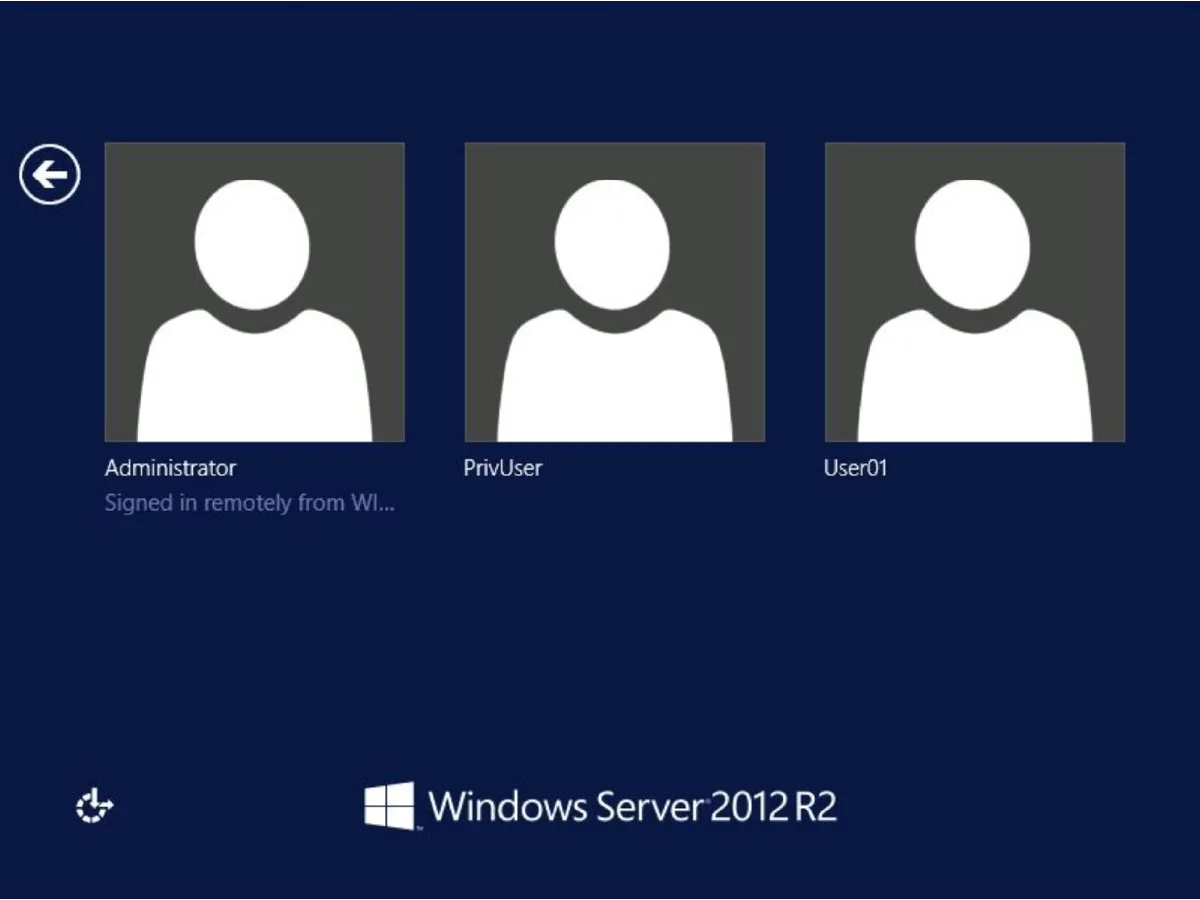
When a client connected to RDS they would be presented a login screen. By default, the login screen often displayed a list of recent users and Windows Domain or Active Directory that the server was part of. This information could then be used in brute force attacks.
FIGURE 1 – Legacy RDS pre-login screen
Brute force attacks
The client side of the RDP protocol required minimal resources and there were no controls in place to stop attackers from using tools such as Hydra or Ncrack to test various username and password combinations in order to discover valid credentials. While Administrators could configure Windows policies to lock out accounts after a certain number of failed login attempts this precaution often wasn’t enforced for Administrator accounts – admins always had login access.
Denial of service
During the initial client connection and prior to authentication, the server provisioned an entire desktop environment before beginning the login process. This meant that attackers could easily create a resource-exhaustion situation by simply opening a large number of sessions. This could happen accidentally as part of an effort to brute force credentials.
Machine-in-the-Middle
The early versions of RDP were susceptible to Machine-in-the-Middle (MitM) attacks that could enable decryption or modification of RDS session data. They used a form of authentication that is now known to have many weaknesses. The encryption used was a stream cipher named RC4. At the time RC4 was commonly used in various protocols such as WEP, WPA, SSL, and TLS. Today, however, it is known to be broken by multiple techniques and the key sizes are such that modern computers make short work of them. It became so risky that RFC 7465 was drafted in 2015 to prohibit RC4’s use in all TLS versions. Further compounding the RDS risks, RDP allowed keys sizes as small as 40 bits in order to comply with US cryptographic export restrictions.
The issues with authentication didn’t end there. Microsoft’s implementation of the key exchange protocol depended on the client and server creating and exchanging random values. The server’s random value was sent unencrypted over the network. The server also provided a public RSA key that could be used by the client to encrypt the client’s random value so that only the server could read it. Unfortunately, Microsoft baked the same public-private RSA key pair into every RDS host. This key was, predictably, extracted and made public. With that information attackers with network access to RDS communications could decrypt the data and extract authentication and session information. Advanced attackers in the correct network position could intercept and monitor or modify an RDS session in real time.
Shoring up defenses
With the release of Windows 2003 Service Pack 1, Microsoft introduced the ability to use TLS, which addressed the issue of machine-in-the-middle (MitM) attacks by enabling the use of significantly more robust encryption cipher suites and key exchange protocols. This also enabled the protocol to take advantage of improvements in TLS over time instead of being locked into a single algorithm. Additionally, TLS allows clients to cryptographically verify they were connecting to the expected server.
In Windows Server 2008, Microsoft introduced Network Level Authentication (NLA), which required users to authenticate themselves before a session would be established. NLA forced authentication to occur after the TLS handshake, but before the console was provisioned, which mitigated the resource-exhaustion concerns, reduced information leakage, and significantly impaired brute-force attacks. Since information leakage was reduced attackers could no longer collect the names of users, but they could still access the Windows hostname and domain information via the CredSSP authentication process. However, this is still an overall improvement in security. There is one downside to requiring NLA – users can no longer authenticate and change expired passwords. This functionality has to be provided via another mechanism such as a Remote Desktop Gateway.
When configuring RDS in Windows Server 2008, administrators had the option to require NLA for all connections or to allow the client to decide. Starting with Windows Server 2012, however, NLA was required by default to improve security across Windows environments.
Real world impact of NLA by default
We explored our data to determine if requiring NLA by default had a real world impact. In other words, do we see a significant percentage of assets where a less secure option has been enabled for Window Server 2012 and beyond?
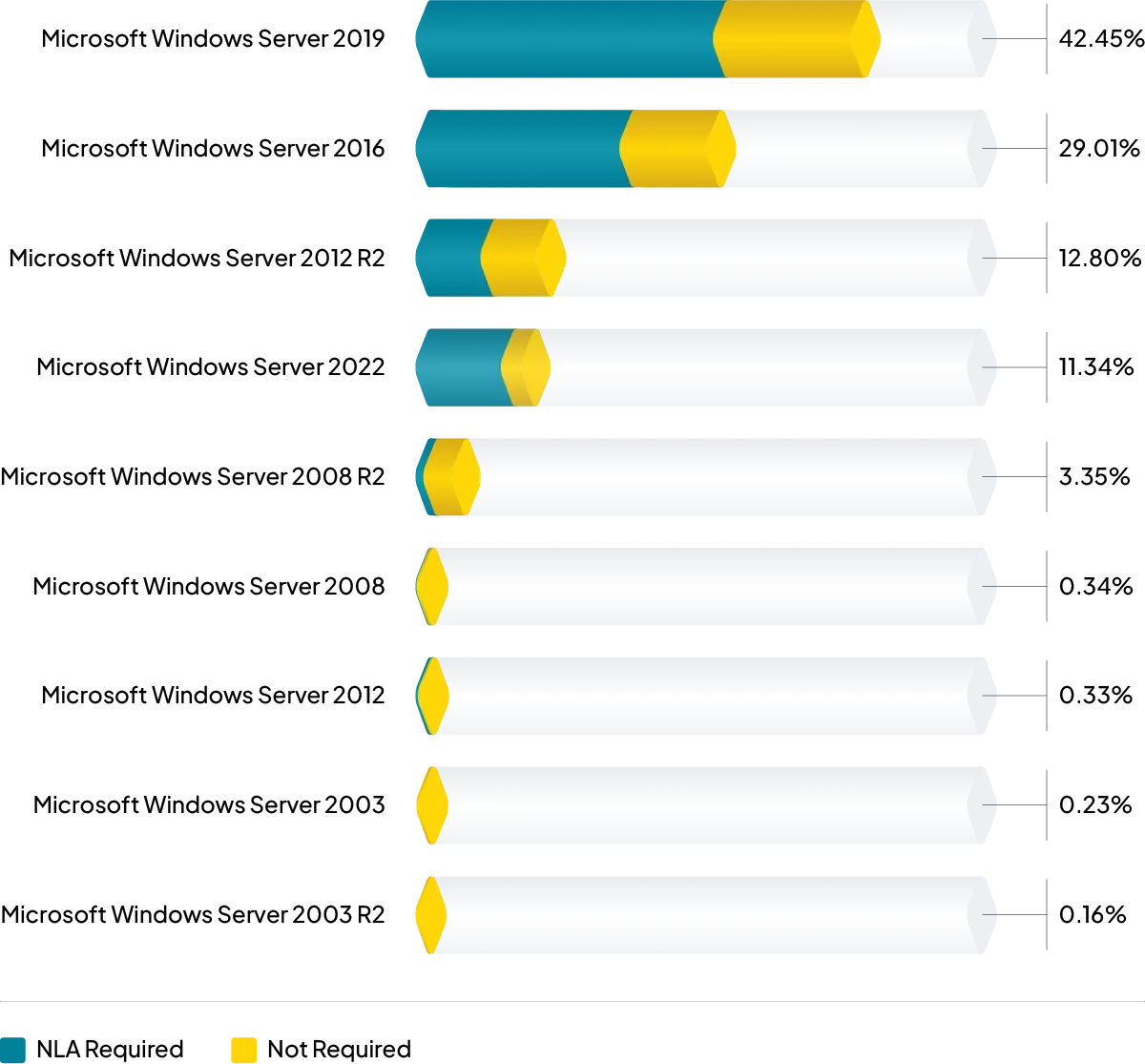
The chart below shows the overall percentage of specific Windows operating systems (OS) in our data as well as the breakdown of NLA is enforcement.
FIGURE 2 – Operating system distribution for RDP NLA enforcement.
As the results illustrate, the majority of RDS on Windows Server versions where NLA is required by default do, in fact, require NLA. This is great news. It indicates that secure defaults can have a positive impact on security posture. Another takeaway is that more modern environments are less likely to operational or compatibility requirements that force less secure configurations. An argument could be made that the NLA requirement being disabled by default on Windows Server 2008 / 2008 R2 shows up in the results as well, but this state may be influenced by those servers being more likely to have legacy or third-party clients that don’t support NLA.
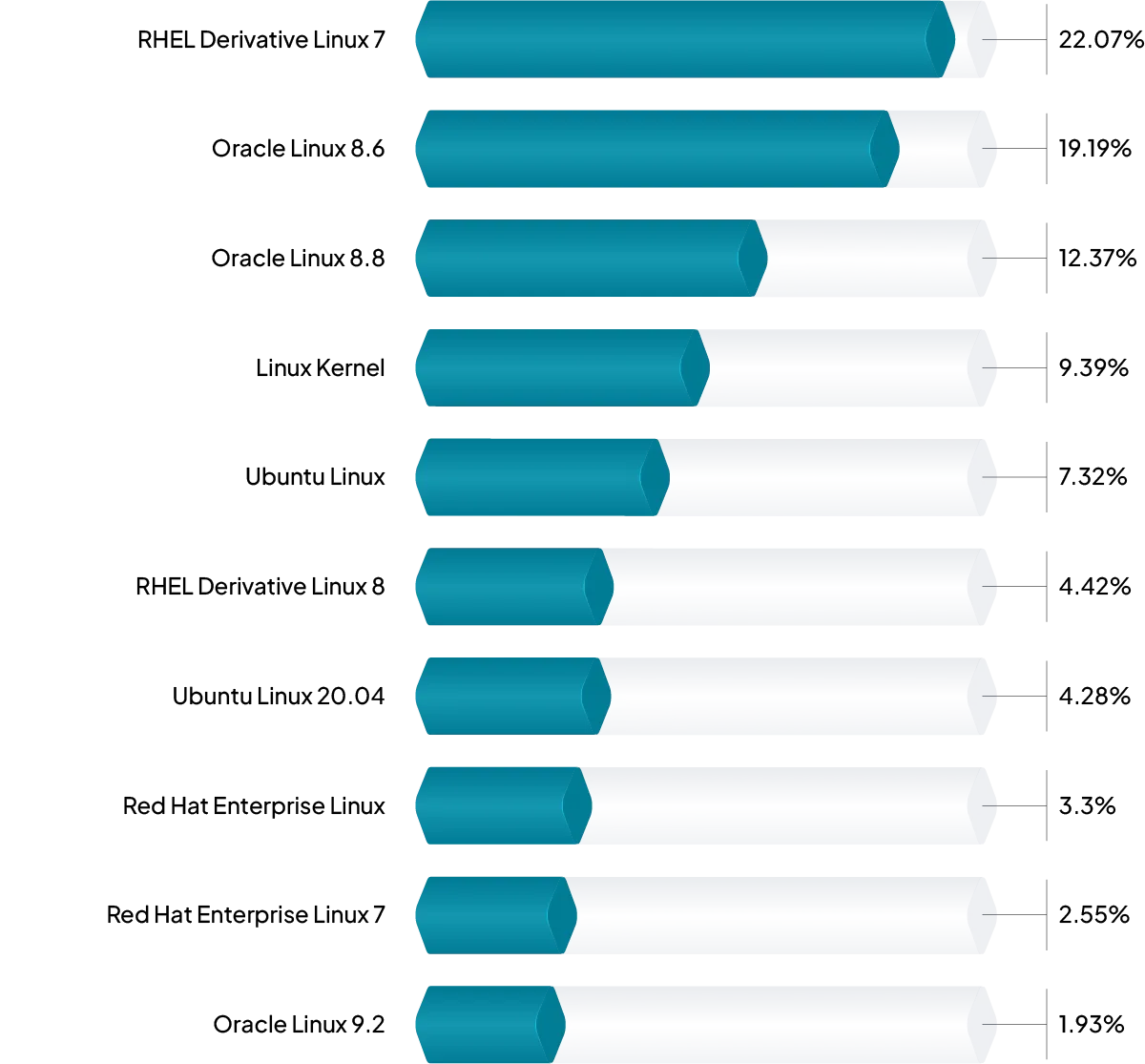
We also reviewed the OS distribution of services that did not permit using NLA at all. This list is dominated by Red Hat Enterprise Linux and its various derivatives running the xrdp RDP service. The xrdp service does not currently support NLA, so these results are not surprising. However, we were encouraged to find so few results for Microsoft Windows machines without NLA support that the number is not statistically significant.
FIGURE 3 – Operating system distribution for RDP without NLA support.
Using runZero to audit RDP configurations
At runZero we put a tremendous amount of effort into trying to extract as much information from scan targets as possible, particularly if the information can help us understand the security posture of the device. From RDS services this includes enumerating all of the RDP authentication mechanisms that target supports. Explore our recommendations to audit RDP configurations in your environment.
Attributes of interest
We store RDP authentication attributes on the RDP service of an asset with the prefix rdp.auth. Here are the attributes that can be used to audit your environment to check to see if NLA is enabled or required as well as if standard, legacy RDP authentication is still enabled:
rdp.auth.nla – a value of supported indicates that the target supports NLA (this is good!).
rdp.auth.rdp – a value of supported indicates that the target still allows authentication using the legacy RDP mechanism. (Red flag. It should only really be required if you have very old clients that still need to connect).
rdp.auth.ssl – a value of supported indicates that the target still allows authentication using the TLS. (Somewhere in the middle. This is better than legacy RDP but still weaker than NLA).
In rdp.auth.rdp and rdp.auth.ssl a value of ERROR_HYBRID_REQUIRED_BY_SERVER indicates that the authentication mechanism is not supported and NLA is required. This is the desired state.
Within runZero you can use a Service inventory search to audit your environment. To find assets supporting legacy RDP authentication you can use the following search criteria:
protocol:rdp and _service.rdp.auth.rdp:="supported"
To find assets supporting either legacy RDP or SSL the following Service inventory search criteria can be used:
protocol:rdp and (_service.rdp.auth.rdp:="supported" OR _service.rdp.auth.ssl:="supported")
A glance into the near future
An interesting recent development is the introduction of Remote Desktop (using the RDP protocol) to both the Gnome and KDE desktop environments. In both cases Remote Desktop is a full fledged, native feature. Based on the currently released code, it appears that the implementations support NLA and do not support either the legacy RDP or SSL protocols. We will be monitoring the growth of these implementations over time and look forward to sharing more insight on that in the future.
Final Thoughts
Thankfully, the security of Microsoft’s RDS has improved over time. As with many such improvements, the benefits are lost if the new features are not implemented. In this case, Microsoft made the pragmatic decision for the most secure option to also be the default and we can measure the real world impact. In short, secure-by-default matters.
About Version 2 Digital
Version 2 Digital is one of the most dynamic IT companies in Asia. The company distributes a wide range of IT products across various areas including cyber security, cloud, data protection, end points, infrastructures, system monitoring, storage, networking, business productivity and communication products.
Through an extensive network of channels, point of sales, resellers, and partnership companies, Version 2 offers quality products and services which are highly acclaimed in the market. Its customers cover a wide spectrum which include Global 1000 enterprises, regional listed companies, different vertical industries, public utilities, Government, a vast number of successful SMEs, and consumers in various Asian cities.
About runZero runZero, a network discovery and asset inventory solution, was founded in 2018 by HD Moore, the creator of Metasploit. HD envisioned a modern active discovery solution that could find and identify everything on a network–without credentials. As a security researcher and penetration tester, he often employed benign ways to get information leaks and piece them together to build device profiles. Eventually, this work led him to leverage applied research and the discovery techniques developed for security and penetration testing to create runZero.
D-Link released a Security Announcement regarding vulnerabilities found within two of their DIR-X WiFi 6 routers (DIR-X5460 – AX5400, DIR-X4860 – EXO AX AX4800) and one of their non-US Mesh routers (COVRX1870 – AX1800).
CVE-2024-45694 is rated critical, with CVSS score of 9.8, and allows for an unauthenticated attacker to potentially execute arbitrary code.
CVE-2024-45695 is rated critical, with CVSS score of 9.8, and allows for an unauthenticated attacker to potentially execute arbitrary code.
CVE-2024-45696 is rated high, with CVSS score of 8.8, and allows for unauthorized access by an attacker.
CVE-2024-45697 is rated high, with CVSS score of 9.8, and allows for unauthorized access to the system by an attacker and the ability to execute arbitrary commands.
CVE-2024-45698 is rated high, with CVSS score of 8.8, and allows for unauthorized access to the operating system by an attacker and the ability to execute arbitrary commands.
What is the impact?
Successful exploitation of the critical vulnerabilities through a stack overflow allows attackers to perform remote code execution (RCE) by sending malicious requests to vulnerable devices. The high severity vulnerabilities affect the target device’s telnet service. CVE-2024-45696 allows for an attacker to forcibly enable telnet on the device, but must be on the same network as the device to log in through the telnet service. CVE-2024-45696, CVE-2024-45697, and CVE-2024-45698 allow for an attacker to log in to the telnet service using hard-coded credentials, if the service is enabled.
Are updates or workarounds available?
D-Link has issued patches for each of the affected devices available for download in the Affected Models section of the announcement.
How to find potentially vulnerable systems with runZero
From the Asset Inventory, use the following query to locate systems running potentially vulnerable software:
mac_vendor:"D-Link"
About Version 2 Digital
Version 2 Digital is one of the most dynamic IT companies in Asia. The company distributes a wide range of IT products across various areas including cyber security, cloud, data protection, end points, infrastructures, system monitoring, storage, networking, business productivity and communication products.
Through an extensive network of channels, point of sales, resellers, and partnership companies, Version 2 offers quality products and services which are highly acclaimed in the market. Its customers cover a wide spectrum which include Global 1000 enterprises, regional listed companies, different vertical industries, public utilities, Government, a vast number of successful SMEs, and consumers in various Asian cities.
About runZero runZero, a network discovery and asset inventory solution, was founded in 2018 by HD Moore, the creator of Metasploit. HD envisioned a modern active discovery solution that could find and identify everything on a network–without credentials. As a security researcher and penetration tester, he often employed benign ways to get information leaks and piece them together to build device profiles. Eventually, this work led him to leverage applied research and the discovery techniques developed for security and penetration testing to create runZero.