Skip to content

Firewall vs. antivirus: essential tools for protecting your business

In today’s economy, choosing the right cybersecurity security tools can make or break a company’s finances.

Ransomware cost global companies around $1 billion in 2023. Data breaches cost companies $4.45 million on average, while DDoS attack victims lose around $500,000 each. 

The thing is, robust firewalls and antivirus coverage can protect companies against most malware attacks. Filtering traffic and efficiently getting rid of malware agents deters attackers and renders them harmless.

Despite this, many companies rely on ineffective and outdated security solutions. Don’t be like them. Act now to avoid becoming part of next year’s cybersecurity statistics.

This blog will explain the functions of firewalls and antivirus software and help you choose the right security tools. We will dive a little deeper, too, exploring how to update your cloud security posture. Let’s start at the network edge with an introduction to firewall technology.

What is a firewall?

Firewall devices protect network security by filtering incoming and outgoing traffic.

Firewalls inspect data and apply rules to determine whether data is legitimate or malicious. If packets pass security rules, data is allowed to enter or leave. If not, data is denied or discarded and cannot compromise security.

Traditional firewalls come in software and hardware forms. Hardware firewalls operate as separate devices between external networks and local devices. On the other hand, firewall software uses agents or modules on network endpoints.
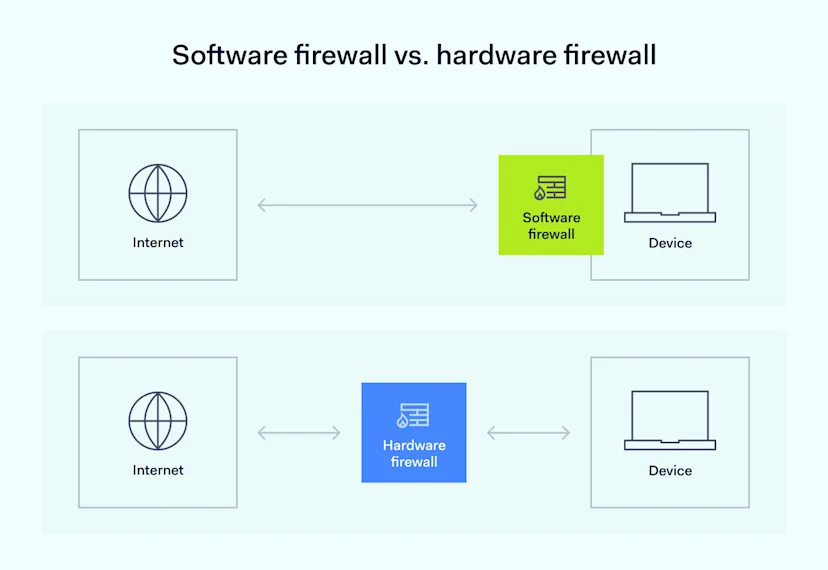
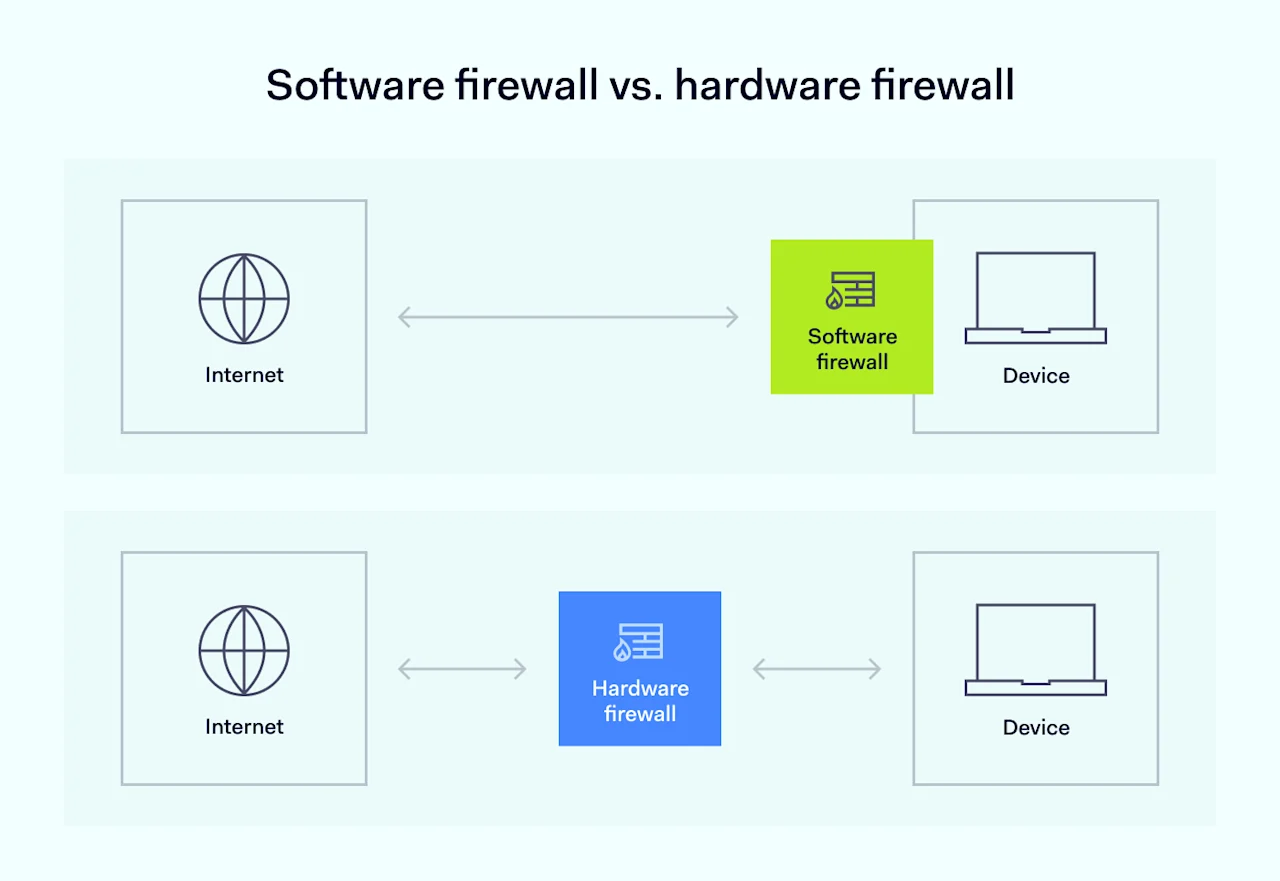
Software firewall vs hardware firewall

Hardware firewalls tend to handle large amounts of traffic efficiently, but coverage is limited to nearby devices. Software firewalls move with devices. They suit remote workers but may compromise device performance.

Traditional firewalls employ two main inspection techniques:

  • Packet filtering—assesses surface packet data, including source and destination IP addresses, protocol types, and ports.

  • A stateful inspection—evaluates the state of active connections to determine whether they meet network rules.

Next-generation firewall services go beyond traditional features.

NGFWs include deep packet inspection and Intrusion Prevention Systems (IPS). These features enable NGFWs to analyze the contents of data packets, something not possible in traditional packet filtering.

These extra features guard against complex threats like DDoS attacks, extending firewall capabilities from simple filtering to active threat prevention.

Recently, Cloud firewall services have also emerged. These firewalls reside in the cloud and operate on a firewall-as-a-service (FWaaS) model.

Cloud firewalls protect cloud deployments and scale as companies add new cloud applications or data capacity. They also ensure consistent access control and data filtering across hybrid and multi-cloud environments.

What are antivirus tools?

Companies install antivirus software on network endpoints, where it analyzes traffic to identify and block cyber threats. When it identifies malware or other suspicious agents, antivirus software quarantines and neutralizes threats, keeping network assets safe.

Antivirus solutions typically use signature analysis to detect known threats.

Researchers identify new worms, viruses, or malware. They extract a unique identifier from each agent based on file attributes, byte sequences, or malware behavior. They then send information about this signature to antivirus tools.

Antivirus software compares traffic signatures to threat databases. Software blocks signatures that match. Security tools may quarantine or delete malware, depending on local security settings and the severity of the threat.

Some antivirus software also uses heuristic methods to identify threats.

Heuristic systems track file or user behavior and flag suspicious activity that does not match known profiles. More advanced antivirus software uses machine learning to understand network environments, tailoring detection to specific contexts.

As with firewalls, antivirus software has also entered the cloud. Cloud-native antivirus tools scan virtual machines and cloud-hosted data. They integrate with popular cloud platforms and scale with deployments – complementing on-premises security tools.

Key differences between firewall and antivirus software

When comparing firewalls vs antivirus software, the main difference is simple: firewalls filter traffic at the network edge. Antivirus software identifies and neutralizes threats on network endpoints.
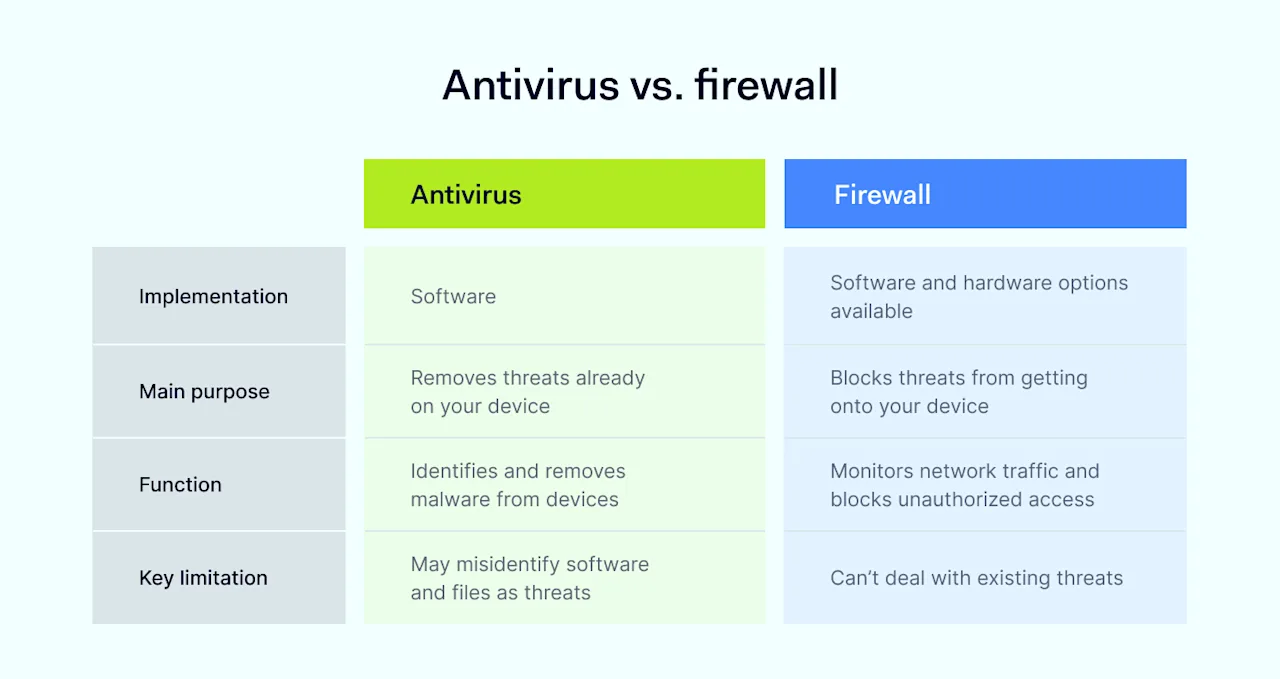
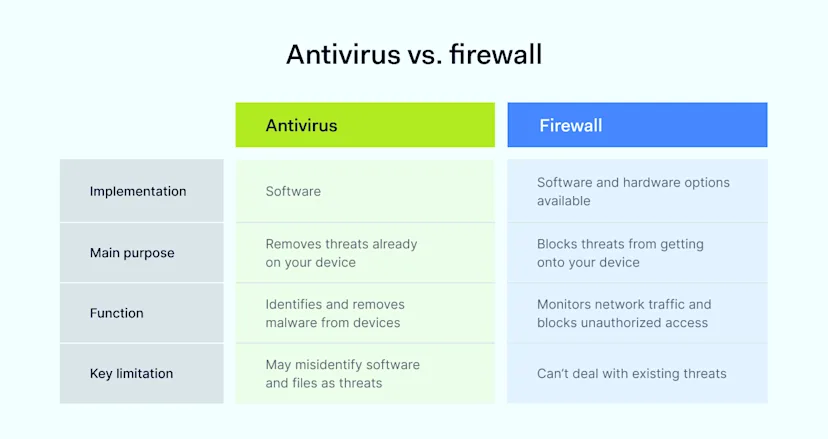
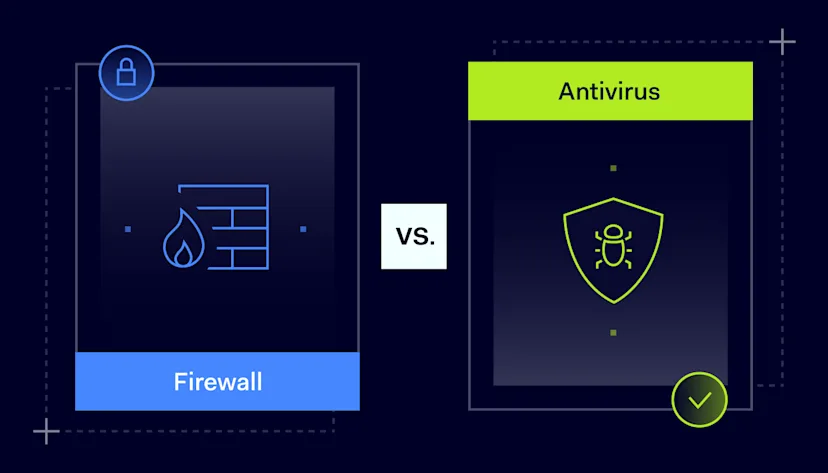
Antivirus vs firewall

However, the two security technologies have many other differences. Understanding where they differ is important when building functional security systems. Below is a handy summary.

Functionality

  • Firewalls: Scan traffic entering and leaving networks to block harmful traffic.

  • Antivirus: Scan files on network endpoints. They protect against internal threats, including malware or worms.

Scope

  • Firewalls: Operate at the network level via packet filtering and protocol analysis. Can extend Saas or IaaS deployments via cloud firewalls.

  • Antivirus: Works at the application or system level. It scans files and communications between devices.

Threat detection

  • Firewalls: Rules define what traffic is permitted. Uses packet filtering and stateful inspection to block external threats and malicious traffic.

  • Antivirus: Analyzes files on devices to find malicious programs. Identifies threats via malware signatures and heuristic analysis.

Implementation

  • Firewalls: Implemented at the network edge to filter incoming and outgoing traffic.

  • Antivirus: Installed on computer systems and other endpoints connected to the network.

Performance impact

  • Firewalls: Minimal impact on system performance. Minor effects on network latency.

  • Antivirus: Real-time and scheduled system scans can impact device performance.

Cost

  • Firewalls: Tend to be cost-effective, especially basic firewalls included with operating systems. Costs rise for high-maintenance enterprise-level implementations.

  • Antivirus: Subscription costs rise with protection requirements. Add-ons like VPNs and identity theft measures raise costs further.

Updates and maintenance

  • Firewalls: Companies must update rules to reflect security needs. Security teams must monitor traffic, test rules, and ensure compatibility with network applications.

  • Antivirus: Less burdensome as automated updates deliver virus definitions and patches. Security teams may need to schedule scans and manage quarantined files.

Compatibility with other security tools

  • Firewalls: Must integrate with the local Intrusion Prevention System and Virtual Private Network tools.

  • Antivirus: Sometimes, antivirus conflicts with existing endpoint security tools. These conflicts may lead to false positives or consume more system resources.

Effectiveness

  • Firewalls: Good at blocking cyber threats at the network edge, including cloud deployments. Ineffective at dealing with malware within the network.

  • Antivirus: Detects, identifies, and neutralizes malicious software. Scans must cover all endpoints to work effectively.

Similarities between firewalls and antivirus tools

Despite the differences listed above, firewalls and antivirus software are closely related. Understanding their similarities helps when choosing the correct security solution. Similarities include:

  • Fundamental goal. Both tools protect networks against external threats. They filter or block malicious agents, ensuring smooth performance and protecting critical data.

  • Changing techniques. Antivirus software and firewalls are evolving to meet new challenges. For instance, both come in cloud-native versions to defend virtualized assets.

  • Network monitoring. Firewalls monitor network traffic to prevent unauthorized entry or exit, and antivirus programs actively monitor internal threats.

  • Customization. Companies can set firewall rules to suit their operations, and users can customize antivirus coverage with scheduling, alerts, and exclusion lists.

  • Compliance roles. Firewalls and antivirus software are critical tools to ensure compliance with data security regulations.

Should your business choose a firewall or antivirus?

Until recently, answering this question was simple. Companies needed both, as traditional antivirus tools and firewalls performed complementary network security functions.

However, the choice is not as simple as it once was. Security solutions featuring both firewall and antivirus protection are becoming ever more popular.

In the past, firewalls operated as a barrier between untrusted external networks and local assets. Antivirus software operated locally, scanning for malicious software. Firewalls deal with network-level attacks, while antivirus systems operate at the application or system level.

Firewalls created a first line of defense. Antivirus software allowed layered defense, dealing with malware that crossed the network edge. In that situation, it often made sense for companies to source separate firewall and antivirus protection.

Things have changed. Next-generation firewall systems have narrowed the differences between the two technologies. The familiar firewall vs antivirus comparison is unhelpful when antivirus firewalls offer a single solution.

Cloud coverage is also something to consider. Next-generation cloud firewalls deliver flexible security in cloud environments. Access control is a critical challenge when securing cloud assets, potentially making cloud firewalls more attractive than cloud-hosted antivirus software.

How NordLayer can enhance your network security

Robust cybersecurity is a must for any business. Cyber threats can expose confidential data and take systems offline in seconds, with catastrophic consequences.

Firewalls and antivirus software are two of the most effective cybersecurity tools. Even so, choosing the wrong tools will leave systems exposed. Outdated protection is almost as risky as no protection at all.

NordLayer’s Cloud Firewall (FWaaS) is the perfect solution.

Our cloud-hosted security tools create a watertight barrier around your cloud infrastructure. Our firewall lets you control who accesses assets by defining teams and members. You can also determine how users connect by granting access to various end-points.

NordLayer’s cloud firewall adds control and security that complements our virtual private gateways—bringing hybrid cloud networks under your security framework.

Update your firewall technology today.
About Version 2 Digital

Version 2 Digital is one of the most dynamic IT companies in Asia. The company distributes a wide range of IT products across various areas including cyber security, cloud, data protection, end points, infrastructures, system monitoring, storage, networking, business productivity and communication products.

Through an extensive network of channels, point of sales, resellers, and partnership companies, Version 2 offers quality products and services which are highly acclaimed in the market. Its customers cover a wide spectrum which include Global 1000 enterprises, regional listed companies, different vertical industries, public utilities, Government, a vast number of successful SMEs, and consumers in various Asian cities.

About NordLayer
NordLayer is an adaptive network access security solution for modern businesses – from the world’s most trusted cybersecurity brand, Nord Security.

The web has become a chaotic space where safety and trust have been compromised by cybercrime and data protection issues. Therefore, our team has a global mission to shape a more trusted and peaceful online future for people everywhere.

About NordLayer
NordLayer is an adaptive network access security solution for modern businesses – from the world’s most trusted cybersecurity brand, Nord Security.

The web has become a chaotic space where safety and trust have been compromised by cybercrime and data protection issues. Therefore, our team has a global mission to shape a more trusted and peaceful online future for people everywhere.

NIS2 implementation: Is your SaaS prepared?

The revised Network and Information Systems Directive (NIS2) signifies the European Union’s strengthened commitment to enhancing cybersecurity measures across the region. Scheduled to take effect in October 2024, NIS2 broadens the scope of its predecessor, the original NIS Directive from 2016. It imposes stricter requirements to elevate the overall information security and posture in Europe.

As a cornerstone of the digital economy, Software-as-a-Service (SaaS) providers must thoroughly examine the implications of NIS2 and take timely action to ensure compliance.

What is the NIS2 Directive? 

NIS2 is designed to build upon the foundation laid by the original NIS Directive. It aims to foster greater collaboration between entities and harmonize cybersecurity standards across all European Union member states. At its core, NIS2 emphasizes a risk-based approach, proactive monitoring, and corporate accountability.

The directive introduces more stringent reporting obligations, enforcement measures, and management training requirements. Non-compliance with NIS2 can result in substantial fines of up to €10 million or 2% of global turnover, whichever is higher.

These penalties underscore the importance of adhering to the directive’s mandates and prioritizing cybersecurity.

Who does NIS2 apply to?

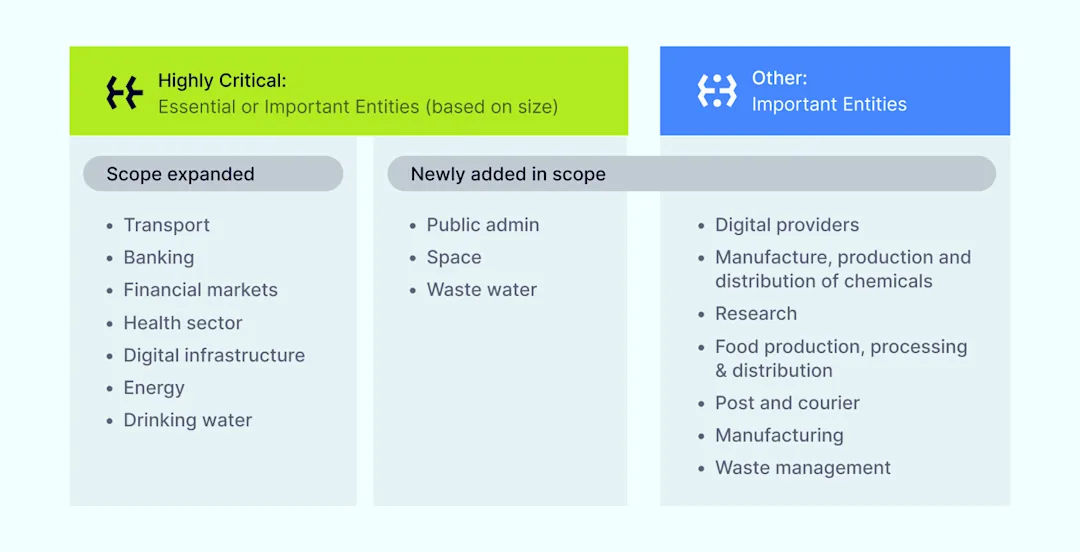
The NIS2 Directive targets “essential” and “important” entities operating within critical sectors such as digital infrastructure, healthcare, energy, and transport. This comprehensive scope extends to many SaaS providers, even if they do not have a physical presence within the European Union, as long as they offer digital services to EU customers.

Who does NIS2 apply to: essential versus important entities

Given the nature of SaaS models, which typically involve handling sensitive data and ensuring continuous availability, these providers are significantly affected by NIS2’s risk management measures and business continuity planning provisions. As remote work trends increase reliance on cloud-based solutions, SaaS providers need to understand and address the potential implications of NIS2 implementation.

NIS2 for SaaS: its scope and impact

Due to its expanded scope and rigorous requirements, NIS2 will substantially impact SaaS providers. The Directive mandates that providers implement comprehensive risk management measures, including regular risk analysis and continuous monitoring, to detect and mitigate cyber threats. Providers must also establish robust incident response procedures to address any security incidents swiftly.

NIS2 enforces stricter reporting obligations, requiring SaaS providers to promptly notify relevant authorities and customers during a significant cyber incident. This enhances transparency, trust, and accountability within the digital ecosystem.

Additionally, NIS2 emphasizes the importance of cybersecurity training and awareness programs for management and staff. SaaS providers must invest in ongoing education to ensure their teams are prepared to handle evolving cyber threats and maintain compliance with the directive.

Why NIS2 compliance matters

Ensuring compliance with NIS2 is not just about avoiding penalties; it is a critical step toward enhancing your SaaS operations’ overall security and resilience. Here are key reasons why compliance with the European Directive is vital:

  • Protects sensitive data. SaaS providers often manage large volumes of sensitive and personal data. Compliance with NIS2 helps protect this data against cyber threats, reducing the risk of data breaches and the associated financial and reputational damage.

  • Maintains customer trust. Customers expect their data to be handled securely. By complying with NIS2, SaaS providers demonstrate a commitment to high standards of information security, thereby maintaining and potentially increasing customer trust and loyalty.

  • Avoids financial penalties. Non-compliance with NIS2 can result in hefty fines. Ensuring compliance helps avoid significant financial penalties and their negative impact on your business.

  • Enhances competitive advantage. In a market where information security is a significant concern, compliance with NIS2 can provide a competitive edge. SaaS providers prioritizing compliance can differentiate themselves by offering more secure and reliable services.

  • Ensures business continuity. NIS2 mandates robust risk management measures and incident response procedures. By adhering to these requirements, SaaS providers can minimize downtime and ensure continuous service availability, which is crucial for maintaining operations and customer satisfaction.

  • Strengthens corporate accountability. NIS2 emphasizes the role of senior management in cybersecurity. Compliance ensures that executives know their responsibilities and actively manage and mitigate cyber risks, leading to better governance and oversight.

  • Mitigates supply chain risks. With NIS2’s focus on the supply chain, compliance ensures that all third-party services and partners adhere to high-security standards. This reduces the risk of vulnerabilities introduced through external parties.

  • Aligns with global standards. As information security threats become increasingly global, aligning with the NIS2 Directive positions SaaS providers to meet international security standards, facilitating smoother operations across different regions and markets.

Compliance with NIS2 is a proactive measure that goes beyond regulatory obligations. Building a robust, secure, and trustworthy digital infrastructure that can withstand the constantly evolving cyber threats environment is essential.

By prioritizing compliance, SaaS providers safeguard their operations and contribute to enhancing cybersecurity across the European Union.

Challenges of the NIS2 Directive for SaaS providers

As SaaS providers prepare to implement NIS2, they may encounter several challenges that require careful planning and strategic action. Below there is a list of potential hurdles that providers should be aware of:

  • Complex compliance requirements: Navigating the extensive and detailed requirements of NIS2 sectors can be challenging, especially for smaller SaaS providers with limited resources

  • Enhanced reporting obligations: Meeting the directive’s stringent reporting requirements may require significant changes to existing processes and systems

  • Increased costs: Implementing the necessary security measures and training programs can be costly, impacting the provider’s budget and resource allocation

  • Risk management: Establishing effective risk management measures involves continuous monitoring, regular assessments, and timely updates to security protocols

  • Corporate accountability: Ensuring that senior management is adequately trained and aware of their responsibilities under NIS2 can be demanding

  • Data sovereignty & localization: Adhering to data sovereignty and localization requirements, especially for providers operating across multiple jurisdictions, adds another layer of complexity

  • Supply chain vulnerabilities: Managing and securing the supply chain to ensure that all third-party services comply with NIS2 can be a daunting task

Prepare your SaaS for NIS2 compliance

To help SaaS providers navigate the complexities of NIS2 compliance, we have outlined a list of essential steps.

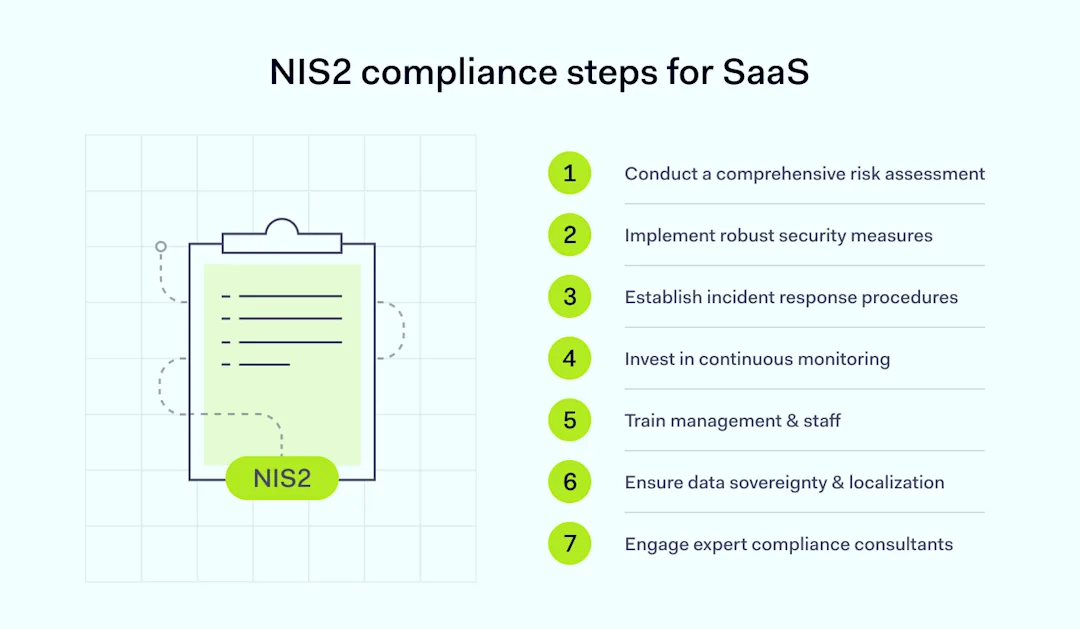
NIS2 compliance steps for SaaS

1. Conduct a comprehensive risk assessment

Perform a thorough risk analysis to identify potential vulnerabilities and threats within your network and information systems. Regularly update this assessment to reflect new risks and changes in the threat landscape.

2. Implement robust security measures

Ensure that your security measures align with NIS2 requirements, including Always-On VPN and Multi-Factor Authentication (MFA) for secure access, as well as dynamic firewalls and network segmentation to isolate environments and enforce least privileged access.

3. Establish incident response procedures

Develop and implement a robust incident response plan that includes procedures for detecting and responding to security incidents and clear communication protocols for notifying authorities and affected parties.

4. Invest in continuous monitoring

Utilize advanced monitoring tools such as cloud-delivered Intrusion Prevention Systems (IPS), Intrusion Detection Systems (IDS), and Web Application Firewalls (WAF) for continuous surveillance and protection.

5. Train management & staff

Provide regular cybersecurity training for management and staff to ensure their awareness of their responsibilities under NIS2 and their ability to respond effectively to cyber threats and security incidents.

6. Ensure data sovereignty & localization

Adhere to data sovereignty and localization requirements by using dedicated servers with fixed IP addresses to ensure data remains within the specified jurisdiction.

7. Engage expert compliance consultants

Consider partnering with compliance consultants to strategize and validate your NIS2 preparedness and ensure thorough attention to all aspects of the Directive.

Embracing the future of cybersecurity

As we move towards an increasingly digital future, the importance of robust cybersecurity cannot be overstated. Implementing NIS2 represents a significant transition in approaching security across the European Union, setting a new standard for resilience against cyber threats.

This directive is both a challenge and an opportunity for SaaS providers. By embracing NIS2’s requirements, providers protect their operations and build trust with their customers, enhance their competitive edge, and contribute to a safer digital ecosystem.

Compliance with NIS2 is more than a regulatory obligation; it is a commitment to excellence in cybersecurity. As cyber threats evolve, staying ahead requires proactive measures, continuous improvement, and a dedication to safeguarding data and infrastructure.

Take this opportunity to transform your SaaS business’ security practices, fortify your defenses, and create a secure digitalized environment.

How NordLayer can help

As a network security provider, NordLayer offers tools and services to help SaaS providers achieve NIS2 compliance by:

  • Access control policies. Implement strong Network Access Control (NAC) policies using NordLayers Virtual Private Gateways with a dedicated IP address. Additionally, adopt advanced features like Cloud Firewall for granular network segmentation, and Device posture security to ensure only known and compliant devices can enter the company’s network. Elevate your network protection with multi-layered authentication methods such as 2FA (SMS & TOTP) and biometrics to access your network.

  • Effective incident handling. Utilize threat prevention features like traffic encryption, IP masking, DNS filtering, and Always-On VPN to mitigate various threats that can infect your network. Improve threat detection with Device Posture Security and activity monitoring to maintain a resilient network infrastructure.

  • Solid cryptography policies. Utilize NordLayer’s VPN gateways with quantum-safe encryption of data in transit. Provide a secure environment for browsing online and accessing sensitive resources or hybrid networks.

With NordLayer, SaaS providers can simplify infrastructure security management and demonstrate compliance with some of the stringent requirements of the NIS2 Directive.

About Version 2 Digital

Version 2 Digital is one of the most dynamic IT companies in Asia. The company distributes a wide range of IT products across various areas including cyber security, cloud, data protection, end points, infrastructures, system monitoring, storage, networking, business productivity and communication products.

Through an extensive network of channels, point of sales, resellers, and partnership companies, Version 2 offers quality products and services which are highly acclaimed in the market. Its customers cover a wide spectrum which include Global 1000 enterprises, regional listed companies, different vertical industries, public utilities, Government, a vast number of successful SMEs, and consumers in various Asian cities.

About NordLayer
NordLayer is an adaptive network access security solution for modern businesses – from the world’s most trusted cybersecurity brand, Nord Security.

The web has become a chaotic space where safety and trust have been compromised by cybercrime and data protection issues. Therefore, our team has a global mission to shape a more trusted and peaceful online future for people everywhere.

About NordLayer
NordLayer is an adaptive network access security solution for modern businesses – from the world’s most trusted cybersecurity brand, Nord Security.

The web has become a chaotic space where safety and trust have been compromised by cybercrime and data protection issues. Therefore, our team has a global mission to shape a more trusted and peaceful online future for people everywhere.

Why passwordless authentication is the way forward

Moving beyond passwords

Passwords have been the go-to method for securing access to online accounts and data from the early days of the Internet. However, as cyberattacks grow increasingly sophisticated, relying solely on passwords may no longer suffice.

Hacker-controlled machines are now too good at cracking them, particularly because many people use weak or reused passwords across multiple accounts, unaware that this practice makes the attackers’ job effortless.

And so, the time has come to move beyond passwords and adopt more modern standards to safeguard digital assets. In other words, it’s time to go passwordless.

What is passwordless authentication?

Passwordless authentication is a cybersecurity method where users can access a service or application without entering a password. How does passwordless authentication work then? It allows users to utilize alternative authentication factors such as fingerprints or face IDs to verify their identity while logging into a service.

The goal of passwordless authentication is to provide a more convenient alternative to traditional passwords that can not only maintain but also enhance the level of protection against cyberattacks.

Types of passwordless authentication

Passwordless authentication can take many forms; however, some are now more popular than others. Let’s now go through a few of the commonly used authentication techniques that do not require passwords.

Biometric authentication

Probably the most popular passwordless authentication method available today, biometrics involves using built-in scanning tools on devices to verify unique biological characteristics such as fingerprints or facial features to confirm a user’s identity. This method has become highly popular because most modern mobile phones support it. Also, fingerprints can’t be as easily stolen as James Bond movies might suggest, which makes biometric authentication a more secure option than passwords.

Authentication apps

This popular password-free authentication technique uses a dedicated app to generate time-limited codes for accessing accounts, ensuring high security. It works well because most people have their mobile phones with them, making it easier to check the app for a code than to remember all their passwords for different online accounts.

Hardware Tokens

Generally speaking, hardware tokens are physical devices that generate authentication codes or utilize cryptographic keys to grant access to systems. They are quite popular due to their reliability in providing a second factor of authentication, which significantly enhances security. Also, hardware tokens do not rely on internet connectivity or software, making them more resilient against many forms of cyber threats.

With this method, users receive a link via email that, when clicked, allows them to log in to their account without entering a password. This approach simplifies the login process while ensuring security, as the link is usually valid for a limited time and can only be used once.

Passkeys

Compared to other types of passwordless authentication described in this section, passkeys are the new kid on the block, though already quite popular. Passkeys typically involve using a pair of cryptographic keys: a private key stored on the user’s device and a corresponding public key on the website’s server. Access is granted when these keys are successfully matched in a process often initiated through biometrics. This approach enhances convenience and significantly boosts security because attackers must acquire both keys to gain unauthorized access. Stealing the private key from the user’s device is extremely difficult.

The benefits of passwordless authentication

As we’ve already covered in this article, the benefits of passwordless authentication are plenty. These advantages become even clearer when compared to what passwords can provide. So, let’s delve into each major benefit in detail, starting with…

1. Enhanced security

The first, and arguably the most important, benefit of passwordless authentication is that it provides much more protection than traditional passwords. This is because it eliminates vulnerabilities commonly associated with password-based systems, such as phishing, brute-force attacks, and password reuse. With passwordless methods like biometrics or passkeys, authentication relies on unique and difficult-to-replicate factors, significantly reducing the risk of unauthorized access. As a result, adopting passwordless authentication strengthens overall security posture and helps keep outsiders at bay.

2. Ease of use

When it comes to user convenience, passwordless authentication delivers a knockout blow to passwords, preventing them from getting back up. Firstly, the passwordless approach is much faster as it allows users to log in to a service or application with one click, whereas with passwords… well, you know the drill. Secondly, with passwordless authentication, users don’t have to remember anything, freeing their minds and preventing the frustration of repeatedly entering incorrect passwords. And thirdly, this ease of use extends to business as well, preventing account lockouts and shopping cart abandonments, and keeping customers happier and more willing to use a given service.

3. Reduced password-related support

Unlike traditional authentication methods that frequently lead to forgotten passwords and subsequent support requests, passwordless authentication effectively eliminates these issues. This significantly reduces the need for password-related support, saving time and resources while enhancing user satisfaction with a seamless login experience.

4. Enhanced regulatory compliance

Embracing passwordless authentication is a strategic way for businesses to boost their compliance with regulations on data privacy. How so? By adopting secure methods like biometrics or passkeys, organizations can meet diverse data protection requirements without compromising user convenience. This proactive approach not only helps mitigate financial and reputational risks associated with non-compliance but also builds trust among customers and stakeholders.


Passwordless authentication use cases

With the support of organizations such as the FIDO Alliance, which helps develop authentication standards to reduce the world’s reliance on passwords, passwordless authentication methods have become highly popular among key players across all industries.

This should come as no surprise, especially considering that, according to a study by Secret Double Octopus and the Ponemon Institute called “State of Workforce Passwordless Authentication,” organizations can save up to $1.9 million by implementing passwordless authentication methods.

This explains why Microsoft has been promoting passwordless authentication through Windows Hello; why Amazon, Apple, and Google have introduced support for passkeys in their services; why Twitter offers password-free login options through third-party authentication apps and security keys; and so on — almost everywhere you look, a password-free login option is available. As a result, passwordless authentication is used today by millions of users worldwide and is gradually pushing passwords out of the picture.

How to enable passwordless authentication on your service

If your website or application requires customers to log in but doesn’t offer passwordless options, consider adding this feature to your to-do list. The answer to whether your company and your customers will benefit from that is undoubtedly yes. The real question is: how can you integrate a password-free login option effectively?

Well, although you can hire a team of IT professionals and ask them to write passwordless logins into your code, this approach requires significant upfront investment and is rather time-consuming.

Fortunately, there are alternatives. For example, you can use Authopia by NordPass, a free tool that allows you to easily add a passkeys widget to the login form on your website or service. Here’s how it works: you receive pre-written code that even those with basic IT skills can implement, you activate the widget by registering with Authopia, and voilà — you have a password-free login option up and running!

As already mentioned, Authopia is free to use, which means you can quickly integrate passkey logins into your service and observe improvements in sign-ups and conversions today. So, don’t miss out on this opportunity!

About Version 2 Digital

Version 2 Digital is one of the most dynamic IT companies in Asia. The company distributes a wide range of IT products across various areas including cyber security, cloud, data protection, end points, infrastructures, system monitoring, storage, networking, business productivity and communication products.

Through an extensive network of channels, point of sales, resellers, and partnership companies, Version 2 offers quality products and services which are highly acclaimed in the market. Its customers cover a wide spectrum which include Global 1000 enterprises, regional listed companies, different vertical industries, public utilities, Government, a vast number of successful SMEs, and consumers in various Asian cities.

About NordPass
NordPass is developed by Nord Security, a company leading the global market of cybersecurity products.

The web has become a chaotic space where safety and trust have been compromised by cybercrime and data protection issues. Therefore, our team has a global mission to shape a more trusted and peaceful online future for people everywhere.

Trello data breach: Immediate steps for users

Using Trello? Your data may have been exposed

In case you haven’t heard, Trello, the popular project management tool from Atlassian, just experienced a major breach. Hackread reports that a staggering 21.1 GB of Trello data has been leaked online, putting millions of users’ sensitive information at risk.

If you’ve used Trello recently or in the past, your data might have been affected too. We’re here to fill you in on what happened, provide tips on how to minimize the impact of the breach, and offer advice on how to protect your data effectively, whether you’re an individual user or a business.

Trello breach: what happened, exactly?

According to Hackread, a hacker known as “Emo” has leaked over 20 GB of Trello data on a cybercrime platform called Breach Forums. The hacker claims to have stolen the data back in January 2024 but did not publish it until Tuesday, July 16. The leaked data includes details on millions of Trello users, such as their usernames, legal names, email addresses, associated memberships, and status information.

“Emo” detailed how they broke into Trello by exploiting a vulnerable open API endpoint that didn’t require a login. This vulnerability allowed the hacker to link email addresses to Trello accounts, exposing the identities of Trello users. The hacker then continued to exploit this vulnerability and, as they said, spread the breach out of boredom. This resulted in data being stolen from millions of Trello users, putting everyone affected at serious risk.

How Trello users should respond

While the news of a major data breach can be alarming, it’s crucial to know that there are steps you can take right away to protect yourself and minimize the damage.

First, check if your data was compromised in the Trello breach. You can use our free online Data Breach Scanner to quickly assess your exposure. If the scan indicates that your data is safe, that’s great! However, if it shows that your information has been leaked, you’ll need to take further action.

If your data has been exposed, immediately change your Trello password to prevent unauthorized access. Also, update the passwords for any other accounts where you use the same password to keep your information secure – better safe than sorry.

Next, keep a close eye on your account activity for any unusual actions that could suggest someone else has gained control. Be vigilant for phishing emails, as cybercriminals may use your email address from the breach to send fake messages pretending to be from Trello. These could be attempts to take over your account, install malware, or trick you into providing more personal information. Stay cautious!

What should businesses do in this situation?

The Trello breach is just the tip of the iceberg. This month alone, we’ve heard of reports of two other major companies, AT&T and Disney, falling victim to cyberattacks with their data ending up on crime forums. It’s a stark reminder that no business is too big or too small to be targeted.

To prevent data leaks and unauthorized access, businesses can take a few key steps to stay ahead of threats. These include:

  • Use a data breach monitoring tool: Regularly scan your systems for vulnerabilities and potential breaches – a good breach monitoring tool will help you identify weak points in your security before hackers can exploit them.

  • Monitor account activity: Keep an eye on who’s accessing your resources and watch for any unusual or unauthorized activity that might indicate a security issue.

  • Enforce a strong password policy: Implement guidelines on password complexity to make sure all employees use strong, unique passwords for their business accounts.

  • Educate your team: Hold training sessions to make sure all employees know how to recognize phishing attempts, create strong passwords, and handle sensitive data securely.

  • Implement multi-factor authentication (MFA): Ask for an extra layer of verification beyond just passwords to make it more difficult for anyone trying to gain unauthorized access.

How NordPass can help protect you or your organization

Whether you’re just a regular user of services like Trello, or a company looking to safeguard your digital assets, NordPass is a solution that can significantly boost your cybersecurity without a hassle.

For individuals, the NordPass Premium plan offers more than encrypted storage for your passwords, passkeys, and other sensitive info. It also includes features designed to protect your digital identity. For example, you get the Data Breach Scanner that constantly searches the dark web for any mentions of your information and alerts you if it finds a match. There’s also the Password Generator that creates strong, unique passwords for you on the spot, and Email Masking, which lets you use a fake email address to sign up for newsletters and services without exposing your real one.

If you’re an organization, the NordPass Business plan has you covered with everything you need to up your security game. It lets you monitor account activity in real time, set and enforce a password policy across your organization, and use a company-wide Data Breach Scanner to check for any mentions of your company data in breaches. It also allows your team to securely share credentials over encrypted channels.

NordPass is a comprehensive solution that helps you tackle many cybersecurity challenges with just one tool. Give it a try and see the difference for yourself.

Use the promo code to get one month free

We want to help you stay protected, especially after incidents like the Trello security breach. That’s why we’re giving you the promo code “haveibeenbreached,” which you can use to get an extra free month of our Premium plan. We hope this helps you feel more secure, knowing that threats can happen anytime. It’s always better to be prepared.

About Version 2 Digital

Version 2 Digital is one of the most dynamic IT companies in Asia. The company distributes a wide range of IT products across various areas including cyber security, cloud, data protection, end points, infrastructures, system monitoring, storage, networking, business productivity and communication products.

Through an extensive network of channels, point of sales, resellers, and partnership companies, Version 2 offers quality products and services which are highly acclaimed in the market. Its customers cover a wide spectrum which include Global 1000 enterprises, regional listed companies, different vertical industries, public utilities, Government, a vast number of successful SMEs, and consumers in various Asian cities.

About NordPass
NordPass is developed by Nord Security, a company leading the global market of cybersecurity products.

The web has become a chaotic space where safety and trust have been compromised by cybercrime and data protection issues. Therefore, our team has a global mission to shape a more trusted and peaceful online future for people everywhere.

How Distilled upgraded its legacy VPN with a cloud-based solution for remote network access

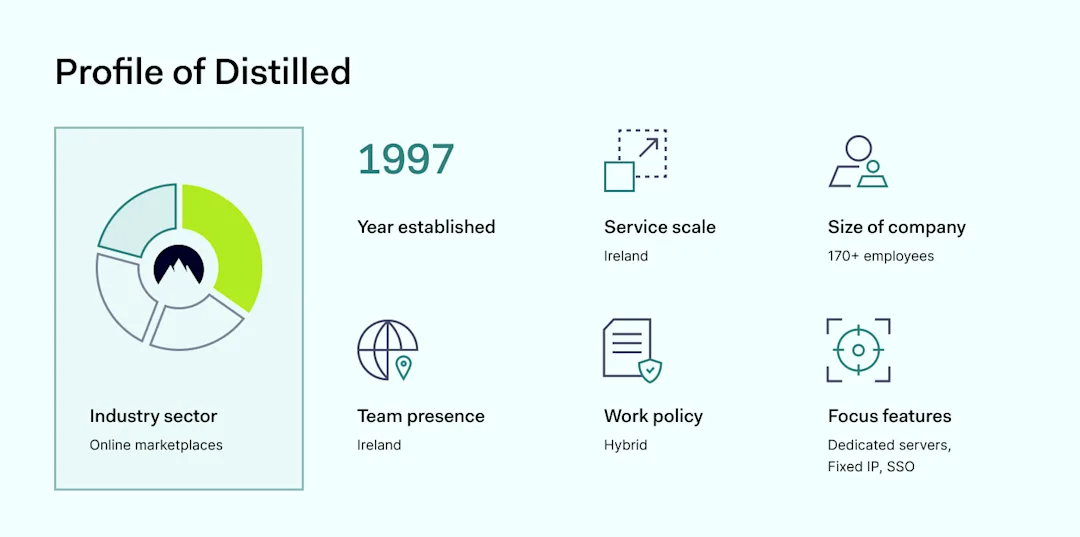
Founded in 1997, Distilled emerged as a pioneering real estate platform designed to simplify the property search for buyers in Ireland. Over the years, the company expanded through acquisitions and partnerships, such as Daft.ie, DoneDeal.ie and Adverts.ie, and became part of the international group, Adevinta. Today, Distilled focuses on managing these major brands within Ireland, offering comprehensive real estate and classified advertisement services.

Profile of Distilled

Being established in the 90s means that the technological stack is based on bespoke applications not fully compatible with all types of modern security platforms. The dedicated team had to manually configure, maintain, and upgrade the company’s physical infrastructure whether it was holidays, weekends, or after-hours. Transitioning to a modern company mindset, Distilled had to change its approach — IT Operations Manager Joe O’Brien shared how it happened.

The challenge

Complex infrastructure support for remote teams

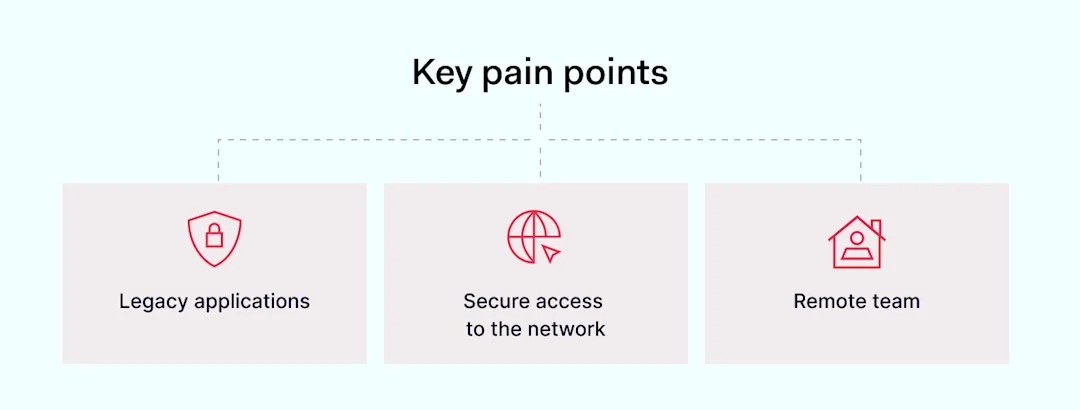
Key pain points

As the global pandemic shifted work from office to home, Distilled faced significant challenges with their legacy applications, which were accessible only through an office IP address.

“When COVID hit, employees were scattered across the country. To access our internal systems, we were using our office VPN to provide our users secure IP access —that’s what we’ve been using for the last couple of years.”

Click to tweet

This setup granted employees access to essential systems, enabling productivity across dispersed locations. However, working with legacy applications required extra labor to support them, expanding the work scope for the IT team.

“There’s a lot of infrastructure which we have to maintain: local internet, firewalls, access servers and connections between our office to remote locations. Infrastructure was too complex, had too many fail points, and was not designed as a full-time solution for all employees working remotely.”

Click to tweet

The situation called for a revision of the existing technology stack. It was necessary to exchange complex applications with solutions that are easy to use and don’t require hands-on presence. These changes enabled remote teams to access the company network securely.

The solution

Focus on a simple and secure solution

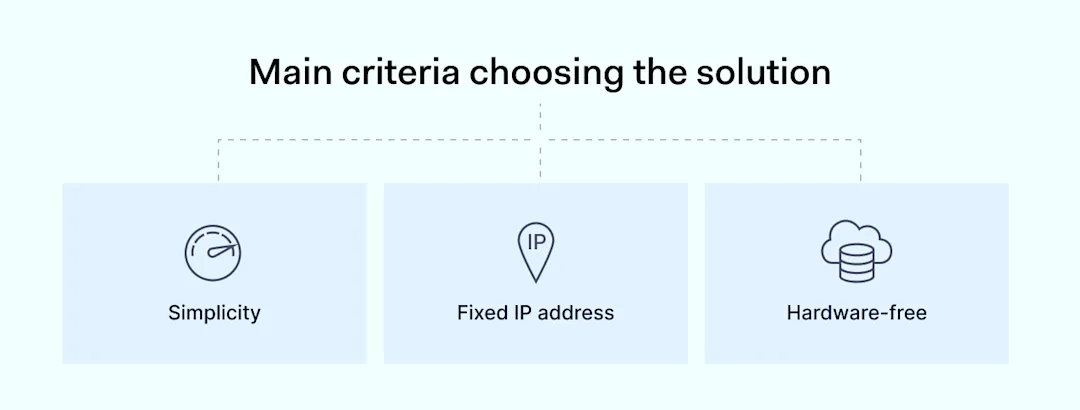
Main criteria choosing the solution

Distilled turned to NordLayer to address their connectivity and security challenges. By implementing NordLayer’s dedicated server option, the company secured a fixed IP address, simplifying remote access without the need for complex and unreliable VPN setups.

“We looked into a solution that was simple and guaranteed a fixed IP address for all of our employees. We could then use that IP as one of the security checks on our systems to grant remote workers access. NordLayer checked all the boxes I had in mind.”

Click to tweet

The integration with Distilled’s Identity and Access Management solution ensured that only company-managed devices could access these systems, enhancing overall security.

“Integration with our IAM system allowed us to quickly onboard all staff, utilising 2FA access to NordLayer from company-managed devices, and assign a fixed IP address as a secure configuration.”

Click to tweet

Distilled has a layered security strategy, one of which is based on fixed IP addresses to confirm and control user access. This way the IT team can coordinate permissions, manage employee accounts, and ensure that the company network is under a sufficient security layer.

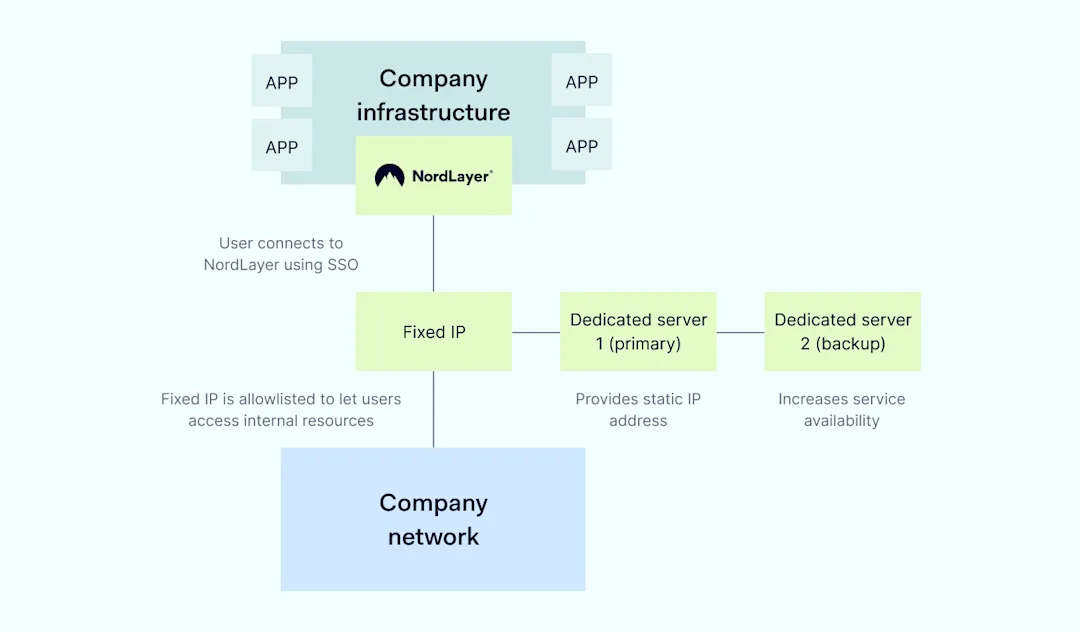
Moreover, the company settled for 2 dedicated servers so they can rest assured that if the primary server goes down or is overloaded, the backup server will help maintain service levels unimpacted.

Why choose NordLayer

NordLayer was selected for its simplicity, reliability, and ease of integration. Unlike other solutions that required additional infrastructure, NordLayer offered a straightforward, out-of-the-box solution.

“The internal infrastructure team maintains and manages the application systems, while the IT team looks after the access security, ensuring that our employees get into the network with ease. NordLayer takes the complexity away from providing our end users with these services.”

Click to tweet

It allowed the IT team at Distilled to deploy a secure access system in minutes, significantly reducing the administrative overhead associated with managing traditional VPN solutions.

A hardware-free solution to securely connect to the company network

Scheme

Distilled was looking for an easy way to give all their end users a single fixed IP address for the whole company. Other systems they looked at required adding additional infrastructure into their offices, which the team had to manage themselves. With NordLayer, it’s all included.

The outcome

Removing the complexity for the user and IT team

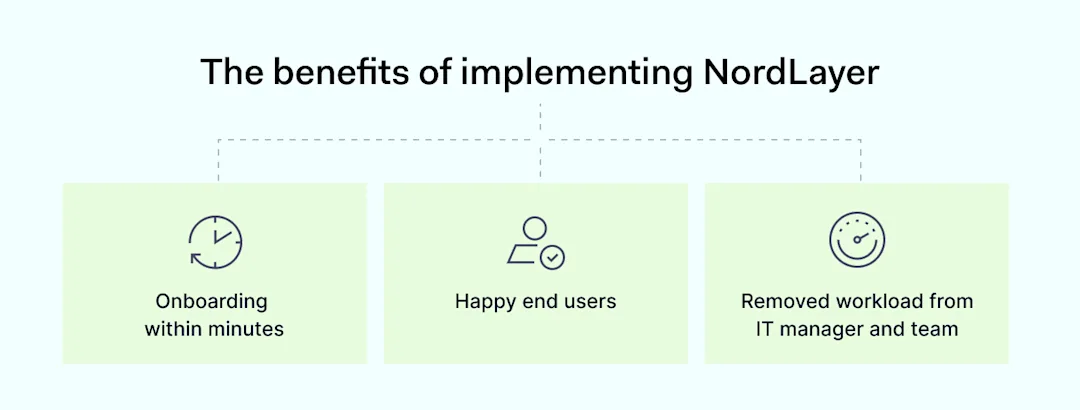
The benefits of implementing NordLayer

The adoption of NordLayer has led to a more flexible and secure remote working environment at Distilled. Employees now enjoy seamless access to critical applications without the hassles of a traditional VPN.

“The setup from a client perspective was very easy: download the app, click on the SSO login button to and you are in.”

Click to tweet

The solution has proven reliable, with no significant downtime reported, allowing the IT team to focus on more strategic tasks rather than maintaining complex network infrastructures.

“NordLayer saved so much time and it takes so much pressure off our small IT team. VPN support was needed outside of normal working hours. Previously, any time our VPN would drop, someone needed to go to the site to fix the issue. Now that we have NordLayer, it just works all the time.”

Click to tweet

Moreover, the IT Operations Manager got a lot of positive feedback from users that the app runs in the background, it doesn’t interfere with their work and he himself has nothing to worry about.

Pro cybersecurity tips

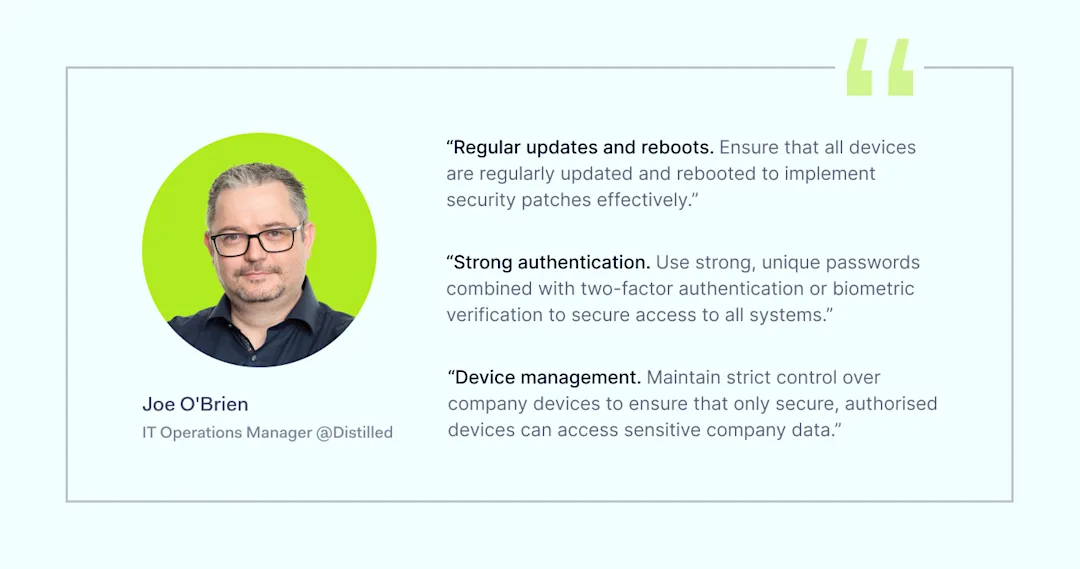
In cybersecurity, you have to know the drill. How to practise security, prevent data breaches, and stay out of the bad actors’ radar. To achieve it you don’t have to climb mountains, just be cautious and aware. Here are some tips on how Joe O’Brien, Distilled IT Operations Manager, practices security on a daily basis and you are welcome to join these activities.

Quote

Through strategic use of technology and a focus on security, Distilled has not only adapted to remote work challenges but has also positioned itself as a leader in using cybersecurity solutions to enhance business operations.

About Version 2 Digital

Version 2 Digital is one of the most dynamic IT companies in Asia. The company distributes a wide range of IT products across various areas including cyber security, cloud, data protection, end points, infrastructures, system monitoring, storage, networking, business productivity and communication products.

Through an extensive network of channels, point of sales, resellers, and partnership companies, Version 2 offers quality products and services which are highly acclaimed in the market. Its customers cover a wide spectrum which include Global 1000 enterprises, regional listed companies, different vertical industries, public utilities, Government, a vast number of successful SMEs, and consumers in various Asian cities.

About NordLayer
NordLayer is an adaptive network access security solution for modern businesses – from the world’s most trusted cybersecurity brand, Nord Security.

The web has become a chaotic space where safety and trust have been compromised by cybercrime and data protection issues. Therefore, our team has a global mission to shape a more trusted and peaceful online future for people everywhere.

About NordLayer
NordLayer is an adaptive network access security solution for modern businesses – from the world’s most trusted cybersecurity brand, Nord Security.

The web has become a chaotic space where safety and trust have been compromised by cybercrime and data protection issues. Therefore, our team has a global mission to shape a more trusted and peaceful online future for people everywhere.

×

Hello!

Click one of our contacts below to chat on WhatsApp

×