
Skip to content

Apply network management protocols to your organization for better results

To address this issue, first understand that, in the digitization we are experiencing, there are multiple resources and devices that coexist in the same network and that require a set of rules, formats, policies and standards to be able to recognize each other, exchange data and, if possible, identify if there is a problem to communicate, regardless of the difference in design, hardware or infrastructure, using the same language to send and receive information. This is what we call network protocols (network protocols), which we can classify as: 

    • Network communication protocols for communication between network devices, whether in file transfer between computers or over the Internet, up to text message exchange and communication between routers and external devices or the Internet of Things (IoT). For example: Bluetooth, FTP, TCP/IP and HTTP.
    • Network security protocols to implement security in network communications so that unauthorized users cannot access data transferred over a network, whether through passwords, authentication, or data encryption. For example: HTTPS, SSL, SSH and SFTP.
    • Network administration protocols that allow network management and maintenance to be implemented by defining the procedures necessary to operate a network. These protocols are responsible for ensuring that each device is connected to others and to the network itself, as well as monitoring the stability of these connections. They are also resources for troubleshooting and assessing network connection quality.

Content:

Importance and Context in Network Management

Network management ranges from initial configuration to permanent monitoring of resources and devices, in order to ensure connectivity, security and proper maintenance of the network. This efficient communication and data flow have an impact on the business to achieve its objectives in stable, reliable, safe, efficient environments, better user experience and, consequently, the best experience of partners and customers.
Something important is the knowledge of the network context (topology and design), since there is an impact on its scalability, security and complexity. Through network diagrams, maps and documentation to visualize and understand the topology and design of the network, it is possible to perform analyses to identify potential bottlenecks, vulnerabilities and inefficiencies where action must be taken to correct or optimize it.
Another important aspect is the shared resources not only in the network but in increasingly widespread infrastructures in the cloud, in Edge Computing and even in the Internet of Things that demand monitoring of the state of the network, network configuration and diagnosis to promote efficiency, establish priorities and also anticipate or solve connection problems in the network and on the internet.
We’ll talk about the benefits of Network Management later.

Network protocols vs network management protocols

As explained above, network management protocols are part of network protocols. Although they may seem the same, there are differences: network protocols, as a rule, allow data transfer between two or more devices and are not intended to manage or administer such devices, while network administration protocols do not aim at the transfer of information, but the transfer of administrative data (definition of processes, procedures and policies), which allow to manage, monitor and maintain a computer network.
The key issue is to understand the following:

  • Within the same network, network communication protocols will have to coexist with network management protocols.
  • Network management protocols also have an impact on the overall performance of the platforms, so it is essential to know and control them.
  • The adoption of cloud and emerging technologies, such as Edge Computing and the Internet of Things, make it clear that reliable and efficient connectivity is critical.

Deep Network Management Protocols

Network management protocols make it possible to know the status of resources, equipment and devices on the network (routers, computers, servers, sensors, etc.), and provide information on their availability, possible network latency or data loss, failures, among others. The most common network management protocols are: Simple Network Management Protocol (SNMP), Internet Control Message Protocol (ICMP) and Windows Management Instrumentation (WMI), as seen in the diagram below and explained below:

Simple Network Management Protocol (SNMP)

SNMP is a set of protocols for managing and monitoring the network, which are compatible with most devices (switches, workstations, printers, modems and others) and brands (most manufacturers make sure their product includes SNMP support) to detect conditions. SNMP standards include an application layer protocol, a set of data objects, and a methodology for storing, manipulating, and using data objects in a database schema. These protocols are defined by the Internet Architecture Board (Internet Architecture Board, IAB) and have evolved since their first implementation:

  • SNMPv1: first version operating within the structure management information specification and described in RFC 1157
  • SNMPv2: Improved support for efficiency and error handling, described in RFC 1901.
  • SNMPv3: This version improves security and privacy, introduced in RFC 3410.

SNMP Architecture Breakdown: Agents and Administrators

All network management protocols propose an architecture and procedures to retrieve, collect, transfer, store and report management information from the managed elements. It is important to understand this architecture and its procedures to implement a solution based on said protocol.
The SNMP architecture is based on two basic components: Agents and Administrators or Managers, as we presented in the following diagram of a basic schema of the SNMP architecture:
Where:

    • SNMP agents are pieces of software that run on the elements to be managed. They are responsible for collecting information on the device itself. Then, when SNMP administrators request such information through queries, the agent will send the corresponding. SNMP agents can also send the SNMP Manager information that does not correspond to a query but that comes from an event that takes place in the device and that requires to be notified. Then, it is said that the SNMP agent proactively sends a notification TRAP.
    • SNMP Administrators are found as part of a management or monitoring tool and are designed to work as consoles where all the information captured and sent by the SNMP agents is centralized.
  • OIDs (Object Identifier) are the items used to identify the items you want to manage. OIDs follow a format of numbers such as: .1.3.6.1.4.1.9.9.276.1.1.1.1.11. These numbers are retrieved from a hierarchical organization system that allows to identify the device manufacturer, to later identify the device and finally the item. In the following image we see an example of this OID tree outline.
  • MIBs (Management Information Base) are the formats that the data sent from the SNMP agents to the SNMP managers will comply with. In practice, we have a general template with what we need to manage any device and then have individualized MIBs for each device, with their particular parameters and the values that these parameters can reach.

SNMP’s crucial functions are:

  • Fault Validation: for detection, isolation and correction of network problems. With the SNMP trap operation, you may get the problem report from the SNMP agent running on that machine. The network administrator can then decide how, testing it, correcting or isolating that problematic entity. The OpManager SNMP monitor has an alert system that ensures you are notified well in advance of network issues such as faults and performance slowdowns.
  • Performance Metrics Network: performance monitoring is a process for tracking and analyzing network events and activities to make necessary adjustments that improve network performance. With SNMP get and set operations, network administrators can track network performance. OpManager, an SNMP network monitoring tool, comes with powerful and detailed reports to help you analyze key performance metrics such as network availability, response times, throughput, and resource usage, making SNMP Management easier.

To learn more about SNMP, we recommend reading Blog SNMP Monitoring: keys to learn how to use the Simple Network Administration Protocol

Internet Control Message Protocol (ICMP)

This is a network layer protocol used by network devices to diagnose communication problems and perform management queries. This allows ICMP to be used to determine whether or not data reaches the intended destination in a timely manner and its causes, as well as to analyze performance metrics such as latency levels, response time or packet loss. ICMP contemplated messages typically fall into two categories:

  • Error Messages: Used to report an error in packet transmission.
  • Control messages: Used to report on device status.

The architecture that ICMP works with is very flexible, since any device on the network can send, receive or process ICMP messages about errors and necessary controls on network systems informing the original source so that the problem detected is avoided or corrected. The most common types of ICMP menssages are key in fault detection and performance metric calculations:

  • Time-Out: Sent by a router to indicate that a packet has been discarded because it exceeded its time-to-live (TTL) value.
  • Echo Request and Echo Response: Used to test network connectivity and determine round-trip time for packets sent between two devices.
  • Unreachable Destination: Sent by a router to indicate that a packet cannot be delivered to its destination.
  • Redirect: Sent by a router to inform a host that it should send packets to a different router.
  • Parameter issue: Sent by a router to indicate that a packet contains an error in one of its fields.

For example, each router that forwards an IP datagram has to decrease the IP header time-to-live (TTL) field by one unit; if the TTL reaches zero, an ICMP type 11 message (“Time Exceeded”) is sent to the datagram originator.
It should be noted that sometimes it is necessary to analyze the content of the ICMP message to determine the type of error that should be sent to the application responsible for transmitting the IP packet that will ICMP message forwarding.
For more detail, it is recommended to access Pandora Discussion Forums FMS, with tips and experiences of users and colleagues in Network Management using this protocol.

Windows Management Instrumentation (WMI)

With WMI (Windows Management Instrumentation) we will move in the universe composed of computers running a Windows operating system and the applications that depend on this operating system. In fact, WMI proposes a model for us to represent, obtain, store and share management information about Windows-based hardware and software, both local and remote. Also, WMI allows the execution of certain actions. For example, IT developers and administrators can use WMI scripts or applications to automate administrative tasks on remotely located computers, as well as fetch data from WMI in multiple programming languages.

Architecture WMI

WMI architecture is made up of WMI Providers, WMI Infrastructure and Applications, Services or Scripts as exemplified in this diagram:

Where:

  • A WMI provider is a piece responsible for obtaining management information for one or more items.
  • The WMI infrastructure works as an intermediary between the providers and the administration tools. Among its responsibilities are the following:
    • Obtaining in a scheduled way the data generated by the suppliers.
    • Maintaining a repository with all the data obtained in a scheduled manner.
    • Dynamically finding the data requested by administration tools, for which a search will be made in the repository and, if the requested data is not found, a search will be made among the appropriate providers.
  • Administration applications correspond to applications, services or scripts that use and process information about managed items. WMI manages to offer a consistent interface through which you may have applications, services and scripts requesting data and executing the actions proposed by WMI providers about the items that you wish to manage.

CIM usage and WMI Class Breakdown

WMI is based on CIM (Common Information Model), which is a model that uses item-based techniques to describe different parts of a company. It is a very widespread model in Microsoft products; In fact, when Microsoft Office or an Exchange server is installed, for example, the extension of the model corresponding to the product is installed automatically.
Precisely that extension that comes with each product is what is known as WMI CLASS, which describes the item to be managed and everything that can be done with it. This description starts from the attributes that the class handles, such as:

  • Properties: Properties that refer to item features, such as their name, for example.
  • Methods: Actions that refer to the actions that can be performed on the object, such as “hold” in the case of an item that is a service.
  • Associations: They refer to possible associations between items.

Now, once WMI providers use the classes of the items to collect administration information and this information goes to the WMI infrastructure, it is required to organize data in some way. This organization is achieved through logical containers called namespaces, which are defined by administration area and contain the data that comes from related objects.
Namespaces are defined under a hierarchical scheme that recalls the outline that folders follow on a disk. An analogy many authors use to explain data sorting in WMI is to compare WMI to databases, where the classes correspond to the tables, the namespaces to the databases, and the WMI infrastructure to the database handler.
To learn more about WMI, we recommend reading our blog post What is WMI? Windows Management Instrumentation, do you know it?

Key Insights for Network Management Protocol Analysis:

It is easy to understand that the more complex and heterogeneous the platform you want to manage, the greater its difficulty from three angles:

  • Faults: have fault detection procedures and a scheme for reporting them.
  • Performance: Information about platform performance to understand and optimize its performance.
  • Actions: Many administration protocols include the possibility of executing actions on network devices (updating, changes, setting up alerts, reconfigurations, among others).

It is important to understand which of the three angles each of the protocols tackels and, therefore, what it will allow you to do. A fundamental pillar is Data Organization, which we will explain below.

Effective data organization: a fundamental pillar in network management protocols

A fundamental aspect of Network Management Protocols is the way in which the elements to be managed are defined and identified, making approaches on:

  • What element can I administer with this protocol?
  • Should it just be the hardware or should applications be considered too, for example?
  • What format should be used to handle data? And how is it stored, if so?
  • What are the options you have to access this information?

In that sense, effective data sorting allows the successful information exchange between devices and network resources. In network monitoring, data is required from routers, switches, firewalls, load balancers, and even endpoints, such as servers and workstations. The data obtained is filtered and analyzed to identify possible network problems such as configuration changes or device failures, link interruptions, interface errors, lost packets, latency or response time of applications or services on the network. Data also makes it possible to implement resource planning due to traffic growth or the incorporation of new users or services.

Challenges, Benefits and Key Tasks in Network Management Protocols

For those in charge of operating and managing enterprise networks, it is important to know five common challenges:

  • Mixed environments, in which resources and devices exist in local and remote networks (including Edge Computing and IoT), which makes it necessary to adapt to the demands of hybrid networks.
  • Understand network needs and perform strategic planning, not only in physical environments but also in the cloud.
  • Reinforcing the security and reliability of increasingly dynamic networks, more so when business ecosystems are engaging interconnecting customers, suppliers, and business partners.
  • Achieve observability that gets rid of network blind spots and provide a comprehensive view of IT infrastructure.
  • Establish a network management strategy that can be connected, integrated, and even automated, especially when IT teams are doing more and more tasks in their day-to-day lives.

As we have seen throughout this Blog, understanding how network management protocols work is essential for communication, business continuity and security, which together have a great impact on organizations to:

  • Establish and maintain stable connections between devices on the same network, which in turn results in less latency and a better experience for network users.
  • Manage and combine multiple network connections, even from a single link, which can strengthen the connection and prevent potential failures.
  • Identify and solve errors that affect the network, evaluating the quality of the connection and solving problems (lower latency, communication reestablishment, risk prevention in operations, etc.)
  • Establish strategies to protect the network and the data transmitted through it, relying on encryption, entity authentication (of devices or users), transport security (between one device and another).
  • Implementing performance metrics that ensure quality service levels.

Key Tasks and Benefits in Network Management

Efficient network administration involves device connectivity, access systems, network automation, server connectivity, switch management and network security, so it is recommended to carry out the following tasks:

  • Strategies for Upgrades and Effective Maintenance: One of the big challenges is achieving end-to-end network visibility in an increasingly complex business environment. Most IT professionals have an incomplete understanding of how their network is set up, as new components, hardware, switches, devices, etc. are constantly being added, so it is vital to maintain an up-to-date catalog of your network and provide proper maintenance to guide network management principles and enforce the correct policies. You also have to consider that there are resource changes in your IT team. It is possible that the original administrator who defined the network topology and required protocols may no longer be available, which could result in having to undergo a full network administration review and incur additional costs. This can be avoided by detailed documentation of configurations, security policies, and architectures to ensure that management practices remain reusable over time.
  • Rigorous Performance Monitoring: Network management demands performance monitoring (e.g. with a dashboard with performance indicators) consistently and rigorously with defined standards to provide the best service and a satisfactory usage experience without latency and as stable as possible. Previously this was a greater challenge when traditional network environments relied primarily on hardware for multiple devices, computers, and managed servers; today, advances in software-defined networking technology make it possible to standardize processes and minimize human effort to monitor performance in real time. It is also recommended to ensure that network management software is not biased towards one or a few original equipment manufacturers (OEMs) to avoid dependence on one or a few vendors in the long run. The impact would also be seen in the difficulty in diversifying IT investments over time.
  • Downtime Prevention: A team designated for network failure management allows you to anticipate, detect and resolve network incidents to minimize downtime. On top of that, the team is responsible for logging information about failures, performing logs, analyzing, and assisting in periodic audits. This implies that the network failure management team has the ability to report to the network administrator to maintain transparency, and to be in close collaboration with the end user in case failures need to be reported. Also, it is recommended to rely on a Managed Service Provider (MSP) as an external partner that can assist in the design and implementation of the network and in routine maintenance, security controls and configuration changes, in addition to being able to support on-site management and support.
  • Network Security Threat and Protection Management: Business processes are increasingly moving online, so network security is vital to achieving resilience, alongside risk management.
    A regular stream of logs is generated in an enterprise network and analyzed by the network security management team to find digital fingerprints of threats. Depending on the business and the size of the organization, it is possible to have equipment or personnel assigned for each type of network management. Although it is also recommended to rely on services managed by experts in the industry in which the organization operates, with a clear knowledge of common risks, best security practices and with experts in the field of security that constantly evolves and becomes more sophisticated.
  • Agile IP Address Management and Efficient Provisioning: Network protocols are the backbone of digital communication with rules and procedures on how data is transmitted between devices within a network, regardless of the hardware or software involved. Provisioning must contemplate the IT infrastructure in the company and the flow and transit of data at different levels from the network, including servers, applications and users to provide connectivity and security (also managing devices and user identities).
    Another important task in network management is transparency about usage, anomalies and usage trends for different functions or business units and even individual users. This is of particular value for large companies in that they must make transparent the use of shared services that rent network resources to different branches and subsidiaries to maintain an internal profit margin.

Summary and conclusions

In business digitization, Network Management Protocols aims to take actions and standardize processes to achieve a secure, reliable and high-performance network for end users (employees, partners, suppliers and end customers). Companies distributed in different geographies depend on Network Management Protocols to keep the different business areas, functions and business teams connected, allowing the flow of data inside and outside the company, whether on local servers, private clouds or public clouds.
As technology continues to evolve, so do network protocols. The IT strategist and the teams assigned to network management must prepare for the future of network protocols and the integration of emerging technologies, to take advantage of advances in speed, reliability and security. For example, 5G is a technology that is expected to have a significant impact on networks, driven by the need for greater connectivity and lower latency. People’s daily lives also involve connecting objects (vehicles, appliances, sensors, etc.), revolutionizing networks to meet the Internet of Things. In Security, more robust network protocols are being developed, such as Transport Layer Security (TLS), which encrypts transmitted data to prevent access or manipulation by third parties.
All this tells us that the development of network protocols will not slow down in the short term as we move towards an increasingly connected world.
Pandora FMS works with the three main protocols for network management to offer a comprehensive and flexible monitoring solution. Check with Pandora FMS sales team for a free trial of the most flexible monitoring software on the market: https://pandorafms.com/en/free-trial/
Also, remember that if your monitoring needs are more limited, you have at your disposal the OpenSource version of Pandora FMS. Find out more here: http://pandorafms.com/community
Do not hesitate to send us your queries. Our Pandora FMS team will be glad to assist you!

About Version 2 Digital

Version 2 Digital is one of the most dynamic IT companies in Asia. The company distributes a wide range of IT products across various areas including cyber security, cloud, data protection, end points, infrastructures, system monitoring, storage, networking, business productivity and communication products.

Through an extensive network of channels, point of sales, resellers, and partnership companies, Version 2 offers quality products and services which are highly acclaimed in the market. Its customers cover a wide spectrum which include Global 1000 enterprises, regional listed companies, different vertical industries, public utilities, Government, a vast number of successful SMEs, and consumers in various Asian cities.

About PandoraFMS
Pandora FMS is a flexible monitoring system, capable of monitoring devices, infrastructures, applications, services and business processes.
Of course, one of the things that Pandora FMS can control is the hard disks of your computers.

Introducing GREYCORTEX Mendel 4.3

We are happy to introduce the new version of GREYCORTEX Mendel. Version 4.3 enhances operational efficiency, security, and data management. This update strengthens OT capabilities and significantly improves IT security.

New version 4.3 includes these features:

  • Real-Time OT Metrics
  • Enhanced OT Capabilities
  • PCAP Recorder 2.0
  • NetFlow Processing Improvements
  • Expanded API Support
  • Improved User Experience

Explore more about GREYCORTEX Mendel 4.3

About Version 2 Digital

Version 2 Digital is one of the most dynamic IT companies in Asia. The company distributes a wide range of IT products across various areas including cyber security, cloud, data protection, end points, infrastructures, system monitoring, storage, networking, business productivity and communication products.

Through an extensive network of channels, point of sales, resellers, and partnership companies, Version 2 offers quality products and services which are highly acclaimed in the market. Its customers cover a wide spectrum which include Global 1000 enterprises, regional listed companies, different vertical industries, public utilities, Government, a vast number of successful SMEs, and consumers in various Asian cities.

About GREYCORTEX
GREYCORTEX uses advanced artificial intelligence, machine learning, and data mining methods to help organizations make their IT operations secure and reliable.

MENDEL, GREYCORTEX’s network traffic analysis solution, helps corporations, governments, and the critical infrastructure sector protect their futures by detecting cyber threats to sensitive data, networks, trade secrets, and reputations, which other network security products miss.

MENDEL is based on 10 years of extensive academic research and is designed using the same technology which was successful in four US-based NIST Challenges.

Head of SafeDNS’s Customer Support: “People lack a human touch – SafeDNS still provides it”

Today effective customer support is the backbone of any successful tech company. Joining us today is Leo Nagano, the Head of Customer Support at SafeDNS, who has climbed the ranks from a technical support agent to one of the key leaders in the company. He shares insights on his career path, team dynamics, and the unique approaches that set SafeDNS apart in the realm of customer service.

Background


Leo, I know that you have had quite an interesting journey in the world of customer support, starting as a technical support agent. Can you share with our followers how you transitioned from that role to your current position?

Absolutely. My journey began in a local telecom company, where my passion for technology propelled me rapidly from a regular technical support agent to a senior engineer. In this role, I juggled numerous responsibilities, including managing departmental tasks. My curiosity did not stop there. After mastering the telecom sector, I explored various IT niches in different companies, progressing through roles like team lead and senior engineer. This exploration led me to network operation companies and, eventually, to my current role at SafeDNS.


That is quite a trajectory! And speaking of your current role, could you give us a glimpse into the structure of your support team?

Certainly. Our team at SafeDNS consists of highly qualified technical support agents, operating around the clock. The majority are seasoned professionals, having been with us for over two years. This experience has fostered a robust technical team.

Support Philosophy & Strategy


What is the core philosophy that drives your approach to customer support?

Our ethos is simple yet powerful: do everything possible to aid our customers. We aim for a support process that is not just high-quality but also fast, accurate, and courteous. There is no room for irrelevant responses in our playbook.


How do you balance efficiency with the need for a personal touch in customer interactions?

It all boils down to passion. Loving your job naturally leads to a balance between efficiency and personal care in handling customer needs.

Challenges & Solutions


Every team faces challenges. What are the most common ones for your team, and how do you tackle them?

Our primary challenges include managing a seamless ticket workflow and providing dual support – both to end users and internally. The key is our team’s professionalism, which allows us to navigate these challenges effectively.


How do you handle situations where a customer might not be right?

These situations are less about proving someone wrong and more about guidance. We rely on our technical documentation to provide clear, standardized solutions.


And in moments of high pressure, like peak times, how do you prioritize issues?

Prioritizing critical issues swiftly is essential. When a major issue arises, we quickly assess and focus our collective efforts on resolving it.

Training & Development


Could you walk us through how you onboard new members into your support team?

Onboarding at SafeDNS is a meticulous process. We only seek candidates who excel in both customer service and technical skills. Effective communication with customers is sometimes even more crucial than technical expertise, yet we are dedicated to excelling in both areas. As a result, only a select few candidates can begin their probationary period. Once onboard, new agents are supported by a comprehensive knowledge base, senior agents, and a collaborative work environment, ensuring a smooth transition into their roles.

Tools & Technology


What tools does your team rely on, and why?

Our toolkit includes platforms like Freshworks, Intercom, Whatsapp Business, and an internal CRM manager, alongside various minor integrations. For example, Freshworks gives us extensive support solutions, and Intercom allows for smooth communication with our clients. WhatsApp Business offers an easy-to-use interface for quick and cost-effective interactions. Our internal CRM helps keep customer data organized, and other small integrations we use to make our processes more efficient. These tools are chosen for their convenience, reliability, and comprehensive features, enhancing our team’s productivity and support quality.


How do you incorporate technology, like AI or chatbots, into enhancing support experiences?

AI and chatbots are invaluable in improving our support services. This technology quickly handles simple, frequent questions, freeing our agents to deal with more intricate and tailored customer needs. It makes our support process more efficient and ensures prompt, precise help for our customers. AI and chatbots can also provide round-the-clock support for complex issues. Blending AI and chatbot capabilities with our skilled support team, we offer comprehensive support that caters to our customers’ varied needs.

Metrics & Feedback


What key metrics do you track and how do they guide your decision-making?

We monitor customer satisfaction scores (CSAT), first response and resolution times, and customer effort scores (CES). Reviewing CSAT scores helps us pinpoint where we can improve our services. Tracking how quickly we respond and resolve issues allows us to gauge our efficiency and manage our resources better, leading to a smoother support experience. Additionally, the customer effort score helps us assess how easily our customers can use our support and interact with our products or services.


How do you integrate customer feedback into improving your services?

We collect feedback through surveys, our website, social media, and emails. This data managed via our CRM and sentiment analysis tools, informs product and service enhancements through regular cross-functional reviews and agile methodologies.


What would you say about negative feedback? How do you turn it into an opportunity for improvement?

This may sound cliché but we do view it constructively. Our approach involves acknowledging the feedback, investigating the issue, and communicating transparently with the customer. I would like to underline that transparent communication is a key element, where we keep the customer informed about the steps, we are taking to address their concerns. Long story short, we always use negative feedback as a learning tool for internal improvements and to enhance our support services.

Employee Wellbeing


Given the demanding nature of support roles, how do you ensure the well-being and morale of your team members?

Our focus is on creating a positive work environment. For example, we conduct regular team building activities, organized both online and offline, with the aim of enhancing camaraderie among team members and getting rid of the tedious daily routine. Flexible working hours, remote work options, and accommodating special personal needs are some of the ways we ensure a good work-life balance. We also maintain open lines of communication by ensuring that all team members are free to voice their views, concerns, or positive feedback, ensuring that every opinion matters. Our team members set goals together, discussing career opportunities so that everybody can clearly see relevant growth opportunities within the company. What I am listing now is not just about our department, it is SafeDNS’ philosophy on how to interact with employees.


How do you address burnout within the team?

We actively monitor for signs of burnout. Flexible scheduling, workload rotation, emphasis on breaks, recognition, well-being programs, and vacation usage are among our key strategies to combat burnout. But I guess the main thing that helps prevent burnout is to discuss concerns. At SafeDNS every single person is open to discussing any problems.

Unique Approach at SafeDNS:


We have already talked about the technical aspects and philosophy behind SafeDNS support. Can you tell me what makes SafeDNS customer support different from other companies?

I would say it is our proactive approach and personalized support with human touch. For sure we are proud of our truly rapid response times, dedicated account management, and customer feedback integration but in the era of bots and artificial intelligence, people lack a human touch – SafeDNS still provides it. This sets us apart in the industry.


How is this unique approach developed and maintained?

Developing and maintaining our unique approach involves analyzing customer expectations, investing in team training, and establishing a customer-centric company culture. We try to combine a conservative but much-desired human approach with adaptation to technological trends in the industry.

Looking Ahead


Let’s look into the future. How do you envision the future of customer support with evolving technology? What emerging trends are you noticing in tech support, and how are you preparing for them?

Obviously the future of customer support lies in the seamless use of AI. I would add that sophisticated omnichannel experiences, advanced analytics for personalized support, and the use of AR and VR technologies will be an integral part of quality customer support as well. I personally believe that proactive communication and environmental sustainability will also be key aspects.

Since I have been asked about new trends, well, I can say that we are seeing the ubiquitous integration of artificial intelligence, an attempt to strengthen cyber defenses, and a remote work trend, which increases the volume of work. We do our best to keep up with trends and educate our staff, reinforce cybersecurity, leverage collaboration tools, and adopt eco-friendly practices.


What are your future plans?

We do plan to grow as professionals. The sky is the limit, you know. To put it into practice, we are going to develop our mentorship programs which will include more cross-trainings. And, of course, we are embracing the industry advancements to stay at the forefront.

Tips & Recommendations


Leo, could you share your top three tips for enhancing customer support?

Absolutely. First, prioritize clear customer communication. Second, invest in the training and development of your team. And third, wisely embrace technology to streamline processes and improve customer experiences.


And last but not least: are there any resources that have significantly influenced your approach to customer support?

Well, there are a few of them. I would list the following ones: “Delivering Happiness” by Tony Hsieh, “The Customer Support Handbook” by Sarah Hatter, a must-read no matter what sector you work in, and probably the courses on customer support from HubSpot Academy and Coursera. Blogs like Help Scout and Zendesk also provide regular industry insights.


Thanks a lot for your detailed answers and useful tips. Good luck to you and your team!

About Version 2 Digital

Version 2 Digital is one of the most dynamic IT companies in Asia. The company distributes a wide range of IT products across various areas including cyber security, cloud, data protection, end points, infrastructures, system monitoring, storage, networking, business productivity and communication products.

Through an extensive network of channels, point of sales, resellers, and partnership companies, Version 2 offers quality products and services which are highly acclaimed in the market. Its customers cover a wide spectrum which include Global 1000 enterprises, regional listed companies, different vertical industries, public utilities, Government, a vast number of successful SMEs, and consumers in various Asian cities.

About SafeDNS
SafeDNS breathes to make the internet safer for people all over the world with solutions ranging from AI & ML-powered web filtering, cybersecurity to threat intelligence. Moreover, we strive to create the next generation of safer and more affordable web filtering products. Endlessly working to improve our users’ online protection, SafeDNS has also launched an innovative system powered by continuous machine learning and user behavior analytics to detect botnets and malicious websites.

Eliminating BYOD Security Risks with NAC

In the wake of the digital revolution, businesses are continually seeking ways to stay competitive and innovative. One such strategy is the adoption of Bring Your Own Device (BYOD) policies, allowing employees to use personal devices for work. While this approach offers substantial benefits like flexibility and cost savings, it is not devoid of BYOD security risks. It’s imperative for businesses to understand these vulnerabilities and put measures in place to counteract them.

Understanding BYOD Security Risks

The incorporation of BYOD into business strategy may indeed be an innovative approach, yet it comes with an intricate web of security vulnerabilities. These risks, predominantly, sprout from the myriad of devices and diverse operating systems that gain access to the company’s network.

Prominent among these threats are malware attacks, phishing schemes, and the potential for device theft. The danger escalates when employees utilize unsecured public Wi-Fi networks or neglect regular software updates. Moreover, personal devices are often subject to shared use among family members, further escalating the risk of unintentional data leaks.

In essence, each device accessing the network represents a potential entry point for security threats. As such, BYOD increases the attack surface, thus complicating the task of securing business data. The stakes are high; a single security breach can lead to severe financial and reputational damage.

As BYOD continues to rise in popularity, comprehending these associated security risks becomes a prerequisite for any successful implementation. The first step towards mitigating these risks is understanding them in their entirety. This comprehensive knowledge is crucial for the creation of effective security policies that not only protect the organization but also respect user privacy.

Finally, while securing BYOD is a complex endeavor, it is by no means an insurmountable task. With the right tools and strategies in place, organizations can reap the benefits of BYOD without compromising security. And this is where Network Access Control (NAC) comes into play, a subject we will delve into in the following sections.

The Struggle to Secure BYOD

In the dynamic landscape of cybersecurity, the task of securing BYOD introduces a unique blend of complexities. As organizations venture into the realm of BYOD, the mosaic of diverse devices and operating systems presents a formidable challenge. The line demarcating the traditional security perimeter has essentially been erased, making it a daunting task to maintain oversight and regulate data accessed from personal devices.

This phenomenon creates an environment where control can seem elusive. The conventional methods of security that organizations have relied on in the past may not effectively apply to this new domain. A one-size-fits-all approach to security measures is impractical due to the heterogeneity of personal devices. This forces organizations to adapt and evolve, developing a new set of skills and approaches to keep their data safe.

A key part of this evolution involves creating balanced BYOD security policies. These policies must uphold the stringent security requirements that businesses need while simultaneously respecting the privacy rights of their users. Striking this balance is a fine art, requiring a deep understanding of the nuanced relationship between cybersecurity and privacy.

To further complicate matters, organizations often grapple with the constant flux in technology trends and cyber threats. Adapting to these ever-changing scenarios and staying ahead of the threat curve requires agility and foresight. It calls for a relentless commitment to security, continuous improvement, and a willingness to disrupt traditional models to protect sensitive data.

Securing BYOD is undoubtedly a complex endeavor, but it’s not an unconquerable task. With the right blend of strategic planning, smart policy making, and the judicious use of technology tools such as Network Access Control (NAC), organizations can navigate the complexities of BYOD security. Adept navigation in this area is crucial to harvest the benefits of BYOD without compromising on the security front.

The Role of Network Access Control (NAC)

In the labyrinth of BYOD security challenges, Network Access Control (NAC) emerges as an indispensable tool, serving as an architect of a secure digital landscape. This technology shines a spotlight on all devices seeking entry into the network, regardless of their provenance.

By granting such visibility, NAC empowers organizations to implement and enforce security protocols rooted in user identities, device categories, geographical location, among other factors. Its ability to discern and segregate potentially hazardous devices is remarkable, curtailing the risk of contaminating the network with malicious software.

However, the true strength of NAC lies not only in its robust defensive mechanism but also in its adaptability. It evolves with the changing landscape of device usage and cyber threats, aligning with the organization’s security postures. Whether dealing with a remote workforce or a myriad of IoT devices, NAC offers the flexibility to adjust and recalibrate security measures in response to the ever-shifting digital environment.

Yet, it’s crucial to note that the utility of NAC transcends the realm of protection. It also offers valuable insights into network activity, thereby enhancing the organization’s ability to make data-driven decisions about their security strategies. This knowledge, when combined with other security initiatives, can equip organizations with a comprehensive approach to taming the complexity of BYOD security.

Undoubtedly, NAC is a powerful weapon in the arsenal against BYOD security risks. However, wielding this tool effectively requires a holistic cybersecurity strategy, one that integrates NAC into the broader security framework. The interplay between NAC and other security initiatives, underpinned by robust BYOD security policies and a culture of security awareness, is pivotal in mitigating BYOD security risks. In other words, NAC is an integral part of the puzzle, but it’s not the complete picture. To secure BYOD, organizations need to see the whole canvas and strategically position NAC within it.

Leveraging NAC to Mitigate BYOD Security Risks

The incorporation of NAC into a larger cybersecurity strategy is the key to unlocking its full potential in mitigating BYOD security risks. Organizations should move beyond simply employing NAC as a standalone security tool, and instead, adopt a more holistic approach. At the heart of this comprehensive strategy are robust BYOD security policies, designed to safeguard sensitive data while respecting user privacy. These policies should clearly outline what constitutes acceptable use of personal devices within the organization, serving as a blueprint for safe and secure device usage.

Moreover, empowering employees with the knowledge of how to use their devices safely is crucial. Organizations should invest in cybersecurity training that emphasizes the importance of regular software updates, the risks of public Wi-Fi networks, and the appropriate handling of sensitive data. This education, coupled with NAC’s ability to regulate network access based on user identities and device types, can significantly enhance an organization’s defense against BYOD security risks.

Nevertheless, the key to a successful BYOD security strategy lies not only in the implementation of robust policies and the employment of NAC, but also in the strategic use of other security technologies. Organizations should consider leveraging additional security measures such as multi-factor authentication, secure remote access solutions, and advanced threat detection tools. The integration of these technologies with NAC can result in a fortified defense line, capable of identifying and responding to a broad spectrum of threats.

In essence, a strategic and well-rounded approach to BYOD security goes a long way in mitigating associated risks. By positioning NAC at the heart of this strategy and complimenting it with strong policies, continuous employee education, and the use of other security technologies, organizations can significantly reduce their vulnerability to BYOD security threats. The road to securing BYOD is challenging, but with careful planning and the right tools in place, organizations can successfully navigate this complex landscape.

Moving Forward: Visionary Leadership in BYOD Security

As we propel into the future, where BYOD gains more traction, the need for innovative leadership in BYOD security becomes indispensable. Leaders are now tasked with embracing the notion that security isn’t a destination achieved in a single journey but a never-ending voyage of learning, improvement, and transformation. This belief will guide them in navigating the fluctuating landscapes of cybersecurity.

Leadership in this realm extends beyond traditional definitions. It calls for visionaries who can not only foresee potential threats but can also anticipate advancements and trends in technology. This foresight can inspire the development of proactive measures and strategies, keeping organizations one step ahead of evolving security risks.

However, visionary leadership isn’t solely about anticipatory measures. It is also about cultivating an environment of continual learning and innovation. This environment encourages organizations to challenge the status quo, disrupt traditional models, and continuously seek improvements in their cybersecurity protocols. It inspires the pursuit of knowledge, fostering a culture that values learning and adaptation.

Moreover, leadership in BYOD security necessitates a relentless commitment to the protection of sensitive data. Leaders must champion stringent security measures and promote an organizational culture that places a high priority on data protection. This commitment needs to extend to all aspects of the organization, permeating through every department and individual, instilling a collective responsibility towards securing the network.

In essence, steering the course of BYOD security requires leaders to be visionaries, constantly learning, evolving, and driving forward-thinking strategies in the face of changing cybersecurity landscapes. It requires a balance between anticipating future trends and fostering a culture of continual learning and innovation. This kind of visionary leadership is crucial to navigate the intricacies of BYOD security successfully and, ultimately, to maintain the integrity of organizational data in this digital era.

About Version 2 Digital

Version 2 Digital is one of the most dynamic IT companies in Asia. The company distributes a wide range of IT products across various areas including cyber security, cloud, data protection, end points, infrastructures, system monitoring, storage, networking, business productivity and communication products.

Through an extensive network of channels, point of sales, resellers, and partnership companies, Version 2 offers quality products and services which are highly acclaimed in the market. Its customers cover a wide spectrum which include Global 1000 enterprises, regional listed companies, different vertical industries, public utilities, Government, a vast number of successful SMEs, and consumers in various Asian cities.

About Portnox
Portnox provides simple-to-deploy, operate and maintain network access control, security and visibility solutions. Portnox software can be deployed on-premises, as a cloud-delivered service, or in hybrid mode. It is agentless and vendor-agnostic, allowing organizations to maximize their existing network and cybersecurity investments. Hundreds of enterprises around the world rely on Portnox for network visibility, cybersecurity policy enforcement and regulatory compliance. The company has been recognized for its innovations by Info Security Products Guide, Cyber Security Excellence Awards, IoT Innovator Awards, Computing Security Awards, Best of Interop ITX and Cyber Defense Magazine. Portnox has offices in the U.S., Europe and Asia. For information visit http://www.portnox.com, and follow us on Twitter and LinkedIn.。

How to prevent a DDoS attack: 7 key strategies

Key takeaways

  • A DDoS (Distributed Denial of Service) attack is a deliberate attempt to disrupt a network’s normal traffic by flooding it with too much of internet traffic.

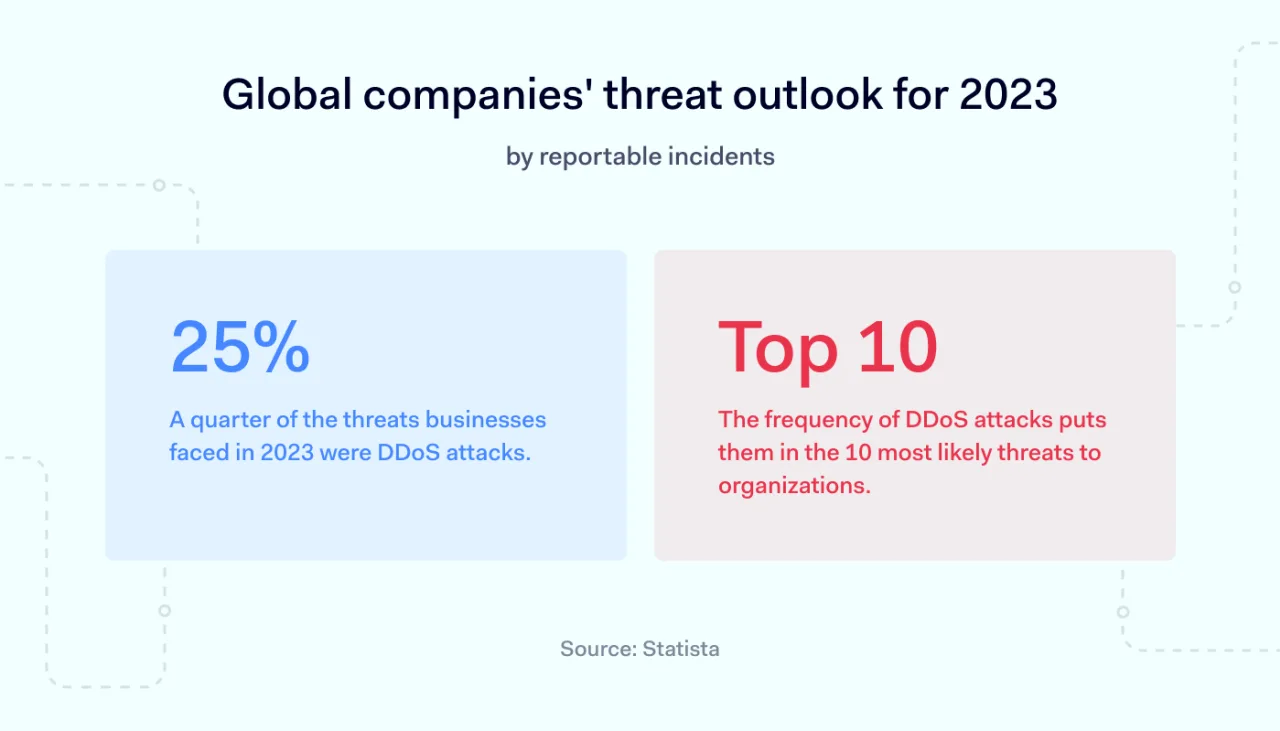
  • DDoS attacks remain a significant threat, with a growing frequency and sophistication. In 2023, there was a 25% chance for organizations to face such attacks.

  • DDoS attacks come in various forms: application-layer attacks that target server response mechanisms, volume-based attacks that overwhelm traffic, and protocol attacks that exhaust server and network resources.

  • To prevent DDoS attacks effectively, organizations should implement a multi-layered strategy.

  • NordLayer’s Cloud Firewall, a key part of its security solutions, employs segmentation principles to reduce the attack surface and filter legitimate traffic.

A DDoS attack is a malicious attempt to disrupt normal traffic of a server, service, or network. It overwhelms the target or its surrounding infrastructure with a flood of internet traffic by overloading server capacity. With the frequency of DDoS attacks increasing, it’s crucial for businesses to understand and implement strategies to mitigate these threats.

While phishing attacks and malware are taking the lead on the list of cyber threats businesses are exposed to, DDoS attacks remain relevant when protecting your business. In 2023, organizations faced a 25% chance of dealing with a DDoS attack.

DDoS attack statistics

The risk of being attacked makes it relevant to include DDoS attack prevention in the organization’s cybersecurity strategy. This helps avoid any business disruption like a traffic jam to the website or unavailable service.

How does a DDoS attack work?

Understanding DDoS attacks begins with recognizing the internet traffic as a network of information exchange. 

Imagine a bustling city intersection where cars represent data packets. Now, a DDoS attack is akin to this intersection being suddenly overwhelmed by an orchestrated fleet of vehicles, blocking regular traffic. 

In the digital world, this fleet consists of numerous compromised computer systems, including personal computers and Internet of Things (IoT) devices, controlled by an attacker. These systems are often infected with malware, allowing the attacker to command them remotely.

In a DDoS attack, these hijacked systems are used as a force to generate massive amounts of network traffic, all directed at a single target, such as a website or an online service. 

This influx of traffic from multiple locations creates a massive bottleneck, flooding the target with more requests than it can handle. In this scenario, the victim struggles to differentiate between legitimate and malicious traffic, much like a security guard trying to identify troublemakers in a crowd. 

This makes it challenging to maintain normal operations without also unintentionally blocking legitimate users. Consequently, the targeted site or service becomes slow or completely unresponsive, leading to downtime and potential business losses.

Proactive DDoS defense is critical for businesses

  • At the end of 2023, companies experienced the biggest DDoS attack in the digital history. 

  • Some of the affected parties were large organizations like Google and Amazon.

  • The attack methods generally involved overwhelming the targeted systems with massive amounts of traffic spikes.

  • Affected companies confirmed that malicious actors exploited a weakness in HTTP/2 (a newer version of the HTTP network protocol).

  • The outcomes of these attacks were significant, leading to widespread service disruptions and highlighting the growing need for robust cybersecurity measures.

What are the common types of DDoS attacks?

DDoS attacks come in various forms, each uniquely crafted to disrupt, overwhelm, and hinder. 

Understanding these common attack types isn’t just about knowing how they work but also about getting into the minds of the attackers. These attacks range from flooding with too much traffic to using clever requests to drain resources. 

This knowledge is crucial for anyone looking to fortify their digital defenses against these cyber threats. DDoS attacks vary in form and method, but the primary types include:

Application-layer attacks

App-layer attacks target specific aspects of an application or service. 

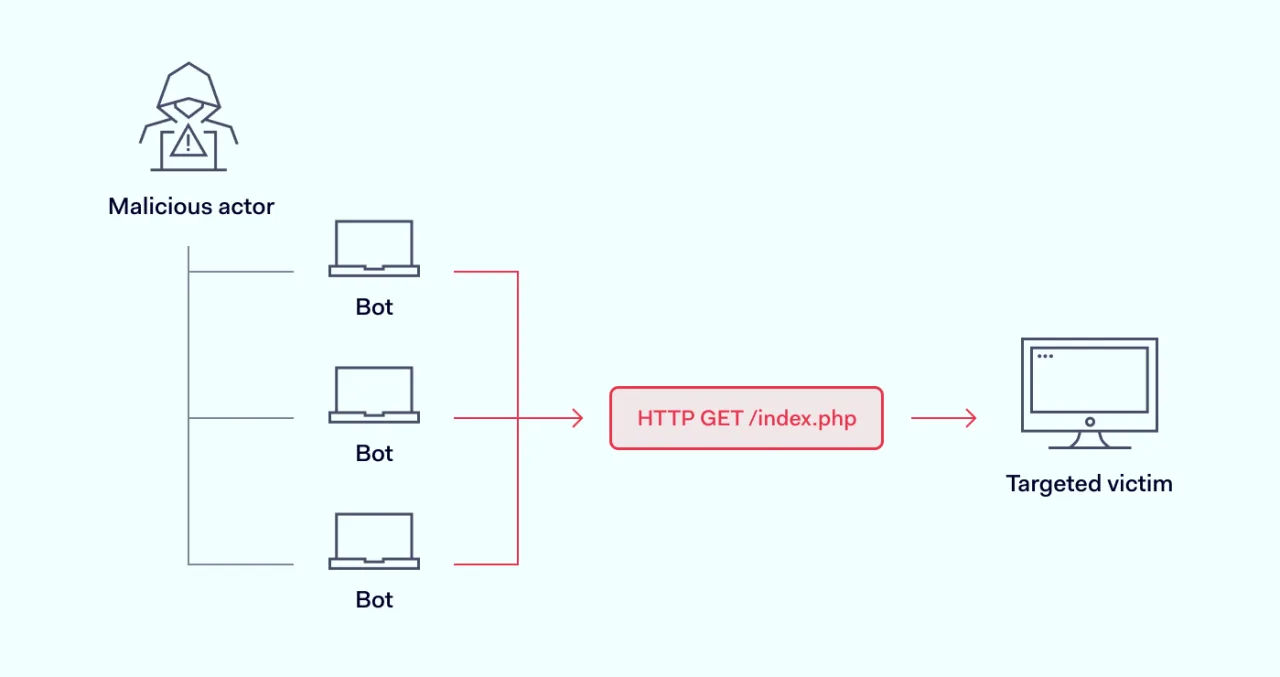
This type of attack focuses on the layer where servers generate responses to client requests. They use bots to overload the server by repeatedly requesting the same resource, like HTTP flood attacks, which keep sending HTTP requests using different IP addresses.

Application-layer attacks

Volume-based attacks

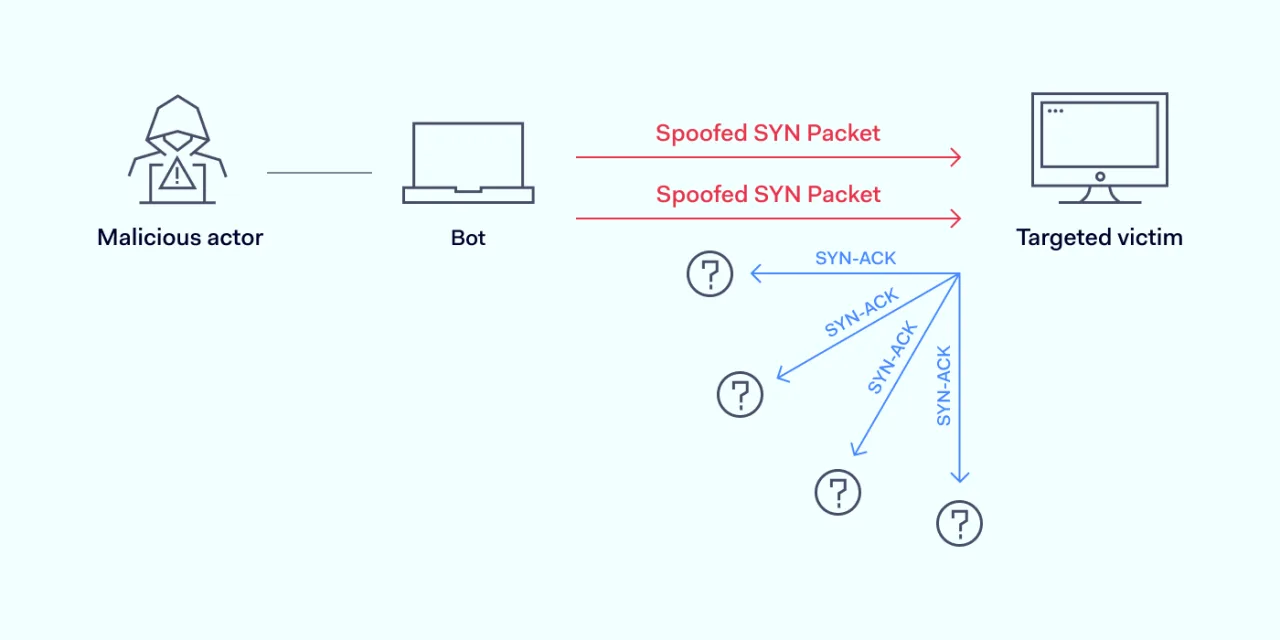
Volume-based–or volumetric–attacks involve overwhelming a system with large traffic volumes.

Volumetric attacks aim to deplete server resources or those of networking systems, such as firewalls or load balancers. A common example is the SYN flood attack, where numerous SYN packets are sent to a server, causing it to crash due to waiting too long for responses.

Volume-based attacks

Protocol attacks

Protocol attacks consume actual server resources or those of intermediate communication equipment, like firewalls and load balancers.

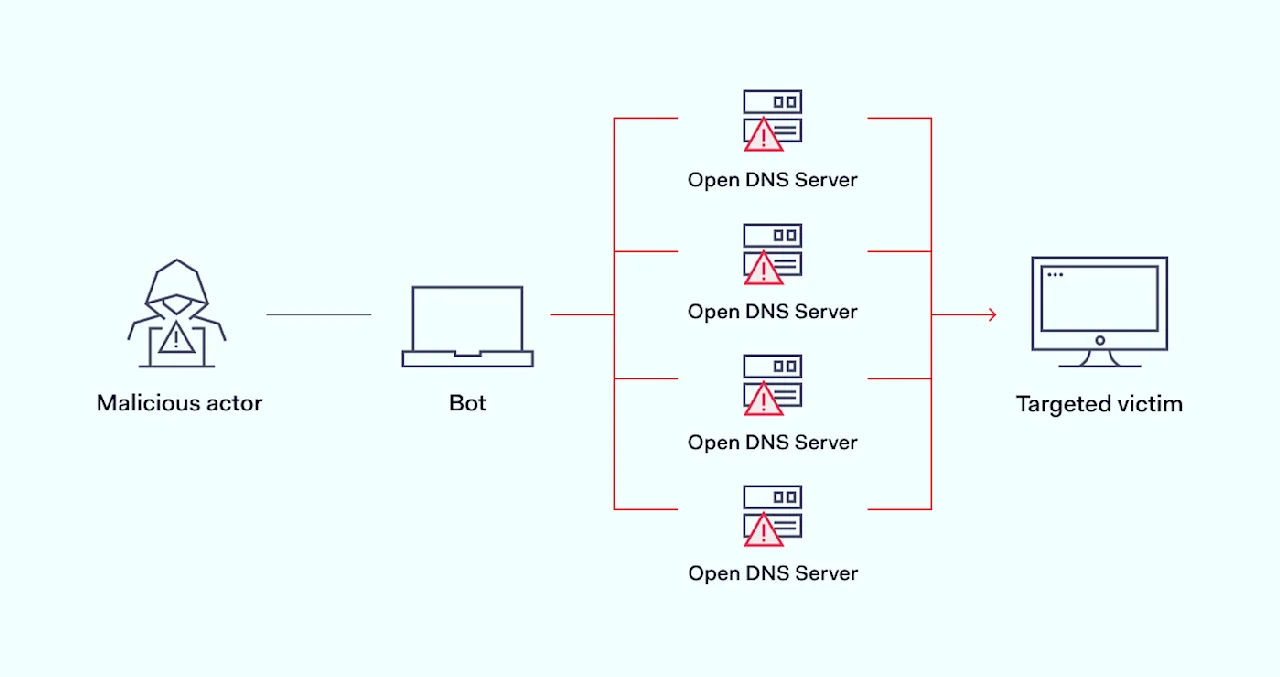
They involve bombarding a server with excessive traffic, exhausting its bandwidth. An example is the DNS amplification attack, where large numbers of DNS responses are sent to the target server, overwhelming it.

Protocol attacks

Each type of protocol attack employs different methods to overload and incapacitate servers or network resources, highlighting the need for robust and versatile defense strategies. 

7 ways to prevent DDoS attacks

Organizations must adopt comprehensive and multi-layered strategies to counter the threat of DDoS attacks effectively. Here are seven key ways to enhance your defense:

1. Enhanced network redundancy

Distributing network resources across multiple locations isn’t just about avoiding a single failure point. It’s like creating a web of pathways where information can travel. 

Imagine a city with multiple roads leading to the same destination. If one road is blocked, traffic smoothly diverts to the other ones. 

Similarly, in network redundancy, data centers play a crucial role. They spread traffic loads, making it difficult for DDoS attacks to target a single weak spot. This strategy is key to building several bridges, so if one falls, others still stand, ensuring the continuous data flow.

2. Robust infrastructure development

Think of your network as a fortress. The walls are your firewalls, the watchtowers are your intrusion prevention systems, and the gates are your security protocols. 

Building a robust network architecture is like fortifying this fortress with various layers of defense. This multi-tiered approach is essential in managing unexpected traffic surges. It’s like having a strong foundation that can support the weight of sudden, heavy loads, ensuring that the network’s flow remains uninterrupted even under the pressure of an attack.

3. Securing the network perimeter

Regularly updating and patching network systems is like continuously reinforcing the walls of your digital fortress. Each update acts like a new layer of armor, closing chinks that attackers might exploit. 

This ongoing maintenance is critical in keeping your network resilient against intrusion attempts. Monitoring IP addresses is like having vigilant guards scanning the horizon for potential threats, ready to raise the alarm and shut the gates against malicious intruders before they can breach your network’s defenses.

4. DDoS protection services

Utilizing DDoS protection services is akin to having an elite security team with advanced tools at your disposal. 

These services, including Firewall as a Service (FWaaS) solutions, are like specialized agents trained to recognize and neutralize specific threats. They keep a watchful eye for volumetric attacks, ensuring your network remains safeguarded against massive, disruptive traffic influxes. 

Think of these services as your rapid response team, always ready to spring into action to maintain the sanctity of your network.

5. Proactive traffic monitoring

Consistent network traffic monitoring is like having a high-tech surveillance system. It lets you detect unusual activity patterns, like traffic spikes, which could signal an upcoming DDoS attack. 

This kind of vigilance enables a swift response, preventing potential threats from escalating. It’s about being one step ahead, recognizing the signs of trouble before they blow up into full-scale attacks.

6. Incident response planning

Having a well-defined incident response plan for DDoS attacks is like having a detailed emergency drill.

Your team knows exactly what to do, how to do it, and when to act. This preparation is key to dealing with threats efficiently, ensuring minimal operational disruption. A good response plan is a playbook that guides your team through a crisis, minimizing chaos and confusion.

7. Employee training

Educating staff about DDoS attack signs and response measures turns your employees into a frontline defense. It’s like training every individual in your organization to spot potential threats and react promptly. 

When your team can recognize early warning signs, such as unusual network slowdowns, they become an integral part of your defense strategy, contributing to quick threat identification and mitigation. This collective awareness is a powerful tool in maintaining the overall security posture of your network.

How NordLayer can help

NordLayer provides a comprehensive approach to network security, with its Cloud Firewall being a standout feature in its arsenal against digital threats, including DDoS attacks. 

This Cloud Firewall is designed not just as a barrier but as a smart filter that adapts to your network’s unique needs. It employs segmentation principles, which are critical to dividing a large, vulnerable surface into smaller, more manageable, and secure zones. 

NordLayer’s Cloud Firewall effectively narrows the attack surface by segmenting the network. This is crucial because a smaller attack surface is less attractive and more challenging for attackers to exploit.

The segmentation works by categorizing network traffic and access points, thus allowing only legitimate and necessary communication to pass through. This targeted filtering significantly reduces the risk of malicious traffic infiltrating the network. 

Are you considering implementing NordLayer’s Cloud Firewall to your security infrastructure to prevent DDoS attacks and other risks? Contact us to learn more about our comprehensive, secure network access solution now.

FAQ

What are the first steps in DDoS protection?

To initiate DDoS protection, start by evaluating your network’s vulnerabilities. Identify critical assets and potential attack vectors. Implementing a robust network infrastructure with redundancy is crucial. This means having your resources spread across various data centers, ensuring no single point of failure. It’s like diversifying your defenses across multiple fortresses instead of just one. Doing so creates a resilient network that’s harder to compromise, significantly helping to prevent attacks.

How can I mitigate DDoS attacks through network configuration?

Mitigating DDoS attacks starts with smart network configuration. Use techniques like rate limiting, which controls the amount of traffic a server accepts over a specific period. Implement geofencing to block or limit traffic from regions that aren’t relevant to your business. Also, configure your network hardware to reject malformed packets and filter out traffic likely to be part of an attack. These steps form a proactive barrier, helping to prevent attacks before they escalate.

Can a firewall stop a DDoS attack?

Cloud firewalls play a crucial role in DDoS attack prevention. They can filter out some malicious traffic and protect against certain attack types. Additional DDoS mitigation measures, such as specialized services and traffic monitoring, are often necessary to effectively counter these attacks. It’s essential to have a comprehensive cybersecurity strategy that combines firewall defenses with other security layers for robust DDoS protection.

About Version 2 Digital

Version 2 Digital is one of the most dynamic IT companies in Asia. The company distributes a wide range of IT products across various areas including cyber security, cloud, data protection, end points, infrastructures, system monitoring, storage, networking, business productivity and communication products.

Through an extensive network of channels, point of sales, resellers, and partnership companies, Version 2 offers quality products and services which are highly acclaimed in the market. Its customers cover a wide spectrum which include Global 1000 enterprises, regional listed companies, different vertical industries, public utilities, Government, a vast number of successful SMEs, and consumers in various Asian cities.

About NordLayer
NordLayer is an adaptive network access security solution for modern businesses – from the world’s most trusted cybersecurity brand, Nord Security.

The web has become a chaotic space where safety and trust have been compromised by cybercrime and data protection issues. Therefore, our team has a global mission to shape a more trusted and peaceful online future for people everywhere.

About NordLayer
NordLayer is an adaptive network access security solution for modern businesses – from the world’s most trusted cybersecurity brand, Nord Security.

The web has become a chaotic space where safety and trust have been compromised by cybercrime and data protection issues. Therefore, our team has a global mission to shape a more trusted and peaceful online future for people everywhere.