Skip to content

How to prevent malware attacks

You’re a well-respected American professor and consultant for government agencies, deeply involved in national security. In the middle of your packed schedule, an email arrives from what seems like a respected colleague asking for your thoughts on their article.

Flattered, you open the attached PDF, but the text is garbled. Assuming it’s a simple glitch, you ask for a clearer copy but instead get a link to a “decryption” tool. Without hesitation, you click on it, only to lose access to all your data—putting your contacts at risk, too.

This breach is the work of Cold River, tied to the Russian state, using “SPICA” malware. They’ve moved from phishing to malware via PDFs, targeting professionals like you for espionage. “SPICA” gives them deep access to steal sensitive information, showcasing the need for constant cybersecurity vigilance.

Key takeaways

  • Malware can harm computers, networks, and devices, putting your data and money at risk. 

  • Different malware types, like ransomware, Trojans, spyware, adware, and worms, each pose their unique threats. 

  • It spreads via phishing emails, malvertising, exploit kits, and social media scams, taking advantage of software flaws. 

  • To spot malware, watch for slow computers, unexpected data sends, and strange file changes. 

  • Fighting malware means using strong endpoint protection, keeping software up-to-date, and educating your team. 

  • NordLayer’s security solutions greatly lower the chance of malware attacks, helping to keep your information safe.

What is malware?

Malware is software that’s made to damage or misuse computers, networks, and devices. It sneaks into systems through weak spots or tricks, like phishing emails, to do things it shouldn’t. This includes taking private data, harming how systems work, or letting hackers in. Malware is risky because it can cause big money problems, leak private info, and interrupt important services, affecting everyone from people to governments.

Getting malware attacks is cheap, too. By March 2023, top-notch malware services were going for up to $4,500 for every 1,000 installs from dark marketplaces.

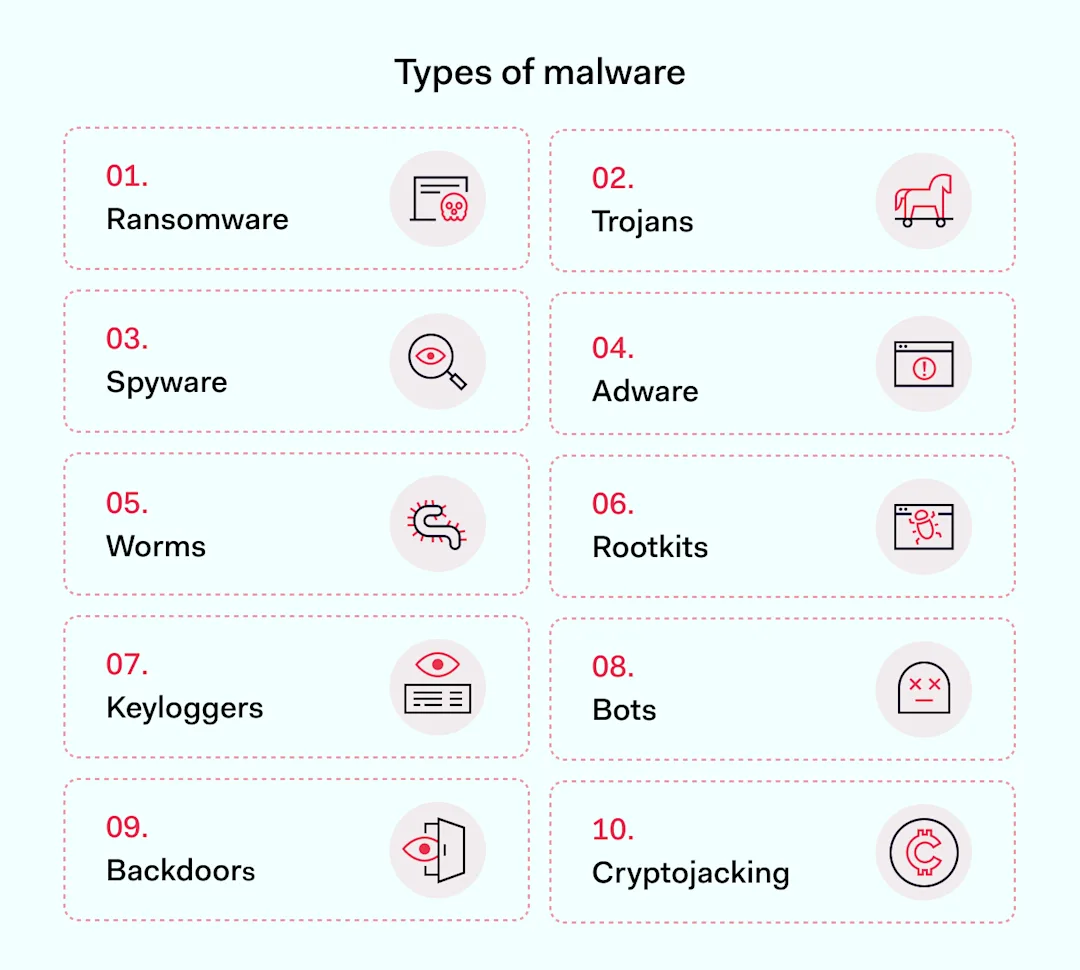
Types of malware

In 2023, we’ve seen a rise in malware that threatens both people and companies in unique ways.
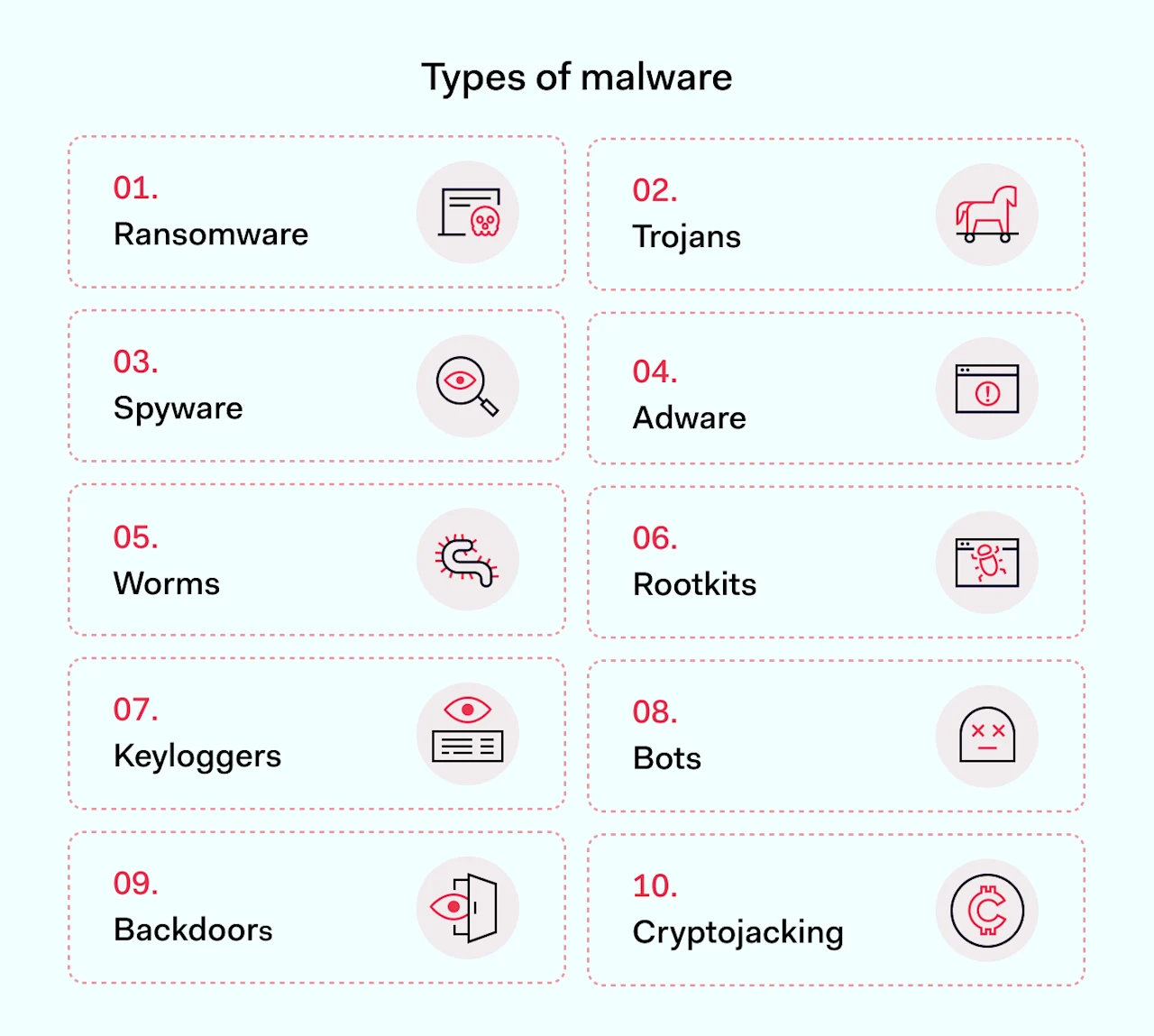
Types of malware

Ransomware is a type of malware that locks data and asks for payment to unlock it. It got worse, also now demanding ransom in cryptocurrency. Ransomware attacks jumped 70% by September 2023 from the year before. The MOVEit software breach affected over 2,300 organizations, revealing private info like health records. The “cl0p” gang’s attack shows how advanced ransomware has become.

Trojans pretend to be safe software to steal data or take control remotely. They now target PCs, Macs, and mobile devices more than ever. Downloading risky content or ignoring updates can invite Trojans, reminding us to stay alert and keep our software fresh.

Spyware secretly collects personal details like what you type and where you go online. This risk highlights the need for safe web habits and spyware protection tools.

Adware might be less harmful but annoys you with unwanted ads and might track you online. This shows why using ad blockers and valuing privacy online matters.

Worms spread through networks by finding weak spots in software, stealing data, or hogging bandwidth. This points to the urgent need to update systems and secure networks.

To deal with these malware types, keeping network security practices sharp, educating ourselves and others, and strengthening our cyber defenses are key.

How is malicious software distributed?

Malware distribution has gotten trickier, using both tech smarts and cunning tricks to sneak into systems and trick people. Here’s a rundown of common ways it spreads:

  1. Phishing emails. Simple but effective, these emails trick people into clicking harmful links or attachments, often looking like they’re from real companies or friends.

  2. Malvertising. This method puts malware into ads on legitimate websites. Just visiting the site might infect a user; no clicks are needed.

  3. Exploit kits. These tools find and use weaknesses in software or systems to slip malware in when someone visits a compromised site.

  4. Social media scams. Fake profiles or messages on social platforms can spread malware, using tempting offers or urgent warnings to lure clicks to dangerous sites.

  5. Supply chain attacks. Here, malware is hidden in software before it even gets to the user, aiming to hit many targets at once.

  6. RDP attacks. More people working remotely means more malware attacks on the Remote Desktop Protocol, where thieves use stolen details to get into systems and plant malware.

  7. File-sharing services. Malware disguised as regular files on sharing sites can trick users into downloading harm.

  8. Spear phishing and whaling. These personalized malware attacks target specific people or companies or go after big fish with the aim of a big payoff.

  9. Zero-day vulnerabilities. Unknown flaws in software are gold for cybercriminals, letting them attack before a fix is out.

  10. Mobile malware apps. Bad apps in app stores can look legit but are really malware in disguise, aiming to infect phones and tablets.

How to recognize malware

For businesses, spotting malware quickly is key to keeping their data safe.

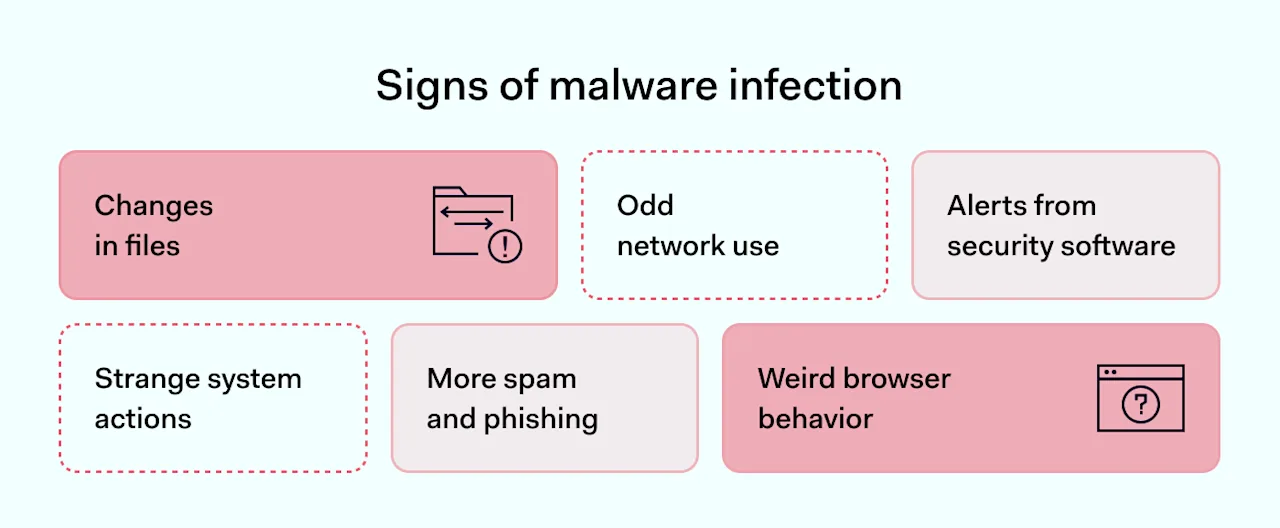
Look out for these signs that might suggest malware presence in your operating system.
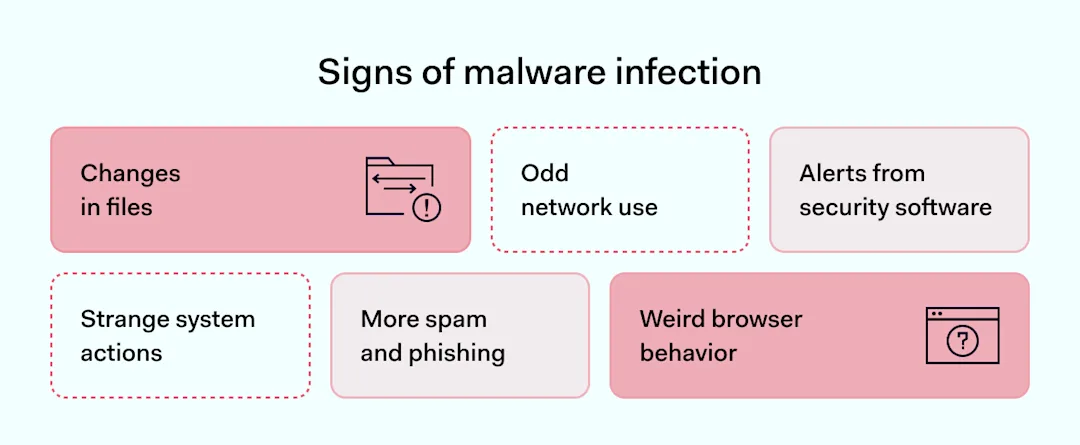
Signs of malware infection Strange system actions

  • Devices or networks slow down might mean malware is using up resources.

  • Systems crash or show errors, which could be malware messing with them.

  • Programs open or install by themselves might be due to malware.

Odd network use

  • Unexpected data sent out could be malware stealing sensitive information.

  • New, unauthorized network connections might be a sign of malware.

Changes in files

  • Files change or vanish without user action, pointing to malware.

  • New files or programs that users didn’t install appear, indicating malware.

Alerts from security software

  • Antivirus gives warnings; it might be spotting malware.

  • A firewall gives out unusual alerts about blocked connections or port access attempts, signaling malware.

More spam and phishing

A rise in phishing emails can show a malware attack is underway.

Weird browser behavior

Browser redirects to odd sites, home page changes, or more pop-ups can indicate malware.

To detect malware, you need:

  • Scan systems regularly with the latest antivirus and anti-malware tools, especially after installing new software.

  • Watch network traffic for any strange activity with monitoring tools.

  • Train employees to recognize and report malware signs.

  • Update all software to close off vulnerabilities.

  • Use advanced protection like ATP solutions for better defense against malware.

Spotting malware early helps businesses react fast to reduce harm. Having a clear plan for when you suspect malware is crucial.

How to prevent malware

To keep businesses safe from malware, a well-rounded cybersecurity strategy is essential. Here are the top seven steps businesses can take:
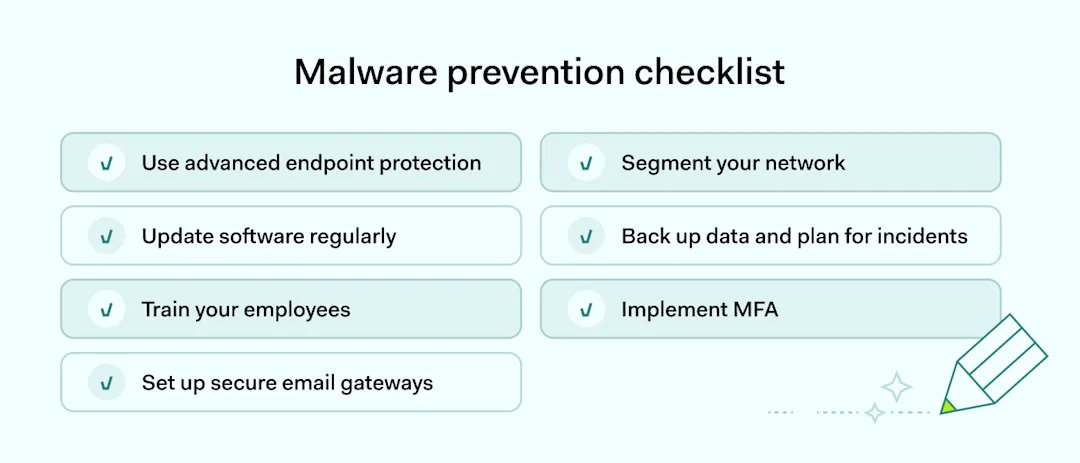
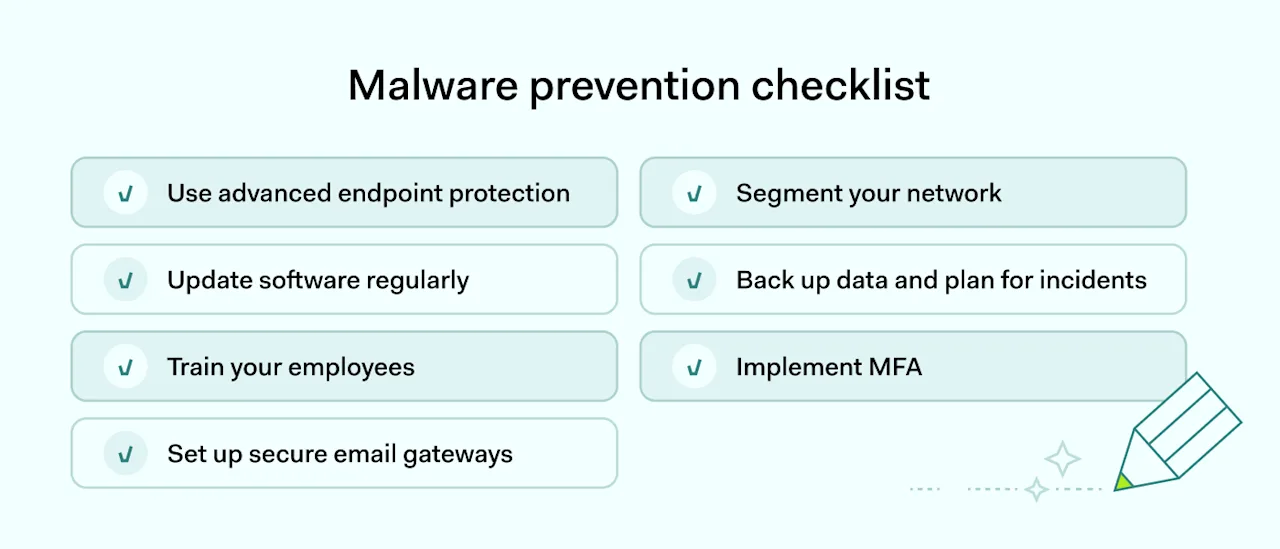
Malware prevention checklist

Use advanced endpoint protection

Opt for antivirus and EDR (Endpoint Detection and Response) solutions that detect and neutralize malware using machine learning. These tools scan for unusual activities and help effectively remove malware. An EDR system, for example, could prevent a ransomware attack by identifying and isolating the threat before it encrypts any files. 

Update software regularly

Ensure your operating system, applications, and network devices are always updated. Outdated software is a prime target for hackers. The WannaCry ransomware incident is a stark reminder: it exploited unpatched Windows systems worldwide. Apply updates promptly for malware prevention.

Train your employees

Educate your staff about the dangers of malware and the importance of verifying new software sources before downloading. Practical training sessions can reduce malware risks by teaching employees to recognize phishing scams, a common malware delivery method. Remind everyone to scrutinize email senders and not to click on suspicious links, which can prevent many potential breaches.

Set up secure email gateways

Deploy email security solutions that filter phishing scams and dangerous links in advance. Use sandboxing technologies that safely analyze dubious email attachments. This step helps stop malware at the entry point.

Segment your network

Divide your network into segments to better manage and contain potential malware spread to other computers. Implementing strict access controls ensures that users have access only to necessary resources. That limits the impact if data is compromised. 

Network segmentation proved effective during the NotPetya malware outbreak, as it helped contain the spread within segmented parts of the network, minimizing overall damage.

Back up data and plan for incidents

Back up your data and have a plan ready for any incidents. Always keep important resources backed up in places separate from your main network, and keep updating your plan for dealing with cyber threats.

Having backups means you can get back on track without paying off ransomware, keeping your data and money safe.

Implement Multi-Factor Authentication (MFA)

Add MFA for better security. It helps keep your operating system safe, even if someone guesses your password. Using MFA makes it much harder for hackers to break in, as they can’t easily bypass this extra security step.

How NordLayer can help

NordLayer offers strong tools for businesses to fight malware with advanced threat prevention and Zero Trust Network Access (ZTNA).
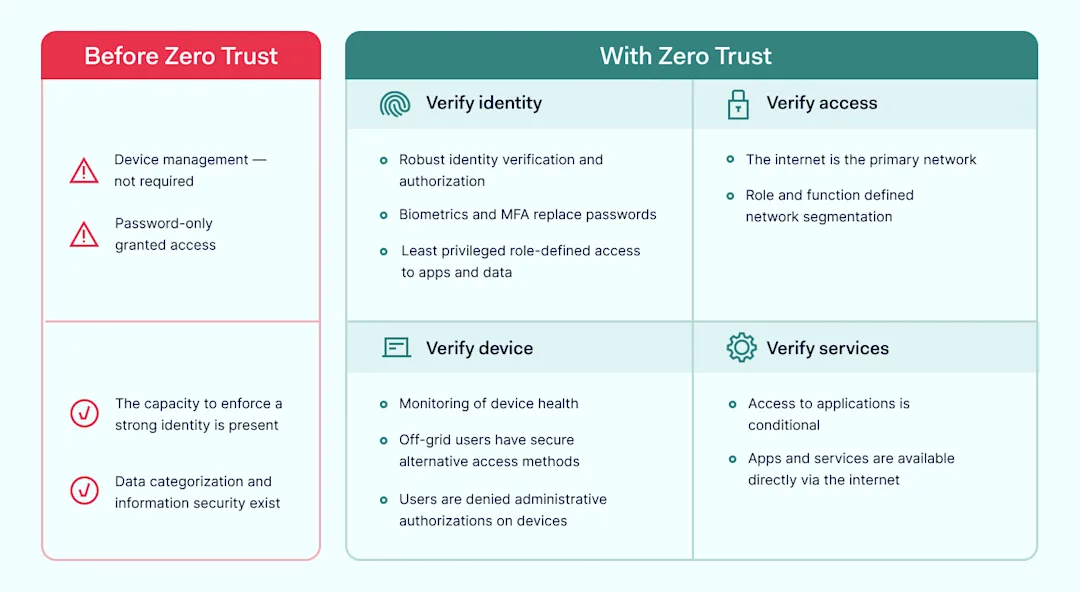
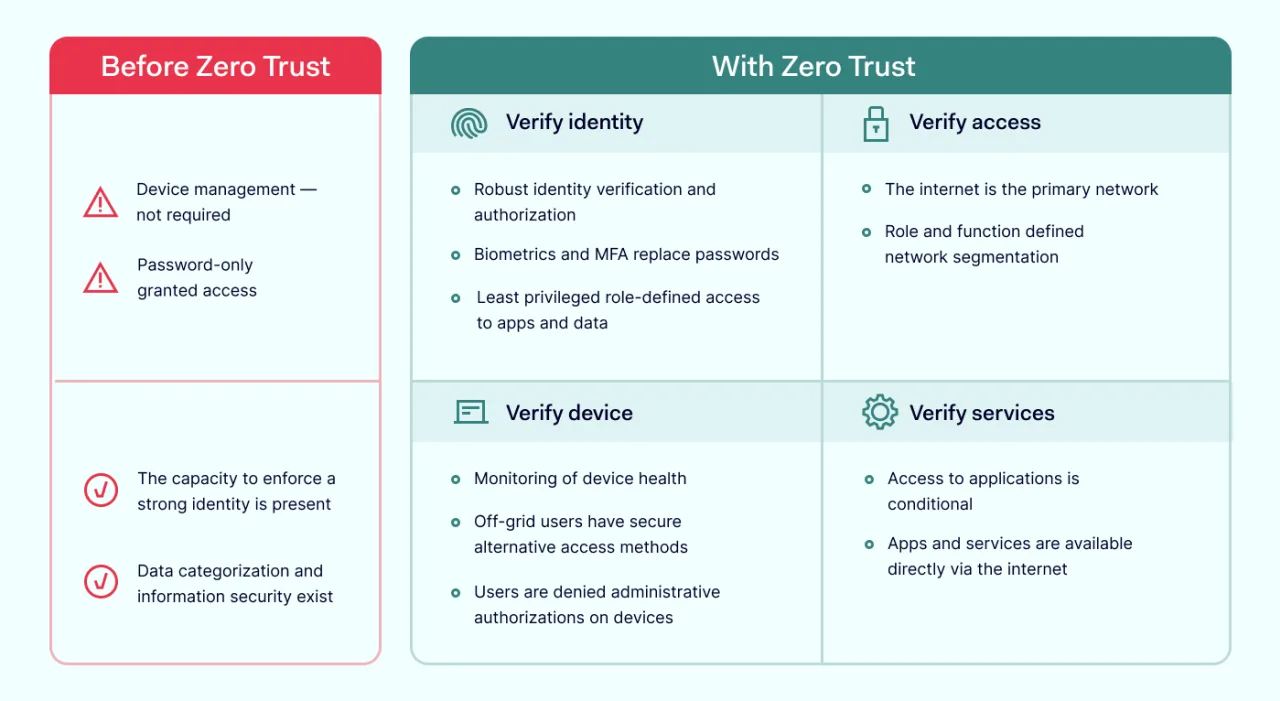
Zero Trust best practices

NordLayer proactively fights threats to keep your data safe. It uses tools and rules that protect every part of your network.

This includes:

  • Stopping advanced threats. NordLayer uses multiple security layers to protect against complex malicious software and phishing.

  • Protecting the network. It keeps your network safe, guarding against threats from outside, no matter where your devices are.

  • Quick incident response. If there’s a breach, NordLayer acts fast to limit damage and keep your data safe.

NordLayer’s ZTNA means not trusting any connection by default. This method checks every access attempt carefully, offering:

  • Secure access and segmentation. NordLayer makes sure users can only reach what they need to, keeping your data safer.

  • Lower insider threat risk. By controlling access tightly, NordLayer reduces the chance of data breaches.

  • Remote work security. NordLayer’s ZTNA protects remote workers, giving them secure access to what they need quickly.

  • A better alternative to VPNs. NordLayer’s ZTNA is a safer option, allowing remote users access only to necessary apps that protect your internal resources.

Using NordLayer’s strategies, businesses can protect themselves against malicious software, keeping their operations secure and running smoothly.

Contact our sales for further assistance.

About Version 2 Digital

Version 2 Digital is one of the most dynamic IT companies in Asia. The company distributes a wide range of IT products across various areas including cyber security, cloud, data protection, end points, infrastructures, system monitoring, storage, networking, business productivity and communication products.

Through an extensive network of channels, point of sales, resellers, and partnership companies, Version 2 offers quality products and services which are highly acclaimed in the market. Its customers cover a wide spectrum which include Global 1000 enterprises, regional listed companies, different vertical industries, public utilities, Government, a vast number of successful SMEs, and consumers in various Asian cities.

About NordLayer
NordLayer is an adaptive network access security solution for modern businesses – from the world’s most trusted cybersecurity brand, Nord Security.

The web has become a chaotic space where safety and trust have been compromised by cybercrime and data protection issues. Therefore, our team has a global mission to shape a more trusted and peaceful online future for people everywhere.

About NordLayer
NordLayer is an adaptive network access security solution for modern businesses – from the world’s most trusted cybersecurity brand, Nord Security.

The web has become a chaotic space where safety and trust have been compromised by cybercrime and data protection issues. Therefore, our team has a global mission to shape a more trusted and peaceful online future for people everywhere.

Meet the Team: solution and industry forecast with the Head of Product

Product is the epicenter of any company, and NordLayer is no exception. Its performance, development, and promise to customers are the staples that help us grow as a service provider. The driving force behind it belongs to the product team led by the Head of Product Andrius Buinovskis

Although his time is always in high demand, he spared us a few moments to answer some questions about the product roadmap and the future of network security. Andrius shares his perspective on evolving threats such as phishing and the rise of ransomware syndicates exploiting human vulnerabilities through social engineering. 

Let’s dive into an insightful interview with Andrius to gain perspectives on projected challenges and how NordLayer is advancing solutions to stay ahead of rapidly evolving cyber threats.

Andrius, as an industry expert, what projections do you see for the future of network security? Will it bring something new, or will the industry continue in the previous years’ direction?

From what we can observe in the market, the future of network security is on a trajectory of rapid advancement, much in line with recent years but accelerated significantly by artificial intelligence (AI). This acceleration will not necessarily introduce wholly new directions but will enhance the speed and sophistication of developments within existing trends. Here are a few projections:

Projections of persistent threats

  1. Phishing attacks (Voice, SMS, email). Phishing remains the cornerstone of cyber threats, continually evolving and targeting countless victims every second. Its persistence and evolution make it a primary concern. As technologies advance, so do the methods of phishing attacks, becoming more sophisticated and harder to detect.

  2. Ransomware and malware. The ease with which bad actors can now access ransomware and malware “as a service” underscores the growing threat landscape. These tools have democratized cyber attacks, making it easier for attackers to launch sophisticated attacks without needing extensive technical know-how.

  3. Misconfigurations and low awareness. In third place, the human element—misconfigurations and a general lack of awareness about potential threats—remains a significant vulnerability. Social engineering exploits these weaknesses, tricking individuals into compromising security through seemingly harmless interactions.

How do these projections relate to cyber threats? What security strategies/practices could best help prevent them?

The tendencies observed in the cyber threat landscape confirm that cyber threats are evolving and becoming more sophisticated and widespread. 

The consistency of fundamental challenges like phishing, ransomware, malware, and human error vulnerabilities underscores the dynamic nature of cyber threats. Integrating AI into security strategies signifies a significant shift, suggesting that while the core types of threats may remain stable, their complexity and the methods to combat them must rapidly evolve.

To effectively counter these threats, a two-way approach is necessary:

  • Reducing misconfigurations and enhancing awareness. The first line of defense is to address the human element. 

    This involves dedicating time and resources to minimize misconfigurations through rigorous system checks and enhancing the cybersecurity awareness of all individuals within an organization. 

    Educating users on the potential threats and how to avoid them can significantly reduce the risk of successful attacks.

  • Adding additional layers of security. Implementing solutions like NordLayer adds an essential layer of security. 

    Products that provide secure network access, data encryption, and threat monitoring can greatly enhance an organization’s defense mechanisms against evolving cyber threats.

While cyber threats continue to grow in sophistication, focusing on foundational security practices—eliminating misconfigurations, raising awareness, and layering security solutions—remains key to preventing them. This approach addresses the current threat landscape and prepares organizations to adapt to future developments in cybersecurity.

How do NordLayer’s plans align with industry trends?

NordLayer’s strategy aligns directly with industry trends while also carving out a unique niche in the cybersecurity landscape. 

It’s critical for us to stay up-to-date on trends and understand where the industry is heading. This knowledge informs our product development, ensuring we’re keeping pace and anticipating future needs.

However, to truly stand out and add value for our clients, we recognize the importance of offering something more—something different

This is where innovations like the NordLynx protocol come into play. NordLynx is a prime example of how we differentiate our offerings. As potentially the fastest protocol available, it underscores our commitment to meet industry standards and set the new ones, providing our clients with superior speed, security, and reliability.

Our plans are twofold: align with industry trends to ensure relevance and forward-thinking, and innovate beyond the expected to deliver unique value propositions like NordLynx. This approach allows us to address current market needs while also setting new benchmarks in cybersecurity excellence.

Tell us about your typical workday here at NordLayer.

My workday combines leadership, exploration, and strategic planning to drive NordLayer forward. Thus, the days are primarily centered around meetings, which means that each morning I’m going over my calendar to prepare. This preparation involves clearly understanding the day’s topics and what I aim to achieve in each meeting.

My main focus areas are:

  • Supporting my team’s growth and helping them achieve our goals. This involves guidance, problem-solving, and ensuring everyone has the necessary resources.

  • Engaging in market discovery activities to understand our industry better, identify opportunities, and anticipate challenges.

  • Developing strategies to bring our plans to realization. This means turning insights and objectives into actionable steps and ensuring we move in the right direction.

Andrius, you and your team seem well-positioned to help organizations layer up advanced security solutions. What work experience have you brought? Compared to previous roles, how is NordLayer unique to work at?

I’ve navigated various industries and roles throughout my career, from banking and telecommunications to health insurance, e-commerce, and cybersecurity. I’ve worn many hats, starting as a programmer and eventually moving up to high-level managerial positions, but the common thread has always been my focus on IT.

Its comprehensive approach to cybersecurity sets NordLayer apart from my previous experiences. It feels like a culmination of my diverse background, where every aspect of my past work converges. 

Here at NordLayer, our services aren’t just another product on the market. They’re essential tools that any company, regardless of size, will need to safeguard their data and protect their employees. 

NordLayer stands out because it intersects necessity and simplicity, making it a unique and compelling workplace. It’s not just about responding to the market’s current demands but anticipating future cybersecurity needs, making our work both challenging and incredibly rewarding.

Provide an overview of your product team and its dynamics: structure, roles, and responsibilities.

If we look at the market, it’s typical that the product team stands between business and engineering. However, at NordLayer, the product team is the one that shows the direction and encourages all others to follow.

This team, consisting of product managers and product owners who are well aware of UX/UI trends, market research, and engineering perks, is critical in defining and advocating for our vision. 

The essence of our team dynamics revolves around a strong belief in our products and the ability to make them appealing and useful to our clients and even our team so they feel confident about the product. It’s about creating technically proficient products that resonate well with our users and employees, ensuring that our offerings are attractive and beneficial.

You and your team are responsible for the product and its further development. How do you define which direction to choose?

Choosing the right direction for product development involves a blend of analytical and strategic considerations. Here’s how we approach it:

  1. Historical demand analysis. We start by looking back at what our existing clients have requested. Understanding the needs and feedback of those who already use our services gives us a direct line to what’s working and what could be improved or expanded.

  2. Market projections. We then shift our gaze forward, analyzing market trends and projections. This helps us anticipate where the industry is headed and what needs might arise in the future, ensuring our product remains relevant.

  3. Competitor portfolio analysis. Knowing what’s out there is crucial. We meticulously examine our competitors’ offerings to identify gaps in the market we can fill and to understand how our product can offer unique value.

  4. Current technical and capacity capabilities. It’s essential to match our aspirations with our abilities. We assess our current technical resources and capacity to ensure that our chosen direction is feasible and sustainable with our available resources.

  5. Internal insights and expertise. Finally, we tap into our team’s wealth of knowledge and experience. Leveraging our internal insights and expertise ensures that our decisions are not just data-driven but also infused with the practical wisdom of our seasoned team members.

By integrating these factors, we aim to make informed, strategic decisions that steer our product development in a direction that meets current demands, anticipates future needs, and capitalizes on our unique strengths.

You most recently released Cloud Firewall and Device Posture Monitoring features, a massive improvement in network security offering. So, what’s next? How does NordLayer’s roadmap look for 2024?

For 2024, NordLayer is set on a path of continuous improvement and innovation. Our recent launches, Cloud Firewall and Device Posture Monitoring, significantly enhanced network security. But we’re not stopping there. Our focus for the upcoming year includes two main areas:

NordLayer near-future focus

  1. Enhancing existing services. We’re committed to refining and enhancing our current offerings. This means looking into how we can make our existing services more robust, user-friendly, and effective in addressing the evolving needs of our clients.

  2. Advancing network visibility tools. Recognizing the critical importance of visibility within network environments, we’re doubling down on developing tools that offer deeper insights into network activities. Visibility is key to making informed decisions, securing networks, and mitigating both internal and external threats efficiently.

In addition to these focal points, we’re also eyeing expansions into the upmarket with several strategic implementations:

  • Public API for service control. We plan to introduce a public API that allows for the automated control of our services. This move aims to cater to more sophisticated needs, enabling seamless integration and automation for our clients.

  • Other integrations. Recognizing the diverse ecosystem in which our clients operate, we’re working on developing additional integrations. These efforts are intended to ensure NordLayer fits smoothly into our clients’ existing workflows and systems, enhancing security without compromising efficiency.

In essence, NordLayer’s roadmap for 2024 is about deepening the value we provide to our clients through improving existing services and strategic advancements. Our goal is to remain at the forefront of network security, offering solutions that are not just cutting-edge but also tailored to the complex needs of modern organizations.

Thank you.


About Version 2 Digital

Version 2 Digital is one of the most dynamic IT companies in Asia. The company distributes a wide range of IT products across various areas including cyber security, cloud, data protection, end points, infrastructures, system monitoring, storage, networking, business productivity and communication products.

Through an extensive network of channels, point of sales, resellers, and partnership companies, Version 2 offers quality products and services which are highly acclaimed in the market. Its customers cover a wide spectrum which include Global 1000 enterprises, regional listed companies, different vertical industries, public utilities, Government, a vast number of successful SMEs, and consumers in various Asian cities.

About NordLayer
NordLayer is an adaptive network access security solution for modern businesses – from the world’s most trusted cybersecurity brand, Nord Security.

The web has become a chaotic space where safety and trust have been compromised by cybercrime and data protection issues. Therefore, our team has a global mission to shape a more trusted and peaceful online future for people everywhere.

About NordLayer
NordLayer is an adaptive network access security solution for modern businesses – from the world’s most trusted cybersecurity brand, Nord Security.

The web has become a chaotic space where safety and trust have been compromised by cybercrime and data protection issues. Therefore, our team has a global mission to shape a more trusted and peaceful online future for people everywhere.

Microsoft 365 Backup: What it means for SaaS data protection

At the Microsoft Ignite conference back in November 2023, Microsoft announced their release plans for their Microsoft 365 Backup service. Now that they’re in a paid public preview, with general availability being slated for basically now (first quarter, calendar year 2024), I thought “what better time than now?” to share my takeaways and what I believe this milestone means for SaaS data protection now and going forward. Here are three main points I’ll cover:

  • Welcome Microsoft to the backup space; 
  • What Microsoft’s backup service means for the SaaS data protection world; 
  • The Keepit promise.

Welcome to Microsoft into the backup space

First off, let’s give a warm welcome to Microsoft on their entrance to the backup space. As a long-time Microsoft community member, twenty-year Microsoft MVP, and Senior Director of Product Management at an industry-leading data protection vendor, I’d say Microsoft’s entry into the market validates what all the SaaS data protection vendors have long been saying about the strong need for Microsoft 365 data protection.

Ultimately, our mission is to protect critical SaaS data to help companies keep their business-critical data backed up, thereby ensuring continuity and compliance in face of rising ransomware threats. As long-time Microsoft partners — part of the ISV Partner Program — we at Keepit see this as an opportunity to have an even greater impact on the market. How’s that?

Well, we know that an overwhelming percentage of Microsoft’s enterprise customers have no backup. So, naturally, we want to bring that number down to boost cyber resilience of, say, critical infrastructure and critical services, and of course the market in general. So, how does Microsoft releasing their own backup help drive us forward?

Well, for one, it validates what we’ve been doing for more than 20 years. We’re built in the cloud, for the cloud, to protect cloud SaaS data. I guess a bit more practically speaking, another change is that we can now probably drop the top objection we faced from customers over that time: That cloud SaaS data doesn’t need backup.

What does Microsoft 365 Backup change? 

Now, let’s get into point two: What does Microsoft 365 Backup mean for SaaS data backup? Well, all the vendors in this space have long had to challenge the popular notion that data being in the cloud was, by default, automatically and perfectly protected. And many of us have talked at length about Microsoft’s shared responsibility model where Microsoft themselves clearly state that you, the customer, are responsible for backup of information and data, including your devices and accounts and identities.

Microsoft has built an amazing record of service quality and resilience, but their primary focus has been on protecting your data against Microsoft losing it. The Microsoft 365 Backup offering is the start of Microsoft’s journey into protecting your data against other threats, including malicious attacks, mistakes, misbehaving automations, and other misfortunes.

The optimist in me hopes that now, with Microsoft themselves developing their own backup service, we can finally put the shared responsibility model into its proper perspective. Of course you need to back up your Entra ID, M365, and other SaaS application data because clearly you are responsible for your data. Why else would Microsoft release a backup service if you weren’t responsible for it all along?

Now, aside from that original objection that perhaps can be laid to rest, at this point, not that much has actually changed with Microsoft’s announcement. That said, there sure is a newly awakened interest in data protection because of this release. This is how I see the typical train of thought playing out in response to the news:

  • We clearly need to back up our Microsoft SaaS app data. Why else would Microsoft be offering a backup service themselves?
  • Protecting our data is important because it helps us meet our business continuity and compliance requirements, but
  • To meet those requirements, we need our data available 24/7.

Let’s dive down a bit more into that last point there. How does a business guarantee access to their data no matter what happens, be it mistakes, mishap, or malice (like ransomware)? The answer is true backup.

The Keepit promise: True backup for cyber resilience 

To get to the Keepit promise, we first need to consider what the meaning of backup is. You might come across the term true backup (we use it ourselves from time to time) because ‘backup’ alone has been misused to cover things that it shouldn’t.

The canonical meaning of backup refers to storing instances of your data on an infrastructure separate from your primary data. If something should happen to your production data, your backups won’t be affected since they are separated by a physical or logical air gap.

In cloud computing, a lot of what’s being called backup is actually storing data on the same cloud as the primary data. What this means is that whatever risks you’re exposed to in your production environment would also impact your ‘backup’ data since there’s no separation. For example, an attacker who can penetrate your Entra ID tenant and can pivot into your Azure tenant holds all your Azure-based storage — including, and especially, backups — at risk.

The Keepit promise is to always offer the ultimate in data protection for multi-workload SaaS application data. By building our solution from the ground up for SaaS data protection only, we were able to create an optimized data protection solution in line with best practices like the 321 backup rule. Air gapping, immutability, and a fully redundant independent cloud are all things we’re already offering now in our service. So, it’s more the Keepit reality rather than the promise of adding in things later.

Protecting SaaS data is the Keepit mission and has always been — it’s not a feature we’re tacking on. As specialists in data protection, we provide confidence to thousands of customers that their data is here today and will be here tomorrow via our vendor-independent cloud. We look forward to working with Microsoft now and into the future to continue to lead the way in protecting SaaS data.

As we embark on this new chapter in SaaS data backup, I’d like to leave you with a question: What steps are you taking today to protect your control plane (Entra ID and Power Platform)? If you want to learn a bit more about control plane data protection, read my previous article on why you should back up Entra ID (Azure AD) in the cloud.

About Version 2 Digital

Version 2 Digital is one of the most dynamic IT companies in Asia. The company distributes a wide range of IT products across various areas including cyber security, cloud, data protection, end points, infrastructures, system monitoring, storage, networking, business productivity and communication products.

Through an extensive network of channels, point of sales, resellers, and partnership companies, Version 2 offers quality products and services which are highly acclaimed in the market. Its customers cover a wide spectrum which include Global 1000 enterprises, regional listed companies, different vertical industries, public utilities, Government, a vast number of successful SMEs, and consumers in various Asian cities.

About Keepit
At Keepit, we believe in a digital future where all software is delivered as a service. Keepit’s mission is to protect data in the cloud Keepit is a software company specializing in Cloud-to-Cloud data backup and recovery. Deriving from +20 year experience in building best-in-class data protection and hosting services, Keepit is pioneering the way to secure and protect cloud data at scale.

Keepit Partner Network: Growing partnerships to the next level

Leading the way with vendor-independent data protection

When I started in Keepit in July 2023, I knew that I was joining a very special company. Not only does the company have a great product, but it also has a great partner ecosystem and the two are key to having an impact on the market.

At the heart of data protection specialist Keepit’s success lies indeed a resilient and purpose-built cloud infrastructure — and also many long-lasting partner relationships.

The company’s platform, exclusively owned and operated independently from other cloud vendors, signifies a revolutionary shift in data protection strategies. Serving as the ultimate safeguard against potential data loss resulting from security incidents or unforeseen events, Keepit ensures that its partners empower clients to maintain control over their critical SaaS data.

And it’s not just a few workloads that we cover: Keepit’s unique easy-to-use platform ensures business-critical SaaS data from multiple SaaS applications, like Microsoft 365, Entra ID (Azure AD), Salesforce (and others) is kept immutable, accessible, and compliant with even the strictest of requirements. Learn more about Keepit’s security and compliance.

Keepit’s impressive scaling secures $40 million from HSBC Innovation Banking

On Jan. 9, 2024, Keepit announced that HSBC Innovation Banking has provided Keepit with a $40 million refinancing package together with The Export and Investment Fund of Denmark (IEFO). The fresh capital is earmarked to sustain the impressive growth trajectory and substantial expansion strategy of Keepit.

Keepit CEO and co-founder, Morten Felsvang, shares that the funding “is an infusion of confidence in our capabilities on all levels. And it means that we can continue our growth strategy at full throttle.”

Partners prove invaluable to Keepit’s growth and success

The Keepit Partner Network (KPN) highlights the company’s dedication to its channel ecosystem. Tailored for resellers, managed service providers, and distributors, this program elevates partner engagement with its tiered structure, ensuring customized support for diverse partner needs.

KPN is designed to propel partners toward unparalleled success within data protection together with Keepit. The recognition of Keepit with its addition as a scaler in the Canalys “Global Managed Backup and Disaster Recovery Leadership Matrix 2023” report underscores the program’s rapid growth and our outstanding performance. 


And in support of that commitment to growth, we’re setting our sights on crossing over into the coveted Canalys “Champions” category on our impressive journey by adopting a partner-only model. 


Keepit’s Partner Network emerges not just as a program but as a strategic cooperation for the future. Partners get the chance to be a hero for customers by offering them award-winning, next-level SaaS data protection that’s transparent in cost and incredibly easy to set up, onboard, and use. 

About Version 2 Digital

Version 2 Digital is one of the most dynamic IT companies in Asia. The company distributes a wide range of IT products across various areas including cyber security, cloud, data protection, end points, infrastructures, system monitoring, storage, networking, business productivity and communication products.

Through an extensive network of channels, point of sales, resellers, and partnership companies, Version 2 offers quality products and services which are highly acclaimed in the market. Its customers cover a wide spectrum which include Global 1000 enterprises, regional listed companies, different vertical industries, public utilities, Government, a vast number of successful SMEs, and consumers in various Asian cities.

About Keepit
At Keepit, we believe in a digital future where all software is delivered as a service. Keepit’s mission is to protect data in the cloud Keepit is a software company specializing in Cloud-to-Cloud data backup and recovery. Deriving from +20 year experience in building best-in-class data protection and hosting services, Keepit is pioneering the way to secure and protect cloud data at scale.

23.12.9 Voyager released

Changes compared to 23.12.8

New Features

  • Added support for Dark Mode to the Comet Server web interface

Bug Fixes

  • Fixed an issue preventing files from being backed up when stored in a OneDrive folder on MacOS
  • Fixed an issue in new Microsoft 365 SharePoint incremental backups referencing an invalid location in older snapshot formats
  • Fixed an issue with the Comet Server failing to start after deleting a tenant

About Version 2 Digital

Version 2 Digital is one of the most dynamic IT companies in Asia. The company distributes a wide range of IT products across various areas including cyber security, cloud, data protection, end points, infrastructures, system monitoring, storage, networking, business productivity and communication products.

Through an extensive network of channels, point of sales, resellers, and partnership companies, Version 2 offers quality products and services which are highly acclaimed in the market. Its customers cover a wide spectrum which include Global 1000 enterprises, regional listed companies, different vertical industries, public utilities, Government, a vast number of successful SMEs, and consumers in various Asian cities.

About Comet
We are a team of dedicated professionals committed to developing reliable and secure backup solutions for MSP’s, Businesses and IT professionals. With over 10 years of experience in the industry, we understand the importance of having a reliable backup solution in place to protect your valuable data. That’s why we’ve developed a comprehensive suite of backup solutions that are easy to use, scalable and highly secure.