Skip to content

5 privacy pitfalls that could damage your organization

In our previous blog posts, we covered a lot about security aspects, exploring various technical measures to safeguard organizations from cybersecurity threats. As we wrap up Privacy Awareness Month at Nord Security, we shift gears to the equally important topic of privacy protection. Join Eglė Bakštytė, Nord Security’s Lead Privacy & Marketing Legal Counsel, as she debunks some common privacy myths and offers expert tips for enhancing privacy practices within the organization. 

Eglė Bakštytė, Nord Security’s Lead Privacy & Marketing Legal Counsel

#1 Privacy is not the same as security

While related, data privacy and information security are different. Data privacy concerns the proper handling and protection of personal data to ensure it’s processed in accordance with privacy laws and individuals’ rights. Information security, on the other hand, focuses on measures and technologies to protect personal data from unauthorized access, cyber threats, and data leaks.

“There’s a common misconception that advanced encryption, firewalls, and intrusion detection systems guarantee the safety of customers’ or employees’ data. Unfortunately, that’s not the case. Due to privacy unawareness, malicious intent, and human error, personal data can still be compromised, even with robust security measures in place,” notes Eglė Bakštytė, Nord Security’s Lead Privacy & Marketing Legal Counsel.

One of the most common human errors is misdirected emails, often due to spelling mistakes, mistaken identity, autocomplete errors, using “To/Cc” instead of “Bcc,” or accidentally hitting “Reply All.”

In a notable incident in 2023, millions of US military emails were mistakenly sent to Mali, a Russian ally, because of a minor typing error. These emails contained sensitive information, including medical records, identity documents, military base staff lists, photos, naval inspection reports, crew lists, tax records, etc. US adversaries could exploit this data leak.

“Taking privacy protection for granted, even with strong security measures, doesn’t shield companies from the consequences of privacy unawareness or human errors. These can lead to severe fines from the authorities, claims from the affected individuals, operational disruptions, a tarnished reputation, and, as in the example mentioned above, even physical threats. It’s crucial to constantly remind employees about privacy best practices and the most common pitfalls to maintain vigilance in their duties,” explains Eglė.

#2 A privacy policy ensures compliance – but that’s not enough

It’s sometimes misunderstood that simply having a privacy policy and updating it from time to time fully ensures compliance with the privacy laws. A privacy policy, also known as a privacy notice, outlines how your company collects, processes, and uses personal data and how individuals can exercise their rights (e.g., access their personal data). However, this document alone doesn’t cover all legal obligations.

Eglė Bakštytė points out that updating the privacy policy is crucial, but before launching a new product or feature, there’s much more groundwork to do:

  • Identify the personal data you’ll process and its purpose: Know what personal data you’ll be collecting and why. Is it legal, and how will it be used?

  • Assess access: Define who will access the data and what vendors you’ll engage. Are these third parties trustworthy? Are all necessary agreements in place?

  • Empower users: Ensure your customers can easily exercise their control over their personal data.

  • Define the data lifecycle: Determine how long you will keep the personal data and how it will be erased.

  • Secure the data: Implement robust security measures to protect personal data.

Merely updating the privacy policy but failing to adhere to data processing principles and other legal requirements can lead to significant legal consequences and reputational damage. So, companies must ensure that their privacy practices are not just compliant on paper but also rigorously enforced throughout every aspect of their operations.

#3 Data doesn’t need to include a name to be personal data

Some still mistakenly believe that personal data must include a name or contact details, which are the most straightforward elements for identifying someone. However, privacy laws generally define personal data much more broadly. This consists of any information that can identify an individual either directly or indirectly, such as location data, credit card number, IP address, or cookie ID.

Because of this unawareness, individuals or organizations might unintentionally share data that could help identify a person, putting them at risk. A notable example involves the Strava Fitness app. Its heatmap feature could expose athletes’ home addresses if they start or end their workouts on less popular routes.

Eglė Bakštytė highlights the potential dangers such seemingly innocent features could pose: “Location data can provide threat actors with insights into a person’s routines, offering details that could be exploited. Similarly, marketers might use this information to craft personalized advertising strategies, often without the individual’s knowledge or permission.”

#4 Collected personal data can’t be stored indefinitely

It would be a mistake to think that once personal data is collected, it can be stored indefinitely. In reality, businesses are required to establish and adhere to data retention policies that specify how long different types of personal data should be kept. And once it expires, it must be deleted or anonymized.

Holding onto data longer than necessary can pose numerous risks for businesses, such as heightened vulnerability to data breaches, loss of customer trust due to privacy concerns, and legal liabilities for non-compliance with privacy regulations. For instance, in 2019, the real estate company Deutsche Wohnen received one of the highest GDPR fines in Germany, amounting to €14.5 million, for retaining tenants’ personal data beyond its purpose. Similarly, Uber faced nearly $11 million in fines from the Dutch Privacy Watchdog for failing to disclose how long it retains drivers’ data in Europe.

Eglė Bakštytė stresses the importance of a minimalist approach when collecting personal data. Only gather the essential data needed to fulfill your purpose. Then, implement a clear data retention and deletion policy that outlines the duration for keeping the data and the procedures for both you and the third parties processing it on your behalf to delete it. Following this practice will give your company a competitive advantage, shielding your organization from legal, financial, and reputational damage.

#5 Data protection is a shared responsibility between employees and the organization

While employees play a crucial role in safeguarding personal data, the organization’s primary responsibility remains. If personal data is leaked, intentionally or unintentionally, the company and the involved employees may be held accountable.

A recent case involving Tesla highlights this point. The company, founded by Elon Musk, faced a lawsuit from a group of current and former employees whose personal information was exposed in a data breach in 2023. The lawsuit alleges that Tesla failed to adequately safeguard this information, which was leaked by two former employees. The exposed data included names, phone numbers, email addresses, birth dates, and Social Security numbers. The affected employees seek compensation for damages such as privacy invasion, risks of identity theft, and other related costs incurred due to the breach. In response, Tesla has taken legal action against the two former employees responsible for the data leak.

Eglė concludes, “Organizations must take a proactive approach by regularly training employees on the importance of privacy and data protection and by reinforcing their legal and ethical obligations. This dual focus on policy and education is one of the effective ways to prevent data breaches and other non-compliances. It ensures that both employees and the organization are aligned in their commitment to safeguarding personal data.”

How to protect against these privacy pitfalls?

Neglecting privacy considerations or believing in some common myths related to personal data can end badly. To avoid them, Eglė Bakštytė shares key tips for keeping your business in line with privacy laws:

  1. Promote a culture of privacy awareness.

    • Foster a workplace culture that values privacy as highly as security.

    • Establish a dedicated Privacy Team to handle privacy issues, educate employees, and serve as a central point for data protection concerns within the organization.

    • Regularly train employees on privacy rules and principles and how to handle personal data responsibly. The General Data Protection Regulation (GDPR) came into force in May, so you can mark it as Privacy Awareness Month/Week in May. It’s a great opportunity to highlight key privacy topics and the fundamentals of privacy laws.


       
  2. Implement “Privacy by Design”.

    • Integrate privacy considerations into every stage of your business operations from the ground up, making privacy an integral part of the organizational process.

    • Educate employees about the broad scope of personal data (any information that helps directly or indirectly identify an individual),

    • Adopt principles of purpose limitation and data minimization, ensuring personal data is only collected for specific, necessary purposes and deleted after its retention period expires.

  3. Update privacy policies and controls.

    • Ensure your privacy policies and other privacy notices are current with laws and reflect your company’s practices.

    • Develop internal controls for adherence to the policies and outline organizational and individual responsibilities.

  4. Develop a data breach management procedure and a clear action plan for responding to data breaches.

    It should detail immediate actions to contain the breach, investigate and assess its impact, and communicate with the authorities and affected parties. Ensure your employees know of such an action plan and train them to act accordingly.


  5. Deploy technical safeguards.

    • Utilize tools to prevent common errors like misdirected emails or unintended sharing permissions.

    • Employ data encryption and anonymization techniques to minimize identifiable information, ensuring privacy protection even when detailed datasets are used.

About Version 2 Digital

Version 2 Digital is one of the most dynamic IT companies in Asia. The company distributes a wide range of IT products across various areas including cyber security, cloud, data protection, end points, infrastructures, system monitoring, storage, networking, business productivity and communication products.

Through an extensive network of channels, point of sales, resellers, and partnership companies, Version 2 offers quality products and services which are highly acclaimed in the market. Its customers cover a wide spectrum which include Global 1000 enterprises, regional listed companies, different vertical industries, public utilities, Government, a vast number of successful SMEs, and consumers in various Asian cities.

About Nord Security
Nord Security is a cybersecurity company known for its flagship product, NordVPN. The company is dedicated to providing online security and privacy solutions to individuals and businesses globally.

How WeTransfer upgraded existing VPN to a cloud-native solution for enhanced security application and experience

In the bustling canals of Amsterdam, a vibrant Dutch company, WeTransfer, emerged in 2009, becoming a haven for creatives worldwide. Known for its ingenious solutions to share large files easily and collaborate with teams, the WeTransfer platform not only caters to creative minds seeking a hassle-free way to distribute their work but also integrates an advertising model that transforms time spent on the site into a visual feast.

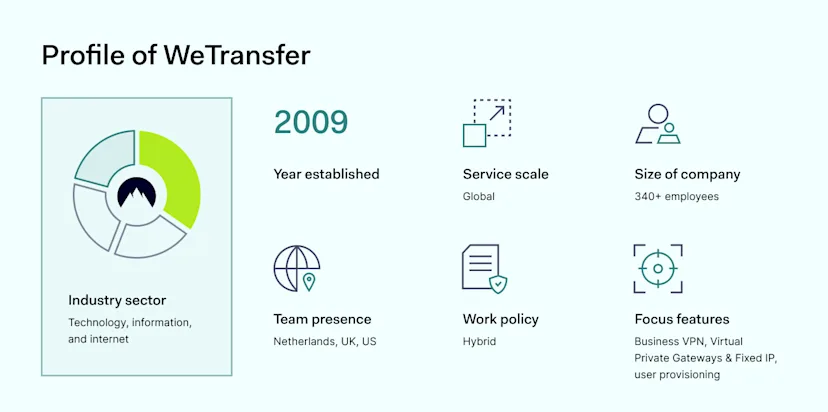
Profile of WeTransfer

WeTransfer takes a unique approach in having a viral product complemented by a full-screen advertising space used by hundreds of major brands around the world. The platform supports creative professionals, as well as creative communities facing the world’s most pressing issues.

As a platform serving tens of millions of people around the world, cybersecurity and operational efficiency are top priorities.

In this interview, Director Enterprise IT Adam O’Toole shares why and how WeTransfer embarked on using NordLayer.

The challenge 

Legacy VPN and the need for reliability

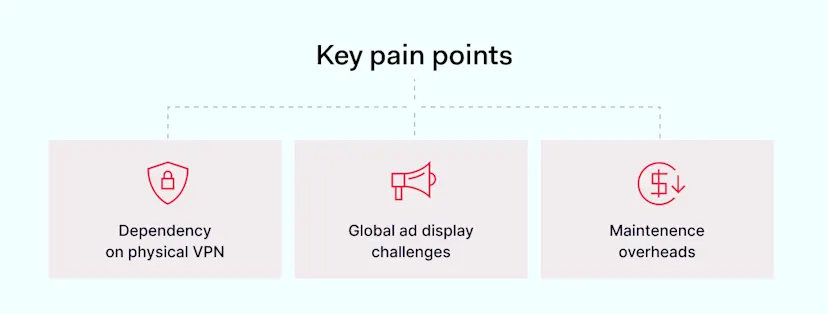
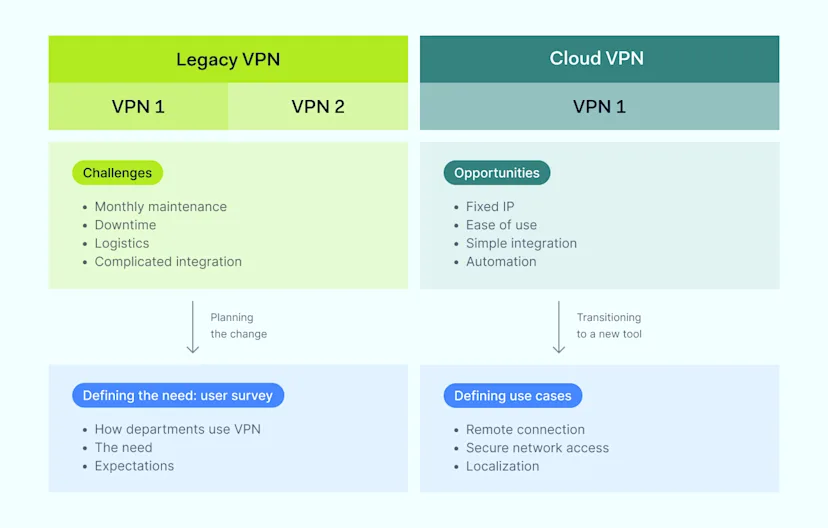
Key pain points

VPN is used at WeTransfer not only for the engineering team to connect to several development APIs. It’s also necessary to validate global ad displays in over 130 countries. Ensuring continuity demanded a more flexible and robust solution.

“Moving to a new HQ, we were faced with a fresh challenge: our VPN was physically hosted on-site so our engineering teams could connect to systems that were inside our network. We needed a cloud alternative for changing places”

Click to tweet

The impending office move only accelerated the search for a cloud-based VPN that could offer uninterrupted service and global reach.

The solution

Strategic transition to a hassle-free tool

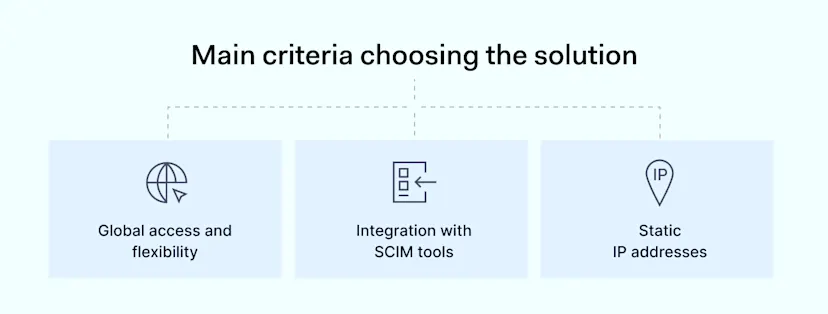
Main criteria choosing the solution

At WeTransfer, the team used two VPNs in total. One was dedicated to product development in the engineering department. The other was established due to a hybrid work model for remote employees to connect to the network and ad team for localization.

NordLayer stood out for several reasons. First, it’s a fully cloud-native solution. Also, it provides an extensive network of global gateways and static IP addresses, which is excellent for a global company like WeTransfer, present in different countries.

“Our ISO certification demands rigorous checks and balances, a standard that NordLayer meets with its comprehensive access policies, ensuring every connection is secure and aligned with our high standards.”

Click to tweet

What is more, it seamlessly integrates with the company’s security framework. And finally, it ensures compliance, a requirement for WeTransfer to follow ISO 27001 standards.

“We are a small team supporting a company of 340+. We need our tools to work for us, not against us. With automation, we’ve been able to spend less time on manual tasks and more on what matters, proving that a lean team can go a long way.”

Click to tweet

The transition marked a pivotal shift towards a cloud-based model, offering a seamless, maintenance-free experience that contrasted with the upkeep of the previous system.

Why choose NordLayer

The journey to NordLayer began with a collaborative effort to understand the specific needs across departments.

  1. We gathered a list of different departments to see how they use a VPN.

  2. The survey format helped us understand the needs and the demand for a VPN tool.

  3. We crystalized the use cases and how many gateways we needed.

  4. Some of the criteria were simple integration into the infrastructure, hassle-free usage, and static IP setup.

  5. Simplicity in using and maintaining the tool was equally important to security.

The integration with the existing security framework simplified access control, ensuring a smooth onboarding and offboarding process that resonated with the company’s lean IT team ethos.

“Okta integration was a big push from a security perspective for us to have better access control and automation when people come and leave.”

Click to tweet

With the Okta integration supported by NordLayer, the company can leverage stronger authentication mechanisms. Biometric authentication via Okta FastPass provides an additional level of security, allowing it to better protect against common attacks.

The intuitive dashboard and the provision for fixed IP addresses further streamlined operations, making NordLayer an obvious choice.

Rethinking the VPN strategy when transitioning to a cloud-based tool from a physical VPN

Legacy VPN vs Cloud VPN

NordLayer’s appeal lies in its ability to meet the company’s unique demands. Its vast network of gateways enabled the advertising team to accurately preview campaigns across different regions, a critical feature for a global player in the advertising space.

The outcome

Seamless operations and enhanced productivity

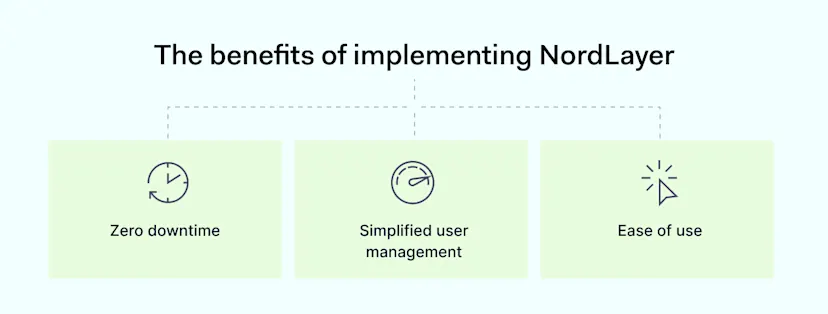
The benefits of implementing NordLayer

The switch to NordLayer translated into tangible benefits. The IT team was liberated from the monthly maintenance rituals that had previously hindered productivity and could focus on strategic initiatives.

“With NordLayer, it’s simple: if you’re in, you get access; if you’re out, you lose it. The dashboard is clear, making setup quick and getting results easy.”

Click to tweet

Thanks to NordLayer’s dedicated gateways, WeTransfer improved developer experience for engineers located outside of the Netherlands, with quicker feedback loops during development cycles.

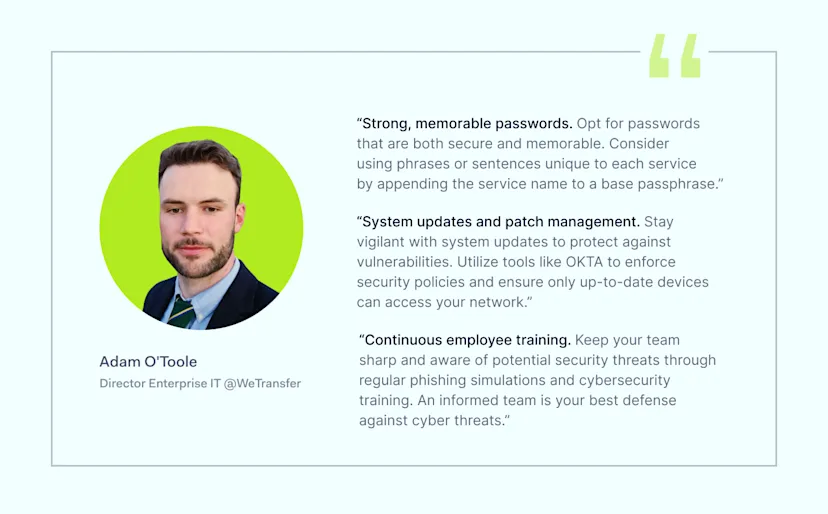
Pro cybersecurity tips

Cybersecurity hygiene is very personal yet important to follow, just as taking care of yourself. It can be achieved differently but for the same result—secure digital environments. This interview was no exception to asking how IT professionals prioritize cybersecurity in their daily lives. Thus,  Adam O’Toole, Director Enterprise IT at WeTransfer, shares his favorite and most important tips on what matters first.

Adam O'Toole, Director Enterprise IT, WeTransfer, about cybersecurity

WeTransfer adoption of NordLayer showcases how cybersecurity posture was improved by underscoring the importance of adaptability, collaboration, and strategic tool selection in the digital age.

The journey from a physical VPN system to a streamlined, cloud-based solution not only enhanced operational efficiency but also fortified the company’s cybersecurity defenses. As a result, the company can continue its mission of supporting the global creative community with trust and confidence.

About Version 2 Digital

Version 2 Digital is one of the most dynamic IT companies in Asia. The company distributes a wide range of IT products across various areas including cyber security, cloud, data protection, end points, infrastructures, system monitoring, storage, networking, business productivity and communication products.

Through an extensive network of channels, point of sales, resellers, and partnership companies, Version 2 offers quality products and services which are highly acclaimed in the market. Its customers cover a wide spectrum which include Global 1000 enterprises, regional listed companies, different vertical industries, public utilities, Government, a vast number of successful SMEs, and consumers in various Asian cities.

About NordLayer
NordLayer is an adaptive network access security solution for modern businesses – from the world’s most trusted cybersecurity brand, Nord Security.

The web has become a chaotic space where safety and trust have been compromised by cybercrime and data protection issues. Therefore, our team has a global mission to shape a more trusted and peaceful online future for people everywhere.

About NordLayer
NordLayer is an adaptive network access security solution for modern businesses – from the world’s most trusted cybersecurity brand, Nord Security.

The web has become a chaotic space where safety and trust have been compromised by cybercrime and data protection issues. Therefore, our team has a global mission to shape a more trusted and peaceful online future for people everywhere.

PINs vs. Passwords: Which is more secure?

Are you team passwords or team PINs?

Passwords and secret codes have been used for thousands of years to keep information safe and private. In today’s digital world, we continue to rely on these methods to protect our data and online accounts. Most people use either passwords or PINs to secure their digital assets, and there has been an ongoing debate about which is more secure.

Some users find PINs secure enough and appreciate that they’re short and easy to remember. Password advocates argue that PINs, usually just a few digits long, offer far fewer combinations, making them more vulnerable to cyber attacks. There are also those who suggest that both PINs and passwords serve the same purpose of authentication and can be equally safe, as well as people who doubt the security of either approach.

Let’s explore this topic to see whether PINs or passwords offer greater security.

What is a PIN?

To understand PINs and passwords, let’s start with the basics. PIN stands for “Personal Identification Number,” a numerical code used to verify a user’s identity. PINs were first introduced in the 1960s along with cash machines (ATMs), and to this day, a typical PIN consists of four to eight digits, providing a relatively simple way to authenticate a person.

The simplicity of a PIN has its pros and cons. Because it’s usually short and made up of numbers, a PIN is easy to remember. However, if a PIN has only four digits, there are just 10,000 possible combinations. While that might sound like plenty, in today’s world of advanced technology, it’s not as secure as you’d think. It’s actually super easy for powerful computers to crack these PINs.

PINs are usually entered manually on touchscreen devices, which makes automated brute-force attacks less effective. Additionally, most systems that use PINs have a limit on the number of failed attempts allowed before locking the user out. For instance, if a device only allows six attempts to enter a PIN, there is a 0.06% chance that someone could crack a four-digit PIN simply by guessing. However, if your PIN is as common as ‘0000’ or ‘1234,’ the chances of getting hacked go up significantly.

What is a password?

A password is a secret word, phrase, or string of characters used to confirm someone’s identity or to gain access to a system, application, or device. It can be just about anything—a word, a set of numbers, or a mix of both. To make it secure, a strong password should combine numbers, uppercase and lowercase letters, and special characters and be at least 12 characters long.

Like PINs, digital passwords first appeared in the early 1960s and have been in use ever since. If you take a 10-character password, it can have a massive 59,873,693,923,837,900,000 possible variations. This might make you think you already know which of the two options is more secure, but things aren’t as straightforward as they seem.

Passwords are often used for online accounts or devices that usually don’t have a limit on failed login attempts. This makes them vulnerable to automated brute-force attacks, where a program systematically tries all possible combinations to crack the password. Not every brute-force attack is practical, though, because it could take years to break into a strong password. However, hacking technologies are evolving quickly, making these attacks more efficient and raising the odds of success.

Password vs. PIN: Which is safer?

It’s time to answer the big question: Which is safer, passwords or PINs? Technically, passwords are more secure if they’re strong enough. Even with the latest hacking software, it could take hundreds of years to crack a complex 12-character password. Using a 16-character password might extend that time to thousands of years. So, if you’re looking to protect your device or online account, using a strong password is a better choice than a PIN.

This doesn’t necessarily mean you should stop using PINs altogether. PINs are a practical and secure method to unlock your touchscreen device, for example. Using them is quick and often has a limited number of attempts before locking, adding an extra layer of protection.

However, if you really care about the security of your online accounts and digital assets, consider using both passwords and PINs generated by a multi-factor authentication (MFA) tool. In this case, after you enter your account’s password, the MFA tool prompts you with a unique PIN that you must enter to verify your access. This extra layer of security ensures that even if someone gets hold of your password, they won’t be able to access your account without the additional verification step.

How to create a secure PIN

If you are to create a PIN for your touchscreen device or credit card, make sure it is as secure as possible. Here are some guidelines on how to achieve that:

  1. Stay away from simple, easily guessable PINs like “1234,” “0000,” “1111,” “123456,” or “9876.”

  2. Don’t use personal information such as birthdates, anniversaries, phone numbers, or other details that someone could easily guess.

  3. Don’t write down your PIN or store it in an insecure manner (like a note on your phone)—just memorize it.

  4. If possible, create a PIN that is longer than four digits.

How to improve your password security

The first thing you should do to improve your password security is to ensure that all your passwords are strong and stored securely. Since we’ve already stressed the importance of unique and complex passwords, let’s now shift our attention to the storage part.

Many people still keep their passwords in their notebooks or notes on their phones, not realizing how insecure that is. But the reasoning behind this habit isn’t too surprising. After all, memorizing all your passwords isn’t exactly easy. According to our study, the average person juggles a whopping 87 passwords just for work. For most of us, this is way too many to even try to remember. So, how do you address this problem? You use a reliable password manager like NordPass.

NordPass provides an encrypted virtual space where you can safely store and manage all your passwords, passkeys, credit card details, and other sensitive information. It is also lightning-fast at generating strong passwords, allows you to securely share credentials with the people you trust, and even checks if your login data has been compromised in a breach. So, if you’re looking for a way to improve your password security, NordPass is your go-to solution.

Try passwordless authentication

It might come as news to some of you that nowadays, you can skip the whole dilemma of choosing between PINs or passwords altogether and opt for a far more secure solution. This is because there is a new authentication method that lets you securely log in to websites and apps without entering a password or a PIN—and it’s called “passkeys”.

A passkey consists of two distinct cryptography keys: a public key, which is registered with the website or app, and a private key, which remains stored locally on your device and never leaves it. During login, these keys are matched up, granting you access to the website.

As already mentioned, NordPass lets you store passkeys, ensuring fast and secure access to your online accounts. This allows you to utilize biometrics, such as fingerprint or facial recognition, for authentication, making the whole process much easier and safer. Therefore, if you’re truly committed to improving the security of your online accounts, we suggest you go passwordless with NordPass and switch to passkeys on accounts and applications.

About Version 2 Digital

Version 2 Digital is one of the most dynamic IT companies in Asia. The company distributes a wide range of IT products across various areas including cyber security, cloud, data protection, end points, infrastructures, system monitoring, storage, networking, business productivity and communication products.

Through an extensive network of channels, point of sales, resellers, and partnership companies, Version 2 offers quality products and services which are highly acclaimed in the market. Its customers cover a wide spectrum which include Global 1000 enterprises, regional listed companies, different vertical industries, public utilities, Government, a vast number of successful SMEs, and consumers in various Asian cities.

About NordPass
NordPass is developed by Nord Security, a company leading the global market of cybersecurity products.

The web has become a chaotic space where safety and trust have been compromised by cybercrime and data protection issues. Therefore, our team has a global mission to shape a more trusted and peaceful online future for people everywhere.

Compliance made easy: Introducing Vanta integration

Achieving and maintaining prestigious security compliance certificates like SOC2, ISO 270001, or HIPAA is not an easy venture. The company must put forth a tremendous amount of effort and resources into preparing for compliance audits and assessments. Luckily, Vanta, the leading trust management platform, makes collecting the proof required for certifications much easier. And now, with its integration with NordPass, this strenuous process becomes even more automated, faster, and less demanding for the company. 

As with all great partnerships — the integration of our business password manager with a popular trust management platform means much more than just a sum of features. Read on and discover how your business can benefit from integrating NordPass and Vanta.

Customers choose companies they trust

According to The State of Trust Report 2023, 70% of business and IT leaders say that better security and compliance strategy builds consumer trust, positively affecting the business. Cybersecurity gives the company a real competitive advantage during sales conversations, especially if it is audited and approved by external certifications.

The problem is that security and compliance specialists often hit the wall because they lack the stuff and budget required to achieve or maintain such certificates. That’s where Vanta, the leading trust management solution, comes in handy. It automates much of the work involved in preparing for audits and assessments, as well as maintaining already gained certificates. In turn, Vanta can save the company lots of time, effort, and money.

Vanta, combined with NordPass, can transform your entire experience with the certification process. Now, let’s discuss the integration, its benefits, and how easy it is to implement.

Benefits of integrating NordPass with Vanta

Many of our clients requested the Vanta integration feature. We are very happy to answer the calls as the update holds many benefits for organizations. Let’s take a look:

  • Automating SOC2, ISO 270001, and HIPAA certification processes

Reliable security and compliance certificates require collecting vast amounts of information and proof. If this is done manually, it puts tremendous pressure on the company’s resources. Integrating NordPass with Vanta provides organizations with real-time password management data and points directly to areas in need of improvement.

  • Prioritizing gap resolution over data collection

Streamlined, automated data collection allows employees to focus on what’s the most important — identified risks and issues related to password security and/or compliance. No more precious company time gets spent on gathering data manually and fixing errors, the natural consequence of handling such tasks by hand. Therefore, prioritizing gap resolution saves money but also enables organizations to optimize employees’ time.

  • Strengthening the company’s overall security and compliance

The unified approach to cybersecurity streamlines business password management and compliance workflows. It enforces consistent password policies, fortifies access control, and ensures you meet the audit requirements. Vanta and NordPass integration results in a more secure and compliant organizational environment, safeguarding your company from cyber threats.

Effortless API integration

We put a lot of effort into making the Vanta and NordPass integration as user-friendly as possible. In fact, you don’t even need a tech person to achieve it.

All you need to do is go to the Integrations tab in your NordPass Admin Panel and choose to connect with Vanta. You’ll be asked to reenter the Master Password to your administrative business account and confirm the integration. The entire process is as straightforward and uncomplicated as setting up an average application for private use.

How else can we make your work easier?

With Vanta’s expertise in trust management and NordPass’ robust password management capabilities, achieving and maintaining prestigious security certificates like SOC2, ISO 270001, and HIPAA has never been easier. Effortless API integration makes a unified approach to cybersecurity and compliance accessible to both tech and non-tech users. Go on, say goodbye to manual processes, and embrace your company’s new security posture.

At NordPass, we’re dedicated to providing organizations with solutions that boost productivity and simplify day-to-day security operations. In the near future, expect more innovative features to enhance current functionalities and address ever-changing security challenges. Keep an eye out for the upcoming updates!

About Version 2 Digital

Version 2 Digital is one of the most dynamic IT companies in Asia. The company distributes a wide range of IT products across various areas including cyber security, cloud, data protection, end points, infrastructures, system monitoring, storage, networking, business productivity and communication products.

Through an extensive network of channels, point of sales, resellers, and partnership companies, Version 2 offers quality products and services which are highly acclaimed in the market. Its customers cover a wide spectrum which include Global 1000 enterprises, regional listed companies, different vertical industries, public utilities, Government, a vast number of successful SMEs, and consumers in various Asian cities.

About NordPass
NordPass is developed by Nord Security, a company leading the global market of cybersecurity products.

The web has become a chaotic space where safety and trust have been compromised by cybercrime and data protection issues. Therefore, our team has a global mission to shape a more trusted and peaceful online future for people everywhere.

Third-party reviews: Perimeter 81 competitors and alternatives

We know how important it is to make the right decision when it comes to selecting cybersecurity tools and solutions. This blog article will have hands-on information about how secure network access solutions and VPNs compare to the most commonly chosen alternatives in the market.

In this article, we will overview Perimeter 81 competitors and alternatives. 

Disclaimer: This article is based entirely on third-party reviews and open-source online information accessed between April 15 and 22, 2024. NordLayer is not responsible for data accuracy, as competitor information is subject to change. The competitor information was gathered through a combination of manual research and data extraction. Data points include feature comparisons and product analysis.

Overview of Perimeter 81

Perimeter 81’s mission is to simplify secure network, cloud, and application access for the modern and mobile workforce. It achieves this by transforming traditional network security technology into one unified Zero Trust Network as a Service derived from a SASE framework.

Perimeter 81 capabilities

  • Smooth integration and deployment

  • Good customer service

  • Satisfactory speed and performance

  • Offers completely audited access

Perimeter 81 benefits

According to the Perimeter 81 website, the flexible and straightforward solution is their strength.

  • Easy building and management without lengthy setups and manual configurations.

  • Fast and flexible solution deployment with a centralized dashboard for resource management.

Perimeter 81 limitations

Perimeter’s weaknesses, according to the mentioned review platforms, are:

  • Premium plans are required to access advanced features

  • Customer support has access to substantial information

  • A relatively small number of countries to select from

  • Pricing is on the higher end

Let’s overview the competition of Perimeter 81 available in the market.

Disclaimer: Product review is based on information provided on VPN review sites such as Gartner, Capterra, and Cybernews and assessed customer feedback shared on these platforms, accessed on April 22, 2024.

NordLayer

NordLayer is a multi-layered business cybersecurity tool enabling all ways of working. It is a secure remote access solution from the Nord Security powerhouse and consumer product NordVPN.

The baseline of NordLayer’s development focus is defined by Secure Access Service Edge (SASE) and Zero Trust frameworks. The solution introduces SaaS security features for the internet, resource, and network access control.

NordLayer capabilities

  • Seamless integration with existing infrastructure and intuitive deployment of a cloud-based platform

  • Scalable with an unlimited number of users and adaptable to various business needs

  • High-performance service and 24/7 tech-savvy support for all plans

  • Strong product capabilities and comprehensive cloud-native feature set

  • In-house developed NordLynx VPN protocol based on Wireguard® for unprecedented performance and speed.

NordLayer benefits

According to the NordLayer website, the solution’s strengths are in its simplicity, security capabilities, and performance.

  • Easy to start, scale, and combine, as the solution requires no hardware and is simple to deploy, set up, and maintain within minutes. It integrates seamlessly with existing infrastructures and has a user-friendly Control Panel.

  • Custom and unique security solutions like NordLayer, the fastest unique VPN protocol, or Browser Extension, a lightweight solution for traffic encryption on a browser level only.

  • Compatibility with popular security providers facilitates the smooth integration of existing Identity & Access Management (IAM) and authentication systems and tools for a quick setup.

  • NordLayer offers a 14-day money-back guarantee.

NordLayer use cases

NordLayer offers a hassle-free cybersecurity solution tailored for businesses. It enables organizations to create secure remote connections to the internet, their company network, and cloud-based resources, facilitating compliance for any way of working.

  • Secure internet access: Protect traveling employees by securing remote access through public Wi-Fi. This prevents threats while browsing the internet, allows access to geo-specific content, and ensures the masking of IP addresses for enhanced privacy and security.

  • Network & resource access management: Establish segmented access to company resources, control access by selecting specific content categories and applications, create connections between remote devices, and enable remote access to hybrid resources. This enhances overall operational flexibility and security.

  • Achieving compliance: Continuously monitor VPN activity within your organization, maintain an overview of devices present in the network, manage identity and remote access for both users and applications, and ensure the encryption of data transmissions originating from untrusted networks to bolster overall cybersecurity.

NordLayer limitations

  • No API access is available

  • Does not integrate with SIEM solutions

  • Minimum member license quota

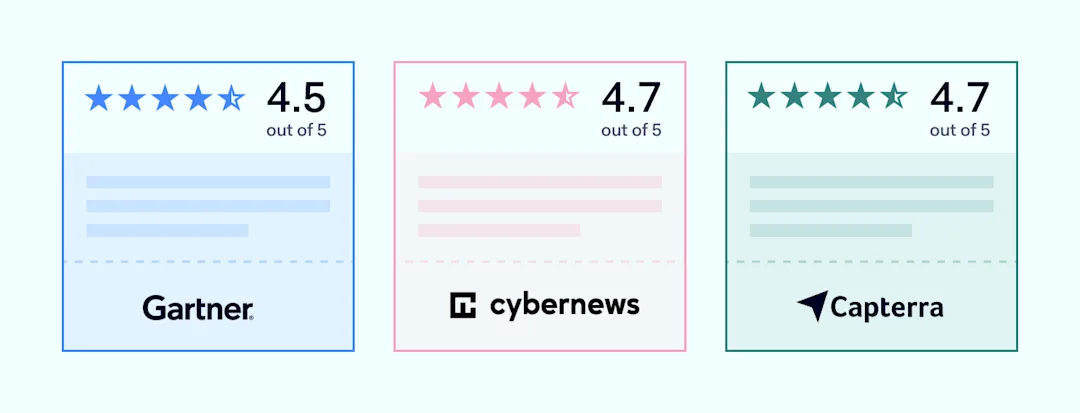
NordLayer reviews

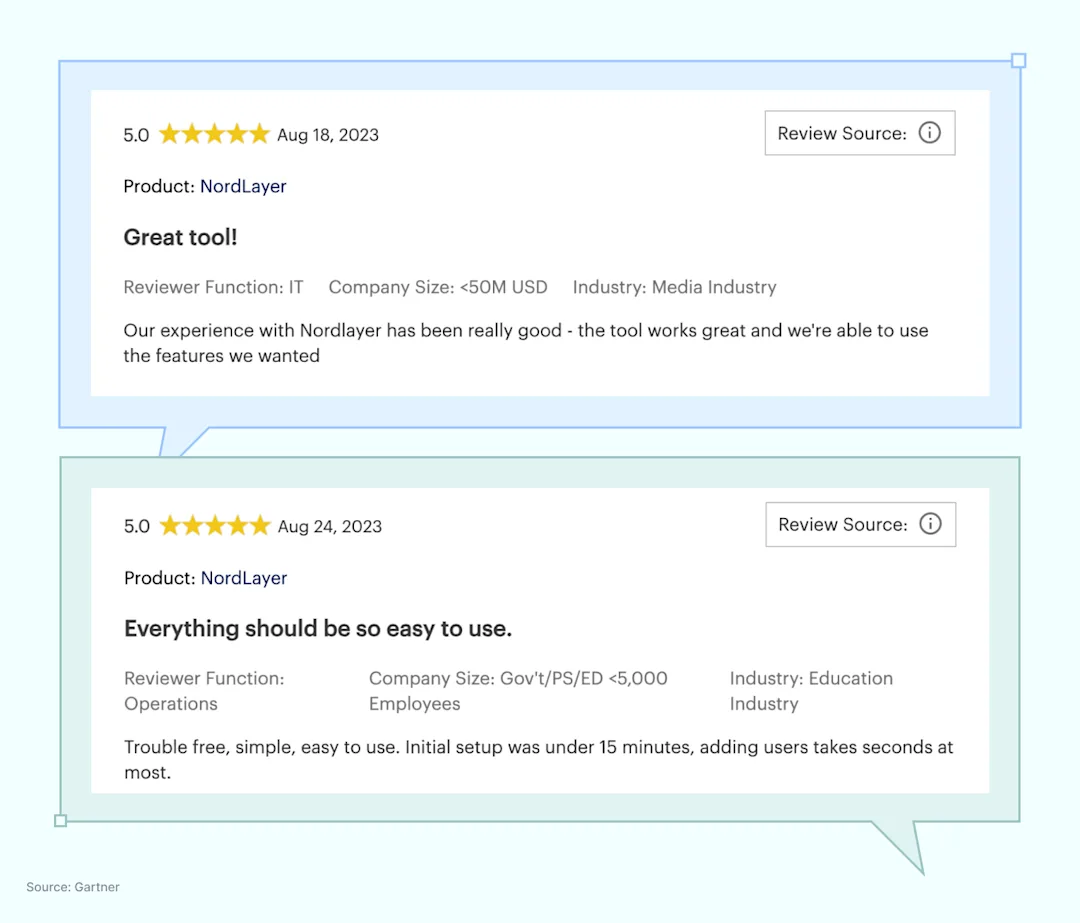
To provide an objective evaluation of the product, we will refer to major VPN review sites (Gartner, Capterra, Cybernews) and will look into client feedback shared on these websites:

Customer feedback and insights:

NordLayer offers Security Service Edge (SSE) capabilities like Cloud Firewall (FWaaS), Zero Trust Network Access (ZTNA), and Secure Web Gateway (SWG) for creating robust security policies. To learn more about NordLayer’s secure network access solution features and plans, see our pricing information.

Twingate

Twingate is a security service that provides controlled remote access to company cloud resources through Zero Trust verification, detailed secure access policies, and multi-factor authentication. It’s deployable on multiple cloud-native services and designed for easy integration with existing tech stacks.

Twingate capabilities

  • Integrations with major IdPs, MDM/EDRs, SIEMs, and DOH providers

  • Security model based on Zero Trust Architecture

  • Centralized management

  • Free introductory plan and free trial

Twingate benefits

According to the Twingate website, the solution’s strengths are its access controls and connectivity.

  • Implementation of least privileged access to protect SaaS applications and cloud-based or on-premise resources

  • Automated Zero Trust integration with API-first design for easy integration with infrastructure as code (IaC)

Twingate limitations

  • It doesn’t provide access control at the port level

  • Requires third-party access to company infrastructure

  • Customer support is limited (i.e., forum support for mid-tier plan)

  • Twingate connector deployment for remote resource access is done via Linux systems or an OCI (docker), which requires technical knowledge

Disclaimer: This review draws on details from prominent VPN evaluation websites like TechRadar, TrustRadius, Comparitech, and customer opinions shared through these channels as of April 22, 2024.

GoodAccess

GoodAccess is a cloud-based VPN that offers secure, encrypted access to local networks with Zero Trust security, static IPs, and threat protection for remote workforce across various devices and locations.

GoodAccess capabilities

  • Static IP for business teams, enabling access to geo-blocked resources

  • High-level encryption for secure internet access and data protection

  • The global public infrastructure of 35+ locations

  • Security features include features like basic and premium threat blockers

GoodAccess benefits

According to the GoodAccess website, the solution’s strengths are its access controls and connectivity.

  • Inexpensive with a free trial and a starting capabilities plan

  • Fast setup and simplified management with an easy-to-use web management platform

GoodAccess limitations

  • Few private server locations

  • Better suits small- and medium-sized organizations

  • 24/7 live support is available for the enterprise plan only

Disclaimer: This analysis is informed by details from leading VPN comparison websites (Capterra, TechRadar, G2) and reviews shared by users on those platforms as of April 22, 2024.

Zscaler

Zscaler is a cloud-based security company providing solutions that improve the safety of users and data across various internet and private networks. It is designed to securely connect users to their applications and manage device policies without traditional hardware-based boundaries.

Zscaler capabilities

  • Offers SASE framework components: SWG, CASB, ZTNA, FWaaS

  • Access control that is detailed and customizable

  • Enhanced visibility into user activities and assets

Zscaler benefits

  • Enhanced security through a multi-layered approach

  • Suits businesses of all sizes

  • User-friendly interface

Zscaler limitations

  • Configuration complexity, which can be challenging for businesses without dedicated IT teams

  • Demands high-speed internet for optimal performance

  • Pricing details are only available through consultation

Disclaimer: Product review is based on information provided on Zscaler’s website, Gartner and TechRadar’s reviews of Zscaler, and customer feedback shared on review platforms (G2), accessed on April 22, 2024.

Cisco

Cisco is a global technology leader known for its networking and security solutions. These solutions are integrated across Cisco’s entire product portfolio and aim to protect enterprise networks, data, and applications.

Cisco capabilities

  • Provides services like malware protection, intrusion prevention, and secure internet gateways.

  • Offers an SSE-based unified defense strategy across networks, clouds, endpoints, and applications.

  • Delivers comprehensive network and cloud security analytics, ideal for large enterprises due to its scalable and detailed features.

Cisco benefits

  • Scalable, advanced threat protection, and comprehensive integration capabilities.

  • Centralized management features across its products enable simplified administration of security policies and procedures.

  • Extensive global reach.

Cisco limitations

  • Some users find the setup and management of certain Cisco security products to be complex and resource-intensive.

  • The cost can be a barrier for smaller businesses or those with limited IT budgets.

Disclaimer: This review draws from details on Cisco’s corporate site, analyses from industry analysts like Gartner and Forrester, as well as end-user reviews found on TrustRadius and G2 as of April 22, 2024.

Make an informed decision

The review of Perimeter 81 and its competitors aims to support decision-makers in securing access to the organization’s local networks and protecting their teams. However, they are struggling to find a starting point.

Explore Decision Maker’s Kit, a free tool prepared by the NordLayer team, which helps build a strategy for selecting the most suitable solution for your organization and guides you throughout the process from A to Z.

About Version 2 Digital

Version 2 Digital is one of the most dynamic IT companies in Asia. The company distributes a wide range of IT products across various areas including cyber security, cloud, data protection, end points, infrastructures, system monitoring, storage, networking, business productivity and communication products.

Through an extensive network of channels, point of sales, resellers, and partnership companies, Version 2 offers quality products and services which are highly acclaimed in the market. Its customers cover a wide spectrum which include Global 1000 enterprises, regional listed companies, different vertical industries, public utilities, Government, a vast number of successful SMEs, and consumers in various Asian cities.

About NordLayer
NordLayer is an adaptive network access security solution for modern businesses – from the world’s most trusted cybersecurity brand, Nord Security.

The web has become a chaotic space where safety and trust have been compromised by cybercrime and data protection issues. Therefore, our team has a global mission to shape a more trusted and peaceful online future for people everywhere.

About NordLayer
NordLayer is an adaptive network access security solution for modern businesses – from the world’s most trusted cybersecurity brand, Nord Security.

The web has become a chaotic space where safety and trust have been compromised by cybercrime and data protection issues. Therefore, our team has a global mission to shape a more trusted and peaceful online future for people everywhere.

×

Hello!

Click one of our contacts below to chat on WhatsApp

×