Skip to content

Medical device cybersecurity: safeguarding patient safety in a digital age


Summary: Healthcare devices are targets for attacks that can disrupt care or expose data. Protect them with updates, strong access controls, and Zero Trust security.

As patient data becomes a prime target for data thieves, healthcare organizations are scrambling to counter numerous critical threats. Medical devices are now a cybersecurity frontier.

The medical devices we rely on to keep us healthy can fall victim to ransomware, identity theft, and DDoS botnets. Meanwhile, strict privacy regulations punish companies that don’t take data security seriously.

Healthcare providers, device manufacturers, insurers, and third-party service providers are all part of the healthcare cybersecurity challenge. This article will explore how to secure medical devices and safeguard patient safety in an increasingly dangerous environment.

Key takeaways

  • Proactive approaches are vital when securing medical devices. Companies must assess risks, monitor threats, and fix vulnerabilities before attacks occur.
  • Critical medical device risks include remote hacking, ransomware, data breaches, unpatched vulnerabilities, insider threats, and botnet attacks.
  • Regulatory compliance is essential. Device manufacturers must meet FDA standards, while users should comply with HIPAA and GDPR. NIST and ISO frameworks provide a roadmap to compliance.
  • Device security best practices include inventorying devices, segmentation, vendor collaboration, monitoring threats, and applying regular updates.
  • Medical device security is evolving. Expect advances in AI and machine learning to detect threats while 5G delivers speed and reliability improvements. New technology also enables the deployment of Zero Trust concepts to verify every device activity.

Why proactive cybersecurity is essential for patient safety

When we think about patient safety, medical competence, affordable care, and safe hospitals all come to mind. Cybersecurity risks aren’t always a top priority until data breaches expose private information to malicious actors.

However, Protected Health Information (PHI) breaches cause serious harm. Data thieves can use confidential details to steal identities or blackmail individuals. Data tampering can falsify records and lead to improper treatments, while information about health conditions can influence the decisions of employers or insurers.

The bottom line is that health data should always be secure. This includes data from medical devices like heart rate trackers, diabetes monitors, and wearable technology. These devices gather confidential data about the patient’s condition. They must also operate reliably – without downtime caused by cyberattacks.

Protecting medical devices demands a proactive cybersecurity approach. Security teams must assess each security risk and fix vulnerabilities before cyberattacks occur. Reactive security is too late. Healthcare providers need robust medical device cybersecurity systems that anticipate threats.

The cybersecurity risks medical devices face

Many people are not familiar with medical device cybersecurity risks. Let’s dive a bit deeper and explore how cyber criminals target consumer and professional healthcare devices.

6 cybersecurity risks for medical devices

Remote hacking

Many medical devices depend on network connectivity to transmit data, but these networks are not always secure. Hospital and home networks are vulnerable to remote hacking via unpatched software or weak passwords.

Criminals with unauthorized network access can theoretically control medical devices, adjusting dosages or pacemaker settings. That’s a terrifying prospect for professionals and patients.

Ransomware attacks

Medical devices, like all devices connected to the external internet, are vulnerable to ransomware infections. A quick exploration of the top ransomware attacks in 2024 shows that the infection risk is severe and growing.

These attacks deploy malicious software which encrypts devices and prevents legitimate access. This can have dangerous care implications if ransomware affects heart rate monitors or scanning equipment, although criminals usually relent when targets make crypto payments.

However, even if healthcare organizations make payments they may lose the data held by medical devices. Ransomware is a triple threat: affecting financial health, compromising critical systems, and exposing patient data.

Data breaches

Ransomware is not the only data breach risk linked to medical device cybersecurity. Cyber attackers may target monitoring tools and apps, gaining access to medical histories and current treatment programs.

Information about treatment is extremely valuable in the wrong hands. Criminals use it to launch insurance fraud scams, craft targeted phishing attacks, and even extract blackmail payments.


Exploits due to unpatched vulnerabilities

Medical device manufacturers may not update firmware or apps to address cybersecurity risks. This is a common issue with IoT technology that opens the door to exploit attacks leveraging outdated software.

Even worse, manufacturers often use proprietary software that is hard to update independently. And they sometimes delay patches due to complexity issues and concerns about compromising device functionality.

Healthcare providers often neglect updates in medical device cybersecurity strategies. However, when a single unpatched scanner can act as a network gateway, updating devices should be a priority.

Insider threats

Accidental errors and malicious employee activity can also compromise medical device security. For example, disgruntled staffers could use external drives to install malware on hospital systems or steal patient data for illegal purposes.

Negligent activity is equally damaging. Staff may ignore security protocols by sharing passwords, failing to encrypt laptops, or misusing physical access controls.

Botnet activity

Botnets pool large numbers of connected devices for criminal activities. For instance, bad actors could install malware on medical devices and use their computing power to mine cryptocurrency.

Lax medical device security also exposes healthcare organizations to DDoS attacks where attackers flood medical networks with traffic. These attacks take devices offline, disrupt care, and compromise security systems, opening the way to secondary attacks.


Medical device cybersecurity: What the regulations say

Governments have reacted to the growth in cyber threats against medical devices, passing many regulations to enforce data security. Organizations in the health sector must understand relevant regulations and use them to design security strategies.

Regulation or framework

Who must comply

Key requirements or recommendations

FDA

All medical device manufacturers in the US

Monitoring risks;
Ensuring device security and providing post-market patches

HIPAA

All healthcare providers in the US

Protection of patient data confidentiality, integrity, and availability

GPDR

All medical device companies operating in the EU

Protection of patient data and the need for a patient’s consent before using their data on medical devices

NIST

  • Not mandatory
  • Security guidelines for medical device manufacturers and patients

Suggests how to secure networks, manage cloud data risks, and ensure security measures meet healthcare professionals’ needs.

ISO/IEC 80001

Best practice for managing IT risks in medical devices

  • In the U.S., it’s not a legal requirement
  • In the EU, it aligns with MDR (Medical Device Regulation) requirements for risk management but is not explicitly required

It emphasizes risk management in medical IT networks to balance cybersecurity and patient data safety

FDA regulations for medical device manufacturers

Firstly, medical device manufacturers must comply with Food and Drug Administration (FDA) guidelines. The FDA regulates the safety of anything that “diagnoses, cures, mitigates, treats, or prevents [a] disease or condition.” In practice, FDA rules cover most medical devices.

Specifically, section 524B of the Federal Food, Drug, and Cosmetic Act requires medical device manufacturers to:

  • Create a plan to monitor and address medical device security risks (including exploits)
  • Ensure devices are “cybersecure” and provide post-market patches as appropriate
  • Submit a software bill of materials to the FDA detailing firmware and other components of medical device software

HIPAA and GDPR rules on safeguarding patient data

The Health Insurance Portability and Accountability Act (HIPAA) and the EU’s General Data Protection Regulation (GDPR) regulate how medical devices protect patient data.

HIPAA requires healthcare providers to protect data confidentiality, integrity, and availability. The law also suggests encrypting data on medical devices, controls on accessing patient data, and comprehensive audit logs.

GDPR protects patient privacy. It requires organizations to gain consent before using medical devices to gather data and the anonymization of patient data. Like HIPAA, GDPR’s “privacy-by-design” model encourages encryption and data minimization (only collecting essential medical data).

Both HIPAA and GDPR levy significant penalties for data breaches. Device security is a core aspect of both frameworks.

For instance, the University of Rochester Medical Center received a $3 million fine from the Department of Health and Human Services for losing a hard drive containing protected health data. In 2015, the Lahey Hospital and Medical Center was penalized for failing to secure a CT scanner workstation.

NIST cybersecurity frameworks

The National Institute of Science and Technology (NIST) offers cybersecurity guidelines for device manufacturers and users. While not enforceable by law, NIST’s cybersecurity framework explains how to:

  • Create secure and interoperable medical networks
  • Manage cybersecurity risks when storing medical data in the cloud
  • Apply quality control procedures in device manufacturing
  • Secure network communications within health settings
  • Ensure security measures meet the needs of healthcare professionals

ISO/IEC 80001: Managing device security risks

Similarly, ISO/IEC 80001 sets out an IT risk management framework for medical devices and is a valuable complement to NIST documents.

ISO recommends collaboration between device vendors and end users to assess and mitigate security risks. Device users should assess cybersecurity risks before deploying devices and apply continuous risk assessment throughout the product lifecycle. The risk management process includes proactively identifying and mitigating emerging data security threats.

The ISO approach works well because it balances cybersecurity standards with patient safety and performance. Systems should meet user needs while securing data and complying with relevant regulations.

Best practices for securing medical devices

The size of compliance penalties and the reputational harm caused by data breaches make cybersecurity solutions essential. But how should you secure medical devices against cybersecurity threats?
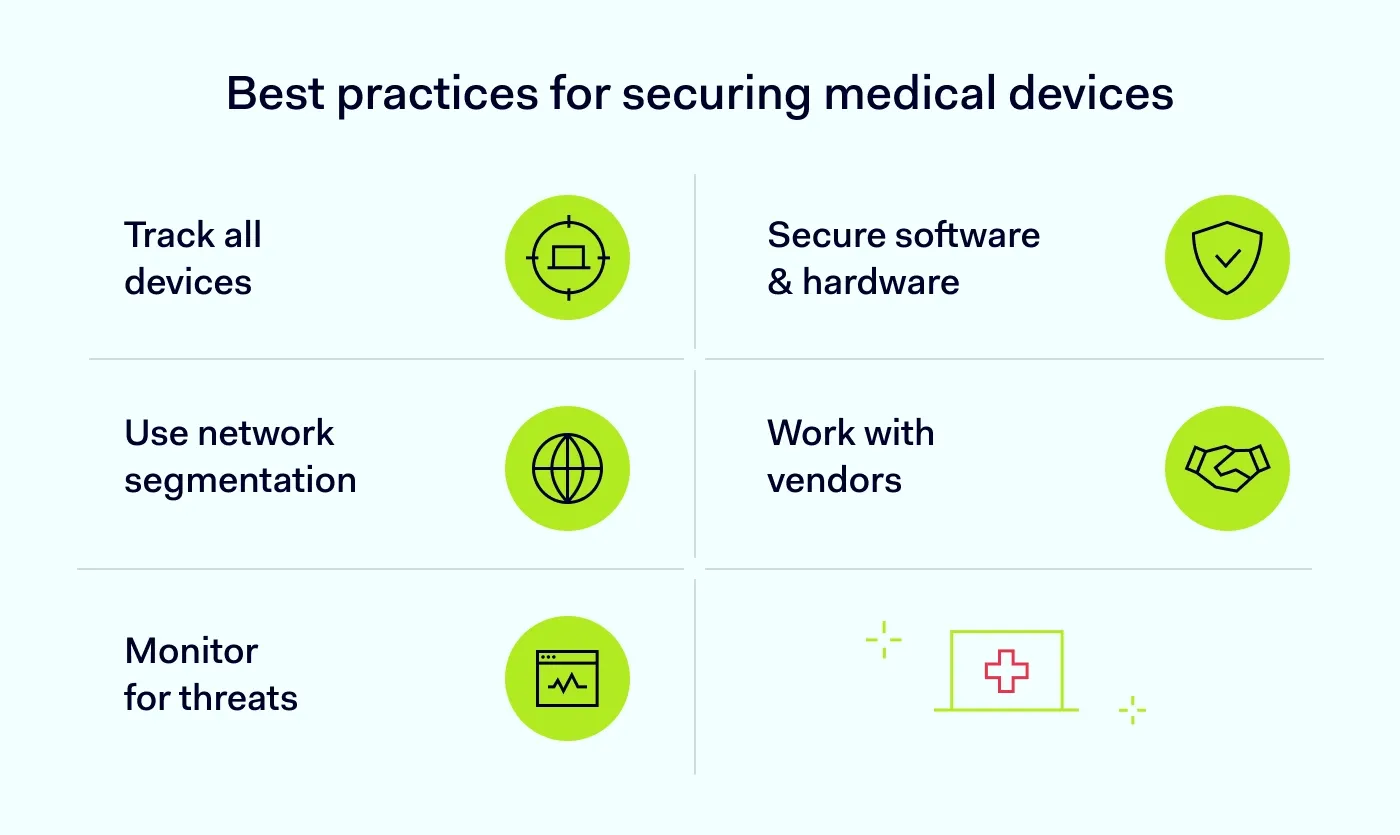
Best practices for securing medical devices

Security solutions vary between medical contexts. However, here are some general best practices for cybersecurity in medical devices:

Understand your device landscape

The number of medical devices used by a healthcare provider can rapidly grow, especially when patients take monitoring devices home. Every device is a potential endpoint and security risk. Each device needs security protection.

Start by creating a comprehensive device inventory. Create processes to update and audit the inventory, bringing all devices under your security umbrella.

Inventory software and hardware

Medical devices must be physically secure, with measures to prevent theft and unauthorized access. However, cybersecurity measures must also secure device firmware. Log current software versions and use automated tools to update medical device software as needed.

Check for end-of-life devices as well. Medical devices become obsolete as new technology appears. Older versions often create security risks and require prompt replacement.

Carry out a comprehensive risk assessment

When you have an accurate inventory, it’s vital to assess the risks posed by cyber threats. In this context, third-party risk assessment makes sense.

Cybersecurity experts with medical device experience understand the threats faced by healthcare organizations, how to prioritize risks, and suitable mitigation options.

Secure sensitive assets with network segmentation

Segmentation creates barriers between network assets. Placing sensitive data within protected segments ensures that attackers cannot access patient records if they gain access to devices.

Additionally, access controls and multi-factor authentication should protect patient information. Users should not be able to access protected information with just a username and password combination.

Work closely with vendors to understand device security

When sourcing medical devices, ask vendors to disclose security features and potential vulnerabilities. Consult vendors to execute a risk assessment for new devices and request a software bill of materials. This assists IT teams when securing device software and makes it easier to manage updates.

Monitor devices and detect threats

Apply intrusion detection systems (IDS) across all medical devices. Deploy continuous monitoring to detect malware or malicious user activity, and feed security alerts into a streamlined incident response plan.

The future of medical device cybersecurity

Medical device security is a dynamic field. Technology is evolving rapidly as medical internet-of-things (MIoT) devices proliferate, providing new ways to detect and counter cyber threats.

For instance, AI and machine learning can analyze network activity to track anomalies and identify attacks at an early stage. Speed increases offered by 5G connectivity supplement AI, enabling real-time activity tracking and reliable data transmission.

Our models for thinking about medical device security are also changing. Forward-thinking healthcare organizations now focus on Zero Trust concepts. Devices request verification for each user action and limit user capabilities according to least-privilege principles.

AI, 5G, and Zero Trust approaches are part of tomorrow’s cybersecurity toolkit. These technologies also reflect a trend toward enhanced collaboration between vendors, users, and regulators.

Work with NordLayer to secure your medical devices

Companies benefit from cloud-connected medical devices to learn about patients and deliver personalized treatment. But, as we’ve seen, medical devices bring security risks. Healthcare cybersecurity solutions are critical.

NordLayer can help you secure devices and serve patients securely and efficiently. Prevent unauthorized access with Identity and Access Management solutions and transfer data safely via Secure Remote Access. Conceal data in transit from attackers via AES 256 or ChaCha20 encryption, monitor 2FA adoption, and Share Gateway access in a centralized Control Panel dashboard.

Balance medical technology, ease of use, and cybersecurity. Contact the NordLayer team and solve your medical device security worries.

 

About NordLayer
NordLayer is an adaptive network access security solution for modern businesses – from the world’s most trusted cybersecurity brand, Nord Security.

The web has become a chaotic space where safety and trust have been compromised by cybercrime and data protection issues. Therefore, our team has a global mission to shape a more trusted and peaceful online future for people everywhere.

About Version 2 Digital

Version 2 Digital is one of the most dynamic IT companies in Asia. The company distributes a wide range of IT products across various areas including cyber security, cloud, data protection, end points, infrastructures, system monitoring, storage, networking, business productivity and communication products.

Through an extensive network of channels, point of sales, resellers, and partnership companies, Version 2 offers quality products and services which are highly acclaimed in the market. Its customers cover a wide spectrum which include Global 1000 enterprises, regional listed companies, different vertical industries, public utilities, Government, a vast number of successful SMEs, and consumers in various Asian cities.

What Is Internet of Things (IoT) Security?

What is IoT?

The Internet of Things (IoT) is what we call networks of physical objects that are packed with sensors, cameras, listening devices, and other technologies—like today’s smartphones, appliances, wearables, and cars. These devices are connected over the internet or a local network, so they can exchange data with each other. This allows them to work together as part of a smart system, enabling the automation of tasks and the creation of intelligent environments like smart homes or smart workplaces. Because of the way IoT devices operate, the Internet of Things and cybersecurity must go hand in hand to deliver smart experiences while ensuring safety and privacy for all users.

What is IoT security?

IoT security is all about protecting the interconnected smart devices and the networks they connect to. Since these devices can collect, store, and share data about users’ surroundings, this data must be handled with the utmost care and caution.

IoT devices aren’t just for personal use—more and more are making their way into workplaces. For example, businesses now install smart thermostats, blinds, and seating planners to optimize resources in their offices.

The benefit of these devices syncing and working together is that they regularly share and communicate data to improve functionality. However, since these devices are interconnected, gaining access to one could allow bad actors to exploit and breach your entire network. That’s why Internet of Things device security (as well as IoT network security) is essential to prevent vulnerabilities that could lead to cyberattacks.

Why is IoT security important?

The recent influx of IoT devices has provided another avenue for hackers to exploit in recent years. IoT devices can be particularly vulnerable to security breaches. At the end of 2021, a study concluded that up to 82% of healthcare organizations experienced an IoT cyberattack over 18 months. There are often security oversights regarding the IoT and its apps. For example, a German teenager hacked Tesla vehicles’ app component not that long ago. While he couldn’t access the driving functions like steering or brakes, he could still exploit other potentially dangerous features like unlocking doors, playing music at max volume, and flashing lights. The more IoT devices become common, the more widespread their security threats will become.

Which industries need IoT security?

Smart devices have made their way into almost every part of our lives. However, some industries rely more heavily on IoT technology than others and require additional security due to its strategic meaning for the nations’ and communities’ welfare.

  • Healthcare

Patient monitoring, advanced medical equipment, administering treatments and vaccines: Medical services increasingly rely on smart devices. Cynerio and Ponemon’s Study proves that healthcare is especially vulnerable to cyber attacks involving the Internet of Things devices as they constitute 88% of all hospital data breaches. More than half of hospitals in the US have experienced an attack on their smart devices between 2020 and 2022. The damage that cybercriminals can cause in healthcare is horrifying — the mortality rate increased in 24% of the attacked hospitals.

  • Energy and Utilities

Internet of Things devices are widely used in the energy and utilities sector for smart grid management, optimizing energy consumption, and remote monitoring of infrastructure. Monitoring devices such as smart meters, security cameras, and temperature/fire/chemical leak controls are prime targets for cybercriminals. Protecting energy infrastructure is essential to prevent disruptions to critical services, including electricity, heating, traffic control, or medical care.

  • Manufacturing

It’s hard to imagine a modern factory without Internet of Things solutions enabling process automation, supply chain management, and predictive maintenance. The endless possibilities that smart devices present to this sector can be overshadowed by the costs of cyberattacks, as hackers often target factories to demand ransom.

  • Logistics

IoT devices are entering the logistics industry through fleet, vessel, and traffic management systems. Self-driving vehicles are becoming commonplace in major cities. Also, the railway relies on Internet of Things devices for traffic planning and power supply management. Hacking an IoT-reliant logistics system could cause chaos on highways or railroads.

  • Supply Chain

In the supply chain industry, connected devices are used for tracking, monitoring, and managing goods throughout transportation. The security risk created by IoT tools used in day-to-day operations grows with the number of vendors a company cooperates with. Supply chain attacks often target third-party partners or suppliers to access the company’s assets.

IoT security challenges

While smart devices introduce plenty of opportunities and convenience to our lives, they also open up the possibility of cyberattacks. Industries such as healthcare and manufacturing increasingly rely on IoT devices, exposing unprepared organizations to cyberattacks. Here are some of the threats IoT devices are susceptible to:

  • Malware: Because cybersecurity isn’t the primary concern of many smart devices, hackers don’t require advanced malicious software to attack. Rudimentary malware can steal data and cause damage to networks and devices. Mirai is used to infect security cameras, scan the network for the IP address of IoT devices, and connect. This allows hackers to launch significant DDoS attacks.

  • Credential-based attacks: Using stolen login IDs and passwords is a popular method for hackers because many people’s logins are already floating around online thanks to massive data leaks such as Collection #1. Once a business’s smart device’s application layer is breached, hackers can access any device connected to the network.

  • Data theft and exposure: Adding IoT devices to your home or office will introduce more potential entry points for hackers to access data. This increases the risk of personal information being stolen and exposed on the internet. A good example of this is when hackers used Amazon’s Alexa to issue self-commands allowing the attackers to control smart lights, buy items on Amazon, and tamper with calendars.

  • Incorrect device management and configuration: Similar to the above, the more devices and accounts you add, the greater the chance of reusing passwords and usernames. Companies often ship IoT devices with default logins that should be changed during their setup. However, a survey of CIOs and IT managers showed that almost 50% of them allowed IoT devices onto their corporate network without changing the default passwords.

  • Complex ecosystem and smart device diversity: An office’s IoT ecosystem can quickly become a juggernaut of interconnected devices. These devices have many moving parts that operate at different levels. Overseeing and managing your wide array of IoT devices will help you prevent IoT attacks.

  • Not following security by design: Cybersecurity is generally not the main focus of many IoT devices, often taking a backseat to its functionality. Your office’s IoT security could be at risk because specific devices may have cybersecurity weaknesses that need to receive software updates. There’s also the possibility that any security features may be obsolete if the product is discontinued and no longer supported by its developer.

Examples of IoT security threats

Jeep Grand Cherokee

Back in 2015, security researchers Charlie Miller and Chris Valasek set out to see if they could remotely hack into and take control of a new Jeep model—the Jeep Grand Cherokee. They ran a series of cybersecurity tests, and sure enough, they found a major backdoor in the Jeep’s built-in infotainment system, which handles things like navigation and entertainment.

Using this vulnerability, they were able to connect to the car’s other systems and take control of the car’s key mechanics like braking, engine control, air conditioning, and transmission. Basically, they turned that Jeep into one of the most expensive remote-controlled toy cars in the world! After this demonstration, Chrysler (the owner of Jeep) had no choice but to recall more than 1 million Grand Cherokees to fix the software vulnerability.

Mirai botnet

Probably the most famous—or infamous, actually—IoT security breach ever, the Mirai botnet was first identified in 2016 and has remained a persistent cyber threat ever since. It works by infecting vulnerable IoT devices—like AVTECH CCTV cameras and Four-Faith industrial routers—and using them to launch large-scale distributed denial-of-service (DDoS) attacks.

In 2018, a Mirai variant was used in a 1.35 Tbps DDoS attack against GitHub, briefly knocking the platform offline. In 2020, the FBI issued a warning that Mirai-based attacks could go beyond websites and target critical infrastructure, like power grids and industrial systems.

But here’s the real problem: the Mirai botnet is still out there. Its original creators released the source code online, and since then, cybercriminals worldwide have been modifying and weaponizing it. Even today, in 2025, Mirai-based botnets are still behind record-breaking cyberattacks, targeting everything from internet service providers to government networks.

ThroughTek

In 2021, security researchers uncovered a serious flaw in ThroughTek’s IoT software, which is used in millions of smart cameras, baby monitors, and security systems around the world. It turned out that hackers could use this vulnerability to remotely access live video and audio streams from the cameras, and in some cases, even take full control of these devices, exposing sensitive footage from homes and businesses in the process.

The vulnerability was so severe that the Cybersecurity and Infrastructure Security Agency (CISA) issued an urgent warning, rating it 9.1 out of 10 on the severity scale.

How to secure IoT devices

The good news is that maintaining an overall good cybersecurity policy for your company will help safeguard your IoT devices. Training your staff with cybersecurity best practices and appointing specific admin roles to deal with the security of IoT devices in your organization are all methods for securing your business from IoT threats.

  • Regularly updating and checking IoT devices for patches: By staying up to date with your IoT devices’ firmware, you’re better equipped to protect your workplace from ever-evolving cyber threats. While people regularly update their computers and phones, they may forget to update their IoT devices.

  • Monitoring device behavior: By knowing your device’s base behavior and aspects such as its performance or regular network activity, you can recognize irregular behavior and intervene if you notice any deviations to your device’s performance.

  • Using strong and unique passwords: Using a password manager for your organization helps secure your IoT data security. NordPass Business creates unique, complex passwords. Additionally, it regularly reminds you to update passwords if they’re old, reused, or weak.

  • Checking app permissions for IoT devices: If an IoT device comes with an app, it is better to review the permissions it’s requesting before allowing access to your device or network. You shouldn’t grant apps more permissions than are strictly necessary.

  • Applying network segmentation and network security: Your workplace should have a way to monitor network activity and any devices connected to it. Tracking this information will help you recognize irregular internet traffic and act as an additional layer of security. This means that if one device is affected by an attack, it won’t be passed on to your other devices.

  • Considering additional security solutions and tools: To secure the app component of IoT devices, consider only accessing the app via a VPN. Doing so will encrypt the data transferred and give your network an extra layer of security.

  • Using multi-factor authentication (MFA): The more layers of security (authentication factors) smart devices used in your workplace have, the safer your company assets are. Incorporating additional factors to authenticate the user, such as biometric data or the user’s geolocation, makes your IoT devices less vulnerable to cyber attacks.

  • Applying Cloud IoT Security: Many IoT applications leverage cloud computing for storing, processing, and analyzing data. Therefore, it’s essential to implement security strategies, procedures, and tools that encompass cloud security if your organization utilizes smart devices.

How NordPass Business boosts your IoT security

The surge of IoT devices in private and professional settings provides more potential routes for hackers to steal valuable data and information. These devices and networks are more intertwined than ever, meaning cybersecurity for IoT shouldn’t be ignored. For companies working with large amounts of data, NordPass Enterprise is the cybersecurity solution you’re looking for. With NordPass, you can securely store and share login credentials for all your accounts and generate strong, unique logins in no time. NordPass allows you and your colleagues to quickly access important office notes (alarm PINs, WiFi passwords, and recovery codes) in one place.

About NordPass
NordPass is developed by Nord Security, a company leading the global market of cybersecurity products.

The web has become a chaotic space where safety and trust have been compromised by cybercrime and data protection issues. Therefore, our team has a global mission to shape a more trusted and peaceful online future for people everywhere.

About Version 2 Digital

Version 2 Digital is one of the most dynamic IT companies in Asia. The company distributes a wide range of IT products across various areas including cyber security, cloud, data protection, end points, infrastructures, system monitoring, storage, networking, business productivity and communication products.

Through an extensive network of channels, point of sales, resellers, and partnership companies, Version 2 offers quality products and services which are highly acclaimed in the market. Its customers cover a wide spectrum which include Global 1000 enterprises, regional listed companies, different vertical industries, public utilities, Government, a vast number of successful SMEs, and consumers in various Asian cities.

Granular policy controls: a flexible way to manage company-wide settings

When you’re ensuring thorough organizational security, company-wide settings can be a tricky business. You need them to be strict enough that all employees must comply with the rules, but you also need just enough flexibility to ensure everyone accesses sensitive information on a need-to-know basis.

To help organizations manage their internal security with more flexibility, NordPass offers granular policy controls—an addition to company-wide settings that lets companies assign more precise access controls to employees based on their needs and responsibilities.

What are granular policy controls and why are they necessary?

Organizations often face the challenge of determining the appropriate security measures across teams and individual employees. While globally applied policies can seem like the optimal option, in reality, they may grant overextended access to employees who should otherwise be restricted from accessing certain rights or advanced tools. This lack of access restrictions on a privilege level can lead to mismanagement and open up the organization to security risks.

NordPass tackles this issue, allowing businesses to control their security practices and access management as they see fit. With this functionality, organizations can set specific security policies at the organizational, role, or individual user level. This ensures that all employees can work efficiently based on their duties, setting a higher security standard in the organization.

How do granular policy controls work?

Granular policy controls are available with the NordPass Business, Teams, and Enterprise plans. The granular adjustments are managed by organization Admins and Owners using the Admin Panel based on member scope and particular policies.

Granularity scope

Before the introduction of granularity, all policies in NordPass were set globally, meaning that all organization members received the same access privileges without exception. With granular controls, Admins and Owners can set more precise access rights for members based on three criteria: whole organization, roles, or individual users.

Policy scope

The scope also is flexible across different policies. For instance, if only your Legal and Sales teams need access to the Guest Sharing policy, you limit it so that only select employees or teams with the appropriate role can access it. You can also flexibly adjust the requirements individually; for instance, employees in more sensitive roles may be required to adhere to a stricter password policy than staff in other roles.

The NordPass granular policy controls apply to the following company-wide settings:

  • Password Policy: you can customize and enforce password rules for the organization or different roles.

  • Guest Sharing: you can allow or disallow the ability to share sensitive information with contacts outside the organization.

  • Exporting: you can allow or disallow members of the organization to export sensitive data.

  • Autolock: you can define different inactivity periods before NordPass is automatically locked for different roles and individuals.

  • Browser extension lock: you can control browser extension behavior and set whether it can remain unlocked based on the role or individual member needs.

  • Multi-factor authentication (MFA): you can enforce MFA to ensure a higher security level for the organization, specific roles, or selected employees.

  • Email Masking: you can allow or disallow the organization, select roles, or individual members to use decoy email domains to protect their work email accounts.

The benefits of granular policy controls

NordPass’ granular policy controls solve a massive issue for business security: companies are no longer forced to apply global policies. Each team can adapt to higher security standards as role-specific rules reduce the likelihood of miscommunication and accidental or malicious access to sensitive materials.

Organizations that handle sensitive information can impose stricter and more accurate data management practices. With granularity ranging from the individual to the full organization, it offers an easier way to delegate security-related roles and responsibilities, such as sharing data with external partners.

Establishing granular access controls can help companies embarking on compliance journeys to meet the necessary regulatory criteria. Administrators can easily decide which settings must have more restrictive access and which can be more lax. This can protect organizations from unnecessary internal risks or human error and ensure a smoother workflow across teams.

Granular policy controls can also take device security into account. For instance, customizing autolock time requirements allows the organization to provide safeguards for all accounts while simultaneously keeping the workflow uninterrupted for those employees who are not exposed to critical access and can have a longer autolock period. MFA helps provide safer access to sensitive data, especially for employees who may be working remotely or traveling to industry events.

Granular policy controls allow organizations to build a more comprehensive data security system and maintain a clear and flexible cybersecurity standard that takes employee productivity and designated roles into account.

Secure your business with NordPass

Granular policy controls join the long list of NordPass functions that help achieve a higher level of cybersecurity in your organization—here, by enhancing company-wide settings with more precise access controls. With NordPass, you can store sensitive company data in XChaCha20-encrypted storage and share it with colleagues without compromising it. NordPass helps you stay ahead of data breaches with features like the Data Breach Scanner and Password Health, alerting you if your domains or email addresses appear on the dark web and checking your saved credentials for compromised, outdated, reused, or weak passwords.

Put your organization’s cybersecurity first without putting your team’s productivity on the back burner. Find the right NordPass plan for your business and enhance your credential security today.


About NordPass
NordPass is developed by Nord Security, a company leading the global market of cybersecurity products.

The web has become a chaotic space where safety and trust have been compromised by cybercrime and data protection issues. Therefore, our team has a global mission to shape a more trusted and peaceful online future for people everywhere.

About Version 2 Digital

Version 2 Digital is one of the most dynamic IT companies in Asia. The company distributes a wide range of IT products across various areas including cyber security, cloud, data protection, end points, infrastructures, system monitoring, storage, networking, business productivity and communication products.

Through an extensive network of channels, point of sales, resellers, and partnership companies, Version 2 offers quality products and services which are highly acclaimed in the market. Its customers cover a wide spectrum which include Global 1000 enterprises, regional listed companies, different vertical industries, public utilities, Government, a vast number of successful SMEs, and consumers in various Asian cities.

10 common types of data breaches that threaten your data security

Summary: Data breaches target system, employee, and vendor vulnerabilities. Strong authentication, encryption, and monitoring reduce risks and protect sensitive data.

Data breaches happen when criminals bypass network security measures and steal data that should remain private. When that happens, they can sell the data on the Dark Web or use it in identity theft attacks or targeted phishing campaigns.

Unfortunately, mitigating data breaches is far from simple. Attackers have many weapons, from phishing and ransomware to exploits, SQL injection, and insider threats. Every attack technique demands a response, as one loose end can leave an entire network exposed.

This article will introduce the critical types of data breaches and mitigation measures to secure your data.

Key takeaways

  • Data breaches are extremely costly. The average data breach costs $4.88 million, while reputational harm can be permanent. Mitigation measures are critically important.
  • Phishing is the most common data breach type. Phishers rely on human error and lack of knowledge to encourage unsafe behavior. Dark web scanning and employee training are effective responses.
  • Ransomware locks data and devices, enabling data theft by attackers. Companies need robust malware protection to avoid infection. File scanning is an essential mitigation measure.
  • Insider threats and physical theft can also expose data. Encrypt sensitive data to counter thieves and monitor user activity to detect malicious insiders.
  • Other data breach causes include SQL injection, man-in-the-middle attacks, supply chain attacks, cloud misconfiguration, and weak passwords. Each attack requires attention and mitigation actions.
  • Specialist data security tools can help you avoid costly breaches. Implement dark web scans to detect compromised data and use business VPNs to block infiltrators.

Phishing attacks: The most common type of data breach

Phishers use persuasion and deception to obtain confidential information from their victims, and they often succeed. According to Verizon’s 2024 Data Breach Report, 68% of data breaches start with human error.

All organizations are vulnerable to social engineering attacks. If your employees use email and share information online, phishing is a critical data breach risk.

The most common form of phishing involves using fake emails that resemble messages from trusted sources. Recipients download malware-infected attachments, which harvest data from their devices. Alternatively, they might click links to fake websites where phony data entry forms request sensitive data.

However, email phishing is not the only variety. Phishers might use SMS messages, phone calls, or video messages (vishing) to achieve their aims.

Whatever method attackers use, the outcome is similar. Victims unwittingly provide personal details, financial information, or login credentials. Criminals use that data to launch identity theft attacks or steal data after accessing private network assets.

Detecting phished credentials before attackers use them

Phishers are challenging adversaries, but companies can strengthen their defenses with dark web scanning.

Criminals use underground marketplaces on the Dark Web to sell stolen credentials and personal information. Criminal groups then use that data in targeted attacks, including large-scale data theft.

Dark web scanners monitor underground marketplaces and provide early warnings about data theft. Victims learn rapidly if their credentials are available for sale. This creates a critical window to reset passwords and secure user accounts before data breaches arise.

We recommend working with expert partners to track your data on the Dark Web. A Dark Web scan for leaked emails and credentials can identify risks and give you time to block phishing attacks.

In addition to dark web scanning, organizations must arrange employee training so employees can understand phishing risks. Most phishing attacks succeed due to human error. Regular training exercises refresh employee knowledge and help users identify risky attachments or links.

Enhance your network security & save up to 22%

Choose a yearly plan with NordLayer to boost performance at a discounted rate


Check our pricing


desktop

Ransomware cyber-attacks

Ransomware is malicious software that locks devices and encrypts data until victims pay a ransom.

Early ransomware attacks focused on financial gain, but this is changing. Attackers routinely steal data if the ransom is not paid. However, data loss is still possible when victims pay in full. The bottom line is that ransomware attacks always put customer data at risk.

For example, the US health company Change Healthcare suffered a ransomware attack in early 2024 by the ALPHV/Blackcat group. Attackers did not just extract a $22 million ransom payment; they stole 4TB of patient data in a so-called “exit scam.”

In total, around 190 million individuals were affected by a single malware infection. Companies need robust defensive measures to secure data and prevent similar incidents.

Reducing ransomware risk with automated malware detection

Best practices to prevent malware attacks include using up-to-date intrusion detection systems and malware scanners. Companies should encrypt confidential information and train staff to avoid phishing emails.

However, it pays to adopt a defense-in-depth with download protection. Companies rely on file transfers from internal and external sources. Any file could carry ransomware agents, making accurate file scanning essential across all devices and endpoints.

Scanning tools ensure malware protection by allowing harmless traffic and identifying high-risk files. A focused approach avoids false alarms, allowing security teams to concentrate on critical ransomware risks.

Insider threats

Insider threats come from individuals or groups inside your organization or partner companies. These data breach threats are hard to detect. Insiders tend to possess legitimate credentials and have high trust levels. If they choose to extract and sell data, security teams may not know until it is too late.

There are two main types of insider threats. The most common variety is accidental data exposure via human error. For instance. employees may expose personal records in public places or share data with outsiders.

Deliberate data theft is less common but potentially more destructive. Unhappy employees with access to business databases could extract client data for sale to competitors or sell the information to criminal collectives.

Businesses must guard against both insider threat types to fine-tune their data breach strategy. Effective security measures include:

  • Using Data Loss Prevention (DLP) tools. DLP monitors the status of critical data, logging access patterns and user actions. These tools can prevent unsafe transfers or request additional credentials to protect sensitive data.
  • Training employees. Staff need to know what data exposure means and how to safely handle information.
  • Managing privileges. Apply the principle of least privilege to limit access to data, and remove network access immediately when staff leave the organization.

Third-party breaches

Anyone with legitimate credentials can launch data theft attacks. This includes trusted third parties, who are often subject to supply chain attacks.

For example, the 2019 SolarWinds attack injected the Orion performance monitoring software with malware. When SolarWinds distributed Orion updates, the malicious code executed, exposing the data of 18,000 customers.

Attackers effectively turn third-party tools into backdoors. Until the supplier patches the vulnerability, criminals can extract data from compromised customers. In the SolarWinds case, hackers lurked for months on client networks, monitoring activity and stealing sensitive information.

Defending against third-party risks is tough. However, companies can manage risks with robust third-party security assessments, limiting vendor privileges, and integrating supply chain attacks into incident response plans.

Weak passwords

User credentials are a critical vulnerability when preventing data breaches. Breaches often happen when employees reuse the same password or rely on similar passwords for each account. In these cases, unauthorized individuals gain access by guessing access credentials—often based on stolen data.

However, criminals don’t need prior knowledge of user behavior. They can use brute force attacks to guess passwords. Alternatively, they might use phishing techniques to persuade users to enter their passwords into fake login portals.

There are many ways to work around password and user name login systems. Moreover, successful attackers appear trustworthy, creating a window of opportunity to extract sensitive information.

Robust network security measures are essential. Implement multi-factor authentication (MFA) for network access, which requires strong, regularly changed passwords. Threat detection systems should also monitor endpoints to detect multiple failed logins, which are often the signature of credential-stuffing attacks.

Unpatched vulnerabilities lead to preventable data breaches

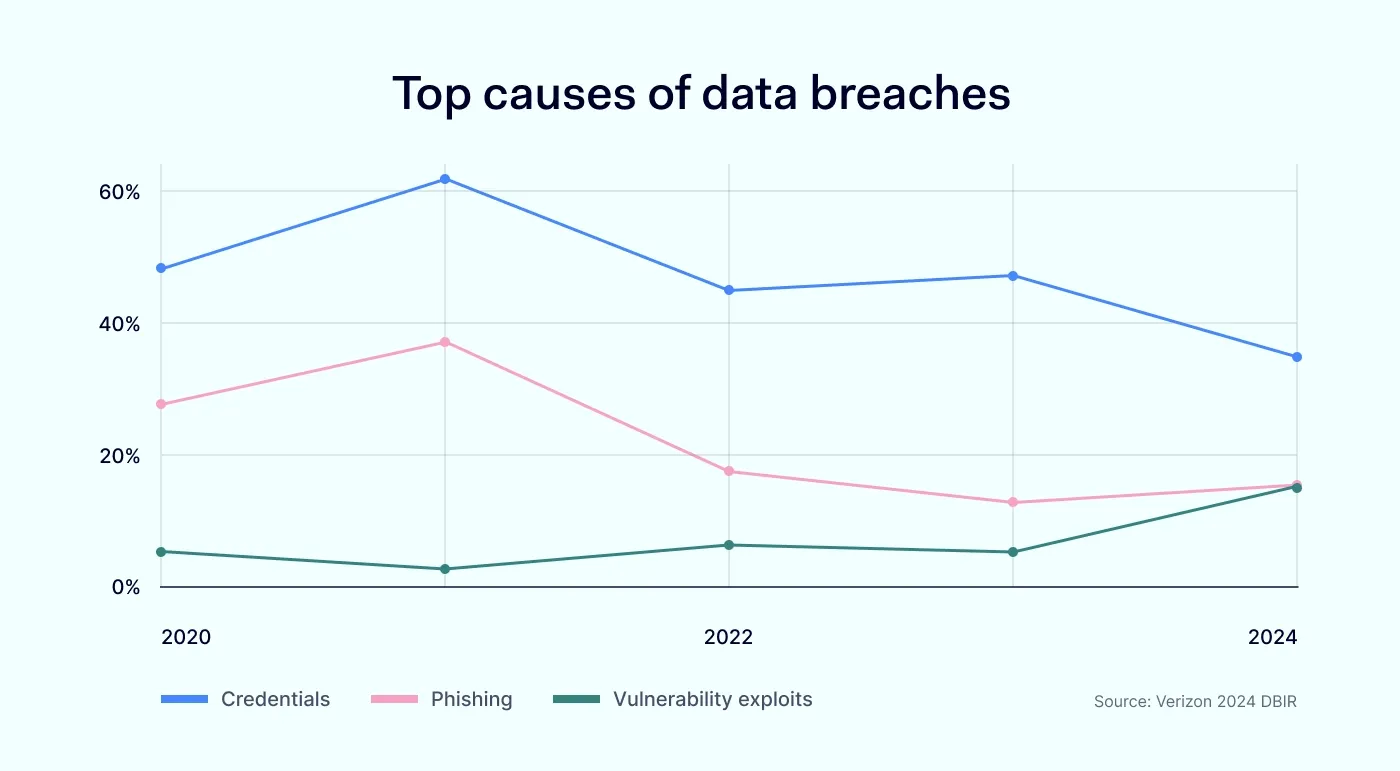
Unpatched software and outdated systems are tempting targets for data thieves. The 2024 Verizon Data Breach Report found that exploits account for 14% of known data breaches. However, while that number sounds low, exploit attacks rose 180% in the previous year. As Verizon puts it, we are experiencing an “exploitation boom.”

Top causes of data breaches

The Equifax data breach shows how damaging exploits can be. In 2017, the credit rating giant suffered one of history’s largest breaches following an attack on outdated Apache Struts 2 servers. A simple vulnerability led to massive data breach costs, including a $425 million settlement and free credit monitoring for 150 million victims of the breach.

Keep confidential data safe by implementing a proactive patch management strategy. Automate patch delivery where possible, and audit updates to ensure internet-facing apps and devices are current. Threat intelligence can also help by alerting security teams to emerging exploits.

Cloud misconfigurations and data security failures

In today’s digital economy, about 60% of corporate data resides in the cloud. This makes cloud platforms common targets for data thieves. It also means that companies need secure cloud configurations to block unauthorized access.

For example, cloud storage buckets containing confidential information should never be directly accessible from the public internet. Encryption and segmentation should separate sensitive data from external actors, with robust access controls. However, misconfigurations can leave data buckets exposed.

Companies may secure data but forget about access management tools—making it easy to gain access and move between cloud resources. Sometimes, IT teams don’t remove obsolete cloud deployments, raising exploit risks.

Cloud security is vital. Implement MFA and attribute-based identity verification to block threat actors. Ensure critical data remains secure and isolated from the public internet, and encrypt data in transit and at rest on cloud platforms.

Physical device theft

All of the talk about exploits and ransomware attacks can be deceptive. While digital data breaches are common, physical security breaches are just as important. Companies can’t focus all of their energy on cybersecurity and forget about physical devices.

Physical data breaches involve unauthorized individuals gaining access to private network devices. Criminals might break into data centers or offices and steal devices or access applications on-site. However, data theft can also happen when employees lose work laptops or smartphones in public places.

This type of attack is common in the healthcare sector. In 2018, thieves stole the laptop of a Coplin Health Systems employee from their automobile. The device was not encrypted, allowing attackers to harvest data from 43,000 patients.

Nothing had changed by 2024, when criminals stole a TimeDoc employee’s laptop on public transport. While the device was password-protected, patient data was not encrypted.

What can you do to avoid similar incidents? Take robust security measures regarding using laptops outside work. Encrypt all sensitive data and require 2FA or MFA for work devices. That way, thieves usually won’t be able to access and sell client data.

SQL injection

SQL injection attacks target website code, allowing criminals to access application backends and confidential databases.

These types of data breaches rely on poor code management and data entry forms that fail to sanitize user inputs. Instead of blocking malicious SQL queries, forms allow attackers to bypass authentication processes or even retrieve all user records.

For example, in 2023 the ResumeLooters collective mounted SQL attacks on 65 employment websites, looting data for sale on Chinese Telegram groups. Both Sony and Marriott Hotels have also fallen victim to SQL injection in recent years, suffering significant data breaches.

Avoid similar breaches by improving your data security practices. Filter database inputs and separate databases from initial login portals. Ensure you sanitize every query to identify malicious inputs, and audit code regularly to ensure ongoing protection.

Man-in-the-Middle attacks

Our final cause of data breaches places attackers between victims and internet resources. Man-in-the-Middle (MitM) attacks intercept traffic without the victim’s knowledge, allowing them to monitor data transfers and conversations.

Attackers can track online activity, or use keyloggers to harvest login credentials and credit card numbers. They can also redirect users to fake websites that resemble trusted originals but actually contain malicious data entry forms.

MITM attacks are commonly associated with remote work. Attackers create fake Wi-Fi hotspots that seem legitimate and linked to an actual location. Connecting to these hotspots allows attackers to seize control, compromising data transfers from remote devices.

Cut Man-in-the-Middle attack risks with VPN protection

The good news about Man-in-the-Middle attacks is that encryption makes them much less effective. Attackers cannot easily understand encrypted traffic and tend to move on to other targets.

Virtual Private Network (VPN)

We advise using a Business VPN to encrypt web traffic at all times. Business VPNs encrypt traffic on cloud platforms and on-premises networks, while also protecting remote connections. This significantly cuts the risk of eavesdroppers using MitM techniques.

You can also strengthen security measures with Always On VPN functionality. This feature applies VPN coverage to all internet connections and cuts connectivity if the VPN drops. There are no vulnerable moments. Encryption applies consistently, across all network devices.

The real impact and cost of a data breach

The list above shows there are many ways to carry out data breaches. But what are the real-world costs of these techniques, and do they justify investing in advanced security measures? In our opinion, the stats below prove that the benefits of security easily outweigh the financial costs:

  • The average cost of a data breach in 2024 was $4.88 million—up 10% from 2023 [IBM]
  • In 2025, the average cost of an insider threat attack is $17.4 million, up from $16.2 million in 2023 [Ponemon]
  • Exploit attacks increased by 180% from 2023-2024 [Verizon]
  • Companies suffering data breaches see their sales growth fall by 3.2% and lose 1.1% of their market value [NBER]
  • 60% of consumers won’t do business with companies that suffer data breaches [Chain Store Age]

How NordLayer can help with data breach prevention

Data is everything in the modern economy, where businesses rise or fall based on their capacity to collect and analyze information. However, as data becomes more valuable, it also becomes a bigger target. Data breach risks require streamlined security solutions.

That’s where NordLayer comes in.

Our Business VPN encrypts network connections, shielding data from eavesdroppers and unauthorized infiltrators—cutting Man-in-the-Middle attack risks. Meanwhile, dark web scanning tools check underground marketplaces for compromised data, enabling proactive strategies before attacks occur.

NordLayer also helps defend against phishing and malware threats. DNS filtering tools block access to malicious websites, while Download Protection detects and prevents accidental malware downloads.

To mitigate insider risks, NordLayer enables network segmentation through Cloud Firewall features, which contain potential threats within isolated environments. Zero Trust policies ensure that only authorized users can access sensitive data.

Want to strengthen your data breach defenses? Contact the NordLayer team today. We’ll help you upgrade your data security and keep sensitive information safe.


About NordLayer
NordLayer is an adaptive network access security solution for modern businesses – from the world’s most trusted cybersecurity brand, Nord Security.

The web has become a chaotic space where safety and trust have been compromised by cybercrime and data protection issues. Therefore, our team has a global mission to shape a more trusted and peaceful online future for people everywhere.

About Version 2 Digital

Version 2 Digital is one of the most dynamic IT companies in Asia. The company distributes a wide range of IT products across various areas including cyber security, cloud, data protection, end points, infrastructures, system monitoring, storage, networking, business productivity and communication products.

Through an extensive network of channels, point of sales, resellers, and partnership companies, Version 2 offers quality products and services which are highly acclaimed in the market. Its customers cover a wide spectrum which include Global 1000 enterprises, regional listed companies, different vertical industries, public utilities, Government, a vast number of successful SMEs, and consumers in various Asian cities.

IT regulatory landscape in 2025: an interview with Prof. Dr. Kipker

Regulatory compliance is a constant yet necessary headache for businesses. Regulations are not set in stone—just because a business met the criteria of one framework or another two years ago does not mean it’ll be sufficient a year from now. In 2025, as we see new technologies like AI emerge, businesses must adapt and prepare to meet new regulatory standards.

So, what do businesses need to know as new regulations roll in and evolve? Prof. Dr. Dennis-Kenji Kipker, member of NordPass Advisory Board, answered some of the most pressing questions about the current cybersecurity landscape in the EU, what AI risks new regulations aim to prevent, and how businesses can prepare for compliance policies that will come into force in 2025.

Kipker is a Professor of IT Security Law at the University of Applied Sciences Bremen and the Scientific Director of the cyberintelligence.institute in Frankfurt. He’s one of the leading cybersecurity experts in the world, acting as an advisor to the European Commission and the German Federal Government. Kipker’s research focuses on cyberlaw, international IT law, and IT consumer protection.

New and updated regulations come into effect every year. What are the major EU regulations coming into force in 2025 that businesses should be aware of?

This year we’ll see several key regulations taking effect. These include the Digital Operational Resilience Act (DORA) for financial institutions, the AI Act, the European Accessibility Act (EAA), and the NIS2 Directive. All these regulations have varying requirements but altogether aim to enhance digital security, compliance, and ethical AI deployment in the EU.

Let’s start with the Digital Operational Resilience Act (DORA). What can you tell us about its impact on financial institutions and IT service providers?

The DORA went into effect earlier this year, on January 17. Its aim is to strengthen the IT security of various financial entities and ensure they’re prepared for potential operational disruption. So, here we’re talking about banks, insurance companies, and the like.

More specifically, DORA requires financial entities to implement stronger cybersecurity frameworks, conduct regular risk assessments, and ensure third-party ICT providers meet security standards. It impacts the overall standards of financial cybersecurity in the EU.

The Network and Information Security Directive 2 (NIS2) entered into force in October 2024. Nevertheless, it’s still a relatively recent legislation for businesses. What have been the key changes stepping away from NIS1 and into NIS2?

Compared to the earlier framework, NIS2 expands the scope of cybersecurity obligations beyond critical infrastructure to include more sectors, such as healthcare, manufacturing, and cloud service providers. It also mandates a faster incident reporting timeframe—businesses must relay this information within 24 hours of an incident occurring.

The NIS2 also introduced stronger risk management policies and established that every EU member state must follow uniform criteria to enforce cybersecurity measures and determine which entities must adhere to them. If an organization fails to meet the NIS2 requirements, its managing bodies are held liable.

AI prevails as one of the most pressing topics, and the EU Artificial Intelligence Act is set to become one of the world’s first AI regulations. What does it aim to achieve?

The AI Act is really the first comprehensive regulation of this kind—it entered into force in August 2024, and its first requirements started to be applied in February. Firstly, it classifies AI systems based on their risk level: that means banning harmful AI, setting strict requirements for high-risk AI in fields like healthcare or law enforcement, and mandating transparency for AI-generated content—think deepfakes.

The first stage of application encompasses prohibitions and AI literacy obligations specifically, broader application is due in August this year. This will be the biggest implementation, covering governance, confidentiality, and penalties, among other requirements. The final applications will be enacted in August 2026 and August 2027.

What kinds of AI applications will be banned under the AI Act? How will companies deploying AI in the EU need to comply with the new rules?

The banned AI applications list includes AI systems that can manipulate human behavior, exploit vulnerabilities, and employ government-led social scoring.

As for companies that use AI in high-risk sectors, they’ll have to conduct risk assessments, maintain detailed documentation, ensure human oversight, and register their AI systems in an EU database.

The European Accessibility Act (EAA) is coming into effect in June this year. How will it impact tech companies? What are the penalties for companies that fail to comply with the new accessibility rules?

The EAA mandates that digital services, such as websites, apps, and e-commerce platforms, must be accessible to people with disabilities. For instance, businesses must redesign user interfaces and offer assistive technology support, like alt text for images. Overall, the EAA follows four key principles of accessibility:

  • Perceivability, meaning that all information of the service must be presented in a way that users can perceive regardless of their disability;

  • Operability, or how the user interacts with the interface and how accessible the navigation is;

  • Understandability, which requires all information to be easy to understand without unnecessary complexities;

  • Robustness, meaning all content must work on different devices and platforms, including assistive technology.

Companies that fail to comply will certainly face penalties which will vary in different EU countries. However, we know that financial fines will vary from €1,000—the lowest fine rate in Malta—to €500,000—the highest fine rate in Germany. Other penalties include legal action and bans on selling non-compliant products or services in the EU.

Finally, what’s your advice for businesses preparing for these upcoming regulations?

Firstly, companies should conduct compliance audits. Some frameworks issue official certifications of compliance. It’s important for businesses to be self-initiative in terms of compliance frameworks and analyze the requirements themselves. That said, working with external consultants can help answer some individual questions regarding compliance.

Updating risk management strategies is also essential. For instance, with the new NIS2 requirements, it’s essential for businesses to have a system in place to react to incidents in a timely manner.

Investing in cybersecurity and AI governance is another recommendation. As the next application stage for the EU AI Act is in August, it gives time for organizations to review what AI governance services they use now and what they plan to use in the future.

And, of course, employee training is always key. Ensuring employees are familiar with and understand the new regulatory requirements can help ensure that the right practices are upheld in an organization.


About NordPass
NordPass is developed by Nord Security, a company leading the global market of cybersecurity products.

The web has become a chaotic space where safety and trust have been compromised by cybercrime and data protection issues. Therefore, our team has a global mission to shape a more trusted and peaceful online future for people everywhere.

About Version 2 Digital

Version 2 Digital is one of the most dynamic IT companies in Asia. The company distributes a wide range of IT products across various areas including cyber security, cloud, data protection, end points, infrastructures, system monitoring, storage, networking, business productivity and communication products.

Through an extensive network of channels, point of sales, resellers, and partnership companies, Version 2 offers quality products and services which are highly acclaimed in the market. Its customers cover a wide spectrum which include Global 1000 enterprises, regional listed companies, different vertical industries, public utilities, Government, a vast number of successful SMEs, and consumers in various Asian cities.

×

Hello!

Click one of our contacts below to chat on WhatsApp

×