Skip to content

Can I Replace Active Directory with Azure AD? No, Here’s Why

Can I replace Microsoft Active Directory with Azure Active Directory? This is a very common question for IT professionals. With almost all of the IT environment moving to the cloud, there are a number of incentives to move the core directory service to the cloud too. Unfortunately, Microsoft’s path to the cloud can be unwieldy, expensive, and difficult to comprehend. It’s also heavily focused on Windows as its first-class citizen and the Microsoft ecosystem at large.

It all starts with Azure Active Directory (AAD), Microsoft’s foray into cloud-based directory services. It’s reasonable to think that it would have all the capabilities of Active Directory® (AD), as the name implies, but the truth is more complicated than that — even before Microsoft’s licensing factors in.

Azure AD’s True Purpose

AAD was created to extend Microsoft’s presence into the cloud. It connects Active Directory users with Microsoft Azure services, and is easier to implement than Active Directory Federation Services (ADFS) for single sign-on (SSO). It doesn’t incorporate the full features of Active Directory and lacks support for authentication protocols including LDAP and RADIUS. It may manage non-Microsoft identities, but there are additional fees for multi-factor authentication (MFA). A gated licensing model keeps many features behind a paywall. For example, group management with role-based access control (RBAC) isn’t included with the free tier of AAD.

AAD is the cornerstone of Microsoft’s portfolio of identity, compliance, device management, and security products, because it provides a common identity for Azure, Intune, M365, and more. The permutations of products and challenges of migrating from Active Directory to the cloud have given rise to a cottage industry of consultants for implementation and planning. The breadth of configurations and options may be fitting for enterprises that have considerable resources to support deployments. Considering that it’s not even possible to abide by Microsoft’s best practices for AAD without subscribing to Premium tiers, AAD may be a mismatch for small and medium-sized enterprises (SMEs) that have more essential needs.

Costs tick upward when SEMs are pulled deeper into the Azure ecosystem or require interoperability with services that fall outside of the Microsoft stack. For example, fees are assessed for unrestricted cross-domain SSO and MFA authentications with other identities. 

Replace AD with Azure AD?

Can Azure AD actually be the complete replacement to AD that admins are looking for? Unfortunately, the short answer to that question is no. Azure AD is not a replacement for Active Directory. AAD was originally intended to connect users with Microsoft 365 services, providing a simpler alternative to ADFS for SSO. It has since evolved into a springboard to new subscription services that target enterprise customers and charge for capabilities that on-prem AD provided at no additional cost. 

You don’t have to take our word for it, check out what a Microsoft representative said in this Spiceworks post:

Azure Active Directory is not designed to be the cloud version of Active Directory. It is not a domain controller or a directory in the cloud that will provide the exact same capabilities with AD. It actually provides many more capabilities in a different way.

That’s why there is no actual “migration” path from Active Directory to Azure Active Directory. You can synchronize your on-premises directories (Active Directory or other) to Azure Active Directory but not migrate your computer accounts, group policies, OU etc.

As you can see here Azure Active Directory is an identity and access management solution for hybrid or cloud-only implementations. It can extend the reach of your on-premises identities to any SaaS application hosted in any cloud. It can provide secure remote access to on-premises applications that you want to publish to external users. It can be the center of your cross-organization collaboration by providing access for your partners to your resources. It provides identity management to your consumer-facing application by using social identity providers. Cloud app discovery, Multi-Factor Authentication, protection of your identities in the cloud, reporting of Sign-ins from possibly infected devices, leaked credentials report, user behavioral analysis are a few additional things that we couldn’t even imagine with the traditional Active Directory on-premises.

Even the recently announced Azure Active Directory Domain Services are not a usual DC as a service that you could use to replicate your existing Active Directory implementation to the cloud. It is a stand-alone service that can offer domain services to your Azure VMs and your directory-aware applications if you decide to move them to Azure infrastructure services. But with no replication to any other on-premises or cloud (in a VM) domain controller.

If you want to migrate your domain controllers in the cloud to use them for traditional task you could deploy domain controllers in Azure Virtual Machines and replicate via VPN.

So to conclude, if you would like to extend the reach of your identities to the cloud you can start by synchronizing your Active Directory to Azure AD.


Why Azure AD Can’t Replace AD Outright
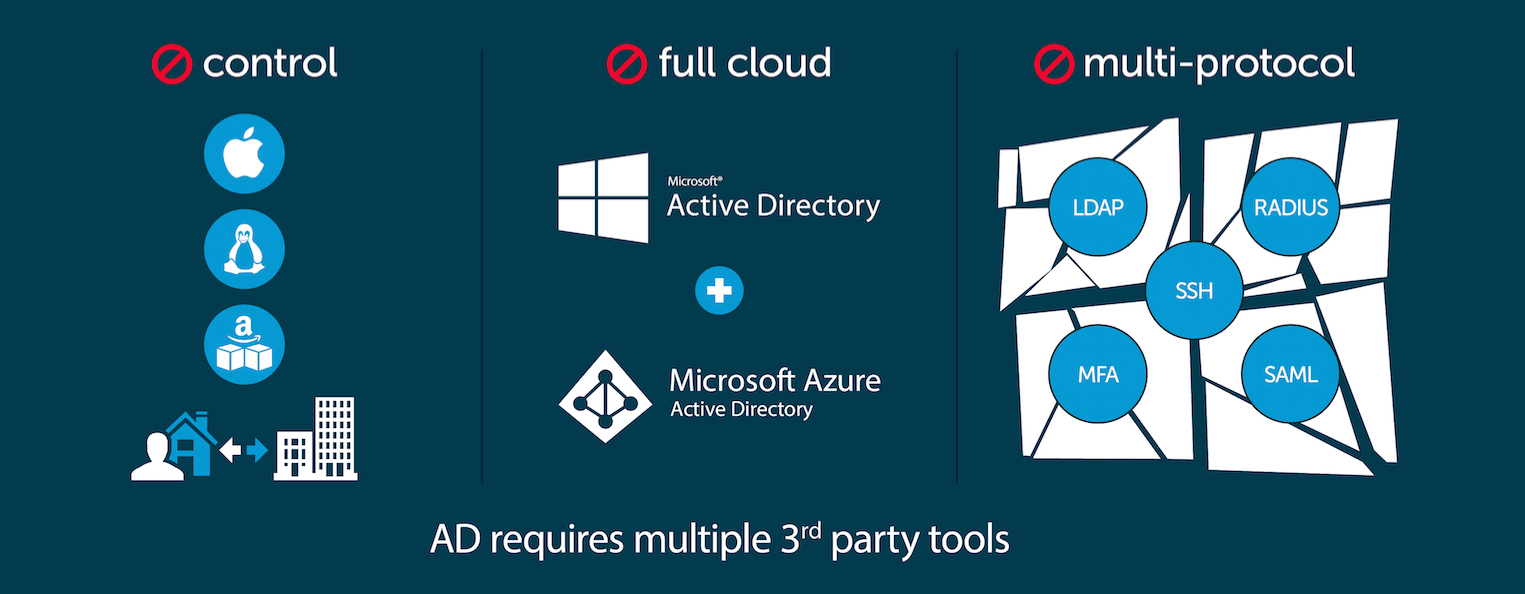
Azure AD and AD require 3rd party tools


When you step back and think about Microsoft’s identity and access management (IAM) strategy, it makes sense that you can’t replace AD with Azure AD. From a business perspective, Active Directory already has more market share than just about any solution they offer.

The on-prem directory acts as a tie that binds a Microsoft network together. By providing a way for customers to shift to a cloud directory service, Microsoft would open up the door to potential customer loss. Instead, it directs SMBs to cloud services that broaden the breadth and depth of its product families. However, these are intended to service enterprise customers and can be difficult to deploy and learn. 

Beyond the business perspective, there are also the technical capabilities to consider. Think of Azure AD as a user management platform for the Azure cloud platform, along with basic web application SSO capabilities. Where Azure falls short is that it doesn’t manage on-prem systems or resources without being integrated with a domain controller or add-on services for Windows.

For example, on-prem Windows (except for Windows 10), Mac, and Linux systems can’t be controlled for user access or systems management without subscribing to Microsoft Intune or Microsoft Endpoint Manager (MEM). Intune has limited functionality for Macs (without more MEM subscriptions) and, at present, has limited Linux support. Windows support is extensive, including auto-pilot onboarding.

Further, non-Microsoft solutions such as AWS and Google Workspace are outside of the scope of provisioning as well. There are a lot of resources that users need that can’t be touched by Azure alone, without adding additional subscriptions. 

While it’s possible to utilize Intune for a domainless enterprise, many organizations are still compelled to have a hybrid environment for full compatibility with AD or ADFS. Microsoft’s reference architecture (diagram below) prescribes both AD and AAD in an environment.

Azure cloud identity and access management graphic

JumpCloud: Extend or Replace Azure Active Directory 

Every environment has different requirements and constraints that can make cloud migration more challenging. Some shops are locked into the Microsoft stack and would benefit from SSO, simplified Zero Trust security, and cross-OS system management that AAD + Intune don’t provide or charge too much for. Other organizations aren’t tied to legacy on-prem systems and can adopt a domainless architecture, saving on infrastructure, management, and rising CAL licensing costs. JumpCloud makes it possible to do either, or anything in between, for individual SMEs or through a multi-tenant portal for MSPs to consolidate tools and deliver value at scale.

JumpCloud’s open directory platform can serve as a cloud replacement to AD. JumpCloud enables admins to have seamless management of users with efficient control over systems (Mac, Windows, and Linux), wired or Wi-Fi networks (via RADIUS), virtual and physical storage (Samba, NAS, Box), cloud and on-prem applications (through SAML, OIDC, RESTful APIs, and LDAP), local and cloud servers (AWS, GCE), and more. Automated group memberships, that pull relevant user attributes from other IdPs or HRIS systems, assist with identity lifecycle management. Environment-wide push/TOTP MFA is implemented for each protocol for free.

Your identities can be assigned to trusted devices. JumpCloud provides mobile device management (MDM) for Android, iOS/iPadOS, Linux, and Windows. Zero-touch onboarding is available for Apple devices. With MDM and the Windows agent, IT teams can leverage GPO-like policies such as full disk encryption. The CLI of each OS is accessible, at root, to deploy custom commands and policies that fall outside of JumpCloud’s point-and-click catalog of policies.

The platform services IT management and security needs with security add-ons, including:

JumpCloud can also integrate seamlessly with Azure AD, Google Workspace, or Okta to create one core identity provider for an organization. It is truly the cloud-forward directory that is built for the modern IT environment. JumpCloud’s open directory platform is interoperable and frees its users to adopt the IT stack of their choosing from best-of-breed services.

An Open Directory Platform™

The JumpCloud platform does not need to fully own and manage an identity. It consumes identities from different sources to orchestrate access and authorization to resources. This simplifies IT management for SMEs by addressing access control and security challenges that arise from having siloed apps and heterogeneous device endpoints outside of a corporate network. For instance, Microsoft doesn’t interoperate with Google Workspace, so IT professionals would otherwise have to seek alternatives for Identity and Access Control (IAC) and device management. Unfortunately, most other alternatives aren’t an integrated solution.

JumpCloud makes it possible for trusted devices to securely access resources across domains.

Delegated authentication is another option for access control. IT can configure AAD credentials to be used for RADIUS authentication into Wi-Fi networks with JumpCloud. There’s no domain controller or third-party service required.
JumpCloud helps SMEs to improve security, save on licensing, reduce headcount, and save time and effort by consolidating orchestration into a single, open directory that serves as an identity broker. The JumpCloud platform also works with Okta identities to provide RADIUS and LDAP access control, SSO, and system management for your device endpoints.

Try JumpCloud for Free

Want to learn more about how you can replace Active Directory with JumpCloud? It’s as simple as signing up for the JumpCloud Free account. JumpCloud offers all free accounts for 10 users and 10 devices, with no credit card info required. This grants the perfect opportunity for you to try out the entire platform including all of our premium functionality and see exactly how it works for yourself. Need more tailored, white glove implementation assistance? Schedule a free 30-minute technical consultation to learn about the service offerings available to you.

The JumpCloud community is always open for peer discussions about any IT topic.

About Version 2 Digital

Version 2 Digital is one of the most dynamic IT companies in Asia. The company distributes a wide range of IT products across various areas including cyber security, cloud, data protection, end points, infrastructures, system monitoring, storage, networking, business productivity and communication products.

Through an extensive network of channels, point of sales, resellers, and partnership companies, Version 2 offers quality products and services which are highly acclaimed in the market. Its customers cover a wide spectrum which include Global 1000 enterprises, regional listed companies, different vertical industries, public utilities, Government, a vast number of successful SMEs, and consumers in various Asian cities.

About JumpCloud
At JumpCloud, our mission is to build a world-class cloud directory. Not just the evolution of Active Directory to the cloud, but a reinvention of how modern IT teams get work done. The JumpCloud Directory Platform is a directory for your users, their IT resources, your fleet of devices, and the secure connections between them with full control, security, and visibility.

Security, Privacy, Anonymity feat. Portable Apps

Intro

I want to talk about why you need virtualization/compartmentalization, but through the prism of portable apps. The reason behind this is twofold: I want to outline the potential uses and security benefits that portable apps bring, as well as to talk more about how one would go on about reducing that attack surface, and their respective risk, through compartmentalization and virtualization. These are great methods, and I dare say, it pays at least knowing a bit more about them.

Portable Apps

Portable apps. We all know what these do (probably) but we may not be familiar with the how. This talk is freeform and example-based. Let’s get to it.

For example, you might use compartmentalization with encryption by separating your stuff by its importance, like having an encrypted volume for each of those potential uses, by using different encryption keys for those volumes. You could also use a NAS where each volume is encrypted using a different encryption key. The more secure ones could be accessed on a need-to basis, only decrypting when you need the access to that specific volume, while you would continue using day to day volumes for other data that needn’t be that secure.

This is a very decent way to reduce the attack surface of your data. From the previous articles, you know how important this is, and you also know that the encryption key is not in the memory if the volume doesn’t get mounted. Also, if its not mounted it cant really be attacked. So, by using this type of virtual isolation in conjunction with encryption you’re actually doing quite a bit for your own security/privacy.

You can also make use of the hidden encrypted volumes… one other option for virtual isolation are portable apps, something we’ve all gathered here about. You can download the tools from portableapp.com or pendrives.com doesn’t really matter which one you choose (I’m sure there are others too), what matters is the fact that portable apps are self-contained, don’t require installation, and are not writing themselves inside your system. They are contained within the folder, and you could even copy/paste them to a desired destination and have another instance of the same app, that’s also self-contained, isolated, and more secure. You can even do this for the versions of the said app.

There are many great implications for your privacy/anonymity/security that stems from the portable apps. For example, let’s say you’re using a regular web-browser… all the data related to the browser’s history is contained within your portable app (which is all within its folder) which makes for a great way to quickly even eliminate that if needed, and also, maybe more importantly, not spewing and writing all that forensically important data all over your OS. Simple, and quite secure.

What is nice about this approach is the fact you can gauge it to your liking, having the more ‘paranoid’ setups, and also the more lax ones, all in accordance with your own security needs.

Furthermore, should you just use this portable setup, you can also place that folder with your self-contained app on a more secure device, like for example an encrypted USB drive; and, there you have it, a much more secure setup, that you can also take with you and plug into another device, without having to lose any sleep over it.

Taking all this further, you can even add that hidden partition to your USB drive.

This is even better, as you well know, because the encrypted partition can’t be accessed at all before being decrypted. This little setup including a hidden volume, a self-contained app (stealthy too!) is already ahead of the curve – maybe even when compared to companies, but, the kicker for me here is that you can have 2, 3, or as many as instances of that specific application as you’d like, that are all self-contained, just by doing some copying and pasting. This is vital, because it basically enables you to create different security domains, profiles, aliases, anything you might need really, and it’s all nicely isolated/contained. The options here are many!

For our example with the browser, I’d like to add this also works for profiles so you can set up your browser’s profiles in any way you’d like, and still retain the ability to pop your USB into any machine and basically have your hardened browser available to you. This also works nicely in conjunction with the regular browser – if we’re talking private use – as you can have one that’s for your everyday stuff, and the other that’s ready to go but is living in a hidden place, securely configured, hardened, available for you to do some private browsing, should that matter. This is a great thing, because it might even keep you forensically ‘clean’ should you end up being scrutinized, since you’re not actually doing anything that’s of importance to anyone, right?

Another thing I want to mention that you can do all of this through the cloud-offered services, by storing your ready to go app in a cloud of your choice.This is a great way to have your app available anywhere, on any device, remotely… This would give you an extra layer of physical isolation. Since the app itself would not exist locally in this case, you could, potentially, escape the sphere of influence of your adversary, and that’s nothing to scoff at.

Lastly, you could also try some sandbox solutions, which are generally good from the security perspective, but are not that great for your privacy and anonymity. This is because of the infrastructure you’re using, but you’re not the owner of. However, you would again be able to enjoy both virtual and physical isolation which reduces your potential risk greatly.

As you can see, there are some caveats with all these options, but all of these should provide you with excellent protection against many types of attacks out there. With your going through other systems and isolating yourself in such a way, even if something were to get compromised, it still ends up contained within that instance you’ve set up, be it a VM, a VPC/server, anything. This is also a great way to browse the web.

When it comes to attacks, browser-based ones are definitely relevant, since we’re all using them. So, with that in mind, this whole story above might even seem much more important, I hope!


Conclusion


It would be great if this conclusion could permeate all of my articles so that I needn’t repeat myself, but the main point I want to emphasize here is the fact that when I’m talking about adversaries, geographic sphere of influence, and similar terms that are within the field, I am not trying to write guides for evading 3-letter agencies, nor am I trying to condone anything illegal.

Think of all that as necessary! Yes, necessary, because as we all know, the same tactics are used by real threat actors, but also by activists, whistle-blowers, journalists, etc. I want us to explore those options together, so we can all learn how to protect ourselves better, and smarter, while online. That’s why we all need to be in the know. The bottom-line remains the same, and that is all about the choice, rather, what you choose to do with all that knowledge and technology.

This is key for me and is the main reason behind the topics I’m choosing to write about.

I hope this article spurred some imagination! Till next time!

Stay tuned.

Cover image by hmm 001

#portable #apps

About Version 2 Digital

Version 2 Digital is one of the most dynamic IT companies in Asia. The company distributes a wide range of IT products across various areas including cyber security, cloud, data protection, end points, infrastructures, system monitoring, storage, networking, business productivity and communication products.

Through an extensive network of channels, point of sales, resellers, and partnership companies, Version 2 offers quality products and services which are highly acclaimed in the market. Its customers cover a wide spectrum which include Global 1000 enterprises, regional listed companies, different vertical industries, public utilities, Government, a vast number of successful SMEs, and consumers in various Asian cities.

About VRX
VRX is a consolidated vulnerability management platform that protects assets in real time. Its rich, integrated features efficiently pinpoint and remediate the largest risks to your cyber infrastructure. Resolve the most pressing threats with efficient automation features and precise contextual analysis.

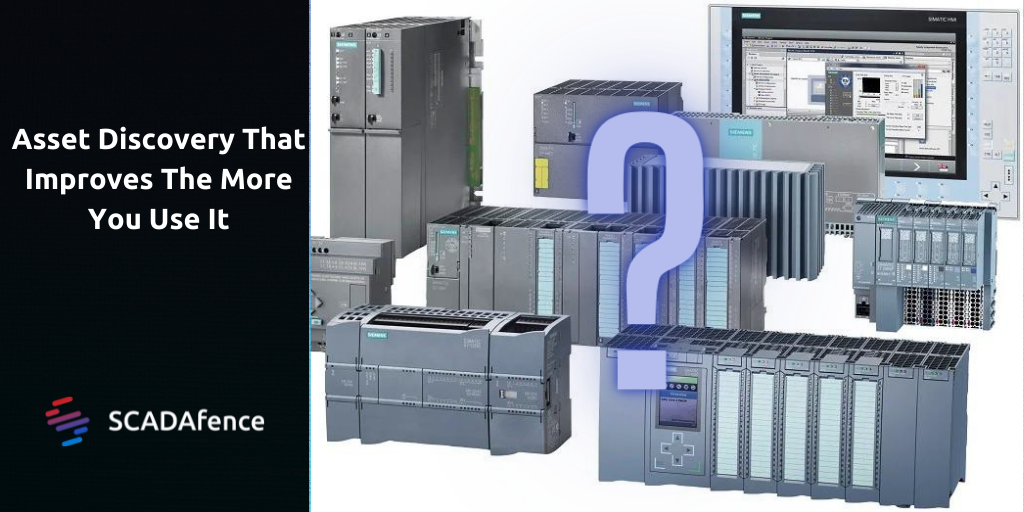
Asset Discovery That Improves The More You Use It

A SCADAfence New Feature report The first question we’re usually asked by any CISO who wants to increase their OT security posture is about asset visibility and management. Gathering a comprehensive and accurate inventory of all the devices attached to an OT network is often the primary need driving an organization to seek assistance, and the biggest barrier to achieving their goals for security and compliance. It’s the right question to be asking, and the best place to start.
Continue reading

Finding Cisco 7800 and 8800 series IP phone assets on your network

Cisco recently published vulnerability details which affect their 7800 and 8800 series of IP (VoIP) phones. These phones are sold across many different model numbers and can be found in businesses and organizations of varying sizes. Originally reported to Cisco by Qian Chen of the Codesafe Team of Legendsec at QI-ANXIN Group, this vulnerability does not require authentication for successful exploitation and can provide attackers remote code execution and/or denial-of-service (DoS) capabilities.

What is the impact?

Cisco assigned a CVSS “high” rating to this vulnerability (tracked as CVE-2022-20968) and has acknowledged that proof-of-concept exploitation code exists. Firmware for all 7800 and 8800 series IP phones (with the lone exception of Cisco Wireless IP Phone 8821) contains this vulnerability, which resides in the input validation logic of received Cisco Discovery Protocol packets. Attackers who have presence in the same VLAN or network segment as vulnerable devices can send specially-crafted Cisco Discovery Protocol packets to trigger a stack overflow, resulting in a denial-of-service condition or potential code execution.

Are updates available?

All firmware versions (14.2 and prior) for these 7800 and 8800 series IP phones contain this vulnerability (CVE-2022-20968), and Cisco is not planning on releasing patched firmware –which is currently expected to be version 14.2(1)– until next month (January 2023).

In the meantime, Cisco does offer the following mitigation for vulnerable IP phones:

Administrators may disable Cisco Discovery Protocol on affected IP Phone 7800 and 8800 Series devices. Devices will then use LLDP for discovery of configuration data such as voice VLAN, power negotiation, and so on. This is not a trivial change and will require diligence on behalf of the enterprise to evaluate any potential impact to devices as well as the best approach to deploy this change in their enterprise.

You can find the full details around this mitigation in the associated Cisco Security Advisory (see “Workarounds” section).

How do I find potentially vulnerable Cisco 7800 and 8800 series IP phone assets with runZero?

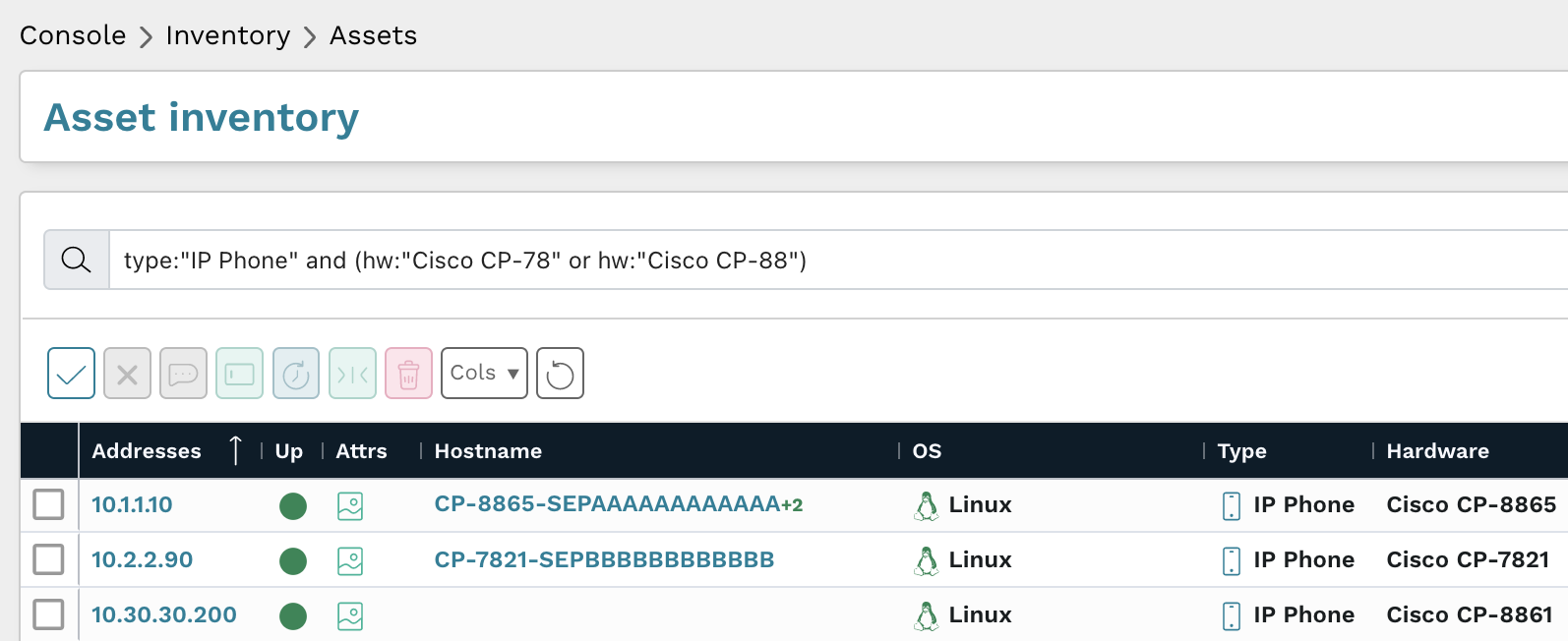
From the Asset Inventory, use the following pre-built query to locate Cisco 7800 and 8800 series IP phone assets which may need remediation:

type:"IP Phone" and (hw:"Cisco CP-78" or hw:"Cisco CP-88")

As always, any prebuilt queries are available from our Queries Library. Check out the library for other useful inventory queries.

About Version 2 Digital

Version 2 Digital is one of the most dynamic IT companies in Asia. The company distributes a wide range of IT products across various areas including cyber security, cloud, data protection, end points, infrastructures, system monitoring, storage, networking, business productivity and communication products.

Through an extensive network of channels, point of sales, resellers, and partnership companies, Version 2 offers quality products and services which are highly acclaimed in the market. Its customers cover a wide spectrum which include Global 1000 enterprises, regional listed companies, different vertical industries, public utilities, Government, a vast number of successful SMEs, and consumers in various Asian cities.

About runZero
runZero, a network discovery and asset inventory solution, was founded in 2018 by HD Moore, the creator of Metasploit. HD envisioned a modern active discovery solution that could find and identify everything on a network–without credentials. As a security researcher and penetration tester, he often employed benign ways to get information leaks and piece them together to build device profiles. Eventually, this work led him to leverage applied research and the discovery techniques developed for security and penetration testing to create runZero.

A Floor, not a Ceiling: ESET welcomes the approval of NIS2

ESET welcomes the decision of EU legislators to adopt the second Network and Information Security Directive (NIS2) aimed at strengthening cyber resilience across the Union. The new legislation comes as a response to the growing dependency of critical sectors on digitalization and their higher exposure to cyber threats.

The directive now approved replaces the NIS directive introduced in 2016 as the first-ever EU-wide legislation on cybersecurity. NIS2 introduces a broader scope of action, impacting more entities in “high criticality” sectors, both the public and private sectors, such as energy, transport, banking, water and waste water, among other critical infrastructure. Whilst new obligations are brought in for those in other “critical” sectors such as manufacturing, food, chemicals, waste management, postal and courier services.

Enterprises classed as “High Criticality” will be required to take both technical and operational measures to comply with NIS2, including incident response, supply chain security, encryption and vulnerability disclosure, adequate risk analysis, testing and auditing of cybersecurity strategies, and crisis management planning in view to ensure business continuity. In case of a cyber incident, these entities will also be required to submit an initial notification within 24 hours and more detailed information within 72 hours. NIS2 also introduces fines for failure to comply, including suspension of certification and personal liability to managerial positions, in line with national laws.

Finally, the directive establishes the European Cyber Crises Liaison Organization Network, EU-CyCLONe, to enable cooperation between national agencies and authorities in charge of cybersecurity, and each Member State will also be required to clearly identify a single point of contact to report cyber incidents.

Are SMEs also obliged to comply?

NIS2 establishes “the application of the size-cap rule, whereby all medium and large enterprises, as defined by Commission Recommendation 2003/361/EC, that operate within the sectors or provide the type of services covered by this Directive, fall within its scope”. While it excludes Small and Micro enterprises from having to comply with the new rules, some exceptions apply for example for SMEs in the sectors of electronic communications networks or of publicly available electronic communications services, trust service providers or top-level domain name (TLD) name registries.

Small and medium-sized enterprises are increasingly becoming the target of supply chain attacks due to limited security resources. Such supply chain attacks can have a cascading effect on entities to which they provide supplies. Member States should, through their national cybersecurity strategies, help small and medium-sized enterprises to address the challenges faced in their supply chains. Member States should have a point of contact for small and medium-sized enterprises at national or regional level, which either provides guidance and assistance to small and medium-sized enterprises or directs them to the appropriate bodies for guidance and assistance with regard to cybersecurity related issues.

In March last year, the European DIGITAL SME Alliance, EU’s largest SME network in the field of ICT, published its position paper to the consultation on the proposal for NIS2, welcoming the new directive, but also alerting for the indirect impact of NIS2 on SMEs.

In conversation with ESET, James Philpot, Project Manager at DIGITAL SME, notes that the first step SMEs should be taking to “understand specific needs to boost their cybersecurity practices” is looking at their “national cybersecurity center and ENISA’s guides and recommendations”. However, “it might be easier or harder” to get the right information as “different Member States provide different resources”. Nonetheless, NIS2 “mandates that States should provide support and resources” mainly when it comes to getting a detailed understanding of the scope of this legislation “and whether their customers will be subject to it”, which will “help plan ahead”.

Turning challenges into opportunities.

“Downstream suppliers are likely to be the most disrupted”, and it can be challenging for some companies to have the needed technical capabilities but mainly to understand “reporting requirements and how NIS2 interplays with other legislation”, explained Philpot.

“But in a more general sense, we have to be positive about it”, and “efforts to improve the level of cybersecurity in European businesses are generally welcomed”. The only caveat, alerts Philpot, is the level of “implementation and support, and how that is managed, that will ultimately be the difference between the legislation helping SMEs and the legislation being regulatory overburden”.

Moreover, ESET and DIGITAL SME are convinced that this new framework might be an opportunity. “Yes, it can be an opportunity, there are technical solutions available in Europe to provide the level of cybersecurity required”, but companies need to avoid “looking for the biggest name or cheapest offer, which tends to come from outside of Europe”. This is why it is so important to “link support and resources” to “leverage this legislation and to strengthen European innovation”.

SMEs can also reach out to their local CSIRTS to mitigate some of the deficiencies of other national bodies, or take advantage of resources such as the DIGITAL SME/SBS guide, the DIGITAL SME Guide on Information Security Controls or cybersecurity certificates.

Moving towards safer enterprises.
ESET’s SMB Digital Security Sentiment Report, published just last month, discovered that while 83% of SMEs believe that cyber warfare is a very real threat and 71% had moderate to high confidence in their ability to investigate the root cause of cyberattacks, 43% consider the lack of awareness of employees as the leading cause for concern, while the actual uptake of EDR (end-point detection and response) solutions, which specifically assist in this area, was only at 32%.

As Philpot also notes in the conversation with ESET, “the impacts of cyber incidents are well known” to SMEs: data leaks, considerable financial impact and loss of customer confidence. So “in a more general sense, we have to be positive” about NIS2; at the very least, this directive will play an important awareness role, even for those companies that “aren’t required to comply, they may develop greater awareness”

The NIS2 will become applicable after the EU Member States transpose the Directive into their national law: by September 2024. Nevertheless, organizations might want to be ready sooner than later, not only to be timely on the implementation process, but also to test different good practices on incident handling, control policies and reporting mythologies. Above all, NIS2 defines a minimum common level of cybersecurity in Europe, one that should be seen as the floor under our feet, not as a ceiling.

About Version 2 Digital

Version 2 Digital is one of the most dynamic IT companies in Asia. The company distributes a wide range of IT products across various areas including cyber security, cloud, data protection, end points, infrastructures, system monitoring, storage, networking, business productivity and communication products.

Through an extensive network of channels, point of sales, resellers, and partnership companies, Version 2 offers quality products and services which are highly acclaimed in the market. Its customers cover a wide spectrum which include Global 1000 enterprises, regional listed companies, different vertical industries, public utilities, Government, a vast number of successful SMEs, and consumers in various Asian cities.

About ESET
For 30 years, ESET® has been developing industry-leading IT security software and services for businesses and consumers worldwide. With solutions ranging from endpoint security to encryption and two-factor authentication, ESET’s high-performing, easy-to-use products give individuals and businesses the peace of mind to enjoy the full potential of their technology. ESET unobtrusively protects and monitors 24/7, updating defenses in real time to keep users safe and businesses running without interruption. Evolving threats require an evolving IT security company. Backed by R&D facilities worldwide, ESET became the first IT security company to earn 100 Virus Bulletin VB100 awards, identifying every single “in-the-wild” malware without interruption since 2003.

×

Hello!

Click one of our contacts below to chat on WhatsApp

×