Skip to content

Portnox & Cisco Meraki: Better Together When Securing & Controlling Access for Cloud Managed IT

The Rise of Cloud Managed IT

Digital transformation is engulfing enterprise IT, with many legacy solutions migrating to the cloud. Paired with the Bring-Your-Own-Device (BYOD), Internet of Things (IoT), cloud adoption and mobile workforce trends, CISOs, network admins and IT teams are faced with new and complex challenges in securing their risk-based perimeter. As that perimeter extends off campus to remote environments, the need arises for convenient access that will encourage productivity and increase efficiency, while enforcing security policies and controlling exposure to emerging cyber threats.

Access Control Meets Cloud Managed IT

The Cisco Meraki and Portnox NAC-as-a-Service partnership helps enterprises realize the potential of cloud managed IT by providing complete visibility, control and management capabilities for network access. As enterprise begins to implement digital transformation, through BYOD, Internet of Things, the mobile workforce and cloud infrastructure, pervasive security tools are required to ensure that access is secured across the risk-based perimeter.

Together, Meraki and Portnox provide mid-market organizations and enterprises with the cloud and compliance infrastructure they need to embrace the benefits of digital transformation, while securing, controlling and appropriately managing access across all network endpoints.

Quick and easy deployment, low operational costs and flexible on-boarding of network endpoints makes the Meraki-Portnox collaboration an essential security tool for the innovative enterprise.

The Key Features of Our Joint Offering

  • Enhanced Security: Secure access in all locations and at all times for wired, wireless, and VPN access. 802.1x provides top-notch user authentication, adding a layer of multi-factor authentication (MFA) to VPN.
  • Full Visibility: Achieve full visibility into all network endpoints, from operating systems through to open ports and onto running applications. Carry out persistent posture assessments on devices and determine their level of access based on a machine learning devised risk score.
  • Zero-Touch Deployment: Start controlling network access today with a pre-deployed and integrated environment including certification authority (CA), RADIUS, user databases and more.
  • Complete Control Over Access: Discover all network endpoints and authorize access regardless of the endpoint’s credential validity to allow for gradual deployment of 802.1x access protection.
  • Flexible On-Boarding: Add devices to wired/wireless networks based on a variety of pre-defined or unique parameters, as well as an option for secured persistent access for contractors and guests.
  • Deep Dive into Devices: Gain context on the devices connecting to your network to better understand their level of risk including information on installed applications, services, certificates, users, open ports and user locations.
  • Widen Switch Support: The joint solution supports 802.1X, certificate, domain and MAC authentication, as well as group-based dynamic VLAN assignments.
  • Move from CAPEX to OPEX: Make the capital expenditure you continually invest in maintaining legacy security solutions operational expenditure that is investor based on level of need and degree of service use.
  • Compliance Compatible: Easily implement compliance directives automate policy management and enforcement across the network.
  • Stable and Secure Enterprise Grade Solution: With a highly available yet secured RADIUS Server, as well as agent support for all platforms, ensure business continuity no matter the circumstances.
  • Support for MSP/MSSP Model: Service providers can easily manage their existing subscriptions together with Portnox, making the solution part of its repertoire of services, including rebranding options as needed.

Portnox-Meraki Use Cases

Portnox and Meraki’s joint offering is great news for network security, access and control. Here’s how the solutions work together, providing benefits that are made possible by joining forces:

  • Persistent risk assessment of employee and contractor workstation to devise a network access control policy based on usage, location and a number of other endpoint characteristics.
  • Perform risk assessments and provide access through a one-time password when accessing over the VPN.
  • Simply control network segmentation based on VLAN assignment and Active Directory Groups.
  • Certificate-based authentication across the entire enterprise – ideal for a multi-site environment.
  • Allow for sponsored guest access, making it easier for guests and contractors to access what they need on the network, while controlling the method and scope of access permissions based on endpoint compliance and risk score.


About Cisco Meraki
Cisco Meraki is a cloud managed IT company that offers comprehensive solutions for organizations to manage all of their IT needs in one place. Meraki’s set of services include: wireless, switching, security, communications, EMM, security cameras and more, all managed through Meraki’s web-based dashboard interface. Meraki was founded in 2006 by Sanjit Bishwas, John Bicket and Hans Robertson and was acquired by Cisco in 2012.

About Version 2 Digital

Version 2 Digital is one of the most dynamic IT companies in Asia. The company distributes a wide range of IT products across various areas including cyber security, cloud, data protection, end points, infrastructures, system monitoring, storage, networking, business productivity and communication products.

Through an extensive network of channels, point of sales, resellers, and partnership companies, Version 2 offers quality products and services which are highly acclaimed in the market. Its customers cover a wide spectrum which include Global 1000 enterprises, regional listed companies, different vertical industries, public utilities, Government, a vast number of successful SMEs, and consumers in various Asian cities.

About Portnox
Portnox provides simple-to-deploy, operate and maintain network access control, security and visibility solutions. Portnox software can be deployed on-premises, as a cloud-delivered service, or in hybrid mode. It is agentless and vendor-agnostic, allowing organizations to maximize their existing network and cybersecurity investments. Hundreds of enterprises around the world rely on Portnox for network visibility, cybersecurity policy enforcement and regulatory compliance. The company has been recognized for its innovations by Info Security Products Guide, Cyber Security Excellence Awards, IoT Innovator Awards, Computing Security Awards, Best of Interop ITX and Cyber Defense Magazine. Portnox has offices in the U.S., Europe and Asia. For information visit http://www.portnox.com, and follow us on Twitter and LinkedIn.。

Cloud IAM: What Do You Need to Know?

With the adoption of remote work by most organizations, the need to join cloud computing and invest in solutions that provide security in this context has also increased.

Therefore, we recommend using Cloud IAM to limit the privilege of users according to their roles, ensuring the protection of data and corporate files in the cloud.

This is only possible through practices such as the use of mechanisms with multi factor authentication (MFA), as we will explain in this article. To facilitate your understanding, we divided our text into topics:

  • What Is Cloud IAM?
  • What Does IAM Mean?
  • How Important Is Cloud IAM?
  • Advantages of Cloud IAM
  • How Does Cloud IAM Work?
  • Cloud Types
  • The Principle of Least Privilege in Cloud Environments
  • What Is the Difference Between Cloud IAM and ICES?
  • About senhasegura
  • Conclusion
    Enjoy reading!

What Is Cloud IAM?

Identity and access management (IAM) consists of a process structure that enables information technology managers to manage users’ access to critical information in their companies.

Its capabilities include privileged access management and mechanisms such as two-factor authentication, multifactor authentication, and single sign-on systems.

All this ensures the security of sharing only the necessary data and also the possibility of storing profile and identity information in a protected manner.

You can deploy IAM systems using a cloud-based or hybrid subscription model through the services of a third-party provider. In an IAM system:

  • One can protect sensitive information within a system;
  • Users and groups can have different levels of access;
  • Users and their roles can be added, removed, and updated in the system;
  • One can identify roles in the systems and verify their attribution to each user;
  • One can identify the users in the system.

What Does IAM Mean?

IAM stands for Identity and Access Management.

It is a technology that allows people to have access to a company’s data in a limited way, in order to ensure a higher level of information security.

As mentioned in the previous topic, this is possible through the following resources:

  • Single sign-on systems;
  • Privileged access management; and
  • Multifactor authentication.

How Important Is Cloud IAM?

When we talk about cloud computing, we refer to the possibility of accessing data and files from any environment, not just from a company’s devices, which is increasingly common with the growth of remote work.

This situation creates great challenges for leaders responsible for protecting corporate documents and data, after all, if access control was made possible based on the network perimeter in the past, today, this is no longer possible.

Thus, what should be considered when granting access to cloud data is the user’s identity.

However, manually assigning and tracking user privileges can be quite a risky procedure. With that in mind, we recommend using IAM, an automated solution.

Affordable for businesses of all sizes, it has a wide range of capabilities, including AI, behavior analysis, and biometrics.

Advantages of Cloud IAM

Cloud IAM brings several benefits to the companies that invest in this solution. Check out the main advantages below:

It Contemplates Cloud Services

In the context of digital transformation, organizations prioritize the migration of identity infrastructure to the cloud. With Cloud IAM, this process occurs faster and more affordably, since cloud services do not require investment in staff and hardware.
Performing an upgrade also becomes easier, especially for companies that rely on cloud providers.

It Reduces Operational Costs

With remote work on the rise and professionals using personal devices for work, there is a greater mobilization of IT teams to manage these resources, which increases the costs of hiring experts and purchasing and maintaining equipment.
By investing in Identity as a Service (IDaaS) and Cloud IAM, these costs can be reduced.

Scalability

No matter how many employees a company has to add in a new location or if its website will attract numerous visitors to shop online during a sale: one can scale Cloud IAM solutions easily for new users.

More Security

With Cloud IAM, you can use features such as multifactor authentication, which ensures more cybersecurity for your company. This is possible because this technology strengthens password security, as it requires more than one authentication factor.

To make the procedure even simpler, eliminating the need for passwords, it is also possible to opt for authentication without using them.

It Saves User Time

Through Cloud IAM, single sign-on allows one to log in and access resources in an agile manner. With this, customers of e-commerce can log in seamlessly and employees can use several applications to perform their activities without wasting time.

It Decreases the Need to Reset Passwords

IAM reduces the need to reset passwords, as well as the occurrence of problems with stolen access. Today, it is believed half of IT technical support tickets are aimed at resetting passwords and each reset would cost about $70.

How Does Cloud IAM Work?

With an IAM solution, one can control people’s access to a company’s critical data. This control is based on the roles of each user within the organization, defined according to their position, authority, and responsibility.

IAM systems capture and record login information, manage the user identity database, and enable the assignment and removal of access privileges, allowing the oversight and visibility of all user base details.

In addition to managing the digital identities of humans, they manage the identities of applications and devices to ensure more security.

It can work as identity or authentication, and the service provider is responsible for registering and authenticating users and managing their information.

Cloud Types

There are several cloud options available, which allow you to use the one that best suits your business needs and your budget. Check it out:

Public Clouds

They are hosted by cloud service providers, such as Google Cloud Platform (GCP) and Amazon Web Services (AWS).

Private Clouds

They are usually hosted in the organization itself, providing flexibility and security.

Partner Clouds

They are often hosted in a public cloud by a partner who manages the environment.

Hybrid Clouds

They combine different types of cloud to ensure security, flexibility, and value for money.

Multiclouds

In general, they combine more than one of the top three public cloud providers, Google Cloud Platform (GCP), Microsoft Azure, and Amazon Web Services (AWS).

The Principle of Least Privilege in Cloud Environments

Each cloud provider offers different capabilities for access permissions. Therefore, IT security teams need to control entitlements when migrating the infrastructure to the cloud, following the principle of least privilege.

This is because conventional IAM permission models are not appropriate for cloud environments, but are designed to protect systems and applications deployed in an organization’s data center.

Cloud environments are accessed by a larger number of people, from any environment, which makes their management much more complex to monitor.

Unlike traditional data centers, a cloud environment belongs to and is operated by the cloud provider by following a shared responsibility model.

In this case, traditional privileged and non-privileged access designations do not apply to the cloud. Information security makers should extend permission models to cloud environments.

IAM permissions control access to cloud resources such as Kubernetes containers, virtual machine servers and files, and cloud services such as database, virtualization, storage, and network services.

What Is the Difference Between Cloud IAM and ICES?

More and more organizations use public cloud providers to simplify their operations and ensure innovation, with many adhering to multi-cloud solutions in order to increase availability and reduce costs.

In this sense, conventional identity and access management (IAM) practices are not enough to protect these dynamic resources, since they are designed to protect static local applications and infrastructure.

For this reason, cloud services create their own IAM resources to contribute to companies that need to protect cloud environments.

Despite this, the diversity, scalability, and dynamism of this solution still generate challenges when it comes to information security.

But with CIEM solutions, one can address these challenges by viewing and correcting incorrect IAM settings and enabling access with the least privilege in this context.

In practice, the difference between Cloud IAM and CIEM is that while CIEM manages privileges (entitlements) and their policies in the environment, Cloud IAM manages, including provisioning credentials such as users and access keys.

About senhasegura

We at senhasegura believe in the importance of promoting digital sovereignty, providing our clients with control over privileged actions and data, and avoiding theft and leaks of information.
When it comes to Cloud IAM, we offer a unique solution in relation to competitors, allowing provisioning, de-provisioning, and access flow for users and access keys.

Conclusion

By reading this article, you learned that:

  • IAM is a process structure that enables information technology managers to manage users’ access to critical information in their organizations;
  • One can deploy IAM systems using a cloud-based or hybrid subscription model through the services of a third-party provider;
  • In Cloud IAM, the user’s identity is considered when granting access to cloud data.
  • Some advantages of this solution are the fact that it includes cloud services, allows cost reduction, provides scalability, security, and saves user time, in addition to reducing the need to reset passwords.
  • In Cloud IAM, three authentication factors are usually used. These are: knowledge factor, possession factor, and inheritance factor.
  • CIEM solutions allow one to address viewing and fixing incorrect IAM settings in cloud environments and enable access with least privilege.

Did you like our article on Cloud IAM? So, share our text with someone else who might be interested in this topic.

About Version 2 Digital

Version 2 Digital is one of the most dynamic IT companies in Asia. The company distributes a wide range of IT products across various areas including cyber security, cloud, data protection, end points, infrastructures, system monitoring, storage, networking, business productivity and communication products.

Through an extensive network of channels, point of sales, resellers, and partnership companies, Version 2 offers quality products and services which are highly acclaimed in the market. Its customers cover a wide spectrum which include Global 1000 enterprises, regional listed companies, different vertical industries, public utilities, Government, a vast number of successful SMEs, and consumers in various Asian cities.

About Segura®
Segura® strive to ensure the sovereignty of companies over actions and privileged information. To this end, we work against data theft through traceability of administrator actions on networks, servers, databases and a multitude of devices. In addition, we pursue compliance with auditing requirements and the most demanding standards, including PCI DSS, Sarbanes-Oxley, ISO 27001 and HIPAA.

runZero 3.0: Check out our new name, and sync assets, software, and vulnerability data from Qualys

What’s new with runZero 3.0?

  • Meet our new brand: runZero!
  • Sync assets, software, & vulnerability data from Qualys

Introducing runZero

Rumble is officially runZero! This name change reflects our growth as a product and as a company. Over the past year, Rumble has added so many new capabilities, presenting an opportunity to evolve so that our brand reflects all of our existing and planned features. runZero continues our mission of making asset inventory easy, fast, and accurate, while giving us runway to grow our platform.

Gathering vulnerability data from Qualys

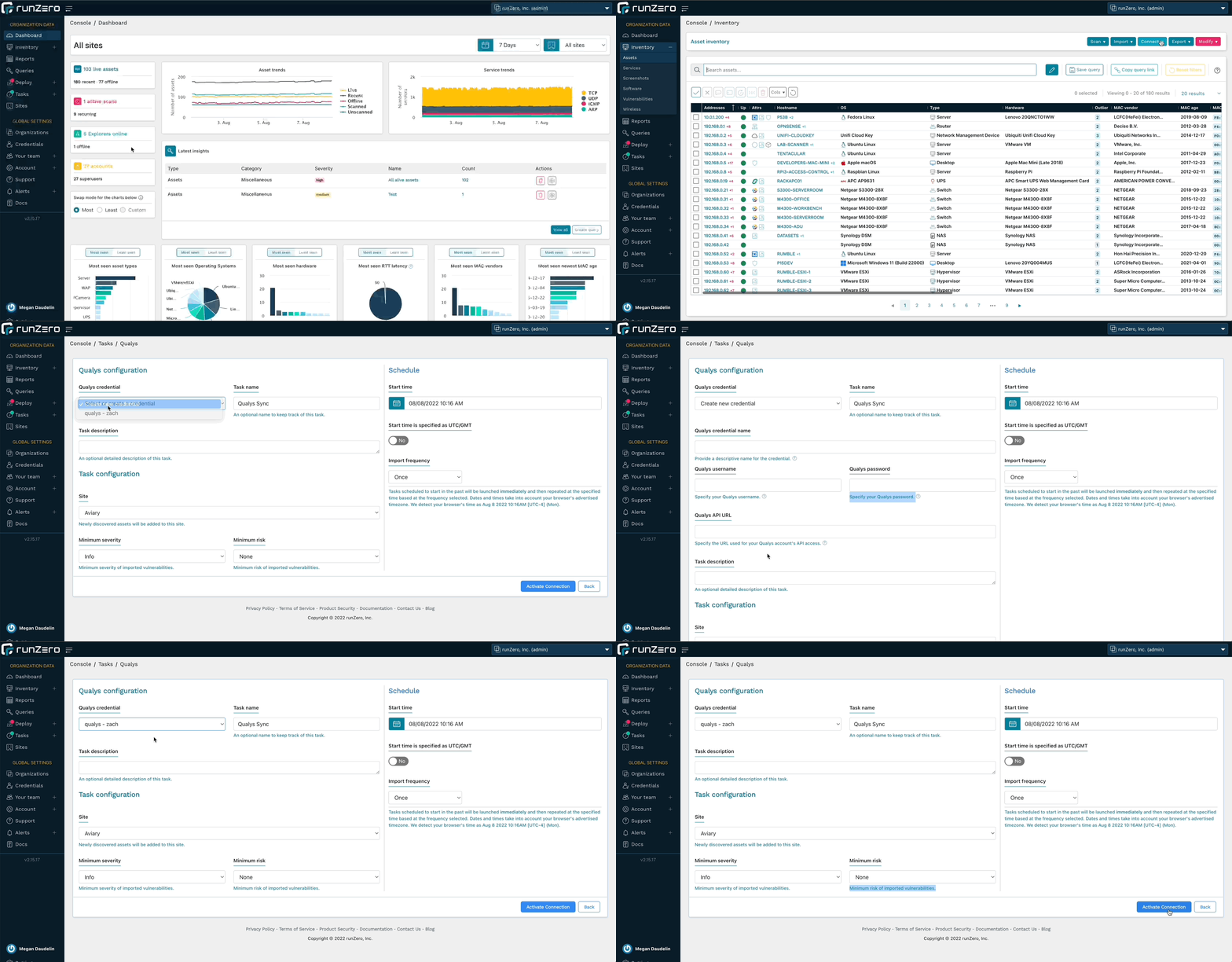
runZero Enterprise users can now enrich their inventory with vulnerability data from Qualys. This allows you to search for Qualys attributes, software entries, and vulnerabilities in runZero, as well as find assets not scanned by Qualys. runZero automatically correlates Qualys assets to runZero assets based on unique fields. Vulnerability data can be viewed in the asset detail view as well as a dedicated inventory tab. Vulnerability attributes include CVSS score, relevant CVEs, vulnerability description, and any recommended remediations.

To get started, set up a connection to Qualys.

Qualys integration

Release notes

The runZero 3.0 release includes a rollup of all the 2.15.x updates, which includes all of the following features, improvements, and updates.

New features

  • Rumble is now runZero and the product UX has been updated to match.
  • runZero Enterprise customers can now sync asset and vulnerability data from Qualys VMDR.
  • Users can now specify a Default Organization in the profile settings page.
  • A custom query to find DrayTek Vigor routers has been added.
  • The Organization API now supports asset merging.

Product improvements

  • Outlier calculations and insight queries now automatically run as daily analysis tasks.
  • Outlier calculations and insight queries can be regenerated on demand using the Metrics menu on the Tasks overview page.
  • Merging assets with foreign attributes from the same source now retains all sets of foreign attributes.
  • Software entries imported from SentinelOne and Tenable now report their service addresses.
  • The Software and Vulnerabilities datatables now have a “view more details” button.
  • The Asset and Service attributes reports can now be filtered by Site.
  • API keys are now shown hidden by default and can be copied to the clipboard through a click.
  • Vulnerability details are now available on the Vulnerability Inventory screen.
  • Improved ability to extract Microsoft Windows information from web services.
  • Improved ability to extract information from NetBIOS, including new detection of Domain Controller roles.
  • Hosted Zone scan limits have been increased.
  • The runZero Explorer now logs configuration file loading and reports any syntax errors.
  • Hostname identification from LDAP responses has been improved.
  • Filtering of non-unique MAC addresses has been improved.
  • Inconsistent SNMP data handling has been improved for certain classes of devices.
  • The API now returns all attributes, sources, and subnets for a single asset.
  • The runZero Explorer now runs as a delayed auto start process on Windows to increase reliability after reboots.
  • The Organization Overview report now includes navigation links to return to the top of the report.
  • Click-to-copy functionality has been restored for MAC addresses displayed on inventory pages.
  • Asset export query errors now return HTTP 400 status code with descriptive bodies.

Performance improvements

  • The Queries datatable has been redesigned and is now more performant.
  • The Route Pathing report is now more performant and aborts early in out-of-memory scenarios.
  • Processing speed for large Nexpose and Tenable imports has been improved.
  • Improved support for processing very large scans.
  • Improved performance of the software and vulnerabilities tables.

Fingerprinting changes

  • Improved operating system fingerprints for Amazon, Azure, and GCP integrations.
  • Improved operating system fingerprints for Red Hat Enterprise Linux / CentOS, Fedora, Rocky, and Ubuntu releases.
  • Improved fingerprints for Windows operating system.
  • Added the ability to fingerprint McAfee ePolicy Orchestrator (ePO) and Agent.
  • Improved NetBIOS, NTLM, and LDAP fingerprinting logic.
  • Improved coverage for networking gear, including vendors Cisco, Dell, and Extreme Networks.
  • Improved NTP banner fingerprints.
  • Printer detection has been improved.
  • OS fingerprinting will now use Rapid7 fingerprints, when Rapid7 is the only data source.
  • Additional support for products by 2N, Axis, D-Link, DrayTek, FortiNet, Foscam, FrontRow, Hisense, Impinj, Kentec, OleumTech, Schneider Electric, SEL, Synology, and VMware.

Integration improvements

  • Improved hostname-based merging for Rapid7 imports.
  • Improved support for processing very large Rapid7 imports.
  • Software will now be populated from Rapid7 imports.
  • Rapid7 foreign attributes have been adjusted for clarity.
  • Services will now be populated from Censys.
  • The InsightVM integration now supports larger imports.

Bug fixes

  • A bug in the AWS Configuration UI causing the “Lambda instances” option to not persist has been resolved.
  • A bug that could prevent external users from being directed to their main SSO login page has been resolved.
  • A bug which could cause stale software entries to be retained has been fixed.
  • A bug in the Insights table which could render very large buttons has been fixed.
  • A bug that could lead to a 500 error when accessing the users endpoint of the organization API has been resolved.
  • A bug that could cause tooltips to persist on the screen has been resolved.
  • A bug that could cause the vulnerabilities table to appear empty when sorted by the details column has been fixed.
  • A bug that could cause the HTTP probe to abort early has been resolved.
  • The asset tag update and bulk asset tag update APIs now work as documented.
  • Fixed a bug which prevented all org admins from deleting other users.
  • The User Last Activity date now shows the correct date.
  • A bug that could prevent connector tasks from running in parallel while connecting to third-party APIs has been resolved.
  • A bug that prevented organization administrators from deleting other users has been resolved.
  • A bug affecting inventory multi-select operations has been resolved.
  • A bug preventing inventory column selection has been resolved.
  • A bug that could indefinitely stall a task has been resolved.
  • A bug affecting license warning banners has been fixed.
  • A bug affecting macOS Explorer upgrades on M1 systems has been fixed.
  • A bug that prevented importing VMware assets has been fixed.
  • When a templated task fails due to an Explorer being unavailable, copying the failed task now retains the connection to the template.
  • A bug in the Overview report which showed blank addresses for Unscanned assets has been resolved.
  • A bug that caused scan copies to get assigned to a different site has been resolved.
  • A bug that prevented OS icons from showing on inventory tables has been resolved.
  • A bug that prevented copying or updating Nessus connector tasks has been resolved.
  • A bug that could lead to an error in the External Asset Report when no assets were present has been resolved.
  • A bug that could cause the Export API to return a 500 instead of 400 for invalid queries has been resolved.
  • A bug that caused some Explorer updates to fail on Windows has been resolved.

About Version 2 Digital

Version 2 Digital is one of the most dynamic IT companies in Asia. The company distributes a wide range of IT products across various areas including cyber security, cloud, data protection, end points, infrastructures, system monitoring, storage, networking, business productivity and communication products.

Through an extensive network of channels, point of sales, resellers, and partnership companies, Version 2 offers quality products and services which are highly acclaimed in the market. Its customers cover a wide spectrum which include Global 1000 enterprises, regional listed companies, different vertical industries, public utilities, Government, a vast number of successful SMEs, and consumers in various Asian cities.

About runZero
runZero, a network discovery and asset inventory solution, was founded in 2018 by HD Moore, the creator of Metasploit. HD envisioned a modern active discovery solution that could find and identify everything on a network–without credentials. As a security researcher and penetration tester, he often employed benign ways to get information leaks and piece them together to build device profiles. Eventually, this work led him to leverage applied research and the discovery techniques developed for security and penetration testing to create runZero.

The most complete comparison: Pandora FMS Open Source vs Pandora FMS Enterprise

What is Pandora FMS Open Source?

Pandora FMS Open Source is not a freemium software, it is not bloatware nor shareware (*Wink for those born before the 80s). Pandora FMS is licensed under GPL 2.0 and the first line of code was written in 2004 by Sancho Lerena, the company’s current CEO.

At that time, free software was in full swing and MySQL was still an independent company, as was SUN Microsystems. Today there are thousands of users of the Open Source version that regularly download updates through the system that we designed for that specific purpose.

We do not know more about the subject (neither their names, nor their companies…) because, above all, we respect privacy.

We consider Pandora FMS to be a real free software. The project has been active in Sourceforge since 2004 and we have all the awards granted by this entity that leads Open Source. All the code is available on Github in real time, but we do believe that there is something more important and that is the documentation we have available in five languages (Spanish, English, French, Japanese and Russian), with a level of depth that allows you to get the most out of it without having to pay for certifications, training or consulting.

Printed, the manual has more than 1,000 pages (per language) and is maintained by our professional development team, Q&A, translators and professional documentalists. We also have a public forum where we solve questions, with more than 15,000 messages.

We believe that freedom consists in offering users options, not just giving them part of the pieces of a puzzle without instructions.

Pandora FMS Enterprise

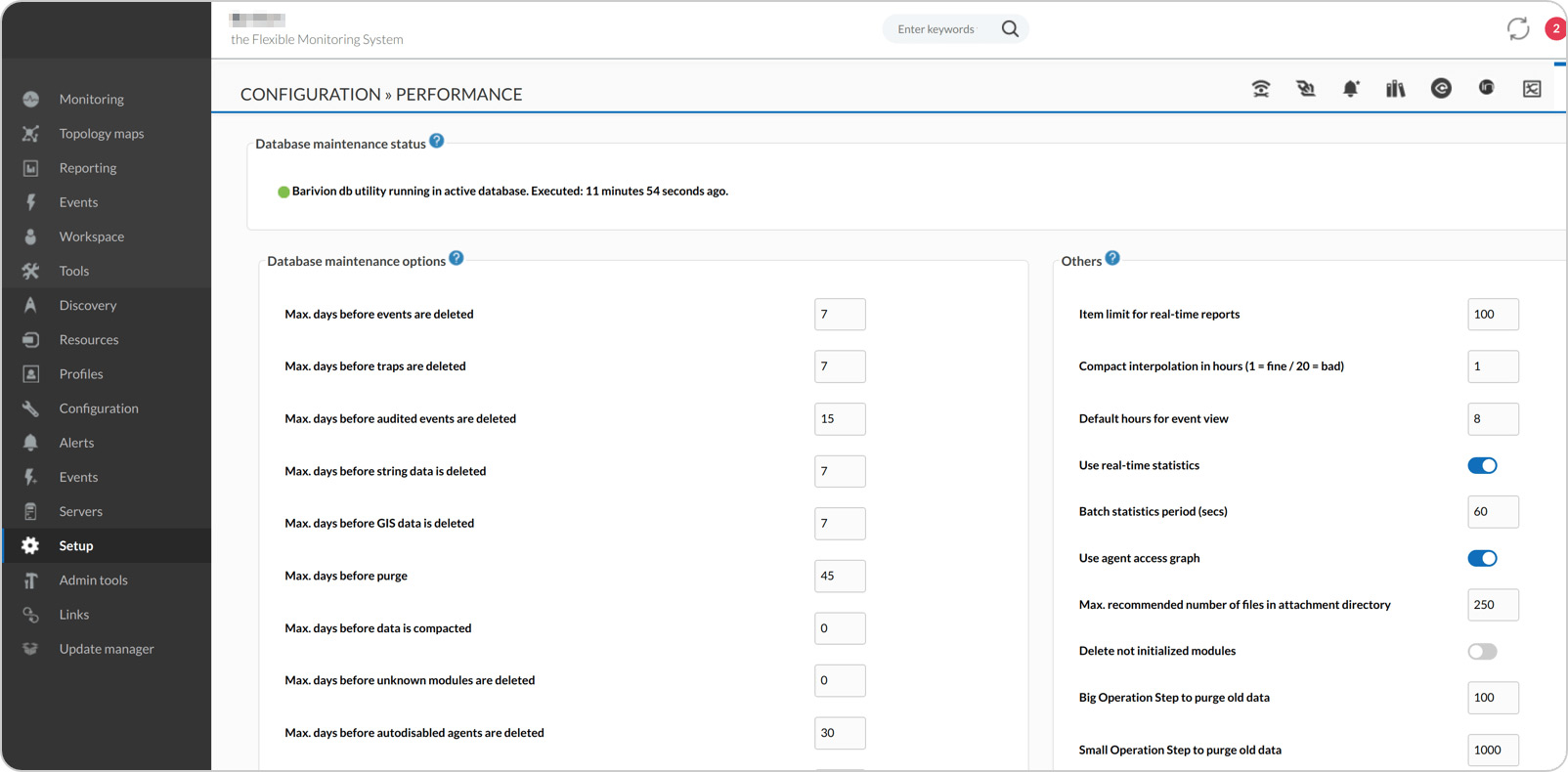
However, Pandora FMS has a version based on a commercial license that extends some of the features present in Pandora FMS OpenSource version. This license incorporates additional source code that is not publicly available or free of charge.

These features are oriented to demanding professional environments that require some automation and more specific tools already created to use them in operation and with professional support so that if something fails they can ask and get a patch if necessary. It is exactly for these types of environments that we designed Pandora FMS Enterprise.

If you want to use Pandora FMS Community and have doubts about whether it will be enough for your organization: Don’t hesitate!, it is not a question of size, we have users of the Open version with thousands of agents and who have been using it for years.

Obviously the main benefit of the Enterprise version is that you will have someone to support you at all times. Whether it is some problem with an update or throughout the installation of a plugin. But there are many small differences that can be key to optimizing your day-to-day management.

Next we will describe some of the Enterprise features. If you want to try them yourself, you can test the waters of a 30-day trial version, but let us show it to you at an online meeting and you’ll save yourself the trouble of messing with the software. Your time is valuable and while our documentation is extensive, PFMS has plenty of features.

Services

Services are the way to show in a simple and visual way what things are like in your organization, classified into different entities that in turn are made up of other services and / or metrics.

That way you may perform an automatic root cause analysis and find out when a service is affected, where the source is and even have it displayed in the form of a tree:
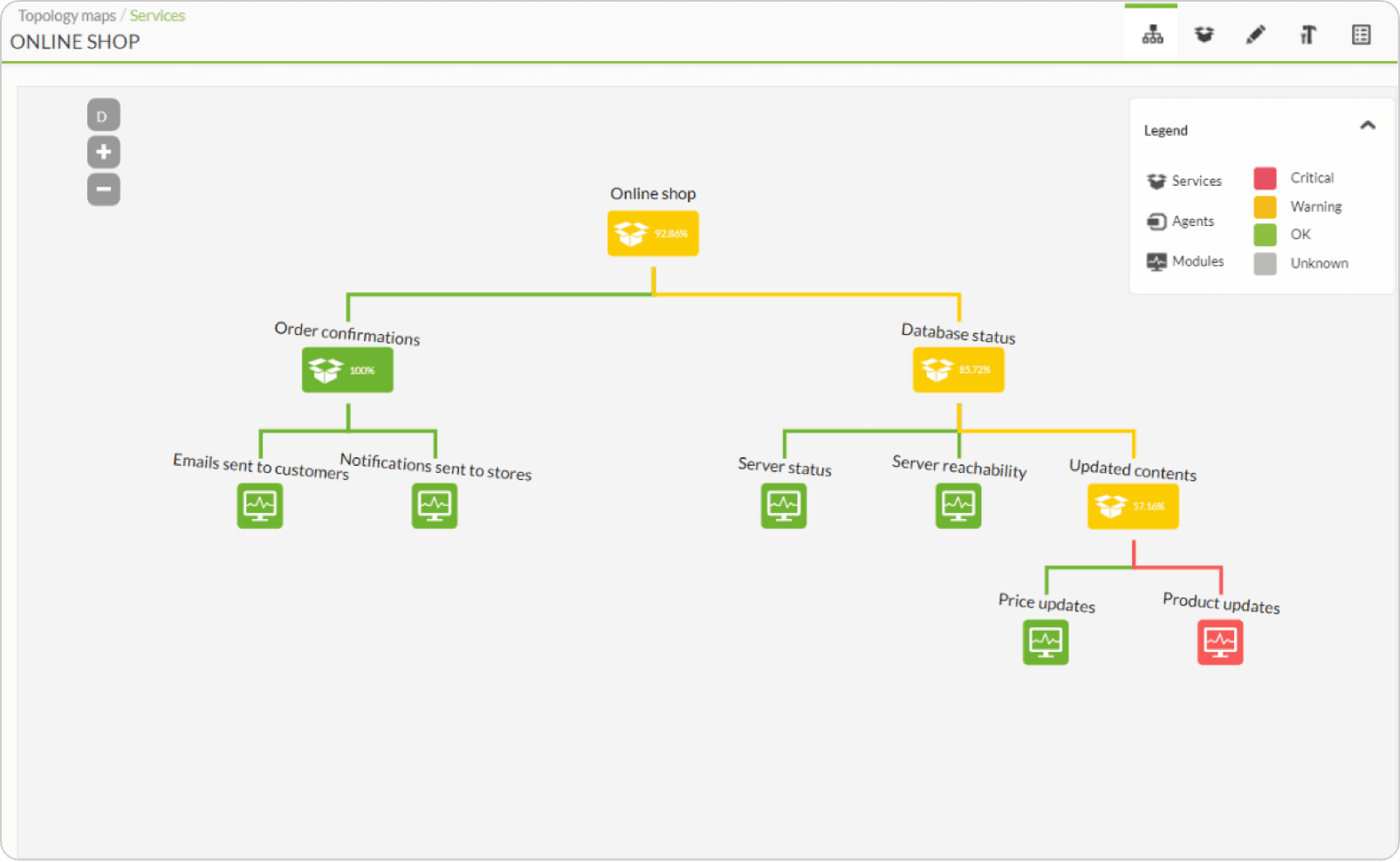
Services complement the existing display options in Pandora FMS and allow system managers to define weight rules that have their systems’ redundancy to alert only in case of need, not when something irrelevant fails.


↑ Go to index

Policies

The need arose from a client who managed many computers with different purposes and technologies. They found out that monitoring Windows 2000 computers was different from monitoring Windows 2003, and that of course the Redhat Linux had different needs from the Debian Linux. It also had differentiated database environments, such as DB2 or MySQL.

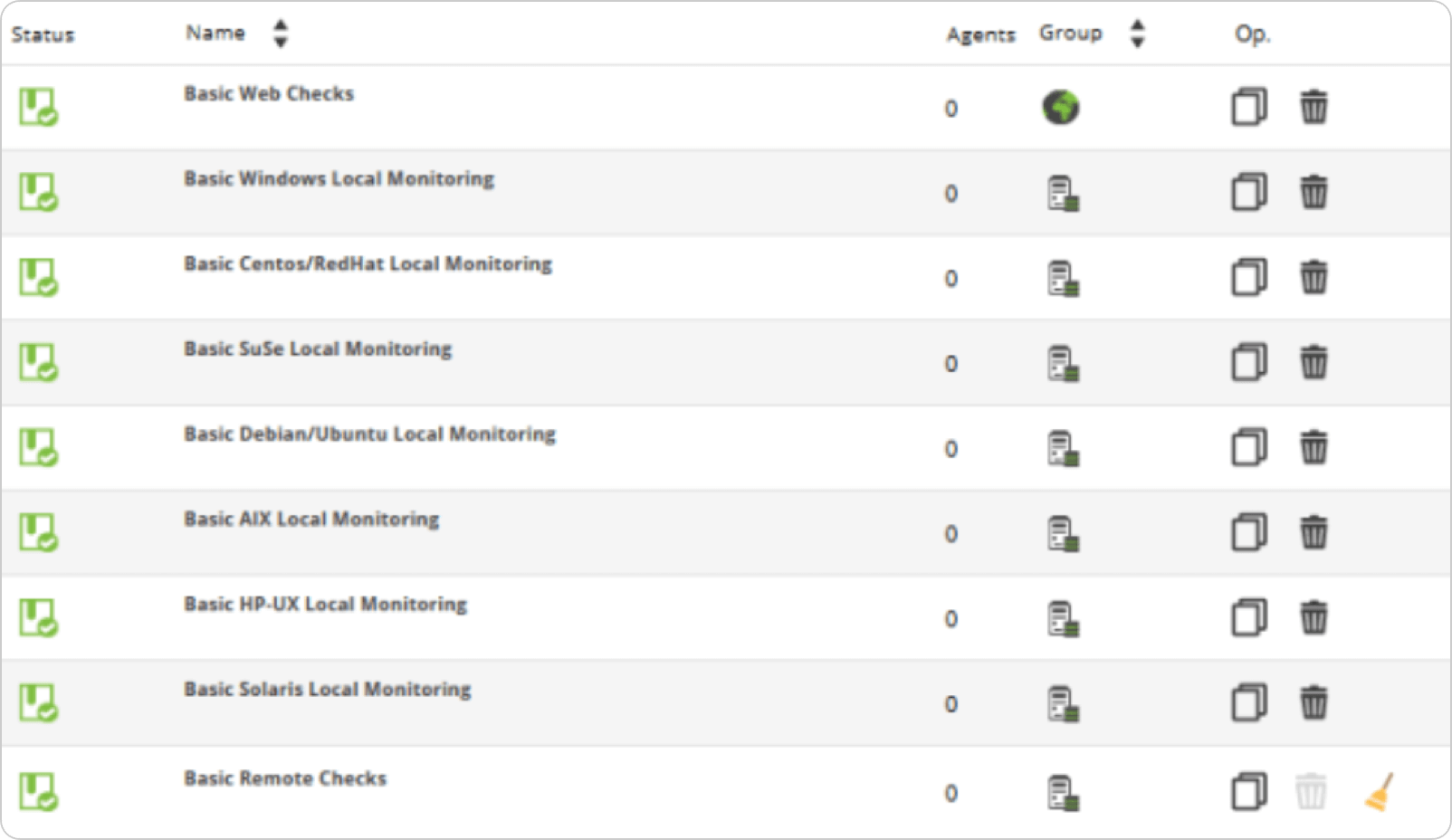
Base monitoring could be “compartmentalized” into different sets of checks that could be standardized, so that any Linux machine that had Oracle could be monitored the same. That way, we made sets of checks that could be easily deployed to machine groups.
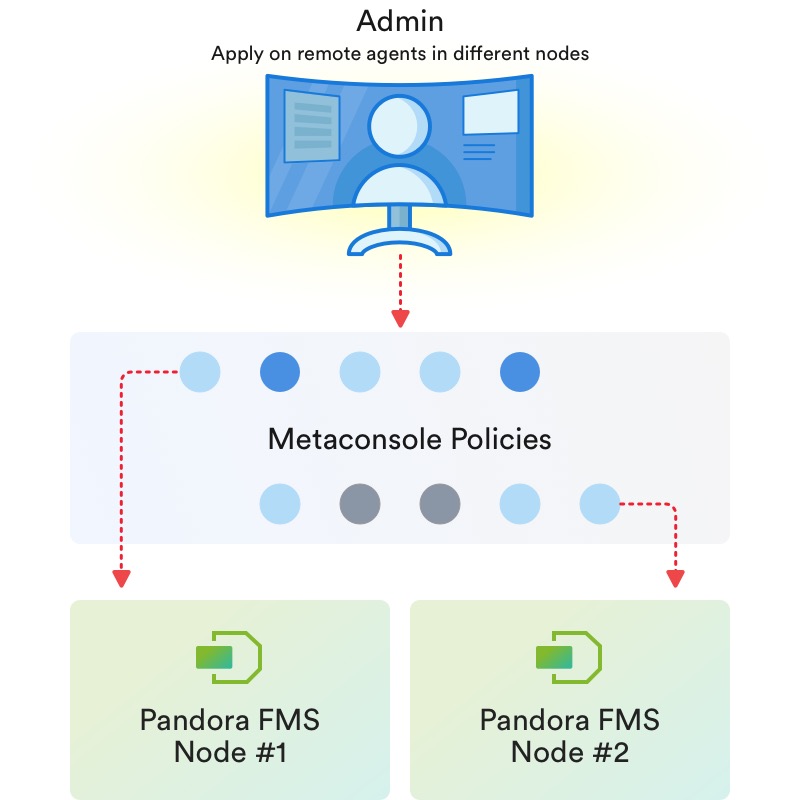
Thanks to policies, it is possible to homogenize monitoring and to deploy standard monitoring by technologies.

Thus a system can have different policies applied (e.g. base operating system, database, application X, network performance, etc.) and for every time you modify the policy, it can get “synchronized” with those systems that are subscribed to said policy, in a totally automatic way.

Of course, exceptions can always be made to policies at individual level, and each system can have unlimited policies in addition to custom monitoring. Using policy monitoring can save system administrators a huge amount of time.

↑ Go to index

Customization and OEM

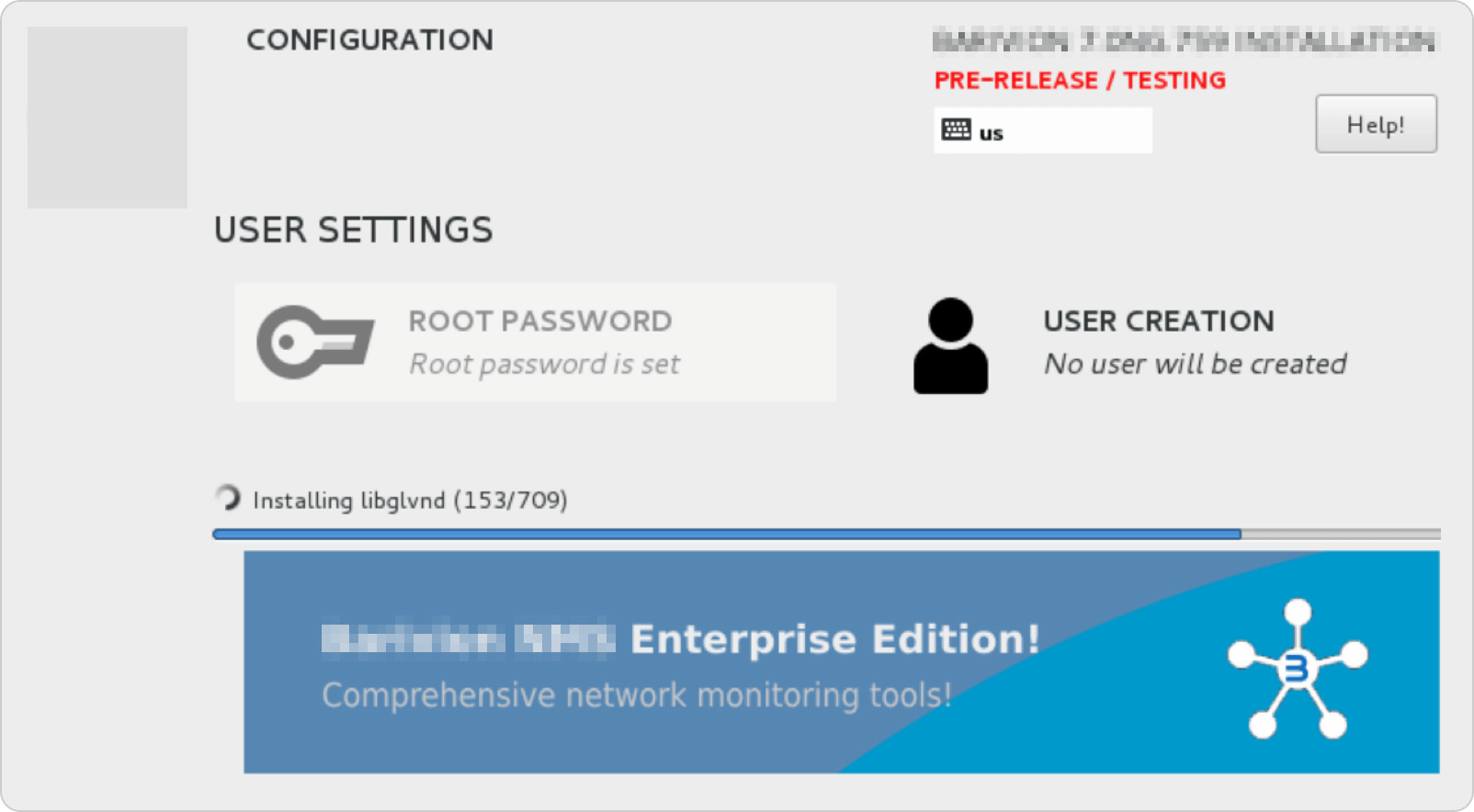
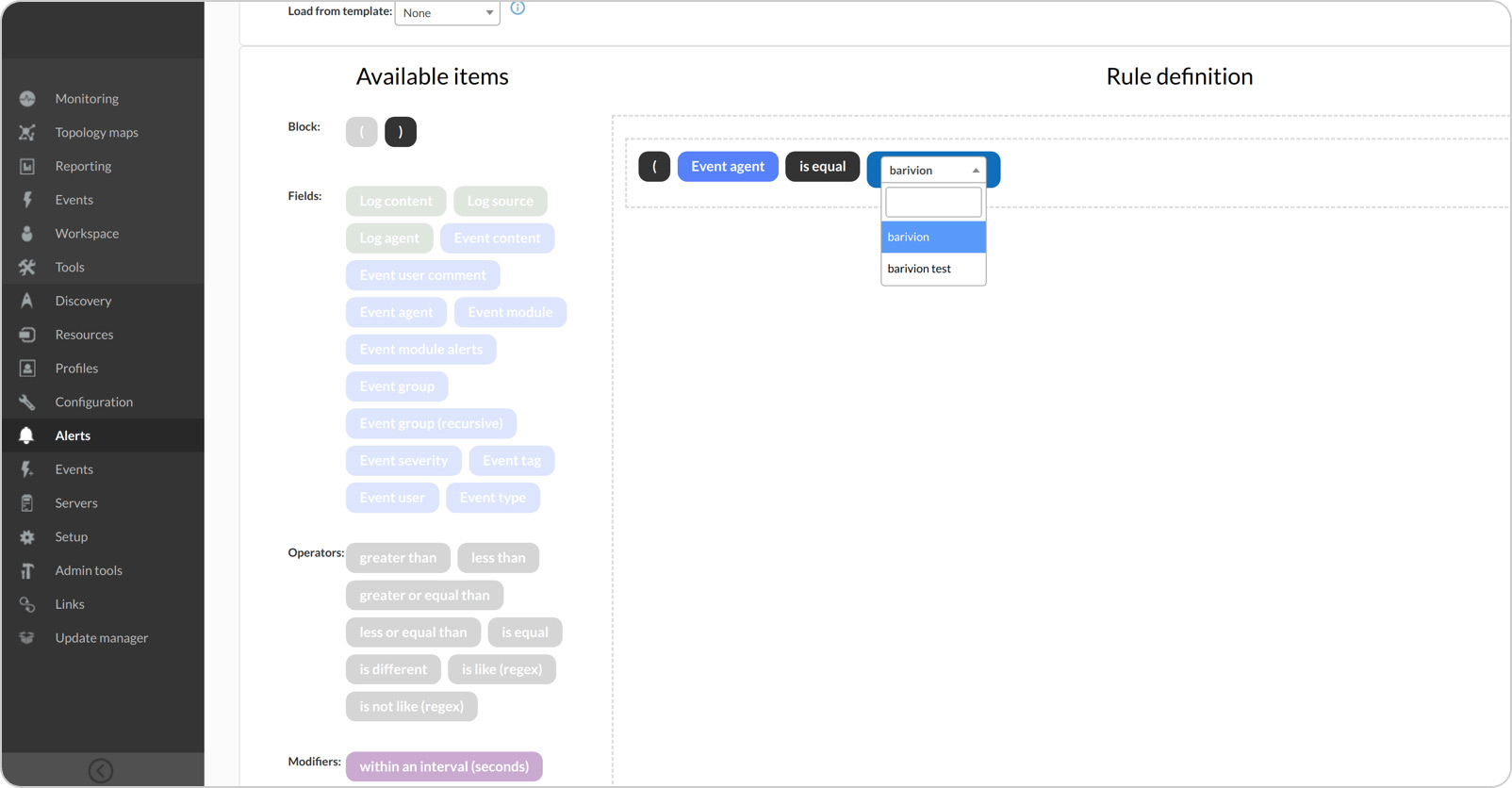
If you need to sell your own monitoring product, with your own brand and full customization not only of its look, but also of its installers, command path, running services, ISO installation images, Windows agents, logos, manufacturer and product names, Pandora FMS Enterprise has different customizing levels.

The most basic, and included as standard in any Enterprise license, allows you to customize the appearance of the console so that it does not look like Pandora FMS but your own product, with your own brand.

If what you need is to go further, and generate a software with another name and that from the installation process to the name of the database everything is alien to Pandora FMS, then OEM customization is what you need. We can even generate update packages specific to your OEM (or teach you how to do it so you can fend for yourself).
↑ Go to index

History DB

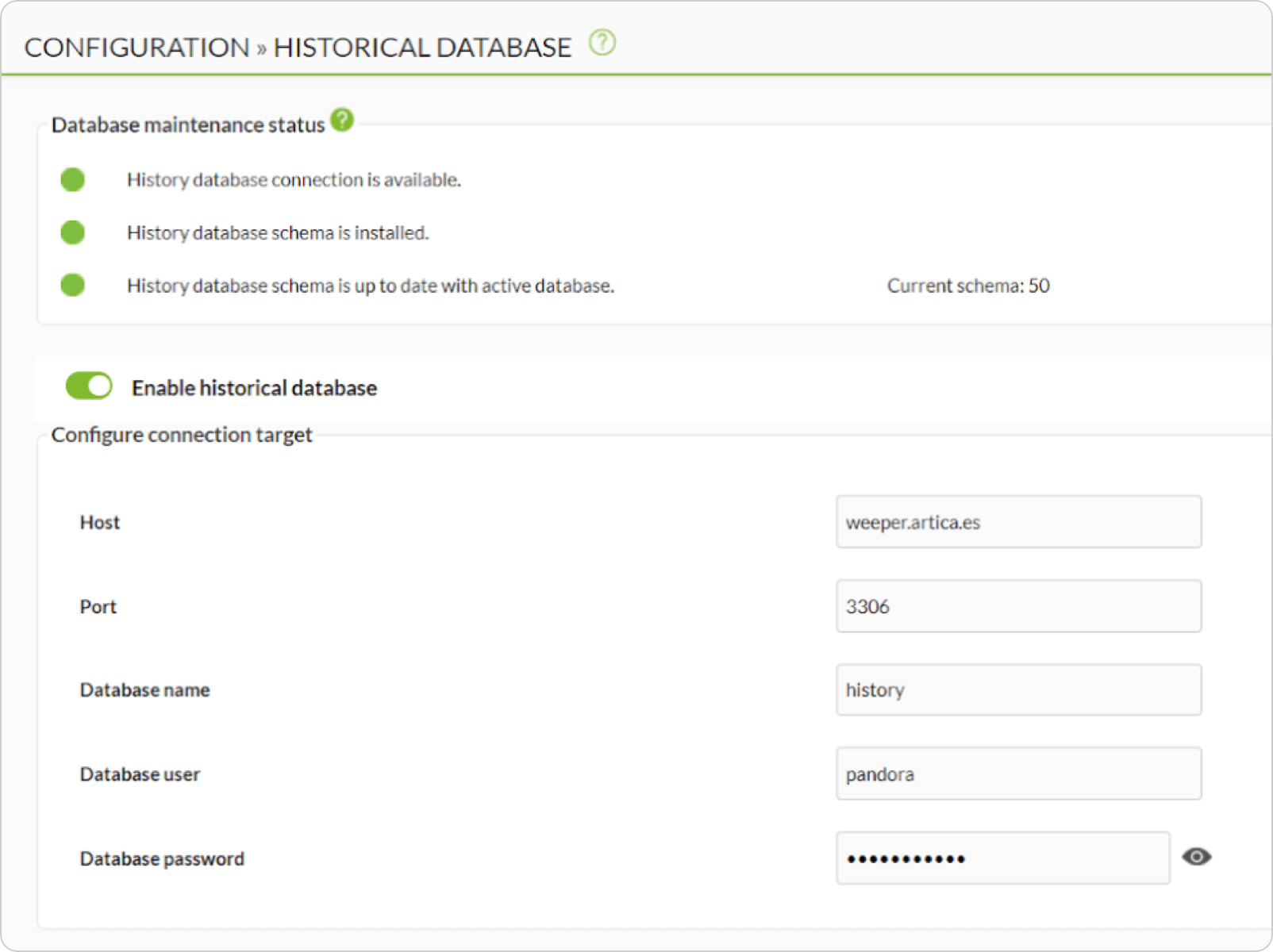
Pandora FMS Enterprise has a secondary storage system in an additional database. The system automatically transfers the data from more than N days to the history database and when it needs it to make reports or graphs, it uses both databases to gather information.

This allows you to have an almost unlimited data history (several years) without compromising the speed of access to day-to-day data.

↑ Go to index

Delegated authentication in Active Directory

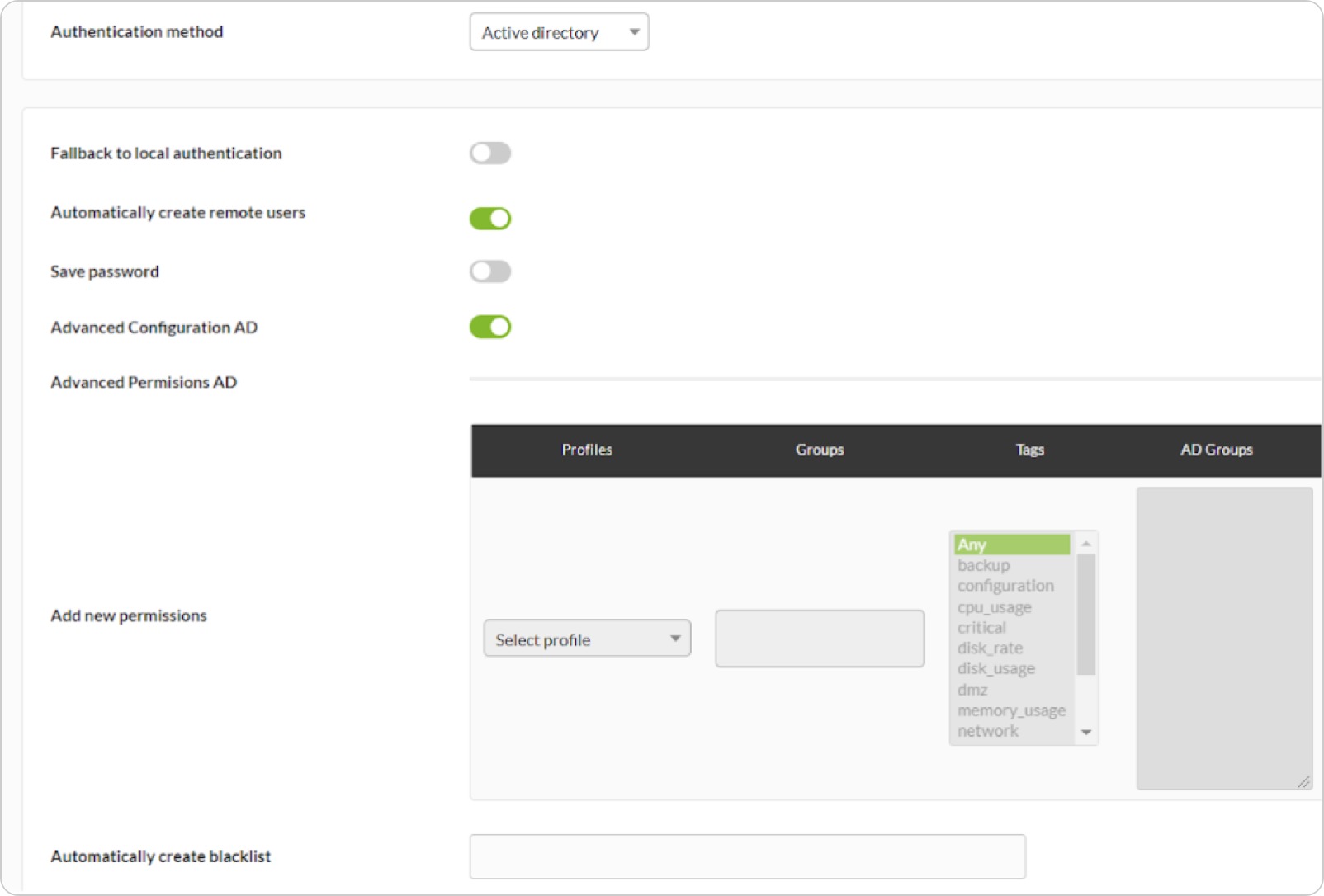
Whether you need your installation to rely on an Active Directory to authenticate users, or to automatically create them at login, assigning them specific profiles or filtering them through a blacklist, this feature is designed specifically for professional environments like yours.

It has advanced options such as delegating to a secondary server, excluding administrators, complementing it with double authentication through Google Auth and many other options.

↑ Go to index

Remote control

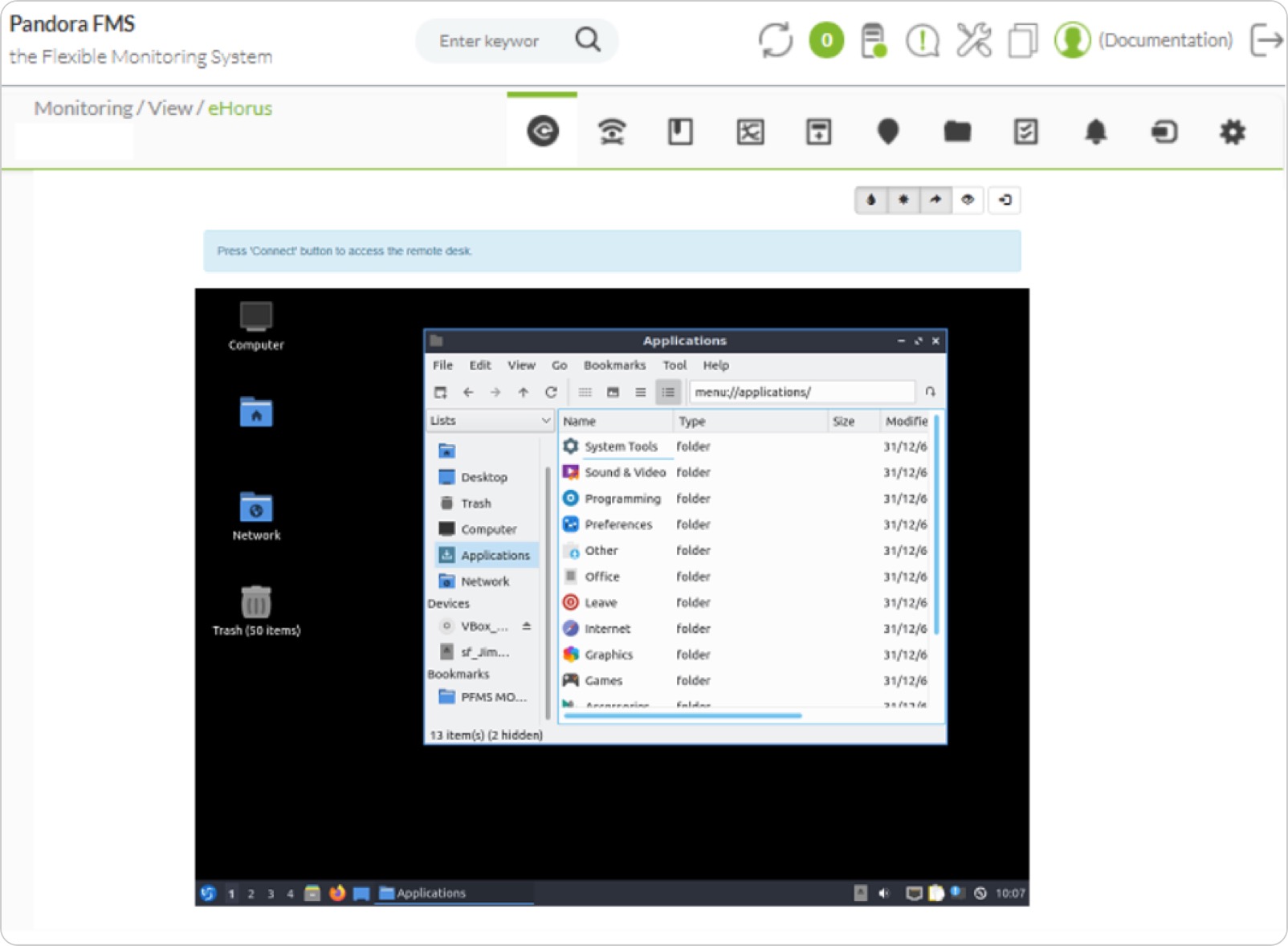
Remotely control and access your systems, whether windows workstations, Linux or Windows servers, or Raspberry or similar embedded systems. Access the remote shell as if you were in front of it, the remote desktop, or copy files both ways. All this from the same Pandora FMS WEB console, fully integrated into your asset management.

In the Enterprise version you may have your own on-premise infrastructure of eHorus servers so that all communication among your systems can be managed and controlled, with total autonomy from third parties and with maximum security and confidentiality.

In the community version, however, you may use our Cloud servers, up to a maximum of five devices for free.

↑ Go to index

Satellite Servers

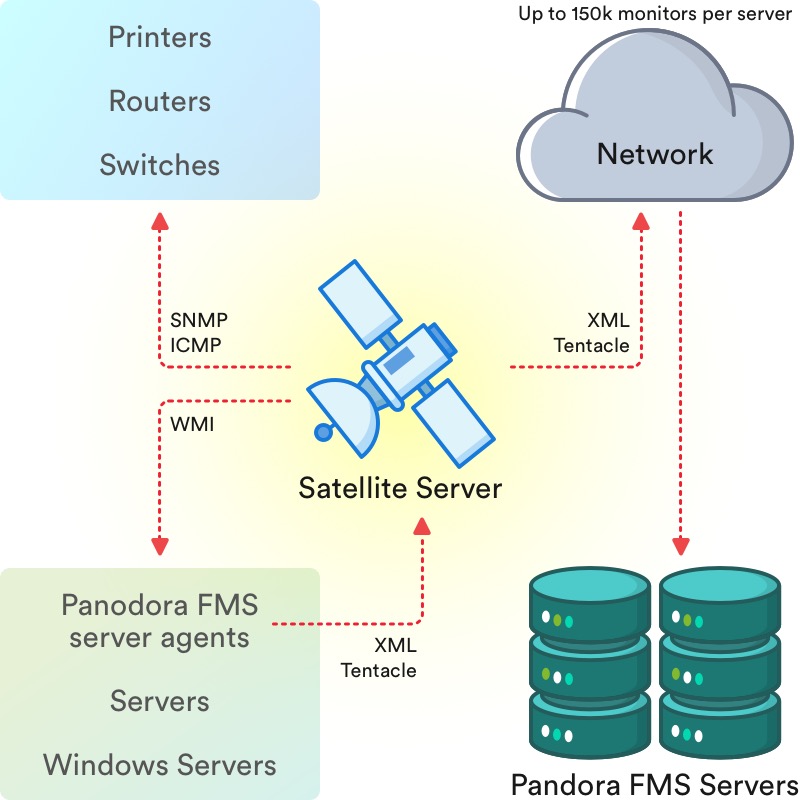
Satellite servers allow headless remote monitoring of entire networks of equipment in a distributed way. Install Satellite servers in the networks of your clients, they will obtain metrics of all kinds of devices around them, exploring what they have around them automatically and sending the information to the central server where you may manage it as if they were normal agents.

Satellite servers are perfect for making deployments in remote sites, customer offices or inaccessible environments. They can be installed on Raspberry, or any type of container.

↑ Go to index

User Experience (UX) Monitoring

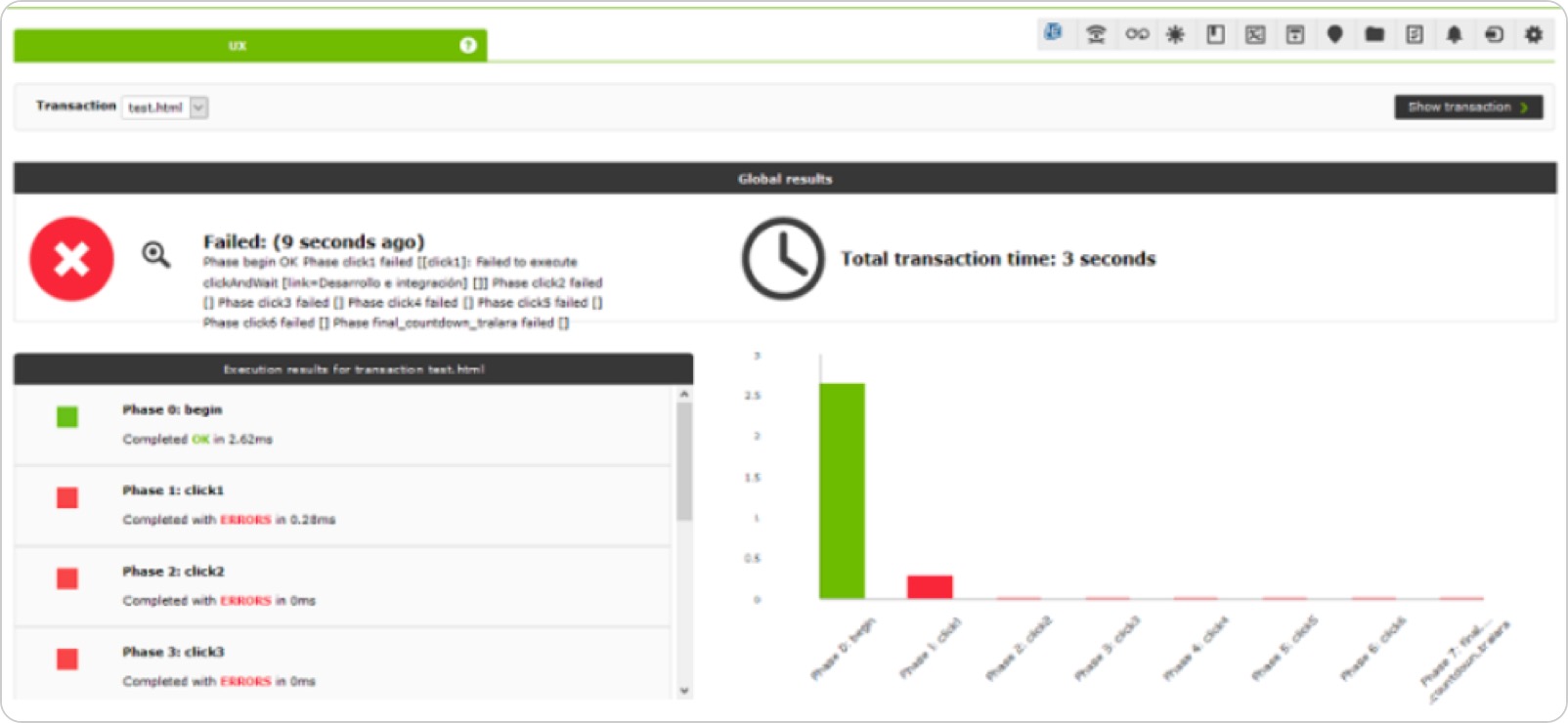
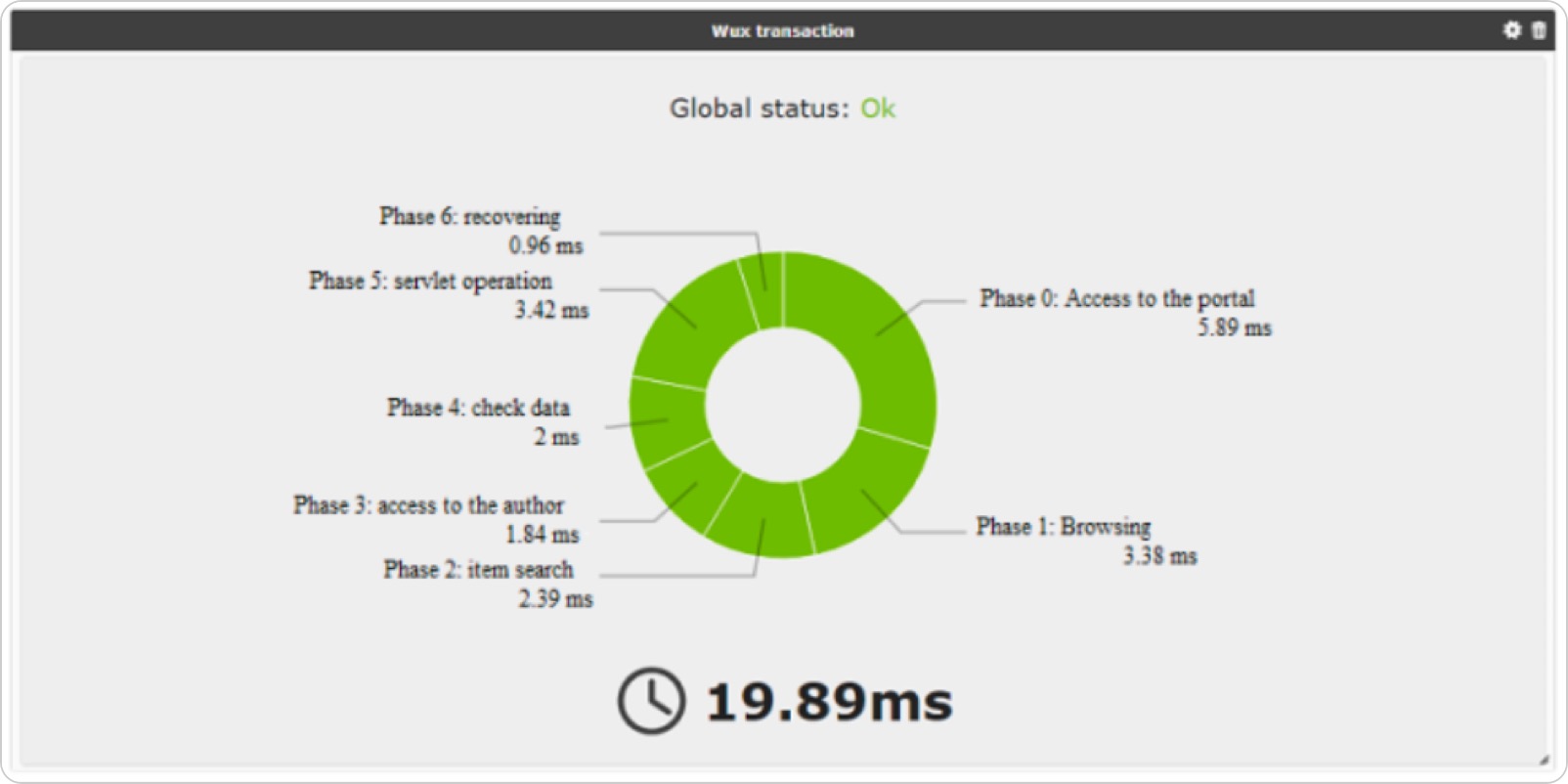
Nothing like observing things pretending to be a real user, if possible from the same chair as the real user. This is what user monitoring consists of, replicating a transaction from beginning to end, step by step, calculating the time it takes in each step, and verifying that each step is completed correctly.

That way you will not only find out whether it fails, but you will also know where, and how long each step takes. You may even take a screenshot to know what the fault looked like. This can be done for web applications (even if they have Java, Flash, HTML5, etc.), and also for traditional desktop applications. It can be done centrally (WUX) or in a distributed way so that the probes perform the tests from different geographical locations.
↑ Go to index

Remote agent deployment

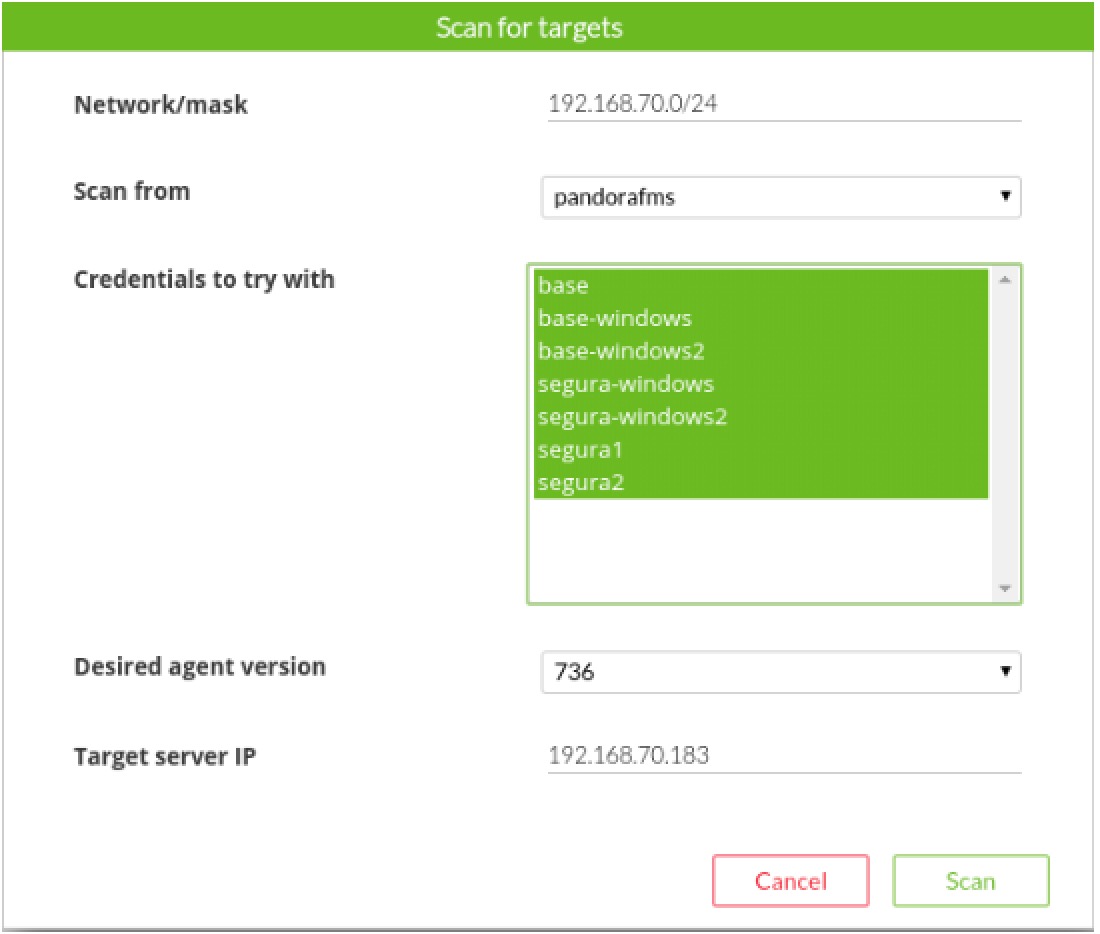
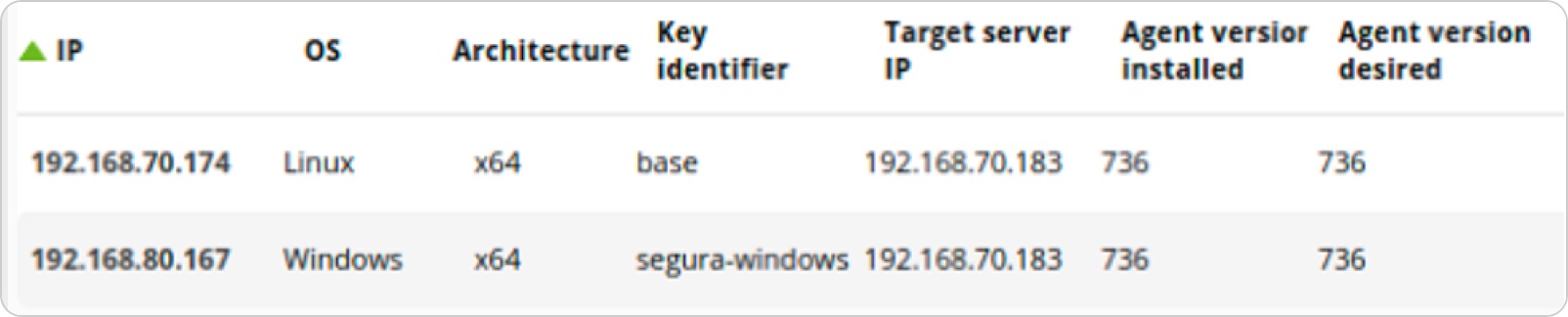
We know that deploying agents and configuring them is one of the most burdensome points of deploying monitoring. That is why we created a tool that allows, providing credentials, to connect to Windows or Linux systems to copy the agent and carry out its unattended installation.

It allows you to customize the installation, by different networks, environments or groups of machines. From dozens to thousands of systems can be installed or upgraded from the agent deployment console.
↑ Go to index

Omnishell

Omnishell is a Pandora FMS Enterprise feature that is used for orchestration (IT automation). It is a fully native tool integrated into the console that uses PFMS agents to execute command blocks on selected targets.

A use example would be to configure the auto-start of the HTTPD service on CentOS 7 systems massively. Another example could be to install a manual patch on those Windows machines that you select from a list. It can be one or several hundred machines.
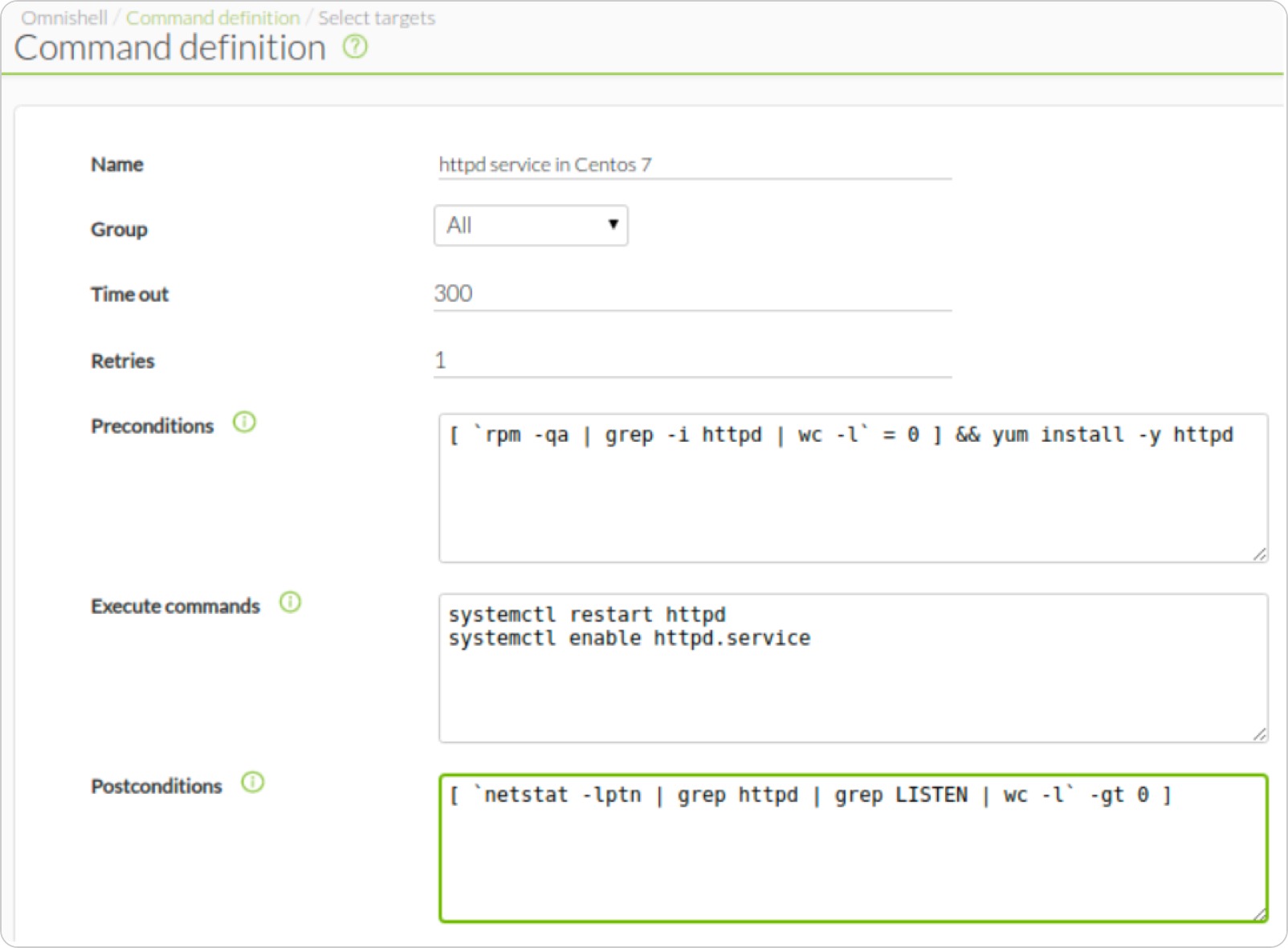
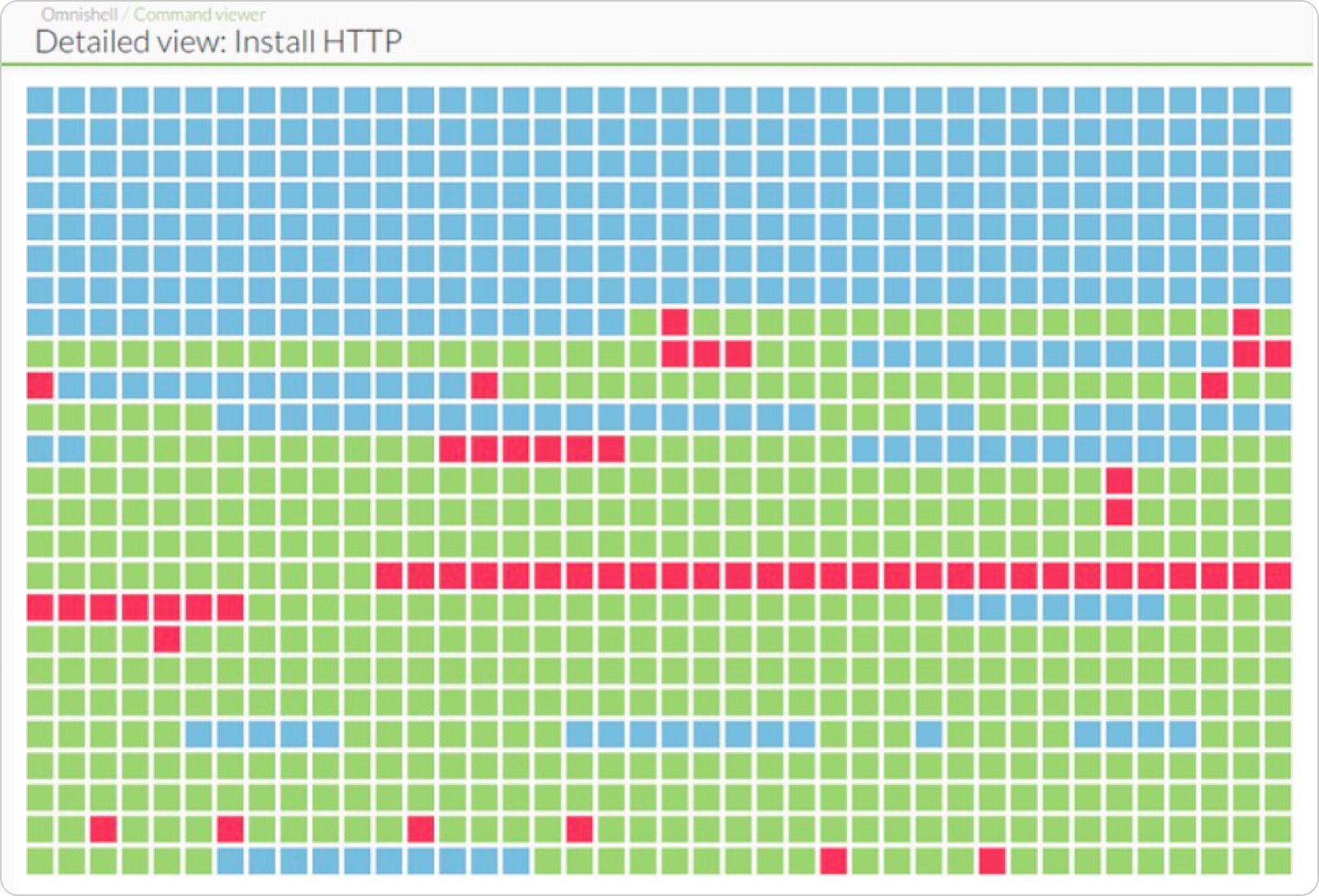
The system is designed to be executed on hundreds of systems simultaneously and wait for the order to be executed, showing on the screen the progress, machine by machine:

↑ Go to index

Auto Provisioning and automatic agent configuration

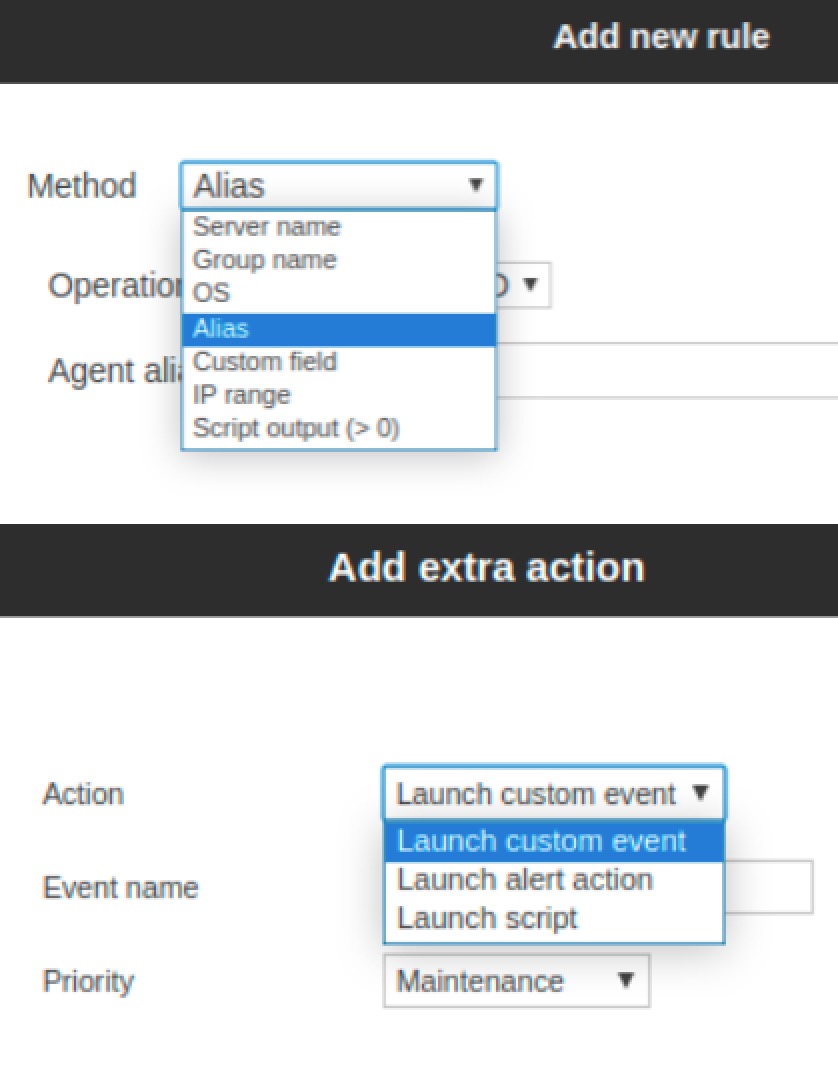
It implements an automatic mechanism by which it can apply policies and changes to newly provisioned agents, so that after deployment, monitoring configuration is automated, assigning it group(s), monitoring policies, alerts, etc.

This customization is done based on rules. For example, having a certain IP range, a specific brand or custom field, or a hostname with a certain pattern. In addition, after you make the configuration change, you may generate a custom action.

↑ Go to index

Collections

Deploying advanced monitoring requires bringing scripts and small applications (ours, yours or from third parties) to the monitored systems, to be executed by the agent in the form of plugins.

Collections allow you to gather this set of files and send them them to agents in an integrated way in the policies. That way, using plugins is something simple and transparent for the final operation.


↑ Go to index

Log collection

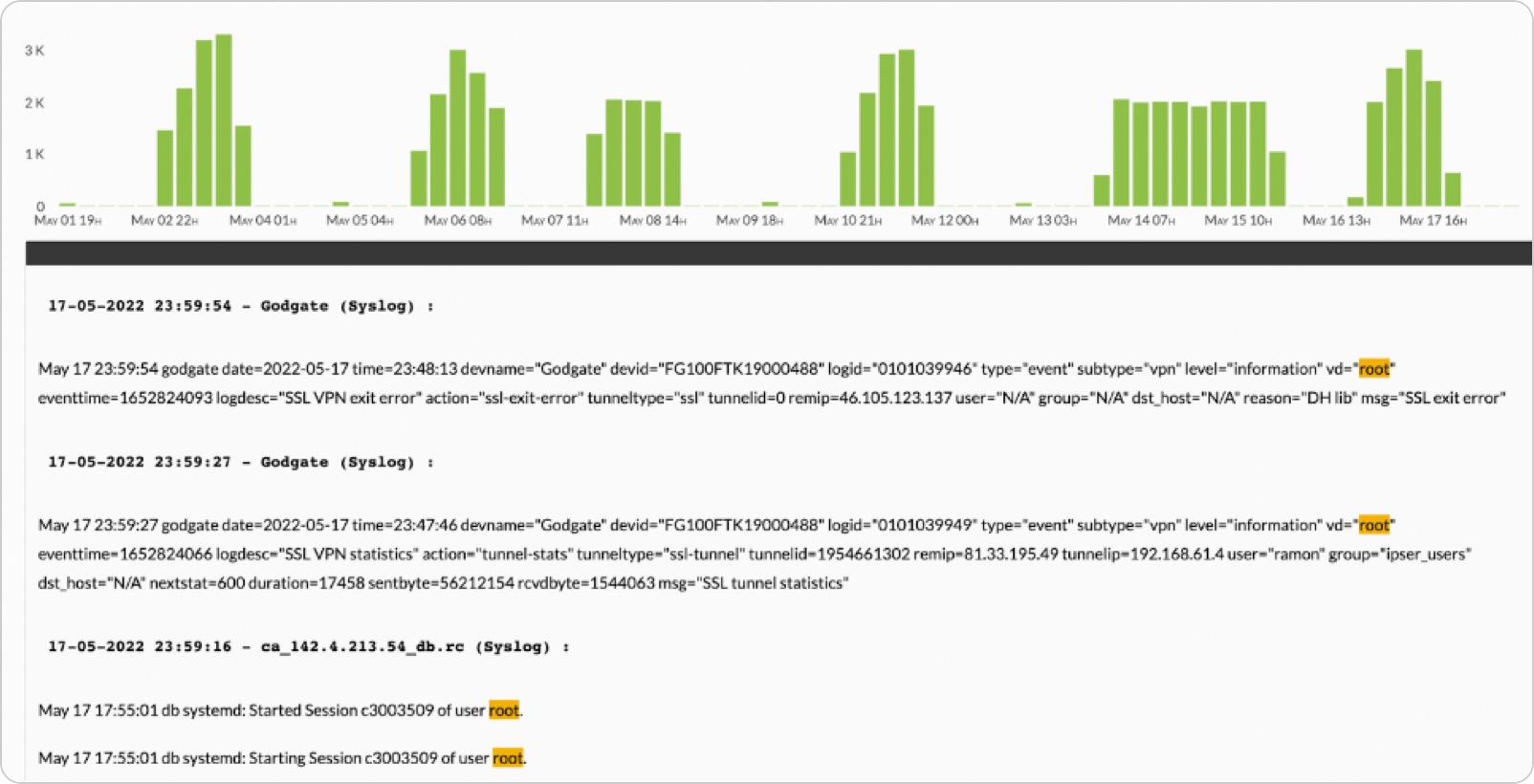
Pandora FMS can collect logs from any source that supports syslog or through software agents (Windows and Linux). Such logs can be plain text files, or Windows system events.

They will be collected by Pandora FMS monitoring agent and sent to the server along with the monitoring data. So if you already have agents installed, you may collect logs from those systems conveniently and quickly, and without additional software or licenses.

Unlike monitoring data that is stored in a conventional SQL database, logs are stored in a separate Elastic system. You will be able to store gigabytes worth of logs and keep them for a long time (you will only need more disk space). You may set up alerts or search through your data sources. It is the ideal complement to comprehensive monitoring, and fully integrated into the console.

↑ Go to index

Inventory Alerts

PFMS inventory allows you to obtain data of many types: installed software packages, users with access to the equipment, installed patches, hardware devices, firmware and version of the base system, license or serial number, etc.

Alerts allow you to generate actions in case of finding or not finding certain data on a computer with inventory information (whitelist / blacklist).

For example, what if you know that there is a vulnerable version in your systems? Well, you could create an alert that notifies you if someone is using it. Or on the contrary, if you need an application installed on all your systems and someone does not install it, you may find out in real time.


↑ Go to index

Metaconsole / Command Center

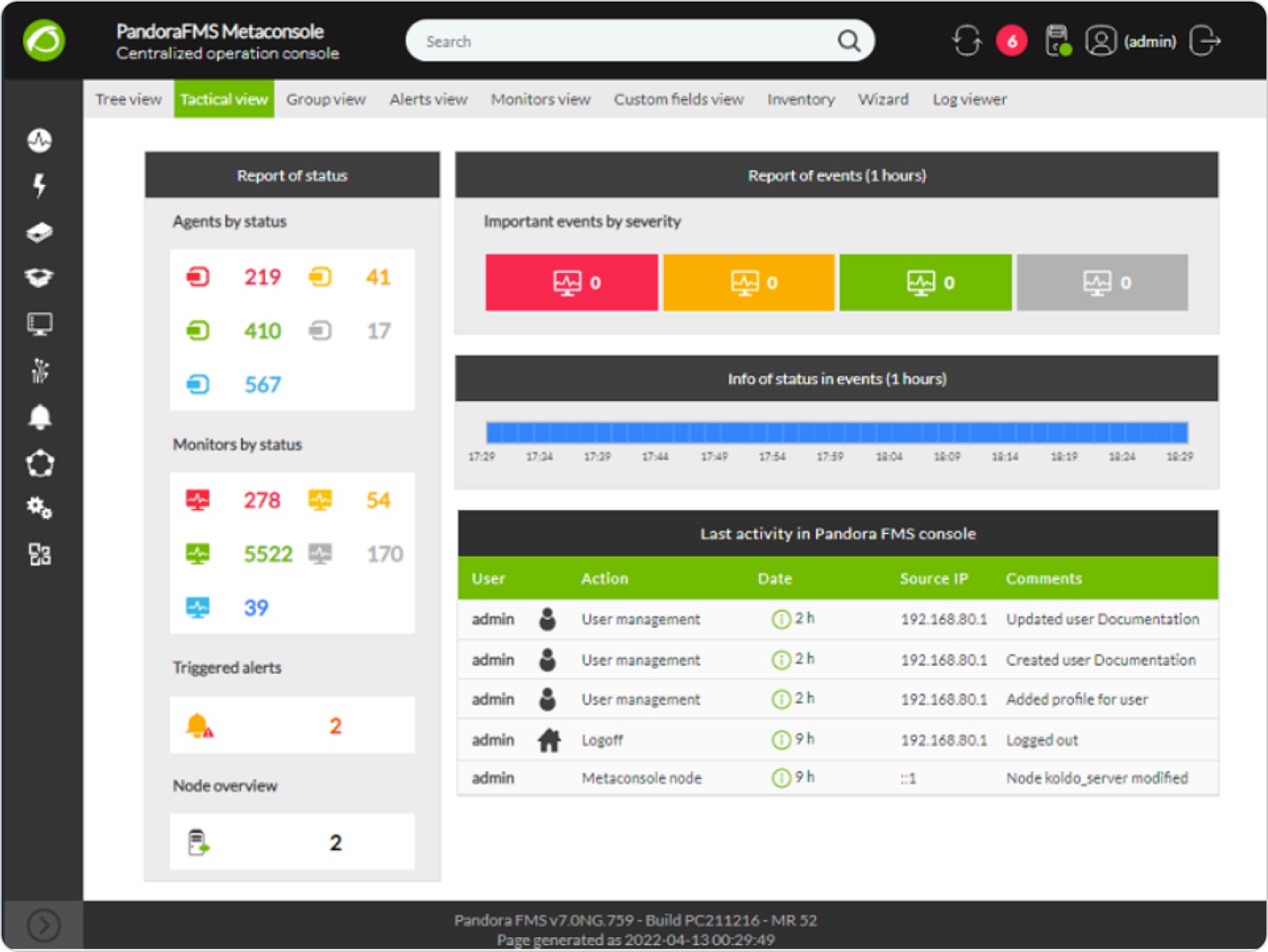
The Command Center is the jewel in the crown of Pandora FMS.

It serves the purpose of centrally controlling an unlimited number of independent Pandora FMS instances (each with its server, its console and its databases) so that you may manage dozens of thousands of agents from a single point, while these systems are in turn managed by independent instances.

This federated management system ensures uniformity and ease of management. It is a robust system where one system failing does not affect the rest of the systems, and where growth is fully horizontal and distributes loads automatically.

We have clients with more than 40,000 agents and more than one million metrics collected.

↑ Go to index

High Availability (HA)

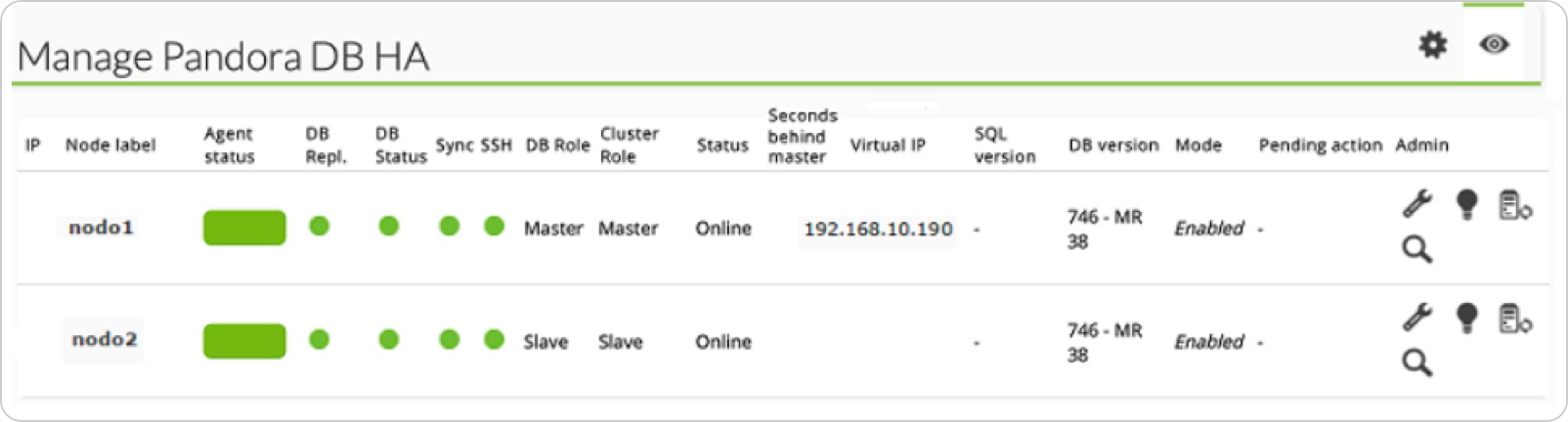
In critical environments and/or with lots of load, it is possible that it is necessary to distribute the load among several machines and make sure that if any Pandora FMS component fails, the system will stay online.

PFMS has been designed to be modular but it is also designed to work collaboratively with other components and to be able to take on the burden of those that failed. The most critical component is the database (MySQL/Percona) that can be configured in Active/Passive mode so that in case of failure, a read-only node is automatically activated and the system continues to operate without pause, and without data loss.

This system is integrated into Pandora FMS console.

↑ Go to index

Discovery Cloud

Discovery Cloud allows, through a fully pre-installed and centralized system, to configure native connectors (through APIs) with the most widespread public cloud providers: Amazon, Azure and Google.

You will be able to get it hooked onto your instances and explore the resources available for monitoring: machines, disks, databases and other elements.
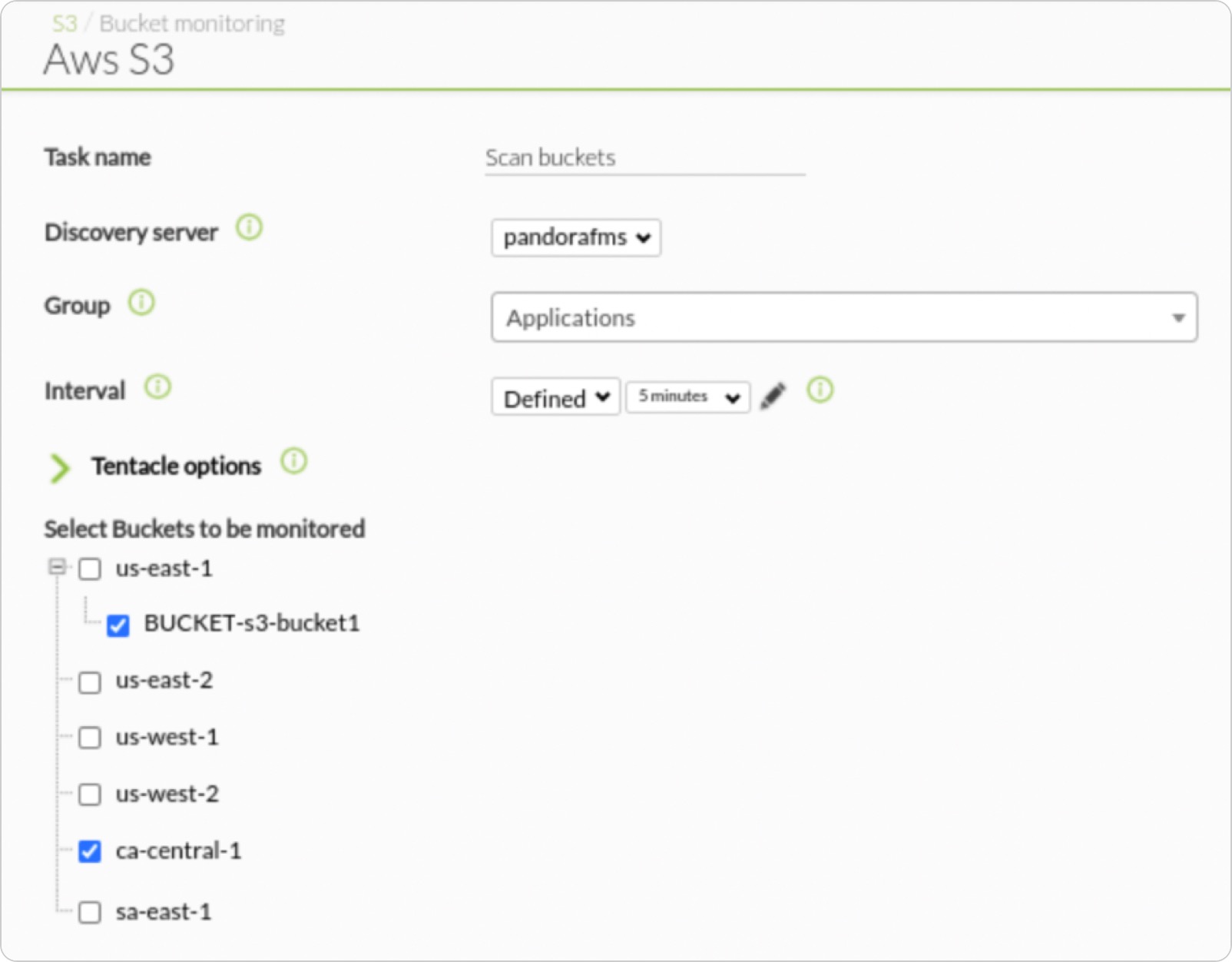
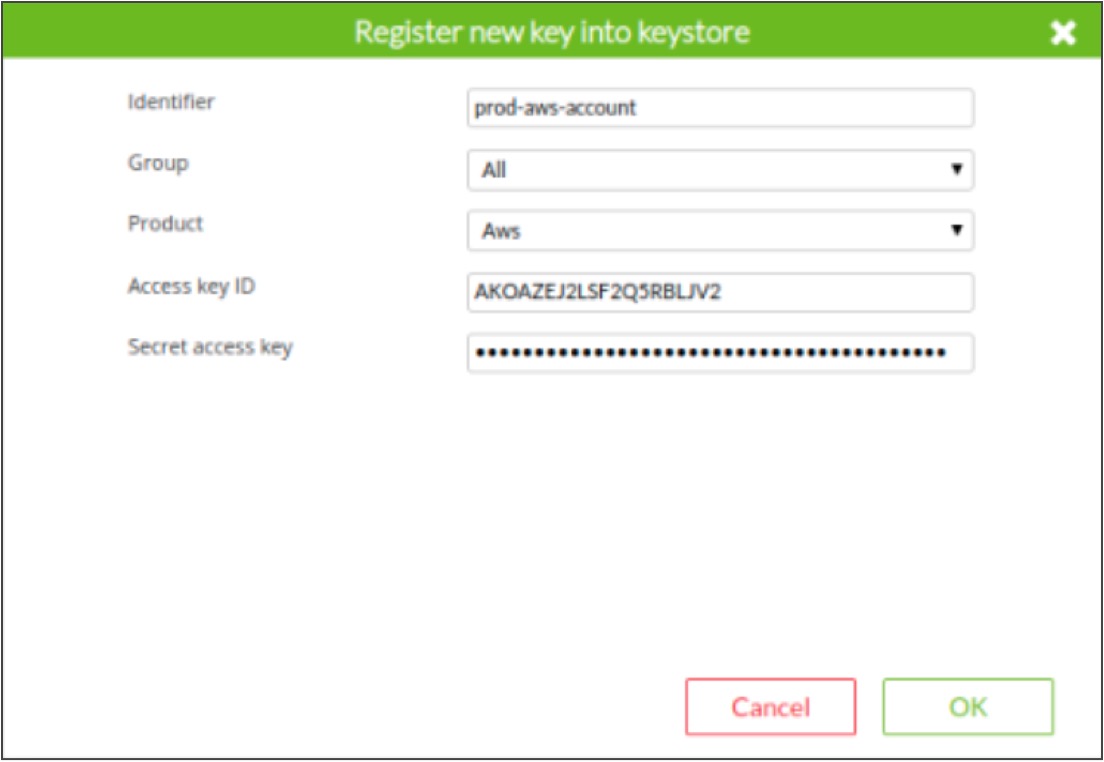
The advantage of this system is that you may get information about the services dynamically, without installing agents. In addition, if you later install agents, you may add both monitoring approaches. Through the credential container system you may even monitor different Amazon instances, for example.

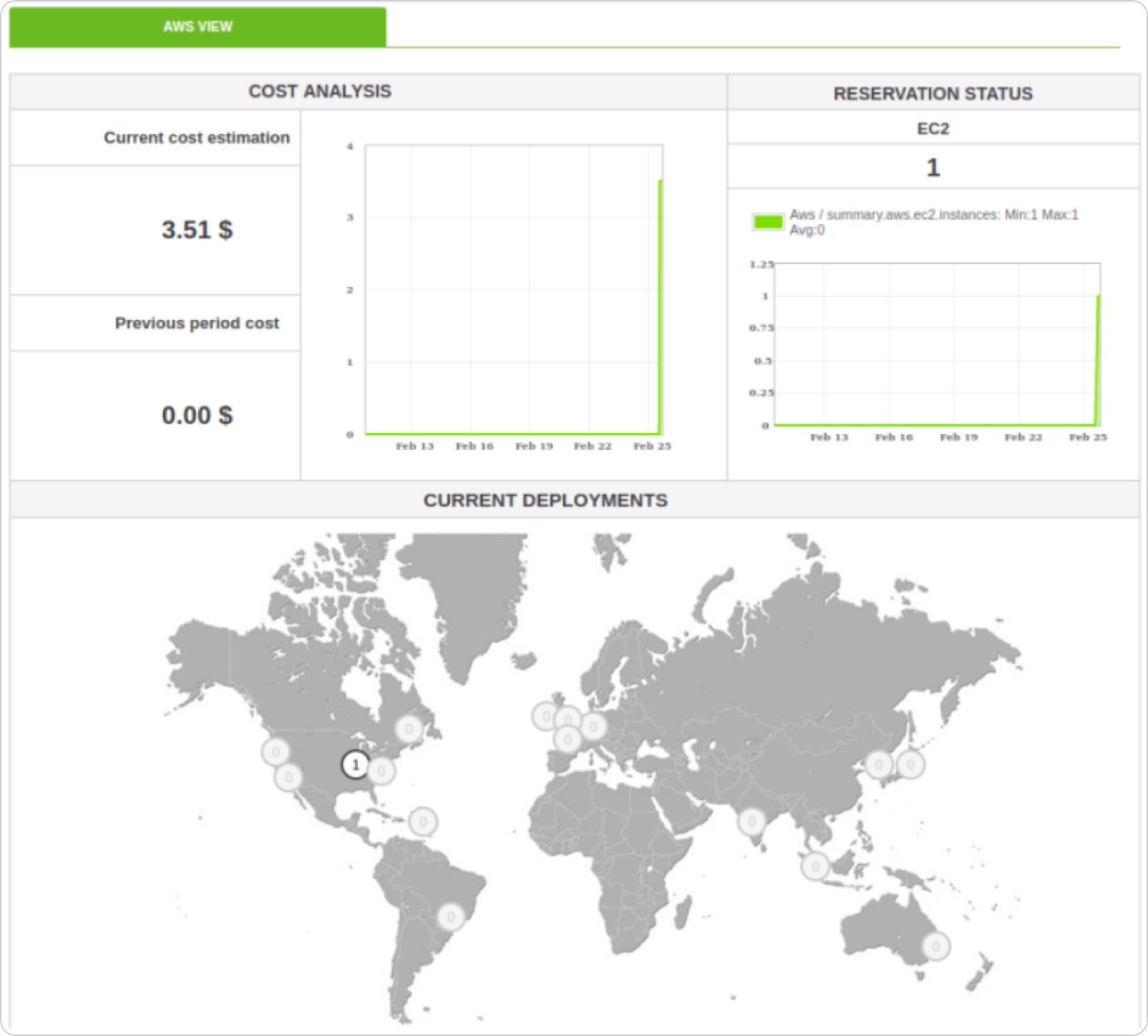
In the case of Amazon, you will also be able to find out the cost of active services.

↑ Go to index

Discovery Applications

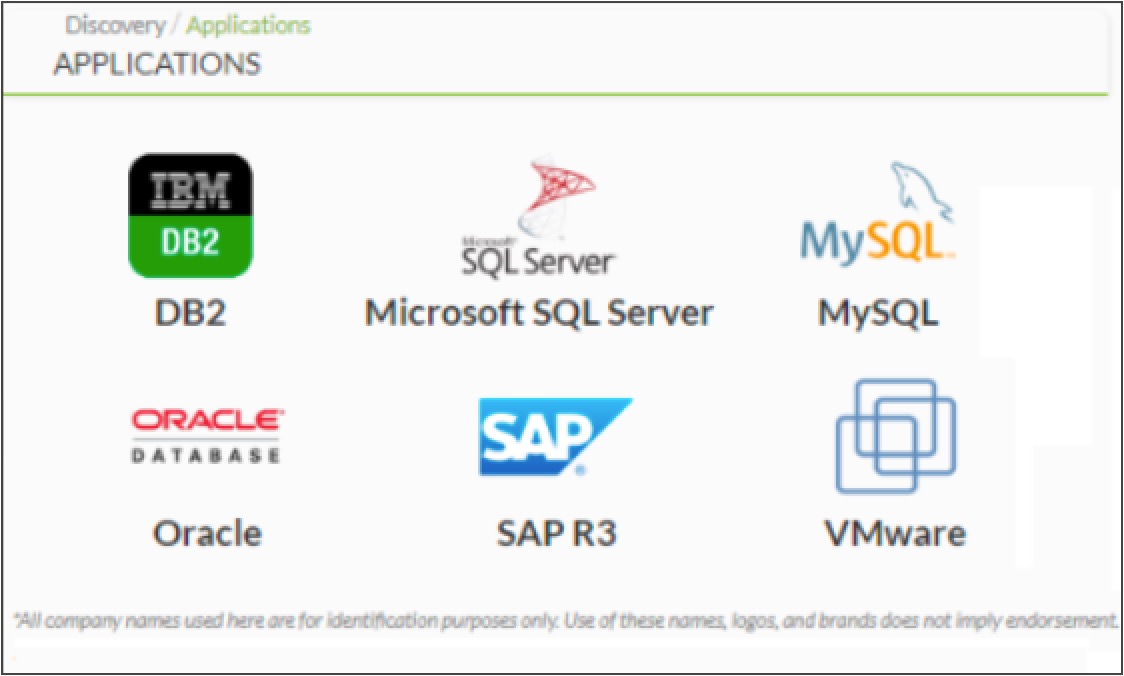
As with cloud providers, Discovery allows out-of-the-box to monitor some extended technologies centrally and remotely: Oracle, SAP R3, DB2, SQL Server, and VmWare virtualization (through the vCenter API).

↑ Go to index

Enterprise ACL’s

Along with OEM features, it allows you to customize not only the look, but the feature accessible by all types of users (including administrators). That way you may limit the functions of a PFMS instance, even making the menus disappear.


↑ Go to index

Comparison table Open Source vs Enterprise


Features Open source Enterprise
Tech support In community forums, by volunteers Worldwide hourly coverage. 24×7 optional
Professional services
Professional certification Several levels
Operating model on-premise on-premise SaaS (MaaS)
Remote monitoring SNMP, WMI and with plugins
Monitoring with agents
Reports, dashboards and visual consoles
Alerts system
Multi-user and multi-tenant
Netflow
Network Configuration Manager
IPAM (764 version)
Mobile Console APPs
High Availability (Manual) (Integrated)
Distributed Servers (Satellite)
Policies
Services
AD Authentication
Historical DB
Remote control Only SaaS SaaS and On-premise
Transactional monitoring of user experience (UX)
IT Service Manager Partial
Remote agent deployment
Omnishell
Agent autoconfiguration / autoprovisioning
Command center (Metaconsole)
Collections
HA
Correlated alerts
Inventory alerts
Log collection
Discovery Cloud
Discovery Applications
Enterprise ACL’s
OEM and Partial Customization Partial

About Version 2 Digital

Version 2 Digital is one of the most dynamic IT companies in Asia. The company distributes a wide range of IT products across various areas including cyber security, cloud, data protection, end points, infrastructures, system monitoring, storage, networking, business productivity and communication products.

Through an extensive network of channels, point of sales, resellers, and partnership companies, Version 2 offers quality products and services which are highly acclaimed in the market. Its customers cover a wide spectrum which include Global 1000 enterprises, regional listed companies, different vertical industries, public utilities, Government, a vast number of successful SMEs, and consumers in various Asian cities.

About PandoraFMS
Pandora FMS is a flexible monitoring system, capable of monitoring devices, infrastructures, applications, services and business processes.
Of course, one of the things that Pandora FMS can control is the hard disks of your computers.

Analyzing the Quantum Threat

The era of quantum computers has arrived.

This isn’t just another “next step” of computing… The application of emerging quantum computing tech in the cybersecurity industry will result in arguably the most significant disruption the world has ever seen.

It could change healthcare by revolutionizing the creation of more effective medicines and vaccines.

It could change the environment by significantly decreasing energy consumption and waste.

It could save lives that would otherwise be lost in natural disasters by facilitating the creation of extremely accurate weather forecasting.

And it could change the face of cybersecurity by obsoleting modern cryptography.

Oops.

Just how can a new evolution of computing do all this? Through the strange world of quantum mechanics.

How Quantum Mechanics Have Evolved Our Thinking

We all know the story of Schrödinger’s cat – it exists as both dead and alive inside a box until someone opens said box. If that sounds confusing, you’re not alone – the same quandary provoked the most brilliant minds in the universe nearly 100 years ago during the fifth Solvay Conference.

Nobel Prize winning minds such as Albert Einstein, Erwin Schrodinger, Werner Heisenberg, and many more, gathered to debate the most preeminent problems in the worlds of physics and chemistry. At this particular conference, the prizefight concerned a controversial theory that defied common sense. Back then, the world as most people knew it was dictated by Newtonian mechanics – the school of thought derived from Isaac Newton’s Laws of Motion.

Newtonian mechanics is, at its core, the body of physical law that emerged in the 1600s with Isaac Newton. According to Newton, objects have positions and speeds, of which they are acted upon by forces. The central tenant of Newtonian mechanics is that objects move in smooth, orderly, and predictable patterns. These are the laws that govern the physical dimension we know, see, and interact with each day.

It has defined our reality for so long that it is nearly impossible to imagine a world where any other system of mechanics could be possible at the macro level. And with it come centuries of developing, testing, and validating these classical laws of the physical world.

That all changed in 1894, when physicist Max Planck took a gig in which he would investigate the quality of heat, energy, and light within light bulbs. During his experiments, Planck noticed that as the filament of the bulb heats up, its color changes, going from red to yellow to white. Planck wondered why the filament did not turn blue as more heat energy was applied. He then assumed energy is not delivered in a continuous wave, but in packets. Packets he called “quanta,” which are mathematically proportional to a given frequency. This breakthrough led to a Nobel Prize as it described a new theory of physics: “quantum mechanics.”

Then, in 1897, J.J. Thomson identified a subatomic particle now known as an electron. This discovery turned the world upside down. If you think of Newtonian mechanics governing common, everyday scenarios, you’d imagine how objects should move and how objects should interact with one another.

For example, at a construction site, a wrecking ball colliding with a brick wall should result in the wall’s destruction. At the classical mechanical level, the space occupied by the brick wall cannot simultaneously be occupied by the wrecking ball.

But shrink our construction site down to the size of an atom and look at this from the quantum level. Here, the wrecking ball does not destroy the wall… it “quantum tunnels” through it and back again! Both the wrecking ball and the brick wall are intact.

Oh, it gets weird. But it’s real.

Enter Einstein, whose 1905 paper on the quantum mechanics of the photoelectric effect proposed that certain wavelengths require specific amounts of energy to release electron packets, called photons. This cemented the theory pioneered by Planck that light energy is released in wave packets. If the heat applied to the wavelength does not match this exact energy requirement, no photons are released.

This led to the double-slit experiment, where large objects are fired through two slits – one on the left and one on the right – into a wall behind the slits. Not all the objects fired through the left slit make it through to the wall. Some collide with the edges and are rejected – classical mechanics in action – and fall to the ground. Those that do make it through will hit the wall on the other side, forming a slit-shaped pattern on the wall’s left side. On the right side, the same thing happens.

Now, let’s reiterate this experiment in the quantum world and shrink this experiment down. Instead of large objects, we’re now firing electrons. And rather than getting the same results as in the Newtonian world, where we see two slit-shaped bands aligned with the two openings, we get five bands aligned on the back wall.

So what happened? Probability.

In quantum mechanics, each slit-shaped band on the back wall represents a potential outcome, rather than a Newtonian outcome.

The next few years were ones of rigorous academic study and debate, where the world’s foremost thinkers challenged the limits of their intellect in a back-and-forth of academic papers.

“God does not play dice with the universe,” said Einstein. To which Niels Bohr shot back, “stop telling god what to do.”

But despite this evolution in technology, the world mostly remained governed by Newtonian physics. Only today, nearly a century after quantum mechanics stumped Einstein, are we finally on the tipping point of using quantum mechanics to revolutionize everything.

But how exactly will quantum mechanics change the way we secure our collective online presence?

Read on…

The Quantum Revolution Arrives

Through quantum mechanics, the world’s biggest technology companies are building quantum computers that obsolete today’s most advanced supercomputers. How? Because they turn binarily stored data into a more powerful form, known as qubits, which can be both “1″ and “0” data stores simultaneously. This makes them extremely valuable in modern day technology, like in artificial intelligence (AI) programs that need exponentially greater processing speeds for tasks such as facial recognition software or voice transcription services.

The potential for quantum computing is almost limitless. Scientists have only just begun exploring its capabilities, but it’s clear that this technology will shift our understanding of how information can be stored and processed in ways we never thought possible before. Imagine being able to run any amount of data you want with ease – even computationally demanding tasks your current computer struggles through.

Therefore, the potential for quantum computing to revolutionize how we process information is massive. With their ability to perform tasks at incredibly fast speeds or generate complex results with pinpoint accuracy, even the most security-illiterate individuals could hack into the world’s most secure networks with ease.

Which means we will need to rethink cybersecurity from the ground up.

And we’re currently right at the doorstep of quantum computing becoming ubiquitous. For example, Google’s Sycamore achieved quantum supremacy in 2019. Amazon, too, is heading into quantum computing with Braket, forging Quantum-Computing-as-a-Service (QCaaS).

It’s very exciting stuff. But with the emergence of quantum computing comes a huge security problem that threatens to obsolete modern cryptography and expose all our online data. And within five to 10 years, everything that you think is safe will be compromised.

How to Combat the Quantum Threat

Today, cybersecurity is primarily based on asymmetric encryption, built on top of mathematical cryptography. Computers based on Newtonian mechanics are not capable enough to quickly break that mathematical cryptography. However, quantum computers are capable. And as a result, the world’s current cybersecurity systems will be made obsolete.

This is what’s known in the industry as the “Quantum Threat.” And it’s coming. But while many computer scientists believed that the quantum threat was 15-plus years away as recently as 2019, rapid advancements in quantum computing have most pegging the quantum threat to arrive between 2025 and 2030.

That means investment in modernizing today’s encryption methods needs to start now because overhauling the world’s cybersecurity system will take time. And to be ready for the quantum threat, governments and companies need to develop new quantum-safe cryptography today.

There are dozens of companies across the world working on this quantum-safe cryptography today. One such company is Arqit, which has developed the best quantum-safe method in existence to date.

Arqit’s solution involves placing a tiny quantum computer on a constellation of satellites in orbit. The satellites transmit quantumly encrypted (and unbreakable) special keys into datacenters around the world. In-house software then distributes those keys to end-point devices, like phones and laptops. The result is a provably secure ecosystem protected by unbreakable quantum encryption.

To be clear, that is a gross oversimplification of what Arqit does. But it’s sufficient in describing exactly how cybersecurity systems might change in the wake of the quantum threat.

A terrestrial version of Arqit’s technology is commercially available today in a very limited capacity. In 2023, the company intends to launch two quantum satellites into space aboard a Virgin Orbit rocket, at which point it will begin full-scale commercial operations.

As with any new breakthrough technology, investment in quantum encryption technologies to expand rapidly. This is the next evolution – and arguably the final destination – of cybersecurity. The quantum threat, however, is likely still more than five years away.

Giving us at least some time to get our collective shit together.

#vicarius_blog #quantum_computing

About Version 2 Digital

Version 2 Digital is one of the most dynamic IT companies in Asia. The company distributes a wide range of IT products across various areas including cyber security, cloud, data protection, end points, infrastructures, system monitoring, storage, networking, business productivity and communication products.

Through an extensive network of channels, point of sales, resellers, and partnership companies, Version 2 offers quality products and services which are highly acclaimed in the market. Its customers cover a wide spectrum which include Global 1000 enterprises, regional listed companies, different vertical industries, public utilities, Government, a vast number of successful SMEs, and consumers in various Asian cities.

About VRX
VRX is a consolidated vulnerability management platform that protects assets in real time. Its rich, integrated features efficiently pinpoint and remediate the largest risks to your cyber infrastructure. Resolve the most pressing threats with efficient automation features and precise contextual analysis.

×

Hello!

Click one of our contacts below to chat on WhatsApp

×