





In the world of infrastructure management and enterprise software, the choice between on-premise and SaaS (Software as a Service) solutions has become a strategic decision for every organization, influencing key areas such as security, flexibility and operational costs.
Both models offer different approaches to software implementation and usage. While SaaS stands out for its accessibility and ease of adoption, the on-premise model provides absolute control over data and infrastructure, making it particularly relevant in industries where security and regulatory compliance are top priorities.
In this article, we analyze the advantages and disadvantages of each model, discussing practical use cases and offering strategic advice to help organizations make informed decisions. Regardless of your needs, understanding these approaches will enable you to optimize your infrastructure management effectively.
Content:
What Is the On-Premise Model?
The term “on-premise” refers to a model in which software is installed and operated on an organization’s local servers. Instead of relying on an external provider for hosting and application management, the company purchases a perpetual license and maintains full control over its infrastructure and data. This means that all resources required to operate the system—hardware, storage, network, and IT staff—are under the direct control of the organization.
For example, a financial sector company may choose an on-premise model to ensure that its sensitive data remains entirely within its domain and complies with strict local regulations.
In the field of infrastructure management software, this model is common in tools such as:
- ITIM (IT Infrastructure Management): Monitoring and optimizing critical infrastructures, such as servers and networks.
- ITOM (IT Operations Management): Automating and managing operational tasks in complex IT environments.
- SIEM (Security Information and Event Management): Enabling security monitoring and analysis.
- ITSM (IT Service Management): Managing IT services.
- CMDB (Configuration Management Database): Documenting assets and their relationships with services.
The on-premise model provides a custom and controlled experience, which many companies consider essential, especially in industries where security and regulatory compliance are critical.
What Is the SaaS Model?
The SaaS (Software as a Service) model is based on cloud-hosted applications provided as a service by external vendors. This approach is especially beneficial for companies with distributed teams or those needing to scale quickly, as it allows access to tools from anywhere with an internet connection and the ability to adjust capacity in real time according to needs.
Instead of installing the software locally, companies access it via the Internet through a monthly or annual subscription. This model is common in tools such as:
- RMM (Remote Monitoring and Management): Remote management of devices.
- APM (Application Performance Management): Optimizing application performance.
- ESM (Enterprise Service Management): Extending ITSM capabilities across the organization.
SaaS has gained popularity due to advantages such as:
- Ease of implementation: Enables quick deployment, eliminating the need for complex initial configurations.
- Lower upfront costs: Offers a low initial investment compared to on-premise solutions, with predictable recurring fees.
- Immediate and ubiquitous access: Users can access the software from any location and device with an Internet connection.
However, this model also has limitations that must be considered:
- Vendor dependency: Service interruptions or unilateral changes to contract terms may impact business operations.
- Data security risks: Sensitive information could be exposed due to security breaches or unauthorized access on the provider’s servers.
Despite its benefits, the SaaS model is not always the best choice for organizations that prioritize data sovereignty or require high levels of customization.
Criteria Comparison: On-Premise vs. SaaS
Criteria | On-Premise | SaaS |
Initial Implementation | Requires time for local installation and configuration. | Quick implementation and immediate access via the cloud. |
Costs | High initial investment but predictable in the long run. | Low initial costs, but recurring fees that may vary. |
Security | Full control over infrastructure and data. | Risk of data exposure due to reliance on an external provider. |
Flexibility | Complete customization and integration with legacy systems. | Limited to the provider’s standard capabilities. |
Vendor Dependency | Low, as the organization has full control. | High, including support and service continuity. |
Updates | The company decides when and how to apply updates. | Automatic, but they may be disruptive. |
Scalability | Internal control over infrastructure, scaling as needed. | Immediate scalability, but subject to provider limitations. |
Regulatory Compliance | Ensures data sovereignty and facilitates legal compliance. | May be challenging to meet local or industry-specific regulations. |
Performance | Minimal latency impact when operating on internal networks. | Dependent on the quality of the internet connection. |
Real Cases: The Hidden Risks of SaaS
Although the SaaS model offers significant benefits, it also presents risks that can severely impact an organization’s operations if proper precautions are not taken. Below are five real cases illustrating the most common challenges associated with this model:
- Critical vendor dependency:
A large retail company experienced a multi-day outage due to a massive failure in its SaaS provider’s servers. The lack of local data backups and an internal contingency system brought operations to a standstill, resulting in multimillion-dollar losses. - Unexpected pricing policy changes:
A tech startup saw a sudden 40% increase in its SaaS provider’s fees without prior notice. Due to its deep integration with the tool, it was unable to migrate quickly, directly impacting its profit margins. - Data loss due to provider shutdown:
A small business relying on a niche SaaS solution lost all its data when the provider abruptly ceased operations. Without an external backup plan, the losses were irreparable. - Exposure to security attacks:
An educational institution suffered a cyberattack that compromised sensitive information stored on the SaaS provider’s servers. This incident led to legal and regulatory issues that damaged its reputation. - Integration limitations:
A manufacturing company had to invest in costly adaptations to integrate its local ERP system with a SaaS tool that was not natively compatible with its legacy systems.
These examples highlight the importance of conducting a thorough analysis before adopting SaaS solutions. Evaluating factors such as vendor dependency, data security, and compatibility with existing infrastructure is crucial. Additionally, implementing mitigation strategies like local backups and risk assessments can significantly reduce the impact of these challenges.
Why the On-Premise Model Remains Relevant in the 21st Century
In an era dominated by cloud solutions, the on-premise model has evolved to remain a strategic option, particularly for organizations that value data sovereignty, security and complete control over their operations. Below is a detailed analysis of the key advantages of the on-premise model, supported by real-world cases that illustrate its relevance.
Full Control Over Data
With an on-premise model, organizations maintain absolute control over their information, preventing data from being transferred to third parties or stored in locations beyond their reach. This autonomy enhances security and ensures that, in the event of disruptions or disasters, local backups enable a complete and rapid recovery, minimizing any operational impact.
A notable example is Basecamp, which decided to return to local models after facing issues with SaaS solutions. Their decision was driven by concerns over data security and the need for total operational control.
Similarly, Dropbox migrated much of its infrastructure from the public cloud to its own data centers in 2016. This transition not only improved operational efficiency but also strengthened its technological sovereignty by managing critical resources internally. These strategies demonstrate how the on-premise model can be a vital tool for organizations that prioritize the protection of sensitive data.
Advanced Customization and Flexibility
The on-premise model offers a unique level of customization, allowing organizations to tailor their systems entirely to their specific needs. From technical configurations to deep integrations with legacy systems, this approach is ideal for companies with complex operational processes or unique requirements.
A relevant example is Airbus, which chose on-premise solutions to manage its critical IT infrastructure. This decision enabled the company to integrate its legacy aerospace production systems, ensuring operational continuity and optimizing processes without the constraints imposed by SaaS solutions. This level of customization makes on-premise a key tool for industries that require solutions tailored to their operational reality.
Technological Sovereignty
By operating with an on-premise model, companies eliminate dependence on external providers and gain the freedom to define their own technological strategies. This includes controlling update schedules, adjusting configurations according to their needs, and avoiding the risks associated with unilateral changes in policies or pricing.
For instance, in 2016, Dropbox launched the “Magic Pocket” project, migrating a significant portion of its infrastructure from the public cloud to its own data centers. This move not only reduced operational costs but also granted the company absolute control over its critical systems and data. This level of technological independence is essential for businesses that prioritize long-term stability and security.
Guaranteed Regulatory Compliance
In sectors such as banking, healthcare, and government, regulations often require that data remain within national borders or comply with specific security measures. The on-premise model provides a clear advantage by allowing organizations to manage their data within local infrastructures, ensuring complete control over storage, access, and protection.
For public administrations, regulatory compliance is not only a legal obligation but also a matter of trust and sovereignty. This model enables governments and public agencies to ensure that sensitive information, such as citizen data or tax records, is not transferred to third parties or hosted outside the country, minimizing legal and strategic risks.
As a result, many public institutions have chosen to implement on-premise solutions, prioritizing information security and rigorously complying with local and international regulations.
Predictable Long-Term Costs
The on-premise model requires a high initial investment in infrastructure and licenses, but it offers financial predictability that many businesses consider essential. Unlike the SaaS model, which relies on recurring payments and is subject to sudden price changes, the on-premise approach eliminates these variable costs and allows organizations to maintain direct control over operational expenses.
According to an article from Xataka, an increasing number of companies are repatriating their infrastructure from the cloud to on-premise environments due to unexpected and uncontrolled cloud service costs. This phenomenon, known as “cloud repatriation,” highlights the need for many organizations to regain financial and strategic control over their technology systems.
Additionally, a Forbes analysis explains that while cloud services may appear more cost-effective initially, operating expenses tend to increase over time, especially for organizations with intensive workloads. In contrast, the on-premise model enables businesses to plan their technology investments more precisely, without being influenced by external factors that may impact their budgets.
For example, industries such as banking and healthcare, which have stringent regulatory and operational requirements, have found the on-premise model to be a more sustainable solution. These sectors have migrated from the cloud to local infrastructures to avoid cost fluctuations and ensure regulatory compliance. A Leobit study supports this trend, emphasizing that many organizations find the return on investment (ROI) of on-premise solutions superior to cloud solutions when evaluated over a period of more than four years.
Finally, it’s crucial to note that the decision between SaaS and on-premise should not be based solely on annual or monthly cost comparisons. A medium- to long-term strategic analysis shows that on-premise solutions are often significantly more cost-effective for companies seeking financial stability and full control over their technology assets.
Higher Performance in Internal Networks
On-premise solutions, operating directly on a company’s local infrastructure, offer significant advantages in terms of performance, particularly in reducing latency and dependence on an Internet connection. By working on local networks, these solutions ensure faster response times and more consistent performance compared to cloud-based applications.
A notable example mentioned in Puppet is the case of companies like Basecamp, which decided to repatriate their infrastructure from the public cloud to on-premise data centers. This move allowed them to regain control over their infrastructure, enhance security, and reduce vulnerabilities while implementing customized measures to comply with local regulations.
Additionally, according to a report by EETimes, 83% of CIOs plan to repatriate workloads to local infrastructures in 2024. The main reasons for this trend include performance control, reduced operational costs, and improved security for critical data.
An analysis by The New Stack also highlights how companies in sectors such as finance and telecommunications are reevaluating exclusive cloud usage, favoring a hybrid or fully on-premise approach to optimize the performance of critical applications and reduce latency in their operations.
These examples reflect a growing trend toward workload repatriation, where companies seek to balance the advantages of the cloud with the need for total control and greater operational efficiency that on-premise solutions provide.
Compliance with Specific Regulations (Sovereignty and Local Regulations)
On-premise solutions offer significant advantages in terms of regulatory compliance, especially in industries where regulations require that data remain within national borders. This approach allows companies to ensure that sensitive information is not transferred to foreign servers, minimizing legal and strategic risks—an essential factor in sectors such as banking, healthcare and public administration.
A Capgemini analysis indicates that many organizations have chosen to repatriate their data from cloud environments to local infrastructures to comply with strict sovereignty regulations. This move has enabled them to implement more specific and customized measures that ensure the protection of sensitive data against vulnerabilities inherent in shared cloud environments.
In this context, the use of on-premise Security Information and Event Management (SIEM) systems has proven to be a crucial solution for meeting regulatory requirements and ensuring data sovereignty. For example, tools like Pandora SIEM not only offer a highly customizable and reliable platform but also allow data to remain within the company’s infrastructure, ensuring security and regulatory compliance.
Similarly, solutions such as OpenText ArcSight™ Enterprise Security Manager stand out for their ability to facilitate compliance with local regulations while maintaining absolute control over critical information.
These examples underscore how on-premise solutions are essential for companies operating in regulated sectors, providing them with the necessary tools to ensure strict regulatory compliance. Additionally, they reinforce the operational autonomy of organizations, ensuring that sensitive data remains under their direct control.
Custom Scalability
On-premise solutions allow companies to exercise complete control over their technological infrastructure, offering scalability tailored to their specific needs. This level of customization eliminates the limitations often imposed by SaaS providers, giving organizations the flexibility to adjust their resources as their operations evolve.
A well-known industry example is Spotify, which, after migrating to AWS in 2011, decided in 2018 to repatriate some of its streaming services to its own data centers. This move enabled them to regain greater control over the scalability of their systems, ensuring both service quality and operational cost optimization.
Security
On-premise solutions stand out by allowing companies to fully manage the security of their systems, providing absolute control over their technological infrastructure. This approach enables the implementation of customized security controls specifically designed to protect sensitive data, which is crucial in industries with strict security and privacy regulations, such as finance, healthcare, government, and defense.
In response to security incidents in cloud environments, many companies have chosen to migrate to on-premise solutions. This transition has allowed them to strengthen the protection of critical data, implementing tailored security measures that surpass the limitations of shared cloud environments.
Seamless Integration with Legacy Systems
On-premise solutions are particularly well-suited for companies that rely on legacy systems, as they allow for deeper and more controlled integration with existing technological infrastructures. This approach not only facilitates operational continuity but also optimizes the use of prior technology investments, ensuring that current systems can evolve without disruptions or incompatibilities.
By operating in an environment fully managed by the organization, the on-premise model provides the flexibility needed to adapt solutions to the specific requirements of legacy systems. This is essential for companies with critical processes that depend on established technologies and need to minimize risks associated with complex migrations or compatibility failures.
Final Reflections on Software Ownership
The on-premise model grants companies full ownership of software licenses, a crucial advantage for avoiding the risks associated with external control that characterizes SaaS models. This approach is especially valuable in environments where stability and long-term predictability are essential for business operations.
Full Control Over Licenses
Once acquired, an on-premise software license is not subject to unexpected price adjustments imposed by external providers. This control allows companies to plan their technology investments without surprises, ensuring greater financial and operational stability.
Unexpected Price Changes
SaaS models give providers the ability to unilaterally modify pricing, which can negatively impact a company’s operating costs. Additionally, these adjustments are often accompanied by mandatory updates that may not always be relevant or necessary for the customer.
A notable example occurred in 2020, when Adobe increased subscription prices for Creative Cloud, sparking complaints among business users who relied on these tools. Many companies, including small design firms, opted for perpetual software versions or alternative solutions that they could manage internally to avoid these additional costs.
Service Discontinuation
Another risk associated with the SaaS model is the potential discontinuation of service by the provider, which could disrupt critical operations. Companies that rely on these tools are subject to the strategic decisions of providers, putting the continuity of their processes at risk.
For example, in 2019, Google decided to discontinue Google Cloud Print, leaving many organizations without a suitable solution for printing in complex enterprise environments. In response, several of these companies migrated to on-premise solutions, ensuring continuity and full control over their operations.
(Supposed) Advantages of the SaaS Model Over On-Premise
Immediate Access and Global Availability
SaaS allows users to access the solution from anywhere at any time, requiring only an internet connection. This is ideal for organizations with distributed teams or mobility needs.
That is simply not true: While SaaS facilitates access, on-premise solutions can also provide remote access through configurations such as VPNs or secure portals. Moreover, these options are often more secure, as the traffic is controlled and protected by the company’s internal infrastructure, rather than relying on general security measures implemented by a third-party provider.
Low Initial Costs
SaaS does not require a large initial investment in hardware or perpetual licenses, as it is based on a recurring fee. This makes adoption easier for companies with limited budgets.
Caution! An on-premise model does not always mean high initial costs. Companies can reuse existing infrastructure and start with licenses scaled to their current needs. Additionally, trial periods and initial versions of on-premise solutions are often just as accessible as SaaS. In the long run, recurring SaaS costs can far exceed the initial investment in on-premise solutions.
Fast Implementation
SaaS solutions are ready to use almost immediately, without the need for lengthy installation or configuration processes on local servers.
Be careful! While SaaS implementations are often fast, they frequently require “onboarding” processes that involve external consulting and specific adjustments, adding hidden costs and extra time. On the other hand, well-planned on-premise systems can be configured quickly and offer the advantage of being fully adapted to local environments from the start.
Easy Scalability
SaaS makes it simple to increase or decrease capacity based on business needs, paying only for what is used. This allows companies to handle demand spikes without acquiring additional infrastructure.
Keep in mind that many SaaS systems are designed for a specific range of customers, primarily small and medium-sized businesses (SMBs), and may not scale effectively for large enterprises. In contrast, on-premise solutions enable controlled and optimized scalability, free from the technical or commercial limitations imposed by an external provider.
Automatic Updates
Software updates and enhancements are implemented automatically, ensuring that users always have access to the latest version without interruptions or additional costs.
While this is a relevant advantage, on-premise solutions can also include vendor-managed updates through comprehensive support contracts. The key difference is that with on-premise, the company decides when to implement updates, avoiding unwanted disruptions that often occur with automatic SaaS updates.
Reduced IT Workload
Infrastructure management, system maintenance, and technical issue resolution are the provider’s responsibility, freeing up internal IT resources.
Just like the previous point, an on-premise support contract can cover infrastructure management and maintenance, allowing the internal team to focus on other tasks. The key difference is autonomy: with on-premise, the company retains full control over its systems and decisions.
Easier Integration
Many SaaS solutions are designed to integrate quickly with other tools through APIs, simplifying interoperability in complex environments.
However, SaaS integrations are often limited to standard and widely used solutions, excluding proprietary systems or specific technologies that are not prioritized by SaaS developers. On-premise solutions, on the other hand, allow for deep and customized integrations with legacy systems, making them better suited to the unique needs of each company.
Built-in Backup and Disaster Recovery
Most SaaS providers include advanced backup and disaster recovery solutions as part of the service, eliminating the need for internal management of these tasks.
However, this depends entirely on the provider, as data security is fully in their hands. This can be problematic since the provider’s liability is usually limited to the subscription fee paid, which does not reflect the true value of a company’s data. Additionally, many SaaS providers restrict the ability to perform full data backups, effectively tying businesses to the provider’s ecosystem.
Cost Predictability
Subscription models allow for predictable operating expenses, with fixed monthly or annual fees that simplify financial planning.
However, perpetual on-premise licenses also offer cost predictability, as support costs remain stable and updates are optional. In contrast, SaaS providers can unilaterally change their pricing and policies, leaving businesses without viable alternatives.
When calculating costs over four years, it’s nearly impossible to do so accurately with SaaS solutions (as most providers will only offer projections for up to three years). Meanwhile, on-premise projects commonly establish financial plans spanning 10 years, ensuring long-term stability.
Access to Advanced Technologies
SaaS platforms often adopt emerging technologies quickly, such as artificial intelligence or advanced analytics, ensuring that businesses have access to innovations without making additional investments.
While emerging technologies are appealing, SaaS environments tend to focus on the latest trends, often neglecting more mature and well-established technologies that many businesses still rely on. This can lead to compatibility issues and a lack of support for existing systems.
Conclusion
The SaaS model offers clear advantages in terms of accessibility, low initial costs, and reduced maintenance, but these benefits often come with significant limitations. On-premise solutions provide greater control, security, and flexibility, which can outperform SaaS in many scenarios, especially when customization, deep integration, and data sovereignty are critical factors.
Fortunately, with Pandora FMS, you do not have to choose—we offer both SaaS and On-Premise models. Which one do you prefer?
Contact us to find out more.


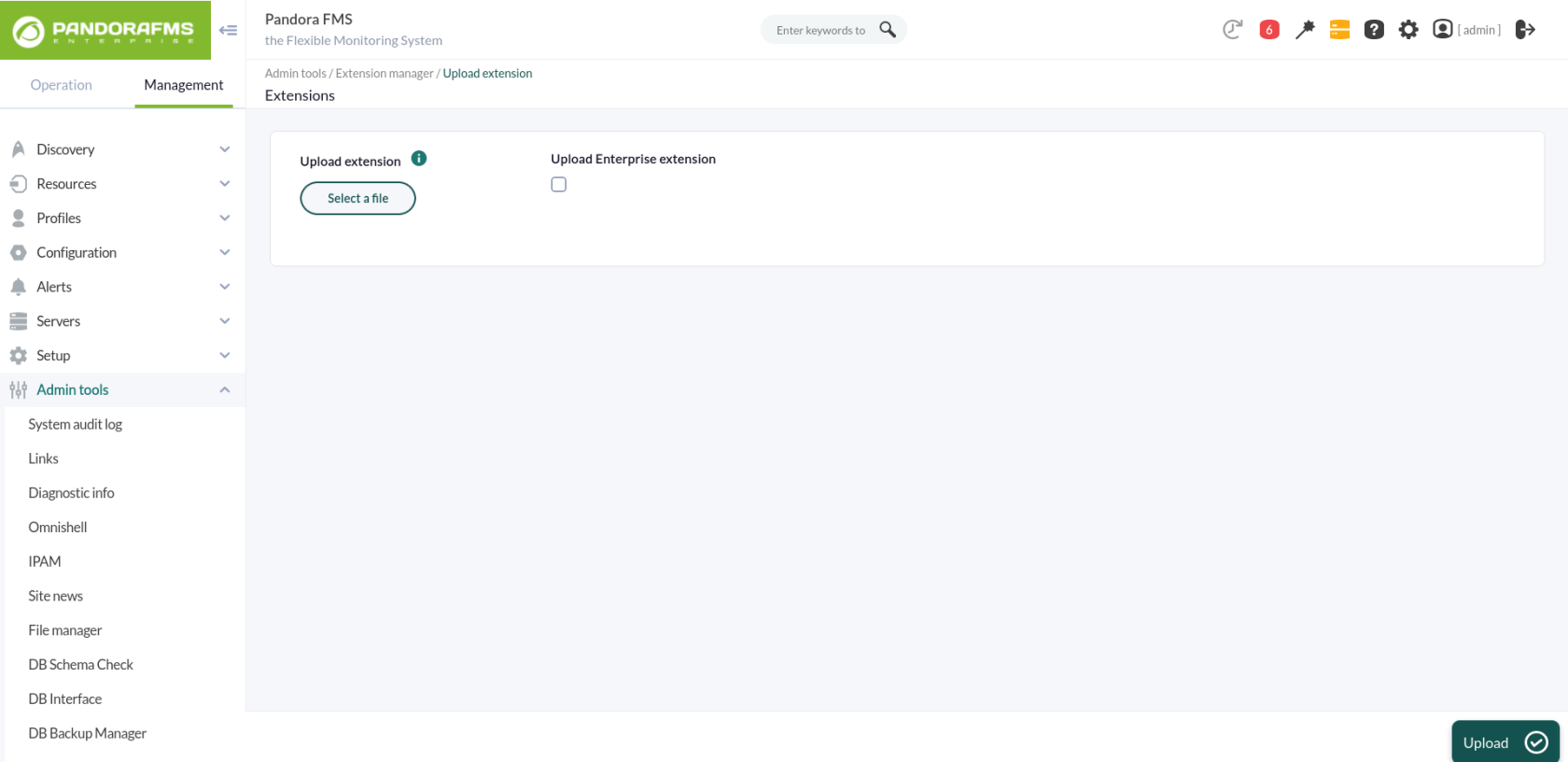
 It is important not to check the “Upload enterprise extension” option.
In short, these steps basically locate the contents of the ZIP file in the extensions directory of Pandora FMS console, which will lead to the directory being created:
/var/www/html/pandora_console/extensions/grafana
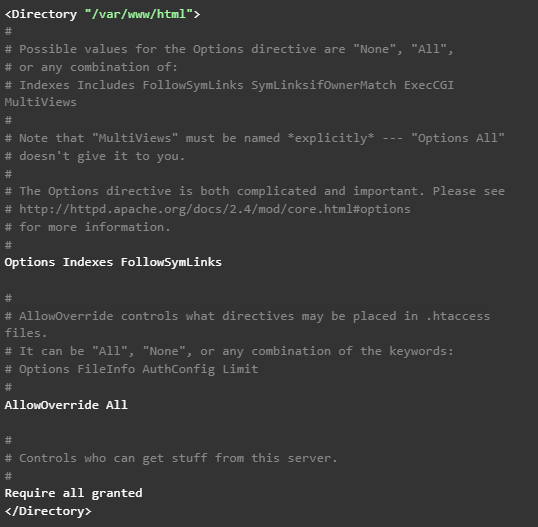
If, as in this case, the installation is based on a Pandora FMS ISO, it will also be necessary to modify a configuration parameter of the Apache server.
Just edit the file /etc/httpd/conf/httpd.conf, and set the parameter “AllowOverride none” as “AllowOverride All”, within the directives of the block ‘’ since that is where Pandora FMS console is located. Therefore, it should be this way:
It is important not to check the “Upload enterprise extension” option.
In short, these steps basically locate the contents of the ZIP file in the extensions directory of Pandora FMS console, which will lead to the directory being created:
/var/www/html/pandora_console/extensions/grafana
If, as in this case, the installation is based on a Pandora FMS ISO, it will also be necessary to modify a configuration parameter of the Apache server.
Just edit the file /etc/httpd/conf/httpd.conf, and set the parameter “AllowOverride none” as “AllowOverride All”, within the directives of the block ‘’ since that is where Pandora FMS console is located. Therefore, it should be this way:
 Also add a parameter in the PHP settings. Add the following line at the end of the file /etc/php.ini: serialize_precision = -1
And for these changes to go into effect, the Apache service must be restarted:
Also add a parameter in the PHP settings. Add the following line at the end of the file /etc/php.ini: serialize_precision = -1
And for these changes to go into effect, the Apache service must be restarted:
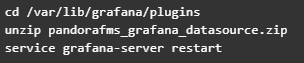


 After this change is applied, the Grafana service must be restarted using the following command: service grafana-server restart
At this point, what you have to do is configure the plugin uploaded in Grafana so that it connects to the extension loaded in Pandora FMS and allows you to use its data in Grafana dashboards.
Access the “Configuration > Datasources” menu in Grafana and click on the “Add datasource” button:
After this change is applied, the Grafana service must be restarted using the following command: service grafana-server restart
At this point, what you have to do is configure the plugin uploaded in Grafana so that it connects to the extension loaded in Pandora FMS and allows you to use its data in Grafana dashboards.
Access the “Configuration > Datasources” menu in Grafana and click on the “Add datasource” button:

 You will see different plugins that you may configure, and at the bottom of the list, you will see the plugin that you just loaded for Pandora FMS. Click on it:

 This will take you to a form where you only need to fill out 3 fields for the connection with the Pandora FMS extension:


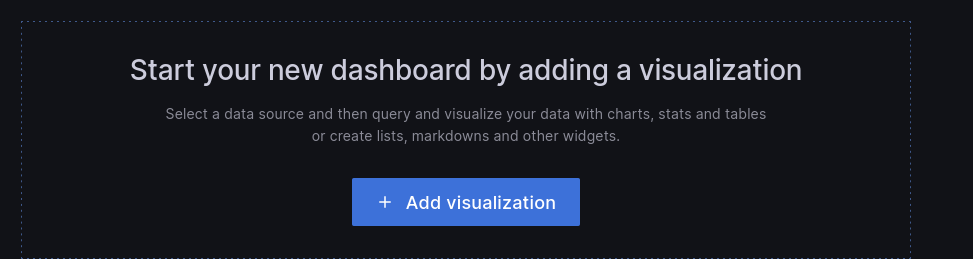
 This will take you to a form where to choose your “Pandora FMS” data source in the “Query” drop-down. This will make the bottom of the form change and you will see a query to choose a module from which to display the data on the board:
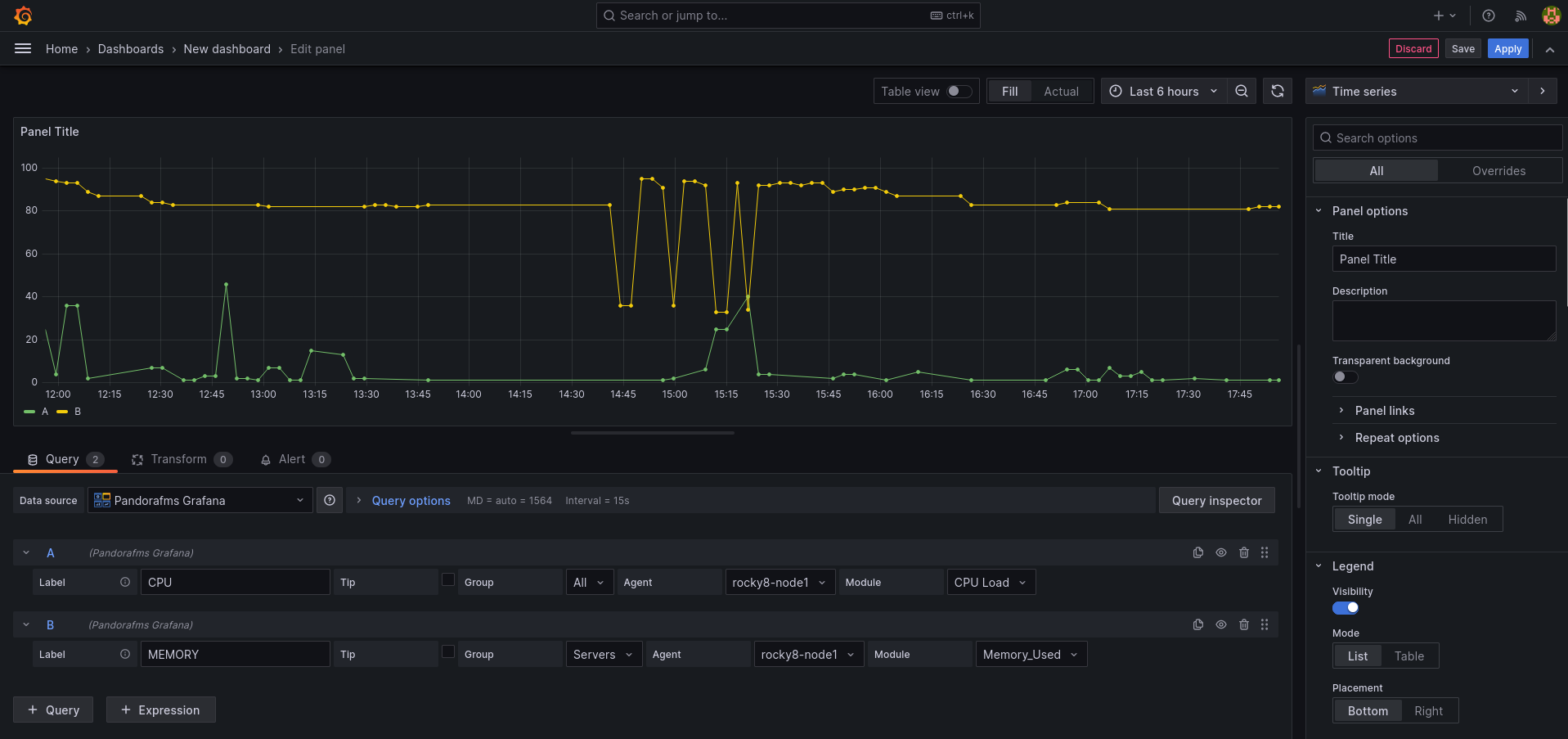
 And you may also add more boards within the same Grafana dashboard, so that you have all the necessary information on the same screen.
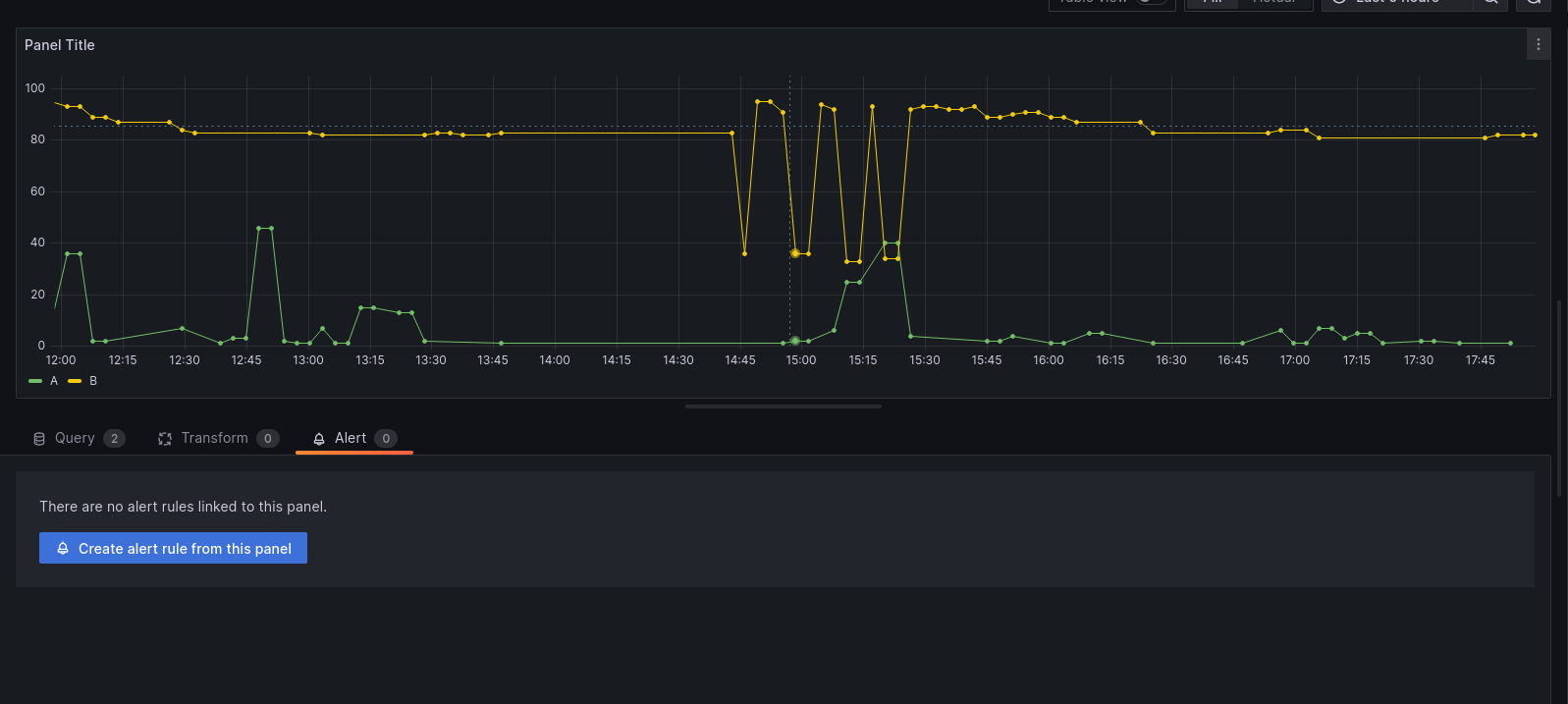
 In this menu, adjust a few rules to configure your alert:
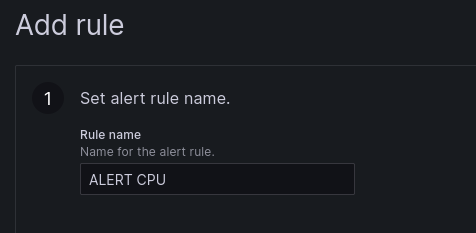
1 . Set the name of the alert rule.
In this menu, adjust a few rules to configure your alert:
1 . Set the name of the alert rule.
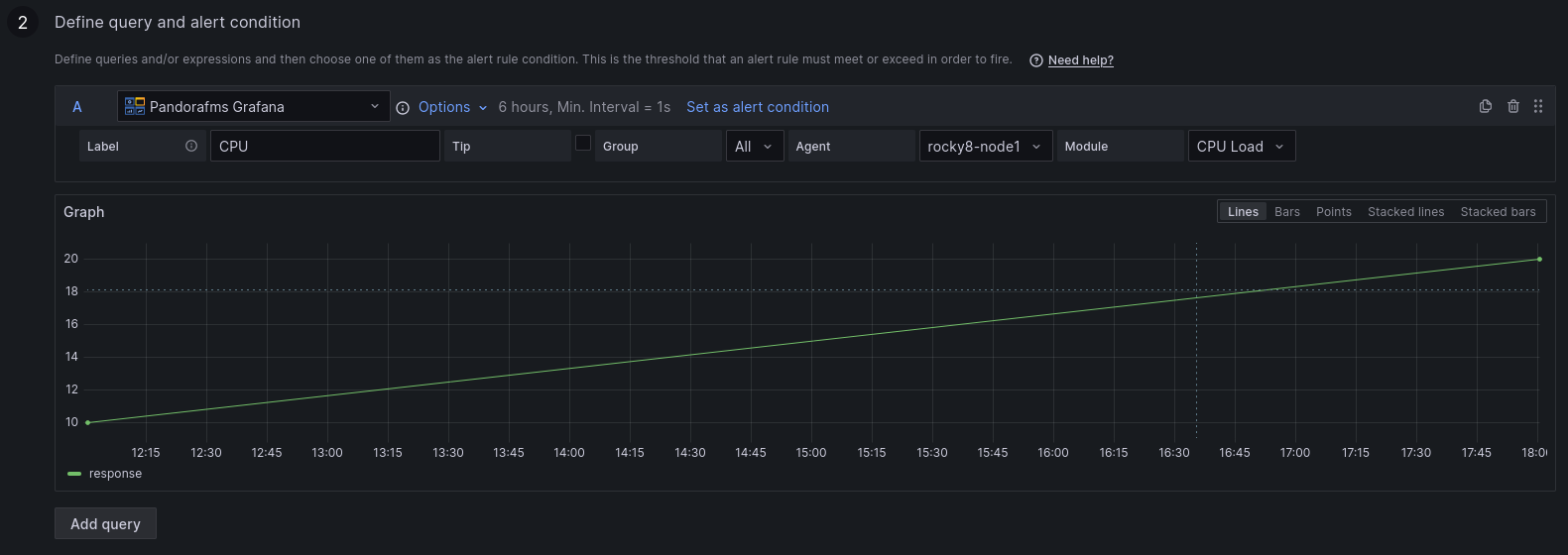
 2. Define the query and the alert condition.
 3. Establish alert evaluation behavior.

 4. Add notes.
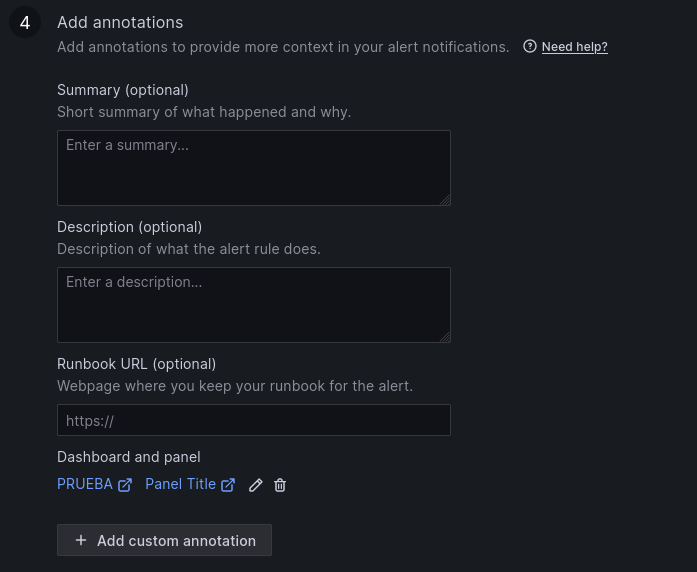
 5. Set up notifications.

 Once the alert is configured and saved, you may see it in the dashboard:


