Skip to content

How to unlock your Mac’s Steam gaming potential

For digital eons, people have found MacOS simpler, snappier, and more intuitive than Windows.

It’s little wonder that MacOS nearly tripled its desktop market share in the ten years between June 2013 and June 2023.

However, this revolution came with a steep price for gamers.

Where Windows had developed into a sprawling ecosystem of cutting-edge experiences — with Steam playing a pivotal role—Apple’s processor of choice made development costly.

In turn, Mac releases became infrequent.

All that began to change with Apple’s switch to Intel-produced processors, enabling a fresh generation of great — albeit infrequent — Mac ports.

Apple then switched to more powerful, internally developed chips, which integrate well with ARM-based Windows 10 and 11.

Because of the chips’ greater power—and newfound commonalities in architecture—today’s average MacBook is also a potential legit gaming laptop, with a little help from Parallels Desktop.

Once you hook your Mac up with Parallels Desktop, a whole new world of gaming awaits you. Don’t let us stop you – sign up for a free trial of Parallels Desktop.
Virtual machines require a lot of memory and processor power—which not all Macs have. As such, not all Apple systems are compatible.

Mac owners with Apple’s recent and hyper-powerful processors—M1, M2, and M3—will get the best performance out of this version.

Compatible Versions of the macOS

  • macOS Sonoma 14.0 or newer
  • macOS Ventura 13.2 or newer
  • macOS Monterey 12.6 or newer
  • macOS Big Sur 11.7 or newer
  • macOS Catalina 10.15.7 or newer
  • macOS Mojave 10.14.6 or newer

Processor type

  • Apple M3, M3 Pro, & M3 Max
  • M2, M2 Pro, M2 Max, M2 Ultra
  • M1 Pro, M1 Max, and M1 Ultra chips
  • Intel Core i5, Core i7, Core i9 or Xeon processor

Recommended memory capacity

  • 16 GB of RAM or more

Storage space

  • 600 MB (for installing Parallels)
  • 16 GB (for Windows 11)

Graphics chips

  • Graphic processors inside all M1, M2, and M3 (including Pro, Max, and Ultra chips)
  • AMD Radeon Pro graphics cards

Are there Steam games that are already Mac-compatible?

Yes. Plenty of Steam games are Mac-compatible—though the majority aren’t.

Despite the Mac’s longstanding gaming drought, developers increasingly publish their games on macOS.

Check Steam’s dedicated MacOS page to find out for yourself. Use a custom search to include only MacOS-compatible games.

How to play Steam games on a Mac with Parallels Desktop

Adding a new operating system sounds like it would take forever. While it once did—please believe me—installing Parallels Desktop is pretty painless.

1. Download Parallels Desktop and play Steam games on a Mac

First, grab a copy of Parallels Desktop for Mac (There’s a free 14-day trial for uncertain gamers).

Once you fill in your email, you’ll arrive at a download page.

Click the Download Parallels Desktop button, then the link will be sent to your email address.

2. Install Parallels Desktop to play Steam games on a Mac

Double-click your newly downloaded .dmg executable. A window with the Parallels Desktop icon will pop up.

Double-click (or hit “Open” if you’re presented with a MacOS confirmation window).

Next, click through the user agreement. You’ll be asked to share usage data with Parallels Desktop to improve the service.

Click enable or disable, depending on your preference.

After that, Parallels Desktop gets automatically downloaded and installed.

3. Download and install Windows 11 to configure a Parallels Desktop VM for Windows-based Steam games

Now that Parallels Desktop is in place, you’ll need to install our operating system: Windows 11.

After selecting Windows, the installer will automatically download and initialize it.

Once done, you’ll see a window containing the complete virtualized operating system.

Now, you can control Windows from a window on your Mac. Mind-blowing, right?

4. Download and install Steam on the Windows VM you created

You’ll need the Steam client to load Steam games on your Mac.

Visit Steam’s storefront and download a Windows-compatible version.

Once completed, click the installer. Give it a moment to download and initialize Steam.

After, create a Steam account if you don’t already have one.

The wide world of PC gaming is now at your fingertips.

5. Download Steam games on your Mac

If you’re a Steam newbie, you’ll spot an avalanche of games set to an infinite scroll.

It’s best to use the search bar to find the games you’re looking for — if only to avoid eyestrain.

Once you find your game’s store page, click Add to Cart.

Hit “Continue to Payment” and choose your payment method. Then complete checkout. Your game should begin downloading immediately.

Once completed, click the Library tab on your Steam app and select your chosen game.

Lastly, hit that big green button to play.

Pat yourself on the back, friend. Your PC gaming career has begun. Clear your schedule; inform your friends, family, and job that they’re on the backburner now.

Optimize your Mac’s performance for Steam games

Tweaking game settings for better performance is a skill in and of itself.

That said, there are a handful of simple methods for improving stability and frame rates.

Monitor CPU usage and close unnecessary tasks

Pay close attention to the computer chip icon on your Parallel’s top window tray. This icon indicates your current CPU capacity (if usage rises above 70 percent, the chip turns red).

Clicking the icon lets you view the exact percentage and gives you access to the Task Manager.

Click it to open a window that displays the processes currently taxing your CPU.

Be sure to close out any processes or software that aren’t necessary for gaming.

Free up your Mac’s disk space

While hard drives don’t determine gaming performance, computers often slow down when they’re more than 90% full.

If yours is overstuffed, delete a handful of unneeded programs or large files—or throw them on the cloud for later.

Change the resolution on your Steam games

Resolution plays a massive role in performance. The more pixels your processor processes, the more stress your hardware experiences.

Because the built-in displays on many Macs are higher than full HD, your computer may be working harder for pixels you won’t see.

Pause your game and open the display or graphics settings.

Reducing it a few notches may provide the performance boost you need.

Steam gaming on Mac FAQs

Do I need to buy a new Windows 11 license to use with Parallels Desktop for Mac?

It depends.

You’ll have a month to use Windows 11 unrestricted. After that, you’ll have to deal with some inconvenient limitations.

You’ll still be able to game after this point, but the disadvantages of not activating your Windows 11 include an omnipresent watermark in the bottom-left corner of your screen.

Unless you can tolerate those limitations, you’ll need a license.

Get one from Microsoft’s official page, or opt for more affordable licenses from third-party retailers.

Does DirectX work with Parallels Desktop for Mac?

Parallels Desktop currently supports DirectX graphics up to Version 11 and OpenGL up to version 4.1, which expands the possibilities for playing Steam games and other PC games on Mac. It does not currently support DirectX 12.

What are some great Steam games I can play on my Mac with Parallels Desktop?

PC gaming is an embarrassment of riches.

Whether you’re looking for simpler grab-and-go indie titles or full-fledged open-world adventures`—and anything in between—you can find it on Steam.

Are you looking for games PC natives are losing their minds over? Here are a few worth checking out:

How do I find good Steam games to play on my Mac?

Steam’s community reviews system is one of its best features.

Using it, any Steam user who’s purchased a game can leave feedback.

Steam qualifies each game with ratings that range from Overwhelmingly Positive to Overwhelmingly Negative, based on the proportion of positive to negative reviews.

Each game gets two scores.

All Reviews is the score averaged across every single user review.

Recent Reviews pulls newly published reviews, effectively showing you the degree to which a game has either been improved through subsequent updates or underwent a change in public perception.

The day you install Parallels Desktop is the first day of your Mac’s new (gaming) life

While it’s not literally true that your fun with Steam PC games will never end, there are enough great games to last you for actual years.

Again, you should tell your loved ones if you plan on dropping off the face of the earth, but they’ll understand when you tell them how you helped achieve nuclear disarmament in our lifetime.

Let Parallels Desktop open a new world of gaming for you. Sign up for a free trial of Parallels Desktop

About Version 2 Digital

Version 2 Digital is one of the most dynamic IT companies in Asia. The company distributes a wide range of IT products across various areas including cyber security, cloud, data protection, end points, infrastructures, system monitoring, storage, networking, business productivity and communication products.

Through an extensive network of channels, point of sales, resellers, and partnership companies, Version 2 offers quality products and services which are highly acclaimed in the market. Its customers cover a wide spectrum which include Global 1000 enterprises, regional listed companies, different vertical industries, public utilities, Government, a vast number of successful SMEs, and consumers in various Asian cities.

About Parallels 
Parallels® is a global leader in cross-platform solutions, enabling businesses and individuals to access and use the applications and files they need on any device or operating system. Parallels helps customers leverage the best technology available, whether it’s Windows, Linux, macOS, iOS, Android or the cloud.

ESET WORLD 2024: CANALYS’ Alastair Edwards: Even in a cloud-based world, relationships still matter

We are in the middle of a major transformation of how companies go to market, but relationships remain key.

Given market uncertainties, changes in partnering, and the surge in subscription models, most companies are now considering partnership ecosystems as the key ingredient to survival and success, according to Alastair Edwards, chief analyst at Canalys, who spoke on the State of the Channel at the ESET WORLD 2024 conference

“Increasingly, vendors co-selling, co-marketing, co-developing, and co-delivering with partners are becoming more important to delivering joint value to the customer,” Mr. Edwards told ESET after the conference.

In the interview with ESET, Mr. Edwards described the current situation with emerging hyperscale cloud marketplaces, the challenges that cybersecurity partnerships face, and the role of AI in the evolving world of cybersecurity.

What role do partners play in the world of emerging hyperscaler cloud marketplaces where vendors can approach customers directly?

While the initial assumption was that hyperscaler marketplaces would cut out channel partners, in fact the opposite is true. Partners will have an increasingly important role in this sales motion, as customers procure a greater proportion of software and cybersecurity through the cloud marketplaces of AWS, Microsoft, and Google Cloud in particular. Customers are able to use their committed cloud spend with the hyperscalers to buy third-party products through the marketplaces, which can be very attractive when core IT budgets are under pressure. They can take advantage of consolidated monthly or annual billing for all their purchases, which simplifies the billing process.

But beyond the transactions, customers will rely more than ever on partners, particularly as they purchase more complex solutions through these marketplaces. A marketplace is ultimately just a catalog of products and solutions. But end-customers need advice on the right technologies to buy, support for those technologies, integration, and management, which only trusted partners can provide. At the same time, vendors selling through these marketplaces continue to need partners to provide customer support, technical expertise, and complex services.

What do these marketplaces mean for vendor-partner-customer relationships?

These models create new dynamics for vendors, partners, and customers. But relationships remain key. Hyperscalers and vendors have recognized the importance of enabling partners to continue supporting customers directly, for example, through offering customized listings to customers through the marketplaces. The hyperscalers are investing in co-selling with both partners and vendors to drive momentum. There is a risk to the channel of course — those channel partners that don’t embrace this model will find themselves being overtaken by those that do. Even those that embrace this will need to continue showing value — and that value will change in future. But Canalys expects the share of hyperscaler marketplace business via channel partners to increase significantly over the next few years.

When preparing the latest Canalys Global Cybersecurity Leadership Matrix, Canalys worked with Channel Partner feedback collected over 12 months. What are the key lessons to take from it?

ESET’s Partners are generally very positive about their relationship with ESET and the support they receive. They are particularly positive about ESET’s ongoing commitment to partners (and channel-led strategy), ease of doing business, the quality of account management and technical support, and ESET’s ability to plan centrally and execute locally. This is why ESET achieved Champion status in this year’s global Cybersecurity Leadership Matrix report.

Based on this feedback, channel partners seek to prioritize relationships with vendors that align with the transformation in their business models and vendors offering products that partners can wrap their own services and solutions around. What does it mean for security vendors? What should they prioritize to create and maintain long-term relationships with partners?

In some ways, the same things apply to building long-term partner relationships: minimizing sales conflict, investing in partner profitability through effective partner programs, building trusted relationships between vendors and partners, and equipping partners with the skills to sell and support the vendor’s technologies.

But in addition to this, vendors must build greater flexibility into their programs and engagement strategies to support an increasingly diverse partner base and partners operating multiple business models, whether those are resell, managed services, consulting, development, etc. Increasingly, vendors co-selling, co-marketing, co-developing, and co-delivering with partners are becoming more important to delivering joint value to the customer. And recognizing customers will work with multiple partners throughout their technology life cycles — and that most partners lack the resources to specialize in every area — vendors must support effective collaboration between partners.

How important is it for cybersecurity vendors to bring innovations such as AI-powered services?

Of course, this is incredibly important. AI is moving to the center of a new cyber arms race between bad actors — cybercriminals that are weaponizing AI to launch more effective attacks — and the cybersecurity industry that is using AI to enhance cyberdefenses, augment existing capabilities, and improve predictions and remediation times. Vendors must be at the forefront of this race or risk falling behind. Canalys expects AI to usher in a whole new suite of advanced cybersecurity technologies. Channel partners and customers will choose to work with vendors that are staying ahead of a rapidly evolving landscape. At the same time, there is a danger that AI becomes overused in terms of vendor product launches and marketing, which will damage credibility and add to customer confusion when most are unclear about the value of AI. Avoiding this risk is critical to long-term success.

On the other hand, there are still some people who see cybersecurity as one single product, such as antivirus, and are surprised when they get a question about how many endpoints they have and what their network looks like. How to earn the trust of such potential partners and show them that cybersecurity is a much more complex topic?   

Many customers still don’t place enough strategic importance on cybersecurity, and these customers are most likely to only think of one product, like antivirus. But they are also the most vulnerable. Cyber resilience needs to become a business hygiene factor, not a nice-to-have. Government regulations will play a bigger role in forcing that. The reality is that building effective cyber resilience as a customer means addressing a plethora of new threats and an expanded surface area that needs to be protected. For companies that understand this, the biggest challenge they face is managing an exponential increase in cybersecurity complexity. One way to do this is to work with a single managed services partner who takes on the management of this complexity on behalf of the customer. MSPs are seeing the fastest growth in the market as a result.

What are the benefits of having a long-term relationship with a leading cybersecurity vendor such as ESET?

Maintaining a long-term vendor relationship is important to ensuring consistency but also efficiency, in terms of the cost and complexity of managing that relationship … partners and customers don’t have to constantly retrain on different vendors’ products and processes, for example. But while there is a growing trend toward ‘platformization’ in the cybersecurity industry (concentrated around a few big cybersecurity vendors), the reality is that no vendor can do everything effectively in security. So, integration with other (specialist) vendors also becomes key to success.

According to Canalys, many partners rank visibility and community involvement highest of their criteria for vendor partnership — even higher than product or pricing. Why is that so?

We are in an ecosystem-led world, in which partners differentiate through specialist skills, customer focus, and business model. Vendors who empower partners within a broader ecosystem, who promote their partners’ skills, and drive collaboration between partners will provide more value to partners than those that just focus on product or pricing.

In the current world when almost everything is cloud-based or XaaS, is it still important for vendors to maintain local offices providing support to their partners?

Yes, local support will remain key. Even in a cloud-based world, relationships still matter. Cloud and AI can be used to augment those relationships and improve efficiency and productivity. But this is a highly competitive world, and those vendors who see the cloud as a way to step away from their partner relationships will suffer from a loss of relevance and share.

Currently companies and their IT admins are battling alert and portal fatigue. How important is it for cybersecurity vendors to help their partners with simplifying alert management and what are the current trends? 

Extremely important. Customers are struggling to stay on top of the scale of cyber threats and the speed with which they emerge. Finding and retaining the skilled staff to do this is a constant struggle. One of the biggest trends in the market is the role of MSPs in managing that on behalf of customers. Vendors who empower their MSPs with tools like simplified alert management or use AI to automate certain low-level support functions will benefit (through enhanced chatbots, etc.) and ultimately this should enable them to deliver a higher level of support for their customers.

Is the pricing/billing system an important consideration in a partnership? What are the current trends? Do customers favor flexible daily billing or flat rates with long-term commitment?

With the shift to subscriptions, the biggest demands from customers in terms of billing and pricing are simplicity and predictability, when the complexity of managing multiple vendor subscriptions is increasing, with different start and end points, contract lengths, and billing models. This can make it extremely difficult to manage budgets, spending, and planning. Customers as much as possible want partners to help them eliminate that complexity. At the same time, they want flexibility to consume and pay in the way that aligns with their business models. The most successful cybersecurity vendors will help to simplify these models for customers and provide this flexibility to meet the needs of different customers.

About Version 2 Digital

Version 2 Digital is one of the most dynamic IT companies in Asia. The company distributes a wide range of IT products across various areas including cyber security, cloud, data protection, end points, infrastructures, system monitoring, storage, networking, business productivity and communication products.

Through an extensive network of channels, point of sales, resellers, and partnership companies, Version 2 offers quality products and services which are highly acclaimed in the market. Its customers cover a wide spectrum which include Global 1000 enterprises, regional listed companies, different vertical industries, public utilities, Government, a vast number of successful SMEs, and consumers in various Asian cities.

About ESET
For 30 years, ESET® has been developing industry-leading IT security software and services for businesses and consumers worldwide. With solutions ranging from endpoint security to encryption and two-factor authentication, ESET’s high-performing, easy-to-use products give individuals and businesses the peace of mind to enjoy the full potential of their technology. ESET unobtrusively protects and monitors 24/7, updating defenses in real time to keep users safe and businesses running without interruption. Evolving threats require an evolving IT security company. Backed by R&D facilities worldwide, ESET became the first IT security company to earn 100 Virus Bulletin VB100 awards, identifying every single “in-the-wild” malware without interruption since 2003.

How WeTransfer upgraded existing VPN to a cloud-native solution for enhanced security application and experience

In the bustling canals of Amsterdam, a vibrant Dutch company, WeTransfer, emerged in 2009, becoming a haven for creatives worldwide. Known for its ingenious solutions to share large files easily and collaborate with teams, the WeTransfer platform not only caters to creative minds seeking a hassle-free way to distribute their work but also integrates an advertising model that transforms time spent on the site into a visual feast.

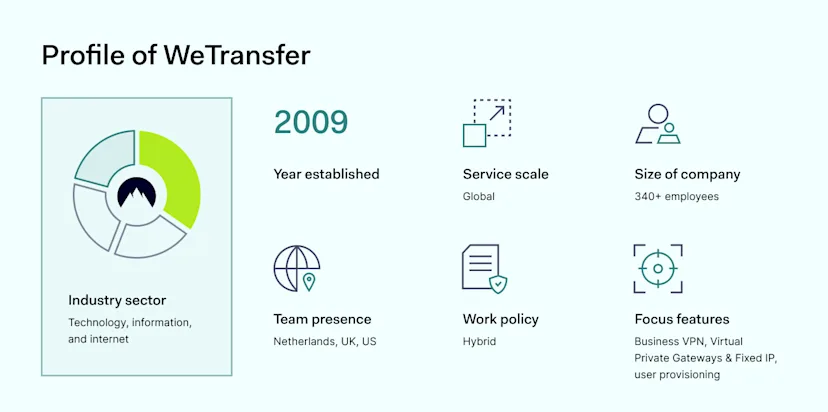
Profile of WeTransfer

WeTransfer takes a unique approach in having a viral product complemented by a full-screen advertising space used by hundreds of major brands around the world. The platform supports creative professionals, as well as creative communities facing the world’s most pressing issues.

As a platform serving tens of millions of people around the world, cybersecurity and operational efficiency are top priorities.

In this interview, Director Enterprise IT Adam O’Toole shares why and how WeTransfer embarked on using NordLayer.

The challenge 

Legacy VPN and the need for reliability

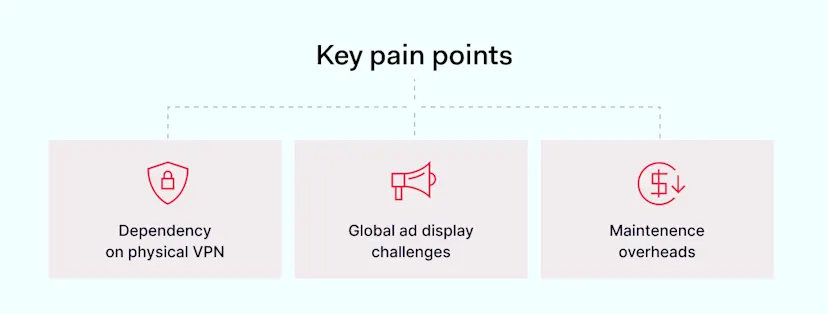
Key pain points

VPN is used at WeTransfer not only for the engineering team to connect to several development APIs. It’s also necessary to validate global ad displays in over 130 countries. Ensuring continuity demanded a more flexible and robust solution.

“Moving to a new HQ, we were faced with a fresh challenge: our VPN was physically hosted on-site so our engineering teams could connect to systems that were inside our network. We needed a cloud alternative for changing places”

Click to tweet

The impending office move only accelerated the search for a cloud-based VPN that could offer uninterrupted service and global reach.

The solution

Strategic transition to a hassle-free tool

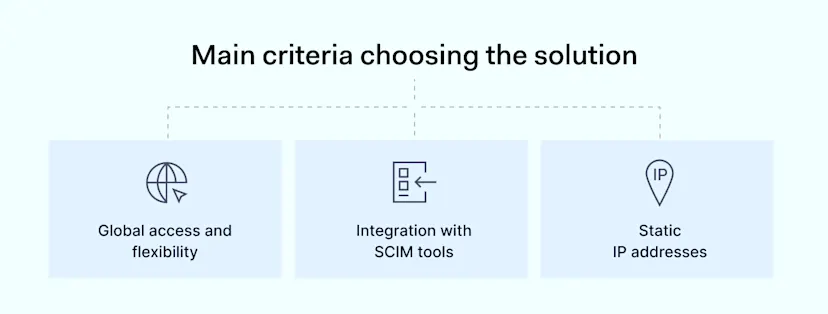
Main criteria choosing the solution

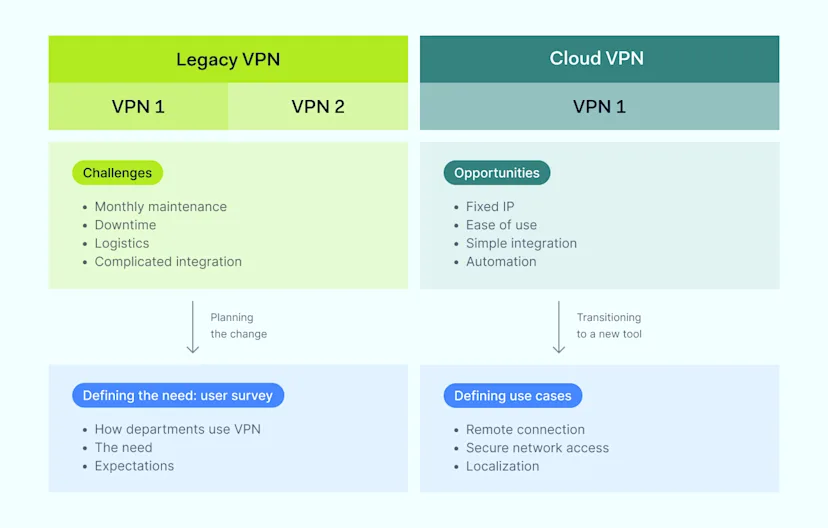
At WeTransfer, the team used two VPNs in total. One was dedicated to product development in the engineering department. The other was established due to a hybrid work model for remote employees to connect to the network and ad team for localization.

NordLayer stood out for several reasons. First, it’s a fully cloud-native solution. Also, it provides an extensive network of global gateways and static IP addresses, which is excellent for a global company like WeTransfer, present in different countries.

“Our ISO certification demands rigorous checks and balances, a standard that NordLayer meets with its comprehensive access policies, ensuring every connection is secure and aligned with our high standards.”

Click to tweet

What is more, it seamlessly integrates with the company’s security framework. And finally, it ensures compliance, a requirement for WeTransfer to follow ISO 27001 standards.

“We are a small team supporting a company of 340+. We need our tools to work for us, not against us. With automation, we’ve been able to spend less time on manual tasks and more on what matters, proving that a lean team can go a long way.”

Click to tweet

The transition marked a pivotal shift towards a cloud-based model, offering a seamless, maintenance-free experience that contrasted with the upkeep of the previous system.

Why choose NordLayer

The journey to NordLayer began with a collaborative effort to understand the specific needs across departments.

  1. We gathered a list of different departments to see how they use a VPN.

  2. The survey format helped us understand the needs and the demand for a VPN tool.

  3. We crystalized the use cases and how many gateways we needed.

  4. Some of the criteria were simple integration into the infrastructure, hassle-free usage, and static IP setup.

  5. Simplicity in using and maintaining the tool was equally important to security.

The integration with the existing security framework simplified access control, ensuring a smooth onboarding and offboarding process that resonated with the company’s lean IT team ethos.

“Okta integration was a big push from a security perspective for us to have better access control and automation when people come and leave.”

Click to tweet

With the Okta integration supported by NordLayer, the company can leverage stronger authentication mechanisms. Biometric authentication via Okta FastPass provides an additional level of security, allowing it to better protect against common attacks.

The intuitive dashboard and the provision for fixed IP addresses further streamlined operations, making NordLayer an obvious choice.

Rethinking the VPN strategy when transitioning to a cloud-based tool from a physical VPN

Legacy VPN vs Cloud VPN

NordLayer’s appeal lies in its ability to meet the company’s unique demands. Its vast network of gateways enabled the advertising team to accurately preview campaigns across different regions, a critical feature for a global player in the advertising space.

The outcome

Seamless operations and enhanced productivity

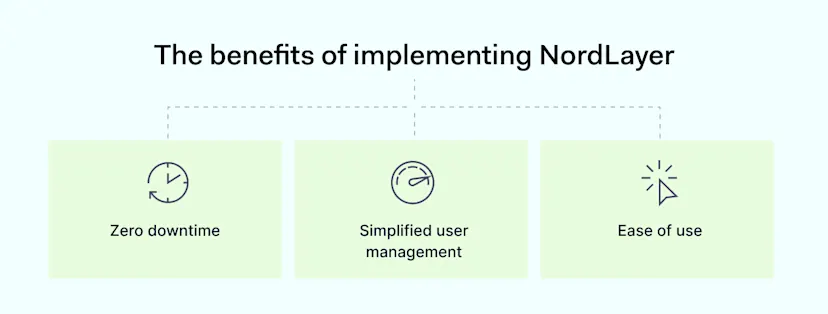
The benefits of implementing NordLayer

The switch to NordLayer translated into tangible benefits. The IT team was liberated from the monthly maintenance rituals that had previously hindered productivity and could focus on strategic initiatives.

“With NordLayer, it’s simple: if you’re in, you get access; if you’re out, you lose it. The dashboard is clear, making setup quick and getting results easy.”

Click to tweet

Thanks to NordLayer’s dedicated gateways, WeTransfer improved developer experience for engineers located outside of the Netherlands, with quicker feedback loops during development cycles.

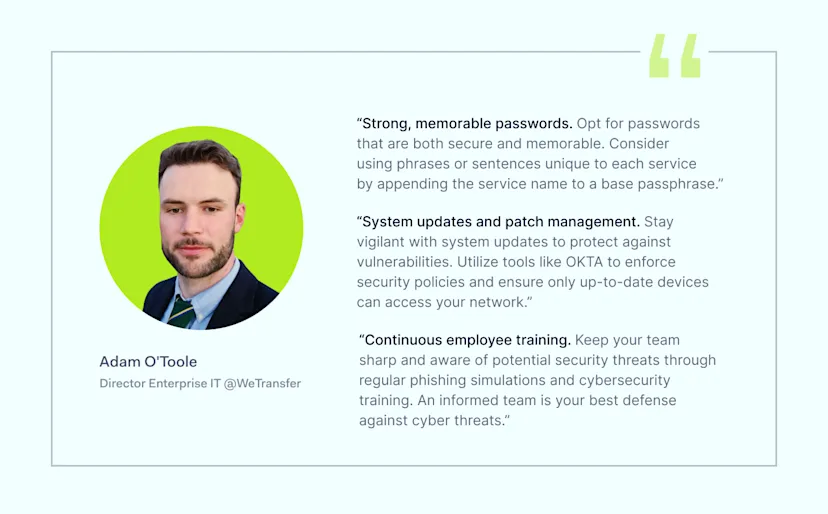
Pro cybersecurity tips

Cybersecurity hygiene is very personal yet important to follow, just as taking care of yourself. It can be achieved differently but for the same result—secure digital environments. This interview was no exception to asking how IT professionals prioritize cybersecurity in their daily lives. Thus,  Adam O’Toole, Director Enterprise IT at WeTransfer, shares his favorite and most important tips on what matters first.

Adam O'Toole, Director Enterprise IT, WeTransfer, about cybersecurity

WeTransfer adoption of NordLayer showcases how cybersecurity posture was improved by underscoring the importance of adaptability, collaboration, and strategic tool selection in the digital age.

The journey from a physical VPN system to a streamlined, cloud-based solution not only enhanced operational efficiency but also fortified the company’s cybersecurity defenses. As a result, the company can continue its mission of supporting the global creative community with trust and confidence.

About Version 2 Digital

Version 2 Digital is one of the most dynamic IT companies in Asia. The company distributes a wide range of IT products across various areas including cyber security, cloud, data protection, end points, infrastructures, system monitoring, storage, networking, business productivity and communication products.

Through an extensive network of channels, point of sales, resellers, and partnership companies, Version 2 offers quality products and services which are highly acclaimed in the market. Its customers cover a wide spectrum which include Global 1000 enterprises, regional listed companies, different vertical industries, public utilities, Government, a vast number of successful SMEs, and consumers in various Asian cities.

About NordLayer
NordLayer is an adaptive network access security solution for modern businesses – from the world’s most trusted cybersecurity brand, Nord Security.

The web has become a chaotic space where safety and trust have been compromised by cybercrime and data protection issues. Therefore, our team has a global mission to shape a more trusted and peaceful online future for people everywhere.

About NordLayer
NordLayer is an adaptive network access security solution for modern businesses – from the world’s most trusted cybersecurity brand, Nord Security.

The web has become a chaotic space where safety and trust have been compromised by cybercrime and data protection issues. Therefore, our team has a global mission to shape a more trusted and peaceful online future for people everywhere.

What’s New? Quarterly Release 24.5 Enceladus

Written by Callum Sinclair – Product Engineering Manager.

This article covers what’s new in our latest Quarterly release series from March 2024 to May 2024. Read the release notes here.

Comet 24.5.0 Enceladus

We’re very pleased to announce our latest Quarterly release series – Comet 24.5 Enceladus. This is the the latest entry in our quarterly rollup series, that branches off from our main rolling Voyager development into a fixed target for you to qualify and build your service offering upon.

Enceladus is a moon of Saturn and is named after the giant Enceladus of Greek mythology. There are a few worlds that are thought to have liquid water oceans beneath their frozen shell, but Enceladus sprays its ocean out into space where spacecraft can sample it. From these samples, scientists have determined that Enceladus has most of the chemical ingredients needed for life, and likely has hydrothermal vents releasing hot, mineral-rich water into its ocean. Enceladus is about as wide as Arizona, and it also has the most reflective surface in our solar system. Because it reflects so much sunlight, the surface temperature is extremely cold, about minus 330 degrees Fahrenheit (minus 201 degrees Celsius).

For users coming from the previous 24.2 Mimas quarterly release series, Enceladus adds 6 new features and 38 enhancements. Some of the new features we are excited about are:

  • Hyper-V Changed Block Tracking (CBT) support
  • Impossible Cloud Storage Templates
  • SMB Storage Vaults
  • Comet Backup desktop app Protected Item wizard refresh
  • Syncro integration
  • Server Self Backup enabled by default

The full set of changes can be found in the release notes.

Webinar announcement

If you’d prefer to watch rather than read, we’re hosting a webinar to discuss this new quarterly release and all the new changes. Please register before we go live on Tuesday 11 June (4pm EDT / 1pm PDT) to catch up on all the latest Comet news with Comet’s CTO, Mason – and as usual, there will be time for a live question-and-answer session at the end of the presentation.

As well as that, we have many more videos available on our YouTube channel, including guides on getting started with Comet, individual features, demonstrations with our technology partners, and webinars for previous quarterly software releases.

Microsoft Office 365 Protected Item Performance Improvements

Over this month, we have made significant improvements to the backup performance of our Microsoft Office 365 Protected Item. These performance improvements mean the backup job completes faster, as well as reduces the amount of data we need to upload. We expect partners to see Microsoft Office 365 Protected Items finish up to 30 times faster.

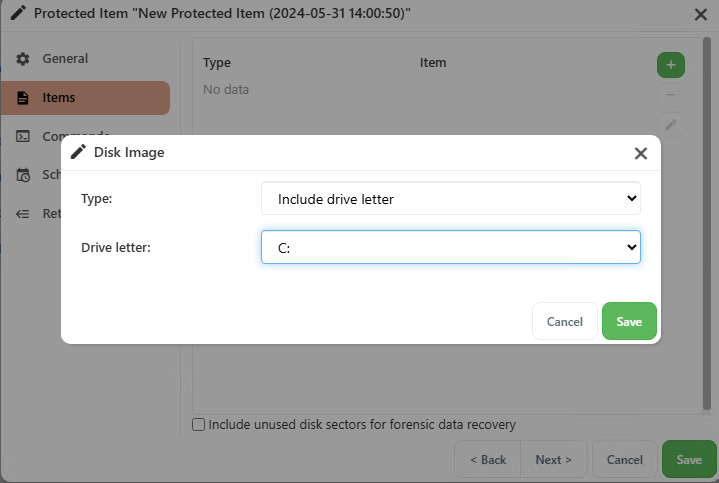
Disk Image Drive Letter Selection

When configuring a Disk Image Protected Item in the Comet Server web interface, it can be difficult to configure when the device is not currently connected to the Comet Server. To help partners configure a Disk Image Protected Item more easily, we have added a new option to select disks to protect by drive letter.

Bulk Upgrade CPU Limits

Our Bulk Upgrade feature is a great way to keep Comet Backup desktop app installs up to date with the latest version that the Comet Server is running. However, for Comet Servers with many tenants using custom branding, a Bulk Upgrade campaign to upgrade older clients consumed significant CPU time building new client installers quickly.

In Comet 24.3.8 we added a new configuration option to limit the maximum number of CPU cores Comet can use during a Bulk Upgrade campaign. This is a fantastic improvement as it reduces the burden on system resources during a Comet Server upgrade. It also provides a more robust Bulk Upgrade campaign, as Comet Backup desktop app installs can be upgraded without overwhelming the Comet Server’s resources. For more information, you can check out our documentation here.

Windows System Backup Protected Item – Deprecation Notice

Our Windows System Backup Protected Item is being deprecated. Before we added our Disk Image Protected Item, Windows System Backup Protected Item was a great way to backup and restore entire Windows disks. However, it required spool space (temporary storage) to be able to perform this backup. This means for a 500GB disk, Comet requires an additional 500GB of free space for this Protected Item to work.

Because of this limitation, and how difficult it is to setup, we have always recommended partners use our Disk Image Protected Item. To assist partners through this change, we have built a Windows System Backup to Disk Image conversion tool. For more information, you can see our documentation on the tool here.

We will be removing this Protected Item in November (Comet Release 24.11).

About Version 2 Digital

Version 2 Digital is one of the most dynamic IT companies in Asia. The company distributes a wide range of IT products across various areas including cyber security, cloud, data protection, end points, infrastructures, system monitoring, storage, networking, business productivity and communication products.

Through an extensive network of channels, point of sales, resellers, and partnership companies, Version 2 offers quality products and services which are highly acclaimed in the market. Its customers cover a wide spectrum which include Global 1000 enterprises, regional listed companies, different vertical industries, public utilities, Government, a vast number of successful SMEs, and consumers in various Asian cities.

About Comet
We are a team of dedicated professionals committed to developing reliable and secure backup solutions for MSP’s, Businesses and IT professionals. With over 10 years of experience in the industry, we understand the importance of having a reliable backup solution in place to protect your valuable data. That’s why we’ve developed a comprehensive suite of backup solutions that are easy to use, scalable and highly secure.

ESET WORLD 2024: Building a proactive defense strategy featuring Forrester’s Madelein van der Hout

Threat actors are developing new tools, phishing is getting more sophisticated, and AI is finally here. Organizations need to adapt and be proactive. 

When you think about cybersecurity, it shares many similarities with strategic board games such as Risk, where players try to conquer enemies’ territories. To win, good players define their strategic assets, anticipate opponents’ moves, and create safe areas with limited access that allow further expansion.

The same can be said about companies and institutions trying to survive and thrive in the world of fast-evolving cyber threats, according to guest speaker Madelein van der Hout, a senior analyst from Forrester, a leading global market research company.

“Winning is everything. If you end up being second, you are actually being the first of the losers,” said Mrs. van der Hout during her presentation, hinting at potentially menacing outcomes of a data breach in a real-world scenario.

Using the popular game Risk as a metaphor for the cyber threat landscape, Mrs. van der Hout presented her insights into building a prevention-first approach in cybersecurity at the ESET WORLD 24 conference. After her session, she also kindly answered a few of ESET’s questions.

Strategic assets

Considering the current level of automation, cloudification, and remote working, there are numerous assets that institutions and companies need to protect, such as employees’ devices, customers’ data, or even IT Admin credentials, to name just a few.

But there are also other risk factors that are not directly caused by cyber-attacks. We are talking about pressure on both CISOs and security admins who bear responsibility for their organization’s cybersecurity and face a huge number of challenges including the financial consequences of cyberattacks.

For example, 97 percent of boards are expecting CISOs to deliver business value and 31 percent of boards will fire CISOs in case of a breach, according to Forrester’s research. This kind of pressure often results in high levels of stress and burnout.

Challenges faced by CISOs in 2024:

  • Changing/evolving nature of threats
  • Geopolitics
  • Regulations
  • Hybrid workforce
  • Economic pressure & cost savings
  • Integrating cybersecurity with business strategy
  • Complexity of IT environment
  • Lack of visibility
  • Talent shortage
  • Lack of comprehensive vulnerability and exposure management

Dealing with these challenges, 66 percent of employees working in cybersecurity stated that they are experiencing significant stress levels. Mrs. van der Hout took it a step further, surprising the audience with survey results revealing that among these highly stressed employees, 51 percent take prescription medicine and 19 percent drink three or more alcoholic beverages per day to cope with these challenges.

“We cannot meditate ourselves from (out of) cybersecurity burnout,” said Mrs. van der Hout, adding that there are some measures that companies can take immediately such as automated alert management or providing mental health support to employees.

But considering the current talent shortage, which exceeds 4 million unoccupied job positions worldwide, more measures will need to be taken.

Don’t dwell on the past

Be it a board game or real-world cybersecurity, adopting a prevention-first strategy relies on anticipating the opponents’ moves. But what Forrester analysts often see are companies making decisions based on what has happened before – i.e., using a rearview mirror. They set their priorities, create incident plans, and adjust their budgets, but when a data breach occurs, all this planning goes out the window.

“[Just like] how I flip the board [over] when I am about to lose a game, that’s how they flip their priorities for the upcoming year. Their investment profiles change,” said Mrs. van der Hout.

For example, in 2023, CISOs recognized the importance of the human factor in cybersecurity and increased budgets accordingly, but in 2024 their focus has shifted back to technological solutions.

And the situation has become serious. Within the last 12 months, 78 percent of surveyed organizations reported one or more incidents potentially compromising sensitive data. The estimated cumulative loss of those data breaches is on the rise in both the US and Europe and is now exceeding $1 million per company, according to Forrester.

How others play their cards

When moving to improve one’s game, it is often useful to see how others play their cards. To face current cybersecurity challenges, organizations need to follow current trends and learn from others.

For example, AI and machine learning help cybercriminals create more sophisticated threats, but legitimate security organizations can also harness this technology to build more effective cybersecurity tools and processes. Moreover, identity protection is no longer strictly about protecting the identity of employees, but also of partners, customers, and even non-human identities, thus the term: “everything identity.”

Current trends in cybersecurity:

  • AI and machine learning
  • Quantum computing and blockchain technology
  • Expansion of OT&IoT
  • Zero trust
  • Everything identity
  • Increasing regulations and geopolitics

New legislation has also been adopted around the world, but Mrs. van der Hout pointed out that following legislation is not only about checking compliance boxes but also about helping companies to build stronger defenses. Therefore, security solution providers should retain trusted advisors, and governments should educate companies and citizens to achieve the desired level of resilience.

“Governments need to be clearer about what organizations need to do to comply with new regulations instead of having really vague articles,” Mrs. van der Hout said.

When learning from others, organizations should look at the strategic and tactical priorities of other players on the market.

Strategic priorities:

  1. Boost cloud security strategy
  2. Improve the ability to detect and respond to threats
  3. Enhance identity and access management for employees, partners, and customers

Tactical priorities:

  1. Improve application security and/or product security
  2. Improve access management and policies for employees and partners
  3. Improve security operations’ effectiveness

Building a proactive defense strategy

Taking all this information into account, let’s build some proactive defense strategies.

First, determine business-relevant elements of your strategy and consider that board members will expect it to deliver some value. Business and cyber security need to work together to shape a strong security posture to persuade both partners and customers, who are increasingly taking a proactive interest in their own security.

With a business strategy set, look at possible risks and keep in mind that this should be an ongoing process. While doing this, make sure that you have proper data from cyber intelligence and advanced security technologies.

“And that’s not only about data collection. It’s also about action and response,” Mrs. van der Hout said.

Next step is to create a strong security culture within an organization as current Forrester predictions say that 90 percent of all data breaches will still include a human element.

“Looking at one cybersecurity awareness video while multitasking isn’t changing anyone’s behavior. So, when addressing awareness, please, move beyond videos. Make sure that your employees understand the importance of awareness and make security part of your organization’s culture,” Mrs. van der Hout said.

The final aspect of a proactive defense strategy is continuous improvement and adaptation. Instead of adopting one solution, and then setting and forgetting, organizations should review their defenses, close gaps, make adjustments, and ask for help if needed.

You are not alone

It is always nice to talk about the latest cybersecurity solutions and proactive defense but there are smaller companies or non-profit organizations that don’t have a budget for CISOs and high-end technologies.

When asked about this, Mrs. van der Hout remained in her winning mood, pointing out that even small companies can analyze their threat surface and set priorities. And what is more, the “good guys” in IT environments can help each other.

“We are operating in ecosystems where larger enterprises and SMBs are working together. We need to partner with each other to make sure that we are secure. Security should travel beyond just contractual agreements,” she said.

About Version 2 Digital

Version 2 Digital is one of the most dynamic IT companies in Asia. The company distributes a wide range of IT products across various areas including cyber security, cloud, data protection, end points, infrastructures, system monitoring, storage, networking, business productivity and communication products.

Through an extensive network of channels, point of sales, resellers, and partnership companies, Version 2 offers quality products and services which are highly acclaimed in the market. Its customers cover a wide spectrum which include Global 1000 enterprises, regional listed companies, different vertical industries, public utilities, Government, a vast number of successful SMEs, and consumers in various Asian cities.

About ESET
For 30 years, ESET® has been developing industry-leading IT security software and services for businesses and consumers worldwide. With solutions ranging from endpoint security to encryption and two-factor authentication, ESET’s high-performing, easy-to-use products give individuals and businesses the peace of mind to enjoy the full potential of their technology. ESET unobtrusively protects and monitors 24/7, updating defenses in real time to keep users safe and businesses running without interruption. Evolving threats require an evolving IT security company. Backed by R&D facilities worldwide, ESET became the first IT security company to earn 100 Virus Bulletin VB100 awards, identifying every single “in-the-wild” malware without interruption since 2003.

×

Hello!

Click one of our contacts below to chat on WhatsApp

×