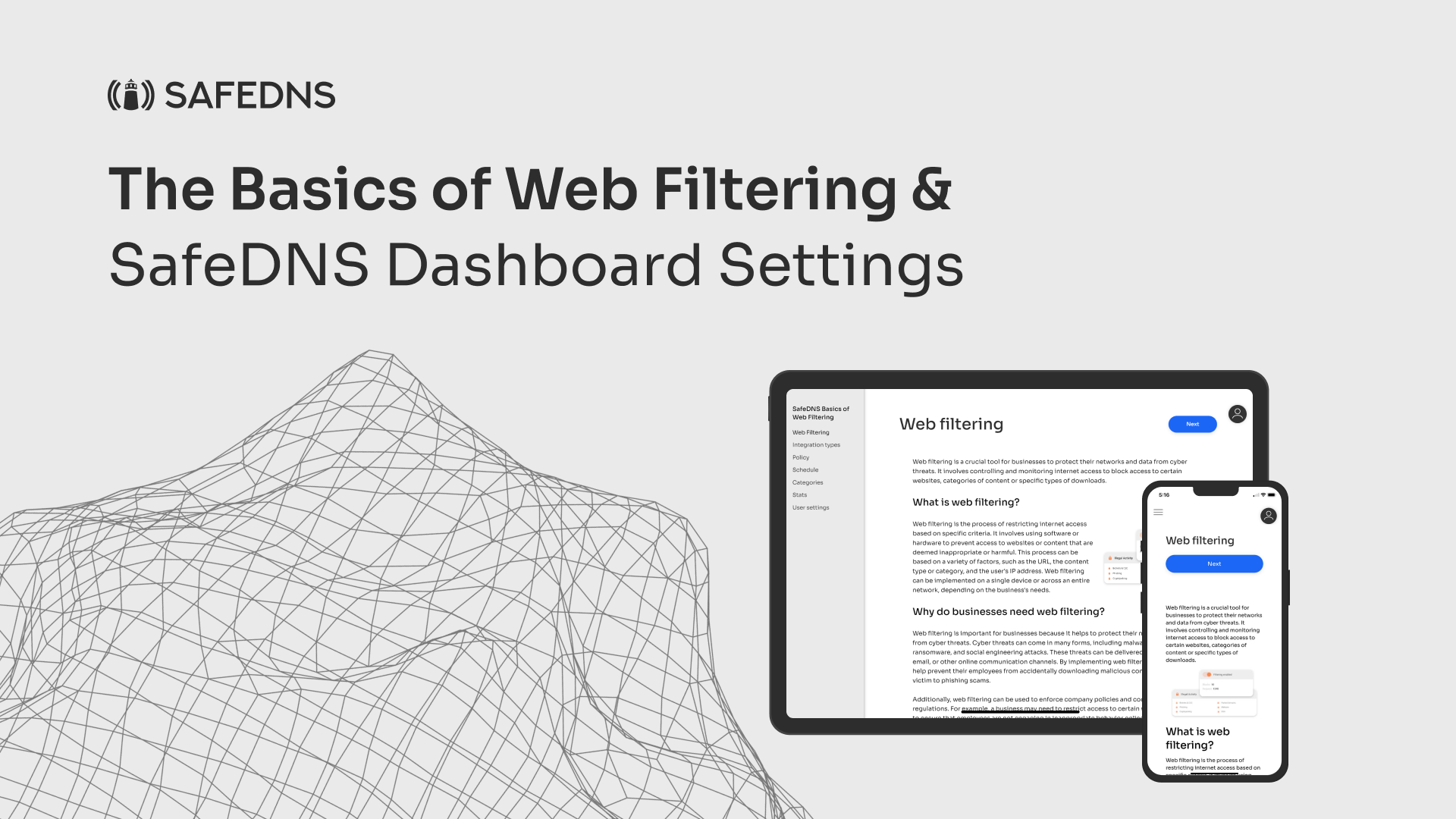
- Introduction to web filtering
- Creating allowlists and denylists
- Setting up custom filtering rules
- Monitoring network activity
- SafeDNS dashboard settings and configuration





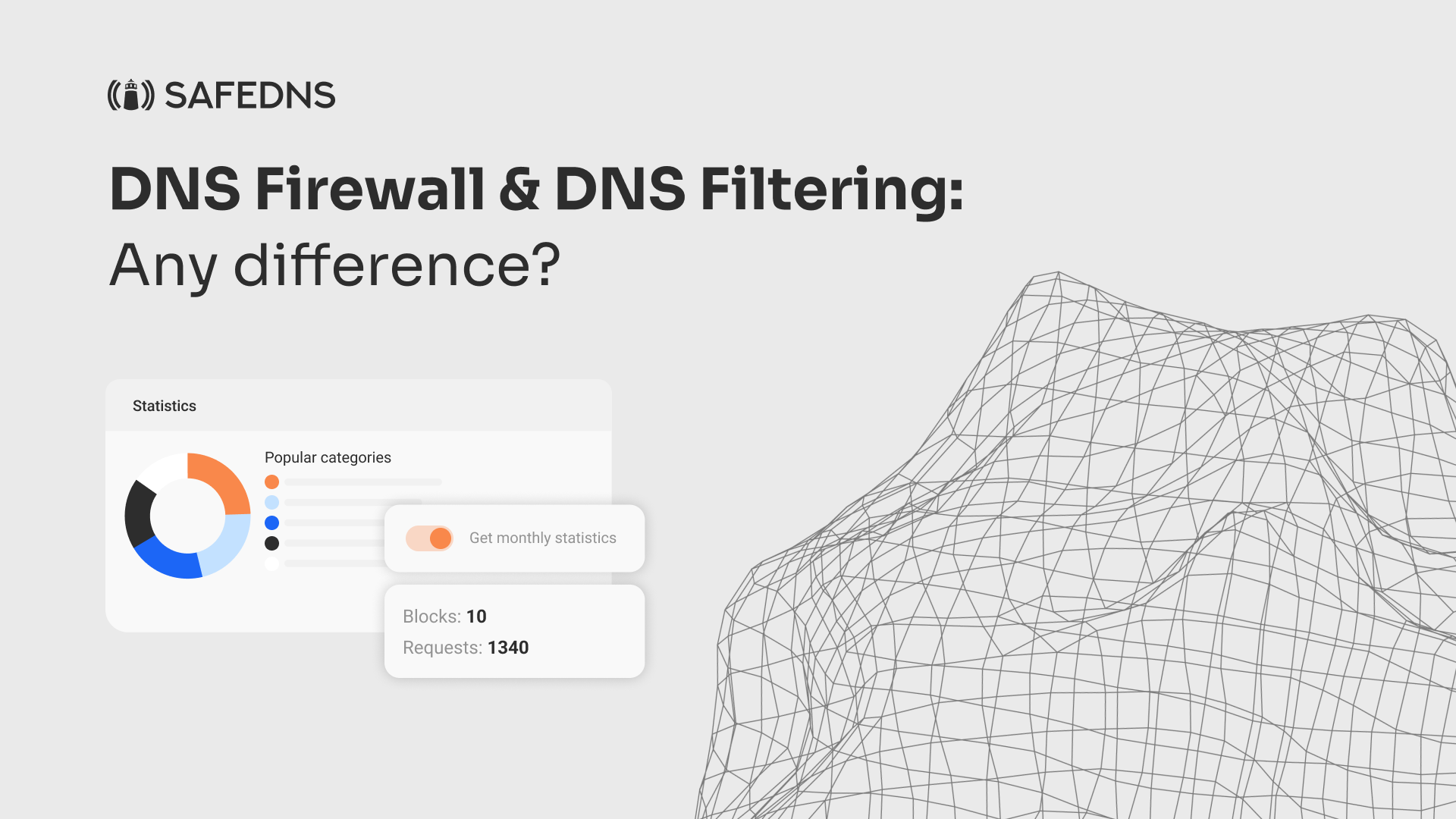
A firewall is a security system designed to monitor and control incoming and outgoing network traffic based on predefined security rules. Firewalls can be implemented at different levels of the network, including the hardware level, operating system level, and application level. Firewalls can block unwanted traffic, detect and prevent unauthorized access, and protect against malware and other security threats.
Content filtering refers to the process of blocking or allowing access to certain types of content based on predefined criteria. Content filtering can be done at the network level or at the endpoint level, and can be based on a variety of factors, including keywords, categories, file types, and more. Content filtering is often used to block access to inappropriate or harmful websites, or to prevent employees from accessing non-work-related content during work hours.
DNS filtering is a type of content filtering that is based on domain name system (DNS) queries. DNS filtering works by intercepting DNS queries and determining whether to allow or block the requested domain based on predefined criteria. DNS filtering can be used to block access to known malicious domains, prevent access to specific categories of content, and enforce company policies related to internet usage.
One reason for the confusion between DNS filtering and DNS firewall is that both technologies operate at the DNS level. However, while DNS filtering is a type of content filtering that focuses on blocking or allowing access to specific domains, DNS firewalling is a more comprehensive approach that involves blocking or allowing traffic based on a wide range of criteria, including IP addresses, ports, protocols, and more. In essence, DNS filtering is a subset of DNS firewalling, but the two terms are often used interchangeably, which can lead to confusion.
While DNS filtering is often referred to as a DNS firewall, this is not entirely accurate. A DNS firewall is a security system that is designed to prevent attacks that exploit DNS vulnerabilities, such as DNS cache poisoning or DNS amplification attacks. DNS filtering, on the other hand, is a content filtering technology that is designed to block or allow access to specific domains based on predefined criteria. While both technologies operate at the DNS level, they have different purposes and should be referred to using the appropriate terminology.
It’s crucial for cybersecurity companies to have a clear understanding of what “DNS Firewall” really means and to ensure that they can deliver exactly what their clients expect from them, without any confusion or uncertainty. While this term is used in many definitions and contexts, it can sometimes be difficult to know exactly what you’re getting. That’s why it’s important to choose a cybersecurity provider that you can trust to provide the services they promise. At SafeDNS, we started out as a content filter, and we have built our reputation on being transparent and delivering exactly what we say we will. When you work with us, you can have confidence that you are getting the protection and security you need, without any guesswork or uncertainty. Choose SafeDNS and let us help you stay safe and secure online.
If you’re interested in protecting your network and employees from harmful content and malicious domains, sign up for a free trial of SafeDNS today.


As healthcare providers increasingly rely on Software-as-a-Service (SaaS) applications to manage patient data, it is crucial for them to understand the importance of HIPAA compliance.
This article will discuss what healthcare organizations need to know about HIPAA compliance for SaaS and how to ensure that their SaaS applications follow industry-specific regulations.
When it comes to HIPAA compliance, SaaS providers fall into two broad categories: developers and app providers and SaaS hosting services. The two groups have different compliance needs, so it’s helpful to discuss them separately.
 SaaS developers and providers
SaaS developers and providers that serve the healthcare sector must ensure their products are HIPAA compliant.
HIPAA compliance means that SaaS developers and service providers adhere to HIPAA’s Security, Privacy, and Breach Notification rules. The most important section here is the HIPAA Security Rule, which has three sub-sections: technical, administrative, and physical.
Under the HIPAA Security Rule, Covered Entities (CEs) and Business Associates (BAs) must put in place protective measures to secure Protected Health Information (PHI). SaaS companies tend to fall under the Business Associate header.
SaaS providers must sign Business Associate Agreements (BAAs) with clients. These agreements set out areas of responsibility and liability. Both healthcare companies and cloud providers should be clear about sharing compliance duties and protecting patient data.
The situation is less clear about SaaS hosting services. HIPAA security rule does not set clear guidelines for cloud computing companies hosting healthcare services. Yet, it has become increasingly important to brand cloud infrastructure as HIPAA-eligible.
HIPAA-eligible hosts offer products that clients can adapt to meet HIPAA standards. This reassures clients that shared cloud computing architecture is properly secured. The major cloud platforms offer HIPAA-eligible services, including Amazon Web Services, Microsoft Azure, and Google Cloud.
Not all SaaS companies working in the healthcare sector need to worry about HIPAA compliance. For example, many health app developers won’t handle patient records if their involvement ends when the app is delivered to clients.
But this changes if DevOps teams maintain and update cloud apps for health companies. If you handle Protected Health Information or could access PHI during development tasks, you must be HIPAA compliant.
Generally speaking, HIPAA compliance is critical for providers of SaaS-based healthcare services such as monitoring apps, payment portals, or insurance management tools. And compliance is also a concern for services that host PHI on cloud infrastructure.
Specifically, healthcare organizations need to protect patient data:
When creating patient records
When information is received
When PHI is at rest on cloud resources
During transmission (if this involves SaaS infrastructure or apps).
What does the process of becoming HIPAA-compliant look like? Under the HIPAA Privacy rule, there are three main areas of focus.
Firstly, achieving SaaS data security involves creating robust technical controls. This could include encryption of data in transit and at rest. It also includes access controls to prevent unauthorized access to confidential data. Multi-factor authentication, firewall protection, and password management systems all contribute.
On the administrative side, SaaS companies must train workers to use SaaS tools safely. They must also have robust data handling policies and device usage rules to prevent the unsafe movement of patient data.
Finally, physical security measures include securing data centers via locks, authorization systems, and cameras. There should be measures to protect physical devices on and off-site and plans to guard data against natural disasters and sabotage.
Business Associate Agreements cover all three of these areas. The Covered Entity and Business Associate sign BAAs before commencing their business partnership.
The BAA describes the areas of responsibility of clients and SaaS providers. It includes details on how to achieve compliance. And it explains how partners will be liable when security breaches occur.
Under the Privacy Rule. SaaS partners and Covered Entities have shared responsibility for protecting patient data.
Cloud Service Providers guard infrastructure and data at rest on their servers. Service users manage access control, data in transit, and how users interact with their apps. This situation applies in healthcare as well. But controls on data access are much tighter.
HIPAA-compliant SaaS hosts and providers must apply the strongest possible encryption to all confidential data. They are responsible for ensuring data is available when requested. Servers must also remain online when healthcare organizations need them.
SaaS hosts manage the physical safety of hosting infrastructure. SaaS providers handle the integrity of application code. They must guard against emerging threats like Zero Day Exploits and ensure healthcare apps are as secure as possible.
Healthcare organizations (Covered Entities) have different responsibilities. Healthcare organizations must train staff to use SaaS services safely. Every covered entity needs to educate users about safe remote access, using encryption, managing passwords, and avoiding phishing attacks.
Healthcare organizations also deal with access controls. They must ensure PHI is only available to authorized professionals or patients themselves.
Most cloud-based cyber attacks have their roots in unsafe user behavior or loose access controls. Provider-side security is critical. Yet, it’s also important for SaaS providers and hosts to tighten their HIPAA compliance.

Healthcare organizations and SaaS partners should know exactly how to share responsibility and take appropriate action to ensure watertight compliance.
A robust HIPAA compliance plan ensures that SaaS companies follow HIPAA’s Security, Privacy, and Breach Notification rules. Dividing your compliance plan between the three HIPAA regulations is good practice.
Compliance plans cover many areas, and the exact make-up varies between organizations. But common elements include:
Create risk management plans for all critical data protection risks. Risk assessment processes should include risk severity and actions required to mitigate each risk.
Appoint individuals with responsibility for HIPAA privacy and security management.
This includes physical safeguards such as cameras and locks. Data protection controls are also crucial. Use encryption, access management, endpoint protection, and monitoring tools to track user activity,
This could include training plans to educate workers and communicate HIPAA responsibilities.
Regular compliance audits ensure controls function properly and that staff training achieves the desired results.
Create a secure email or phone line to report PHI violations. Organizations must make data available to patients and have streamlined processes to report data breaches to regulators.
Create and store clear documentation outlining HIPAA compliance policies. Make documents available to staff members and regulators if needed.
HIPAA-compliant organizations must have solid procedures to onboard business associates. SaaS partners should be able to provide clear evidence of compliance and HIPAA eligibility (if needed).
Clients should immediately know that the SaaS provider is a dependable and secure partner. If you have not done so, plan to achieve recognized security standards such as NIST 800-53, ISO 27001, or ISO 20000-1.
Becoming HIPAA compliant can be challenging for SaaS developers and service providers. But if you want to thrive in the healthcare sector, a strong compliance plan is essential. Nordlayer’s HIPAA-compliant solution can help you make the changes needed when building a reputation in SaaS health provision.
Our network security solutions include the following:
Streamlined network access controls to ensure only authorized users can access PHI.
Secure Remote Access from all endpoints ensures equally secure and protected network access for remote and hybrid work environments without putting health data at risk.
256-bit AES encrypts data that is being sent between networks and reduces data breach risks.
Compatibility with major cloud platforms such as Azure and AWS. Integrate Secure Remote Access with cloud-native controls to create a solid HIPAA security setup.
All SaaS companies operating in the health sector need rock-solid data protection that complies with HIPAA regulations. Explore your options and ensure safe access to PHI with Nordlayer’s assistance.
A discussion with Mark Rowland, Co-Founder & Managing Director at Cutec, about how they solved client problems using NordLayer and what to expect for next cybersecurity’s major challenges and possibilities.
Cutec is a Managed Service Provider (MSP) and IT support company from England. Operating in the industry for 25 years, a 20-employee expert team supports a range of small and medium clients across the UK. Whether an organization has a staff of just a few or hundreds of people, Cutec’s role is to consult companies with technical focus and accuracy to fill in the vacancy of an internal IT person for the client.

The client has been with Cutec for about 6 years — during this time, the company of 30 people expanded to an almost 300-employee organization. And as this financial services provider grew into a country-wide company, it started facing security challenges.
“As for a managed IT service provider, it is important to be there for your client when they need you. It’s our responsibility to support branches dotted around different parts of the UK — online presence becomes a necessity over physical.”
Being contained in one place and managing 20 people is relatively easy. However, the client business model involved advisors spread all over the country. Combine it with rapid growth during a short time and data sensitivity due to the nature of financial services — the need to protect databases, CRM, and phone systems was critical.
The foundational elements for security were there: the client had two-factor authentication, password management, and fixed IP in place. It’s secure enough for 20 people sitting in one office, but not if numbers jump to hundred users in dozen cities — circumstances urged for an extra layer of security.
An increasing number of VPN connections to internal applications started causing connectivity issues and quickly bogged the network. This was the turning point for Cutec to find a better solution for a VPN route that would ensure security.
One of the available options for the client was to get much more powerful broadband for the HQ office, install hardware firewalls, and achieve the wanted level of security for an outrageous expense bill.
Moreover, the solution would bind everything to one location. From a disaster management perspective, it’s not sustainable for business continuity — if the power is cut off, the internet goes down, and all employees get disconnected despite their location.
The alternative was getting a NordLayer subscription. Although it meant paying per user license, it offered what the company needed — a fixed IP address that provided much-needed flexibility and stability.
Choosing NordLayer allowed upgrading and downgrading the number of member accounts as the staff comes and leaves and, most importantly, eliminating the dependence on the HQ office — if the power got cut off, server design allowed carry-on working.
Sorting out the inconvenience of in-house security

NordLayer, on the other hand, provided a simple solution. The MSP had to connect to the Partner Portal and add the user, so they could complete the setup themselves — click the welcome link to install the VPN.
“The solution setup was fantastic as we looked at a massive project and a big headache. Rolling out NordLayer VPN connection to 300 people was achieved in four days. And out of 300 members, we had only five people calling for help, but that’s because they were cautious, not because they didn’t know what to do.”
It’s worth mentioning that the client has no one in-house with the knowledge and expertise on cybersecurity. In this case, Cutec is an advisor and a guide for organizations’ cybersecurity strategy, closely collaborating with a single point of contact on-premise, the Technology Director, to help steer the business away from cyber threats.
The client scope Cutec works with is usually small-medium sized businesses without internally dedicated IT staff. Better to say SMBs have little understanding of cybersecurity. There’s a persistent tendency for a slow but inevitable change in the business mindset:
A now-outdated perspective of ‘antivirus solves all our security problems’ was effective 10–20 years ago — today you have to think outside the box.
Small-medium enterprises tend to give on-premise servers and migrate to the cloud more often. Core IT support is going to change. It will be more about picking the right cloud solution for people driving the migration to the cloud. Over the next three years, people will drop on-premise stuff and go to the cloud completely, and we’ll be there to help them with that.
Cloud-edge solutions like NordLayer are going to get more popular over time. Teams work from coffee shops and McDonald’s — they connect to public Wi-Fi and hot spots and must protect their traffic with tools that work well.

Previously, having a server in the office under lock and key with a firewall allowed us to assume that that was enough to keep the company secure. However, small businesses struggle to comprehend the gravity of cybersecurity.
“Using Office365, therefore, thinking my data is secure is a mistaken approach. Company data might be secure in the Microsoft Data Center, but is it safe where you are accessing it from?”
After Covid, once people started connecting from their home PCs and smartphones, companies without proper security measures risked having their business data on employees’ personal devices.
Larger enterprises and governmental institutions already have an awareness – sometimes forced by insurance companies and bank regulations – of owning some security accreditations to filter down the risks. Meanwhile, small-medium enterprises don’t have this perception, and MSPs like Cutec help them drive in the right direction.
Our biggest challenge is overcoming the big issue of clients thinking that security is finite. Threats are layered and complex — getting an antivirus or a firewall might solve only a small part of the potential risks and gaps for threat actors to exploit. Instead, business owners and their teams must keep up-to-date with a cybersecurity mindset to guarantee business continuity.
Education on cybersecurity is increasing, and it is becoming a common topic of conversation. More and more employees and decision-makers now acknowledge a serious lack of digital security knowledge. To make the learning process easier, it’s better to ask questions and have some starting points. Here’re some pro tips you can begin with:

Want to join forces to build a more resilient and aware cybersecurity landscape for businesses and organizations? NordLayer invites Managed Service Providers to seize the opportunity to join our Partner Program — reach out to learn more about it.
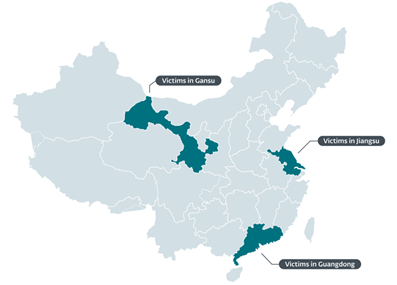
BRATISLAVA, MONTREAL — April 26, 2023 — ESET researchers have discovered a campaign conducted by the APT group known as Evasive Panda, in which update channels of legitimate Chinese applications were hijacked to also deliver the installer for the MgBot malware, Evasive Panda’s flagship cyberespionage backdoor. Chinese users were the focus of this malicious activity, which ESET telemetry shows started in 2020. The targeted users were located in the Gansu, Guangdong, and Jiangsu provinces. The majority of the Chinese victims are members of an international non-governmental organizations (NGO).
In January 2022, ESET Research discovered that while performing updates, a legitimate Chinese application had received an installer for the Evasive Panda MgBot backdoor and that the same malicious actions had already taken place as far back as 2020 with several other legitimate applications developed by Chinese companies.
“Evasive Panda uses a custom backdoor known as MgBot that has seen little evolution since its discovery in 2014. To the best of our knowledge, the backdoor has not been used by any other group. Therefore, we attribute this activity to Evasive Panda with high confidence,” says ESET researcher Facundo Muñoz, who discovered this latest campaign. “During our investigation, we discovered that when performing automated updates, several legitimate application software components also downloaded MgBot backdoor installers from legitimate URLs and IP addresses,” explains Muñoz.
When ESET researchers analyzed the likelihood of several methods that could explain how the attackers managed to deliver malware through legitimate updates, two scenarios stood out: supply-chain compromises, and adversary-in-the-middle (AitM) attacks.
“Given the targeted nature of the attacks, we speculate that attackers would have needed to compromise the QQ update servers to introduce a mechanism to identify the targeted users in order to deliver the malware, and filtering out non-targeted users and delivering them legitimate updates. This is because we registered cases where legitimate updates were downloaded through the same abused protocols,” says Muñoz. “On the other hand, AitM approaches to interception would be possible if the attackers were able to compromise vulnerable devices such as routers or gateways and the attackers could have gained access to ISP infrastructure”.
MgBot’s modular architecture allows it to extend its functionality by receiving and deploying modules on the compromised machine. The functionalities of the backdoor include recording keystrokes; stealing files, credentials, and content from the Tencent messaging apps QQ and WeChat; and capturing both audio streams and text copied to the clipboard.
Evasive Panda (also known as BRONZE HIGHLAND and Daggerfly) is a Chinese-speaking APT group, active since at least 2012. ESET Research has observed the group conducting cyberespionage against individuals in mainland China, Hong Kong, Macao, and Nigeria. One victim of this campaign was verified to be located in Nigeria and was compromised through the Chinese software Mail Master by NetEase.
For more technical information about the latest Evasive Panda campaign, check out the blogpost “Evasive Panda APT group delivers malware via updates for popular Chinese software” on WeLiveSecurity. Make sure to follow ESET Research on Twitter for the latest news from ESET Research.
Map of China showing where users were targeted
Click one of our contacts below to chat on WhatsApp
