Skip to content

Key webinar takeaways: Cybersecurity trends to look out for

Modern security needs are constantly changing, so keeping an eye on emerging trends and evaluating them critically is key. As the attackers are getting better, faster, and stronger by utilizing the emerging technologies, so should the organizations.

Gerald Kasulis, VP of Business & Channel Operations, North America at Nord Security, recently hosted a webinar featuring Matt Lee, Senior Director of Security and Compliance at Pax8, and Frida Kreitzer, IT Consultant at FridaIT. Together they shared insights on the tech trends that are shaping cybersecurity into the near future.

Topics discussed included the shift towards Zero Trust architecture, ransomware’s surging menace, and the growing momentum in passwordless authentication.

Watch the full recording below, or keep reading this blog for some of the key takeaways we took from the webinar.

Cybersecurity landscape

Matt Lee believes that changing market conditions demand a heightened focus on cybersecurity: “what changed drastically is that we actually started feeling the pains of threat actors’ endeavors. But the big shift that I think took place is that people are actually trying to solve the cybersecurity problem at the SMB and mid-market level.”

Frida Kreitzer gave a quick overview of the situation on the ground for IT teams in the current threat landscape, where more than 80% of cyberattacks are made possible by human error. For her, the primary concern is: “How can we be as proactive as possible without “breaking” the company?”

Zero trust, but more security

Never trust, always verify

A Zero Trust architecture assumes that all network traffic is untrustworthy, regardless of origin. It’s become an increasingly significant area of interest for business leaders, as it minimizes risk by dividing your assets into walled-off sections.

“Zero Trust is a world where I know the device’s posture is healthy.” Matt suggests not even allowing network connections to be attempted if certain criteria aren’t reached: “If it’s got the right [security] tools, it’s using a layer for access, and it’s coming from the right IP address, then I’ll let someone try a password. Why would I even [allow an attempt] if they’re not meeting those conditions?”

Perimeter model

Matt draws a comparison between fortified castle walls and the perimeter model which has been “the mainstay of network security for decades. In both scenarios, the fortified area has a single gateway for access. But when cannons are rolled up or spies sneak through the gate, the perimeter can no longer adequately protect its inhabitants.

When new means of attack are developed, defenses must adapt. “Business email compromises and social engineering have grown extremely large,” Matt says, referring to the most common methods used by hackers to gain access. “It’s a different world now, that [requires changing] to a different policing model.”

Verify first, then trust

Matt sees Zero Trust as a shift from the attitude of trust first, then verify.

quote bubble

IoT security risks

Security leaders should consider more than just end users when addressing security concerns, Frida observes. With every additional device on your network, your potential attack surface expands. Internet of Things (IoT) devices can be particularly risky:

Ransomware: Not going anywhere

State of ransomware

Ransomware attacks have been surging in recent years. Matt observes that ransomware groups have become so efficient as to resemble legitimate businesses:

Matt explains that ransomware has become a fully-fledged economy unto itself, with various personas, services, and markets operating within. “I could be a bloke that just breaks into companies – that’s an initial access broker. You’ve heard of SaaS or software as a service. Well, now there’s RaaS – ransomware as a service. I can go to a marketplace and not only find a victim. The marketplace has all the infrastructure, all the capabilities to fully enact a ransomware scheme.” The problem has escalated to the point that law enforcement agencies worldwide and the recent US National Cybersecurity Strategy prioritize the dismantling of ransomware gangs.

Should you pay?

Gerald poses a controversial question on the topic – should you pay the ransom?

For Matt, “It depends. For me, it’s typically a balance of the greater good. And I think that that’s where I would try to make that decision of what’s in the best interests of everyone involved: the company, the customers, the patients. So it’ll come down to the sensitivity of the data, the impact, the gravitas of it. All of those things come into the conversation. Each one is a business by business decision.”

Frida suggests that pay or not, companies won’t be guaranteed safety from other attacks in the future. “They will get blackmailed again and again… Now you’re a target. We know that you’re vulnerable.” Frida says baking security into your software in early development should be a priority, but the real challenge is staying proactive on an ongoing basis.

Avoiding complacency is a big point for Matt as well: “Just like any business risk, you’re going to have to deal with it on a continuous basis. This is a continuous improvement model.”

Security leaders should be particularly vigilant when dealing with external contractors or consultants. Frida outlines the risks: “Someone who doesn’t know policy, someone who doesn’t have a company computer, someone who doesn’t use a password manager. Someone who’s easily susceptible to social engineering.”

Frida warns smaller companies not to assume they’ll fly under the radar:

Promises of passwordless: What’s the benefit?

The future of authentication – passwordless

The humble password, used since the early days of the internet, represents an increasingly outdated means of authentication, compromised with growing ease by social engineering or brute force attacks. As Matt says, “Passwords can be tricked or coerced from you.” The golden term for forward-looking, security-conscious organizations is “passwordless”.

Frida Kreitzer weighs in: “Most simply, [passwordless] means you’re not having to type in a password or use a password manager for authentication. That’s very exciting – you’re skipping that portion and just going straight to MFA (Multi-factor authentication, where multiple criteria have to be reached in order for the user to be authenticated). It’s a key that’s being sent to a device – usually a phone.”

Passkeys – a simpler and safer sign-in

Passkeys, digital credentials generated by a device, are invisible to the user, and represent a big step forward for the passwordless future. By removing the need for passwords and relying on user devices or biometrics for authentication, passwordless essentially circumvents the risk of password-related attacks.

Built on public-key cryptographic algorithms, passkeys are virtually impossible to phish or hack. Matt explains: “A [passkey] is a cryptographic representation of you that’s very hard to beat – it’s really large math.”

Closing comment

Getting your cybersecurity into a resilient posture is no mean feat. Matt points out that helpful frameworks exist that can support getting the ball rolling. “Stop trying to be the smartest guy or gal in the room. CIS (Center for Internet Security) has 153 little “do this” statements… if you do each of those you’ll greatly reduce your risk and reduce overspending because you won’t duplicate efforts. Be pragmatic.”

Important to remember is not to exaggerate or overstate security concerns when communicating with stakeholders. This can cause diminishing returns, according to Frida:

quote bubbleAs technology continues to evolve, so do the threats that emerge alongside it, shaping the cybersecurity landscape and the strategies needed to navigate it. Understanding these ever-changing trends is vital for any business aiming to build robust defense mechanisms. They can embrace security strategies like Zero Trust architectures, prepare for the relentless threat of ransomware, and explore cutting-edge authentication methods, such as passwordless systems. Through these strategic measures, organizations can enhance their digital security, preserving trust and ensuring continuity in an era marked by swift technological changes.

About Version 2 Digital

Version 2 Digital is one of the most dynamic IT companies in Asia. The company distributes a wide range of IT products across various areas including cyber security, cloud, data protection, end points, infrastructures, system monitoring, storage, networking, business productivity and communication products.

Through an extensive network of channels, point of sales, resellers, and partnership companies, Version 2 offers quality products and services which are highly acclaimed in the market. Its customers cover a wide spectrum which include Global 1000 enterprises, regional listed companies, different vertical industries, public utilities, Government, a vast number of successful SMEs, and consumers in various Asian cities.

About NordLayer
NordLayer is an adaptive network access security solution for modern businesses – from the world’s most trusted cybersecurity brand, Nord Security.

The web has become a chaotic space where safety and trust have been compromised by cybercrime and data protection issues. Therefore, our team has a global mission to shape a more trusted and peaceful online future for people everywhere.

Capitalizing on threats & opportunities – now is the time to venture into cybersecurity

In our rapidly digitizing world, the role of cybersecurity cannot be overstated. The increase in online platforms and the adoption of digital solutions by businesses of all sizes have led to a surge in cyber threats. While the scope of online risks is expanding, the need for cybersecurity grows exponentially.

A challenge for some is a golden opportunity for others. Thus, this growing need for cybersecurity solutions presents a lucrative business prospect for Managed Service Providers (MSPs) and resellers to partner with cybersecurity firms and offer their clients robust protection.

Cybersecurity market: threats and opportunities

Despite the escalating cyber threats, virtual work setup offers immense potential for businesses and enterprises. To better understand the risks and, paradoxically, their advantages, let’s review the current cybersecurity setting.

Luring risk of cyber attacks

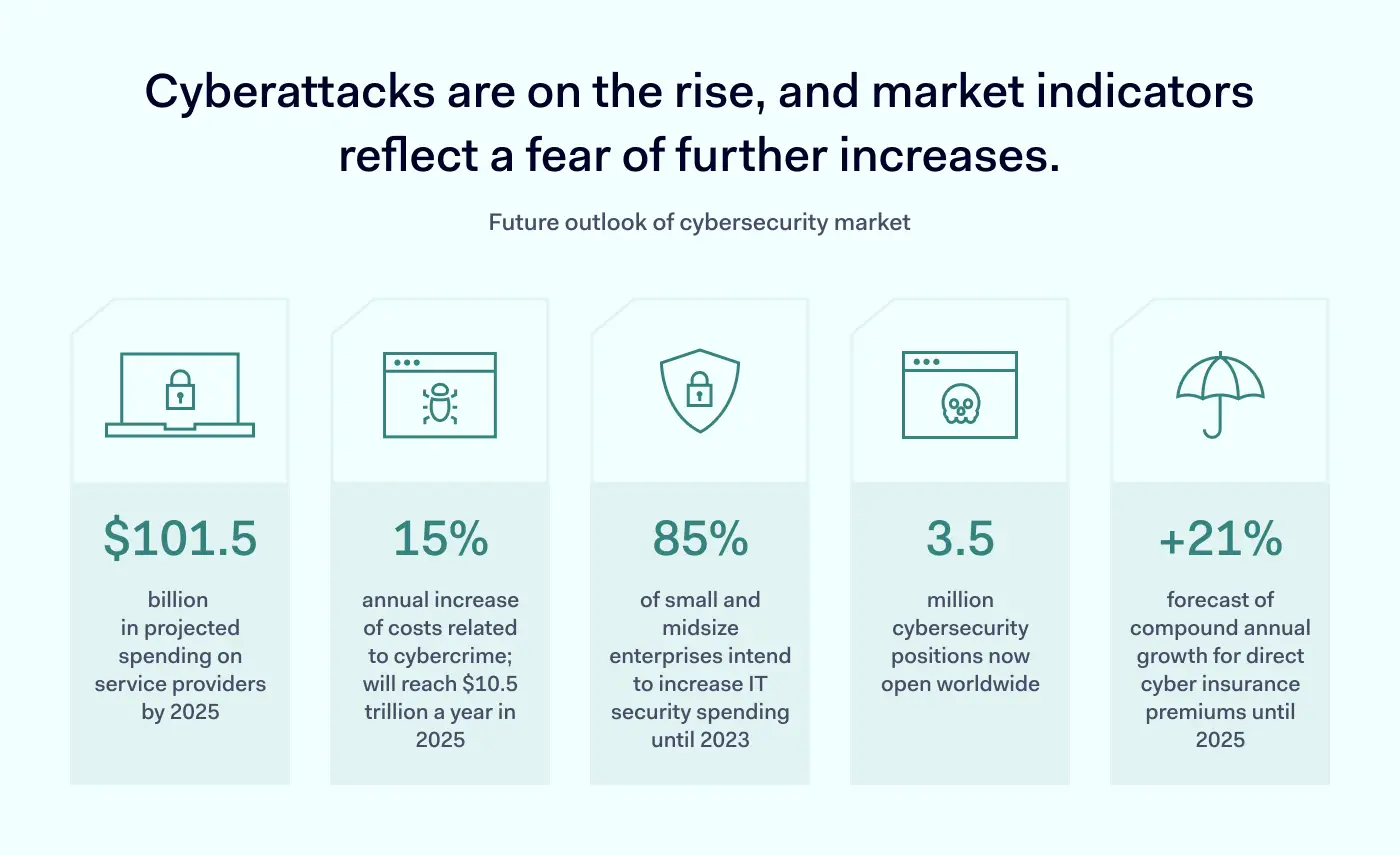
According to Statista, projected from 2023 to 2028, the total global cost of cybercrime is anticipated to surge by 5.7 trillion U.S. dollars, showcasing a notable rise of 69.94%. The latest estimates indicate that by 2028, global expenses related to cybercrime will soar to 13.82 trillion U.S. dollars.

Year after year, data breaches and ransomware attacks have wreaked havoc on the digital landscape. Recent cybersecurity threats research revealed that phishing attacks and malware are top risks businesses of all sizes are exposed to the most. Yet due to the dynamic cyber climate, leading threats constantly evolve, shifting their positions.

For instance, small- and medium-sized businesses (SMBs) are the most vulnerable, as companies with fewer than 1,000 employees bear the brunt of 46% of all cyber breaches. These statistics emphasize that no business is too small to ignore the importance of cybersecurity.

Moreover, analysis shows that ransomware attacks will reach an astounding 620.5 million cases in 2023, eventually costing approximately $265 billion U.S. dollars by 2031. Although it’s only a glimpse into the future digital ecosystem perceptions, the need for fortified cybersecurity solutions is more pressing than ever.

Possibilities dictated by the digital landscape

The silver lining in this situation lies in a boom in the cybersecurity market. This creates an opportune moment for MSPs and resellers to venture into cybersecurity. The global cybersecurity market size is predicted to grow exponentially in the coming years, and those prepared to seize the opportunity now stand to gain immensely.

This opportunity emerges as a prediction for MSP industry revenue to reach €21.18bn in 2023. The anticipated annual growth rate (CAGR 2023-2028) is 2.84%, culminating in a market volume of €24.36bn by 2028.

According to cybersecurity investments research, 59% of companies plan to purchase cybersecurity solutions, services, or applications. 52% of those who plan to invest in cybersecurity solutions and services are small– and medium–sized enterprises.Companies 1400x764

In addition, research gives an overview of major markets like the U.S., Canada, and the United Kingdom, revealing that approximately 22% of enterprises outsource their cybersecurity expertise. On average, almost 12% of companies don’t have in-house or outsourced cybersecurity professionals.

Regarding company size, a majority (52%) of small businesses don’t have and don’t outsource skilled cybersecurity staff, while 29% of medium-sized companies tend to outsource these functions.

Challenges faced by most MSPs & resellers

Like every sector has its own challenges, managed service providers and resellers encounter various obstacles in outsourcing business. According to Statista, in 2022, the most prominent impediments were coping with advanced and sophisticated security threats and acquiring more customers.

MSPs business challenges worldwide in 2022 1400x840

In 2022, 30–40% of respondents in EMEA (Europe and Middle East Africa), Americas, and APAC (Asia-Pacific) regions saw gaining new customers as a challenge. By 2023, 29% of service providers still cited the acquisition of new clients as their biggest challenge, followed by revenue growth and profitability.

Besides the struggle to find more clients, handling cybersecurity threats is an issue for a significant number (approximately 20%) of MSP and reseller companies in 2022. Service providers are directly exposed to digital threats like their customers and any other modern company.

NordLayer: your trusted cybersecurity partner

Navigating the cybersecurity landscape might seem daunting for many MSPs and resellers. That’s where NordLayer comes into play.

NordLayer offers a comprehensive partner program to help you tap into this booming cybersecurity market, enhancing your business performance and increasing your profits.

Boost your business performance

With NordLayer, your business can gain a competitive edge through an accessible software-defined solution. Our remote security solution ensures your clients stay safe online, allowing you to stay ahead of the game.

Grow your profits

NordLayer’s easy-to-adapt software eliminates the need for expensive hardware, saving your clients significant costs. By opting for a subscription-based SaaS model, you can enjoy a steady stream of recurring revenue, greatly amplifying your financial gains.

No tech expertise is needed

NordLayer simplifies the process of selling cybersecurity solutions. This means you don’t need a deep understanding of tech and network knowledge or invest in human resources education or competencies to start selling.

24/7 support

We believe that partnership goes beyond selling solutions. With NordLayer, you gain access to a committed, caring, and proficient technical support team available round the clock, helping you identify and close deals and propelling you toward success.

Efficiency is our priority

At NordLayer, we prioritize efficiency. With our solutions, you can onboard clients in under 10 minutes and scale rapidly. No minimum order requirement makes NordLayer ideal for SMBs. Network deployment and administration are simplified, without the need for complex hardware or tedious configurations, saving time and resources while boosting productivity.

Afterword

The time is ripe for MSPs and resellers to seize the opportunities in the cybersecurity market. With NordLayer as your partner, you will be well-equipped to navigate this booming sector and take your business to new heights. The cyber threats are real, but so are the opportunities. Now is the perfect time to start selling cybersecurity solutions.

Future partner, become an enabler securing all ways of working by joining forces with NordLayer.

About Version 2 Digital

Version 2 Digital is one of the most dynamic IT companies in Asia. The company distributes a wide range of IT products across various areas including cyber security, cloud, data protection, end points, infrastructures, system monitoring, storage, networking, business productivity and communication products.

Through an extensive network of channels, point of sales, resellers, and partnership companies, Version 2 offers quality products and services which are highly acclaimed in the market. Its customers cover a wide spectrum which include Global 1000 enterprises, regional listed companies, different vertical industries, public utilities, Government, a vast number of successful SMEs, and consumers in various Asian cities.

About NordLayer
NordLayer is an adaptive network access security solution for modern businesses – from the world’s most trusted cybersecurity brand, Nord Security.

The web has become a chaotic space where safety and trust have been compromised by cybercrime and data protection issues. Therefore, our team has a global mission to shape a more trusted and peaceful online future for people everywhere.

Essential cybersecurity measures when scaling your business

As businesses grow and expand in the digital era, their security must also advance. Business expansion brings more cybersecurity risks, including cyber attacks and data breaches. Because the cost of data breaches is currently very high, businesses face a challenge: as they grow, they become more attractive to hackers.

This is why it’s vital to consider boosting cybersecurity as your business grows. Let’s explore how a strong cybersecurity plan can safeguard intellectual property, sensitive data, and other crucial business resources.

Key takeaways

  • As businesses grow and expand, their cybersecurity risks also increase

  • To safeguard against increasing threats, a scalable cybersecurity policy should be developed

  • Conducting an internal cybersecurity audit helps identify system strengths and  weaknesses

  • Strengthening IAM ensures users have appropriate access privileges based on their roles

  • Encryption and VPNs safeguard sensitive data, making it unreadable to unauthorized individuals, and prevent data interception

  • Aligning with compliance requirements helps businesses avoid legal complications

  • Network segmentation limits the extent of damage a cyber attacker can cause

Understanding cybersecurity for business growth

Ensuring your business runs smoothly involves giving your team access to networks and IT systems. But as you do this, you also make your business a bigger target for problems. When you have more devices to keep safe and lots of data to handle each day, the chances of a cyberattack increase as your business grows.

Related articles


What is Security Compliance Management

In Depth

What is Security Compliance management?

And it’s not helping that cybercrime is on the rise. Different kinds of attacks can slow down or even stop your business. This can hurt how much your customers trust you, how people see your brand, and how much money you make.

When the key to doing well in business is being able to bounce back, you can’t forget about cybersecurity. These days, keeping your business safe from online problems is just as important as any other basic part of your business. The people who handle IT and the ones who run the business need to work together. If they don’t, your business can’t keep growing because it won’t be safe from new kinds of problems.

What are cybersecurity threats that businesses may face when scaling up?

Expanding a business means making it bigger online, which can lead to more cybersecurity problems. Here are some specific security issues that a business might have while growing:

Cloud problems: When businesses get bigger, they use more cloud services. But these can be weak against cyberattacks. For instance, outsiders might access private data if cloud settings aren’t set up right.

Increased attack surface: When a business grows, its networks, systems, and data increase. Attackers get more chances to break in, causing data leaks.

Insider threats: With more employees, there’s a bigger chance of trouble from insiders. Some might want to intentionally harm the company (like unhappy workers), while others might accidentally cause problems (by clicking on bad links).

Phishing and social engineering: These types of attacks go up as businesses get bigger. Bad actors try to fool employees into sharing secret info.

Third-party vulnerabilities: Growing companies often work with more outside vendors. But these vendors might not have great security. They could open the door to attackers.

Advanced Persistent Threats (APTs): Some attacks never stop and keep trying to break in for a long time. Big companies are often targets for these attacks because they can lead to big rewards.

Distributed Denial-of-Service (DDoS) attacks: Bigger companies might get hit with attacks that flood their systems, causing them to crash.

More complications: Expanding often means adding new tech and software, making things more complex. This can make it tough to keep everything safe and organized.

Regulatory compliance: As businesses get larger, they usually need to follow more rules, especially if they operate in many places. They could expose data and get fined if they don’t follow these rules.

Scaling security: the key to successful growth

When the number of threats increases and their techniques become increasingly sophisticated, this calls for a cybersecurity framework encompassing a scalability and growth plan. This means aligning with current requirements while considering infrastructure modernization for businesses.

Creating a scalable security system ensures that your cybersecurity program can grow with it as your business grows, not lag behind. A scalable security system can anticipate the changing landscape and proactively address potential security risks before they become an issue. Therefore, investing in scalable security is critical to sustainable business growth security.

Scaling your business safely: essential online security measures

As your business grows, it’s important to approach cybersecurity carefully. This helps protect your company from online threats, keep your data private, and follow rules and regulations.

1. Conduct an internal cybersecurity audit

Associative visual for a cybersecurity audit 1400x800

Conducting an internal audit is a crucial first step toward scaling cybersecurity. It helps an organization gain a comprehensive understanding of its existing cybersecurity posture. This includes identifying strengths, weaknesses, and vulnerabilities within the system. Without a clear picture of the current state, it’s challenging to determine where improvements are needed.

The audit also helps to identify potential risks and threats. This involves analyzing the security infrastructure, data handling processes, employee practices, and more. The critical areas that need the most attention can be prioritized by knowing the risks. It ensures that resources are allocated effectively to maximize security.

2. Educate employees

A “human firewall” refers to the idea that employees, through their awareness, knowledge, and actions, can play a crucial role in preventing and mitigating cybersecurity incidents. Employees who are educated about cybersecurity threats, best practices, and policies are better equipped to recognize and respond to potential attacks.

Regular cybersecurity training can help them understand the latest tactics used by cybercriminals and how to avoid falling victim to scams, phishing attempts, and social engineering attacks.

Creating a strong cybersecurity culture within an organization instills the belief that every employee has a role in protecting the company’s data and systems. The organization’s overall security posture improves when cybersecurity is everyone’s responsibility.

3. Strengthen Identity and Access Management (IAM)

As an organization grows, the complexity and scale of its operations also increase. This growth leads to more employees, contractors, partners, and customers accessing various resources and systems within the organization. As a result, the need for effective identity and access management (IAM) becomes paramount.

Different roles and departments have varying access requirements. Therefore, effective IAM ensures that users have appropriate access privileges based on their roles and responsibilities. This avoids granting excessive permissions and reduces the risk of unauthorized access. It’s a fundamental component of any cybersecurity strategy.

4. Use encryption and virtual private networks

Using encryption and virtual private networks (VPNs) is a crucial cybersecurity measure. Encryption helps to safeguard sensitive data by converting it into an unreadable format that can only be decrypted with a specific key or password. This prevents unauthorized access to data, even if it’s intercepted during transit or at rest. Without encryption, sensitive information such as passwords, financial details, and personal details would be vulnerable to theft or unauthorized use.

Meanwhile, a business VPN creates a secure tunnel between the user’s device and a remote server, encrypting all data transmitted. This prevents hackers and cybercriminals from eavesdropping on the data being exchanged. It’s particularly important when using public Wi-Fi networks, where data can be easily intercepted without proper security measures.

5. Step up your organization’s compliance alignment

Aligning with compliance requirements is a non-negotiable aspect of scaling cybersecurity. Laws, regulations, and industry standards dictate compliance requirements. Failure to comply leads to legal consequences, including fines, penalties, and lawsuits.

Compliance frameworks are designed to address specific risks and vulnerabilities in the cybersecurity landscape. Regulations like GDPR and HIPAA set certain data privacy and security standards that businesses must adhere to. By meeting these compliance requirements, your business avoids legal complications and demonstrates to clients and customers that you prioritize their data’s security.

6. Implement network segmentation

Associative visual for network segmentation 1400x800

Network segmentation involves dividing your network into multiple segments, each with its security controls. These segments are then isolated, creating barriers that restrict unauthorized access and the lateral movement of attackers within the network. It limits the extent of damage a cyber attacker can cause if they manage to breach your system. It’s vital to a scalable security strategy, protecting your business scales.

Even if hackers access a segmented network, they cannot move laterally across the network. This means that the hackers are trapped within the network segment, giving companies more time to respond to threats and contain the damage.

Protect your business with NordLayer: your cybersecurity partner

As your business expands, keeping it secure becomes crucial. You can take simple steps to ensure your growth is safe. Educating your employees and organizing your network are some of these steps. Working with partners who can grow with you is also smart.

NordLayer is here to help when your business is growing fast. No matter what is your business size or work model, you can keep your network security up to standard.

With NordLayer, you can enable secure access to your cloud platforms. Additional controls and ZTNA-focused contextual checks can be implemented to improve the organization’s security posture further.

Organizations using NordLayer can set up resource access policies with SSO, network segmentation, site-to-site tunnels, and more. There is an audit log for all actions completed within the Control Panel, including gateway connection timestamps helping to keep track of what’s happening within your network.

NordLayer makes your business more secure. Want to know more? Get in touch with our sales team to learn more about our offerings.

About Version 2 Digital

Version 2 Digital is one of the most dynamic IT companies in Asia. The company distributes a wide range of IT products across various areas including cyber security, cloud, data protection, end points, infrastructures, system monitoring, storage, networking, business productivity and communication products.

Through an extensive network of channels, point of sales, resellers, and partnership companies, Version 2 offers quality products and services which are highly acclaimed in the market. Its customers cover a wide spectrum which include Global 1000 enterprises, regional listed companies, different vertical industries, public utilities, Government, a vast number of successful SMEs, and consumers in various Asian cities.

About NordLayer
NordLayer is an adaptive network access security solution for modern businesses – from the world’s most trusted cybersecurity brand, Nord Security.

The web has become a chaotic space where safety and trust have been compromised by cybercrime and data protection issues. Therefore, our team has a global mission to shape a more trusted and peaceful online future for people everywhere.

Simplify remote employee onboarding with a complete checklist

Remote working is now a standard feature of the work landscape. From IT support to DevOps, companies rely on armies of remote workers to keep things moving.

As remote work has expanded, companies have had to adapt their onboarding processes. Remote onboarding has become critical when ensuring a smooth transition for new hires. But how does remote employee onboarding work, and what challenges can HR teams expect?

This article presents a comprehensive remote employee onboarding checklist. Our step-by-step checklist simplifies the onboarding process, making challenges easy to overcome. The result will be a more positive experience for IT professionals and remote workers.

Challenges with remote employee onboarding

Remote onboarding integrates new hires into company culture and introduces IT systems that power the organization. But unlike standard hiring procedures, remote employee onboarding is a virtual experience.

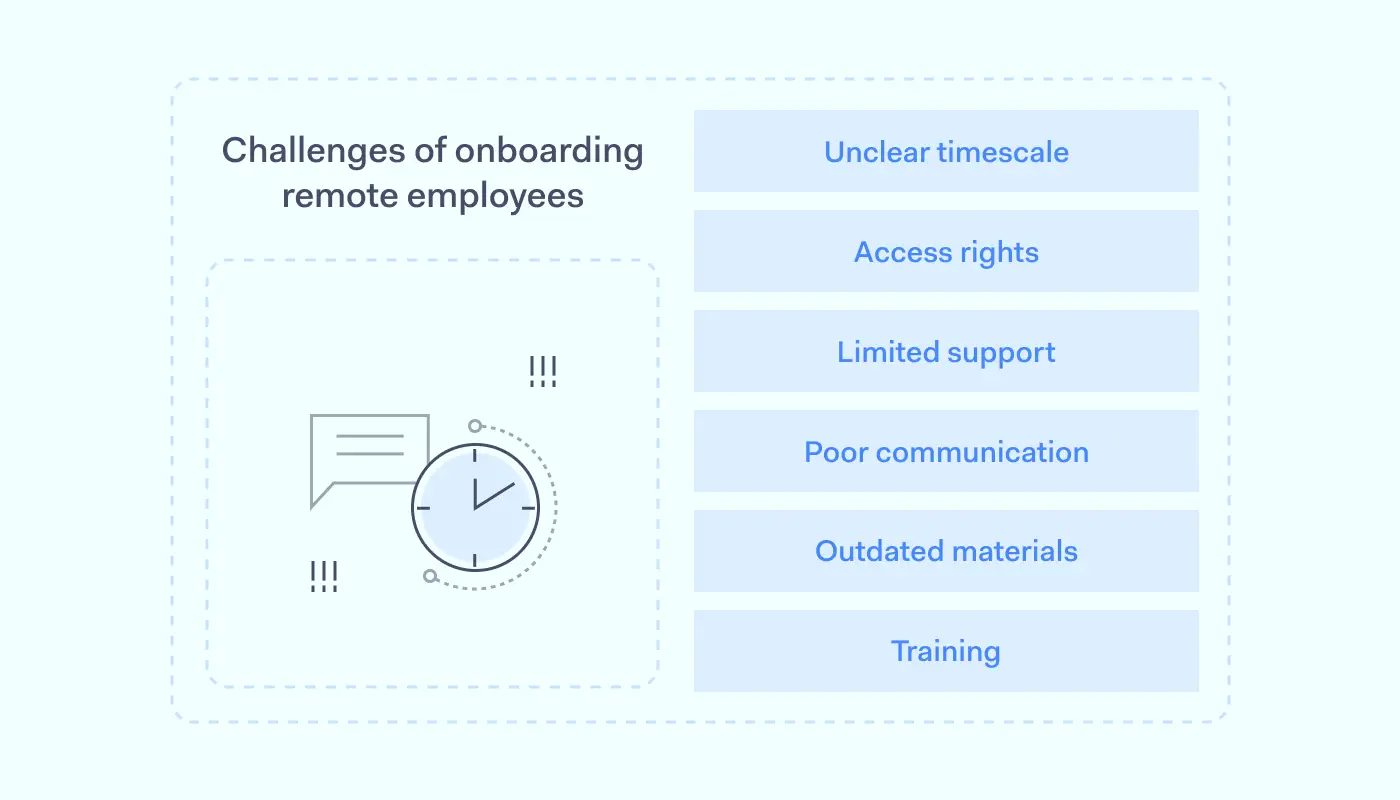
Challenges of onboarding remote employees 1400x800

HR teams do not have face-to-face contact with new hires during remote onboarding. Employees meet managers and colleagues virtually via emails, Teams meetings, and Slack discussions. This creates some unique challenges that companies need to think about.

1. Lack of a clear onboarding timescale

Onboarding tasks like creating access profiles, logging devices, and providing security training takes time. New hires may need to arrange calls with IT teams, HR professionals, and departmental colleagues.

Companies may provide employees with approved hardware like authentication tokens or access cards. And contracts and confidentiality agreements are often part of the process.

As a result, onboarding processes aren’t usually over in hours. They can even extend beyond the first week. New hires can wait over a week before accessing applications and databases. So HR teams must set itineraries for each stage of the remote onboarding process.

2. Managing access credentials and permissions

Each new hire must have an appropriate access control profile before accessing network assets. But establishing access controls for different resources can be challenging.

Security teams must create accurate profiles for new employees and connect permissions to their corporate role. They must also ensure that new hires have suitable credentials and train workers to use enterprise-wide 2FA or Multi-factor authentication systems.

3. Limited technical and administrative support

Remote onboarding can be highly technical. Employees sometimes need to update their hardware and security setups to meet company requirements. Companies often use unique platforms and apps that require orientation training. Collaboration tools can also lead to bottlenecks, making it harder to start work efficiently.

Every remote hire needs support to overcome these issues. But with many new employees entering an organization and limited IT resources, providing this support can be difficult.

4. Communication problems

Ideally, HR teams and managers would introduce new hires to the company via face-to-face meetings. But that’s not possible with remote onboarding. The distance between new hires and central offices can result in communication issues.

Without instant feedback, it’s also easy to lose critical information the new hire needs. And this is even more challenging when workers speak a different language.

New hires may also struggle to create personal connections with their colleagues. Integrating a new hire into the company culture becomes very difficult. Companies thrive when workers are connected and willing to share information. But disconnected remote workers rarely collaborate effectively.

5. Out-of-date onboarding materials

New remote employees require relevant information about technology, access, and cybersecurity. But company policies constantly change. HR teams may not maintain up-to-date onboarding databases. And they often provide the wrong information during remote onboarding processes.

For example, a company might install a data loss prevention (DLP) system to protect critical client data. But new hires may not receive guidance about classifying and handling data. This results in security risks and frustration when they begin work.

6. Delivering cybersecurity training

Cybersecurity in the workplace now extends to home offices. New remote employees need the knowledge required to use company assets securely, wherever they are. Whether you are hiring managers or freelance designers, delivering the correct cybersecurity training is challenging.

Video calls, emails, and downloadable presentations are a robust basis for security training. But they do not always add up to a productive learning environment. New hires may have questions about policies and processes. Technical problems could interfere with training events. And managers may lack assurance that employees retain critical information.

Remote employee onboarding checklist: what you need to know

When done well, remote onboarding allows workers to hit the ground running. It makes sure employees are cybersecurity aware. And it minimizes the workload on IT support teams as hires become familiar with corporate systems.

But a poorly executed remote onboarding program can be disastrous. Companies can lose the social connections that make teams effective. IT staff can become overwhelmed. Poor security practices creep into everyday work, raising the risk of phishing and malware attacks.

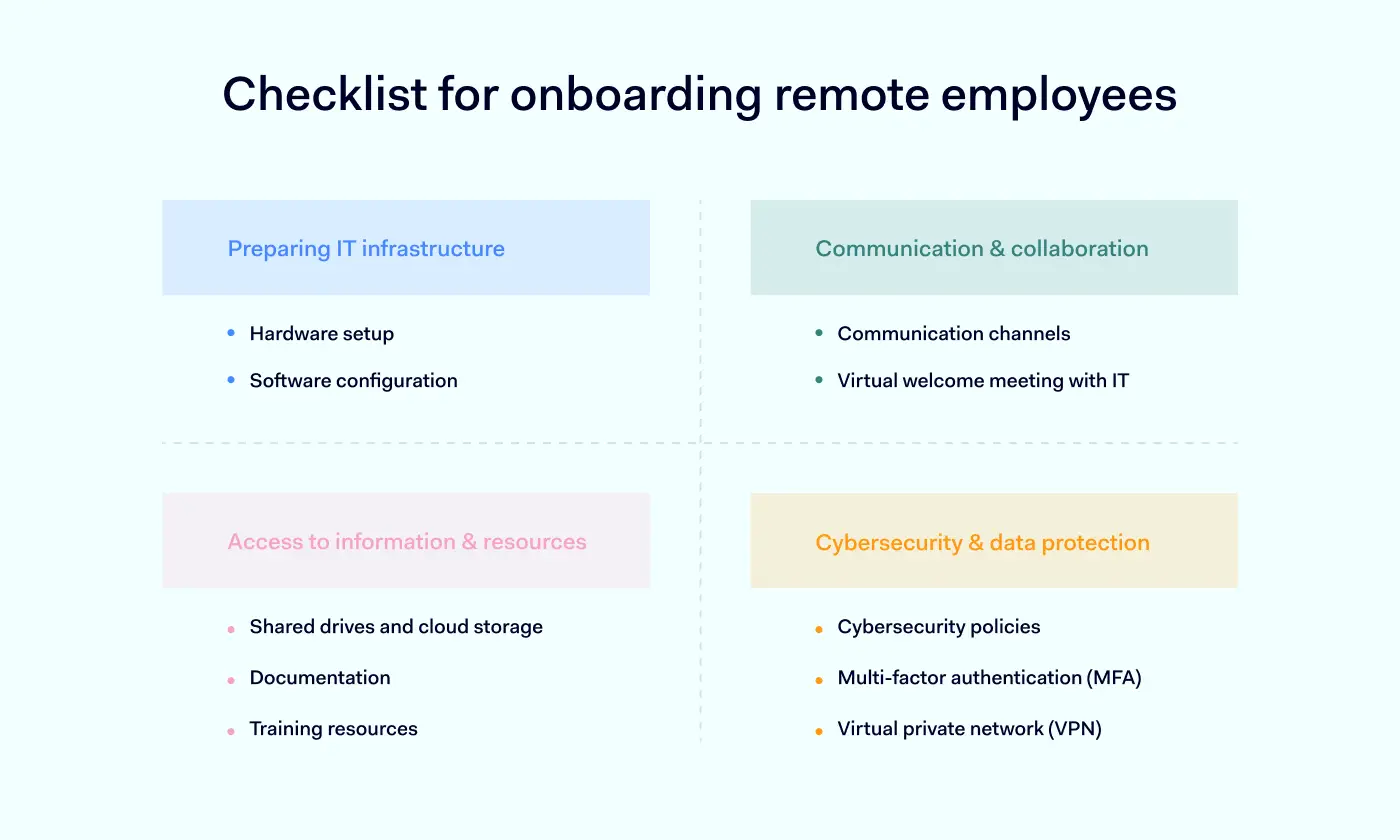
A well-structured remote onboarding policy streamlines the process. And creating effective systems relies on IT professionals. The following checklist provides a roadmap to design onboarding systems that integrate new hires without raising security risks or damaging productivity.

1. Preparing the IT infrastructure

New hires must usually make changes to their home IT setup. IT teams need to ensure staff have appropriate workstations and operating systems. They need to consider cybersecurity, as well as providing critical communication tools. And IT staff must provide proper support to make IT infrastructure operational.

Hardware setup

At the start of the onboarding process, prepare any necessary hardware. Match up new hires with required laptops or authentication peripherals. Prepare the hardware for shipment as quickly as possible.

OSHA can also fine companies that put the health and safety of remote workers at risk. In any case, protecting worker health is crucial. Verify that each workspace meets ergonomic requirements. And provide any necessary furniture to create safe, comfortable environments.

Software configuration

Remote employees need access to essential applications. IT teams should prioritize the configuration of video conference software and communication tools. Set up messaging apps and virtual meeting platforms. This will keep new hires informed and help to integrate them quickly.

IT must check that software supplied to remote devices has the correct licenses. And technicians should test every critical app. Ensure the worker can access central or cloud-hosted resources and that performance meets minimum benchmarks.

2. Cybersecurity and data protection

Remote workers can create cybersecurity risks to both network assets and sensitive data. IT teams need to prioritize security when introducing new employees.

Cybersecurity policies

Review your security policies before onboarding new workers. Security policies should cover all critical risks. For example, they should clearly explain password policies for remote workers. And they should include details about penalties for policy breaches.

Provide cybersecurity training for every hire. Remote workers should understand the main phishing risks and the importance of using updated threat detection tools. They should be aware of corporate data handling policies. Including a list of best practices in the employee handbook is advisable. This list should provide guidelines for critical security issues.

Multi-factor authentication (MFA)

Remote workers should connect via secure authentication systems. Implement multi-factor authentication for all access requests. MFA requires multiple authentication factors for each login request. It can apply to SSO portals or individual messenger apps.

Ensure every employee has correct credentials and that authentication tools connect seamlessly with privileges management systems.

Virtual Private Network (VPN)

Virtual private networks encrypt data passing between remote workers and central network resources. They provide an essential layer of protection for information and should be part of every remote onboarding process.

Inform new hires how to access the company VPN. Provide client software and any required hardware. And check connection speeds to ensure seamless connectivity.

3. Communication and collaboration

Create smooth communication channels between your new hire and the IT department. Onboarding remote workers involves a lot of technical information. And employees usually have queries or issues to resolve. Following these communication best practices will help.

Communication channels

Add remote employees to relevant team chats and email lists. Introduce them to colleagues in team chat rooms, and ensure staff can use communication tools effectively. If you need to provision specialist collaboration tools, go ahead and do so.

Introduce virtual meeting tools and check for bandwidth or configuration issues. Licensing problems can interfere with some video meeting tools. Double-check to ensure everything is up to date.

Virtual welcome meeting with IT

Schedule a virtual introduction meeting with relevant IT professionals. This is an opportunity to explain critical technology issues and reinforce cybersecurity training.

The meeting is a social event that introduces personalities and gives new hires the confidence to raise questions. Take onboard employee feedback and use it to make the onboarding process more efficient. The meeting also allows technicians to test video conferencing tools, allowing IT staff to fine-tune configurations.

4. Access to information and resources

Network resources should be available to remote employees when they complete security training. This should take place as quickly as possible. IT teams should plan so that access privileges slot into place automatically.

Shared drives and cloud storage

Link each new hire to a role-based access management profile. Access management tools document which resources are available to the user. Users should have easy access to data and apps that are relevant to their role, including company intranets and cloud environments. But IT teams should block access to all other resources on shared drives and cloud containers.

Be careful to provide the right privileges for each role. If you are hiring a large group of remote workers for a project, you can use generic RBAC profiles. But hiring managers requires a more tailored approach for each individual.

Documentation

Make security and IT policies available to every new hire. At the introductory meeting, explain how to access documentation and how policies are updated and maintained. If possible, create an employee handbook that includes everything remote workers need to know.

Training resources

Remote employees require virtual training. So prioritize access to digital training materials and resources. From the start, security training is a core part of the company culture. And make access to resources as flexible as possible, allowing workers to fit training into their onboarding routine.

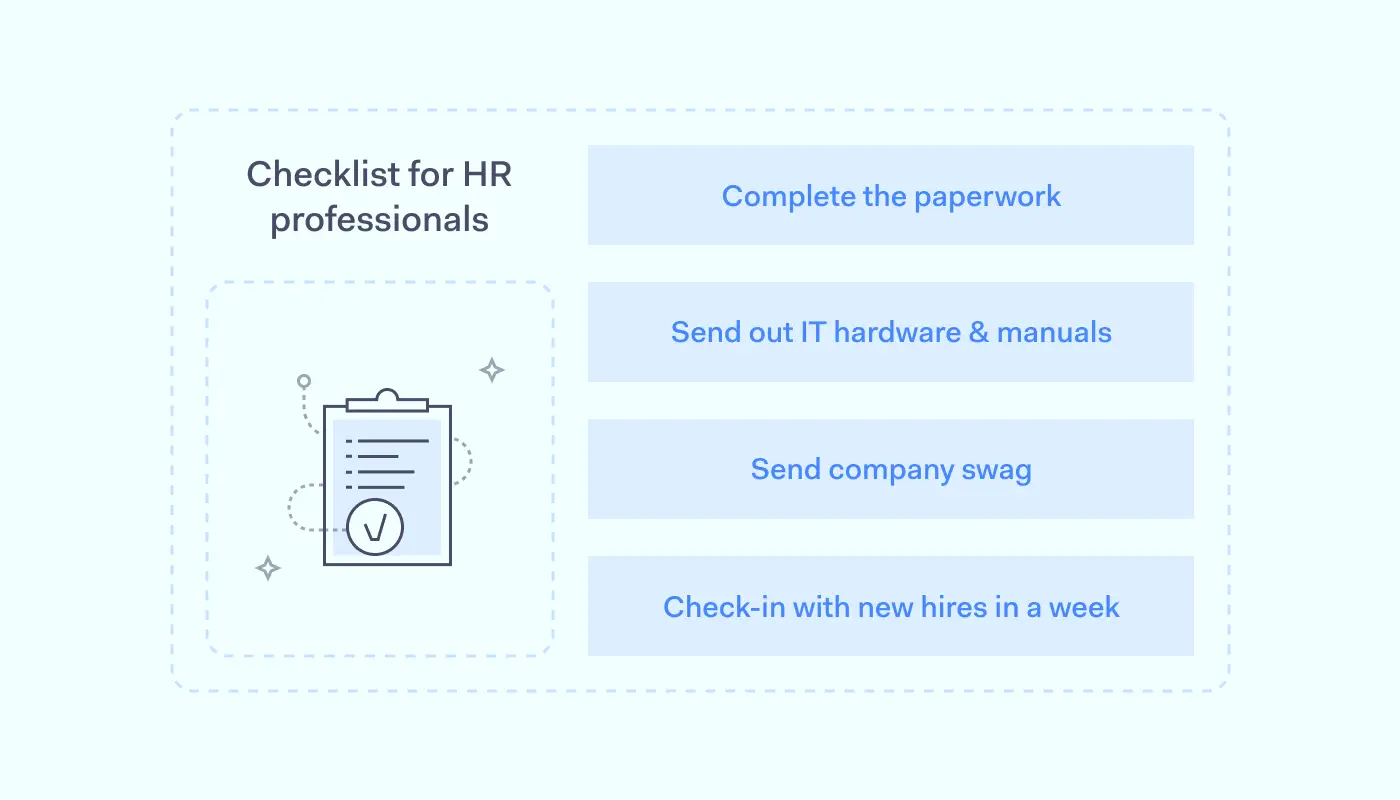
Checklist for HR professionals

The other side of the remote onboarding coin relates to Human Resources teams. HR professionals are critical in introducing new employees and making the onboarding experience more enjoyable.

Company orientation tasks complement the work of IT departments. Here are the key actions that HR officers need to consider:

Ensure paperwork is done

Nothing is more frustrating during onboarding than receiving an endless stream of documents to sign. Make this task pain-free by creating a single cache of necessary paperwork for each onboarding procedure.

Automate the provisioning of key documents. This reduces the number of times the new employee needs to provide digital signatures and makes human error less likely. Assign a team member to field queries about forms or policies. And apply encryption to secure any personal information transmitted during onboarding procedures.

Send pre-boarding IT hardware and manuals

Ensure employees are comfortable and safe by providing ergonomic furniture and peripherals like back supports and ergonomic mice. And field requests for specific hardware. Employees may need more powerful laptops or software upgrades. Provide whatever hires need to work safely and productively.

Manuals are an important part of the HR onboarding process. Produce an appealing employee manual that blends clarity and accessibility. Include information about cybersecurity and how to access critical workloads. But also add sections on company history and employee benefits the company provides.

Send company swag

One of the most important HR tasks during remote onboarding is creating a sense of belonging to the company culture. That isn’t easy to achieve without face-to-face contact. HR professionals need to think creatively about the onboarding experience and make every new employee feel welcome from the start.

Providing company swag in the first week is an easy win. Simple branded items like cups, mouse pads, pens, or diaries can add a human touch. But you can go as far as you like. Some companies like to send hoodies or T-shirts. Others send laptop cases, beach towels, or practical items like reusable water bottles.

Check up on new hires in the first week

HR is the first point of contact for each new employee during their first days on the job. Make HR professionals available to talk via video calls. And proactively check up on remote workers to keep them in the loop.

HR can also encourage staff to complete the onboarding schedule within the agreed timescale. Don’t force new hires to finish the onboarding process too quickly. Everyone adjusts at their own pace. But be clear about what employees must do, and let them know when everything is complete.

Simplify and secure remote onboarding with NordLayer

Remote onboarding is a challenge for businesses in every area of the economy. Workers need to receive training and information. They need the tech to carry out their duties. And they must have the right access privileges and authentication credentials to work securely.

NordLayer will help you create a secure and streamlined onboarding experience. Our solutions make the IT side of remote onboarding much easier.

Companies can use our secure remote access solutions to replace existing Virtual Private Networks. NordLayer’s business gateway encrypts traffic passing from remote workstations to the company intranet. And they scale easily. Organizations can easily add more workers as the need arises.

Our remote access systems facilitate network segmentation for assigning role-based privileges, offering network administrators precise controls over the network. They integrate with all major authentication providers. And they do so cost-effectively. Companies can onboard hires rapidly, safely, and affordably.

If you are struggling with remote employee onboarding, NordLayer can assist. Use our checklist to guide you and feel free to get in touch with our team today.

About Version 2 Digital

Version 2 Digital is one of the most dynamic IT companies in Asia. The company distributes a wide range of IT products across various areas including cyber security, cloud, data protection, end points, infrastructures, system monitoring, storage, networking, business productivity and communication products.

Through an extensive network of channels, point of sales, resellers, and partnership companies, Version 2 offers quality products and services which are highly acclaimed in the market. Its customers cover a wide spectrum which include Global 1000 enterprises, regional listed companies, different vertical industries, public utilities, Government, a vast number of successful SMEs, and consumers in various Asian cities.

About NordLayer
NordLayer is an adaptive network access security solution for modern businesses – from the world’s most trusted cybersecurity brand, Nord Security.

The web has become a chaotic space where safety and trust have been compromised by cybercrime and data protection issues. Therefore, our team has a global mission to shape a more trusted and peaceful online future for people everywhere.

It’s time to talk about cloud security

Reading about the cloud in 2023 has an almost nostalgic feeling to it, a bit like watching that HBO special for the 20th anniversary of the Harry Potter series. You suddenly realize how long it’s been since the whole conversation about cloud computing started.

The cloud has become such a common IT tool that today it is difficult to find an industry (or even a company) that does not use it to some extent. The chances are very high that you yourself are using it frequently.

So, we will not waste your time with generic information explaining the benefits and challenges of the cloud. Instead, we’ll get down to the nitty-gritty and discuss what’s really important — cloud data security.

First things first: What is cloud security?

Cloud data security could be explained as what organizations do to protect their cloud-based systems and applications — and the data they store in the cloud — against cyber threats.

You could also say that it is a set of strategies, procedures, and tools that, when properly applied, can help companies prevent unwanted data exposure or IT infrastructure damage caused by various internal or external factors.

Both explanations are correct. In fact, they complement each other and together provide more context — although they don’t give the whole picture.

Treating it more like a concept, we could say that cloud security is a complex and constantly evolving field in IT that requires attention from all organizations that have either fully or partially based their IT environment on the cloud. So, with that in mind, the question you may be asking yourself right now is…

Why is cloud security so important?

If we had to answer that in one sentence, it would probably be this: cloud security plays an essential role in ensuring the confidentiality, integrity, and availability of sensitive data stored in the cloud. But this only scratches the surface. So, allow us to elaborate a bit because there’s more to this matter than meets the eye.

Each year, more and more organizations start their digital transformation journeys and integrate cloud-based tools and services into their IT infrastructures. All of those companies — no matter if they are small businesses or large-scale enterprises — cannot afford to take any risks regarding the security of their digital assets.

This is why cloud security is one of the aspects that these companies must address if they decide to run even a tiny part of their activities in the cloud — or to keep their data inside one. If they don’t, they risk not only data loss or disruption of their business operations but also financial and reputational damage. They must be aware of the fact that keeping digital assets in the cloud doesn’t mean that they are unreachable to hackers.

This is to say that organizations should make every effort to ensure that their cloud cybersecurity is at the highest level at all times — after all, the success of their business endeavors depends on that.

Main risks associated with cloud security

Security issues in cloud computing often revolve around the potential for unauthorized access — but not only that. Below, you will find descriptions of some of the biggest threats that today’s companies must be aware of while developing their cloud security strategy. Whether a company will be able to address and manage these threats depends not only on the actions they take but also on its awareness of the emerging trends and disruptive forces shaping its industry.

  • Data breaches:

    Whenever an organization starts storing sensitive information in the cloud, it instantly becomes a target for cybercriminals — and they will try to find their way in. A successful breach could result in the exposure of the company’s confidential data including its financial records, customers’ personal information, or even intellectual property.

    In its “Cost of a data breach” report, IBM reveals that the global average cost of a data breach across all sectors in 2023 is almost $4.5 million — which is an amount that has increased by almost 15% over the last three years. This fact alone shows that companies cannot waste time, and they should introduce robust authentication mechanisms, encryption protocols, and access controls as soon as possible to protect themselves against this threat.

  • Insider threats and privilege abuse:

    It should be no surprise to anyone that employees with access to company data sometimes misuse their privileges or can be coerced into revealing sensitive information. This can lead to similar or even the same issues that arise due to data breaches.

    Hackers will use every vulnerability in security controls or protocols to gain unauthorized access to your systems and applications — and that is why companies must work on developing sound cybersecurity policies that, first, their employees will adhere to, and second, will help them mitigate the damage if one of their employees (whether intentionally or not) causes a potential cybersecurity threat.

  • Cloud service providers often operate on a global scale, helping customers from different parts of the world where different sets of data protection laws and regulations apply. It’s no rocket science to point out that complying with these diverse legal requirements can be a challenge for both cloud providers and their customers.

    Non-compliance with the standards may lead to serious financial or reputational losses. Thus, businesses must carefully navigate the regulatory landscape and choose cloud providers that meet the relevant criteria.

Best practices in cloud security

Before we discuss any cloud security best practices, we would like to point out that cloud security as a whole is a continuous process and, therefore, you should stay informed about the latest security trends and practices so that you can protect your cloud environment more effectively. In other words, do not think of the following examples as the only elements you should pay attention to when creating a cloud security strategy. Instead, treat them as a starting point.

  1. Encrypt your data: One of the foundational pillars of cloud security is encryption, which is the process of using combinations of sophisticated algorithms to make sure that no unauthorized party can access your data — whether at rest or in transit. Some cloud service providers offer built-in encryption features, which you can leverage to keep your data secure at all times. If they are not available to you from the get-go, consider using third-party encryption tools to protect your sensitive information.

  2. Implement and use identity and access management (IAM) tools: To manage user access and permissions effectively, you must implement a strong IAM strategy. For example, by following the principle of least privilege, you can ensure that only authorized users with specific roles can access your systems, applications, and data. In other words, you can use IAM tools to provide the right people with access to the right resources — and only them. This will help you protect sensitive information from being compromised.

  3. Carry out audits regularly and monitor all cloud activities: You can stay ahead of potential security risks if you conduct frequent security audits. That way, you will be able to identify cybersecurity areas that require improvement and take necessary measures to address them before any security breach occurs. If you pay close attention to what’s going on in your network, you’ll be able to detect and respond to any anomalies or potential threats before they cause damage.

  4. Find out what your provider does to ensure cloud security: When teaming up with a cloud service provider, you should take the time to understand their shared responsibility model and all the security features they offer. In other words, you should get familiar with your provider’s security practices and security to, first, double-check if their approach aligns with your organization’s specific security requirements, and second, to ensure that your sensitive data and applications are adequately protected in the cloud environment.

  5. Backup your data: You can enhance your organization’s cybersecurity by consistently backing up your business data in a highly secure location and rigorously testing the recovery process. If you take this proactive approach, you will be able to, in the unfortunate event of a security breach or data loss, quickly and seamlessly restore crucial data and applications. Not to mention that it will help you minimize downtime, safeguard your reputation, and ensure business continuity.

How does NordLocker fit into the context of cloud security?

To adequately answer this question, we need to start with a brief explanation of what NordLocker is, namely an end-to-end encrypted cloud storage platform that allows you to securely store, manage, and share your business data with company members and partners.

NordLocker was designed to help companies — no matter the size, location, and nature of their business — protect their digital assets in a highly secure, state-of-the-art cloud environment to which only they have access. Therefore, it is more than fair to say that NordLocker was created with cloud security in mind.

Thanks to its wide range of features — from end-to-end encryption, through multi-factor authentication (MFA), to zero-knowledge architecture (and everything in between) — NordLocker covers all the cybersecurity practices we discussed in this article to help its users create a much safer online business environment. It can help you do that as well.

That’s why we encourage you to go to NordLocker and learn more about the platform and get a 14-day free trial. That way, you will be able to see for yourself if NordLocker is the right fit for your business and if what we’re saying is true.

Enjoy the ride!

About Version 2 Digital

Version 2 Digital is one of the most dynamic IT companies in Asia. The company distributes a wide range of IT products across various areas including cyber security, cloud, data protection, end points, infrastructures, system monitoring, storage, networking, business productivity and communication products.

Through an extensive network of channels, point of sales, resellers, and partnership companies, Version 2 offers quality products and services which are highly acclaimed in the market. Its customers cover a wide spectrum which include Global 1000 enterprises, regional listed companies, different vertical industries, public utilities, Government, a vast number of successful SMEs, and consumers in various Asian cities.

About NordPass
NordPass is developed by Nord Security, a company leading the global market of cybersecurity products.

The web has become a chaotic space where safety and trust have been compromised by cybercrime and data protection issues. Therefore, our team has a global mission to shape a more trusted and peaceful online future for people everywhere.