
Skip to content

The AI race: will you adapt or fall behind in business automation?

Many organizations are at a critical crossroads in the race toward AI-driven automation. The allure of AI is irreristible. It promises greater efficiency, higher productivity, and streamlined operations. But, as with any technological revolution, the question is whether it’s a necessity or just a trend. 

We talked to Shawn David, an AI expert, about why companies must adapt to AI automation to survive and boost their productivity. We also discussed the potential risks AI technologies entail.

Shawn David has degrees in computer science and organizational leadership. He found his passion in automation while working at a marketing agency. He now runs “Automate to Win,” educating entrepreneurs on using AI to enhance productivity and efficiency.

At a glance: insights from this interview

  • Benefits of AI for organizations: how AI enhances efficiency and productivity through automation?

  • Strategy for adopting AI: what’s the best plan for implementing an AI-based tool?

  • Data safety & AI: how to ensure your assets are safe with AI-based technologies?

  • AI-powered decision-making: how AI can help make informed decisions?

  • AI integration across industries: how AI automates tasks across various sectors?

  • Risks regarding AI: what’s the best approach to the adoption of AI?

Benefits of AI for organizations

NordLayer: Shawn, generative AI tools like ChatGPT and Midjourney are now on everybody’s radar, and some organizations have already successfully deployed them. What are the benefits of using AI for businesses?

Shawn David: There are many benefits, but first of all, AI greatly improves business efficiency and productivity, particularly in automation. Employees can swiftly spot patterns and segments in large datasets, saving them from the manual analysis of thousands of lines of spreadsheets. This speed and accuracy can help combat fatigue and reduce errors. For example, creating a presentation deck can take 20 minutes instead of five hours.

By automating manual and repetitive processes, businesses can focus on understanding their workflows and automating the right processes. The essence is in deploying automation identifying and optimizing processes for reliable outputs. It’s the bread and butter of AI-driven automation, which, done properly, helps businesses achieve greater efficiency, higher productivity, and more reliable results.

NordLayer: You said repetitive jobs would be automated. And interestingly, Gartner predicts that 40% of such tasks we do now will be automated by 2030. What are the business implications of adopting AI?

Shawn David: I can highlight an example from an agency’s context. This agency conducts more than 2,000 A/B tests annually across various clients. Now, imagine streamlining this and automating the mechanism. Whatever time and workforce you save can be entirely freed up. Also, assuming the agency’s billable rate is $300 per hour and the average time spent on this particular task is almost five hours, the annual gain amounts to $2.7 million. What’s remarkable about AI is that this isn’t just a cost-saver. It’s a strategic asset that fuels growth, boosts profits, and eliminates repetitive tasks.

AI-in-business Automating-processes-for-efficiency-and-productivity 1400x873 1

Strategy for adopting AI

NordLayer: Indeed, it’s remarkable, but the question is how to start with AI in business. Can you explain your three-step strategy for organizations looking to leverage AI?

Shawn David: Think of the first step as testing things out. You must step beyond your usual methods and rethink how you use AI. Even I, with two decades of systems engineering, had to adjust my thinking after about six months of working with it.

Consider three generative AI models: Claude, Bard, and ChatGPT. Think of them as three different ovens, each baking the same cake but with unique qualities and results. You are the chef here.

And now, the idea is to use AI to create a recipe for optimizing your business. Start with the end goal. AI will show you how to use the ingredients (your data and processes) to reach that outcome. Remember that you can hire a professional if you’re unsure how to use AI effectively for your specific needs.

NordLayer: First, you pinpoint your business needs with AI. What’s the next step?

Shawn David: You use AI with your data in the second step. There are two paths here: public Large Language Models (LLMs) like Bard and Claude are great for answering questions you already grasp. Imagine the result you desire. For instance, getting insights from 12,000 PDFs. The beauty is LLMs understand what you ask.

In the third step, you apply AI to your business processes. Now, avoid the DIY route. There are professionals who can handle this for you. Also, building a customized AI tool will help you secure your data by providing a more advanced and proactive approach and preventing unauthorized access to sensitive information.

Quote 1400x604 2

NordLayer: Let’s explore a practical scenario. Say I’m a healthcare business with around 60 employees, and I’m aiming to develop a secure AI tool.

Shawn David: Absolutely, building a safe AI tool involves a step called vectorization, which is like having a super-smart assistant. It studies content, creating connections and context within data. For example, when we think of  “jaguar” and instantly associate it with “Kitty Cat” or “English car.”

If you have sensitive data, like personal information, create an isolated database, keeping it safe from outside networks. Then, use your natural language processing on this database without directly linking to an AI model.

As you invest in vectorization, you eliminate complex translations between humans and machines. Encoded vectors carry meaning, easily understood by AI. This ensures clear communication, fostering secure and context-aware AI tools.

In summary, for goals like healthcare data privacy, vectorization empowers secure, efficient, and direct interactions with AI systems.

NordLayer: Certainly, understanding risks is crucial. Are there downsides to deploying a customized AI tool for businesses?

Shawn David: One concern is not fully knowing how it works and blindly trusting its results. There’s a risk when you get output without clarity on the process. Let’s look at an example. Imagine you purchase a natural language processing system for your company. You feed in data, which tells you 51 to 85-year-old females have a 97% conversion rate. But it might hide the idea that grandmothers are buying kids’ presents, leading to wrong business decisions based on misleading info.

To avoid this, you need to understand the AI’s mechanism. Talk to engineers, ask about biases, and get answers. If not, bring experts or consider adopting open-source solutions in a safe, air-gapped (disconnected) environment. This keeps data secure. It’s like driving a tractor-trailer if you don’t know how you’re stuck. Unlike in your first step, trial and error won’t help here. You need a solid understanding to navigate potential challenges. I advise talking to AI tool developers with the insights for smooth and secure use.

Cyber threats & AI

NordLayer: How do the risks you highlighted align with the ever-evolving landscape of cyber threats, and what challenges arise at the crossroads of AI and cybersecurity?

Shawn David: The emergence of AI-driven attacks has elevated the game beyond the usual culprits like software bugs or human errors. These attacks are woven into the very fabric of algorithms, and fixing them is now a complex puzzle.

Interestingly, despite their sophistication, many AI attacks exploit the same traditional vulnerabilities, such as weak passwords, unpatched software, or social engineering. In simpler terms, AI introduces new threats and uses age-old weaknesses. Strengthening cybersecurity defenses with established measures like strong passwords and multi-factor authentication can indeed create a formidable barrier.

NordLayer: Your insights on AI are intriguing. Shifting gears to the blend of cybersecurity and AI, especially in light of the growing concern surrounding deepfake and video content, what narrative do you see taking shape?

Shawn David: The proliferation of deepfake audio and video content undoubtedly demands our attention. With the rise of the LLMs and the whisper-1 audio-to-text and then training, you can quickly recreate someone’s likeness in real-time audio.

AI can mimic words you never uttered, prompting a quest for alternative validation methods. A human-based certification of any digital communication, perhaps? If AI can 100% replicate my voice and appearance during a Zoom call or run my LinkedIn posts, that’s scary.

NordLayer: So what, in your opinion, is the smartest way to ensure data safety within the realm of AI?

Shawn David: The data that AI feeds on can be twisted around for bad purposes in totally new and unexpected ways. This means we must change how we gather, keep, and use that data when dealing with AI.

Think of it like building your own AI tools in-house. It’s just like creating a strong fortress to safeguard your valuable assets. As I said earlier, adopting open-source solutions in a safe, disconnected environment keeps data secure. My advice is to use a thoughtful approach to AI and cybersecurity. This will help make sure a business remains resilient.

Decision-making and AI

NordLayer: That’s an insightful perspective on cyber threats in the context of AI. Now, let’s delve into AI-powered decision-making. Can you explain what it means?

Shawn David: According to Gartner, by 2025, 95% of decisions involving data will be at least partially automated. AI will improve the speed and accuracy of decisions in three ways.

First, we’ll have human-based decisions, such as medical diagnoses, where machines assist with visualization, but humans make the final call based on ethics, bias, logic, skills, and emotions.

Second, we’ll have hybrid decisions, like in financial investment, where the machine suggests, but the human decides. AI will provide recommendations and analytics for human validation.

Finally, we’ll have full decision automation, as in choosing the next best action for a digital order, where the machine decides using predictions and forecasts. Managing risks is key here, which might involve setting guardrails or keeping a human in the loop.

AI integration across various industries

NordLayer: Now, let’s talk about the impact of AI across various industries. How can different sectors benefit from AI integration?

Shawn David: Absolutely, the potential applications are vast. Industries characterized by routine human interaction or manual tasks are ripe for transformation. Consider roles involving data transposition, low-level content creation, or entry-level graphic design. For instance, I’m developing a system that can replace low-paying content creation gigs on platforms like Upwork and Fiverr. Users can train an AI using their own social media posts, and it will generate content in their style, which can then be refined further. This kind of symbiotic relationship between humans and AI can lead to a more efficient workflow.

AI-in-business Automating-processes-for-efficiency-and-productivity 1400x1245 2

Consider facilities like the Cleveland Clinic and the Mayo Clinic, which already utilize AI to monitor patients round-the-clock. Vital signs, such as heart and breath rates, are tracked, alerting medical staff to changes. AI aids in medication dispensing and even assists in medical diagnosis, analyzing patterns in cells that the human eye might miss. Radiology and surgery benefit from AI’s unmatched precision, akin to a drug-sniffing dog that never fails to detect. The potential of AI in healthcare is profound, touching everything from immediate care to complex diagnostics.

NordLayer: It’s interesting how AI’s influence varies across industries. What about the IT industry? Will it also see a significant impact?

Shawn David: Absolutely, even in the IT industry, there are areas that AI can revolutionize. For instance, AI bots can easily handle routine tasks like answering basic customer queries about platforms like GoDaddy or providing guidance on Google or Facebook ad setups. AI can watch and understand training videos, making manual checks unnecessary. This kind of automation can reshape entire sectors overnight. However, it’s important to note that AI adoption in IT is all about efficiency and profit. Open AI’s training data includes questions from users, not as an altruistic gesture, but to improve AI’s performance.

Regarding industries with less potential AI impact, those heavily reliant on high-level creativity or personalized concierge services might not experience significant change. For example, luxury services that thrive on human touch and bespoke experiences may remain less influenced by AI’s reach.

Risks regarding AI

NordLayer: Finally, can we discuss risks for businesses regarding AI?

Shawn David: One of the biggest business risks is falling behind the AI race and losing competitiveness. If you approach automation authoritatively without involving the workforce, it can lead to resistance and chaos. The key is to view AI as a collaborator, like a helpful robot. If people grasp this concept, we’d be in a better place. However, the rush to adopt AI while disregarding ethical concerns can lead to unintended consequences. It’s crucial to strike a balance between progress and responsibility.

NordLayer: Thank you very much for this insightful conversation.

Shawn David: My pleasure.

Before diving into the AI world, consider securing your business’s digital journey. Learn how NordLayer can help you strengthen your defenses.

This text has been generated by a human.
About Version 2 Digital

Version 2 Digital is one of the most dynamic IT companies in Asia. The company distributes a wide range of IT products across various areas including cyber security, cloud, data protection, end points, infrastructures, system monitoring, storage, networking, business productivity and communication products.

Through an extensive network of channels, point of sales, resellers, and partnership companies, Version 2 offers quality products and services which are highly acclaimed in the market. Its customers cover a wide spectrum which include Global 1000 enterprises, regional listed companies, different vertical industries, public utilities, Government, a vast number of successful SMEs, and consumers in various Asian cities.

About NordLayer
NordLayer is an adaptive network access security solution for modern businesses – from the world’s most trusted cybersecurity brand, Nord Security.

The web has become a chaotic space where safety and trust have been compromised by cybercrime and data protection issues. Therefore, our team has a global mission to shape a more trusted and peaceful online future for people everywhere.

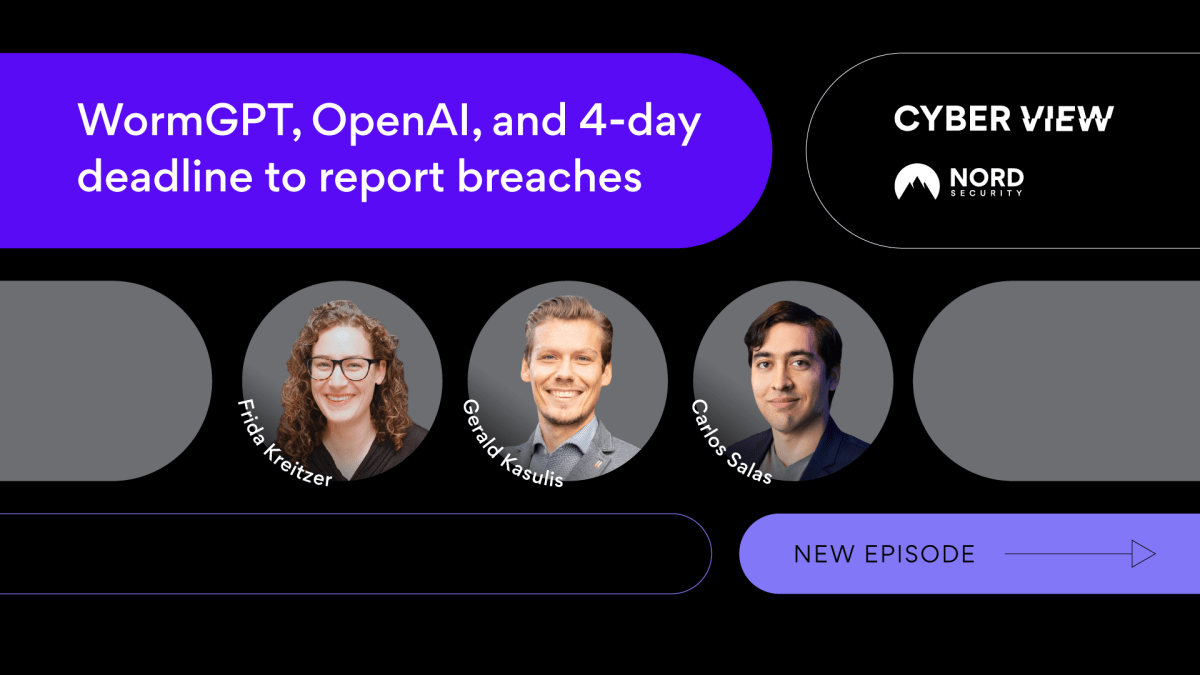
Cyberview: WormGPT, FTC investigates OpenAI, 4-day deadline to report hacks

The latest Cyberview episode is out! Join cybersecurity experts Gerald Kasulis, Frida Kreitzer, and Carlos Salas as they explore the most talked-about news in the digital world, from WormGPT, ChatGPT’s evil twin, to OpenAI’s FTC investigation and the controversial 4-day breach disclosure rule. Dive into their discussion bellow to discover what’s new in tech and cybersecurity world.

In this episode, we dive into: 

  • ChatGPT’s evil twin WormGPT

  • The Federal Trade Commission (FTC) investigation into OpenAI data leak and ChatGPT’s inaccuracy

  • A new 4-day rule for disclosing cyberattacks set by the US Securities and Exchange Commission (SEC)

Watch Cyberview here 

ChatGPT’s evil twin WormGPT

The new tool, WormGPT, is advertised on underground forums as a blackhat alternative to ChatGPT for launching phishing and business email compromise (BEC) attacks. Although, ChatGPT’s natural language abilities can already help hackers write convincing emails, resulting in the obvious signs of malicious emails disappearing.

Tools like ChatGPT and Google’s Bard have some safeguards in place that try to ensure that AI-generated content does not cause harm. However, WormGPT is specifically designed to be fully unrestricted and facilitate criminal activities, so it raises even more questions about the ethical limits of AI.

FTC investigates OpenAI over data leak and ChatGPT’s inaccuracy

Has ChatGPT broken consumer protection laws by risking personal reputations and data? The FTC has opened an investigation into OpenAI, requiring details on how OpenAI gathers and protects data and vets information.

The FTC wants to know how information was used to train its model and how it prevents false claims from being shown to users. Additionally, they are interested in how APIs connect to OpenAI’s systems and how user data is protected, all while the FTC issued multiple warnings that existing consumer protection laws apply to AI.

The 4-day deadline for public companies to report breaches

US companies hit by cyberattacks will face a 4-day deadline for publicly disclosing hacks, under new rules approved by the US Securities and Exchange Commission (SEC). There are mixed feelings about this new requirement. On the one hand, it is praised for encouraging transparency about cybersecurity breaches, as they are considered as important to investors as any other significant operational disruption.

On the other hand, the new rule is being labeled as a controversially short deadline that may not allow companies enough time to put an action plan in place or fix vulnerabilities. Although regulations state that if the SEC is informed in writing of a national security or public safety risk, a delay in breach disclosure of up to 60 days is allowed.

Stay tuned for the next episode of Cyberview.

About Version 2 Digital

Version 2 Digital is one of the most dynamic IT companies in Asia. The company distributes a wide range of IT products across various areas including cyber security, cloud, data protection, end points, infrastructures, system monitoring, storage, networking, business productivity and communication products.

Through an extensive network of channels, point of sales, resellers, and partnership companies, Version 2 offers quality products and services which are highly acclaimed in the market. Its customers cover a wide spectrum which include Global 1000 enterprises, regional listed companies, different vertical industries, public utilities, Government, a vast number of successful SMEs, and consumers in various Asian cities.

About NordLayer
NordLayer is an adaptive network access security solution for modern businesses – from the world’s most trusted cybersecurity brand, Nord Security.

The web has become a chaotic space where safety and trust have been compromised by cybercrime and data protection issues. Therefore, our team has a global mission to shape a more trusted and peaceful online future for people everywhere.

How to access a company network from different locations

Secure and easy access to workplace networks isn’t just a perk in the remote work era. Yet, remote work brings security and connectivity challenges businesses can’t ignore. We’ve all have come across the term Virtual Private Networks or VPNs in our work, whether we’re technology professionals, IT administrators, or just everyday remote employees. 

In this article, we’ll break down the A-Z of VPNs. From secure access to a company’s network from different locations to understanding why free VPNs might cost you more than you think. Plus, we’ll explore why business VPN might be one of your best business decisions.

What is a VPN?

A simple yet profound technology

Understanding what a Virtual Private Network (VPN) is the first step in learning how to access and share data on many branches of a company network from different locations.

A VPN creates a secure tunnel between your device and the internet, using advanced encryption algorithms to safeguard data in transit. This tunnel acts as a secure conduit through which data such as usernames, passwords, and sensitive files are sent and received.

This encrypted tunnel ensures that even if someone could intercept your data, they would not be able to decode it.

The secondary but equally important aspect of VPNs is masking your IP address. Every time you connect to the internet, your device is assigned an IP address, a unique identifier that can reveal your location.

A VPN replaces your IP address with one from its server, shielding your true location. This dual functionality of encryption and new IP address masking makes VPN both straightforward and robust. And it helps companies protect their privacy, data, and assets.

Role of VPNs in internet safety and remote work

VPNs: the gatekeepers of internet safety

VPNs create a digital barrier that protects your data from cyber threats like ransomware attacks, phishing scams, and data breaches. Given the alarming rise in cybercrime, their role in preventing business disruption and financial loss is crucial.

VPNs standardize technology processes for organizations spread across many locations, even internationally.

Businesses can use VPNs to securely share data and connect various locations to different network nodes, such as branch offices, cloud-based services, or mobile employees.

This standardization ensures uniform security across the entire organization, reducing vulnerabilities that cybercriminals could exploit.

Remote access facilitating offsite connection in business

Before, secure remote work was difficult due to complex security protocols and the limitations of traditional WANs. VPNs have dramatically simplified this process by offering secure, seamless remote access to a company’s internal network from anywhere in the world.

With a VPN, remote employees can securely access many company resources, like files, applications, on-site servers, and internal communications tools.

For most businesses operating under a remote or hybrid work model, a VPN is indispensable. It ensures that employees can work as efficiently from home—or any global location—as they could if they were present at the office.

3 risks of free VPN services: why quality matters

1. Compromised speed and limited server choices

The appeal of free VPN services often hinges on the absence of initial costs. Yet, these services frequently limit the internet speed available to users. These speed caps can significantly hamper productivity and efficiency for many businesses that need fast and uninterrupted access to data and communication tools.

Moreover, free VPN services usually offer a restricted range of server locations. This limitation can be problematic for businesses that need to connect to servers in specific geographic locations for compliance or operational reasons. The lack of server choices may also lead to network congestion, further slowing your connection.

2. Security risks: lax encryption and data logging

One of the most critical drawbacks of free VPN services is their inadequate security features. Many free VPNs lack state-of-the-art encryption protocols, leaving your data vulnerable to interception and unauthorized access. This compromised security is a severe issue, especially for businesses handling sensitive or confidential information.

Some free VPN services may log your browsing activities, a practice that contradicts the purpose of using a VPN for enhanced privacy.

These logs can be susceptible to data breaches or be sold to third parties for marketing purposes, putting your data and privacy at risk.

3. Suitability for businesses: high stakes, higher risks

Regarding business applications, relying on a free VPN can be a grave mistake.

The risks include slower internet speeds or fewer server choices. More seriously, they can extend to more consequential matters like compromised data integrity and potential breaches of customer information.

Businesses face greater risks in a cyber-incident, such as financial losses and damage to their reputation and customer trust. Given their many limitations, free VPN services aren’t appropriate for corporate use, where data security and privacy stakes are significantly higher.

Elevating enterprise security with a business VPN

Ensuring business infrastructure security

If you are serious about business data security, an enterprise VPN is the way to go.

These VPNs provide tailor-made solutions for businesses, unlocking capabilities such as IP allowlisting for secure resource access and offering more robust encryption protocols. This enables businesses to securely access company networks from various locations.

This technology setup ensures the security of your central server, and the software safeguards cloud computing services, on-site servers, remote offices, local area networks, and even individual computers at various business locations.

Distance entry: the future of work

The COVID-19 pandemic showed us that remote work is not just a trend—it’s here to stay. A corporate VPN is essential for companies that have embraced this shift.

With this software setup, employees can securely access company networks from home and seamlessly share and receive data with colleagues globally.

The glue keeps your dispersed team on the same page: secure file sharing, one office environment, and one network.

Enabling remote access: bridging on-site servers with cloud services

Businesses nowadays are not just confined to physical office spaces or two offices—they also operate in virtual private networks in the cloud. So, how do you access the company network from different office locations, and can you bridge these two worlds? And what about static IP addresses?

Remote access VPNs are essential for cloud computing, requiring static IP addresses to establish connections to on-site servers and other cloud resources. These addresses aren’t just for enhanced security, they’re fundamental for any remote connection to a physical network or device. By following these prerequisites, users can significantly minimize risks associated with remote access, allowing employees to work securely, no matter where they are.

Boosting your business security with a VPN

The importance of wireless connection safety

While convenient, public Wi-Fi networks are a breeding ground for various cybersecurity threats. There are numerous vulnerabilities, from Man-in-the-Middle (MITM) attacks to cybercriminals eavesdropping on your data to unauthorized access.

These are not just fears—they’re real threats. They can translate into concrete security breaches involving sensitive personal or business data. This has been particularly underscored by the increasing cyber-attack incidents targeting users on public Wi-Fi networks.

Beyond the basics: advanced VPN features for enhanced online protection

Beyond the essential security features, corporate VPNs offer additional layers of protection. Advanced features like:

  • Split tunneling

  • Zero-knowledge architecture

  • Multi-hop connections

What does all of this mean for businesses? More options for keeping your internet connection safe, secure, and tailored to your needs. The saying goes, “The best defense is a good offense.”

Conclusion: why a business VPN is an essential digital protection tool

Remote work demands robust security beyond standard business applications and software. Just as NordLayer’s VPN sets the bar high for a secure connection for remote work, your choice of a business VPN should meet similar standards. It’s not just about better secure connections in remote offices, it’s also about comprehensive data protection, user management, and ease of use, all while enabling all ways of working.

Don’t settle for basic security features. Elevate your business operations with NordLayer’s Business VPN solution. Move today to ensure a secure, virtual private network and efficient remote office work environment tailored to your needs.

Contact us today, and let us help you create a security solution that fits your business needs.

About Version 2 Digital

Version 2 Digital is one of the most dynamic IT companies in Asia. The company distributes a wide range of IT products across various areas including cyber security, cloud, data protection, end points, infrastructures, system monitoring, storage, networking, business productivity and communication products.

Through an extensive network of channels, point of sales, resellers, and partnership companies, Version 2 offers quality products and services which are highly acclaimed in the market. Its customers cover a wide spectrum which include Global 1000 enterprises, regional listed companies, different vertical industries, public utilities, Government, a vast number of successful SMEs, and consumers in various Asian cities.

About NordLayer
NordLayer is an adaptive network access security solution for modern businesses – from the world’s most trusted cybersecurity brand, Nord Security.

The web has become a chaotic space where safety and trust have been compromised by cybercrime and data protection issues. Therefore, our team has a global mission to shape a more trusted and peaceful online future for people everywhere.

Enabling remote access to the office network without security compromises

After the pandemic, the shift to working from home and hybrid work models increased severely. Most office employees were allowed to choose where they wanted to work. The problem was that security was often left as an afterthought regarding remote access. This also meant that cyberattacks increased on an unprecedented scale, threatening businesses even more. 

Ensuring that work networks are reachable from the convenience of the employees’ homes is still crucial for business continuity. However, this also means navigating the complex and intricate world of network security, which can be a challenge. Therefore, this article will guide you through various techniques and solutions for achieving remote work with proper attention to data security.

Key takeaways

  • Secure network access to internal systems for remote employees and third-party vendors is crucial.

  • VPN software helps keep your connection secure, hides your IP address, and lets you access the company’s network from anywhere in the world.

  • To ensure you can safely access your system from anywhere, it’s important to use a list of approved users and set up multiple verification forms.

  • Regular check-ins, routine upkeep, and staying informed about security can help reduce cyber risks for remote teams.

How to safely access the company network from any location?

Remote and hybrid work provides unparalleled flexibility for remote workers to figure out how to tackle their tasks. The challenge is to figure out network access control mechanisms for third-party vendors, clients, and remote employees working from home. It’s a paradox: the resources must be made available but not too available so that it becomes a security liability.

Without proper precautions, unauthorized users might take advantage of weak security. For this reason, businesses seek to improve their network security stance by implementing various network access control solutions or adopting good practices for their IT infrastructure management. Here are some examples of how secure remote access could be arranged.

Protect your network with a Virtual Private Network

A Virtual Private Network (VPN for short) is an online security staple in remote access. It encrypts users’ connections, securing them from any potential external eavesdropping. This helps ensure that the data transmitted between the device and the company network remains secure. Data encryption stops criminals from capturing the data in transit as they don’t have the decryption key. It’s invaluable for remote employees working from public Wi-Fi or other unsecure networks.

In addition, business VPN software helps to maintain the anonymity of your employees’ identities by masking the user’s IP address. This can help prevent third-party tracking and ensure that sensitive information about the company’s operations remains confidential. Hiding the remote worker’s IP address also makes it more difficult for hackers to monitor their online behavior or exploit any vulnerabilities in the network.

Finally, VPNs allow employees to connect to the company’s network from anywhere worldwide. This can be particularly useful in remote work scenarios where resources must be shared securely with a large group of people. It helps to maintain the privacy, integrity, and availability of the data and services essential for the company’s operations and stay productive.

Secure access to cloud storage

Safeguarding cloud-stored assets goes beyond mere passwords. A holistic security strategy requires methods like IP whitelisting, network segmentation, and advanced authentication techniques such as MFA and biometrics to secure access to cloud resources.

Allow Remote Access To Your Office Network Without Compromising Security 2 1400x722

These measures protect data and ensure that tools like Confluence, Jira, and Salesforce are accessed solely by authorized users. When it comes to remote work, the challenge amplifies. Solutions like site-to-site VPNs have become invaluable, allowing employees to securely connect to the office network from afar, guaranteeing a secure and seamless connection to essential data.

Use cases for secure remote access

Secure remote access has grown exponentially in importance, particularly during the shifts of digital transformation, remote working, and global collaboration. Here are some key use cases for secure remote access that organizations and individuals are leveraging.

Remote work and collaboration

With the rise of remote work, employees across the globe need secure access to their organization’s network and resources. It allows staff to work outside the office, accessing files, applications, and internal systems without compromising security. Businesses must keep sensitive information only to authorized users, maintaining its confidentiality and integrity.

Remote monitoring and management

In our globally connected environment, keeping a close eye on devices everywhere is more important than ever. This goes beyond just watching; it means having the ability to access and manage these devices securely. It’s a vital tool, especially when teams are spread across different locations, helping maintain strict security standards. This includes setting specific security guidelines, regulating access based on these rules, and getting timely alerts about any non-compliant connections.

Adopting remote monitoring ensures smooth operations and can quickly address potential issues, no matter where they arise, keeping your business running seamlessly and efficiently.

Disaster recovery and business continuity

In the event of natural disasters or unexpected disruptions that affect your physical network or infrastructure, flexible remote access solutions enable organizations to continue their operations. Employees can connect to the cloud tools and resources safely, and IT teams can remotely manage and restore systems to maintain business continuity.

How to enable secure remote workers’ network access?

For the remote workforce, secure access to the company’s network is essential for productivity. Here are a couple of things you can do to ensure that remote access is secure for your employees.

Establish secure connections to your network

Secure remote access is vital in today’s network security, ensuring both digital and physical aspects of networks and devices are safeguarded. There are two primary use cases: site-to-site access, which connects separate locations securely through VPNs, authentication, monitoring, and firewalls, and smart remote access, which allows to connect to devices that don’t support VPN applications.

For site-to-site access, the goal is to encrypt, monitor, and authorize data exchange between locations. In contrast, smart remote access emphasizes dynamic access based on context, seamless maintenance, and timely security updates. Both approaches aim to provide secure and efficient remote connections in our ever-evolving digital landscape in which SaaS access control is key.

Implement IP allowlisting

Allowlisting gives specific applications, IP addresses, or devices permission to access certain resources. This boosts security by only allowing trusted sources. However, managing varying IPs can be tough when remote workers from different global locations access resources.

For easier management, this works best when IP allowlisting is combined with Virtual Private Gateways with a fixed IP. This means only one fixed IP to handle, reducing complications. It helps to filter out unverified connections and ensure that only authorized personnel can access sensitive information.

Use multi-factor authentication (MFA)

MFA is vital for remote work, enhancing security by requiring at least two types of identification before access is granted. This can be a combination of a password, a device like a phone, or even a fingerprint.

With remote work, there are increased risks compared to an office environment. Devices are more susceptible to theft, and ensuring physical workspace security is challenging. MFA serves as a barrier against unauthorized access. Simple tasks might need a password and a text code, but sensitive data requires stronger authentication, like combining a password, fingerprint, and a smart card. This extra security helps counteract the risks of remote work.

Strict authentication is essential

Weak passwords can often be guessed or cracked through brute force or dictionary attacks. Yet even strong passwords can fall pretty to cyberattacks if they’re reused. It’s much more secure to use single sign-on (SSO) and phase out email-password logins, which can be vulnerable.

SSO provides centralized control over user access, making it easier to manage permissions and revoke access when needed. This is especially crucial in organizations where employees or users come and go. As technology advances, it’s crucial to stay ahead of the curve and prioritize security measures that adapt to the changing threat landscape.

Enable endpoint security

Endpoint security is super important today. It ensures that devices like laptops and phones are up to security standards. Since everyone’s personal device can be different, some might not be as secure as others or even be at risk.

That’s where endpoint security tools come in. They keep an eye on these devices and help tech teams spot and handle risks. This stops unwanted access and keeps our data safe. As more people work remotely and use their own devices, having good endpoint security is like having a protective shield for our digital workspace.

Monitor and log access

Regularly monitoring and logging who is accessing your network helps detect any unusual behavior or unauthorized access patterns. This may indicate external hackers trying to breach the network and internal users trying to access resources they shouldn’t have permission to access.

All the logs help to check and ensure that all those who ‘should’ be using secure connections are actually doing so. This provides visibility into network activities, supports incident response, and enables proactive security measures.

How to provide secure access to your network for third parties?

Businesses often need to give third-party vendors, consultants, or partners access to their networks. While third-party collaboration is unavoidable, it comes with the risk of compromising the network’s security. Implementing proper protocols and safeguards is vital to ensure the system’s integrity.

Here’s how you can give third-party network access without jeopardizing security.

Clearly define access requirements

Before providing access to your third-party partners, you must outline what resources need access and why. This tailored approach to data access minimizes the total attack surface and leaves hackers less wiggle room. In the long run, this helps to minimize the risk of unauthorized access, data breaches, and potentially malicious activities.

Still, the company that wants to initiate this access model will require a structured approach. All held networks and their resources must be well-documented for them to work. After that’s done, third parties can be joined within the infrastructure with lesser privileges.

Create separate subnetwork for external partners

Breaking networks into smaller segments can help stop hackers from moving around easily if they get in. It also lets us design specific areas of the network just for outside groups. This means the main system is safer if an outsider’s system is hacked. If an internal system breach happens, it stays within that smaller area and doesn’t spread everywhere.

Use role-based access controls (RBAC)

RBAC restricts system access to authorized users. It’s essential for managing and controlling access within an organization’s network, especially when third parties are involved. By setting up roles, it’s possible to limit third-party access only to the areas necessary for them to fulfill their functions. This minimizes the risk of accidental or intentional data misuse, enhancing security.

Additionally, RBAC provides a clear record of who has access to what. This can be crucial for auditing and monitoring purposes, making it easier to track who accessed certain resources and when. If an incident does occur, the organization can easily trace back actions to spot individuals or roles.

Draft a Comprehensive Security Agreement

A Comprehensive Security Agreement (CSA) outlines the responsibilities and obligations of both parties. It establishes what the third party expects regarding security protocols and clarifies what the organization will provide in return. This agreement should include how data is handled, stored, and destroyed and what actions will be taken if there’s a security breach.

The agreement serves as a legally binding pact that holds both parties accountable. This ensures that both sides have taken necessary precautions and can be used in legal proceedings.

How can NordLayer help

In today’s dynamic business landscape, providing remote access to your office network is crucial. However, it must be done cautiously to protect sensitive data and ensure business continuity. Cybersecurity shouldn’t be left for a chance. Finding trustworthy allies is important, as malicious actors aren’t showing any signs of slowing down.

NordLayer is perfect for businesses shifting to a mix of office and home work. As more companies adopt this hybrid work style, NordLayer provides easy-to-use services that ensure remote work is both safe and convenient for everyone.

Virtual Private Gateways with a dedicated server by NordLayer can help a lot. It keeps your online data safe by encrypting traffic, adjusts easily to your needs, and lets you control who gets access by setting role-based privileges. Plus, it pairs seamlessly with all major login providers, ensuring only the right people get in.

We provide tools that make your local networks and Cloud resources super secure. Enjoy top-notch VPN protection, extra security with multi-factor authentication, and always-on network monitoring. The best part? Our solutions don’t require any hardware and can be adjusted easily to fit your business needs.

If any of these challenges sound familiar to your organization, reach out to our team. We’re here to help you explore various ways to strengthen your network’s cybersecurity.

About Version 2 Digital

Version 2 Digital is one of the most dynamic IT companies in Asia. The company distributes a wide range of IT products across various areas including cyber security, cloud, data protection, end points, infrastructures, system monitoring, storage, networking, business productivity and communication products.

Through an extensive network of channels, point of sales, resellers, and partnership companies, Version 2 offers quality products and services which are highly acclaimed in the market. Its customers cover a wide spectrum which include Global 1000 enterprises, regional listed companies, different vertical industries, public utilities, Government, a vast number of successful SMEs, and consumers in various Asian cities.

About NordLayer
NordLayer is an adaptive network access security solution for modern businesses – from the world’s most trusted cybersecurity brand, Nord Security.

The web has become a chaotic space where safety and trust have been compromised by cybercrime and data protection issues. Therefore, our team has a global mission to shape a more trusted and peaceful online future for people everywhere.

Creating a successful remote work policy: examples and best practices

Remote work is now a key part of how many businesses operate. It offers new ways of working, like flexible hours and the chance to save money on office space. Because of this, it’s important to have a clear plan for remote employees and those who work both in the office and at home. 

In this article, we’ll take a look at how to put together a remote work agreement for your company. We’ll cover why you need one, what should be included, and some helpful tips for making it work. By planning ahead, businesses can make the move to remote work smoothly, leading to a successful and energetic work environment.

What is the remote work policy?

A remote work policy is like a set of rules that bosses and workers follow when working from home or outside the office. It explains everything you need to know about working remotely, like your job duties, when you should be working, the technical help you can get, and other important information.

This policy helps to protect both the company and the workers so nobody gets into legal trouble. It sets fair rules for everyone and ensures all employees understand what they need to do when working remotely.

A remote work policy might talk about things like:

  • What equipment you’ll need

  • Making sure you have a good internet connection

  • How you’ll talk to your co-workers

  • Ways to keep computer information safe

Having a remote work policy helps businesses be more flexible, letting people work where they want while ensuring everyone does their job right and keeps information secure.

The details of a remote work policy can change depending on things like what kind of business you’re in, how big your company is, and what laws you have to follow. But no matter what, certain things are always important regarding remote work policies.

Why does your company need a remote work policy?

After the COVID-19 pandemic, there was a shift in employees’ view of remote work. A well-defined remote work agreement becomes crucial with the increasing prevalence of remote workers. Here are the main arguments for it:

Work flexibility is not a bonus but an expectation

Work flexibility is in greater demand than ever before. According to the American Opportunity Survey, when people have an opportunity to work flexibly, 87% of them take it. This is noticeable across occupations, demographics, and geographies. The data shows that the remote work trend continues to shape the future of work relationships.

According to the same research, the third most popular reason for workplace changes was a search for more flexible work arrangements. This means businesses that have already adopted remote work policies have the advantage of attracting top talent. Yet, it’s first necessary to form a remote work policy to move forward with remote work as a practice.

Remote work brings value to the company

There are tangible business benefits directly attributed to flexible working conditions. Working from home did increase productivity by 5%. This shows that giving employees the freedom to choose how they work enables them to be more efficient regarding their work scope. In this case, the business wins, as it reaps the productivity benefits.

Additionally, remote work expands the pool of potential employees. This means that the workplace can attract global talents while fostering innovation, ultimately leading to improved profitability. Far from just being something that exists to please employees, remote work has direct and quantifiable effects on business performance. Yet, it also needs a remote work policy to be viable.

Compliance must remain a priority

Remote work, just like any other job, has to follow specific laws and rules. Employers need to know where their employees are working to avoid legal and tax problems. Since these rules can be very different in various places, it can be tricky for companies with remote workers in different regions or countries.

They also have to think about things like health insurance, which plays a big part in shaping remote work policies.

It’s crucial to regularly check and update remote work rules with the help of legal, HR, IT, and other important departments. This helps to keep everything running smoothly and legally. There may be limits on where or for how long employees can work remotely, and these rules should be part of your remote work policy. By putting these rules in place, you can protect your organization against future misunderstandings and communication breakdowns.

Data security and confidentiality

Employees working from home or elsewhere can create security risks for the company’s information and digital assets. To keep everything safe, the company needs a clear policy for remote work. This policy should spell out the rules everyone must follow to protect sensitive data and other important information.

The remote work policy should also include other safety measures, like:

  • Making sure that remote workers are using safe, up-to-date software.

  • Requiring them to use virtual private networks (VPNs) to keep their connections private.

  • Making them use multi-factor authentication to access company systems, which means they have to provide more than one piece of information to prove who they are.

  • Requiring encrypted communication tools for sensitive conversations.

  • Regularly updating and patching remote devices to guard against possible weaknesses.

By following these steps, the company can keep its valuable assets safe and maintain the trust of its clients, partners, and stakeholders in a world where more and more work is being done remotely.

Working from home best practices

Remote work policy components and examples

To help you create your remote work policy, we drafted a potential structure that could be used as an example.

Objective

This guide outlines the conditions and regulations for staff members working from places other than designated work locations such as [office, building, floor, etc.]. It aims to ensure that both employees and supervisors know the remote work conditions and guidelines.

The relevant authorities must first approve all remote work requests [supervisor, manager, Human Resources, etc.]. This remote work regulation stays effective until [an end date is set or the policy is reviewed].

Applicability

This policy is relevant only to [full-time employees, suitable part-time employees, staff not in training, etc.].

Guidelines

Eligible staff members are required by [Company name] to work remotely on a [temporary or permanent] basis. Work can be carried out [anywhere, specific city or state, etc.].

The following criteria must be outlined for positions that qualify for remote work:

Work timing and presence

Specified times when remote employees must be working

Example: “Remote employees should be actively working according to the schedule outlined in their contract. If an alternative work schedule is desired, written consent from a supervisor must be obtained, and the new schedule must be communicated to the team.”

Remote work setting

Standards related to the remote working space

Example: “To ensure optimal productivity, remote workers must select an environment without distractions, with stable internet access, and conducive to focused work during working hours.”

On-location work

Steps remote employees need to follow when working on-site

Example: “If planning to work at the office, remote employees should use [Company Name] ‘s reservation system to check and reserve available workspaces to prevent overcapacity.”

Communication expectations

Preferred methods of communication and expected response times

Example: “Remote employees should be accessible through Slack or phone during working hours and should reply to emails within a day unless specified differently in the client’s statement of work. Regular check-ins with teammates and attendance at mandatory meetings are also required.”

Tools and technology

What will the company supply in terms of hardware and software

Example: “[Company Name] will furnish remote employees with the necessary tools and technology tailored to their roles and responsibilities. This equipment must be used exclusively for business and kept secure.”

Information security

Instructions for safeguarding confidential information

Example: “Remote employees are expected to follow the company’s acceptable use policy (AUP) and bring your device (BYOD) policy, taking necessary measures to reduce cybersecurity risks and safeguard sensitive and proprietary information.”

We made a helpful template for remote work guidelines

Best practices for implementing a remote work policy

Best practices for implementing a remote work policy 1400x495Implementing a remote work policy benefits employees and employers, allowing flexibility and the ability to tap into a broader talent pool. However, to ensure success, it’s a good idea to consider the following best practices.

1. Identify which roles are suitable for remote work

Not every position in an organization can seamlessly transition to remote work arrangement. While a software developer may easily work from home, an office administrator may not fulfill all job obligations remotely. Therefore it’s necessary to outline which roles can function in a home environment without decreasing employee performance.

Secondly, it’s also important to look at the tasks themselves and determine whether they can be done remotely, even when factoring that some job roles are more suited to remote work. In those cases, setting a fixed amount of time for in-person and remote work is a good compromise.

2. Reinforce the guidelines

It’s important to know which company rules and guidelines need to be followed, even if employees are working from home. All the usual company rules still apply, but we need to make sure everyone understands that these rules aren’t put on hold just because they’re working remotely.

By providing clear and easy-to-understand guidelines, we can set clear expectations for everyone. This will help prevent confusion and make managing remote work much easier. It creates a level of openness and trust that will make remote working a smooth and efficient process for all involved.

3. Create remote work plans

Company goals need to be broken down into clear and achievable targets. Department heads can help turn these big objectives into practical tasks and responsibilities. This gives employees a clear path to follow, making their jobs easier during changes or transitions.

Managers should make it a habit to lay out these plans and talk them over with their teams. They should also keep an eye on progress to make sure everyone is on track to meet the goals. This helps prevent confusion, especially when shifting to a remote work model that may require more effort from employees outside the office. It keeps everyone on the same page and ensures a smooth transition.

4. Specify the necessary tools for remote work

Remote workers need the right technology and help to do their jobs and work together with their team. This means making sure they have what they need to do their tasks from home or elsewhere. Sometimes, you might even need to buy extra software or tools to help remote workers handle the special demands of working away from the office.

Remote work often causes communication problems and mix-ups. But by supporting remote employees with different tools, you can help them stay in touch in real-time. This makes it easier to sort out any problems that might come up.

5. Detail insurance and liability considerations

If you’re working from home, it’s essential to know your rights and how things like injuries or losses will be dealt with. A good remote work policy will cover all these details, including benefits, insurance, and liability considerations. It’s not just important for employees; employers need this too, to make sure that everyone’s working in a safe and secure way.

What does all this mean in practice? Well, it helps create a positive work environment and makes sure that the company is following the law, reducing legal risks. Plus, it shows that the company really cares about its employees’ well-being and safety. By being clear and open about the rules and policies, it can help build trust and make remote workers feel like a part of the team, boosting productivity and inclusion within the company culture.

Easier cybersecurity with NordLayer

Remote working is quickly transforming traditional employment models. Yet, in this arrangement, the company and its employees share the responsibility of maintaining security and the well-being of company data. Achieving this may only be feasible with the right tools and solutions for network management.

NordLayer offers a package for hybrid work security that enhances the safety of working remotely. We enhance collaboration between remote employees and modern businesses allowing them to control access to company resources and safeguard critical assets.

Without needing any special hardware, NordLayer provides an accessible solution suitable for businesses of all sizes and easily enables secure remote work from anywhere. Solve your remote work challenges with effective solutions to make your setup safer.

Contact our sales department to learn more about our solutions and uplift your remote work capabilities today.

About Version 2 Digital

Version 2 Digital is one of the most dynamic IT companies in Asia. The company distributes a wide range of IT products across various areas including cyber security, cloud, data protection, end points, infrastructures, system monitoring, storage, networking, business productivity and communication products.

Through an extensive network of channels, point of sales, resellers, and partnership companies, Version 2 offers quality products and services which are highly acclaimed in the market. Its customers cover a wide spectrum which include Global 1000 enterprises, regional listed companies, different vertical industries, public utilities, Government, a vast number of successful SMEs, and consumers in various Asian cities.

About NordLayer
NordLayer is an adaptive network access security solution for modern businesses – from the world’s most trusted cybersecurity brand, Nord Security.

The web has become a chaotic space where safety and trust have been compromised by cybercrime and data protection issues. Therefore, our team has a global mission to shape a more trusted and peaceful online future for people everywhere.