Skip to content

The darkest season: the peak time of cyber threats

Summary: Dark web forums peak in activity during winter months. Holiday scams surge, boredom rises, and AI makes cyber-attacks easier.

The dark web is a key enabler for cybercrime. It allows bad actors to share tools, knowledge, and services secretly.

Anyone wanting to buy illegal items—like cyber-attack tools or drugs—can find them on dark web marketplaces. These markets appear and disappear quickly as they get blocked. They are usually advertised on dark web forums, and some even have mirror sites on the clear web.

Researching the dark web is hard because marketplaces have short lifespans. They come and go quickly. That’s why NordLayer and NordStellar decided to analyze dark web forums instead.

Forums are more stable over time. This stability makes it possible to see trends in discussions. These forums mix legal topics like news, politics, and content sharing with illegal activities.

However, legal activities like whistleblowing make up less than 1% of the content. Illegal activities are the largest part. By studying these forums, we wanted to uncover new trends in illicit activities.

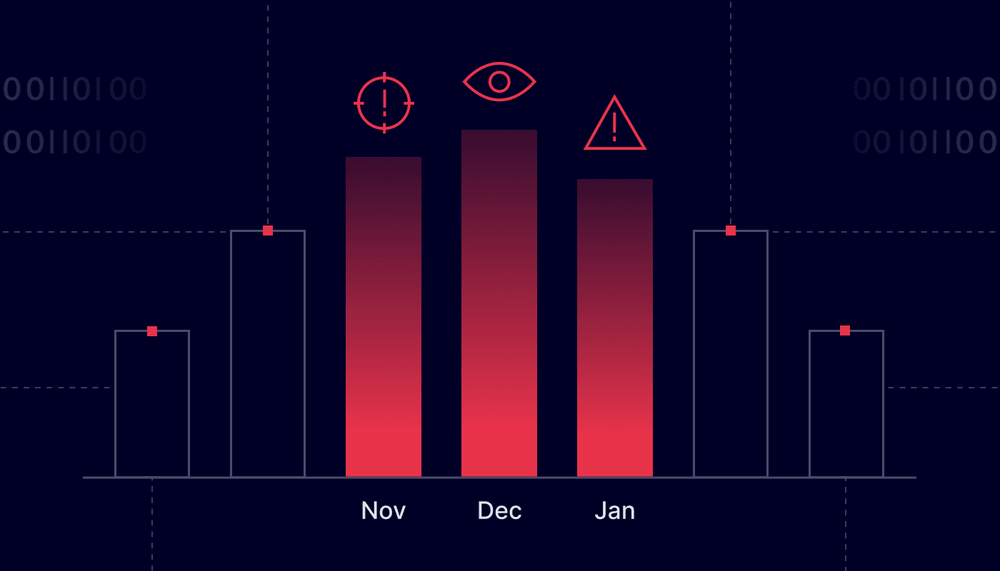
Our research shows that illicit posts peak in November, December, and January. The darkest months of the year also see the most activity in the web’s shadowy corners.

Why is winter the peak season for illicit posts?

We studied posts from June 2023 to October 2024. We categorized posts by topics and focused on illicit ones. Here’s how those posts were distributed:

These numbers reflect posts on the dark web, not actual attacks. However, research by BitNinja Security, Cloud Security Alliance, and Mimecast shows that Q4 is also when most cyber-attacks take place. This suggests a link between increased dark web activity and real-world cybercrime during this period.

Why are threat actors more active in dark months, both discussing illicit topics and committing crimes?

Carlos Salas (Sr. R&D Engineer at NordLayer): “In most industries, November to January is the busiest time, mainly because of the high amount of transactions from Thanksgiving, Black Friday, and Christmas. Criminals exploit this, knowing people are more likely to click on a phishing link while going through thousands of email orders and offers, compromising their network security.”

It’s a known issue. Black Friday is already called Black Fraud Day. In the UK only, more than 16,000 reports of online shopping fraud were recorded between November 2023 and January 2024, with each victim losing £695 on average.

Andrius Buinovskis (Head of Product at NordLayer): “Everyone is looking for gifts and the best prices, and fake ads try to hook you into deals. Bad actors exploit this season, using urgency tactics boosted by AI to spread threats. People are more relaxed and less cautious, paying less attention to how they use personal and company devices. Employees might receive phishing emails like a supposed ‘yearly bonus’ from the CEO, which could lead to catastrophic consequences for the company.”

But on dark web forums, people discuss not only cybercrime. A big part of forums is about sharing pirated software and media, like movies.

This number grows in dark months. Comparing the summer months of 2023 with November—January, the number of dark forum posts about all kinds of pirated content surged by 105%.

Vakaris Noreika (Head of Product at NordStellar): “I think it’s the weather, to be honest. People tend to stay at home more and sit at their computers bored, which makes them more active in their cybercriminal activities. We’ve seen a similar effect during the COVID lockdown when the number of dark web users increased a lot. We also see fewer large data breaches in the summer, and this cycle seems to repeat every year.”

Like advanced persistent threats, “advanced persistent teenagers” are now a problem. Bored but skilled threat actors cause major disruptions. They trick employees with emails and calls, posing as help desk staff. These attacks lead to data breaches affecting millions. Teenagers now show techniques once limited to nation-states.

Another factor is adding to the boredom of dark web forum users. They are mostly from countries where winter is pretty harsh. Most users accessing Tor—the browser used for dark web activities—are from Germany (36%), the US (14%), and Finland (4%). For countries where users access Tor via bridges, the top is Russia (41%). Maybe dark web forums are just the coziest winter hangouts.

Changing platforms and AI effects on cybercrime

Our research shows that September and October of 2024 had much fewer posts about illicit things on dark web forums than a year before. Why is that?

Vakaris Noreika: “There could be many reasons why this happens. The most notable ones are maybe the platform changes; some hacker forums close, others open up, some become popular to fade out later.

There are some hacker communities, especially from Russia, which have been active for more than 20 years now. This is because the forum owners don’t get arrested, unlike forum owners from the US, UK, etc., who do get arrested way more often.

Telegram has also been a huge platform change. We’ve seen exponential growth in hacking-related activity on Telegram since the beginning of the war in Ukraine. But Telegram activity is focused on niche topics, while forums cover a wider range of ideas.”

Another trend affecting dark web discussions could be AI use in cybercrime.

Retail and cloud computing giant Amazon, which can now view activity on around 25% of all IP addresses on the internet, says it is seeing hundreds of millions more possible cyber threats across the web each day compared to earlier this year. They used to see about 100 million hits per day, but that number has grown to 750 million over six or seven months.

Amazon’s Chief Information Security Officer is sure AI is making tasks easier for ordinary people, allowing them to do things they couldn’t do before just by asking the computer. This might explain fewer discussions on dark web forums—why ask others when AI can do the work for you?

How to protect organizations during peak cybercrime seasons

So, winter months bring not only holidays but also heightened cyber risks. Instead of enjoying time with your family, you might find yourself dealing with cyber-attacks.

But don’t worry—there are steps you can take to protect your organization. The good news is these measures aren’t expensive or hard to implement.

Many of these precautions are the same as those needed year-round. Basic cybersecurity practices like employee training, strong passwords, and regular software updates are essential.

Employee education is the first line of defense.

Vakaris Noreika: “It’s hard to control what happens with your employees. It’s unavoidable that their data will be leaked online, and this data might be used to attack your company. Here’s what I always encourage companies to do:

  1. Educate employees about phishing, credential stuffing, and other popular attack methods.
  2. Take care of the information that’s already leaked: monitor it and react. NordStellar can help with that.
  3. Manage access to important company resources carefully.

By doing this, you will be better off than 99% of companies around.”

Prepare now to minimize risks during the peak cyber-attack season.

Carlos Salas:Double down on cybersecurity awareness in months before the high season. Consider having a pentest done beforehand to know what could be exploited by criminals.

That said, we’re humans, and there will always be a chance of clicking the wrong link or sharing the wrong files. So, practices such as network segmentation, setting up security policies for devices, or using toolsets such as Data Loss Prevention suites and malware protection are a must-have. They help contain the threats and minimize the ‘blast radius’ of any security incident.”

With AI making cyber-attacks easier, it’s crucial to think about these things right now, when the cyber-attack season is at its peak. The next year could bring even more advanced threats.

So, give your company a Christmas present and invest in a solid cybersecurity solution.

Methodology

NordStellar acquired data from over 80 forums where illicit activities are most often discussed. These forums span different web layers: the clear web, the deep web, and the dark web. We gathered textual content from forum threads between June 2023 and October 2024. The numbers we obtained represent the number of forum posts.

We used a fine-tuned AI model to categorize dark web posts into 67 tags. These tags were then grouped into 10 broader categories. For example, the tag “SERVICE” refers to posts where users offer services for a fee, including hacking or hiring hitmen. This tag falls under “Illicit services and marketplaces.” 

The study is thorough but has limitations from analyzing posts on approximately 80 forums only. Additionally, the shorter lifecycle of criminal sites and the rapid rise of mirror sites can affect data consistency and completeness.

About NordLayer
NordLayer is an adaptive network access security solution for modern businesses – from the world’s most trusted cybersecurity brand, Nord Security.

The web has become a chaotic space where safety and trust have been compromised by cybercrime and data protection issues. Therefore, our team has a global mission to shape a more trusted and peaceful online future for people everywhere.

About Version 2 Digital

Version 2 Digital is one of the most dynamic IT companies in Asia. The company distributes a wide range of IT products across various areas including cyber security, cloud, data protection, end points, infrastructures, system monitoring, storage, networking, business productivity and communication products.

Through an extensive network of channels, point of sales, resellers, and partnership companies, Version 2 offers quality products and services which are highly acclaimed in the market. Its customers cover a wide spectrum which include Global 1000 enterprises, regional listed companies, different vertical industries, public utilities, Government, a vast number of successful SMEs, and consumers in various Asian cities.

The role of machine learning in cybersecurity

So, does that mean IT teams will become redundant soon, as AI-based security tools can do it all? Simply put, no. But for a more in-depth answer, we’ll need to first understand what machine learning in cybersecurity is and what this technology holds for businesses in the future.

What is machine learning?

Machine learning refers to the ability of algorithms to learn patterns from existing data and use this knowledge to predict outcomes on new, previously unknown data without explicitly being programmed. The more information you feed to the machine learning engine, the more data it can analyze and, consequently, become more accurate.

But what does it mean to say that a machine is learning from the existing data? While traditional programming performs simple and predictable tasks by strictly following detailed instructions, machine learning allows the computer to teach itself through experience. In other words, it mimics human behavior in how to solve problems.

However, the fact that machine learning can improve itself isn’t the only reason why it’s so easy to find its models in the online wilderness. The sheer amount of information that businesses in different industries currently have to manage has become too vast for humans to tackle alone. As a result, companies rely on machine learning to process that data and quickly generate actionable insights.

For instance, an ML technique called a decision tree solves classification dilemmas and uses certain conditions or rules in the decision-making process. This particular technique is widely used in fintech (for loan approval and credit scoring) and marketing.

Machine learning solutions are also helpful for businesses in harvesting, organizing, and analyzing large volumes of customer data. This can include purchasing history or individual customer’s typical behavior, such as online browsing habits. With such analyzed data, companies can then recommend relevant products tailored to their customers’ preferences. Think Netflix: With an ML-driven model, it examines its users’ histories on the platform to compile appropriate content recommendations for them to choose from. This increases the time users spend watching Netflix content and their overall satisfaction. Similarly, ML models pick up information relevant to the unique user on the Facebook feed and even moderate content on Instagram.

Machine learning can also boost a company’s cybersecurity by detecting and responding to threats faster than human analysts. This has led to the term “machine learning security,” which, while still a bit niche, describes how ML is used for security tasks like spotting malware or unusual network activity. With its ability to handle massive amounts of data, machine learning has become a key tool for keeping systems safe.

In addition, in most customer support self-service tools, users usually interact with a machine rather than a fellow human being. Such chatbots can answer basic questions and guide a person to relevant content on the website.

Lastly, even in the medical field, machine learning plays a huge role. These models can be trained to examine medical images or other information and then search for illness characteristics.

The importance of data quality in machine learning security

To get the most out of machine learning, you need to give it high-quality data. Think of it this way: ML can only analyze and learn from what you put into it, so if the data’s flawed, the insights will be too. This is especially critical for companies using ML to support decision making. Without quality data, ML models may lead to misguided decisions.

Alongside accuracy, machine learning security is also a vital part of data quality. Sensitive information should be prepared and protected before feeding it into ML models. Some ML platforms, while powerful, have vulnerabilities that could expose data if not managed carefully. In short, quality data should be both precise and secure.

Four types of machine learning

Machine learning traditionally has four broad subcategories that are defined by how the machine learns:

  • Supervised machine learning models rely heavily on “teachers”, meaning models that are trained with labeled data sets, which allow them to learn and become more accurate over time. For instance, if you want to teach the algorithm to identify cats, you’ll have to feed it with pictures of cats and other things, all labeled by humans.

  • Unsupervised machine learning looks for patterns and common elements in data. In turn, such machine learning can find similarities and trends that humans aren’t explicitly looking for.

  • Semi-supervised machine learning falls somewhere between supervised and unsupervised learning. In this case, the model is trained on a small amount of labeled data and lots of unlabeled data. Such a way of learning is beneficial when there’s a lot of unlabeled data, and it’s too difficult (or expensive) to label it all.

  • Reinforcement machine learning is where an algorithm learns new tasks by interacting with a dynamic environment. Here, it is rewarded for correct actions, which it strives to maximize, and punished for incorrect ones. Such machine learning is widely used in cybersecurity, as it enables a broader range of cyber attack detection.


Machine learning use cases in cybersecurity

As cybersecurity is a truly fast-paced environment where threats, technologies, and regulations constantly evolve, it’s the agility of machine learning that comes in handy.

ML-powered models can process massive amounts of data and, therefore, rapidly detect critical incidents. This means that machine learning enables organizations to detect various types of threats like malware, policy violations, or insider threats by constantly monitoring the network for anomalies. It is so because ML-driven algorithms learn to identify, for instance, new malicious files or activity based on the attributes and behaviors of previously detected malware.

In addition, using machine learning proves to be a good method for filtering your company’s inbox from unsolicited, unwanted, and virus-infected spam emails, which may contain pernicious attachments such as malware or ransomware. For instance, the machine learning model used by Gmail not only sifts through spam but also generates new rules based on what it has learned in the past. ML methods, coupled with natural language processing techniques, can also detect phishing domains by picking on phishing domain characteristics and features that distinguish legitimate domains.

Last but not least, machine learning can significantly support online fraud detection and prevention. By using ML algorithms, companies can identify suspicious activities in transactional data. These algorithms are trained to recognize normal payment processes and flag suspicious ones. Also, ML-driven engines can be trained to spot when cybercriminals change their tactics as they automatically will retrain themselves to recognize a new fraud pattern.

These examples illustrate just a few use cases of machine learning in cybersecurity. But there are many others, such as vulnerability management, that can greatly impact business cybersecurity.

So, is it AI, machine learning, or deep learning?

Frequently, these terms – artificial intelligence, machine learning, and deep learning (DP) – are used interchangeably. We already defined machine learning, so now, let’s see how it relates to artificial intelligence and deep learning.

Artificial intelligence, in the broadest sense, is a set of technologies that enable computers to perform various advanced tasks in a way similar to how humans solve problems. This makes machine learning a subfield of artificial intelligence.

In turn, deep learning is a subset of machine learning. It mimics the structure and functions of the human brain. Such systems use artificial neural networks that function like neurons in the brain. These neurons, also referred to as nodes, are used in chatbots or autonomous vehicles.

Difference between machine learning, artificial intelligence, deep learning, and cybersecurity

Even though machine learning brings some challenges when applied to cybersecurity (for instance, the difficulty in collecting large amounts of certain malware samples for the ML machine to learn from), it remains the most common approach and term used to describe AI applications in this industry.

In cases where shallow (or traditional machine learning) falls short, deep learning should be used. For example, when dealing with highly complex data such as images and unstructured text or when temporal dependencies have to be taken into account.


The future of machine learning in cybersecurity

In the current AI tool-filled climate, it’s easy to see how this technology can become better at specific tasks than we humans are. Luckily (or not), machine learning is not a panacea to all things cybersecurity. However, it provides and will continue to provide a great deal of support to cybersecurity or IT teams by reducing the load off of their shoulders.

Since many devices (like phones and laptops) connect to the company’s networks daily, it is almost impossible for IT teams to monitor every single gadget. With AI-powered device profiling, you can improve the fingerprinting of endpoint devices and better understand the type and quantity of endpoints connecting to your network. This will help you create effective segmentation rules and stop unwanted devices (potentially including bad actors) from connecting.

Also, employing machine learning can improve your cybersecurity game by helping your IT team develop policy recommendations for security devices such as firewalls. In this case, machine learning learns what devices are connected to the network and what constitutes normal device behavior. In turn, ML-powered systems can make specific suggestions automatically — instead of your team manually navigating different conflicting access control lists for each device and network segment.

And so, integrating artificial intelligence in security, particularly through machine learning, can significantly enhance how your cybersecurity framework adapts to the evolving IT landscape. With more devices and threats coming online daily, the human resources available to tackle them are becoming scarce. In such an environment, machine learning can step in by helping sort out various complicated cybersecurity situations and scenarios at scale while maintaining constant surveillance 24/7.

Challenges of Machine Learning in Cybersecurity

Just like in life, the things that bring us the most value come with their own set of challenges. After all, you can’t expect great results without putting in some effort. The same goes for using machine learning in cybersecurity. It can be incredibly powerful, but getting the most out of it requires navigating a few obstacles along the way. So, here are a few challenges you might face when applying ML to data security:

  • Adaptation to threats: Cyber threats are becoming increasingly intricate and complex, requiring ML models to undergo continuous retraining to identify new vulnerabilities effectively. This ongoing adaptation is essential to ensure that ML security systems remain capable of countering the latest tactics employed by hackers.

  • Adversarial attacks (ML poisoning): By manipulating input data or introducing deceptive data, attackers can compromise an ML model’s effectiveness, reducing system reliability and jeopardizing operations by making it more difficult to accurately identify malicious activity.

  • Operational issues: Integrating machine learning into an established cybersecurity framework isn’t always straightforward. There are a few challenges to consider, like the complexity of the implementation process, the risk of false positives that can add to analysts’ workloads, regulatory compliance requirements, and the limited availability of professionals skilled in both ML and cybersecurity.

How does NordPass use machine learning?

Machine learning offers a wide range of applications for businesses, from applying it to cybersecurity to simply enhancing customer satisfaction. With artificial intelligence still making headlines, we’re likely to see even more use cases in the future. However, machine learning in IT security will be one of the key areas that will continue to evolve.

NordPass is one of the companies that use machine learning. We do so to offer more accuracy and convenience for our customers. Our autofill engine relies heavily on machine learning to accurately categorize the field that it needs to fill in on a website or app – no matter if it is a sign-up, credit card, or personal information form. Remember those artificial neural networks? It has been trained using exactly those!

If you’re interested in improving your IT team‘s online experience and enhancing overall company security, explore what enterprise password management can offer for your company.

About NordPass
NordPass is developed by Nord Security, a company leading the global market of cybersecurity products.

The web has become a chaotic space where safety and trust have been compromised by cybercrime and data protection issues. Therefore, our team has a global mission to shape a more trusted and peaceful online future for people everywhere.

About Version 2 Digital

Version 2 Digital is one of the most dynamic IT companies in Asia. The company distributes a wide range of IT products across various areas including cyber security, cloud, data protection, end points, infrastructures, system monitoring, storage, networking, business productivity and communication products.

Through an extensive network of channels, point of sales, resellers, and partnership companies, Version 2 offers quality products and services which are highly acclaimed in the market. Its customers cover a wide spectrum which include Global 1000 enterprises, regional listed companies, different vertical industries, public utilities, Government, a vast number of successful SMEs, and consumers in various Asian cities.

How to choose the best DNS filtering solution for your business

Summary: Discover key factors for selecting a DNS filtering solution that enhances network security, boosts productivity, and ensures compliance for your business.

Now, businesses face many online threats that can jeopardize network security, reduce employee productivity, and compromise regulatory compliance. Domain Name System (DNS) filtering is a powerful tool for protecting against these threats by blocking access to harmful websites—those that may host malware, phishing attempts, or inappropriate content.

Beyond protecting your network, DNS filtering tools improve workplace productivity by limiting access to non-work-related websites. They also help ensure compliance by restricting access to certain types of content.

However, with many DNS filtering providers available, selecting the right one can be overwhelming. This guide will walk you through the key factors to consider when choosing the best DNS filtering solution for your organization.

How DNS filtering solutions work

DNS filtering is like a gatekeeper for internet usage, preventing access to malicious or inappropriate websites before they can harm your network. By intercepting DNS queries—requests users make when accessing a website—the filtering system determines whether the requested domain is safe based on predefined security policies.

Typically, DNS servers function like an internet “phonebook,” translating domain names into IP addresses to connect your browser and the required website.

With a DNS filtering solution in place, however, each query undergoes additional checks. If the requested site is flagged on a blocklist or is identified as a security risk, the DNS resolver blocks the request, preventing the page from loading and neutralizing potential cyber threats.

Benefits of implementing a DNS filtering solution

Deploying a DNS filtering solution offers a range of benefits that go beyond basic Internet browsing controls:

Internet threat prevention

Each organization should control employee online traffic. By blocking access to sketchy sites full of malware, phishing, or ransomware, DNS filtering solutions shield your network from all kinds of cyber-attacks before they even have a chance to strike.

Keeping productivity on point

Let’s face it—distractions are everywhere. DNS filtering tools help minimize those distractions by blocking non-work-related sites so your team can stay focused and get more done.

Improved network performance

No more bandwidth hogs. A DNS filtering solution ensures your network runs smoothly and efficiently by limiting heavy streaming or large file downloads.

Security compliance

Worried about regulations? DNS filtering helps you meet industry standards by controlling access to restricted content and protecting your business from potential legal and reputational risks.

Keeping remote workers safe

With more people working remotely, DNS filtering solutions block online threats and secure sensitive data, no matter where your employees log in.

Filtering for safer Internet access

Whether it’s a school, home, or workplace, DNS filtering blocks inappropriate or harmful content, creating web filtering for schools or employees.


5 considerations for choosing the best DNS filtering solution

When it comes to selecting a DNS filtering provider, it’s essential to weigh your options carefully. With so many choices out there, understanding the key factors can help you find the right fit for your organization. Here are some critical considerations to keep in mind:

#1 Technical architecture

The backbone of a solid DNS filtering solution is its technical architecture. You’ve got two main options: cloud-based or on-premise. Cloud-based solutions are super scalable. They make it easier to grow with your business’s security needs. They are also easier to deploy, need less maintenance, and usually come with real-time updates.

On-premise solutions give you more control over your data. This can be a big help if you have strict privacy rules. However, they might require higher initial costs, more time, and greater expertise to maintain.

Another thing to keep in mind is DNS resolution speed—how fast it can process requests and load websites. A provider with a global network will keep things running smoothly with less lag when accessing sites.

#2 Advanced threat detection

In today’s world, you need more than just the basics. Look for a DNS filtering solution that’s equipped with advanced threat detection. Such a solution must monitor network activity in real-time, spotting and blocking threats like malware and phishing before they can mess with your network. As cyber threats keep evolving, having a tool that adapts is a must.

#3 Integration with existing systems

Whatever DNS filtering solution you pick should be compatible with your current system. Make sure it works well with your existing security infrastructure, like your firewall or Security Information and Event Management (SIEM) tools. Some providers even offer API access for easy integration with third-party tools or custom solutions. A smooth integration means less hassle for your IT team and a more seamless security experience.

#4 Granular policy management

DNS filtering is designed to restrict access to specific content, but when it comes to defining exclusive rules for network access, we enter a different technological area. Therefore, when selecting DNS filtering solutions, it’s best to look for comprehensive products beyond content restriction and address network access use cases.

Fine-tuning access with your DND filtering solution helps boost productivity and security, keeping everyone where they need to be.

#5 Real-time analytics and reporting

Keeping tabs on what’s happening in your network is essential. Make sure your DNS filtering provider offers real-time analytics and reporting so you can spot potential threats, check network activity, and stay compliant. Detailed DNS query logs and custom reports are especially useful for digging into incidents or proving you’re following industry regulations.

Tips for selecting the best DNS filtering solution

  • Check out content control features: Look for customizable filtering options that let you block malware, phishing attempts, adult content, gambling sites, and more. Keeping distractions and risks at bay is key for productivity and compliance.
  • Make sure it has solid security features: Don’t settle for basic protection. Your DNS filtering solution has strong encryption, advanced threat detection, and malware protection. These features add extra layers of security, especially when your data is in transit.
  • Go for user-friendly setup and centralized management: Setting up DNS filtering shouldn’t be a headache. Look for something simple to install with centralized management so your IT team can control everything from one spot, enforce policies, and quickly handle any issues.
  • Look for customization options: Every business is different, so you’ll want a solution that lets you fine-tune filtering rules to fit your specific needs. Flexibility is key to keeping security tight without slowing down business activities.

Conclusion

Choosing a DNS filtering solution for your business is critical. It impacts everything from your cybersecurity to productivity and compliance. Take the time to evaluate things like the technical architecture, how the provider handles threats, and how well the solution integrates with your current systems. Opt for providers that offer robust security, real-time reporting, and detailed control over access to make sure you’re getting the best DNS filtering solution possible.

With the right DNS filtering in place, you can protect your network, control online interactions, and create a safer, more productive work environment for your team.

How NordLayer can help

NordLayer offers easy-to-use DNS filtering capabilities to protect your network. With features like DNS filtering by category, Web Protection, and Download Protection, keeping your team safe is simple. Setup is quick, even for non-tech users, and managing security for your whole team is straightforward.

  • DNS filtering by category allows IT admins to block content from over 50 categories. This helps keep your network secure and your team focused.
  • Web Protection automatically blocks access to websites that are flagged as potentially malicious.
  • Download Protection scans every new file download and removes harmful files before they can infect your devices.

These features can work together to prevent risks like malware infections and phishing. But that’s not all. All NordLayer customers get encrypted connections and masked IP addresses. This ensures your internet access is secure, no matter where you are.

Want to learn more? Contact NordLayer’s sales team to see how we can help protect your network.


About NordLayer
NordLayer is an adaptive network access security solution for modern businesses – from the world’s most trusted cybersecurity brand, Nord Security.

The web has become a chaotic space where safety and trust have been compromised by cybercrime and data protection issues. Therefore, our team has a global mission to shape a more trusted and peaceful online future for people everywhere.

About Version 2 Digital

Version 2 Digital is one of the most dynamic IT companies in Asia. The company distributes a wide range of IT products across various areas including cyber security, cloud, data protection, end points, infrastructures, system monitoring, storage, networking, business productivity and communication products.

Through an extensive network of channels, point of sales, resellers, and partnership companies, Version 2 offers quality products and services which are highly acclaimed in the market. Its customers cover a wide spectrum which include Global 1000 enterprises, regional listed companies, different vertical industries, public utilities, Government, a vast number of successful SMEs, and consumers in various Asian cities.

How to reset or change your Epic Games password


How to reset your Epic Games password

Forgot your Epic Games password and got locked out of your account? No problem! There’s an easy way to reset the password and regain access. Here’s what you need to do:

  1. Head to the login page on the Epic Games Store website or app.

  2. Click on “Forgot password?”

  3. Enter the email tied to your account to get a security code.

  4. Check your email for the code, then enter it on the site.

  5. Set up a new password that meets Epic Games’ security requirements, and click “Reset Password.”

  6. Use the new password to sign in again.


How to change your Epic Games password

If you suspect that your Epic Games password isn’t strong enough or simply want to change it (as recommended every 6 months to ensure account security), you can quickly do so by following a few steps on the Epic Games Store platform. Here’s how:

  1. Log in to your Epic Games account.

  2. Go to the “Account Info” page and find the “Password and Security” section.

  3. Enter your current password in the “Current Password” field.

  4. Create a new password, then confirm it by retyping it in the second box.

  5. Click “Save Changes.”


Best practices for creating a strong password

As mentioned earlier, a good habit is to change your passwords every 6 months, even if they’re strong. Why? Because regular updates make it harder for attackers to break in and access your accounts. So, if it’s been a while since you last updated your Epic Games password, now’s a great time to do it.

When creating a strong new password for Epic Games—or any other account—aim for at least 16 characters, mixing uppercase and lowercase letters, numbers, and symbols. Avoid using anything familiar, like phrases or personal information. The more random it is, the better.

And if creating and remembering such secure passwords sounds challenging, NordPass can help. It can generate strong passwords for you on the spot and store them securely in an encrypted vault that only you can access. With NordPass, you can log in quickly and securely to your Epic Games account without sacrificing security. Try it and see the difference it will bring to your online experience.


Frequently asked questions


What are the Epic Games password requirements?

Epic Games keeps its password requirements fairly simple: your password only needs to be at least 8 characters long, with at least one number and one letter, and no spaces. To better secure your account, though, we recommend that you go for a 16-character password that includes numbers, symbols, and a mix of uppercase and lowercase letters, all arranged randomly.


How often should I change my Epic Games password for security purposes?

It’s a good idea to change your Epic Games Store password, just like any other password, every 6 months to keep things secure. This makes it much harder for hackers to break in. And if creating complex passwords feels like a hassle, tools like NordPass’ Password Generator can handle it for you instantly.


How do I enable two-factor authentication (2FA) to protect my Epic Games account?

To set up two-factor authentication on your Epic Games account, all you need to do is just log in, go to the “Password & Security” section, and pick your 2FA method—an authenticator app, SMS, or email. This adds an extra layer of security by requiring a code from your chosen method each time you log in.


What should I do if someone else has changed my Epic Games password without my permission?

If you think or know for sure that someone has changed your Epic Games password without your consent, act quickly and follow these 3 steps to secure your account:

  1. Reset your password using the Epic Games password reset page or the account recovery page.

  2. Set a strong password for the email address linked to your Epic Games account.

  3. Enable 2FA on your Epic Games account to add an extra layer of security.

About NordPass
NordPass is developed by Nord Security, a company leading the global market of cybersecurity products.

The web has become a chaotic space where safety and trust have been compromised by cybercrime and data protection issues. Therefore, our team has a global mission to shape a more trusted and peaceful online future for people everywhere.

About Version 2 Digital

Version 2 Digital is one of the most dynamic IT companies in Asia. The company distributes a wide range of IT products across various areas including cyber security, cloud, data protection, end points, infrastructures, system monitoring, storage, networking, business productivity and communication products.

Through an extensive network of channels, point of sales, resellers, and partnership companies, Version 2 offers quality products and services which are highly acclaimed in the market. Its customers cover a wide spectrum which include Global 1000 enterprises, regional listed companies, different vertical industries, public utilities, Government, a vast number of successful SMEs, and consumers in various Asian cities.

AIOps: Boosting IT operations with machine learning

The rise of artificial intelligence and big data has paved the way for a new approach to IT operations: AIOps (artificial intelligence in IT operations). By using machine learning, AIOps enables increased automation, deeper insights, and most importantly for NordVPN—less downtime.

What is AIOps?

The global scope of NordVPN generates an avalanche of variable data that affects our user experience. With such a huge volume, our data analytics team is always on the lookout for ways to automate incident response protocols. These protocols involve diagnosing issues, resolving them, and then performing root cause analysis to avoid them happening again.

An AIOps model processes data points from all kinds of systems and processes – syslog, SNMP, configuration changes – and looks for specific issues they’ve been trained on. It then automatically feeds back intelligence, diagnostics, and recommended actions to our IT team, enhancing accuracy and reliability in their operations.

Let’s look at the various approaches to incident response (IR) management.

IR maintenance protocols overview

Most incident management steps are performed by system administrators, site reliability engineers, and similar personnel, depending on the issue. Alerting is usually based on simple rules (“if X increases, Y will decrease and we should alert Z”) when in reality the relationships between hundreds of parameters and dimensions in our system are anything but simple. We’re typically reacting to results rather than accurately predicting things because so many situations are not perceptibly related or logically connected.

IR maintenance protocols can be broadly divided into two main groups, reactive (reacting after an incident occurs) and proactive (acting before the incident occurs). To be precise, let’s drill down into these main groups’ more specific subcategories.

Reactive

  • Palliative: Fix the issue and assume it won’t occur again. No further actions taken.

  • Curative: Fix the issue, assume it won’t occur again, but perform root cause analysis to be sure.

Proactive

  • Planned: Intentionally break our own systems to identify and fix potential issues.

  • Conditional: Select a threshold (usually on a parameter value) that might cause an issue. Once the threshold is reached, we send an alert and prevent the problem.

Predictive and prescriptive categories are the most efficient IR protocols, but this comes at a cost: they’re also the most difficult to implement. With AIOps, however, they become more viable.

  • Predictive: Utilize machine learning or big data analysis to predict and fix a potential issue before it occurs.

  • Prescriptive: The ‘holy grail’ of AIOps. The system does everything automatically.

Now that we have an overview of IR protocols, we can explore how AIOps can enhance each phase, from perception to action.

The spectrum from reactive to proactive maintenance protocols. AIOps is about being as proactive as possible.

How AIOps can improve our incident response

  1. Perception: With AIOps, we’re not limited to one layer of data as with most standard IT maintenance protocols. Instead, all data layers and telemetry are simultaneously integrated – technical (servers, RAM), application (events), functional (network traffic, API endpoint results), and business (product metrics, KPIs). A comprehensive approach like this, which leverages real-time as well as historical data, is risky but offers significant upside potential.

    Why the risk? With machine learning, it’s difficult to evaluate whether the model has properly calculated the relationships between data across layers. We can lose transparency during decision-making, and some decisions might seem illogical from a human perspective. This is important to keep in mind when using AIOps.

  2. Prevention: The ideal AIOps stack spots vulnerabilities and potential failures before they occur. For example, if a server is reaching a critical CPU limit, the platform automatically directs the API to stop recommending that server to newly joining users. New users are spared a sluggish connection while those already connected don’t experience any downtime. While load balancing is a common strategy, AIOps can elevate the process and adapt to long-term trends like seasonal fluctuations, dynamically adjusting server limits to ensure a smooth user experience.

  3. Detection: AIOps models excel at spotting anomalies in established trends and patterns. Anomalies can pop up from anywhere and are often caused by external factors or faulty monitoring, which can be detected by an AIOps system hooked up to outside data feeds and APIs. Automatically detecting system slowdowns, errors, and security vulnerabilities enables us to avoid downtime and ensure a stable service for our customers.

  4. Location: In-depth analysis of the root cause and location of the issue. AIOps will point out a specific set of components and variables that might have triggered an incident. Again, this will not be limited to internal factors only, but also consider external factors (e.g. network conditions, number of users and their behavior, and similar).

  5. Interaction: Prioritizes and triages incidents, suggests corrective actions, and flags issues that require human input. Our team prioritizes issues based on the number of users that would be affected or at risk if a certain fault is not prevented. Additionally, AIOps can utilize prepared responses to specific situations based on historical data and incident resolution patterns.

Okay, this all sounds great! So why haven’t we done this yet?

AIOps implementation checklist

  1. Need: First off, evaluate whether you actually need to leverage AIOps. If your operations team is typically facing more incidents than they can comfortably handle, it might be time to change. In our case at NordVPN, with an ever-expanding customer base, server requirements, area coverage, and platform offering, AIOps was a necessary optimization.

  2. Team: An effective AIOps team requires a diverse set of roles, including data engineers and scientists to build and refine the AI models, and data analysts to extract useful insights. Engineering across DevOps, site reliability, and full stack ensures seamless integration, process automation, and system performance/scaling. Security specialists and project managers oversee the security and overall workflow of the project.

  3. Hardware: Appropriate processing power, a decent amount of storage, and high-speed networking capability.

  4. Software: Big data platforms (detailed below), ETL tooling, selected ML and AI tools, CI/CD tools, containerization platforms (Docker/Kubernetes), and monitoring tools.

  5. Data: The data management platform generally has to be built from the ground up and include all relevant ingest data, such as event logs, traces, incident reports, etc.

    Building a platform for that kind of scale is a huge job. There are third-party AIOps platforms out there, but they still require a major effort to align with your specific needs and often necessitate a data lake to centralize your data. You’ll also need the appropriate APIs.

  6. Trust: It takes a mindset shift in your team or company to trust models over humans to diagnose incidents correctly. Don’t pass over this one—it’s key to successfully adopting new IT approaches like AIOps. You could start by gradually incorporating models in low-risk scenarios or incident patterns. Your team can experience the advantages of AIOps firsthand, which will build confidence and trust in this new approach.

  7. Quality data: So important that we have to say it twice. Anything we want to achieve with data science or artificial intelligence relies on a strong data foundation. I’ll explore this topic in greater detail in my next blog, so follow us on LinkedIn or Instagram to be notified when it’s out.

To wrap up, we’ve found that a well-implemented AIOps system is an efficient way of bringing excellent service to customers. Equipped with deeper insights and increased automation, our IT team was able to shift focus to priority incidents and innovation with AIOps.

Explore data roles at Nord Security.

About NordLayer
NordLayer is an adaptive network access security solution for modern businesses – from the world’s most trusted cybersecurity brand, Nord Security.

The web has become a chaotic space where safety and trust have been compromised by cybercrime and data protection issues. Therefore, our team has a global mission to shape a more trusted and peaceful online future for people everywhere.

About Version 2 Digital

Version 2 Digital is one of the most dynamic IT companies in Asia. The company distributes a wide range of IT products across various areas including cyber security, cloud, data protection, end points, infrastructures, system monitoring, storage, networking, business productivity and communication products.

Through an extensive network of channels, point of sales, resellers, and partnership companies, Version 2 offers quality products and services which are highly acclaimed in the market. Its customers cover a wide spectrum which include Global 1000 enterprises, regional listed companies, different vertical industries, public utilities, Government, a vast number of successful SMEs, and consumers in various Asian cities.

×

Hello!

Click one of our contacts below to chat on WhatsApp

×