Skip to content

Zero Trust: What Is It and How to Implement

Due to the surge of ransomware attacks, the increased risks for data loss, and the continuous adverse effects cybercrime poses, many organizations have adopted the zero-trust principle to harden the security of their systems, thereby increasing their cyber resiliency.

Cyberattacks have become so ubiquitous that the Biden White House issued a statement urging American business leaders to strengthen their organization’s cybersecurity measures.

As it stands, GlobeNewswire reported that zero trust security is expected to reach a market value of $29 million USD by the end of 2022 and increase to US $118.7 billion by 2032. This significant growth in the coming decade comes from the value zero trust brings companies.


The simple fact is that business leaders are following its principles, like consistent monitoring and validation, because these principles help prevent data breaches and mitigate data loss.

This post will dive into what the zero principle is, as well as its capacity to tighten workplace data and security, effectively ushering in what Microsoft calls:

A new security model that more effectively adapts to the complexity of the modern environment, embraces the hybrid workplace, and protects people, devices, apps, and data wherever they’re located.

What are the cybercrime trends that zero trust can help curb?

One trend that’s risen in recent years is ransomware. Ransomware cripples businesses by locking their computer systems until a sum of money is paid. These attacks are expected to have a price tag of $265 billion USD annually by 2031, according to Cybersecurity Ventures.

With how easy it has become for ransomware gangs to deploy ransomware on a multinational scale, businesses need to deploy enhanced cybersecurity solutions to lessen system vulnerabilities, because “when it comes to ransomware attacks, it’s a matter of when, not if.” Read more from the Keepit blog article on how to prepare for ransomware.

It should come as no surprise that ransomware attacks can result in operational downtime. A Statista report stated that the average length of interruption after ransomware attacks is 20 days.


Even minor disruptions can decrease employee productivity, impede communications with clients—among other issues such as the significant fines Marriott faced—and impact business continuity. One might struggle to fully comprehend the serious implications that 20 days of downtime would have for businesses.

Zero trust, in a nutshell, is guided by the principle of ‘never trust, always verify.’

Why Zero Trust?

Zero trust, in a nutshell, is guided by the principle of “never trust, always verify.” It’s a modern security architecture which assumes that internal and external threats exist on the network at all times due to the pervasiveness of cybercrime. And as such, it requires all network users to undergo verification and validation processes before they can access the network resources.

Is zero trust really needed?

Generally, employees within a company access multiple networks simultaneously. There are many, many data exchanges between multiple user devices, across potentially numerous networks – of course, depending on the complexity of a company’s IT infrastructure.


This architecture boosts productivity through increased collaboration. However, this can come with a hidden risk when not following the zero-trust security model.

Zero trust use cases

What might that risk look like? Let’s suppose that one employee working on a single device is validated as “trusted.” But that device has become infected with malware by the user opening a dangerous email. (Learn how to identify a dangerous email.)

Since this user’s device was previously validated and is now assumed harmless, it still has access to all the users and networks as before being infected without having to provide or verify any credentials.

The result is unrestricted access to spread malware from this “trusted” device to other users within the network and to other devices within overlapping networks, allowing the malicious actor to expand their reach and damage, gaining access to more and more of a company’s business-critical data.

This example is the main reason zero trust architecture rejects assuming any device is safe. Rather, the system reduces risks through continuous authentication, thereby enhancing protection for your company’s network system by always verifying and authenticating. According to TechTarget:

This protects your organization in ways other models can’t. It stops malware from entering your network; gives remote workers more protection without affecting productivity; simplifies management of security operations centers with enhanced automation; and extends visibility into potential threats to improve proactive remediation and response.

TechTarget

How to Adopt Zero Trust  

According to a Microsoft zero trust business plan, “digital transformation forces re-examination of traditional security models.” And as such, there are many companies offering guidance. Microsoft alone has helped aid zero trust deployments in thousands of organizations with insightful (and practical) guides on how to adopt a zero-trust business plan.

Global cybersecurity leader Palo Alto Networks shares that there are three crucial steps you need to follow to deploy zero trust architecture in your business:

  1. Define your protected surface: Zero trust architecture can be costly and complicated. As such, identify your protected surface—including components like company applications and assets— rather than focusing on a large network area.

    If your business utilizes Microsoft 365, then you’ll know that documents, email, SharePoint data, and Teams chat must be secured against cyberattacks. Attackers can breach an account with access to the data or hijack your system admin, making it imperative to find a SaaS data backup solution that can maintain multiple backup copies with the needed granularity of data and metadata.

  2. Map your data flow: Plan your business’ flow of instructions and data as this will provide you with information on overlapping networks.

    For instance, where and in which formats is the data stored? If your employees utilize digital, desktop, mobile, or cloud, identify them so you can see how data is moved and shared.

  3. Design your architecture: Essentially, the network architecture should prevent unauthorized access to individuals who aren’t part of your company.

    This is especially relevant if you want to encrypt data before it moves to cloud storage devices. If you want to back up your company’s Microsoft 365 data, for instance, we offer blockchain-based encryption technology that guarantees your backups will remain immutable to ransomware threats and data loss. At Keepit, we also offer comprehensive coverage for M365 applications such as SharePoint, OneDrive, Groups and Teams, and Exchange Online.

Of course, implementation isn’t as simple as one, two, three: It involves a massive undertaking and a focused effort to implement and maintain. There are many, many other variables and considerations.


For instance, you can also adopt multi-factor authentication (MFA) and ensure use of updated devices.

  • MFA is especially relevant for companies who have stored their digital information on cloud computing systems. With MFA, you can prevent unauthorized users from accessing your organization’s resources.
  •  Similarly, encourage your workforce to update their devices with the latest firmware as this typically offers security patches for known vulnerabilities.

Continuously monitor your network and device attributes. Adopting zero trust architecture can prove futile if your workers do not audit and maintain a log for monitoring network traffic.

Do I still need to get backup for my SaaS data?

Ultimately, zero trust makes it much more difficult for external threats to gain access to an organization’s business-critical data – but not impossible. It also does not protect you against internal threats nor from human errors such as accidental overwrites and accidental deletions.

Data protection best practices tell us to always have a backup. That is a fundamental responsibility for you, the data creator and customer of a SaaS service like Microsoft 365, due to the well-documented yet often misunderstood shared responsibility model.  Securing an independent backup is still the best way to ensure 24/7 availability to your data.

With the offerings from specialized third-party backup and data management providers, peace of mind can be had quickly and from a cost-effective service. This is why Keepit was created: Your data, here today, here tomorrow.

Want backup now?

Learn more about Keepit’s SaaS data backup service offerings here.

If you’d like to explore more about backing up a particular SaaS workload like Microsoft 365, find the relevant Keepit blog posts below, as Keepit offers a suite of cloud SaaS data protection services:

  • Read our blog about why you need to back up M365
  • If you’re using Salesforce, read that blog article here
  • Why back up Active Directory (Azure) here
  • And for Google Workspace
  • Finally, read why to back up Zendesk here

About Version 2 Digital

Version 2 Digital is one of the most dynamic IT companies in Asia. The company distributes a wide range of IT products across various areas including cyber security, cloud, data protection, end points, infrastructures, system monitoring, storage, networking, business productivity and communication products.

Through an extensive network of channels, point of sales, resellers, and partnership companies, Version 2 offers quality products and services which are highly acclaimed in the market. Its customers cover a wide spectrum which include Global 1000 enterprises, regional listed companies, different vertical industries, public utilities, Government, a vast number of successful SMEs, and consumers in various Asian cities.

About Keepit
At Keepit, we believe in a digital future where all software is delivered as a service. Keepit’s mission is to protect data in the cloud Keepit is a software company specializing in Cloud-to-Cloud data backup and recovery. Deriving from +20 year experience in building best-in-class data protection and hosting services, Keepit is pioneering the way to secure and protect cloud data at scale.

Building an Incident Response Plan for Ransomware

Ransomware is considered one of the biggest threats to business in 2022. In this type of cyberattack, hackers block their victims’ computers and charge a ransom to unlock them.

You may be wondering: what are the basic steps of an Incident Response Plan for ransomware or what an Incident Response Plan should include? So we prepared this article.

Here are the aspects a proper response to a ransomware attack should include:

  • Risk Assessment
  • Identification of a Ransomware Attack
  • Defining the Scope of the Attack
  • Isolation of Affected Systems Elimination of Malicious Software Disclosure of the Attack Environment Recovery Incident Recovery Plan Application of Lessons Learned
Keep reading this article and learn all about it!

Basic Steps of an Incident Response Plan An Incident Response Plan involving ransomware shall cover the following steps:

Risk Assessment The first step for those who want to design an Incident Response Plan involving ransomware is to assess the risks and threats faced by the company. In this step, you should understand which types of ransomware your company is most vulnerable to and which assets and data would be most impacted. In addition, it is important to know how and to what extent your organization would be affected by a ransomware attack.

Identification of a Ransomware Attack When implementing an Incident Response Plan for ransomware, it is possible to identify an attack, taking into account there are many types of malware similar to ransomware, and the main signs of the latter are encryption and file blocking.

Defining the Scope of the Attack In an Incident Response Plan for ransomware, defining the scope of the attack is equivalent to measuring how much data and systems were affected by it. That is when you will know if the attack affected a single server, or if all your files kept in the data center or the cloud were impacted as well.

Isolation of Affected Systems The next step is to stop ransomware activities by isolating the affected systems in order to contain the attack and immediately putting the affected systems and networks offline. If this is not possible, disconnect the compromised devices or remove them from Wi-Fi to prevent ransomware infection from spreading.

Elimination of Malicious Software After containing the attack and isolating the affected systems, you must respond to the incident by eliminating malicious software and making sure the attack has been stopped. In the Incident Response Plan for ransomware, this is the time to assess the extent of the damage and check for backups to the locked files.

Disclosure of the Attack

Certain data protection laws and compliance regulations provide that attacks affecting sensitive data must be notified to authorities and persons who have had their information exposed.

So, if a ransomware attack has affected your customers’ data, be prepared to make the disclosure, according to the steps established by the regulatory bodies.

Environment Recovery

After removing the malicious software and disclosing the attack, the focus should be on restoring systems and data by using the backup to retrieve information and reinstalling the systems.

In this step, the security team must work in collaboration with the IT team, ensuring all security mechanisms are updated before reinstalling the impacted systems.

Incident Recovery Plan

If you are not prepared to restore systems and data after the attack, you will need to create an Incident Recovery Plan for ransomware.

This activity may be a bit time-consuming, but it is essential to avoid errors during recovery. In this step, you should also look for ways to recover files that were not saved in backups.

Application of Lessons Learned

Once you have recovered the data and restored your business operations, it is essential to check what has happened. Making a solid assessment of what motivated the ransomware attack will help your company not make the same mistakes and prepare employees to deal with future situations.

Relevant Statistics on Ransomware

  • Here are some relevant figures about ransomware attacks:
  • 9% of Americans have been targeted by this type of attack;
  • Two-thirds of ransomware infections are caused by phishing emails;
  • Annually, ransomware attacks generate $1 billion for malicious attackers;
  • It is believed a ransomware attack will take place every 11 seconds by the end of 2022.
  • In 2020, schools and colleges were the main targets of ransomware attacks.

About senhasegura

We are senhasegura, a company widely recognized as a leader in cybersecurity. Our purpose is to provide sovereignty over sensitive data to the companies that hire us, using PAM to prevent data theft and leaks, as well as shutdowns in activities, which damage the results of corporations.

To achieve this goal, we track the lifecycle of privileged access management and use machine automation before, during, and after access.

Moreover, we automatically audit the use of privileges and privileged actions to prevent abuse, reducing cyber risks. We also bring organizations into compliance with audit criteria and standards such as HIPAA, PCI DSS, ISO 27001, and Sarbanes-Oxley.

Conclusion

In this article, you saw that:

  • Ransomware is a cyberattack in which hackers block their victims’ computers and charge a ransom to unlock them;
  • An Incident Response Plan involving ransomware must include the risk assessment, identification of the attack, definition of the scope of the attack, isolation of the affected systems, elimination of malicious software, disclosure of the attack, and recovery of the environment among its steps;
  • It is also critical to verify what happened after implementing the Incident Response Plan for ransomware; and
  • Alarming numbers reveal ransomware is one of the main cyber threats today.

Did you like our article? Then share it with someone who wants to learn more about Incident Response Plan for ransomware.

ALSO READ IN SENHASEGURA’S BLOG

The Biggest Cybersecurity Challenges for Internet of Things
Network Security Perimeter: Why Is This Concept Obsolete?
How Has Robotic Process Automation Revolutionized Routine Execution?

About Version 2 Digital

Version 2 Digital is one of the most dynamic IT companies in Asia. The company distributes a wide range of IT products across various areas including cyber security, cloud, data protection, end points, infrastructures, system monitoring, storage, networking, business productivity and communication products.

Through an extensive network of channels, point of sales, resellers, and partnership companies, Version 2 offers quality products and services which are highly acclaimed in the market. Its customers cover a wide spectrum which include Global 1000 enterprises, regional listed companies, different vertical industries, public utilities, Government, a vast number of successful SMEs, and consumers in various Asian cities.

About Segura®
Segura® strive to ensure the sovereignty of companies over actions and privileged information. To this end, we work against data theft through traceability of administrator actions on networks, servers, databases and a multitude of devices. In addition, we pursue compliance with auditing requirements and the most demanding standards, including PCI DSS, Sarbanes-Oxley, ISO 27001 and HIPAA.

GREYCORTEX Mendel 4.0 Now Available

December 15, 2022 – We have released a new version of GREYCORTEX Mendel. Version brings a new view of security and risks that individual subnets and hosts bring, advanced NetFlow processing and integration with other tools and security platforms.

The new version is already available for new installations and will also be gradually released on December 19 for an online upgrade.

More about GREYCORTEX Mendel 4.0

About Version 2 Digital

Version 2 Digital is one of the most dynamic IT companies in Asia. The company distributes a wide range of IT products across various areas including cyber security, cloud, data protection, end points, infrastructures, system monitoring, storage, networking, business productivity and communication products.

Through an extensive network of channels, point of sales, resellers, and partnership companies, Version 2 offers quality products and services which are highly acclaimed in the market. Its customers cover a wide spectrum which include Global 1000 enterprises, regional listed companies, different vertical industries, public utilities, Government, a vast number of successful SMEs, and consumers in various Asian cities.

About GREYCORTEX
GREYCORTEX uses advanced artificial intelligence, machine learning, and data mining methods to help organizations make their IT operations secure and reliable.

MENDEL, GREYCORTEX’s network traffic analysis solution, helps corporations, governments, and the critical infrastructure sector protect their futures by detecting cyber threats to sensitive data, networks, trade secrets, and reputations, which other network security products miss.

MENDEL is based on 10 years of extensive academic research and is designed using the same technology which was successful in four US-based NIST Challenges.

Data Privacy Laws for SMEs: Stay Compliant in 2023 and Beyond

“The house of every one is to him as his Castle and Fortress as well for defense against injury and violence…”Sir Edward Coke, English judge and jurist.

Coke uttered the famous words across the pond more than 400 years ago. For centuries, the legal precedent has underpinned the right to freedom from intrusion. 

One can only imagine what Coke would think about today’s ongoing privacy debate between consumers, big tech, and legal systems. 

No longer are homes the only places we store personal information. Today’s companies have multiple options (and incentives) for collecting, storing, and sharing data. 

As the IT admin of a small-to-medium-sized enterprise (SME), what do these developments mean for you? And what are the essential things you need to know about data privacy laws?

Keep reading to learn more about data security versus data protection, the history of data privacy laws, and the most relevant laws in the U.S. and Europe. In addition, we’ll share our best tips on how to strengthen your compliance efforts. 

Data Privacy Laws and Why They Exist

A low angle view on a blue digital key made to resemble a circuit and placed on a surface with encrypted text.

The topic of data privacy entered the world stage in 2018. That’s when the Facebook-Cambridge Analytica scandal flashed across news headlines around the world.The New York Times reported that the company harvested the Facebook profiles of 50 million users, without their permission, for nefarious political purposes. 

Shortly after, several high-profile data breaches further emphasized the need for enhanced data privacy and security regulations. Google+ developers discovered a breach that allowed 438 external apps to access 500,000 Google+ users’ data, including names, emails, addresses, occupations, genders, and ages. The result? 

Lawmakers and regulators worldwide are now taking data privacy seriously. Several laws and regulations have popped up in recent years to protect people’s privacy. The most notable and expansive of these are the General Data Protection Regulation (GDPR) in the European Union and the California Consumer Privacy Act (CCPA) in the United States. We’ll dive into these regulations in a moment, but first, let’s define data privacy laws. 

What Are Data Privacy Laws? 

Data privacy laws are mandates that govern how organizations can collect, use, and share personal information. The laws exist to protect individuals from having their personal data mishandled or misused.

In addition, data privacy laws set standards for how organizations must handle and secure data and give data subjects rights over their information. This often includes the right to know and permit what information is collected, the right to have it erased, and the right to object to its use. 

The specifics of data privacy laws vary from country to country. But they all aim to achieve the same goal: to protect people’s information from falling into the wrong hands.

Benefits of Data Privacy Laws

The benefits of data privacy laws for individual data subjects are self-evident. However, they may seem somewhat burdensome for corporations.

After all, complying with data privacy laws requires significant time, resources, and money investments. But make no mistake, adhering to data privacy laws is not only the right thing to do, but it’s also good for business.

Encryption your data. Binary code and digital Lock. Hacker attack and data breach. Big data with encrypted computer code. Safe your data. Cyber internet security and privacy concept. Database storage 3d illustration.

1. Enhance Consumer Trust (and Credibility)

In a world where data breaches are becoming increasingly common, customers want to work with companies they can trust. 

In fact, 71% of respondents in a 2020 McKinsey survey stated they would take their business elsewhere if a company released sensitive information without permission. Complying with data privacy regulations sends a strong signal to stakeholders that you take privacy seriously and do everything you can to protect their data. 

2. Level the Playing Field

Submitting all companies to the same standards means the differentiating factor would be products and service quality, not who has the most lenient data privacy practices. This is particularly important for SMEs that lack the resources of larger corporations and would be at a competitive disadvantage if there were no data privacy regulations.

Understanding Data Sovereignty

As noted earlier, different countries have different nuances on data privacy laws, making the discussion on data sovereignty ever-important.

Data sovereignty is the concept that data should be stored and managed in compliance with the laws of its country of origin. This is especially critical for companies that operate in multiple countries, as they need to ensure that their data complies with the laws of each country.

It also extends to the idea that organizations should store data originating from a country in the same country to avoid subjecting individuals’ privacy to a foreign government’s jurisdiction.

Data sovereignty has immense relevance in cloud storage applications as companies sometimes host servers in different countries from where the data is collected. Data sovereignty will become even more critical as the internet grows and expands.

Data Security vs. Data Protection 

People often use the terms data security and data protection interchangeably without realizing they are two completely different concepts.

person in deep mind solutions

Data Security

Data security is the practice of restricting access to data. This includes ensuring that only certain users can obtain data and that information is not modified or destroyed without authorization. 

Data security is vital for both individuals and organizations, as it helps protect information from being misused or stolen. Examples of data security strategies include encryption, firewalls, and password protection

Organizations can use an IT toolkit like the JumpCloud Directory Platform to streamline data security compliance, oversee device management in heterogeneous environments, provision/deprovision users, and enforce password controls. 

Data Protection

Data protection involves safeguarding data from loss or damage. It includes measures such as backing up data and storing it in a secure location to ensure that important data is not lost in the event that security measures fail. 

For example, suppose cyberattackers seize control of an organization’s server in a ransomware attack. In that case, data protection measures ensure that the organization can still access its data. 

Though relevant as the last line of defense in a wider security strategy, data protection is also handy for other reasons besides malicious attacks. For example, it helps businesses recover from data loss due to technical failures or human error. 

Also, if different locations house data (e.g., on premises and in the cloud), data protection helps ensure critical systems don’t grind to a halt if one storage location goes down. 

The Four Basic Data Privacy Protections 

Oftentimes, implementing data privacy policies is challenging for organizations because they don’t approach it as a baseline for operations. 

Instead, they treat it as an afterthought and only focus on meeting regulatory compliance when required. At JumpsCloud, we’ve seen SMEs take a similar approach with IT security compliance measures to their own detriment. 

Organizations seeking to take a proactive approach to data privacy should have the following protective measures in place as mandated by the General Data Protection Regulation and other similar laws:

  1. Data Collection and Sharing Rights

Your privacy approach should include letting users know what types of data you collect, how you use it, who you’ll share it with, and what purpose you’ll use it for.

It should also inform and enable them to exercise their rights over their data, such as the right to access, delete, or correct their data.

They should also have the right to deny third-party access to some or all of their data.

  1. Opt-In (Consent)

What’s better than letting your users know what data you handle? Asking their permission for how you intend to handle it.

It’s common for websites to have pre-ticked boxes that allow users to opt out of cookies or the collection of certain information. This is neither good practice nor in line with the laws, such as the GDPR’s cookie consent requirements.

Require your customers to take clear and proactive action to indicate that they agree to have their data collected.

coworkers in sever room looking at a tablet
  1. Data Minimization and Storage Limitation

Only collect and store the data that is necessary for you to fulfill your business purpose. For example, suppose you’re a business that sells products. In that case, you’ll need to store data such as the customer’s name, shipping address, and payment information. 

Don’t store data such as visitor browsing history on your site or the sites they visit after leaving yours. Furthermore, limit the amount of time you keep data. For instance, you can delete customer data once they haven’t interacted with your site for a certain period, such as 12 months.

Perhaps, the most shocking cautionary tale is the double-header case of AdultFriendFinder, where a dating website got hacked twice, and very private information of users was made available on the dark web. What was already a sticky situation became even worse. It turned out that the data of former users who had deleted their accounts were still being kept and were among those leaked.

  1. Nondiscrimination and No Data-Use Discrimination

This protection requires you not to engage in discriminatory behavior against individuals who choose to exercise their data privacy rights.

For example, you cannot charge a higher price, refuse service, or give them a lower quality service because they exercised their right to access or delete their data. Also, you can’t use collected data to profile individuals along discriminatory lines.

For instance, using data to target ads or content to individuals based on their race, ethnicity, gender, religion, disability, or other discriminating factors could violate your data subjects’ rights.

Evolution of Data Privacy

As referenced in our introduction, the notion of privacy has been around long before the digital age. Here’s some additional fun facts for the history buffs out there: 

  • In 1890, two Americans, Samuel Warren and Louis Brandeis wrote “The Right to Privacy.” The article advocated individuals “be left alone” and not have their lives turned into public spectacles. With time, the need to protect people’s information became more apparent as the technological landscape changed.
  • In 1967, an interesting development to the U.S. constitution’s fourth amendment arose in Katz v. The U.S., where investigators had recorded a gambler’s conversations on a public telephone. The court held that the right to privacy extended beyond a person’s house, papers, and effects to include areas where a person has a reasonable expectation of privacy, such as a telephone booth, as in this case.
  • Katz vs. The U.S. accelerated the movement toward data privacy, and in time, Sweden enacted the first national data privacy law in 1973. 
  • The 1980s saw the Organisation for Economic Co-operation and Development (OECD) release data privacy guidelines which then and till today, form the basis for many data privacy laws around the world.
  • Then came the internet, which made it easier for organizations to store more information than ever. In response, the European Union (EU) passed the Data Protection Directive in 1995.
  • During the Wild West days of the internet, data privacy concerns took the backseat while data security rode shotgun. However, this soon changed with the rise of big data firms such as Google, Amazon, and Facebook in the 2000s.

The massive data these organizations collected, coupled with high-profile privacy scandals, made it inevitable that data privacy would come to the forefront again.

As previously mentioned, several countries have enacted data privacy laws reflecting its greater importance. Meanwhile, only time can tell what new technologies will develop and what concerns and responses to data privacy they might bring.

U.S. Data Privacy Laws 

The United States does not have a single, all-encompassing data privacy law. Instead, it relies on a patchwork of federal and state laws and industry-specific regulations.

woman holding coffee standing in front of her home office

National Privacy Legislation

There are several pieces of U.S. federal legislation that deal with data privacy. Perhaps the most popular are the Health Insurance Portability and Accountability Act (HIPAA), the Gramm-Leach-Bliley Act (GLBA), and the Children’s Online Privacy Protection Act (COPPA).

HIPAA establishes national standards to protect people’s medical information. It applies to healthcare providers, health plans, and other medical information organizations.

The GLBA requires financial organizations to safeguard sensitive information and explain their information-sharing procedures to customers. It also demands that they respect the customer’s right to opt out of any data sharing with unaffiliated parties.

COPPA protects the online privacy of children under 13 by prohibiting website operators from collecting personal information from children without parental consent.

State Privacy Legislation 

Several states also have data privacy laws. For example, The Massachusetts Data Privacy Law is one of the most comprehensive state data privacy laws. It requires businesses to take reasonable security measures to protect personal information. It imposes harsh penalties for companies that suffer data breaches.

California has the California Consumer Privacy Act (CCPA), which came into effect in 2020. The act contains residents’ right to know what personal information is being collected about them, the right to delete that information, and the right to opt out of its sale. With few exceptions, the CCPA contains as many measures as the GDPR.

There is also the Nevada Internet Privacy Law, with similar provisions to the CCPA but limited to online and web services only.

EU Data Privacy Laws

The European Union has one of the world’s most comprehensive data privacy laws. The EU’s General Data Protection Regulation (GDPR) came into effect in 2018 and builds on the EU’s 1995 Data Protection Directive.

The GDPR requires businesses to get explicit consent from individuals before collecting, using, or sharing their personal data. It also gives individuals the right to know what private data organizations collect about them, the right to have that data erased, and the right to object to its use.

The GDPR applies to data processes irrespective of whether the data is collected online or offline; or whether or not the business is in the EU.

Companies that violate the GDPR can receive a fine of 4% of their annual global revenue or €20 million, whichever is greater.

woman behind a laptop toggling on the mouse

Data Privacy Quick Tips for SMEs

So, what can SMEs do to comply with data privacy laws? Here are some quick tips:

  • Get rid of dark patterns: You know how easy it is to use those complicated menus to frustrate users and discourage them from using the opt-out button. Or how easy it is to place confusing words like “Don’t Not Sell My Personal Information” beside the “I agree” checkbox. Well, don’t use them. Dark patterns are not only annoying to your user; specific instances of them could also be illegal under relevant laws.
  • Implement privacy by design: This means building privacy into your products and services from the ground up. It starts with understanding what personal data you are collecting and why. Do you really need it? Can you get by with an email address? Once you’ve decided what data you need, figure out how to collect it to minimize the risk of exposure. For example, if you’re managing sensitive information like health data, consider using encryption to keep this information safe both during and after collection.
  • Communicate changes in policy: If you change your privacy policy, communicate these changes to your users. Also, ensure you provide an option for users to opt into the new policy. It goes without saying that you should also make it easy for users to find your privacy policy on your website or app.
  • Data privacy is more than the internet: Remember that privacy laws also apply to offline data collection. This includes data collected through paper forms, over the phone, or in person. So, if you collect this type of information, take steps to protect this information from exposure and use it only for the purpose it was collected.

Improve IT Security Hygiene with JumpCloud 

Data privacy laws are constantly evolving, and businesses must keep up to date with the latest changes. By understanding the basics of data privacy, you can ensure your organization complies with relevant laws and protects your customers’ personal information.

Did you know that instituting and enforcing IT hygiene policies helps improve organizational data privacy, security, and protection posture?Learn how organizations can adopt data-hygienic practices, improve data privacy, and avoid breaches in The IT Manager’s Guide to Data Compliance Hygiene.

About Version 2 Digital

Version 2 Digital is one of the most dynamic IT companies in Asia. The company distributes a wide range of IT products across various areas including cyber security, cloud, data protection, end points, infrastructures, system monitoring, storage, networking, business productivity and communication products.

Through an extensive network of channels, point of sales, resellers, and partnership companies, Version 2 offers quality products and services which are highly acclaimed in the market. Its customers cover a wide spectrum which include Global 1000 enterprises, regional listed companies, different vertical industries, public utilities, Government, a vast number of successful SMEs, and consumers in various Asian cities.

About JumpCloud
At JumpCloud, our mission is to build a world-class cloud directory. Not just the evolution of Active Directory to the cloud, but a reinvention of how modern IT teams get work done. The JumpCloud Directory Platform is a directory for your users, their IT resources, your fleet of devices, and the secure connections between them with full control, security, and visibility.

JumpCloud RADIUS Certificate-Based Auth Feature Bulletin Blog

Streamlined and unified authentication to all resources is a core feature of JumpCloud’s open directory platform. That capability extends to secure network access into Wi-Fi and VPNs. JumpCloud’s cloud RADIUS service now supports credential-based (password) and certificate-based (passwordless) authentication. 

The combination of these authentication methods addresses the vast majority of risk levels an organization may face. Furthermore, the certificate-based authentication (CBA) approach is considered the most secure and frictionless method available today. JumpCloud’s CBA is consistent with the open directory principles, offering IT and network admins the flexibility to bring your own certificates (BYOC) as well as the future ability to manage certificates within JumpCloud.

What Is RADIUS Certificate-Based Authentication?

RADIUS Certificate-Based Authentication (CBA) is an authentication method that leverages the content of a X.509 compliant certificate to validate the identities of the device and the user requesting access to a network resource. RADIUS CBA obtains the certificate contents from the RADIUS client when a user requests access to an AP (access point) via client PC (RADIUS client). It then validates the standing of the certificate, as well as the certificate trust chain, with the corresponding certificate authority (CA). Finally, RADIUS CBA verifies the user status and access privileges against the JumpCloud Directory before allowing access to the RADIUS resource (typically Wi-Fi or VPN) when the certificate is validated. 

The Benefits of RADIUS CBA

The benefits of CBA are predicated on two fundamental capabilities. First, the ability to positively identify the authenticating party by leveraging the digital private/public key pair technology recognized as the most secure technology in the industry; and second, the ability to authenticate the user bound to the certificate without any input from the user (frictionless). Small and medium-sized enterprises (SMEs) can use CBA to secure and streamline user authentication flows and eliminate the potential for identity silos or duplicate systems.

Key Features of RADIUS CBA

All current cloud RADIUS features are available with the RADIUS CBA release. The following new capabilities are part of this new release:

  • Bring your own certificates (BYOC) – The initial release of RADIUS CBA allows IT administrators to import their certificates into RADIUS for authentication. The certificate lifecycle management and delivery to target endpoints is achieved by tools external to JumpCloud. 
  • Multilayer User Authentication – Before allowing user access, RADIUS CBA authenticates the good standing of a certificate (expiration, origin, and revoke status), compliance to one of three JumpCloud user certificates supported (Email user identifier in Subject Alternative Name field, Email user identifier in Distinguished Name field, or Username user identifier in Common Name field), the user status in JumpCloud directory, and finally the user certificate location (must be located on target client device).
  • Password as an alternative to certificates – RADIUS CBA allows administrators to use credentials as an initial alternative to certificate. This capability enables the gradual migration to certificate based authentication. Users can initially authenticate using their Username/Password then transition to certificates.
  • User groups – The traditional user group association capability and assignment to RADIUS AP is also available with certificates. Groups leverage JumpCloud’s attribute-based access control (ABAC) to automate identity lifecycle management.
  • Consolidated IT infrastructure –No additional servers, Windows Server roles, or on-premise infrastructure is required to set up and maintain cloud RADIUS CBA. This lowers IT’s administrative overhead and reduces potential cyberattack surface areas.
  • ​​​​​​​Certificate Status check during Authentication BYOC supports validating the good standing of a certificate on every authentication transaction via the Online Certificate Status Protocol (OCSP). 

The Benefits of RADIUS CBA/BYOC

Certificates may originate from multiple CAs. Organizations that already use and manage certificates can import them into JumpCloud and use them for authentication to JumpCloud RADIUS to secure network access. For more on the JumpCloud CBA, see Certificate-Based Authentication to RADIUS for Admins.

Examples of BYO Certs in Action

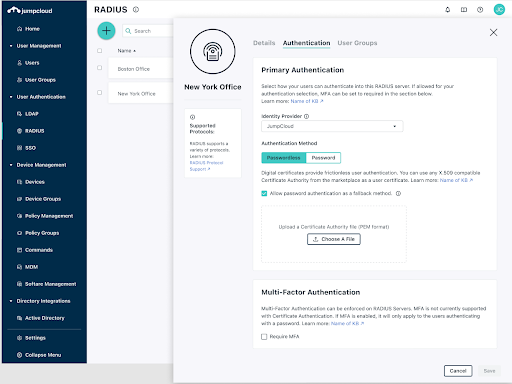
When the SME wants its users to authenticate securely and without friction, the administrator:

  • Selects the “passwordless” authentication method
  • Imports the certificate chain, which allows the JumpCloud RADIUS server to challenge the RADIUS client with EAP-TLS mutual authentication. 

The admin can also allow password authentication as a fallback method for those users who have not yet received a certificate.

Admin 

screenshot of primary authentication

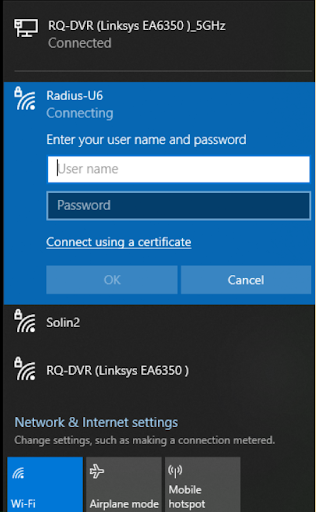
When a user initially connects to a Wi-Fi device configured for JumpCloud RADIUS with certificate authentication (and password as a fallback), they can select “connect using a certificate.” Going forward, authentication to the Wi-Fi AP will happen automatically without any additional input from the user.

screenshot of connecting to RADIUS

JumpCloud’s cloud RADIUS validates the certificate contents provided and checks if the certificate, and user, are in good standing before granting access to the Wi-Fi network.

Try JumpCloud Cloud RADIUS

JumpCloud offers its full open directory platform without any charges for up to 10 users and devices. Free chat support is provided for 10 days to help get you started. Pricing is workflow-based to help SMEs meet their unique requirements versus feature-based SKUs. Would you prefer tailored, white-glove implementation assistance? Schedule a free 30-minute technical consultation to learn about the service offerings available to you.

About Version 2 Digital

Version 2 Digital is one of the most dynamic IT companies in Asia. The company distributes a wide range of IT products across various areas including cyber security, cloud, data protection, end points, infrastructures, system monitoring, storage, networking, business productivity and communication products.

Through an extensive network of channels, point of sales, resellers, and partnership companies, Version 2 offers quality products and services which are highly acclaimed in the market. Its customers cover a wide spectrum which include Global 1000 enterprises, regional listed companies, different vertical industries, public utilities, Government, a vast number of successful SMEs, and consumers in various Asian cities.

About JumpCloud
At JumpCloud, our mission is to build a world-class cloud directory. Not just the evolution of Active Directory to the cloud, but a reinvention of how modern IT teams get work done. The JumpCloud Directory Platform is a directory for your users, their IT resources, your fleet of devices, and the secure connections between them with full control, security, and visibility.

×

Hello!

Click one of our contacts below to chat on WhatsApp

×