338,144,752 children. Yes, you read that right, roughly 300 million children have been exposed to harmful content online. It’s more than just some numbers. It’s the collective innocence of our future generations at stake.
According to UNICEF, the global population of children under 18 stands at a staggering 2,415,319,658, and of those aged 9-13—roughly 483,063,932 children—seven out of 10 have encountered inappropriate or dangerous content while browsing the internet.[1][2]Content Filtering Software for Schools
The internet, while a way to infinite knowledge, has also become a minefield of risks for children, from explicit material to cyberbullying and scams. With such a massive number of young minds under threat, the pressing question is: are we doing enough to shield them?
How can we unravel the problem and explore the solution?
Understanding web filtering in schools
After reading the numbers you might wonder that you were sending your kids to school every day to learn but they might be the ones distracted by harmful content, cyberbullies, or sites that offer nothing but junk. Sounds like a nightmare, right?
Well, that’s exactly why web content filtering exists. It helps make sure that students stay on track, focused on their education, and away from all the dangerous stuff lurking online.
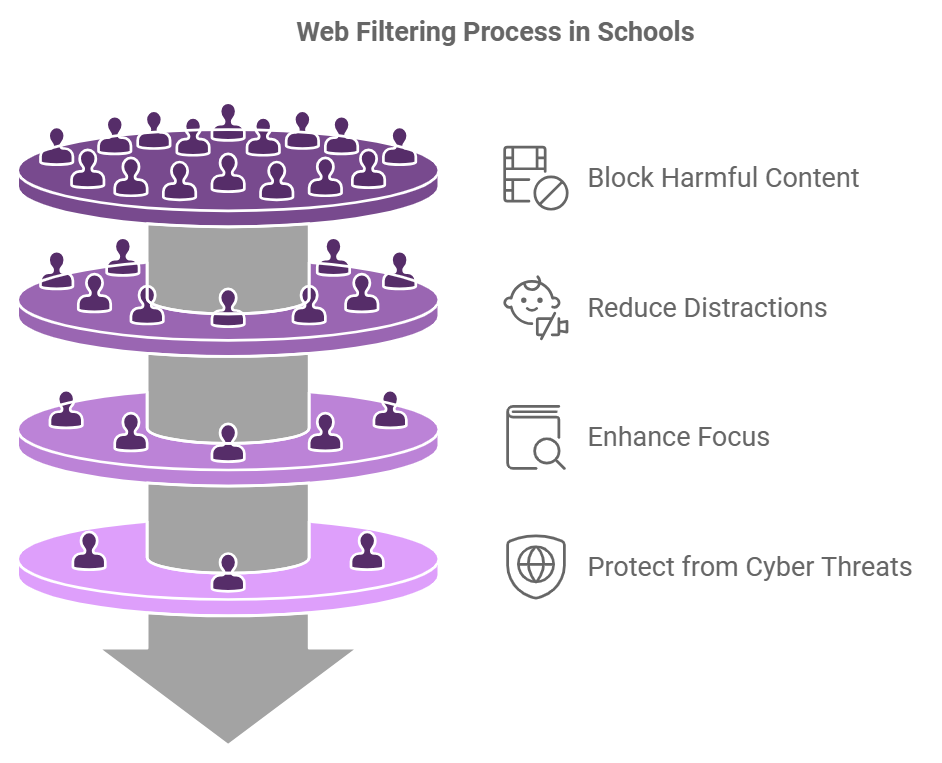
Internet filtering in schools isn’t as complicated as it might sound. In simple terms, it’s a system that blocks access to websites or content that could be harmful—whether that’s explicit material, violent content, or even distractions like social media.
But here’s the thing: web filters don’t just stop at blocking bad content. They also help students stay focused on the right stuff—learning. With the right filters, schools can ensure that students aren’t sidetracked by online games, random videos, or other distractions during study time.
It’s as if setting a study timer on your phone—but for the entire school.
On top of that, web filters act as shields against the growing number of cyber threats. We’re talking about phishing scams, malware, and cyberbullying—risks that can wreak havoc not just on a student’s safety but on their mental health as well. These dangers are kept at bay with web filtering software for schools, creating a safer and more productive environment.
The Problem: The real dangers of an unfiltered internet
The internet, for all its potential, is full of dangers. And without proper web filtering, schools leave students vulnerable to a range of problems.
Here are the top 5 threats that make web filtering a must-have:
1. Exposure to explicit content
We’re talking about graphic images, violence, and explicit material—things that no child should stumble upon while browsing the web. Yet, without web filters, students are just a click away from encountering inappropriate content.
2. Cyberbullying
It’s not just face-to-face bullying that we need to worry about anymore. Cyberbullying is a major concern, and it can have devastating effects on a child’s mental health. With web filters in place, students can be shielded from harmful interactions, ensuring they have a safer space to learn.
3. Scams and phishing attacks
The internet is a goldmine for scammers, and children are prime targets. From fake websites to phishing emails, it’s easy for students to fall for tricks that could steal their personal information. Web filters block these sites, preventing students from becoming victims.
4. Malware and viruses
The internet is full of shady websites and downloads that can infect devices with malware or viruses. These threats can compromise school networks and put personal data at risk. A strong web filter stops these malicious sites in their tracks, ensuring students and their devices stay safe.
5. Distractions that waste time
Think about the number of times you’ve clicked on random videos or games while you should be doing something else. Now imagine students doing the same during class. Without proper web filtering, distractions are everywhere, preventing students from focusing on their studies.
The Solution: web filtering software to the rescue
So, how do we stop these problems from derailing our kids’ education and safety? Solution: Web filtering software for schools.
Here’s how it works:
Blocks harmful content
Web filters prevent access to inappropriate websites by scanning for specific keywords, categories, or URLs. Schools can customize these filters to block everything from explicit material to violent content, making sure students can’t stumble upon harmful websites.
Focuses students’ attention
With distractions like social media, games, and random videos out of the equation, web filtering helps students stay focused on the task at hand—learning. This is particularly important during school hours when students need to stay engaged in their lessons and educational resources.
Protects against cyber threats
A solid web filter does more than block inappropriate sites—it also protects students from cyber threats like phishing scams, malware, and identity theft. By stopping these dangerous sites before they can do harm, web filters keep students safe and secure while they navigate the web.
Protection for schools
One of the best parts of content filtering software for schools is that it can be tailored to meet specific needs. Filters can be set based on the grade level, the subject being studied, or even specific content areas that need to be restricted or encouraged.
Real-time monitoring and reporting
Most web filtering systems offer real-time monitoring and reports, which means educators and administrators can track what students are accessing online. This allows for quick action if anything inappropriate or dangerous is spotted, keeping everyone accountable.
A safer, smarter digital world for students with Veltar
At the end of the day, the internet is an incredible resource, but without the proper safeguards, it can also be a dangerous place. With the alarming statistics highlighting that approximately 338 million children have been exposed to harmful content online, it’s imperative for educational institutions to implement measures to protect their students.
One effective solution is the deployment of web filtering software, such as Veltar.
Veltar is a comprehensive endpoint security solution that helps protect data at rest and in motion. It offers features like web content filtering, VPN tunneling, I/O device access control, and application control, providing a unified approach to endpoint security.
By integrating Veltar into school networks, administrators can prevent access to inappropriate websites by scanning for specific keywords, categories, or URLs. You can select categories of websites to block and enter specific domains to restrict.
Keep students immersed in meaningful learning by cutting out distractions like social media and games.
About Scalefusion Scalefusion’s company DNA is built on the foundation of providing world-class customer service and making endpoint management simple and effortless for businesses globally. We prioritize the needs and feedback of our customers, making sure that they are at the forefront of all decision-making processes. We are dedicated to providing comprehensive customer support services, and place emphasis on customer-centric thinking throughout the organization.
About Version 2 Digital
Version 2 Digital is one of the most dynamic IT companies in Asia. The company distributes a wide range of IT products across various areas including cyber security, cloud, data protection, end points, infrastructures, system monitoring, storage, networking, business productivity and communication products.
Through an extensive network of channels, point of sales, resellers, and partnership companies, Version 2 offers quality products and services which are highly acclaimed in the market. Its customers cover a wide spectrum which include Global 1000 enterprises, regional listed companies, different vertical industries, public utilities, Government, a vast number of successful SMEs, and consumers in various Asian cities.