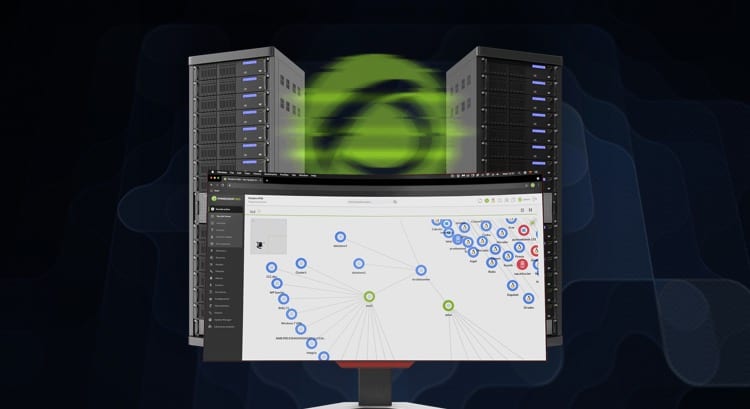
What’s new in the latest Pandora FMS release, Pandora FMS 758
Let’s check out together the features and improvements related to the new Pandora FMS release: Pandora FMS 758. Remember this is an LTS version, we only have two of them a year, in April and November and they are stable.
NEW FEATURES AND IMPROVEMENTS
Network Configuration Manager
We added for the first time in Pandora FMS a new network computer management system, which allows you to distribute configuration changes in a customized way to network computers, differentiating by model and provider. You may back up configurations and recover them or see the differences compared to the previous backup. In future versions you will be able to deploy mass changes to network computers, apply firmwares and more features.
Improvements in IPAM
Our improved IPAM includes network export/import, new options for working with subnets (sorting, adding networks to supernets from the first range available, etc.), as well as new tree views in supernet maps and network usage statistical graphs. New IPAM reports have also been added to see the list of used/unused IPs as well as those assigned to an agent.
Network usage statistical graphs
Supernet display in tree format
New service list widget
A new widget has been added, where you may choose to see the services view and choose what type of view you want to see.
New visual console element: Simple graphs
The visual console supports a new type of element that displays the graph in a simplified format, providing a label with the value of the last data collected in a very visual way, creating a new world of possibilities for creating dashboards.
New Alert server
The new Pandora FMS alert server allows parallelization of the alert execution load in another component, so that monitoring processing is not affected in alert storm situations. This new server is optional and it is not activated by default.
Open Source network maps
At the request of our user community, we opened the network map editor feature for the OpenSource version. It can now be used without limits in the community version.
IPv6 support for Satellite server
Since this version, both the Satellite server and the Enterprise Network Server support IPv6 in all its advanced features. High-performance code previously only supported on IPv4 now applies to IPv6 as well, enhancing existing polling capabilities.
New Enterprise plugin: Apache Spark
The Apache Spark plugin creates an agent for each app that has finished or is running on the server with the data of all its executors. More information in our library.
About Version 2 Digital
Version 2 Digital is one of the most dynamic IT companies in Asia. The company distributes a wide range of IT products across various areas including cyber security, cloud, data protection, end points, infrastructures, system monitoring, storage, networking, business productivity and communication products.
Through an extensive network of channels, point of sales, resellers, and partnership companies, Version 2 offers quality products and services which are highly acclaimed in the market. Its customers cover a wide spectrum which include Global 1000 enterprises, regional listed companies, different vertical industries, public utilities, Government, a vast number of successful SMEs, and consumers in various Asian cities.
About PandoraFMS
Pandora FMS is a flexible monitoring system, capable of monitoring devices, infrastructures, applications, services and business processes.
Of course, one of the things that Pandora FMS can control is the hard disks of your computers.
We would love to say that companies, above all else, value their employees, but it would be as naive as it is false. Yes, because at the top of the companies’ scale of values is data. The precious data. Data that actually only plays an important role when properly stored. And here is where the data warehouses come in.
What exactly is a data warehouse?
A data warehouse is actually a way of managing your data, specially designed, of course, to support business activities, especially those related to analytics. Enterprise data warehouses contain, of course, vast amounts of historical data to collate, query, pattern or analyze. These data, which the warehouse centralizes, come from a wide and different range of sources. We have the type: application log files, transaction applications, etc.
Apart from centralizing data and unifying their sources, data warehouses help in the decision-making process. This is because they contain valuable raw business knowledge. A very rich historical record for analysts and data experts. And from them, from the experts, we have taken the main advantages of data warehouses:
Source tracking and verification Thanks to data warehouses, we may trace the data to its source and verify both the information as well as the root it comes from. That way we will be able to store this source in our database and always ensure consistent and relevant information.
Sifting relevant data for companies. Once in the system, the quality and integrity of the data is guaranteed. Companies will only have useful data, those necessary for their activities, since the data warehouse format predisposes the analysis of their information at any time and under any circumstance. No one should any longer depend on a hunch or rash from the decision-maker, incomplete or poor quality data. The results will be fast and accurate.
In the data warehouse, the data is copied and processed, integrated and restructured, in advance, in a Semantic Data Store. This makes any analysis process much easier.
Imagine analyzing large amounts of data of all kinds and retrieving a value from them in a specific and precise way.
Types of data warehouses
If we strictly stick to company data warehouses, today we can have three main types:
Enterprise Data Warehouse (EDW): A data warehouse that contains the business data of a business and that includes all the information about its customers. It enables data analysis and can provide actionable insights. It also offers a unified approach to organizing and representing such data.
Operational Data Warehouse (ODS): We are faced with a central database that provides us with a snapshot of the freshest data from multiple transactional systems so that we can prepare operational reports. The ODS enables organizations to combine data in its original format, from several sources, to produce business reports.
Data market: It focuses on a single functional area of an organization and encompasses a subset of stored data. The data marketplace is specially designed for use by a specific department or set of users in an organization. We are talking about a condensed version of the data warehouse.
Small retrospective
Most would stop the clock on their time machine in 1980, where they believe that the concept of the data warehouse arises, but we would have to let it run a little further back, to the hippy sixties. When Dartmouth and Mills develop the term dimension and facts in a collaborative project.
Then we would advance to the seventies to witness how Nielsen and IRI introduce Dimensional Data Marts for retail sales, Tera Data Corporation launches a database management system prepared to help and assist in making decisions, and then, after a decade of progress, in the eighties, where the first implementation of a data warehouse emerged by the hand of Paul Murphy and Barry Devlin, IBM workers.
From the data warehouse to the Cloud?
As we have already seen in previous articles, the coronavirus pandemic that has devastated our planet has a lot to do with the new technological restructuring and with the religious ascents to the Cloud. It is also, of course, to blame for moving data warehouses to Cloud platforms.
On-premise data warehouses have great advantages: security, speed, etc. But they are not that elastic, and the foresight to determine how to scale the data warehouse, regarding future needs, is quite complex. During the famous Confinement, most moved to the Cloud and the data warehouses were going to follow their example of course. Even those in large companies, those who no one thought they could abandon their local data centers, are switching to the Cloud to make the most out of its advantages. That flexibility in computing and storage. Its ease of use, its versatile management and its profitability.
Tomorrow: Automation of the data warehouse
The list of issues a data warehouse deals with is still there: data integration, data views, data quality, optimization, competing methodologies, and so on. However, we can find an answer: warehouse automation..
With data warehouse automation, a data warehouse can use the latest technology for pattern-based automation and advanced design processes. This allows you to automate the planning, modeling and integration steps of the entire life cycle. We are faced with what seems like a very efficient alternative to traditional data warehouse design, one that reduces time-consuming tasks such as generating and deploying ETL codes on a database server.
After this long journey through the life and exploits of the data warehouses, we say goodbye, as you can see, focusing on the answers that it promises to give us in the near future. We will always be positive in the matter.
About Version 2 Digital
Version 2 Digital is one of the most dynamic IT companies in Asia. The company distributes a wide range of IT products across various areas including cyber security, cloud, data protection, end points, infrastructures, system monitoring, storage, networking, business productivity and communication products.
Through an extensive network of channels, point of sales, resellers, and partnership companies, Version 2 offers quality products and services which are highly acclaimed in the market. Its customers cover a wide spectrum which include Global 1000 enterprises, regional listed companies, different vertical industries, public utilities, Government, a vast number of successful SMEs, and consumers in various Asian cities.
About PandoraFMS
Pandora FMS is a flexible monitoring system, capable of monitoring devices, infrastructures, applications, services and business processes.
Of course, one of the things that Pandora FMS can control is the hard disks of your computers.
The fight of the century: Data Center VS Cloud! Let’s go!
In this blog we have always been eager for fights or competitions of whatever we please. We are like that, like fierce pokemon trainers who want to finally find out who has the greatest capabilities to win. They have praised us for it, they have hated us for it, but it does not matter, the point here is not having fun, but to give the most complete information about the litigants and the battle, so that the user can see closely who they should choose in the future. For all these reasons, today we have in our very own ring Data Center VS Cloud.
How to choose between a data center and Cloud storage?
When the decisive moment arrives, a company must decide about what it intends to do with data storage: “Do we send everything to the Cloud? Do we store our data right here, in our datacenter? Do we outsource them to a professional data center? After all, there are multiple factors, financial elements, the logistics of the company, different clauses and details. A lot of regulation to take into account that has you sweating when it comes to finding the correct answer.
The truth? In this article we are going to expose situations in which data centers beat the Cloud, because, for better or for worse, we are facing a foreseen victory.
Do you need more security?
It is true that the Cloud is no longer sooo in cloud 9 and both the Cloud and its computing and data storage solutions have made great progress in recent times. In fact, they offer a great infrastructure with protected access and the add-on of pay-as-you-go. But if you really want to have the appropriate protocols, compliance and security software, well, your data can be better and more secure in a data storage center, external or at home. There are many companies that offer external, professional and guaranteed data storage, which certifies that the information is your exclusive property and that the data will always be kept safe.
As we have said, storage security in IT Clouds is not as weak as some leaks of private pictures of celebrities have led us to believe. What’s more, the Cloud is often the first choice for a large number of companies, but there are certain nuances in Cloud storage that lead others to choose data centers. And there is a certain lack of control when choosing Cloud storage: problems with shared servers, lack of automatic backups, data leaks, fraudulent devices, vulnerable storage gateways, etc.
Combining infrastructure and profitability
If there is something that the clouds look like from the mainland, it is comfort and convenience, and so does the Cloud, something comfortable, agile… However, user fees can end up being quite expensive, depending on the type of services that one might need. An on-premise data center, in your own facilities, can also be one of the most expensive options, in addition that to manage it you must have a good security and IT team that takes care of regular updates and keeps it operational and always ready.
External storage might be the middle ground. Your own space within a data center or as part of a colocation package. If you think about it, you get the advantages of the Cloud without having to spend all that money that normally requires hosting data on a local data center. It is a very attractive option, considered by companies that have started getting consolidated and are now in full growth. Something more robust and reliable than the Cloud and without so many problems with the facilities.
Do you handle sensitive customer data?
Do you know when companies make up their minds quickly in this fierce fight between on-premise vs Cloud? When it comes to collecting, saving and using customer data that if leaked, lost or stolen would mean the destruction of their business, the private life of the person who trusted them or the public welfare in general. To give you an idea, Emperor Palpatine would never hang plans for The Death Star in the Cloud. Too risky.
Imagine then companies that compile and safeguard financial, political, medical, institutional, sensitive data… All of them choose to use physical data centers instead of the Cloud. And the same goes for telecommunications or social media companies. Physical centers are not the best thing ever, but the Cloud has proven itself more often to be vulnerable and easier to be violated more times.
You need a Cold Storage Location
When we talk about a Cold Storage Location we mean the storage of data that is completely offline, that is, they are not in the Cloud at all, they do not relate to the Cloud, they do not want the Cloud, they do not know what the Cloud is. Data is stored on safe physical means and then moved off-site in the event of a cataclysm. Like you know, a dana, a volcanic explosion, the Twister hurricane or a robbery attempt. This data storage option is often used by companies that have long-term compliance dates, financial institutions, brands threatened by ransomware attacks… They all see Cold Storage Location as the safest backup plan they can have.
Conclusion: Then, what about it?
Well, if we have to reach some conclusions, it must be said that storage in the Cloud is often convenient and has its place, but, of course, it is not the only option, nor is it the best for many companies. Data centers are the ones that best help companies, provide them with security, scalability and peace of mind. It is also the only alternative for companies looking for Cold Storage Location.
After this brawl, Cloud VS on-premise, you can take more into account the advantages and disadvantages of each one of them and make the best decision for your company and your customers’ data.
About Version 2 Digital
Version 2 Digital is one of the most dynamic IT companies in Asia. The company distributes a wide range of IT products across various areas including cyber security, cloud, data protection, end points, infrastructures, system monitoring, storage, networking, business productivity and communication products.
Through an extensive network of channels, point of sales, resellers, and partnership companies, Version 2 offers quality products and services which are highly acclaimed in the market. Its customers cover a wide spectrum which include Global 1000 enterprises, regional listed companies, different vertical industries, public utilities, Government, a vast number of successful SMEs, and consumers in various Asian cities.
About PandoraFMS
Pandora FMS is a flexible monitoring system, capable of monitoring devices, infrastructures, applications, services and business processes.
Of course, one of the things that Pandora FMS can control is the hard disks of your computers.
On the way to perfecting its services, Pandora FMS launches one of the most advanced and complete solutions in its history as monitoring software: Monitoring as a Service (MaaS).
As we all know by now, Pandora FMS is a software for network monitoring that, among many other possibilities, allows visually monitoring the status and performance of several parameters from different operating systems (servers, applications, hardware systems, firewalls, proxies, databases, web servers, routers…). It can also be deployed on almost any operating system and has remote monitoring (WMI, SNMP, TCP, UDP, ICMP, HTTP …), etc.
But what concerns us this time is to see how Pandora FMS once again surpasses itself with Monitoring as a Service. Because yes!, it is time for you to have Pandora FMS ready to use and ready to cover all of your needs. Avoid, from now on, wasting valuable resources on installation, maintenance and operation, MaaS is fully intended as a flexible and easy-to-understand subscription model.
Monitoring as a Service (MaaS) advantages
In order not to roughly explain it in a rush, we better go into detail and list some of the most important advantages of Monitoring as a Service (MaaS).
With Monitoring as a Service, you do not need to invest in an operations center, or in an internal team of engineers to manage monitoring. That’s it, without capital expenditures (capex) or operating expenditures (opex).
With Pandora FMS as a Service monitoring you may accelerate the time to obtain values.
Available 24/7, access it anytime, anywhere. There are no downtimes associated with monitoring. Wonderful and available 24/7.
Generate alerts based on specific business conditions and discover the easy integration of this service with business processes.
Important: Permanent security. All information is protected, monitored and complies with GDPR.
Operation services, we can operate for you, saving resources and optimizing startup times.
Custom integrations, with Pandora FMS specialist consultants at your disposal.
Deployment projects, to support specialized resources wherever you need them.
Here is our proposal in more detail
What does this mean for your company or business?
Going straight to the point, Monitoring as a service (MaaS) provides unlimited scalability and instant access from anywhere and gets rid of worrying about maintaining storage, servers, backups, and software updates.
It is up to you to discover, right away, how the digital transformation of all business processes makes Monitoring as a Service (MaaS) an essential activity to boost the productivity of your company.
Some frequently asked questions about the solution (FAQ)
Of course, given such a technological scoop, you may have some doubts about the subject. Here we answer several of the most frequent questions that we were asked.
What agent limit does the service have? Does it have an alert or storage limit?
There is no agent limit, although the service starts from 100 agents. There is no limit on alerts or disk storage.
How long is history data stored?
45 days maximum. However, you may optionally hire a history data retention system to store data for up to two years.
What is the service availability? What happens if it crashes on a weekend?
The service availability SLA is 99.726% in Basic service, 99.932% in Standard service and 99.954% in Advanced service. In short, we will make sure it is never down.
In which country are the servers located?
We have several locations, to comply with different legislations, such as GDPR (EU), GPA (UK), CBPR (APEC) and CPA (California).
What security does the service offer?
In addition to an availability SLA guaranteed by contract, our servers are exclusive for each client, we have 24/7 monitoring, and our own system security. Of course, backup is included in the service.
How much does the service cost?
You pay a fee per month, which is calculated on the number of agents you are using that month. So if you increase the number of agents in a certain month, you will pay more that month. However, if you decrease the number of agents, you will pay less. There are also some start-up costs for the service and also some optional packages, such as if you want our engineers to develop a custom integration or help you deploy monitoring in your internal systems.
How is it billed?
Quarterly or semi-annually, with monthly cost calculations, so you can plan growth and costs without surprises.
What does the service include?
From Pandora FMS Enterprise license to the operating system, database management, system optimization, maintenance, updates, emergency patches, integration with Telegram and SMS sending, backup and recovery, preventive maintenance, environment security and any other technical task that may take up operating time. You will only have to operate with Pandora FMS.
What is the difference between Basic, Standard and Advanced services?
With the basic service, if you want to make a report or configure an alert, you can do it directly, without worrying about installing, configuring or parameterizing anything. In the Standard and Advanced service you can ask us to do it for you and we will be happy to do so, the same applies for building remote plugins, creating reports, users, policies, graphs or any other administrative Pandora FMS task. In the Standard and Advanced services you will have a number of hours of service each month for any request you may make, and our technical team will be at your disposal. Our technical team will be at your complete disposal.
What are the service hours?
Full office hours (from 9 AM to 6 PM) in America and Europe. From San Francisco to Moscow.
If you can no longer handle the intrigue and want to see how far the possibilities of Monitoring as a service go, you may now hire the solution through this link.
About Version 2 Digital
Version 2 Digital is one of the most dynamic IT companies in Asia. The company distributes a wide range of IT products across various areas including cyber security, cloud, data protection, end points, infrastructures, system monitoring, storage, networking, business productivity and communication products.
Through an extensive network of channels, point of sales, resellers, and partnership companies, Version 2 offers quality products and services which are highly acclaimed in the market. Its customers cover a wide spectrum which include Global 1000 enterprises, regional listed companies, different vertical industries, public utilities, Government, a vast number of successful SMEs, and consumers in various Asian cities.
About PandoraFMS
Pandora FMS is a flexible monitoring system, capable of monitoring devices, infrastructures, applications, services and business processes.
Of course, one of the things that Pandora FMS can control is the hard disks of your computers.
A Service Level Agreement (SLA) is a document that details the expected level of service guaranteed by a vendor or product. This document generally sets out metrics such as uptime expectations and any payoffs if these levels are not met.
For example, if a provider advertises an uptime of 99.9% and exceeds 43 minutes and 50 seconds of service downtime, technically the SLA has been breached and the customer may be entitled to some type of remuneration depending on the agreement.
What do we want SLAs for?
A Service Level Agreement (SLA) specifies the quality of a service. It is a way of defining the limit of failures or times in which the response to a service is measured. Each service measures its quality in a different way, but in all cases it refers to times, and therefore it can be measured.
For example, if you worked in a restaurant, you would define your customer service SLA with several parameters:
Maximum time since a customer sits at the table and is served by a waiter.
Maximum time since you order the drink and it is served to you.
Maximum time since requesting the bill and paying.
Suppose that in our restaurant, we consider that the most important thing is the initial attention, and that no more than 60 seconds can go by, from when you sit down to when you are served. If we had a fully sensorized business with IoT technology, we could measure the time from when the customer sits at a table until a waiter approaches the table.
That way, we could measure the number of times each waiter manages to serve a customer in the established time. The way to do it can be more or less simple, but let’s keep it simple, suppose that every time they do it in less than 60 seconds they comply and when they do not make it, they do not comply. So if out of ten clients they serve in an hour, they fail only with two, they would be 80% compliant. We could make the average of their entire work day and thus easily compare different employees to find out which one has more “quality” in the metric of “serving a customer when they sit down.”
If we use a monitoring system, we could notify their manager every time that the overall quality of the service drops below 80% and by generating automatic reports, we could each month reward those with the best service compliance percentage and take measures (or fire) for those who are doing it worst.
One of the most important functions of monitoring systems is to measure. And measuring service compliance is essential if we care about quality. Whether we are on the provider side or on the client side.
If you are paying for a service, wouldn’t you like to check that you are actually getting what you pay for?
Sometimes we do well not to trust the measurements of others, and it is necessary to check it for “ourselves.” For this, monitoring tools such as Pandora FMS are essential.
What is the «uptime» or activity time?
Uptime is the amount of time that a service is available and operational. It is generally the most important metric for a website, online service, or web-based provider. Sometimes uptime is mistaken with SLA, but uptime is nothing more than a very common metric in online services that is used to measure SLAs, not an SLA, which as we have seen before is something much broader.
The trade-off is downtime – the amount of time a service is unavailable.
Uptime is usually expressed as a percentage, such as “99.9%”, over a specified period of time (usually one month). For example, an uptime of 99.9% equals 43 minutes and 50 seconds of inactivity.
What are the typical metrics of a supplier?
Those that are agreed between the supplier and the client. Each service will have its own metrics and indicators. Thus, in our Monitoring as a Service (MAAS) we can establish several parameters to be measured, among others, let’s see some of them to better understand how to «measure the service quality» through SLA:
Minimum response time to a new incident, 1 hr in standard service.
Critical incident resolution time: 6 hours in standard service.
Service availability time, 99.932% in the standard service.
When we talk about a time percentage, it generally refers to the annual calculation, so 99.932% corresponds to a total of 5h 57m 38s of service shutdown in a year. We can use our SLA calculator (below to test other percentages).
On the contrary, 1hr would be the inverse calculation, and for this we can use online tools such as uptime.is. By using it we will get that six hours would correspond to:
Weekly reporting: 99.405 %
Monthly reporting: 99.863 %
Quarterly reporting: 99.954 %
Yearly reporting: 99.989 %
Similarly to the initial waiter example, we can measure compliance with a support SLA by measuring the sum of several factors, if all are met, we are meeting the SLA, otherwise we’re not. This is how Integria IMS measures it, the helpdesk component integrated in Pandora FMS. Pandora FMS clients use Integria for support, and thanks to it we can ensure that we attend to client requests on time.
How to calculate the service SLA time?
Use our online calculator to calculate a service downtime. For example, test 99.99% to see the maximum downtime for a day, a month, or the entire year.
How can Pandora FMS help with SLAs?
Pandora FMS has different tools to exhaustively control the SLAs of your client/supplier. You have SLA reports segmented by hours, days or weeks. That way you can visually assess where the defaults are.
This is an example of an SLA report in a custom time range (one month) with bands by ranges of a few minutes.
There are reports prepared to show the case of information sources with backup so that you can find out the availability of the service from the customer’s point of view and from the internal point of view:
This is an example of a monthly SLA view with detail by hours and days:
This is an example of a monthly SLA report view with a weekly view and daily detail:
This is an example of an SLA report view by months, with simple views by days:
Service monitoring
One of the most advanced functions of Pandora FMS is monitoring services with Pandora FMS. It is used to continuously monitor the status of a service, which, as we have seen at the beginning, is made up of a set of indicators or metrics. This service often has a series of dependencies and weightings (there are things more important than others) and all services have a certain tolerance or margin, especially if they are made up of many elements and some of these are redundant.
The best example is a cluster, where if you have ten servers, you know that the system works perfectly with seven of them. So the service as such can be operational with one, two or up to three machines failing.
In other cases, a service may have non-critical elements, which are part of the service and that we want to control, even if the service is not affected:
One of the advantages of service monitoring is that you can easily get the route to failure, literally being able to find the needle in the haystack. When you talk about technology, the source of a problem can be somewhat tiny compared to the amount of data you receive. Services help us determine the source of the problem and isolate ourselves from informational noise. They also allow to monitor the degree of service compliance in real time and take action before the quality of the service for a customer is affected.
About Version 2 Digital
Version 2 Digital is one of the most dynamic IT companies in Asia. The company distributes a wide range of IT products across various areas including cyber security, cloud, data protection, end points, infrastructures, system monitoring, storage, networking, business productivity and communication products.
Through an extensive network of channels, point of sales, resellers, and partnership companies, Version 2 offers quality products and services which are highly acclaimed in the market. Its customers cover a wide spectrum which include Global 1000 enterprises, regional listed companies, different vertical industries, public utilities, Government, a vast number of successful SMEs, and consumers in various Asian cities.
About PandoraFMS
Pandora FMS is a flexible monitoring system, capable of monitoring devices, infrastructures, applications, services and business processes.
Of course, one of the things that Pandora FMS can control is the hard disks of your computers.