





You’d be hard-pressed to find someone who doesn’t care about their privacy. It’s human nature. You want control over what private information you share and who you share it with. Unfortunately, you can lose this control with a careless click.
What is private data?
Private data is anything that reveals information about you. It can be your name, your photos, your posts on social media, your email addresses, or your IP.
Some of these details are highly sensitive, including your banking information, genetic data, health records, social security number, and home address. As a rule of thumb, any information that could cause you financial or reputational damage can be considered sensitive.
What is data privacy and why is it important?
Data privacy, also known as information privacy, generally refers to a person’s right to choose for themselves when, how, with whom, and to what extent they want to share their private data with others.
As internet usage has become ubiquitous over the years, so has the importance of data privacy and protection. Various websites and applications often collect your private data in exchange for its services.
Some platforms and applications may exceed their reach when it comes to data collection, storage, and usage. Others may have a lax attitude toward private data protection.
The key questions to ask when talking about data privacy are:
-
Who has access to information about you?
-
Who controls this access?
-
Is it secure?
When private data falls into the wrong hands, consequences can be dire. A data breach on an online platform could put your sensitive information into the hands of cyber crooks. Users whose data is leaked are put at risk of identity theft, bank fraud, and other online-related scams and crimes. These days, data is king and there’s no way around it. Thus, it’s not surprising that protection is paramount.
Your privacy in the hands of the government
Various entities handle your private data. First – the government and its institutions. Let’s take the justice system as an example. You cannot go to court or file a claim without revealing your identity. And that’s fine — it wouldn’t be fair to the other side if you were suing them anonymously.
Similarly, you can’t get public services (for example, electricity, a high school education, or healthcare) without identifying yourself.
In a perfect world, the government does not infringe upon your privacy more than necessary. In the real world, some governments store every bit of data they can get their hands on. Even worse, others engage in mass surveillance of their citizens.
Your privacy in the hands of businesses
You can buy apples at a fruit stand and remain a stranger to the vendor. But buy apples online, and you’ll give away private information about yourself. It may be a fact as simple as you liking apples. This information will be sold to an advertiser, and the next time you go online, an ad for apples will pop up on your screen.
Almost everything you do online leaves a data footprint. You have little control over how your digital footprint is collected.
Usually, it works like this. Before you start using a new online service, you have to read a wall of fine print. But you don’t, because who has time to wade through paragraphs of legal jargon? You click “Agree,” and that’s how you begin to give away your private data. The agreement can’t be changed, and you cannot bargain — take it or leave it. This service will collect your data and use it for marketing purposes or sell it to the highest bidder. And there’s nothing you can do.
It’s easy to say “Don’t use these services.” The problem is that most online services collect information. If you want none of your private data on the internet, you have to quit using the internet. And that’s a price most people find too high to pay.
Data protection laws
Over the years, as technology and the internet came to be an inseparable part of our lives, governments around the globe took part in creating and passing laws regulating private data. Most countries today have various laws governing data collection, storage, and usage. Here are some of the most important and impactful ones:
The General Data Protection Regulation (GDPR)
The GDPR regulates data privacy laws across all EU member countries. It was designed to replace previous data regulation laws and provide greater protection and rights to individuals, essentially giving subjects the right to control their personal data and ensuring the right to be forgotten. The GDPR also outlines how individuals’ private data should be collected, stored, and used as well as outlining the limitations. The GDPR is one of the most impactful and comprehensive regulations developed in the past decade.
Data privacy laws in the US
At the moment, the United States has no federal law or legislation that comprehensively addresses data privacy. However, individual states have enacted their own laws and regulations to address issues of data privacy in different industries such as healthcare, finance, and marketing. But, even with all these different laws and regulations, there’s still one important agency that helps to make sure everyone is following the rules.
The Federal Trade Commission (FTC) is the agency that oversees data privacy regulations and ensures consumer protection. The FTC Act grants the organization the authority to prevent unfair or deceptive trade practices and enforce privacy laws.
The FTC can take action against organizations that fail to implement reasonable data security measures, violate consumer data privacy rights, or engage in misleading advertising practices.
There are also other federal laws that govern the collection of information online, such as the Children’s Online Privacy Protection Act (COPPA), the Health Insurance Portability and Accounting Act (HIPAA), the Gramm Leach Bliley Act (GLBA), the Fair Credit Reporting Act (FCRA), and the Family Educational Rights and Privacy Act (FERPA). These laws focus on ensuring the protection of specific types of information, such as data related to children, health, and finances.
National data protection laws
Many countries around the world, including Australia, Canada, and Japan have comprehensive data protection laws in place that outline the ways personal data should be handled, much like the GDPR.
Important data privacy and protection trends for 2023
Increasing use of AI and ML in data protection
As we move into 2023, the use of artificial intelligence (AI) and machine learning (ML) in data security and privacy is becoming increasingly prevalent. AI can be a powerful tool for protecting consumer privacy.
In 2023 we’ll start seeing an increase in the use of both AI and ML to proactively identify and prevent cyber threats and detect patterns that may indicate a potential data breach.
However, data protection through automation has not yet advanced as much as we would like. Nevertheless, in 2023 and beyond, we can expect to see significant improvements in this area as the technology matures and becomes more suited for ensuring the privacy and security of sensitive data.
Data security and privacy will be a priority for consumers
Because data breaches are more common and sophisticated than ever, consumers are unsurprisingly becoming more vigilant about the security of their personal information. Increasingly more people these days are being selective about who they trust with their data. A company’s data-sharing practices and policies now are a crucial factor for many consumers.
In 2023, businesses should be ready for increased scrutiny around their data security and privacy practices. If you are a company that looks to succeed this year, it is vital for you to earn and maintain the trust of your clientele by being transparent about your data protection approach. Trust is a two-way street, and in today’s digital age, it’s more important than ever.
Increasing collaboration between government entities and private companies
Because a decrease in cyber criminal activity is nothing we can bet on in 2023, expect to see heightened levels of collaboration between private companies and government entities aiming to improve data security and privacy.
The collaboration between private and government entities may take many forms, from joint research and development of new security technologies and processes, to more information-sharing in an effort to craft well-rounded regulatory mechanisms.
The rise of passwordless authentication and regulation of biometric data
Passwordless authentication methods are already gaining popularity due to their convenience and security benefits. In 2023, we can expect to see more online service providers adopting various forms of passwordless authentication.
The major advantage of passwordless authentication is that it eliminates the need for users to remember and manage multiple passwords. Additionally, passwordless authentication greatly reduces the risk of password-related security breaches. However, most passwordless technology leverages biometric data for authentication purposes and 2023 might be the year when we will see more regulatory entities coming up with standards and requirements to ensure the secure storage and handling of biometric data. We might see laws and regulations establishing best practices as well as penalties for entities that fail to comply with such standards.
What can you do to protect your data privacy?
Information privacy will become an even hotter topic once technologies create more invasive tools. You’ll be surrounded by facial-recognition cameras, smart speakers that listen to your conversations, e-textiles, wearable health monitors, and other data-gathering gadgets.
That means you must take action now:
-
Foster healthy online habits. Refrain from publicly sharing your personal information on social media. Leverage privacy settings and make your social media profiles private to limit exposure. Be weary of attachments or links in emails that come your way from unknown senders. Make use of multi-factor authentication (MFA) and enable it on your online accounts whenever possible. Use strong, unique passwords for all your accounts and employ a password manager to securely store your passwords and other sensitive information.
-
Use tools and services that enhance your privacy. Choose private search engines, private email providers, and privacy-focused browsers. And use encryption tools — they’re much more user friendly than they sound. NordPass itself uses state-of-the-art encryption to protect your passwords. In addition, NordVPN makes sure your traffic is invisible to your internet service provider.
-
Don’t need it? Then don’t use it. Don’t sign up if you don’t really need the service. And if you do need it, read the fine print before clicking “Agree.” If the fine print is too complicated, look for comments and reviews regarding the service’s privacy policies.
Fight for information privacy and make the internet better for all.
These days, cybercrime is rampant. It’s no longer a matter of “if” you’re going to suffer an attack but “when” it will happen. All companies want to be ready for any crisis. And this is where a business continuity plan comes into play.
But what is a business continuity plan exactly? Why is it important? What should one include? Today, we’re exploring all these questions in-depth.
What is a business continuity plan?
A business continuity plan (BCP) is a document that sets guidelines for how an organization will continue its operations in the event of a disruption, whether it’s a fire, flood, other natural disaster or a cybersecurity incident. A BCP aims to help organizations resume operations without significant downtime.
Unfortunately, according to a 2020 Mercer survey, 51% of businesses across the globe don’t have a business continuity plan in place.
What’s the difference between business continuity and disaster recovery plans?
We often confuse the terms business continuity plan and disaster recovery plan. The two overlap and often work together, but the disaster recovery plan focuses on containing, examining, and restoring operations after a cyber incident. On the other hand, BCP is a broader concept that considers the whole organization. A business continuity plan helps organizations stay prepared for dealing with a potential crisis and usually encompasses a disaster recovery plan.
Importance of business continuity planning
The number of news headlines announcing data breaches has numbed us to the fact that cybercrime is very real and frequent and poses an existential risk to companies of all sizes and industries.
Consider that in 2021, approximately 37% of global organizations fell victim to a ransomware attack. Then consider that business interruption and restoration costs account for 50% of cyberattack-related losses. Finally, take into account that most cyberattacks are financially motivated and the global cost of cybercrime topped $6 trillion last year. The picture is quite clear — cybercrime is a lucrative venture for bad actors and potentially disastrous for those on the receiving end.
To thrive in these unpredictable times, organizations go beyond conventional security measures. Many companies develop a business continuity plan parallel to secure infrastructure and consider the plan a critical part of the security ecosystem. The Purpose of a business continuity plan is to significantly reduce the downtime in an emergency and, in turn, reduce the potential reputational damage and — of course — revenue losses.
Business continuity plan template
Password security for your business
Store, manage and share passwords.
30-day money-back guarantee
Business Continuity Plan Example
[Company Name]
[Date]
I. Introduction
-
Purpose of the Plan
-
Scope of the Plan
-
Budget
-
Timeline
The initial stage of developing a business continuity plan starts with a statement of the plan’s purpose, which explains the main objective of the plan, such as ensuring the organization’s ability to continue its operations during and after a disruptive event.
The Scope of the Plan outlines the areas or functions that the plan will cover, including business processes, personnel, equipment, and technology.
The Budget specifies the estimated financial resources required to implement and maintain the BCP. It includes costs related to technology, personnel, equipment, training, and other necessary expenses.
The Timeline provides a detailed schedule for developing, implementing, testing, and updating the BCP.
II. Risk Assessment
-
Identification of Risks
-
Prioritization of Risks
-
Mitigation Strategies
The Risk Assessment section of a Business Continuity Plan (BCP) is an essential part of the plan that identifies potential risks that could disrupt an organization’s critical functions.
The Identification of Risks involves identifying potential threats to the organization, such cybersecurity breaches, supply chain disruptions, power outages, and other potential risks. This step is critical to understand the risks and their potential impact on the organization.
Once the risks have been identified, the Prioritization of Risks follows, which helps determine which risks require the most attention and resources.
The final step in the Risk Assessment section is developing Mitigation Strategies to minimize the impact of identified risks. Mitigation strategies may include preventative measures, such as system redundancies, data backups, cybersecurity measures, as well as response and recovery measures, such as emergency protocols and employee training.
III. Emergency Response
-
Emergency Response Team
-
Communication Plan
-
Emergency Procedures
This section of the plan focuses on immediate actions that should be taken to ensure the safety and well-being of employees and minimize the impact of the event on the organization’s operations.
The Emergency Response Team is responsible for managing the response to an emergency or disaster situation. This team should be composed of individuals who are trained in emergency response procedures and can act quickly and decisively during an emergency. The team should also include a designated leader who is responsible for coordinating the emergency response efforts.
The Communication Plan outlines how information will be disseminated during an emergency situation. It includes contact information for employees, stakeholders, and emergency response personnel, as well as protocols for communicating with these individuals.
The Emergency Procedures detail the steps that should be taken during an emergency or disaster situation. The emergency procedures should be developed based on the potential risks identified in the Risk Assessment section and should be tested regularly to ensure that they are effective.
IV. Business Impact Analysis
The Business Impact Analysis (BIA) section of a Business Continuity Plan (BCP) is a critical step in identifying the potential impact of a disruption to an organization’s critical operations.
The Business Impact Analysis is typically conducted by a team of individuals who understand the organization’s critical functions and can assess the potential impact of a disruption to those functions. The team may include representatives from various departments, including finance, operations, IT, and human resources.
V. Recovery and Restoration
-
Procedures for recovery and restoration of critical processes
-
Prioritization of recovery efforts
-
Establishment of recovery time objectives
The Recovery and Restoration section of a Business Continuity Plan (BCP) outlines the procedures for recovering and restoring critical processes and functions following a disruption.
The Procedures for recovery and restoration of critical processes describe the steps required to restore critical processes and functions following a disruption. This may include steps such as relocating to alternate facilities, restoring data and systems, and re-establishing key business relationships.
The Prioritization section of the plan identifies the order in which critical processes will be restored, based on their importance to the organization’s operations and overall mission.
Recovery time objectives (RTOs) define the maximum amount of time that critical processes and functions can be unavailable following a disruption. Establishing RTOs ensures that recovery efforts are focused on restoring critical functions within a specific timeframe.
VI. Plan Activation
-
Plan Activation Procedures
The Plan Activation section is critical in ensuring that an organization can quickly and effectively activate the plan and respond to a potential emergency.
The Plan Activation Procedures describe the steps required to activate the BCP in response to a disruption. The procedures should be clear and concise, with specific instructions for each step to ensure a prompt and effective response.
VII. Testing and Maintenance
-
Testing Procedures
-
Maintenance Procedures
-
Review and Update Procedures
This section of the plan is critical to ensure that an organization can effectively respond to disruptions and quickly resume its essential functions.
Testing procedures may include scenarios such as natural disasters, cyber-attacks, and other potential risks. The testing procedures should include clear objectives, testing scenarios, roles and responsibilities, and evaluation criteria to assess the effectiveness of the plan.
The Maintenance Procedures detail the steps necessary to keep the BCP up-to-date and relevant.
The Review and Update Procedures describe how the BCP will be reviewed and updated regularly to ensure its continued effectiveness. This may involve conducting a review of the plan on a regular basis or after significant changes to the organization’s operations or threats.
What should a business continuity plan checklist include?
Organizations looking to develop a BCP have more than a few things to think through and consider. Variables such as the size of the organization, its IT infrastructure, personnel, and resources all play a significant role in developing a continuity plan. Remember, each crisis is different, and each organization will have a view on handling it according to all the variables in play. However, all business continuity plans will include a few elements in one way or another.
-
Clearly defined areas of responsibility
A BCP should define specific roles and responsibilities for cases of emergency. Detail who is responsible for what tasks and clarify what course of action a person in a specific position should take. Clearly defined roles and responsibilities in an emergency event allow you to act quickly and decisively and minimize potential damage.
-
Crisis communication plan
In an emergency, communication is vital. It is the determining factor when it comes to crisis handling. For communication to be effective, it is critical to establish clear communication pipelines. Furthermore, it is crucial to understand that alternative communication channels should not be overlooked and outlined in a business continuity plan.
-
Recovery teams
A recovery team is a collective of different professionals who ensure that business operations are restored as soon as possible after the organization confronts a crisis.
-
Alternative site of operations
Today, when we think of an incident in a business environment, we usually think of something related to cybersecurity. However, as discussed earlier, a BCP covers many possible disasters. In a natural disaster, determine potential alternate sites where the company could continue to operate.
-
Backup power and data backups
Whether a cyber event or a real-life physical event, ensuring that you have access to power is crucial if you wish to continue operations. In a BCP, you can often come across lists of alternative power sources such as generators, where such tools are located, and who should oversee them. The same applies to data. Regularly scheduled data backups can significantly reduce potential losses incurred by a crisis event.
-
Recovery guidelines
If a crisis is significant, a comprehensive business continuity plan usually includes detailed guidelines on how the recovery process will be carried out.
Business continuity planning steps
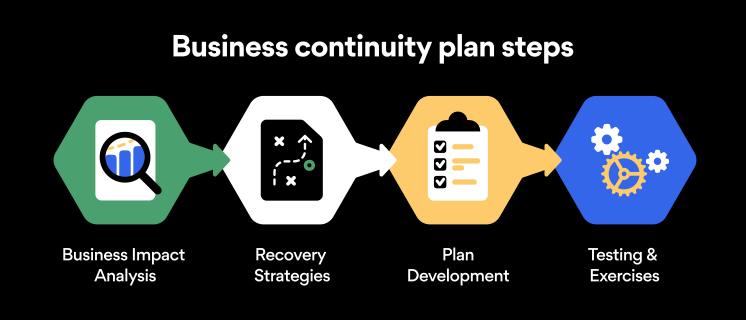
Here are some general guidelines that an organization looking to develop a BCP should consider:
Analysis
A business continuity plan should include an in-depth analysis of everything that could negatively affect the overall organizational infrastructure and operations. Assessing different levels of risk should also be a part of the analysis phase.
Design and development
Once you have a clear overview of potential risks your company could face, start developing a plan. Create a draft and reassess it to see if it takes into account even the smallest of details.
Implementation
Implement BCP within the organization by providing training sessions for the staff to get familiar with the plan. Getting everyone on the same page regarding crisis management is critical.
Testing
Rigorously test the plan. Play out a variety of scenarios in training sessions to learn the overall effectiveness of the continuity plan. By doing so, everyone on the team will be closely familiar with the business continuity plan’s guidelines.
Maintenance and updating
Because the threat landscape constantly changes and evolves, you should regularly reassess your BCP and take steps to update it. By making your continuity plan in tune with the times, you will be able to stay a step ahead of a crisis.
Level up your company’s security with NordPass Business
A comprehensive business continuity plan is vital for the entire organization’s security posture. However, in a perfect world, you wouldn’t have to use it. This is where NordPass Business can help.
Remember, weak, reused, or compromised passwords are often cited as one of the top contributing factors in data breaches. It’s not surprising, considering that an average user has around 100 passwords. Password fatigue is real and significantly affects how people treat their credentials. NordPass Business counters these issues.
With NordPass Business, your team will have a single secure place to store all work-related passwords, credit cards, and other sensitive information. Accessing all the data stored in NordPass is quick and easy, which allows your employees not to be distracted by the task of finding the correct passwords for the correct account.
In cyber incidents, NordPass Business ensures that company credentials remain secure at all times. Everything stored in the NordPass vault is secured with advanced encryption algorithms, which would take hundreds of years to brute force.
If you are interested in learning more about NordPass Business and how it can fortify corporate security, do not hesitate to book a demo with our representative.


