Skip to content

MSP vs. MSSP: what’s the difference?

Navigating the world of IT support and cybersecurity services can feel like exploring a maze. Two terms that often come up are MSP and MSSP. Though they sound similar, their roles in the IT ecosystem are distinct.

Let’s dive in to clarify these differences, helping you identify which service aligns best with your IT and cybersecurity needs.

What is an MSP?

An MSP, or Managed Service Provider, acts as your IT department’s extension or sometimes its entirety.

They manage a spectrum of IT services, from network and infrastructure to software management and support. MSPs aim to ensure your IT operations run smoothly, efficiently, and without interruption, focusing on maintenance and optimization.

What is an MSSP?

MSSP stands for Managed Security Service Provider. While MSPs cover the broader IT landscape, MSSPs focus on cybersecurity.

They monitor and manage your security devices and systems and offer threat intelligence, incident response, and more. Essentially, they’re your cybersecurity guardians, proactively defending your digital assets against threats.

Key differences between MSP and MSSP

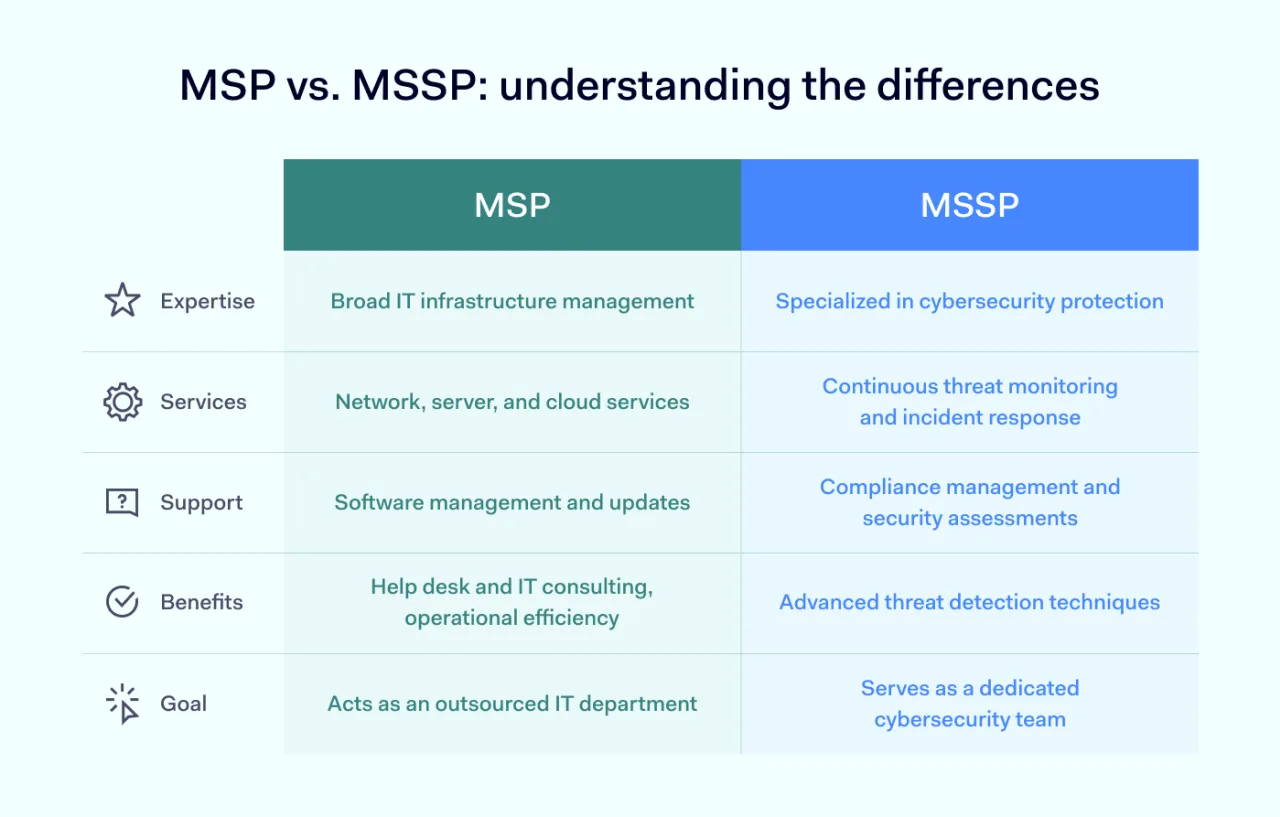
MSPs serve as a full IT department, offering various services like network management and software updates. Their primary goal is to ensure the seamless operation and reliability of your IT infrastructure. MSPs are the technology stewards, ensuring your systems are efficient, up-to-date, and scalable to support your business objectives.

MSSPs focus narrowly yet deeply on cybersecurity, acting as vigilant protectors against cyber threats. They specialize in monitoring, managing, and responding to security risks, employing a suite of services designed to protect businesses from digital dangers. Their services range from real-time threat monitoring to incident response and compliance management, all aimed at fortifying your organization’s cybersecurity posture.

To neatly summarize the distinctions, let’s lay MSP vs. MSSP out in a table:
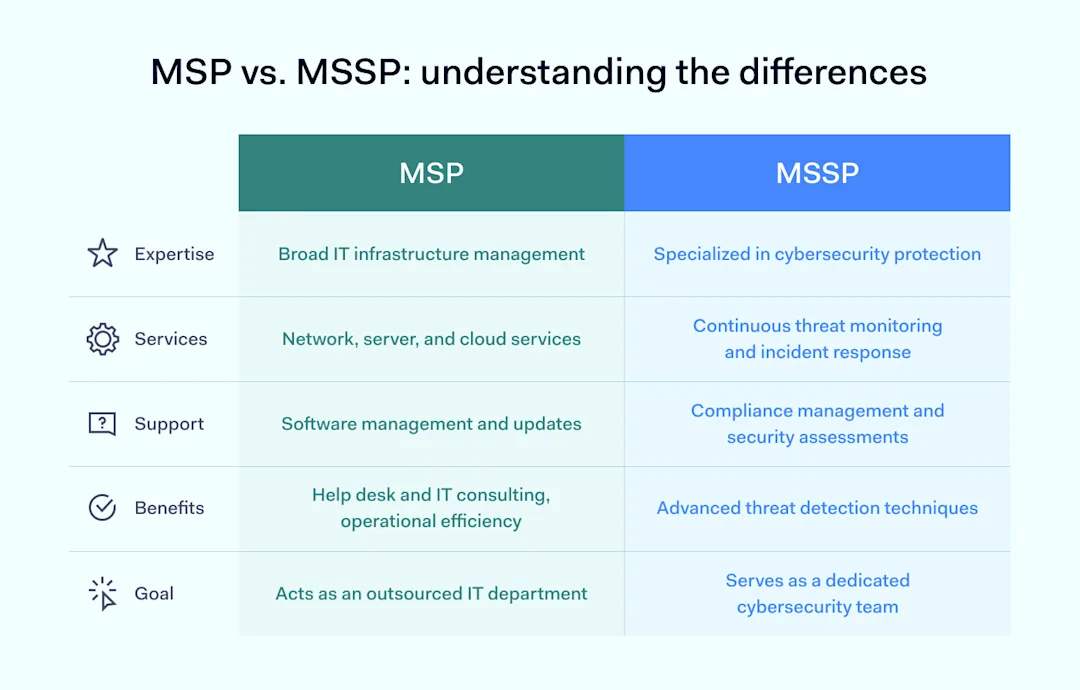
MSP vs MSSP: the key differencesHere’s a breakdown of their primary differences:

MSPs focus on the broader spectrum of managing and optimizing IT infrastructure and operations. They offer a wide range of services, including:

  • Managing networks, servers, and cloud services

  • Providing software management and updates

  • Help desk support and IT consulting.

The core objective of MSPs is to enhance operational efficiency and support business growth, acting essentially as an outsourced IT department.

MSSPs, on the other hand, specialize in protecting businesses from cyber threats and ensuring data security. Their services are centered around:

  • Incident response

  • Compliance management

  • Security assessments.

They use advanced methods to detect and prevent cyber threats, acting as a dedicated cybersecurity team for their clients.

While MSPs are all about ensuring that the IT infrastructure is running smoothly to support and enhance business operations. MSSPs, on the other hand, dive deeper into the cybersecurity aspect, ensuring that businesses are safeguarded against the increasing number of cyber threats.

Whether a business opts for an MSP or an MSSP depends on its primary needs: comprehensive IT management or specialized cybersecurity protection.

Click to tweet

In many cases, businesses benefit from the combined strengths of both types of providers to ensure both operational excellence and robust security.

What is the difference between MSSP and MDR?

While MSSPs focus on managing and monitoring security services, MDR (Managed Detection and Response) providers take a more hands-on approach to actively hunting, detecting, and responding to threats. Think of MSSPs as your cybersecurity watchdogs, while MDR services are the special forces that detect and neutralize threats.

MSP and MSSP: the market growth

The global managed services market has seen consistent growth, driven by businesses’ increasing reliance on IT infrastructure and the need for efficient, scalable solutions.

According to projections, this market could grow significantly, reaching a substantial valuation by 2028. This growth is fueled by the ongoing digital transformation in various sectors, necessitating managed IT services to support operations, data management, cloud services, and customer relations.

The managed security services market is also on a robust growth trajectory, with a specific focus on cybersecurity services.

The escalating threat landscape propels this market’s expansion, regulatory compliance requirements, and the complexity of cybersecurity solutions. Businesses are increasingly outsourcing their cybersecurity needs to MSSPs to protect against data breaches and cyber-attacks and to ensure data privacy and compliance with regulations.

Factors defining MSP market growth

  • Digital transformation: as businesses continue to digitize operations, the demand for comprehensive IT services, including cloud management, data analytics, and network infrastructure, grows.

  • Cost efficiency: MSPs offer a cost-effective solution for businesses to manage their IT needs without the overhead of an in-house IT department.

  • Scalability and flexibility: the ability of MSPs to scale services according to business needs is a key driver, allowing companies to adjust their IT services based on growth and seasonal demands.

Factors responsible for MSSP market growth

  • Cybersecurity challenges: the increasing sophistication of cyber threats drives demand for MSSPs as businesses seek specialized expertise to navigate the complex cybersecurity landscape.

  • Regulatory compliance: With growing regulatory pressures around data protection, businesses turn to MSSPs for compliance assurance and to avoid potential fines.

  • Advanced threat detection and response: the need for 24/7 monitoring and quick response to security incidents has become critical, making MSSPs an essential partner for businesses.

Market differences

While both MSPs and MSSPs are integral to the IT and cybersecurity ecosystem, their markets differ primarily in focus and expertise.

MSPs are broad, covering all aspects of IT management and support, catering to businesses’ operational and efficiency needs. In contrast, MSSPs are specialized, focusing solely on cybersecurity services to protect businesses from digital threats and ensure compliance with data protection laws.

The MSP market is defined by its operational support and infrastructure management role, appealing to businesses looking for end-to-end IT services. The MSSP market, however, is driven by the need for specialized cybersecurity services, attracting businesses focused on enhancing their security posture in the face of increasing cyber threats.

Can an MSP be an MSSP?

Yes, the line between MSPs and MSSPs can blur. Some MSPs evolve to include MSSP functions, offering a hybrid model that covers both IT management and security services. This evolution reflects the growing importance of cybersecurity across all IT operations.

The managed service provider can indeed evolve into a Managed Security Service Provider. Still, this transformation requires a strategic approach, significant investment in skills and technology, and a commitment to adopting a security-first mindset.

Why make the transition?

The move from MSP to MSSP is often motivated by the growing demand for cybersecurity services. Businesses are increasingly aware of the risks posed by cyber threats and are seeking providers that can offer both IT management and robust security measures. By transitioning to an MSSP, providers can meet this demand, offering a one-stop shop for IT and security needs.

Moreover, this evolution allows providers to differentiate themselves in a crowded market, offering added value to clients through specialized security solutions. It also opens up new revenue streams, as businesses are willing to invest significantly in cybersecurity to protect their assets and reputation.


What are the deciding factors when choosing between an MSP and an MSSP for your business?

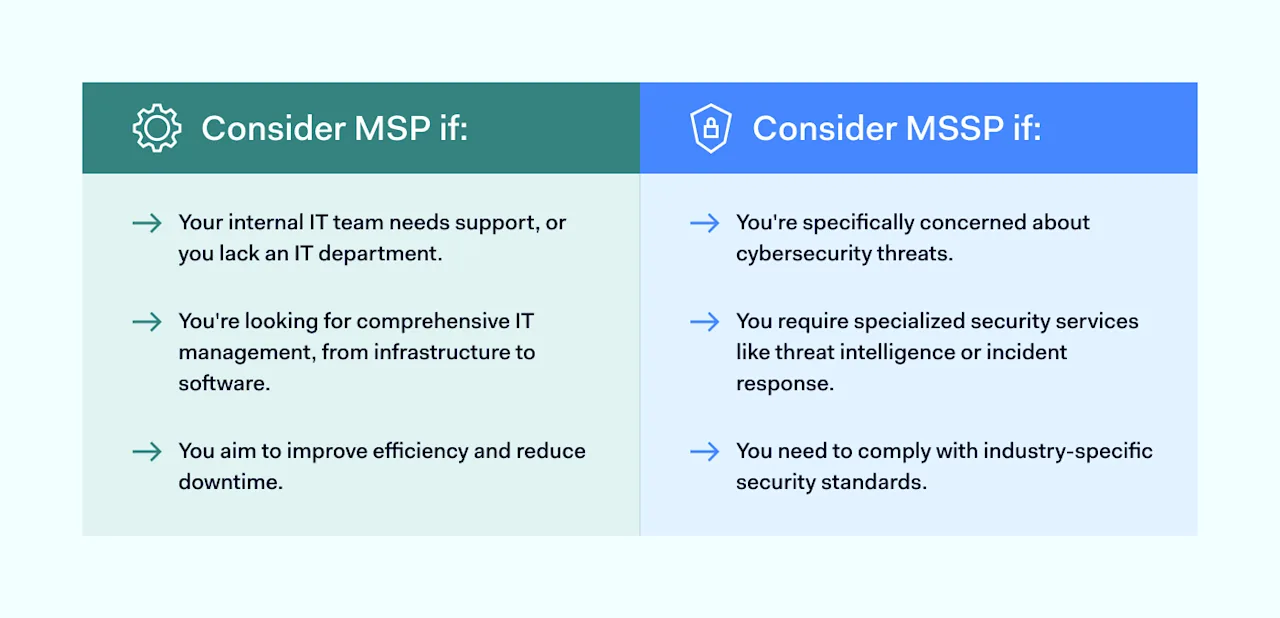
Comparing MSP vs. MSSP for your business comes down to understanding your core IT infrastructure management and cybersecurity needs. Here’s a streamlined approach to making that decision:

  • Assess business IT capabilities: if a business lacks a dedicated IT department or needs to augment its existing IT capabilities, an MSP might be the right fit. MSPs provide comprehensive IT services, ensuring your infrastructure is robust and up-to-date, with increased efficiency supporting your business operations.

  • Evaluate security requirements: if you’re particularly concerned about cybersecurity, face stringent regulatory compliance requirements, or handle sensitive data, leaning towards an MSSP makes sense. MSSPs specialize in protecting businesses from cyber threats with services like real-time monitoring, incident response, and compliance management.

  • Consider business size and sector: small to medium-sized businesses often find MSPs suitable for their broader IT needs, while larger organizations or those in high-risk sectors (e.g., finance, healthcare) may prioritize the specialized security services of an MSSP.

  • Budget and investment: determine the budget for IT and cybersecurity services. MSPs can offer more predictable costs for a range of IT services, while MSSPs might represent a higher investment focused on advanced security measures.

  • Future growth and scalability: think about business future needs. An MSP can help scale the IT infrastructure as your business grows, whereas an MSSP will ensure your cybersecurity posture scales in tandem with your risk exposure.

Selecting either an MSP or an MSSP boils down to understanding your specific needs:
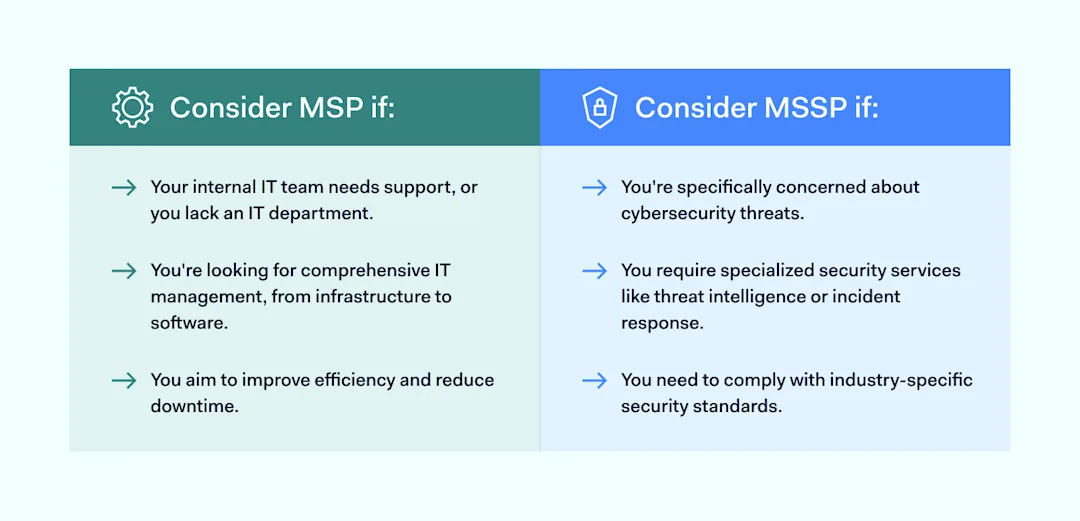
Factors when choosing between an MSP and an MSSP

How NordLayer boosts MSP capabilities

Third-party providers like NordLayer step in as a powerful solution for MSPs, enhancing their capabilities to manage and secure networks with comprehensive security solutions. It offers features like Secure Remote Access, Zero Trust network architecture, and advanced threat protection.

  • Security monitoring. NordLayer amplifies MSPs’ ability to offer continuous security monitoring, which is crucial for early threat detection and maintaining a vigilant cybersecurity posture. This ensures clients are protected around the clock from a broad spectrum of cyber threats.

  • Security operations. With NordLayer’s security solutions, MSPs can enhance their security operations through automation and advanced analytics, speeding up incident response and bolstering defenses against evolving cyber threats, thereby elevating the level of service to clients.

  • Endpoint protection. NordLayer supports MSPs in implementing robust endpoint protection and safeguarding client devices against malware and other attacks, which is essential for the integrity and security of client networks.

  • Data protection. By offering encryption and secure access controls, NordLayer assists MSPs in protecting clients’ sensitive data against unauthorized access, aligning with information security regulations, and enhancing clients’ trust.

  • Cloud services. NordLayer enables secure access to cloud services, protecting data in transit to and from the cloud, an essential feature for businesses leveraging cloud-based solutions and security operations in today’s digital environment.

  • Providing cybersecurity services. Integrating NordLayer allows MSPs to expand their cybersecurity services, covering everything from security monitoring to data protection, meeting the increasing demand for comprehensive cybersecurity solutions.

These tools bolster an MSP’s service offering and ensure clients’ networks are both accessible and secure. By performing risk assessment and integrating NordLayer, MSPs can provide a more robust IT and security infrastructure, reflecting the synergy between comprehensive IT support and dedicated cybersecurity measures.

Are you looking for a trusted partner to secure your clients’ networks? NordLayer offers a Partner Program with a focus on tangible benefits for its partners and simple yet effective solutions to protect businesses in the hectic cybersecurity landscape.


About Version 2 Digital

Version 2 Digital is one of the most dynamic IT companies in Asia. The company distributes a wide range of IT products across various areas including cyber security, cloud, data protection, end points, infrastructures, system monitoring, storage, networking, business productivity and communication products.

Through an extensive network of channels, point of sales, resellers, and partnership companies, Version 2 offers quality products and services which are highly acclaimed in the market. Its customers cover a wide spectrum which include Global 1000 enterprises, regional listed companies, different vertical industries, public utilities, Government, a vast number of successful SMEs, and consumers in various Asian cities.

About NordLayer
NordLayer is an adaptive network access security solution for modern businesses – from the world’s most trusted cybersecurity brand, Nord Security.

The web has become a chaotic space where safety and trust have been compromised by cybercrime and data protection issues. Therefore, our team has a global mission to shape a more trusted and peaceful online future for people everywhere.

How to detect and prevent DNS hijacking

Imagine trying to access a news website to catch up on the latest headlines. Still, instead of finding the articles you were looking for, you’re secretly redirected to a clone site designed to spread misinformation or to gather your personal data.

This scenario has become a reality for some, thanks to the Sea Turtle cyber espionage campaign. Linked to Turkey, this group has engaged in DNS hijacking, targeting not just any websites but those connected to telecommunications, media, ISPs, IT services, and Kurdish platforms in the Netherlands.

Their goal was to collect sensitive data on political dissidents and minority groups. DNS hijacking is often state-sponsored and used by governments to surveil and collect data on political adversaries and minority groups. These actors exploit the DNS system—essentially the internet’s phonebook—to manipulate how and where we access information online.

Businesses, too, face big risks from DNS hijacking. This threat can result in large financial losses, data breaches, and a decrease in customer trust. 

The cryptocurrency sector is especially at risk. Threat actors frequently hijack DNS to send users to fake websites and steal cryptocurrency assets. Because you can’t reverse cryptocurrency transactions, this approach is particularly dangerous. 

In this article, we’ll explore how to detect DNS hijacking in simple steps.

Key takeaways

  • DNS hijacking is an attack where someone redirects you to a different site that they control, which might look like the one you wanted but can steal your information or harm your computer.

  • The attack uses the DNS system, which normally helps your browser find websites, to send you to a fake website instead of the real one you wanted to visit.

  • Look out for being sent to unexpected websites, your internet running slowly, or warnings about a website’s security certificate to catch DNS hijacking early.

  • Protect yourself by using strong passwords for your router, updating its firmware, enabling DNSSEC validation, and using a VPN to encrypt your online activity.

  • Incidents like the Sea Turtle campaign and the attack on a Brazilian bank show how serious DNS hijacking can be and why strong security measures are important.

  • NordLayer helps protect against these threats with its DNS filtering service, which blocks harmful websites.

What is DNS hijacking?

Domain Name System (DNS) hijacking is a form of cyber-attack in which an attacker intercepts and redirects the DNS queries made by a user. Instead of reaching the intended website, the user is sent to a fraudulent site, often without realizing it. This technique can be used to steal personal information, distribute malware, or censor information.

Related articles


In Depth

What is content filtering?

13 Sep 202210 min read

Content Filtering


Product Updates

NordLayer features in review: DPI & DNS filtering

27 Sep 20229 min read

Filter online traffic with Virtual Private Gateway


How does DNS hijacking work?

DNS hijacking operates by using the DNS, which acts as the internet’s phonebook. Normally, when you enter a website address into your browser, your computer sends a DNS query to a DNS server to translate the domain name into an IP address. This IP address is what allows your browser to connect to the website’s server.

However, in a DNS hijacking scenario, an attacker intercepts or alters this query process. Instead of directing you to the correct IP address, the attacker redirects you to a fraudulent website or server that they control. This manipulated redirection can occur without any visible signs, making the user believe they are visiting a legitimate site.

For example, imagine you’re trying to log into your online banking account. You type the bank’s URL into your browser, expecting to be taken to your bank’s login page. If you’re a victim of DNS hijacking, you are sent to a counterfeit version of the bank’s website instead of reaching the real banking site. This site looks identical to the real one, but when you enter your login credentials, they are captured by the attacker.

Types of DNS hijacking

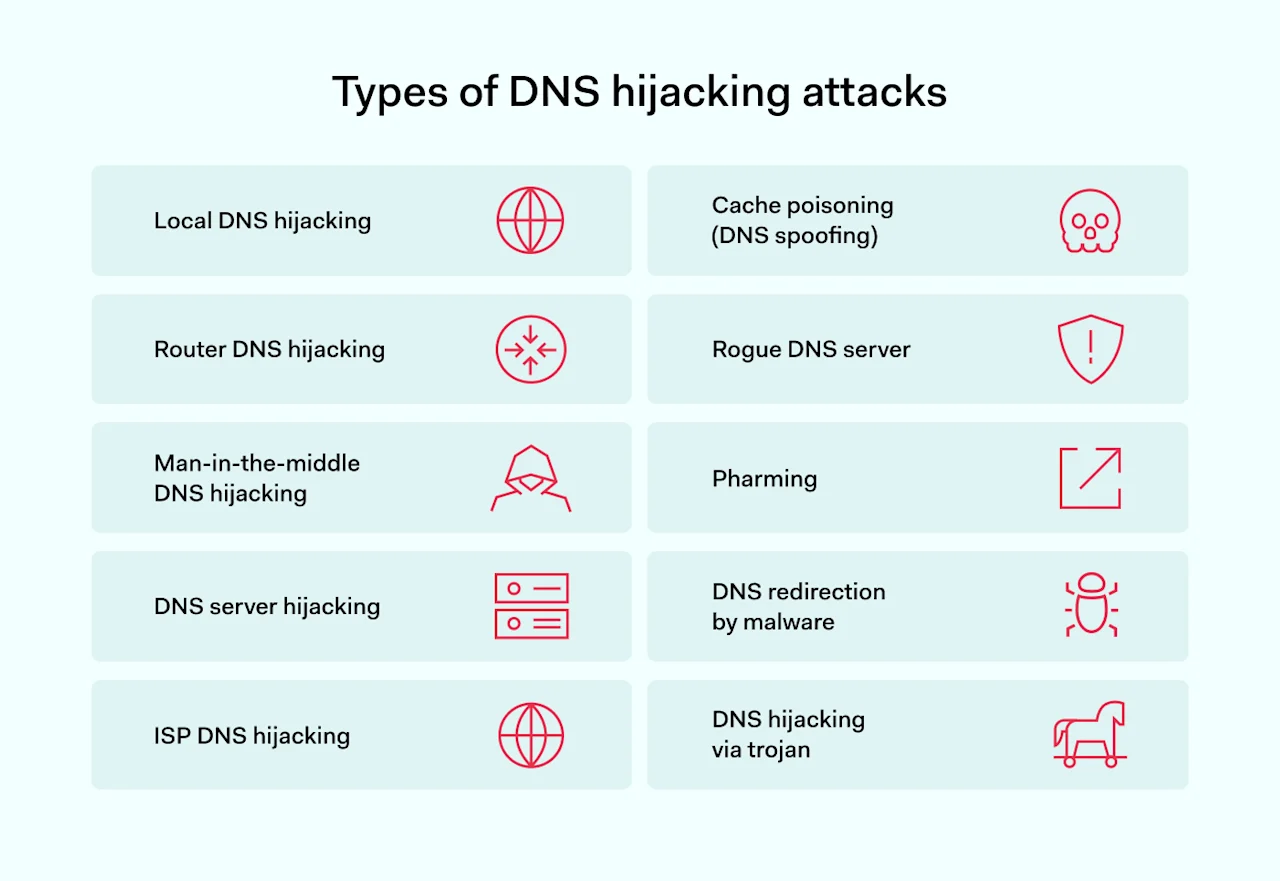
Understanding the various types of DNS hijacking is crucial for maintaining our online safety. Let’s explore the most popular ones.

Types of DNS hijacking attacks

Local DNS hijacking

This happens when malware changes the DNS settings on your device. If this occurs, your device might take you to places on the internet that you didn’t intend to visit, risking your personal information. It’s essential to keep your antivirus software up to date to catch and remove such malware.

Router DNS hijacking

Attackers target your internet router and change its DNS settings. This action affects all devices using that router. It’s like someone redirecting all the mail from your house to somewhere else. 

Ensuring your router’s firmware is regularly updated and its password is strong is a good practice to prevent DNS hijacking.

Man-in-the-middle DNS hijacking

In this scenario, attackers intercept your DNS requests. It’s as if someone catches a letter you’re sending out, opens it, and sends it somewhere else without you knowing. 

Using secure networks and VPN services can help safeguard against such interceptions.

DNS server hijacking

Here, the attackers take control of a DNS server and change its DNS records. This means they can redirect traffic from many users to malicious websites. It’s a broad DNS attack, affecting many at once. 

Internet Service Providers and organizations managing DNS servers need to monitor and secure their servers diligently.

ISP DNS hijacking

Sometimes, your Internet Service Provider might redirect your DNS queries. Although these redirects aren’t always malicious, they can still introduce security risks. Using a custom DNS service can give you more control over where your queries go, enhancing your privacy and security.

Cache poisoning (DNS spoofing)

Cache poisoning, also known as DNS spoofing, is a technique where attackers insert false information into a DNS server’s cache. When this happens, your computer, which relies on the DNS server to translate website names into IP addresses, gets misled. It takes you to a different website controlled by the attacker.

A DNS resolver is a crucial part of this process. It’s the tool that your computer uses to ask the DNS server, ‘What is the IP address for this website?’ When the resolver receives incorrect information from a poisoned DNS cache, it unknowingly directs you to the wrong place.

The DNS cache is where the resolver stores IP addresses it has recently looked up. If the cache gets poisoned, even future DNS requests can lead to the wrong sites until the DNS cache is cleared or the false entries expire.

Preventing cache poisoning involves ensuring your DNS resolver uses DNSSEC (DNS Security Extensions). DNSSEC is a security measure that ensures the information your resolver receives is authentic.

Rogue DNS server

If you’re tricked into using a rogue DNS server, it will intentionally mislead you by taking you to the wrong websites. This often leads to malicious websites. Being cautious about which DNS server you use and opting for reputable DNS providers can protect you.

Pharming

Pharming redirects you to fake websites without your click or consent, exploiting vulnerabilities either in your device or in DNS servers. It’s more sneaky than phishing. 

Employing robust security measures and staying vigilant about unusual browser behavior can help you stay clear of these traps.

DNS redirection by malware

When malware on your device redirects your DNS queries, it can make you think you’re visiting safe websites when you’re not. Regular scans with updated antivirus software can help detect and remove such malware.

DNS hijacking via trojan

A trojan can change your DNS settings or point you to a malicious DNS server. It often masquerades as legitimate software, tricking you into downloading it. Being cautious about what you download and keeping your security software up to date are good ways to avoid such threats.

Each type of DNS hijacking exploits our trust in the internet’s infrastructure. Remember, detecting DNS hijacking early and taking steps to prevent it are key to keeping your internet experience safe and secure.

Examples of DNS hijacking

Brazilian bank attack

Back in 2016, a big bank in Brazil was hit by a DNS hijacking attack. The threat actors changed the bank’s DNS settings, redirecting customers to fake websites instead of the bank’s real ones. These sites mimicked the bank’s authentic ones, tricking people into giving away their personal and banking info.

This incident showed how big of an impact DNS hijacking can have, especially on financial institutions, and showed the need to prevent DNS hijacking attacks. 

Sea Turtle campaign

The Sea Turtle campaign is a cyber espionage operation that started in 2019. It targets organizations across the globe to gather sensitive information. 

This group uses DNS hijacking because after redirecting internet traffic to malicious websites and stealing login credentials, they can spy on the data traffic of targeted entities. They opt for DNS hijacking because of its sneakiness; victims often don’t realize they’re visiting fake websites.

In 2024, Sea Turtle expanded its reach to include targets in the Netherlands, focusing on telecommunications, media, ISPs, IT services, and Kurdish websites. 

Iranian attack incidents

Iranian threat actors, known under the alias Lyceum, target the Middle East with DNS hijacking. They’ve introduced a new NET-based backdoor, evolving their tactics to manipulate DNS queries. 

The essence of this DNS hijacking lies in its execution through a macro-laced Microsoft Document, seemingly reporting legitimate news but actually serving as a trojan horse for the malware. It’s designed not just for spying but also for full control over the compromised systems. 

Companies need robust measures to detect and prevent DNS spoofing and similar DNS hijacking attacks.

How to detect DNS hijacking?

Here’s a guide on how to spot DNS hijacking, which includes simple steps that can help you figure out if a DNS attack has hit you.

Spot unexpected website redirects. Imagine you’re trying to visit your favorite news site but end up on a completely different page that asks for personal details. This could be a sign of DNS hijacking, where attackers redirect you to fake sites to steal your info.

Notice if your internet feels slow. If your web pages suddenly start taking longer to load, it might mean someone is messing with your DNS queries. This slowing down happens because the hijack adds extra steps to reach websites.

Use tools to check your DNS server. There are tools online that let you see if the DNS server your computer is using matches the one your Internet Service Provider (ISP) gave you. A mismatch might mean your DNS settings have been changed without you knowing.

Watch for SSL certificate warnings. When you visit a secure site, your browser checks its SSL certificate to ensure it’s safe. If you get a warning that something’s off, like the certificate doesn’t match the site’s name, it could mean you’ve been redirected to a harmful site by DNS hijacking.

Use network monitoring tools. These tools can spot odd behavior in your DNS traffic, like a sudden spike in DNS requests or visits to known bad sites. This can clue you in on possible DNS hijacking attempts.

Audit your DNS records. Check your domain’s DNS records with your registrar every so often. If you find changes you didn’t make, it might mean someone has hijacked your DNS.

Talk to your ISP. If you’re worried about DNS hijacking, a call to your ISP can be reassuring. They can check if the DNS servers you’re using are legit and offer tips on keeping your connection secure.

How to prevent DNS hijacking for businesses?

Keeping your online world safe from DNS hijacking is really important. Here’s a guide on how to prevent DNS hijacking attacks.

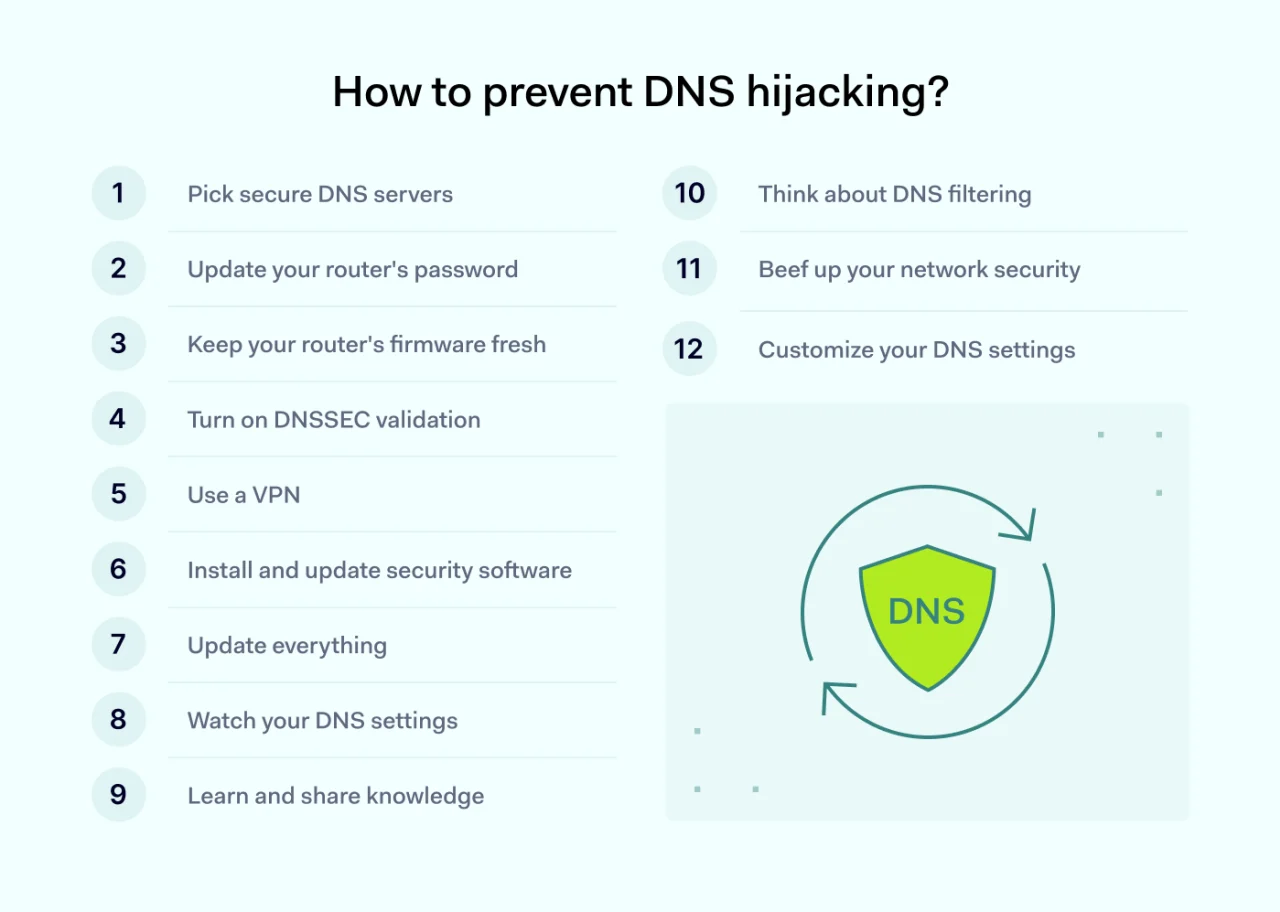
How to prevent DNS hijacking

Pick secure DNS servers. DNSSEC stands for Domain Name System Security Extensions. It’s a set of protocols that add a layer of security to the DNS lookup process, ensuring the information your network receives hasn’t been tampered with. Opting for DNS servers that support DNSSEC minimizes the risk of your business being directed to fraudulent websites.

Update your router’s password. Routers often come with default passwords that are easily predictable. Changing these passwords to something strong and unique is crucial for keeping attackers out. 

Keep your router’s firmware fresh. Router makers often fix security holes with new firmware updates. Staying up-to-date helps block paths that threat actors could use for DNS hijacking.

Turn on DNSSEC validation. Enabling DNSSEC validation across your network means that DNS responses are checked for authenticity before being accepted. This prevents attackers from redirecting your internet traffic to malicious sites through spoofed DNS responses, a common tactic in DNS hijacking. 

Use a business VPN. A Virtual Private Network encrypts what you do online, shielding you from certain DNS hijacking methods. Choosing a trusted VPN service adds a solid layer of protection.

Install and update security software. Antivirus and anti-malware programs can catch and delete harmful software that might change your DNS settings. Keeping this software up to date is key to fighting off new threats. 

Update everything. Software updates often patch up security weaknesses. Regularly updating your system and applications protects you from being an easy target for DNS hijacking.

Watch your DNS settings. Keep an eye on the DNS settings on your company’s devices and router. If something looks off, dig deeper and fix it to ensure you’re not under attack.

Learn and share knowledge. Understanding this issue is key to keeping your network safe. Explain to your employees what DNS hijacking is, why it’s a problem, and how to spot if the network might be compromised. When people know what to look out for, they can help stop these attacks before they do harm.

Think about DNS filtering. These services stop your network from connecting to websites that are known to be harmful. They can also block attempts to contact servers that spread malware. Adding DNS filtering to your security plan is a good way to keep out threats that could lead to DNS hijacking. 

Beef up your network security. Using firewalls and following best practices for network security build a strong defense against unauthorized entries and various cyber threats, including DNS hijacking. These actions add extra layers of protection, which makes it harder for attackers to break into your network or carry out harmful activities.

Customize your DNS settings. Instead of sticking with your Internet Service Provider’s DNS, switch to custom DNS servers known for being secure. This gives you more control and reduces hijacking risks. 

How NordLayer can help

NordLayer steps in to help your company stay safe online with its DNS filtering service. This tool stops access to malicious websites and screens out content that might be harmful or distracting for your team.

Managers can set rules on what’s not allowed on the company’s networks. It acts like a shield, keeping team members safe from phishing and other harmful online stuff. This way, everyone can focus on their work without worrying about online threats.

Using NordLayer’s DNS filtering is easy and effective. Whenever someone tries to visit a website, NordLayer checks it against a list of safe and approved sites. If it finds a website that’s unsafe or on a blocklist, it won’t let the site load.

This step is great for stopping online threats before they can do any harm. Plus, NordLayer has a feature called ThreatBlock, which finds and blocks dangerous domains by pulling information from many places. Along with keeping your internet traffic safe with strong encryption and the ability to filter out more than 50 types of not-so-great content, NordLayer gives you a powerful way to keep your organization’s online space secure and productive. No matter the size of your team, NordLayer is ready to help you manage and protect your remote workers in a simple and effective way. 

About Version 2 Digital

Version 2 Digital is one of the most dynamic IT companies in Asia. The company distributes a wide range of IT products across various areas including cyber security, cloud, data protection, end points, infrastructures, system monitoring, storage, networking, business productivity and communication products.

Through an extensive network of channels, point of sales, resellers, and partnership companies, Version 2 offers quality products and services which are highly acclaimed in the market. Its customers cover a wide spectrum which include Global 1000 enterprises, regional listed companies, different vertical industries, public utilities, Government, a vast number of successful SMEs, and consumers in various Asian cities.

About NordPass
NordPass is developed by Nord Security, a company leading the global market of cybersecurity products.

The web has become a chaotic space where safety and trust have been compromised by cybercrime and data protection issues. Therefore, our team has a global mission to shape a more trusted and peaceful online future for people everywhere.

What are advanced persistent threats (APT) and how can you steer clear of them?

Cyberattacks are not all one-and-done deals. Some cybercriminals prefer to play the long game – they lurk and gather information over time before dealing the massive final blow. Advanced persistent threats (APT), our topic today, are exactly such long ploys – they’re used to infiltrate a device and slowly collect its most sensitive data.

Falling victim to prolonged attack campaigns can be detrimental to a business, so it’s crucial to know the most effective defenses against them. Let’s look at how advanced persistent threats work, how they differ from other cyberattacks, and what you can do to keep your company safe.

Advanced persistent threat lifecycle

Unlike malware, phishing emails, or other dangers lurking online, an advanced persistent threat isn’t a single tool or action. The term describes a series of processes that include the infiltration and extraction of sensitive information from a device or a system. Its scale means that catching advanced persistent threats is a delicate process, and they may go unnoticed until it’s too late.

Given the intricate nature of APTs and the complexity of their execution, these tactics are usually used by more experienced cybercriminals. Governments, law firms, and financial institutions are particularly popular targets as they handle highly valuable confidential data. The attackers tend to go after classified personal and financial information, intellectual property, patents, and other data that may be used for blackmail or ransom. Motives behind APTs include espionage and cyber warfare.

Advanced persistent threats require a lot of preparations ahead of the true strike. The attackers must first establish their targets and research them thoroughly, learning both about the organization’s internal structure and the employees. The preparation stage helps find the target’s weak links, such as poor password policies, insufficient on-site security, or outdated software use.

Once the background information is gathered, testing begins. The attackers want to ensure they enter and leave the system with the stolen data unnoticed, and they must go through trial and error to succeed. This thorough preparation makes advanced persistent threats stand out as some of the most sophisticated attacks, requiring expert teams to dismantle them and prevent or undo the damages. The execution itself consists of three advanced persistent threat steps.

Once the background work is done and the test runs have succeeded, cybercriminals initiate the first stage of the lifecycle – infiltration. Depending on the nature of the attack, they can infiltrate the system in different ways. Phishing to acquire employees’ login credentials is a common strategy, as is using malicious email attachments that infect the system once downloaded and opened. Regardless of the actual strategy, the goal is to breach the defense systems and weaken the security measures in place.

As soon as the hackers have established their presence in the now-infected system, it’s time for them to settle in and spread their roots. This step is usually known as escalation – a crucial stage for gathering intel and inching to the much-desired data. As they escalate, cybercriminals will acquire employee credentials, override security protocols, and establish backdoors to enter and exit the systems unnoticed, even if their key operation is compromised. They can attempt to reuse the backdoors in the future after evolving their tactics and striking the system again.

With the jackpot uncovered and the valuable data gathered, attackers can start the final phase of their operation – extraction. The backdoors from step two can be advantageous here, as the goal is to exfiltrate all the stolen information undetected. The biggest challenge here is distracting any uncompromised security systems. To achieve this, cybercriminals may rely on code obfuscation – creating a code that’s difficult for humans and computers to understand and disassemble – or distributed denial of service (DDoS) attacks.

How do APTs differ from other threats?

The hint is in the name here – advanced persistent threats aren’t crafted like viruses you can easily quarantine. Instead, they’re deeply hidden in the system, quietly combining several threats that would be a challenge to contain on their own to maximize the damage. They’re not quite the “mother of all threats,” but they’re certainly close – especially for small-scale companies that can be eroded from within by tactics that APT attackers employ.

Advanced persistent threats combine the worst that cyber criminals have to offer, all packaged into one – Trojan viruses infiltrating the systems, denial of service attacks to distract the security team, and mass phishing campaigns to get hold of as many login credentials as possible. One such attack could cause irreparable harm to a company, while the whole package is a destructive force. Worst of all, the amount of work put into every stage of the APT lifecycle means they’re difficult to detect, and the damage is harder to undo.

What tactics are employed in an APT attack?

As we’ve established, the process of setting up and executing is complex and multifaceted. Different stages of the process employ different tactics to optimize the potential retrieval of data and exploit as many blind spots as possible. The goal is to simultaneously overwhelm the system’s security measures and pass through them undetected. Common tactics used during an advanced persistent threat attack include:

  • Phishing. Social engineering techniques reign supreme even in the most sophisticated schemes, so it’s unsurprising that phishing is employed in APT attacks. In this instance, spear phishing is the popular choice – this type of attack targets a specific person to access sensitive information required to get inside the system.

  • Credential theft. This tactic often goes hand in hand with phishing attempts. The goal is to overtake as many login credentials within the organization as possible to maximize the possible theft scale.

  • DoS and DDoS attacks. These two types of denial-of-service attacks are used as a distraction technique. By overwhelming the server traffic with artificial requests, attackers distract the security team and can sneak deeper into the system undetected.

  • Zero-day exploits. Zero-day vulnerabilities are bugs or other weaknesses in a system that have been noticed by an attacker but haven’t been patched yet. This strategy is a gambit for hackers because it requires a fast pace to execute. If executed in time, it can be used for espionage or extraction.

  • Trojans. Coopting their name from the ancient Greek myth, Trojan viruses pretend to be legitimate apps and, upon being opened, attack your system from within. They may be used to weaken the defensive systems, create backdoors, or grant remote control of the infected device.

  • Code obfuscation. This is the process of creating a program that uses code so complicated neither people nor computers can effectively read or decipher it. This tactic helps cybercriminals escape the system in the final stages of an APT attack undetected, as the security tools are too preoccupied with the impossible code.

Advanced Persistent Threat examples

Some of the biggest advanced persistent threats were years-long projects, attesting to the complexity of such attacks. Some APT groups have been around for over a decade, targeting high-profile subjects and companies, often in politically charged schemes. Many such groups are considered state-sponsored, while others may form on their own volition.

One of the oldest named attacks is Titan Rain, which started in 2003 and lasted several years. While the attacks that targeted the computer systems of various US-based organizations originated in China, the specific group was never identified or named. Nevertheless, the APT space is associated with a few notorious groups associated with cyber espionage, warfare, and hacktivism.

The APT group names that you see in the news are rarely official. Unlike other cybercrime groups that may pick a moniker, APT groups are identified and named by cybersecurity and cyberintelligence agencies. Therefore, you may see the same group referred to by a different name. For example, Microsoft’s naming taxonomy assigns climate terms based on the presumed region of the attack, whereas CrowdStrike uses animal names, i.e., “Typhoon” and “Panda” for China or “Sandstorm” and “Kitten” for Iran, respectively.

Fancy Bear (Forest Blizzard, APT28)

Fancy Bear is a Russian-based cyber espionage group. Although it wasn’t officially identified until 2014, it’s been engaged in advanced persistent threat attacks since at least 2007. The primary exploitation used by APT28 is zero-day vulnerabilities. Over the years, the group has been associated with Russian military intelligence and has been part of active cyber warfare following Russia’s invasion of Ukraine in 2022. They’ve also notably targeted the German parliament in a six-month APT in 2014 and interfered in presidential elections in France and the US.

Lazarus (Diamond Sleet, APT38)

Lazarus is an allegedly North Korean cyber warfare group. Its earliest confirmed APT attack, Operation Troy, dates back to 2009 and lasted until 2012. The group targeted the South Korean government with a stream of DDoS attacks. In recent years, Lazarus gained more notoriety for attacks against cryptocurrency exchanges, digital casinos, and traditional financial institutions.

Helix Kitten (Hazel Sandstorm, APT34)

Helix Kitten is assumed to be an Iranian cybercriminal group. It has a history of targeting financial and telecommunications industries, particularly in the Middle East, and relies heavily on social engineering techniques in its attacks. Its targets often overlap with those hit by Refined Kitten, another APT group assumed to be from Iran. However, it’s unclear whether the two groups work in tandem.

APT security measures

Preparing defenses against advanced persistent threats requires businesses to think ahead and stay on top of the most recent breach strategies. In some instances, an organization may only start working on its security measures after the infiltration phase of the attack, meaning that its reaction has to be quick and rely on robust tools to prevent broach escalation.

Here are some of the tools and tactics that your advanced persistent threat defense system should include:

  • Routine software updates and patches – due to the prominence of zero-day exploits, it’s crucial to keep your software up-to-date to close any potential vulnerabilities.

  • Secure private networks – unencrypted networks open up gateways for cybercriminals to sneak in. Ensure your organization uses encrypted network access, like NordLayer, to secure your company resources.

  • Web Application Firewalls (WAF) – firewalls help protect your web servers from potential infiltration attempts by monitoring web traffic in your organization, detecting suspicious activity, and blocking threats.

  • Breach and Attack Simulations (BAS) – running simulations helps ensure your security team is ready to tackle an incoming threat. It also ensures your tools are up-to-date and ready to handle robust cybercriminal tactics.

  • Live monitoring – it’s simpler to open a backdoor passage when the security team isn’t looking. Ensure that your company is always monitoring inbound and outbound network traffic to detect and block suspicious and malicious activity instantly.

  • Centralized password policies – password exploits help cybercriminals access organization accounts and, by extension, their jackpot – sensitive data and resources. By enforcing a password policy in your organization, you can ensure that everyone follows the protocol and uses strong login credentials. The policies can also account for potential data breaches and help reset affected accounts faster.

  • Employee training – to account for the human error factor, all employees should be aware of and stick to correct cybersecurity practices. Ensure your teams have regular online security training and follow the company guidelines.

How can NordPass help you stay protected?

Perhaps the scariest thing about advanced persistent threats is their ability to infiltrate a system undetected. This simply means that you need to reinforce your first line of defense to prevent cybercriminals from breaching your systems in the first place. Even if you suspect you’re under attack, you can work on reinforcing your APT cybersecurity protection.

You may have noticed a trend already – many APT attacks involve social engineering techniques and rely on human error to succeed in the early stages. This makes protective measures surprisingly easy – implementing a secure password management system in your organization can be a life-changer.

The NordPass Enterprise password manager lets you set up a robust company-wide password policy, ensuring everyone adheres to the highest security standards. The Enterprise plan is compatible with major identity authentication services, enabling secure and instant single sign-on (SSO) access. If you suspect any malicious activity from within, you can easily revoke access to sensitive information or reassign it to a different employee. If you suspect that your sensitive data has been compromised, you can use the Data Breach Scanner to track your company credentials, domains, and credit card information.

Get in touch with our team to learn more about how NordPass Enterprise helps your organization stay secure in the face of advanced persistent threats.

About Version 2 Digital

Version 2 Digital is one of the most dynamic IT companies in Asia. The company distributes a wide range of IT products across various areas including cyber security, cloud, data protection, end points, infrastructures, system monitoring, storage, networking, business productivity and communication products.

Through an extensive network of channels, point of sales, resellers, and partnership companies, Version 2 offers quality products and services which are highly acclaimed in the market. Its customers cover a wide spectrum which include Global 1000 enterprises, regional listed companies, different vertical industries, public utilities, Government, a vast number of successful SMEs, and consumers in various Asian cities.

About NordPass
NordPass is developed by Nord Security, a company leading the global market of cybersecurity products.

The web has become a chaotic space where safety and trust have been compromised by cybercrime and data protection issues. Therefore, our team has a global mission to shape a more trusted and peaceful online future for people everywhere.

Tech she said: insights and life hacks from women in the field

Many countries mark International Women’s Day on March 8. In the tech industry, we see a significant gap: women occupy only 22% of the tech roles in Europe. The Economist’s glass-ceiling rating reveals that not even the wealthiest countries have achieved gender equality. 

This led us to have a conversation about gender equality with two accomplished women in tech, Shelby Dacko, a Human Risk Analyst at Social-Engineer LLC, and Gintarė Milkevičiūtė, a Product Manager at NordLayer. We explored issues related to gender equality and self-confidence among women. We also talked about ways to empower women and took time to celebrate their successes.

The interview highlights

  • To increase the number of women in tech, it’s essential to both encourage young girls and support women who are already in the field.

  • Role models are crucial for inspiration; they can be everyday people you know, not necessarily famous women.

  • When feeling stressed before something important, reassure yourself by remembering just to do what you do every day.

  • A useful strategy during stressful times is to believe that you are the most knowledgeable person in the room.

  • Being mindful of your current situation, preparing adequately, and investing in presenting yourself confidently are key.

  • Diversity is beneficial for business as people from different backgrounds and mindsets enhance performance.

  • The tech field is exciting and welcoming, affirming that women are fully capable and belong in this space.

NordLayer: Let’s introduce Shelby Dacko, a Human Risk Analyst at Social-Engineer LLC. She’s skilled in open-source intelligence and has made over 20,000 vishing calls. Shelby, can you tell us more about yourself and being a certified ethical social engineer?

Shelby Dacko: I started as a sign language interpreter before shifting towards tech. I was drawn to social engineering after a course recommendation. That course sparked my interest, leading me to join the field. I’ve been in tech for nearly five years now.

NordLayer: Thank you. We also welcome Ginte Milkevičiūtė, Product Manager at NordLayer. She focuses on product development and management.

Gintarė Milkevičiūtė: I joined the cybersecurity sector and NordLayer just over half a year ago. Understanding how users interact with and utilize the product is my area of expertise. Before that, I spent my career in similar positions, leading tech-oriented projects, products, and transformations in both B2C and B2B organizations.

Insight #1: Boost women in tech by encouraging young girls and backing the women who are paving the way

NordLayer: Increasing the number of women in tech is key. A McKinsey analysis suggests that if Europe could boost women’s presence in tech to 45% by 2027, it might close the talent gap and potentially increase GDP by up to €600 billion.

There are programs aimed at including women in tech, such as Black Girls Code, among other initiatives. Shelby, what do you think about strategies to further empower women to join and thrive in the tech industry?

Shelby Dacko: It’s crucial for young women to see other women in tech. We need to encourage opportunities from a young age, and the organizations mentioned are doing a great job at this. Involvement in programs targeting high schoolers and younger to foster a love for the field is necessary. My company has engaged in such activities, with my boss speaking to children about social engineering. These are just a few actions we need to continue and expand upon.

Gintarė Milkevičiūtė: I strongly agree that seeing women in technical roles early in life can be as inspiring as knowing Barbie can be a doctor or an astronaut. It shows there are more alternatives.

Another important aspect is how we communicate with children and young adults. Often, girls are complimented on their appearance, while boys are praised for their intelligence. This reflects a societal bias, emphasizing the need for society, including parents, grandparents, uncles, friends, and brothers, to recognize and nurture individuals with a suitable mindset for tech, regardless of gender. Let’s not limit our children’s opportunities based on gender stereotypes.

Talent Acquisition insights 

In my time hiring for tech roles, I’ve noticed a big increase in women applying over the last five years. More and more women are showing interest in a variety of tech jobs, like engineering, cybersecurity, and data science.

At Nord Security, diversity matters a lot to us. We make it a priority to encourage women to apply for positions. Our NordSwitch program is a great example of this. We run it every year to bring in people from different backgrounds.

We’re looking forward to it this April just as much as in past years. It’s worth noting that half of the people we hired from this program were women. What’s even more heartening is that 90% of them have stayed with us for more than six months, and they’re happy in their roles.

Lauryna Girėnienė, Head of Talent Acquisition at NordVPN and NordLayer

Click to tweet

Insight #2: Your role model could be someone you know; heroes aren’t just those in the spotlight

NordLayer: Let’s talk about the role of models. Shelby, how have role models influenced your tech career?

Shelby Dacko: Three women come to mind as my role models. First, there’s Dr. Abbie, a scientist, not specifically tech-focused but a mentor who significantly helped me step out of my comfort zone. Then, Amanda Marchuk, my colleague, is my biggest supporter. Finally, Rosa Rowles, a fellow researcher I work with daily, brings a different perspective to our work, which is fascinating. We tackle problems from varied angles but always support each other.

NordLayer: That’s wonderful. Having an empowering atmosphere within the team is vital. Ginte, could you also share your story and role models?

Gintarė Milkevičiūtė: It might sound cliché, but it’s my mother. She’s had a 55-year career in civil engineering, specializing in drafting blueprints for large buildings, such as refrigerating facilities the size of football fields and various industrial buildings. When she started her career, it was a highly male-dominated field.

She’s taught me to be logical, focused, and thorough, which has been invaluable. Growing up, her example made me confident I could succeed in technical areas, especially ones involving physics and math, which I loved.

When I started my professional life, I finally met other women in tech. A standout was the head of our architecture department, the most senior woman I’d seen in my field. She was incredibly skilled and supportive.

Now, at NordLayer, our CTO, Juta, is a fantastic leader I admire. I’m lucky to have a great circle of friends at work to share ideas and challenges with.

Insight #3: Stressed? Remind yourself, “I’ve got this, just like any other day.”

NordLayer: Now, let’s touch on challenges and setbacks. Shelby, could you share some of the biggest challenges you’ve faced as a woman in tech, the mindset that helped you overcome these obstacles, and any particular stories, lessons learned, or achievements that make you proud?

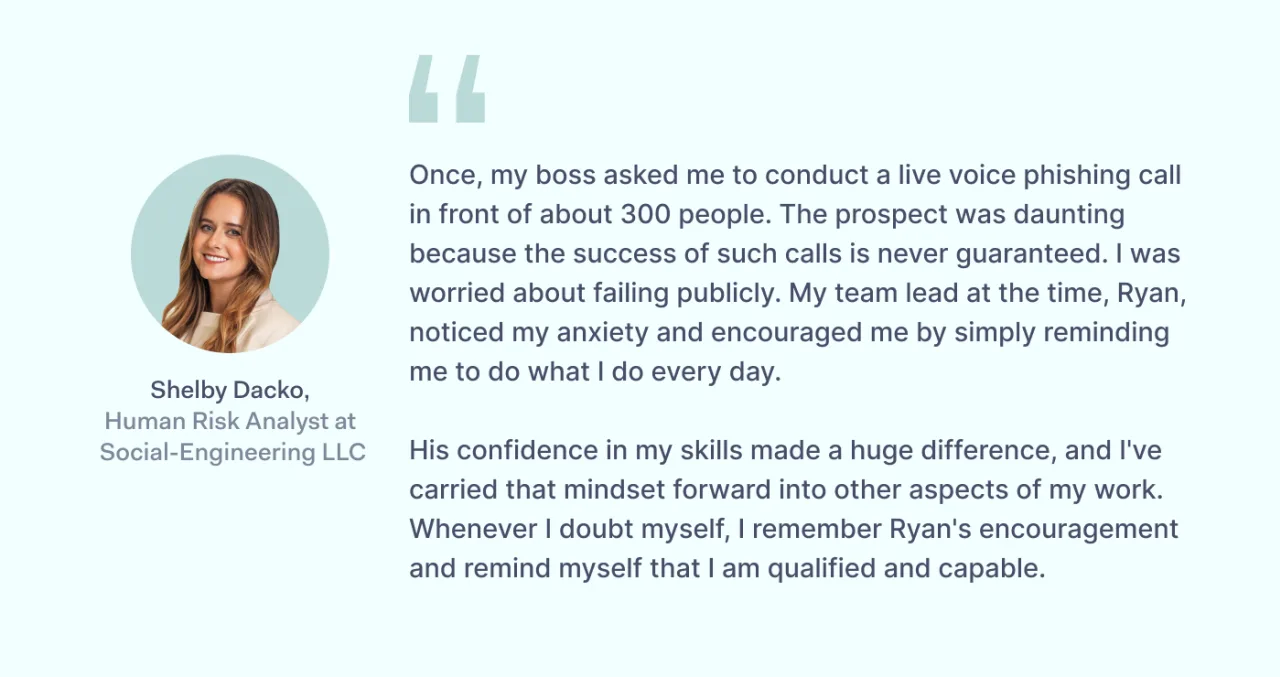
Shelby Dacko: Many of my challenges have stemmed from my own doubts about my capabilities. Once, my boss asked me to conduct a live vishing call in front of about 300 people. The prospect was daunting because the success of such calls is never guaranteed, and I was worried about failing publicly. However, my team lead at the time, Ryan, noticed my anxiety and encouraged me by simply reminding me to do what I do every day. His confidence in my skills made a huge difference, and I’ve carried that mindset forward into other aspects of my work, from on-site jobs to various projects. Whenever I doubt myself, I remember Ryan’s encouragement and remind myself that I am qualified and capable.

Shelby Dacko quote

NordLayer: Where do these insecurities stem from, in your opinion?

Shelby Dacko: It’s a mix of personal and societal factors. While my parents have always been supportive, not everyone has that kind of encouragement, and societal influences, like teachers not promoting STEM subjects, can play a part. Imposter syndrome is particularly prevalent in our industry, and it can be more intense for women. Reading “Swing Away” by Billy Boatright, which focuses on imposter syndrome, helped me a lot. One key takeaway is that if you’re chosen to take the stage, you have the skills needed to compete, even if you don’t always come out on top.

Talent Acquisition insights 

Regarding imposter syndrome, we’ve noticed women often request lower salaries than men, particularly in tech roles in Europe. This could be because the rise of women in tech is relatively recent, and many are unsure about the salary they should expect. Often, women entering tech in their late 20s or 30s, possibly from different fields, opt for stability over risking higher salary demands.

Lauryna Girėnienė, Head of Talent Acquisition at NordVPN and NordLayer

Click to tweet

Insight #4: In tough times, own the room. Believing you’re the smartest one there helps

NordLayer: Considering the competitive nature often seen as a male trait, how do you view the role of confidence and emotional intelligence in your field?

Gintarė Milkevičiūtė: In my first job, I was lucky to work in an environment filled with experienced business consultants. They taught me that you need to appear knowledgeable and confident, even if you don’t feel it initially. This is about your internal belief in your capabilities, projecting self-confidence and expertise that you might not feel you possess at the moment but will develop over time.

One colleague advised me always to consider myself the most knowledgeable person in the room, which really helps set a positive attitude. This advice seems to come more naturally to Americans than Europeans, who tend to be more reserved. But maintaining this confidence internally can significantly influence how you handle difficult situations, find patterns, and guide conversations effectively.

NordLayer: That’s a useful tip—having a mindset of “fake it till you make it.”

Gintarė Milkevičiūtė: But it’s not really faking. You have the knowledge, and if you don’t, you navigate the conversation until you do. It’s not faking; it’s believing in your capacity to learn and adapt.

Insight #5: Face reality head-on, prep thoroughly, and shine with confidence

NordLayer: Do you have a motto or something that helps you when you’re nervous or stressed?

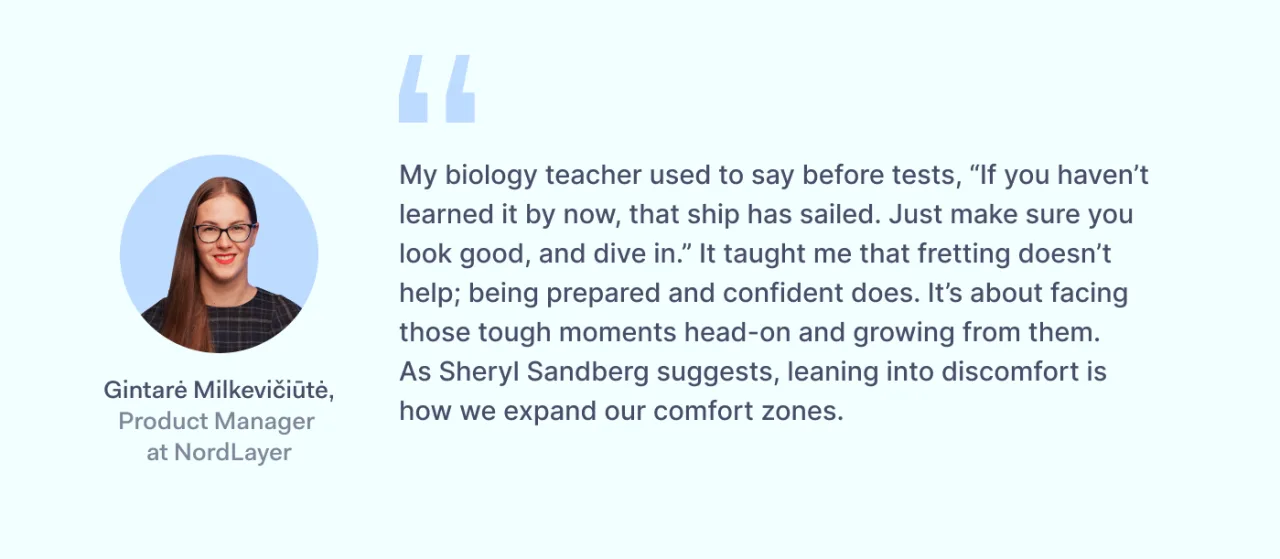
Gintarė Milkevičiūtė: My biology teacher used to say before tests, “If you haven’t learned it by now, that ship has sailed. Just make sure you look good and dive in.” It taught me that fretting doesn’t help; being prepared and confident does. It’s about facing those tough moments head-on and growing from them. As Sheryl Sandberg suggests, leaning into discomfort is how we expand our comfort zones.

Shelby Dacko: Get comfortable being uncomfortable.

Gintare Milkeviciute quote

Insight #6: Diversity isn’t just nice; it’s smart business. Different perspectives drive success

NordLayer: Let’s discuss diversity. It’s clear that diversity, including different ages, ethnicities, and backgrounds, is key in a team. It not only boosts the economy by increasing employment but also enhances productivity and creativity, as diverse teams often make better decisions. Shelby, can you share how diversity has impacted your team’s dynamics and decision-making?

Shelby Dacko: This is something I see clearly on my team because we all come from different backgrounds. For example, my colleague Rosa came from the hotel industry, and on her first day, she managed to achieve a goal in a client task that I never approached because I couldn’t figure out how. She just blew me away with her approach, which I had never considered, even though I had been with the company for a year. This is a great demonstration of how diversity adds so much to a team.

NordLayer: Thank you so much. Gintarė, as a manager, how do you approach diversity in your team?

Gintarė Milkevičiūtė: Diversity is essential, yet it can sometimes make things uncomfortable. I’ve noticed teams and managers where all members have a similar profile, not just in terms of ethnicity, gender, or age, but also in mindset and way of thinking. However, diverse teams need people who ideate, challenge, plan, execute, and review. Although it might slow down work or complicate agreement on certain topics.

For instance, when a developer in our team started asking unusual questions, it initially seemed disruptive. Yet, by exploring these questions, we uncovered a new use case that prevented users from misusing our product and opened up opportunities for monetization. Product development, built on the pillars of product, engineering, and design, benefits greatly from diversity.

Insight #7: Tech’s cool, and so are you. Women belong in this innovative space

NordLayer: As we close, let’s talk about our drive in the tech industry. What excites you about it? Shelby, can you start?

Shelby Dacko: The constant change in tech is what’s exciting. It means we need to adapt our techniques to keep up with the bad actors. We have to evolve our methods and help train and protect those we work with.

The fact that bad actors won’t stop means we can’t either. We must continue combating them, and it’s thrilling to see the technological advancements made in response to these challenges. That’s what motivates me—to keep growing in our efforts.

NordLayer: Great insight. Gintarė, what about you? What’s your favorite thing about working in tech?

Gintarė Milkevičiūtė: For me, it’s the complexity and the need for teamwork. The predictability of past jobs bored me. In tech, especially in the product field, things are constantly changing and everything is interconnected. I enjoy strategizing and leading projects. The feeling of managing a complex task, like keeping a fast-moving train on track without it derailing, but maintaining its speed, is exhilarating. That’s what motivates me in the product field, and I think it’s the best job.

About Version 2 Digital

Version 2 Digital is one of the most dynamic IT companies in Asia. The company distributes a wide range of IT products across various areas including cyber security, cloud, data protection, end points, infrastructures, system monitoring, storage, networking, business productivity and communication products.

Through an extensive network of channels, point of sales, resellers, and partnership companies, Version 2 offers quality products and services which are highly acclaimed in the market. Its customers cover a wide spectrum which include Global 1000 enterprises, regional listed companies, different vertical industries, public utilities, Government, a vast number of successful SMEs, and consumers in various Asian cities.

About NordPass
NordPass is developed by Nord Security, a company leading the global market of cybersecurity products.

The web has become a chaotic space where safety and trust have been compromised by cybercrime and data protection issues. Therefore, our team has a global mission to shape a more trusted and peaceful online future for people everywhere.

How to prevent unauthorized access: 10 best practices

As the sun rose, a well-known law firm prepared for a day filled with client meetings and case reviews. They didn’t know they were about to face a digital security threat. 

John, a hardworking attorney who often seemed to have too much on his plate, got an email. It looked like a standard message about updating the system. The email asked him to act quickly to keep his account safe.

John clicked on a link in the email, which was actually a trap. This mistake allowed threat actors to get into the firm’s system, putting sensitive client information and internal documents at risk.

This can happen to any organization. Let’s dive into this topic to see how to prevent unauthorized access.

Key takeaways

  • Unauthorized access means someone gets into a system, network, or storage they shouldn’t, caused by software issues, stolen login info, or skipped security measures.

  • Simple passwords or outdated software are common reasons for unauthorized data access, making it easy for cybercriminals to access or steal important information.

  • To stop this, update systems, use strong passwords, train employees on security, encrypt data, and ensure Wi-Fi is secure.

  • NordLayer helps by checking who is using the system or device, making it easier to see and follow data protection laws.

  • With NordLayer, businesses can better manage their networks and detect unauthorized access early, helping avoid data breaches and the loss of money or reputation.

What is unauthorized access?

Unauthorized access occurs when someone enters a computer system, network, or data storage area without permission or exceeds their allowed access. It can happen by exploiting software flaws, using stolen login information, or bypassing security measures to protect digital assets.

When someone gains unauthorized access, it puts the privacy, security, and availability of information at risk. This can lead to severe problems for data protection, security, and how well the system works.

Imagine an employee who should only see information from the human resources department. But they find a colleague’s computer, which is already logged into the finance department’s systems. The employee looks through and takes sensitive financial reports without being allowed to.

This is a case of unauthorized access because the employee uses this chance to see data they shouldn’t, breaking the company’s rules and possibly going against laws that protect data privacy. By addressing vulnerabilities, organizations can better defend against unauthorized access and its potential consequences.

Why does unauthorized access occur?

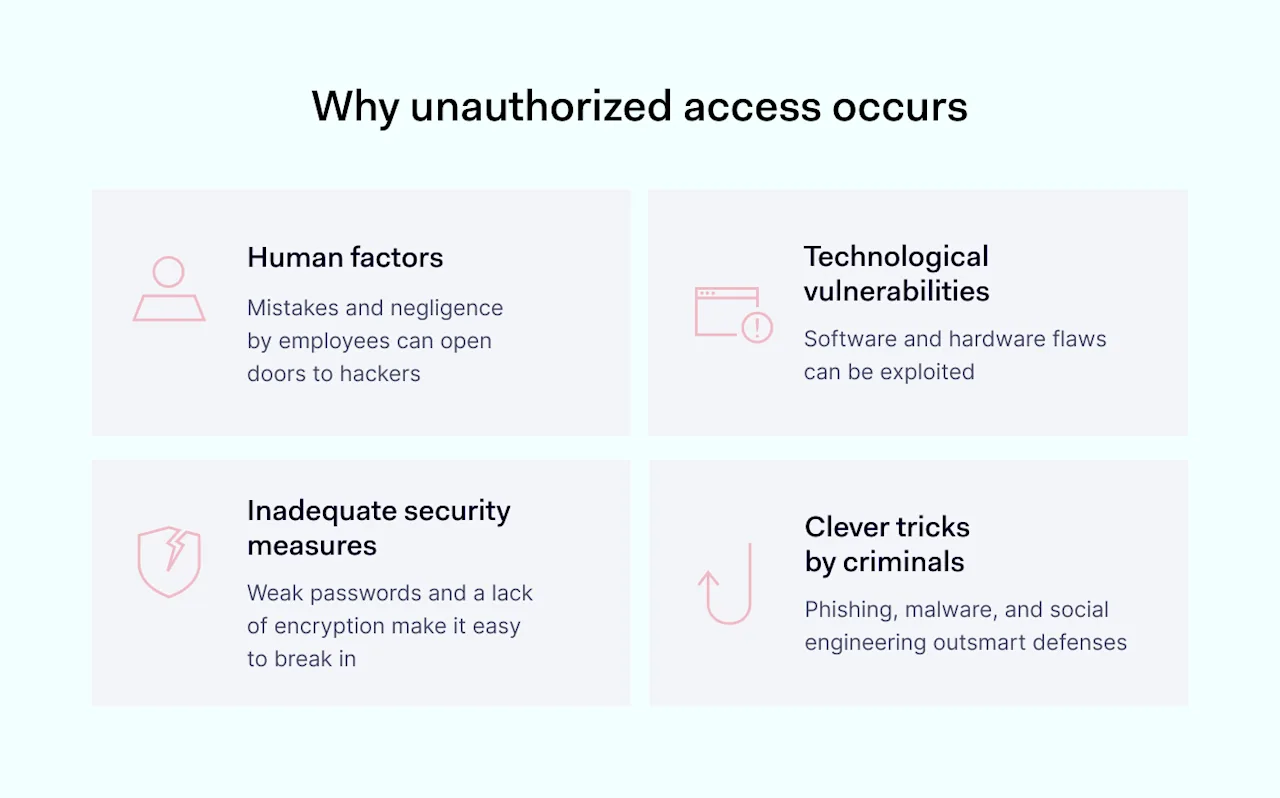
Unauthorized access happens for many reasons, involving both technology issues and human actions. People can get into places they shouldn’t be in digital systems, seeing or taking sensitive information they don’t have the right to access. Let’s take a look at some examples.

Why unauthorized access occurs

Human factors. People can accidentally help attackers gain access. This might happen if they use easy-to-guess passwords, like ‘password123,’ or are tricked by fake emails asking for their login details. It’s similar to accidentally giving a thief your house keys. Not knowing about these risks or how to avoid them makes it easier for these mistakes to happen.

Technological vulnerabilities. One of the primary reasons unauthorized access occurs is due to weaknesses in software and hardware systems. Cybercriminals exploit these vulnerabilities, which may exist because of outdated systems, unpatched software, or insecure web applications. Such vulnerabilities open the door for attackers to infiltrate systems and access sensitive information without permission.

Inadequate security measures. Sometimes, the problem is that there isn’t enough security in place. This could mean not having a good way to check who’s entering your network (like network access control solutions), not keeping information safe (like encrypting sensitive data), or not watching the network closely to spot trouble. It’s as if a building doesn’t have enough guards or security cameras.

Clever tricks by criminals. Cybercriminals use more and more sophisticated methods and gain more resources. This includes advanced phishing schemes, social engineering tactics, malware, and ransomware attacks, all designed to either steal credentials directly or to exploit users’ actions to gain unauthorized access.

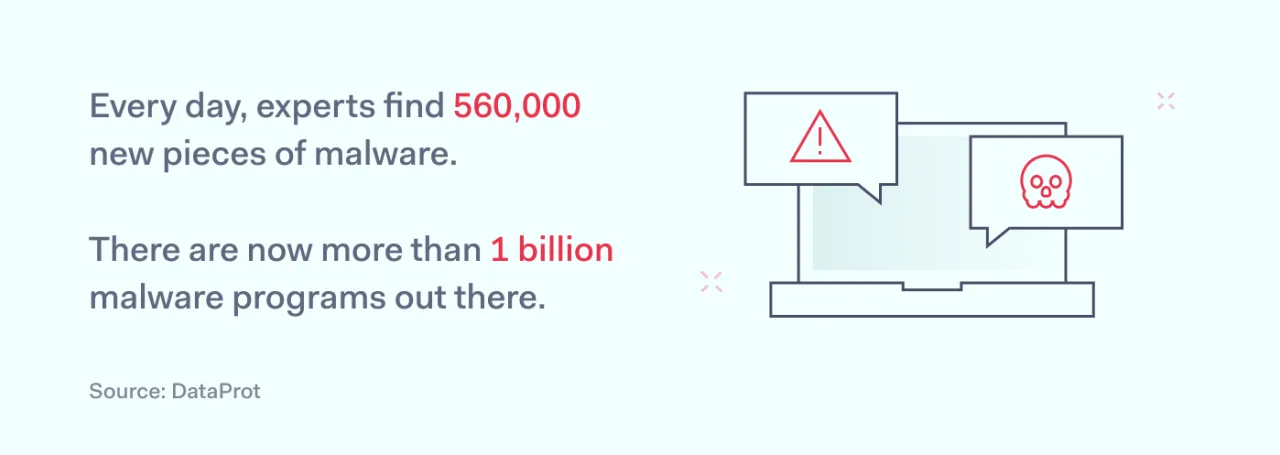
Threat actors devise new tricks to get past security, like zero-day vulnerabilities. Also, they use new malware—software that can damage your computer; or ransomware, which locks your files until you pay a ransom. 560,000 new pieces of malware are detected every day, and there are now more than 1 billion malware programs circulating. These methods are constantly changing and can be hard to catch.

Unauthorized access consequences

Unauthorized access can lead to serious problems for both people and organizations. It’s important to understand these issues and focus on solid cybersecurity measures.

  1. Data breaches. Sensitive data is in danger when someone gains unauthorized access. This situation can lead to identity theft, financial fraud, and a big drop in trust from customers and partners.

  2. Financial loss. The costs of dealing with unauthorized access can add up quickly. Organizations may have to pay for investigations, legal fees, and letting affected people know what happened. They might also face fines for not following data protection laws and lose business.

  3. Reputational damage. A security breach can badly damage how people see an organization. Customers might start to doubt if their sensitive information is safe, which can make them less loyal and decrease business.

  4. Operational disruption. If unauthorized data access affects critical systems, it can stop business operations. Getting back to normal takes time and money, adding to the financial loss.

  5. Legal and regulatory consequences. Companies could face legal issues and fines if they don’t meet data protection regulations. This makes dealing with a security breach even more complicated and expensive.

  6. Loss of intellectual property. If someone steals intellectual property through unauthorized access, it can hurt an organization’s competitive edge and revenue.

  7. Compromised personal safety. Leaked personal information can put people at risk of physical harm or harassment.

Real-life examples of unauthorized access

Unauthorized access can happen in many ways. It often takes advantage of technical weaknesses and human errors.

Malware statisticsHere are five ways unauthorized access can happen in businesses, explained simply:

  • Phishing attacks. Imagine getting an email that looks like it’s from someone you trust at work, asking you to click a link and log in. If you do, cybercriminals can enter the company’s network with your details. For instance, Twitter (now X) faced a significant phishing attack in 2020, where attackers targeted employees to gain access to high-profile accounts and trick people into sending money.

  • Weak passwords. If someone tries common passwords, they might just guess yours, especially if it’s a simple one. A weak password can cause data breaches or harm your reputation. Take the 2020 incident with SolarWinds. Although the main breach was due to a supply chain attack, a separate issue was a weak password, ‘solarwinds123,’ used by an intern. This drew criticism from US lawmakers and pointed out a lapse in security.

  • Outdated software. Not updating your software can leave open doors for attackers. The WannaCry ransomware attack in 2017 is a stark example. It affected thousands of computers worldwide because they hadn’t updated their Windows systems.

  • Insider threats. Sometimes, the danger comes from within. A Tesla incident in 2023 showed how former employees could take sensitive information and share it outside the company, putting personal data at risk.

  • Social engineering. This is when bad actors pretend to be someone you trust to get access to the company’s network. They might act like a boss in a hurry, asking for data or access they shouldn’t have. Old, but still very effective. For example, Mailchimp experienced a breach in the summer of 2022 and then again in January 2023 due to social engineering. In both instances, an intruder accessed internal tools and compromised data on 133 Mailchimp accounts.

10 ways to prevent unauthorized access

Strong password policies

Setting up strong password policies is an essential first step in preventing unauthorized access. This means requiring passwords that mix letters, numbers, and special characters, which are hard for attackers to guess.

Changing passwords regularly and not using the same password for different accounts helps keep data safe. For example, making it a rule to change passwords every three months can greatly lower the risk of a security breach.

Regular software updates

Updating software regularly is crucial for protecting against cyber threats. These updates often fix security weaknesses that could let attackers in. By keeping your software up to date, you can avoid data breaches that exploit old vulnerabilities.

Use of multi-factor authentication (MFA)

Multi-factor authentication adds an extra layer of security by needing more than one proof of identity to access systems. This means that even if a password gets stolen, it’s still hard for unauthorized people to get into sensitive information. MFA is a powerful way to reduce the chance of unauthorized data access and keep accounts safe.

Employee security awareness training

Teaching employees about security and how to spot phishing and other cyber threats is key to stopping unauthorized access. This training helps employees understand how they can protect sensitive data and spot attempts to gain unauthorized access, reducing the chance of a security breach because of human error.

Network access control (NAC) solutions

NAC solutions help businesses set up rules for who can access their networks, playing a crucial role in catching and stopping unauthorized access. They make sure that only allowed users and devices that meet security standards can connect, which is vital for keeping sensitive information safe.

Data encryption

Encrypting data, no matter if it’s stored or being sent, is essential to keep it secure from unauthorized eyes. Encryption is a key part of protecting data, especially when it comes to keeping sensitive data safe from outside threats and potential breaches.

Secure Wi-Fi networks

Making Wi-Fi networks secure with strong encryption like WPA3 and hiding the network name can stop unauthorized access from outside. Having a separate network for guests can help keep the main network, which holds sensitive information, safer from threats.

Regular security audits and assessments

Doing regular security checks and assessments is important to find and fix weaknesses that could allow unauthorized access. These checks are crucial for keeping your security strong and making sure your data protection measures are up to date.

Access management policies

Strict access management policies make sure employees only have access to the information they need for their jobs, reducing the risk of internal threats and unauthorized access to sensitive data. Limiting access to sensitive data to those who really need it can help prevent internal data breaches.

Incident response plan

Having a detailed incident response plan is important for quickly dealing with unauthorized access and managing the situation after a security breach. This plan should include steps for isolating affected systems, informing stakeholders, and getting operations back to normal, which helps minimize damage and recover faster from attacks.

How NordLayer can help

NordLayer helps businesses strengthen their digital defenses and block unauthorized access. Its NAC solutions authenticate users and devices, offering secure access across different platforms. This approach not only helps in preventing unauthorized access but also keeps an eye on the network, allowing businesses act fast when they spot potential threats.

NordLayer gives companies a clear view of their network, showing which devices have permission and making sure they meet strict data protection rules like GDPR, HIPAA, and PCI-DSS.

Moreover, with NordLayer’s tools for network visibility and threat prevention, businesses can deeply understand what’s happening on their networks and take steps to stop threats before they can gain unauthorized access. These tools reduce the chance of data breaches and help businesses avoid financial and reputational harm.

By mixing information on activities, server use, and device conditions, NordLayer makes unauthorized access hard. Contact our sales team to protect your networks, keep sensitive data safe, and keep your customers’ and partners’ trust.

About Version 2 Digital

Version 2 Digital is one of the most dynamic IT companies in Asia. The company distributes a wide range of IT products across various areas including cyber security, cloud, data protection, end points, infrastructures, system monitoring, storage, networking, business productivity and communication products.

Through an extensive network of channels, point of sales, resellers, and partnership companies, Version 2 offers quality products and services which are highly acclaimed in the market. Its customers cover a wide spectrum which include Global 1000 enterprises, regional listed companies, different vertical industries, public utilities, Government, a vast number of successful SMEs, and consumers in various Asian cities.

About NordPass
NordPass is developed by Nord Security, a company leading the global market of cybersecurity products.

The web has become a chaotic space where safety and trust have been compromised by cybercrime and data protection issues. Therefore, our team has a global mission to shape a more trusted and peaceful online future for people everywhere.

×

Hello!

Click one of our contacts below to chat on WhatsApp

×