Skip to content

Understanding SaaS compliance: key standards and best practices

Software as a Service (SaaS) has become the backbone of many businesses, offering scalable and cost-effective solutions for various industries. However, with the convenience of SaaS comes the critical responsibility of ensuring SaaS compliance with industry standards and data protection laws. 

For those new to SaaS, understanding SaaS compliance can be daunting, but it is crucial for protecting sensitive data, building customer trust, and avoiding legal pitfalls. This guide will walk you through the basics of SaaS compliance, covering key standards, common challenges, and best practices to help you keep your business on the right track.

What is SaaS compliance?

SaaS compliance means that software-as-a-service providers have to follow various regulatory requirements, laws, and industry-specific standards. These standards are designed to protect sensitive data, ensure financial transparency, and maintain security protocols across cloud-based services. For SaaS providers, compliance is not just a legal obligation but is also about demonstrating their commitment to safeguarding customer data and upholding industry benchmarks.

For instance, consider a company that offers cloud-based solutions for managing healthcare records. To operate legally and securely, the company must comply with the Health Insurance Portability and Accountability Act (HIPAA), which sets strict standards for protecting sensitive patient information. Without HIPAA compliance, the company could face fines, lose customers, and suffer reputational damage.

Why is SaaS compliance important?

Understanding why SaaS compliance is important is crucial for any business operating in the SaaS space. Compliance serves two primary purposes: protecting data security and maintaining customer trust.

Data security

With data breaches becoming an everyday threat, robust SaaS compliance practices help SaaS providers safeguard their customers’ data against security risks. Compliance frameworks like the General Data Protection Regulation (GDPR) and the California Consumer Privacy Act (CCPA) impose stringent requirements on how companies collect, store, and process personal data. Failure to comply can lead to severe penalties and legal consequences.

For example, in 2023, Meta was fined $1.3 billion for GDPR violations. The company failed to ensure adequate protections for user data during transfers between the EU and the U.S. This shows how important it is to prioritize data security and compliance to avoid substantial legal penalties.

Customer trust

Compliance also plays a crucial role in building and maintaining customer trust. When customers know that a SaaS provider follows compliance frameworks like PCI DSS (Payment Card Industry Data Security Standard) or SOC 2 (Service Organization Control 2), they feel more confident that their data is secure. This trust is essential for long-term business relationships and customer retention.

Risks of non-compliance

The risks of non-compliance are significant. They include legal penalties, financial loss, reputational damage, and operational disruptions. Companies that fail to meet compliance standards may also find it challenging to attract and retain customers as trust in their services diminishes. In extreme cases, non-compliance can lead to business shutdowns, especially if the violations are severe.

Key compliance standards for SaaS providers

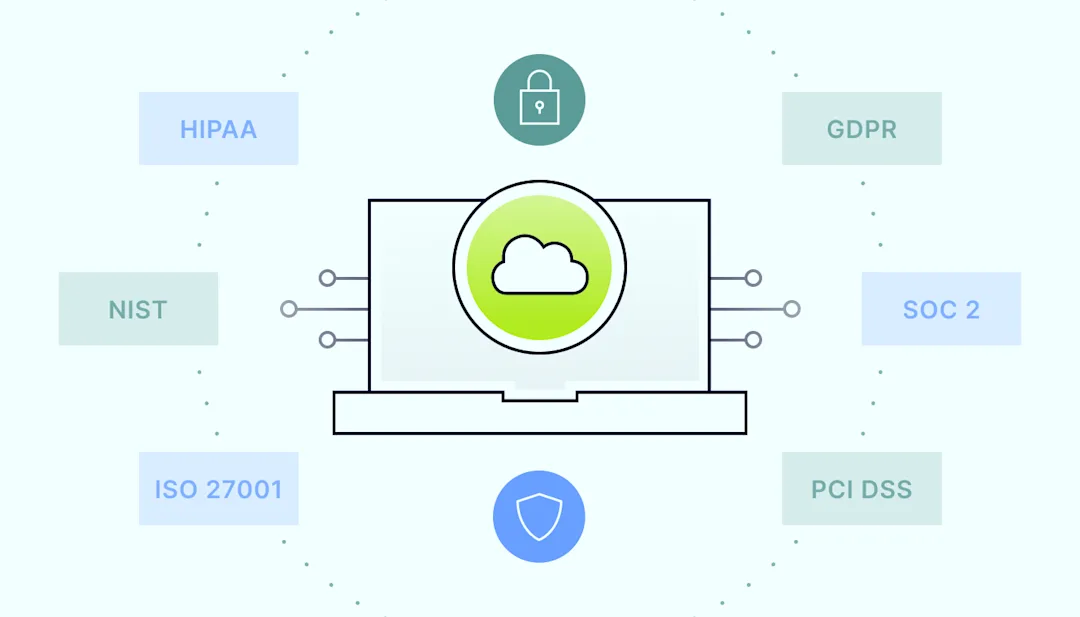
To effectively manage compliance, SaaS providers must understand the types of SaaS compliance relevant to their industry. These compliance standards vary depending on the nature of the service, the type of data handled, and the geographical location of the customers. Here’s an overview of some major compliance frameworks.

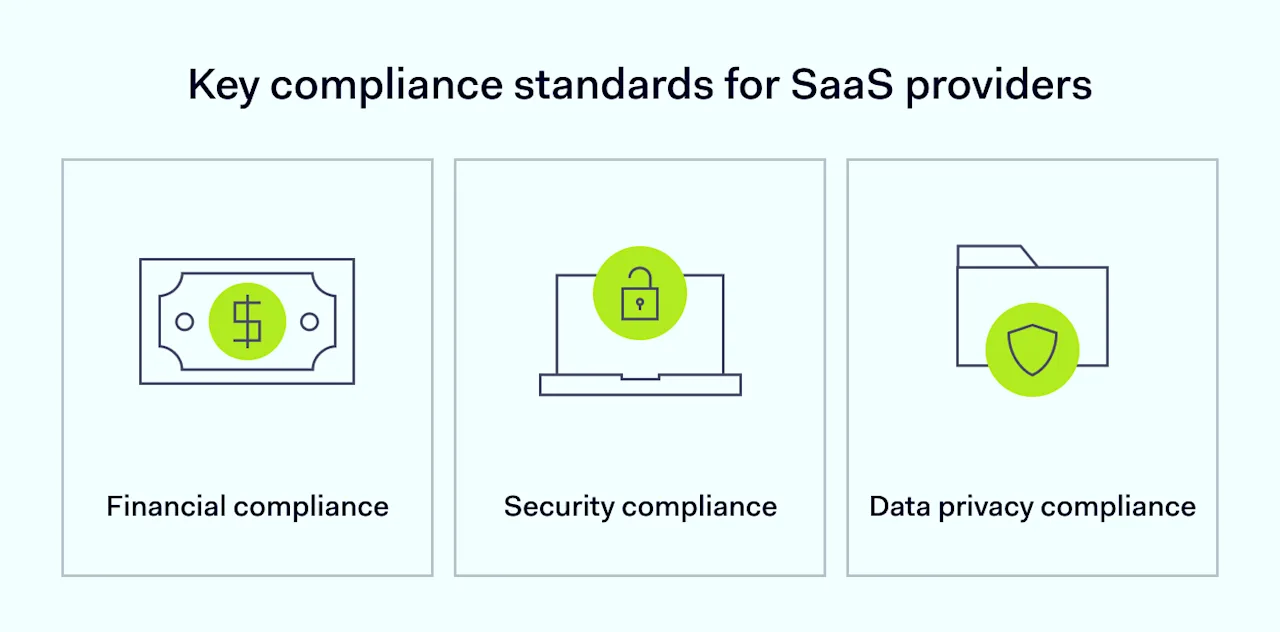
Key compliance standards for SaaS providers

Financial compliance

Payment Card Industry Data Security Standard (PCI DSS)

PCI DSS is essential for any SaaS provider that handles payment card transactions. This standard outlines security measures to protect cardholder data, including data encryption, secure storage, and regular monitoring. Implementing solutions to become PCI compliant is crucial for preventing data breaches and maintaining customer trust.

Accounting Standards Codification (ASC 606)

ASC 606 provides guidelines for revenue recognition, ensuring that companies report their financial performance accurately. SaaS providers must comply with ASC 606 to demonstrate financial transparency and avoid legal issues related to revenue reporting.

Sarbanes-Oxley Act (SOX)

SOX compliance is mandatory for publicly traded companies, including SaaS providers. It focuses on corporate governance and financial reporting, requiring companies to implement internal controls and report on their effectiveness. Non-compliance with SOX can lead to severe penalties, including fines and imprisonment for executives.

Security compliance

Service Organization Control 2 (SOC 2)

SOC 2 compliance is a critical standard for SaaS providers that handle customer data. It ensures the company’s information security management systems meet industry standards. SOC 2 audits evaluate controls related to security, availability, processing integrity, confidentiality, and privacy. Achieving SOC 2 compliance is essential for demonstrating that your SaaS solutions are secure and reliable.

ISO/IEC 27001

ISO/IEC 27001 is an international standard for information security management systems. It provides a framework for managing and protecting sensitive information through a systematic approach. Implementing an ISO 27001 compliance solution can help SaaS providers safeguard their data, meet customer expectations, and improve overall security.

Center for Internet Security (CIS) Controls

The CIS Controls are a set of best practices for cybersecurity. They provide a prioritized set of actions to protect organizations from cyber threats. SaaS providers can use these controls to strengthen their security posture and reduce security risks, including breaches.

National Institute of Standards and Technology Cybersecurity Framework (NIST CSF)

The NIST CSF is a voluntary framework that provides guidelines for managing and reducing cybersecurity risks. SaaS providers can adopt it to enhance their security practices and ensure they are aligned with industry standards.

Data privacy compliance

General Data Protection Regulation (GDPR)

GDPR is a European Union regulation that governs how companies handle personal data. It applies to any SaaS provider that processes data belonging to EU citizens, no matter where the company is based. Compliance with GDPR is essential for avoiding hefty fines and protecting customer privacy. Companies can explore GDPR compliance services for tailored support.

HIPAA (Health Insurance Portability and Accountability Act)

HIPAA sets the standard for protecting sensitive patient information in the healthcare industry. SaaS providers that handle health-related data must comply with HIPAA to avoid penalties and ensure that patient information is kept confidential. Implementing HIPAA compliance solutions is vital for any SaaS provider operating in the healthcare sector.

CCPA (California Consumer Privacy Act)

The CCPA is a state law that grants California residents rights over their personal data. It requires businesses to disclose what information they collect, allow consumers to opt out of data sharing, and delete personal data upon request. SaaS providers must comply with CCPA to avoid legal penalties and maintain customer trust.

Data security and privacy regulations

Data security and privacy are at the heart of SaaS compliance. Data protection laws like GDPR, HIPAA, and CCPA are designed to protect individuals’ data from misuse and unauthorized access. These regulations require SaaS providers to implement strict security measures, such as data encryption, access controls, and regular monitoring, to ensure that data is protected at all times.

For example, a SaaS provider offering cloud storage services must ensure that data is encrypted at rest and in transit. This means that even if a malicious actor gains access to the data, they would not be able to read it without the decryption key.

Complying with data security and privacy regulations can help SaaS providers protect their customers’ information and avoid legal consequences.

Challenges in achieving SaaS compliance

Achieving SaaS compliance can be challenging for SaaS providers, especially those just starting. Here are some common challenges and potential solutions:

Complexity of regulations

SaaS compliance requirements can be complex and vary by industry and region. For example, a global SaaS provider may need to comply with multiple regulations, such as GDPR, CCPA, and HIPAA, each with unique requirements. To manage this complexity, SaaS providers can use SaaS compliance management tools that automate tracking and implementing regulatory requirements.

Resource constraints

Small and medium-sized SaaS companies often lack the resources for compliance efforts. Hiring compliance experts or outsourcing SaaS compliance can be expensive. However, non-compliance can be even more costly in the long run. To handle this, SaaS providers can focus on implementing the most critical compliance measures first and gradually expand their compliance efforts as their business grows.

Keeping up with changes

Compliance standards and data protection laws are constantly evolving, and SaaS providers must stay up-to-date with the latest changes to remain compliant. This requires continuous monitoring of regulatory updates and adjusting compliance practices as needed. An effective compliance strategy includes subscribing to industry newsletters, attending webinars, and participating in compliance forums to stay informed.

Benefits of SaaS compliance

While achieving SaaS compliance can be challenging, the benefits far outweigh the effort. Here are some key benefits:

Improved security

SaaS compliance ensures that providers implement robust security controls to protect customer data. This reduces the risk of data breaches and cyber-attacks, safeguarding both the company and its customers.

Enhanced customer trust

SaaS security compliance demonstrates to customers that their data is in safe hands, building trust and loyalty and leading to long-term customer relationships.

Competitive advantage

Compliant SaaS companies can differentiate themselves from competitors who may not offer the same level of security and privacy protection. This can be a significant selling point in a crowded market.

Best practices for maintaining SaaS compliance

Maintaining SaaS compliance is an ongoing process that requires constant attention. Here are some best practices to help:

Regular audits

Conduct internal and external audits regularly as part of your compliance strategy. Audits help assess your compliance status and identify any gaps in your security practices. They can also help you stay on top of compliance requirements and ensure that your SaaS solutions remain secure.

Employee training

Regularly train employees on SaaS compliance requirements and their role in maintaining it. An informed team is better equipped to follow measures and avoid potential compliance risks.

Usage of compliance management tools

Leverage compliance management tools to automate tracking and implementing regulatory requirements. These tools help reduce human error and ensure all compliance obligations are met. Additionally, use only SaaS-compliant tools for daily operations to create a secure environment and minimize risks. The more secure your operational tools, the stronger your overall compliance posture.

Document compliance efforts

Keep detailed records of your compliance activities, including policies, procedures, and audit results. This documentation is crucial during an audit or regulatory inquiry.

SaaS compliance checklist

To help you get started, here’s the SaaS compliance checklist of key steps.

SaaS compliance checklist

  • Identify applicable regulations: Determine which compliance standards (like GDPR, HIPAA, or PCI DSS) apply to your SaaS business

  • Implement security measures: Ensure your platform meets all security requirements, such as encryption and access controls

  • Conduct regular audits: Schedule regular audits to assess your compliance and identify areas for improvement

  • Train employees: Provide ongoing training to ensure employees understand their compliance responsibilities

  • Use compliance tools: Implement tools to automate and streamline your compliance tasks

  • Document compliance efforts: Keep detailed records of your compliance activities, including financial compliance measures and the implementation of security controls.

How can NordLayer help companies stay compliant?

NordLayer itself meets multiple compliance standards for securing applications and services, including GDPR, HIPAA, ISO 27001, and PCI DSS. Compliance often requires specific network security measures, such as traffic encryption, advanced network access control, and multi-factor authentication.

NordLayer addresses these needs by providing robust security features designed to meet these requirements. By integrating NordLayer, you can enhance the security of your SaaS solutions, ensuring they align with compliance standards and protect sensitive data effectively.

Conclusion

SaaS compliance is a critical aspect of running a successful software-as-a-service business. By understanding and adhering to key compliance standards, SaaS providers can protect their customers’ data, build trust, and avoid legal pitfalls. While achieving compliance can be challenging, the benefits—including improved security, customer loyalty, and competitive advantage—make it well worth the effort.

By following best practices and leveraging tools like NordLayer, you can navigate the complex world of SaaS compliance with confidence and ensure your business’s long-term success.

About Version 2 Digital

Version 2 Digital is one of the most dynamic IT companies in Asia. The company distributes a wide range of IT products across various areas including cyber security, cloud, data protection, end points, infrastructures, system monitoring, storage, networking, business productivity and communication products.

Through an extensive network of channels, point of sales, resellers, and partnership companies, Version 2 offers quality products and services which are highly acclaimed in the market. Its customers cover a wide spectrum which include Global 1000 enterprises, regional listed companies, different vertical industries, public utilities, Government, a vast number of successful SMEs, and consumers in various Asian cities.

About NordLayer
NordLayer is an adaptive network access security solution for modern businesses – from the world’s most trusted cybersecurity brand, Nord Security.

The web has become a chaotic space where safety and trust have been compromised by cybercrime and data protection issues. Therefore, our team has a global mission to shape a more trusted and peaceful online future for people everywhere.

About NordLayer
NordLayer is an adaptive network access security solution for modern businesses – from the world’s most trusted cybersecurity brand, Nord Security.

The web has become a chaotic space where safety and trust have been compromised by cybercrime and data protection issues. Therefore, our team has a global mission to shape a more trusted and peaceful online future for people everywhere.

Inherent risk is more than just a concept – it’s the reality

So, whether in your personal life or business, every activity involves some level of risk, and you just have to consider it. Of course, the bigger the potential reward or value of your aim, the greater the risk usually is. Nevertheless, the main takeaway is that, regardless of the risk’s scale, it is unavoidable.

The key, then, is to learn how to manage and minimize the risks commonly associated with the activities you perform by first recognizing that these risks even exist and then understanding their magnitude. This is where the concept of inherent risk comes into play.

What is inherent risk?

In basic terms, inherent risk is the natural risk associated with any process or activity before you add any controls or safety measures. So, to measure inherent risk is to assess how risky something is on its own, without any safety nets in place. Once you recognize the scale of a given inherent risk, you can then determine how much you can reduce that risk with the appropriate controls, policies, and resources.

To measure inherent risk, an organization needs to go through a thorough process that involves risk identification (discovering activities that could pose risks) and risk evaluation (determining how serious the potential impact could be), examining the risks in their raw form. Once you’ve established this baseline, you can decide where to add new controls and policies to manage the inherent risks effectively.

Does the term “inherent audit risk” ring a bell?

If so, that’s because inherent risk is one of the key components of overall audit risk. Audit risk is a term that usually refers to the risk that the company’s financial statements can be materially misstated and the auditor fails to detect these misstatements, leading to a misleading audit opinion. Audit risk consists of three elements:

  • Detection risk: The risk that the auditor’s procedures will fail to identify a mistake in the financial statements.

  • Control risk: The risk that the company’s own controls won’t identify or prevent mistakes in its financial statements.

  • Inherent risk: The risk of mistakes caused by the nature of the business or industry before any controls are put to use.

Knowing about these risks helps auditors plan and carry out their work more effectively, so they can give a trustworthy opinion on the company’s financial statements.

Which industries have high inherent risk?

Generally speaking, industries that are heavily regulated tend to face higher inherent risks. For example, the financial services sector is quite exposed due to its need to navigate market fluctuations, regulatory compliance, and cybersecurity threats. Similarly, the oil and gas industry contends with environmental regulations, geopolitical uncertainties, and various operational hazards. The IT and cybersecurity sector also grapples with rapid technological changes, intellectual property issues, and persistent cybersecurity threats.

But it’s not just these high-profile sectors. Most industries, whether it’s agriculture, travel, healthcare, or any other field, deal with their own sets of inherent risks. What’s important is to recognize these risks in your daily processes and have strategies in place to address them effectively.

Inherent risk vs. residual risk

There’s another key term in risk management that pairs with inherent risk—think of it as the yang to inherent risk’s yin—and that’s residual risk. Simply put, residual risk is the level of risk that remains after you’ve applied controls or mitigating measures. In other words, it helps you gauge how much of the inherent risk you’ve reduced or eliminated, and how much is still left to address.

So, to sum it up quickly, inherent risk is the natural level of risk before you do anything to prevent it, while residual risk is what’s left after you’ve taken steps to manage the inherent risk.

Risk is part of almost everything we do, so the examples of inherent risk are practically endless. But when it comes to managing risk in a business setting, there are a few key areas that really stand out. Here are some important ones to keep an eye on:

  • Insufficient audit processes: Without thorough audits, companies may fail to identify internal weaknesses or compliance issues, putting their whole operation at risk.

  • Security incidents caused by human error: Mistakes made by employees, such as mishandling sensitive data or falling for phishing scams, can lead to significant security breaches, resulting in financial losses and damage to the company’s reputation.

  • Management’s failure to uphold operational standards: Without the right processes from management, things can get pretty disorganized. This often leads to poor-quality work, reduced productivity, and non-compliance with industry regulations.

  • Financial interactions between related businesses: The value of an asset in financial transactions between related parties, like subsidiaries or affiliates, might be reported incorrectly, leading to financial discrepancies and compliance issues.

All online activities are inherently risky

No matter what you do online, there’s always some risk involved. This is especially important for businesses to keep in mind. When you’re running a company with dozens or even hundreds of employees, all using company accounts and accessing company resources, you’re dealing with many different types of inherent risk. People make mistakes—they click on malicious links, use weak passwords, or share credentials in ways they shouldn’t (like on sticky notes or via email).

So, how can you mitigate such risks? One option is to use NordPass Enterprise. It’s more than just an encrypted password manager—it’s a cybersecurity solution that helps you manage access to company resources, enforce strong password policies across your organization, give your employees tools to securely share data, and even check if their information has been compromised in a data breach.

If you want to reduce the risks that come with modern business, give NordPass Business a try and see how it can enhance both your cybersecurity and productivity.

About Version 2 Digital

Version 2 Digital is one of the most dynamic IT companies in Asia. The company distributes a wide range of IT products across various areas including cyber security, cloud, data protection, end points, infrastructures, system monitoring, storage, networking, business productivity and communication products.

Through an extensive network of channels, point of sales, resellers, and partnership companies, Version 2 offers quality products and services which are highly acclaimed in the market. Its customers cover a wide spectrum which include Global 1000 enterprises, regional listed companies, different vertical industries, public utilities, Government, a vast number of successful SMEs, and consumers in various Asian cities.

About NordPass
NordPass is developed by Nord Security, a company leading the global market of cybersecurity products.

The web has become a chaotic space where safety and trust have been compromised by cybercrime and data protection issues. Therefore, our team has a global mission to shape a more trusted and peaceful online future for people everywhere.

What is an OTP bot, and how to protect yourself from it?

Imagine this: Your new accounting employee receives a call from what seems to be your company’s financial service provider. The caller sounds professional and mentions a suspicious transaction in the company’s account. 

Reassuring your employee that it’s a routine check, they ask for a one-time password (OTP) that has just been sent to secure the account. In a rush to safeguard the business, your employee shares the OTP—unaware they’ve fallen victim to a sophisticated scam involving an OTP bot.

Such real-life scenarios show how serious the threat of OTP bots has become in our digitalized environment. Understanding what OTP bots are and how to protect yourself from them is crucial to safeguarding your personal and business information. Let’s take a closer look at this emerging threat and explore ways to defend against it.

What is an OTP bot?

An OTP bot is a malicious automated software that cybercriminals use to steal one-time passwords (OTPs). OTPs are temporary verification codes sent to a user’s phone or email as part of two-factor authentication (2FA) or multi-factor authentication (MFA) processes. These codes provide extra security for online accounts, ensuring that even if someone knows your password, they still need the OTP to gain unauthorized access.

OTP bots exploit the trust and urgency associated with these security codes, tricking users into revealing their OTPs. Once the bot obtains the OTP, it can bypass security measures and access personal data and accounts.

How do OTP bots work?

OTP bots operate through a combination of social engineering and automated technology. Here’s how they typically work:

  1. The attacker initiates contact with the victim, often posing as a legitimate entity such as a bank, service provider, or even a tech support representative. The goal is to trick a user by creating a sense of urgency and trust, convincing them that sharing their OTP is necessary.

  2. Once the victim is convinced, the attacker uses an OTP bot to trigger a legitimate OTP request from the service provider. The attacker then attempts to log into the victim’s account using their credentials (often obtained through a previous phishing attack or data breach).

  3. The bot waits for the victim to receive the verification code and then relays the request to the victim, often through a phone call or text message. The bot uses convincing language and scenarios to persuade the victim to share their OTP.

  4. Once the bot receives the OTP from the victim, it immediately uses it to complete the login process, gaining unauthorized access to the victim’s account.

By automating this process, attackers can efficiently target multiple victims simultaneously, increasing their chances of success.

Process of OTP bot attacks

Understanding the step-by-step process of OTP-related attacks can help you recognize and avoid them. Let’s consider another example. You receive a call from someone claiming to be from a popular online retailer. They inform you that there is an issue with your recent order and they need to verify your identity to proceed with the correction.

They ask you to provide the verification code sent to your phone to confirm the changes. In reality, the caller is an attacker using an OTP bot. They have already initiated a password reset request on your retailer account, triggering the OTP.

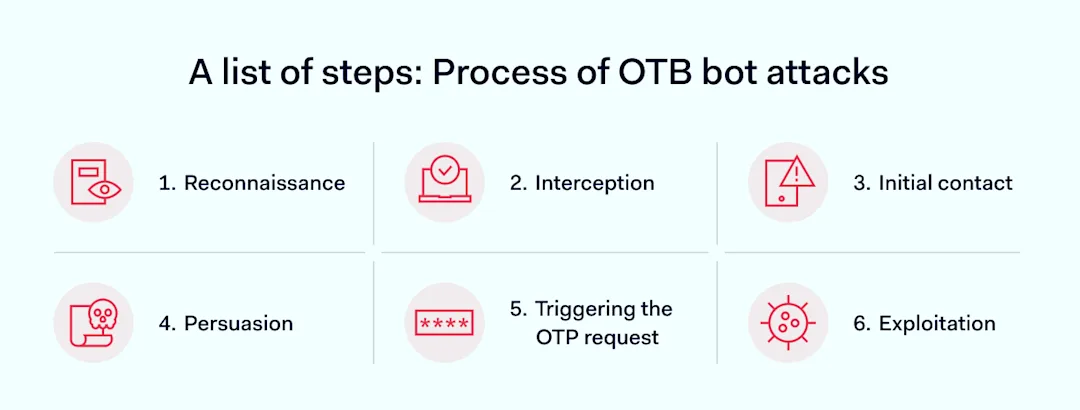
As soon as you share the OTP code, the attacker uses it to change your account password and gain access, potentially making unauthorized transactions with your stored payment information. Here’s how these attacks typically unfold in a particular order:

  1. Reconnaissance: Malicious actors gather information about potential targets through phishing emails, social media, and other online sources. This information helps them craft convincing scenarios for the social engineering phase.

  2. Initial contact: The attacker contacts the victim by phone, often using spoofed numbers or email addresses to appear legitimate. They create a sense of urgency or importance, prompting the victim to act quickly.

  3. Requesting the OTP: Using stolen login credentials, the attacker tries to log into the victim’s account, triggering an OTP request from the service provider.

  4. Interception: The attacker’s OTP bot waits for the victim to receive the OTP codes. The bot then contacts the victim, often through a phone call, claiming to need the OTP to resolve a supposed urgent issue.

  5. Persuasion: The bot uses persuasive language and convincing scenarios to convince the victim to share the OTP. This might involve claims of fraud prevention, account recovery, or urgent security updates.

  6. Exploitation: Once the OTP is obtained, the attacker uses it to complete the login process and gain unauthorized access to the victim’s account. This access can lead to unauthorized transactions, financial theft, data breaches, and other forms of cybercrime.

The impact of OTP bot attacks on organizations and networks

OTP bot attacks can have severe consequences for both individuals and organizations. Beyond what was mentioned earlier, here are some potential impacts:

  • Financial loss: Unauthorized access to accounts can result in significant financial losses, particularly for businesses handling large sums of money

  • Data breaches: Access to sensitive data can lead to data breaches, exposing personal and business data to misuse

  • Reputational damage: Victims of OTP-related attacks, especially businesses, can suffer reputational damage, while customers and clients may lose trust in the organization’s ability to protect their digital information

  • Operational disruption: Attacks can disrupt business operations, causing downtime and lost productivity

One notable example is the attack on Twitter in 2020, in which attackers used social engineering and OTP bots to gain access to high-profile accounts. They then used these accounts to promote a cryptocurrency scam, causing financial and reputational damage to the platform.

How to protect your business from OTP bots

Protecting your business from OTP threats involves a combination of technological solutions and best practices. Here are detailed strategies to safeguard your organization:

1. Implement multi-factor authentication (MFA)

Multi-factor authentication (MFA) is a critical safety measure that adds an extra layer of protection beyond passwords. Implement MFA to ensure that unauthorized access is prevented even if a password is compromised.

Consider MFA methods that don’t depend solely on text messages, such as app-based authenticators or hardware tokens, which are more secure alternatives. Additionally, integrate two-factor authentication (2FA) into your regular protocols, as it can significantly enhance your overall security posture.

2. Educate employees

Employee awareness is a key component in defending against all kinds of threats. Regularly train your employees about the risks of OTP bots and social engineering tactics. Ensure they recognize suspicious requests for OTPs or other sensitive information.

Develop clear security protocols for verifying the legitimacy of such requests, and encourage employees to report any unusual or suspicious activity immediately.

3. Monitor & analyze

Keep monitoring your systems for early detection of OTP threats. Use advanced analytics tools to track and analyze user behavior, looking for patterns indicating an ongoing or attempted attack.

Implement monitoring solutions that provide real-time insights and alerts about anomalous activities. By maintaining a vigilant watch over your network and systems, you can quickly identify and respond to potential breaches before they cause significant damage.

4. Secure communication channels

Ensuring the security of communication channels used for OTP delivery is crucial. Choose encrypted communication methods to send OTPs, such as app-based authenticators or secure email services.

By encrypting your OTPs and other sensitive communications, you can prevent attackers from intercepting and using them to gain access to your systems.

5. Regularly audit security

Regular security audits help identify and address vulnerabilities in your authentication processes and overall security infrastructure. During these audits, assess the effectiveness of your current security protocols, review access controls, and test your systems for potential weaknesses.

Regularly auditing your security practices ensures that your defenses remain robust and up-to-date.

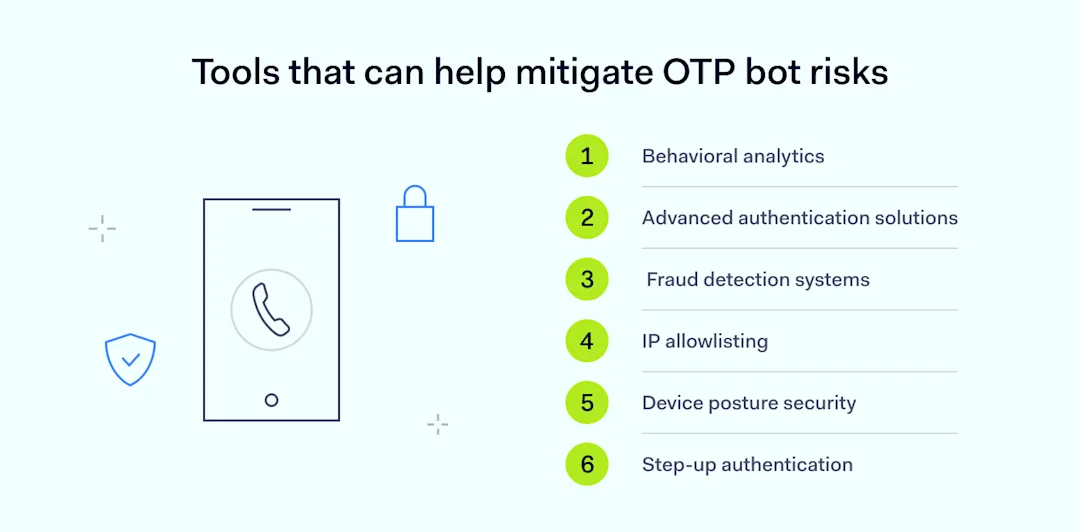
Tools that can help mitigate OTP bot risks

To keep your organizational walls secure, some useful tools and technologies can help detect and prevent OTP bot attacks:

Behavioral analytics

Behavioral analytics tools can be instrumental in identifying and mitigating OTP threats. Tools designed to analyze user behavior and detect anomalies—that may indicate a security threat—provide real-time alerts and detailed reports, enabling organizations to respond swiftly to potential attacks and prevent unauthorized access.

Advanced authentication solutions

Implementing advanced authentication solutions can significantly enhance security against attacks. Tools like Google Authenticator offer more secure methods for generating and verifying one-time passwords.

Such solutions reduce reliance on text messages, which are more vulnerable to interception by OTP bots. Using app-based authenticators or hardware tokens adds an extra layer of security, making it harder for attackers to infiltrate.

Fraud detection systems

Fraud detection systems can help detect and prevent fraudulent activities, such as an OTP bot attack. These systems use advanced algorithms and machine learning to analyze transaction patterns and identify suspicious behavior.

By integrating these systems into your security protocols, you can proactively detect and mitigate potential threats before they result in unauthorized transactions or data breaches.

IP allowlisting

Even if an attacker has access to your credentials, including a one-time password (OTP), they still won’t be able to connect to sensitive databases or tools without the correct IP address. With IP allowlisting, only pre-approved IP addresses are granted access to your network, adding a critical layer of security.

NordLayer supports this by enabling organizations to create virtual private gateways with fixed IP addresses, ensuring that unauthorized users are blocked, even if they possess valid login credentials.

Device posture security

Device posture security helps prevent unauthorized devices from accessing sensitive resources. With features like NordLayer’s Device Posture Security (DPS), organizations can ensure that only approved devices—whether personal or company-issued—are granted access. Even if an attacker has all the correct login credentials, access will be restricted if they’re not using a recognized, authorized device. This adds another layer of protection, ensuring that only compliant devices can interact with your network.

Step-up authentication

Step-up authentication involves implementing additional verification steps when high-risk activities are detected. For example, suppose a user logs in from a new location or attempts a high-value transaction. In that case, the system can require additional authentication methods, such as biometric verification or a hardware token. This approach ensures that only legitimate users can perform sensitive actions, reducing the risk of unauthorized transactions.

These tools and technologies can help businesses significantly reduce the risk of OTP threats and protect their data. Staying vigilant and implementing these security measures is essential to maintaining a robust defense against evolving threats.

Best practices for enhancing security against OTP bots

To enhance your security posture against OTP bots, consider the following practices:

  • Regular software updates. Update all software and systems regularly to fix security holes. Keeping everything up to date helps protect against known vulnerabilities.

  • Implement strong password policies. Enforce complex and unique passwords for different accounts. Use password managers to help you manage and generate secure passwords and regularly prompt password changes.

  • Train your employees. Conduct regular training sessions to inform employees about the latest phishing tactics, social engineering schemes, and specific threats, such as OTP bots. Establish protocols for verifying unusual requests for sensitive information.

  • Encrypt communication channels. Encrypted messaging services or app-based authenticators, including OTPs, are used to transmit sensitive information. Avoid SMS-based OTPs for critical transactions due to their vulnerability to interception.

  • Conduct regular security audits. Perform periodic security audits to identify vulnerabilities and weaknesses in your authentication processes. Work with third-party security experts to conduct comprehensive audits and provide improvement recommendations.

  • Develop a robust incident response plan. Create a well-defined incident response plan for managing and mitigating the impact of security breaches. Include steps for responding to OTP bot attacks, such as isolating affected systems and notifying stakeholders.

  • Implement access controls & the principle of least privilege. Ensure employees have access only to the resources necessary for their roles. Regularly review and adjust access permissions, and utilize role-based access control (RBAC) to manage user permissions.

  • Use threat intelligence & monitoring services. Integrate threat intelligence services for real-time information about emerging threats. Continuous monitoring tools and security information and event management (SIEM) systems should be used to detect suspicious activities early.

  • Stay informed about new threats. Stay updated on new threats, vulnerabilities, and best practices by participating in industry forums, attending conferences, and subscribing to security bulletins. Proactively adapt your security measures based on the latest developments.

Conclusion

While OTP bots pose a serious threat, staying vigilant and proactive puts you in the strongest position to prevent their constantly evolving tactics. OTP attacks will only grow more advanced if we fail to upgrade our defenses. Here are the core items to remember:

  1. Conduct regular employee training to spotlight the latest social engineering techniques. Aware, informed staff are your first line of prevention.

  2. Implement robust, at least two-factor authentication wherever possible. Removing reliance on single-factor OTPs starves bots of their favorite phishing fuel.

  3. Consider additional verification for high-risk events like fund transfers. Extra authentication layers prevent bots’ most enticing break-in targets.

Cybersecurity is an ongoing process that needs effort and adaptation. While challenges will always exist, empowering your organization with strategic security practices makes you resilient against sophisticated online threats. Stay proactive and keep your digital defenses strong.

About Version 2 Digital

Version 2 Digital is one of the most dynamic IT companies in Asia. The company distributes a wide range of IT products across various areas including cyber security, cloud, data protection, end points, infrastructures, system monitoring, storage, networking, business productivity and communication products.

Through an extensive network of channels, point of sales, resellers, and partnership companies, Version 2 offers quality products and services which are highly acclaimed in the market. Its customers cover a wide spectrum which include Global 1000 enterprises, regional listed companies, different vertical industries, public utilities, Government, a vast number of successful SMEs, and consumers in various Asian cities.

About NordLayer
NordLayer is an adaptive network access security solution for modern businesses – from the world’s most trusted cybersecurity brand, Nord Security.

The web has become a chaotic space where safety and trust have been compromised by cybercrime and data protection issues. Therefore, our team has a global mission to shape a more trusted and peaceful online future for people everywhere.

About NordLayer
NordLayer is an adaptive network access security solution for modern businesses – from the world’s most trusted cybersecurity brand, Nord Security.

The web has become a chaotic space where safety and trust have been compromised by cybercrime and data protection issues. Therefore, our team has a global mission to shape a more trusted and peaceful online future for people everywhere.

Understanding SaaS compliance: key standards and best practices

Software as a Service (SaaS) has become the backbone of many businesses, offering scalable and cost-effective solutions for various industries. However, with the convenience of SaaS comes the critical responsibility of ensuring SaaS compliance with industry standards and data protection laws.

For those new to SaaS, understanding SaaS compliance can be daunting, but it is crucial for protecting sensitive data, building customer trust, and avoiding legal pitfalls. This guide will walk you through the basics of SaaS compliance, covering key standards, common challenges, and best practices to help you keep your business on the right track.

What is SaaS compliance? 

SaaS compliance means that software-as-a-service providers have to follow various regulatory requirements, laws, and industry-specific standards. These standards are designed to protect sensitive data, ensure financial transparency, and maintain security protocols across cloud-based services. For SaaS providers, compliance is not just a legal obligation but is also about demonstrating their commitment to safeguarding customer data and upholding industry benchmarks.

For instance, consider a company that offers cloud-based solutions for managing healthcare records. To operate legally and securely, the company must comply with the Health Insurance Portability and Accountability Act (HIPAA), which sets strict standards for protecting sensitive patient information. Without HIPAA compliance, the company could face fines, lose customers, and suffer reputational damage.

Why is SaaS compliance important?

Understanding why SaaS compliance is important is crucial for any business operating in the SaaS space. Compliance serves two primary purposes: protecting data security and maintaining customer trust.

Data security

With data breaches becoming an everyday threat, robust SaaS compliance practices help SaaS providers safeguard their customers’ data against security risks. Compliance frameworks like the General Data Protection Regulation (GDPR) and the California Consumer Privacy Act (CCPA) impose stringent requirements on how companies collect, store, and process personal data. Failure to comply can lead to severe penalties and legal consequences.

For example, in 2023, Meta was fined $1.3 billion for GDPR violations. The company failed to ensure adequate protections for user data during transfers between the EU and the U.S. This shows how important it is to prioritize data security and compliance to avoid substantial legal penalties.

Customer trust

Compliance also plays a crucial role in building and maintaining customer trust. When customers know that a SaaS provider follows compliance frameworks like PCI DSS (Payment Card Industry Data Security Standard) or SOC 2 (Service Organization Control 2), they feel more confident that their data is secure. This trust is essential for long-term business relationships and customer retention.

Risks of non-compliance

The risks of non-compliance are significant. They include legal penalties, financial loss, reputational damage, and operational disruptions. Companies that fail to meet compliance standards may also find it challenging to attract and retain customers as trust in their services diminishes. In extreme cases, non-compliance can lead to business shutdowns, especially if the violations are severe.

Key compliance standards for SaaS providers

To effectively manage compliance, SaaS providers must understand the types of SaaS compliance relevant to their industry. These compliance standards vary depending on the nature of the service, the type of data handled, and the geographical location of the customers. Here’s an overview of some major compliance frameworks.

Key compliance standards for SaaS providers

Financial compliance

Payment Card Industry Data Security Standard (PCI DSS)

PCI DSS is essential for any SaaS provider that handles payment card transactions. This standard outlines security measures to protect cardholder data, including data encryption, secure storage, and regular monitoring. Implementing solutions to become PCI compliant is crucial for preventing data breaches and maintaining customer trust.

Accounting Standards Codification (ASC 606)

ASC 606 provides guidelines for revenue recognition, ensuring that companies report their financial performance accurately. SaaS providers must comply with ASC 606 to demonstrate financial transparency and avoid legal issues related to revenue reporting.

Sarbanes-Oxley Act (SOX)

SOX compliance is mandatory for publicly traded companies, including SaaS providers. It focuses on corporate governance and financial reporting, requiring companies to implement internal controls and report on their effectiveness. Non-compliance with SOX can lead to severe penalties, including fines and imprisonment for executives.

Security compliance

Service Organization Control 2 (SOC 2)

SOC 2 compliance is a critical standard for SaaS providers that handle customer data. It ensures the company’s information security management systems meet industry standards. SOC 2 audits evaluate controls related to security, availability, processing integrity, confidentiality, and privacy. Achieving SOC 2 compliance is essential for demonstrating that your SaaS solutions are secure and reliable.

ISO/IEC 27001

ISO/IEC 27001 is an international standard for information security management systems. It provides a framework for managing and protecting sensitive information through a systematic approach. Implementing an ISO 27001 compliance solution can help SaaS providers safeguard their data, meet customer expectations, and improve overall security.

Center for Internet Security (CIS) Controls

The CIS Controls are a set of best practices for cybersecurity. They provide a prioritized set of actions to protect organizations from cyber threats. SaaS providers can use these controls to strengthen their security posture and reduce security risks, including breaches.

National Institute of Standards and Technology Cybersecurity Framework (NIST CSF)

The NIST CSF is a voluntary framework that provides guidelines for managing and reducing cybersecurity risks. SaaS providers can adopt it to enhance their security practices and ensure they are aligned with industry standards.

Data privacy compliance

General Data Protection Regulation (GDPR)

GDPR is a European Union regulation that governs how companies handle personal data. It applies to any SaaS provider that processes data belonging to EU citizens, no matter where the company is based. Compliance with GDPR is essential for avoiding hefty fines and protecting customer privacy. Companies can explore GDPR compliance services for tailored support.

HIPAA (Health Insurance Portability and Accountability Act)

HIPAA sets the standard for protecting sensitive patient information in the healthcare industry. SaaS providers that handle health-related data must comply with HIPAA to avoid penalties and ensure that patient information is kept confidential. Implementing HIPAA compliance solutions is vital for any SaaS provider operating in the healthcare sector.

CCPA (California Consumer Privacy Act)

The CCPA is a state law that grants California residents rights over their personal data. It requires businesses to disclose what information they collect, allow consumers to opt out of data sharing, and delete personal data upon request. SaaS providers must comply with CCPA to avoid legal penalties and maintain customer trust.

Data security and privacy regulations

Data security and privacy are at the heart of SaaS compliance. Data protection laws like GDPR, HIPAA, and CCPA are designed to protect individuals’ data from misuse and unauthorized access. These regulations require SaaS providers to implement strict security measures, such as data encryption, access controls, and regular monitoring, to ensure that data is protected at all times.

For example, a SaaS provider offering cloud storage services must ensure that data is encrypted at rest and in transit. This means that even if a malicious actor gains access to the data, they would not be able to read it without the decryption key.

Complying with data security and privacy regulations can help SaaS providers protect their customers’ information and avoid legal consequences.

Challenges in achieving SaaS compliance

Achieving SaaS compliance can be challenging for SaaS providers, especially those just starting. Here are some common challenges and potential solutions:

Complexity of regulations

SaaS compliance requirements can be complex and vary by industry and region. For example, a global SaaS provider may need to comply with multiple regulations, such as GDPR, CCPA, and HIPAA, each with unique requirements. To manage this complexity, SaaS providers can use SaaS compliance management tools that automate tracking and implementing regulatory requirements.

Resource constraints

Small and medium-sized SaaS companies often lack the resources for compliance efforts. Hiring compliance experts or outsourcing SaaS compliance can be expensive. However, non-compliance can be even more costly in the long run. To handle this, SaaS providers can focus on implementing the most critical compliance measures first and gradually expand their compliance efforts as their business grows.

Keeping up with changes

Compliance standards and data protection laws are constantly evolving, and SaaS providers must stay up-to-date with the latest changes to remain compliant. This requires continuous monitoring of regulatory updates and adjusting compliance practices as needed. An effective compliance strategy includes subscribing to industry newsletters, attending webinars, and participating in compliance forums to stay informed.

Benefits of SaaS compliance

While achieving SaaS compliance can be challenging, the benefits far outweigh the effort. Here are some key benefits:

Improved security

SaaS compliance ensures that providers implement robust security controls to protect customer data. This reduces the risk of data breaches and cyber-attacks, safeguarding both the company and its customers.

Enhanced customer trust

SaaS security compliance demonstrates to customers that their data is in safe hands, building trust and loyalty and leading to long-term customer relationships.

Competitive advantage

Compliant SaaS companies can differentiate themselves from competitors who may not offer the same level of security and privacy protection. This can be a significant selling point in a crowded market.

Best practices for maintaining SaaS compliance

Maintaining SaaS compliance is an ongoing process that requires constant attention. Here are some best practices to help:

Regular audits

Conduct internal and external audits regularly as part of your compliance strategy. Audits help assess your compliance status and identify any gaps in your security practices. They can also help you stay on top of compliance requirements and ensure that your SaaS solutions remain secure.

Employee training

Regularly train employees on SaaS compliance requirements and their role in maintaining it. An informed team is better equipped to follow measures and avoid potential compliance risks.

Usage of compliance management tools

Leverage compliance management tools to automate tracking and implementing regulatory requirements. These tools help reduce human error and ensure all compliance obligations are met. Additionally, use only SaaS-compliant tools for daily operations to create a secure environment and minimize risks. The more secure your operational tools, the stronger your overall compliance posture.

Document compliance efforts

Keep detailed records of your compliance activities, including policies, procedures, and audit results. This documentation is crucial during an audit or regulatory inquiry.

SaaS compliance checklist

To help you get started, here’s the SaaS compliance checklist of key steps.
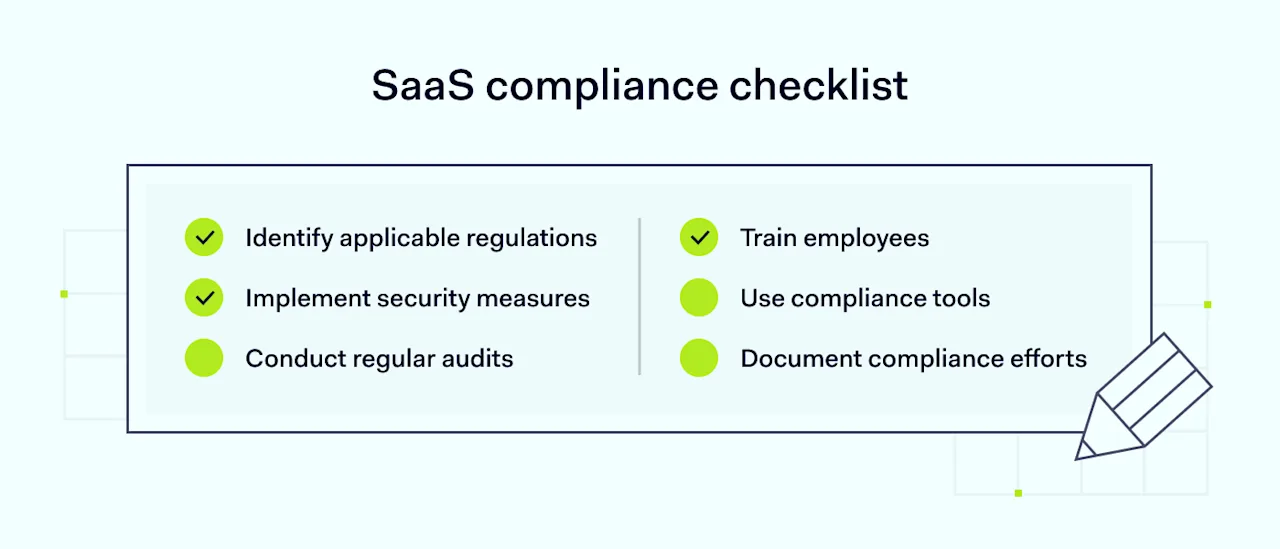
SaaS compliance checklist

  • Identify applicable regulations: Determine which compliance standards (like GDPR, HIPAA, or PCI DSS) apply to your SaaS business

  • Implement security measures: Ensure your platform meets all security requirements, such as encryption and access controls

  • Conduct regular audits: Schedule regular audits to assess your compliance and identify areas for improvement

  • Train employees: Provide ongoing training to ensure employees understand their compliance responsibilities

  • Use compliance tools: Implement tools to automate and streamline your compliance tasks

  • Document compliance efforts: Keep detailed records of your compliance activities, including financial compliance measures and the implementation of security controls.

How can NordLayer help companies stay compliant?

NordLayer itself meets multiple compliance standards for securing applications and services, including GDPR, HIPAA, ISO 27001, and PCI DSS. Compliance often requires specific network security measures, such as traffic encryption, advanced network access control, and multi-factor authentication.

NordLayer addresses these needs by providing robust security features designed to meet these requirements. By integrating NordLayer, you can enhance the security of your SaaS solutions, ensuring they align with compliance standards and protect sensitive data effectively.

Conclusion

SaaS compliance is a critical aspect of running a successful software-as-a-service business. By understanding and adhering to key compliance standards, SaaS providers can protect their customers’ data, build trust, and avoid legal pitfalls. While achieving compliance can be challenging, the benefits—including improved security, customer loyalty, and competitive advantage—make it well worth the effort.

By following best practices and leveraging tools like NordLayer, you can navigate the complex world of SaaS compliance with confidence and ensure your business’s long-term success.

About Version 2 Digital

Version 2 Digital is one of the most dynamic IT companies in Asia. The company distributes a wide range of IT products across various areas including cyber security, cloud, data protection, end points, infrastructures, system monitoring, storage, networking, business productivity and communication products.

Through an extensive network of channels, point of sales, resellers, and partnership companies, Version 2 offers quality products and services which are highly acclaimed in the market. Its customers cover a wide spectrum which include Global 1000 enterprises, regional listed companies, different vertical industries, public utilities, Government, a vast number of successful SMEs, and consumers in various Asian cities.

About NordPass
NordPass is developed by Nord Security, a company leading the global market of cybersecurity products.

The web has become a chaotic space where safety and trust have been compromised by cybercrime and data protection issues. Therefore, our team has a global mission to shape a more trusted and peaceful online future for people everywhere.

A quick guide to remote access protocols

Remote access is a business necessity. Around 50% of workers use remote access technologies to work from home or on the move. Many of those workers access remote desktops to recreate workplaces outside the office.

While workers see Office 365 or SalesForce on their displays, a lot happens under the hood. Businesses rely on remote access protocols to connect devices and transfer data. In every case, companies must secure remote access methods while ensuring optimal performance. 

This blog will explore remote access protocols and introduce some popular varieties. We will also list some remote access best practices to help you find the perfect setup.

What are remote access protocols?

Remote access protocols enable connections between remote devices and servers. Protocols set the conditions for transferring data packets, allowing workers to access desktops hosted on centralized data centers. Many protocols also strengthen security by applying encryption to hide traffic from outsiders.

Common types of remote access protocols

Almost every device has an in-built remote access protocol. Windows uses the Remote Desktop Protocol (RDP), while Linux and Macs use the Secure Shell Protocol (SSH).

Protocols have default settings, which often suit user needs. However, there are occasions when customizing remote access protocols is essential. You may also add extra protocols to improve security or ensure compatibility with other systems.

When you deviate from default setups, it’s important to understand how remote access protocols work. Let’s explore the main remote access protocols and how to use them.

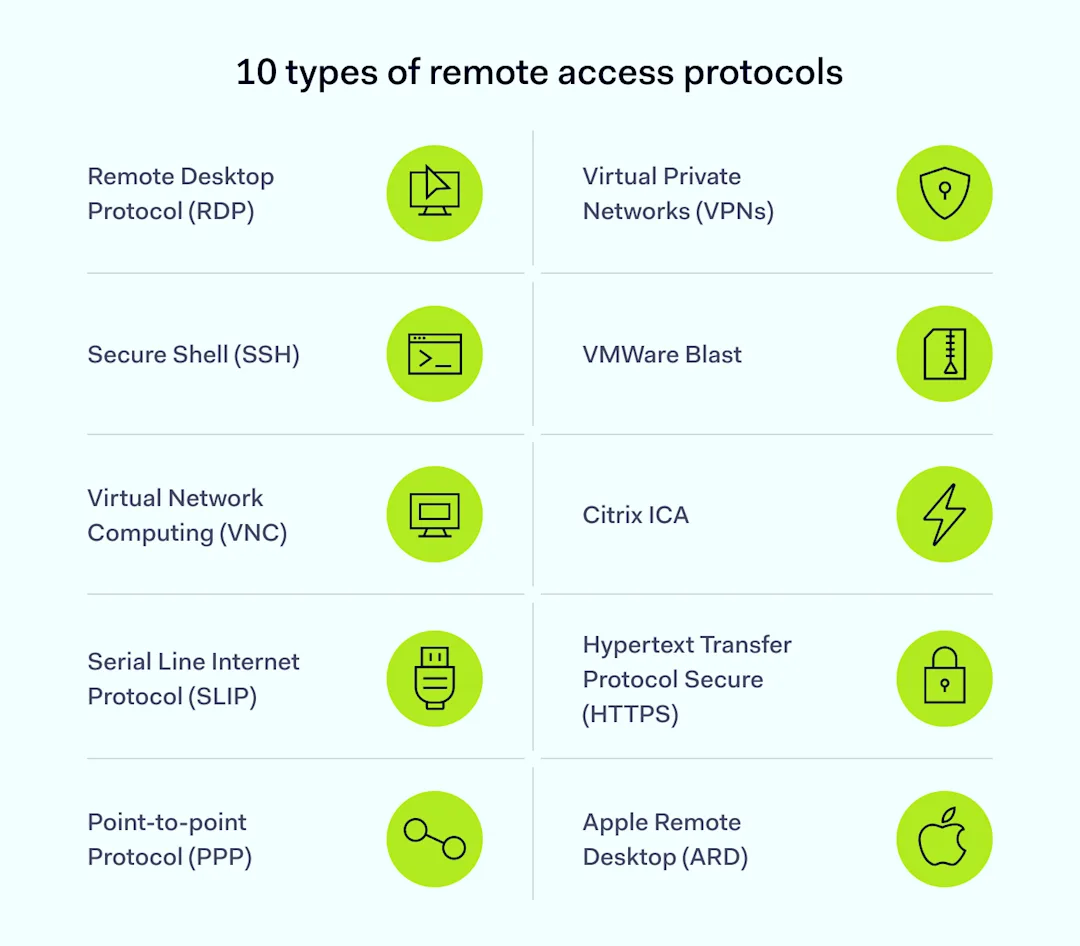
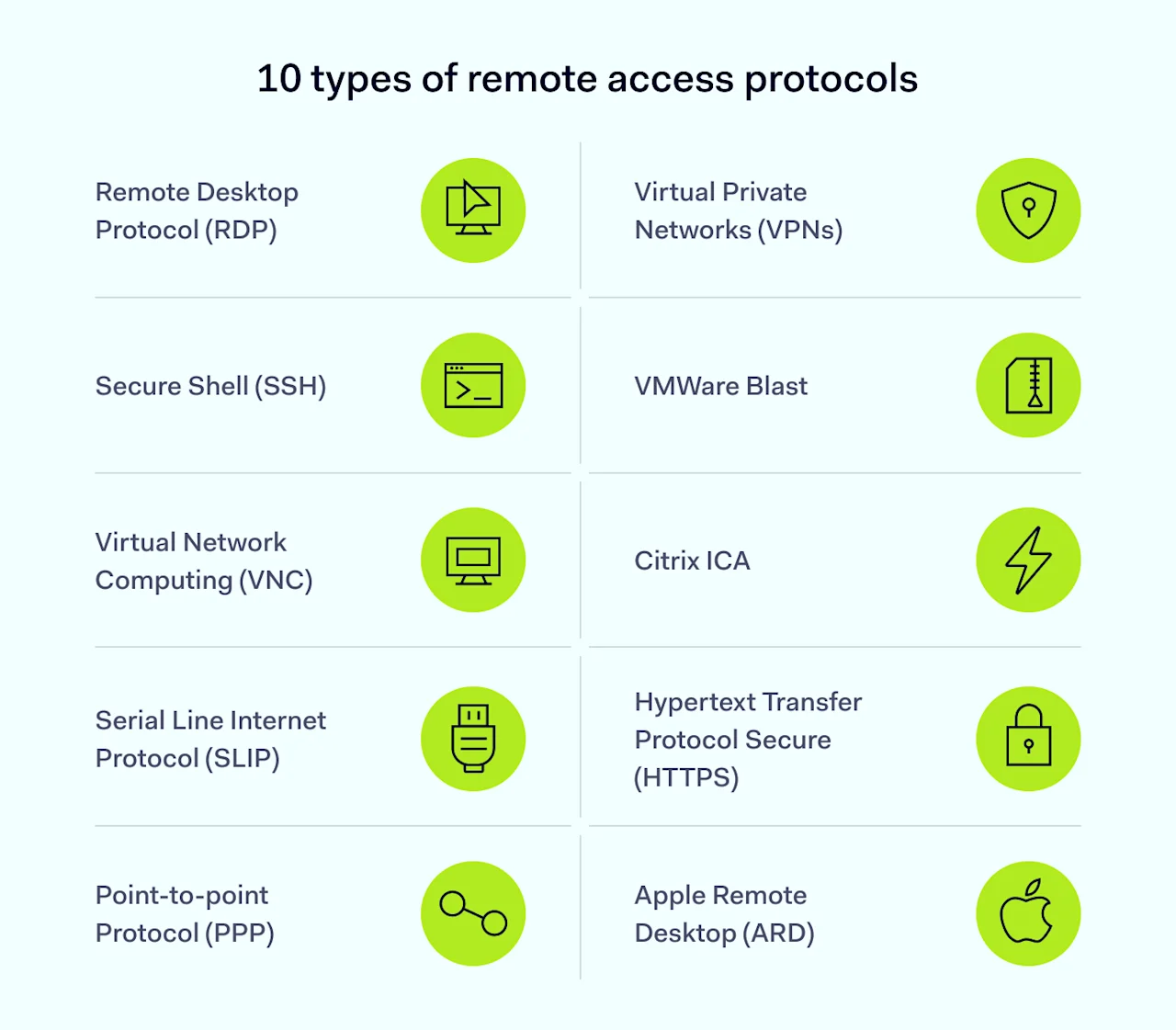
10 types of remote access protocols

Remote Desktop Protocol (RDP)

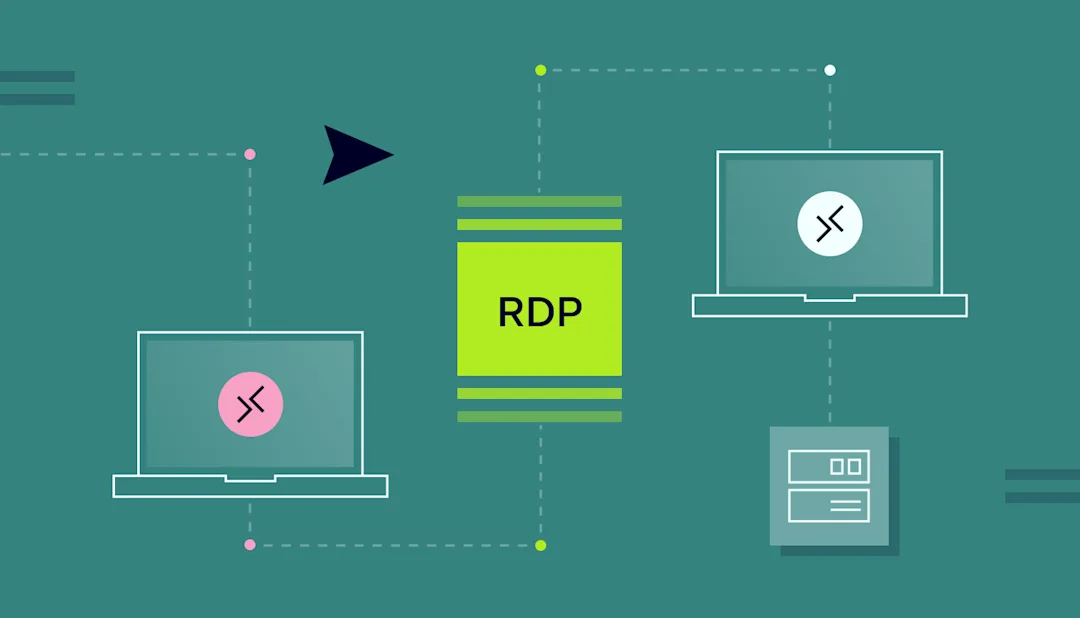
Microsoft created the Remote Desktop Protocol in 2012. RDP uses a server and client setup to organize shared connections between remote devices and central servers. Engineers use RDP to access remote devices securely, and the protocol works with Windows, Linux, Mac OS, and even Android.

RDP uses port forwarding and the TCP/IP transfer protocol to send and receive data over a network channel. This channel carries data about keystrokes, mouse movements, and visual information from remote servers.

With RDP, users don’t need to host apps on their devices. They can access central assets via RDP and work via the remote desktop.

Secure Shell (SSH)

The Secure Shell remote transfer protocol allows remote users to deliver command-line instructions to central devices. The SSH protocol encrypts commands and enables secure file transmission. These features make it a popular protocol for server management.

SSH may also be a good option for secure remote access. The SSH protocol uses public and private keys to authenticate connections. RDP relies on password credentials supplied by remote users, which can be vulnerable to theft or brute force attacks.

Virtual Network Computing (VNC)

Like RDP, VNC users remotely control applications stored on central servers. Unlike RDP, VNC uses the Remote Frame Buffer Protocol (RFB). The screen-sharing protocol allows remote capture of devices, providing greater control compared with RDP.

VNC is popular because it is platform-independent. Many users can connect to a VNC instance, regardless of their operating system. It is a common choice for IT or customer service teams who need secure access to user devices.

Serial Line Internet Protocol (SLIP)

SLIP is one of the oldest remote access technologies, having appeared in the 1980s. First used to connect Unix devices, SLIP is still a popular way to control TCP/IP data transmission.

SLIP creates point-to-point pathways between serial devices. Serial communication is rarely used in remote working as it struggles with audio-visual data flows. However, companies commonly use the technique to control internet-of-things devices due to its low cost and simplicity.

Point-to-point protocol (PPP)

Point-to-point protocols use TCP/IP to create secure connections between remote devices and central servers. Operating at the link layer, PPP is a go-to protocol for Internet Service Providers.

PPP is the foundation of other remote access technologies. For example, Point-to-Point Protocol over Ethernet (PPPoE) allows rapid file transfers over Ethernet connections. PPPoE also enables network monitoring to track user activity.

Virtual Private Networks (VPNs)

Virtual Private Networks use variants of the Point-to-Point Tunneling Protocol (PPTP) to create secure tunnels between clients and servers. Tunneling enhances user privacy by encrypting data and assigning fresh IP addresses.

These features make VPNs some of the most secure remote access solutions. However, VPN protocols are not specialized for remote desktop access. They tend to operate alongside RDP and other remote access technologies.

Remote access VPNs create digital gateways to secure other forms of remote access. That’s especially useful for remote workforces that connect via home offices and unsecured public networks.

VMWare Blast

Blast is VMWare’s virtual display protocol and uses the H.264 video compression standard to transfer video data. Compression makes Blast a good option if companies rely on video conferencing and virtual meetings. It also suits remote desktop access with complex visual demands.

VMWare Blast is platform-neutral, supporting Linux, MacOS, and Windows. It uses the UDP and TCP/IP framework for data transfers, while encryption and authentication functions provide additional security.

Citrix ICA

Citrix ICA is a proprietary remote desktop protocol focused on high-performance desktop access.

The “Independent Computing Architecture” resembles RDP’s client and server architecture. Unlike basic RDP, Citrix ICA optimizes data flows for graphics and audio. This reduces latency and enhances efficiency.

Hypertext Transfer Protocol Secure (HTTPS)

HTTPS is a secure version of the Hypertext Transfer Protocol that transmits most web traffic.

Companies can use it to secure remote access via web applications. For example, HTTPS enables collaboration via Google Docs or access to publishing tools like Canva.

The problem with HTTPS is it only applies to web-based traffic. Users will need additional protocols to secure other forms of traffic.

Apple Remote Desktop (ARD)

Apple’s version of the Remote Desktop Protocol, ARD, allows remote management of MacOS systems. It provides similar services to RDP, including remote admin and file transfers.

IT teams can use ARD to remotely manage software on Apple devices or control many Macs on a company network. ARD also features screen-sharing, file distribution, and software installation to ease the workload for security teams.

ARD is only used with Apple systems. You can use it as part of remote access systems, but other protocols are needed if PCs or other devices are involved.

How should you choose the right remote access protocol for your needs?

Take care when choosing different types of remote access protocol, as the protocol you select influences overall performance.

Remote access solutions should balance criteria and take business needs into account. In some situations, security is critical. In others, speed matters slightly more. Here are some criteria to guide your decision-making:

  • Security. If security is foremost, choose remote access protocols that support strong encryption and authentication systems. A smart remote access setup based on combining VPNs and RDP should protect critical data.

  • Speed and performance. Fast protocols consume minimal bandwidth and generate very little latency—handy if you rely on split-second connectivity. Protocols may also support file compression to reduce transfer volumes, another good way to improve performance.

  • Compatibility. Think about how remote access protocols fit into your network environment. Some RAPs support all operating systems. Others, like RDP or ARD, are less wide-ranging. Check your protocol works with visualization platforms like Citrix (if you use them).

  • Cost. Sourcing a proprietary remote access protocol like VMWare Blast can be expensive, as companies must buy licenses for every user. RDP or other solutions may be better suited to small businesses on cost grounds.

Best practices for using remote access protocols

Challenges remain after choosing remote access protocols. How should you use protocols securely and efficiently to achieve your business goals?

Implementing remote access technologies varies between businesses, but some best practices apply across the board:

  • Use multi-factor authentication (MFA). MFA requires extra user credentials before establishing a remote access session. Most protocols support authentication, which cuts the risk of outsiders gaining control of network devices.

  • Encrypt data securely. Encryption scrambles data packets transported via remote access protocols. Tools like RDP do not provide strong encryption by default. The safest option is applying encryption over the top via VPN protocols.

  • Segment networks for added security. Strengthen protection by isolating remote access servers in secure network segments. Control access to this secure zone and minimize east-west movement if attackers breach remote access defenses.

  • Update software regularly. Remote access protocols can be vectors for exploit attacks. Regular patches and software updates keep network assets current and protected against known vulnerabilities.

  • Monitor remote access. Security teams can monitor data transferred via remote access protocols to detect suspicious activity. Maintain activity logs and schedule regular audits to identify potential problems.

  • Organize user training. Users must know how to use remote desktop protocols securely. Password hygiene, VPNs, patching, and avoiding unsafe public spaces should all appear in training programs.

  • Use load balancing to scale RAP solutions. Scaling remote access protocols can cause performance issues. Load balancing helps you manage bandwidth and avoid network bottlenecks.

Remote access protocols: How NordLayer can help

To connect to a remote device, you need a remote access protocol. Products offering this service should be compatible with popular protocols.

The best solutions not only establish the connection but also ensure it is encrypted and secure, like NordLayer. NordLayer’s Smart Remote Access works with SSH, VPC, and RDP protocols. Additionally, NordLayer provides extra security like encryption and access controls, enhancing the safety of remote connections.

Our Smart Remote Access (SRA) feature allows organizations to create virtual LANs interconnecting several work devices. Users can easily reach other devices connected to the same Virtual LAN as if they were on the same physical network.

Virtual LANs created with NordLayer’s SRA are extremely safe, as only authorized users and devices can access network assets. Employees can upload and delete files securely while VPN technology runs in the background—making connections secure wherever users are. IT admins can troubleshoot issues remotely and manage servers from different locations without hassle. Remote desktops can run without security concerns, keeping sensitive data protected.

For example, a sales team on the road can access internal resources and update the CRM in real time, improving response times and data accuracy. A development team spread across different locations can collaborate on code, share files, and use shared servers, boosting productivity and keeping projects on time. Healthcare professionals can access patient records securely from various locations, ensuring timely and accurate medical care.

About Version 2 Digital

Version 2 Digital is one of the most dynamic IT companies in Asia. The company distributes a wide range of IT products across various areas including cyber security, cloud, data protection, end points, infrastructures, system monitoring, storage, networking, business productivity and communication products.

Through an extensive network of channels, point of sales, resellers, and partnership companies, Version 2 offers quality products and services which are highly acclaimed in the market. Its customers cover a wide spectrum which include Global 1000 enterprises, regional listed companies, different vertical industries, public utilities, Government, a vast number of successful SMEs, and consumers in various Asian cities.

About NordLayer
NordLayer is an adaptive network access security solution for modern businesses – from the world’s most trusted cybersecurity brand, Nord Security.

The web has become a chaotic space where safety and trust have been compromised by cybercrime and data protection issues. Therefore, our team has a global mission to shape a more trusted and peaceful online future for people everywhere.

About NordLayer
NordLayer is an adaptive network access security solution for modern businesses – from the world’s most trusted cybersecurity brand, Nord Security.

The web has become a chaotic space where safety and trust have been compromised by cybercrime and data protection issues. Therefore, our team has a global mission to shape a more trusted and peaceful online future for people everywhere.

×

Hello!

Click one of our contacts below to chat on WhatsApp

×