Skip to content

How to change your Facebook password

How to change your password on Facebook

Facebook remains an important hub for personal and professional interactions, as well as a service that is quite commonly linked to other accounts, making the security of your Facebook account significant to say the least.

The process for changing your Facebook password is largely consistent across desktop, iOS, and Android devices. However, if you’re specifically looking for how to change Facebook password on iPhone or Android, always ensure you have the latest version of the Facebook app installed for the most up-to-date instructions.

So, whether you’re taking proactive measures or responding to a potential concern, updating your password is a simple yet effective step. Here’s a detailed guide to help you change your Facebook password with ease.

Changing Facebook password on desktop

Facebook has made it relatively straightforward to update your security settings on a desktop device.

Here’s a step-by-step guide to changing your password on a PC or Mac:

  1. Sign in to your Facebook account.

  2. Click the downward-pointing arrow in the upper-right corner.

  3. Select “Settings and privacy” followed by “Settings.”

  4. In the left sidebar, click on “Security and login.”

  5. Under the “Login” section, find and click “Change password.”

  6. Enter your current password and then, enter your new password in both the “New” and “Retype new” fields.

  7. Click “Save changes.”

  8. Your password is now updated.

Changing Facebook password on mobile

With the increasing reliance on mobile devices for our daily online activities, it’s essential to know how to secure your Facebook account on the go. Whether you’re using an iPhone or an Android device, here’s how you can change your Facebook password:

For both iOS and Android:

  1. Open the Facebook app on your mobile device.

  2. Tap your profile picture.

  3. Select “Settings and privacy” and tap “Settings.”

  4. Scroll to find the “Security and login” option and tap it.

  5. Under the “Login” section, tap “Change password.”

  6. Enter your current password, then your new password in both the “New password” and “Retype new password” fields.

  7. Tap “Update password.”

  8. Your password is now updated.

Remember, while changing your password is a great security measure, always consider additional protective steps like enabling multi-factor authentication for enhanced account safety.

Changing Facebook password in Accounts Center

You can also change your Facebook password in the Accounts Center, a centralized hub where you can manage all of your connected Meta experiences, including Facebook and Instagram.

Here’s how to change your Facebook password via Accounts Center:

  1. Go to “Accounts Center.”

  2. Navigate to the “Password and security” section.

  3. Select Facebook from the list of connected accounts.

  4. Click on “Change password” and follow the instructions to create a new password.

  5. Confirm and save the changes.

Once you’ve completed all the steps, your Facebook password will be updated, and you’ll be able to use it to log in to Facebook on any of your devices.

How to reset your password on Facebook

You can try a few methods if you have forgotten your Facebook password. The most straightforward one is to use the “Forgot password?” functionality, but you must have access to the email account or a phone number you used when you signed up for Facebook.

But what should you do if you no longer have access to the email address you signed up with? No worries – you can still recover your Facebook account through a backup email address or phone number or recover your account using the Find Your Account page. Here’s how it works:

  1. First, go to Facebook’s homepage.

  2. Try to log in with the last password you remember using.

  3. If it’s incorrect, click “Forgot password?”

  4. You will be redirected to the “Find your account” page. Type into the search field the email address, phone number, full name, or username associated with your Facebook account.

  5. Follow further on-screen instructions.

If you can’t access the email account that you used when signing up for Facebook or you haven’t set up a backup email or phone number, then unfortunately, you won’t be able to log in to your Facebook account. There is no way to verify that it’s you trying to regain access to your Facebook.

How to set recovery email or phone number

If you managed to remember your password and login, it’s best to add additional verification and recovery methods, like an email address or a phone number. You never know when you might forget your password or someone might try to hack your account – it’s best to have a few different verification methods.

Here’s how to add a recovery email address:

  1. Log in to your Facebook account, click on your profile picture on the upper right side of the screen, and select “Settings and privacy.”

  2. Click “Settings.”

  3. Go to “Accounts Center,” then “Personal Details.”

  4. Navigate to “Contact info.”

  5. Click “Add new contact,” then choose “Add email address.”

  6. Enter the email address you want to add, select the account, and click “Next.”

  7. Complete the process by entering the confirmation code sent to your email.

Here are the steps for adding a recovery phone number:

  1. Log in to Facebook, click on your profile picture on the upper right side of the screen, and choose “Settings and privacy.”

  2. Go to “Settings.”

  3. Navigate to “Accounts Center,” then “Personal Details.”

  4. Go to “Contact info.”

  5. Click “Add new contact,” then choose “Add mobile number.”

  6. Enter the phone number you want to add, select the account, and click “Next.”

  7. Facebook will text you a confirmation code to verify your new phone number. Use it to confirm your new number.

Improve your Facebook account security

While you’re at it, you can tweak other security and privacy settings to further improve your Facebook account security. Here are a few quick tips on leveling up your security posture on Facebook.

Enable two-factor authentication

  1. Log in to your Facebook account, click your profile image on the upper right side of the screen, and select “Settings and privacy.”

  2. Click “Settings.”

  3. Go to “Accounts Center,” then “Password and security.”

  4. Choose “Two-factor authentication,” and then select the account for which you want to enable it.

  5. Select the security method you wish to add and follow the instructions displayed on the screen.

Set up alerts for unrecognized logins

  1. Log in to your Facebook account, click your profile image on the upper right side of the screen, and select “Settings and privacy.”

  2. Click “Settings.”

  3. Go to “Accounts Center,” then “Password and security.”

  4. Select “Login alerts.”

  5. Choose your preferred method for receiving alerts, such as via email or through a Facebook notification on a recognized device.

Change your password to something long and complex

A long and complex password might be tough to remember, but it might be the best way to keep your Facebook account safe.

Consider using a password that’s at least 12 characters long and includes a mix of numbers, special symbols, and upper- and lowercase letters. Determining whether your new password is as strong as it should be can be tricky, and that’s where our password strength checker can help.

While long and complex passwords are your best bet to keeping your online accounts secure, it can be challenging to remember them on the spot. And that’s one of the reasons why password managers such as NordPass exist. NordPass provides an all-around solution for passwords and passkeys management. With the ability to automatically prompt users to save passwords for new websites, NordPass streamlines the often tedious process of having to manually type out your passwords. Additionally, with NordPass you get secure password sharing, biometric authentication, and encrypted note storage, ensuring a holistic approach to online security.

About Version 2 Digital

Version 2 Digital is one of the most dynamic IT companies in Asia. The company distributes a wide range of IT products across various areas including cyber security, cloud, data protection, end points, infrastructures, system monitoring, storage, networking, business productivity and communication products.

Through an extensive network of channels, point of sales, resellers, and partnership companies, Version 2 offers quality products and services which are highly acclaimed in the market. Its customers cover a wide spectrum which include Global 1000 enterprises, regional listed companies, different vertical industries, public utilities, Government, a vast number of successful SMEs, and consumers in various Asian cities.

About NordPass
NordPass is developed by Nord Security, a company leading the global market of cybersecurity products.

The web has become a chaotic space where safety and trust have been compromised by cybercrime and data protection issues. Therefore, our team has a global mission to shape a more trusted and peaceful online future for people everywhere.

Backend-driven UI: Fast A/B testing and unified clients

As a Senior Frontend Engineer at NordLayer, I recently dove into BDUI to see what makes it stand out. In this article, I’ll break down where UI development is now and how adding more server-side power could improve the usual frontend-focused methods.

Frontend-only UI development

Imagine a simple UI feature, like the banner at the top of a page. How does our team create this banner? Let’s take a look at the 6-step development lifecycle for a single feature. 

A basic development cycle for a UI feature.

Development starts with requirement gathering, where the product owner (PO) outlines the desired functionality of the UI element. In this case, we want it to display a static message. So we design the banner, and as it’s a frontend-only feature, we may skip backend development and go straight into frontend development, then testing. After that, there’s only one step left – deployment. That’s it – the job’s done…

… or is it?

Emphasizing the backend’s role

Let’s say this whole process takes a week, depending on your setup. But features don’t simply stay the same indefinitely – we iterate upon them.

For example, we’d like to show a different message for the second iteration. However, realizing that the message will change a lot, we’d move its management to the backend. To ensure a smooth integration between departments, the backend engineers build an API and provide it to the frontend team. After testing and deployment, everything’s ready to go.

Let’s iterate further. Now we want to deliver tailored messages to different user segments, as part of an A/B testing strategy. The beautiful part? No more frontend changes required! The frontend’s role now is simply to call the backend to retrieve the display message. Our UI approach is now effectively ‘backend-driven,’ enabling faster iterations and more flexible content management and delivery.

The goal of backend-driven UI

Simply stated, backend-driven UI aims to make user interfaces a function of state.

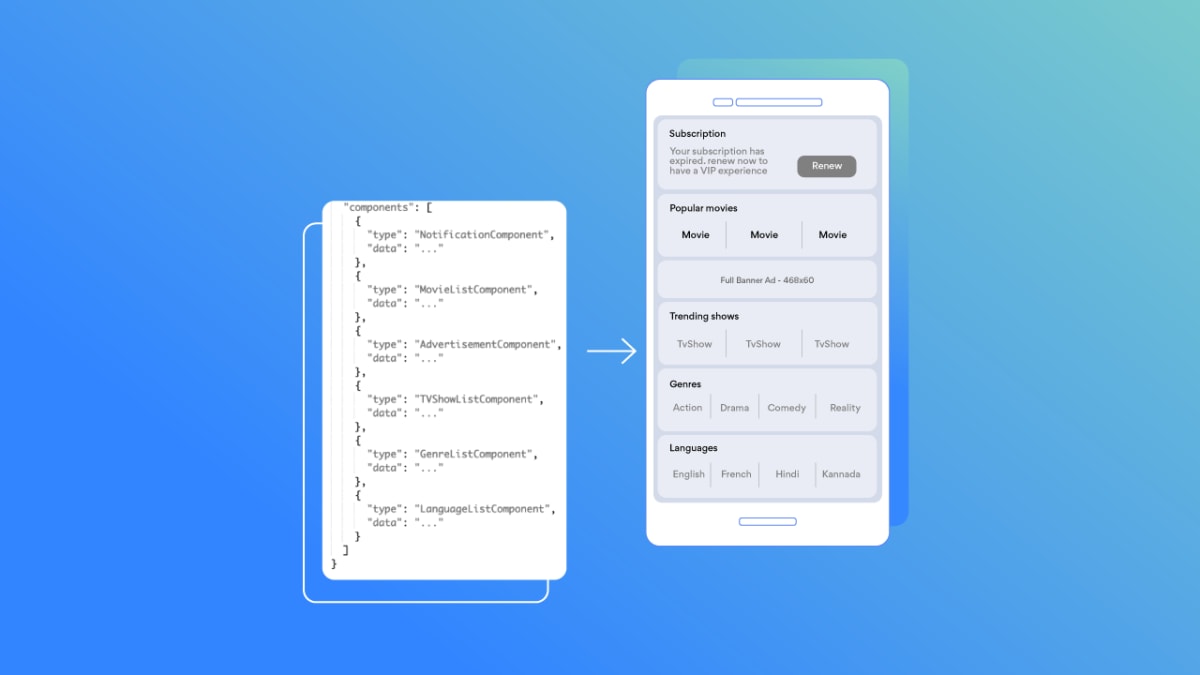
Spotify expressed BDUI as UI = fn(state) in one of its early talks on the subject. This distills the idea beautifully. What we’re trying to achieve here is making the interface depend entirely on the state provided to it. Imagine a webpage structured using JSON data objects, which in our case, become the state. Each object represents a component on the frontend client. 

A mobile UI defined by JSON components.

The benefits of backend-driven UI

  • Redesigning our interface becomes streamlined: This can be achieved by simply changing the order of our objects. We can also add components without any frontend redeployment.

  • Backend-driven UI allows us to unify our client approach because this state can be used to populate any client, whether it’s mobile, desktop, or otherwise. This way, users get new features at the same time, regardless of what client they’re using. In terms of development, this helps developers across various teams follow a similar workflow.

  • Easier A/B testing. All we need to focus on is how to deliver different states based on user feedback, and with that, we can get really flexible when conceptualizing and experimenting with new UIs.

The cons of backend-driven UI

Uneven developer distribution

As mentioned before, every useful software development approach will have downsides. Implementing backend-driven UI means migrating all logic from the frontend. Naturally, this will result in higher workloads for backend developers. Keeping that in mind, does the usual developer distribution change when using this approach? Generally, yes, but this ultimately depends on the product/app/service you’re building. Some are already more backend-heavy than others.

Workload will vary depending on the stage of implementation. When starting with backend-driven UI, designing the architecture, agreeing on the contract, and executing the switch is heavily dependent on all engineers. Questions mostly arise when the migration is complete. From then on, backenders will have bigger workloads.

High cost

The upfront cost of introducing backend-driven UI can be significant. When making a UI reliant only on the state provided to it, the implementation can quickly become overcomplicated. This impacts the pace of development. It’s not an easy task, but we’re trading high upfront costs for being faster and more flexible in the future.

You should first consider whether this approach is even useful for your specific business. Spotify popularized this approach because it wanted the ability to experiment fast and flexibly with novel UI features. But if you’re building an admin panel, does it need to be backend-driven? Will the interface change a lot, or will you be conducting A/B tests for the users? Implementing BDUI should align with your tech setup and business goals.

Sanity check: Is BDUI for you?

With the pros and cons in mind, let’s address some common questions:

How much should you commit initially?

Backend-driven UI doesn’t need to replace the entire system. You can also take a modular approach when determining viability. As an example, you can identify specific parts of the application that you could make backend-driven. The banner example that we discussed above could be something to start with. If that works, try it out on a more challenging feature like a table or carousel.

Are we inventing HTML again?

Avoid being too detailed. Taking a simple feature like a text box, we could go overboard and start thinking about allowing different text colors, size changes, or other modifications…  But then we’d come dangerously close to CSS and HTML, which is certainly not the goal! Remember: Enable backend-driven UI using general components, not detailed blocks.

Do we have the foundation to implement a backend-driven UI?

Do you have a design system? As we said above, being too detailed will cause problems. With a design system in place, we have a very clear direction on where to go. Development becomes very logical as long as our frontend can handle our designed components. Everyone uses the same components to describe UIs: Whether you’re a mobile developer, frontender, or designer, we all speak the same language. A button means the same component across different contexts.

Big Tech and backend-driven UI

Most of this article’s content is based on findings from Lyft, Spotify, Airbnb, and others. These are huge companies with the resources to make backend-driven UI a reality.

And even though BDUI can be a pricy upfront investment that requires developer redistribution, its long-term benefits – including flexibility and faster adaptation to user feedback – are a huge upside for many teams, products, and apps.

Read more about engineering at Nord Security.

About Version 2 Digital

Version 2 Digital is one of the most dynamic IT companies in Asia. The company distributes a wide range of IT products across various areas including cyber security, cloud, data protection, end points, infrastructures, system monitoring, storage, networking, business productivity and communication products.

Through an extensive network of channels, point of sales, resellers, and partnership companies, Version 2 offers quality products and services which are highly acclaimed in the market. Its customers cover a wide spectrum which include Global 1000 enterprises, regional listed companies, different vertical industries, public utilities, Government, a vast number of successful SMEs, and consumers in various Asian cities.

About NordPass
NordPass is developed by Nord Security, a company leading the global market of cybersecurity products.

The web has become a chaotic space where safety and trust have been compromised by cybercrime and data protection issues. Therefore, our team has a global mission to shape a more trusted and peaceful online future for people everywhere.

Forgot your Apple ID password? Here is how you can reset it.

Before you reset your Apple ID password

Before you go about resetting or changing your Apple ID password, it’s important to have all the necessary information for the process. Here’s what you’ll need:

  • Email address: Make sure you have access to the email address that you’ve used with your Apple ID.

  • Security questions: Have answers ready to any security questions if required.

  • Multi-factor authentication (MFA): If you’ve enabled MFA, ensure you have access to the trusted device or phone number.

  • Recovery email or phone number: If you’ve set up a recovery email or phone number, ensure you can access it.

On top of that, it is also crucial to note that Apple has a set of specific requirements for passwords, including:

  • A password has to be at least eight characters long.

  • A password must include a number.

  • A password must include both uppercase and lowercase letters.

How to reset your Apple ID password on iPhone and iPad

  1. Go to “Settings” and tap on your name.

  2. Select “Sign-In & Security.”

  3. Tap “Change password.”

  4. Enter your device’s passcode. Then, enter your new password and confirm it.

  5. Tap “Change” or “Change Password.”

How to reset your Apple ID password on a Mac

  1. Click on Apple’s logo at the top left of your screen.

  2. Select “System Preferences” and click on your name.

  3. On the left, select “Sign-In & Security.”

  4. In the next window, select “Change password.”

  5. You will need to enter your device’s password.

  6. You will be able to enter your new password in the next window. Then, select “Change” and “Done.”

How to reset your Apple ID password online

  1. Go to appleid.apple.com

  2. Click “Sign in” and select “Forgot password?”

  3. Enter your email address or phone number, enter the CAPTCHA code, and click “Continue.”

  4. You will receive a prompt to change your password on one of your Apple devices.

If you don’t have the device with you, you will have to either answer security questions or confirm your identity via email. If you are unable to do that, you will be asked to enter the 2FA recovery key to reset your password. You can create a new password only after you’ve confirmed your identity.

How to reset your Apple ID on a new device

  1. During the setup of a new Apple device, you will be asked to enter your Apple ID.

  2. Select “Forgot password or don’t have an Apple ID?”

  3. Finish the setup of a new device.

  4. As soon as the setup is complete, select an app that requires you to sign in to your Apple ID. On iPhone, iPad, or Apple Watch, you can simply select Messages. On a Mac, follow the instructions above.

What to do if the standard Apple ID reset methods haven’t worked for you

In case the outlined methods for resetting or changing your Apple ID password don’t work for you, there are still a few alternative strategies you can try. These methods can help you recover your account and regain access to all your Apple devices and services.

  • Check for devices already signed in with your Apple ID: If you have other Apple devices already signed in with your Apple ID, you can use one of those devices to reset your password. This can often be the quickest solution since it allows you to bypass additional verification steps.

  • Use recovery information: When setting up your Apple ID, you may have provided a recovery email address or phone number. If so, Apple can send you a verification code or reset link to help you regain access to your account.

  • Contact Apple Support: If you’ve tried the above methods without success, reaching out to Apple Support is your next best option. Apple Support can assist you in verifying your identity and recovering your account. While this might take a bit more time, it’s a reliable way to resolve the issue.

Best practices for managing and securing your passwords

To avoid the frustration of forgetting your Apple ID password in the future, we highly recommend adopting strong password management practices.

Create strong, complex passwords

Whenever you’re creating a password for a website, app, or service, remember that a strong password is a password that’s at least eight characters long and includes a healthy mix of uppercase and lowercase letters, numbers, as well as special characters. During password creation, it is also important to avoid using any easily guessable information such as your name or birthdate. If you’re looking for inspiration and practical tips for creating a strong and complex password, check out our Five Strong Password Ideas post.

Enable multi-factor authentication (MFA)

Beyond strong passwords, enabling multi-factor authentication (MFA) can further secure your accounts. MFA provides an extra layer of security by requiring a second form of verification in addition to the traditional username and password combination. This could be a code sent to your phone, a biometric scan, or a prompt on a trusted device.

Use a password manager

Finally, managing multiple strong passwords can be challenging and quite frustrating. This is where a password manager like NordPass can come in handy. NordPass simplifies password management and life online in general by offering a single secure place to safely store it all: passwords, passkeys, credit cards, personal information, secure notes, and more. On top of that, NordPass is designed to automatically save and fill in your credentials when you need to log in, saving you time and reducing the risk of password fatigue. NordPass for iOS even allows you to sync your passwords across all your devices, ensuring you have access to your digital valuables whenever, wherever. Even when you’re offline.

Start using passkeys instead of passwords

Passkeys are a new, convenient, and phishing-resistant way to sign up for and access apps, websites, and other various online services. In essence, a passkey is a digital login credential that uses your device—be it a phone, laptop, tablet, or desktop—to authenticate you instead of a traditional combination of a username and password. Cybersecurity experts see passkeys as the future of authentication technology, which will inevitably replace passwords. Tech giants such as Microsoft, Google, and Apple already allow users to opt for passkey-based authentication on their services. If you want to take your access security to the next level, we highly advise moving toward passkey-based authentication. To learn the ins and outs of setting up and using passkeys on your Apple devices, be sure to check out our latest blog entry on that exact topic.

By adopting these practices into your routine, you’ll significantly reduce the risk of unauthorized access to your accounts and minimize the stress of managing multiple passwords. Not only will your Apple ID be more secure, but you’ll also have the peace of mind of knowing that all your online accounts are protected.

About Version 2 Digital

Version 2 Digital is one of the most dynamic IT companies in Asia. The company distributes a wide range of IT products across various areas including cyber security, cloud, data protection, end points, infrastructures, system monitoring, storage, networking, business productivity and communication products.

Through an extensive network of channels, point of sales, resellers, and partnership companies, Version 2 offers quality products and services which are highly acclaimed in the market. Its customers cover a wide spectrum which include Global 1000 enterprises, regional listed companies, different vertical industries, public utilities, Government, a vast number of successful SMEs, and consumers in various Asian cities.

About NordPass
NordPass is developed by Nord Security, a company leading the global market of cybersecurity products.

The web has become a chaotic space where safety and trust have been compromised by cybercrime and data protection issues. Therefore, our team has a global mission to shape a more trusted and peaceful online future for people everywhere.

10 best network firewall solutions for businesses

Since the first commercial firewall in 1991, network security needs and technology have evolved significantly. While many businesses still use hardware firewalls, the rise of virtual network firewalls has made it easier to achieve the same functionality without the maintenance and complexity of physical firewalls.

Software firewalls offer effective network protection in a simpler, easier-to-manage way compared to hardware options. This article reviews our top 10 picks for software network firewalls to help you choose the best one for your business.

How we chose the best network firewall solutions (in our opinion)

We selected a range of network firewall options, including large enterprise solutions, mid-size businesses with similar features, and smaller companies that may not be as developed but still provide strong functionality. We didn’t go into too many details, but we focused on how well the firewall strengthens network security and how easy it is to set rules relating to the user interface. We also looked at the overall benefits of each firewall vendor and what types of clients they suit. We also considered cost-effectiveness and how comprehensive these solutions are.

We checked reviews and user feedback on sites like Gartner, G2, Reddit, and Capterra. We focused on what users said about cost, performance, next-generation firewalls, feature reliability, and how helpful the support teams were. If we found unusual feedback about a specific firewall provider that users often mention, we included it as well.

Top 10 network firewall solutions, in our opinion

Different solutions suit different business types. Here’s a detailed look at our favorite network firewall solutions available today, listed in no particular order:

  • NordLayer

  • Cato SASE Cloud

  • Fortinet: FortiGate VM

  • Palo Alto VM Series

  • Cloudflare WAF

  • Zscaler Internet Access

  • Appgate SDP

  • Perimeter 81 (Check Point Harmony SASE)

  • Todyl

  • Banyan Security

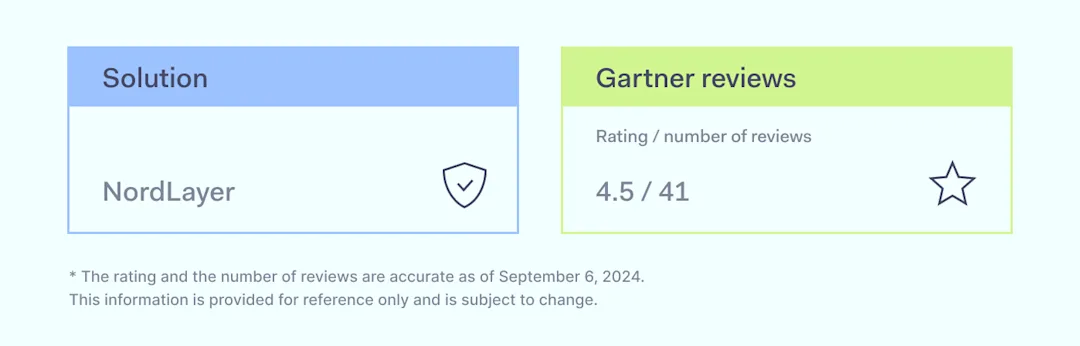
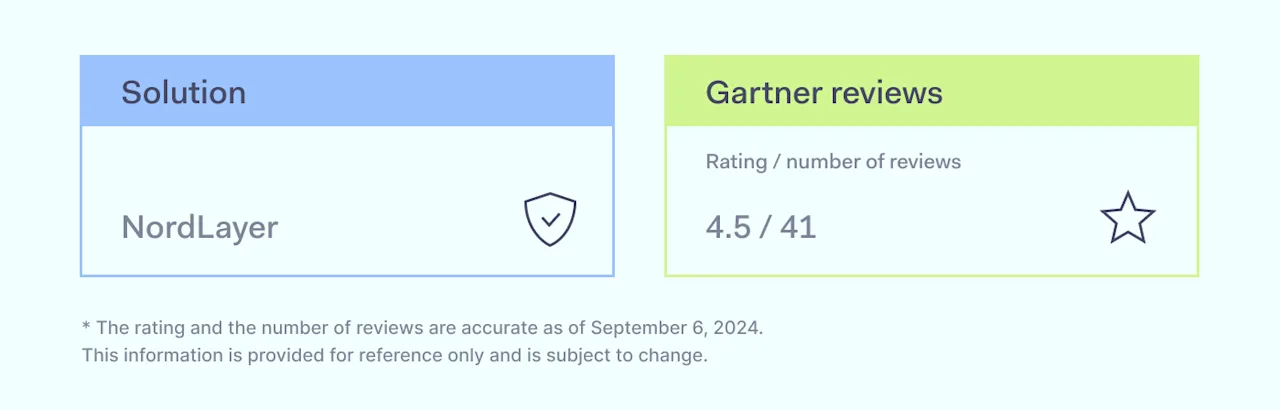
1. NordLayer

NordLayer

NordLayer is a network security solution that offers secure access to company resources from any location. It helps protect networks, enables remote work, and provides the tools necessary to comply with key regulatory frameworks. Developed by Nord Security, the creators of NordVPN, NordLayer offers a multi-layered defense and features typical of next-generation firewalls (NGFW).

NordLayer enables organizations to implement Firewall as a Service (FWaaS) along with Zero Trust Network Access (ZTNA), and Secure Web Gateway (SWG) principles.
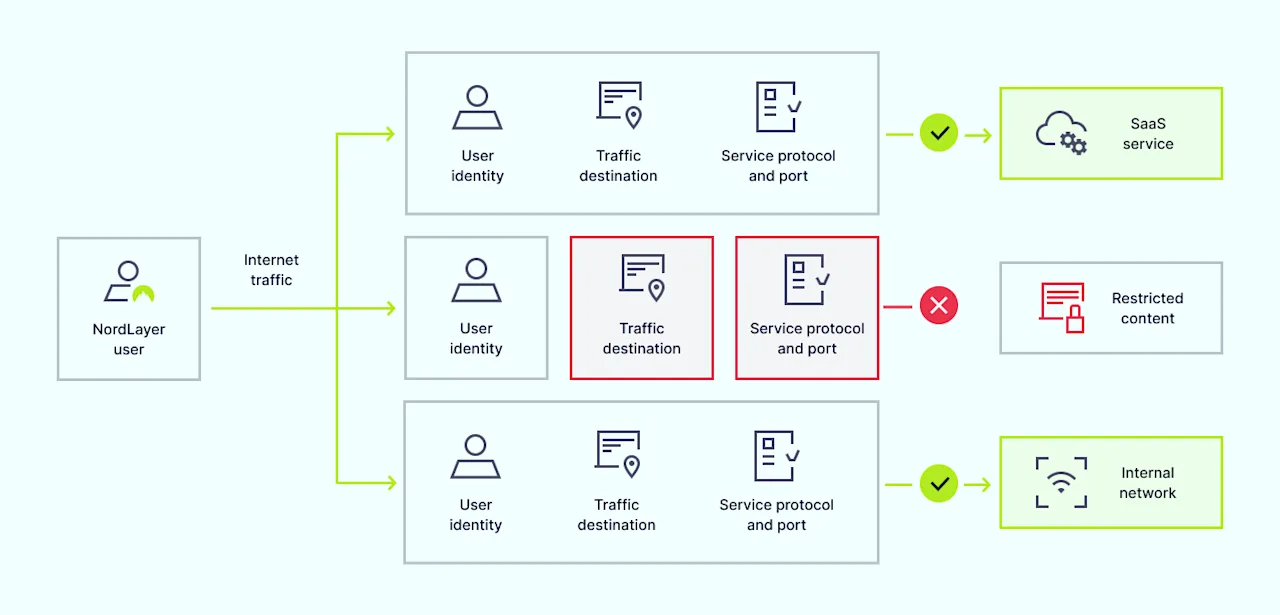
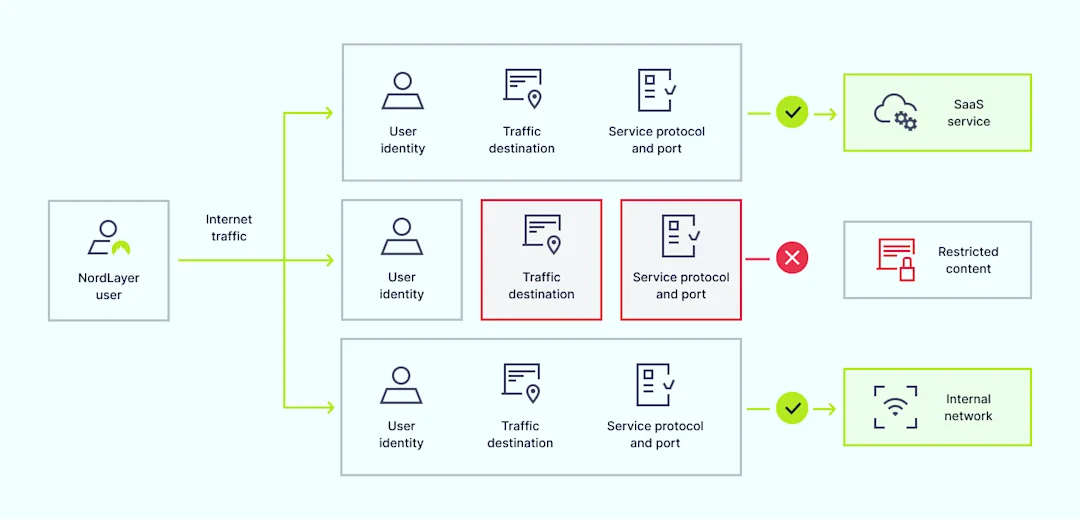
How NordLayer Cloud Firewall works

Five ways NordLayer Cloud Firewall can help:

  1. Prevent data leaks. Network segmentation is key in access control. Without it, data leaks are more likely.

  2. Achieve compliance. Many standards focus on network access control and protection of network and encrypted traffic.

  3. Implement security strategy. Best practices include secure access service edge (SASE), FWaaS, SWG, and ZTNA.

  4. Unify security across hybrid setups. Securing a mix of data centers, cloud, and on-premise systems can be challenging, but NordLayer helps simplify this.

  5. Support hybrid work models. NordLayer strengthens security for remote teams while managing network firewalls across locations.

NordLayer’s flexibility makes it ideal for businesses of all sizes that need scalable network protection. It provides secure internet access, resource protection, and compliance with major cybersecurity regulations.

Apart from Cloud Firewall, NordLayer offers other security features like:

  • Quantum-safe encryption

  • Dedicated servers with Fixed IP

  • Device Posture Security

  • IP allowlisting

  • Web protection (formerly ThreatBlock)

  • DNS filtering

  • NordLynx VPN protocol

  • Browser extension for secure browsing

Benefits:

  • Transparent pricing, starting at $7 per user per month

  • Proactive setup support

  • 24/7 live support with dedicated account managers

  • Direct user feedback influences product development

Drawbacks:

  • Less known compared to other competitors

  • Fewer security features than large enterprise firewall vendors

  • Possible slowdowns with the use of VPN

  • Reducing team size requires reaching out to support

  • Occasional confusion between NordVPN and NordLayer

Disclaimer: This product review is based on information provided on our website, VPN review sites and social networking forums such as Gartner, G2, and TechRadar, as well as customer feedback shared on these platforms, accessed on September 6, 2024.

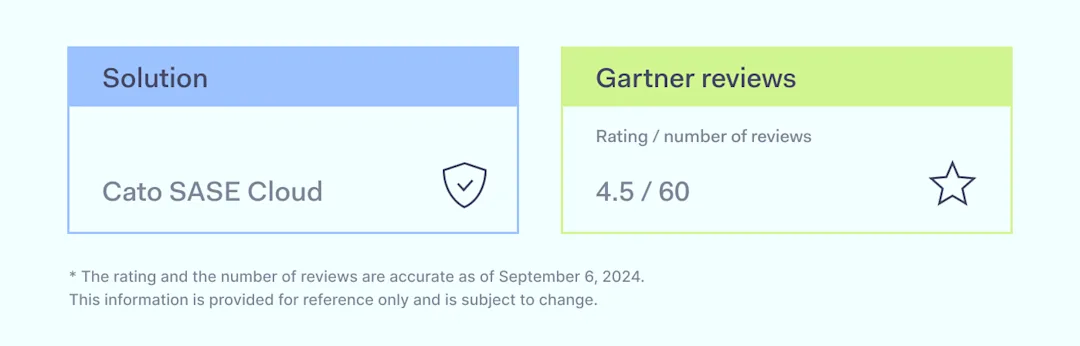
2. Cato SASE Cloud
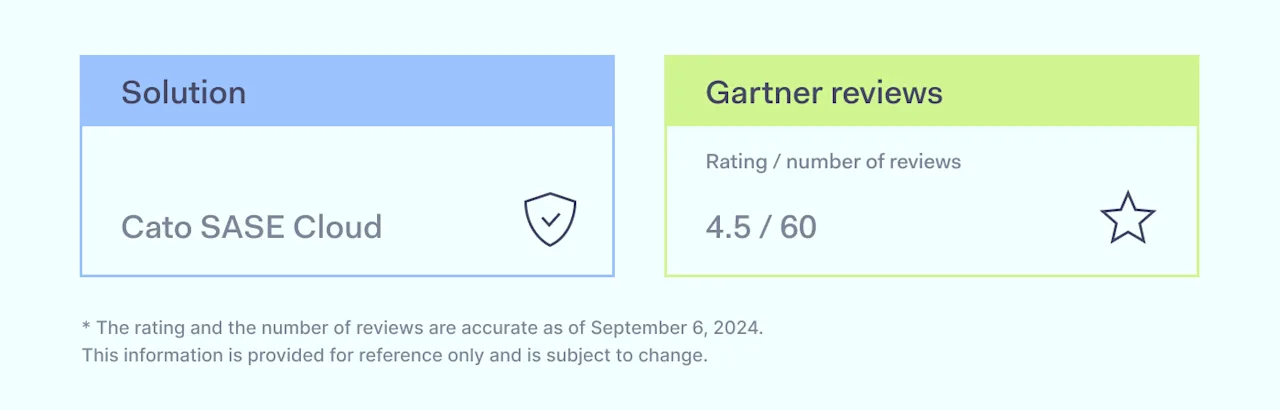
Cato SASE Cloud

Cato Networks is an Israeli company that offers Secure Access Service Edge (SASE) technology. The platform combines communication and security in a cloud-based solution. Founded in 2015, Cato Networks now employs over 900 people globally. When it comes to the firewall, users frequently mention that the solution is easy to set up, with straightforward firewall rule management and affordability. It simplifies firewall management and offers features typical of NGFW.

Most mentioned overall product benefits:

  • Comprehensive security features

  • Complete management panel for easy user control

  • Low-latency performance through numerous points of presence (PoPs)

  • Reliable, with no impact on internet speed or application performance

  • Automatic firewall updates

  • Agile and scalable solution

Drawbacks:

  • Can be difficult to implement

  • License costs are high

  • Logs and reports are hard to interpret

  • VPN licenses must be purchased in packs of 10

  • Sometimes the app fails to log in

  • Upgrading bandwidth capacity for a site can be costly

Disclaimer: This product review is based on information provided on the company’s website, VPN review sites and social networking forums such as Gartner and G2, and it assesses customer feedback shared on these platforms, accessed on September 6, 2024.

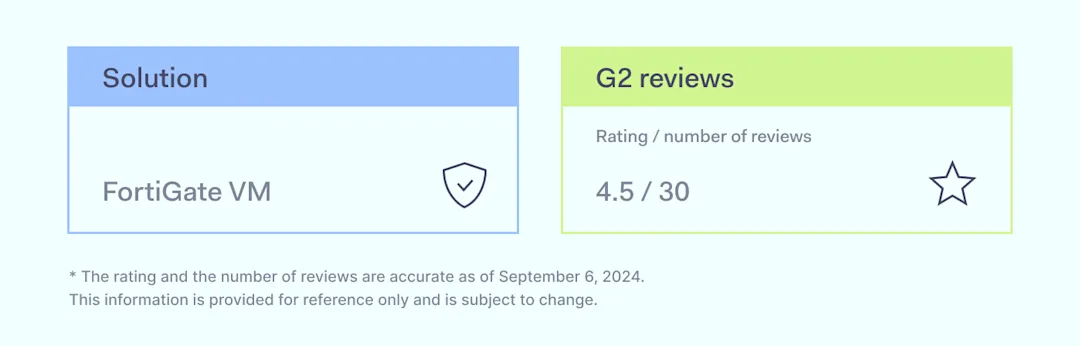
3. Fortinet: FortiGate VM
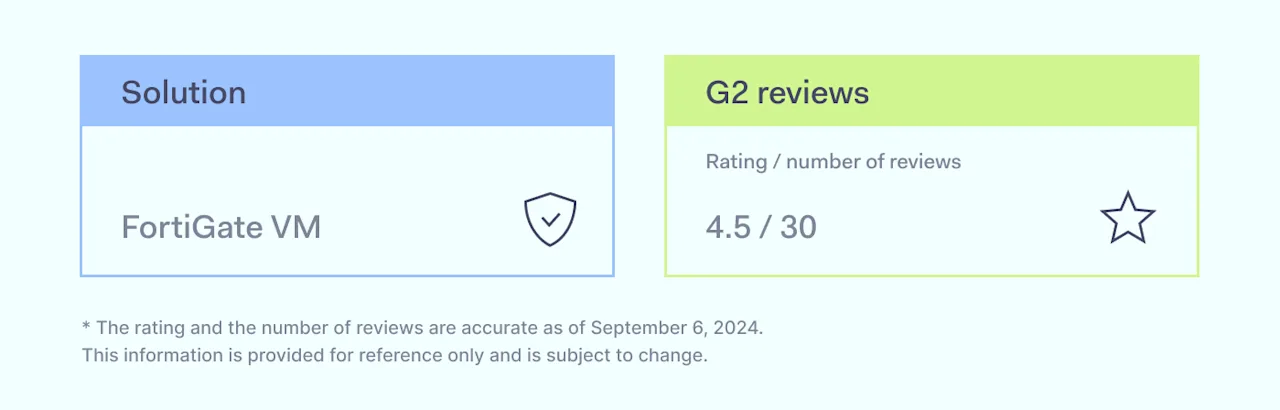
FortiGate VM

Fortinet, founded over 20 years ago in Sunnyvale, California, provides cybersecurity solutions for a wide range of users. FortiGate VM—a virtual firewall—offers network protection in private, public, and telco cloud environments. Running on the same OS as FortiGate hardware, it enforces consistent security policies across hybrid setups.

Most mentioned overall product benefits:

  • User-friendly interface

  • Straightforward setup and management of virtual machines

  • Easy integration in virtual environments

  • Works well with multivendor environments, including IaaS and public clouds

Drawbacks:

  • More advanced tutorials or documentation needed

  • Complex configurations

  • Some interface complexities

  • High entry pricing

  • Logging and reporting issues

  • Problems integrating with certain XDR solutions

  • Sizing virtual environments could be clearer

Disclaimer: This product review is based on information provided on VPN review sites and social networking forums such as G2, and it assesses customer feedback shared on these platforms, accessed on September 6, 2024.

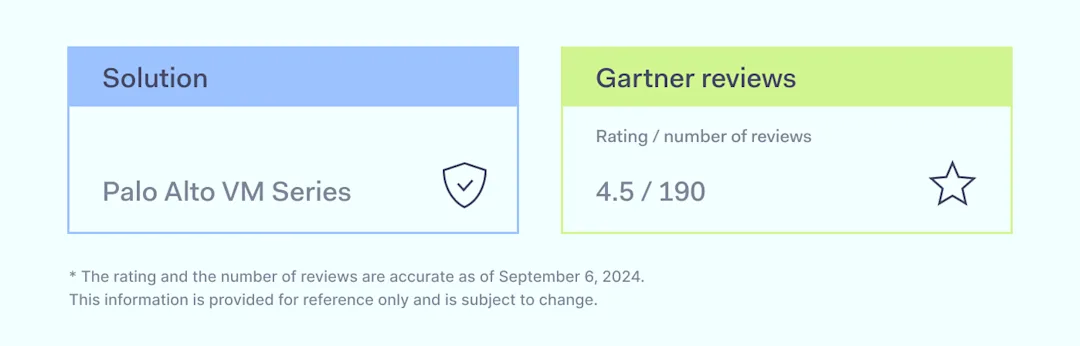
4. Palo Alto VM Series
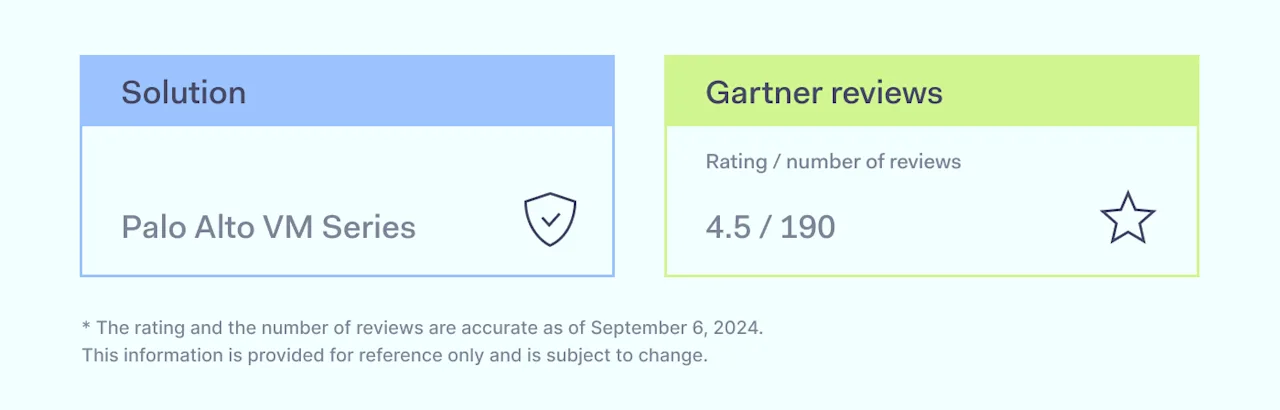
Palo Alto VM Series

Palo Alto Networks is a multinational cybersecurity company based in Santa Clara, California. Its platform includes advanced network firewalls and cloud-based solutions that cover various aspects of security. The company serves over 70,000 organizations worldwide. Users praise the firewall’s strong security features, ease of use, and flexibility, which are on par with those of on-premises network firewalls.

Most mentioned overall product benefits:

  • Easy deployment

  • Flexible and scalable

  • Effective for disaster recovery

  • Centralized management

  • User-friendly interface

Drawbacks:

  • High pricing

  • Licensing complexity

  • Long upgrade and restart times

  • Documentation could be improved

  • Occasional performance slowdowns

  • Limited integrations with some cloud platforms

  • Resource-intensive solution

Disclaimer: This product review is based on information provided on the company’s website, VPN review sites and social networking forums such as Gartner and G2, as well as customer feedback shared on these platforms, accessed on September 6, 2024.

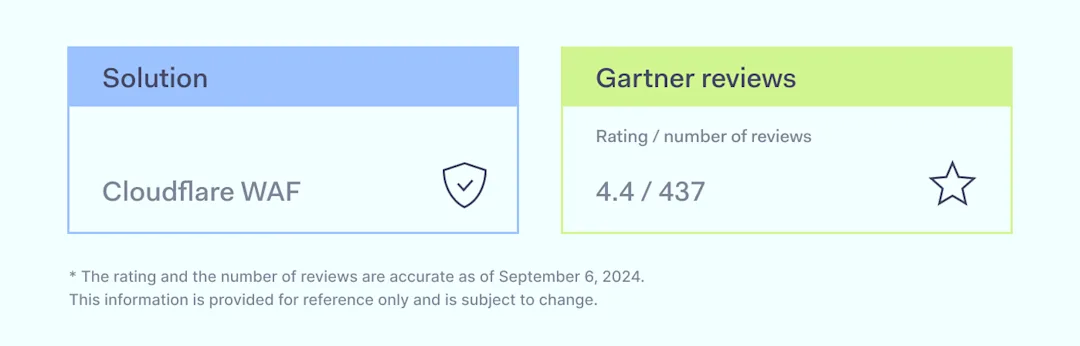
5. Cloudflare WAF
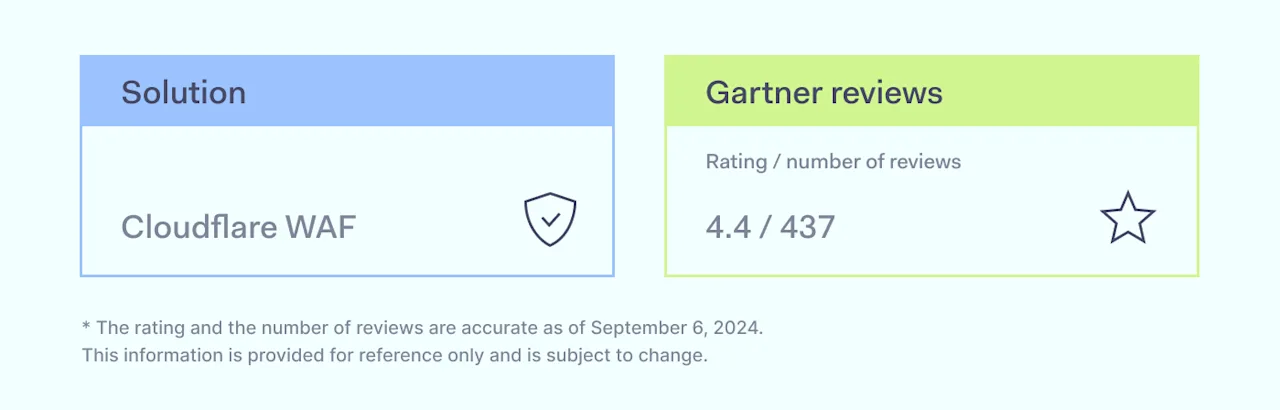
Cloudflare WAF

Cloudflare is an American company that offers content delivery networks, cloud cybersecurity, DDoS mitigation, and domain services. As of 2024, over 19% of the internet uses it for web security. Its Web Application Firewall (WAF) features managed rulesets that are frequently updated, geolocation blocking, and proxy detection, making it highly effective in preventing man-in-the-middle attacks. Users also note its useful integrations, such as with Azure AD and Google Cloud.

Most mentioned overall product benefits:

  • Easy installation

  • Simple to monitor with actionable features

  • Extremely effective with customizable options

  • User-friendly interface

  • Straightforward to use

Drawbacks:

  • Hard for small businesses to negotiate pricing and add features

  • Limited configurations in the Terraform provider

  • Implementing network-based rules through code is difficult

  • Documentation lacks specific, in-depth configurations

  • Some false positives in traffic blocking, though fixable over time

  • Slow customer support responses

  • Limited flexibility in rate-limiting rules for APIs

  • Load balancing requires an additional license

Disclaimer: This product review is based on information provided on the company’s website, VPN review sites and social networking forums such as Gartner and Reddit, and it assesses customer feedback shared on these platforms, accessed on September 6, 2024.

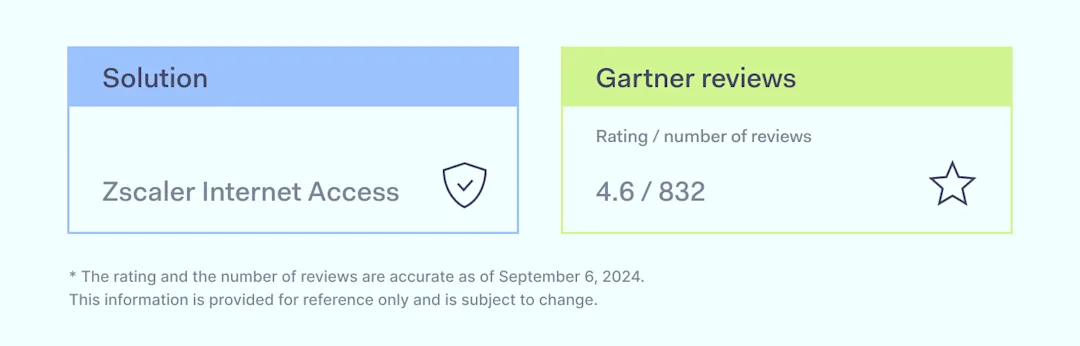
6. ZScaler Internet Access
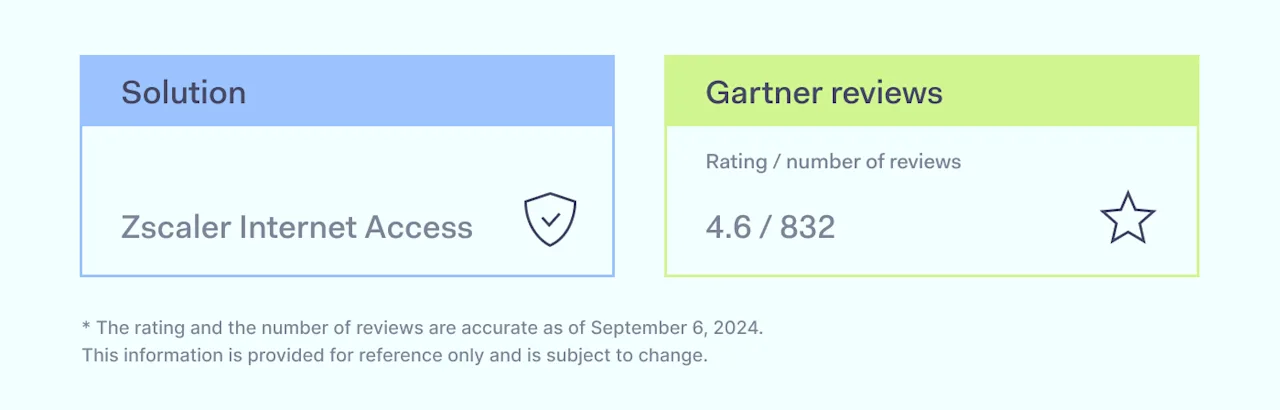
Zscaler Internet Access

Established in 2007 and headquartered in California, ZScaler provides a cloud-native Zero Trust Exchange platform that focuses on securing online traffic and controlling access to applications. It offers cloud-based protection against cyber threats and data loss. As for its firewall features, users point out that ZScaler offers a broad range of security tools and flexible options, making it adaptable for cloud-based setups.

Most mentioned overall product benefits:

  • Scalable

  • Consistent and stable connectivity

  • Efficient centralized management for access and security oversight

  • Robust cloud-native infrastructure

  • Intuitive interface for users

  • High-performance security solution

Drawbacks:

  • Complicated migration from traditional VPN to Zero Trust Network Access

  • Steep learning curve for new users

  • URL misclassifications that affect protection measures

  • Disconnects during brief internet interruptions

  • Inadequate API documentation

  • Slow customer service response

  • Lengthy setup and configuration process

  • Confusing pricing structure for features and services

Disclaimer: This product review is based on information provided on VPN review sites and social networking forums such as Gartner and G2, as well as customer feedback shared on these platforms, accessed on September 6, 2024.

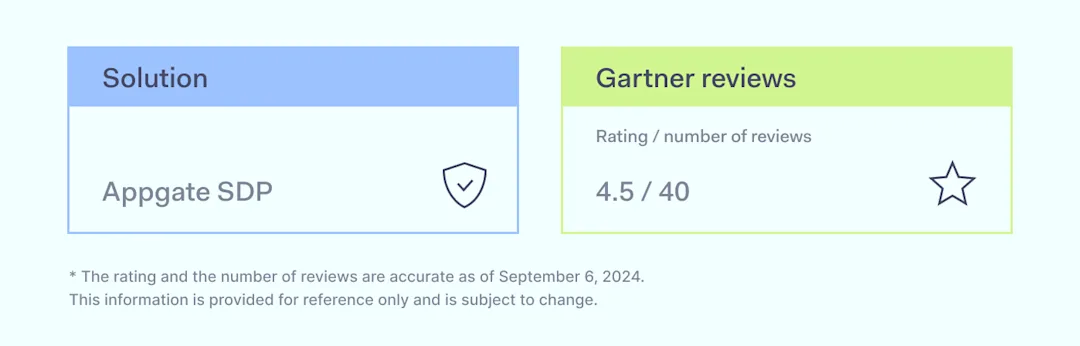
7. Appgate SDP
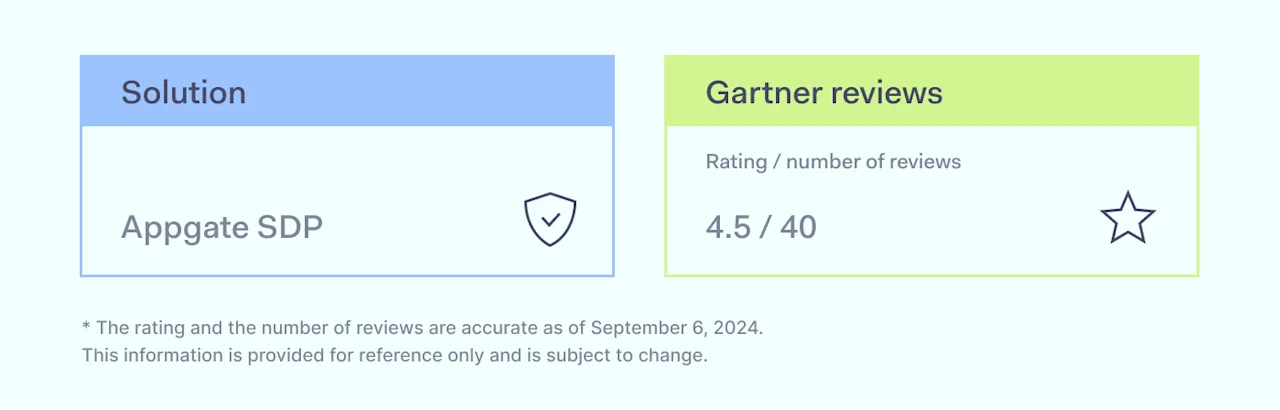
Appgate SDP

Appgate, founded in 2020 and based in Coral Gables, Florida, provides security solutions for organizations and government agencies. It focuses on Universal Zero Trust Network Access (ZTNA) and fraud protection. As for the firewall functionality, users mention that Appgate SDP is straightforward to manage with helpful troubleshooting documentation.

Most mentioned overall product benefits:

  • Stable performance

  • Fast operation

  • Easy to deploy and manage

  • Clear documentation for troubleshooting

  • Real-time updates based on risk metrics

  • Micro-segmented access to resources

  • Intuitive user interface

Drawbacks:

  • Runs on Ubuntu Server, which is not frequently updated

  • Per-site licensing increases overall costs

  • Slow connection speeds to remote sites

  • Occasional resource reduction despite steady internet bandwidth

  • Complex to configure

  • Limited log management features

  • Dashboard is not very helpful for security monitoring

  • Frequent need to restart due to slow connection despite good internet

  • Insufficient dashboard information for identifying node connectivity issues

  • Centralized management lacks efficiency

Disclaimer: This product review is based on information provided on VPN review sites and social networking forums such as Gartner and G2, as well as customer feedback shared on these platforms, accessed on September 6, 2024.

8. Check Point Harmony SASE (formerly Perimeter 81)
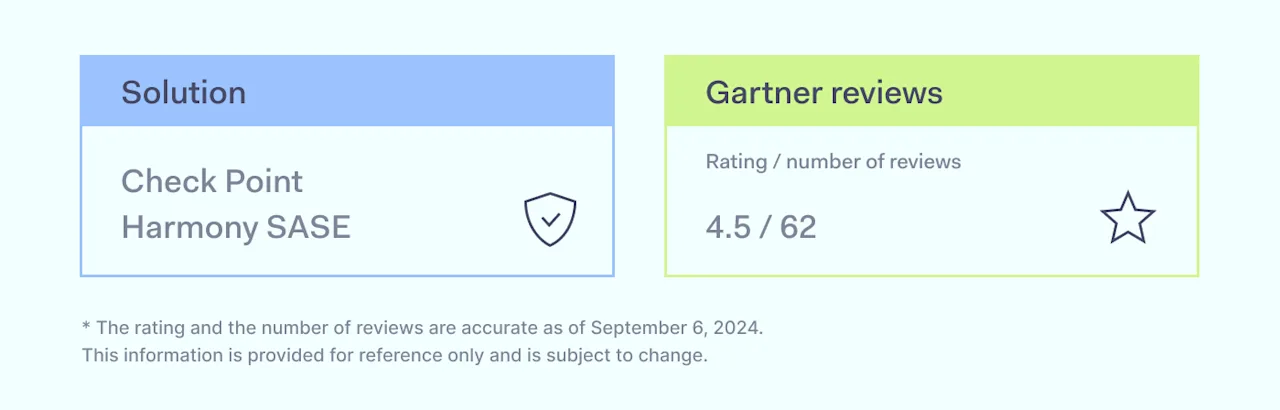
Check Point Harmony SASE

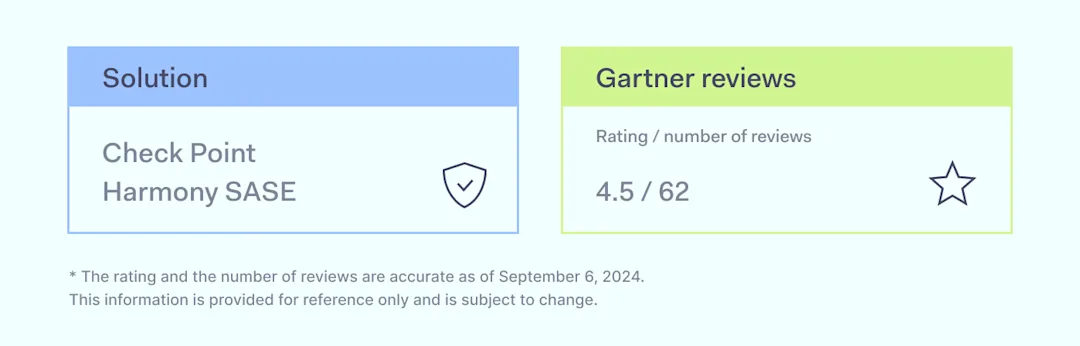
Check Point Software Technologies offers solutions to protect businesses and governments. Founded in 1993, it employs over 6,000 people and protects more than 100,000 organizations. Check Point Harmony SASE, formerly known as Perimeter 81, combines network and endpoint security for a unified approach. As for the firewall capabilities, users note easy troubleshooting due to log visibility and VPN tunnel stability.

Most mentioned overall product benefits:

  • Smooth migration with easy configuration of necessary features

  • Smart Console is user-friendly and free of software bugs

  • Unified platform integrating network and endpoint security

  • Proactive threat prevention and real-time monitoring

  • Simplified management with enhanced visibility across the IT environment

  • Reliable performance

  • Useful logging activity in the dashboard

Drawbacks:

  • Unable to establish redundant VPN tunnels with cloud environments

  • Support failed to detect misconfiguration, leading to significant downtime

  • Complex initial setup, steep learning curve for new users

  • Integration challenges with third-party vendors

  • High pricing structure

  • Difficulty getting timely technical support

  • Frustration with poor customer service and unresolved issues

  • Issues with overbilling and slow responses from the support team

  • Logging activity is unreliable, with users questioning its accuracy

Disclaimer: This product review is based on information provided on VPN review sites and social networking forums such as Gartner and G2, as well as customer feedback shared on these platforms, accessed on September 6, 2024.

9. Todyl
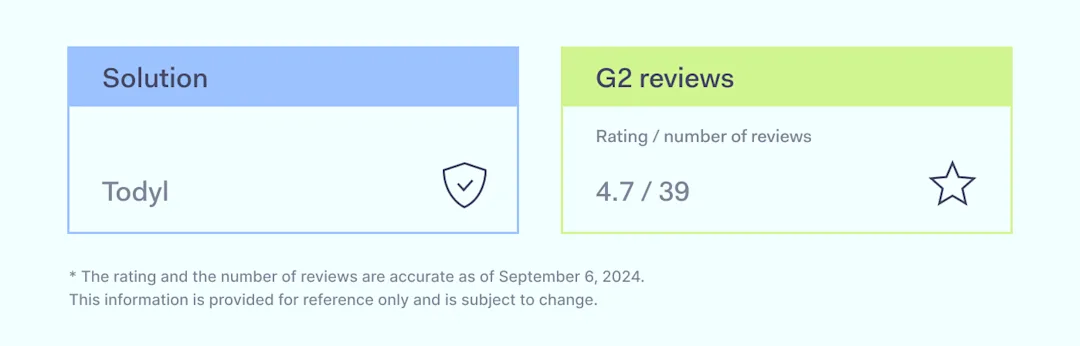
Todyl

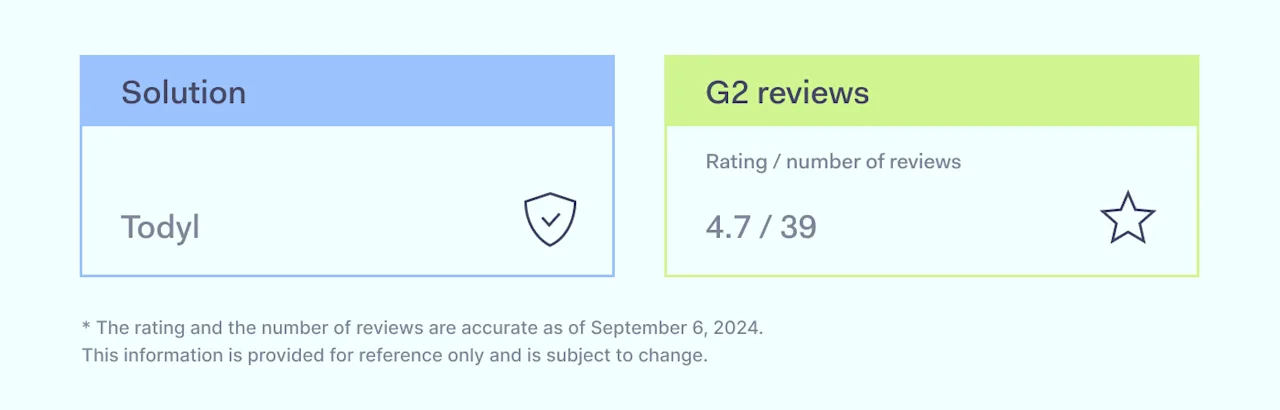
Founded in 2015 and headquartered in Denver, Colorado, Todyl offers a cybersecurity platform designed for MSPs and MSSPs. The platform provides comprehensive security solutions through a single-agent model, allowing businesses to customize capabilities to meet their needs. Users frequently note that Todyl’s integration and ease of deployment stand out as key features.

Most mentioned overall product benefits:

  • Easy to use

  • Top-notch support

  • Intuitive interface

  • Simple integration and deployment

  • All-in-one solution for clients

  • Centralized logs in the SEIM

  • Flexible licensing options per device and customer

Drawbacks:

  • Simultaneous use with Defender may cause reporting issues

  • Lacks custom gauge creation for dashboards

  • Missing GRC features

  • Setup can sometimes be tricky

  • Occasional bugs with the SGN Connect agent disappearing from the system tray

  • Web filtering can be clumsy

  • Marketing strategies have upset users

  • Platform lacks maturity

  • Connecting to on-premise devices like servers is difficult

  • Site-to-site connection often disconnects

  • Hard to cancel the service

  • Frequent DNS issues and workarounds needed

Disclaimer: This product review is based on information provided on VPN review sites and social networking forums such as G2 and Reddit, as well as customer feedback shared on these platforms, accessed on September 6, 2024.

10. Banyan Security
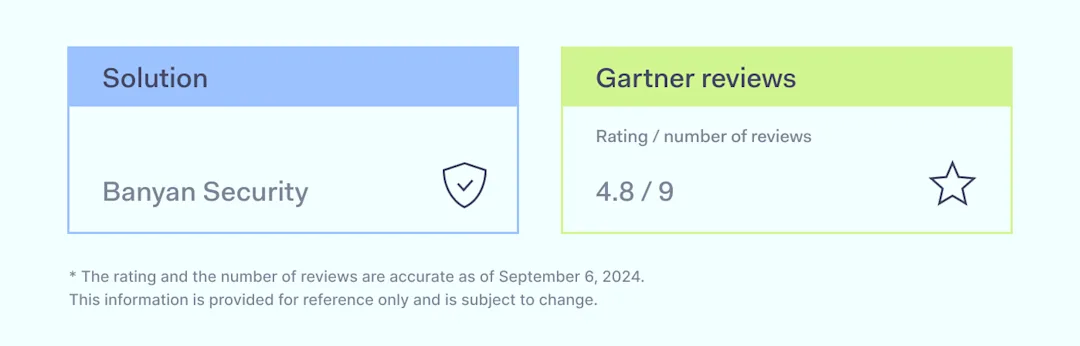
Banyan Security

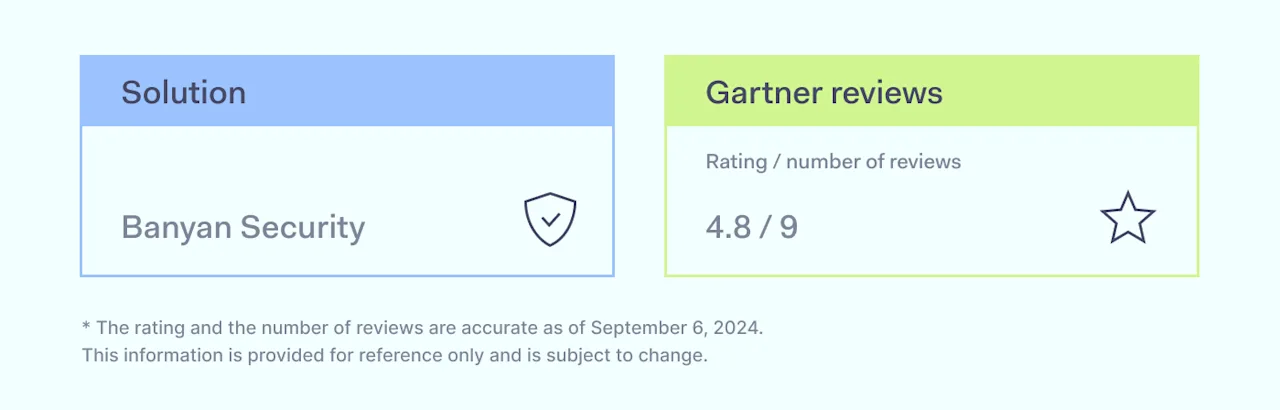
Banyan Security, recently acquired by SonicWall, provides a Zero Trust Network Access (ZTNA) solution focused on securing remote access to applications and resources. It is known for strong visibility and auditing features along with a user-friendly experience.

Most mentioned overall product benefits:

  • Good visibility and auditing features

  • Easy to use

  • More affordable than competitors

Drawbacks:

  • Integration challenges

  • Higher costs for some features

  • False positives in security alerts

  • Some rough edges in the platform

Disclaimer: This product review is based on information provided on VPN review sites and social networking forums such as Gartner, G2, Capterra and Reddit, as well as customer feedback shared on these platforms, accessed on September 6, 2024.

Key features to look for in a firewall

Focus on features that provide strong network protection while meeting the specific needs of your business. The right firewall solution should offer visibility, easy integration, and scalability to ensure nothing gets misconfigured as your company grows:

  1. Visibility and control. A good firewall solution needs to provide deep insight into your network traffic and applications, especially for businesses needing access control to meet regulations. Next-generation firewalls with strong threat intelligence can help you stay compliant.

  2. Easy integrations. Ensure the firewall provider offers solutions that integrate well with your current systems, like deep packet inspection tools or data centers. It should strengthen your overall network security by fitting smoothly with your other security features.

  3. Updates and maintenance. Choose firewall vendors that provide regular updates and proactive product development. Focus on solutions that are frequently updated, well-maintained, and show consistent growth. Providers should offer public release notes, regular updates, and clear communication with customers. It’s crucial to ensure that security features stay current. Automated updates and clear versioning also reduce manual work for IT teams,

  4. Hybrid network support. If your business operates across both on-premises and cloud setups, choose a firewall solution that supports hybrid infrastructures.

  5. Scalability. As your business grows, your firewall solution should scale without significant cost increases. For example, as your setup becomes more complex, you’ll need more firewall rules. It’s wise to check the number of rules included in each plan before purchasing, as the cost difference between plans can sometimes be steep. This helps maintain strong network protection as your infrastructure expands.

When picking a firewall, focus on features that offer strong security and fit your setup. Prioritize solutions with automation features to reduce manual work. It will save time and help manage security across complex infrastructures.

How to choose the best firewall for your business

When picking the right firewall for your company, you need to weigh several important factors:

  1. Security needs. Start by assessing your network security risks. If you’re a larger organization facing more threats, choose a next-generation firewall with a strong intrusion prevention system, advanced threat intelligence, and encryption to protect sensitive data across all layers. Smaller businesses should focus on essential features like packet filtering, malware defense, and network monitoring without overcomplicating the setup. Make sure the firewall solution aligns with the size and complexity of your network to avoid unnecessary costs or gaps in protection.

  2. Ease of use. The firewall should be easy to deploy and manage, especially if your IT resources are limited. Network firewalls with simple, user-friendly interfaces can reduce the time spent on managing network protection. Opt for solutions that offer automation for tasks like network traffic monitoring, deep packet inspection, and access control to save time.

  3. Support. Reliable customer support is crucial when setting up and maintaining a firewall. A firewall vendor that provides 24/7 support ensures issues are resolved quickly, minimizing downtime. If your business uses data centers or hybrid cloud setups, look for a vendor that offers proactive support to avoid misconfigurations and keep your security features running smoothly.

  4. Cost. While the price is important, consider the long-term value. Cheaper options may lack the scalability and advanced features you’ll need as your business grows. Make sure the solution can scale with your business, especially if you expand your data centers or cloud environments, without incurring hefty costs when upgrading.

  5. Compatibility. Ensure the firewall integrates seamlessly with your existing infrastructure, whether it’s cloud services, VPNs, or identity management systems. A firewall that works well with other security tools, such as intrusion prevention systems and threat management platforms, strengthens your overall network security and prevents integration issues.

  6. Performance and scalability. As your business grows and network traffic increases, your firewall must be able to handle the additional load without sacrificing performance. Whether securing sensitive resources or managing remote access, the firewall should maintain consistent network protection and scale efficiently to meet your evolving needs.

Overall, different firewall solutions suit different business needs. Large options like Fortinet and Palo Alto are ideal for enterprises. Mid-sized businesses may find NordLayer or Perimeter 81 effective, while Todyl targets MSPs and MSSPs. Smaller options like Banyan Security fit smaller budgets. Choose based on your security needs and resources.

Disclaimer: The information in this article is provided for informational purposes only. It is based on publicly available third-party reviews, user feedback, and online sources accessed on September 6, 2024, and should not be considered definitive or permanent. While we strive for accuracy and completeness, Nord Security Inc. and its affiliates make no guarantees regarding the information’s accuracy, completeness, or suitability. We do not undertake, warrant, or represent that any product, or its feature, is or will remain publicly regarded as better or worse than other alternatives, serve any purpose, has mentioned features, benefits, strengths, and limitations for any period of time. Product features, pricing, and other details may change, and we advise readers to verify these directly with vendors. We disclaim any liability to any party for any errors, omissions, or actions taken based on this information. The inclusion of competitor products does not imply affiliation or endorsement, and all trademarks mentioned are the property of their respective owners. Readers should conduct their research and seek independent advice before making purchasing decisions.

About Version 2 Digital

Version 2 Digital is one of the most dynamic IT companies in Asia. The company distributes a wide range of IT products across various areas including cyber security, cloud, data protection, end points, infrastructures, system monitoring, storage, networking, business productivity and communication products.

Through an extensive network of channels, point of sales, resellers, and partnership companies, Version 2 offers quality products and services which are highly acclaimed in the market. Its customers cover a wide spectrum which include Global 1000 enterprises, regional listed companies, different vertical industries, public utilities, Government, a vast number of successful SMEs, and consumers in various Asian cities.

About NordLayer
NordLayer is an adaptive network access security solution for modern businesses – from the world’s most trusted cybersecurity brand, Nord Security.

The web has become a chaotic space where safety and trust have been compromised by cybercrime and data protection issues. Therefore, our team has a global mission to shape a more trusted and peaceful online future for people everywhere.

About NordLayer
NordLayer is an adaptive network access security solution for modern businesses – from the world’s most trusted cybersecurity brand, Nord Security.

The web has become a chaotic space where safety and trust have been compromised by cybercrime and data protection issues. Therefore, our team has a global mission to shape a more trusted and peaceful online future for people everywhere.

Firewall vs. VPN: Best security option for your business

Virtual Private Networks (VPNs) and firewalls are two of the most common and vital cybersecurity tools. Both security tools defend against external threats. However, they use different methods and play complementary roles.

If you are confused about VPNs and next-generation firewalls (NGFWs), now is the perfect time to learn. This blog will introduce firewalls and VPNs and help you choose the correct security measures for your business network.

What is a firewall and how does it work?

A firewall is a security tool that filters traffic at the network perimeter.

Pre-defined rules allow or deny traffic at the network edge. Deny and allow rules work in tandem to protect network assets and optimize performance.

Firewall users start with default actions applying to all traffic. Users then specify controls as needed by creating new rules. This provides flexibility to allow or deny access.Traditional firewalls analyze data packets before they reach network devices (or leave corporate networks). Businesses can implement them as hardware devices or choose as a software firewall installed on network servers.

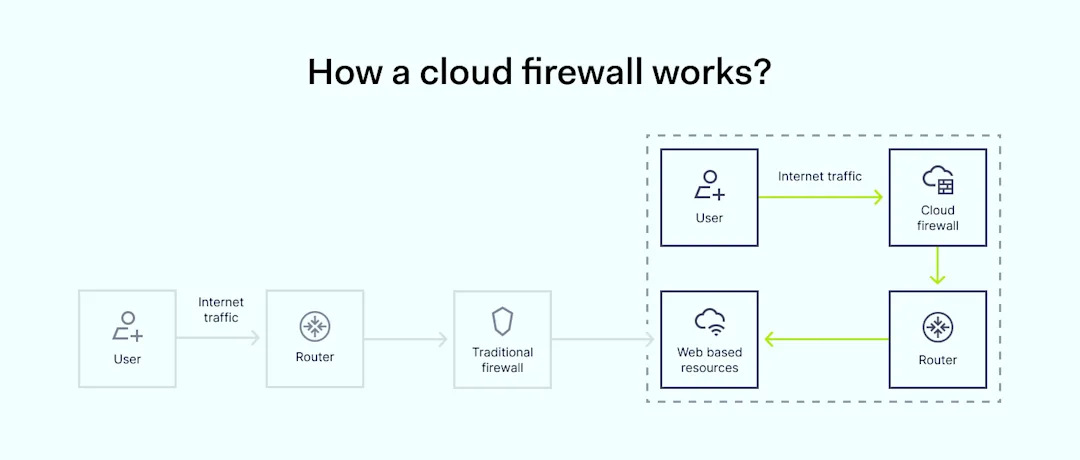
How a cloud firewall works

Whatever style you choose, firewalls have significant security benefits. Business advantages include:

  • Perimeter security: Companies can set rules to admit only authorized identities to access specific environments or services. Employees or trusted partners can access network resources relevant to their roles. The firewall enforces these rules, limiting or completely denying access to other resources, both to insiders and outsiders. This way, the firewall ensures that insiders have specific access rights based on what they need or don’t need for their role.”

  • Content filtering: DNS-level firewalls can filter web traffic and block undesirable websites without compromising performance. Firewalls create segmented zones throughout the network where content is tightly controlled, ensuring different departments have appropriate access. For instance, social media may be restricted, but the marketing department could retain access if needed. Firewalls can also block the transmission of document formats or executable files, cutting the risk of phishing attacks.

Firewall capabilities vary, and companies must pick a solution to suit their security needs.

Basic firewalls assess surface information like IP address data. Stateful firewalls use contextual information to discover malicious traffic. Next-generation firewalls (NGFWs) are more powerful, adding capabilities like Deep Packet Inspection, sandboxing, and AI-powered application awareness.

Finally, cloud firewalls take NGFW functions and apply them to virtualized environments. These software firewalls reside in cloud environments but aren’t limited to SaaS security. Cloud firewalls are fully compatible with both physical and cloud-based networks, making them ideal for hybrid environments. They provide all-around protection, handling all firewall needs across various infrastructures.

What is a VPN and how does it work?

A Virtual Private Network encrypts data as it passes between your device and the VPN server, securing it across the internet. VPNs anonymize traffic by assigning data packets new IP addresses. End-to-end encrypted tunnels work with IP address reassignment to mask your identity. VPNs hide your browsing history from ISPs and enable organizations to test localized content and campaigns in different virtual locations conveniently.

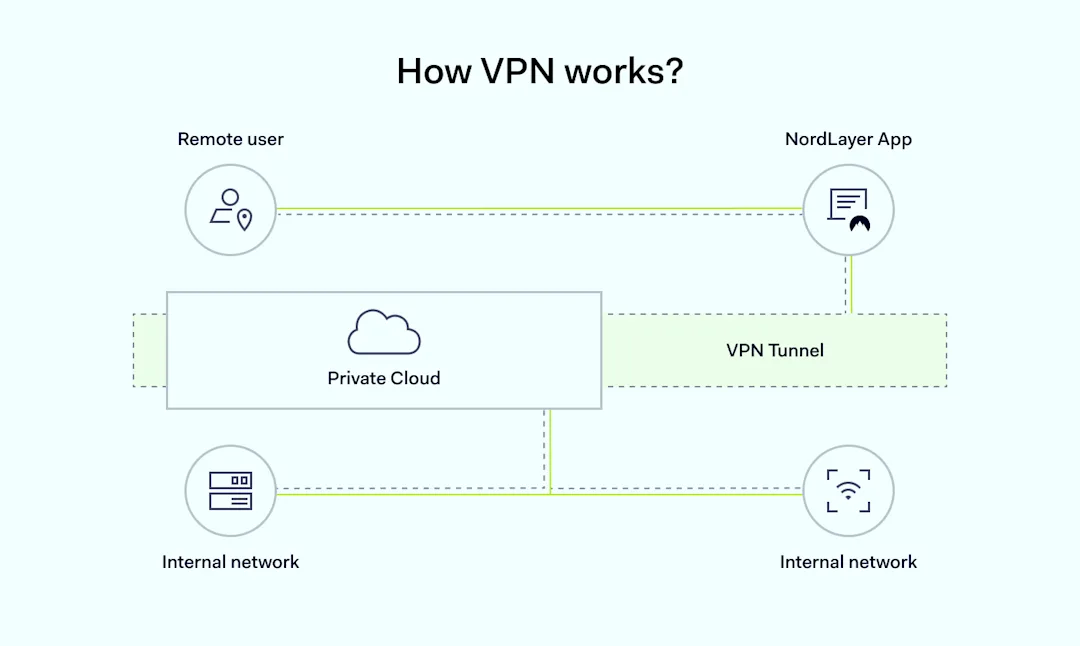
How VPN works

VPN users install client software on their devices. Clients encrypt data and establish connections with VPN servers, which assign IP addresses. The server then routes traffic to its destination via the standard internet service provider.

VPNs became famous as individual users sought to evade geo-blockers and government censorship. However, nowadays, businesses use VPNs not only to secure network traffic but also to test localized content and campaigns in different virtual locations conveniently.

Benefits of using a VPN for business include:

  • Secure remote access: Remote workers may send confidential data via public Wi-Fi or other unprotected networks, such as those in cafes, airports, or conferences. These are highly vulnerable environments, making VPNs mandatory to prevent man-in-the-middle attacks, which can lead to network breaches and sensitive data leaks. A remote access VPN secures remote connections, ensuring data safety while employees maintain flexibility.

    However, a simple business VPN alone may not be enough to ensure secure access and file transmission. Advanced VPN features, such as site-to-site or Smart Remote Access (SRA), provide stronger security.

    Additionally, advanced configurations can offer a unified IP address for the entire organization, simplifying IP allowlisting and enhancing network and resource access security.

  • Safe file transmission: Companies often send sensitive documents and assets to partners and clients. More advanced VPN providers enable secure file transmission. Site-to-site encryption and SRA protect confidential data while making it available to relevant users.

  • Unified IP addresses. Advanced VPN configurations provide a unified IP address for the entire organization. This makes IP allowlisting possible and easy to manage and use. Allowlisting increases network and resource access security.

Differences between firewalls and VPNs

The main difference between firewalls and VPNs is that firewalls filter traffic at the network edge. On the other hand, Virtual Private Networks create a secure connection over the external internet.

Imagine a medieval castle. Firewalls defend your castle, only admitting friends. VPNs are like armor, protecting knights outside the walls as they carry messages throughout the land.

Beyond that general distinction, differences between firewalls and VPNs include:

  • VPNs protect your privacy while sending and receiving data. Firewalls block malicious or suspect traffic, but they do not encrypt or anonymize traffic.

  • VPNs use end-to-end encryption, which conceals the contents of data packets. Traditional firewalls don’t encrypt data; they only track and filter traffic according to firewall rules.

  • Advanced next-generation firewalls (NGFWs) can detect malware before it enters the network, while VPNs do not actively scan for cyber threats.

  • Firewalls enhance network security not only by handling external threats but also by controlling access to prevent internal threats. They stop lateral movement across the network and help prevent accidental data leaks. VPNs make data transfers more secure.

When to use a VPN vs. a firewall

Firewalls and VPNs have different use cases. Knowing how and when to use them effectively is critically important.

Use a Virtual Private Network when you:

  • Need to secure remote access connections over public networks. VPNs allow secure connections from public Wi-Fi and home offices.

  • Need to secure file transfers across the internet. Encrypted tunnels ensure that the transfer channels remain secure and confidential, preventing unauthorized access. This means that VPNs protect the transfer channels and do not act as a method for sending files.

  • Worry about corporate espionage or surveillance. With a VPN, outsiders cannot monitor your online activity.

  • Need to connect different work locations. Site-to-site VPN services securely connect distant offices, factories, or stores.

Use a firewall when you:

  • Need to apply network segmentation to protect critical assets.

  • Need to filter traffic entering or leaving your network.

  • Need to implement access control lists and exclude unauthorized users or devices.

  • Have specific content filtering needs. For example, schools may want to block any adult content at the network edge.

Firewall vs. VPN: does your business need both?

Firewalls and VPNs are different tools. However, the firewall versus VPN division is misleading. In most instances, using both will enhance your network security.

Firewalls provide a first line of defense to filter traffic entering and leaving the network. They detect malware, identify unauthorized access requests, and control the flow of sensitive data.

VPNs supplement these firewall functions. They hide user IP addresses and encrypt data, complicating life for external attackers. With a dependable Virtual Private Network, your data will remain private as it passes from remote work locations to central offices.

Firewalls police the boundary of your network. They exclude threats before they can cause harm. VPNs extend protection outside the network perimeter. Users can browse the web without adding extra cybersecurity risks.

Enhance your security with NordLayer’s business VPN and cloud firewall

Traditional firewalls don’t work well in modern business contexts. The rise of the cloud complicates cybersecurity. Data no longer resides locally, and employees access resources from many locations

NordLayer provides a comprehensive solution that adapts to your business needs. Whether you need a simple VPN, a site-to-site VPN, or advanced features like cloud firewalls, Deep Packet Inspection (DPI), and DNS filtering, our tools offer complete protection and network segmentation.

Our security solutions allow you to start with VPNs and later add firewalls, DNS filtering, DPI, and even Download Protection as your security needs evolve. This full suite of features meets the definition of Next-Generation Firewalls, with the added flexibility to enable each feature separately or all together, based on your needs. NordLayer ensures that your security grows with your business, providing a long-term, adaptable solution.

With NordLayer, you can easily lock down critical assets, segment networks, and protect both on-premises and cloud resources. Secure remote access is simple to implement, reducing the risk of data breaches. Whether you need VPNs, firewalls, or a complete NGFW solution, NordLayer’s adaptable tools have you covered.

Next-generation cybersecurity is available for all. Find out more by contacting NordLayer today.

Frequently asked questions

Does a VPN solve firewall needs?

Firewalls and VPNs have different use cases and play complementary security roles. Firewalls filter incoming and outgoing traffic, allowing you to apply network segmentation and block dangerous traffic. VPNs, on the other hand, shield network traffic via an encrypted tunnel.

Firewalls cannot be used as a replacement for VPNs or vice versa. They are discrete tools with separate uses. Only deploy them if you have a solid use case for doing so.

What comes first, VPN or firewall?

Companies usually adopt VPNs first. VPNs are simple to operate and provide a reliable level of protection. Employees can get to grips with VPNs quickly, and everyone understands the role they play.

More mature organizations often use firewalls as they require more complex configuration and maintenance.

However, the answer isn’t always straightforward. VPNs and firewalls address different security needs, so the implementation strategy should reflect the specific requirements of your company. It’s important to assess your needs carefully and implement the right tools for your situation.

What is the difference between a VPN server and a VPN firewall?

A VPN server processes network traffic and assigns the client a new IP address for the session. VPN servers also establish encrypted tunnels between clients and servers to protect the user’s data and identity.

While a VPN firewall can be configured to allow only VPN traffic, this is not its only purpose. A VPN firewall functions similarly to a regular firewall but with added rules or configurations specific to VPN traffic.

A VPN firewall functions like a standard firewall but includes additional rules and configurations specific to VPN traffic. This allows admins to combine VPN and firewall protection seamlessly. While it can be configured to allow or block only authorized VPN traffic, its purpose extends beyond that. It provides the same filtering and security features as a regular firewall, with added capabilities for managing and securing VPN traffic.

Can a firewall block a VPN?

Yes. VPNs may use network ports that firewalls automatically block. For example, the PPTP protocol uses TCP port 1723, and the OpenVPN protocol uses UDP port 1194. Firewalls identify traffic passing through those ports as suspicious and may prevent network access. Port blocking makes it vital to configure firewalls before adding VPN protection.

About Version 2 Digital

Version 2 Digital is one of the most dynamic IT companies in Asia. The company distributes a wide range of IT products across various areas including cyber security, cloud, data protection, end points, infrastructures, system monitoring, storage, networking, business productivity and communication products.

Through an extensive network of channels, point of sales, resellers, and partnership companies, Version 2 offers quality products and services which are highly acclaimed in the market. Its customers cover a wide spectrum which include Global 1000 enterprises, regional listed companies, different vertical industries, public utilities, Government, a vast number of successful SMEs, and consumers in various Asian cities.

About NordLayer
NordLayer is an adaptive network access security solution for modern businesses – from the world’s most trusted cybersecurity brand, Nord Security.

The web has become a chaotic space where safety and trust have been compromised by cybercrime and data protection issues. Therefore, our team has a global mission to shape a more trusted and peaceful online future for people everywhere.

About NordLayer
NordLayer is an adaptive network access security solution for modern businesses – from the world’s most trusted cybersecurity brand, Nord Security.

The web has become a chaotic space where safety and trust have been compromised by cybercrime and data protection issues. Therefore, our team has a global mission to shape a more trusted and peaceful online future for people everywhere.

×

Hello!

Click one of our contacts below to chat on WhatsApp

×