Skip to content

Addressing the Limitations of Multi-Factor Authentication (MFA)

As organizations strive to safeguard their sensitive data and critical assets, multi-factor authentication (MFA) has emerged as a popular choice for enhancing security. However, as recent high-profile attacks have shown, relying solely on MFA for authentication can leave organizations vulnerable to cyber threats. In this article, we will delve into the various weaknesses of MFA, highlight notable incidents that exploited these weaknesses, and explore how pairing MFA with digital certificates can provide a more secure authentication solution. 

The Rise and Limitations of Multi-Factor Authentication

Multi-factor authentication, as the name suggests, combines multiple forms of verification to grant access to systems and data. It typically involves something you know (like a password), something you have (like a smartphone or token), and something you are (like a fingerprint or facial recognition). This layered approach adds an extra layer of security beyond traditional username-password combinations, making it significantly harder for unauthorized individuals to gain access.

However, MFA is not without its vulnerabilities:

  • Phishing Attacks: Phishing remains a prevalent attack vector, and even MFA cannot fully protect against it. In a phishing attack, cybercriminals trick users into revealing their credentials or MFA codes by masquerading as a legitimate entity. Once the attacker has both the password and the MFA code, they can gain access just as easily as the legitimate user.
  • SIM Swapping: In SIM swapping attacks, hackers fraudulently transfer a victim’s phone number to a new SIM card, allowing them to intercept MFA codes sent via SMS. This technique has been used successfully to compromise high-profile social media and cryptocurrency accounts.
  • Biometric Vulnerabilities: While biometric factors like fingerprints and facial recognition provide an added layer of security, they are not foolproof. Sophisticated attackers have demonstrated the ability to bypass these mechanisms using techniques such as fingerprint replication or deepfake technology.
  • MFA Code Interception: Even if MFA codes are generated by authenticator apps or hardware tokens, they can still be intercepted if the user’s device is compromised by malware or if the token is stolen. This highlights the importance of securing the device itself.


High-Profile MFA Exploits

Over the past few years, several high-profile incidents have demonstrated the limitations of MFA:

  • Twitter Hack (2020): In a widely publicized attack, hackers compromised several high-profile Twitter accounts, including those of Barack Obama, Elon Musk, and Bill Gates. While MFA was enabled on these accounts, the attackers used social engineering techniques to manipulate Twitter employees into granting them access to internal tools, effectively bypassing MFA.
  • SolarWinds Attack (2020): The SolarWinds supply chain attack, one of the most significant cyber incidents in recent memory, highlighted the vulnerability of MFA. Attackers compromised SolarWinds’ software updates and used them to distribute malware to thousands of organizations. Once inside these networks, the attackers could bypass MFA using stolen credentials.

Beyond MFA: Going Passwordless with Digital Certificates

To address the limitations of MFA, organizations are turning to digital certificates as a complementary, passwordless authentication method. Digital certificates provide a secure means of identifying both users and devices, reducing the risk of unauthorized access. Here’s an overview of how digital certificates enhance authentication:

  • Strong Authentication Digital: Digital certificates use asymmetric cryptography, making them extremely secure. Users and devices are issued a unique certificate that includes a public and private key pair. When they attempt to access a system, the private key is used to sign a challenge from the server. This challenge-response process ensures that only the legitimate certificate holder can gain access.
  • Device Authentication: Certificates can also be used to authenticate devices, not just users. This is particularly valuable in the context of IoT (Internet of Things) devices, where traditional username-password authentication is often impractical.
  • Secure Key Management: Certificates are stored securely, typically in hardware security modules (HSMs), making it difficult for attackers to compromise them. This level of protection is often superior to the security of user-generated passwords and MFA tokens.
  • Reduced Phishing Risk: Since digital certificates are based on cryptographic keys rather than static credentials like passwords or codes, they are not susceptible to phishing attacks. Even if an attacker gains access to a user’s certificate, they would still need the private key to authenticate.
  • Regulatory Compliance: Many industries, such as healthcare and finance, are subject to strict regulatory requirements for data protection. Digital certificates help organizations meet these compliance standards by providing a robust authentication mechanism.

Employing a Multi-Layered Approach to Cybersecurity

While multi-factor authentication (MFA) is a valuable component of a cybersecurity strategy, it is not a silver bullet. Recent high-profile attacks have demonstrated its limitations, particularly in the face of sophisticated threats. To bolster their defenses, organizations should consider adopting a multi-layered approach that combines MFA with digital certificates.

Digital certificates offer strong, cryptographic authentication that is less susceptible to common attack vectors like phishing. They provide a secure means of identifying both users and devices, reducing the risk of unauthorized access. By integrating digital certificates into their authentication systems, organizations can significantly enhance their cybersecurity posture and protect their critical IT assets from evolving threats.

In the ever-evolving landscape of cybersecurity, staying one step ahead of adversaries is crucial. By recognizing the limitations of MFA and embracing more robust authentication methods like digital certificates, organizations can better safeguard their valuable data and maintain the trust of their stakeholders in an increasingly interconnected world.

About Version 2 Digital

Version 2 Digital is one of the most dynamic IT companies in Asia. The company distributes a wide range of IT products across various areas including cyber security, cloud, data protection, end points, infrastructures, system monitoring, storage, networking, business productivity and communication products.

Through an extensive network of channels, point of sales, resellers, and partnership companies, Version 2 offers quality products and services which are highly acclaimed in the market. Its customers cover a wide spectrum which include Global 1000 enterprises, regional listed companies, different vertical industries, public utilities, Government, a vast number of successful SMEs, and consumers in various Asian cities.

About Portnox
Portnox provides simple-to-deploy, operate and maintain network access control, security and visibility solutions. Portnox software can be deployed on-premises, as a cloud-delivered service, or in hybrid mode. It is agentless and vendor-agnostic, allowing organizations to maximize their existing network and cybersecurity investments. Hundreds of enterprises around the world rely on Portnox for network visibility, cybersecurity policy enforcement and regulatory compliance. The company has been recognized for its innovations by Info Security Products Guide, Cyber Security Excellence Awards, IoT Innovator Awards, Computing Security Awards, Best of Interop ITX and Cyber Defense Magazine. Portnox has offices in the U.S., Europe and Asia. For information visit http://www.portnox.com, and follow us on Twitter and LinkedIn.。

How SafeDNS Provided a Secure Internet for a 30K-person event

Recently, amidst the thunderous roars and screeching tires of the races we supported, thousands gathered in Mexico City, Mexico on the 1st of July to experience the heart-pounding excitement of Notiauto Cup. In the midst of this motorsport extravaganza, SafeDNS stood as a silent sentinel, ensuring secure and seamless internet connectivity for the massive crowd.With 20-30 thousand attendees converging at Notiauto Cup and a significant portion of them relying on the event’s free WiFi, SafeDNS, a stalwart in online security, ensured their online journeys were devoid of cyber threats. Working in partnership with Joop Solutions, who provided the internet services, SafeDNS’s proven expertise maintained uninterrupted browsing while blocking all the online threats. With nearly half of the attendees accessing the event through the free WiFi, SafeDNS’s proven expertise maintained uninterrupted browsing while blocking all the online threats.   


As Carluc Racing continues to enthrall motorsport enthusiasts, SafeDNS remains committed to fortifying online experiences. In a world where connectivity is indispensable, SafeDNS not only ensures a safe digital journey but also paves the way for an uninterrupted and secure adventure for all attendees.

About Version 2 Digital

Version 2 Digital is one of the most dynamic IT companies in Asia. The company distributes a wide range of IT products across various areas including cyber security, cloud, data protection, end points, infrastructures, system monitoring, storage, networking, business productivity and communication products.

Through an extensive network of channels, point of sales, resellers, and partnership companies, Version 2 offers quality products and services which are highly acclaimed in the market. Its customers cover a wide spectrum which include Global 1000 enterprises, regional listed companies, different vertical industries, public utilities, Government, a vast number of successful SMEs, and consumers in various Asian cities.

About SafeDNS
SafeDNS breathes to make the internet safer for people all over the world with solutions ranging from AI & ML-powered web filtering, cybersecurity to threat intelligence. Moreover, we strive to create the next generation of safer and more affordable web filtering products. Endlessly working to improve our users’ online protection, SafeDNS has also launched an innovative system powered by continuous machine learning and user behavior analytics to detect botnets and malicious websites.

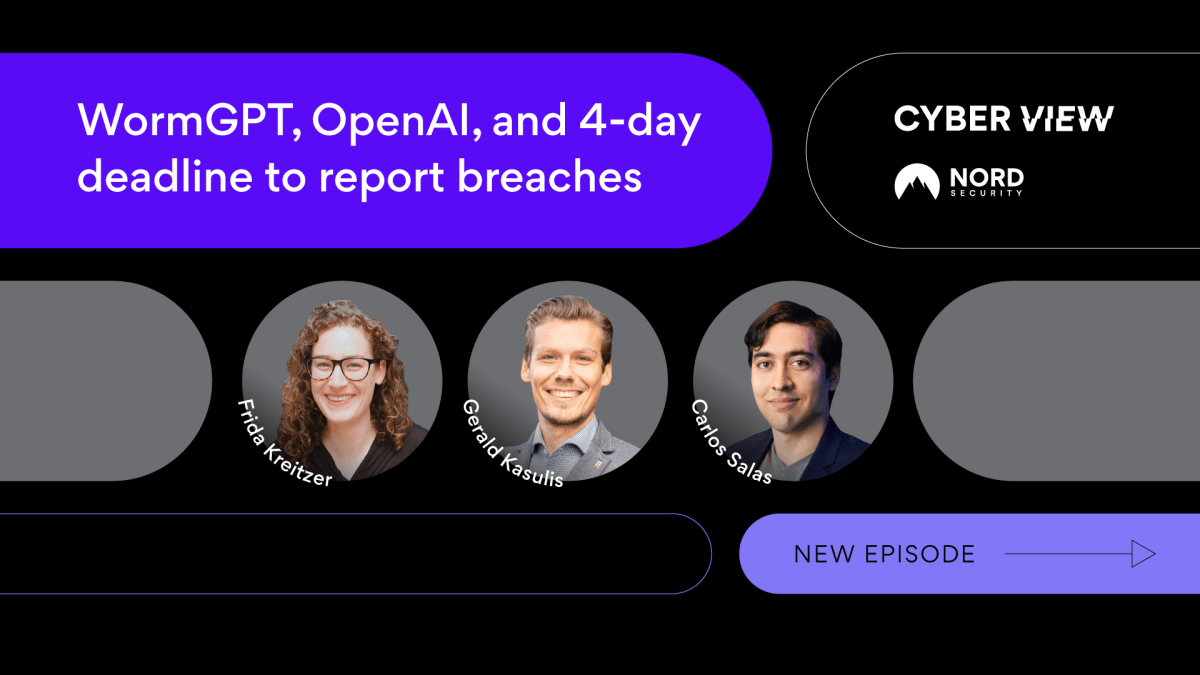
Cyberview: WormGPT, FTC investigates OpenAI, 4-day deadline to report hacks

The latest Cyberview episode is out! Join cybersecurity experts Gerald Kasulis, Frida Kreitzer, and Carlos Salas as they explore the most talked-about news in the digital world, from WormGPT, ChatGPT’s evil twin, to OpenAI’s FTC investigation and the controversial 4-day breach disclosure rule. Dive into their discussion bellow to discover what’s new in tech and cybersecurity world.

In this episode, we dive into: 

  • ChatGPT’s evil twin WormGPT

  • The Federal Trade Commission (FTC) investigation into OpenAI data leak and ChatGPT’s inaccuracy

  • A new 4-day rule for disclosing cyberattacks set by the US Securities and Exchange Commission (SEC)

Watch Cyberview here 

ChatGPT’s evil twin WormGPT

The new tool, WormGPT, is advertised on underground forums as a blackhat alternative to ChatGPT for launching phishing and business email compromise (BEC) attacks. Although, ChatGPT’s natural language abilities can already help hackers write convincing emails, resulting in the obvious signs of malicious emails disappearing.

Tools like ChatGPT and Google’s Bard have some safeguards in place that try to ensure that AI-generated content does not cause harm. However, WormGPT is specifically designed to be fully unrestricted and facilitate criminal activities, so it raises even more questions about the ethical limits of AI.

FTC investigates OpenAI over data leak and ChatGPT’s inaccuracy

Has ChatGPT broken consumer protection laws by risking personal reputations and data? The FTC has opened an investigation into OpenAI, requiring details on how OpenAI gathers and protects data and vets information.

The FTC wants to know how information was used to train its model and how it prevents false claims from being shown to users. Additionally, they are interested in how APIs connect to OpenAI’s systems and how user data is protected, all while the FTC issued multiple warnings that existing consumer protection laws apply to AI.

The 4-day deadline for public companies to report breaches

US companies hit by cyberattacks will face a 4-day deadline for publicly disclosing hacks, under new rules approved by the US Securities and Exchange Commission (SEC). There are mixed feelings about this new requirement. On the one hand, it is praised for encouraging transparency about cybersecurity breaches, as they are considered as important to investors as any other significant operational disruption.

On the other hand, the new rule is being labeled as a controversially short deadline that may not allow companies enough time to put an action plan in place or fix vulnerabilities. Although regulations state that if the SEC is informed in writing of a national security or public safety risk, a delay in breach disclosure of up to 60 days is allowed.

Stay tuned for the next episode of Cyberview.

About Version 2 Digital

Version 2 Digital is one of the most dynamic IT companies in Asia. The company distributes a wide range of IT products across various areas including cyber security, cloud, data protection, end points, infrastructures, system monitoring, storage, networking, business productivity and communication products.

Through an extensive network of channels, point of sales, resellers, and partnership companies, Version 2 offers quality products and services which are highly acclaimed in the market. Its customers cover a wide spectrum which include Global 1000 enterprises, regional listed companies, different vertical industries, public utilities, Government, a vast number of successful SMEs, and consumers in various Asian cities.

About NordLayer
NordLayer is an adaptive network access security solution for modern businesses – from the world’s most trusted cybersecurity brand, Nord Security.

The web has become a chaotic space where safety and trust have been compromised by cybercrime and data protection issues. Therefore, our team has a global mission to shape a more trusted and peaceful online future for people everywhere.

23.9.0 ‘Voyager’ released

Changes compared to 23.8.0

New Features

  • Feature: Added a lobby option to the Comet Backup desktop app installers, allowing for silent installation with fully-remote device authentication via the Devices page in the Comet Server web interface.
  • Feature: Updated the name of the Connected Devices page to Devices in the Comet Server web interface and redesigned the page to show all devices.
  • Feature: Added bulk actions to the Devices page in the Comet Server web interface.

Enhancements

  • Enhancement: Protected Item types that are not compatible with the device operating system will now be greyed out and disabled in the Comet Server web interface
  • Enhancement: Added the ability to mark jobs that are stuck in the running state as abandoned if they are unable to be cancelled in the Comet Server web interface

  • Enhancement: Changed clients on Linux platforms to log to stdin/stderr for background services
  • Enhancement: Improved the performance of restoring data from backups which contain large amounts of blank data, such as Disk Images

Bug Fixes

  • Fixed an issue with Files and Folders Protected Items being configurable through the Comet Server web interface while restricted by policy

  • Fixed an issue with Linux client uninstall jobs remaining in a running state indefinitely, even when the client has finished uninstalling
  • Fixed a cosmetic issue with selecting symlinks for backup in the Comet Backup desktop app on macOS and Linux
  • Fixed a cosmetic issue with pixelated text in the Comet Backup desktop app on multi-screen setups
  • Fixed a cosmetic issue with the ‘Configure’ text being in the wrong location in the Comet Backup desktop app

  • Fixed an issue with browsing and restoring one or more files from HyperV backup
  • Fixed an issue with the Open Folder button displaying in the Comet Backup desktop app when restoring from an Office 365 backup to a custom cloud location

  • Fixed a cosmetic issue with very long usernames and account names in the Comet Server web interface
  • Fixed a cosmetic issue during restores in the Comet Server web interface when the ‘Allow administrator to view file names remotely’ user setting is disabled

Breaking Changes

  • User and account names can no longer be created with more than 255 characters

About Version 2 Digital

Version 2 Digital is one of the most dynamic IT companies in Asia. The company distributes a wide range of IT products across various areas including cyber security, cloud, data protection, end points, infrastructures, system monitoring, storage, networking, business productivity and communication products.

Through an extensive network of channels, point of sales, resellers, and partnership companies, Version 2 offers quality products and services which are highly acclaimed in the market. Its customers cover a wide spectrum which include Global 1000 enterprises, regional listed companies, different vertical industries, public utilities, Government, a vast number of successful SMEs, and consumers in various Asian cities.

About Comet
We are a team of dedicated professionals committed to developing reliable and secure backup solutions for MSP’s, Businesses and IT professionals. With over 10 years of experience in the industry, we understand the importance of having a reliable backup solution in place to protect your valuable data. That’s why we’ve developed a comprehensive suite of backup solutions that are easy to use, scalable and highly secure.

Scale Computing’s Jeff Ready and Mike O’Neil to Speak at SpiceWorld 2023

Leadership and Innovation Take Center Stage

SPICEWORLD, AUSTIN – September 5, 2023 — Scale Computing, a market leader in edge computing, virtualization, and hyperconverged solutions, today announced that CEO and cofounder, Jeff Ready, and Director of Systems Engineers, Mike O’Neil, will be presenting at the 2023 SpiceWorld IT Conference in Austin, Texas, September 5th – 7th. The three-day event boasts hundreds of tech brands and thousands of attendees, providing participants a unique opportunity to gain insights, build connections, and explore the latest innovations in the field.

“SpiceWorld 2023 is an incredible platform for knowledge-sharing and networking,” said Ready. “I am thrilled to once again be part of the event and to have the opportunity to share the story behind Scale Computing and its evolution as we enter the age of the edge computing revolution. We’ve built award-winning solutions that eliminate the need for VMware, hypervisor, storage management, server management, container management, fleet management, and disaster recovery. Our journey is a testament to the power of innovation and dedication. We were just ranked #1 in multicloud software platforms and #1 in HCI in CRN’s latest annual report card—beating out brands like VMware and HPE—and we’re going to continue to push the envelope. This year’s SpiceWorld event has a stellar lineup of some of the top industry professionals, including many of our esteemed channel partners, and we can’t wait to show them what we’ve got on the horizon.”

Ready will present his talk, “Moving Beyond VMware: Trust, Innovation, and the Edge – The Personal Story Behind Scale Computing” on Tuesday, September 5th at 7:00pm CDT at the Tech Talk Theatre in the Expo Hall. On Wednesday, O’Neil will share his presentation, “IT Infrastructure – Harness the Power of the Edge,” at 2:15pm CDT in the breakout space.

Conference attendees can meet with the Scale Computing team at booth 133 during the event. On Thursday, September 7th, the company will host the Annual Scale Computing Bat Boat Tour beginning at 6:30pm CDT. Tickets are limited and will be issued on a first-come, first-served basis at the booth, where attendees can also enter to win a Millennium Falcon Lego set.

About Version 2 Digital

Version 2 Digital is one of the most dynamic IT companies in Asia. The company distributes a wide range of IT products across various areas including cyber security, cloud, data protection, end points, infrastructures, system monitoring, storage, networking, business productivity and communication products.

Through an extensive network of channels, point of sales, resellers, and partnership companies, Version 2 offers quality products and services which are highly acclaimed in the market. Its customers cover a wide spectrum which include Global 1000 enterprises, regional listed companies, different vertical industries, public utilities, Government, a vast number of successful SMEs, and consumers in various Asian cities.

About Scale Computing 
Scale Computing is a leader in edge computing, virtualization, and hyperconverged solutions. Scale Computing HC3 software eliminates the need for traditional virtualization software, disaster recovery software, servers, and shared storage, replacing these with a fully integrated, highly available system for running applications. Using patented HyperCore™ technology, the HC3 self-healing platform automatically identifies, mitigates, and corrects infrastructure problems in real-time, enabling applications to achieve maximum uptime. When ease-of-use, high availability, and TCO matter, Scale Computing HC3 is the ideal infrastructure platform. Read what our customers have to say on Gartner Peer Insights, Spiceworks, TechValidate and TrustRadius.