Skip to content

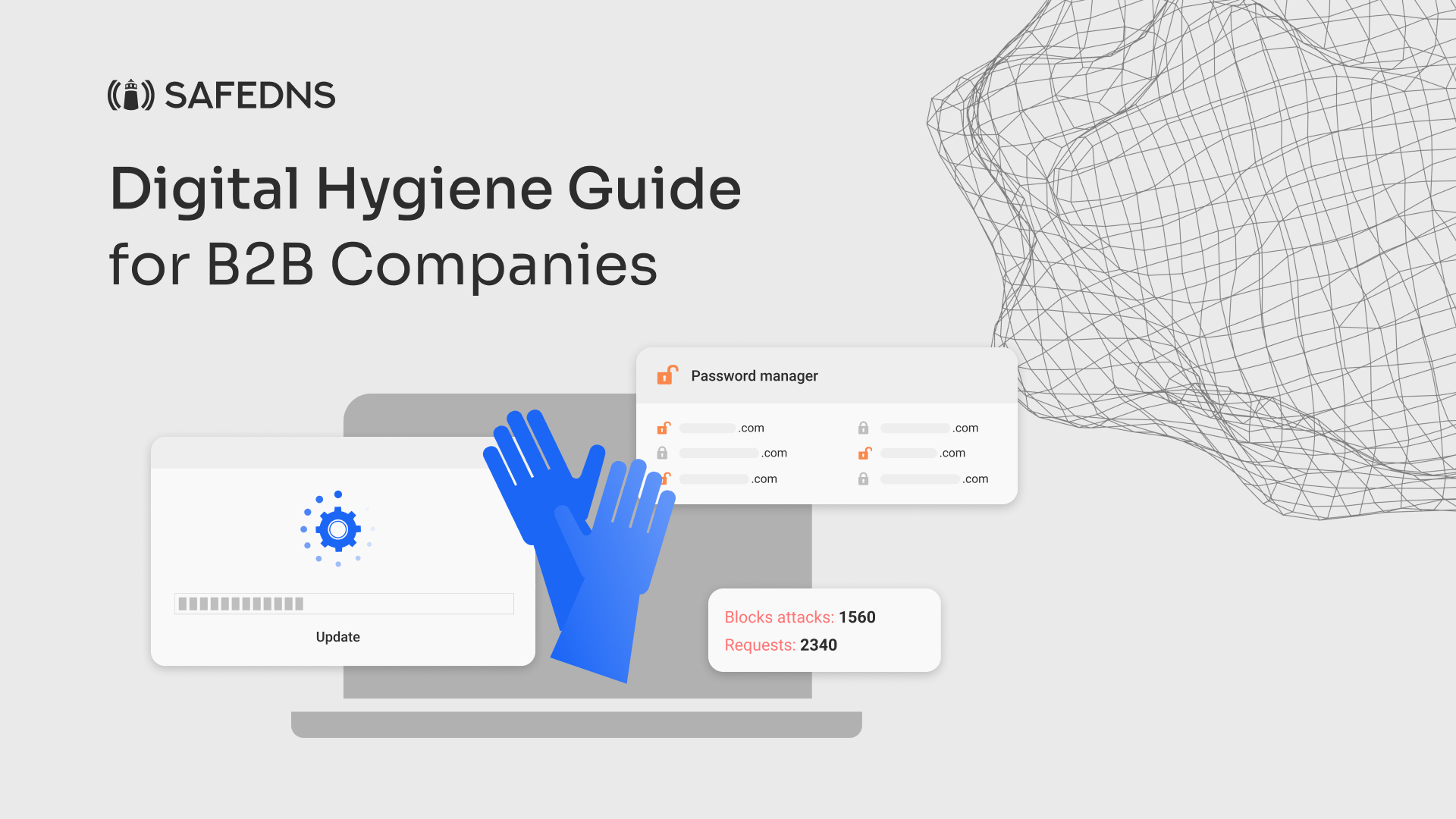
Digital Hygiene Guide for B2B Companies

With cyber threats becoming highly sophisticated, it is important for organizations to maintain a strong defense against potential attacks. As cybersecurity experts, we at SafeDNS understand the value and significance of digital hygiene for businesses. Today we will explore three key lines of defense in cybersecurity and review rules that B2B companies must implement to ensure a safe and secure online environment.

Good digital hygiene is the proactive approach that B2B companies must adopt to ensure the cleanliness, security, and overall well-being of their digital assets, data, and online activities across multiple platforms. In the fast-paced world of B2B interactions, it’s extremely important to recognize that the vast majority of business operations now take place in the digital realm. Fundamental ways to maintain good digital hygiene include data security measures, online reputation management strategies, and compliance with industry regulations. By prioritizing these aspects, B2B companies can protect themselves from cyber threats, build trust among clients and partners, maintain a positive brand image, and ensure the efficient functioning of their digital operations.

The first line of defense is password and confidential data security. To ensure the basis of data hygiene is solid, check to see if you have done all you should have done to keep your data safe.


  • It is crucial to apply a strict policy that requires a certain minimum password length and complexity for any account.
  • Using different accounts and passwords to access different resources and utilizing multi-factor authentication are essential steps to enhance digital hygiene.
  • Default credentials must be changed for equipment within the network, e.g., admin:admin.
  • Provide each employee with their own accounts with strictly defined access rights to resources, especially when employees use the same workplace and device. Try to minimize user privileges whenever possible.
  • Probably the most obvious yet problematic point: stop storing sensitive information in the clear or in the public domain!
  • Regular backups are our everything: create backup copies of systems and store them on dedicated servers separate from the network segments of work systems. In the event of a cyberattack or data breach, having a reliable backup system and a well-defined disaster recovery plan is crucial.
  • Key lesson to learn: work to increase employee awareness of data security. The more seriously you take this point, the fewer problems you will encounter.


The second defense line, the one you should take most seriously, is your technical means. To be sure that no threat can cross this line, we recommend you use:


  • automated tools for security analysis and identification of software vulnerabilities;
  • web application firewalls as a primary measure to protect web resources;
  • systems for in-depth analysis of network traffic, which help detect complex targeted attacks both in real time and in saved copies of traffic;
  • specialized anti-DdoS services;
  • anti-virus protection systems with a sandbox, a built-in isolated environment, for dynamic file scanning, capable of identifying and blocking malicious files in corporate email before they are opened by employees;
  • SIEM solutions: for timely detection and effective response to information security incidents.


The last line is system security. What can be done to ensure the security of this line of defense? Let’s have a look at the ways of protection.


  • We strongly recommend that you conduct regular penetration tests to timely identify new attack vectors on internal infrastructure and evaluate the effectiveness of the protection measures taken.
  • Also, it is important to analyze the security of web applications regularly, including source code analysis, in order to identify and eliminate vulnerabilities to attacks, including on application clients.
  • Monitor the number of requests to resources per second and set up the configuration of servers and network devices in such a way as to neutralize typical attack scenarios (e.g., TCP and UDP floods or multiple requests to DB).
  • Promptly update the software you use as patches are released.
  • Control the appearance of unsafe resources on the network perimeter; regularly conduct an inventory of resources available for connection from the Internet; analyze the security of such resources; and eliminate vulnerabilities in the software used.
  • Do not forget about filtering! It is crucial for your company’s web security to use content and email filtering to protect against phishing sites, resources that distribute viruses, DNS spoofing, and hidden miners.


Remember, digital hygiene is an ongoing process that requires constant vigilance. Implementing the practices mentioned above is a great start, but it is also essential to stay updated on the increasing number of threats and adapt your security measures accordingly.

By prioritizing digital hygiene and implementing proactive security measures, B2B companies can minimize the risk of cyberattacks, protect sensitive business data, and build trust among clients and partners, which is fundamental in today’s world.

Invest in your company’s digital hygiene and overall health today and safeguard your business against the ever-evolving threat landscape!

About Version 2 Digital

Version 2 Digital is one of the most dynamic IT companies in Asia. The company distributes a wide range of IT products across various areas including cyber security, cloud, data protection, end points, infrastructures, system monitoring, storage, networking, business productivity and communication products.

Through an extensive network of channels, point of sales, resellers, and partnership companies, Version 2 offers quality products and services which are highly acclaimed in the market. Its customers cover a wide spectrum which include Global 1000 enterprises, regional listed companies, different vertical industries, public utilities, Government, a vast number of successful SMEs, and consumers in various Asian cities.

About SafeDNS
SafeDNS breathes to make the internet safer for people all over the world with solutions ranging from AI & ML-powered web filtering, cybersecurity to threat intelligence. Moreover, we strive to create the next generation of safer and more affordable web filtering products. Endlessly working to improve our users’ online protection, SafeDNS has also launched an innovative system powered by continuous machine learning and user behavior analytics to detect botnets and malicious websites.

NordLayer insights: the making of a Black Friday cyber scam

Key takeaways 

  • Black Friday sees a major spike in both shopping, with billions spent online, and in scam activities, with a 22% increase in fraud losses reported.

  • Cybercriminals start gearing up for Black Friday scams in January, indicated by increased dark web searches for related keywords.

  • Dark web data shows Black Friday is a topic of interest throughout the year, not just in November, with notable search activity in April.

  • Months before Black Friday, the dark web buzzes with searches for big retailers, hinting at planned attacks on these platforms.

  • Key protective measures include skepticism towards unexpected deals, consistent software updates, using different devices for work and personal use, secure passwords, and informed cyber practices.

Black Friday is famous for big sales and shopping frenzy. It’s also a busy time online, with a record $9.12 billion spent last year, as reported by Adobe Analytics. This global trend saw Salesforce reporting worldwide online sales hitting $40 billion.

Yet, alongside this rise in legitimate transactions, there was a notable increase in fraudulent activity, with reported losses from scams associated with Black Friday and Cyber Monday climbing by 22% from the previous year. These statistics don’t just reflect consumer zeal for deals; they also underscore the period’s vulnerability to cyber threats.

Based on this reality, NordLayer’s recent exploration reveals a complex strategy behind the festive frauds that often begin brewing while most still stick to their New Year’s resolutions.

January: the planning period for cybercriminals

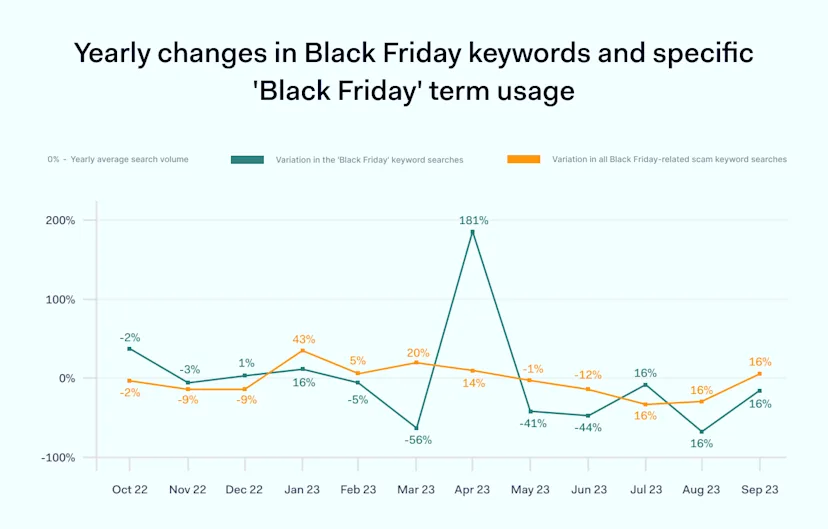
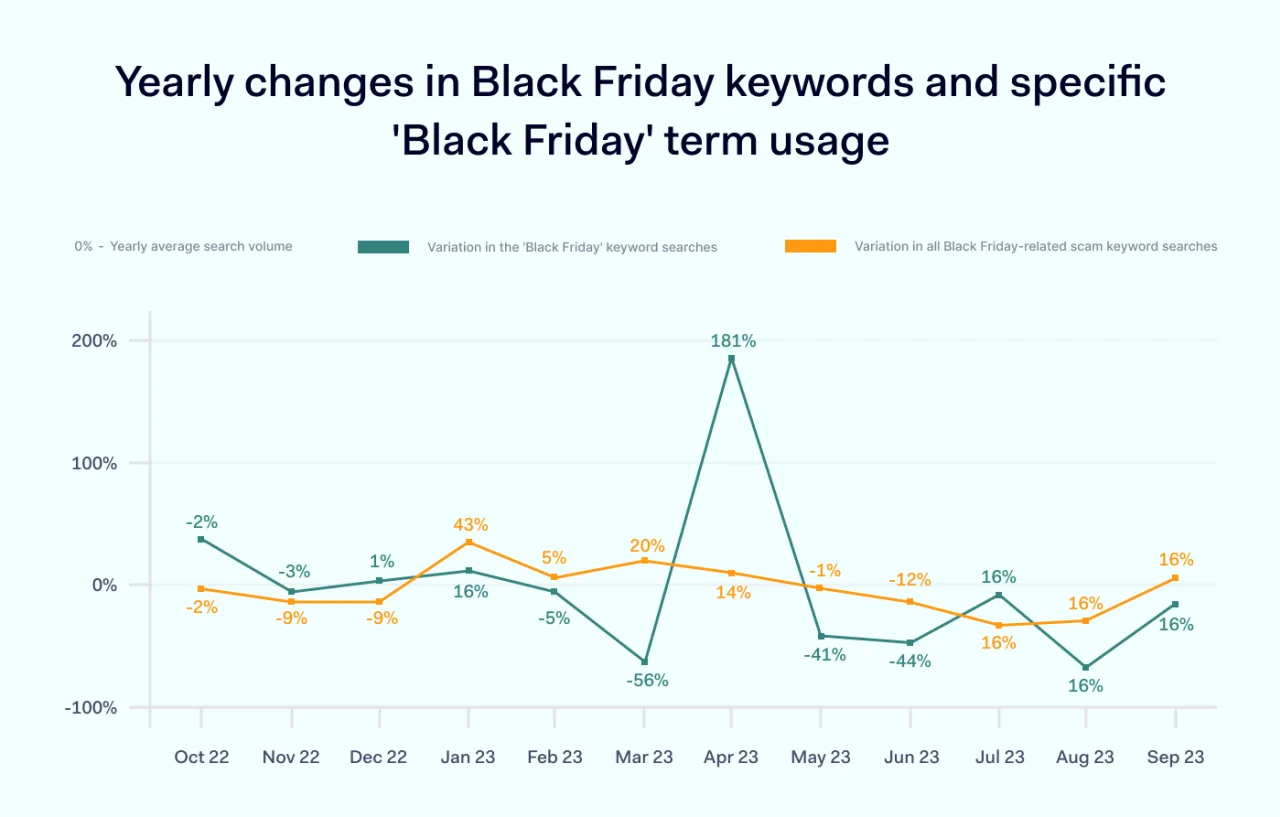
The words “Black Friday” might bring images of late-year sales to mind, but for a cybercriminal, January is a prime month for laying the groundwork. During this period, researchers noted a surge in search activity on the dark web, encompassing all Black Friday-related keywords, from hot shopping trends to potential cybersecurity threats.

Yearly changes in Black Friday keywords

Carlos Salas, Head of Platform Engineering at NordLayer, illustrates the situation: “The reason behind this early start is the need to establish a network of resources, from stolen personal data to compromised accounts, to facilitate their scams when Black Friday arrives. Criminals also seek to exploit the heightened sense of urgency and excitement surrounding the holiday season to deceive unsuspecting shoppers.”

Surprisingly, the ‘Black Friday’ keyword spiked in April searches—an unexpected deviation from the usual November interest. The reasons for this springtime surge are unclear, but it’s a reminder to stay alert for online dangers all year round, not just during the holiday shopping rush.

‘Black Friday’ queries are at their lowest in August, but remarkably, they shoot up in September, doubling the volume seen in the previous month.

Why Black Friday deals are a dark web trend all year

Black Friday isn’t just for November anymore; it’s a year-round event where you can always find deals. On the dark web, ‘Black Friday’ means discounts on things like stolen data and illegal items every day. These places sell lots of subscription services at lower prices, too. Cybercriminals are ready to use this buzz to target both shoppers and companies.

Black Friday became synonymous with getting great deals, so this keyword is popular year-round. Vendors on the dark web marketplaces know that when a potential customer sees the term ‘Black Friday,’ they will likely be attracted to the idea of saving a coin, regardless of what season it is,” says Salas.

High traffic, high risk

Popular online marketplaces are beacons for threat actors. It’s clear that retailers like Amazon, eBay, and Target, with their high online traffic, are primary targets for these attackers.

The data points to a sharp rise in targeted keyword searches for these e-commerce platforms starting early in January. The increase shows that the more well-known a retailer is, the more likely it is to attract attention from potential attackers on the dark web.

For instance, interest in Amazon spiked, with keyword searches climbing over 45% in January, followed by notable upsurges of 15% in May and 13% in March.

The Federal Trade Commission (FTC) in 2022 reported that scams where people pretend to be from a business took a massive leap, causing a loss of $2.6 billion. Looking back, from mid-2020 to mid-2021, out of every three complaints about these kinds of scams, one was about someone faking to be from Amazon. Last year, the amount of money swindled by fake businesses was $660 million, which is more than the $453 million lost the year before. The FTC hasn’t given a breakdown for Amazon scams for 2022 specifically, but it’s a fair guess that, given the trend, Amazon impersonators have also become more common.

eBay saw a similar pattern, with dark web keyword searches soaring by 68% in January, while March and April recorded increases of 46% and 19%, respectively.

Target-related searches peaked with a 41% rise in March, a 31% jump in January, and a moderate 15% hike in April.

Each spike in search volume represents more than consumer trends; they’re opportunities eyed by cybercriminals.

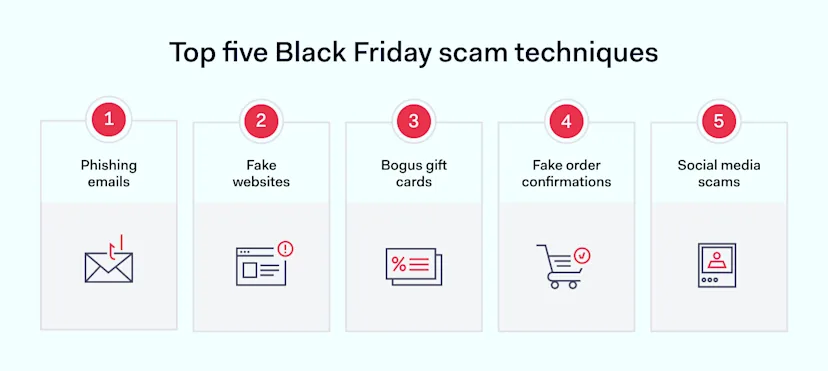
Top 5 threats this Black Friday

Carlos Salas points out the top five scams to be wary of.

Phishing scams

Phishing remains a favored tactic. Fraudulent attempts to gather sensitive information don’t take a holiday, especially not on Black Friday.

Phishing scams come to life when cybercriminals buy phishing kits from dark web stores. These all-in-one packages enable setting up websites that look trustworthy but are traps for stealing sensitive data.

Before the generative AI era, phishing emails were somewhat easy to spot due to poor grammar, illogical vocabulary, and bad spelling. Such glaring errors were easy to pick up by automated defenses and reasonably careful people. But with AI tools, it is now far more likely that a phishing email will appear genuine, leading to more potential victims actually clicking on malicious links.

Fake websites

Imitation may be flattery, but in the cyber world, it’s a weapon. Cybercriminals craft convincing copycat websites offering too-good-to-be-true deals to lure in unsuspecting shoppers.

The development of fake websites follows a similar path to phishing scams. Scammers use sophisticated software to clone legitimate websites, which are then hosted on compromised or malicious servers. These counterfeit sites are often used together with phishing emails or advertisements to steal user data or payment information.

Gift card frauds

Gift cards from third-party vendors may not be as beneficial as they appear. There’s a real danger they could be fake or previously drained, rendering your gift worthless.

On the dark web, there are marketplaces and forums where stolen gift card numbers are bought and sold. Scammers also trade tips and tools for cracking the algorithms of gift card numbers, allowing them to generate and sell counterfeit cards.

Fake order confirmations

Be wary of unexpected emails, calls, or messages about orders or deliveries you don’t recognize.

This scam involves creating fake order confirmation emails that appear to come from well-known retailers. These emails are crafted using templates available on dark web markets, complete with logos and branding, and contain links to phishing websites or malware.

Social media scams

According to FTC data, social media ranks as the fifth most common way scammers contact their victims. In cases reported on social media scams, 61% resulted in financial loss. The median amount that people were scammed out of was $528. Think twice before you click on offers that look too good to be true.

These scams are often centered around fake profiles or compromised accounts. The dark web provides a venue for buying and selling the access credentials to these accounts, as well as software that automates the creation of posts and messages designed to defraud social media users.

The methodology behind Black Friday cyber threat analysis

The compilation of data was a joint effort with independent experts focused on researching cybersecurity incidents. The team conducted an analysis of the most searched terms related to Black Friday, including popular discussion topics, retail chains, and methods of attack. They conducted their search analysis over a period stretching from September 2022 to August 2023.

The benchmark is based on the average monthly search volume for Black Friday-related scam terms, and variations from this norm were calculated accordingly.

Fortifying your digital defenses: five tactical measures

Be skeptical of unexpected communications

Phishing doesn’t come with a neon sign. Treat unexpected emails and messages cautiously, verifying the sender through other channels if necessary.

Update and patch regularly

Ensure that all systems and software are up-to-date with the latest security patches. Think of updates as your digital immune system’s vitamins—essential for fending off infection by cybercriminals.

Separate work and personal devices

Using personal devices for work can cause trouble. If possible, keep them separate to minimize the risk of cross-contamination.

Embrace strong, unique passwords

A common foothold for cybercriminals is a weak password. Opt for complex, unique passwords for each account, and consider a password manager to keep track of them all.

Educate on cyber hygiene

Empower employees and users with knowledge. Regular training sessions can turn the most innocuous user into a vigilant watchkeeper against phishing scams and suspicious links.

Strengthen your business with NordLayer security

The shift to hybrid work models has made the understanding of security threats more important than ever. NordLayer helps businesses adapt by providing advanced solutions for network access and management. Our services are built around the Zero Trust security model, which rigorously verifies every access request, thus enhancing your data protection. Virtual Private Gateways further secure your operations with dedicated servers that encrypt data and offer detailed access management, seamlessly integrating with leading login systems.

NordLayer offers a suite of security features, including a top-quality VPN, multi-factor authentication, and ongoing network monitoring, designed to fit your business needs without additional hardware complexity.

Contact NordLayer today to strengthen your organization’s defenses against cyber threats.

Genetic data leak, 23andMe point to credential stuffing

Hackers are selling genetic data stolen from users of the company 23andMe. The company itself says they weren’t breached, although their users’ data was used by what seems to be a single threat actor stealing personal details and genetic data. This data was then published or advertised online. 23andMe suggested that the threat actor(s) gained unauthorized access with “recycled login credentials”, a technique known as credential stuffing.

The logic is simple: Keep trying stolen username/password combinations, and eventually, they’ll work on another site. An easy solution to credential stuffing attacks? You guessed it: Multi-factor authentication (MFA). While 23andMe has offered an MFA feature since 2019, it was not made mandatory for users. With genetic and personal data at stake and up to 7 million users affected by these recent breaches, it might be time for a change in policy.

The Bleach Breach: Clorox revenue and supply chain hit

Clorox, the household cleaning giant, predicts a more than 20% drop in quarterly sales due to a cyberattack (thought to be ransomware) that caused product shortages and operational disruptions. Manufacturing, often kept running by legacy systems and sprawling workforces, suffers more cyberattacks than any other industry.

The Clorox incident is being linked to the same group responsible for the MGM and Caesars Palace hacks, discussed in our previous episode, which occurred around the same time in August 2023. “Scattered Spider” is notorious for using social engineering methods to gain access to internal systems. The Clorox Company’s share price has dropped by over 7 percent in the last month.

Wearable AI: Trendy or just trending?

Tech companies are rushing to secure the lead in wearable AI products. Meta has collaborated with Ray-Ban on a pair of high-tech glasses, enabling wearers to live stream directly from the glasses to Facebook or Instagram and voice activate Meta AI, “an advanced conversational assistant”. Jony Ive, Apple’s legendary former design lead, and OpenAI are reportedly teaming up to design the “iPhone of AI”.

Rewind.ai unveiled a neck-worn pendant that records conversations to your smartphone and creates a searchable database of life moments. Humane, imagining “a world where you can take AI everywhere”, have developed a smart device that resembles a badge or lapel pin.

The common goal here seems to be for technology to rely less on screens, to fade from view, and become all but invisible.

Stay tuned for the next episode of Cyberview.

About Version 2 Digital

Version 2 Digital is one of the most dynamic IT companies in Asia. The company distributes a wide range of IT products across various areas including cyber security, cloud, data protection, end points, infrastructures, system monitoring, storage, networking, business productivity and communication products.

Through an extensive network of channels, point of sales, resellers, and partnership companies, Version 2 offers quality products and services which are highly acclaimed in the market. Its customers cover a wide spectrum which include Global 1000 enterprises, regional listed companies, different vertical industries, public utilities, Government, a vast number of successful SMEs, and consumers in various Asian cities.

About NordLayer
NordLayer is an adaptive network access security solution for modern businesses – from the world’s most trusted cybersecurity brand, Nord Security.

The web has become a chaotic space where safety and trust have been compromised by cybercrime and data protection issues. Therefore, our team has a global mission to shape a more trusted and peaceful online future for people everywhere.

ESET Research: Android malware Kamran spying via news app on residents of the disputed Kashmir region

  • ESET Research has discovered Android spyware, which ESET researchers named Kamran, that has been distributed via a possible watering-hole attack on the Hunza News website.
  • The malware targets residents using Urdu language in Gilgit-Baltistan, part of the disputed Kashmir region that is administered by Pakistan.
  • The malicious app prompts the user to grant it permissions to access various information. If accepted, it gathers data about contacts, calendar events, call logs, location information, device files, SMS messages, and images.

BRATISLAVA, KOŠICE — November 09, 2023 — ESET researchers have identified what appears to be a watering-hole attack on a regional news website that delivers news about Gilgit-Baltistan, a region administered by Pakistan. Gilgit-Baltistan consists of the northern region of the greater Kashmir territory, embroiled in longstanding disputes involving India and Pakistan (since 1947) as well as between India and China (since 1959). Watering-hole attacks are a type of threat where a commonly visited website is compromised to serve malware. When opened on a mobile device, the Urdu version of the Hunza News website offers readers the possibility to download the Hunza News Android app directly from the website; however, the app has malicious espionage capabilities. Urdu is the official and main language of communication used for inter-ethnic communication within this disputed region. ESET has named this previously unknown spyware Kamran.

The word Kamran was used by ESET to name this spyware due to its package name “com.kamran.hunzanews.” Kamran is a common given name in Pakistan and other Urdu-speaking regions; in Farsi, which is spoken by some minorities in Gilgit-Baltistan, it means fortunate or lucky.

The Hunza News website has both English and Urdu versions; English is the second official language spoken in the region. The English mobile version doesn’t provide any app for download. However, only the Urdu version on mobile offers to download the Android spyware in question. While the English and Urdu desktop versions also offer the Android spyware, it is not compatible with desktop operating systems. ESET Research reached out to Hunza News regarding Kamran, however, the website provided no response prior to the publication of this research.

The Kamran spyware displays the content of the Hunza News website but also contains custom malicious code. Upon launching, the malicious app prompts the user to grant it permissions to access various information. If accepted, it gathers data about contacts, calendar events, call logs, location information, device files, SMS messages, images, etc. If the requested permissions to the app are granted, Kamran automatically gathers this sensitive user data and uploads it to a hardcoded command and control (C&C) server. The C&C server was reported to Google, as the platform misused by the spyware is provided by them. However, the malware lacks remote control capabilities.

This malicious app has never been offered through the Google Play Store but is instead downloaded from a source referred to as Unknown by Google, to install this app, the user is requested to enable the option to install apps from unknown sources. ESET was able to identify at least 22 compromised smartphones, with five of them being located in Pakistan.

The malicious app appeared on the website sometime between January 7, 2023, and March 21, 2023; the developer certificate of the malicious app was issued on January 10, 2023. During that time, protests were being held in Gilgit-Baltistan for various reasons encompassing land rights, taxation concerns, prolonged power outages, and a decline in subsidized wheat provisions.

“With a high degree of confidence, we can affirm that the malicious app specifically targeted Urdu-speaking users, who accessed the website via Android devices. However, since Kamran demonstrates a unique codebase, distinct from other Android spyware, this prevents its attribution to any known advanced persistent threat – APT – group,” says ESET researcher Lukáš Štefanko, who discovered the Kamran spyware. “This spyware shows once again that it is important to reiterate the importance of downloading apps exclusively from trusted and official sources,” he adds.

Hunza News, likely named after the Hunza District or the Hunza Valley, is an online newspaper delivering news related to the Gilgit-Baltistan region. Internet archive data shows that the site has been delivering news since 2013. In 2015, Hunza News started to provide a legitimate Android application that was available on the Google Play Store. Based on available data, ESET Research believes two versions of this app were released on Google Play, with neither containing any malicious functionality.

For more technical information about Kamran spyware, check out the blogpost “Unlucky Kamran: Android malware spying on Urdu-speaking residents of Gilgit-Baltistan.” Make sure to follow ESET Research on Twitter (today known as X) for the latest news from ESET Research.


About ESET
ESET develops software solutions that deliver instant, comprehensive protection against evolving computer security threats. ESET pioneered and continues to lead the industry in proactive threat detection. ESET NOD32 Antivirus, its flagship product, consistently achieves the highest accolades in all types of comparative testing and is the foundational product that builds out the ESET product line to include ESET Smart Security. ESET Smart Security is an integrated antivirus, antispyware, antispam and personal firewall solution that combines accuracy, speed and an extremely small system footprint to create the most effective security solution in the industry. Both products have an extremely efficient code base that eliminates the unnecessary large size found in some solutions. This means faster scanning that doesn’t slow down computers or networks. Sold in more than 160 countries, ESET has worldwide production headquarters in Bratislava, SK and worldwide distribution headquarters in San Diego, U.S. ESET also has offices in Bristol, U.K.; Buenos Aires, AR; Prague, CZ; and is globally represented by an extensive partner network. For more information, visit our local office at https://eset.version-2.sg.

About Version 2 Limited
Version 2 Limited is one of the most dynamic IT companies in Asia. The Company develops and distributes IT products for Internet and IP-based networks, including communication systems, Internet software, security, network, and media products. Through an extensive network of channels, point of sales, resellers, and partnership companies, Version 2 Limited offers quality products and services which are highly acclaimed in the market. Its customers cover a wide spectrum which includes Global 1000 enterprises, regional listed companies, public utilities, Government, a vast number of successful SMEs, and consumers in various Asian cities. For more information, please visit https://www.version-2.com.sg/ or call (65) 6296-4268.

About Version 2 Digital

Version 2 Digital is one of the most dynamic IT companies in Asia. The company distributes a wide range of IT products across various areas including cyber security, cloud, data protection, end points, infrastructures, system monitoring, storage, networking, business productivity and communication products.

Through an extensive network of channels, point of sales, resellers, and partnership companies, Version 2 offers quality products and services which are highly acclaimed in the market. Its customers cover a wide spectrum which include Global 1000 enterprises, regional listed companies, different vertical industries, public utilities, Government, a vast number of successful SMEs, and consumers in various Asian cities.

About ESET
For 30 years, ESET® has been developing industry-leading IT security software and services for businesses and consumers worldwide. With solutions ranging from endpoint security to encryption and two-factor authentication, ESET’s high-performing, easy-to-use products give individuals and businesses the peace of mind to enjoy the full potential of their technology. ESET unobtrusively protects and monitors 24/7, updating defenses in real time to keep users safe and businesses running without interruption. Evolving threats require an evolving IT security company. Backed by R&D facilities worldwide, ESET became the first IT security company to earn 100 Virus Bulletin VB100 awards, identifying every single “in-the-wild” malware without interruption since 2003.

NordLayer Partner Program: TEKRiSQ on how practical solutions help eliminate weak security links

A discussion with Dean Mechlowitz, Co-founder of TEKRiSQ responsible for Technology Operations, about the main challenges organizations face with cybersecurity threats, the benefits of the NordLayer Partner Program, and what perspectives are anticipated for different industries. 

Highlights

  • About the company: TEKRiSQ is a cybersecurity team of up to 10 people aiding small- and medium-sized businesses (SMBs) in the US and Canada and focusing on enhancing cyber resilience against digital threats since 2021.

  • Business case: the MSP tackles the challenges SMBs face in cybersecurity, addressing the lack of internal IT expertise and the misconception of being too insignificant to be targeted.

  • NordLayer adoption: a partner utilizes NordLayer’s simple and efficient remote network access solutions to enhance cybersecurity for clients without overwhelming them.

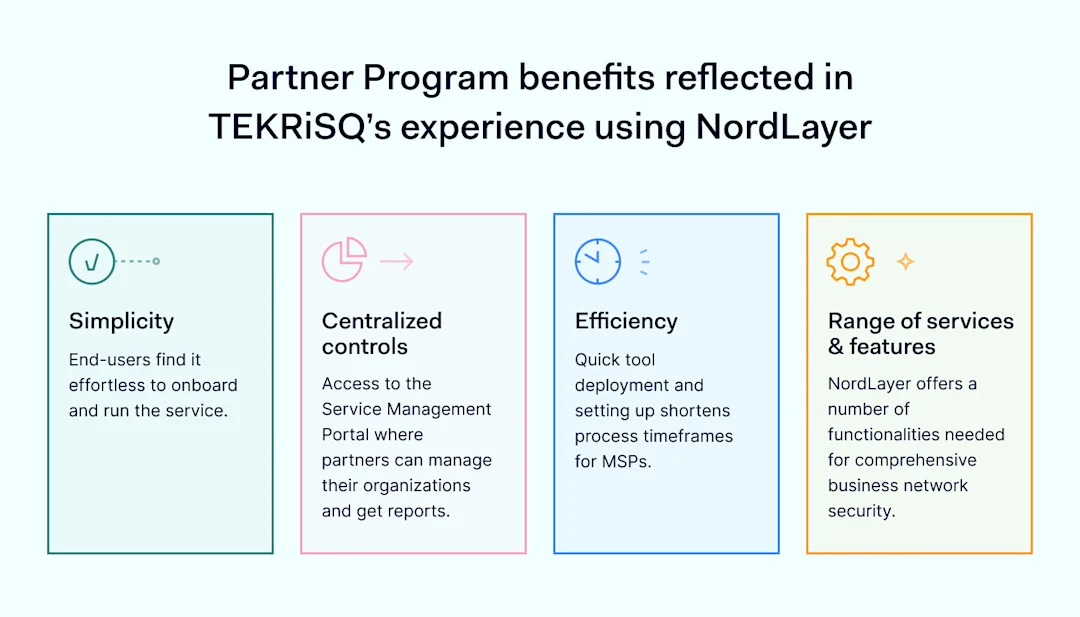
  • Benefits of NordLayer Partner Program: the program offers MSPs like TEKRiSQ user-friendly solutions, a centralized management portal, and reporting capabilities, emphasizing ease of use for end-users.

  • Future projections. Future cybersecurity challenges will center around remote work risks, the protection of personal data, and the need for basic security measures like multi-factor authentication.

About the company

TEKRiSQ is a team of cybersecurity professionals helping SMBs build cyber resilience against digital threats. Operating as a managed service provider (MSP) in the US and Canada, a team of up to 10 people ensures that their clients transform into fully cyber-insurable companies.

Established in 2021, TEKRiSQ was founded on strong fundamentals of experience and expertise in modern cybersecurity and technology. The company has been advising everyone from small teams to big global players, gaining unique insights into the industry and how SMBs navigate the changing security landscape.

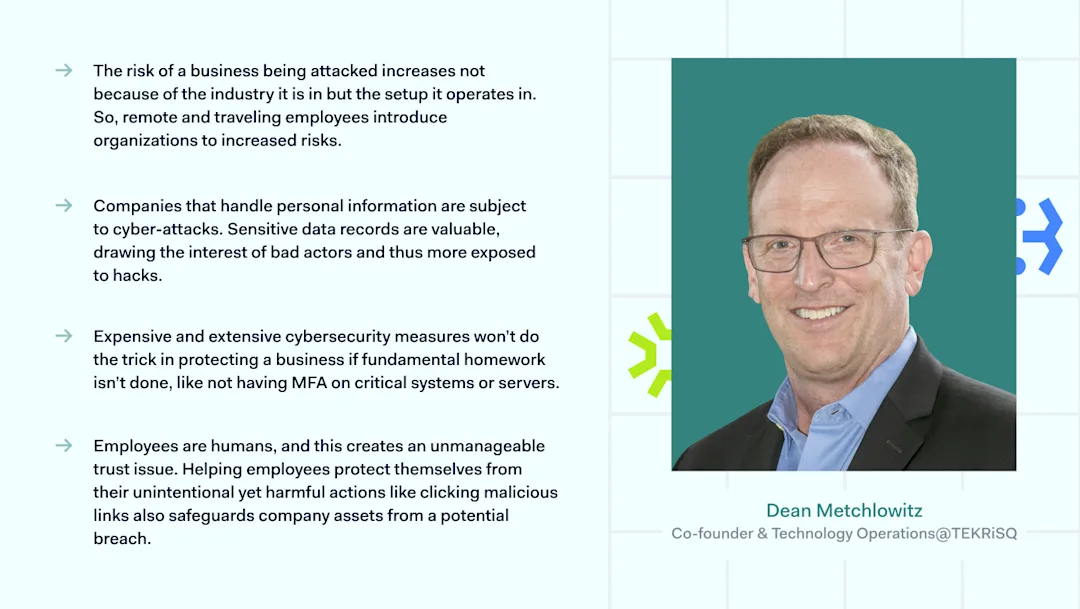
Dean Mechlowitz, Co-founder of TEKRiSQ responsible for Technology Operations, discusses the company’s approach to building cybersecurity culture and technology stack for SMBs, and how NordLayer’s secure remote access solution contributes to their mission.

Business case: bringing in the cyber expertise so clients don’t have to move a finger

According to TEKRiSQ, companies often struggle not due to industry-specific challenges but because of their mindset when it comes to adopting security measures. Small and medium enterprises are convinced that their insignificance will protect them from potential risks.

“Usually, companies with fewer than 200 employees are basically sitting ducks. They believe “I’m too small, and all my data is in the cloud, so I am not at risk,” but truly, they just have no idea how to understand it.”

SMBs who don’t typically have internal IT departments or Chief Information Officers end up outsourcing specialists and services. Without the right knowledge, it’s challenging to determine cyber risks applicable to their businesses and keep up with technological changes. Partner-Case-study-Sequentur web-cover 1400x8002

The lack of expertise makes organization decision-makers immobile and hesitant in taking action because the only thought they have in their minds is, “What do I do?” However, some service providers jump into the multibillion-dollar MSP market with no actual experience in cybersecurity.

“Many MSPs are not cyber experts and fail to introduce basic security measures like multi-factor authentication to their clients, or they aren’t familiar with the latest security issues.”

Qualified MSPs often play a crucial role in guiding organizations lost in the subject. They are responsible not only for bringing knowledge and expertise but also for making sure the clients are aware of the risks. Our speaker Dean highlights that clients tend not to know or simply don’t care about the importance of business cybersecurity.

Guiding the unaware and the naive with a pragmatic approach

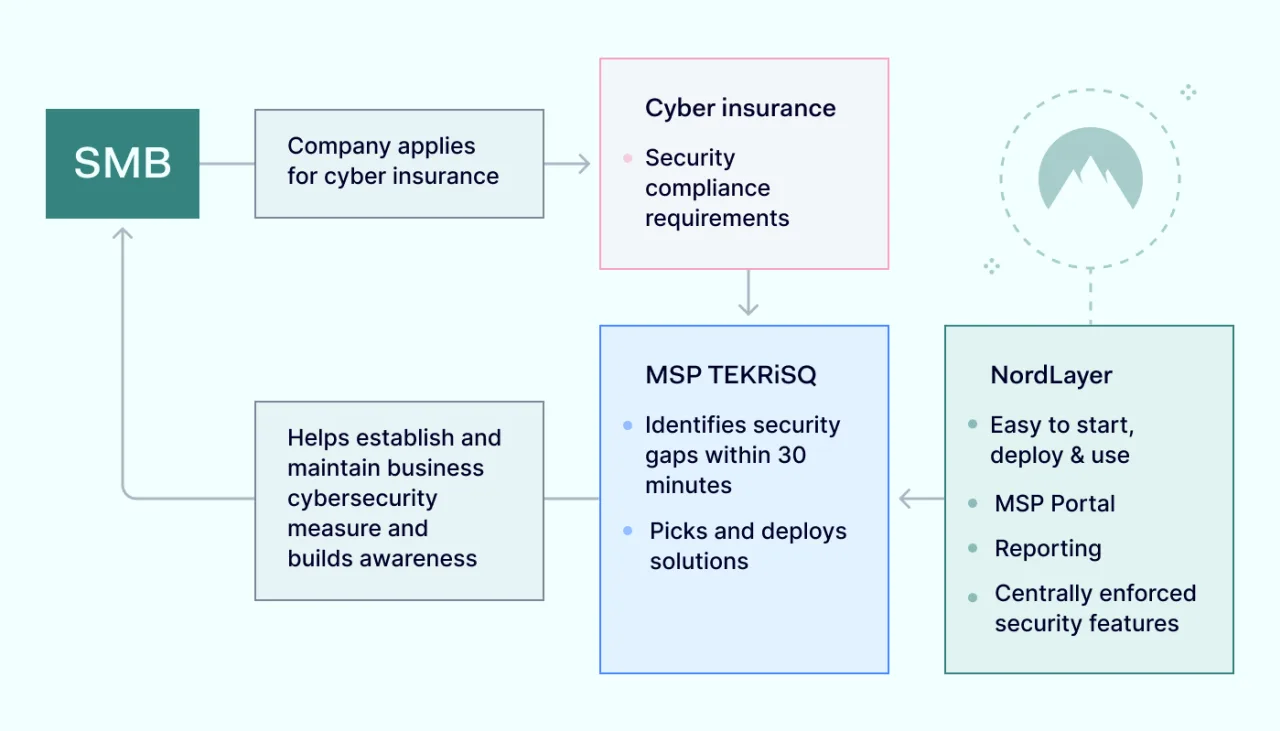
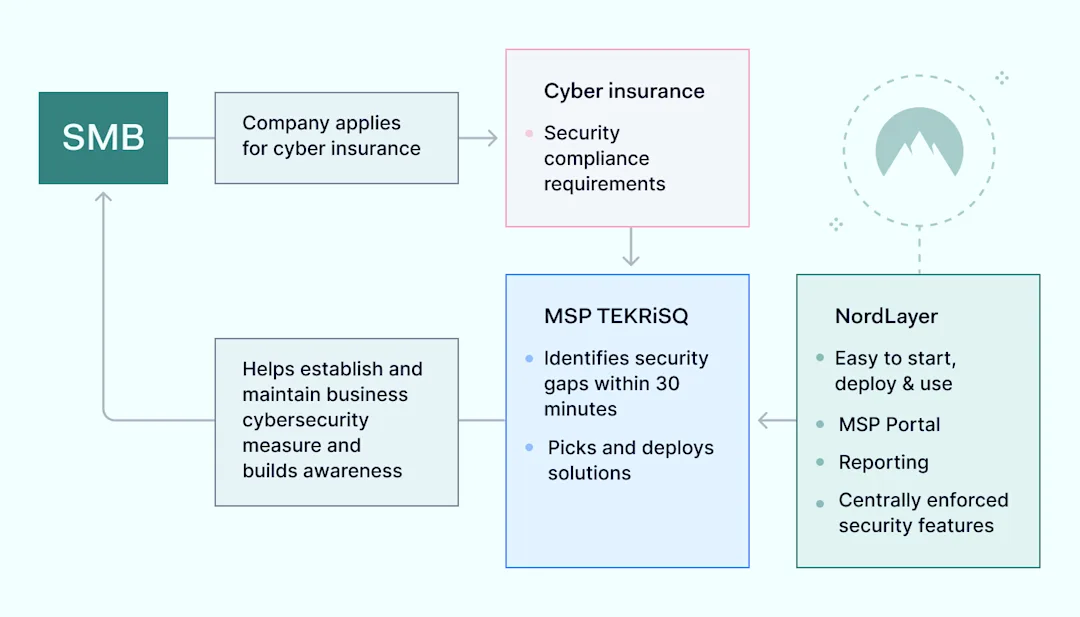
TEKRiSQ’s strategy is to use cyber insurance channels to get clients’ attention to security needs.

1 1400x800

Business owners and managers, just like any other person, are looking for a quick and painless solution to their problem—and insurance, at first glance, seems like an easy way out. However, businesses must comply with insurance requirements that usually include the incorporation of network and data security policies.

“People think “I’ve never been attacked before. Therefore, I’m never going to be attacked,” which is incorrect.”

Then, the ignorant, unaware, or careless mindset faces a reality check after hearing three control questions from a TEKRiSQ representative:

  1. If all your data was exposed and published on the dark web, would that be a problem for your business?

  2. If all your data was inaccessible for three or four weeks, would that be a problem for your business?

  3. If your computers were shut down for a month or two, would that be a problem for your business?

According to Dean, everybody uses computers, and everybody has data that’s really sensitive, so the answer is, “Of course, it’d be a problem,” and it doesn’t matter what business you’re in.

“Companies have remote workforces, which is almost everybody today. A lot of companies have consultants sitting all over the country using their own computers. That’s problematic, right? Many people travel to airports and hotels—that’s problematic, too.”

So there are certain businesses that have bigger risks, and some have smaller ones, but it’s the MSPs’ task to identify and mitigate them for the client if they lack internal resources to do it independently.

Close collaboration with insurance providers allows TEKRiSQ to be at full speed with what’s required by the insurer. Many MSPs are unaware of such nuances and cannot offer clients the right solutions.

Close-up on the solution

TEKRiSQ is a unique managed service provider that performs risk assessments in 30 minutes. They also focus on delivering solutions in minutes, not weeks or months. Thus, working with tools that correspond with such objectives is super important.

NordLayer’s onboarding for secure remote network access is about as simple as possible. You put the email into the system, and it sends an activation email. The setup must be super simple so non-tech users can understand it and follow instructions.

“The setup only takes tens of seconds or a minute—it’s pretty simple. It’s for us to find a way to encourage them to consistently use the tool.”

As an MSP, TEKRiSQ must have access to activity reporting to see whether the clients are using the systems. If the activity is low, they must be able to enforce the service, as companies tend to forget to use it after installing the application.

“None of our clients wishes to learn or do anything in terms of managing a solution, so it has to be fully governed by us. They only want not to care about it besides turning the tool off and on.”

Finally, adding extra layers of security, like incorporating dedicated IP into the company’s network protection, is crucial. Whether it’s encrypting connections while working on a public network or adding IP or access control lists for the firewall—the client most likely doesn’t realize the need for such a measure because they don’t know there’s more behind a firewall or generic VPN.

Why join the NordLayer Partner Program?

Our Partner Program provides MSPs with an ecosystem of user-friendly solutions, educational materials, and hands-on support from our experts. The main benefit of NordLayer is in our approach to thinking two steps ahead for our clients and partners.

NordLayer is all about stress-free cybersecurity. Thus, it has to be approachable for the end-user and effective for our partners.

“Unless clients start to care enough to start doing something themselves to protect their business, my only concern is to make it really easy for them—like turning on the app and forgetting about the rest.”

By providing a Service Management Portal, NordLayer gives its partners keys to their organizations’ administration in one place. There they have centralized controls of comprehensive security features and user management.

Interested in collaborating to build a more resilient and aware cybersecurity landscape for businesses and organizations? NordLayer invites Managed Service Providers to seize the opportunity to join our Partner Program.

Thank you, Dean, for sharing your experience with NordLayer in helping your clients overcome network security challenges.

Future projections: threats and challenges to keep an eye on

Experience and daily work in the cybersecurity field help draw some presumptions about what to expect from the industry in the upcoming years. Our story hero, Dean agreed to share his insights on what companies should be cautious about in order to protect their businesses.

Genetic data leak, 23andMe point to credential stuffing

Hackers are selling genetic data stolen from users of the company 23andMe. The company itself says they weren’t breached, although their users’ data was used by what seems to be a single threat actor stealing personal details and genetic data. This data was then published or advertised online. 23andMe suggested that the threat actor(s) gained unauthorized access with “recycled login credentials”, a technique known as credential stuffing.

The logic is simple: Keep trying stolen username/password combinations, and eventually, they’ll work on another site. An easy solution to credential stuffing attacks? You guessed it: Multi-factor authentication (MFA). While 23andMe has offered an MFA feature since 2019, it was not made mandatory for users. With genetic and personal data at stake and up to 7 million users affected by these recent breaches, it might be time for a change in policy.

The Bleach Breach: Clorox revenue and supply chain hit

Clorox, the household cleaning giant, predicts a more than 20% drop in quarterly sales due to a cyberattack (thought to be ransomware) that caused product shortages and operational disruptions. Manufacturing, often kept running by legacy systems and sprawling workforces, suffers more cyberattacks than any other industry.

The Clorox incident is being linked to the same group responsible for the MGM and Caesars Palace hacks, discussed in our previous episode, which occurred around the same time in August 2023. “Scattered Spider” is notorious for using social engineering methods to gain access to internal systems. The Clorox Company’s share price has dropped by over 7 percent in the last month.

Wearable AI: Trendy or just trending?

Tech companies are rushing to secure the lead in wearable AI products. Meta has collaborated with Ray-Ban on a pair of high-tech glasses, enabling wearers to live stream directly from the glasses to Facebook or Instagram and voice activate Meta AI, “an advanced conversational assistant”. Jony Ive, Apple’s legendary former design lead, and OpenAI are reportedly teaming up to design the “iPhone of AI”.

Rewind.ai unveiled a neck-worn pendant that records conversations to your smartphone and creates a searchable database of life moments. Humane, imagining “a world where you can take AI everywhere”, have developed a smart device that resembles a badge or lapel pin.

The common goal here seems to be for technology to rely less on screens, to fade from view, and become all but invisible.

Stay tuned for the next episode of Cyberview.

About Version 2 Digital

Version 2 Digital is one of the most dynamic IT companies in Asia. The company distributes a wide range of IT products across various areas including cyber security, cloud, data protection, end points, infrastructures, system monitoring, storage, networking, business productivity and communication products.

Through an extensive network of channels, point of sales, resellers, and partnership companies, Version 2 offers quality products and services which are highly acclaimed in the market. Its customers cover a wide spectrum which include Global 1000 enterprises, regional listed companies, different vertical industries, public utilities, Government, a vast number of successful SMEs, and consumers in various Asian cities.

About NordLayer
NordLayer is an adaptive network access security solution for modern businesses – from the world’s most trusted cybersecurity brand, Nord Security.

The web has become a chaotic space where safety and trust have been compromised by cybercrime and data protection issues. Therefore, our team has a global mission to shape a more trusted and peaceful online future for people everywhere.

Scale Computing Recognized with Three 2023 TrustRadius Awards: Best Feature Set, Best Relationship, and Best Value for the Price

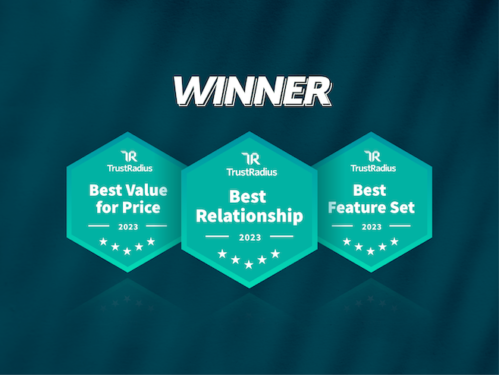
INDIANAPOLIS – November 8 2023 — Scale Computing, a market leader in edge computing, virtualization, and hyperconverged solutions, today announced that the company has been recognized with three TrustRadius Best of Awards in the Hyper-Converged Infrastructure category. Scale Computing received awards for Best Feature Set, Best Relationship, and Best Value for Price.

TrustRadius is a leading independent research and review platform that provides comprehensive, vetted product information and customer-generated reviews, recognizing top technology solutions based on user feedback. To win a Best of Award, nominees must have received at least ten reviews between January and September 2023, ensuring an accurate gauge of recent customer sentiment. The awards honor the few companies that have gone above and beyond in user satisfaction based on key insight statistics related to value, feature set, and customer relationships. To win, vendors must be ranked in the top three per award type in their technology category.

Scale Computing, whose solutions enable IT managers to run applications and process data outside centralized data centers, at the edge of a network closest to where that data is created and utilized, was named the first-place winner in all three Best of Award categories. Earlier this year, the company announced it also earned multiple TrustRadius Top Rated Awards in the categories of Hyperconverged Infrastructure, Server Virtualization, and Edge Computing.

“We are truly honored that Scale Computing is yet again the recipient of the TrustRadius Best of Awards for value, feature set, and customer relationships,” said Jeff Ready, CEO and co-founder, Scale Computing. “We are dedicated to delivering leading IT infrastructure and edge computing solutions that not only meet but exceed the expectations of our customers. The TrustRadius awards are especially meaningful because the recognition has to be earned through genuine positive feedback from users. These awards fuel our passion to continue innovating and providing unparalleled value and service to our partners and customers.”

A TrustRadius review of Scale Computing summarizes a common sentiment: “Scale Computing is our number one recommended hypervisor platform and becomes the backbone of our clients’ IT infrastructure. When selecting Scale Computing for clients we look at overall cost savings, ease of use and scalability. We implement Scale Computing for clients that have as little as 5 users to clients that have over 8000 users! With the ease of use it takes the burden off of the IT department for both the hypervisor and backups. Our clients can sleep better at night and can ‘Set it and forget it.’”

The TrustRadius Best of Awards help customers cut through the sea of products and allow the best to shine through. “Scale Computing Platform has achieved a remarkable feat, securing first place in all three awards in the Hyper-Converged Infrastructure category,” declared Megan Headley, VP of research at TrustRadius. “Scale Computing Platform’s recognition is entirely based on customer feedback. Customers emphasize their satisfaction with the feature set, confirm that the product lives up to sales and marketing promises, and provides outstanding value for the price.”

To learn more about what real users have to say about Scale Computing, visit the TrustRadius Scale Computing Platform review page: https://www.trustradius.com/products/scale-computing-hc3/reviews.

About Version 2 Digital

Version 2 Digital is one of the most dynamic IT companies in Asia. The company distributes a wide range of IT products across various areas including cyber security, cloud, data protection, end points, infrastructures, system monitoring, storage, networking, business productivity and communication products.

Through an extensive network of channels, point of sales, resellers, and partnership companies, Version 2 offers quality products and services which are highly acclaimed in the market. Its customers cover a wide spectrum which include Global 1000 enterprises, regional listed companies, different vertical industries, public utilities, Government, a vast number of successful SMEs, and consumers in various Asian cities.

About Scale Computing 
Scale Computing is a leader in edge computing, virtualization, and hyperconverged solutions. Scale Computing HC3 software eliminates the need for traditional virtualization software, disaster recovery software, servers, and shared storage, replacing these with a fully integrated, highly available system for running applications. Using patented HyperCore™ technology, the HC3 self-healing platform automatically identifies, mitigates, and corrects infrastructure problems in real-time, enabling applications to achieve maximum uptime. When ease-of-use, high availability, and TCO matter, Scale Computing HC3 is the ideal infrastructure platform. Read what our customers have to say on Gartner Peer Insights, Spiceworks, TechValidate and TrustRadius.

×

Hello!

Click one of our contacts below to chat on WhatsApp

×