Skip to content

Portnox Awarded 2025 TMCnet Zero Trust Security Excellence Award

Portnox Honored for Offering Exceptional Unified Access Control Solutions that Fortify Zero Trust Security Strategies


Austin, TX – Jan. 30, 2025—Portnox, a leading provider of cloud-native, zero trust access control solutions, announced today that TMC has named Portnox as a 2025 TMCnet Zero Trust Security Excellence winner.

The award recognizes the leaders and pioneers in the industry with the best and the brightest providers, offering the most innovative, effective solutions leveraging zero trust principles and strategies. Judged by the editors of TMCnet, each winner submitted a thorough application, nominating the selected solution.

“We are thrilled to be recognized by TMCnet for our commitment to advancing zero trust security solutions,” said Denny LeCompte, CEO of Portnox. “This award underscores our mission to make zero trust accessible and manageable for organizations of all sizes. With the Portnox Cloud, we’ve focused on delivering a solution that is not only effective and innovative but also simple to deploy and maintain, empowering IT teams to stay ahead of increasingly sophisticated access-related security threats without unnecessary complexity.”

The Portnox Cloud delivers the best value in cyber security today, enabling companies to enforce passwordless zero trust security through unified access control, risk mitigation, and compliance enforcement across their entire IT environment – no matter how distributed or complex it may be. But that’s not all – easy deployment and scalability paired with no maintenance make Portnox headache-free, freeing up your IT security team to tackle other priorities.

The Portnox Cloud supports several key tenants of zero trust:

  • Unified: Control access to your network, applications, and infrastructure – all under one roof.
  • Cloud-Native: The Portnox Cloud is fully cloud-native, making it easy to scale and manage with no on-prem components.
  • Vendor Agnostic: Apply access controls across any networking hardware or applications in use.
  • Maintenance-Free: Never lose sleep over upgrades, patches, or costly maintenance ever again.

“It gives me great pleasure to honor the recipients of the TMCnet Zero Trust Security Excellence Award,” said Rich Tehrani, CEO, TMC. “The award recognizes solutions providers championing the ‘Trust nothing, verify everything’ mantra of a Zero Trust approach to security at a time when businesses are facing more complex and frequent threats than ever. The TMCnet Team is thoroughly impressed and congratulates the recipients.”

The 2024 TMCnet Zero Trust Security Excellence Award winners were recognized on TMCnet news portal.


About Portnox
Portnox provides simple-to-deploy, operate and maintain network access control, security and visibility solutions. Portnox software can be deployed on-premises, as a cloud-delivered service, or in hybrid mode. It is agentless and vendor-agnostic, allowing organizations to maximize their existing network and cybersecurity investments. Hundreds of enterprises around the world rely on Portnox for network visibility, cybersecurity policy enforcement and regulatory compliance. The company has been recognized for its innovations by Info Security Products Guide, Cyber Security Excellence Awards, IoT Innovator Awards, Computing Security Awards, Best of Interop ITX and Cyber Defense Magazine. Portnox has offices in the U.S., Europe and Asia. For information visit http://www.portnox.com, and follow us on Twitter and LinkedIn.。

About Version 2 Digital

Version 2 Digital is one of the most dynamic IT companies in Asia. The company distributes a wide range of IT products across various areas including cyber security, cloud, data protection, end points, infrastructures, system monitoring, storage, networking, business productivity and communication products.

Through an extensive network of channels, point of sales, resellers, and partnership companies, Version 2 offers quality products and services which are highly acclaimed in the market. Its customers cover a wide spectrum which include Global 1000 enterprises, regional listed companies, different vertical industries, public utilities, Government, a vast number of successful SMEs, and consumers in various Asian cities.

EasyVista + OTRS: Stronger Together for ITSM

At EasyVista, we’re always looking for ways to enhance the value we provide to our customers, which is why we’re thrilled to announce the completion of our acquisition of a majority stake in OTRS Group, a leading German provider of open source IT service management (ITSM) and security incident response solutions. 

This exciting milestone marks a significant step forward in our mission to become a global leader in IT solutions, and strengthens our ability to deliver unparalleled value to organizations like yours.

Why This Matters to You 

With this acquisition, we’re enhancing our capabilities in ways that directly benefit our customers: 

Stronger IT Security Incident Response and Remediation: We’re unlocking new features tailored to meet the growing demands of IT Security Incident Response and remediation to help your teams streamline incident response, mitigate breaches, and proactively manage security risks. These capabilities are designed to address the growing complexity of today’s IT environments, giving you the tools to act quickly and effectively when threats arise.

Enhanced ITSM, ITOM, and Remote Support Capabilities: We’re remain steadfast in our commitment to improving IT service delivery.Through our shared expertise, you’ll benefit from innovations that strengthen IT operations while maintaining the seamless workflows and automation you rely on.

Expanding Global Reach, Serving You Better: This acquisition extends EasyVista’s footprint into Germany and the broader DACH region, one of Europe’s largest ITSM markets. For our customers, this means a more robust international presence and access to solutions designed to meet the unique demands of diverse industries and geographies. 


Elevate Your IT Security 

EV Reach, our remote IT support product, is already empowering IT teams with proactive service delivery through: 

  • Rich endpoint insights to keep your systems healthy 
  • Streamlined workflows to resolve tickets faster and reduce downtime 
  • Advanced automation to address issues before they affect productivity 

With this acquisition, we are enhancing our IT Security solutions, adding new capabilities to support enterprise security and incident response. These enhancements will enable your team to respond faster and more effectively to security threats while maintaining the robust EasyVista Platform and ITSM capabilities you rely on to meet your evolving needs


What’s Next?

At EasyVista, our goal remains clear: to empower you to achieve success in an ever-evolving digital world. Whether it’s through enhanced IT service delivery, improved security incident response, or proactive IT management, we’re here to help you stay ahead. 

Thank you for trusting EasyVista as your IT solutions partner. We’re excited to embark on this new chapter and look forward to continuing to deliver the innovation and support you need to thrive. 

Stay tuned for more updates, and as always, feel free to reach out to learn more about how this acquisition benefits your business. 

About EasyVista  
EasyVista is a leading IT software provider delivering comprehensive IT solutions, including service management, remote support, IT monitoring, and self-healing technologies. We empower companies to embrace a customer-focused, proactive, and predictive approach to IT service, support, and operations. EasyVista is dedicated to understanding and exceeding customer expectations, ensuring seamless and superior IT experiences. Today, EasyVista supports over 3,000 companies worldwide in accelerating digital transformation, enhancing employee productivity, reducing operating costs, and boosting satisfaction for both employees and customers across various industries, including financial services, healthcare, education, and manufacturing.

About Version 2 Digital

Version 2 Digital is one of the most dynamic IT companies in Asia. The company distributes a wide range of IT products across various areas including cyber security, cloud, data protection, end points, infrastructures, system monitoring, storage, networking, business productivity and communication products.

Through an extensive network of channels, point of sales, resellers, and partnership companies, Version 2 offers quality products and services which are highly acclaimed in the market. Its customers cover a wide spectrum which include Global 1000 enterprises, regional listed companies, different vertical industries, public utilities, Government, a vast number of successful SMEs, and consumers in various Asian cities.

Lumma Stealer: A fast-growing infostealer threat


In their biannual ESET Threat Report, ESET researchers have revealed a massive rise in detections of Lumma Stealer, which quietly threatens consumers and businesses alike.

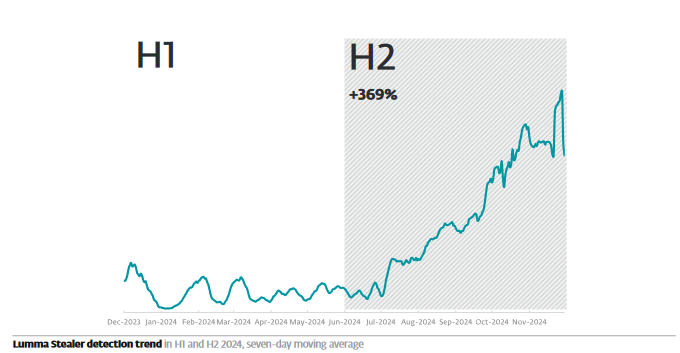
ESET Research is back with a frightening statistic — Detections of Lumma Stealer, an infostealer we previously reported as a threat to gamers, increased 369% between H1 and H2 2024. This is problematic, as infostealers like Lumma continue to plague both consumer and business systems, usually without the knowledge of their owners.

While infostealers are a sneaky lot, they are not without their vulnerabilities — which ESET products can capitalize on, to your security benefit.

Let Lumma tell you a story

Also known as LummaC2 Stealer, this malware-as-a-service mostly targets cryptocurrency wallets, user credentials and two-factor authentication browser extensions, but it also tries to exfiltrate various other data from compromised machines.

What is malware-as-a-service (MaaS)?

Not unlike modern software offers, malware-as-a-service is a business model that provides interested parties with ready-made and instantly deployable malware solutions. Typically offered on underground hacking forums found on the dark web, MaaS operators supply a variety of malware either as a one-time purchase or via a subscription. Ultimately, this easy access enables even those without advanced technical skills to launch cyberattacks, increasing their prevalence.

Lumma Stealer first appeared in August 2022 and is available for sale through a tiered pricing structure on hacking forums and Telegram. The cost ranges from $250 to $20,000, with the most expensive tier letting buyers access the infostealer’s source code — enabling-would-be criminals to act as resellers.

Because Lumma is a ready-made malware solution, it is easier for novice threat actors to share around. Its ease of use and breadth of functions alone make it an attractive choice for would-be attackers — but the fact that it can be spread through multiple vectors, unnoticed, makes it even more useful.

Exploring attack vectors and ESET telemetry

While Lumma Stealer can spread through a variety of distribution vectors, some methods are more clever than others. One particularly sophisticated campaign discovered in October 2024 delivered Lumma Stealer through fake CAPTCHA sites, which, after successful “verification,” delivered the infostealer onto the victim’s device.

Other avenues enabling Lumma Stealer’s spread include cracked installations of popular open-source or paid apps such as ChatGPT or Vegas Pro. The infostealer can also spread via phishing emails or Discord messages, making it more likely to land in the inbox of even the youngest online users.

Did you know?

Message boards like Discord can play a major role in the spread of malicious software and scams. This is due to the way such places act as a kind of digital crossroads for online human activity, making them ripe for abuse. Moreover, threat actors can abuse the content delivery networks of such online/cloud platforms to distribute malware, as well.

ESET also detected a campaign in which the Win/Rozena.ADZ injector delivered Lumma Stealer via compromised videos on online marketplaces and websites with adult content. Likewise, Lumma Stealer was detected in KMS activators for pirated copies of Windows.

Last but not least, in June 2024, ESET Research reported that players of the popular Hamster Kombat mobile clicker game were being targeted, with cryptors containing Lumma Stealer hidden on GitHub repositories in the guise of helpful automation tools for the game.

Just one of many infostealers on the loose

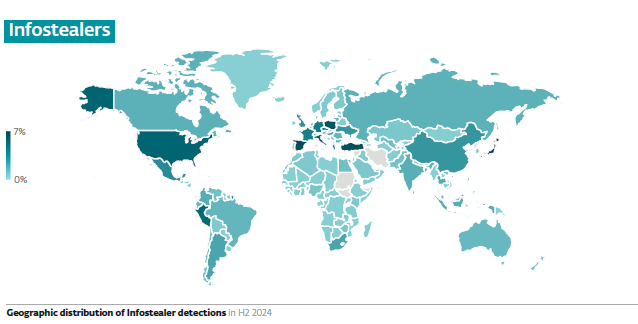
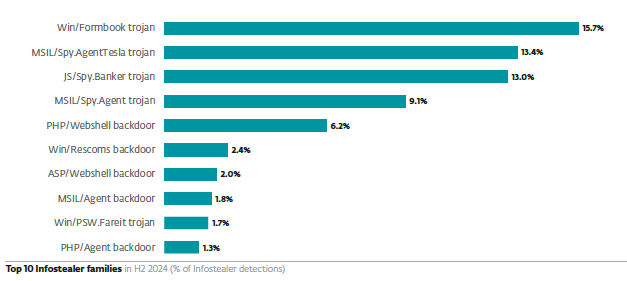
ESET telemetry for H2 2024 registered the highest number of Lumma Stealer attack attempts in Peru, Poland, Spain, Mexico and Slovakia. However, Lumma is not the only infostealer going around, and in general, the top five countries targeted by infostealer attacks in H2 2024 were Japan, Spain, Turkey, Poland and Italy.

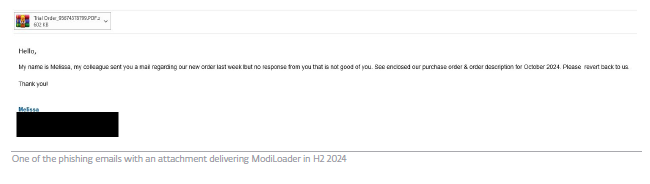
Among other notable infostealers is Formbook, first discovered in 2016 and mainly spread through email phishing. This infostealer collects clipboard data, keystrokes, screenshots and cached browser data, and uses sophisticated obfuscation techniques to prevent deeper analysis. Moreover, it’s been detected as part of large-scale ModiLoader and AceCryptor campaigns in Central and Eastern European states such as Poland, Romania, Czechia and Croatia.

Spy another day

Infostealers are so damaging because being compromised even for a short time can be quite disastrous for both individuals and businesses. Once an infostealer gathers sufficient data to steal someone’s credentials, funds, or identity, that individual can lose funds (crypto or cash), access to personal accounts, and more.   Compromised businesses can experience such costly cyber incidents as network infiltration, data breaches, extortion and ransomware attacks.

Fortunately, there are many ways to prevent infostealers and similar threats from infiltrating our devices:

  • Get endpoint security: The easiest way to prevent most malware from making a mess of our systems is to install an endpoint security solution with real-time protection. ESET Endpoint Security or ESET Home Security offer such a solution, thanks to multilayered ESET LiveSense technology that protects without hindering computer performance.
  • Block: Another good practice is to block popups and ads in browsers, as they can sometimes lead to malware downloads. In addition, consider increasing your browser security and privacy settings, as these restrict how much data can flow between a website/cookies and your in-browser activities/PC. Alternatively, use a secure browser (such as the one contained in ESET security products) for safer banking and browsing.
  • Update: Keep every device updated. Known vulnerabilities are still highly exploited, as people tend to leave their systems unpatched, leading to data breaches and data exfiltration.
  • Verify: Never click on random links or open any attachments that look suspicious, as these can harbor malware. Likewise, try not to download cracked or seemingly “free” software, and opt to use legitimate marketplaces to prevent accidental infostealer attacks.

Lumma looms on the horizon

Threats such as Lumma Stealer don’t distinguish whether the user being victimized is a child, an adult, or a business; they just spread by diverse means and take whatever they can to further malicious agendas. While increasing your awareness of infostealers and how they work is a great first step toward decreasing the chance of a human error-induced compromise, the rising sophistication and presence of infostealers online make it wise to patch up any newly discovered security gaps before they invite bad actors.

So don’t pass up on device security, and be mindful of risks in the digital world, as you can never know what you might encounter.

About ESET
For 30 years, ESET® has been developing industry-leading IT security software and services for businesses and consumers worldwide. With solutions ranging from endpoint security to encryption and two-factor authentication, ESET’s high-performing, easy-to-use products give individuals and businesses the peace of mind to enjoy the full potential of their technology. ESET unobtrusively protects and monitors 24/7, updating defenses in real time to keep users safe and businesses running without interruption. Evolving threats require an evolving IT security company. Backed by R&D facilities worldwide, ESET became the first IT security company to earn 100 Virus Bulletin VB100 awards, identifying every single “in-the-wild” malware without interruption since 2003.

About Version 2 Digital

Version 2 Digital is one of the most dynamic IT companies in Asia. The company distributes a wide range of IT products across various areas including cyber security, cloud, data protection, end points, infrastructures, system monitoring, storage, networking, business productivity and communication products.

Through an extensive network of channels, point of sales, resellers, and partnership companies, Version 2 offers quality products and services which are highly acclaimed in the market. Its customers cover a wide spectrum which include Global 1000 enterprises, regional listed companies, different vertical industries, public utilities, Government, a vast number of successful SMEs, and consumers in various Asian cities.

Throwback to the Target Hack: How It Happened, and Lessons Learned….We Learned Lessons, Right?

The December 2013 Target hack remains one of the most infamous data breaches in cybersecurity history.  The hackers stole 40 million credit card numbers, got the PII (Personal Identifiable Information) of 70 million people, cost Target upwards of $200 million, and ruined Christmas for probably every single person working in Target’s IT department.  The breach not only tarnished Target’s reputation but also impacted several other sectors, highlighting the ripple effects of large-scale cyberattacks. Financial institutions faced increased costs for reissuing millions of compromised cards, while consumers dealt with heightened anxiety over identity theft and fraud. The breach also served as a wake-up call for retailers and businesses worldwide, prompting many to reevaluate their cybersecurity practices and adopt more robust systems to safeguard sensitive data. Ultimately, it underscored the critical importance of proactive cybersecurity measures in an increasingly interconnected world.

What the Hack Happened

The breach began when attackers targeted a third-party vendor that had legitimate access to Target’s network. The vendor, Fazio Mechanical Services, was a Pennsylvania-based HVAC (heating, ventilation, and air conditioning) company that provided maintenance services to Target.

Attackers sent a phishing email to Fazio employees, and one unfortunate soul fell for it. That’s a point that deserves some emphasis – it only takes one person, one click, in one unguarded moment, to give the bad actors a way in.  

The laptop was protected with the free version of Malwarebytes – an excellent tool that scans for and eliminates malware when initiated by the user.  The version you pay for – that actually gets appropriately licensed for corporate use – has a real-time scanner that probably would have caught the issue, because the malware installed, called Citadel, was pretty well-known.

Network Infiltration

Using the stolen credentials from Fazio Mechanical Services, the attackers got access to a Target-hosted web service dedicated to outside vendors.  They uploaded a file that allowed them to install a web shell to execute commands on the hosting server.  Some call this a vulnerability, but there are lots of legitimate reasons a web application would let you upload files – invoices, for example – and while it should ideally block executables, it’s easy enough to disguise them. 

 They used a Pass-the-Hash attack to get domain admin credentials, and then the network was their playground.  They went looking for database servers, and they found them – to the tune of 70 million records of PII (Personally Identifiable Information.)

But here’s a fun fact – know what those databases did not contain?  Credit card numbers!  Because Target’s data was PCI-DSS compliant, there was no financial info stored on their database servers.  

Deployment of Malware & Exfiltration of Data

Having been foiled in their scheme by Target’s PCI-DSS compliance, the hackers moved on to plan B (or what might have been plan A all along, we don’t really know) – infiltrate the PoS (Point-of-Sale) servers and capture credit card data in real-time.  They did this using malware called Kaptoxa, which would scrape the machine’s memory and store anything that looked like a credit card number in a file. Then, the malware would periodically transfer that file to another server, which would transfer it back to the hackers via FTP.  

If you’ve been following along so far, one thing that may have stuck out to you was how the attackers were able to wander through the network, accessing pretty much whatever they pleased.  This is why standard security procedures – like role-based access control and network segmentation, are so important.  

Note: There’s a very thorough deep-dive about the hack here, including all of the tools, protocols, and technology used if you want to geek out.

Target’s Security Posture Before the Breach

You might think that Target had pretty poor security before the breach, but that was surprisingly (and alarmingly) not true.  They had a security team of over 300 employees and had just invested in the well-known security tool FireEye.  This tool actually did send out alerts about the malware, which the security team forwarded on to the operations team….but no one did anything about them.  Not only that, FireEye has a setting that can automatically remove Malware….and they turned it off. The thought was they wanted a human to make decisions about what to remove vs. automated software.  

Lessons Learned

So what are the lessons we can take away from Target?  Let’s review:

Lesson 1: Security can be expensive – but not nearly as expensive as a breach.

Lesson 2: Assume every device outside your organization is compromised, because eventually one will be.

Lesson 3: Regulatory compliance might be difficult, but it is often worth it.

Lesson 3: Pay attention to the security basics.  Role-based access control, least-privileged access and network segmentation are not new concepts, but they are invaluable to minimize damage.  

Lesson 4: Your security tools are essential; invest in them and tailor them to work for you.  Automation is there to make your life easier.  

We’re going on 12 years since this hack happened, and it still serves as a powerful reminder of the critical importance of cybersecurity in today’s digital age.  The Target breach underscored how even a single weak link in a company’s supply chain can have catastrophic consequences, impacting not only the business but also millions of customers. It also paved the way for stricter industry regulations and greater emphasis on safeguarding sensitive data. As cyber threats continue to evolve, the lessons from this breach remain especially relevant.  

About Portnox
Portnox provides simple-to-deploy, operate and maintain network access control, security and visibility solutions. Portnox software can be deployed on-premises, as a cloud-delivered service, or in hybrid mode. It is agentless and vendor-agnostic, allowing organizations to maximize their existing network and cybersecurity investments. Hundreds of enterprises around the world rely on Portnox for network visibility, cybersecurity policy enforcement and regulatory compliance. The company has been recognized for its innovations by Info Security Products Guide, Cyber Security Excellence Awards, IoT Innovator Awards, Computing Security Awards, Best of Interop ITX and Cyber Defense Magazine. Portnox has offices in the U.S., Europe and Asia. For information visit http://www.portnox.com, and follow us on Twitter and LinkedIn.。

About Version 2 Digital

Version 2 Digital is one of the most dynamic IT companies in Asia. The company distributes a wide range of IT products across various areas including cyber security, cloud, data protection, end points, infrastructures, system monitoring, storage, networking, business productivity and communication products.

Through an extensive network of channels, point of sales, resellers, and partnership companies, Version 2 offers quality products and services which are highly acclaimed in the market. Its customers cover a wide spectrum which include Global 1000 enterprises, regional listed companies, different vertical industries, public utilities, Government, a vast number of successful SMEs, and consumers in various Asian cities.

Multi-factor authentication: the ins and outs

What is multi-factor authentication (MFA)?

Multi-factor authentication, also referred to as “multi-step authentication” by some experts, is an access management component that requires users to provide two or more authentication factors to log in and access an account. Essentially, users must provide extra proof of identity besides their username and password. Think of MFA as an extra lock on your door.

Unfortunately, misconceptions about MFA exist: they’re especially prevalent in the business world and often deter users from using it and taking advantage of its security. Organizations tend to think that mandating multi-factor authentication in the IT infrastructure for the entire company is cumbersome and could be counterproductive.

The reality of the matter is actually the opposite: with today’s security technologies, setting up MFA company-wide is quick and causes practically no interruptions. Once it’s done, the benefits that MFA brings to the table far outweigh any possible inconveniences that a company might face during the implementation.

How does MFA work?

Multi-factor authentication employs various technologies, like one-time passwords, tokens, and biometrics, to authenticate users when they try to access their accounts. First, the user enters their username or email and their password. But besides these credentials, and with MFA switched on, the user is also asked to authenticate their identity using their selected secondary verification method. Once the two factors are authenticated, the user is granted access to their account.

One of the most popular MFA factors is known as one-time passwords (OTPs). They’re security codes that can be used only once to authenticate a login attempt. A one-time password is usually 4–8 digits long and can be valid for anywhere between 15 seconds and a few hours. When a user attempts to log in, a one-time password is sent via text message or email for authentication. OTPs can also be generated using an authentication app, like NordPass’ built-in Authenticator.

As you set up multi-factor authentication, your one-time password will be generated in one of two ways: either as a time-based one-time password (TOTP) or a hash-based one-time password (HOTP). Their core difference is how frequently a new code is generated. An authentication app refreshes a TOTP at a set interval (for example, every 30 seconds), while a HOTP only refreshes upon a new login attempt.

One-time passwords rely on two factors—a seed and a moving factor. The seed is a static secret key that stays on the server side, while the moving factor is affected by the counter, which ensures the periodical generation of new passwords. The process of generating a one-time password is randomized, and the number of OTPs that can be generated is practically limitless.

The process of multi-factor authentication takes 3 steps:

  • Registration. You create an account on a website or app and, in addition to your login credentials, select a preferred method of additional authentication. You may use your phone number to receive authentication via text messages, get emails with the code, switch on biometrics, or use an authentication app. The exact method may vary depending on the platform’s permissions.

  • Authentication. As you log in to your account, you enter your login credentials first and are then prompted to enter your multi-factor authentication code. Use your selected means of authentication to access and input the code. Some apps allow you to autofill the code so that you don’t lose it before it resets.

  • Access. If the one-time code you entered matches the server request, your login attempt is authenticated and you can access your account. If you log out, you must start the process over.

how does mfa work

Types of MFA factors

Varying from platform to platform, a number of different factors are used to authenticate login attempts. The most common examples include the following.

What you know (knowledge factor)

The knowledge factor typically consists of a password, PIN, passphrase, or security questions whose answers are known only to the rightful account holder. For the knowledge factor to work correctly, the user must enter the correct information requested by the online application.

What you have (possession factor)

Before smartphones existed as MFA devices, people carried tokens to generate an OTP that would be entered as an authentication factor. These days, smartphones are the primary physical tools for generating OTPs, usually via authenticator apps. However, physical security keys are also available as a possession factor, often considered one of the most secure MFA options.

What you are (inherence factor)

Biometric data, such as fingerprints, facial features, retina scans, voice recognition, or other biometric information, can also be used for multi-factor authentication. Biometric authentication is gaining more traction by the day, as this method is frictionless when compared to other types of authentication.

Where you are (location factor)

Last but not least, location-based authentication checks the user’s IP address and geolocation. Users can whitelist certain geolocations and block others. If the login attempt comes from an unrecognized location, MFA blocks access to the account and vice versa.

inner types of mfa

Why is multi-factor authentication important?

As cybercrime continues to increase in frequency and sophistication, individuals and companies alike look for effective and simple ways to ensure the security of their online accounts. Passwords are no longer enough. In fact, considering how frequently weak passwords are the culprit of breaches and how susceptible to attacks the most common passwords in the world are, additional security measures are not just a recommendation but a necessity. Multi-factor authentication provides that extra layer of security that can make the difference between a secure account and a hacked one.

When bad actors steal passwords and usernames, they can easily gain unauthorized access to accounts and network systems. But with MFA security in place—whether it’s OTP, biometric authentication, or other means—having correct login credentials alone wouldn’t be enough to get into the account. All of that complicates things for attackers, as they would need access to smartphones or other authentication devices related to the user to execute their scheme successfully.

Given that around 68% of data breaches are related to human error in one way or another, adding MFA to your accounts can significantly improve your security. According to the 2024 Elastic Global Threat Report, brute-force techniques grew by 12%. But that’s not all. Security experts and researchers continue to see an increase in phishing attacks, which are usually at the top of the hacking funnel. As cybercrime continues to rise in prominence, MFA is quickly becoming a critical part of everyone’s security, whether it’s an individual or a large organization.

What’s the difference between MFA and two-factor authentication?

As the name suggests, the difference between two-factor authentication (2FA) and multi-factor authentication lies in the number of authentication factors required to authenticate a given user. Two-factor authentication requires exactly two authentication factors, whereas MFA requires two or more factors to work as intended. Essentially, you can think of multi-factor authentication as an umbrella term that includes 2FA as one of the options.

Multi-factor authentication examples

As already mentioned, multi-factor authentication involves two or more authentication factors that identify a given user. These factors include static and one-time passwords, PINs, passphrases, tokens, and biometrics like fingerprint recognition and face ID. By combining a range of these factors, you can build authentication sequences with different levels of security—but any combination can be stronger than using a single factor.

Usually, your login credentials—your username, account number, or email address and your password—are the first step in the authentication process. Once you provide this information, your login attempt is validated. However, if your login details are breached, anyone can use them to log in to the account and pretend to be you. There is no way of guaranteeing the person logging in is actually you, unless the platform checks to see if the IP matches your usual one—but this would fall under location authentication.

To truly prove it’s you logging in, you need to get the second factor in place. This can be a single-use code sent to you by text, the one-time password generated by your authentication app, or a pop-up on your phone requesting you to verify your fingerprint. For improved accessibility, you can also receive an automated call that uses text-to-speech to list the numbers of your verification code.

From here, you can take it up a notch and add another authentication method. For example, you can combine the one-time password with a biometric proof of identity. However, the principle of “less is more” still stands true—introducing too many authentication factors may negatively affect the overall user experience, making the process too burdensome. Imagine using a token as your second layer and biometrics as your third. If you forget or lose either of the two, you’re barred from accessing your account.

MFA benefits

We’re now familiar with the technical side of MFA and how it works to support data protection. Let’s take a minute to see the practical benefits of using multi-factor authentication to protect your personal and work-related credentials.

The number one advantage that MFA brings to the table is, naturally, enhanced security. Multi-factor authentication works hand in hand with strong passwords to ensure more robust account and app security. Switching on MFA makes it harder for bad actors to access accounts or system networks without accessing the authentication device.

While increased security is one of the biggest benefits of multi-factor authentication, it’s far from the only one. MFA can be crucial for regulatory compliance. Many cybersecurity policy guidelines list it as a necessity to meet appropriate data protection standards. For instance, the CIS Password Policy Guide has different standards for accounts that use a password only and those that have MFA mandated. Compliance adherence allows businesses to build stronger trust with customers as it shows they take precautions against cyber threats.

Of course, it cannot be understated that multi-factor authentication is a user-friendly and convenient solution. It may seem contrary at first, as it does require extra steps than just logging in. However, with features like autofill for one-time passwords or biometric authentication, the MFA process can take as little as a tap on the screen. Furthermore, passkeys are a type of multi-factor authentication that reduces login time by eliminating the password step altogether while maintaining a high level of security. They combine biometric verification with cryptographic keys, ensuring no one else can access your accounts without your authentication.

In the long term, setting up multi-factor authentication is a cost-effective strategy for businesses. With the average breach costing small and medium-sized businesses as much as $3.31 million, setting up company-wide MFA policies can help protect your organization’s reputation and stop the threats before they get to your doorstep. Thanks to its range, MFA can help future-proof businesses from emerging threats. For instance, users can opt for biometric authentication over one-time passwords and vice versa.

What types of multi-factor authentication does NordPass Business support?

Multi-factor authentication is tightly knit with password protection and is essential for businesses and individuals alike. So, it’s unsurprising that password managers aim to improve not just your credential storage but the way you handle MFA as well.

NordPass is a secure and intuitive password manager that’s purpose-built to facilitate smooth and secure management of passwords, passkeys, credit card details, and other sensitive information. It offers support for 3 types of multi-factor authentication:

  • An authenticator app

  • A security key

  • Backup codes

NordPass supports major authenticator apps such as Google Authenticator, Microsoft Authenticator, and Authy. However, it makes things easy for you by letting you generate and store your one-time passwords directly in your vault. NordPass Authenticator for Business allows you to set up two-factor codes alongside your passwords, eliminating the need for third-party authentication apps. You can also stay flexible, as NordPass will autofill your one-time passwords for you, whether you’re on your mobile device or desktop browser.

NordPass comes equipped with other security features that help you optimize your business credential security. With features like Password Health and Data Breach Scanner, you can ensure that all credentials used in your organization are strong and secure. Furthermore, you can set up a centralized Password Policy to enforce compliance with high security standards. Try NordPass today and see for yourself how it can help fortify your corporate security.

About NordPass
NordPass is developed by Nord Security, a company leading the global market of cybersecurity products.

The web has become a chaotic space where safety and trust have been compromised by cybercrime and data protection issues. Therefore, our team has a global mission to shape a more trusted and peaceful online future for people everywhere.

About Version 2 Digital

Version 2 Digital is one of the most dynamic IT companies in Asia. The company distributes a wide range of IT products across various areas including cyber security, cloud, data protection, end points, infrastructures, system monitoring, storage, networking, business productivity and communication products.

Through an extensive network of channels, point of sales, resellers, and partnership companies, Version 2 offers quality products and services which are highly acclaimed in the market. Its customers cover a wide spectrum which include Global 1000 enterprises, regional listed companies, different vertical industries, public utilities, Government, a vast number of successful SMEs, and consumers in various Asian cities.

×

Hello!

Click one of our contacts below to chat on WhatsApp

×