Skip to content

Top 5 AI Cyber-Attacks & Threats

Artificial Intelligence (AI) has enabled impressive progress in many fields, but as our reliance on it grows, so does its abuse. As remarkable advancements like ChatGPT, Dall-E, Vall-E, and other AI models reshape our digital landscape, there’s a pressing concern—AI cyber-attacks. Cybersecurity, as we know it, is being challenged, and we need to respond effectively.

AI Cyber-Attacks: A New Battlefield

AI’s potential to revolutionize cyber threats is immense. With AI, hackers can craft human-like text, generate phishing emails, and automate the creation of malicious content. For example, an AI model trained on known vulnerabilities can generate new malware, making it a potent weapon in the hands of cybercriminals.

The threat is not hypothetical; AI’s impact on cybersecurity is here. Hackers can quickly create sophisticated, hard-to-detect attacks. Take, for instance, a phishing email; an AI model can generate convincing emails that can easily dupe the untrained eye. The old telltale signs of a phishing email – poor grammar, awkward language, and misuse of overly formal language – no longer apply. And Vall-E’s ability to imitate someone’s voice adds another layer of deception to phone-based social engineering attacks.

The Rise of AI Ransomware

Recent reports underscore AI’s increasing use in conceptualizing and executing cyberattacks. According to the report, here are the different ways hackers are leveraging AI today:

  • Dataset creation and validation: Assembling and refining data that the AI model learns from, ensuring it’s relevant and high quality.
  • Potency assessment of malware: Evaluating the effectiveness and potential impact of malware, optimizing it for maximum harm.
  • Exploit mapping and malware modification: Using AI to identify system vulnerabilities and tailor malware to target these points.
  • Sandbox evasion testing: Using AI to enhance malware’s ability to evade detection within isolated, controlled environments (sandboxes).
  • Release of AI-modified malware: Unleashing optimized, AI-modified malware to its intended targets, leading to potentially more adaptive and damaging threats.

One notable instance was a variant of Lockbit 3.0 ransomware that was modified using AI. Evidently, hackers are leveraging AI to devise and deploy more sophisticated malware.

The rise of AI cyber-attacks is still nascent, but experts anticipate a surge. Bad actors can deploy AI to identify potential targets, create new malware variants, identify security gaps, schedule automated attacks, and even manage the operation of bot farms.

Top 5 AI Cyber-Attacks & Threats

While hackers can leverage AI for a wide range of cyber-attacks, these are the areas they’re laser-focused on today:

  1. Advanced Persistent Threats (APTs): These long-term attacks use AI to avoid detection and target specific entities.
  2. Deepfake Attacks: AI-generated synthetic media is used to impersonate individuals for fraud or disinformation.
  3. AI-Powered Malware: Self-evolving malware using AI to avoid detection and adapt to changing environments.
  4. Phishing: Using natural language processing and machine learning, attackers craft convincing phishing emails to trick individuals.
  5. DDoS Attacks: Employing AI to identify and exploit network vulnerabilities, magnifying the scale and impact of attacks.

Responding to AI Cyber-Attacks

ChatGPT and other generative AI tools may have simplified cybercrime, but we can counter this rise. It’s crucial to:

  • Understand that malware can now be more sophisticated and harder to detect, thanks to AI.
  • Be vigilant about personalized phishing emails that lack the usual scam signs.
  • Recognize the potential of deep fakes in fraudulent activities.
  • Acknowledge that CAPTCHAs and passwords are no longer impenetrable shields.
  • Be aware of the potential sabotage in ML-based cyber threat detection.

AI cyber-attacks are a stark reality in our digital age. As AI shapes the future of cyber threats, we must adapt and fortify our defenses. Our digital world’s safety hinges on a proactive and informed approach to cybersecurity. It’s a battle, but one we cannot afford to lose.

About Version 2 Digital

Version 2 Digital is one of the most dynamic IT companies in Asia. The company distributes a wide range of IT products across various areas including cyber security, cloud, data protection, end points, infrastructures, system monitoring, storage, networking, business productivity and communication products.

Through an extensive network of channels, point of sales, resellers, and partnership companies, Version 2 offers quality products and services which are highly acclaimed in the market. Its customers cover a wide spectrum which include Global 1000 enterprises, regional listed companies, different vertical industries, public utilities, Government, a vast number of successful SMEs, and consumers in various Asian cities.

About Portnox
Portnox provides simple-to-deploy, operate and maintain network access control, security and visibility solutions. Portnox software can be deployed on-premises, as a cloud-delivered service, or in hybrid mode. It is agentless and vendor-agnostic, allowing organizations to maximize their existing network and cybersecurity investments. Hundreds of enterprises around the world rely on Portnox for network visibility, cybersecurity policy enforcement and regulatory compliance. The company has been recognized for its innovations by Info Security Products Guide, Cyber Security Excellence Awards, IoT Innovator Awards, Computing Security Awards, Best of Interop ITX and Cyber Defense Magazine. Portnox has offices in the U.S., Europe and Asia. For information visit http://www.portnox.com, and follow us on Twitter and LinkedIn.。

How to Prevent IoT from Ruining Your Life

One of the worst things you can go through as a company is a data breach. It costs a small fortune (average of $4.35 million as of 2022), destroys your reputation, often leads to bankruptcy, and takes a massive toll on your employee’s well-being. Thus, preventing a data breach should be top of your to-do list. Today, that means taking a hard look at your connected endpoints – starting with IoT – and making sure you have the necessary tools to keep them from putting you at risk. 

Safety Third for IoT 

IoT (Internet of Things) is loosely defined as devices other than computers and networking equipment that connect to the internet, and these days that is just about everything. There are currently over 13 billion IoT things connected around the globe, with that number projected to grow two-fold to 25.4 billion by 2030.  

The unfortunate reality of these billions of devices is that they are not designed with security at the top of the list…if it’s even on the list. Default administrator passwords, security patches that are slow to be released if at all, and impossible to update firmware are some of the many ways IoT devices make your network vulnerable.  

Behold, IoT Fingerprinting! 

One of the trickiest things about IoT devices is just figuring out that they’re there. IoT devices prioritize ease of setup and use (most of them just connect to the internet and away you go) over best security practices, which makes them an attractive target for hackers. They don’t respond to SNMP, WMI, or other common monitoring protocols, and they typically run locked-down operating systems that don’t allow for additional software like agents. It’s easy for them to hide in plain sight, just waiting to be exploited.

This is where IoT fingerprinting comes in – a good option here is a NAC solution that has the ability to pull information from IoT devices to give you critical information like operating system, manufacturer, and firmware version. There are several ways to get this information with various levels of accuracy – Nmap scanning, DHCP, NetFlow, MAC address look up, etc. Many of these options require additional configurations or features in your network, so it’s important to pick one that will work with what you already have without creating any network latency. 

Staying in Your IoT Lane 

In 2017, a casino was hacked using a fish tank as an entry point. Two buildings in Finland had their heat turned off in November through a DDoS attack on the internet-connected thermostats (and with the average temperature just a bit above freezing, that put some lives at risk.). When security startup Verkada was breached, hackers got access to not only the live camera feeds, but archived security camera footage from Tesla, Equinox, Cloudflare, and others. 

One of the most important ways to protect your networks is making sure they are segmented – the practice of separating your network into different VLANs with limited access to specific resources. This is particularly important for your IoT devices because if they are breached, you don’t want the hackers to be able to move through your network and cause further damage. Ideally you would create a special IoT VLAN that had internet access only, and then use a security tool like a NAC to automatically move all of your IoT devices to that specific VLAN.   

After all, your fish tank probably does not need access to your customer database.  

Spoof Proof IoT 

When it walks like a duck, but barks like a dog…. 

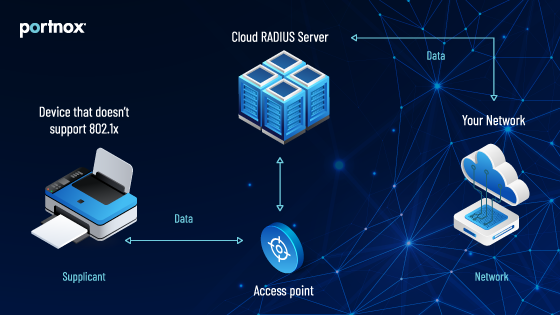
One challenge in adding IoT devices onto your network is the fact they don’t support 802.1x authentication. That means they need to bypass your usual safeguards and get on some other way.  

MAC Authentication Bypass (MAB) is a way for a device to authenticate based on its MAC address, rather than any kind of certificate or identity provider. Essentially, a device connects to a switch or wireless access point and then does not respond to requests for 802.1x authentication (because it can’t). The device then sends a packet containing its MAC address to the switch, which forwards it onto the RADIUS server and determines if it gets access or not.

MAB

Obviously, the issue here is that there is no real authentication happening, so you need something to ensure you’re not just letting every device onto your network. The most common way to do this is to set up a MAC address filter, which your RADIUS server will then use to validate that the device asking for access is allowed, but that’s still not a great solution because MAC addresses can be spoofed. 

Spoofing is, in fact, laughably easy – a quick Google search yields over 6 million how-to results! To prevent a potential bad actor from gaining access, you want to make sure you have a solution that can do some kind of comparison between a device’s past behavior and present behavior so that if a security camera suddenly starts behaving like a laptop, you can remove it from the network. 

If all this seems a bit overwhelming, well, securing IoT can definitely be a big undertaking.  

IoT Device Trust 

Thankfully, there are tools in the zero trust security space that have recognized how important it is to keep these devices secure and can do most of the heavy lifting for you. Portnox combines all of these features – fingerprinting, access control, and secure MAB, into a collection called IoT Device Trust.  These features are key to keeping your network secure no matter how many things live on your internet.  

About Version 2 Digital

Version 2 Digital is one of the most dynamic IT companies in Asia. The company distributes a wide range of IT products across various areas including cyber security, cloud, data protection, end points, infrastructures, system monitoring, storage, networking, business productivity and communication products.

Through an extensive network of channels, point of sales, resellers, and partnership companies, Version 2 offers quality products and services which are highly acclaimed in the market. Its customers cover a wide spectrum which include Global 1000 enterprises, regional listed companies, different vertical industries, public utilities, Government, a vast number of successful SMEs, and consumers in various Asian cities.

About Portnox
Portnox provides simple-to-deploy, operate and maintain network access control, security and visibility solutions. Portnox software can be deployed on-premises, as a cloud-delivered service, or in hybrid mode. It is agentless and vendor-agnostic, allowing organizations to maximize their existing network and cybersecurity investments. Hundreds of enterprises around the world rely on Portnox for network visibility, cybersecurity policy enforcement and regulatory compliance. The company has been recognized for its innovations by Info Security Products Guide, Cyber Security Excellence Awards, IoT Innovator Awards, Computing Security Awards, Best of Interop ITX and Cyber Defense Magazine. Portnox has offices in the U.S., Europe and Asia. For information visit http://www.portnox.com, and follow us on Twitter and LinkedIn.。

Why AI is Key to Ensuring IoT Security in the Digital Age

The Internet of Things (IoT) has become an integral part of our daily lives, from smart homes to connected cars and beyond. However, with the increasing number of connected devices, the risk of security breaches has also grown.

That’s where Artificial Intelligence (AI) comes in, providing a powerful tool for enhancing IoT security. By allowing networks and devices to learn from past decisions, predict future activity, and continuously improve performance and decision-making capabilities, AI unlocks the true potential of IoT. With this in mind, let’s explore the crucial role of AI in securing the IoT landscape and how this convergence of technologies is shaping the future of our connected world.

The Cybersecurity Skills Shortage

According to a 2022 workforce study, the global shortage of skilled cybersecurity professionals has more than doubled since 2019, leaving a gap of 3.4 million professionals. It’s a dire situation and one that’s impacting IoT security significantly.

The shortfall in qualified cybersecurity personnel means that many organizations are struggling to keep pace with the evolving cyber threat landscape and implement adequate security measures to protect their IoT devices. The consequences of this skills gap are profound, with potential security breaches and data theft leaving organizations and individuals exposed to significant risks.

But by converging AI and IoT security, we can reduce the impact of this skills gap. AI can help automate security processes and reduce the burden on human experts, while IoT devices can generate valuable data to train AI models. Over time, these models will become skilled at detecting threats and anomalies and shutting down cyber attacks swiftly.

How Attackers Target IoT Devices

Attackers use various methods to target IoT devices, and understanding these methods is crucial for developing effective cybersecurity strategies. Some common methods include:

  • Initial reconnaissance: Attackers scan the network to identify vulnerable devices they can target.
  • Physical attacks: Attackers can use a variety of physical attacks to disrupt the functionality of IoT devices, like outage attacks which involve shutting off the network that the devices are connected to. Attackers can also damage devices or their components to prevent proper functionality.
  • Man-in-the-middle attacks: Attackers intercept and manipulate data as it is transmitted between devices on a network, giving them access to sensitive information and the ability to control the devices themselves.
  • False data injection attacks: Attackers send malicious data to IoT devices, which can cause them to behave in unexpected ways or compromise their security.
  • Botnets: Attackers can take control of many IoT devices, turning them into powerful tools for launching attacks such as distributed denial of service (DDoS) attacks.

Why IoT Needs AI: Artificial Intelligence and Machine Learning In Cloud Computing

The sheer scale and complexity of the IoT landscape make it challenging to secure, manage, and analyze. Enter AI. AI and the Internet of Things (AIoT) represent a powerful combination that can unlock new levels of performance and efficiency while also addressing some of the most pressing challenges facing IoT.

Cloud computing, as the backbone of IoT, also faces significant challenges in ensuring security. Here are some ways AI/ML can combat emerging cyber threats in cloud computing:

  • Anomaly detection: We can train AI/ML to recognize unusual or unexpected behavior in IoT devices and cloud networks. This helps to detect cyber attacks and breaches before they cause significant damage. For instance, AI/ML can detect unusual network traffic patterns or attempts to access data from unauthorized sources.
  • Malware detection: AI/ML can be trained to identify and classify malware using features such as file size, code structure, and behavior. This can help organizations swiftly detect and remove malware from their cloud computing systems.
  • User behavior analysis: AI/ML can analyze user behavior and detect anomalous activities such as excessive data access, unusual login times, and unusual data transfers. This capability can help organizations identify potential insider threats and prevent data exfiltration.
  • Network segmentation: We can use AI/ML to identify and segment IoT devices based on their level of risk. This approach can help organizations isolate vulnerable devices and limit the spread of malware or cyber-attacks.
  • Automated threat hunting: AI/ML can automatically scan cloud computing systems and identify potential threats, such as new vulnerabilities or suspicious activities. This approach can help organizations stay ahead of emerging threats and prevent them from causing significant damage.
  • Predictive analysis: AI/ML can analyze data from various sources to identify trends and patterns that could indicate a potential attack. Predictive analysis can also help organizations to anticipate threats and develop proactive strategies to prevent them. For example, AI/ML can analyze log files to detect changes in system behavior that may indicate a potential attack.
  • Real-time monitoring: AI/ML can also monitor cloud computing systems in real-time and provide alerts when suspicious activities are detected. This capability allows organizations to respond to cyber threats quickly. For example, AI/ML can monitor login attempts to detect brute-force attacks or attempts to bypass authentication.
  • Automated response: AI/ML can automate the response to cyber threats, such as isolating affected systems or blocking malicious traffic. Automated response enables organizations to respond quickly to cyber threats and limit the damage caused by them. For example, AI/ML can automatically block IP addresses associated with malicious activity.
  • Adaptive security: AI/ML can be used to adapt cloud computing security policies and configurations based on real-time threat intelligence data. This approach can help organizations respond quickly to emerging threats and prevent them from causing significant damage.

The AI/ML Problem

While rapid advancements in AI/ML have led to a new era of highly efficient AIoT devices and bolstered IoT security, they’ve ushered in a new problem. Cybercriminals are also capitalizing on this technology, using it to develop more sophisticated cyberattacks. And this is especially worrying for IoT security, where millions of devices are interconnected, and vulnerabilities in one can compromise the entire system.

Final Thoughts on AI and IoT

AI is an invaluable tool in enhancing cybersecurity in an increasingly hostile IoT cyber threat landscape. By leveraging AI and IoT together, we can identify threats, detect anomalies, and respond to attacks in real-time. This allows us to stay one step ahead of the cybercriminals.

About Version 2 Digital

Version 2 Digital is one of the most dynamic IT companies in Asia. The company distributes a wide range of IT products across various areas including cyber security, cloud, data protection, end points, infrastructures, system monitoring, storage, networking, business productivity and communication products.

Through an extensive network of channels, point of sales, resellers, and partnership companies, Version 2 offers quality products and services which are highly acclaimed in the market. Its customers cover a wide spectrum which include Global 1000 enterprises, regional listed companies, different vertical industries, public utilities, Government, a vast number of successful SMEs, and consumers in various Asian cities.

About Portnox
Portnox provides simple-to-deploy, operate and maintain network access control, security and visibility solutions. Portnox software can be deployed on-premises, as a cloud-delivered service, or in hybrid mode. It is agentless and vendor-agnostic, allowing organizations to maximize their existing network and cybersecurity investments. Hundreds of enterprises around the world rely on Portnox for network visibility, cybersecurity policy enforcement and regulatory compliance. The company has been recognized for its innovations by Info Security Products Guide, Cyber Security Excellence Awards, IoT Innovator Awards, Computing Security Awards, Best of Interop ITX and Cyber Defense Magazine. Portnox has offices in the U.S., Europe and Asia. For information visit http://www.portnox.com, and follow us on Twitter and LinkedIn.。

Breaking Down Ransomware’s Preferred Pathways: Top Attack Vectors

In the rising tide of cyber threats, one word persistently echoes across corporate networks and personal devices: ransomware. This breed of malicious software employs an array of cyber attack vectors to infiltrate systems, encrypt data, and demand a ransom to restore access—a tactic proving both lucrative and devastating for those in its crosshairs.

Critically, ransomware attacks are far from random occurrences; they are strategic, exploiting weaknesses within a target’s cyber defenses with precision. And they’re evolving. The year 2022, for example, saw a significant shift in the patterns of successful ransomware attacks, as depicted in Kaspersky’s report, “The Nature of Cyber Incidents.” The primary vector in these attacks was the exploitation of public-facing applications, which constituted a staggering 43% of all breaches. Not far behind, compromised accounts accounted for 24% (up from 18% in 2021), while malicious email took the third spot at 12% .

An attack vector is a path or method used by hackers to infiltrate a network, often to deliver malicious software or exploit system vulnerabilities. And by identifying common attack vectors, we can strengthen these areas, proactively respond to threats, and bolster our overall digital defenses. Simply put, understanding attack vectors is our first line of defense against cyber attacks. With this in mind, let’s dive into the top attack vectors for ransomware attacks.

I. Malware

Malware, encapsulating a myriad of malicious software types, often serves as the delivery vehicle for ransomware attacks. Ransomware is a type of malware that infiltrates systems, often via spear-phishing emails containing infected attachments or links to compromised sites. These attacks cleverly disguise malware as a legitimate file, tricking victims into enabling the encryption of their own files.

Once executed, this malware encrypts user data, rendering it inaccessible. The attacker then demands a ransom, typically in cryptocurrency, to decrypt the data. Unfortunately, even payment doesn’t guarantee data restoration. Therefore, robust security measures, such as updating and patching software, using secure backup solutions, and user education on phishing tactics, are crucial for defense against this pernicious attack vector.

II. Email Attachments

Email attachments are alarmingly potent weapons in a cyber criminal’s arsenal. With a veil of trust, attackers execute sophisticated phishing strategies, puppeteering the identities of people or institutions you know. The deceptive payload? A seemingly innocent attachment or a covert link. One click and the ransomware is unleashed, infecting your system and holding your data hostage.

III. Web Pages

Web pages serve as an insidious cyber attack vector, often overlooked in the landscape of ransomware threats. Imagine this scenario: you’re navigating a trusted website when, silently, a compromised element or embedded malicious script springs into action. Exploiting browser vulnerabilities, these concealed threats facilitate ransomware installation onto your system. Suddenly, your data is encrypted and held hostage until you pay the ransom. More disturbingly, these hazardous scripts can exploit even legitimate websites, transforming them into launch pads for ransomware attacks.

IV. Pop-ups

We’ve all seen them, the intrusive boxes appearing when we’re surfing the web or downloading software. Sites teeming with ads, free software platforms, or even compromised legitimate websites can harbor malicious pop-ups. Seemingly benign actions—like confirming a download or software update—can release ransomware.

V. Instant Messages

Instant messaging platforms, from WhatsApp and Facebook Messenger to Slack and Teams in the corporate world, have become potent conduits for ransomware attacks. Cybercriminals insert malicious links or compromised files into an otherwise casual chat. One misplaced click and ransomware deploys, swiftly encrypting files. The perceived safety within these platforms makes this attack vector particularly successful. The takeaway: treat every message, even from known contacts, with skepticism. Ransomware, hidden in plain sight, can strike anywhere.

VI. Text Messages

Your mobile phone isn’t immune from ransomware threats. Cybercriminals have turned text messages into a cyber-attack vector. Posing as banks, service providers, or even government bodies, they send deceptive messages with malicious links or infected downloads. Unfortunately, our propensity to respond quickly to texts makes this strategy dangerously effective.

VII. Social Engineering

The most alarming ransomware attack vector isn’t technical—it’s psychological. Through social engineering, hackers exploit human vulnerabilities. For example, they might impersonate a coworker by email, a tech support agent on the phone, or even a trusted institution via an official-looking letter. Their goal is to trick you into granting them access, bypassing security systems. Then, ransomware strikes, locking you out of your own system.

Other Common Ransomware Attack Vectors

We’ve covered the primary attack vectors, but others exist too:

  1. Remote Desktop Protocol (RDP): RDP is a popular method for administrators to access and manage systems remotely. If improperly secured, RDP can serve as an attack vector. Cybercriminals, exploiting weak passwords or known vulnerabilities, can gain access and deploy ransomware.
  2. Software Vulnerabilities: Outdated or unpatched software often has known security flaws that ransomware can exploit. These vulnerabilities serve as an entry point for attacks. Regular software updates and patches are crucial to mitigate this risk.
  3. Malvertising: This method involves injecting malicious code into legitimate online advertising networks. When users click on these ads, the ransomware is downloaded onto their system.
  4. Drive-by Downloads: Here, ransomware is automatically downloaded when a user visits a compromised website, even without any interaction. This attack vector often exploits browser and plugin vulnerabilities.
  5. Physical Access or Insider Threats: If a malicious actor gains physical access to a device or system, they can directly install ransomware. For example, they can do this through tampered USB drives or by an insider with legitimate access but malicious intent.
  6. Supply Chain Attacks: In these attacks, the target isn’t the end-user but a software provider. By infiltrating the software development or update process, attackers can simultaneously deliver ransomware to multiple users when they install the compromised software or update.

Final Thoughts

Understanding ransomware attack vectors is crucial in today’s digital landscape. With ransomware evolving into a sophisticated cyber weapon, no platform or communication method is immune. From pop-ups and instant messages to exploiting software vulnerabilities, cybercriminals have a diverse arsenal to deliver their crippling payloads. The ransomware threat underscores the urgent need for constant vigilance, robust security protocols, and ongoing education. As we embrace the digital era, our awareness and readiness to combat such threats will define the safety of our data and the integrity of our digital identities.

About Version 2 Digital

Version 2 Digital is one of the most dynamic IT companies in Asia. The company distributes a wide range of IT products across various areas including cyber security, cloud, data protection, end points, infrastructures, system monitoring, storage, networking, business productivity and communication products.

Through an extensive network of channels, point of sales, resellers, and partnership companies, Version 2 offers quality products and services which are highly acclaimed in the market. Its customers cover a wide spectrum which include Global 1000 enterprises, regional listed companies, different vertical industries, public utilities, Government, a vast number of successful SMEs, and consumers in various Asian cities.

About Portnox
Portnox provides simple-to-deploy, operate and maintain network access control, security and visibility solutions. Portnox software can be deployed on-premises, as a cloud-delivered service, or in hybrid mode. It is agentless and vendor-agnostic, allowing organizations to maximize their existing network and cybersecurity investments. Hundreds of enterprises around the world rely on Portnox for network visibility, cybersecurity policy enforcement and regulatory compliance. The company has been recognized for its innovations by Info Security Products Guide, Cyber Security Excellence Awards, IoT Innovator Awards, Computing Security Awards, Best of Interop ITX and Cyber Defense Magazine. Portnox has offices in the U.S., Europe and Asia. For information visit http://www.portnox.com, and follow us on Twitter and LinkedIn.。

Your Company’s Cyber Insurance Coverage is Making It a Target

The sharp spike in ransomware attacks has increasingly turned cybersecurity insurance coverage from an optional add-on into an essential safeguard for businesses. Yet, a dark trend is emerging: the safety net of insurance may paradoxically mark you out as prey for cybercriminals.

Cyber attacks are becoming more frequent, sophisticated, and severe. According to one report, 70% of businesses fell victim to ransomware attacks in 2022. Moreover, phishing attacks rose by 48% in the first half of the same year, with reports of 11,395 incidents costing businesses $12.3 million.

And in an increasingly dangerous cyber threat landscape, it’s easy to see why cyber insurance is becoming an increasingly attractive prospect for businesses worldwide. But Is cybersecurity insurance really securing your business, or is it setting you up to become the next target in the fast-paced, relentless world of cyber warfare? Let’s get into it.

Cyber Insurance Adoption is Surging

The global market for cybersecurity insurance is surging. It stood at $7.60 billion in 2021 but is expected to grow to a whopping $20.43 billion by 2027.

As businesses become increasingly digital, they inevitably grow more vulnerable to cyber threats. This escalating risk has led to a boom in the demand for cyber insurance. A key reason for this surge is the financial protection it offers. When a cyber-attack strikes, a company faces a multitude of costs ranging from ransom payments to data recovery, crisis management, and even lawsuits from customers or partners.

The benefits of cyber insurance extend far beyond a simple payout. Companies benefit from the insurers’ wealth of knowledge about cyber risk management, which helps craft robust cyber risk mitigation strategies. Furthermore, in the aftermath of a breach, insurance providers often offer expert resources to mitigate the fallout. This includes PR consultants to manage potential reputational damage, forensic teams to identify security loopholes and legal counsel for possible regulatory penalties. For many companies, the ability to access these resources swiftly and efficiently is invaluable, making cyber insurance coverage an increasingly attractive investment

Companies with Cyber Insurance Become Targets

According to a survey by Barracuda Networks, 77% of organizations with cyber insurance were hit at least once, compared to 65% of organizations without insurance. And more worryingly, of the companies that had cyber insurance, 39% paid the ransom.

The report also highlighted other worrying trends – like the fact that insured companies were 70% more likely to be hit with ransomware attacks multiple times.

Why Do Cybercriminals Target Companies with Cyber Insurance Coverage?

  • Increased visibility: Companies with cyber insurance often advertise it as a selling point or include it in their public disclosures. This increased visibility can attract cybercriminals who specifically target companies with cyber insurance, knowing that they might have valuable assets.
  • Perceived financial resources: Cybercriminals may assume that companies with cyber insurance have sufficient financial resources to pay for potential losses or to cover ransom demands. This perception can make them more likely to target these companies in the hopes of securing a larger payout.
  • Inadequate security measures: Some companies may view cyber insurance as a substitute for implementing robust cybersecurity measures. They might become complacent, assuming that their insurance coverage will mitigate any potential damages. This attitude can lead to insufficient investments in security measures, making these companies easier targets for cybercriminals.
  • Potential for higher payouts: Cyber insurance policies typically cover financial losses resulting from cyberattacks. Cybercriminals are aware of this and may specifically target companies with insurance coverage, hoping to inflict significant damages that will result in larger insurance claims and potentially higher payouts.
  • Delayed detection and response: Some companies with cyber insurance may prioritize filing an insurance claim over immediate detection and response to a cyber incident. Cybercriminals can exploit this window of opportunity, knowing that it might take longer for the targeted company to identify the breach and take appropriate action, giving them more time to carry out their malicious activities undetected.

Is There More to the Story?

Barracuda’s report paints a worrying picture, and understandably, companies considering cyber insurance may now feel more reluctant to go ahead. However, the situation is more complex.

For example, cyber insurance coverage has proven to offer several benefits to companies, not just in terms of recovering financial losses and repairing reputations but also in bolstering security. For example, many cyber insurers now require that their clients meet minimum security requirements. These include enabling MFA, having antivirus and malware detection software, a robust firewall, and an endpoint detection and response (EDR) tool. Insurers also often mandate that clients have secure and resilient backups.

These security measures encouraged (or demanded) by cyber insurers help reduce the likelihood of an attack and reduce the probability of victims paying the ransom. For example, if you have regular secure, resilient backups, you can recover the data yourself.

What Can Companies Do?

Beyond choosing to get cyber insurance or not, there are several things companies can do to safeguard their networks from ransomware attacks.

  • Prioritize cybersecurity investments: Companies should allocate sufficient resources to implement robust cybersecurity measures, including regular security assessments, network monitoring, threat intelligence, and employee training.
  • Develop a comprehensive cybersecurity strategy: Companies should create a well-defined cybersecurity strategy that addresses potential vulnerabilities, establishes incident response protocols, and emphasizes continuous improvement and adaptation to evolving threats.
  • Implement multi-layered defense: Deploy a combination of preventive, detective, and responsive security measures, such as firewalls, intrusion detection systems, encryption, endpoint protection, and strong access controls, to create multiple layers of defense against cyber threats.
  • Conduct regular security assessments: Perform regular vulnerability assessments and penetration tests to identify and address weaknesses in the company’s infrastructure, applications, and security controls.
  • Implement strict access controls: Limit user privileges and implement robust authentication mechanisms, such as two-factor authentication, to prevent unauthorized access to sensitive systems and data.
  • Establish incident response plans: Develop and regularly test incident response plans to ensure that the company can effectively detect, respond to, and recover from cyber incidents, minimizing potential damages.

Final Thoughts

While possessing cyber insurance coverage can inadvertently attract cybercriminal attention, companies can mitigate this risk by adopting a proactive cybersecurity approach. By investing in robust security measures, promoting employee awareness, and maintaining a solid cyber defense strategy, companies can safeguard their digital assets and reduce the likelihood of becoming targets for cyberattacks, regardless of their insurance coverage.

About Version 2 Digital

Version 2 Digital is one of the most dynamic IT companies in Asia. The company distributes a wide range of IT products across various areas including cyber security, cloud, data protection, end points, infrastructures, system monitoring, storage, networking, business productivity and communication products.

Through an extensive network of channels, point of sales, resellers, and partnership companies, Version 2 offers quality products and services which are highly acclaimed in the market. Its customers cover a wide spectrum which include Global 1000 enterprises, regional listed companies, different vertical industries, public utilities, Government, a vast number of successful SMEs, and consumers in various Asian cities.

About Portnox
Portnox provides simple-to-deploy, operate and maintain network access control, security and visibility solutions. Portnox software can be deployed on-premises, as a cloud-delivered service, or in hybrid mode. It is agentless and vendor-agnostic, allowing organizations to maximize their existing network and cybersecurity investments. Hundreds of enterprises around the world rely on Portnox for network visibility, cybersecurity policy enforcement and regulatory compliance. The company has been recognized for its innovations by Info Security Products Guide, Cyber Security Excellence Awards, IoT Innovator Awards, Computing Security Awards, Best of Interop ITX and Cyber Defense Magazine. Portnox has offices in the U.S., Europe and Asia. For information visit http://www.portnox.com, and follow us on Twitter and LinkedIn.。

×

Hello!

Click one of our contacts below to chat on WhatsApp

×