Skip to content

Enabling all ways of working with BYOD

Companies have the most varying takes on protecting their assets and teams. Some businesses have strict internal policies like allowing wire-only peripherals, and others force computer shutdown at the end of the working day.

However, rigid restrictions are challenging to keep up with and follow if not monitored closely, especially in hybrid environments. Remote workers, freelancers, teams on different sites, and mobile employees like consultants and salespeople extend a single-location office’s borders.

The fast pace of businesses and information flow often requires being present and removing any obstacles that disconnect employees from being out of reach. It brings us to people using their own devices in the workplace and its extended modern version.

Should organizations encourage using other than corporate-issued endpoints? And how can you manage the risks that come with them? This article will look closely into securing flexible setups of all ways of working.

Focus definitions

  • Bring Your Own Device (BYOD) is an organizational policy allowing employees to work or access corporate data and applications using or linking personal devices like computers and/or smartphones.

  • Deep Packet Inspection (DPI) is a packet filtering feature that examines data pieces against admin-defined security policies and forbidden keywords to block the information from entering the network.

BYOD in the workplace

In the modern world, incorporating employee-owned devices into the company’s technological ecosystem often rolls out with the daily operations flow. The growing tech literacy and availability influence the use of personal devices at work.

Some organizations have an unwritten rule that employees must be within reach after working hours, even though it’s not included in their job description. Or how can you quickly solve a situation when you must join a work meeting, but a corporate-issued PC just started a mandatory OS update?

Real-life situations normalize personal phones or laptops for daily or occasional use. Yet, it allows companies to save expenses for supplying extra cell phones to the staff. And the workforce is already familiar with personal phones and laptops, which allows for skipping training and adjustment periods without affecting productivity.

The BYOD strategy relieves employees from owning +1 or more devices that aren’t necessary and turns into gadget pollution. Besides, employee-owned devices are more likely to be in use and thus up to date. 

Data insights: BYOD policy adoption

According to BYOD Security Report 2022, the vast majority — 82% of organizations have a policy that allows staff to use their own devices, at least to some extent. Although BYOD is mainly considered an employee-related topic, contractors, partners, customers, and suppliers also can become unmanaged-device sources to the organization.
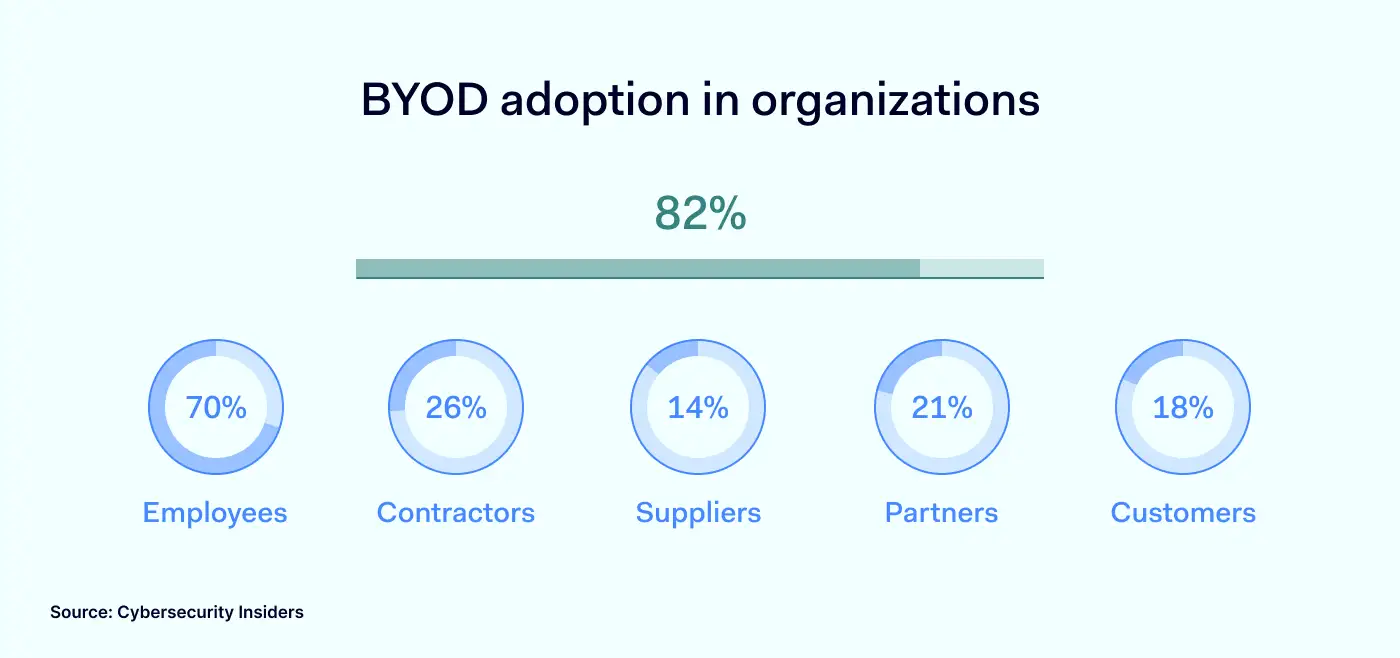
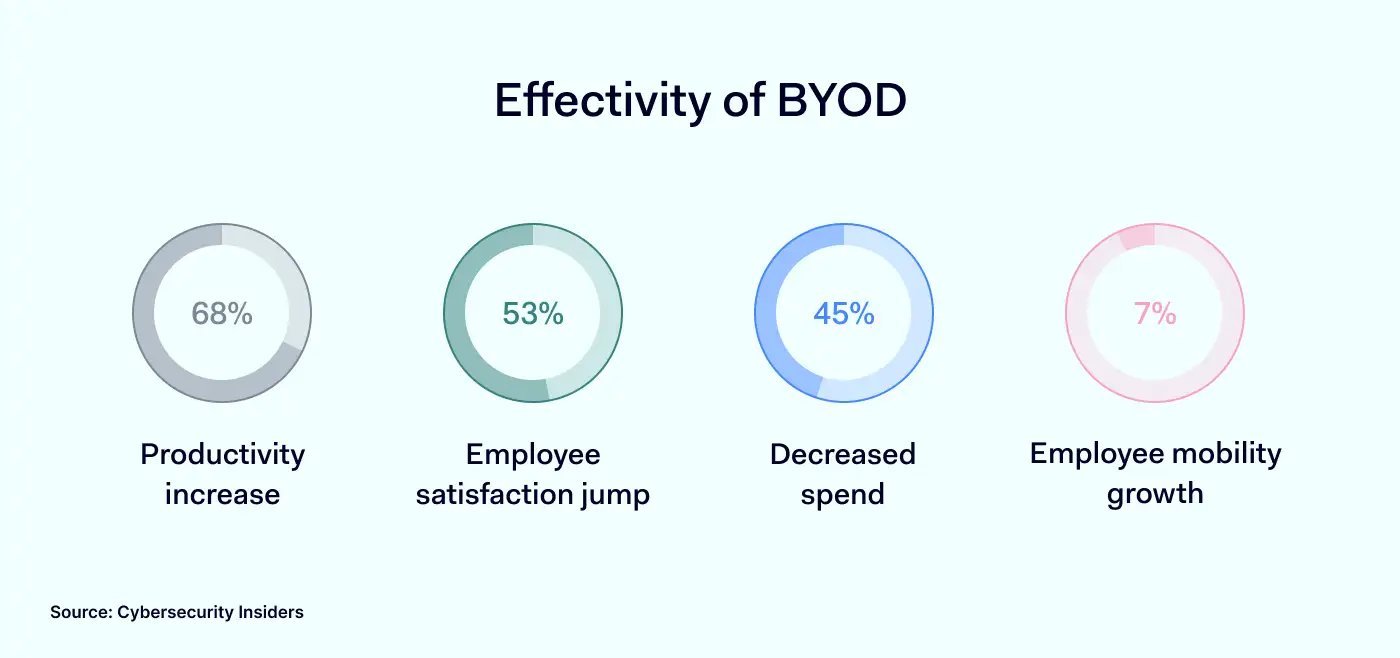
BYOD adoption in organizations 1400x658Companies with a BYOD strategy record major benefits for organizations and the workforce. Employees using their own devices at work are more satisfied as they aren’t attached to an additional piece of technology that needs to be mastered. It boosts productivity and flexibility with a cost-saving approach.

Effectivity of BYOD 1400x658However, convenience has its price. BYOD policy in an organization exposes it to a broader spectrum of risks. An employee manages non-company-issued devices, thus, contents and activity are much more challenging to supervise. 

Risks of BYOD

The idea behind the bring your own device is to incorporate unmanaged user devices into the company network as supportive work tools. Technically, it becomes a security gap as such endpoints aren’t supervised if no security measures are enforced. To what risks do pre-owned user devices expose the organization?

Unknown end-user

A personal device doesn’t mean it is completely accessed only by its owner. If no lock pattern exists, family members, friends, or anyone can use the endpoint, which easily can lead to a data breach or leak. 

Device loss

Taking your laptop or phone outside the office increases the risk of lost or stolen devices. Any hardware containing business-sensitive information compromises data security as it can be extracted or accessed with little effort.

Non-trusted apps and networks

Individual devices mean personal activities. Work-related apps, communication channels, and email accounts mix with entertainment software (at times consisting of surveillance or malicious elements), streaming services, free-roam browsing, and potential for phishing attacks. 

Security features to support BYOD

Preventive measures like single sign-on or multi-factor authentication, network segmentation, and rooted-device detection help manage various risks of BYOD.

Integration of a solution to block external threats makes internet browsing safer for users with pre-owned endpoints. NordLayer’s ThreatBlock feature enriches DNS filtering by screening connection inquiries against libraries of malicious sites and blocklisting them from visiting.

Besides only focusing on protecting the device, encryption of communication channels is a strong addition to BYOD strategy enforcement. Modern AES 256-bit encryption used in internet protocols like NordLynx encodes traveling data. It ensures the confidentiality of sensitive business information when connected to untrusted networks.

Another way to ensure device compliance with organizational security policies is to enable auto-connection to the company’s Virtual Private Network (VPN) once an internet connection is detected and use always-on VPN features. Automatization minimizes the human error vulnerability so users can’t ‘forget’ to switch their devices to the required gateway when accessing company resources.

Let’s shift from the n+1 possible strategies of enabling BYOD policy and, this time, dig deeper into one of the most prominent security functionalities – Deep Packet Inspection (DPI) – that controls what’s entering the company network despite the source of the endpoint.

What is DPI?

Deep Packet Inspection helps protect the company network by filtering out harmful or unwanted sites and applications. It scans data packets of traveling information against flagged keywords and website categories. Unlike DNS filtering, which filters only website data, DPI goes above browser-level restrictions and inspects data on the applications and device levels.

DPI processes packet filtering that may contain malicious elements leading to intrusions and viruses. Alternatively, it allows blocking out sources incompatible with work productivity, like gaming or streaming sites.

In short, the feature serves network management by controlling what ports and protocols employees can access while connected to the company gateways, effectively securing the devices as DPI inspects not only the headers but also the contents of data packets.

How does DPI enable the flexibility of BYOD policy?

In the post-pandemic era, companies are calibrating which approach – remote or on-site – works best for their organizational culture. Ultimately it shows a clear tendency for the application of hybrid work variations. Meaning the BYOD policy is implicit in such companies.

Securing remote workforces

Physical distance is the main attribute of remote work. Traveling and remote employees and freelancers are the driving force for implementing the BYOD policy since acquiring hands-on staff is easier and cheaper.

Removing the office-based restrictions of a controlled network prevents IT administrators from actively monitoring the company infrastructure within a contained perimeter. In this case, the security focus can shift from the actor to the conditions of the environment they operate in.

DPI is based on a set of rules that admins impose collectively for the whole organization or teams and selected users. They can define restrictions on what content can’t enter the company network while connected to the organization gateway.

Blocking specific ports and protocols aid security strategy by stopping:

  • Downloading file-sharing applications 

  • Accessing malicious websites that may inject malware

  • Falling victim to a man-in-a-middle attack while connected to public wifi

  • Entering links with phishing attempts

  • Installing shadow add-ons and software

  • (Un)voluntary data leaking

Office security enhancement

It is easier to manage on-premise work until it turns to online browsing. Dozens of open tabs, links, and distractions on the internet require additional precautions to improve productivity within the office borders.

DPI solution enables IT administrators to manage access to online resources that tend to impact employee effectiveness daily.

First, an organization can simply deny access to streaming, gaming, and secondary websites unrelated to performing job tasks. Less Youtube, Twitch, or Netflix streaming in the background, more focus on performance quality.

Secondly, unnecessary internet traffic slows down the bandwidth within the office. Slow connections disrupt the intended workflow, put pressure on infrastructure, and result in poor user experience. DPI feature allows IT admins to eliminate traffic overload on the company network. 

Enabling secure BYOD with NordLayer

NordLayer introduced Deep Packet Inspection (Lite) security feature focusing on the most tangible organization pain points with hybrid setups. Security and productivity are the priorities of a business; thus, DPI Lite seals the security vulnerabilities, whether you try managing globally spread teams and freelancers or unlocking workforce performance. 

NordLayer’s DPI Lite is one of the many security layers that, combined with other network management features like DNS filtering and IAM integrations, solidify any cybersecurity approach — and help you find the most straightforward way to improve your organizational security.

About Version 2 Digital

Version 2 Digital is one of the most dynamic IT companies in Asia. The company distributes a wide range of IT products across various areas including cyber security, cloud, data protection, end points, infrastructures, system monitoring, storage, networking, business productivity and communication products.

Through an extensive network of channels, point of sales, resellers, and partnership companies, Version 2 offers quality products and services which are highly acclaimed in the market. Its customers cover a wide spectrum which include Global 1000 enterprises, regional listed companies, different vertical industries, public utilities, Government, a vast number of successful SMEs, and consumers in various Asian cities.

About NordLayer
NordLayer is an adaptive network access security solution for modern businesses – from the world’s most trusted cybersecurity brand, Nord Security.

The web has become a chaotic space where safety and trust have been compromised by cybercrime and data protection issues. Therefore, our team has a global mission to shape a more trusted and peaceful online future for people everywhere.

Small business cybersecurity: the importance of proactive safety measures

Small businesses are on the front line of cybersecurity. At any moment, cyberattacks could extract confidential data, damage network infrastructure, or even cause total business failure.

The risks are real. According to Verizon, 60% of small businesses that suffer cyber attacks go out of business within 6 months. Healthcare company Wood Ranch Medical is a great example. The small operator was bankrupted by a 2019 ransomware attack that prevented access to sensitive patient records.

Despite cases like Wood Ranch Medical, most small businesses fail to allocate enough time and resources to counter cyber-threats.

Don’t fall into that trap. Instead, follow this guide to implement robust cybersecurity measures. With our help, you can counter the most dangerous cyber threats faced by SMBs. Let’s find out more.

Understanding the threat landscape for SMBs

The first thing to understand is that small businesses face a diverse range of cyber threats. Any one of them could ruin your reputation and lead to regulatory fines.

Attackers can lurk for months and monitor traffic. They can steal sensitive client data or lock it away until victims pay a ransom. Or they could cause technical damage, ruining network infrastructure.

SMBs can’t afford these consequences. But how do you handle critical cybersecurity threats?

Prevention starts from awareness of the most common threats and how they fit into cybersecurity for small businesses.

Types of cyber attacks

Here’s a list of the most common types of online threats.

All of them threaten small businesses.

1. Phishing

Phishers use social engineering techniques to fool small business employees. With a few pieces of information, attackers can easily convince time-poor workers to make dangerous decisions. This might involve emails pretending to come from colleagues or trusted third parties. The links in these emails lead to malicious sites or initiate malware downloads.

2. Ransomware

Ransomware locks down high-value data and demands a ransom from targets. If attackers control these targets, they can demand a high price to restore access. And small businesses are not always able to pay.

3. Spyware

Spyware tracks data flowing through network assets and sends this information to controllers outside the targeted organization. Some spyware is legitimate. For instance, advertisers sometimes use it to deliver targeted ads. But the majority of spyware is malicious and linked to data extraction.

4. Viruses

Viruses spread between devices and their effects range from relatively light disruption to complete system failure. Some viruses remain dormant for long periods. Others set to work immediately. In all cases, small businesses need updated and effective antivirus software to defend their perimeter.

5. Malware

Malware extends beyond ransomware and spyware. For example, businesses might encounter trojans or worms that stay below the radar until activated. Bots are also common. These agents latch onto devices and create “swarms” to launch wide-scale attacks.

6. Man-in-the-middle attacks

Man-in-the-middle attacks target insecure wifi connections. Attackers can intervene between remote access workers and the corporate network. If the connection is unencrypted, hackers can harvest information from corporate network traffic and steal confidential data.

7. SQL injection

SQL injection uses SQL code to request access to valuable databases. This generally occurs via web forms connected to SQL databases. For small businesses, this could include employee gateways or payment forms. Securing web assets is absolutely essential.

8. DDoS attacks

Distributed denial-of-service attacks involve botnets featuring hundreds or thousands of agents. Botnets direct massive amounts of traffic at their target with the aim of overwhelming networks. Larger organizations may have the resources to absorb DDoS floods. But with attacks averaging 5.17 Gbps, small business websites can easily fold under the pressure.

9. Zero-day exploits

Zero-day exploits target recently documented software vulnerabilities. In these situations, vendors probably haven’t developed patches, exposing users to opportunist attackers. Small businesses rely on anti-virus, communications, and data management tools in everyday work. But any of these tools can become vulnerable overnight.

10. DNS tunneling

DNS tunneling injects malicious code into networks via DNS queries. This allows hackers to seize control of local DNS servers. When that happens, a small business can lose control of its website and network assets. DNS tunneling exploits insecure firewalls, but SMBs often retain legacy firewall products. That’s a bad idea when successful attacks can ruin reputations in seconds.

11. XSS attacks

XSS (or Cross Site Scripting) injects malicious code via web applications and browser-side scripts. XSS attacks allow attackers to change website designs, adding undesirable content. They can launch malicious software, infecting business networks and customer devices. It allows hackers to spoof legitimate identities by hijacking cookies. All of that is bad news for SMBs.

Cybersecurity best practices for small businesses

Small businesses need cybersecurity strategies that deal with critical threats. But how can you implement an effective strategy with a small business budget?

SMBs lack the resources of corporations. But cybersecurity for small businesses must still protect sensitive data and network resources. Here are some best practices to follow that balance cost and efficiency.

1. Implement a strong password policy

Employees should only use strong passwords to log into your company network. Weak passwords are easy to guess or brute force. This makes mounting attacks much simpler.

Require employees to use 10-15 character passwords. Demand a mixture of upper and lower case letters, numbers, and symbols. Enterprise-wide password management tools can help. They make storing and changing passwords easier, eliminating much of the risk of human error.

Combining password hygiene with anti-virus software and firewall protection is also good practice. That way, you can filter potential threats and authenticate users effectively.

2. Schedule regular backups

Cyber-attacks can lead to the deletion of data or system failures that compromise important workflows. This makes it vital to back up high-priority data regularly. Use secure cloud services or external locations away from your core network.

3. Train employees in cybersecurity basics

Digital cybersecurity controls rely upon human knowledge and behavior. The way employees act when encountering cyber threats is a crucial part of a small business security setup. That’s why it’s vital to focus on what is known as the human firewall.

Strengthen the human firewall by training employees to spot phishing emails and malicious links. They must know the company password and access management policies. Remote workers should also understand how to connect securely, as well as the risks of using an insecure public wi-fi network.

4. Use threat prevention measures to reduce cyber attack risks

Minimize cyber security risks by adding antivirus software and malware scanning tools to your network traffic. Use VPNs to encrypt data and anonymize user IP addresses. Create allowlists to screen user identities, admitting only authorized addresses.

Take action to secure your local network as well. You may need to upgrade your wifi network from WEP to WPA2. Check that your router SSID is anonymized and consider upgrading your firewall to add features like Deep Packet Inspection.

5. Implement protection for sensitive information

Encrypt high-value data like personnel records and customer financial information. If you rely on SaaS or PaaS tools, use any cloud data protection tools provided by your Cloud Service Provider.

Use privileges management to limit freedom within network boundaries. Confidential data should only be available to users who need it in their working tasks. That way, when a data breach occurs, attackers will struggle to access and extract data.

Minimize the number of users with administrative privileges. Avoid giving single users the power to make fundamental network changes.

Consider using Data Loss Prevention tools as well. These tools track the location and state of important data. They block data transfers to unauthorized devices and log potentially dangerous access requests. If you handle high-risk, high-value data, DLP could be a sound investment.

6. Create an Incident Response Plan

Small businesses must prepare for cybersecurity incidents. Aim to restore normal working conditions as soon as possible while protecting data and neutralizing active threats.

Carry out a risk assessment for the threats detailed above. Include an assessment of where critical data resides. Assign an individual with the responsibility to protect important data. And connect every resource with risk-reduction strategies.

Create a recovery plan for all critical assets. This should include security scans to identify any malware or virus infections. Document access requests during the security alerts and determine whether data loss has occurred.

SMBs need to be ready to act as soon as possible when cybersecurity issues arise. Be proactive and make sure everyone is aware of incident response procedures.

7. Focus on secure remote access

Many small businesses allow employees to work from home. Sales representatives may also travel widely but require access to central resources. In both cases, remote access creates cybersecurity risks.

Require strong passwords and MFA for remote connections. Consider requiring employees to use an approved VPN service when working from home. Staff may store confidential information on smartphones, creating additional risk. Enforce strict data protection policies for mobile devices.

Make sure your cyber security tools cover both on-premises and cloud resources. Remote workers can bypass central network routers if they connect to SaaS apps. This can create security gaps and compromise visibility.

8. Manage third parties securely

Small businesses rely on third-party vendors, but partners can act as vectors for cyber attackers. For example, CRM providers may not encrypt data securely, putting client data at risk. Virus checkers or low-quality VPNs may transmit spyware.

Check all third parties and ensure they have rock-solid security policies. Trust nobody, and always ask for security assurances if you aren’t sure.

9. Enable 2FA or MFA

Small companies need to secure the network edge with robust authentication procedures. 2-factor authentication or multi-factor authentication are the best options here. These tools request multiple identification factors whenever users connect to network assets. This makes it far harder to obtain access illegitimately.

If MFA is too burdensome for employees, consider using it only for administrator accounts. Or try user-friendly 2FA procedures such as fingerprint scanning. Balance user experience and security. But always go beyond simple password protection.

Ensure your company’s sensitive information is protected

Data protection is the most important cybersecurity goal for small businesses. Data losses lead to huge reputational damage and regulatory penalties. It’s critically important to secure data and show evidence that confidential information is protected. Basic data protection measures include:

  • Encrypting important databases

  • Filtering access with privileges management

  • Strengthening malware and firewall protection.

  • Using Data Loss Prevention tools

  • Educating employees about data security policies.

Beyond those actions, it’s also a good idea to check your data security posture. The Cybersecurity & Infrastructure Security Agency (CISA) provides a free “cyber hygiene” check. This is a good starting point. It should help you find vulnerabilities and identify areas of improvement.

Penetration testing also mimics the activities of hackers, providing a good measure of your data security setup. Robust testing will dramatically reduce the risk of data breaches in the future.

Cybersecurity checklist for small businesses

Small businesses should have a comprehensive cybersecurity plan that guides their efforts.

Follow this checklist to make sure you include the right security measures:
  1. Data protection – Apply encryption, DLP, and privileges management. Prioritize high-value data.

  2. Threat reduction – Put in place virus and malware scanning, and firewall protection.

  3. Incident response – Ensure rapid restoration of critical assets with full security checks.

  4. Backups – Regularly back up important data. Use secure cloud or external storage solutions.

  5. 2FA or Multi-Factor Authentication – Apply robust authentication to ensure legitimate access.

  6. Education – Provide full security training for all employees with a focus on phishing risks.

  7. Remote access – Ensure safe, user-friendly remote access. Enforce strong mobile device security.

  8. Strong passwords – Use strong, regularly changed passwords. Install password management tools to automate procedures.

How can NordLayer help?

Nordlayer is the ideal partner to help small businesses secure their data. We offer a variety of solutions to strengthen network defenses and manage employee identities.

Device Posture Checks make working from home safer. Nordlayer’s systems assess every device connection. If devices fail to meet security rules, posture checks deny access. Users will instantly know about access requests from unknown or compromised devices.

IP allowlisting lets you exclude unauthorized addresses at the network edge. IAM solutions use multifactor authentication and Single Sign On to admit verified identities. Virtual Private Gateways anonymize and encrypt data, adding more remote access protection. And our Cloud VPN services lock down hard-to-secure cloud assets that small businesses rely on.

Nordlayer makes achieving compliance goals easier and provides a safer customer experience. To find out more, get in touch with our sales team today.

About Version 2 Digital

Version 2 Digital is one of the most dynamic IT companies in Asia. The company distributes a wide range of IT products across various areas including cyber security, cloud, data protection, end points, infrastructures, system monitoring, storage, networking, business productivity and communication products.

Through an extensive network of channels, point of sales, resellers, and partnership companies, Version 2 offers quality products and services which are highly acclaimed in the market. Its customers cover a wide spectrum which include Global 1000 enterprises, regional listed companies, different vertical industries, public utilities, Government, a vast number of successful SMEs, and consumers in various Asian cities.

About NordLayer
NordLayer is an adaptive network access security solution for modern businesses – from the world’s most trusted cybersecurity brand, Nord Security.

The web has become a chaotic space where safety and trust have been compromised by cybercrime and data protection issues. Therefore, our team has a global mission to shape a more trusted and peaceful online future for people everywhere.

How CMHA protected sensitive client data in dynamic team environments

Canadian Mental Health Association (CMHA), Alberta South Region (CMHA, ASR), is a mental health non-profit, charitable organization in Canada. CMHA, ASR serves the Southwestern Alberta Region. As part of a nationwide mental health organization, it delivers a wide range of services that contribute to all people’s well-being. Dedicated teams support people in need through housing, crisis services, case management, peer support, Wellness Recovery, information and referral, service navigation, education, and advocacy. From a rapid response operation to providing information to an emergency helpline, CMHA, ASR is here to help people walk through the most challenging moments of their lives.

The CMHA Alberta South Region operates in an area of approximately 200,000 people. It is located next door to two large indigenous communities with over 16,000 people living on and off the reserve. The organization’s nature and a team of 50 specialists working on several projects mean a dynamic and fast-paced workplace. Managing employee attrition and onboarding, working between program sites or at the regional hospital emergency department, and protecting sensitive client data require watertight and responsive security measures to support the daily CMHA operations. Wesley Chenery, the IT Specialist at the CMHA Alberta South Region, reveals the technological backstage of handling these challenges. 

The challenge

One-man army to initiate and contain sensitive data controls

CMHA’s case is unique to the nature of the service model and its place in the health care system in Alberta. Although the organization does not fall under all the regulatory conditions within the public health care system, it is contractually mandated to follow compliance standards like HIPAA and other general data protection regulatory requirements. Yet, most of the security measures are applied by a proactive approach to avoid any potential negative outcomes of client data loss.

Our work culture requires a specific set of skills to be on board with what we do and offer to people. Unlike many more complex government organizations with layers of staff to support departmental needs, I am alone responsible for IT, statistics, and centrally administrating the CMHA’s client-data registry.

Click to tweet

CMHA uses a client management system called ‘Efforts and Outcomes (ETO),’ where all client data is stored. The organization must follow government standards to keep data solely in Canada — it cannot bounce between servers in different countries.

“The information has to be stored in the local data centers, and transfers must find a route that stays within Canada — other restrictions and policies regarding data are designed and implemented at our own discretion.”

Click to tweet

Contractual requirements and government regulations clearly outline data collection security standards. The organization is committed to maintaining high standards of compliance.

Another challenge CMHA faces is ongoing staff change. In a relatively short time, five employees tend to leave the organization, and another five join. A high rate of employee attrition and onboarding creates underlying security issues. Thus, access controls must be carefully managed to disconnect former employees and add new joiners in order to mitigate security risks.

So how does a company with limited resources can streamline its security policies and get ahead of security risks in one of the most cyber-targeted sectors?

The solution

A helping hand for defending data from cyberattacks

A service provider that provides an extensive range of services from hospital presentation aftercare to housing vulnerable individuals, from completing taxes to the monitoring of prescribed medication or guidance on reintegration into society – must represent and maintain trust. Strict internal policies and different tools help to achieve this goal.

Every computer and phone had to run security software that was controlled centrally by the network administrator. Every endpoint had its cookies and internet data wiped out every half-hour or when a browser was closed. Moreover, the browser was running an internet protection tool, and for a VPN, CMHA used an in-house server which was getting old and expensive to maintain. It is also worth mentioning that the internet in Canada is not that fast.

“There were many issues with in-house maintenance as hardware downgrades over time. You have to renew your licenses non-stop and buy accounts for new users — it’s just ridiculously expensive.”

Click to tweet

Besides, there was no option for backup with the on-site server — you lose power, and everyone loses connection. Upgrading the legacy infrastructure for better efficiency and getting more features demonstrated a need for a new solution that is well-developed and affordable.

The solution had to support the IT manager’s daily operations, not burden them. It also had to be simple and intuitive for fast user onboarding, turning money and time to value.

“We used a really old and non-automated system to connect people from the VPN. I’d have to log into the server manually, unplug employees, change over their IP addresses, and afterward get them all set up again. It was extremely time-consuming.”

Click to tweet

Employees are not allowed to connect to public networks. However, they must be mobile as the staff’s workplace might transform into hospitals or encampments. Thus, the tool must be running on their devices.

To eliminate as many risks as possible, CMHA performs cybersecurity awareness training for its employees. There’s a strict work-only device usage policy not to mix business and personal activities on provided laptops and cellphones. Company policies allow user activity monitoring to ensure top-level compliance and client data security.

Why choose NordLayer

NordLayer provides Control Panel with visibility on user activity and controls, with features like Always On VPN, KillSwitch, or ThreatBlock managed centrally. Automation and simple controls allow for saving IT manager’s time and monitoring network safety on a unified scale.

“The biggest feature that I’m really liking is the KillSwitch — it has saved us a couple of times.”

Click to tweet

Once somebody got into CMHA’s network and started changing their setting static IP address. The threat actor was overriding the computer and trying to re-direct our outgoing traffic. But when they hit Implement, all organization computers lost internet, stopping them from getting onto the company’s computers.

“The malware virus was designed to sit underneath our programs and slowly transfer data. I’m guessing it would have probably taken about a month to realize there was an attack before anything started acting funny.”

Click to tweet

Because of the feature, computers went down instead of connecting to the router, where the attacker left a malicious program to transfer all organization information to them. Instead, it hinted to the IT manager that someone was on the network — therefore, data was secured, and the router went into the garbage.

Malicious activity and software can stay undetected on the network for months until the damage is done irreversibly. Threat actors collect or lock away sensitive data for ransomware – one of the most destructive types of cyberattacks – exposing client personal information and making businesses face risks and losses.

The outcome

Effectively-used time to take care of organization security

Sensitive client data in the mental health sector, dynamic teamwork arrangements, and only one person to make it work technically and securely poses a major challenge to anyone.

Therefore, even support-oriented organizations need assistance to make their work easy and effective. A solution like NordLayer is focused on eliminating the complexity and inconvenience outdated hardware brings to security administrators.

“With NordLayer, I receive so few calls about network issues. Unless you are connecting to the right network, you won’t be able to use our systems — an immediate reminder to employees that they need to change the network instead of contacting me to troubleshoot via phone.”

Click to tweet

The right tools give more time, flexibility, and visibility to complicated and sometimes even destructive events in the organizational cybersecurity ecosystem. Besides security features, NordLayer enables to extract user activity data, useful for reporting and auditing, ensuring the security approach is compliant.

Pro cybersecurity tips

Despite the background and certificates in cybersecurity, real-life experiences bring the best insights into what methods and processes work best. Therefore, every story matters, it’s just important to hear it and apply it to your own case.

Wesley Chenery, IT Specialist of CMHA, Alberta South Region, shares the points of importance every security manager should consider and share with their organizations:

Using the right tools, you have better chances to be ahead of unfortunate events that threaten your organization’s network security. A proactive and safety-first mindset in evaluating risks and possible attack scenarios can become a vital element in business continuity. Make sure to upgrade to effective and efficient solutions — contact us to discover your options to improve the way the security of your company.

About Version 2 Digital

Version 2 Digital is one of the most dynamic IT companies in Asia. The company distributes a wide range of IT products across various areas including cyber security, cloud, data protection, end points, infrastructures, system monitoring, storage, networking, business productivity and communication products.

Through an extensive network of channels, point of sales, resellers, and partnership companies, Version 2 offers quality products and services which are highly acclaimed in the market. Its customers cover a wide spectrum which include Global 1000 enterprises, regional listed companies, different vertical industries, public utilities, Government, a vast number of successful SMEs, and consumers in various Asian cities.

About NordLayer
NordLayer is an adaptive network access security solution for modern businesses – from the world’s most trusted cybersecurity brand, Nord Security.

The web has become a chaotic space where safety and trust have been compromised by cybercrime and data protection issues. Therefore, our team has a global mission to shape a more trusted and peaceful online future for people everywhere.

UX/UI Designers in cybersecurity: An essential role for a safer digital world

While most people associate cybersecurity solutions with complex code, it also involves a significant amount of design work. That’s where UX/UI specialists come in. But exactly what role do these designers play in the cybersecurity field, and where can we see their impact?

To answer these questions, we talked to two UX/UI designers working at Nord Security, Teodora Žvilaitytė and Irma Škuratovaitė. They shared their experiences and some insights on their work in this challenging industry and how it feels to shape a quality user experience for the world’s fastest VPN. So, without further ado, let’s dive in.

Meaningful work

What makes working in the cybersecurity field exciting and fulfilling for you as a UX/UI designer?

Irma: It is really gratifying to know that I’m helping make the online world safer for millions of people across the globe. And it’s even more rewarding to see that our hard work has been recognized by TIME magazine, which listed NordVPN as one of the best innovations of 2022.

While UX/UI design may not be the most crucial part of the product (the tech side is), it still plays an essential role in ensuring that the security features of NordVPN are accessible and user-friendly. This involves designing intuitive interfaces, clear instructions, and helpful features that guide users in managing their security settings.

Teodora: It’s crazy how cyber threats are everywhere and can affect not just companies but also ordinary people, who often think they are too small to become a target of cybercriminals – but they’re not. Knowing this, I’m glad to work for NordVPN, securing people’s digital lives.

The fact that I’m playing an active role by creating a seamless, enjoyable experience, allowing NordVPN users to take control of their online security, is what makes my job so fulfilling. Seeing how much they appreciate and trust our product is incredibly inspiring, and it gives me a great sense of purpose that is hard to come by.

Skills needed to succeed

UX design is a broad field that covers many areas of expertise. What skills do you need to succeed as a UX pro?

Irma: To work at Nord Security, you need to have open-mindedness, communication, and presentation skills, along with problem-solving abilities. Being open to discussion, feedback, and different viewpoints will help you collaborate more effectively with stakeholders and cross-functional teams and create better design solutions.

Communication and presentation skills are essential for conveying ideas, preparing presentations, and ensuring that the design process runs smoothly. Problem-solving skills are crucial for empathizing with users and finding solutions to their pain points.

Teodora: Besides having strong communication skills, as Irma mentioned, you also need to have a keen attention to detail and a willingness to tackle problems creatively. As a UX/UI designer, you’ll need to balance aesthetics with functionality and security, and sometimes combining these factors can be challenging.

Finally, since the cybersecurity field is constantly changing, you have to be prepared to work in a fast-paced and high-pressure environment, as designers often work on multiple projects and must meet tight deadlines.

Irma: In terms of hard skills, proficiency in Figma is a must, while familiarity with Adobe AI, PS, HTML, CSS, and JavaScript is also important. Creating wireframes and prototypes, knowing user research methodologies, and following accessibility standards are all key. Knowledge of A/B testing and Google Analytics is also beneficial for deeper insights.

Teodora: Figma will definitely be your major tool in this role, along with the web technologies that Irma mentioned. Besides that, knowledge of user experience (UX) design principles, including user research, information architecture, prototyping, and testing, is a must if you want to work in this role. If you’d like to learn more about what UX/UI designer’s job looks like in the cybersecurity field, feel free to reach out to me on LinkedIn.

Irma: Once you join Nord Security, your professional growth will only accelerate. You’ll have access to a supportive community of experts who are always willing to share their knowledge and wisdom. And our learning and development team is absolutely amazing! They provide us with a wide range of learning opportunities, from internal and external training to mentorship programs, workshops, and knowledge-sharing events.

All these resources help us stay up-to-date with the latest trends and technologies in the field and continuously improve our skills. It’s inspiring to work for a company that truly invests in the growth and development of its team members.

Blog inside image girl 2

Exciting challenges

What are the challenges of working as a UX/UI designer at Nord Security?

Irma: As a UX/UI designer on the conversion rate optimization (CRO) team, my main focus is on creating designs that convert. The team helps me to identify pain points, problems, and opportunities for improvement on our website. Based on that, I create wireframes and prototypes and design A/B test variations for our landing pages.

The biggest challenge in this role is to visually communicate and translate complex security concepts and product features into clear, intuitive, and user-friendly designs.

Teodora: Another challenge is ensuring that our products are accessible and easy to use for all users, including those with disabilities. This involves designing interfaces and user experiences in a way that meets accessibility standards and considers their special needs. By doing so, we can provide a secure digital environment that is inclusive and accessible to all.

One more challenge in this role is finding common ground and ensuring that every stakeholder, from product managers to engineers who have different perspectives and priorities, is working towards the same goal. This challenge can be overcome through effective communication, collaboration, and finding a shared understanding of the project goals.

The impact of work

What is the impact of your work on the world’s fastest VPN?

Teodora: Well, my work has a direct impact on the experience of millions of users. One recent project I worked on was introducing a new navigation menu on our global website, which has already improved the user experience for many NordVPN users. Another was optimizing and raising interest for specific audiences in our Amazon (Indirect Sales) store, which has led to increased engagement and sales.

In addition, I am involved in daily suggestions and problem-solving decisions, such as optimizing our landing pages, localizing web content and adapting it to specific countries, etc. It’s amazing to think that my work is visible to millions of people across the globe and that every design decision I make has the potential to impact someone’s online security and privacy. This is a huge responsibility, but it’s also incredibly rewarding to know that I’m making a difference in the world.

Irma: My team and I have a direct impact on the world’s fastest VPN, NordVPN, by creating design solutions that significantly improve landing page conversions. Through data analysis, we were able to redesign sections with better UI and brand compatibility, improve storytelling for clearer communication, and enhance mobile UX on specific components.

Our work is crucial in making NordVPN more accessible to people worldwide, providing them with a secure and easy-to-use digital environment. By constantly improving the user experience, we are helping NordVPN to continue to grow and maintain its position as the leader in the VPN industry, serving millions of users worldwide.

Work in cybersecurity

Want to catch a glimpse of what working with other Nord Security products as a UX/UI designer looks like? Watch the Meet Nord People video. And if you’re ready to take the next step and join our team, explore our UX/UI designer opportunities here!

About Version 2 Digital

Version 2 Digital is one of the most dynamic IT companies in Asia. The company distributes a wide range of IT products across various areas including cyber security, cloud, data protection, end points, infrastructures, system monitoring, storage, networking, business productivity and communication products.

Through an extensive network of channels, point of sales, resellers, and partnership companies, Version 2 offers quality products and services which are highly acclaimed in the market. Its customers cover a wide spectrum which include Global 1000 enterprises, regional listed companies, different vertical industries, public utilities, Government, a vast number of successful SMEs, and consumers in various Asian cities.

About NordLayer
NordLayer is an adaptive network access security solution for modern businesses – from the world’s most trusted cybersecurity brand, Nord Security.

The web has become a chaotic space where safety and trust have been compromised by cybercrime and data protection issues. Therefore, our team has a global mission to shape a more trusted and peaceful online future for people everywhere.

How nameless malware steals your data (and gets away with it)

Imagine if malware got into your computer. In fact, how do you know it isn’t there already? With some help from third-party researchers, we uncovered and analyzed a database of stolen data. It’s big — and the victims likely never knew their files had been stolen.

The discovery of a stolen database

We want to make it clear: we did not purchase this database nor would we condone other parties doing it. A hacker group revealed the database location accidentally. The analysis of the database was conducted in partnership with a third-party company specializing in data breach research. The cloud provider hosting the data was notified so it can be taken down.

1.2 TB database of stolen data

The stolen database contained 1.2 TB of files, cookies, and credentials that came from 3.2 million Windows-based computers. The data was stolen between 2018 and 2020. The database included 2 billion cookies. The analysis revealed that over 400 million, or 22%, of those cookies were still valid at the time when the database was discovered.

We now know that the virus escaped with 6 million files it grabbed from Desktop and Downloads folders. 3 million text files, 900,00 image files, and 600,000+ Word files made up the bulk of the stolen database, but it also contained over 1,000 types of different files.

Screenshots made by the malware reveal that it spread via illegal software (Adobe Photoshop), Windows cracking tools, and pirated games. Moreover, the malware also photographed the user if the device had a webcam.

The dangers of custom malware

Just like with hurricanes, experts love naming dangerous malware. But computer viruses don’t have to have names to be capable of stealing lots of data. The truth is, anyone can get their hands on custom malware. It’s cheap, customizable, and can be found all over the web.

Dark web ads for these viruses uncover even more truth about this market. For instance, anyone can get their own custom malware and even lessons on how to use the stolen data for as little as $100. And custom does mean custom – advertisers promise that they can build a virus to attack virtually any app the buyer needs.

How to stay safe

Based on the feedback from the researchers, it may be impossible to tell whether a file is infected. If the malware is new, no antivirus can recognize it. The only way to stay safe is to follow good cyber hygiene rules:

  • Web browsers are not good at protecting sensitive data. Use password managers to protect your credentials and auto-fill information.
  • Malware can’t access encrypted files. Services like NordLocker protect your files both on your computer and the cloud, so malware can’t just grab them.
  • Some cookies are valid for 90 days, and some don’t expire for an entire year. Make deleting cookies a monthly habit.
  • Peer-to-peer networks are often used for spreading malware. Only download software from the developer’s website and other well-known sources.
  • All malware gets recognized eventually. Make sure that your antivirus is always updated to prevent old viruses from slipping through the cracks.

About Version 2 Digital

Version 2 Digital is one of the most dynamic IT companies in Asia. The company distributes a wide range of IT products across various areas including cyber security, cloud, data protection, end points, infrastructures, system monitoring, storage, networking, business productivity and communication products.

Through an extensive network of channels, point of sales, resellers, and partnership companies, Version 2 offers quality products and services which are highly acclaimed in the market. Its customers cover a wide spectrum which include Global 1000 enterprises, regional listed companies, different vertical industries, public utilities, Government, a vast number of successful SMEs, and consumers in various Asian cities.

About NordLayer
NordLayer is an adaptive network access security solution for modern businesses – from the world’s most trusted cybersecurity brand, Nord Security.

The web has become a chaotic space where safety and trust have been compromised by cybercrime and data protection issues. Therefore, our team has a global mission to shape a more trusted and peaceful online future for people everywhere.

×

Hello!

Click one of our contacts below to chat on WhatsApp

×