Skip to content

Meet Nord People: Insights from our Engineering Managers

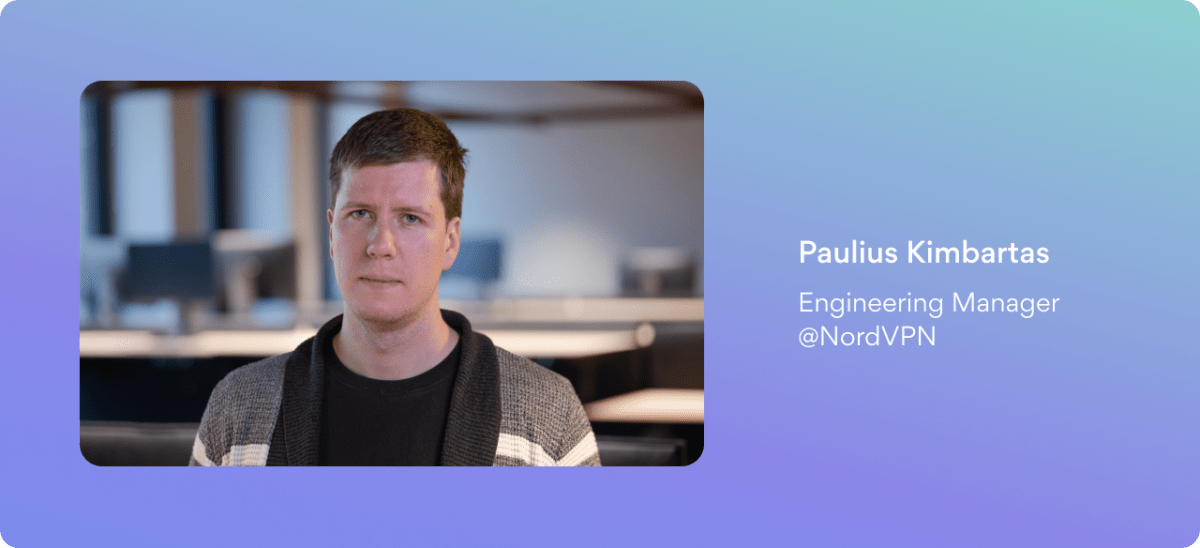
As we strive to create a safer cyber future for everyone, our talented engineering team takes center stage. Curious about what it’s like to be at the heart of our operations? We recently caught up with a few engineering leaders at Nord Security: Gerrit Garbereder, Rokas Dambrauskas, and Paulius Kimbartas to discuss their teams, daily tasks, challenges, and skills.

But not everything made it into the video, and we had a few requests for further exploration! So settle back and enjoy, as we delve deeper into the world of Nord Security engineering.

Engineering teams’ role and projects

Hello, Gerrit, Paulius, and Rokas! Thanks for your time today. To start things off, could you tell us how your teams play a role in the success of Nord Security?

Paulius: Hi there. My team at NordVPN is developing the Checkout system, polishing purchase flows so that customers can get our products in the easiest and most secure way possible. So simply enabling people to purchase our products in their preferred way helps grow our user base.

Gerrit: We’re building tools to protect NordPass customers, even when they’re not actively using the app. Further, as the Premium squad, our team concentrates on monetization of the service. We’re driving this by maximizing customer satisfaction and value for money. Delivering high quality tooling will increase premium subscriptions and reduce the churn rate.

Rokas: Our mission is to continuously enhance the NordLocker platform, creating a seamless and efficient experience for everyone who uses it. By doing so, we empower other teams to excel in their work and ultimately drive the success of the entire company.

Awesome! What are some recent interesting projects you’ve worked on?

R: A little more than a year ago, NordLocker made the strategic decision to go serverless and focus on building cloud-based solutions. In recent months, we finally managed to migrate one of our core functionalities to the cloud, which was a very challenging task!

P: On the NordVPN team, we recently added a one-click payment option to enable our existing users to have a seamless purchase experience in a secure way. This feature required multiple components, such as authentication and secure data retrieval.

G: Adding attachments to NordPass was a really challenging project. We had to align the integration with our colleagues at NordLocker while the underlying structure was reworked from the ground up. During this project we created not only new features but also formed new bonds with people across multiple teams.

Work tools and daily operations

And to get these projects over the finish line, which tools do you normally use?

R: Some tools are used across the whole company. GitLab helps us manage our codebase. For snappy communication, we use Slack. Apart from that, engineers are free to use their IDEs and tools of preference.

P: To expand on that, my team uses Docker, Grafana – and those are only off the top of my head! In terms of programming languages, primarily we use TypeScript, PHP, and GO.

G: As a cross-functional team we’re using a whole zoo of tools every day. We provide each guild the tooling that fits their needs. Android, iOS and Backend development is enabled through corresponding IDEs.

What does an engineering manager do on an average day?

R: My day is quite diverse. I spend most of the time communicating with my team, ensuring their projects are on track and addressing any issues that may arise. I also participate in meetings with other teams and help with long-term planning.

P: In one word: dynamic. My primary focus everyday is to enable engineering teams to achieve their goals, so ad-hoc knowledge sharing, brainstorming, and guiding people takes time every day. On the other hand, focus time is really important for me. Planning upcoming features and aligning our goals across teams is a vital part of my work. It contributes to the team’s overall performance and happiness.

G: To add to the above, after the daily scrum in the morning, I typically take care to remove impediments for the team’s current tasks. Once everyone is unblocked I move towards tactical planning together with the Product Owner on upcoming projects and challenges.

R: I always strive to do some hands-on technical work as well, so I can stay connected to my team and the work they’re doing.

Growth opportunities and skills needed

What do you look for in your teammates?

P: It’s all about having an eagerness to learn – the cybersecurity field is very dynamic, new risks arise and our engineers need to be constantly learning and up to date with new technologies and best practices.

R: Strong technical skills are important, but we also look for individuals who are excellent problem-solvers, able to work well in a team, and have a growth mindset.

G: Engineering specialists are of course expected to be experts in their field. However, I believe it’s also necessary for this role to be open-minded with customer success as a focus. And I agree with Paulius, my expectation for any engineer is to be curious and eager to learn.

P: One other crucial thing is to be an honest communicator. If something’s wrong, we don’t wait till the situation develops. We speak about it and solve it.

How does your team grow together?

R: In my team I encourage open communication and knowledge sharing, which helps everyone on the team to continually refine their skills. Also we do regular performance evaluations, 1-on-1 meetings, as well as offering opportunities to attend relevant training and conferences.

P: Yes, 1-on-1 meetings help us to determine how each engineer wants to grow, because growth is such an individual thing. I always plan the team’s work accordingly, and prioritize initiatives that will help us all grow.

G: We benefit from the training possibilities provided through the Tesonet Group, which focus mainly on soft skills. Hard skills are improved through mentorship programs, online courses, and conferences. I encourage my team to spend around 10% of their time learning, which is scheduled into our sprint planning.

Challenges and how we solve them

It sounds like there’s a lot to consider! What challenges do you face as managers?

G: Translating the big picture into actionable items that allow individual contributors to relate their work to the company’s success is a challenge. Making everyone aware of the actual problem we are trying to solve is a difficult task. Often enough engineers tend to dive straight into a sophisticated solution while a simpler solution would have solved the customer’s problem with ease.

R: For me, it’s balancing the needs of my team with the demands of the business. This can include prioritizing tasks, ensuring everyone is on track to meet deadlines, and effectively communicating changes or updates to the team.

P: I agree with that. Alignment across individual, team, and organization goals is a challenge. The ideal situation is when each engineer’s goals are in alignment with what we as a team want to achieve, and the team goals are in alignment with what we as an organization wants to achieve. In such situations any friction disappears and you can simply tackle whatever challenges you have.

How does your team work together?

G: Our distributed team is shaped by people from different nations with a variety of backgrounds. This mixture of people and culture fosters a vivid exchange of experiences. Not every day is joy and laughter, life is full of challenges and we are handling those challenges together. Recent events in Ukraine and Türkiye are two examples of compassion and support within the team beyond professional distance.

P: Smartest restless achievers I’ve ever known. Each person on the team brings ideas on how we can overcome new challenges, which we always have. On top of that some challenges come unforeseen, but that does not stop us. We can simply jump on a call and brainstorm the solution together. Pair programming is a great way to solve problems.

___

Thanks to Gerrit, Paulius, and Rokas for their time today!

If you’re an engineer or manager interested in working with us at Nord Security to create a safer cyber future, check out our job postings below.

About Version 2 Digital

Version 2 Digital is one of the most dynamic IT companies in Asia. The company distributes a wide range of IT products across various areas including cyber security, cloud, data protection, end points, infrastructures, system monitoring, storage, networking, business productivity and communication products.

Through an extensive network of channels, point of sales, resellers, and partnership companies, Version 2 offers quality products and services which are highly acclaimed in the market. Its customers cover a wide spectrum which include Global 1000 enterprises, regional listed companies, different vertical industries, public utilities, Government, a vast number of successful SMEs, and consumers in various Asian cities.

About NordLayer
NordLayer is an adaptive network access security solution for modern businesses – from the world’s most trusted cybersecurity brand, Nord Security.

The web has become a chaotic space where safety and trust have been compromised by cybercrime and data protection issues. Therefore, our team has a global mission to shape a more trusted and peaceful online future for people everywhere.

Best practices for secure access to Figma

As businesses increasingly shift towards digitalization, secure access to apps cannot be overstated. Today, data breaches and cyberattacks are a constant threat, making cloud security a critical business function. It’s especially difficult with collaborative tools where in-house and external team members work on joint projects.

As a web-based interface design and prototyping tool, Figma allows teams to collaborate in real-time, making various design projects easier to manage and execute. Yet, given its collaborative nature and integration capabilities with other tools, this makes Figma’s security a critical concern for these organizations.

In this article, we’ll look at Figma’s access security and highlight some best practices to prevent various risks.

Why is it important to secure access to Figma?

Figma, a collaborative interface design tool, has become an integral part of the work of designers and developers across industries. As a cloud-based application, Figma allows teams to co-design and manage projects easily, bringing together freelancer help and in-house employees allowing them to create, share, and edit designs in real-time. As many enterprise projects are considered confidential information, its secure access has become a growing concern.

Secure access to Figma projects is essential to ensure the integrity of the designs and limit access to protect the intellectual property of the organization or involved individuals. Therefore, its security is a crucial aspect to consider for all users.

Figma security best practices

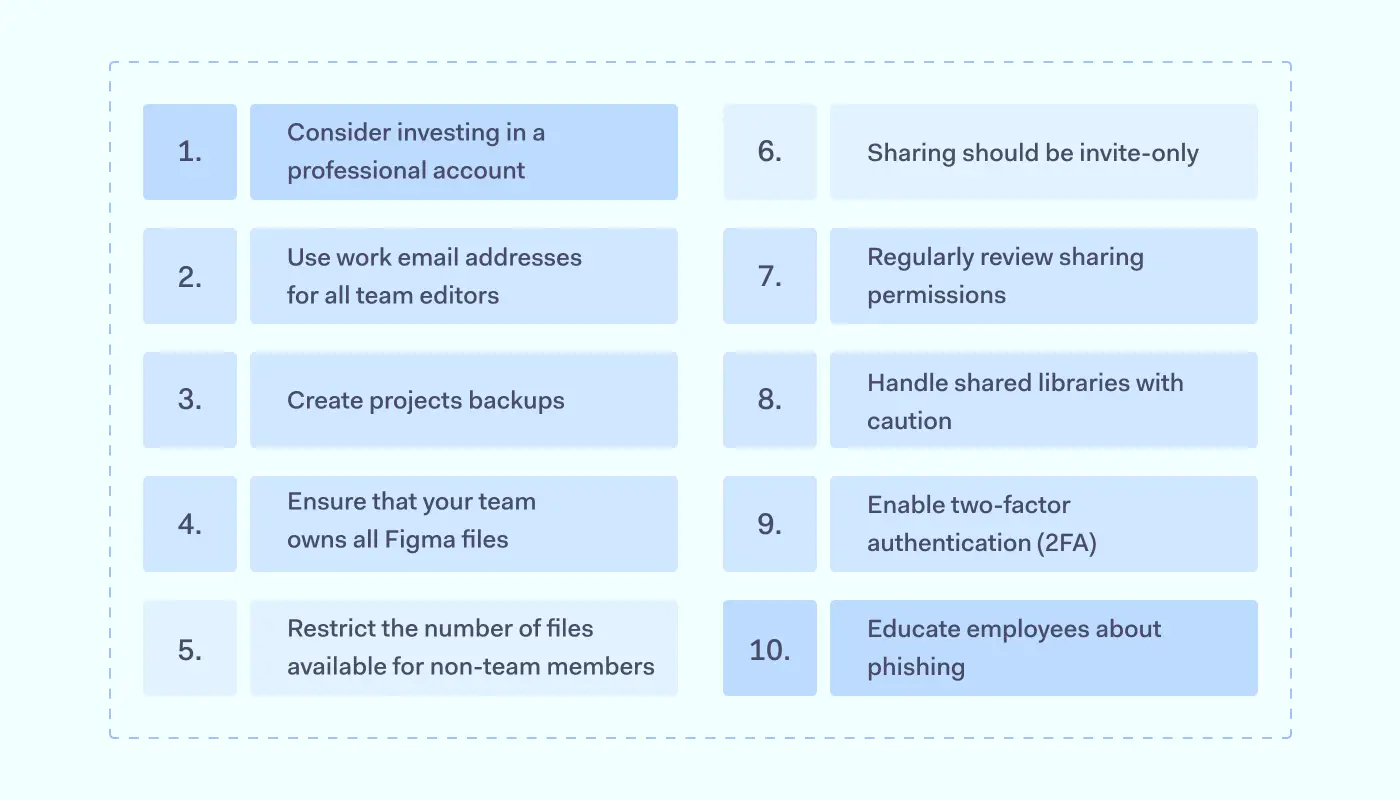
Several key features in Figma can help organizations to edit privileges, sharing files securely. Here are some best practices that could help your team to secure their work.

Best practices for secure access to Figma

1. Consider investing in a professional account

Figma’s Professional plan enhances security measures to offer finer controls over file and prototype permissions. This enables effective management of teams and grants members access to specific Figma file folders and projects. The Professional account also includes unlimited version history, facilitating the tracking of modifications made to a Figma file and identifying the individuals responsible.

2. Use work email addresses for all team editors

If a team member engages in unauthorized activities, it’s a good practice to use work email addresses for all team editors. It enables your company’s IT or security team to promptly revoke edit privileges, maintaining the security and integrity of your organization. This creates an effective safety net against potential threats and can mitigate risks arising from unauthorized actions (i.e. a freelancer going rogue).

3. Create projects backups

Once a project reaches a significant milestone or is considered complete, consider archiving .fig files in a separate file system from Figma. This might involve exporting the final work as PDFs or prototype videos, followed by exporting source files. When the project is officially concluded, relocating these files to a yearly archive with tighter access controls makes sense. Developers can also use these files as a reference for new projects.

4. Ensure that your team owns all Figma files

The ownership of crucial Figma files should be exclusively retained within the team and not granted to external individuals, freelancer colleagues or clients. Figma files include sensitive and proprietary information, including design assets, user interface components, and collaborative work. Therefore, passing ownership to external parties could not only compromise the project’s confidentiality but also pose the risk of unauthorized modifications, distribution, or misuse of the content.

5. Restrict the number of files available for non-team members

Figma offers some access controls built-in. For example, it allows sending invites at the file level. As a general guideline, it’s advisable to refrain from sending invitations to external individuals at the project level unless it’s absolutely necessary. Furthermore, Figma allows granting access solely to prototypes within files. This feature is a lifesaver when individuals require visibility into the prototype without access to the underlying design work. These functions combined allow careful control and protect the access of their design files, ensuring collaboration while maintaining data privacy.

6. Sharing should be invite-only

Files sharing is one of the key priorities when setting up secure access to Figma. While public share links may seem quick and easy, they often fall short of providing robust protection for sensitive information. That’s why it’s highly recommended that the default setting for file sharing should be set to invite only. This way, an additional layer of control and accountability is added. By curating a precise list of invited individuals, the Figma file owner can rest assured that only trusted parties can access the file’s contents.

7. Regularly review sharing permissions

Figma file owners should frequently review the individuals invited to access their files. This helps keep invite-only lists in check, keeping them consistently updated (focusing on disabling publicly available links when they’re no longer needed). It not only ensures data security but also safeguards the integrity of the design process. Figma file owners can use this as a proactive measure to mitigate potential security breaches and stay up to date in terms of team access.

8. Handle shared libraries with caution

Shared libraries demand an added level of attention and consideration. It’s imperative to minimize edit access permissions when it comes to critical design libraries. In most cases, this means that individuals outside the team should never have the opportunity to change your design system. By adhering to this stringent approach, you can safeguard the consistency and stability of your design libraries.

9. Enable two-factor authentication (2FA)

The default Figma password protection is inherently vulnerable to various risks like password reuse or exposure through data breaches. 2FA adds an extra layer of authentication beyond just a strong password. It requires the team to provide additional information, typically a one-time password (OTP) or a verification code, usually generated on a separate device. This ensures that even if someone manages to obtain or guess a user’s password, they still need access to the second factor to gain entry.

10. Educate employees about phishing

Many phishing and social engineering attempts rely on tricking users into revealing sensitive information or compromising their accounts. Educating team members about these threats increases their awareness of the tactics employed by malicious actors and may help them to recognize potential attacks. As Figma accounts often contain valuable and confidential information, their hijacking could lead to data breaches or unauthorized modification to design files. Better-educated employees can protect their accounts better, use stronger passwords, and be cautious about sharing account information.

How can NordLayer help?

Figma is a modern necessity for most creatives and designers. With flexible tools to connect everyone in the design process, it helps to deliver better products and services faster. From websites, applications, and logos — Figma allows users to improve workflow and get creative. Yet, its security is a concern requiring finding a balance between security and ease of use.

Secure access to SaaS apps can be easily improved by implementing IP allowlisting with NordLayer. Our tools help to manage access securely, secure network edges, and track user actions across endpoints. Providing an encrypted and secure internet connection safeguards your team’s Figma activity.

Contact us today, and discover how to combine the benefits of Figma with airtight security.

About Version 2 Digital

Version 2 Digital is one of the most dynamic IT companies in Asia. The company distributes a wide range of IT products across various areas including cyber security, cloud, data protection, end points, infrastructures, system monitoring, storage, networking, business productivity and communication products.

Through an extensive network of channels, point of sales, resellers, and partnership companies, Version 2 offers quality products and services which are highly acclaimed in the market. Its customers cover a wide spectrum which include Global 1000 enterprises, regional listed companies, different vertical industries, public utilities, Government, a vast number of successful SMEs, and consumers in various Asian cities.

About NordLayer
NordLayer is an adaptive network access security solution for modern businesses – from the world’s most trusted cybersecurity brand, Nord Security.

The web has become a chaotic space where safety and trust have been compromised by cybercrime and data protection issues. Therefore, our team has a global mission to shape a more trusted and peaceful online future for people everywhere.

Best practices on cybersecurity budget allocation: a research-based guide

Building a cybersecurity strategy is challenging. It requires more than just technical knowledge and managerial skills but also demands financial resources.

Business budgeting tendencies show that cybersecurity investments receive only a small part of the allocated IT budget. Cybersecurity funds must be distributed wisely to ensure valuable outcomes, prove the chosen security direction effective and minimize resources’ waste.

The main challenge is how to achieve effective security spending. How much should businesses allocate to cybersecurity, and what factors like company size or maturity does it depend on?

According to Statista, information security investments in different categories continuously grow. Projections for 2024 indicate worldwide spending on information security will double compared to 2017.

The trend confirms the necessity of considerable cybersecurity funding. To understand it better, let’s dive into research-based data on how businesses of different sizes and cybersecurity maturity distribute their allocated budgets.

Research methodology

NordLayer surveyed 500 non-governmental organizations across Canada, the United Kingdom, and the United States. An external agency conducted the surveys between March 15 and 25, 2023.

Industries and subindustries represented in the research include business management and support services, e-commerce, education, finance and insurance, health care, information and communication, IT, professional and technical services, and consulting.

The survey explored the organizations’ cybersecurity maturity level (Beginner, Basic, and Advanced), their cybersecurity solutions, and the presence of an in-house specialist or responsible department. It also included questions about cyber incident costs and allocated budgeting for IT and security in the period of 2022-2023.

Companies were segmented by size:

  • Small companies: 1-10 employees.

  • Medium companies: 11-200 employees.

  • Large companies: 201+ employees.

Cybersecurity landscape and the importance of budgeting

The mantra “cybersecurity keeps evolving, so do cyber threats” remains relevant today, emphasizing the need for strengthening business protection measures. As the significance of different types of attacks shifts, mitigating one risk at a time is not a practical solution.

For instance, just last year, ransomware attacks held the top position on the threats list, alerting everyone to stay vigilant. This year, according to Statista, the threat outlook for global companies highlights business email compromise and/or account takeovers (33%) as the most prominent cyber risk surpassing ransomware (32%).

Choosing comprehensive cybersecurity tools and solutions helps to achieve the flexibility needed to adapt to dynamic technological and risk change. A sufficient budget is key, so let’s explore how much companies of all sizes invest in building their cybersecurity strategies.

Understanding the context of digital attacks

Data speaks volumes, so let’s begin by analyzing the culprit behind the need for cybersecurity investments. The survey asked companies about any cyber incidents they encountered in 2022.

The list of top 10 cyberattacks starts with phishing (39%) and malware (34%) attacks firmly holding the first two positions. Despite an intense background of cyber incidents, nearly one-fifth of the companies surveyed didn’t encounter any accidents related to digital threats.

Interestingly, ransomware, one of the most menacing threats recently, appears in the last place (16%) on the list, demonstrating how unpredictable and dynamic the nature of the cybersecurity landscape is. Please note that the frequency of a cyber incident doesn’t necessarily indicate the scale of damage inflicted. 

The scope and type of cyber incidents may depend on a company’s size or the cybersecurity maturity of an organization.

Correlation between cyber incidents and company size

Organizational size usually is misinterpreted in evaluating the likelihood of a cyberattack. Small companies tend to argue they lack valuable assets of interest to malicious actors, requiring less protection.

However, from the first glance at the research data, the trend confirms that medium and large companies are exposed to cyber incidents more often. While 42% of small companies claim they didn’t encounter any cyber incidents in 2022, it accounts for less than half of them.

We observe that insider threats and social engineering attacks are much rarer for small businesses, while data breaches or leaked passwords are more common issues. But phishing attacks (39%) on our list of cyber incidents are equally prevalent across all-sized companies

Large enterprises tend to suffer from malware (43%), social engineering (30%), and insider threats (29%). Compared with the other two categories, medium-sized businesses were exposed most to data breaches (34%) and DDos/DoS attacks (27%).

However, identity theft (27%), compromised/leaked passwords (23%), and ransomware (19%) impact companies with either 11 employees or 201+ to a similar extent.

It’s important not to forget that size doesn’t make one immune. Only the form and approach of malicious actors can differ. Frequency is only one of the aspects to consider when analyzing the intensity of attacks but not the overall impact on business continuity.

Cyber preparedness as digital threat prevention

Company size is more of a predetermined factor rather than an easily controllable aspect of the business. Conversely, cyber preparedness is a decision-based measure of whether an organization invests and focuses on cybersecurity awareness.

Interestingly, higher cyber frequency of attacks is recorded for companies with advanced cybersecurity preparedness. Why is that? A few possible reasons explain this trend.

Cybersecurity maturity is tightly connected with the complexities of creating, providing, and maintaining services and/or products within a company. It also relates to business nature, the processing of sensitive data, and active online presence. 

Companies with a cybersecurity awareness mindset are more likely to assess the risks they face. To mitigate identified risks, security managers implement solutions to prevent, detect, or proactively hunt threats. Monitoring provides explicit data on cyber events or existing breaches, implying that organizations at the basic and beginner level of cyber maturity are less aware of what’s happening under the hood.

Digital advancements increase the attack surface of a company. Factors such as zero-day vulnerabilities, lack of sufficient resources, and incompatible effectiveness of cybersecurity strategy can lead to a higher frequency of cyber attacks, particularly when outsourced services and vendors introduce third-party dependency.

Adversary motivation is common to most malicious actors. These attacks are often based on financial gain or political ideology, but some attackers simply seek the thrill of a challenge. Less cyber-advanced and protected companies are an easy catch, making them suitable for training grounds for attackers compared to more well-protected and globally known companies.

Taking a closer look at the comparison between organization size, cybersecurity maturity level, and the frequency of cyber incidents reveals no distinct deviations.

The main insights imply a weak correlation between insider threats and cybersecurity preparedness levels, while the size of an organization doesn’t seem to impact the frequency of data breaches and identity theft.

Despite the size or cybersecurity maturity, businesses depend on the industry dynamics and the services and data they operate on. The human factor, whether as an internal threat or attacker motivation, is purely a wild card in the context of the cybersecurity landscape, irrespective of the company’s size or preparedness.

Real-life scenario: damage incurred to LinkedIn scam victim companies

Let’s take a real-life example to see how LinkedIn scams, common online threats, affect businesses. The critical part is assessing the inflicted damage and exploring what measures can help prevent such risks.

A LinkedIn scam or fake profile aims to gain illicit funds, either through direct transactions or by gathering personal information that can be used to build a pretext for receiving money. Naturally, the question is, how much do businesses lose in such attacks?

Comparing the damages suffered according to company size, tendencies show that all companies are at risk. Small businesses are the least affected (12%), and medium-sized and large enterprises have to pay the price more often — 22% and 24%, respectively.

Financial damages vary from losses of up to 5,000 in local currency for 33% of companies to 10,000 in local currency for 16% of surveyed companies. These numbers should be considered high as a fifth of respondents could not disclose information regarding their financial losses.

Regarding cybersecurity maturity level, losses increase accordingly — 15% of beginner-level enterprises suffer from financial damage, while 19% of basic-level and 24% of advanced-level companies have declared experiencing expenses.

Does it mean that the more prominent and cybersecurity-developed company, the more risks it is exposed to? Not necessarily, as cyber-ready companies tend to allocate a portion of their budget to IT, particularly when improving their cybersecurity infrastructure.

Research findings on cybersecurity budgeting

Budgeting is an abstract and not clearly defined practice that could be followed by pre-defined recommendations to guarantee success. But it is an important part of business planning, although seen differently by organizations.

Research on cybersecurity budget allocations revealed insights into how enterprises of various sizes approach the same challenges. The following findings are based on overall data, considering company size, cybersecurity maturity, and country unless indicated otherwise.

Budget allocation to IT needs and cybersecurity

IT and cybersecurity budgeting are two different segments of financing. The IT covers overall technology investments, including hardware, software, personnel, and cybersecurity. As cybersecurity is just a fraction of the grand scheme, it explains why budgets can be tight and sometimes even non-existent.

In 2022, over 90% of companies distributed some of their budgets to IT needs. Most companies allocated up to 50% of their financial resources, while only 1% of respondents put all their money into IT spending.
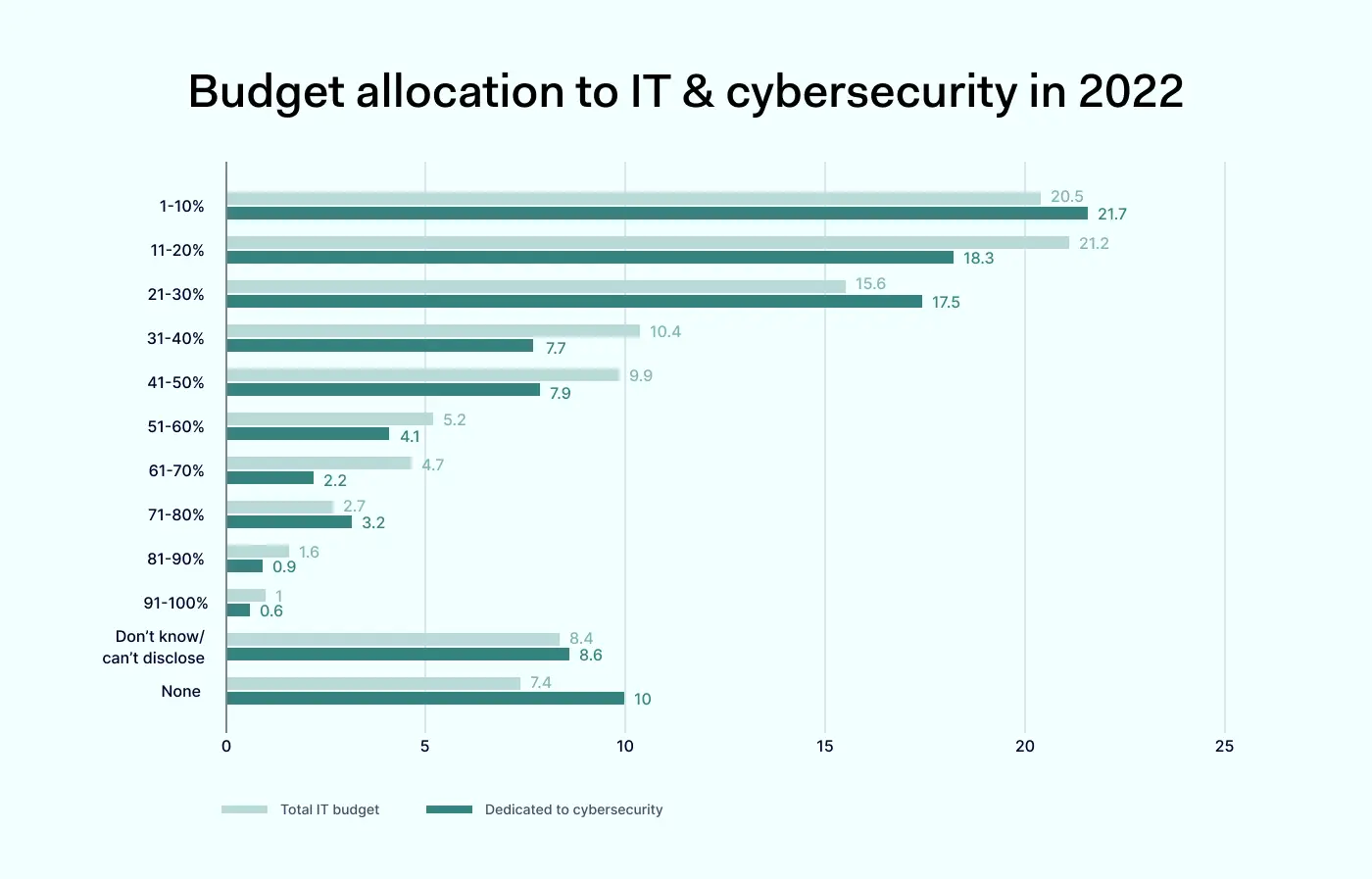
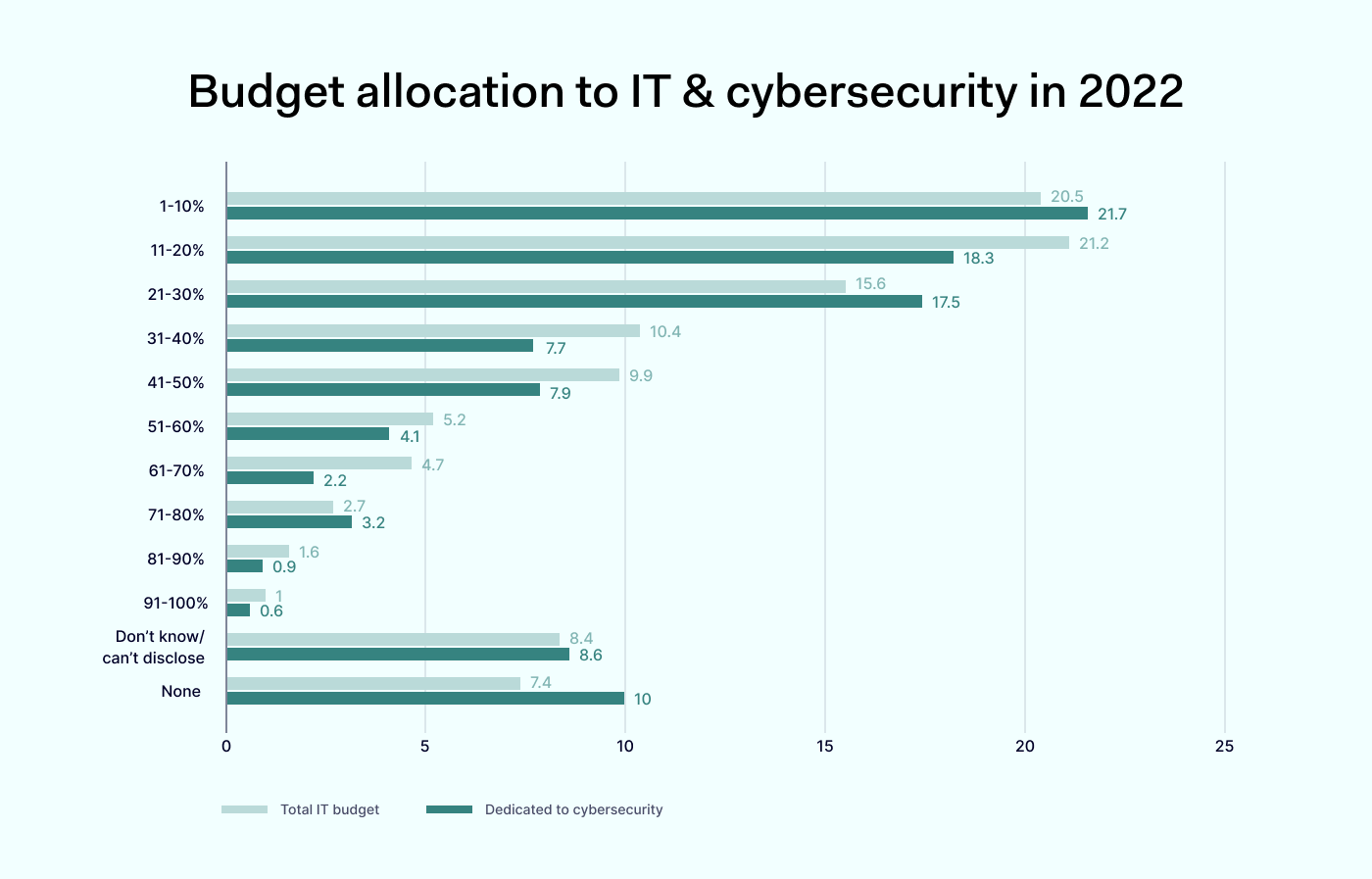
Budget allocation to IT cybersecurity in 2022

Finances allocated directly to cybersecurity spending (besides hardware and software investments) accounted for 84% of received funds in 2022. However, 10% of companies either didn’t find it relevant or had to shift their investing priorities away from cybersecurity. Nearly one-fifth of organizations allocated up to 30% of their funds to digital security.

Half of the small companies mainly invest up to 20% of their budget in upgrading their IT infrastructure. The same tendency appears for beginner cybersecurity maturity-level companies. 14% of small companies and 18% of beginner cybersecurity maturity level organizations chose not to invest in IT needs, while 26% and 31% of these companies did not invest in cybersecurity at all.

On the other hand, large enterprises and advanced cybersecurity maturity level companies tend to allocate more funds to IT, similar to medium-sized companies and basic cyber preparedness level organizations. Large and medium enterprises tended to allocate at least a portion of their budgets to cybersecurity strategy upgrades during the year.

In 2023, the trend shows that fewer companies (88%) distributed company funds to IT needs. Some organizations redistributed their funds to other departments, excluding IT or cybersecurity.

Small and beginner-level cybersecurity maturity companies maintain the trend of investing as little as possible in IT and cybersecurity. In 2023, 16% of small-sized businesses and 19% of Beginner-level companies didn’t allocate funds to IT, which is a negative trend compared to 2022. Yet, 23% of small businesses and 28% of beginner-level companies skipped funding cybersecurity, a decrease compared to last year. 

This leads to the conclusion that although small and unadvanced companies allocate fewer funds to IT, they prioritize cybersecurity to a greater extent.

Medium-sized companies, on average, spend almost 30% of their available budget on IT in 2022. However, this allocation changed to 23% in 2023. Basic cybersecurity maturity level companies maintained a balance of 21-27% of IT funding in the last two years, with a growing tendency. Similar trends can be observed in cybersecurity investments for the same category of organizations.

Large and advanced cybersecurity maturity companies demonstrate stability, consistently allocating an average of 24% of funds designated to IT or cybersecurity needs in 2022-2023.

Investment trends for cyber threats management

Risk assessments and mitigation dictate the cybersecurity strategy of an organization. The strategy is built on security policies, tools, and solutions to implement measures that address the established business protection needs.

The cybersecurity strategy is a process that needs to be monitored, adjusted, and improved for better results. As mentioned earlier, the necessity for flexibility comes from ever-evolving digital environments.

We asked companies which solutions and services they use and what is their future investment focus in cybersecurity.

The list of implemented tools and solutions reveals that companies combine different measures to achieve security. Almost 4 out of 5 companies utilize antivirus software (79%). Secure passwords (65%) and file encryption (64%) are the second-highest priority when creating security policies within organizations.

Virtual Private Networks (VPNs) maintain their popularity in securing organization network connections, with over half (59%) of companies using them. Cyber insurance (45%) is a relatively new solution making its way to business cybersecurity, although its focus is on covering the consequences of an incident rather than preventing it.

Spending on cybersecurity solutions, services, and applications will continue to be a priority (59%) in the 2023 budgets. Raising awareness within organizations is as important as companies providing cybersecurity training and increasing dedicated staff for cybersecurity questions.

Compliance plays an important role in the approach to organizational cybersecurity. External audits and preparation for standard information security certifications are equally in focus (37%). However, 17% of respondent companies weren’t able to disclose their plans for cybersecurity budgeting allocation, and 11% said they had no plans for investing in cybersecurity.

It’s concerning to note that 1 out of 10 companies excluded cybersecurity from their budgeting priorities. 34% of those organizations are at the beginner-level of cybersecurity maturity, and 28% of small-sized businesses. Regarding the country, 8% of companies in the United States, 7% of Canada, and 5% of the United Kingdom companies cut their cybersecurity investments for the ongoing year.

Yearly comparison of cybersecurity investments

Plans for 2023 show a slight change but a clear strategy for businesses with advanced cybersecurity maturity. Purchasing security solutions, services, and/or applications is the top priority, accounting for 70% of planned costs. In addition, there is a strong focus on employee education (70%) and increasing staff for cybersecurity questions (63%).

Attention to organizational preparation for information security certifications grew from 46% in 2022 to 51% in 2023. The data implies that businesses are strengthening their cybersecurity strategies to be more aware and self-sufficient in protecting company assets.

Beginner-level cybersecurity maturity companies fluctuate between 20–30% in the same categories. It indicates awareness present with yet too little security spending allocated.

These companies are smaller, thus easier to manage their scale and exposure to digital threats. For sustainable growth and security, the mindset shift is expected to be cyber-ready for driving large-scale organization protection.

Best practices for developing cybersecurity budgets

Research revealed that cybersecurity spending depends on different factors. It plays a small yet important part in the overall business lifecycle. Investing in cybersecurity is highly recommended to ensure organizational growth and business continuity.

To allocate cybersecurity budgets effectively, evaluate all the components influencing costs, decision-making, and further strategy development. This includes staying vigilant and proactive, planning responsibly, reusing resources (talent, tools, processes) sustainably, and aiming for growth.

Key takeaways: how to identify, estimate, and prioritize security investments

Survey data shows that some companies invest in cybersecurity generously, while others, especially small businesses, tend to refrain from security funding. Naturally, the reason behind it can be related to limited resources, underdeveloped infrastructure and processes, and l time constraints.

Yet poorly protected businesses suffer harder from a cyber incident. Only luck, not size or brand awareness, influences when and how threat actors will target an organization.

Key takeaways

1. Acknowledge the change in the cybersecurity landscape

The first step for all decision-makers in the company, from a Chief Information Security Officer (CISO) to Managing Director, is to be aware of cybersecurity challenges and the vulnerability of their business to cyber threats.

Remember about technology upgrades from hardware to cloud-based environments for more resilience and flexibility. Malicious actors look for security gaps to exploit zero-day vulnerabilities.

2. Assess business-affecting risks

All organizations face the risk of cyber-attacks. Some industries have more red flags than others due to the nature of the data they process. The exposure to cyber threats can vary depending on the type of service or product the organization provides or the company’s maturity.

Understanding what security risks, threats, and scenarios your business is most exposed to is crucial to assess security measures correctly.

3. Investigate internal goals

First, investigate how the company’s budgets are allocated to different needs. What are strategic goals and business development objectives to find the place and role of cybersecurity in the organization?

Examine how the company meets compliance and aligns with stakeholders’ requirements. Are there any plans to seek certification from regulatory compliance providers, such as HIPAA for healthcare providers? Certification is a process that requires dedicated resources and, at the same time, provides guidelines for building a more robust cybersecurity strategy.

4. Audit solutions and best practices

Review your security strategy. To some extent, policies, procedures, and tools should already exist unless it’s the very beginning of a company. See what needs improvement and identify what gaps must be addressed as soon as possible.

Are there any processes that could be consolidated or solutions that aren’t used to the fullest? Companies tend to invest in applications – review what apps are utilized and if they satisfy business and user needs.

5. Plan a cybersecurity strategy

Cybersecurity strategy starts from a mindset within the company. The main elements that require continuous investment planning combine:

  • Tools & solutions.

  • Employee security training and development.

  • Dedicated staff, consultants, and outsourced services.

  • Developing backup plans for different threat scenarios to ensure a stable business lifeline.

6. Implement cybersecurity tools and policies

After evaluating the business needs for security, select solutions and tools that best suit your case. It’s beneficial to have demo calls with vendors and have a trial period to test tool adoption within the organization.

Once chosen, deploy tools, upgrade policies, and onboard the team to the new cybersecurity strategy.

7. Review & adapt to business needs

Implementing a solution and introducing new processes doesn’t end your cybersecurity strategy journey. Test, monitor, and confirm its effectiveness. Ongoing monitoring requires a dedicated team to ensure a smooth transition to a new way of working.

Whether your organization chooses to have an in-house or outsourced dedicated cybersecurity staff, it is important to allocate the necessary investments. It is recommended to choose a solution that is sustainable and easy to manage.

8. Update & make cybersecurity an ongoing process

Work on new and follow-up business initiatives in accordance with your cybersecurity strategy. Investigate what areas need changing, upgrades, and improvements for another implementation cycle.

Coherent tracking and planning help make next year’s cybersecurity budget easier. It is essential to invest in security training, tools, and dedicated employees in the company and view security as continuous learning and growth.

Following recommendations for cybersecurity budgeting

Finances and the effective allocation of limited resources is a sensitive and complex topic for any organization manager responsible for business planning. This research sheds light on the industry trends regarding how companies approach cybersecurity funding, which is ultimately connected to digital threat prevention.

Further investigation and insights are beneficial for informed planning, so explore other materials from NordLayer for a better understanding and planning of the cybersecurity budget:

Cost-benefit analysis of cybersecurity spending

A comprehensive analysis of cybersecurity costs and factors affecting them, benefits of cybersecurity spending, and how to apply it to your organization. In the article, you’ll find more comprehensive information on specific solutions and tools, security spending projections on dedicated cybersecurity staff, and other nuances influencing the cybersecurity strategy.

The study helps better understand the subject and find convincing arguments for discussions with other decision-makers.

Decision Maker’s Kit

This content support platform is dedicated to assisting decision-makers in choosing, explaining, and onboarding their selected cybersecurity solution within their organization. From strategical to explanatory materials, prepared templates, and documentation, the platform provides a better perspective on what’s required and expected when building a cybersecurity strategy for a business.

Projections on security budgeting for 2023

An overview of how much companies plan to allocate to cybersecurity in 2023, considering different factors. The article covers building a budgeting strategy, assessing the expense gap, and exploring investment alternatives such as the cost of a data breach.

About Version 2 Digital

Version 2 Digital is one of the most dynamic IT companies in Asia. The company distributes a wide range of IT products across various areas including cyber security, cloud, data protection, end points, infrastructures, system monitoring, storage, networking, business productivity and communication products.

Through an extensive network of channels, point of sales, resellers, and partnership companies, Version 2 offers quality products and services which are highly acclaimed in the market. Its customers cover a wide spectrum which include Global 1000 enterprises, regional listed companies, different vertical industries, public utilities, Government, a vast number of successful SMEs, and consumers in various Asian cities.

About NordLayer
NordLayer is an adaptive network access security solution for modern businesses – from the world’s most trusted cybersecurity brand, Nord Security.

The web has become a chaotic space where safety and trust have been compromised by cybercrime and data protection issues. Therefore, our team has a global mission to shape a more trusted and peaceful online future for people everywhere.

A tour of Nord Security’s new office in Cyber City

It’s official: All Nord Security products have finally moved under one roof at Cyber City. It’s the ultramodern destination for our community that sets a new standard for our employee experience. Dive into this blog to discover what life and work look like at one of the most cutting-edge tech offices in the Baltics.

Our brand-new HQ

In 2020, we started an exciting journey by laying the foundation of a brand-new office that could accommodate our fast-growing community and encourage a collaborative company culture. May 2023 marked the end of this journey as we transitioned over 900 employees from NordVPN, NordLayer, NordPass, and NordLocker to one of the most cutting-edge tech hubs in the Baltics, Cyber City, nestled in the heart of Vilnius, Lithuania.

Tom Okman Eimantas Sabaliauskas


Tom Okman and Eimantas Sabaliauskas, co-founders of Nord Security

Located on the grounds of the former “Sparta” textile factory, our new headquarters is a testament to its industrial past. The exterior design of our tech hub mirrors textile patterns, while the preserved iconic chimney standing tall in the heart of our business campus serves as a powerful symbol of our relentless ambition – to build future-shaping cybersecurity solutions from the ground up.


Nord Security office is located on the grounds of the former “Sparta” textile factory

Our state-of-the-art HQ building, housing Nord Security, Surfshark, Oxylabs, CyberCare, Hostinger, and other Tesonet community companies, is located on a 35,000 m2 site. Spanning seven floors, our new premises come with a wide range of features (see for yourself below) that raise the bar for our workforce culture.

Cultivating growth and creativity

The Cyber City business hub is the new Silicon Valley of the Baltic states, where the top tech talents and companies meet the best conditions for work, growth, and innovation. With this in mind, our HQ office features:

  • Ergonomic co-working spaces for all-day comfort.

  • 106 meeting rooms built-in with cutting-edge technology (smart cameras, easy room booking, and presentation systems) for seamless onsite and remote collaborations.

  • Modern conference hall and spacious atrium, perfect for hosting internal events, quarterly celebrations, and company-wide festivities.

  • A state-of-the-art production studio for elevating our content creation.

  • Dedicated silent zones for focused, uninterrupted work.

  • Music room equipped with an array of musical instruments for solo improvisation or collaborative jams with colleagues.

  • Hacker and innovation room for team building activities and LAN parties, exploration of groundbreaking tech, captivating video shoots, and immersive tech tours.

  • IQ lounge – a zone full of books and magazines stimulating curiosity and never-ending learning about art, architecture, science, and technology.

Ciber City office premises 4
Ciber City office premises 2
Ciber City office premises 5
Ciber City office premises 1
Ciber City office premises 3
Ciber City office premises 8
Ciber City office premises 7
Ciber City office premises 9
Ciber City office premises 6
Cyber City office premises 10

“What I absolutely adore about our office is the flexibility to work from different locations. Yes, we all have our dedicated spaces, but when you need that extra bit of focus or solitude, you can go and work in silent rooms. You can sit on the couch in the corridor or our spacious atrium if you want more comfort. And if you’re going to discuss your projects with someone in a more informal setting, our kitchen or coffee bar might be just perfect. There’s a place for every mood, every task, and every moment of your working day. Now, if I had to pick a personal favorite, it would be the lighting. I tend to be quite sensitive to harsh, bright lights, which give me headaches and eye strain. But here, it’s all warm, soothing light. It creates a calm and inviting atmosphere that’s just a pleasure to work in,” Ugnė Mikalajūnaitė, Country Manager at NordVPN, Nord Security.

All these forward-looking amenities, coupled with the growth opportunities Nord Security provides, be it internal training, online courses, mentorship programs, or Tech Days knowledge-sharing events – we build an environment that helps our employees stay at the top of their game.

Nord Security events 9
Nord Security events 8
Nord Security events 7
Nord Security events 3
Nord Security events 10
Nord Security events 6
Nord Security events 5
Nord Security events 4
Nord Security events 2
Nord Security events 1

Nurturing a thriving community

At Nord Security, we believe in the power of teamwork. With this in mind, we wanted to have all our products under one roof, so we could foster a sense of community more easily.

Cyber City office Toma Sabaliauskiene


Our open co-working spaces, inviting dining areas, cozy coffee spots, and the iconic “Sparta” bar provide a wealth of opportunities to connect and engage with people from different teams and products. And for some light-hearted fun with colleagues, our game room awaits, packed with board and tabletop games, as well as the most popular gaming consoles.

Cyber City office Rita Sereivaite


At last, Cyber City not only offers a collaborative work environment but also cultivates our community spirit through celebrated events. One such event was the grand opening of Cyber City, marking the official start of our new life in this state-of-the-art tech hub.

Ciber City Opening Party 9
Ciber City Opening Party 5
Ciber City Opening Party 2
Ciber City Opening Party 1
Ciber City Opening Party 3
Ciber City Opening Party 7
Ciber City Opening Party 10
Ciber City Opening Party 8
Ciber City Opening Party 12
Ciber City Opening Party 14
Ciber City Opening Party 13
Ciber City Opening Party 15
Ciber City Opening Party 17
Ciber City Opening Party 18
Ciber City Opening Party 16
Ciber City Opening Party 19

Enhancing work-life balance

A strong focus on work-life balance is what keeps our results and motivation at their peak. As a result, we follow a hybrid work model, giving us the freedom to connect with our colleagues at the office three days a week and enjoy the comfort of remote work for the remaining two. Not to mention flexible working hours when needed and the opportunity to work from abroad.

Having so many people passionate about sports and an active lifestyle, we can enjoy group training and well-being consultations in Cyber City led by in-house Physical Well-Being Team experts, saving us both time and money. And those who prefer individual workouts have free 24/7 access to a fully-equipped gym.

Cyber City office Deividas Armonas


For our working parents looking to strike the perfect work-family balance, we’ve established a dedicated parents’ room. Whether it’s an unexpected school closure or a need to share their workplace with their little ones for a few hours, we’ve got their back. This dedicated space ensures that extra bit of peace of mind when it’s most needed.

Cyber City office Arnas Aukstikalnis


The future starts here

Our brand-new workspace was tailor-made with Nord Security people in mind. Its environment mirrors our values, respects individual needs, and fosters a shared culture, sparking creativity and promoting a collaborative atmosphere.

Plus, it creates ample room for fresh talents ready to join our mission of shaping a safe cyber future. Does that sound like you? Check open positions at Nord Security and learn more.

About Version 2 Digital

Version 2 Digital is one of the most dynamic IT companies in Asia. The company distributes a wide range of IT products across various areas including cyber security, cloud, data protection, end points, infrastructures, system monitoring, storage, networking, business productivity and communication products.

Through an extensive network of channels, point of sales, resellers, and partnership companies, Version 2 offers quality products and services which are highly acclaimed in the market. Its customers cover a wide spectrum which include Global 1000 enterprises, regional listed companies, different vertical industries, public utilities, Government, a vast number of successful SMEs, and consumers in various Asian cities.

About NordLayer
NordLayer is an adaptive network access security solution for modern businesses – from the world’s most trusted cybersecurity brand, Nord Security.

The web has become a chaotic space where safety and trust have been compromised by cybercrime and data protection issues. Therefore, our team has a global mission to shape a more trusted and peaceful online future for people everywhere.

NordLayer use case: cybersecurity compliance

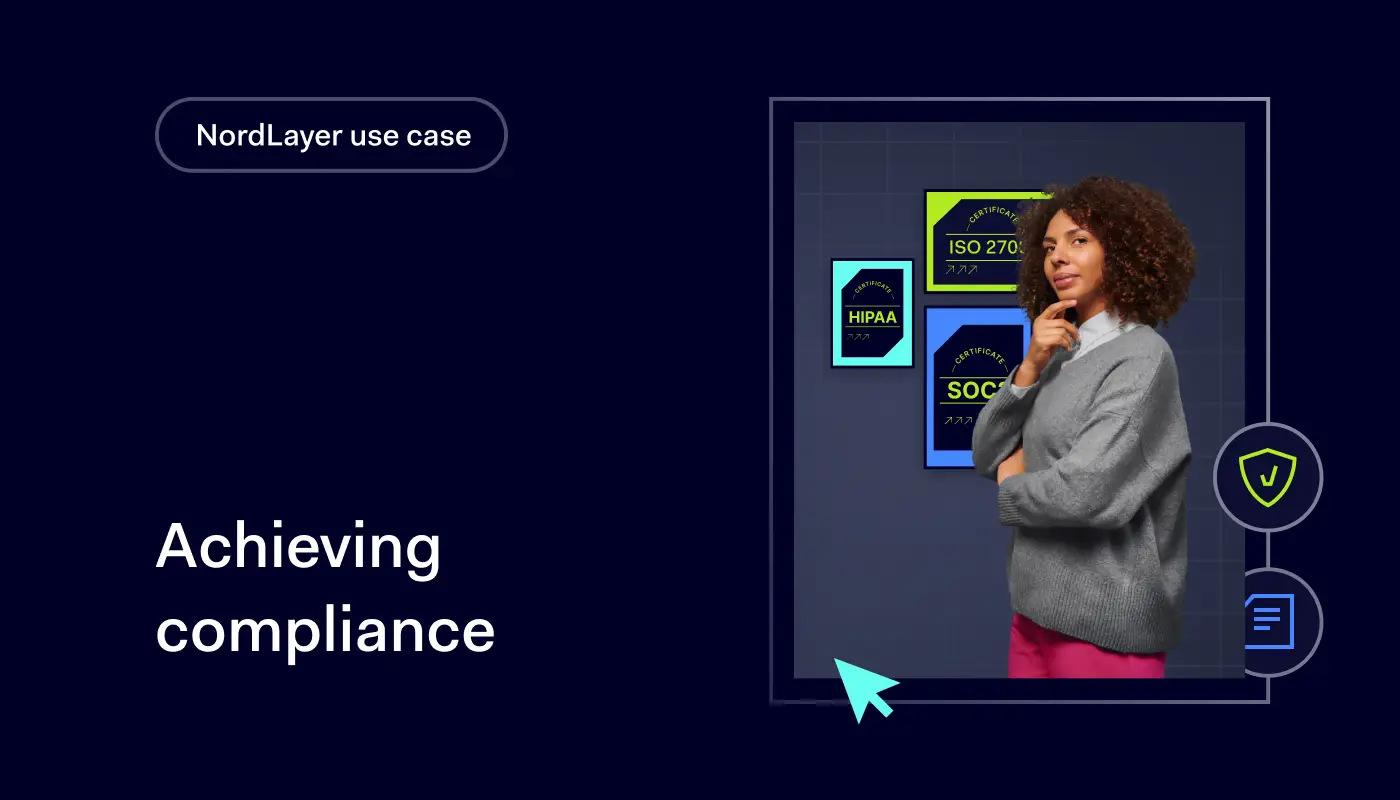
The regulatory landscape constantly evolves, and the number of cyber-attacks is rising. Organizations face the challenge of meeting strict and complex requirements for cybersecurity compliance. It is essential for companies to comply with the standards and regulations regarding the safety of information and data privacy that are relevant to the industry and global or local laws. 

This article will help you navigate through the compliance protocol labyrinth and show why implementing adequate solutions minimizes the risk of data breaches.

Reasons for complying with security regulations

Cybersecurity compliance is crucial for all companies, regardless of their size. The IBM Data Breach Report found that in 2022, 83% of organizations impacted by IT incidents had multiple data breaches. Neglecting to invest in robust cybersecurity measures leaves vulnerabilities open to malicious actors and increases the risk of non-compliance.

Why should your organization prioritize security regulations?

Avoiding fines and penalties

To protect access to your sensitive data, you must stay up-to-date with industry-specific compliance requirements. Non-compliance can result in substantial fines. The regulatory controls vary depending on the business’s location or data processing practices.

Some common compliance regulations include:

  • European General Data Protection Act (GDPR)

  • Health Insurance Portability and Accountability Act (HIPAA)

  • Payment Card Industry – Data Security Standard (PCI-DSS)

  • International Standard to Manage Information Security (ISO 27001)

  • System and Organization Controls Standard (SOC TYPE 1 and 2)

Building your business reputation

Companies with access to confidential data are at a greater risk of becoming a target for cybercriminals. Protecting sensitive information is vital for maintaining your customers’ trust and enhancing your organization’s reputation. Potential data leaks or theft can cause significant financial losses and damage your reputation.

Upgrading your data management capabilities

Modern businesses need to upgrade their data management capabilities. This includes implementing encrypted data, resource management features, and access control tools like single sign-on (SSO), biometrics, and two-factor authentication (2FA).

For example, healthcare organizations must with the new HIPAA encryption requirements and ensure all sensitive patient data is unreadable, undecipherable, and unusable to unauthorized individuals or software.

The challenges of security compliance control

Regulatory compliance means following rules designed to keep organizations in line with industry-specific laws. These regulations reduce breach risks, ensure companies are transparent, and protect them from financial losses or legal penalties. Compliance also boosts an organization’s reputation, integrity, and standing in the industry. Our comprehensive guide on compliance gives you a bigger picture of this important topic.

Non-compliant organizations face significant penalties. For example, Uber had to pay $148 million to settle a data breach affecting 57 million riders and drivers. Equifax paid $575 million for compromising the data of approximately 147 million people. Violating the General Data Protection Regulation (GDPR) can result in fines of up to $ 23 million for companies with EU citizens in their customer base.

Before discussing ways of reducing risks and implementing cybersecurity controls, it’s essential to understand the challenges your organization needs to overcome in security compliance control.

Challenge 1: evolving security environments

Security threats and compliance demands are constantly changing. New regulations are introduced to address emerging cyber risks, making your organization promptly adapt and adhere to updated controls.

Challenge 2: distributed workforce and endpoints

The remote work model has expanded the attack surface, making endpoints the epicenter of threats. Managing and securing many employee devices presents a challenge for any organization.

Challenge 3: larger teams

Coordinating teams and infrastructures across an extensive working environment complicates compliance management.

Additionally, a data breach can result in higher costs and impacts many individuals.

Challenge 4: multiple regulations

Irrespective of the industry, your business must follow many rules and regulations. And companies with employees in different countries must meet compliance regulations specific to each location. For example, processing payments through point-of-service (POS) devices necessitates compliance with the Payment Card Industry Data Security Control Standard (PCI DSS) standards.

Challenge 5: outdated technologies

Relying on manual methods such as spreadsheets and file shares for compliance updates is time-consuming and falls short of cybersecurity requirements. Keeping up with the changing industry regulations demands advanced tools to maintain secure data protection environments.

Understanding compliance protocols

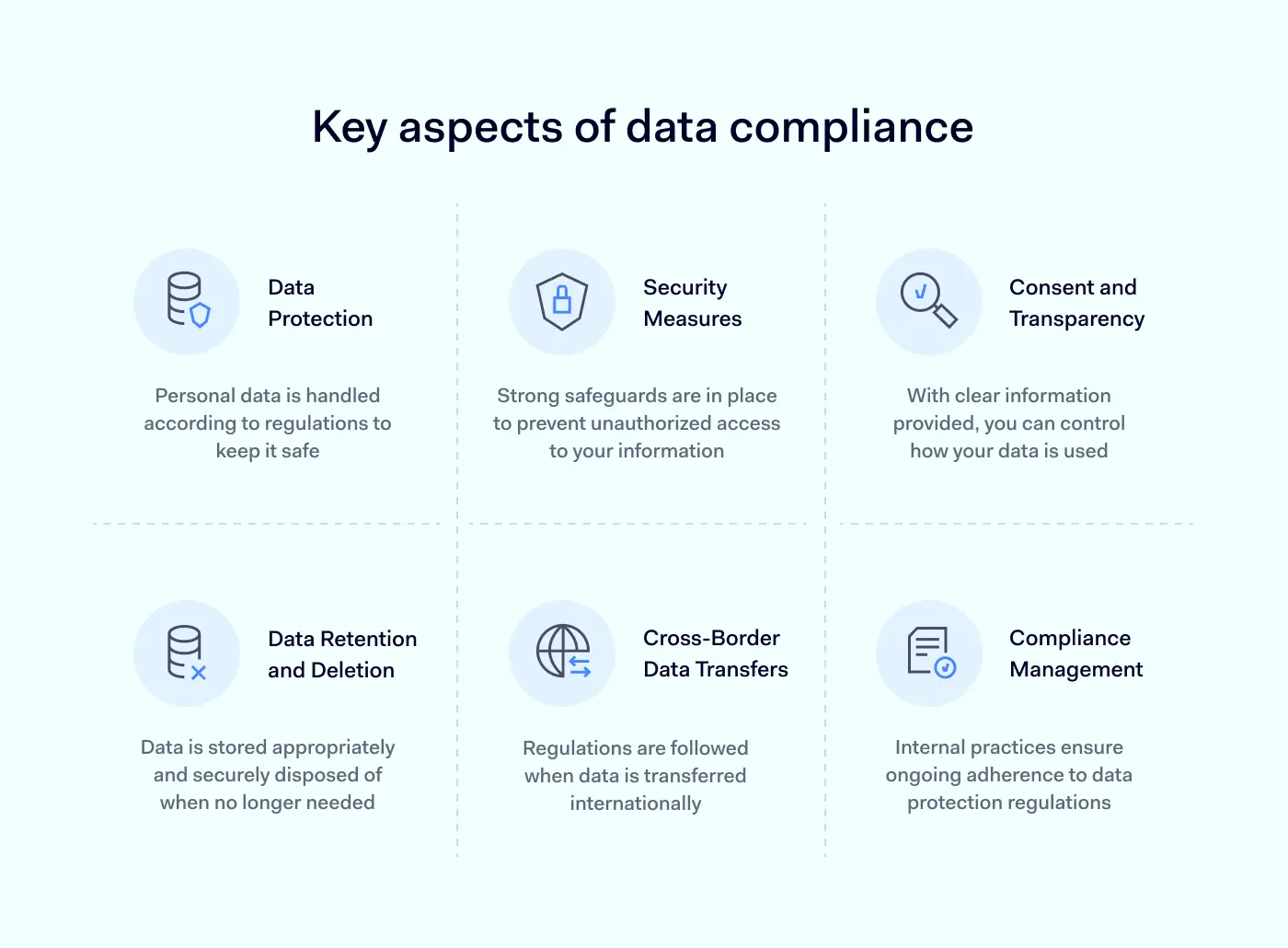
Compliance rules cover various areas, including data privacy and financial reporting, with variations based on industry and location. Ensuring effective compliance with industry-specific regulations can be complex. Through security compliance management, you can bring security and compliance together.

Let’s now explore major compliance protocols that focus on protecting sensitive data, such as personal information, health records, and payment details.

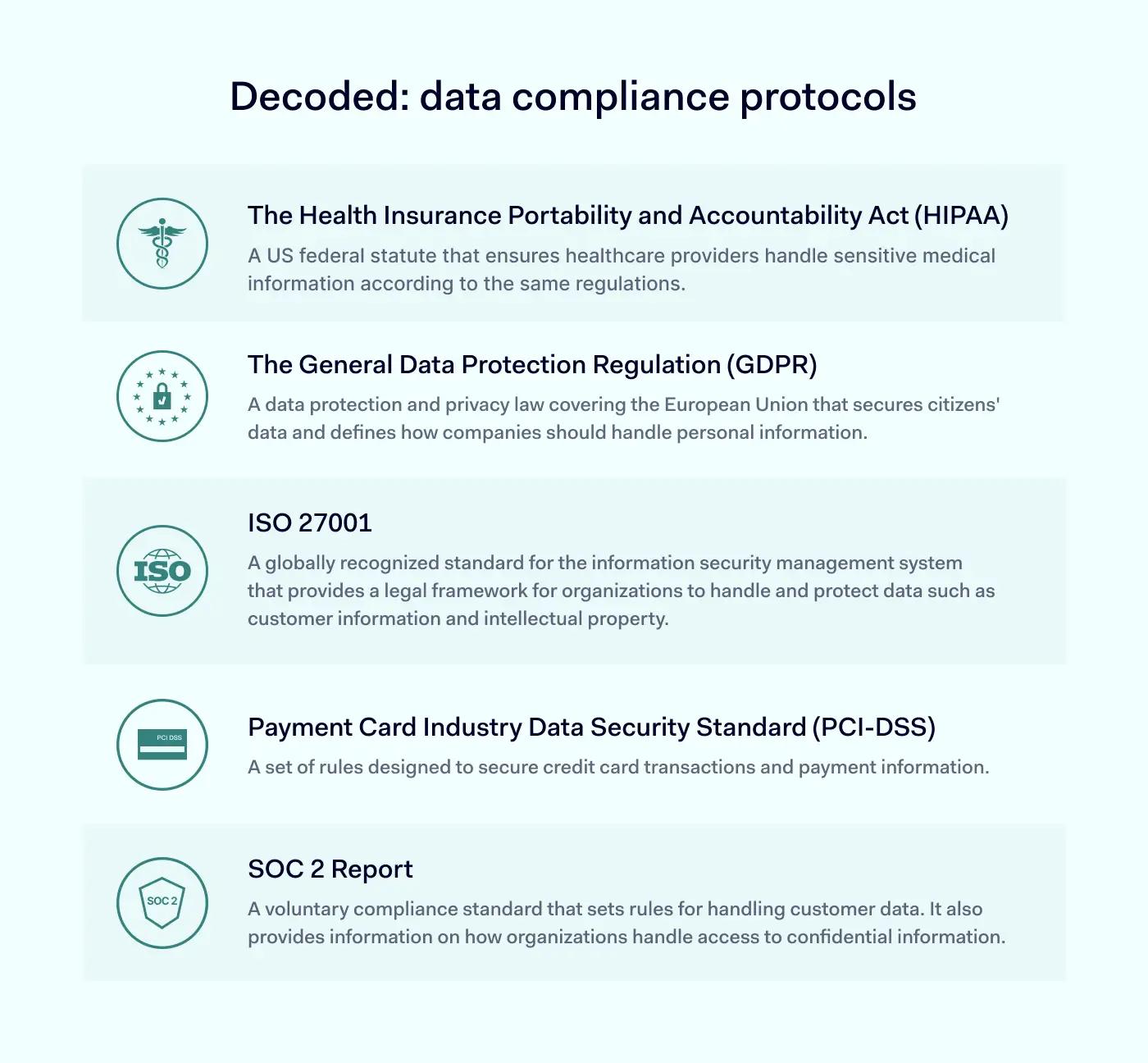
Decoded data compliance protocols

HIPAA

What is it?

HIPAA, or the Health Insurance Portability and Accountability Act, is a federal law in the United States that ensures healthcare providers handle sensitive medical information according to the same regulations. It consists of four rules that provide guidance on achieving HIPAA compliance.

Best practices for HIPAA compliance

  • Familiarize yourself with the HIPAA requirements.

  • Create a HIPAA compliance checklist.

  • Identify and classify your sensitive data.

  • Establish access controls and implement safeguards for Protected Health Information (PHI).

  • Consider using a network access solution like NordLayer for easier HIPAA compliance.

With NordLayer’s HIPAA-compliant solution, you can meet healthcare industry regulations without requiring complex advanced setups or lengthy deployments. Gain secure access to every endpoint in your organization, locking down essential apps and databases while maintaining user-friendly accessibility.

GDPR

What is it?

The GDPR, or the General Data Protection Regulation, is a data protection and privacy law that applies to the European Union (EU) and European Economic Area countries. It focuses on protecting the personal data of European citizens and imposes requirements on how companies should handle such information.

The GPDR enables EU citizens to manage their personal data without restrictions. A company must get an individual’s consent before ensuring confidentiality and safety for any data processing activities. Also, the organization informs the affected person and the right institutions in case of a breach.

Best practices for GPDR compliance

  • Get familiar with a GPDR compliance checklist for companies.

  • Appoint a Data Protection Officer to stay updated on the GPDR requirements.

  • Partner with a trusted security service provider.

  • Map out your  GPDR compliance strategy and determine what security measures your company needs.

NordLayer’s compliance solutions are user-friendly, requiring no hardware and offering easy deployment, start, and scalability. One of our solutions, Zero Trust Network Access, provides enhanced security through multilayered network access control. With our Virtual Private Gateway, your traffic is encrypted, and your identity remains hidden while connecting to a public Wi-Fi. Our secret remote access solutions, such as Secure Remote Access and site-to-site connections, ensure secure and convenient remote access to devices and networks.

ISO 27001

What is it?

ISO 27001 is a widely recognized global recognized standard for information security management systems. It provides a framework for organizations to handle and protect various data types, including intellectual property, customer, employee, and financial information.

The regulations outlined in  ISO 27001 emphasize the importance of identifying and managing cyber risks, implementing security controls, and monitoring the system 24/7.

Best practices for ISO 27001 implementation

With Nordlayer’s solutions, you can ensure your data is encrypted and only known devices access your network and prevent unauthorized access with network segmentation or a Zero-Trust access model.

PCI-DSS

What is it?

PCI-DSS, or Payment Card Industry Data Security Standard, is a set of rules designed to protect credit card transactions in the payment industry. It focuses on managing risks associated with payment information and requires organizations to implement security controls, such as encryption and access controls, to safeguard cardholder data throughout the transaction process.

Best practices for PCI-DSS implementation

  • Review the PCI-DSS compliance checklist.

  • You can then assess your systems and processes to identify vulnerabilities.

  • Assess systems and princesses for vulnerabilities.

  • Deploy security measures aligned with PCI-DSS requirements, such as a firewall, traffic encryption, and restricting access to your confidential data

SOC 2 report

What is it?

SOC 2 is a voluntary compliance standard developed by the American Institute of Certified Public Accountants (AICPA) to ensure businesses handle sensitive customer data securely. It provides insights into how a company and its partners manage and secure access to confidential data.

There are two types of SOC 2 reports:

  • SOC 2 Type I describes the organization’s systems and ensures they follow relevant trust principles.

  • SOC 2 Type II describes the operational efficiency of the system.

Best practices for SOC 2 report

To ensure a successful SOC 2 report and that your valuable customer data and privacy are well-protected, you must implement robust security measures like monitoring, access controls, and encryption.

NordLayer has gone through an independent SOC 2 Type 1 audit. What does it mean for your business? It means that all NordLayer’s tools provide adequate security controls to manage customer data and protect privacy.

How NordLayer helped a full-stack insurtech secure data

Rey. id, first Indonesia’s insurtech start-up is an insurance platform offering various healthcare services, including online and offline doctor consultations. As Rey deals with sensitive and regulated data, it was crucial for them to put appropriate security controls in place.

Rey needed a trusted system that meets the Indonesian regulatory requirements and safely store all data for 25 years. Using NordLayer, Rey seamlessly integrated their systems, enabling secure connections to their app and cloud servers. The hardware-free Business VPN service is now mandatory for Rey’s employees based on their job roles and access permissions, and it requires minimal resources for setup and maintenance. Rey also implemented Standard Operating Procedures (SOPs), including Single Sign-On (SSO) for user authentication.

Rey’s team can easily manage new employees, allowlist IP addresses for new servers, and assign specific task groups based on their needs, like code uploading and system deployment. This simplifies the VPN configuration process within the infrastructure, removing its complexity.

With NordLayer, Rey combined security measures with compliance standards, effectively reducing data breach risks. These strong security solutions helped Rey achieve ISO 27001, a huge milestone for a young company like theirs, ensuring the secure handling of confidential data.

Actionable tips and best practices for compliance

Maintaining regulatory compliance in today’s hybrid and remote work environment has become increasingly challenging. Here are some practical tips to help your organization secure access to your sensitive data and ensure compliance.

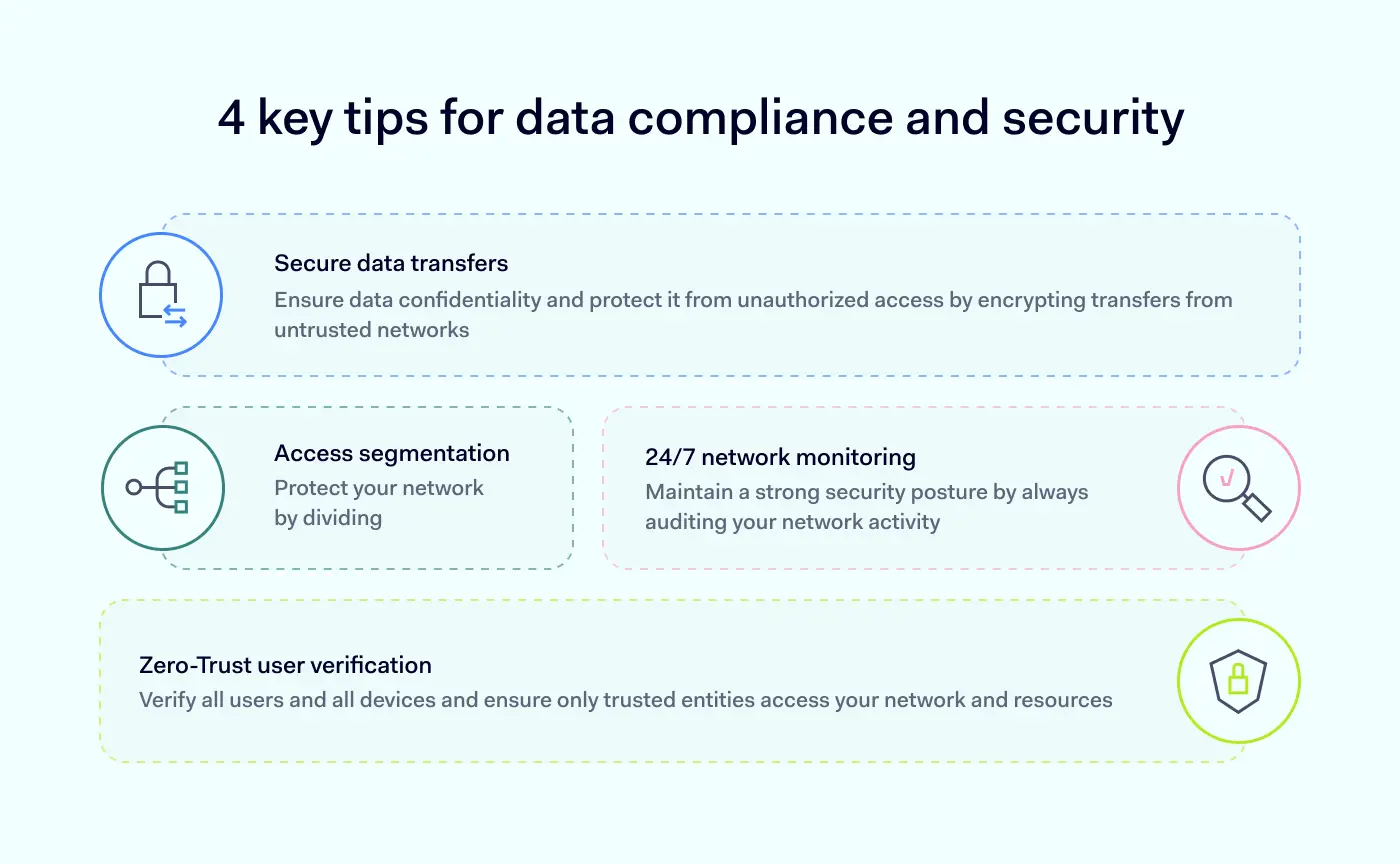
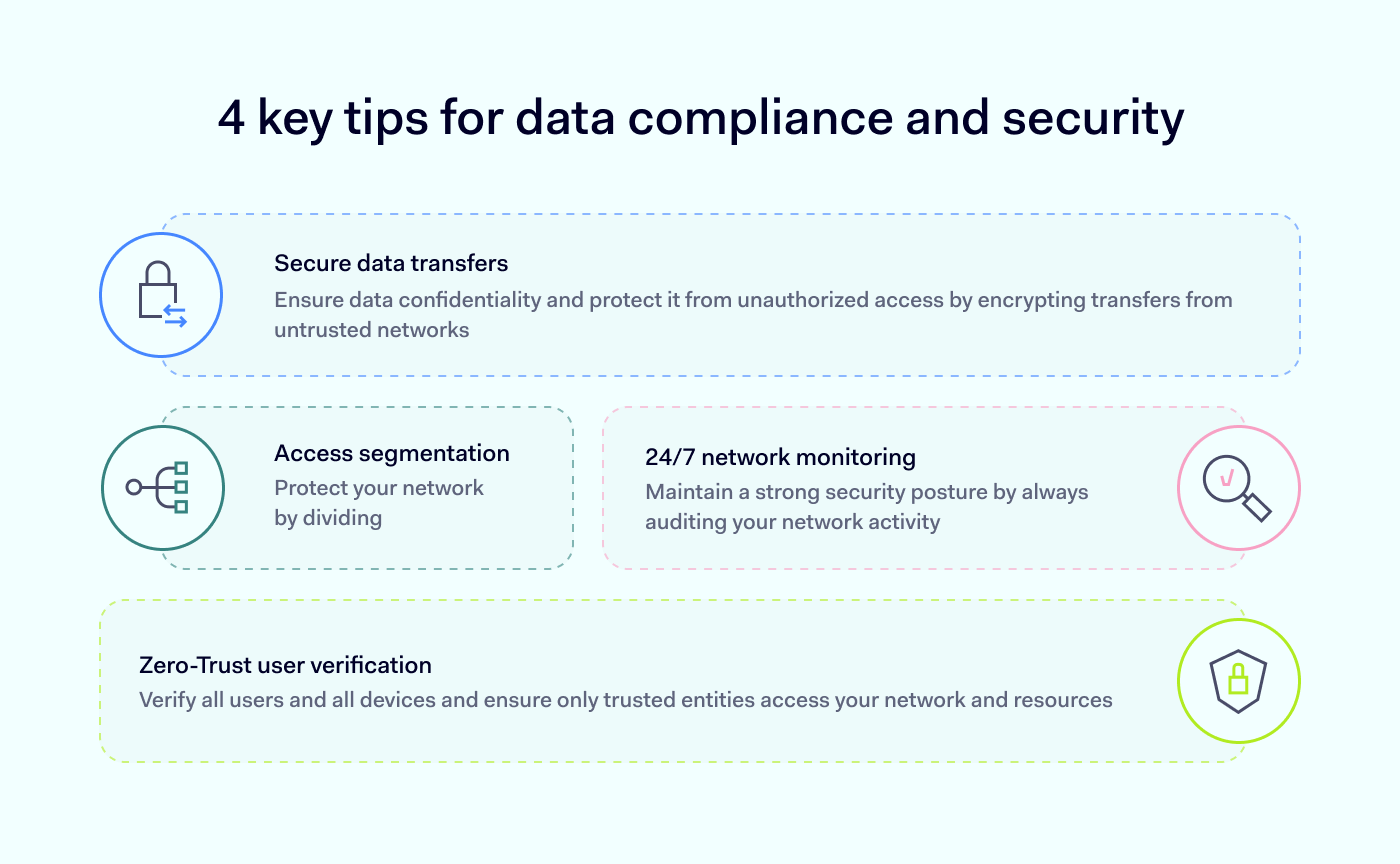
4 key tips for data compliance and security

  • Encrypt data transfers from untrusted networks. Encryption helps you safeguard data confidentiality, protecting it from unauthorized access. This is particularly crucial for healthcare providers, partners, and subcontractors dealing with Protected Health Information.

  • Monitor and audit your network activity 24/7. With efficient monitoring, logging, and auditing solutions, you can track secured connections, detect anomalies and prevent security incidents.

  • Allow only trusted devices to connect to your internal network. You can ensure the network’s security and health by monitoring and accessing devices based on predefined security rules. Receive notifications about non-compliant devices to take appropriate measures.

  • Implement access segmentation to protect resources and limit cybercriminals’  movement within your network in the event of a breach. Network segmentation enables you to allocate resource access using private gateways, enhancing overall network security.

  • Adopt a Zero-Trust solution to strengthen your network safety. This model ensures that only authorized users can access protected data by implementing strict security measures like 2FA, SSO, and biometrics. With this trust-noone-verify-all approach, you can enhance the safety of your network and safeguard your data.

How can NordLayer help your organization achieve compliance?

Modern organizations face now complex digital security rules and regulations. Poor security compliance exposes businesses to risks, including regulatory fines, reputational damage from data breaches, and financial losses.

As you embark on your way to compliance, you must familiarize yourself with the specific regulations relevant to your industry. For example, healthcare organizations should comply with HIPPA, while companies operating within the European Union must adhere to the GDPR.

NordLayer provides advanced and reliable tools that help organizations merge security and compliance effectively. By integrating our solutions into your compliance strategies, you can secure access to sensitive data. Whatever sector your organization operates in, NordLayer can assist in achieving compliance.

To begin your compliance journey, get in touch with our team. Whether you need ISO 20007 certification, HIPAA compliance, or adherence to the GDPR, we are here to support you on every step of the way.

About Version 2 Digital

Version 2 Digital is one of the most dynamic IT companies in Asia. The company distributes a wide range of IT products across various areas including cyber security, cloud, data protection, end points, infrastructures, system monitoring, storage, networking, business productivity and communication products.

Through an extensive network of channels, point of sales, resellers, and partnership companies, Version 2 offers quality products and services which are highly acclaimed in the market. Its customers cover a wide spectrum which include Global 1000 enterprises, regional listed companies, different vertical industries, public utilities, Government, a vast number of successful SMEs, and consumers in various Asian cities.

About NordLayer
NordLayer is an adaptive network access security solution for modern businesses – from the world’s most trusted cybersecurity brand, Nord Security.

The web has become a chaotic space where safety and trust have been compromised by cybercrime and data protection issues. Therefore, our team has a global mission to shape a more trusted and peaceful online future for people everywhere.

×

Hello!

Click one of our contacts below to chat on WhatsApp

×