Sustainability: More than green energy, tech stacks must be efficient

Keepit’s holistic approach to sustainability pushes beyond only using green energy options: it’s about maximized efficiencies from our purpose-built architecture perfected for protecting and storing SaaS application data in the fastest, most efficient way possible. 


So, let’s look into how we consider sustainability in the data protection and backup industry, the design choices Keepit has made to be fast and efficient (like deduplication and incremental backup), as well as the challenges legacy systems face in regard to sustainability.

Introduction 


What is sustainability in a context where energy consumption must happen? And by “must happen” I mean — in our very real example — for critical services like data protection and backup that’s required by law (think compliance with NIS2, HIPAA, GDPR) and crucial for businesses ensuring operations and continuity. 


Keepit, the only vendor-independent cloud data protection specialist (think air gapping with a separate logical infrastructure, in line with the 321 backup rule), not only leads the way for greener solutions by way of substantially better efficiency, but also demonstrates that performance and profitability don’t have to take a backseat to environmental stewardship.

This article explores Keepit’s comprehensive approach to sustainability, focusing on its commitment to minimizing resource consumption while delivering industry-leading data protection of essential services and critical infrastructure. 


From efficient technology stack design to innovative data management practices, Keepit exemplifies how sustainability can be integrated into every aspect of operations, often leading to some beneficial “side effects” I’ll talk about below. 


This article sheds light on the importance of responsible resource utilization in the tech industry and offers insights into practical strategies for achieving unmatched environmental sustainability and performance capabilities.

Let’s look into how we integrate sustainability considerations into our data protection and backup services operations.

Sustainability in data protection: Maximize performance and efficiency to minimize use

Delivering any service, including this one, will consume resources and there’s just no way around that. So, what we try to do here at Keepit is to make as much positive impact with our customers as we can by not only delivering a great service (that they’re often obligated by law to have) but delivering that same high level of service with the least negative impact for the world and future generations, in regards to energy use and energy origin. 


Sustainability for us, as I see it anyway, means being responsible in our consumption of resources because there’s absolutely no way around consuming resources. So, for us at Keepit, we built our technology stack from the ground up specifically for solving these exact problems that we’re solving in the most efficient way possible. 


And with efficiency here, I mean broadly, so it’s in terms of how much physical equipment we need, how much space do we need to consume, how much power we consume, and how many people we need to run this business. In that light, you can say that a sustainable business is also going to be a more profitable business because minimizing resource consumption not only reduces environmental impact but also lowers operational costs, ultimately leading to increased profitability. 


Let’s look into the keys of consumption and sustainability.

Sustainable resource consumption

To us at Keepit, there’s an emphasis on the understanding that every action leaves an impact, and because of this, we define sustainability as being responsible for resource consumption. This includes a commitment to minimizing the footprint left by the company’s operations. 


The company acknowledges that, given the nature of its services, resource consumption is inevitable, and therefore sustainability, in the context of Keepit, means making conscious and responsible choices to mitigate the environmental impact associated with its operations. So, what do we do to make a difference and to limit our impact? 


What makes Keepit green: Technology stack and efficiency 


Beyond running data centers with 100% renewable energy, we take pride in having constructed our technology stack from the ground up, specifically designed to efficiently address data storage challenges. This approach reflects a commitment to optimizing resource utilization and delivering a service that is not only effective but also resource efficient. 


Efficiency, in Keepit’s view, extends beyond environmental considerations to include broader aspects such as the physical equipment required, space utilization, power consumption, and the personnel needed to operate the business. This holistic approach ensures a sustainable business model — and a profitable one, like mentioned above. 


Now, how do we take on the tough task of being sustainable and high performing? 


By starting from a clean slate. We built this system specifically for storage, protection, and management of cloud SaaS data. So, we built up this entire technology stack specifically for the purpose of delivering exactly the service we’re delivering — cloud backup in the cloud, for the cloud, and so it does this “one thing” extremely well and efficiently. 


And one of the things we did is that, well, we did what Amazon, Microsoft, and Google do: We built up this whole cloud infrastructure. We have full ownership of our technology stack instead of building on top of middleware that runs on top of middleware that runs on top of abstractions and virtualizations and other layers that all add overhead. 


We avoid unnecessary complexity by being purpose built, and therefore we use less storage space, need less processing power due to fewer operations, and use fewer human resources to run it all. 


Predictable costs as a wonderful “side effect” 


With full ownership of our technology stack, we have precise insights into the costs associated with running our operations. When a developer writes a piece of code that inefficiently utilizes resources, it’s something the operations team will see, and it directly impacts them. Efficiency and sustainability are integral parts of our culture, so we address these inefficiencies by writing “better” code. 


We don’t just elastically spin up some additional set of servers and try to solve the problem with a credit card. But that’s exactly how a lot of people approach this — that’s how a lot of competitors approach this. It may offer immediate relief, but that type of short-sighted solution fails to align with our company culture and long-term goals. 


It’s enormously inefficient both from a bottom-line perspective and from a sustainability perspective. And it doesn’t fix the problem. It just kind of scribes it further in the future — kicking the can down the road. So, whatever you’re paying for with your credit card now are inefficiencies that you’ll be paying for again and again into the future. 


They fix the problem with money, but in terms of efficiency, it’s not an action done for the betterment of future generations. They waste energy every single CPU cycle — and they’re also paying for that bigger bill every billing cycle thereafter. 


Not only does that power need to come from somewhere, but so does the money to pay for it, which is either passed on to their customers or covered with venture capital. 


What these companies are left with is a band-aid solution that’s going to consume more energy and cost more month after month after month — basically for as long as they exist. And on any consumption-based model, the costs will be continually growing with datasets. 


Lean, green, backup machine: 99% power saving 


Like I mentioned, when we started, we weren’t bound to use any specific technology, so we started with a clean slate. The programming language we chose for the majority of our technology stack is a very efficiently compiled language (you can read my blog post about it.) And if you compare that to common languages, you know, if you go online and say, “hey, I’m building this upstart company on the net, what technology stack should I use,” the advice you will get there is very different from what we chose to go with. 


And because of that decision, it means that we’re something like 30 to 100 times more efficient. So, for doing one specific operation, if I program that in the technology that we’re using versus if I program that in one of these most common, most hyped technologies, we have a 30 to 100 times change in CPU resource utilization, which also translates directly to power consumption. 


So, if we had done what everyone else was doing, we would’ve consumed something like 100 times more power than we do today and that’s huge. Can you imagine achieving a 99% power saving? That’s basically what we started out doing. 


From that perspective, it’s now more difficult for us to make additional power savings since we’re already so efficient. Sure, it looks good when companies boast “15% energy savings,” but another way of looking at that — and we do from our perspective — is that their waste was high, their tech stack wasn’t lean. Of course, it’s good that they improve, but they’re still not even close from an efficiency standpoint. 


Reducing consumption with incremental backup and deduplication 


If you look at the core service that we provide, we make a copy of your data set a couple of times a day. We keep that copy for as long as you want as a customer company. Some companies need seven years of retention, some need 20 years of retention, and some even pay for 100 years of retention. Data retention really depends on the industry you’re in and and where you operate and all that. 


In theory, we keep complete copies of your entire data across two separate, mirrored locations for, let’s say, 100 years. In theory. In reality, we’re smart about this, because it wouldn’t be feasible to transport your entire data set every day. 


Not only would it not be feasible, there’s also no need to do that because of incremental backup. TechTarget defines incremental backup as “a backup type that only copies data that has been changed or created since the previous backup activity was conducted. By only backing up changed data, incremental backups save restore time and disk space. Incremental is a common method for cloud backup as it tends to use fewer resources.” 


At Keepit, we utilize incremental backups. We transport only the differences, such as edits, that have happened since the original backup was completed. And this also means that we don’t duplicate your entire data set multiple times every day, we just transfer the changes. How does this reduce consumption? Let’s consider an example: 


If you have one unchanging file and we hold that in our backup set for, let’s say, 1,000 backups, then we will have only one instance of the file. We refer to that original file in each of those 1,000 backup sets, but we will storage only one instance.

It’s stored once, but that file is pointed to in each of those 1,000 backup sets. We’re not duplicating data needlessly. Deduplication means that we need much less storage space and can reduce network load because less data is transferred from incremental backups, and less data is held in storage because of deduplication. This is all possible because every file, no matter the file type, has reliable identifiers where you can kind of say, “This is exactly the same file.” 


Let’s say I send someone a Word file and she doesn’t change it. She just saves it from my attachment, and that can be identified as being identical. Let’s expand this across an organization: If you have 1,000 employees in your company that have identical copies of this file and we have those across the 1,000 backup sets, then we will not hold what would literally be 1,000,000 copies of the file. We will again hold just the single instance of the file and there will be a million references to the file. 


Not every backup and recovery solution does it this way though, and as a result, they’re using vast amounts of energy and hardware to power these operations and then to keep all this data in storage. Even if they happen to leverage a green energy source, they’re not exactly using resources responsibly if they are using 1,000,000 times or even 1,000 times what they would with incremental backup. 


Purpose-built storage architecture 


Inherent in our storage architecture is this deduplication across both space and time. And that’s one of these initial thoughts we had and one of the earliest ideas of our storage architecture that we built for this purpose. We did sit down and build a storage foundation for this backup service from the start. We basically invented a file system or object store, if you will, for this purpose: to store these enormous data sets for decades, and we could see we needed something that we couldn’t go out and buy anywhere. We needed something that was built for purpose and so we could avoid the problems we were already seeing others have with legacy systems. 


Legacy complexities add inefficiencies 


Running this stack end to end ourselves, we avoid legacy inefficiencies as I mentioned above. If we had chosen to run on AWS (Amazon Web Services), or Azure, or Gcloud, we’d be provisioning virtual machines, and there’s a lot of complexities that get added when you’re on a virtual machine: All of those layers of middleware that we don’t have to employ. (And with the storage virtualization: If you’re on S3 or Azure blob, then you’re using very sophisticated pieces of machinery that come with great functionality and therefore great overhead. To store backups on them is like hammering in nails with a microscope — it’s perfectly doable but it’s not a very good match of tools for the job.) 


With those virtual machines, you need some automation tools and some various management software to run them reliably. So, you add that, then the virtualization middleware, and then you have some resource management middleware. You have a lot of systems, and your software doesn’t run on the computer anymore: It runs on a collection of layers that run on the computer which you may share with other customers. And ultimately, even if you don’t, Amazon or Microsoft is going to want to instrument your code enough so they can charge you for what you’re doing. So, there’s a number of inefficiencies that are introduced here. And they all translate directly to cost and power consumption.  


But, since we built and operate our own architecture, we don’t have any of those costs, complexities, or additional consumption. No one needs to instrument anything to find out what we need to pay. So, in addition to predictable costs, another happy “side effect” is that we don’t have any sub-processors, which makes vetting and compliance (with GDPR and NIS2, for example) easier for our customers, partners, and anyone else we’re in business with.  


Conclusion 

Keepit’s holistic approach to sustainability sets a commendable example for the tech industry, particularly within data protection and backup services. By prioritizing responsible resource consumption and efficiency in its technology stack design and operational practices, Keepit demonstrates how environmental sustainability can be seamlessly integrated into essential services. 


Through the utilization of deduplication and incremental backup techniques, Keepit minimizes data storage requirements and energy consumption, paving the way for a more environmentally responsible approach to data protection. Additionally, Keepit’s purpose-built storage architecture and avoidance of legacy inefficiencies further underscore its commitment to sustainability, resulting in both cost savings and reduced environmental impact. 


As we navigate an increasingly digital landscape, Keepit’s sustainability initiatives serve as a testament to the importance of balancing important factors such as regulatory compliance and business continuity with environmental responsibility. By embracing sustainable practices, Keepit not only enhances its own operational efficiency but also contributes to the broader goal of mitigating the environmental footprint of the tech industry.

In essence, Keepit’s journey towards sustainability exemplifies the potential for technology companies to lead by example, demonstrating that profitability and environmental stewardship are not mutually exclusive. As we look to the future, let us draw inspiration from Keepit’s success and strive to emulate its commitment to sustainability in all facets of our operations. 

About Version 2 Digital

Version 2 Digital is one of the most dynamic IT companies in Asia. The company distributes a wide range of IT products across various areas including cyber security, cloud, data protection, end points, infrastructures, system monitoring, storage, networking, business productivity and communication products.

Through an extensive network of channels, point of sales, resellers, and partnership companies, Version 2 offers quality products and services which are highly acclaimed in the market. Its customers cover a wide spectrum which include Global 1000 enterprises, regional listed companies, different vertical industries, public utilities, Government, a vast number of successful SMEs, and consumers in various Asian cities.

About Keepit
At Keepit, we believe in a digital future where all software is delivered as a service. Keepit’s mission is to protect data in the cloud Keepit is a software company specializing in Cloud-to-Cloud data backup and recovery. Deriving from +20 year experience in building best-in-class data protection and hosting services, Keepit is pioneering the way to secure and protect cloud data at scale.

Microsoft 365 Backup: What it means for SaaS data protection

At the Microsoft Ignite conference back in November 2023, Microsoft announced their release plans for their Microsoft 365 Backup service. Now that they’re in a paid public preview, with general availability being slated for basically now (first quarter, calendar year 2024), I thought “what better time than now?” to share my takeaways and what I believe this milestone means for SaaS data protection now and going forward. Here are three main points I’ll cover:

  • Welcome Microsoft to the backup space; 
  • What Microsoft’s backup service means for the SaaS data protection world; 
  • The Keepit promise.

Welcome to Microsoft into the backup space

First off, let’s give a warm welcome to Microsoft on their entrance to the backup space. As a long-time Microsoft community member, twenty-year Microsoft MVP, and Senior Director of Product Management at an industry-leading data protection vendor, I’d say Microsoft’s entry into the market validates what all the SaaS data protection vendors have long been saying about the strong need for Microsoft 365 data protection.

Ultimately, our mission is to protect critical SaaS data to help companies keep their business-critical data backed up, thereby ensuring continuity and compliance in face of rising ransomware threats. As long-time Microsoft partners — part of the ISV Partner Program — we at Keepit see this as an opportunity to have an even greater impact on the market. How’s that?

Well, we know that an overwhelming percentage of Microsoft’s enterprise customers have no backup. So, naturally, we want to bring that number down to boost cyber resilience of, say, critical infrastructure and critical services, and of course the market in general. So, how does Microsoft releasing their own backup help drive us forward?

Well, for one, it validates what we’ve been doing for more than 20 years. We’re built in the cloud, for the cloud, to protect cloud SaaS data. I guess a bit more practically speaking, another change is that we can now probably drop the top objection we faced from customers over that time: That cloud SaaS data doesn’t need backup.

What does Microsoft 365 Backup change? 

Now, let’s get into point two: What does Microsoft 365 Backup mean for SaaS data backup? Well, all the vendors in this space have long had to challenge the popular notion that data being in the cloud was, by default, automatically and perfectly protected. And many of us have talked at length about Microsoft’s shared responsibility model where Microsoft themselves clearly state that you, the customer, are responsible for backup of information and data, including your devices and accounts and identities.

Microsoft has built an amazing record of service quality and resilience, but their primary focus has been on protecting your data against Microsoft losing it. The Microsoft 365 Backup offering is the start of Microsoft’s journey into protecting your data against other threats, including malicious attacks, mistakes, misbehaving automations, and other misfortunes.

The optimist in me hopes that now, with Microsoft themselves developing their own backup service, we can finally put the shared responsibility model into its proper perspective. Of course you need to back up your Entra ID, M365, and other SaaS application data because clearly you are responsible for your data. Why else would Microsoft release a backup service if you weren’t responsible for it all along?

Now, aside from that original objection that perhaps can be laid to rest, at this point, not that much has actually changed with Microsoft’s announcement. That said, there sure is a newly awakened interest in data protection because of this release. This is how I see the typical train of thought playing out in response to the news:

  • We clearly need to back up our Microsoft SaaS app data. Why else would Microsoft be offering a backup service themselves?
  • Protecting our data is important because it helps us meet our business continuity and compliance requirements, but
  • To meet those requirements, we need our data available 24/7.

Let’s dive down a bit more into that last point there. How does a business guarantee access to their data no matter what happens, be it mistakes, mishap, or malice (like ransomware)? The answer is true backup.

The Keepit promise: True backup for cyber resilience 

To get to the Keepit promise, we first need to consider what the meaning of backup is. You might come across the term true backup (we use it ourselves from time to time) because ‘backup’ alone has been misused to cover things that it shouldn’t.

The canonical meaning of backup refers to storing instances of your data on an infrastructure separate from your primary data. If something should happen to your production data, your backups won’t be affected since they are separated by a physical or logical air gap.

In cloud computing, a lot of what’s being called backup is actually storing data on the same cloud as the primary data. What this means is that whatever risks you’re exposed to in your production environment would also impact your ‘backup’ data since there’s no separation. For example, an attacker who can penetrate your Entra ID tenant and can pivot into your Azure tenant holds all your Azure-based storage — including, and especially, backups — at risk.

The Keepit promise is to always offer the ultimate in data protection for multi-workload SaaS application data. By building our solution from the ground up for SaaS data protection only, we were able to create an optimized data protection solution in line with best practices like the 321 backup rule. Air gapping, immutability, and a fully redundant independent cloud are all things we’re already offering now in our service. So, it’s more the Keepit reality rather than the promise of adding in things later.

Protecting SaaS data is the Keepit mission and has always been — it’s not a feature we’re tacking on. As specialists in data protection, we provide confidence to thousands of customers that their data is here today and will be here tomorrow via our vendor-independent cloud. We look forward to working with Microsoft now and into the future to continue to lead the way in protecting SaaS data.

As we embark on this new chapter in SaaS data backup, I’d like to leave you with a question: What steps are you taking today to protect your control plane (Entra ID and Power Platform)? If you want to learn a bit more about control plane data protection, read my previous article on why you should back up Entra ID (Azure AD) in the cloud.

About Version 2 Digital

Version 2 Digital is one of the most dynamic IT companies in Asia. The company distributes a wide range of IT products across various areas including cyber security, cloud, data protection, end points, infrastructures, system monitoring, storage, networking, business productivity and communication products.

Through an extensive network of channels, point of sales, resellers, and partnership companies, Version 2 offers quality products and services which are highly acclaimed in the market. Its customers cover a wide spectrum which include Global 1000 enterprises, regional listed companies, different vertical industries, public utilities, Government, a vast number of successful SMEs, and consumers in various Asian cities.

About Keepit
At Keepit, we believe in a digital future where all software is delivered as a service. Keepit’s mission is to protect data in the cloud Keepit is a software company specializing in Cloud-to-Cloud data backup and recovery. Deriving from +20 year experience in building best-in-class data protection and hosting services, Keepit is pioneering the way to secure and protect cloud data at scale.

Keepit Partner Network: Growing partnerships to the next level

Leading the way with vendor-independent data protection

When I started in Keepit in July 2023, I knew that I was joining a very special company. Not only does the company have a great product, but it also has a great partner ecosystem and the two are key to having an impact on the market.

At the heart of data protection specialist Keepit’s success lies indeed a resilient and purpose-built cloud infrastructure — and also many long-lasting partner relationships.

The company’s platform, exclusively owned and operated independently from other cloud vendors, signifies a revolutionary shift in data protection strategies. Serving as the ultimate safeguard against potential data loss resulting from security incidents or unforeseen events, Keepit ensures that its partners empower clients to maintain control over their critical SaaS data.

And it’s not just a few workloads that we cover: Keepit’s unique easy-to-use platform ensures business-critical SaaS data from multiple SaaS applications, like Microsoft 365, Entra ID (Azure AD), Salesforce (and others) is kept immutable, accessible, and compliant with even the strictest of requirements. Learn more about Keepit’s security and compliance.

Keepit’s impressive scaling secures $40 million from HSBC Innovation Banking

On Jan. 9, 2024, Keepit announced that HSBC Innovation Banking has provided Keepit with a $40 million refinancing package together with The Export and Investment Fund of Denmark (IEFO). The fresh capital is earmarked to sustain the impressive growth trajectory and substantial expansion strategy of Keepit.

Keepit CEO and co-founder, Morten Felsvang, shares that the funding “is an infusion of confidence in our capabilities on all levels. And it means that we can continue our growth strategy at full throttle.”

Partners prove invaluable to Keepit’s growth and success

The Keepit Partner Network (KPN) highlights the company’s dedication to its channel ecosystem. Tailored for resellers, managed service providers, and distributors, this program elevates partner engagement with its tiered structure, ensuring customized support for diverse partner needs.

KPN is designed to propel partners toward unparalleled success within data protection together with Keepit. The recognition of Keepit with its addition as a scaler in the Canalys “Global Managed Backup and Disaster Recovery Leadership Matrix 2023” report underscores the program’s rapid growth and our outstanding performance. 


And in support of that commitment to growth, we’re setting our sights on crossing over into the coveted Canalys “Champions” category on our impressive journey by adopting a partner-only model. 


Keepit’s Partner Network emerges not just as a program but as a strategic cooperation for the future. Partners get the chance to be a hero for customers by offering them award-winning, next-level SaaS data protection that’s transparent in cost and incredibly easy to set up, onboard, and use. 

About Version 2 Digital

Version 2 Digital is one of the most dynamic IT companies in Asia. The company distributes a wide range of IT products across various areas including cyber security, cloud, data protection, end points, infrastructures, system monitoring, storage, networking, business productivity and communication products.

Through an extensive network of channels, point of sales, resellers, and partnership companies, Version 2 offers quality products and services which are highly acclaimed in the market. Its customers cover a wide spectrum which include Global 1000 enterprises, regional listed companies, different vertical industries, public utilities, Government, a vast number of successful SMEs, and consumers in various Asian cities.

About Keepit
At Keepit, we believe in a digital future where all software is delivered as a service. Keepit’s mission is to protect data in the cloud Keepit is a software company specializing in Cloud-to-Cloud data backup and recovery. Deriving from +20 year experience in building best-in-class data protection and hosting services, Keepit is pioneering the way to secure and protect cloud data at scale.

NIS2 directive: A key to compliance is business continuity

As the timeline to implementation of the NIS2 directive shortens, businesses find themselves contemplating the necessary steps for implementing robust cyber security and IT compliance. The impending deadline of October 17, 2024, necessitates a strategic approach to meet the regulatory requirements outlined in NIS2. 

This article provides actionable insights into how organizations can proactively prepare for NIS2 compliance, with a particular focus on backup management and disaster recovery as integral components for ensuring business continuity — a key focus of the new directive, specifically article 21.

Let’s jump into the essential steps businesses can take now to fortify their defenses against cyber threats by following a best practice framework.

If you’re looking for a general overview of all things NIS2, such as who does NIS2 apply to, read our blog, “What is the NIS2 Directive?”

What to do now: Get your business ready with best practices

Article 21 of the NIS2 directive sets out clear cybersecurity risk-management measures “to protect network and information systems” that focus on ensuring business continuity through “backup management and disaster recovery.”


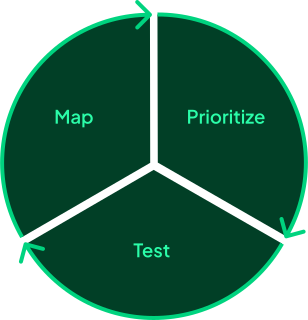
At the minimum, the best practice would be to back up vital data, create a strong disaster recovery plan, and then test these processes to know that they work as expected (meaning you have protected your business-critical data and it can be recovered). Luckily, to help elaborate on this practice, there’s a framework to follow to help guide you through the process: Map, prioritize, test.

Map-prioritize-test framework for NIS2 directive compliance backup and disaster recovery

Map-Prioritize-Test framework to ensure compliance

This framework is helpful for businesses to prepare for compliance with the expected NIS2 requirements by boosting cyber resiliency, most notably by maintaining business-critical functions through protecting key business infrastructure. Here’s more detail about what each leg of the framework entails:

1. Map critical systems

Assess and analyze critical infrastructure across on-premises, native cloud, and public cloud environments. Identify and prioritize crucial data, ensuring business continuity. Don’t overlook SaaS applications like Entra ID; safeguarding identity and credential data is vital.


Neglecting identity and access data can impact business continuity even if other data is fully restored. Microsoft recognizes identity systems as more critical than human life support systems due to how important this data is for businesses: Read what Microsoft has to say about the importance of backing up Entra ID (formerly Azure AD).

2. Prioritize: What is critical to maintain access to?

Understanding the nature of your data is key to strengthening your organization’s data resilience. As you consider the types of data you handle, such as SaaS data from Microsoft 365 (M365) or Entra ID, it becomes evident that not all data holds equal importance. This realization forms the basis for strategic prioritization, a critical step in preparing for NIS2 compliance.


Whether safeguarding CEO emails, logistics data, customer information, intelligence dashboards, or proprietary code, identifying the priority for recovery establishes a strategic foundation. This speeds up recovery time and minimizes downtime, ensuring that your business continuity efforts are precisely aligned with the specific datasets crucial for sustaining your operations.
By determining what needs to be recovered first, you ensure that your business continuity efforts are targeted and aligned with the specific data sets crucial for sustaining your operations. This strategic prioritization not only optimizes your backup plan but also enhances your preparedness for compliance with the NIS2 directive.

3. Test that your backup works

This critical phase of the framework involves validating the effectiveness of your backup and disaster recovery processes. Testing is a key element of continuity, because with regular testing, your business ensures that data recovery is possible in the event of a real crisis — this is best practice data security and compliance in line with the NIS2 framework.


Ensuring the effectiveness of your backup and disaster recovery processes is crucial for maintaining data integrity and business continuity. The following guidelines outline key steps in the testing phase, aimed at validating your organization’s readiness to swiftly recover critical data in diverse scenarios.


From prompt validation of restoration capability to involving relevant stakeholders, this comprehensive testing phase guideline ensures confidence in your disaster recovery plan and ongoing resilience against potential threats:

  • Validate restoration capability promptly:
    Promptly validate that your backup systems can efficiently restore critical data without compromising integrity.
  • Determine acceptable downtime:
    Establish the maximum allowable time for data recovery, aligning with recovery time objectives set during prioritization.
  • Regularly test backups for confidence:
    Frequently test your backups to instill confidence in your disaster recovery plan and promptly address any identified issues.
  • Consider different scenarios:
    Simulate diverse scenarios, testing the recovery of individual files, entire databases, and complete systems to identify weaknesses.
  • Document and analyze results:
    After each testing session, document and analyze the time, accuracy, and challenges encountered to gain insights for improvement.
  • Involve relevant stakeholders:
    Collaborate with IT teams, data custodians, and business continuity managers to ensure comprehensive testing aligns with broader goals.
  • Update and improve:
    Continuously update recovery plans based on testing insights, addressing weaknesses, refining procedures, and adapting to evolving threats.

As organizations diligently adhere to the rigorous testing guidelines outlined above, they pave the way for a robust IT compliance policy essential for NIS2 readiness. The elements of backup management and disaster recovery, as emphasized by Article 21 of NIS2, not only acknowledge its far-reaching impact but also serve as proactive measures against evolving cyber threats.

Keepit as an established expert in EU compliance

Keepit, being a European company based in Denmark, understands the intricacies of EU regulations and their profound impact as we’re also subject to them ourselves. We operate without any sub-processors and maintain our own independent cloud operations within the EU, utilizing data centers in Denmark, Germany, and the UK. With a commitment to excellence in compliance, Keepit holds end-to-end ISO 27001 certification and is audited in accordance with ISAE 3402 type 2.


To guide your company through the complexities of legislative directives such as NIS2, NIS, and GDPR, we invite you to explore a demonstration of how Keepit can assist in ensuring comprehensive compliance.

About Version 2 Digital

Version 2 Digital is one of the most dynamic IT companies in Asia. The company distributes a wide range of IT products across various areas including cyber security, cloud, data protection, end points, infrastructures, system monitoring, storage, networking, business productivity and communication products.

Through an extensive network of channels, point of sales, resellers, and partnership companies, Version 2 offers quality products and services which are highly acclaimed in the market. Its customers cover a wide spectrum which include Global 1000 enterprises, regional listed companies, different vertical industries, public utilities, Government, a vast number of successful SMEs, and consumers in various Asian cities.

About Keepit
At Keepit, we believe in a digital future where all software is delivered as a service. Keepit’s mission is to protect data in the cloud Keepit is a software company specializing in Cloud-to-Cloud data backup and recovery. Deriving from +20 year experience in building best-in-class data protection and hosting services, Keepit is pioneering the way to secure and protect cloud data at scale.

Keepit Partner Network: Growing partnerships to the next level

Leading the way with vendor-independent data protection

When I started in Keepit in July 2023, I knew that I was joining a very special company. Not only does the company have a great product, but it also has a great partner ecosystem and the two are key to having an impact on the market.

At the heart of data protection specialist Keepit’s success lies indeed a resilient and purpose-built cloud infrastructure — and also many long-lasting partner relationships.

The company’s platform, exclusively owned and operated independently from other cloud vendors, signifies a revolutionary shift in data protection strategies. Serving as the ultimate safeguard against potential data loss resulting from security incidents or unforeseen events, Keepit ensures that its partners empower clients to maintain control over their critical SaaS data.

And it’s not just a few workloads that we cover: Keepit’s unique easy-to-use platform ensures business-critical SaaS data from multiple SaaS applications, like Microsoft 365, Entra ID (Azure AD), Salesforce (and others) is kept immutable, accessible, and compliant with even the strictest of requirements. Learn more about Keepit’s security and compliance.

Keepit’s impressive scaling secures $40 million from HSBC Innovation Banking

On Jan. 9, 2024, Keepit announced that HSBC Innovation Banking has provided Keepit with a $40 million refinancing package together with The Export and Investment Fund of Denmark (IEFO). The fresh capital is earmarked to sustain the impressive growth trajectory and substantial expansion strategy of Keepit.

Keepit CEO and co-founder, Morten Felsvang, shares that the funding “is an infusion of confidence in our capabilities on all levels. And it means that we can continue our growth strategy at full throttle.”

Partners prove invaluable to Keepit’s growth and success

The Keepit Partner Network (KPN) highlights the company’s dedication to its channel ecosystem. Tailored for resellers, managed service providers, and distributors, this program elevates partner engagement with its tiered structure, ensuring customized support for diverse partner needs.

KPN is designed to propel partners toward unparalleled success within data protection together with Keepit. The recognition of Keepit with its addition as a scaler in the Canalys “Global Managed Backup and Disaster Recovery Leadership Matrix 2023” report underscores the program’s rapid growth and our outstanding performance. 


And in support of that commitment to growth, we’re setting our sights on crossing over into the coveted Canalys “Champions” category on our impressive journey by adopting a partner-only model. 


Keepit’s Partner Network emerges not just as a program but as a strategic cooperation for the future. Partners get the chance to be a hero for customers by offering them award-winning, next-level SaaS data protection that’s transparent in cost and incredibly easy to set up, onboard, and use. 

About Version 2 Digital

Version 2 Digital is one of the most dynamic IT companies in Asia. The company distributes a wide range of IT products across various areas including cyber security, cloud, data protection, end points, infrastructures, system monitoring, storage, networking, business productivity and communication products.

Through an extensive network of channels, point of sales, resellers, and partnership companies, Version 2 offers quality products and services which are highly acclaimed in the market. Its customers cover a wide spectrum which include Global 1000 enterprises, regional listed companies, different vertical industries, public utilities, Government, a vast number of successful SMEs, and consumers in various Asian cities.

About Keepit
At Keepit, we believe in a digital future where all software is delivered as a service. Keepit’s mission is to protect data in the cloud Keepit is a software company specializing in Cloud-to-Cloud data backup and recovery. Deriving from +20 year experience in building best-in-class data protection and hosting services, Keepit is pioneering the way to secure and protect cloud data at scale.