Amid student protests, Winnti Group targets Hong Kong universities, ESET discovers

BRATISLAVA, MONTREAL – ESET researchers have recently discovered a new campaign by the Winnti group. This time, Hong Kong universities were the desired target. ESET’s machine-learning engine detected a unique, malicious sample on multiple computers belonging to two Hong Kong universities. In addition to the two confirmed compromised universities, ESET has indications that at least three additional universities may have been affected. The attackers were interested in stealing information from the victims’ machines. This campaign of the Winnti Group was taking place as widespread civic protests swept Hong Kong, including the territory’s universities.

The latest research into Winnti Group, previously responsible for high-profile supply-chain attacks against the video game and software development industry as well as attacks against healthcare and education sectors, confirms that the group is still using its flagship ShadowPad backdoors. However, in the campaign against Hong Kong universities, ShadowPad’s launcher was replaced with a new and simpler version detected by ESET products as Win32/Shadowpad.C.

“Both ShadowPad and Winnti, found at these universities in November 2019, contain campaign identifiers and command & control URLs matching the name of the universities, which indicates a targeted attack,” says Mathieu Tartare, leading ESET researcher into the Winnti Group.

“ShadowPad is a multi-modular backdoor and, by default, every keystroke is recorded using the Keylogger module. The use of this module by default indicates that the attackers are interested in stealing information from the victims’ machines. In contrast, the variants we described in our earlier whitepaper didn’t even have that module embedded,” elaborates Tartare on the discovery.

For more technical details about the latest discovery into the Winnti Group, read the blog post Winnti Group targeting universities in Hong Kong on WeLiveSecurity.com. ESET researchers recently published a whitepaper updating our understanding of the arsenal of the Winnti Group as well. Make sure to follow ESET research on Twitter for the latest news from ESET Research. 


About Version 2 Digital

Version 2 Digital is one of the most dynamic IT companies in Asia. The company distributes a wide range of IT products across various areas including cyber security, cloud, data protection, end points, infrastructures, system monitoring, storage, networking, business productivity and communication products.

Through an extensive network of channels, point of sales, resellers, and partnership companies, Version 2 offers quality products and services which are highly acclaimed in the market. Its customers cover a wide spectrum which include Global 1000 enterprises, regional listed companies, different vertical industries, public utilities, Government, a vast number of successful SMEs, and consumers in various Asian cities.

About ESET
For 30 years, ESET® has been developing industry-leading IT security software and services for businesses and consumers worldwide. With solutions ranging from endpoint security to encryption and two-factor authentication, ESET’s high-performing, easy-to-use products give individuals and businesses the peace of mind to enjoy the full potential of their technology. ESET unobtrusively protects and monitors 24/7, updating defenses in real time to keep users safe and businesses running without interruption. Evolving threats require an evolving IT security company. Backed by R&D facilities worldwide, ESET became the first IT security company to earn 100 Virus Bulletin VB100 awards, identifying every single “in-the-wild” malware without interruption since 2003.

ESET identifies Latin American banking trojan, Mispadu, targeting victims with malicious Facebook ads

BRATISLAVA – ESET, a global leader in cybersecurity, continues its research into Latin American banking trojans with the identification of another previously unknown malware family, Mispadu.

Similar to the Amavaldo and Casbaneiro malware families recently described by ESET, Mispadu is written in Delphi and targets victims through the use of fake pop-up windows trying to persuade potential victims to share their personal details and credentials. The Mispadu banking trojan, which primarily targets Brazil and Mexico, contains backdoor functionality, can take screenshots, simulates mouse and keyboard actions, and captures keystrokes.

The ESET research team has seen the Mispadu family using two different distribution methods – spam and malvertising. While the former is common among Latin American banking trojans, the latter is quite rare. The threat actor behind Mispadu places sponsored advertisements on Facebook that offer fake discount coupons for McDonald’s. Clicking on the advertisement leads the potential victim to a malicious webpage where a ZIP file containing an MSI installer, masquerading as a discount coupon, can be downloaded. If downloaded and executed, a chain of three scripts follows, resulting in the download and execution of the Mispadu banking trojan. The trojan uses four potentially unwanted applications, all modified copies of legitimate software, to extract the victim’s stored credentials from web browsers and email clients.

In Brazil, Mispadu has been seen also distributing an interesting, malicious Google Chrome extension. The extension claims to “Protect your Chrome,” but instead it attempts to steal credit card and online banking data, and can even compromise Boleto, a popular payment system in Brazil that uses a barcode-based ticketing system to transfer payments. The Boleto component of the Mispadu malware attack is its most advanced feature, as it replaces the legitimate barcode on a Boleto ticket with one connected to the attacker’s bank account, generated via the abuse of a legitimate website.

For more details, read the blog post, Mispadu: advertisement for a discounted Unhappy Meal, on WeLiveSecurity.

About Version 2 Limited

Version 2 Limited is one of the most dynamic IT companies in Asia. The company develops and distributes IT products for Internet and IP-based networks, including communication systems, Internet software, security, network, and media products. Through an extensive network of channels, point of sales, resellers, and partnership companies, Version 2 Limited offers quality products and services which are highly acclaimed in the market. Its customers cover a wide spectrum which include Global 1000 enterprises, regional listed companies, public utilities, Government, a vast number of successful SMEs, and consumers in various Asian cities.


About Version 2 Digital

Version 2 Digital is one of the most dynamic IT companies in Asia. The company distributes a wide range of IT products across various areas including cyber security, cloud, data protection, end points, infrastructures, system monitoring, storage, networking, business productivity and communication products.

Through an extensive network of channels, point of sales, resellers, and partnership companies, Version 2 offers quality products and services which are highly acclaimed in the market. Its customers cover a wide spectrum which include Global 1000 enterprises, regional listed companies, different vertical industries, public utilities, Government, a vast number of successful SMEs, and consumers in various Asian cities.

About ESET
For 30 years, ESET® has been developing industry-leading IT security software and services for businesses and consumers worldwide. With solutions ranging from endpoint security to encryption and two-factor authentication, ESET’s high-performing, easy-to-use products give individuals and businesses the peace of mind to enjoy the full potential of their technology. ESET unobtrusively protects and monitors 24/7, updating defenses in real time to keep users safe and businesses running without interruption. Evolving threats require an evolving IT security company. Backed by R&D facilities worldwide, ESET became the first IT security company to earn 100 Virus Bulletin VB100 awards, identifying every single “in-the-wild” malware without interruption since 2003.

Tracking down the developer of Android adware affecting millions of users

We detected a large adware campaign running for about a year, with the involved apps installed eight million times from Google Play alone.We identified 42 apps on Google Play as belonging to the campaign, which had been running since July 2018. Of those, 21 were still available at the time of discovery. We reported the apps to the Google security team and they were swiftly removed. However, the apps are still available in third-party app stores. ESET detects this adware, collectively, as Android/AdDisplay.Ashas.

Figure 1. Apps of the Android/AdDisplay.Ashas family reported to Google by ESET
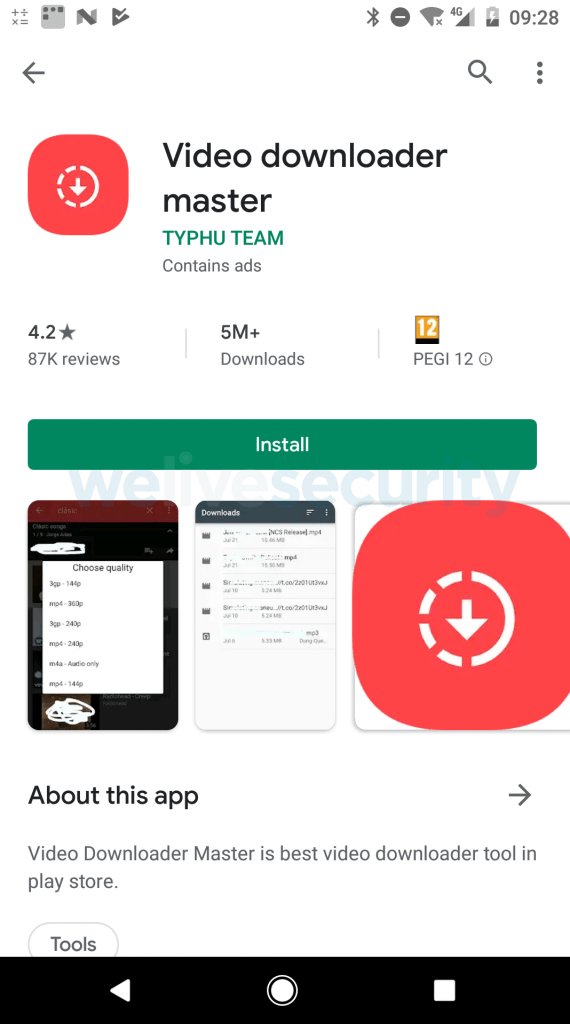
Figure 2. The most popular member of the Android/AdDisplay.Ashas family on Google Play was “Video downloader master” with over five million downloads

Ashas functionality

All the apps provide the functionality they promise, besides working as adware. The adware functionality is the same in all the apps we analyzed. [Note: The analysis of the functionality below describes a single app, but applies to all apps of the Android/AdDisplay.Ashas family.]

Once launched, the app starts to communicate with its C&C server (whose IP address is base64-encoded in the app). It sends “home” key data about the affected device: device type, OS version, language, number of installed apps, free storage space, battery status, whether the device is rooted and Developer mode enabled, and whether Facebook and FB Messenger are installed.

Figure 3. Sending information about the affected device

The app receives configuration data from the C&C server, needed for displaying ads, and for stealth and resilience.

Figure 4. Configuration file received from the C&C server

As for stealth and resilience, the attacker uses a number of tricks.

First, the malicious app tries to determine whether it is being tested by the Google Play security mechanism. For this purpose, the app receives from the C&C server the isGoogleIp flag, which indicates whether the IP address of the affected device falls within the range of known IP addresses for Google servers. If the server returns this flag as positive, the app will not trigger the adware payload.

Second, the app can set a custom delay between displaying ads. The samples we have seen had their configuration set to delay displaying the first ad by 24 minutes after the device unlocks. This delay means that a typical testing procedure, which takes less than 10 minutes, will not detect any unwanted behavior. Also, the longer the delay, the lower the risk of the user associating the unwanted ads with a particular app.

Third, based on the server response, the app can also hide its icon and create a shortcut instead. If a typical user tries to get rid of the malicious app, chances are that only the shortcut ends up getting removed. The app then continues to run in the background without the user’s knowledge. This stealth technique has been gaining popularity among adware-related threats distributed via Google Play.

Figure 5. Time delay to postpone displaying ads implemented by the adware

Once the malicious app receives its configuration data, the affected device is ready to display ads as per the attacker’s choice; each ad is displayed as a full screen activity. If the user wants to check which app is responsible for the ad being displayed, by hitting the “Recent apps” button, another trick is used: the app displays a Facebook or Google icon, as seen in Figure 6. The adware mimics these two apps to look legitimate and avoid suspicion – and thus stay on the affected device for as long as possible.

Figure 6. The adware activity impersonates Facebook (left). If the user long-presses the icon, the name of the app responsible for the activity is revealed (right).

Finally, the Ashas adware family has its code hidden under the com.google.xxx package name. This trick – posing as a part of a legitimate Google service – may help avoid scrutiny. Some detection mechanisms and sandboxes may whitelist such package names, in an effort to prevent wasting resources.

Figure 7. Malicious code hidden in a package named “com.google”

Hunting down the developer

Using open-source information, we tracked down the developer of the adware, who we also identified as the campaign’s operator and owner of the C&C server. In the following paragraphs, we outline our  efforts to discover other applications from the same developer and protect our users from it.

First, based on information that is associated with the registered C&C domain, we identified the name of the registrant, along with further data like country and email address, as seen in Figure 8.

Figure 8. Information about the C&C domain used by the Ashas adware

Knowing that the information provided to a domain registrar might be fake, we continued our search. The email address and country information drove us to a list of students attending a class at a Vietnamese university – corroborating the existence of the person under whose name the domain was registered.
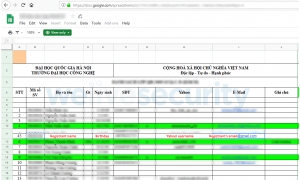
Figure 9. A university class student list including the C&C domain registrant

Due to poor privacy practices on the part of our culprit’s university, we now know his date of birth (probably: he seemingly used his birth year as part of his Gmail address, as further partial confirmation), we know that he was a student and what university he attended. We were also able to confirm that the phone number he provided to the domain registrar was genuine. Moreover, we retrieved his University ID; a quick googling showed some of his exam grades. However, his study results are out of the scope of our research.

Based on our culprit’s email address, we were able to find his GitHub repository. His repository proves that he is indeed an Android developer, but it contained no publicly available code of the Ashas adware at the time of writing of this blogpost.

However, a simple Google search for the adware package name returned a “TestDelete” project that had been available in his repository at some point

The malicious developer also has apps in Apple’s App Store. Some of them are iOS versions of the ones removed from Google Play, but none contain adware functionality.

Figure 10. The malicious developer’s apps published on the App Store which don’t contain the Ashas adware

Searching further for the malicious developer’s activities, we also discovered his Youtube channel propagating the Ashas adware and his other projects. As for the Ashas family, one of the associated promotional videos, “Head Soccer World Champion 2018 – Android, ios” was viewed almost three million times and two others reached hundreds of thousands of views, as seen in Figure 11.

Figure 11. YouTube channel of the malicious developer

His YouTube channel provided us with another valuable piece of information: he himself features in a video tutorial for one of his other projects. Thanks to that project, we were able to extract his Facebook profile – which lists his studies at the aforementioned university.

Figure 12. Facebook profile of the C&C domain registrar (cover picture and profile picture edited out)

Linked on the malicious developer’s Facebook profile, we discovered a Facebook page, Minigameshouse, and an associated domain, minigameshouse[.]net. This domain is similar to the one the malware author used for his adware C&C communication, minigameshouse[.]us.

Checking this Minigameshouse page further indicates that this person is indeed the owner of the minigameshouse[.]us domain: the phone number registered with this domain is the same as the phone number appearing on the Facebook page.

Figure 13. Facebook page managed by the C&C domain registrant uses the same base domain name (minigameshouse) and phone number as the registered malicious C&C used by the Ashas adware

Of interest is that on the Minigameshouse Facebook page, the malicious developer promotes a slew of games beyond the Ashas family for download on both Google Play and the App Store. However, all of those have been removed from Google Play – despite the fact that some of them didn’t contain any adware functionality.

On top of all this, one of the malicious developer’s YouTube videos – a tutorial on developing an “Instant Game” for Facebook – serves as an example of operational security completely ignored. We were able to see that his recently visited web sites were Google Play pages belonging to apps containing the Ashas adware. He also used his email account to log into various services in the video, which identifies him as the adware domain owner, beyond any doubt.

Thanks to the video, we were even able to identify three further apps that contained adware functionality and were available on Google Play.

Figure 14. Screenshots from this developer’s YouTube video shows history of checking Ashas adware on Google Play

ESET telemetry

Figure 15. ESET detections of Android/AdDisplay.Ashas on Android devices by country

Is adware harmful?

Because the real nature of apps containing adware is usually hidden to the user, these apps and their developers should be considered untrustworthy. When installed on a device, apps containing adware may, among other things:

  • Annoy users with intrusive advertisements, including scam ads
  • Waste the device’s battery resources
  • Generate increased network traffic
  • Gather users’ personal information
  • Hide their presence on the affected device to achieve persistence
  • Generate revenue for their operator without any user interaction

Conclusion

Based solely on open source intelligence, we were able to trace the developer of the Ashas adware and establish his identity and discover additional related adware-infected apps. Seeing that the developer did not take any measures to protect his identity, it seems likely that his intentions weren’t dishonest at first – and this is also supported by the fact that not all his published apps contained unwanted ads.

At some point in his Google Play “career”, he apparently decided to increase his ad revenue by implementing adware functionality in his apps’ code. The various stealth and resilience techniques implemented in the adware show us that the culprit was aware of the malicious nature of the added functionality and attempted to keep it hidden.

Sneaking unwanted or harmful functionality into popular, benign apps is a common practice among “bad” developers, and we are committed to tracking down such apps. We report them to Google and take other steps to disrupt malicious campaigns we discover. Last but not least, we publish our findings to help Android users protect themselves.

Indicators of Compromise (IoCs)

Package nameHashInstalls
com.ngocph.masterfreec1c958afa12a4fceb595539c6d208e6b103415d75,000,000+
com.mghstudio.ringtonemaker7a8640d4a766c3e4c4707f038c12f30ad7e21876500,000+
com.hunghh.instadownloader8421f9f25dd30766f864490c26766d381b89dbee500,000+
com.chungit.tank1990237f9bfe204e857abb51db15d6092d350ad3eb01500,000+
com.video.downloadmasterfree43fea80444befe79b55e1f05d980261318472dff100,000+
com.massapp.instadownloader1382c2990bdce7d0aa081336214b78a06fceef62100,000+
com.chungit.tankbattle1630b926c1732ca0bb2f1150ad491e19030bcbf2100,000+
com.chungit.basketball188ca2d47e1fe777c6e9223e6f0f487cb5e98f2d100,000+
com.applecat.worldchampion2018502a1d6ab73d0aaa4d7821d6568833028b6595ec100,000+
org.minigamehouse.photoalbuma8e02fbd37d0787ee28d444272d72b894041003a100,000+
com.mngh.tuanvn.fbvideodownloader035624f9ac5f76cc38707f796457a34ec2a97946100,000+
com.v2social.socialdownloader2b84fb67519487d676844e5744d8d3d1c935c4b7100,000+
com.hikeforig.hashtag8ed42a6bcb14396563bb2475528d708c368da316100,000+
com.chungit.heroesjumpc72e92e675afceca23bbe77008d921195114700c100,000+
com.mp4.video.downloader61E2C86199B2D94ABF2F7508300E3DB44AE1C6F1100,000+
com.videotomp4.downloader1f54e35729a5409628511b9bf6503863e9353ec950,000+
boxs.puzzles.Puzzleboxb084a07fdfd1db25354ad3afea6fa7af497fb7dc50,000+
com.intatwitfb.download.videodownloader8d5ef663c32c1dbcdd5cd7af14674a02fed3046750,000+
com.doscreenrecorder.screenrecordere7da1b95e5ddfd2ac71587ad3f95b2bb5c0f365d50,000+
com.toptools.allvideodownloader32E476EA431C6F0995C75ACC5980BDBEF07C8F7F50,000+
com.top1.videodownloadera24529933f57aa46ee5a9fd3c3f7234a1642fe1710,000+
com.santastudio.headsoccer286d48c25d24842bac634c2bd75dbf721bcf4e2ea10,000+
com.ringtonemakerpro.ringtonemakerapp20195ce9f25dc32ac8b00b9abc3754202e96ef7d66d910,000+
com.hugofq.solucionariodebaldor3bb546880d93e9743ac99ad4295ccaf98292026010,000+
com.anit.bouncingball6e93a24fb64d2f6db2095bb17afa12c34b2c845210,000+
com.dktools.liteforfb7bc079b1d01686d974888aa5398d6de54fd9d11610,000+
net.radiogroup.tvnradioba29f0b4ad14b3d77956ae70d812eae6ac761bee10,000+
com.anit.bouncingball6E93A24FB64D2F6DB2095BB17AFA12C34B2C845210,000+
com.floating.tube.bymuicv6A57D380CDDCD4726ED2CF0E98156BA404112A5310,000+
org.cocos2dx.SpiderSolitaireGamesadbb603195c1cc33f8317ba9f05ae9b74759e75b5,000+
games.puzzle.crosssum31088dc35a864158205e89403e1fb46ef6c2c3cd5,000+
dots.yellow.craft413ce03236d3604c6c15fc8d1ec3c9887633396c5,000+
com.tvngroup.ankina.reminderWater5205a5d78b58a178c389cd1a7b6651fe5eb7eb095,000+
com.hdevs.ringtonemaker2019ba5a4220d30579195a83ddc4c0897eec9df59cb75,000+
com.carlosapps.solucionariodebaldor741a95c34d3ad817582d27783551b5c85c4c605b5,000+
com.mngh1.flatmusic32353fae3082eaeedd6c56bb90836c89893dc42c5,000+
com.tvn.app.smartnoteddf1f864325b76bc7c0a7cfa452562fe0fd413511,000+
com.thrtop.alldownloaderf46ef932a5f8e946a274961d5bdd789194bd2a7d1,000+
com.anthu91.soccercard0913a34436d1a7fcd9b6599fba64102352ef2a4a1,000+
com.hugofq.wismichudosmildiecisiete4715bd777d0e76ca954685eb32dc4d16e609824f1,000+
com.gamebasketball.basketballperfectshote97133aaf7d4bf90f93fefb405cb71a2877908391,000+
com.nteam.solitairefree3095f0f99300c04f5ba877f87ab86636129769b1100+
com.instafollowers.hiketop3a14407c3a8ef54f9cba8f61a271ab94013340f81+

C&C server

http://35.198.197[.]119:8080


MITRE ATT&CK techniques

TacticIDNameDescription
Initial AccessT1475Deliver Malicious App via Authorized App StoreThe malware impersonates legitimate services on Google Play
PersistenceT1402App Auto-Start at Device BootAn Android application can listen for the BOOT_COMPLETED broadcast, ensuring that the app’s functionality will be activated every time the device starts
ImpactT1472Generate Fraudulent Advertising RevenueGenerates revenue by automatically displaying ads

Kudos to @jaymin9687 for bringing the problem of unwanted ads in the “Video downloader master” app to our attention.  


About Version 2 Digital

Version 2 Digital is one of the most dynamic IT companies in Asia. The company distributes a wide range of IT products across various areas including cyber security, cloud, data protection, end points, infrastructures, system monitoring, storage, networking, business productivity and communication products.

Through an extensive network of channels, point of sales, resellers, and partnership companies, Version 2 offers quality products and services which are highly acclaimed in the market. Its customers cover a wide spectrum which include Global 1000 enterprises, regional listed companies, different vertical industries, public utilities, Government, a vast number of successful SMEs, and consumers in various Asian cities.

About ESET
For 30 years, ESET® has been developing industry-leading IT security software and services for businesses and consumers worldwide. With solutions ranging from endpoint security to encryption and two-factor authentication, ESET’s high-performing, easy-to-use products give individuals and businesses the peace of mind to enjoy the full potential of their technology. ESET unobtrusively protects and monitors 24/7, updating defenses in real time to keep users safe and businesses running without interruption. Evolving threats require an evolving IT security company. Backed by R&D facilities worldwide, ESET became the first IT security company to earn 100 Virus Bulletin VB100 awards, identifying every single “in-the-wild” malware without interruption since 2003.

Winnti Group’s skip‑2.0: A Microsoft SQL Server backdoor

Notorious cyberespionage group debases MSSQL

For a while, ESET researchers have been tracking the activities of the Winnti Group, active since at least 2012 and responsible for high-profile supply-chain attacks against the video game and software industry. Recently, we discovered a previously undocumented backdoor targeting Microsoft SQL (MSSQL) that allows attackers to maintain a very discreet foothold inside compromised organizations. This backdoor bears multiple similarities to the PortReuse backdoor, another tool used by the Winnti Group that was first documented by ESET in October 2019, such as the use of the same custom packer and VMProtected launcher, which is why we attribute this backdoor to the Winnti Group.

Earlier this year, we received a sample of this new backdoor called skip-2.0 by its authors and part of the Winnti Group’s arsenal. This backdoor targets MSSQL Server 11 and 12, allowing the attacker to connect stealthily to any MSSQL account by using a magic password – while automatically hiding these connections from the logs. Such a backdoor could allow an attacker to stealthily copy, modify or delete database content. This could be used, for example, to manipulate in-game currencies for financial gain. In-game currency database manipulations by Winnti operators have already been reported. To the best of our knowledge, skip-2.0 is the first MSSQL Server backdoor to be documented publicly. Note that even though MSSQL Server 11 and 12 are not the most recent versions (released in 2012 and 2014, respectively), they are the most commonly used ones according to Censys’s data.

We recently published a white paper updating our understanding of the arsenal of the Winnti Group, and that exposed a previously undocumented backdoor of theirs called PortReuse. It uses an identical packer to that used with the payload embedded in compromised video games uncovered by ESET in March 2019. The VMProtected launcher that drops the PortReuse backdoor was also found being used to launch recent ShadowPad versions. In that context, we were able to find a new tool called skip.2-0 by its developer. It uses the same VMProtected launcher as well as Winnti Group’s custom packer and exhibits multiple similarities with other samples from the Winnti Group’s toolset. This leads us to ascribe skip-2.0 to that toolset also.

This article will focus on the technical details and functionality of this MSSQL Server backdoor, as well as on exposing the technical similarities of skip.2-0 with the Winnti Group’s known arsenal – in particular, with the PortReuse backdoor and ShadowPad. A note on the reasons why we chose the “Winnti Group” naming can be found on our white paper.

VMProtected launcher

We found skip-2.0 while looking for VMProtected launchers, for which the payload is usually either PortReuse or ShadowPad.

Embedded payload

As with the encrypted PortReuse and ShadowPad payloads, skip-2.0 is embedded in the VMProtected launcher’s overlay, as shown in Figure 1:

Figure 1. VMProtected launcher’s headers. The payload is embedded in the PE overlay.

Encryption

The payload encryption is identical to that used in the other VMProtected launchers. It is RC5-encrypted with a key derived from the VolumeID and the string f@Ukd!rCto R$. – as described in our previous white paper on the Winnti Group arsenal.

Persistence

As in the case of PortReuse and ShadowPad, the launcher probably persists by exploiting a DLL hijacking vulnerability by being installed at C:\Windows\System32\TSVIPSrv.DLL. This results in the DLL being loaded by the standard Windows SessionEnv service at system startup.


Winnti Group’s custom packer

Once decrypted the embedded payload is actually Winnti Group’s custom packer. This packer is the same shellcode that was documented in our previous article and white paper. It is used to pack the PortReuse backdoor as well as the payload embedded in the compromised video games.

Packer configuration

As described in our previous article, the packer configuration contains the decryption key of the packed binary as well as its original filename, its size and the execution type (EXE or DLL). The payload’s packer configuration is shown in Table 1.

Table 1. Payload’s packer configuration

Table 1. Payload’s packer configuration

One can see from the packer configuration that the payload is called Inner-Loader. Inner-Loader is the name of an injector that is the part of the Winnti Group’s arsenal used to inject the PortReuse backdoor into processes listening on a particular port, as described in our previous publication. Beyond that identical name, by analyzing this payload it appears that it is another variant of the Inner-Loader injector.

Inner-Loader injector

This variant of Inner-Loader, instead of looking for a process listening on a particular port, as in the case when injecting the PortReuse backdoor, looks for a process called sqlserv.exe, which is the conventional process name of MSSQL Server. If found, Inner-Loader then injects a payload into this process. This payload is also packed with the custom packer – the packer configuration of that payload is shown in Table 2.

Table 2. Packer configuration of the payload embedded in Inner-Loader

Table 2. Packer configuration of the payload embedded in Inner-Loader

The original filename of this injected payload is skip-2.0.dll.
 

skip-2.0

After having been injected and launched by Inner-Loader, skip-2.0 first checks whether it is executing within an sqlserv.exe process and if so, retrieves a handle to sqllang.dll, which is loaded by sqlserv.exe. It then proceeds to find and hook multiple functions from that DLL. Figure 2 depicts the skip-2.0 chain of compromise.

Figure 2. skip-2.0 unpacking and injection

Hooking sqllang.dll

The hooking procedure used by skip-2.0 is very similar to the one used by NetAgent, the PortReuse module responsible for installing the networking hook. This hooking library is based on the distorm open source disassembler that is used by multiple open source hooking frameworks. In particular, a disassembling library is needed to correctly compute the size of the instructions to be hooked. One can see in Figure 3 that the hooking procedure used by NetAgent and skip-2.0 are almost identical.

Figure 3. Hex-Rays output comparison between the NetAgent (left) and skip-2.0 (right) hooking procedures

There is one notable difference, which is the fact that the hooking function from skip-2.0 takes the address of the hook to be installed as an argument, while for NetAgent, the address of the hook to install is hardcoded. This is due to the fact that skip-2.0 has to hook multiple functions in sqllang.dll to operate properly, while NetAgent targets only a single function.

To locate each sqllang.dll function to be hooked, skip-2.0 first retrieves the size of the DLL once loaded in memory (i.e. its virtual size) by parsing its PE headers. Then an array of bytes to be matched within sqllang.dll is initialized as shown in Figure 4. Once the address of the first occurrence matching the byte array is found, the hook is installed using the procedure shown in Figure 3.

Figure 4. Hex-Rays output of the procedure initializing the byte array to match in sqllang.dll

The success of the hook installation is then logged in cleartext in a log file located at the hardcoded path C:\Windows\Temp\TS_2CE1.tmp and shown in Figure 5.

Figure 5. Log generated during hooks installation

Should the targeted function not be found, the hook installer searches for a fallback function, with a different set of byte patterns.

Matching a sequence of bytes to locate the address of the targeted function instead of using a static offset, plus using a fallback sequence of bytes, allows skip-2.0 to be more resilient to MSSQL updates and to potentially target multiple sqllang.dll updates.

One password to rule them all

The functions targeted by skip-2.0 are related to authentication and event logging. The targeted functions include:

  • CPwdPolicyManager::ValidatePwdForLogin
  • CSECAuthenticate::AuthenticateLoginIdentity
  • ReportLoginSuccess
  • IssueLoginSuccessReport
  • FExecuteLogonTriggers
  • XeSqlPkg::sql_statement_completed::Publish
  • XeSqlPkg::sql_batch_completed::Publish
  • SecAuditPkg::audit_event::Publish
  • XeSqlPkg::login::Publish
  • XeSqlPkg::ual_instrument_called::Publish

The most interesting function is the first one (CPwdPolicyManager::ValidatePwdForLogin), which is responsible for validating the password provided for a given user. This function’s hook checks whether the password provided by the user matches the magic password; if that is the case, the original function will not be called and the hook will return 0, allowing the connection even though the correct password was not provided. A global flag is then set that will be checked by the other hooked functions responsible for event logging. The corresponding decompiled procedure is shown in Figure 6. In the case where this global flag is set, the hooked logging functions will silently return without calling their corresponding, original functions, so the action will not be logged. In the case where a different password is provided, the original function is called.

Figure 6. Hex-Rays output of the procedure responsible for matching the password provided at login with the hardcoded string

A similar backdooring technique, based on hardcoded passwords, was used with SSH backdoors previously discovered by ESET. The difference here is that skip-2.0 is installed in-memory, while in the case of the SSH backdoors the sshd executable was modified prior to execution.

Additionally, CSECAuthenticate::AuthenticateLoginIdentity will be called from within its hook code but the hook will always return 0. The ReportLoginSucess and IssueLoginSuccessReport hooks will not call the original functions if the magic password was used to log in. The same behavior is applied to FEExecuteLogonTriggers. Other logging functions such as XeSqlPkg::sql_statement_completed::Publish or XeSqlPkg::sql_batch_completed::Publish will also be disabled in the case where the user logged in with the magic password. Multiple audit events are disabled as well, including SecAuditPkg::audit_event::Publish, XeSqlPkg::login::Publish and XeSqlPkg::ual_instrument_called::Publish.

This series of hooks allows the attacker not only to gain persistence in the victim’s MSSQL Server through the use of a special password, but also to remain undetected thanks to the multiple log and event publishing mechanisms that are disabled when that password is used.

We tested skip-2.0 against multiple MSSQL Server versions and found that we were able to login successfully using the special password with MSSQL Server 11 and 12. To check whether a particular sqllang.dll version is targeted by skip-2.0 (i.e., that matches the byte patterns), we created a YARA rule, which can be found in our GitHub repository.

Connection with the Winnti Group

We observed multiple similarities between skip-2.0 and other tools from the Winnti Group’s arsenal. Its VMProtected launcher, custom packer, Inner-Loader injector and hooking framework are part of the already known toolset of the Winnti Group. This leads us to think that skip-2.0 is also part of that toolset.

Conclusion

The skip-2.0 backdoor is an interesting addition to the Winnti Group’s arsenal, sharing a great deal of similarities with the group’s already known toolset, and allowing the attacker to achieve persistence on an MSSQL Server. Considering that administrative privileges are required for installing the hooks, skip-2.0 must be used on already compromised MSSQL Servers to achieve persistence and stealthiness.

We will continue to monitor new activities of the Winnti Group and will publish relevant information on our blog. For any inquiries, contact us at threatintel@eset.com.

Indicators of Compromise (IoCs)


MITRE ATT&CK techniques


About Version 2 Digital

Version 2 Digital is one of the most dynamic IT companies in Asia. The company distributes a wide range of IT products across various areas including cyber security, cloud, data protection, end points, infrastructures, system monitoring, storage, networking, business productivity and communication products.

Through an extensive network of channels, point of sales, resellers, and partnership companies, Version 2 offers quality products and services which are highly acclaimed in the market. Its customers cover a wide spectrum which include Global 1000 enterprises, regional listed companies, different vertical industries, public utilities, Government, a vast number of successful SMEs, and consumers in various Asian cities.

About ESET
For 30 years, ESET® has been developing industry-leading IT security software and services for businesses and consumers worldwide. With solutions ranging from endpoint security to encryption and two-factor authentication, ESET’s high-performing, easy-to-use products give individuals and businesses the peace of mind to enjoy the full potential of their technology. ESET unobtrusively protects and monitors 24/7, updating defenses in real time to keep users safe and businesses running without interruption. Evolving threats require an evolving IT security company. Backed by R&D facilities worldwide, ESET became the first IT security company to earn 100 Virus Bulletin VB100 awards, identifying every single “in-the-wild” malware without interruption since 2003.

ESET 將於 2019 年 10 月 18 日停售 ESET Multi-Device Security 產品


親愛的客戶,感謝您對 ESET 的支持! 我們將於 2019 年 10 月 18 日停售 ESET Multi-Device Security 產品,現有或新用戶可於購買、續期時選購 ESET Internet Security,以繼續讓 ESET 保護您的網上安全。

若有任何資安需求,歡迎聯絡銷售團隊 2893 8860,或上官網查詢:https://www.eset.hk/

Dear customers, thank you for your support on ESET! We would like to announce our ESET Multi-Device Security products will ceased from the market on 18 October 2019. Kindly note for our existing and new users can continue to renew or purchase their licenses under ESET Internet Security for us to protect your online security.

If you have any enquiries, please contact our sales team at 2893 8860 or visit https://en.eset.hk/


關於Version 2

Version 2 Digital 是立足亞洲的增值代理商及IT開發者。公司在網絡安全、雲端、數據保護、終端設備、基礎設施、系統監控、存儲、網絡管理、商業生產力和通信產品等各個領域代理發展各種 IT 產品。透過公司龐大的網絡、通路、銷售點、分銷商及合作夥伴,Version 2 提供廣被市場讚賞的產品及服務。Version 2 的銷售網絡包括台灣、香港、澳門、中國大陸、新加坡、馬來西亞等各亞太地區,客戶來自各行各業,包括全球 1000 大跨國企業、上市公司、公用事業、醫療、金融、教育機構、政府部門、無數成功的中小企及來自亞洲各城市的消費市場客戶。

關於ESET
ESET成立於1992年,是一家面向企業與個人用戶的全球性的電腦安全軟件提供商,其獲獎產品 — NOD32防病毒軟件系統,能夠針對各種已知或未知病毒、間諜軟件 (spyware)、rootkits和其他惡意軟件為電腦系統提供實時保護。ESET NOD32佔用 系統資源最少,偵測速度最快,可以提供最有效的保護,並且比其他任何防病毒產品獲得了更多的Virus Bulletin 100獎項。ESET連續五年被評為“德勤高科技快速成長500 強”(Deloitte’s Technology Fast 500)公司,擁有廣泛的合作夥伴網絡,包括佳能、戴爾、微軟等國際知名公司,在布拉迪斯拉發(斯洛伐克)、布裏斯托爾(英國 )、布宜諾斯艾利斯(阿根廷)、布拉格(捷克)、聖地亞哥(美國)等地均設有辦事處,代理機構覆蓋全球超過100個國家。