Skip to content

訊連FaceMe® Security全新升級 整合AXIS Camera Station,打造一站式智慧安控解決方案

旗下新品FaceMe® Platform人臉辨識API平台首次亮相
開發人員可快速部署多樣化的人臉辨識解決方案,提升導入效率

【2022年3月16日,台北訊】全球頂尖臉部辨識開發商訊連科技將於「2022智慧城市展 Smart City Summit & Expo」展出智慧安控及門禁、智慧物聯網及智慧金融等多項採用旗下FaceMe® AI人臉辨識的各種智慧解決方案。「2022智慧城市展」將於3月22日至3月25日於南港展覽館2館展出,訊連科技攤位為P104。

隨著邊緣AI技術普及,AI人臉辨識亦日趨廣泛,而其中門禁安控更是人臉辨識的主要應用場域。訊連科技推出之FaceMe® Security就是專為安控及門禁設計的人臉辨識解決方案,提供刷臉打卡、口罩與體溫監測、單張相片以圖搜人、影像即時監控回放等功能。FaceMe® Security可相容於現行IP安控架構,如IP攝影機、工作站、NVR等。此外,亦可與Milestone、Network Optix、AXIS、Genetech、AVIGILION及VIVOTEK等主流影像管理系統(VMS)整合,提供即時示警功能。

此次訊連科技展出亮點,還包含首次對外亮相的FaceMe® Platform人臉辨識API平台。FaceMe® Platform主打彈性部署、高可用性及效能,提供用戶各項開發人臉辨識應用所需之核心功能,開發商可利用平台上的開放API介接其服務。訊連科技亦將同時展出專為智慧辦公室設計之FaceMe® TimeClock人臉辨識考勤系統,及專為零售店開發,可提供人流分析之FaceMe® Smart Retail等兩款採用FaceMe® Platform之全新解決方案。

此外,訊連科技亦提供FaceMe® SDK人臉辨識引擎,可支援Windows、Linux、Android、JetPack等平台,讓門禁機開發商於各式硬體中快速整合人臉辨識功能。FaceMe® SDK符合iBeta 依ISO/IEC 30107-3標準進行的活體冒用攻擊Level 2測試,可有效杜絕臉部照片、影片及3D列印面具之活體冒用攻擊。

欲了解AI人臉辨識在智慧安防領域之應用,歡迎於4/27至4/29的Secutech博覽會造訪訊連科技攤位。

Secutech 2022台北國際安全科技應用博覽會

  • 活動期間:111年 4 月 27 日 至 4 月 29 日
  • 展出時間:上午9:30至下午17:30 (最後一日參觀至下午16:30)
  • 活動地點:台北南港展覽館2館1樓(115台北市南港區經貿二路2號)
  • 訊連科技攤位編號:826

關於Version 2

Version 2 Digital 是立足亞洲的增值代理商及IT開發者。公司在網絡安全、雲端、數據保護、終端設備、基礎設施、系統監控、存儲、網絡管理、商業生產力和通信產品等各個領域代理發展各種 IT 產品。透過公司龐大的網絡、通路、銷售點、分銷商及合作夥伴,Version 2 提供廣被市場讚賞的產品及服務。Version 2 的銷售網絡包括台灣、香港、澳門、中國大陸、新加坡、馬來西亞等各亞太地區,客戶來自各行各業,包括全球 1000 大跨國企業、上市公司、公用事業、醫療、金融、教育機構、政府部門、無數成功的中小企及來自亞洲各城市的消費市場客戶。

關於CyberLink
訊連科技創立於1996年,擁有頂尖視訊與音訊技術的影音軟體公司,專精於數位影音軟體及多媒體串流應用解決方案產品研發,並以「抓準技術板塊,擴大全球行銷布局」的策略,深根台灣、佈局全球,展現亮麗的成績。訊連科技以先進的技術提供完美的高解析影音播放效果、以尖端的科技提供完整的高解析度擷取、編輯、製片及燒錄功能且完整支援各種高解析度影片及音訊格式。產品包括:「威力導演」、「PowerDVD」、「威力製片」、「威力酷燒」等。

The Challenges to API Security

Some services depend on the integration between software, applications, or systems to be run by the end-user and this communication is possible due to the existence of APIs in people’s daily lives.

However, with the constant evolution of technology, these tools have been vectors for attacks by malicious agents, as explained below. Here, we also show you how important it is to invest in API security and what are the main challenges to achieving this goal.

To facilitate your reading and make our content more understandable, we divided this article into topics addressing the following subjects:

  • What is an API?
  • API Today
  • What Is API Security and How Important Is It?
  • Types of Frequent API Attacks
  • Six Best Practices for API Security
  • About senhasegura
  • Conclusion

Enjoy your reading!

  • What is an API?

The expression Application Programming Interface (API) consists of a set of programming standards that allow access to an application or platform. 

This mechanism is created when a software organization intends to develop other programs related to the service they offer. 

In this way, they provide codes to be used on other websites by their end-user. This is what happens with Google Maps, when it is adapted for use by other websites, such as hotel pages. 

This is possible with the intermediation of an API used by the developers of the hotel’s website with the Google Maps code.

This means that APIs enable communication between different applications through multiple codes, without any effort from the users. 

An API is useful for connecting several features of a website that can be used in other services, which is possible via programming. 

  • API Today

An API is typically described as an interface that connects applications. However, this generic concept no longer fully explains the features of this tool, which recently gained new ones.

APIs today adhere to models accessible and easily understood by developers. They are considered products, used by specific consumers, and present versions, which guarantees their lifecycle.

They are extremely standardized software, focused on governance and security, and one can also monitor the APIs and manage their performance. 

Their lifecycle includes the design, testing, construction, management, and version control phases. Modern APIs are still documented for consumption.

These APIs spread through plug-ins. In practice, the developers of a given application create an API and make it available to other developers, who create other plug-ins, enhancing the operation of this program. 

  • What Is API Security and How Important Is It?

With the evolution of technology, cybercriminals are going beyond their conventional targets and expanding their operations to IoT, external applications, and mobile applications. 

As a result, the large number of existing APIs has become a challenge for information security professionals. 

To complete, developers often do not have all the skills to develop a flawless API that complies with web and cloud security standards, which creates vulnerabilities to programs. Thus, many risks arise, such as:

  • Authorization Failures;
  • Data Exposure;
  • Denial of Service;
  • Failures in Security Settings;
  • Endpoints.

Vulnerable APIs open space for hackers, who can access sensitive information, medical and financial data of organizations, generating incalculable losses.

When we talk about API security, we typically refer to the protection of an application’s back-end services, including its database, user management system, or other components that interact with data storage.

Thus, it is essential to ensure the security of APIs, which covers the use of resources and the adoption of protection procedures. The security of a company’s APIs involves the services that use them and should prevent malicious agents from accessing sensitive data and performing unauthorized actions. 

It is important to mention that applications from other companies impact API security. Therefore, the risks must be evaluated by the IT team so that an efficient protection plan is created. 

Types of Frequent API Attacks

Here are the most common API attacks:

  • Injection Attack

When an API developer does not limit entries to certain applications, malicious agents can perform an API injection attack by sending a script to the server with a request that allows them to access the program. 

  • Stolen Authentication Attack

APIs configured with wrong authentication standards generate vulnerabilities for organizations, which need to prevent hackers from accessing the controls of this API and stealing data from their customers. Inadequate authentication processes can also result in brute force attacks. 

  • Man-in-the-middle Attack (MITM)

Transmission of unsigned or unencrypted messages, problems with secure session configuration, or even the use of SSL/TLS encryption with incorrect configuration can compromise API security and make an organization vulnerable to Man-in-the-middle attacks, compromising all messages with the customer.

Thus, malicious agents gain access to sensitive data, such as personally identifiable information. 

  • DDoS Attack

API endpoints have become the target of DDoS attacks. Malicious agents point a bot to the API and make multiple requests on an endpoint until it exceeds the tolerance of those requests and affects its responsiveness, making the service unavailable to users. 

To protect an API from DDoS attacks, we recommend edge protection and the Web Application Firewall with WAAP. 

Six Best Practices for API Security

Some practices are recommended to ensure API security. Below you will find what should be done for this purpose.

  • Analyze API Vulnerabilities

To ensure API security, automatic verification must be enabled in order to detect vulnerabilities and eliminate them at different stages of the software lifecycle. 

Automated verification features allow you to identify security flaws by comparing the application configuration to a known vulnerability database.

In practice, Crashtest Security Suite allows you to scan vulnerabilities, helping to establish a continuous testing process and prevent intrusions generated by a lack of API security. 

The suite also performs benchmarks referring to OWASP’s top 10 and provides a security analysis for APIs, applications, and JavaScripts. 

  • Restrict HTTP Methods

REST APIs enable programs capable of performing multiple HTTP operations. HTTP information is not encrypted, so these methods can facilitate attacks. 

For added security, it is important to prohibit unsafe HTTP methods, but if this is not possible, we recommend restricting your whitelist by rejecting all requests that are not on the list. 

Another important measure is the use of RESTful API authentication practices, which ensure the user can use the HTTP method.

  • Avoid Untrusted Entries by Implementing Input Validation Mechanisms

When the API client makes data available, do not fully trust it, since the authentication server can run an unauthorized application service or a malicious script. 

In this sense, it is recommended information security professionals implement mechanisms to validate the entry into the server and the client in order to avoid untrusted entries. 

Concerning the client, this validation has the job of indicating errors and warning about entries that must be accepted. On the server-side, it works to verify incoming data and prevent threats such as SQL Injection and XSS attacks. 

  • Set a Maximum Request Limit 

Limiting requests is an API security measure that requires setting up a temporary status for the API to analyze requests. It is usually used to prevent abuse, spam, or denial of service attacks. It also contributes to managing REST API security and preventing brute force and DDoS attacks. 

Some APIs may have flexible limits, enabling users to exceed request limits for a short time. Therefore, setting the time limit is a best practice to ensure API security. 

Also, request queue libraries make it possible to create APIs that accept a predefined number of requests, placing the others in a queue. 

  • HTTPS/TLS Must Be Used For REST APIs

HTTPS and Transport Layer Security (TLS) provide security for the transfer of encrypted information between web servers and browsers. In addition, HTTPS contributes to the protection of authentication credentials being transferred. 

Every API should implement HTTPS to ensure confidentiality, authenticity, and integrity. What’s more, security professionals are advised to use mutually authenticated client-side certificates to provide more security for sensitive information and operations. 

When creating a REST API, it is necessary to avoid redirecting HTTP to HTTPS, endangering user security. It is also important to take action to divert Cross-Source Resource Sharing (CORS) and JSONP requests for cross-domain calls.

  • Use An API Management Platform

An API gateway is intended to separate the client interface from the back-end API collection and to ensure the availability and scalability of API services. 

In addition to managing the most diverse API services, the API management platform makes it possible to manage standard functions, such as rate limitation, telemetry, and user authentication.

The API gateway is characterized by accepting API calls, coordinating resources needed to service it, performing authentication, and ensuring appropriate results. 

  • About senhasegura

For us, from senhasegura, the protection, access, and confidentiality of privileged information is a right of all individuals and legal entities. Therefore, we strive to operate as the best-privileged access management solution in the market.

Our commitment is to assist organizations to build sovereignty and security over access and privileged information.

  • Conclusion

By reading this article, you saw that:

  • APIs are a set of programming standards that allow integration between software, applications, and systems run by the end-user.
  • They contribute to the governance and security of organizations, can be monitored, and have their performances managed;
  • Nevertheless, with the evolution of technology, these tools have become vectors of attacks by malicious agents;
  • Thus, the large number of existing APIs has become a challenge for information security professionals;
  • It is essential to ensure API security with the use of tools and the adoption of procedures aimed at protecting this solution;
  • Among the types of API attacks, the following stand out: Injection Attack, Stolen Authentication Attack, Man-in-the-middle Attack (MITM), and DDoS Attack;
  • To ensure the security of APIs, it is critical to analyze their vulnerabilities; restrict HTTP methods; avoid untrusted entries by implementing input validation mechanisms; set a maximum limit of requests; use HTTPS/TLS for REST APIs and API gateway.
  • You also had the opportunity to learn a little about the work developed by senhasegura to promote its customers’ protection.

Did you like our article on API security? So, share it with someone else who is interested in this topic and keep following our posts. 

ALSO READ IN SENHASEGURA’S BLOG

Password Reuse: Understand the Risks of this Practice

Everything You Need to Know About SSH Keys

Strength: How to Create Strong Passwords for Credentials?

About Version 2 Digital

Version 2 Digital is one of the most dynamic IT companies in Asia. The company distributes a wide range of IT products across various areas including cyber security, cloud, data protection, end points, infrastructures, system monitoring, storage, networking, business productivity and communication products.

Through an extensive network of channels, point of sales, resellers, and partnership companies, Version 2 offers quality products and services which are highly acclaimed in the market. Its customers cover a wide spectrum which include Global 1000 enterprises, regional listed companies, different vertical industries, public utilities, Government, a vast number of successful SMEs, and consumers in various Asian cities.

About Segura®
Segura® strive to ensure the sovereignty of companies over actions and privileged information. To this end, we work against data theft through traceability of administrator actions on networks, servers, databases and a multitude of devices. In addition, we pursue compliance with auditing requirements and the most demanding standards, including PCI DSS, Sarbanes-Oxley, ISO 27001 and HIPAA.

CyberLink Joins FIDO Alliance, an Open Industry Association for Authentication Standards

As a member of the FIDO Alliance, CyberLink commits to developing and supporting new biometrics-based authentication standards through FaceMe®, its facial recognition technology

TAIPEI, TAIWAN — April 21, 2022 — CyberLink Corp. (5203.TW), a pioneer of AI and facial recognition technologies, announces it became an Associate Member of the FIDO Alliance, an open industry association focused on authentication standards and device attestation. CyberLink joins hundreds of industry players in developing and implementing new authentication specifications and standards, including facial recognition, that will better protect user privacy.

The FIDO Alliance is an industry association centered on advancing authentication standards to decrease dependence on passwords, which can be easily stolen or hacked. These new standards make authentication simpler for consumers to use and easier for service providers to manage. The Alliance’s rich membership comprises stakeholders that include government agencies, service providers, technology players and financial services industry leaders.

Technology industry member CyberLink is dedicated to providing encrypted biometric authentication through its FaceMe AI facial recognition solutions. With its facial recognition expertise, CyberLink is well-positioned to help the Alliance promote the adoption of biometric technologies that will deliver to our society more secure and convenient authentication alternatives to those with inherent flaws that are generally used today.

“We are excited to welcome our newest Associate Member CyberLink,” said Andrew Shikiar, Executive Director and CMO of the FIDO Alliance. “The FIDO vision of universal strong authentication promises better security, enhanced privacy, more commerce and expansion of services throughout digital industries. CyberLink’s addition to our Alliance supports our industry goal to make user authentication easier and safer for all parties.”

“As privacy and protection are increasingly critical imperatives of our society’s reliance on technology in every facet of life, users deserve stronger yet more intuitive authentication methods,” said Dr. Jau Huang, CEO of CyberLink. “I have no doubt that CyberLink’s biometrics authentication expertise, cemented through FaceMe, our facial recognition technology, will benefit the FIDO Alliance in establishing and providing safer authentication methods for end-users.”

About Version 2 Digital

Version 2 Digital is one of the most dynamic IT companies in Asia. The company distributes a wide range of IT products across various areas including cyber security, cloud, data protection, end points, infrastructures, system monitoring, storage, networking, business productivity and communication products.

Through an extensive network of channels, point of sales, resellers, and partnership companies, Version 2 offers quality products and services which are highly acclaimed in the market. Its customers cover a wide spectrum which include Global 1000 enterprises, regional listed companies, different vertical industries, public utilities, Government, a vast number of successful SMEs, and consumers in various Asian cities.

About CyberLink
Founded in 1996, CyberLink Corp. (5203.TW) is the world leader in multimedia software and AI facial recognition technology. CyberLink addresses the demands of consumer, commercial and education markets through a wide range of solutions, covering digital content creation, multimedia playback, video conferencing, live casting, mobile applications and AI facial recognition.  CyberLink has shipped several hundred million copies of its multimedia software and apps, including the award-winning PowerDirector, PhotoDirector, and PowerDVD.  With years of research in the fields of artificial intelligence and facial recognition, CyberLink has developed the FaceMe® Facial Recognition Engine. Powered by deep learning algorithms, FaceMe® delivers the reliable, high-precision, and real-time facial recognition that is critical to AIoT applications such as smart retail, smart security, and surveillance, smart city and smart home. For more information about CyberLink, please visit the official website at www.cyberlink.com

Network Maps with Pandora

The wait is finally over, and the seventh version of Pandora FMS, “Next Generation” has arrived to keep your networks in working order, and more. Now including UX monitoring, transaction monitoring, extra features and visual highlights, interactive network maps and events history. It’s difficult to imagine that there is a more powerful and complete monitoring software currently available. We’re excited to talk about the new network maps upgrades, but if you’d like to find out about the other new additions click here.

The glowing iridescent Pandora FMS Omni-Brain that directs the office hive-mind has instructed the developers to make changes to the network maps function, consolidating both Open and Enterprise versions into a single tool, all-in-one. It’s now possible to display network maps totally visually and dynamically, with greater interaction possibilities, and represent any kind of network topology, including manual L2 links. You can also view all and any sub-networks that your organization is running and/or maintaining, on- or off-site; create hierarchy relations allowing a greater level of topological detail than ever before.

Creating network maps

Network maps can be created from:

  • An agent group, if there are hierarchy relations between nodes in a group and these are going to be shown on the map.
  • A network mask, to define the boundaries of a sub-network.
  • Finally, one of the most usual ways, via self-discovery tasks. A reconnaissance task can be carried out to detect your network topology, respecting the connections and relations between nodes. At network interface level and layer 2 relations, information is presented automatically.

Keep in mind the relations between modules and agents to define the network topology you want to view.

In the following screenshot the available options for map-generating can be seen. You can select a group of agents (Group), a recon task (Recon task), or a network mask (CIDR IP mask).

network maps

If “Recon task” is selected the map design will show discovered nodes and any relations detected among them:

network maps

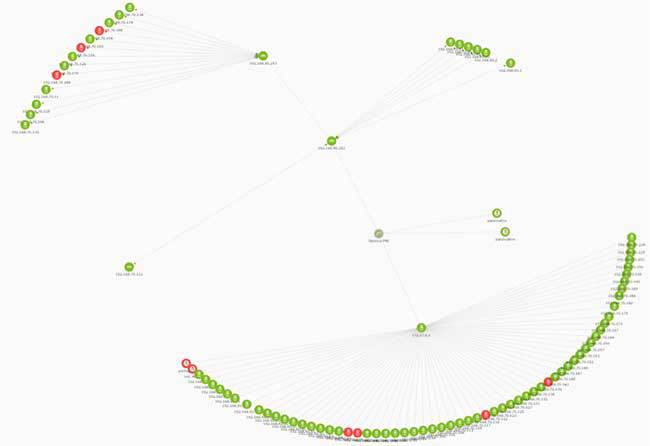
In a wider environment the perspective is going to be different: here you can see what a network map with more connected nodes would look like:

network maps

You can see how Pandora FMS connects to intermediary locations in the node diaspora. These locations usually correspond to routers, switches or access points.

Navigating network maps

Simpler than before, once a network map has been created you can move around it by simply dragging the mouse. Double-click or scroll to zoom in.

If you zoom in on a recon task-generated map you’ll see an image like the one below, allowing you to see relations between different map elements in more detail, including those at interface level.

network maps

It’s also easier to navigate map elements; simply drag and drop the elements, or scroll around the map at your leisure.

Editing maps

But there’s more; Pandora FMS 7’s maps are completely dynamic, meaning their default design can be modified, and elements displayed in the way that best suits the user. All intuitively and by simply using the mouse.

Double-click on any node on the map and you’ll see different edit options deployed, plus their relevant details. Likewise, you can now create, delete or modify relations between nodes and also their appearance.

network maps

To create a dependent relation between nodes or interfaces simply click on the node and create the relation by defining the parent and child element. You can also change the position of the node by dragging and dropping them on the map. If you need to move various nodes simultaneously, press “ctrl” and select the groups you want to move.

network maps

Right click on a node to deploy its options, see details or create a relation between two nodes at interface level, selecting the parent and child element respectively. Right click on a blank space to see the following options:

network maps

One of the most important labor-saving tools is the automatic generation of relations. This is possible thanks to self-discovery tasks, that allow relations between existing nodes to be automatically detected.

Last but not least, Pandora FMS 7 Next Generation includes the holding area. If you need to manually add new agents and relations to a pre-existing map, or if the recon task discovers new hosts, using the “refresh holding area” option will display nodes created or discovered subsequently in the “holding area”, and the original map will maintain its aesthetic, not being sullied with elements created a posteriori. Drag the new nodes out of the holding area to see its corresponding relations by clicking refresh.

In the Pandora FMS video “Network Maps” you can see everything we’ve explained in this article, and find out how to create, edit, and use a network map in a dynamic, graphic and easier way than in previous versions.


For more info visit https://pandorafms.com/ or our YouTube channel.

About Version 2 Digital

Version 2 Digital is one of the most dynamic IT companies in Asia. The company distributes a wide range of IT products across various areas including cyber security, cloud, data protection, end points, infrastructures, system monitoring, storage, networking, business productivity and communication products.

Through an extensive network of channels, point of sales, resellers, and partnership companies, Version 2 offers quality products and services which are highly acclaimed in the market. Its customers cover a wide spectrum which include Global 1000 enterprises, regional listed companies, different vertical industries, public utilities, Government, a vast number of successful SMEs, and consumers in various Asian cities.

About PandoraFMS
Pandora FMS is a flexible monitoring system, capable of monitoring devices, infrastructures, applications, services and business processes.
Of course, one of the things that Pandora FMS can control is the hard disks of your computers.

ESG Study Reveals Granular and Air-gapped Backup Are Key in Data Recovery After a Ransomware Attack

Nearly 90 percent of respondents admit that not all mission-critical data is protected from cyberattacks.

Copenhagen, Denmark – April 19, 2022 – Granular and air-gapped backup are critical to data recovery, when, not if, a business falls victim to ransomware. Those are among the key takeaways from a new Enterprise Strategy Group (ESG) study, titled “The Long Road Ahead to Ransomware Preparedness”, which surveyed information technology (IT) and cybersecurity professionals working within organizations across North America and Western Europe.

According to the report’s findings, while ransomware attacks aren’t always made public, they are a common occurrence and represent both a significant and recurring source of business disruption. Among the more than 600 respondents, 79 percent experienced a ransomware attack within the last year, with 17 percent experiencing attacks weekly and 13 percent experiencing attacks daily. 

More than three-quarters (79 percent) of the survey’s respondents said they categorize ransomware preparedness as being within the top five on their list of overall business priorities,

“Organizations are building their own individual strategies and processes in response to a lack of industry reference architecture or a blueprint for ransomware protection,” Christophe Bertrand, Practice Director at ESG. “The results of this report serve as a critical step in understanding the most important components of data recovery after a ransomware attack, and it is our hope that organizations can use this as guidance as they work towards preparedness.”

“The Long Road Ahead to Ransomware Preparedness” includes responses from 620 IT and cybersecurity professionals tasked with protecting against ransomware attacks at midmarket and enterprise organizations in North America (the United States and Canada) and Western Europe (UK, France, and Germany).

The study, sponsored by Keepit, the world’s only vendor-neutral and independent cloud dedicated to Software-as-a-Service (SaaS) data protection based on a blockchain-verified solution, sought to identify proactive and reactive strategies employed by organizations to guard against the ransomware threat, analyze ransomware mitigation best practices and identify how organizations are prioritizing and planning to mitigate the ransomware threat in the coming 12 to 18 months.

Other Key Findings Include: 

  • 56 percent of respondents admitted to having paid a ransom to regain access to their data, applications, or systems but only 14 percent got all their data back following payment. 
  • Only 1 in 7 organizations report protecting more than 90 percent of their mission-critical applications from cyberattacks.  
  • 39 percent of successful ransomware attacks impact cloud data, and 40 percent impact storage systems.   

Additionally, some trends identified in the study include:  

  • Cloud and storage systems are the most common ransomware targets across the board. 
  • Granular data restores are widely preferred as a best practice over full rollback restores. 
  • Granular and air-gapped backup have emerged as best practices among industry leaders, with hybrid methodologies favored. 
  • Backup is the clear leader for cyber recovery strategy and can empower organizations to refuse to negotiate with ransomers. 

“Public cloud infrastructure has become a destination of choice for data backup, which means that cloud data is increasingly becoming a target for cybercriminals who really want to render businesses inoperable. Organizations are concerned that their backup copies could be corrupted by ransomware attacks and protecting backup copies is a key prevention tactic,” said Jakob Østergaard, CTO at Keepit.  “Our strategy is to build in security from the ground up with immutable, blockchain-verified technology, encryption, and air-gapping, and the ESG study clearly documents how.” 

As an alternative to ransom paying, the ESG study revealed that air-gapped backup and the ability to granularly restore data have emerged as best practices among industry leaders, with hybrid methodologies favored. In the context of backing up cloud data, this means allowing the backup or recovery copies to be physically and logically separated from the rest of the network.

Air-gapping is a time-tested solution that allows backup or recovery data copies to be housed separately from the rest of the network. It is becoming a “must-have” technology when it comes to keeping cloud data out of reach of cybercriminals.  The ESG report demonstrates that IT leaders will be looking for these capabilities in their current and future backup solutions, which must be hybrid to support on-premises, cloud-only, or a combination of deployment topologies.

Access the Report

About Version 2 Digital

Version 2 Digital is one of the most dynamic IT companies in Asia. The company distributes a wide range of IT products across various areas including cyber security, cloud, data protection, end points, infrastructures, system monitoring, storage, networking, business productivity and communication products.

Through an extensive network of channels, point of sales, resellers, and partnership companies, Version 2 offers quality products and services which are highly acclaimed in the market. Its customers cover a wide spectrum which include Global 1000 enterprises, regional listed companies, different vertical industries, public utilities, Government, a vast number of successful SMEs, and consumers in various Asian cities.

About Keepit
At Keepit, we believe in a digital future where all software is delivered as a service. Keepit’s mission is to protect data in the cloud Keepit is a software company specializing in Cloud-to-Cloud data backup and recovery. Deriving from +20 year experience in building best-in-class data protection and hosting services, Keepit is pioneering the way to secure and protect cloud data at scale.