Skip to content

How to secure remote access in education in 2022

Remote learning and remote teaching are indispensable concepts in higher education around the world. Since the shift to remote working and online learning, the sector is facing more and more cybersecurity challenges. Where before the biggest part of school operations stayed in the school’s environment, there is now an increased use of technology in a remote environment. That means that there are also more potentially vulnerable access points for attackers. But how can you let staff and students securely access a desktop or application without putting the school network at risk?

IT admins of universities and colleges are thus looking for secure remote access solutions in education, as security is one of the primary worries in an increasingly digital world. We’re talking about enormous user groups (dozens of teachers and often thousands of students) that use many different devices to access applications and files with a lot of personal and sensitive data.

Remote learning is a standard part of the curriculum, but it comes with its own cybersecurity challenges

In this blog, we will be looking at  the top 4 remote access solutions used in education. Those are Teamviewer, VPN, RDP and secure unified workspaces. Needless to say, all these solutions are valid options to enable remote access in education – but they’re not always equally secure. Nevertheless, it’s important to keep the specific problems you want to solve in mind. Define how you want to enable remote access, and what remote access solution fits your query. That way, it will be clear that some solutions offer more advantages, often in terms of security, than others.

Why have remote access for staff and students?

In their courses, students often have to use very class-specific applications and software, which are installed on computers in university PC rooms. In times where (partially) remote learning is the norm rather than the exception, it is usually not possible to offer this software personally to students, as it is very expensive for the university and/or cannot be installed on any hardware. A way to solve this, could then be to give students remote access to the school computers via their own device (Chromebook, tablet, …) . Depending on what type of access your provide for these forms or remote learning, they can easily access the software – even if it’s legacy software (that needs to be installed on the device) from outside the university or college.

Another often-heard use-case is that of network-restricted third-party services. Educational institutions often have memberships for services like JSTOR that they offer to their students and academic personnel. Often, access to those services is limited to the network of the university or college. If a researcher or student can get access to these services from anywhere, this would greatly benefit the institution’s (and their personal) academic prowess.

However, enabling remote access is not only a necessity for the students. There are also many administrative staff members working in universities and colleges who would like the option of working remotely. For example, they may need access to personnel files or work with accounting applications from home. For those people, universities and colleges should be looking for a secure and simple solution, because this administrative staff often works with personal data of staff and students. There must be absolutely no risk of data loss, so security is very important. Furthermore, the IT team should not be burdened with the fact that these employees want to work at home, so a school should look for a simple solution that requires few support (tickets). Of course, this is also the case for teachers who want to be able to access files and applications they need for lessons remotely.

Remote access solutions in education in 2022

There are many remote access solutions for education on the market. However, some of them are complex to use or to manage, and others pose a risk to the educational organization’s critical cybersecurity. Let’s take a look at the top 4 remote access solutions in education in 2022:

TeamViewer

TeamViewer is a remote control computer software, that allows you to maintain computers and other devices. In an educational context it is sometimes used by IT teams to give remote support to students or teachers when one of those parties is not present at school. With the software, users can share their screens, application window and even an entire remote desktop.

This solution is especially useful to share a remote desktop view between users to collaborate or support. However, it is a less ideal software for teachers and students to connect with lab computers in the school.

Disadvantages of TeamViewer

TeamViewer is used to remotely control a computer. It’s simple, but comes with a set of security issues.

  • It is free for home/personal use, but it cannot be used for free in the commercial settings. Prices are steep: $130/mo for 3 concurrent sessions – at that rate, giving entire classes remote access quickly becomes a costly affair.
  • TeamViewer offers built-in MFA, but there is as of yet no way to enforce its use. This is a long outstanding request by the TeamViewer community
  • Because integration of AD and MFA are not mandatory, you risk leaked credentials. Students will log in with a username and password, and they’re in. It is unwise to have thousands of credentials shared with users that can access your network, and that don’t necessarily adhere to the privacy protocols you have put up
  • In the past years, researchers (and hackers) have discovered multiple 0day exploits in the TeamViewer software, such as CVE-2018-16550 (brute-force vulnerability) and CVE-2020-13699 (allowing malicious websites to launch the host device’s TeamViewer application)
  • Depending on your license, you can miss out on mass deployment. If you’re configuring (and maintaining) accounts for the entire school, this can become a very time-consuming effort. Furthermore, users report that its AD integration is cumbersome and requires many steps (it requires an additional software download (the TeamViewer AD connector), API key generation, etc.)
  • TeamViewer doesn’t have the ability to use full screen with high-resolution screens
  • A student or teacher needs a fast and continuous internet connection if they want to use TeamViewer
  • Students and staff are not able to share large files in an easy way
  • Every system needs to have a TeamViewer and the same version installed on it to work which is not efficient when students work remotely on an unmanaged device

About Version 2 Digital

Version 2 Digital is one of the most dynamic IT companies in Asia. The company distributes a wide range of IT products across various areas including cyber security, cloud, data protection, end points, infrastructures, system monitoring, storage, networking, business productivity and communication products.

Through an extensive network of channels, point of sales, resellers, and partnership companies, Version 2 offers quality products and services which are highly acclaimed in the market. Its customers cover a wide spectrum which include Global 1000 enterprises, regional listed companies, different vertical industries, public utilities, Government, a vast number of successful SMEs, and consumers in various Asian cities.

About Parallels 
Parallels® is a global leader in cross-platform solutions, enabling businesses and individuals to access and use the applications and files they need on any device or operating system. Parallels helps customers leverage the best technology available, whether it’s Windows, Linux, macOS, iOS, Android or the cloud.

Nmap Advanced Uses Pt.4: NSE

Intro

Now that we have covered some of the more important features of Nmap, we would like to talk about one of the most, if not the most, important features: NSE, short for Nmap Scripting Engine. Firstly, let’s mention the fact that the set of NSE scripts is quite diverse and constantly growing. NSE was designed to be flexible, specifically for network discovery, more sophisticated version detection, backdoor detection, vulnerability detection and exploitation.

NSE Scripts

NSE scripts are written in the Lua programming language. They are tagged with the -sC option (default scripts option) or with –script when we want to specify an exact set of scripts. Note that there are two types of scripts that are supported – host and service scripts. 

Service scripts pertain to some service (open port) that’s running on our target host. All results are shown next to the port in the Nmap output. Host scripts run only once for every target IP.

Before delving further into usage of NSE scripts, and some examples, we would like to provide a bit more context on what spurred the genesis of NSE and what was the original intention for them.

From the Nmap Network Scanning book:

Network discovery – “Examples include looking up whois data based on the target domain, querying ARIN, RIPE, or APNIC for the target IP to determine ownership, performing identd lookups on open ports, SNMP queries, and listing available NFS/SMB/RPC shares and services.”

More sophisticated version detection – “The Nmap version detection system is able to recognize thousands of different services through its probe and regular expression signature based matching system… Nmap could also recognize more SNMP services if it tried a few hundred different community names by brute force. Neither of these tasks are well suited to traditional Nmap version detection, but both are easily accomplished with NSE…”

Vulnerability detection – “When a new vulnerability is discovered, you often want to scan your networks quickly to identify vulnerable systems before the bad guys do. While Nmap isn’t a comprehensive vulnerability scanner, NSE is powerful enough to handle even demanding vulnerability checks. Many vulnerability detection scripts are already available and we plan to distribute more as they are written.”

Backdoor detection – “Many attackers and some automated worms leave backdoors to enable later reentry. Some of these can be detected by Nmap’s regular expression based version detection. For example, within hours of the MyDoom worm hitting the Internet, Jay Moran posted an Nmap version detection probe and signature so that others could quickly scan their networks for MyDoom infections. NSE is needed to reliably detect more complex worms and backdoors.”

NSE – Usage

As mentioned above, to use most common scripts, specify -sC. With –script, we can use a specific script we need, but we can also use this switch to further customize our scripts by providing them with some arguments. For example, we can say —script-args (for arguments), or —script-trace and –script-updatedb if we want to debug our script.

NSE scripts are defined by categories, and current categories are:

  • auth
  • default
  • discovery
  • external
  • intrusive
  • malware
  • safe
  • version
  • vuln
auth

As the name implies, these scripts try to decide what the authentication credentials are for the target machine. Some examples are: snmp-brute, ftp-anon.

default

These are run when we use the -A or -sC options. But, we can also explicitly specify them with the —script option. Some factors to consider when trying to decide if you should be running a script by default:

  • Speed
  • Verbosity
  • Usefulness
  • Reliability
  • Intrusiveness
  • Privacy

Of course, these are mostly subjective and subject to your discretion, as the limitations in their usage will vary depending on your use case. Thus, you should ponder which ones you would like to promote to the default category.

discovery

These look for information about our target network, mostly by querying SNMP-enabled devices, public registries, etc. Some examples would be: smb-enum-shares, html-title (looks for the root path of a website).

external

External scripts may, at times, send data to a db owned by a third-party. (Whois for example) Meaning, if that service is logging activity (which is very likely) they might see and record all that you’ve sent, which will most likely include your IP address. Note that most scripts send traffic strictly between the target (scanned machine) and the scanning machine (attacker machine). Those that don’t send traffic that way are placed in the external category.

intrusive

Scripts that do not end up in the safe category, due to the risks being too high (use a lot of resources – CPU, bandwidth, etc.) and/or considered to be malicious, end up within the intrusive category. Some of the examples are: snmp-brute, http-open-proxy,

malware

Scripts in this category check to see if the target is infected with malware. Some examples are: smtp-strangeport, auth-spoof. Strangeport looks for SMTP servers that are running on unorthodox ports. Auth-spoof looks for spoofing daemons that love giving fake answers even before queried. These are all signs of malware infected behavior.

safe

As the name implies, these scripts are designed specifically not to crash anything that’s running, hence they’re categorized as safe. However, they can still anger an administrator! Still, most usually do some regular things and are thus not considered to be a particular threat, or overly aggressive in behavior. Examples: ssh-hostkey, html-title.

version

These scripts basically extend the version detection, but cannot be specified explicitly. They’re covered under the -sV command. Examples include: skypev2-version, pptp-version, iax2-version.

vuln

Vuln scripts check against a specific known vulnerability. They only report results if the vulns are found. Examples would be: realvnc-auth-bypass, xampp-default-auth.

Mainly, there are five arguments when it comes to script scanning.

  • -sC – the default set of scripts, equivalent to –script=default
  • –script <script-categories> | <directory> | <filename> | all

Please note that Nmap scripts are stored in the scripts directory of Nmap. All would execute all scripts in the Nmap script db. Similarly, if we were to specify a directory, Nmap would load (and run) all the scripts inside – rather, all the files that have .nse extension. Also, note that these can harm your system since they are not run in a sandbox. Verify first. Always.

  • –script-args – with this, we can give arguments to our scripts
  • –script-trace – this option is akin to the –packet-trace, but with one main difference: it runs at the application layer.
  • –script-updatedb – only used if you’ve removed or added some scripts to the default scripts directory, or if some of the categories have been changed. It is ran by specifying the following command – nmap –script-updatedb

Conclusion

Network Scripting Engine, or NSE for short, is a big and important part of Nmap. We hope that by covering the basics in this article, you’re now at least a bit more familiar with some of the ways in which it works.

Remember that anyone can contribute to this project, too. So, if you have some special use cases that you would like to automate, or tweak further, this might be an option for you. There’s also many great resources on the Internet about NSE, so you can see what are some of the uses of it. For example, in the aftermath of the whole Log4j debacle, someone made an NSE script that will check against log4shell or LogJam vulns (CVE-2021-44228). You can check out the Github repo here.

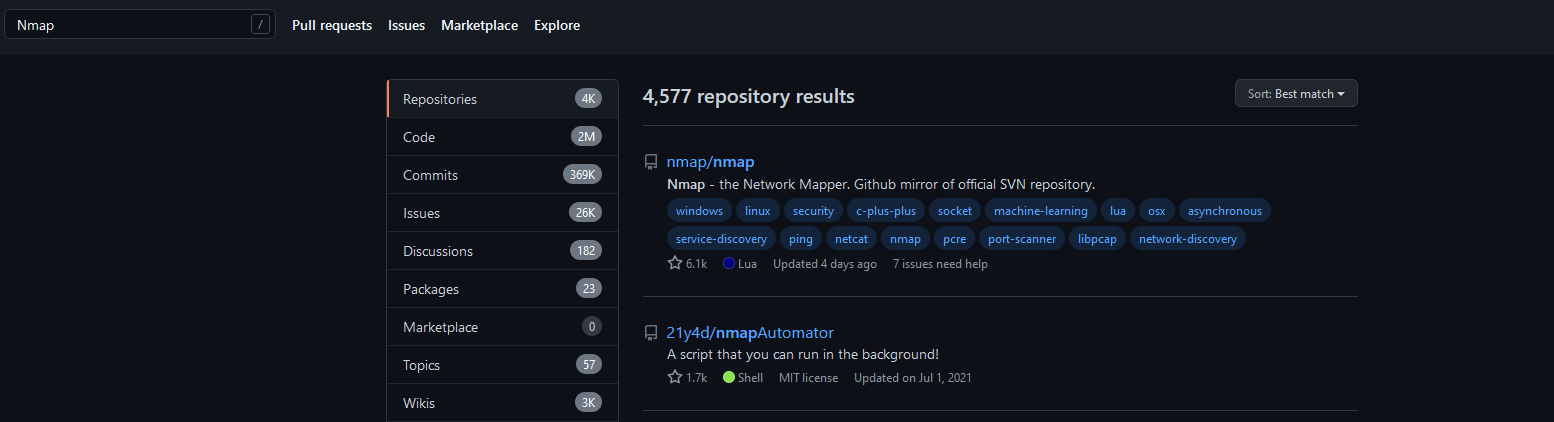
Just typing Nmap in Github search gave us 4,577 hits!

And there you have it! Boosted with your knowledge of NSE, you can further improve on your Nmap mastery, and if you’re interested in writing your own NSE scripts, go and check out this link for NSE script writing tutorial. There is also a simple example script on Nmap’s official website, called finger, that might be a good starting point for you!

Resources

Below are some interesting links on the topic of NSE, but we greatly encourage you to go out and search them yourselves.

About Version 2 Digital

Version 2 Digital is one of the most dynamic IT companies in Asia. The company distributes a wide range of IT products across various areas including cyber security, cloud, data protection, end points, infrastructures, system monitoring, storage, networking, business productivity and communication products.

Through an extensive network of channels, point of sales, resellers, and partnership companies, Version 2 offers quality products and services which are highly acclaimed in the market. Its customers cover a wide spectrum which include Global 1000 enterprises, regional listed companies, different vertical industries, public utilities, Government, a vast number of successful SMEs, and consumers in various Asian cities.

About VRX
VRX is a consolidated vulnerability management platform that protects assets in real time. Its rich, integrated features efficiently pinpoint and remediate the largest risks to your cyber infrastructure. Resolve the most pressing threats with efficient automation features and precise contextual analysis.

Why ESET is a leader for managed service providers serving SMBs

Michal Jankech, ESET Vice President of SMB and MSP Segment

In a unique report put out by Analysys Mason in 2021, ESET scored among the leaders for small- and medium-sized business (SMB) endpoint security vendors. The reason for this placement is clear: backed by a strong managed service provider (MSP) program tailored to the needs of SMBs, ESET has shown consistent financial growth in serving the SMB market around the world.)

Similarly, in 2022, Canalys published a unique report called the MSP Tech Stack, which layers five core MSP technologies positioning cybersecurity at the bottom. Although ESET did not feature among the cybersecurity vendors in this report, ESET is poised to reach a milestone in product development where it will meet the two entry criteria:

1.    Over 10% of revenue sourced via MSPs.
2.    A strong detection and response capability ready for MSPs.

The first criterion on revenue source is a mark already hit by ESET. The second criterion is on track to be met with the release of ESET Inspect Cloud – ESET’s XDR-enabling technology, which was already released for businesses in March 2022 – into ESET’s MSP program later this year.

The Canalys MSP Tech Stack serves as an insightful lens into the MSP world because it reveals the delicate balance between trust and freedom sought by MSPs: the trust to select any one vendor as a long-term, stable partner committed to its MSP program, and the freedom to mix and match several trusted vendors from the tech stack to access the best technologies available.

Finding a trusted security partner

Many events cause MSPs concern, like unwanted changes to partner programs, acquisitions between vendors serving the MSP community, or the widespread blocking of sales in the wake of the Ukraine invasion followed by the breaking and forging of many partnerships. In addition to this tumultuous time for service chains around the world, the concerns about cyberthreats remain ever present with governments simultaneously advising the solicitation of help from security experts and caution about the security posture of third-party vendors.

For many MSPs trudging through this complexity, turning to ESET as an EU-headquartered security provider may be a perfect fit, to put it boldly. Since its origins 35 years ago, ESET has been proud to be a privately owned company not beholden to stockholders and thus free to engage with partners to design an MSP program built on their feedback and the actual needs of SMBs. This means that ESET can offer partners a stable relationship set to last for many years.

But to be stable is not to be stagnant. ESET continually strives to enhance its MSP portfolio and improve the quality of its security products along with their integrations and features for MSPs. The key examples demonstrating this commitment are ESET PROTECT and ESET Inspect.

Prevent, detect, and respond from the cloud

ESET PROTECT represents ESET’s tiered approach to providing businesses with subscriptions for scalable protection centered around a management console. When this move was made in 2021, a key feature was the release of a cloud-based version of ESET PROTECT. This new foray to the cloud was not an isolated event but a paradigm shift of becoming cloud first in the way ESET plans to serve businesses and MSPs in the future.

Of course, ESET was already leveraging the power of the cloud to provide increased protection for many years. But the birth of ESET PROTECT was a new way for MSPs to scale their efforts and focus their time now unencumbered by on-premises concerns. This was followed in 2021 by the genesis of yet another cloud product – ESET Cloud Office Security – which directly protects cloud-based tools, chiefly Microsoft 365.

Yet, after having traversed all this ground to the cloud, the appetite of MSPs for cloud-provisioned protection has only been sharpened. And the succulent steak for this meal, ESET Inspect Cloud, is the detection and response module laying the foundation of ESET’s pursuit of XDR.

Interested in partnering via ESET’s MSP program? Read more here.

Apart from ESET Inspect, other plans are in store for MSPs. To give only a few hints now, ESET has long-term plans to offer multifactor authentication from the cloud, to build a vulnerability and patch management solution, and to launch a unified license management solution capable of serving the needs of all partners’ distribution model types.


Further reading:

  1. MSPs must master cybersecurity II
  2. Criminal hacking hits managed service providers: Reasons and responses
  3. No-cost ESET plugins for MSPs streamline security via low-effort dashboard
  4. With more businesses moving to the cloud and adopting SaaS, ESET Cloud Office Security provides easily managed security to MSPs and their Microsoft 365 clients
  5. A new business offering for a new business world
  6. Bringing cloud-based management to the managed service providers’ tool kit with ESET PROTECT Cloud

About Version 2 Digital

Version 2 Digital is one of the most dynamic IT companies in Asia. The company distributes a wide range of IT products across various areas including cyber security, cloud, data protection, end points, infrastructures, system monitoring, storage, networking, business productivity and communication products.

Through an extensive network of channels, point of sales, resellers, and partnership companies, Version 2 offers quality products and services which are highly acclaimed in the market. Its customers cover a wide spectrum which include Global 1000 enterprises, regional listed companies, different vertical industries, public utilities, Government, a vast number of successful SMEs, and consumers in various Asian cities.

About ESET
For 30 years, ESET® has been developing industry-leading IT security software and services for businesses and consumers worldwide. With solutions ranging from endpoint security to encryption and two-factor authentication, ESET’s high-performing, easy-to-use products give individuals and businesses the peace of mind to enjoy the full potential of their technology. ESET unobtrusively protects and monitors 24/7, updating defenses in real time to keep users safe and businesses running without interruption. Evolving threats require an evolving IT security company. Backed by R&D facilities worldwide, ESET became the first IT security company to earn 100 Virus Bulletin VB100 awards, identifying every single “in-the-wild” malware without interruption since 2003.

What is remote network monitoring?

Remote network monitoring is a technical specialty that was born almost at the same time as networks themselves. Since then, many strategies have emerged when it comes to monitoring network elements.

In this article we will talk about the current techniques based on SNMP polling and network statistic collection through Netflow, and we will also mention outdated systems such as RMON.

Most techniques are purpose-oriented, so they are especially useful. Some more modern ones use combined techniques to offer higher control and network knowledge.

What advantages does each one of them offer?

What is remote network monitoring?

Remote network monitoring consists of detecting and knowing the status of any device connected to the network.

It can be network-specific hardware (such as a router, server, printer) or a specialized device (such as a probe or IoT element).

Simple, right?

Then let’s talk about the different techniques you have to monitor a network remotely.

Basic Remote Network Monitoring Techniques

Often this monitoring takes place through basic techniques.

With basic techniques we mean something as well known as pinging and checking whether the computer responds to the network.

What is pinging? It is a communication mechanism that allows you to find out whether a computer is connected and responds when you “knock” on its door.

To use it you just have to know its IP address.

Other basic techniques include measuring latency times (network lagging) or packet loss (network packet loss).

Advanced Remote Network Monitoring Tool – Netflow

The most common and already much more network specific techniques include the use of the SNMP protocol (Simple Network Monitoring Protocol) that helps to obtain specific information from devices connected to the network: number of connections, incoming traffic through its network interface, firmware version, CPU temperature, etc.

Something that, if we use technical terms, is known as SNMP polling.

Other tools use protocols from the Netflow family (JFlow, SFlow, Netflow) to obtain statistical information about network usage.

This statistical information is incredibly useful to be able to analyze the use of the network, detect bottlenecks and, above all, to have a clear vision of what the communication flows between the different elements of a network are.

Advanced Network Remote Monitoring Techniques – RMON

There is an almost obsolete protocol called RMON. However, it is worth mentioning, because we can still find it in some installations.

This protocol used a technology network monitoring technology that listened to the wire to obtain statistical information using a specific SNMP agent. Something like what Netflow does.

Advanced Remote Network Monitoring Tools – SNMP Traps

On the other hand, most devices still use SNMP TRAPS to report incidents in asynchronous mode.

Although it is a very old method, it is still used today as a monitoring method on almost all network devices.

Not to be mistaken with the SNMP Polling that we discussed at the beginning!

Benefits of Network Monitoring

The most important and simple benefit is to find out the status of the network:

  • Whether it is active
  • Whether it is overloaded
  • Which devices have the most traffic
  • What kind of traffic is circulating over the network
  • Bottlenecks
  • Jams
  • …

An example of a traffic flow diagram captured with Pandora FMS could be the following:

Remote network monitoring tools

Most network management and monitoring systems automatically detect connected systems and draw a network map representing the network.

The most advanced tools allow you to update that map in real time and see even the physical connections between interfaces (known as a link-level topology or Layer 2).

For example, like this automatic network map generated with Pandora FMS:

Remote monitoring in network management

Some systems incorporate what is known as IPAM (IP Address Management) and, at the same time, monitor the network status, allowing IP addressing to be mapped and controlled so that you know which networks are free and how they are used.

How does a remote network monitoring service work?

Generally, a tool like this one has a central server that allows you to detect systems and launch network tests (ping, icmp, snmp) to find out the status of each device. 

To know the network in detail through its network flows in real time, you will need to configure the network routers and switches with the Netflow protocol and send that information to a Netflow collector. Although only professional medium/top-range network equipment supports the use of Netflow.

If you use an advanced monitoring tool, it will have its own Netflow collector.

Sometimes it is necessary to monitor devices that are in inaccessible networks, so intermediate polling servers, called proxies or satellites, are used.

These secondary servers perform network scans and monitoring on the devices nearby, and then send the collected data to a central system.

But what do we do with all this numerical data?

It is essential that the monitoring tool you use has graphs, reports and visual screens to display that data.

If we’re already talking about the top-of-the-range tools, those visual network maps will allow you to manually correct and add the details you need to manage those networks.

What are the best remote network monitoring software?

The professional tools that cover SNMP, Netflow, network maps and IPAM that work best today are:

  • SolarWinds
  • Whatsup Gold
  • Pandora FMS

Although they differ from each other in several respects, you may cover all your monitoring needs with any of them.

Would you like to know more about remote network monitoring tools? Then this will no doubt interest you:

Best network monitoring systems

Not all market tools cover these areas.

Some only support basic SNMP, but do not support Netflow. Others do not have good discovery or map editing capabilities and most of them do not have IPAM features. 

The basic thing a good network monitoring tool should have is:

  • SNMP v1, v2 and v3 capabilities
  • To be able to use proxy servers
  • SNMP Trap Collection
  • Device Discovery
  • Map drawing

About Version 2 Digital

Version 2 Digital is one of the most dynamic IT companies in Asia. The company distributes a wide range of IT products across various areas including cyber security, cloud, data protection, end points, infrastructures, system monitoring, storage, networking, business productivity and communication products.

Through an extensive network of channels, point of sales, resellers, and partnership companies, Version 2 offers quality products and services which are highly acclaimed in the market. Its customers cover a wide spectrum which include Global 1000 enterprises, regional listed companies, different vertical industries, public utilities, Government, a vast number of successful SMEs, and consumers in various Asian cities.

About PandoraFMS
Pandora FMS is a flexible monitoring system, capable of monitoring devices, infrastructures, applications, services and business processes.
Of course, one of the things that Pandora FMS can control is the hard disks of your computers.

透過視覺溝通工具引導和改善使用者體驗——ArtVersion 使用案例分享

Goran Paunovic 於1999年成立 ArtVersion 創意機構。 ArtVersion 協助《財富》世界500大企業、大型公司、中型公司,甚至新創公司加強網頁設計和使用者體驗(UX)設計的成果。

ArtVersion 的作品在 Vega Digital Awards 和 MUSE Creative Awards 中揚名國際,這兩項比賽都是由享有盛譽的 International Awards Associate(IAA)所精心策劃。目前,創辦人 Goran Paunovic 使用 IPEVO 愛比科技的 VZ-X 作為與網路設計及開發相關的網頁易用性和使用者測試的工具。Goran 強調:「VZ-X對於幫助我們了解使用者在使用我們所設計的網站或應用程式時的行為起了關鍵性的作用,是個不可或缺的工具。」

戈蘭·帕諾維奇(Goran Paunovic) — ArtVersion 創辦人。

在使用愛比科技產品前,Goran 解釋:「ArtVersion 『為體驗而設計』的過程是反覆的試驗。在特別採用愛比科技 VZ-X 產品前,我們描述使用者行為或優先考慮事項的方式更像是一種猜謎遊戲。此外,因為沒有熟知的科技可以更有效率的指導整個過程,貫徹『為體驗而設計』變得更加費力和耗時。」

多虧了愛比科技的VZ-X 無線教學攝影機,ArtVersion 對於如何更好的開發使用者旅程以優化網路體驗有了更清晰的方向:「我們的團隊可以在理解具體數據後進行透徹的觀察,進而得出更多答案。準確評估行為數據在產品或體驗設計中至關重要,而愛比科技的 VZ-X 無線教學攝影機使創作過程與客戶(以及之後的線上使用者)更貼近。IPEVO 的 VZ-X 產品驗證了我們夢寐以求的行為分析,為 ArtVersion 團隊提供了更好的響應性式網頁設計方法。」

最近,ArtVersion 的網站因其傑出的使用者經驗 (UX) 設計、視覺敘事和行動應用獲得 awwwwards 的認可。因此,Goran 強烈推薦愛比科技的產品給網頁和平面設計專業人士:「對於在設計領域的其他工作者來說,VZ-X是一款敏捷的產品,可以幫助動態使用者體驗。此外,VZ-X匯編資料的能力不僅可以應用於網頁設計或圖形設計,還可以廣泛的應用於其他行業。除了 VZ-X 產品的科技方面,它還是個很棒的協作工具,可以透過無線連接模式將影像投影在大銀幕上,分享資訊給大家。」


ArtVersion 榮獲四次 Vega 數位獎。

關於Version 2

Version 2 Digital 是立足亞洲的增值代理商及IT開發者。公司在網絡安全、雲端、數據保護、終端設備、基礎設施、系統監控、存儲、網絡管理、商業生產力和通信產品等各個領域代理發展各種 IT 產品。透過公司龐大的網絡、通路、銷售點、分銷商及合作夥伴,Version 2 提供廣被市場讚賞的產品及服務。Version 2 的銷售網絡包括台灣、香港、澳門、中國大陸、新加坡、馬來西亞等各亞太地區,客戶來自各行各業,包括全球 1000 大跨國企業、上市公司、公用事業、醫療、金融、教育機構、政府部門、無數成功的中小企及來自亞洲各城市的消費市場客戶。

關於IPEVO
IPEVO源自於PChome Online硬體事業部門,2007年7月正式獨立。自2004年於台灣營運Skype網絡電信服務,使台灣成為Skype全球發展中最成功的市場。2005年起以IPEVO品牌推出一系列Skype專屬硬件產品,將Skype虛擬服務轉化為使用者實質經驗。IPEVO以簡單、實際且具有價值的經驗為產品目標,其簡潔俐落的產品風格呼應著IPEVO的核心思考與產品精神。目前已研發之產品包括:Skype有線USB話機、Skype無線話機、Skype會議系統、Skype視訊設備、Stand-alone免電腦Skype話機。