Summary: Best practices of eCommerce security to protect your online store and customer data from breaches, fraud, and evolving cyber threats effectively.
Running an e-shop offers many opportunities, but it also brings security risks you can’t ignore. As online shopping grows, cybercriminals keep evolving their tactics to exploit weaknesses. Protecting your online store from cyber threats is crucial for both keeping your business secure and your customers’ payment information safe.
From credit card details to other sensitive data, your customers trust you to protect their confidential information. This guide will walk you through the eCommerce security best practices, covering key areas to help strengthen your online store and reduce the risk of cyber threats.
Why it’s important to protect your eCommerce website
A single security breach can cause serious harm to your business. It can lead to significant financial losses, legal penalties, a loss of customer trust, and severe reputational damage that takes years to rebuild. Imagine the fallout if customer data is stolen, or your store goes offline during a busy sales period.
Beyond the immediate chaos, a security breach can result in:
Financial losses: Costs from investigations, legal fees, fines (like
GDPR or
CCPA penalties), credit monitoring for affected customers, and lost revenue during downtime.
Reputational damage: News of a data breach can spread fast, leading to bad publicity and loss of customer confidence. Regaining trust is hard once it’s lost.
Legal and compliance issues: Failing to follow data protection rules can lead to heavy fines and legal consequences.
Operational disruptions: Cyber-attacks can shut down your store, affecting sales, your supply chain, and day-to-day operations.
Strong eCommerce security isn’t just about meeting compliance requirements. It’s about building a reliable, trustworthy online store that customers can depend on.
Common eCommerce security threats
Cyber threats constantly change, with attackers finding new ways to target online shops. Understanding these common threats is the first step in building effective defenses.
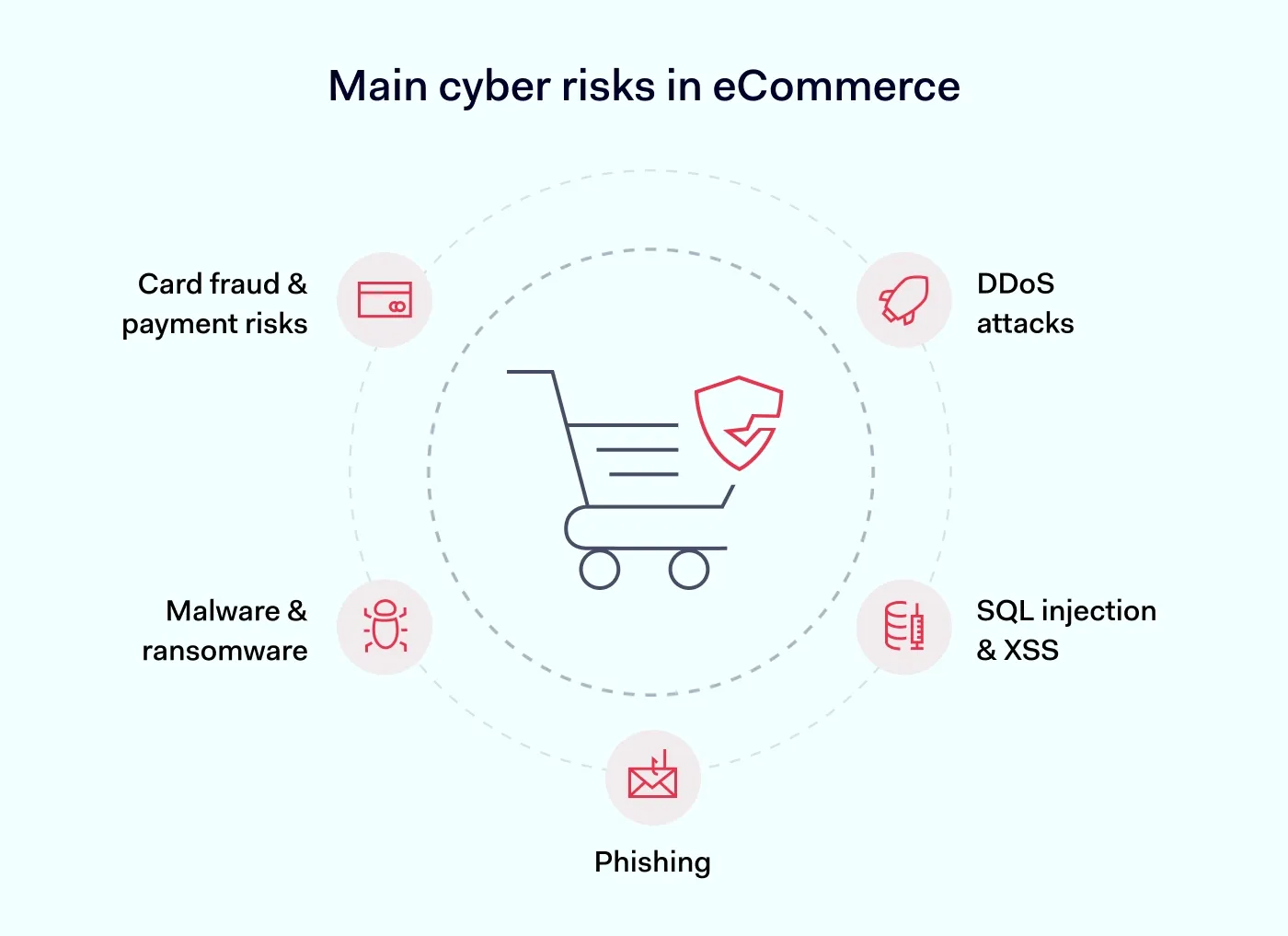
SQL injection and XSS vulnerabilities
SQL injection and Cross-Site Scripting (XSS) are two common weaknesses that can seriously harm your eCommerce website’s security:
SQL injection. This attack occurs when an attacker inserts malicious SQL code into input fields on your website, like login forms or search bars. If your server doesn’t validate these inputs properly, the attacker’s code can run on your website’s database. This could grant them unauthorized access to, or even manipulation of, your database, potentially exposing sensitive data like customer records, order details, and even credit card information.
Cross-Site Scripting (XSS) vulnerabilities. XSS attacks involve injecting malicious scripts into trusted websites. When a user visits your site, their browser runs the malicious script, which can lead to session hijacking, redirecting users to fake sites, or stealing customer data. For online stores, this can mean compromised user accounts or tricking customers into giving away personal information.
Phishing attacks targeting online stores
Phishing attacks remain one of the most common and effective methods for cybercriminals. In eCommerce, phishing can target both the business itself and your customers.
Targeting businesses: Attackers may send fake emails to your employees, pretending to be vendors, banks, or company leadership. These emails try to trick employees into sharing login credentials for your store’s admin panel or financial systems. If they succeed, attackers can gain direct access to sensitive business data.
Targeting customers: Malicious actors often create fake websites or send fraudulent emails that look like real e-stores. They trick customers into entering their login or payment information on these fake sites, leading to data breaches and financial fraud.
Teaching your employees and customers how to spot phishing attempts is one of the most important steps you can take. Human error is still the easiest way for cybercriminals to bypass technical security measures.
Malware and ransomware
Malware—short for malicious software—includes many harmful programs designed to damage, disrupt, or gain unauthorized access to systems. Ransomware is a particularly damaging form of malware.
Malware. Your eCommerce site can get infected with malware through insecure plugins, weak hosting environments, or phishing attacks. Malware can steal customer data, disrupt your site, redirect traffic, or use your site to spread further infections, harming customer trust and data security.
Ransomware. Attackers lock your files by encrypting them and demand payment, often in cryptocurrency, to unlock them. For online shops, this could mean losing access to product catalogs, customer data, and order history, stopping your business entirely and risking a data breach. Regular backups are critical for recovering from ransomware attacks.
Distributed Denial of Service (DDoS) attacks
DDoS attacks overwhelm your website with fake traffic, making it unavailable for real customers who want to browse products, place orders, or complete online transactions.
These attacks can cause significant financial losses from lost sales, damaged reputation, and the costs associated with mitigating the attack and restoring service. While they don’t always directly aim to steal data, they can be used as a smokescreen for other, more targeted attacks.
Effective security measures for DDoS include specialized mitigation services and robust infrastructure.
Card fraud and other eCommerce transaction risks
Payment processing is at the core of eCommerce, making it a key target for fraud.
Credit card fraud. Fraudsters may use stolen card information to make purchases or use tactics like e-skimming (Magecart attacks), where malicious code is placed on your checkout page to capture payment details as customers enter them.
Chargebacks. Fraudulent transactions often result in chargebacks, where the rightful cardholder disputes the charge. This can lead to financial penalties for your store and harm your account processing reputation.
Identity theft. If attackers steal customer data like personal identifiable information (PII), they can commit identity theft, harming your customers and potentially leading to legal and financial consequences for your business.
These common eCommerce security threats show why having a layered security strategy is essential to protect every part of your online store and keep your customers’ trust.
Best eCommerce security practices for online store administration
Your store’s admin side needs as much protection as the customer-facing side. Here’s how to keep your business secure:
Use multi-factor authentication (MFA)
Multi-factor authentication adds a critical layer of protection to user accounts. Instead of relying solely on a password, MFA requires users to provide two or more verification factors to gain access. These could be something they know (password), something they have (a code from an authenticator app or SMS), or something they are (biometrics like a fingerprint).
Secure your eCommerce website with an SSL certificate
An SSL certificate (Secure Sockets Layer) is foundational for any eCommerce business. It encrypts the connection between your server and your customers’ browsers. When a website has an SSL certificate, its URL begins with https:// instead of http://, and a padlock icon appears in the browser’s address bar.
Regularly update your eCommerce platform and plugins
Outdated software is a top target for bad actors. Updates fix security gaps, so don’t skip them.
Make it a habit to:
Update your platform. Whether you use Shopify, Magento, WooCommerce, or another platform, ensure it’s running on the latest version.
Update themes and plugins. Third-party tools are often sources of vulnerabilities. Regularly check for and apply updates.
Remove unused plugins/themes. Unused components can still pose a security risk. If you don’t use them, delete them.
Automate updates where possible. Consider automating updates for critical security patches, but always test them in a staging environment first.
This proactive approach to maintenance is essential for your store’s security.
Implement secure payment gateways to protect your online store
Payment processing is the most critical part of your e-shop’s security. Always use reputable, secure payment gateways that employ advanced encryption, tokenization, and fraud detection technologies to protect the data. In that way, transactions between your store and the customer’s bank will be handled safely, and the transmission of cardholder data and other payment information will remain secure.
By using robust, industry-standard payment gateways, you significantly improve the security measures protecting your customers’ financial information.
Educate employees and customers on eCommerce security best practices
Technology alone isn’t enough; human error is stilla significant vulnerability. That’s why education is such a powerful security measure.
Employee training. Train your employees on identifying phishing attempts, using strong, unique passwords, understanding social engineering tactics, and following proper procedures for handling personal data. Regular refreshers are vital. Employees with access to your web server or admin panels should be particularly security-aware.
Customer awareness. While you can’t control your customers’ security habits, you can educate them. Provide clear information on your website about your security practices, how to identify official communications from your e-store, and tips for protecting their information (e.g., using strong passwords, being wary of suspicious links). This fosters trust and empowers them to be part of your security defense.
Protecting customer data
At its heart, e-shop security is all about safeguarding confidential data. This extends beyond just credit card details to encompass all personally identifiable information like names, addresses, phone numbers, and purchase history.
A data breach involving this information can result inidentity theft, phishing attacks against your customers, and severe regulatory penalties for your business.
Key aspects of protecting customer data include:
Data minimization: The less you store, the less you risk. Only collect the data you absolutely need for legitimate business purposes.
Encryption at rest and in transit: Ensure all confidential data is encrypted, both when it’s stored on your servers (data at rest) and when it’s being transmitted across networks (data in transit) via an encrypted connection.
Access control: Implement strict access controls, limiting who can access sensitive customer data to only those employees who require it for their job functions. Use
role-based access control (RBAC) to define granular permissions.
Regular data audits: Periodically audit your data storage and access logs to identify any suspicious activity or unauthorized access attempts.
Clear data retention policies: Establish clear policies for how long you retain customer data. Once data is no longer needed, securely delete it.
Advanced security measures
While basic network security practices are essential, advanced security measures are increasingly necessary to combat modern threats.
Consider:
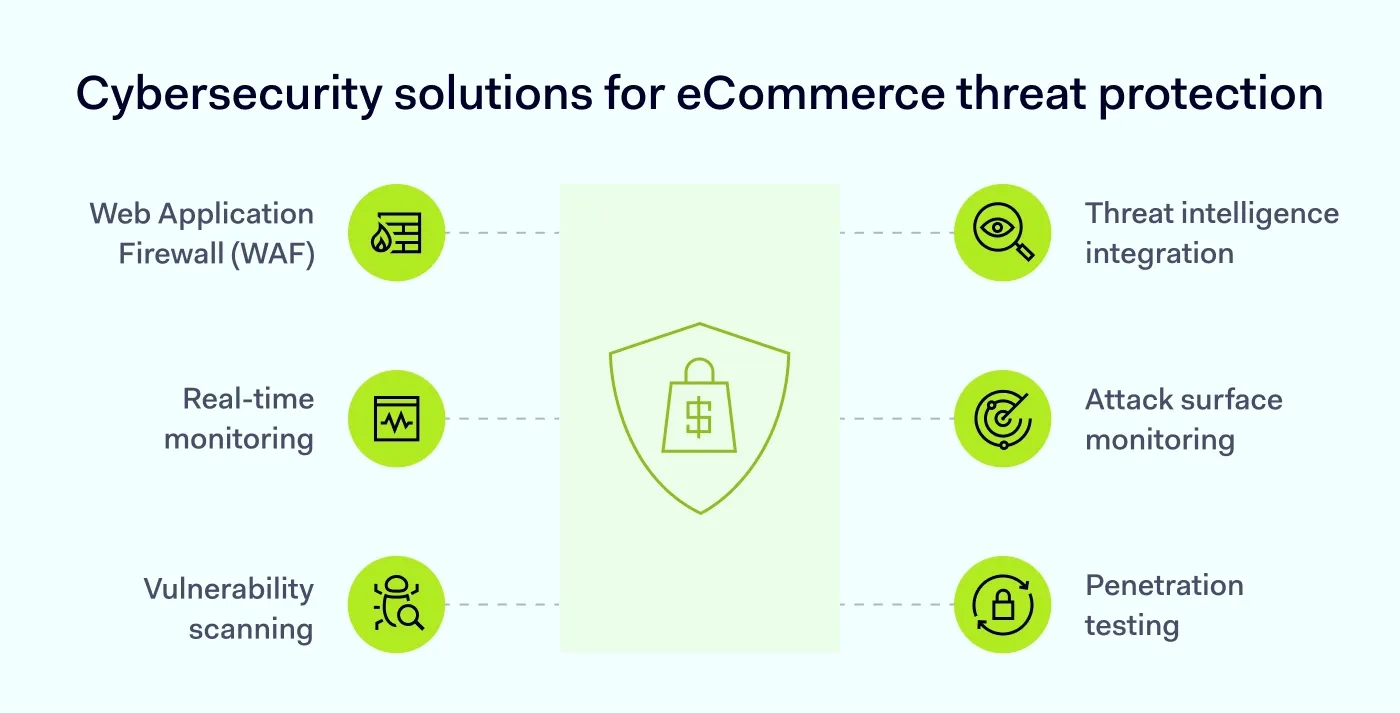
Web Application Firewall (WAF)
A WAF sits between your website’s server and the internet, monitoring and filtering HTTP traffic. It acts as a shield, protecting your website from common attacks like SQL injection, XSS, and other web-based vulnerabilities before they reach your application.
Real-time monitoring
Continuous monitoring of your e-store for suspicious activity, unauthorized access attempts, and performance anomalies is crucial. This includes monitoring server logs, network traffic, and application logs. Real-time alerts allow for rapid response to potential threats.
Vulnerability scanning
Regularly scan your eCommerce platform, plugins, and underlying infrastructure for known vulnerabilities. Automated vulnerability scanners can identify weaknesses that attackers might exploit, allowing you to patch them proactively.
Penetration testing
Beyond automated scans, professional penetration testing involves ethical hackers simulating real-world attacks to uncover vulnerabilities that automated tools might miss. This provides a deep understanding of your eCommerce website security posture.
Attack surface monitoring
This involves continuously discovering, inventorying, and monitoring all internet-facing assets of your website (e.g., domains, subdomains, IP addresses, cloud instances) to identify potential entry points for attackers.
Threat intelligence integration
Using threat intelligence feeds can provide early warnings about new cyber threats and attack vectors targeting the eCommerce industry. This helps adapt your security measures before an attack happens.
Stay compliant with security standards
Following industry-specific and regional compliance standards is not just about avoiding fines; it’s about building a solid foundation for data protection and demonstrating a commitment to protecting customer data.
Understanding PCI-DSS requirements for eCommerce websites
The Payment Card Industry Data Security Standard (PCI DSS) is a set of security standards designed to ensure that all companies that process, store, or transmit credit card details maintain a secure environment. For eCommerce websites that handle online transactions, PCI DSS compliance is mandatory.
Key requirements of PCI DSS include:
Establishing a secure network, using firewalls to protect cardholder data, and changing all default system passwords.
Protecting cardholder data by encrypting its transmission across open, public networks and securing stored information.
Maintaining a vulnerability management program through regularly updating anti-virus software and developing secure systems and applications.
Implementing strong access controls to limit who can view cardholder data, assigning unique IDs for computer use, and restricting physical entry.
Regularly monitoring and testing networks, including tracking all access to network resources and cardholder data, and routinely testing security systems and processes.
Maintaining an information security policy that establishes guidelines addressing information security for all staff.
Achieving and maintaining PCI DSS compliance is a continuous process that involves regular assessments, remediation, and reporting. Failing to comply can result in severe penalties, including fines and the inability to process credit card payments.
GDPR and CCPA compliance for protecting customer data
Beyond financial data, general data privacy regulations like the General Data Protection Regulation (GDPR) in Europe and the California Consumer Privacy Act (CCPA) in the United States impose strict requirements on how eCommerce businesses collect, store, process, and protect personal data.
GDPR (General Data Protection Regulation). Applies to any business handling EU citizens’ data, requiring consent, rights to access and erase data, and breach reporting. Non-compliance can result in fines up to 4% of global annual revenue or €20 million, whichever is higher.
CCPA (California Consumer Privacy Act). Like GDPR, CCPA grants California consumers significant rights regarding their personal information, including the right to know what data is collected, the right to opt out of data sales, and the right to request deletion. While the penalties are not as steep as GDPR, the reputational damage and legal costs can still be substantial.
Complying with these privacy regulations is not just a legal obligation. It’s also a way to build trust by demonstrating a strong commitment to protecting customer data and respecting their privacy.
How NordLayer can help protect your eCommerce store
Securing your e-store requires more than just the basics—it demands a resilient, adaptable cybersecurity infrastructure. NordLayer delivers advanced eCommerce cybersecurity solutions designed for comprehensive, layered protection.
NordLayer can fortify your online store by:
Securing remote access: NordLayer ensures encrypted, authenticated connections for employees and admins accessing your e-store backend via NordLayer’s infrastructure, protecting sensitive systems from unauthorized entry. Bonus? It simplifies
IP whitelisting: instead of managing multiple external IPs, you can grant access by creating a NordLayer user account—quick, secure, and configuration-free.
Implementing Zero Trust Network Access (ZTNA): Built on the principle of “never trust, always verify,” NordLayer authenticates and authorizes every user and device before granting access to your internal business systems via the NordLayer network. This granular control reduces your attack surface and defends against insider threats and credential compromise.
Providing Firewall-as-a-Service (FWaaS) capabilities: NordLayer’s Cloud Firewall filters malicious traffic, targeting the secure gateways to access internal business systems. This adds a powerful layer of defense against DDoS attacks and exploitation attempts on those access points (note: not the public-facing eCommerce website).
Enhancing data security: By encrypting network traffic between users connected to NordLayer and your internal applications or cloud resources, NordLayer keeps sensitive business data confidential and safe from interception, complementing, not replacing, existing SSL protections on your e-commerce site.
Simplifying security compliance: With built-in security measures for access control and data protection, NordLayer helps eCommerce businesses meet regulations like GDPR and PCI DSS with less complexity.
Reducing malware risks: NordLayer’s malware detection reduces the risk of malware infections, protecting your internal systems and customer data.
Take control of your eCommerce security and compliance with NordLayer. Build trust, reduce risks, and let your customers shop with confidence.