Skip to content

Navigating New Horizons: Thinfinity® Workspace as a Strategic VMware Alternative

Introduction

The acquisition of VMware by Broadcom has significantly reverberated through the tech community, especially among VMware’s customer base. This development has introduced a wave of uncertainty regarding the future of product roadmaps, support frameworks, and licensing costs. Consequently, CIOs and IT leaders are urgently revisiting their strategies for virtualization and remote access solutions to ensure operational continuity, stability, and scalability.

The Need for a Strategic Pivot

This acquisition’s implications are profound, compelling VMware users to evaluate various migration strategies that adhere to their long-term business objectives. As organizations consider the transition to alternative platforms, they are confronted with pivotal decisions concerning cost, compatibility, and future readiness. In recent months, there have been notable price increases for several VMware products, with some clients experiencing cost escalations of 2x to 5x. This situation has led stakeholders to seek our guidance to effectively navigate these challenges. If the decision of CIOs is to continue with the VMware stack without feasible alternatives, it becomes crucial to focus on optimizing utilization, ensuring stability, and addressing any emergent issues.

Identifying Potential Alternatives for VMWare Hypervisor

Several alternatives have come to the forefront as viable options for those considering moving away from VMware hypervisor as virtualization engine:
Microsoft Hyper-v - logo

Microsoft Hyper-V

Available within Windows Server and Azure Stack HCI, Hyper-V is a well-supported solution though it sometimes faces critiques regarding its management tool complexity.
KVM - logo

Linux KVM

Integrated into all Linux distributions, KVM offers a robust solution but might pose a challenge for administrators less familiar with Linux environments.

Xen Project - logo

Xen

Known for its role in Citrix Hypervisor, Xen is tailored for large enterprises and critical applications, albeit with a complex management landscape.
Public cloud or SaaS Migration - icon

Public Cloud or SaaS Migration

Accelerating migration to the public cloud can be a strategic move, especially with recent changes in VMware licensing potentially making this a more financially sound option.

Container Platforms Kubernetes - logo

Container Platforms

Transitioning to a Kubernetes-based container management solution could significantly modernize application management.
Distributed Hybrid Infrastructure - icon

Distributed Hybrid Infrastructure (DHI)

Hybrid and Multi Cloud deployments, with focus on hyperconvergence infrastructure

Identifying Alternatives for VMWare Horizon and Vsphere

As organizations evaluate their virtualization strategy in the wake of evolving market dynamics and rising costs associated with VMware products, Thinfinity® Workspace emerges as a robust alternative capable of seamlessly integrating with a variety of virtualization platforms. Below, we explore how Thinfinity can effectively replace VMware vSphere and VMware Horizon, providing enhanced management, flexibility, and scalability across different environments. This alignment allows businesses to maintain operational efficiency and adapt to their specific technological landscapes:

VMware (ESXi and Horizon) Legacy Workflows

If your organization heavily relies on VMware virtualization, migrating within a short period may not be feasible. Adequate planning is crucial, and selecting a technology partner that can help reduce current licensing costs while providing a migration path to alternative hypervisors is essential. Thinfinity Workspace integrates seamlessly with any VMware VM or ESXi console. This integration allows you to substitute vSphere with Thinfinity for secure, remote access to these workflows. Not only does this approach maintain a disruption-free user experience, but it also enhances it, laying a foundation for future transitions to other hypervisors.

Public Cloud or SaaS Migration (Cloud VDI Orchestration)

If your workflows are ready for cloud migration, Thinfinity Workspace represents an optimal technology choice. It natively integrates with public cloud hypervisors, allowing you to provision and scale VDI workflows using an infrastructure-as-code approach. With Thinfinity, you can seamlessly migrate VMware workflows to any public cloud without disruption or loss of functionality, while enhancing both user and admin experiences. As part of this shift towards cloud solutions, Thinfinity supports migrations to public cloud platforms by facilitating a smooth transition and management of virtual desktops in these environments. This can help mitigate the cost implications associated with VMware licensing changes. Thinfinity offers native integration and a comprehensive VDI manager for platforms like Azure, Ionos, AWS, GCP, Oracle Cloud, Huawei Cloud, and more. For additional details on Thinfinity’s VDI manager capabilities, click here.

Distributed Hybrid Infrastructure (DHI)

In the realm of Distributed Hybrid Infrastructure (DHI), Thinfinity stands out with its agnostic capabilities tailored for hyperconverged environments. This includes advanced features like reverse connections and cloud tunneling, which are essential for integrating multi-cloud VDI capabilities. By enabling organizations to seamlessly connect and manage their IT resources across various cloud platforms, Thinfinity provides a significant advantage over traditional VMware alternatives. Additionally, Thinfinity enhances its offering with extra capabilities such as Zero Trust Network Access (ZTNA) and Privileged Access Management (PAM). These features ensure that security and access control are robust and adaptable, providing an added layer of protection and efficiency that surpasses typical VMware functionalities.

Cost Effectiveness

Following the exploration of Thinfinity® as a versatile alternative to VMware, it’s essential to highlight the cost advantages it offers, particularly in today’s economic climate marked by VMware’s pricing volatility.

Concurrent User Licensing Model:

  • Aligns costs with actual usage rather than potential maximum capacity, making it a more cost-effective model compared to named licenses.
  • Reduces financial burdens, which is particularly beneficial for organizations experiencing significant increases in VMware licensing fees.
  • Historically proven to offer better cost management over time, as it avoids the expense of unused licenses that often accompanies named licensing systems.

Efficient on Less Demanding Hardware:

  • Significantly lowers the total cost of ownership compared to the heavier hardware demands of VMware and Citrix systems.
  • Enables performance efficiency, reducing the need for frequent hardware upgrades.

Cloud-Agnostic Capabilities:

  • Allows deployment across any cloud service or on-premises setup without additional costs.
  • Provides the flexibility to optimize operational costs and adapt to changing business needs seamlessly.

By leveraging these features, Thinfinity® helps organizations maintain robust virtualization capabilities while effectively managing and reducing their infrastructure expenses.

Migration recommendations from VMware

For CIOs charting the course away from VMware, it is crucial to:

  • Align with Business Goals: Whether it’s cost reduction, agility, or cloud migration, ensure that the migration strategy is in step with broader business objectives.
  • Feasibility and Compatibility Analysis: Evaluate the compatibility of current applications with potential alternatives like Thinfinity, considering factors like user access patterns and application performance.
  • Comprehensive Cost Analysis: Undertake a detailed ROI/TCO analysis to gauge the financial impacts of transitioning, factoring in all variables from IT effort to potential disruptions.
  • Manage Expectations: Prepare for a migration timeline that could extend from 0.5 to 3 years, planning phased rollouts and gradual integration of new systems.

Conclusion

As the landscape evolves following VMware’s acquisition, Thinfinity emerges as a robust and adaptable solution for enterprises aiming for stability and agility in their virtualization strategies. By integrating Thinfinity, CIOs can ensure their organizations not only remain resilient but also gain enhanced flexibility and advanced features like ZTNA and RPAM, which are critical in today’s dynamic technological environment. Additionally, Thinfinity’s capability to seamlessly operate across various platforms—from hyper-converged infrastructures to mult-icloud environments—positions it as a cost-effective alternative that enhances operational efficiency. To explore how Thinfinity can specifically benefit your organization and to discuss customized solutions, we invite you to speak with one of our expert engineers.

About Cybele Software Inc.
We help organizations extend the life and value of their software. Whether they are looking to improve and empower remote work or turn their business-critical legacy apps into modern SaaS, our software enables customers to focus on what’s most important: expanding and evolving their business.

About Version 2 Digital

Version 2 Digital is one of the most dynamic IT companies in Asia. The company distributes a wide range of IT products across various areas including cyber security, cloud, data protection, end points, infrastructures, system monitoring, storage, networking, business productivity and communication products.

Through an extensive network of channels, point of sales, resellers, and partnership companies, Version 2 offers quality products and services which are highly acclaimed in the market. Its customers cover a wide spectrum which include Global 1000 enterprises, regional listed companies, different vertical industries, public utilities, Government, a vast number of successful SMEs, and consumers in various Asian cities.
Why is Thinfinity® Workspace the Best Alternative to Remote Desktop Broker and Gateway?

Introduction

As we Move through, the demand for efficient, secure, and cost-effective remote desktop solutions has never been higher. Your success as an IT professional or business leader depends on the quality of digital experiences you deliver. Consider a video call for a remote worker: they open their app, turn on the camera, and join the meeting. While it seems straightforward, the call travels through a complex network, and any hiccup along the way can disrupt the experience.

This is where Thinfinity comes into play. It presents a compelling alternative to traditional Remote Desktop Broker (RDB) and Remote Desktop Gateway (RDG) solutions, specifically designed to meet the needs of System Administrators and CIOs. Thinfinity ensures seamless, high-quality digital interactions, making it easier to keep your team connected and productive without the usual headaches.


Why Thinfinity Stands Out

Zero Trust Security

In today’s cybersecurity landscape, ensuring the security of access points is paramount. Thinfinity integrates advanced zero-trust security protocols, minimizing the risk of unauthorized access. This proactive approach is crucial, particularly as cyber threats become more sophisticated. By ensuring that every access request is authenticated, authorized, and encrypted, Thinfinity protects sensitive data and maintains the integrity of IT infrastructure.

Clientless Access

Thinfinity’s clientless access is a game-changer. Unlike traditional RDB and RDG, which often require specific client applications, Thinfinity allows users to access their desktops and applications directly through a web browser. This flexibility supports a wide range of devices, including tablets and smartphones, eliminating the need for additional software. This not only reduces complexity but also enhances user convenience and accessibility.

Hybrid and Multi-Cloud Support

Seamlessly integrating with hybrid and multi-cloud environments, Thinfinity enables businesses to deploy resources across different platforms, optimizing performance and cost. This capability is particularly valuable in a landscape where hybrid cloud strategies are becoming the norm. System Administrators can efficiently manage these deployments, ensuring that resources are utilized effectively and business operations remain agile and responsive.

Enhanced User Experience

Thinfinity offers features like multi-monitor support, clipboard redirection,screen sharing and a user-friendly interface among other advanced features, ensuring that end-users have a seamless and productive experience. These enhancements are critical for maintaining workflow efficiency in remote settings. A streamlined user experience translates to higher productivity, reduced frustration, and greater overall satisfaction among employees.

Simplified IT Management

For CIOs and IT teams, Thinfinity simplifies the complexity associated with traditional RDB and RDG. With centralized management, IT can easily monitor and control remote sessions, enforce security policies, and ensure compliance. This reduces the administrative burden and allows IT teams to focus on strategic initiatives. The ease of management also translates to quicker resolutions of issues and a more resilient IT environment.

Scalability and Cost-Effectiveness

Thinfinity is designed to scale with your business. Whether you’re a small enterprise or a large corporation, Thinfinity’s scalable architecture ensures that you only pay for what you use. This model provides a cost-effective solution compared to the often rigid and expensive licensing structures of traditional RDB and RDG. As your business grows, Thinfinity can easily accommodate increased demand without significant additional costs.

The Future of Remote Desktop Services: Thinfinity® vs. Traditional Solutions

Introduction to Remote Desktop Services

Remote desktop services have become an integral part of modern business operations. They enable employees to access corporate resources from anywhere, enhancing flexibility and productivity. However, traditional solutions like RDB and RDG often come with limitations that can hinder performance and scalability. Thinfinity, with its innovative approach, addresses these challenges effectively.

Advantages of Thinfinity Over Traditional RDB and RDG

Enhanced Security Measures

Traditional remote desktop solutions often depend on static security measures, leaving them susceptible to contemporary cyber threats. Thinfinity, however, employs a zero-trust model that continuously verifies the identity and legitimacy of each access request, ensuring a dynamic and robust security framework. Additionally, Thinfinity supports two-factor authentication (2FA) and multi-factor authentication (MFA) and offers native integrations with leading identity providers such as Okta, Duo, Azure AD, and Ping Identity. It also includes a native HOTP/TOTP server to enforce two-factor authentication for both local and Active Directory users, compatible with Microsoft Authenticator and Google Authenticator.

For more detailed information on Thinfinity’s authentication features, please refer to the Thinfinity Knowledge Base.  $

Clientless Flexibility

As you probably already know, traditional Remote Desktop Protocol (RDP) and Remote Desktop Gateway (RDG) solutions often require specific client applications, which can be a significant barrier, especially in diverse IT environments. Thinfinity’s clientless access through web browsers removes this hurdle, offering greater flexibility and ease of use. Users can connect from popular browsers such as Chrome, Firefox, Edge, and Safari, on a wide range of devices not typically suitable for Windows Applications, including tablets, smartphones, Chromebooks,and others. This ensures that employees can create and access their digital workspace on virtually any device without the need for complex installations or configurations.

Optimized Hybrid and Multi-Cloud Integration

While traditional Remote Desktop Gateway and broker solutions are adequate for on-premises or single-cloud deployments, they often struggle with hybrid and multi-cloud environments, Thinfinity excels in this area. Its seamless integration capabilities ensure that businesses can leverage the benefits of various cloud platforms without encountering compatibility issues. Thinfinity natively integrates with major cloud providers such as Azure, AWS, GCP, Ionos Cloud, and Huawei Cloud. For more information on Thinfinity’s native integration with cloud platforms, please visit the Thinfinity VDI Manager page.

Superior User Experience

Traditional remote desktop solutions often fall short in providing the intuitive interfaces and advanced features that modern users expect. Thinfinity goes beyond these limitations with its focus on delivering a superior user experience. Key features include high-speed connections for seamless remote interactions, support for multi-monitor setups, and adaptive streaming technology that ensures optimal performance even under varying network conditions. The platform is designed to be user-friendly, with a straightforward, web-based access portal that requires no client installation, making it easier for employees to connect from any device.

Streamlined IT Management

Managing traditional RDB and RDG can be complex and time-consuming. Thinfinity’s centralized management tools simplify these tasks, allowing IT teams to maintain control and oversight with less effort and fewer resources.

Cost Efficiency and Scalability

Traditional remote desktop solutions often come with rigid licensing structures that can be both costly and inflexible. Thinfinity, however, offers a more economical and scalable alternative tailored for growing businesses. By optimizing resource usage and reducing the need for extensive hardware investments, Thinfinity helps businesses cut IT costs significantly.

Implementing Thinfinity in Existing Infrastructure

Ease of Integration

Thinfinity is engineered for seamless integration into existing IT infrastructures. Its design allows it to be effortlessly plugged into any existing Microsoft and terminal services infrastructure without adding complexity or cost. This compatibility ensures that businesses can transition smoothly, leveraging their current setups without the need for extensive reconfiguration or downtime. Thinfinity’s ability to integrate seamlessly with existing environments means that organizations can enhance their remote desktop capabilities while maintaining operational efficiency and minimizing disruptions.

Simplifying Future Migrations

As businesses evolve, the need to migrate to new platforms or technologies becomes inevitable. Thinfinity’s flexible architecture simplifies these future migrations, reducing the risk and complexity associated with such transitions. By offering seamless compatibility with various systems and environments, Thinfinity ensures that your organization can adapt to new technological advancements with minimal disruption. This future-proof approach not only eases the migration process but also safeguards your investment in IT infrastructure. For more information on how Thinfinity supports seamless migrations, please visit our Remote Desktop Architecture  page.

Training and Support

Effective implementation of any new technology requires adequate training and support. Thinfinity offers comprehensive resources to ensure that IT teams and end-users can make the most of its features. This support includes detailed documentation, training sessions, and responsive customer service.

Conclusion

Thinfinity represents the future of remote desktop services, offering a superior alternative to Remote Desktop Broker and Remote Desktop Gateway. Its combination of zero-trust security, clientless access, hybrid and multi-cloud support, enhanced user experience, and simplified IT management makes it an ideal choice for modern enterprises.

By choosing Thinfinity, System Administrators and CIOs can ensure their organizations are equipped with the tools needed to thrive in a remote-first world. The benefits of adopting Thinfinity are clear: enhanced security, greater flexibility, improved user experience, simplified IT management, and cost-effective scalability.

About Cybele Software Inc.
We help organizations extend the life and value of their software. Whether they are looking to improve and empower remote work or turn their business-critical legacy apps into modern SaaS, our software enables customers to focus on what’s most important: expanding and evolving their business.

About Version 2 Digital

Version 2 Digital is one of the most dynamic IT companies in Asia. The company distributes a wide range of IT products across various areas including cyber security, cloud, data protection, end points, infrastructures, system monitoring, storage, networking, business productivity and communication products.

Through an extensive network of channels, point of sales, resellers, and partnership companies, Version 2 offers quality products and services which are highly acclaimed in the market. Its customers cover a wide spectrum which include Global 1000 enterprises, regional listed companies, different vertical industries, public utilities, Government, a vast number of successful SMEs, and consumers in various Asian cities.

What is Telemetry?

Telemetry is a powerful wireless technology used to collect, transmit, and analyze data remotely. It plays a crucial role in making monitoring and control systems more efficient. 


Ensuring optimal network performance in IT infrastructures, enabling real-time monitoring in healthcare, transmitting environmental data such as temperature and humidity to weather stations, providing space agencies with information on the health of satellites, spacecraft, and aircraft: telemetry helps organizations across various sectors make informed, data-driven decisions. But what exactly is telemetry, and how does it work? 

Brief Introduction to Telemetry 

Telemetry is the automatic process of both collecting data from remote sources and transmitting it to a central system, where the data is analyzed and monitored. 

The term telemetry comes from the French word “télémètre,” which is composed of “télé,” meaning “distant,” and “mètre,” meaning “meter” or “measuring device.” It traces its roots to the Greek words “tele” (remote) and “metron” (measure). 

We can trace the origins of early telemetric devices to 1763 with mercury pressure gauges and the Morse telegraph in the 1800s. In 1912, telemetry was used to monitor power plants. After World War II, it became widely available and evolved significantly during the Cold War. 

By the 1960s, advanced systems made it possible to selectively transmit data via mainframe computers. Today, telemetry is driven by advancements in cloud computing, the Internet of Things (IoT), and real-time monitoring. 

How Telemetry Works 

To generate value from telemetry data, it is essential first to identify monitoring requirements and define message formats to ensure smooth communication between all systems involved. 

Next, the instrumentation is set up by integrating and configuring the target system, based on the defined scheme for key events. Proper data validation is crucial: sensitive information must be handled according to company privacy and security policies. 

The telemetry process moves through three key phases: data collection, transmission, and analysis. 

  • Data collection: Sensors or devices embedded in systems, vehicles, or infrastructures gather vital information such as performance metrics, environmental conditions, or system integrity indicators. 

  • Transmission: Collected data is transmitted wirelessly or via a network to a central system. This can be done using various communication technologies like Wi-Fi, cellular networks, or satellite links.  

  • Analysis: Once the data reaches the central system, it is processed and analyzed to provide useful insights. Such analysis can help organizations monitor performance, detect anomalies, and trigger alerts. 

In modern environments, telemetry systems are cloud-based, allowing real-time data access from anywhere. With the integration of IoT devices and real-time monitoring capabilities, telemetry is becoming indispensable in sectors where continuous oversight and immediate responses are necessary. 

Types of Telemetry Systems 

Telemetry systems come in various forms, each designed to meet specific requirements depending on the context and application. 

  • Wireless telemetry: Data is transmitted via radio waves or satellite communications, commonly used in applications where physical wiring is not feasible, such as remote sensors or space missions. 

  • Wired telemetry: Data is transmitted via cables or physical networks, offering reliable connections in environments like factories or data centers, where direct links are possible (and often preferable). 

  • Embedded telemetry: Telemetry systems are directly integrated into devices or machines, such as vehicles, industrial machinery, or IT infrastructures, enabling real-time monitoring and control of critical systems.


Application Sectors 

The global telemetry market, valued at $116.85 billion in 2020, is projected to grow to over $202 billion by 2028, with a growth rate of 7.68% between 2021 and 2028. Its applications are numerous, with three fields in particular offering particularly promising prospects. 

  • Healthcare: Telemetry is essential in patient monitoring systems. Devices like heart rate monitors and wearable medical devices collect real-time data, enabling doctors to monitor patients remotely and respond quickly to emergencies. 

  • Automotive: Telemetry is used to monitor vehicle performance, fuel consumption, GPS data, and autonomous driving systems. With this data, automakers can improve the safety and efficiency of the cars they produce and predict maintenance needs. 

  • IT: In the IT sector, telemetry plays a crucial role in monitoring system performance, network health, and application usage, ensuring smooth and efficient operations. By continuously collecting data from various IT systems, telemetry provides real-time insights into hardware performance, server uptime, network bandwidth, and application behavior. This constant stream of information helps IT teams not only detect and resolve issues quickly but also prevent them from escalating. 

Telemetry in IT and Beyond 

Among telemetry’s application sectors, IT deserves special attention. Here, telemetry is closely tied to observability, an approach that goes beyond monitoring and offers a deeper understanding of system behavior by considering logs, metrics, and traces. 

Observability can be defined not as a specific operation—monitoring—but as a distinctive feature of the system that enables control over complexity. 

Telemetry data powers observability, but on its own, it doesn’t make a system observable. When combined with AI-based analytics, telemetry becomes even more powerful. Once processed by machine learning algorithms, it helps predict potential issues, optimize resource allocation, and provide automated responses to detected anomalies. 

Key Use Cases 

Telemetry plays a vital role in ensuring the efficient operation of IT infrastructure. The three main use cases are: 

  • Network monitoring: Telemetry helps track bandwidth usage, identify network bottlenecks, and optimize performance, ensuring smooth and efficient operations.

  • Cloud infrastructure: Telemetry monitors cloud-based services such as virtual machines, storage systems, and applications, ensuring their optimal, secure operation.
  • Application performance monitoring: By monitoring application behavior, telemetry helps optimize user experience and ensure application security. 

Benefits 

By providing a holistic view of IT infrastructure, telemetry enables IT teams to improve overall performance, ensure reliability, and maintain high levels of security and compliance. 

The benefits are significant and span across multiple sectors: 

  • Real-time monitoring: Telemetry enables systems to be monitored in real-time, allowing for quick problem detection and response, reducing downtime, and improving reliability.  

  • Proactive maintenance: Telemetry data can identify potential issues before they become critical, enabling predictive maintenance and preventing costly failures.  

  • Data-driven decisions: Data collected via telemetry provides organizations with insights to optimize performance, make informed decisions, and drive efficiency improvements. 
     
  • Automation: Telemetry can trigger automated responses to anomalies or predefined conditions, reducing the need for manual intervention and improving operational efficiency.  

  • Security: By monitoring access patterns, telemetry helps identify suspicious activities and provides real-time alerts on potential threats. 

Key Technologies Supporting Telemetry 

Several technologies are essential to supporting modern telemetry systems: 

  • IoT devices: These devices act as sensors, collecting real-time data from machines, environments, or systems and feeding it into central monitoring platforms.  

  • Cloud Computing: Cloud platforms store and analyze vast amounts of data, offering scalability, accessibility, and processing power to handle real-time information.  

  • Machine learning and artificial intelligence: AI-based systems analyze telemetry data to provide predictive insights, automate responses, and optimize performance. 

Challenges and Considerations for Telemetry 

While the growth opportunities are promising, implementing telemetry systems comes with challenges. 

  • Data overload: The vast volume of data collected through telemetry can be overwhelming. To extract valuable insights, organizations will need reliable data analysis and management solutions.  

  • Privacy and security: Ensuring that telemetry data is securely transmitted and stored is crucial, especially when dealing with sensitive or confidential information.  

  • Integration with existing systems: Integrating telemetry into legacy systems can be complex and often requires careful planning to ensure a smooth, uninterrupted transition. 

Why Telemetry is Important Today 

Telemetry is a fundamental technology in today’s hyper-connected world because it allows organizations to monitor systems, predict problems, and make data-driven decisions. 

The future of telemetry will be shaped by trends we are already witnessing. For example, the rise of edge computing: by processing data closer to the source, latency can be reduced, and real-time responses improved. Or advancements in AI and machine learning, which will further enhance the ability to provide predictive insights and automation. 

Our prediction is firmly rooted in the present: the importance of telemetry will only grow as companies seek to improve efficiency, reliability, and performance. 


FAQs
 

What is telemetry?

Telemetry is a technology that collects, transmits, and analyzes data remotely and is used to monitor and control systems in real-time.

How does telemetry work?

Telemetry collects data through sensors, transmits it to a central system, and analyzes it to provide useful insights and detect problems. 

In which sectors is telemetry used?


Telemetry is used in IT, healthcare, automotive, aerospace, and many others to monitor performance, improve safety, and prevent failures.
 

About EasyVista  
EasyVista is a leading IT software provider delivering comprehensive IT solutions, including service management, remote support, IT monitoring, and self-healing technologies. We empower companies to embrace a customer-focused, proactive, and predictive approach to IT service, support, and operations. EasyVista is dedicated to understanding and exceeding customer expectations, ensuring seamless and superior IT experiences. Today, EasyVista supports over 3,000 companies worldwide in accelerating digital transformation, enhancing employee productivity, reducing operating costs, and boosting satisfaction for both employees and customers across various industries, including financial services, healthcare, education, and manufacturing.

About Version 2 Digital

Version 2 Digital is one of the most dynamic IT companies in Asia. The company distributes a wide range of IT products across various areas including cyber security, cloud, data protection, end points, infrastructures, system monitoring, storage, networking, business productivity and communication products.

Through an extensive network of channels, point of sales, resellers, and partnership companies, Version 2 offers quality products and services which are highly acclaimed in the market. Its customers cover a wide spectrum which include Global 1000 enterprises, regional listed companies, different vertical industries, public utilities, Government, a vast number of successful SMEs, and consumers in various Asian cities.

Web filtering software for schools: Keeping students safe online

338,144,752 children. Yes, you read that right, roughly 300 million children have been exposed to harmful content online. It’s more than just some numbers. It’s the collective innocence of our future generations at stake. According to UNICEF, the global population of children under 18 stands at a staggering 2,415,319,658, and of those aged 9-13—roughly 483,063,932 children—seven out of 10 have encountered inappropriate or dangerous content while browsing the internet.[1][2]
Web filtering software for schools
Content Filtering Software for Schools
The internet, while a way to infinite knowledge, has also become a minefield of risks for children, from explicit material to cyberbullying and scams. With such a massive number of young minds under threat, the pressing question is: are we doing enough to shield them? How can we unravel the problem and explore the solution?

Understanding web filtering in schools

After reading the numbers you might wonder that you were sending your kids to school every day to learn but they might be the ones distracted by harmful content, cyberbullies, or sites that offer nothing but junk. Sounds like a nightmare, right? Well, that’s exactly why web content filtering exists. It helps make sure that students stay on track, focused on their education, and away from all the dangerous stuff lurking online.
Internet filtering in schools isn’t as complicated as it might sound. In simple terms, it’s a system that blocks access to websites or content that could be harmful—whether that’s explicit material, violent content, or even distractions like social media. But here’s the thing: web filters don’t just stop at blocking bad content. They also help students stay focused on the right stuff—learning. With the right filters, schools can ensure that students aren’t sidetracked by online games, random videos, or other distractions during study time. It’s as if setting a study timer on your phone—but for the entire school. On top of that, web filters act as shields against the growing number of cyber threats. We’re talking about phishing scams, malware, and cyberbullying—risks that can wreak havoc not just on a student’s safety but on their mental health as well. These dangers are kept at bay with web filtering software for schools, creating a safer and more productive environment.

The Problem: The real dangers of an unfiltered internet

The internet, for all its potential, is full of dangers. And without proper web filtering, schools leave students vulnerable to a range of problems. Here are the top 5 threats that make web filtering a must-have:

1. Exposure to explicit content

We’re talking about graphic images, violence, and explicit material—things that no child should stumble upon while browsing the web. Yet, without web filters, students are just a click away from encountering inappropriate content.

2. Cyberbullying

It’s not just face-to-face bullying that we need to worry about anymore. Cyberbullying is a major concern, and it can have devastating effects on a child’s mental health. With web filters in place, students can be shielded from harmful interactions, ensuring they have a safer space to learn.

3. Scams and phishing attacks

The internet is a goldmine for scammers, and children are prime targets. From fake websites to phishing emails, it’s easy for students to fall for tricks that could steal their personal information. Web filters block these sites, preventing students from becoming victims.

4. Malware and viruses

The internet is full of shady websites and downloads that can infect devices with malware or viruses. These threats can compromise school networks and put personal data at risk. A strong web filter stops these malicious sites in their tracks, ensuring students and their devices stay safe.

5. Distractions that waste time

Think about the number of times you’ve clicked on random videos or games while you should be doing something else. Now imagine students doing the same during class. Without proper web filtering, distractions are everywhere, preventing students from focusing on their studies.

The Solution: web filtering software to the rescue

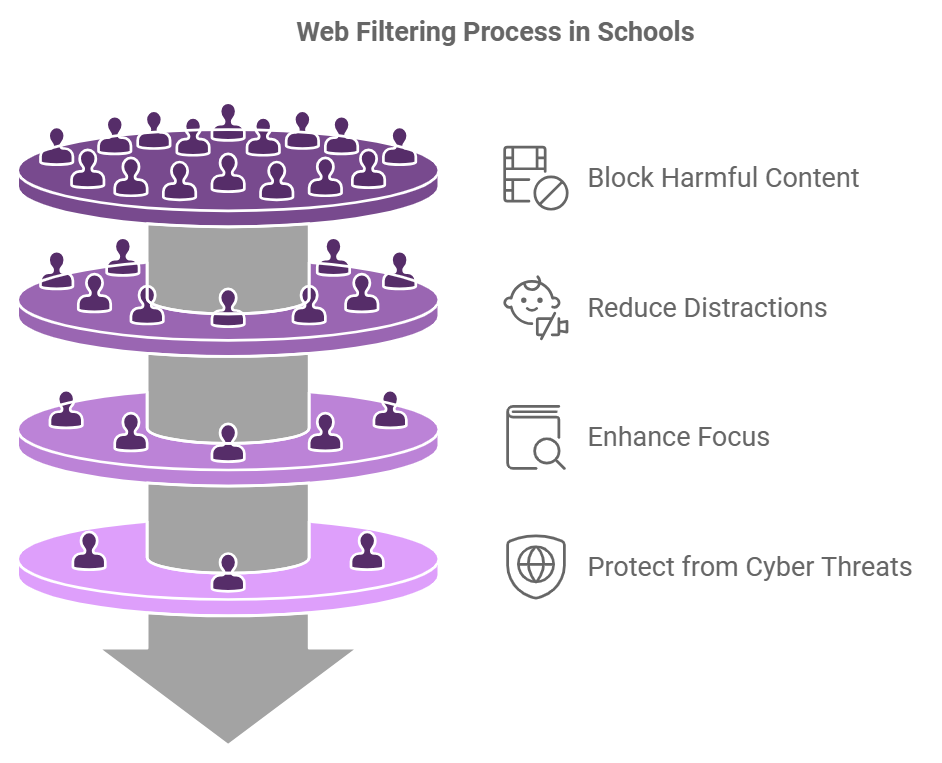
So, how do we stop these problems from derailing our kids’ education and safety? Solution: Web filtering software for schools. Here’s how it works:

Blocks harmful content

Web filters prevent access to inappropriate websites by scanning for specific keywords, categories, or URLs. Schools can customize these filters to block everything from explicit material to violent content, making sure students can’t stumble upon harmful websites.

Focuses students’ attention

With distractions like social media, games, and random videos out of the equation, web filtering helps students stay focused on the task at hand—learning. This is particularly important during school hours when students need to stay engaged in their lessons and educational resources.

Protects against cyber threats

A solid web filter does more than block inappropriate sites—it also protects students from cyber threats like phishing scams, malware, and identity theft. By stopping these dangerous sites before they can do harm, web filters keep students safe and secure while they navigate the web.

Protection for schools

One of the best parts of content filtering software for schools is that it can be tailored to meet specific needs. Filters can be set based on the grade level, the subject being studied, or even specific content areas that need to be restricted or encouraged.

Real-time monitoring and reporting

Most web filtering systems offer real-time monitoring and reports, which means educators and administrators can track what students are accessing online. This allows for quick action if anything inappropriate or dangerous is spotted, keeping everyone accountable.

A safer, smarter digital world for students with Veltar

At the end of the day, the internet is an incredible resource, but without the proper safeguards, it can also be a dangerous place. With the alarming statistics highlighting that approximately 338 million children have been exposed to harmful content online, it’s imperative for educational institutions to implement measures to protect their students. One effective solution is the deployment of web filtering software, such as Veltar. Veltar is a comprehensive endpoint security solution that helps protect data at rest and in motion. It offers features like web content filtering, VPN tunneling, I/O device access control, and application control, providing a unified approach to endpoint security. By integrating Veltar into school networks, administrators can prevent access to inappropriate websites by scanning for specific keywords, categories, or URLs. You can select categories of websites to block and enter specific domains to restrict. Keep students immersed in meaningful learning by cutting out distractions like social media and games.  

About Scalefusion
Scalefusion’s company DNA is built on the foundation of providing world-class customer service and making endpoint management simple and effortless for businesses globally. We prioritize the needs and feedback of our customers, making sure that they are at the forefront of all decision-making processes. We are dedicated to providing comprehensive customer support services, and place emphasis on customer-centric thinking throughout the organization.

About Version 2 Digital

Version 2 Digital is one of the most dynamic IT companies in Asia. The company distributes a wide range of IT products across various areas including cyber security, cloud, data protection, end points, infrastructures, system monitoring, storage, networking, business productivity and communication products.

Through an extensive network of channels, point of sales, resellers, and partnership companies, Version 2 offers quality products and services which are highly acclaimed in the market. Its customers cover a wide spectrum which include Global 1000 enterprises, regional listed companies, different vertical industries, public utilities, Government, a vast number of successful SMEs, and consumers in various Asian cities.

How to find BeyondTrust appliances on your network

Latest BeyondTrust vulnerability (CVE-2024-12356)

BeyondTrust disclosed that affects their Privileged Remote Access (PRA) and Remote Support (RS) appliances. This has also been added to the CISA KEV as it has been exploited in the wild.

  • CVE-2024-12356 is rated highly-critical with a CVSS score of 9.8. Successful exploitation of this vulnerability would allow an attacker execute arbitrary commands on the appliance.


What is the impact?

The issue impacts PRA and RS versions 24.3.1 and earlier.


Are updates or workarounds available?

BeyondTrust has released a patch for all supported iterations of PRA and RS versions 22.1.x and higher and has applied the patch to cloud customers earlier this week.


How do I find potentially vulnerable systems with runZero?

From the Services Inventory, use the following query to locate systems running potentially vulnerable software: 

vendor:BeyondTrust or http.body:BeyondTrust

From the Assets Inventory, use the following query to locate systems running potentially vulnerable software:

os:BeyondTrust OR hw:BeyondTrust OR os:Bomgar OR hw:Bomgar


About runZero
runZero, a network discovery and asset inventory solution, was founded in 2018 by HD Moore, the creator of Metasploit. HD envisioned a modern active discovery solution that could find and identify everything on a network–without credentials. As a security researcher and penetration tester, he often employed benign ways to get information leaks and piece them together to build device profiles. Eventually, this work led him to leverage applied research and the discovery techniques developed for security and penetration testing to create runZero.

About Version 2 Digital

Version 2 Digital is one of the most dynamic IT companies in Asia. The company distributes a wide range of IT products across various areas including cyber security, cloud, data protection, end points, infrastructures, system monitoring, storage, networking, business productivity and communication products.

Through an extensive network of channels, point of sales, resellers, and partnership companies, Version 2 offers quality products and services which are highly acclaimed in the market. Its customers cover a wide spectrum which include Global 1000 enterprises, regional listed companies, different vertical industries, public utilities, Government, a vast number of successful SMEs, and consumers in various Asian cities.

×

Hello!

Click one of our contacts below to chat on WhatsApp

×