The Parallels Desktop Management Portal is a cloud-based service built to make life easier for IT teams managing large-scale deployments of Parallels Desktop within their organizations.
It’s tailored for customers who have the need to manage 30 or more Parallels Desktop licenses, and need a more advanced, centralized way to handle their entire virtualization environment.
With just a few clicks, this new portal lets administrators deploy VMs efficiently, control Parallels Desktop installations, monitor what users are up to, and set policies that apply across the board.
The Enterprise Edition also adds flexibility with hybrid licensing, letting you choose between per-user and per-device licensing to suit your needs.
Key features of the Management Portal
1. Centralized VM deployment with golden Images
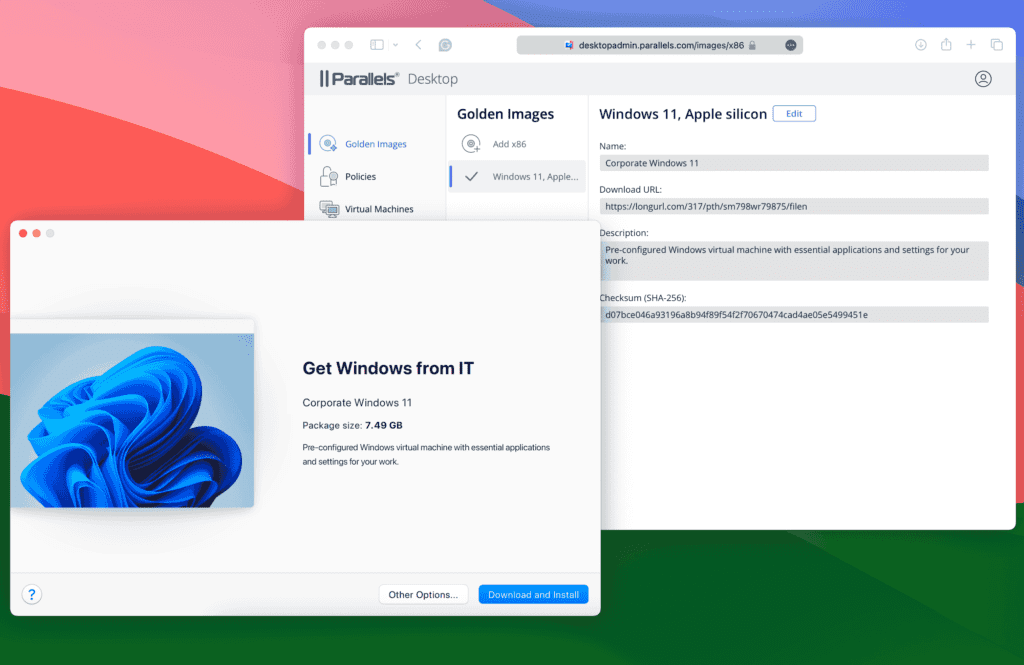
Golden images let IT administrators create pre-configured VM images that can be deployed to end users in a matter of minutes. This feature eliminates the need for configuring machines individually, speeding up deployment time and ensuring every machine is set up the exact same way. Administrators can also pre-install the needed applications and settings inside the VM to provision to their users.
2. Advanced policy control
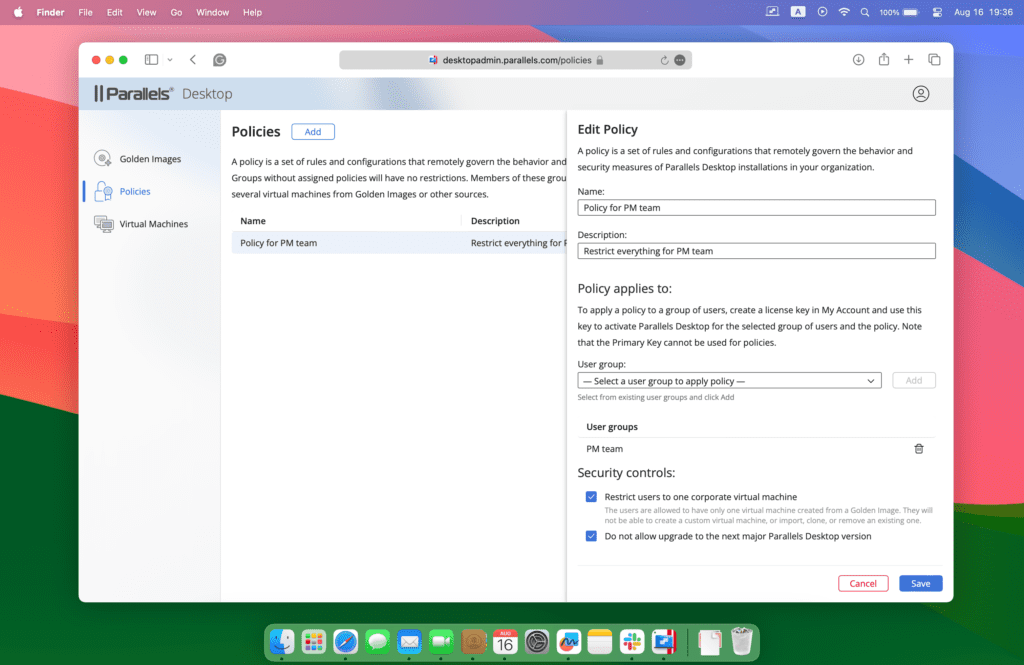
The Management Portal gives administrators complete control over how Parallels Desktop is used. Administrators can enforce policies like restricting users to corporate VMs, preventing VM deletion, or limiting access to a single VM. These settings provide a granular level of control, ensuring that users stick to the organizational guidelines. Policies can also be enforced based on user groups which allows admins to create a separate and unique policy for each group.
3. Real-time monitoring and reporting
Monitoring VMs and their usage has never been easier. The portal gives you real-time insights into user activity, helping you stay on top of compliance and manage resources more efficiently. This feature is especially helpful when overseeing large teams and making sure policies are followed.
4. Hybrid licensing for maximum flexibility
A standout feature of the new Parallels Desktop Enterprise edition is its hybrid licensing model, which supports both per-user and per-device activation. This flexibility is ideal for organizations that need to accommodate various user types and licensing preferences.
Benefits of the Management Portal for large organizations
Streamlined management
Managing individual licenses and VMs can be time-consuming and prone to errors. The Management Portal eliminates these issues by centralizing control, allowing admins to deploy, monitor, and manage everything from a single dashboard.
Improved efficiency
With golden images and setting up policies within the portal, admins can roll out new VMs in minutes rather than hours. This speed is crucial in environments where new users or machines need to be onboarded quickly without sacrificing compliance or security.
Scalability matching your growth
Whether your organization has 30 or 300 employees, the Management Portal grows with you. Thanks to its hybrid licensing model and centralized controls, handling even the most significant deployments remains smooth and hassle-free.
What’s next for the Parallels Desktop Enterprise Edition?
The initial release of the Management Portal is already packed with powerful features, but there is so much more to come.
Later this year, support for SSO activation will be added, allowing for seamless integration with your existing identity provider. The Parallels team is also working on support for multiple golden images and improved group management, making the portal even more versatile for large, complex environments.
If you’re an existing Parallels Desktop Business customer and would like to explore these new features, upgrading to the Enterprise Edition is simple. Simply visit the Parallels Desktop Enterprise Edition page to learn more or fill out the form to start a trial. Once submitted, a representative will reach out to assist you with any questions or guide you through the process of discovering how the Management Portal can transform the way you manage VMs in your organization.
About Parallels Parallels® is a global leader in cross-platform solutions, enabling businesses and individuals to access and use the applications and files they need on any device or operating system. Parallels helps customers leverage the best technology available, whether it’s Windows, Linux, macOS, iOS, Android or the cloud.
About Version 2 Digital
Version 2 Digital is one of the most dynamic IT companies in Asia. The company distributes a wide range of IT products across various areas including cyber security, cloud, data protection, end points, infrastructures, system monitoring, storage, networking, business productivity and communication products.
Through an extensive network of channels, point of sales, resellers, and partnership companies, Version 2 offers quality products and services which are highly acclaimed in the market. Its customers cover a wide spectrum which include Global 1000 enterprises, regional listed companies, different vertical industries, public utilities, Government, a vast number of successful SMEs, and consumers in various Asian cities.
Perforce matches functional safety with the software and design driven world of automotive today.
MINNEAPOLIS, OCTOBER 29, 2024 — Perforce Software, a global provider of enterprise DevOps solutions, today announced its version control platform Helix Core has achieved ISO 26262 Functional Safety Process Certification by internationally-accredited certification body TÜV SÜD. With this certification, Perforce ensures its platform meets the strict safety and reliability standards required for developing automotive systems and reinforces its commitment to supporting innovation within the automotive industry.
Perforce Helix Core is the version control platform trusted by leading automotive OEMs and suppliers – as well as the world’s largest semiconductor firms, embedded systems developers, and top gaming and media studios – for limitless scalability, fine-grained security, and rapid file access from anywhere in the world.
ISO 26262 is an international functional safety standard for the development of electrical and electronic systems, including hardware and software components, for road vehicles. By certifying its version control platform is ISO 26262 compliant, Perforce now makes this critical solution available to all organizations that need to prove compliance with the highest safety, quality, and reliability standards.
“With the transition to software-defined vehicles and the rise of autonomy, automotive OEMs and suppliers are revolutionizing their development pipeline with modern tools that accelerate innovation, yet safety remains paramount,” said Brad Hart, CTO and VP of Product Management at Perforce. “Helix Core offers a modern alternative to legacy tools that can no longer meet the demands of today’s fast-paced software- and design-driven automotive development. For large, cross-functional, globally distributed teams, Helix Core is the only version control solution that can deliver the speed, scale, and security necessary to manage all digital assets, including binary code and large game engine/3D files.”
Perforce’s 2024 State of Game Technology survey found that 50% of respondents are now using game engines outside of traditional game development, such as in the creation of digital twins of vehicles. These digital twins can enhance vehicle safety in many ways, from virtual crash tests to using simulated driving scenarios to more efficiently train Advanced Driver Assistance Systems (ADAS). With Helix Core serving as an essential foundation to effectively leverage this technology, achieving the ISO 26262 Functional Safety Process Certification allows Perforce to offer a platform that drives innovation while ensuring the highest level of automotive safety.
About Perforce The best run DevOps teams in the world choose Perforce. Perforce products are purpose-built to develop, build and maintain high-stakes applications. Companies can finally manage complexity, achieve speed without compromise, improve security and compliance, and run their DevOps toolchains with full integrity. With a global footprint spanning more than 80 countries and including over 75% of the Fortune 100, Perforce is trusted by the world’s leading brands to deliver solutions to even the toughest challenges. Accelerate technology delivery, with no shortcuts.
About Version 2 Digital
Version 2 Digital is one of the most dynamic IT companies in Asia. The company distributes a wide range of IT products across various areas including cyber security, cloud, data protection, end points, infrastructures, system monitoring, storage, networking, business productivity and communication products.
Through an extensive network of channels, point of sales, resellers, and partnership companies, Version 2 offers quality products and services which are highly acclaimed in the market. Its customers cover a wide spectrum which include Global 1000 enterprises, regional listed companies, different vertical industries, public utilities, Government, a vast number of successful SMEs, and consumers in various Asian cities.
Virtual Desktop Infrastructure (VDI) and Desktop-as-a-Service (DaaS) are leading innovations in IT resource management, revolutionizing how businesses operate and manage their IT assets. This guide delves into the intricacies of establishing virtual desktop environments, covering the technical groundwork, user management tactics, security measures, and scalability—all vital for accommodating the dynamic requirements of modern businesses.
As organizations strive to boost operational efficiency and fortify their security measures, the roles and benefits of VDI and DaaS become more pronounced. The primary focus here is to unpack the critical components necessary for the successful implementation of virtual desktop solutions. Through an examination of various case studies, this article offers IT professionals and decision-makers a practical framework to navigate the complexities of virtual desktop technologies and to choose the most suitable solution—be it VDI or DaaS—for their needs.
Understanding VDI and DaaS:
Virtual Desktop Infrastructure (VDI) is a technology that hosts desktop environments on a centralized server. This setup allows users to access their desktops on any device capable of supporting the VDI’s interface, regardless of the geographic location. The main appeal of VDI is its ability to offer a controlled, customized, and secure desktop experience to multiple users while maintaining the data and applications on a company-managed server.
Desktop-as-a-Service (DaaS), on the other hand, is a cloud service model where the entire desktop virtualization is handled by a third-party provider. DaaS solutions deliver similar benefits as VDI, such as accessibility from multiple devices and locations; however, they reduce the organization’s burden of managing the underlying infrastructure, updates, security, and storage, as these responsibilities are managed by the DaaS provider.
II) Key Considerations for Choosing Between VDI and DaaS
Security and Compliance: With VDI, you have direct control over the security and compliance measures, tailoring them to meet specific organizational standards and regulations.
Pros of VDI
Endpoint Independence: Users can access their virtual desktop from any device, providing flexibility without compromising the desktop environment or experience.
Centralized Management and Control: VDI offers a centralized platform for managing user desktops, streamlining IT operations, and enforcing policies across the organization.
Endpoint Choice: Organizations can provide a variety of endpoint options, from high-end workstations for power users to more cost-effective thin clients for standard users.
Cons of VDI
Digital Employee Experience Challenges: Implementing VDI requires careful planning to ensure that the digital workspace delivers a responsive and robust user experience.
Infrastructure Costs: Initial setup for VDI can be capital intensive, with significant investments needed for servers, storage, and network infrastructure.
Solution Complexity: The complexity of a VDI environment can be substantial, requiring a high level of IT expertise to manage the infrastructure, software, and potential issues that arise.
Pros of DaaS
Agility and Elasticity: DaaS platforms are highly scalable, allowing businesses to quickly adjust their resources to meet changing demands.
Utility Pricing/Pay Per Use: Many DaaS providers offer a pay-as-you-go model, converting a capital expense into an operational one and avoiding the need for large upfront investments.
Cloud Service Integration: DaaS often integrates well with other cloud services, allowing for a seamless connection between virtual desktops and cloud-based applications.
Disaster Recovery: With DaaS, disaster recovery processes are typically built into the service, offering greater resilience and faster recovery times.
Cons of DaaS
Service Insight and Control: While DaaS providers handle much of the infrastructure management, organizations may have less visibility and control over the backend operations.
Less Configuration/Customization Choice: There might be limitations on the level of customization available for the virtual desktops compared to a self-hosted VDI solution.
Long-Term Cost: Although DaaS can be more affordable upfront, ongoing subscription costs can add up over time, potentially making it more expensive in the long run.
Deciding between VDI and DaaS hinges on balancing these pros and cons against your organization’s strategic objectives, budget constraints, and IT capabilities. Each solution offers distinct benefits and challenges that must be carefully considered to ensure that your chosen virtual desktop infrastructure aligns with your business requirements.
III) VDI Deployment Considerations
Assuming you have the requisite data center capacity, in-house expertise, and cloud management skills, choosing to self-implement a Virtual Desktop Infrastructure (VDI) is a strategic step. This decision sets the stage for a detailed exploration of implementation factors to optimize the deployment within your own facilities or your selected public cloud environment.
A. Choosing the Appropriate Infrastructure
Setting up a virtual desktop infrastructure (VDI) requires a detailed assessment of the necessary hardware, including servers, storage solutions, and networking equipment, to effectively support the virtual desktop environment. This assessment should include not only an evaluation of the current infrastructure to identify any gaps that could hinder implementation but also a consideration of integrating public cloud services. These options offer scalability, flexibility, and potentially lower upfront costs, making them viable alternatives for organizations looking to optimize their VDI strategy.
B. User Management Strategies
Effective user management strategies are crucial for enhancing productivity and ensuring seamless access to virtual desktops. It involves creating user accounts, allocating appropriate resources, and managing access rights to ensure security standards are met and users can efficiently perform their duties.
C. Security Concerns and Protocols
Security is paramount in virtual desktop infrastructures. Implementing stringent security measures, like encryption and multi-factor authentication, protects sensitive information and mitigates potential cyber threats. Regular security audits are also essential to address any vulnerabilities.
D. Scalability and Flexibility
Designing scalable and flexible virtual desktop infrastructures is vital for adapting to business needs. Technologies that allow dynamic resource allocation and access from various devices enhance productivity, especially in remote work scenarios.
E. VDI Deployment Factors to Consider:
End-User Requirements: Understanding how users interact with the infrastructure, including login times and application needs, is crucial to avoiding performance bottlenecks.
Factor in User Location: Different locations may necessitate varied VDI architectures, affecting everything from bandwidth requirements to user experience.
Infrastructure Impact: VDI affects other IT systems; careful planning can prevent issues such as IP address depletion and bandwidth consumption.
Desktop Type (Persistent vs. Nonpersistent): Choose between persistent desktops, which save user settings, and nonpersistent desktops, which reset after each session based on user needs.
High Availability Design: Ensuring that the VDI infrastructure is highly available is crucial to prevent downtime that could affect the entire organization.
Client Device Options: Deciding on client devices, whether repurposing old PCs or employing BYOD (Bring Your Own Device) policies, influences maintenance and operational ease.
BYOD Policy Considerations: Establish clear guidelines on the acceptable devices and operating systems to secure data and reduce support burdens.
Security Strategy: Extend all physical desktop security best practices to virtual desktops, ensuring all systems are secure and compliant.
F. Selecting a Comprehensive Software Solution for Virtual Desktop Infrastructure
To simplify the implementation of the strategies outlined for infrastructure setup, user management, and security, it is crucial to select a comprehensive software solution tailored for virtual desktop infrastructure. A pivotal component of this solution should be a VDI orchestrator, which seamlessly manages VDI deployment and auto scaling across various hypervisors and public clouds. Ideally, the solution would be cloud-agnostic and multi-cloud compatible, reducing dependency on specific cloud vendors and providing flexibility for organizations that may start on-premises but plan to extend their workflows to the cloud in the future. Additionally, the software should support simple role-based permissions for efficient user management and embody Zero Trust Network Access principles to secure access points. The inclusion of Privileged Access Management (PAM) functionalities is also vital, especially if the workflows are critical, ensuring robust security and compliance. Strong audit and analytics capabilities are essential to monitor and optimize the VDI environment effectively. Lastly, the solution must guarantee a superior user experience on any device, catering to both internal and external users. This ensures the productivity of the workforce is maintained regardless of their location or the device they use, further enhancing the overall efficiency and effectiveness of the virtual desktop infrastructure.
IV) DaaS Deployment Considerations
Having assessed your organization’s capabilities and workflows, should the balance tip in favor of a third-party Desktop-as-a-Service (DaaS) solution, we transition to a critical phase—DaaS implementation considerations. This phase is dedicated to ensuring that the chosen DaaS offering aligns with your business requirements and operational objectives, reflecting a strategic alignment with your evaluation.
1. Security and Data Protection:
When outsourcing your VDI to a 3rd party DaaS provider, it is crucial to assess their security measures and data protection practices. Ensure that they have robust security protocols in place to protect your sensitive data from unauthorized access or breaches.
2. Reliability and Performance:
Evaluate the reliability and performance of the 3rd party DaaS provider before making a decision. Look for providers that offer high availability, minimal downtime, and guaranteed performance levels to ensure your users have a seamless experience.
3. Scalability and Flexibility:
Consider the scalability and flexibility of the DaaS solution offered by the provider. Your organization’s needs may change over time, so it is essential to choose a provider that can accommodate growth and provide the necessary resources as needed.
4. Compliance and Regulatory Requirements:
If your industry has specific compliance or regulatory requirements, ensure that the 3rd party DaaS provider can meet those standards. They should be able to demonstrate their adherence to relevant regulations and provide the necessary certifications or audits.
5. Cost and Pricing Model:
Evaluate the cost and pricing model offered by the 3rd party DaaS provider. Consider factors such as upfront costs, ongoing maintenance fees, and any additional charges for scaling or customization. It is important to have a clear understanding of the financial implications before committing to a provider.
6. Support and Service Level Agreements:
Assess the level of support provided by the 3rd party DaaS provider. Look for providers that offer proactive monitoring, timely support, and comprehensive service level agreements (SLAs) to ensure a smooth operation of your VDI environment.
By considering these points, you can make an informed decision when choosing a 3rd party DaaS provider and outsourcing your VDI with a DaaS solution.
V) Conclusion: How Thinfinity Can Help with VDI and DaaS
As you approach the culmination of your virtual desktop exploration, choosing between VDI and DaaS, Thinfinity stands ready to empower your decision with versatile solutions. Whether you are at the decision-making stage or ready to implement, Thinfinity offers tools and insights to ensure your choice meets your business’s unique needs.
For VDI, Thinfinity Workspace offers a comprehensive solution that delivers robust, secure, and scalable virtual desktops across your own infrastructure, whether on-premises, hybrid, or entirely cloud-based. It streamlines the complexities of VDI deployment and incorporates zero trust access protocols, allowing secure and efficient access from any device, anywhere with the best user experience. This not only enhances your workforce’s productivity but also fortifies your IT environment against potential security threats.
Thinfinity Virtual Desktops delivers a fully managed DaaS solution that offers an agile, cost-effective, and resilient infrastructure. It seamlessly integrates with your existing identity providers and security workflows, ensuring smooth interoperability between DaaS and on-premises workflows. This integration enhances the overall efficiency and security of your IT environment, facilitating a unified management experience.
What’s more, we recognize that one size does not fit all. With the flexibility to mix and match both VDI and DaaS solutions according to specific workflows, your IT team can enjoy the best of both worlds. This hybrid approach allows for a more comprehensive, scalable, and manageable software environment, combined with a secure and reliable DaaS solution.
Our team expertise extends beyond provision to consultation, assisting you in discerning which workflows are best suited to each solution. Leveraging Thinfinity, you can tailor your virtual desktop strategy to provide peak efficiency and reliability, ensuring your IT infrastructure is not just keeping pace with your business growth but driving it forward.
About Cybele Software Inc. We help organizations extend the life and value of their software. Whether they are looking to improve and empower remote work or turn their business-critical legacy apps into modern SaaS, our software enables customers to focus on what’s most important: expanding and evolving their business.
About Version 2 Digital
Version 2 Digital is one of the most dynamic IT companies in Asia. The company distributes a wide range of IT products across various areas including cyber security, cloud, data protection, end points, infrastructures, system monitoring, storage, networking, business productivity and communication products.
Through an extensive network of channels, point of sales, resellers, and partnership companies, Version 2 offers quality products and services which are highly acclaimed in the market. Its customers cover a wide spectrum which include Global 1000 enterprises, regional listed companies, different vertical industries, public utilities, Government, a vast number of successful SMEs, and consumers in various Asian cities.
Have you ever bought a new gadget, only to find it packed with lengthy setup steps? Now suppose the same happening with every device in your company. That’s where zero-touch deployment steps in—removing the bother for IT admins and employees.
What is Zero-touch Deployment for Mac?
Zero-touch deployment allows new Mac devices to be shipped directly to employees, fully configured and ready to go right out of the box. IT admins no longer need to spend hours configuring security settings, installing apps, or personalizing devices. Zero-touch deployment is a smarter way for businesses to manage their growing fleets of devices while keeping things simple for everyone involved.
The result? Happy employees, smoother operations, and an easier life for IT.
What is Zero-touch Deployment for Mac?
Zero-touch deployment on Mac is a method that enables IT teams to remotely configure and deploy Mac devices without the need for physical handling. When a MacBook is unboxed by an employee, it is already fully set up with the necessary applications, configurations, and security protocols in place.
This approach eliminates the need for IT to manually set up each device, as the entire process is automated. As a result, new hires or remote workers can start using their Mac devices immediately, enhancing productivity from day one. Zero-touch deployment is an efficient solution for businesses looking to streamline Mac device management while ensuring robust security and compliance measures are maintained.
The Key Benefits of Zero-touch: Simplifying Mac Deployments
1. Faster Deployments
Zero-touch deployment eliminates manual setup, allowing IT teams to configure and ship devices like Macs directly to users. For large-scale deployments, this drastically reduces time spent on device setup, enabling quick rollouts for new hires or department-wide refreshes.
2. Simplified Mac Enterprise Deployment
With Apple zero-touch deployment, devices are pre-configured with apps, settings, and security protocols, making it ideal for Mac enterprise deployment. IT teams can focus on other tasks instead of repetitive configurations.
3. Improved Security
Since all devices are set up with predetermined security policies, there’s no risk of users misconfiguring or skipping vital security steps. This ensures company-wide compliance and peace of mind.
4. Cost Efficiency
By automating the deployment process, companies can save significantly on labor and resources. IT teams can manage devices remotely, reducing the need for on-site staff, especially in remote work scenarios.
5. Consistency Across Devices
For businesses wondering, “How does IT benefit organizations with large-scale deployments?” Zero-touch ensures every device follows the same standard setup, resulting in uniformity across all Macs, regardless of location.
How to Implement Zero-touch Deployment for Mac with Scalefusion UEM
Step-by-Step Guide
Step 1: Log in to Scalefusion
Access your Scalefusion Dashboard.
Go to Getting Started > Apple Setup > ADE/DEP.
Step 2: Download ADE Public Key
Click the Download Public Key button and save the ADETokenKey.pem file.
For new devices, go through the initial setup (language, Wi-Fi).
For existing iOS devices, navigate to Settings > General > Reset > Reset All Content & Settings.
For macOS, use CMD + R to reinstall macOS.
Step 8: Complete Enrollment
After initial setup, the devices will show a Remote Management screen.
Enter the required credentials (email, OTP) for User Authenticated Enrollment, if enabled.
Follow the remaining steps to complete the enrollment.
Step 9: Check Enrollment Status
Verify the enrollment status of your devices in the Scalefusion Dashboard under Devices. The devices will be managed automatically under the chosen configuration.
This setup enables zero-touch deployment, allowing ADE devices to automatically enroll into the Apple MDM as soon as they are set up or reset.
Wrapping Up: The Future of Mac Enterprise Deployment
Zero-touch deployment is more than just a convenience—it’s a transformation in how businesses manage their devices. As organizations scale, particularly those deploying a large number of Macs, the simplicity and efficiency of automating the setup process become invaluable.
With Scalefusion UEM, IT teams can streamline operations, ensure security, and maintain consistency across all devices, no matter where they are. Whether you’re deploying 10 or 1,000 Macs, this solution ensures your teams are always ready to work, right out of the box.
About Version 2 Digital
Version 2 Digital is one of the most dynamic IT companies in Asia. The company distributes a wide range of IT products across various areas including cyber security, cloud, data protection, end points, infrastructures, system monitoring, storage, networking, business productivity and communication products.
Through an extensive network of channels, point of sales, resellers, and partnership companies, Version 2 offers quality products and services which are highly acclaimed in the market. Its customers cover a wide spectrum which include Global 1000 enterprises, regional listed companies, different vertical industries, public utilities, Government, a vast number of successful SMEs, and consumers in various Asian cities.
About Scalefusion Scalefusion’s company DNA is built on the foundation of providing world-class customer service and making endpoint management simple and effortless for businesses globally. We prioritize the needs and feedback of our customers, making sure that they are at the forefront of all decision-making processes. We are dedicated to providing comprehensive customer support services, and place emphasis on customer-centric thinking throughout the organization.