Skip to content

Modernizing Legacy Backup Solutions

Traditional legacy backup solutions served organizations in the past. However, in recent years, they have been unable to keep up with data protection needs and the rapid increase in cyber threat sophistication. Thus, any organization still relying on legacy backups should be prepared to encounter data loss because of the inefficiency of these outdated solutions.

To keep their businesses on track, organizations must upgrade to modernized backup solutions that are on par with the realities of data threats today, ensuring optimal protection from data loss and speedy recovery during a data disaster. This article explores the failures of legacy backup solutions and the growing need for organizations to upgrade to modernized solutions that offer better protection.

What is Backup Modernization?

Backup modernization is the process of replacing an outdated data protection solution with a newer backup and recovery system. Modern backup provides better technological advantages, providing more effective and efficient protection against data disasters. With the ever rising data threats, upgrading your backup solution is crucial for business continuity.

Failures of Legacy Backup Solutions

Organizations often get stuck with legacy data protection systems because they are already familiar with these systems. Some also shy away from the imminent cost needed to overhaul these systems. However, the truth is that these legacy backup solutions are outdated and will present several issues you can avoid when you upgrade to modern backup systems. Some problems legacy solutions pose are:

  • Expensive Use and Maintenance

Maintaining legacy systems could be very expensive because of their complexity and the need for specialized knowledge of these solutions. Thus, running legacy systems will incur unnecessary costs for your organization.

  • Long Backup Windows

Also, legacy solutions lead to higher downtime because they take time to recover data. A typical backup system has lengthy backup windows, meaning data could get lost if a disaster occurs between one backup process and another. This lack of incremental backups leads to slow processing and higher data loss or corruption risks.

  • Disaster Recovery Challenges

Besides backup, disaster recovery is another crucial concern regarding data protection. After a data disaster, the quick recovery of data ensures an organization returns to its regular operation in record time. However, legacy solutions take time to restore data and are less reliable, posing greater risk when disasters occur.

  • Delayed Cloud Adoption

Most legacy systems don’t support clouds because they were not built with it in mind. Thus, it becomes difficult to integrate cloud solutions, preventing organizations from using cloud infrastructure to their advantage.

  • Scalability Issues

Legacy systems often struggle to scale because they are designed primarily for smaller, static datasets. As a result, they may be unable to handle large data volumes, making them unsuitable for growing organizations that constantly face increasing data volumes.

  • Lack of Advanced Security features and Automation

Operating legacy backup systems requires more human resources because they need manual operations. These traditional solutions don’t offer automatic security features like encryption and access control. So, there is a higher risk of human error and an increased hands-on management of resources.

Why Organizations Should Upgrade Their Legacy Backup Solutions

With legacy backup solutions proven less effective and efficient, looking into other options is crucial. The best solution companies can seek is to upgrade from legacy solutions to modernized backups that offer better results. Let’s look at some reasons why organizations should upgrade their systems.

  • Improved Speed and Efficiency

Legacy systems can be complex, and the lack of automation and advanced features contributes to their failing speed and efficiency. However, modernized solutions prioritize speed and efficiency, leveraging advanced technologies, including incremental backups, continuous data protection (CDP), and deduplication. These features help to reduce downtime by backing up and restoring data quickly.

  • Automation

Modern solutions use automation to reduce the manual workload, ensuring the data protection process runs smoothly. They offer scheduled backups, central management, and automated failover. Unlike legacy systems that require a more hands-on approach, modernized backup solutions streamline the work process, helping companies achieve better results.

  • Enhanced Data Security

The main aim of backup solutions is data protection, but legacy systems may fail to provide the best security because they weren’t designed with the latest threats in mind. Thus, they are less effective in fighting against modern cyber threats. On the other hand, modern backup solutions consider the present sophistication of cyber threats. So, these solutions integrate the latest security features to offer more robust data backup and recovery, reducing the risk of data corruption and loss and ensuring quick data recovery.

  • Scalability

In any growing organization, scalability is essential. While legacy systems find it challenging to scale alongside the organization’s growing needs, data volume keeps growing. So organizations must find a solution that can quickly adapt to this ever-increasing need and work speed. Modern backup solutions are scalable, ensuring that organizations have no issues with data protection as the company size and data volume grows. This leads to flexibility and reduced costs over time.

  • Cloud Integration

Cloud has become a staple in today’s data world, offering increased data protection and less dependence on physical infrastructure for organizations. Cloud integration not only improves data protection but also reduces the cost of operation by limiting the physical infrastructure needed to protect data. Modernized backup solutions integrate Cloud, enabling organizations to combine physical and virtual data storage and protection for optimal results and lower risks.

  • Support for Latest Technologies

Legacy solutions may not support newer technologies as most are not open to technological advancements. However, modernized solutions support state-of-the-art technologies like containerization, continuous data protection (CDP), and deduplication, ensuring they offer data protection at its peak.

Conclusion

Legacy backups can no longer serve organizations because they pose problems like scalability issues, disaster recovery challenges, long backup windows, expensive maintenance, and a lack of advanced security features and automation. These challenges prevent them from providing the best protection against data threats or an excellent recovery process.

Companies must upgrade to modernized backup solutions that offer improved speed and efficiency, automation, scalability, enhanced data security, and support for the latest technologies. This will ensure that their data protection system can weather against cyber threats and other data disasters.

Storware Backup and Recovery bridges the gap between modern and legacy data management. For modern workloads, it offers features like agent-based protection for cloud data, containers, and virtual environments, ensuring your most cutting-edge applications are secure. However, Storware doesn’t leave older systems behind. It can integrate seamlessly with existing backup solutions, acting as a proxy to streamline and centralize your overall data protection strategy, regardless of the system’s age. This future-proof approach ensures your valuable information is protected, no matter its source or platform.

About Storware
Storware is a backup software producer with over 10 years of experience in the backup world. Storware Backup and Recovery is an enterprise-grade, agent-less solution that caters to various data environments. It supports virtual machines, containers, storage providers, Microsoft 365, and applications running on-premises or in the cloud. Thanks to its small footprint, seamless integration into your existing IT infrastructure, storage, or enterprise backup providers is effortless.

About Version 2 Digital

Version 2 Digital is one of the most dynamic IT companies in Asia. The company distributes a wide range of IT products across various areas including cyber security, cloud, data protection, end points, infrastructures, system monitoring, storage, networking, business productivity and communication products.

Through an extensive network of channels, point of sales, resellers, and partnership companies, Version 2 offers quality products and services which are highly acclaimed in the market. Its customers cover a wide spectrum which include Global 1000 enterprises, regional listed companies, different vertical industries, public utilities, Government, a vast number of successful SMEs, and consumers in various Asian cities.

Automation, Orchestration and Data Protection Efficiency

Growth and development never stop, and this also rings true when it comes to data management technologies. In recent years, automation tools and orchestration platforms have significantly improved, and these advancements help frame and optimize data backup and recovery, enhancing efficiency, speed, and reliability. With advancements in automation tools and orchestration platforms, their benefits have more than doubled, giving organizations a better edge over cyber threats and other potential data disasters. This article explores five advancements in recent years and the benefits of automation and orchestration in the backup and recovery process.

Benefits of Automation and Orchestration in Backup and Recovery Processes

1. Consistency and Reliability Automated backup procedures ensure backups are done consistently and reliably at proper intervals, preventing human errors or missed backups. This gives you confidence that your data is consistently protected. 2. Economical Use of Time and Resources Automating backup tasks gives the IT staff free time to concentrate on other, more significant issues than merely routine activities associated with backups. In one turn, these automated solutions will execute the backup and recovery workflows quickly and very effectively. 3. Improved Data Management Choosing to automate backup and recovery employs tools like data deduplication and compression to optimize space usage and minimize costs. A centralized management interface also gives better visibility and control of the status of the backups and storage utilization, ensuring that organizations can monitor and manage the process. 4. Shortened Recovery Times Automated recovery processes will help restore data quickly and reduce business operation downtime if data is lost or there is a system failure. Automated recovery tools can promptly trace and retrieve the necessary data quickly, thus reducing the recovery process to a few minutes from what would have taken hours or even days. This ensures that your organization bounces back and returns to the usual business operation on time. 5. Data Protection An automated backup system, developed using encryption, access controls, and compliance enforcement, will ensure the protection of backup data and guarantee the satisfaction of regulatory requirements. Thus, when using an automated system, you can rest assured that your data is appropriately secured. Incremental backups and continuous data protection also ensure that data doesn’t get lost during disasters. 6. Eliminating Human Related Errors Another risk it eliminates is human-related mistakes. Mistakes such as selecting the incorrect backup files and overwriting vital information could occur during manual recovery processes. Automated tools eliminate these errors by following predefined protocols and procedures, ensuring consistent and proper implementation of the recovery process each time. 7. Scalability With advanced backup tools, companies don’t have to worry about growing data sizes. They can easily back up data and handle storage demands, ensuring all data is sufficiently covered. As the organization grows, accommodating increasing data needs, these advanced solutions scale along with the data size.

Five Advancements in Automation Tools and Orchestration Platforms

1. Continuous Data Protection (CDP) A groundbreaking technology called continuous data protection captures every change that happens with data and tracks changes in real-time. Unlike traditional backup, which depends on periodic snapshots, CDP creates an unbroken data stream that organizations can use instantly in recovery. It guarantees restored data up to any point and minimizes data loss and downtime. 2. AI-powered Backup Optimization Now, backup processes are optimized using artificial intelligence and machine learning algorithms. By analyzing historical data and patterns, these technologies can single out redundant or unnecessary backups, reuse them, optimize storage usage, and even automate data retention and deletion. This doesn’t just help drive greater efficiency; it also reduces overall storage costs. 3. Cloud-Native Backup Solutions With the advent of cloud computing, cloud-native backup solutions can leverage their scalability, flexibility, and cost-effectiveness. Most of these solutions are directly tied to leading cloud platforms and typically feature automated scheduling for backups, off-site replication, and instant recovery. Unlike the on-premises hardware necessary for many cloud services, a cloud-native backup solution streamlines infrastructure management while taking some of the responsibility off the IT team. 4. Orchestrated Disaster Recovery These days, disaster recovery processes are much easier and more automated because of orchestration platforms. This allows organizations to redefine the DR (disaster recovery) workflows they must configure during a disaster. It orchestrates task execution, such as failover, failback, and testing, to ensure consistent and reliable recovery procedures. Orchestration of DR reduces complex management in the DR infrastructure, improving overall resilience. 5. Self-healing Data Protection Some modern backup and recovery solutions can now self-heal. These systems can detect and automatically correct data corruption, missing backups, or configuration errors. With constant monitoring of the backup infrastructure, self-healing technology ensures robust data protection continuously, even after unexpected failures or human errors.

Implementation Challenges of Automation and Orchestration

Although the benefits of automation and orchestration on data management are huge, there might still be a few challenges while trying to implement these technologies. Common problems include the following:

Compatibility Problem:

If compatibility issues exist, automation and orchestration tools may not easily integrate with a company’s systems and infrastructures. This can incur extra expenses, as you may have to replace their infrastructure.

Skill Gaps:

Organizations may lack the in-house expertise to operate these infrastructures. Hence, you must employ an extra hand with the appropriate technical know-how. Leverage their expertise in implementation techniques to help assist in the implementation process. Also, you need to educate and develop IT staff to be competent in managing and supporting new technologies, ensuring the smooth running of the organization’s backup and recovery system.

Change Management: 

Migrating from manual to automated data management processes instills an entirely new culture within a company. Therefore, organizations must develop robust strategies to effectively manage this change and allow staff to transition seamlessly from the former system to the advanced one.

Conclusion

Advancements in data automation tools and orchestration platforms bring data backup and recovery to a whole new level of efficiency, reliability, and affordability. An organization can protect vital data and assure business continuity through continuous data protection, AI-powered optimization, cloud-native solutions, orchestrated disaster recovery, and self-healing functionalities. These technologies empower the organization to manage data effectively and efficiently, mitigate potential human errors, and ensure the quick restoration of critical data in the case of a disaster or system failure.

About Storware
Storware is a backup software producer with over 10 years of experience in the backup world. Storware Backup and Recovery is an enterprise-grade, agent-less solution that caters to various data environments. It supports virtual machines, containers, storage providers, Microsoft 365, and applications running on-premises or in the cloud. Thanks to its small footprint, seamless integration into your existing IT infrastructure, storage, or enterprise backup providers is effortless.

About Version 2 Digital

Version 2 Digital is one of the most dynamic IT companies in Asia. The company distributes a wide range of IT products across various areas including cyber security, cloud, data protection, end points, infrastructures, system monitoring, storage, networking, business productivity and communication products.

Through an extensive network of channels, point of sales, resellers, and partnership companies, Version 2 offers quality products and services which are highly acclaimed in the market. Its customers cover a wide spectrum which include Global 1000 enterprises, regional listed companies, different vertical industries, public utilities, Government, a vast number of successful SMEs, and consumers in various Asian cities.

The Future Of Virtualization Infrastructure

When the Broadcom company announced its acquisition of VMware on the 26th of May 2022, the virtualization industry was brazing for another great evolution. And this time, we might witness a greater blast in the evolution of virtualization infrastructures. So, at the back of this announcement and the introduction of many virtualization-enhancing features, are we getting into the fourth-age evolution of virtualization infrastructures?

The inception of data virtualization infrastructures focused on relieving the huge task accompanying big data issues of physical machines by granting end-users the opportunity to access and modify data stored across various systems through a single view. Using the ESX hypervisor machine, VMware gained huge momentum in the data management sector. However, while this infrastructure was widely accepted, it contains a series of challenges that made users desire significant improvement.

At the back of this development, the second age of virtualization infrastructures comes into play. This time, a cloud-based data virtualization infrastructure was announced, taking virtualization to a new level where users can access data on popular platforms like Azure, Amazon web, and more. Again, this transition gave users timely access to the database with minimum stress. Then, big companies and the public sector with a data center utilized OpenStack for data positioning. Thus, increasing their accessibility to end users.

The Third virtualization infrastructure age introduced the use of containers in database management on Kubernetes. This transformation aims to allow developers to present their database in independent containerized microservices. Thus, they can promote their services to test, stage, and promotion environments and become readily available to users.

Utilizing ETCD, Kubernetes stores the containerized services, which are only accessible with the help of an API. This development was a big upgrade on the seemingly cumbersome traditional VMs and Hypervisors as it provides users with the needed database at the minimum interval. While data virtualization keeps enjoying a series of upgrades, we might as well say that we are already witnessing the fourth age of evolution. This development makes users curious about what the fourth evolution has in stock and about what the future holds for data virtualization.

So, before moving on to the future of virtualization infrastructures, let’s look at what the buzzing fourth-age evolution is all about and why this development is all for the customer’s good.

The fourth age virtualization infrastructures

Like every other evolution mentioned earlier, the fourth age virtualization comes with another view on virtualization. It is also called the age of evolution and convergence on cloud-native platforms. It aimed at running virtual machines alongside Kubernetes through the help of KubeVirt. The KubeVert project allows KVM-enabled machines to be managed as pods on Kubernetes.

Despite the fame of Kubernetes in recent years, it’s surprising that many projects are still run on virtual machines. With the prolonged coexistence between these two virtualization tools, the new evolution is about having both works as a single system without a requirement for the actual application.

This innovation combines the features of both Virtual machines and Kubernetes to provide a good user experience. In addition to this benefit, KubeVirt grants Virtual machines the opportunity to utilize Kubernetes abilities, as seen with projects like Tetkton, Knative, and the like. These projects work as both Virtual machines and container-based applications.

Features of the fourth age evolution Virtualization Infrastructures

Combining virtual machines and containers into a single system, the fourth-age virtualization tools possess several amazing features that provide a great user experience. Here are the features:

  • Virtualization Monitoring
  • Pipelines Incorporations
  • Utilization of GitOps
  • Serverless Architecture
  • Service Mesh

Virtualization Monitoring

This is an automated and manual technique that ensures appropriate analysis and monitoring of virtual machines and other virtualization infrastructures. The virtualization monitoring technique has three main processes that enhance its efficacy. This process includes monitoring, troubleshooting, and reporting. This feature guides against untoward occurrences, performance-related issues, unexplainable or architectural changes, and risks.

Also, it allows you to plan capacity better and manage resources adequately. Another benefit associated with virtualization monitoring is the absence of server overload, which makes data processing faster and better. Lastly, virtualization monitoring improves the general performance of virtualization infrastructures by quickly detecting impending issues. With total control of virtualization monitoring processes, a feature seen in previous ages, virtualization monitoring is a key feature in the new infrastructures with more efficiency.

Pipelines Incorporations

Pipelines are aggregates of tasks assembled in a defined order of execution through the help of pipeline definitions. With this feature, a continuous flow integration and delivery of your applications’ CI/CD workflow become organized.

OpenShift Pipeline, based on Kubernetes resources, is an example of how this feature works. In addition, it utilizes Teckton for optimum accuracy. With CI/CD pipeline automation, you can easily escape human errors and maintain a consistent process for releasing software.

Utilization of GitOps

GitOps aims at automated processing, ensuring secure collaboration among teams across repositories. This feature utilizes Git for applications and infrastructure management. GitOps allows for maximum productivity through its ability to offer continuous deployment and delivery. Also, it allows you to create a standardized workflow using a single set of tools.

Furthermore, GitOps provides more reliability through the revert and fork feature. There’s also the provision of additional visibility and fewer attacks on your server. GitOps provides easier compliance and auditing due to the ability of Git to track and log changes. Git also affords users an augmented developer experience while managing Kubernetes updates, even as a newbie to the Kubernetes services.

Serverless Architecture

Serverless computing is an as-used backend service provision method that ensures users face less stress while computing databases. In addition, it allows users to work on a budgeted amount as the user only pays for what they consume. Also, the scalability of this feature makes it possible to process many requests in less time. You can easily update, fix or add a new feature to an application with minimal effort. Moreover, the serverless architecture significantly reduces liabilities as there’s no backend infrastructure to account for.

Lastly, with serverless architecture, efficiency is hundred percent because there’s no idle capacity, as it is usually evoked only on request.

Service Mesh

A feature that uses a sidecar to control service-to-service communication over a network. Service mesh allows different parts of an application to work hand in hand. This feature is commonly seen in microservices, cloud-based applications, and containers. With the service mesh feature, you can effectively separate and manage service-to-service communication in your application. Also, detecting communication errors becomes easier because each exists on an individual infrastructure layer.

Furthermore, the service mesh offers security features such as authorization, encryption, and authentication. As a result, application development, testing, and deployment also become faster. Lastly, having a sidecar beside a cluster of containers is good for managing network services. With this and other amazing features of the fourth-age evolution virtualization, you can incorporate your VMs and containers into a cloud-native platform.

How can you incorporate cloud-native platforms into your business?

While you might be wondering how to get started with a cloud-native platform, the simplest thing to do is research the essence of using Kubernetes and containers and how you can incorporate them into your business. Furthermore, you can also look into organizations running a similar business as you and how they use the cloud-native platform. Then, after understanding how this platform works and how you can transition into the platforms, proceed to download the Red Hat OpenShift.

Install the application, and after the installation, you can download the OpenShift Migration Toolkit for Virtualization. This Toolkit is a guide for efficiently transitioning into the OpenShift Virtualization from the current virtual machines. With this development, you can incorporate your virtual machines into the current Kubernetes. Also, virtual machines will be able to offer OpenShift capabilities such as cluster management, cloud storage, cloud-native platform services, and other amazing features.

Just as the transition from the big old data to the growing virtualization era, virtual machines are fast becoming a thing of the past and should be replaced by more efficient cloud-native platforms. Moreover, with the growing demand for data sharing in the digital world, sticking with an old-time virtualization system might impact your business negatively. Therefore, you need to embrace this latest trend for maximum output.

What does the future hold for virtualization infrastructures?

Looking at how far virtualization infrastructures have changed over the years, it’s safe to say that more exciting features await the evolution of virtualization infrastructures. The digital world keeps expanding with jaw-dropping developments in all sectors. Moreover, cryptocurrency has come to challenge the legal notes for making digital transactions, with robots gradually replacing human efforts, among other innovations.

So, the wave in the evolution of virtualization infrastructures is expected to become stronger over the years. Soon enough, we might expect the innovation of the fifth-age virtualization infrastructures.

About Storware
Storware is a backup software producer with over 10 years of experience in the backup world. Storware Backup and Recovery is an enterprise-grade, agent-less solution that caters to various data environments. It supports virtual machines, containers, storage providers, Microsoft 365, and applications running on-premises or in the cloud. Thanks to its small footprint, seamless integration into your existing IT infrastructure, storage, or enterprise backup providers is effortless.

About Version 2 Digital

Version 2 Digital is one of the most dynamic IT companies in Asia. The company distributes a wide range of IT products across various areas including cyber security, cloud, data protection, end points, infrastructures, system monitoring, storage, networking, business productivity and communication products.

Through an extensive network of channels, point of sales, resellers, and partnership companies, Version 2 offers quality products and services which are highly acclaimed in the market. Its customers cover a wide spectrum which include Global 1000 enterprises, regional listed companies, different vertical industries, public utilities, Government, a vast number of successful SMEs, and consumers in various Asian cities.

Backup and Restore OpenStack Volumes and Snapshots with Storware

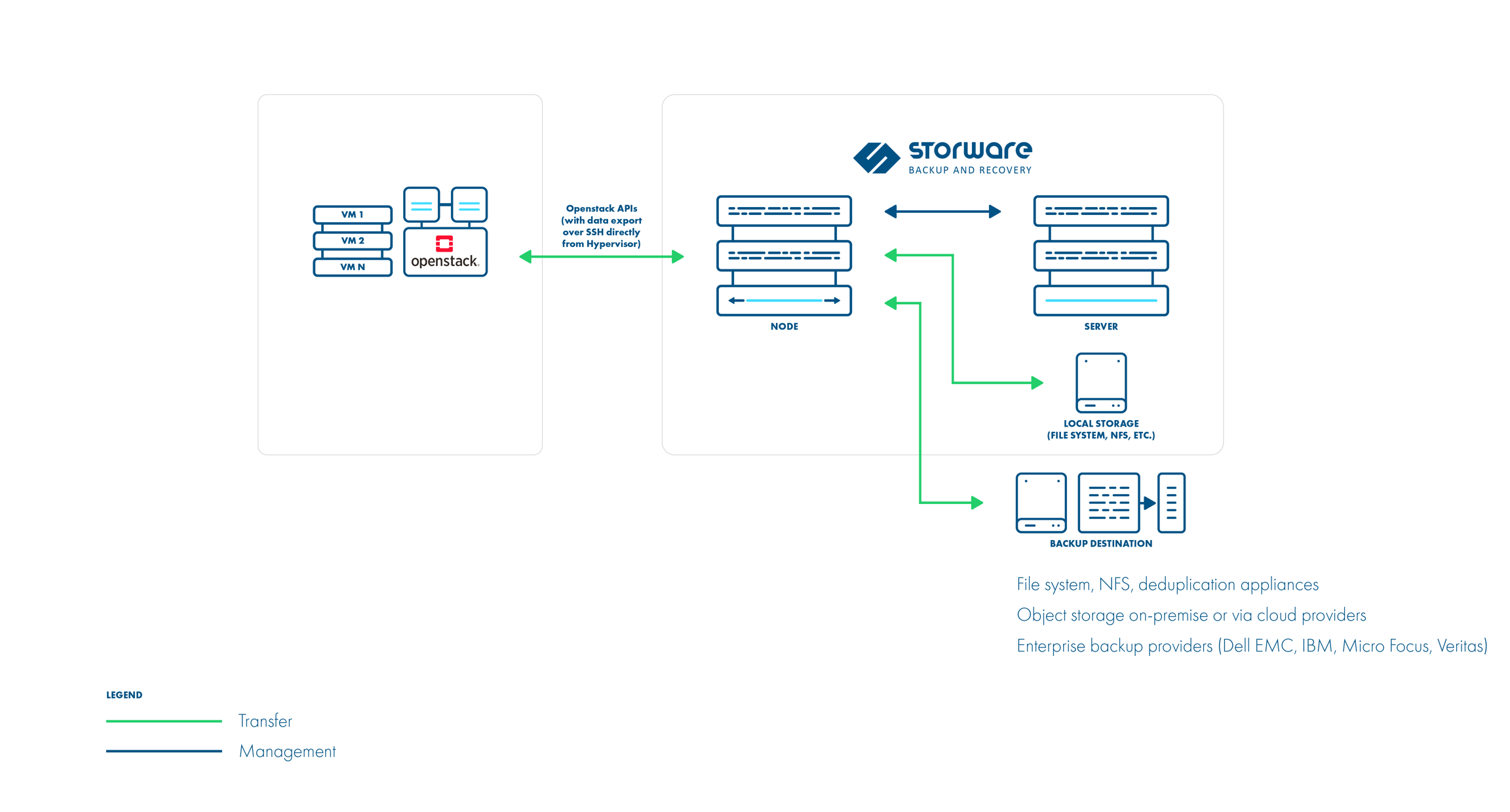
Storware Backup and Recovery offers a comprehensive solution for protecting your OpenStack environment.

Here’s a step-by-step guide to get you started with backups and recovery:

Prerequisites:

  • OpenStack environment using KVM hypervisor and VMs with QCOW2 or RAW files.
  • Storware Backup and Recovery software.

Deployment:

1. Install Storware Backup and Recovery Node: The Storware node can be installed on a separate machine. Ensure it has access to OpenStack APIs and hypervisor SSH.
2. OpenStack API Integration: Configure Storware to communicate with OpenStack APIs like Nova and Glance for metadata collection and VM restore processes.

Backup Configuration:

1. OpenStack UI Plugin (Optional): Install the Storware OpenStack UI plugin to manage backups directly from the OpenStack dashboard. This simplifies backup creation, scheduling, and restores.

2. Backup Schedules: Define backup schedules for your VMs. Storware supports both full and incremental backups.

3. Backup Options:

  • Libvirt strategy
  • Disk attachment strategy
  • Ceph RBD storage backend

All three strategies support full and incremental backups.

Libvirt strategy works with KVM hypervisors and VMs using QCOW2 or RAW files. It directly accesses the hypervisor over SSH to take crash-consistent snapshots. Optionally, application consistency can be achieved through pre/post snapshot command execution. Data is then exported over SSH.

Disk attachment strategy is used for OpenStack environments that use Cinder with changed block tracking. It uses a proxy VM to attach disks to the OpenStack instances. Snapshots are captured using the Cinder API. Incremental backups are supported. Data is read from the attached disks on the proxy VM.

Ceph RBD storage backend

Storware Backup & Recovery also supports deployments with Ceph RBD as a storage backend. Storware Backup & Recovery communicates directly with Ceph monitors using RBD export/RBD-NBD when used with the Libvirt strategy or – when used with the Disk-attachment method – only during incremental backups (snapshot difference).

Libvirt strategy

Disk attachment strategy

Retention Policies: Set retention policies to manage how long backups are stored.

Backup Process:

1. Storware interacts with OpenStack APIs to gather VM metadata.
2. Crash-consistent snapshots are taken directly on the hypervisor using tools like virsh or RBD snapshots.
3. (Optional) Pre-snapshot scripts run for application consistency.
4. VM data is exported using the chosen method (SSH or RBD).
5. Metadata is exported from OpenStack APIs.
6. Incremental backups leverage the previous snapshot for faster backups.

Recovery Process:

1. Select the desired VM backup from the Storware interface.
2. Choose the recovery point (specific backup version).
3. Storware recreates VM files and volumes based on the backup data.
4. The VM is defined on the hypervisor.
5. Disks are attached (either directly or using Cinder).
6. (Optional) Post-restore scripts can be run for application-specific recovery steps.

Additional Notes:

  • Storware supports both full VM restores and individual file/folder recovery.
  • The OpenStack UI plugin provides a user-friendly interface for managing backups within the OpenStack environment.
  • Refer to Storware documentation for detailed configuration steps and advanced options -> https://storware.gitbook.io/backup-and-recovery

By following these steps and consulting the Storware documentation, you can leverage Storware Backup and Recovery to safeguard your OpenStack VMs and ensure a quick recovery process in case of data loss or system failures.

About Storware
Storware is a backup software producer with over 10 years of experience in the backup world. Storware Backup and Recovery is an enterprise-grade, agent-less solution that caters to various data environments. It supports virtual machines, containers, storage providers, Microsoft 365, and applications running on-premises or in the cloud. Thanks to its small footprint, seamless integration into your existing IT infrastructure, storage, or enterprise backup providers is effortless.

About Version 2 Digital

Version 2 Digital is one of the most dynamic IT companies in Asia. The company distributes a wide range of IT products across various areas including cyber security, cloud, data protection, end points, infrastructures, system monitoring, storage, networking, business productivity and communication products.

Through an extensive network of channels, point of sales, resellers, and partnership companies, Version 2 offers quality products and services which are highly acclaimed in the market. Its customers cover a wide spectrum which include Global 1000 enterprises, regional listed companies, different vertical industries, public utilities, Government, a vast number of successful SMEs, and consumers in various Asian cities.

×

Hello!

Click one of our contacts below to chat on WhatsApp

×