




Designed to ensure the safety and security of an organization’s operations and protection of its customers, regulatory compliance standards are a fact of life in today’s business world. Fail to comply and be ready to face serious financial, legal, and reputational harm to your organization.
Today, we’re taking an in depth look at regulatory compliance, exploring different standards, and looking into how NordPass Business can help your organization meet the requirements in an easier and more efficient way.
What is regulatory compliance?
Regulatory compliance refers to various processes and procedures of adhering to the laws, regulations, and standards set by various governing bodies. The regulations can come from numerous sources such as local, state, federal, or even international agencies, industry groups, and professional associations. The intention behind various regulatory compliance is to protect consumers and other stakeholders.
Importance of regulatory compliance
The aim of regulatory compliance is to make sure that businesses and organizations operate in a secure, responsible, and ethical manner. Regulatory compliance can also provide businesses and organizations with a competitive advantage by helping to create a culture of transparency and credibility with customers, employees, and other involved parties. Furthermore, adhering to regulatory compliance can improve internal processes, risk management procedures, and mitigate potential legal issues, which in turn lays a great foundation for a sustainable organization.
However, it’s critical to remember that most regulatory compliance is mandatory. Failing to comply with any of the mandatory regulations can result in hefty fines. For instance, Google has been fined nearly $57 million by French regulators for violation of the General Data Protection Regulation (GDPR). Meta — the company formerly known as Facebook — recently has been fined over $400 million by top EU regulators for forcing users to accept targeted ads.
Besides financial losses, non-compliance can cause major damage to the organization’s reputation as clients may lose trust in the organization. This can even lead to serious legal issues.
Below are some of the most common regulatory compliance standards.
National Institute of Standards and Technology (NIST)
The National Institute of Standards and Technology (NIST) is a US federal agency that develops technology, metrics, and standards to drive innovation and ensure operational security within a business environment. NIST compliance is mandatory for all US-based federal information systems except those related to national security. However, the standard can be adopted by any organization.
To be NIST-compliant, a company needs to implement access controls to limit the risk of unauthorized access, develop a comprehensive incident response plan, and devise audit procedures and schedules.
General Data Protection Regulation (GDPR)
The General Data Protection Regulation (GDPR) is a data protection law that applies to businesses and organizations operating within the European Union (EU) and the European Economic Area (EEA). It sets out rules for how organizations can collect, use, and store personal data, and provides individuals the right to access and control their personal data.
To adhere to the GDPR, organizations and businesses need to implement measures such as obtaining consent from individuals before collecting their data, providing clear and concise information about their data collection practices, and implementing appropriate security measures to protect personal data.
Health Insurance Portability and Accountability Act (HIPAA)
The Health Insurance Portability and Accountability Act (HIPAA) is a US law that sets out standards for the protection of personal health information. The law applies to healthcare providers and all other entities that handle personal health information in the US.
To meet the requirements set out by the HIPAA, organizations need to implement secure systems for storing and transmitting personal health information, providing training to employees on HIPAA requirements, and implementing access controls to prevent unauthorized access to personal health information.
Payment Card Industry Data Security Standard (PCI DSS)
The Payment Card Industry Data Security Standard (PCI DSS) is a set of security standards that apply internationally to organizations that handle credit card transactions. The regulatory standard sets out requirements for protecting cardholder data and preventing unauthorized access to such data.
The PCI DSS regulations require businesses and organizations that process payment card information to implement secure systems for storing and transmitting cardholder data, conduct regular security assessments, and implement further security controls to prevent unauthorized access to cardholder data.
ISO/IEC 27001
The ISO/IEC 27001 is an international standard that outlines best practices for an information security management system (ISMS). The standard has been developed to help organizations protect their information assets and manage risks related to information security. The ISO/IEC 27001 is not a mandatory requirement.
To meet the ISO/IEC 27001 compliance, organizations need to conduct regular risk assessments, implement controls to protect against unauthorized access, and regularly review and update their information security management systems.
California Consumer Privacy Act (CCPA)
The California Consumer Privacy Act (CCPA) is a privacy law that in many ways mimics its European counterpart — the GDPR. However, the CCPA applies to businesses operating in California and it provides California residents with the right to access and control their personal data, and imposes certain requirements on businesses that collect and handle personal data.
For an organization to be CCPA compliant, it needs to implement security measures to protect customer data. Furthermore, companies are also required to provide clear and concise information about data collection practices, allowing California residents to request access to and deletion of their personal data.
Gramm-Leach-Bliley Act (GLBA)
The Gramm-Leach-Bliley Act (GLBA) is a US law that applies to financial institutions within the US. Like many of the regulatory compliance standards we already discussed, GLBA requires financial institutions to implement safeguards that would protect personal information as well as to disclose their data collection and sharing practices to customers.
To comply with the GLBA regulatory standards, financial institutions may need to implement secure systems for storing and transmitting personal financial information, providing customers with information about their data collection and sharing practices, and implementing access controls to prevent unauthorized access to personal financial information.
Center for Internet Security (CIS)
The Center for Internet Security (CIS) is a nonprofit organization that provides cybersecurity guidance and best practices to help organizations protect their systems and data. The CIS comprises 18 Critical Security Controls for identifying and protecting against the most common cyber threats.
To be CIS compliant, companies and organizations need to establish a comprehensive cybersecurity perimeter to ensure protection of their data and information management systems.
Opinion 498
The Formal Opinion 498 outlined by the American Bar Association (ABA) provides guidance for US-based lawyers and law firms with regard to virtual practice. While the ABA Model Rules of Professional Conduct permit virtual practice, the Formal Opinion 498 provides an additional set of guidelines for virtual practice.
To follow the guidelines set out by the Opinion 498, organizations or individuals are urged to establish secure information management systems and protect them with complex passwords to ensure secure storage and access to client data.
Agence nationale de la sécurité des systèmes d’information (ANSSI)
ANSSI compliance combines a set of security standards set by the French National Cybersecurity Agency. The ANSSI has been developed as a regulatory standard in France to protect sensitive information and systems from cyber threats such as hacking, malware, and data breaches. Companies that store and handle sensitive information may be required to comply with the ANSSI standards in order to ensure the security of that information.
Compliance with the ANSSI standards may involve regular audits, penetration testing, and other security measures to identify and address vulnerabilities in a company’s systems.
How can NordPass help with regulatory compliance?
Meeting regulations and staying compliant can be a complex and time-consuming process, as businesses and organizations must stay up-to-date with the latest regulatory requirements and implement appropriate policies, procedures, and tools.
However, with the right tools at your disposal compliance can be less of a hassle than you might think. One such tool is NordPass Business — a secure and easy-to-use password manager designed for business use and it can help your organization comply with the security guidelines and requirements outlined in the regulatory compliance standards listed above. But how exactly can it help?
Strong passwords and secure password storage
Most regulatory compliance standards require organizations to implement some sort of security measures to limit the possibility of unauthorized access.
For instance, PCI DSS, GLBA, GDPR, and CIS Controls all have outlined guidelines for ensuring the security of personal data processing and storage.
This is where NordPass comes in as a tool that can help. Designed by the principles of zero-knowledge architecture and equipped with an advanced XChaCha20 encryption algorithm, NordPass offers a secure way to store and access business passwords and other sensitive information in line with regulatory requirements.
Password Policy — a NordPass Business feature — can also play a critical role in compliance. Using Password Policy, companies can set certain specifications for password complexity for the entire organization, which can significantly fortify the overall security of the organization.
To easily follow Password Policy rules and specifications, users can use our very own Password Generator — a tool that can generate a password adhering to all the specifications outlined in the Password Policy in just a few clicks.
On top of that, NordPass Business can ensure that all of your organization’s passwords are stored securely and in line with the regulatory requirements.
Secure access management
Some compliance standards require organizations to implement secure access management solutions. For example, this is the case with ANSSI compliance as well as with HIPAA and NIST.
Here NordPass Business and its Admin Panel can play a major role because it is designed to provide organizations a way to effectively and easily manage access privileges across the entire organization.
Via the Admin Panel, solution owners and admins can grant or revoke access to systems as well as monitor member activity within the organization. The Admin Panel is also the place where you can set the Password Policy for the organization, ensuring that passwords throughout the company adhere to certain specifications.
Breach Monitoring
Regulatory compliance standards also tend to outline best practices for responding to a security incident such as a data breach. This is explicitly outlined in the GDPR’s Article 33, which states that data breach including personal data breach should be reported within 72 hours to the supervisory authority. Failing to do so may result in a fine of 10 million or 2% of annual revenue.
NordPass Business is equipped with a Data Breach Scanner — a tool that can scan the entire company’s domain list for potential breaches. Because the Data Breach Scanner issues a notification to all members of the organization, the company potentially affected by a breach can act quickly and efficiently to contain it.
The NordPass Password Health tool can help you detect potentially weak, old, or reused passwords throughout the organization and significantly reduce the risk of unauthorized access.
Bottom line
These days, regulatory compliance is an inseparable part of running a business. Fail to comply and be ready to face hefty fines and serious reputational damage. However, compliance is never easy. But with the right tools at your disposal, the whole process can be a lot smoother.
NordPass Business can be a tool to assist organizations in meeting various requirements in an easier and more efficient way. By staying compliant, organizations can not only avoid costly fines and legal issues, but also gain a competitive advantage by building a culture of transparency and credibility with their customer base or investors.
These days, cybercrime is rampant. It’s no longer a matter of “if” you’re going to suffer an attack but “when” it will happen. All companies want to be ready for any crisis. And this is where a business continuity plan comes into play.
But what is a business continuity plan exactly? Why is it important? What should one include? Today, we’re exploring all these questions in-depth.
What is a business continuity plan?
A business continuity plan (BCP) is a document that sets guidelines for how an organization will continue its operations in the event of a disruption, whether it’s a fire, flood, other natural disaster or a cybersecurity incident. A BCP aims to help organizations resume operations without significant downtime.
Unfortunately, according to a 2020 Mercer survey, 51% of businesses across the globe don’t have a business continuity plan in place.
What’s the difference between business continuity and disaster recovery plans?
We often confuse the terms business continuity plan and disaster recovery plan. The two overlap and often work together, but the disaster recovery plan focuses on containing, examining, and restoring operations after a cyber incident. On the other hand, BCP is a broader concept that considers the whole organization. A business continuity plan helps organizations stay prepared for dealing with a potential crisis and usually encompasses a disaster recovery plan.
Importance of business continuity planning
The number of news headlines announcing data breaches has numbed us to the fact that cybercrime is very real and frequent and poses an existential risk to companies of all sizes and industries.
Consider that in 2021, approximately 37% of global organizations fell victim to a ransomware attack. Then consider that business interruption and restoration costs account for 50% of cyberattack-related losses. Finally, take into account that most cyberattacks are financially motivated and the global cost of cybercrime topped $6 trillion last year. The picture is quite clear — cybercrime is a lucrative venture for bad actors and potentially disastrous for those on the receiving end.
To thrive in these unpredictable times, organizations go beyond conventional security measures. Many companies develop a business continuity plan parallel to secure infrastructure and consider the plan a critical part of the security ecosystem. The Purpose of a business continuity plan is to significantly reduce the downtime in an emergency and, in turn, reduce the potential reputational damage and — of course — revenue losses.
Business continuity plan template
Password security for your business
Store, manage and share passwords.
30-day money-back guarantee
Business Continuity Plan Example
[Company Name]
[Date]
I. Introduction
-
Purpose of the Plan
-
Scope of the Plan
-
Budget
-
Timeline
The initial stage of developing a business continuity plan starts with a statement of the plan’s purpose, which explains the main objective of the plan, such as ensuring the organization’s ability to continue its operations during and after a disruptive event.
The Scope of the Plan outlines the areas or functions that the plan will cover, including business processes, personnel, equipment, and technology.
The Budget specifies the estimated financial resources required to implement and maintain the BCP. It includes costs related to technology, personnel, equipment, training, and other necessary expenses.
The Timeline provides a detailed schedule for developing, implementing, testing, and updating the BCP.
II. Risk Assessment
-
Identification of Risks
-
Prioritization of Risks
-
Mitigation Strategies
The Risk Assessment section of a Business Continuity Plan (BCP) is an essential part of the plan that identifies potential risks that could disrupt an organization’s critical functions.
The Identification of Risks involves identifying potential threats to the organization, such cybersecurity breaches, supply chain disruptions, power outages, and other potential risks. This step is critical to understand the risks and their potential impact on the organization.
Once the risks have been identified, the Prioritization of Risks follows, which helps determine which risks require the most attention and resources.
The final step in the Risk Assessment section is developing Mitigation Strategies to minimize the impact of identified risks. Mitigation strategies may include preventative measures, such as system redundancies, data backups, cybersecurity measures, as well as response and recovery measures, such as emergency protocols and employee training.
III. Emergency Response
-
Emergency Response Team
-
Communication Plan
-
Emergency Procedures
This section of the plan focuses on immediate actions that should be taken to ensure the safety and well-being of employees and minimize the impact of the event on the organization’s operations.
The Emergency Response Team is responsible for managing the response to an emergency or disaster situation. This team should be composed of individuals who are trained in emergency response procedures and can act quickly and decisively during an emergency. The team should also include a designated leader who is responsible for coordinating the emergency response efforts.
The Communication Plan outlines how information will be disseminated during an emergency situation. It includes contact information for employees, stakeholders, and emergency response personnel, as well as protocols for communicating with these individuals.
The Emergency Procedures detail the steps that should be taken during an emergency or disaster situation. The emergency procedures should be developed based on the potential risks identified in the Risk Assessment section and should be tested regularly to ensure that they are effective.
IV. Business Impact Analysis
The Business Impact Analysis (BIA) section of a Business Continuity Plan (BCP) is a critical step in identifying the potential impact of a disruption to an organization’s critical operations.
The Business Impact Analysis is typically conducted by a team of individuals who understand the organization’s critical functions and can assess the potential impact of a disruption to those functions. The team may include representatives from various departments, including finance, operations, IT, and human resources.
V. Recovery and Restoration
-
Procedures for recovery and restoration of critical processes
-
Prioritization of recovery efforts
-
Establishment of recovery time objectives
The Recovery and Restoration section of a Business Continuity Plan (BCP) outlines the procedures for recovering and restoring critical processes and functions following a disruption.
The Procedures for recovery and restoration of critical processes describe the steps required to restore critical processes and functions following a disruption. This may include steps such as relocating to alternate facilities, restoring data and systems, and re-establishing key business relationships.
The Prioritization section of the plan identifies the order in which critical processes will be restored, based on their importance to the organization’s operations and overall mission.
Recovery time objectives (RTOs) define the maximum amount of time that critical processes and functions can be unavailable following a disruption. Establishing RTOs ensures that recovery efforts are focused on restoring critical functions within a specific timeframe.
VI. Plan Activation
-
Plan Activation Procedures
The Plan Activation section is critical in ensuring that an organization can quickly and effectively activate the plan and respond to a potential emergency.
The Plan Activation Procedures describe the steps required to activate the BCP in response to a disruption. The procedures should be clear and concise, with specific instructions for each step to ensure a prompt and effective response.
VII. Testing and Maintenance
-
Testing Procedures
-
Maintenance Procedures
-
Review and Update Procedures
This section of the plan is critical to ensure that an organization can effectively respond to disruptions and quickly resume its essential functions.
Testing procedures may include scenarios such as natural disasters, cyber-attacks, and other potential risks. The testing procedures should include clear objectives, testing scenarios, roles and responsibilities, and evaluation criteria to assess the effectiveness of the plan.
The Maintenance Procedures detail the steps necessary to keep the BCP up-to-date and relevant.
The Review and Update Procedures describe how the BCP will be reviewed and updated regularly to ensure its continued effectiveness. This may involve conducting a review of the plan on a regular basis or after significant changes to the organization’s operations or threats.
What should a business continuity plan checklist include?
Organizations looking to develop a BCP have more than a few things to think through and consider. Variables such as the size of the organization, its IT infrastructure, personnel, and resources all play a significant role in developing a continuity plan. Remember, each crisis is different, and each organization will have a view on handling it according to all the variables in play. However, all business continuity plans will include a few elements in one way or another.
-
Clearly defined areas of responsibility
A BCP should define specific roles and responsibilities for cases of emergency. Detail who is responsible for what tasks and clarify what course of action a person in a specific position should take. Clearly defined roles and responsibilities in an emergency event allow you to act quickly and decisively and minimize potential damage.
-
Crisis communication plan
In an emergency, communication is vital. It is the determining factor when it comes to crisis handling. For communication to be effective, it is critical to establish clear communication pipelines. Furthermore, it is crucial to understand that alternative communication channels should not be overlooked and outlined in a business continuity plan.
-
Recovery teams
A recovery team is a collective of different professionals who ensure that business operations are restored as soon as possible after the organization confronts a crisis.
-
Alternative site of operations
Today, when we think of an incident in a business environment, we usually think of something related to cybersecurity. However, as discussed earlier, a BCP covers many possible disasters. In a natural disaster, determine potential alternate sites where the company could continue to operate.
-
Backup power and data backups
Whether a cyber event or a real-life physical event, ensuring that you have access to power is crucial if you wish to continue operations. In a BCP, you can often come across lists of alternative power sources such as generators, where such tools are located, and who should oversee them. The same applies to data. Regularly scheduled data backups can significantly reduce potential losses incurred by a crisis event.
-
Recovery guidelines
If a crisis is significant, a comprehensive business continuity plan usually includes detailed guidelines on how the recovery process will be carried out.
Business continuity planning steps
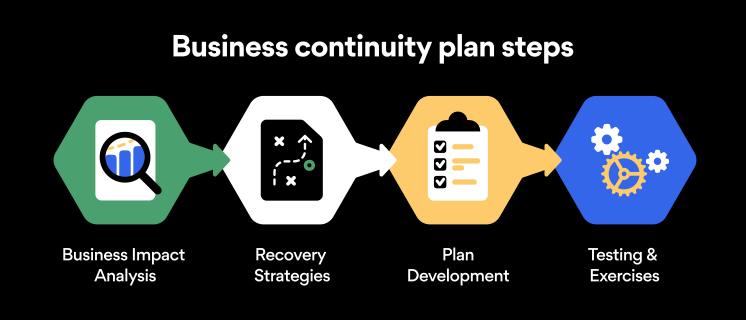
Here are some general guidelines that an organization looking to develop a BCP should consider:
Analysis
A business continuity plan should include an in-depth analysis of everything that could negatively affect the overall organizational infrastructure and operations. Assessing different levels of risk should also be a part of the analysis phase.
Design and development
Once you have a clear overview of potential risks your company could face, start developing a plan. Create a draft and reassess it to see if it takes into account even the smallest of details.
Implementation
Implement BCP within the organization by providing training sessions for the staff to get familiar with the plan. Getting everyone on the same page regarding crisis management is critical.
Testing
Rigorously test the plan. Play out a variety of scenarios in training sessions to learn the overall effectiveness of the continuity plan. By doing so, everyone on the team will be closely familiar with the business continuity plan’s guidelines.
Maintenance and updating
Because the threat landscape constantly changes and evolves, you should regularly reassess your BCP and take steps to update it. By making your continuity plan in tune with the times, you will be able to stay a step ahead of a crisis.
Level up your company’s security with NordPass Business
A comprehensive business continuity plan is vital for the entire organization’s security posture. However, in a perfect world, you wouldn’t have to use it. This is where NordPass Business can help.
Remember, weak, reused, or compromised passwords are often cited as one of the top contributing factors in data breaches. It’s not surprising, considering that an average user has around 100 passwords. Password fatigue is real and significantly affects how people treat their credentials. NordPass Business counters these issues.
With NordPass Business, your team will have a single secure place to store all work-related passwords, credit cards, and other sensitive information. Accessing all the data stored in NordPass is quick and easy, which allows your employees not to be distracted by the task of finding the correct passwords for the correct account.
In cyber incidents, NordPass Business ensures that company credentials remain secure at all times. Everything stored in the NordPass vault is secured with advanced encryption algorithms, which would take hundreds of years to brute force.
If you are interested in learning more about NordPass Business and how it can fortify corporate security, do not hesitate to book a demo with our representative.
