Skip to content

Top Alternative to Citrix Netscaler in 2024

Introduction

In the previous article of our series, we discussed how to reduce latency across multi-cloud deployments. If you missed it, you can catch up here. Today, we’re going to discuss a crucial topic: finding the top alternative to Citrix Netscaler in 2024. As you all know, Citrix has recently undergone significant changes in management and strategy, focusing on simplifying its product offerings. This shift has brought numerous concerns, including increased support overhead and a lack of support for medium and small customers. Additionally, changes in the licensing model have introduced extra costs for contract renewals, adding to the overall financial burden on organizations.

In this context, it’s essential to explore robust alternatives that can offer reliable performance, security, and cost efficiency. One such alternative is Thinfinity Workspace. This article will delve into why Thinfinity Workspace stands out as the top alternative to Citrix Netscaler in 2024.

Let’s get into the meat of this real quick. Imagine a bustling corporate environment where the IT infrastructure must support hundreds of employees accessing critical applications simultaneously. The performance and reliability of these applications can make or break productivity. This is where Thinfinity® Workspace steps in, offering a robust and flexible solution that addresses the unique challenges faced by large organizations. We’ll delve into the features and benefits of Thinfinity Workspace and see why it stands out as the top alternative to Citrix Netscaler in 2024.


Understanding Application Delivery Controllers (ADCs)

ADCs, or Application Delivery Controllers, play a pivotal role in managing, optimizing, and securing the delivery of applications across networks. They ensure that applications are delivered swiftly, securely, and efficiently to end-users, thus maintaining business continuity and enhancing user experience.

Definition and Core Functions of ADCs

An ADC is a device or software appliance positioned between the client and server to manage application traffic. ADCs perform essential functions such as load balancing, traffic optimization, and application acceleration. By distributing client requests across multiple servers, ADCs prevent any single server from becoming a bottleneck, thereby enhancing the performance and availability of applications. Think of an ADC as a traffic cop at a busy intersection, skillfully directing vehicles to different lanes to prevent congestion and ensure a smooth flow of traffic. Similarly, ADCs manage data traffic, directing it efficiently to maintain optimal performance.

The Role of ADCs in Modern IT Infrastructure

In the era of cloud computing and distributed applications, ADCs have become indispensable. They not only balance loads but also provide crucial security features such as SSL offloading, Web Application Firewall (WAF) capabilities, and DDoS protection. This comprehensive approach ensures that applications are not only fast but also secure from various cyber threats. Picture an ADC as a skilled conductor leading an orchestra, ensuring each instrument plays harmoniously and at the right time while also safeguarding the entire performance from disruptions. Similarly, ADCs efficiently guide data traffic while safeguarding it against cyber threats, maintaining the integrity and performance of applications.

Common Challenges Addressed by ADCs

Enterprises often grapple with issues like server overload, latency, and security vulnerabilities. ADCs mitigate these problems by intelligently managing traffic, accelerating application performance, and implementing security protocols to protect against attacks.

For example, we assisted an oil and gas company with a vast network of remote drilling sites across the United States and South America. These sites relied on real-time data for monitoring and decision-making but faced significant latency and security issues that were impacting their operational efficiency. By deploying an ADC, we were able to distribute the traffic load more evenly, reducing latency and ensuring that data was transmitted securely and promptly. This improvement enabled the company to make timely decisions, enhancing both safety and productivity. Common applications in the oil and gas industry that benefit from ADCs include Supervisory Control and Data Acquisition (SCADA) systems, Programmable Logic Controllers (PLCs), and Distributed Control Systems (DCS), all of which require efficient data transmission for optimal performance.

How do ADCs enhance application performance and security?

Continuing with our story, this new customer in the Oil and Gas Industry had been struggling with delayed data transmissions and frequent security breaches in their SCADA systems, which are crucial for real-time monitoring and control of field equipment. Implementing the ADC addressed these issues by providing advanced load balancing and traffic management, which significantly reduced latency and ensured uninterrupted data flow. The ADC’s security features, including SSL offloading and DDoS protection, fortified the company’s network against cyber threats, safeguarding sensitive operational data. As a result, the company experienced a marked improvement in operational efficiency, enabling faster response times to field conditions and more accurate decision-making processes. This case underscores how ADCs can resolve critical pain points in application delivery, leading to enhanced performance and security in complex industrial environments.

Thinfinity® Workspace ADC 2024

Thinfinity Workspace offers a cutting-edge approach to application delivery, combining robust performance, security features, and ease of use, making it a superior alternative to traditional ADCs like Citrix Netscaler.

Key Features of Thinfinity® Workspace as an ADC

Performance: Thinfinity Workspace optimizes application delivery with advanced load balancing and traffic management techniques. Its ability to handle high traffic volumes without compromising performance ensures that applications remain accessible and responsive, even during peak usage times.

Security: Thinfinity Workspace provides comprehensive security features, including SSL offloading, Web Application Firewall (WAF) capabilities, and DDoS protection. These features safeguard applications from cyber threats, ensuring data integrity and compliance with security standards.

User Experience: The user-friendly interface and seamless integration with existing IT infrastructure simplify the management of application delivery. Thinfinity Workspace enhances the user experience by providing intuitive controls and efficient workflows.

Cloud-Agnostic Architecture: Thinfinity Workspace’s cloud-agnostic architecture supports deployment across various cloud environments, including public, private, and hybrid clouds. This flexibility allows organizations to scale their infrastructure as needed, without being locked into a single vendor. The solution seamlessly integrates with existing cloud services and on-premises systems, ensuring a smooth transition and optimal performance across different platforms. Think of Thinfinity Workspace’s cloud-agnostic architecture as a versatile vehicle that can traverse any terrain, providing reliable performance regardless of the environment.

Explore further cloud-agnostic capabilities of Thinfinity Workspace $

Once again, in the case of this oil and gas company, Thinfinity Workspace significantly improved the performance of their SCADA systems. Before implementing Thinfinity, data bottlenecks during peak operation hours led to delayed decision-making and reduced efficiency. With Thinfinity’s advanced load balancing, the company saw a 40% reduction in latency and a marked increase in system responsiveness. This allowed engineers to make quicker, more informed decisions, directly enhancing operational productivity.

The company also benefited from Thinfinity’s robust security features. Previously, their SCADA systems were vulnerable to cyber-attacks, which posed significant risks to their operations. With Thinfinity’s SSL offloading and WAF capabilities, the company’s network security was greatly enhanced. There was a notable decrease in security incidents, giving the IT team confidence that their data was protected. This improvement not only safeguarded critical operational data but also ensured compliance with industry regulations.

The transition to Thinfinity Workspace was seamless for the oil and gas company. The IT staff found the interface intuitive and easy to navigate, which minimized the learning curve and allowed them to quickly leverage Thinfinity’s full capabilities. The integration with their existing systems was smooth, with minimal downtime during the transition. As a result, the company experienced an overall improvement in IT staff efficiency and user satisfaction, as the platform’s intuitive controls and efficient workflows made their daily operations more manageable and less time-consuming.

Thinfinity Workspace addresses common challenges with its advanced features, improving both performance and security while offering a superior user experience. This makes it a compelling alternative to Citrix Netscaler for enterprises looking to enhance their application delivery infrastructure.

Transparent Licensing Model Based on Concurrent Users

Cost Efficiency: Thinfinity Workspace offers a transparent licensing model based on concurrent users, eliminating hidden fees and unexpected costs. This model provides organizations with clear pricing, making it easier to budget and plan for IT expenditures.

Scalability: The licensing model supports scalability, allowing organizations to add or remove users as needed without incurring additional costs. This flexibility ensures that businesses can adapt to changing demands without financial strain.

Of course, our new customer greatly benefited from Thinfinity Workspace’s transparent licensing model. Prior to implementing Thinfinity, the company struggled with high costs and maintenance burdens associated with Citrix. Our licensing model provided clear, predictable pricing not only for their current needs but also for future growth. This reduced their total cost of ownership (TCO) by up to 65%, thanks to lower licensing prices and the absence of hidden costs for features like fault tolerance or high availability. Additionally, the scalable licensing allowed the company to adjust user counts as needed without incurring extra costs, offering previously unattainable financial flexibility. This transparent and cost-effective approach empowered the company to better manage their IT budget and invest in other critical areas, ultimately enhancing their overall operational efficiency and financial health.

Thinfinity® Workspace vs. Citrix Netscaler

Before we conclude, let’s take a moment to compare Thinfinity Workspace with Citrix Netscaler across several key areas. This comprehensive table will help you make an informed decision by highlighting the strengths and differences between these two solutions.

This will ensure you have all the necessary information to understand why Thinfinity Workspace is an excellent alternative for your application delivery needs.

Conclusion

As we’ve explored today, finding a robust alternative to Citrix Netscaler is crucial, especially in light of recent changes at Citrix. These changes have led to increased support overhead, less support for medium and small customers, and additional costs due to new licensing models. Such developments have intensified the financial burden on organizations relying on Citrix for their application delivery needs.

Thinfinity Workspace shows up as a top contender to replace Citrix Netscaler, offering several compelling advantages. Its advanced features ensure optimal application performance, while the cloud-agnostic architecture provides flexibility across various environments. Furthermore, Thinfinity Workspace’s transparent licensing model alleviates financial uncertainties, making it a cost-effective solution for enterprises of all sizes.

For CIOs, CTOs, and CISOs, transitioning to Thinfinity Workspace is more than just a technical upgrade; it’s a strategic decision that can enhance operational efficiency and provide a competitive edge. The benefits of improved application performance, enhanced security, and significant cost savings make Thinfinity Workspace an excellent choice in the evolving digital landscape.

Now is the opportune time to explore Thinfinity Workspace’s capabilities fully and consider how it can meet your organization’s unique application delivery requirements, positioning you for success in 2024 and beyond.

About Cybele Software Inc.
We help organizations extend the life and value of their software. Whether they are looking to improve and empower remote work or turn their business-critical legacy apps into modern SaaS, our software enables customers to focus on what’s most important: expanding and evolving their business.

About Version 2 Digital

Version 2 Digital is one of the most dynamic IT companies in Asia. The company distributes a wide range of IT products across various areas including cyber security, cloud, data protection, end points, infrastructures, system monitoring, storage, networking, business productivity and communication products.

Through an extensive network of channels, point of sales, resellers, and partnership companies, Version 2 offers quality products and services which are highly acclaimed in the market. Its customers cover a wide spectrum which include Global 1000 enterprises, regional listed companies, different vertical industries, public utilities, Government, a vast number of successful SMEs, and consumers in various Asian cities.

The Role of ITSM in Cybersecurity Incident Response

IT service management (ITSM) plays a crucial role in any business, ensuring IT operations are efficient and well-coordinated, but its impact extends beyond that to everything related to cybersecurity incident response.


In concrete terms, it does this by reducing response times, facilitating communication, and improving coordination during an incident.

But it’s not just about “curing”; ITSM also allows for prevention, solving problems before they arise.

ITSM and cybersecurity are crucial and delicate topics that we will focus on in the rest of the article.

How ITSM Improves Cybersecurity Incident Management


The role of ITSM in incident detection and response

ITSM systems can support structured management of cybersecurity incidents, starting from the detection processes. A response is then triggered, often in an automated manner.

Solutions like EV Observe offer continuous monitoring, enabling you to detect incidents and initiate corrective actions as quickly as possible.


ITSM 
workflows with cybersecurity needs

By leveraging ITSM, you can standardize your IT workflows to make them consistent with your IT security practices. These practices are constantly evolving; here’s another key point: good ITSM systems ensure no vulnerabilities are introduced during system changes and updates.


Reducing response time through ITSM frameworks

Here, we touch on another crucial aspect we have mentioned since the introduction.

Adopting an ITSM framework for incident management can significantly reduce response times in the event of incidents or cyberattacks. It can do so through predefined and automated processes of prioritization and escalation.

In this regard, automation tools, such as those offered by EV Reach, manage security tickets in real time, improving the response’s overall effectiveness.


ITSM 
Features That Strengthen Cybersecurity


Incident tracking and compliance documentation

It’s not just about detecting and fixing errors. One of the most important aspects of ITSM is the ability to track and document each phase of incident management, a key factor when it comes to cybersecurity. Detailed recording of activities allows compliance with regulations (for example, GDPR) and provides valuable information to prevent future incidents, triggering a continuous improvement mechanism.


Root cause analysis and response coordination

Still on the subject of continuous improvement: after an incident, it is essential to conduct a thorough analysis to identify the causes and prevent similar events from happening in the future. ITSM also facilitates this process through workflows structured around this objective.

In this way, the coordination of the response becomes increasingly efficient. It’s a bit like what happens in all immune systems.


Automated workflows and reduction of human errors

Automation is one of the most powerful weapons in the fight against cyberattacks. In this way, efficiency soars and the risk of human errors tends toward zero.


ITSM 
Metrics and KPIs for Incident Response


KPIs for cybersecurity in ITSM

Measuring the effectiveness of your security incident response is critical to continuously improving your business protection.

There are several relevant KPIs, and they depend on the type of company. Among these, the most important and valid for everyone are as follows:

  • The mean time to detect incidents (MTTD).
  • The mean time to resolution (MTTR).
  • The number of incidents resolved without escalation.


ITSM m
etrics to optimize incident response strategies

At this point, it is a matter of taking a further step: collecting data from ITSM allows you to continuously optimize response strategies; we have seen it. It is always a question of quantity of information but also of quality and depth.

Last but not least, IT teams must easily read this data.

Solutions like EV Reach and EV Service Manager offer intuitive, customizable dashboards that allow IT managers to visualize incident trends and make informed decisions to prevent future attacks.


Continuous improvement through incident data analysis

We have reiterated in several passages above that the information collected during incident management is fundamental for improving security processes.

Using historical incident data, organizations can implement timely fixes and improve their defenses in the short, medium, and long term. ITSM is at the heart of this process, as it ensures all information is stored and used to optimize response plans.


Best Practices for Implementing ITSM in Cybersecurity Incident Response


ITSM 
processes with security policies

Processes must be aligned with the company’s security policies for ITSM to effectively support cybersecurity.

This means clearly defining roles and responsibilitiesstandardizing response procedures, and ensuring all teams have access to the same information and tools. All this must occur in a dynamic manner since these policies can (and must) be constantly updated.


ITSM 
team training for security incident management

Automation is important, but it is of little use if it is not supported by attentive and well-trained staff. In other words, companies must invest in the continuous training of their IT teams to be prepared to face ever-evolving threats through ever-evolving tools.


Leveraging automation in ITSM for faster incident resolution

As we have reiterated, speed is a decisive factor in managing cybersecurity incidents.

Attention must always be at its maximum, 24 hours a day, seven days a week. The human factor alone cannot guarantee this type of attention. By automating many repetitive tasks, you can ensure fast and accurate incident responses.


Collaboration between ITSM and cybersecurity teams

ITSM systems can serve as a hub for communication and coordination during a security incident. Collaboration between ITSM and cybersecurity teams enables a more coordinated response based on relevant information shared in real time.


ITSM is a central hub for communication and coordination

We have discussed collaboration and coordination between teams as the key to timely incident resolution. However, such a response cannot be achieved without efficient centralization of processes.

Tools like EV Service Manager offer an integrated platform that centralizes communications. This ensures that all teams involved have access to the same information and that decisions are made quickly and with full knowledge of the facts.


Challenges and Solutions in Integrating ITSM for Cybersecurity


Breaking down organizational silos for incident management

One of the main obstacles to effectively integrating ITSM into cybersecurity processes is the presence of organizational silos or inefficient barriers between one sector and another. Instead, it is important to foster a culture of collaboration in which various teams share knowledge and resources to ensure a timely and coordinated response.


ITSM 
flexibility to address evolving threats

Cybersecurity threats are constantly evolving, and ITSM must be flexible enough to adapt. This is another reason to rely on solutions and platforms that allow you to easily update workflows and adapt to new needs, keeping your business security up to date.


Cross-functional incident management with ITSM

Integrating ITSM with other business functions, such as vulnerability management and compliance monitoring, can significantly improve cross-functional incident management. This is a direct consequence of what we highlighted earlier about ITSM’s role as a facilitator of communication and collaboration between departments.


Conclusion: The Future of ITSM in Cybersecurity Incident Response

In an increasingly digital business, it is normal for cyber threats and incidents to multiply. Consequently, we will increasingly need efficient, easy-to-use, continuously updated tools.

ITSM systems will be increasingly crucial in cybersecurity management, especially as advanced technologies such as artificial intelligence and automation are integrated.


FAQs

What are the main benefits of ITSM in cybersecurity incident management?

Improved team coordination, reduced response times, and compliance assurances through incident documentation and tracking.

How can automation improve security incident response?

By enabling you to detect, classify, and respond to incidents faster and more efficiently, reducing human error and improving resolution speed.

What are the main challenges in integrating ITSM with cybersecurity?

Overcoming the inefficiencies of organizational silos and aiming for ever greater flexibility to address emerging threats.

About EasyVista  
EasyVista is a leading IT software provider delivering comprehensive IT solutions, including service management, remote support, IT monitoring, and self-healing technologies. We empower companies to embrace a customer-focused, proactive, and predictive approach to IT service, support, and operations. EasyVista is dedicated to understanding and exceeding customer expectations, ensuring seamless and superior IT experiences. Today, EasyVista supports over 3,000 companies worldwide in accelerating digital transformation, enhancing employee productivity, reducing operating costs, and boosting satisfaction for both employees and customers across various industries, including financial services, healthcare, education, and manufacturing.

About Version 2 Digital

Version 2 Digital is one of the most dynamic IT companies in Asia. The company distributes a wide range of IT products across various areas including cyber security, cloud, data protection, end points, infrastructures, system monitoring, storage, networking, business productivity and communication products.

Through an extensive network of channels, point of sales, resellers, and partnership companies, Version 2 offers quality products and services which are highly acclaimed in the market. Its customers cover a wide spectrum which include Global 1000 enterprises, regional listed companies, different vertical industries, public utilities, Government, a vast number of successful SMEs, and consumers in various Asian cities.

為什麼管理員入口網站的安全性至關重要? JumpCloud 引領安全新標準,助力企業應對網絡威脅

在當今快速變化的網絡安全環境中,管理員入口網站是公司企業的重要資源,因此它們成為攻擊者的主要目標。攻擊者試圖利用漏洞牟取財務利益、竊取數據或破壞營運。未能保障這些入口的公司企業將面臨數據洩露、監管罰款和聲譽損害的風險。

本文利用 4-3-2-1 框架,解釋為什麼管理員入口網站存取安全如此重要,以及 JumpCloud 如何通過單一身份管理保護擁有管理角色的用戶資源。

管理員入口網站安全至關重要的四大原因

管理員入口網站是公司企業的核心鑰匙
管理員入口網站提供對公司企業最敏感系統(如身份、設備、電子郵件等)的特權存取。若發生泄露,可能帶來災難性後果,導致品牌和聲譽受損。在不當使用的情況下,管理角色可能被用於操控系統、竊取寶貴數據,甚至完全中斷業務營運。保護管理員入口網站對於維護整個公司企業的安全至關重要。

  • 數據事實:74% 的數據洩露涉及使用者和管理員賬戶的憑證或權限濫用(Verizon DBIR, 2023)。

憑證洩露是主要攻擊途徑
弱密碼或被盜憑證是跨行業數據洩露的主要原因。尤其是管理員入口網站,由於可提供對敏感系統和基礎設施的不受限制存取,因此成為攻擊者的高價值目標。釣魚攻擊、暴力破解和憑證填充等方法被攻擊者用來提升權限、繞過安全控制並造成大範圍破壞。

為這些賬戶添加強認證方法作為第二層保護(密碼作為第一層),是降低洩露風險的重要措施。

  • 數據事實:19% 的洩露源於憑證洩露,平均每次事件損失達 450 萬美元(IBM, 2023)。

遺留管理賬戶是一個隱藏的威脅
若員工離職或角色變更後,遺留的管理賬戶仍保持活躍,會帶來重大安全風險。這些賬戶通常不被注意或監控,為惡意行為者提供潛在的未經授權存取入口,繞過一般的防控措施。

當管理角色未與集中化用戶身份管理系統綁定時,風險尤為嚴重,可能導致員工離職後權限未被撤銷。

  • 數據事實:58% 的公司企業因遺留賬戶而遭遇數據洩露(Ponemon Institute)。

合規要求加強管理控制
許多行業受嚴格的監管框架(如 GDPR、HIPAA 和 PCI DSS)約束,要求公司企業對管理存取實施強大的安全控制。未能執行足夠的管理存取政策(如 MFA 和基於角色的存取控制),可能導致監管處罰、法律後果和客戶信任流失。

此外,維護詳細的審計日誌並跟蹤管理活動是合規的關鍵要求,確保可以迅速檢測和調查任何異常或未經授權的存取。

  • 數據事實:違反合規每年平均給企業帶來 1,482 萬美元的損失(Global Data Protection Compliance)。

JumpCloud 提升安全性的三種方式

單一身份管理
當管理角色直接與用戶的主身份綁定時,可以實現集中化身份管理,並減少因維護單獨用戶和管理賬戶而產生的憑證或 MFA 疲勞。

JumpCloud 能將現有用戶創建為管理角色,確保員工離職或角色變更時,管理存取自動被撤銷,防止出現遺留管理賬戶。

此外,具有管理角色的用戶需要存取管理員入口網站時,可使用其主憑證進行身份驗證,並啟用 MFA 進一步保障存取安全。

針對現代攻擊的高認證安全性 MFA
網絡攻擊者不斷演進其策略,利用釣魚、中間人攻擊和令牌盜竊來繞過傳統 MFA 方法。

通過 JumpCloud,管理員可以為具有管理角色的用戶配置抗釣魚的無密碼 MFA 方法,並使用基於 WebAuthn(FIDO2)的設備身份驗證器或硬件安全密鑰,保護管理員入口網站。這些先進的安全存取保護措施確保僅憑憑證無法存取核心系統。

持續 MFA 保護管理員入口網站安全
對於像管理員入口網站這樣的關鍵系統,持續啟用 MFA 是必需的。JumpCloud 提供的持續認證層,確保只有經過驗證的具有管理角色的用戶,才能每次使用先進的 MFA 方法存取敏感資源。

兩項實現了的真實成果

簡化公司企業安全管理
通過集中控制簡化和保障身份生命周期管理,實現對 JumpCloud 管理員入口網站的高級別安全性,並確保不留遺留管理賬戶,降低洩露風險。

符合監管要求變得簡單
詳細的審計日誌可以基於用戶角色跟蹤其行為,結合持續 MFA,幫助您滿足合規要求,同時減少因違規而遭受的潛在處罰。

一項立即行動的建議

管理員入口網站的安全已不再是奢侈品,而是必要條件。

公司企業必須採取主動措施來保護其最具特權的賬戶。風險不容小覷 —— 一次洩露可能導致財務損失、業務中斷和持久的聲譽損害。

作為公司企業的超級管理員(具有賬單權限的管理員),您需要立即管理現有用戶中的管理員,並保障其對 JumpCloud 管理員入口網站的安全存取。JumpCloud 的抗釣魚安全功能,如 JumpCloud Go、基於 WebAuthn 的設備身份驗證器、硬件安全密鑰和 JumpCloud Protect,都是原生且全面整合的 MFA 方法,您可以利用這些功能來保護系統。

了解更多,保護最重要的資源。立即確保您的 JumpCloud 管理員入口網站安全。如果您是首次接觸 JumpCloud 的 IT 管理員,可立即註冊免費演示,探索 JumpCloud 平台的功能,並開始通過單一控制台高效管理整個 IT 基礎設施中的設備和身份。還可以體驗我們的引導式模擬。

關於 JumpCloud

JumpCloud® 提供一個統一的開放式目錄平台,使 IT 團隊和 MSP 能夠輕鬆、安全地管理公司企業中的身份、裝置和存取權限。通過 JumpCloud,用戶能夠從任何地方安全工作,並在單一平台上管理其 Windows、Apple、Linux 和 Android 裝置。

關於Version 2

Version 2 Digital 是立足亞洲的增值代理商及IT開發者。公司在網絡安全、雲端、數據保護、終端設備、基礎設施、系統監控、存儲、網絡管理、商業生產力和通信產品等各個領域代理發展各種 IT 產品。透過公司龐大的網絡、通路、銷售點、分銷商及合作夥伴,Version 2 提供廣被市場讚賞的產品及服務。Version 2 的銷售網絡包括台灣、香港、澳門、中國大陸、新加坡、馬來西亞等各亞太地區,客戶來自各行各業,包括全球 1000 大跨國企業、上市公司、公用事業、醫療、金融、教育機構、政府部門、無數成功的中小企及來自亞洲各城市的消費市場客戶。

How ESM Transforms IT Departments into Service-Centric Organizations

How ESM Transforms IT Departments into Service-Centric Organizations

With enterprise service management (ESM), you can digitize your internal processes, streamline incoming request management, automate tasks, relieve pressure on your service desk, and perform lengthy, low-value-added processes efficiently while improving the user experience.


In essence, by adopting ESM tools, you apply IT service management (ITSM) best practices to your entire organization, not just the IT department.

On the other hand, any company that wants to remain competitive today can do nothing but commit itself to increasing the quality of its services, both internal (e.g., the activities of employees) and external (the end customer).

This commitment requires a transformation of IT departments, which must emerge from traditional isolation to become integrated and service-oriented organizations.

Enterprise service management is a crucial enabler of this transformation.


How IT Departments Are Changing: From Cost Centers to Strategic Partners

The need to integrate digital tools into every part of the business demonstrates that the isolation we have mentioned is an inefficient and uneconomical strategy.

Today, IT departments can achieve business results and generate value and can no longer be considered mere technical support functions.

Traditional IT departments focus on infrastructure management, system maintenance, and network security. They are reactive—responding to issues as they arise—and have limited interaction with other business units as they operate in silos. Their perception of being cost centers rather than strategic partners limits their ability to influence broader business goals.

Therefore, the traditional approach produces inefficiencies: isolated systems and processes cause delays and prevent the provision of consistent services.

The choice to equip oneself with ESM solutions helps to overcome the role typically assigned to IT departments, moving toward the adoption of a holistic approach that aligns with the broader organizational strategy.


What Does Service-Centric Mean?

By now, we should have realized that an organization’s true digital transformation is not just about expanding ITSM best practices.

For transformation to happen, processes must be standardized and unified, and services provided to users must be interconnected. Old ITSM tools are not suited to such flexible and customer-centric deployments; they are expensive and complex to extend to the rest of the company.

The development of more agile cloud-based tools is changing things for the better. Modern ESM software has become much faster to deploy, manage, and maintain. This means that non-IT functions are increasingly able to easily administer their own services.

The essence of a service-centric organization lies in the possibility of the different departments to exploit their specific objectives through collaboration with all other company functions, thanks to advanced ESM systems and ITSM best practices.


Key Components of Enterprise Service Management

ESM includes multiple key components: service catalogs, self-service portals, automated workflows, integrated reporting and analytics, and tools for incidentproblem, and change management.

These components help standardize service delivery across the organization, break down silos, and foster a more collaborative environment. They enable consistent delivery, regardless of the department or service being offered. Through automation and self-service capabilities, they reduce manual workloads and accelerate response times.

Finally, specific features allow for improved collaboration and communication between departments.


A Short Guide to ESM Implementation

Implementing ESM is a complex process. The following are the basic steps:

  1. The first step consists of a complete assessment of current IT capabilities—maturity of existing ITSM practices, level of automation in place, and general alignment of IT services with business objectives. Part of this initial phase also involves identifying weaknesses (areas where current services are lacking) and strengths. A successful ESM strategy must start with clear and aligned objectives and goals in line with the organization’s overall strategy.
  2. In the second step, a roadmap is developed to establish the necessary steps for implementing ESM, from identifying the scope of distribution of the ESM software to selecting the most appropriate tools and technologies up to defining the timing.
  3. The deployment of ESM solutions must be carefully planned and executed. At this stage, the infrastructure is set up, systems are configured, and stakeholders are adequately trained.

Best Practices for Successful Deployment

ESM implementation can only be successful if done correctly, following a methodical and thorough approach. Here are some tips:

  • Gain top management buy-in. Leadership support is an important signal to drive ESM adoption throughout the organization.
  • Set specific goals. Having clear, realistic goals you expect to achieve with ESM helps you measure your progress objectively.
  • Involve stakeholders. During the planning and implementation phases, representatives from different departments and teams should be involved to ensure a complete view of the entire adoption process.
  • Communicate effectively. Explaining the benefits of the change produced by ESM and promptly responding to doubts or correcting inaccurate beliefs helps to defuse resistance.
  • Opt for a phased approach. Implementing ESM so that each phase builds on the previous one helps manage complexity and minimize disruptions, leading to a smoother transition.

Benefits of ESM for IT Departments from a Customer-Centric Perspective

It is clear that ESM plays a fundamental role in enriching IT departments’ performance and contributes to their transformation into service-focused and fully customer-centric organizations.

Through process automation and standardization, ESM optimizes service delivery, enhances IT staff capabilities, and fosters a more efficient and customer-centric approach. The benefits are numerous; let’s explore them one by one.

  • Improved service delivery. A structured approach to service management ensures consistent and efficient service delivery, meeting the needs of internal and external users.
  • Improved user experience. By focusing on the user experience, ESM helps create more intuitive and user-friendly service interactions. Self-service portals and automated workflows enable users to access services quickly, easily, independently, and with greater satisfaction.
  • Reduced response times and downtime. Automation and streamlined workflows significantly reduce response times and downtime. This improves service reliability and allows staff, not just IT, to focus on more strategic activities.
  • Increased efficiency and productivity. Standardized processes and improved workflows enable IT departments to deliver service faster and reduce time spent on manual tasks. Eliminating redundant processes and optimizing resource allocation increases efficiency and productivity across the organization.
  • Cost savings. ESM helps save costs by reducing the need for IT departments to intervene manually. By automating routine tasks, organizations can allocate resources more effectively, resulting in significant cost reductions.
  • Empowered IT staff. ESM provides IT staff with ongoing training opportunities. By exposing them to a broader range of services and processes, ESM helps IT professionals develop a more comprehensive understanding of the business.
  • A service-oriented mindset. IT staff is encouraged to think beyond technical support and consider the overall user experience. This shift in perspective is critical to providing high-quality, truly customer-centric services.

ESM and IT Departments: New Scenarios

ESM adoption can present several challenges, including resistance to change, poor buy-in, and problems integrating with existing systems. Overcoming these challenges requires strong leadership, clear communication, and a well-defined implementation plan.

Emerging technologies, particularly artificial intelligence (AI) and automation, are largely driving the transformation of IT departments into service-centric and customer-centric organizations.

Adopting AI in ESM scenarios streamlines and facilitates service delivery, allowing IT teams to focus on strategic initiatives.

In practice, by automating routine tasks, AI allows proactive problem-solving and timely delivery of personalized services, such as generating articles, analyzing financial data, and communicating formal documents.

Moving from manual processes to intelligent automation enables IT departments to provide faster, more accurate, and personalized support. As a result, IT can better align with business goals, providing tailored services that meet the specific needs of different departments, thereby improving the overall user experience.

This focus on service quality and customer solutions is the essence of a service-centric organization.


Conclusion

As ESM continues to evolve, IT departments are transforming from support functions to strategic partners and service-centric organizations.

Enterprise service management (ESM) is a powerful tool that can make this transformation successful. By extending service management principles across the enterprise, ESM improves process efficiency and user experience while empowering IT staff.


FAQs

What does enterprise service management (ESM) do?

ESM applies IT service management best practices across the organization, helping IT departments become service-centric organizations focused on efficiency and user satisfaction.

What are the benefits of adopting ESM?


ESM improves service delivery, reduces costs, and increases productivity, transforming IT departments into strategic, service-centric partners focused on improving the user experience.

How does ESM support the transformation of IT departments into service-centric organizations?


ESM unifies and standardizes processes, enabling IT departments to deliver faster, more consistent services, which is critical to a service-centric, user-centric organization.

What are the main challenges in implementing ESM?


Challenges include resistance to change and integration issues. Overcoming these challenges helps IT departments evolve into service-centric organizations, improving collaboration and efficiency.

How is artificial intelligence (AI) enhancing the ESM?


AI automates routine tasks, improving service accuracy and speed. This supports the transformation of IT departments into service-centric organizations focused on personalized solutions for users.

About EasyVista  
EasyVista is a leading IT software provider delivering comprehensive IT solutions, including service management, remote support, IT monitoring, and self-healing technologies. We empower companies to embrace a customer-focused, proactive, and predictive approach to IT service, support, and operations. EasyVista is dedicated to understanding and exceeding customer expectations, ensuring seamless and superior IT experiences. Today, EasyVista supports over 3,000 companies worldwide in accelerating digital transformation, enhancing employee productivity, reducing operating costs, and boosting satisfaction for both employees and customers across various industries, including financial services, healthcare, education, and manufacturing.

About Version 2 Digital

Version 2 Digital is one of the most dynamic IT companies in Asia. The company distributes a wide range of IT products across various areas including cyber security, cloud, data protection, end points, infrastructures, system monitoring, storage, networking, business productivity and communication products.

Through an extensive network of channels, point of sales, resellers, and partnership companies, Version 2 offers quality products and services which are highly acclaimed in the market. Its customers cover a wide spectrum which include Global 1000 enterprises, regional listed companies, different vertical industries, public utilities, Government, a vast number of successful SMEs, and consumers in various Asian cities.

Setting up StarWind Virtual SAN (VSAN) as Hardened Repository for Veeam B&R


Introduction

Hi, fellas. If you’re in charge of keeping your business data safe, you know that protecting it from ransomware and other threats is a top priority. One of the best ways to do this is using a 3-2-1-1 backup practice. That extra “1” in 3-2-1-1 stands for using immutable storage, such as on a Linux-based hardened repository.

In this article, I will show you how to turn your existing or aging server hardware into immutable backup storage to keep your data safe against ransomware. All you need is Veeam Backup & Replication and StarWind VSAN that will perform a role of Hardened Repository. This is a super easy and efficient way to keep your data safe, and I’ll walk you through the entire process step by step.

Why immutability?

Firstly, let’s talk about why backups have to be immutable. Essentially, it means that once a backup is made, it can’t be deleted or changed. This is important for crucial data because it means that even if a hacker gets into your system and tries to remove your backups, they won’t be able to. This is why write-once-read-many (WORM) storage media like tape libraries and optical media are commonly used for backups. However, these types of media can be a bit of a pain to manage because they need to be rotated and replaced regularly to align with retention policies.

What’s the easiest way to enable immutability? 

This is where Veeam B&R comes in – it’s an industry-standard backup solution that works with most storage media types, including physical and virtual tapes. What’s more, in Veeam B&R v11, they added support for  Hardened Backup Repositories, allowing to enable immutability for backups without using object storage or any specialized third-party solutions. You can find the deployment documentation for this on Veeam B&R KB.

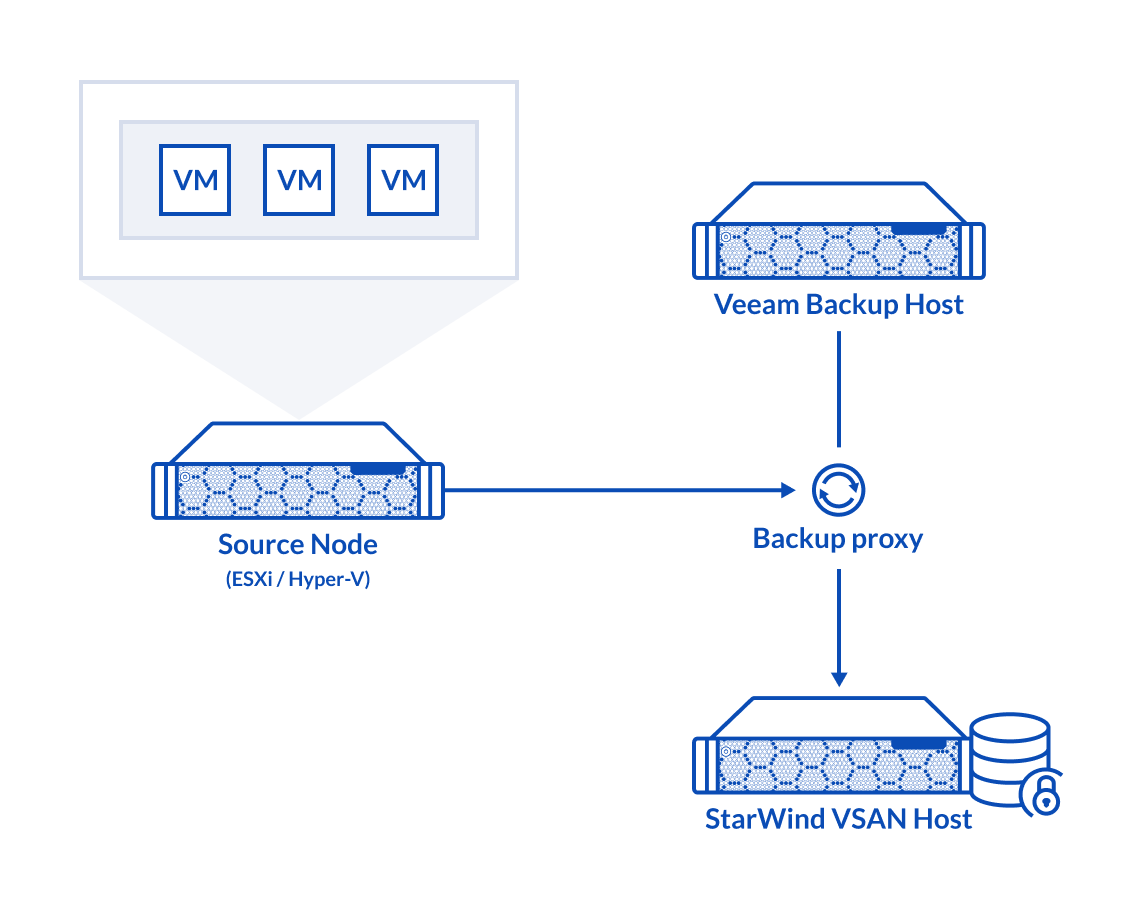
Now, you could go through the process of setting up a Linux server and configuring it to work with Veeam B&R, but it’s not exactly a walk in the park. However, there’s good news – we’ve made it super simple with StarWind VSAN.Diagram: StarWind VSAN as Hardened Repository for Veeam B&R

We’ve developed a set of management tools that are pre-configured in the web console, so you can easily set up a storage server using commodity hardware. All you need to do is use a few wizards in StarWind Virtual SAN  web-console, and you’ll have a hardened repository for Veeam B&R in no time.

How to set up?

In today’s article, I won’t be covering the initial setup process. For details on configuring the StarWind Controller Virtual Machine (CVM), its networking, and storage, refer to our previous article: ‘How to Create a File Share with StarWind VSAN‘. Make sure to review it before proceeding. We’ll also post instructions for the bare-metal StarWind VSAN deployment in a separate blog post later on, so stay tuned.

Assuming you’ve completed the preliminary steps and created a storage pool, we can now move on to creating a new volume in the Virtual SAN Web UI.

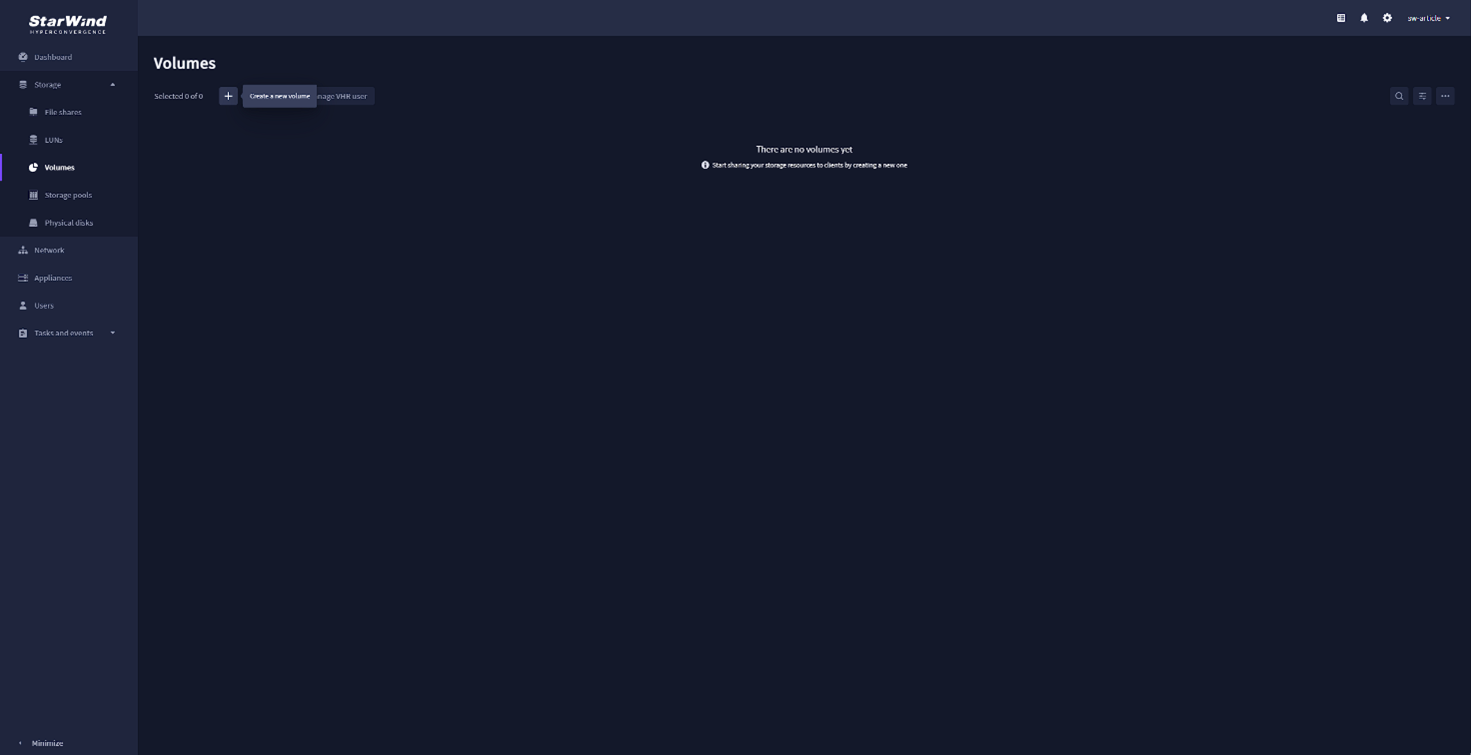
Once the storage pool is created, navigate to the “Volumes” tab and click the “+” button to open the “Create volume” wizard:

“Volumes” tab | “Create volume”

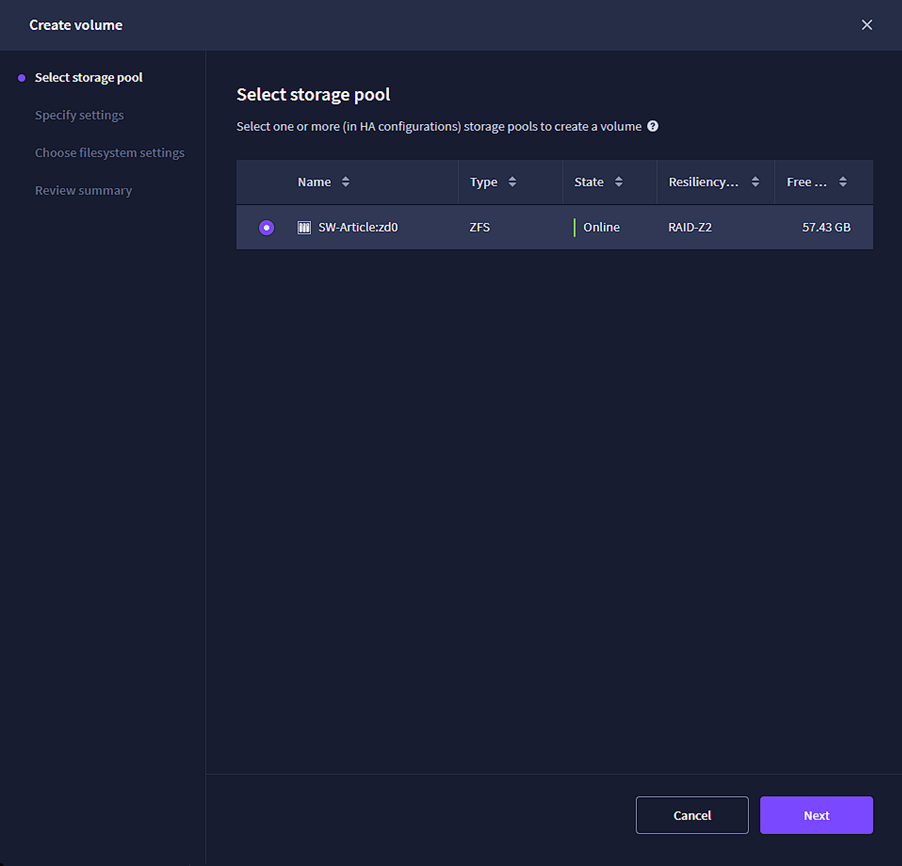
Now select the storage pool that you are going to use for the new volume and click “Next”:

Create volume wizard | Select storege pool

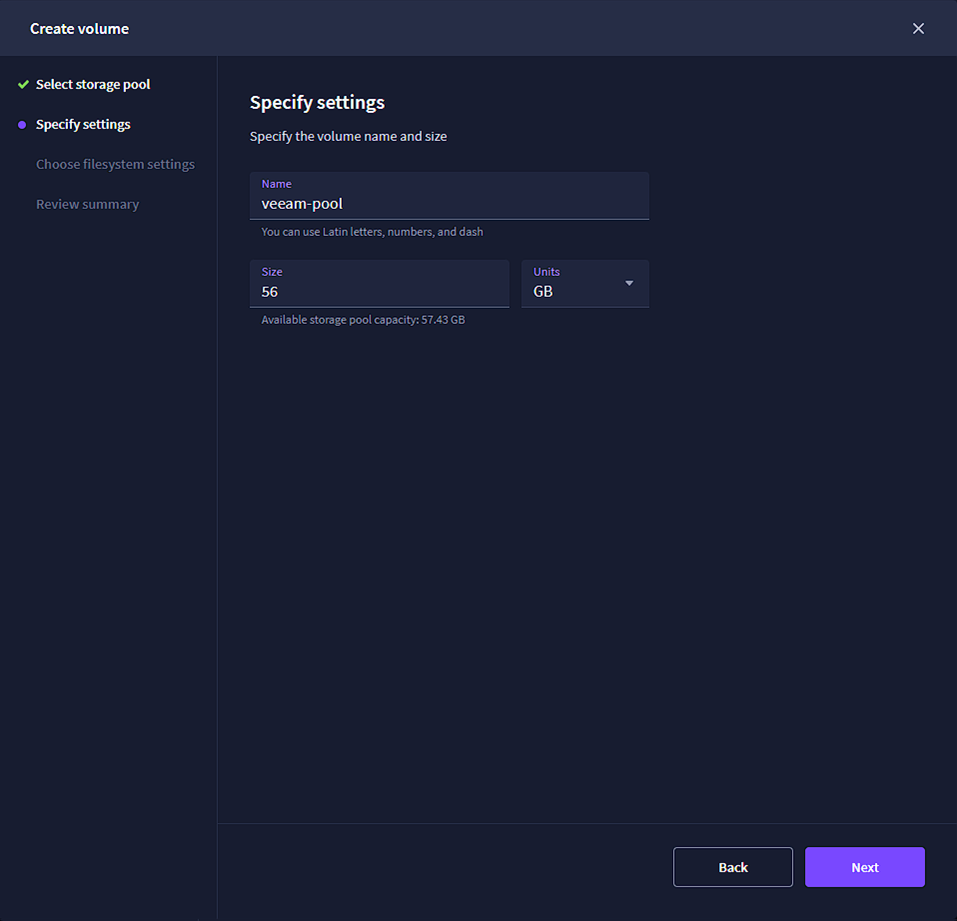
Specify the name of the new volume and select the required size:

Create volume | Specify settings

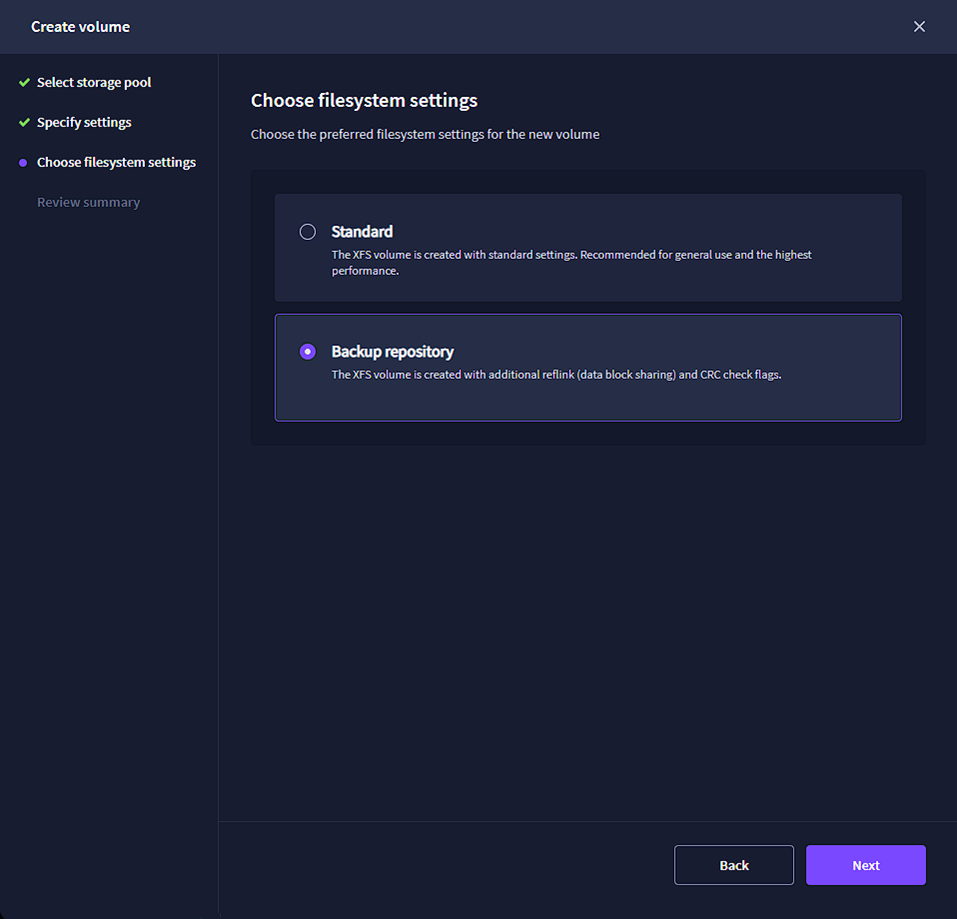
Now select the filesystem for your volume. Select the “Backup repository” option, because it is already configured according to Veaam best practices and recommendations.

Create volume | Choose Filesystem settings

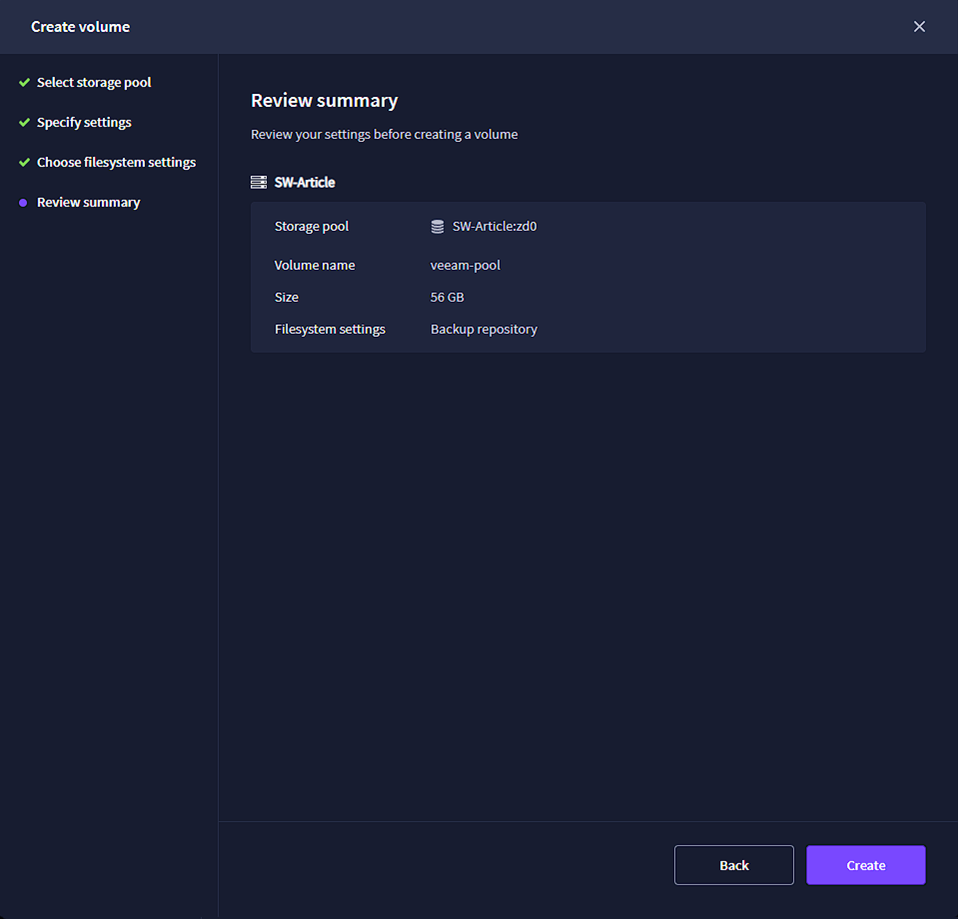
Review your settings and click “Create” to create the new volume:

Create volume | Review summary

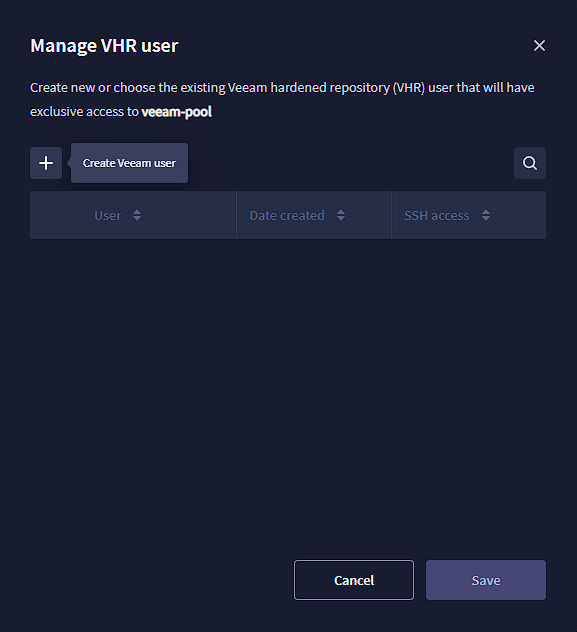
After this, you need to add a Veeam user to the CVM to provide Veeam access to the storage. For this, in the “Volumes” tab, select your newly created backup volume and click “Manage VHR (Veeam Hardened Repository) user.

In the “Manage VHR user” pop-up window, click the “+” button:

Manage VHR user | Create Veeam user

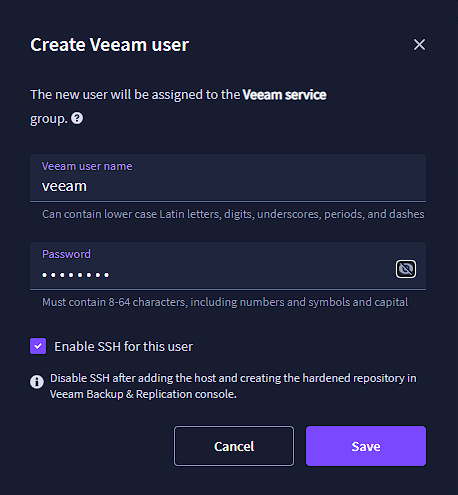
Specify the credentials for the new user:

Create Veeam user | Specify the credentials for the new user

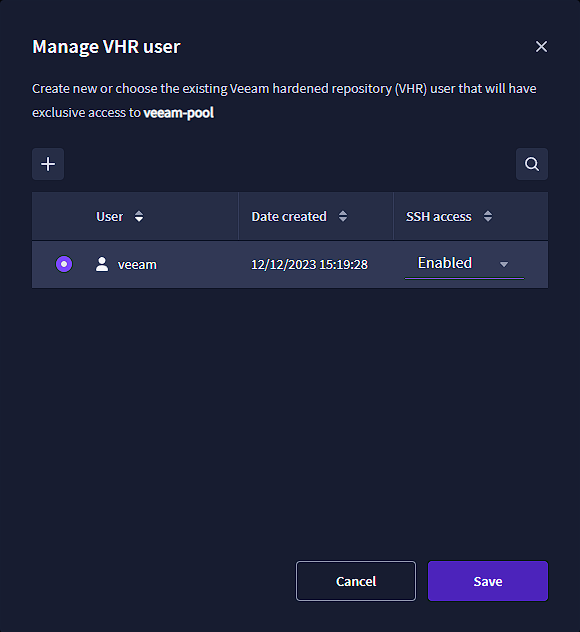
Select the newly created user and enable SSH access for it, and click “Save”:

Manage VHR user | Select the newly created user and enable SSH

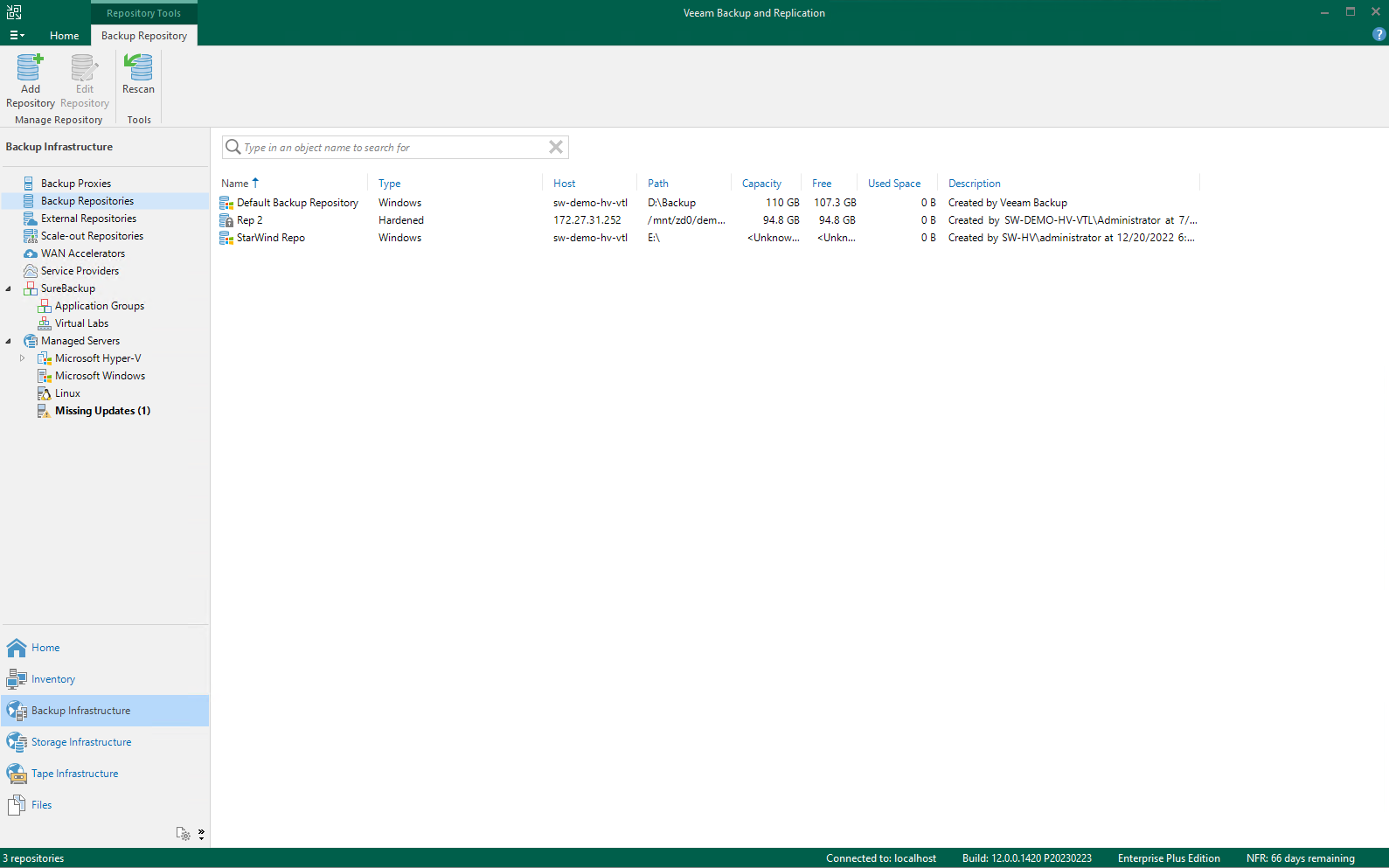
Congrats! You have completed the StarWind VSAN configuration. You’ll need to connect the created volume to Veeam B&R as the new backup repository. To do that, open the Veeam Backup and Replication console, navigate to “Backup Infrastructure”, and select “Backup Repositories”:

Veeam Backup and Replication console | Navigate to “Backup Infrastructure”, and select “Backup Repositories”

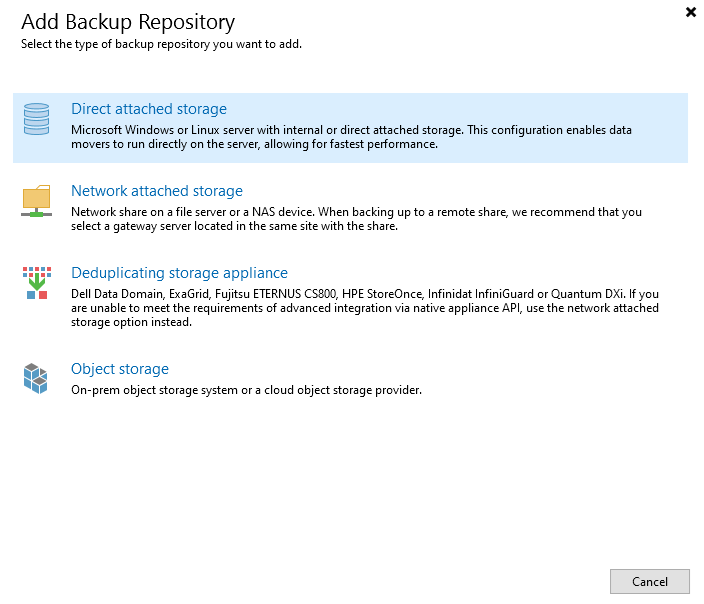
Click “Add Repository”  and select “Direct attached storage:

Add Backup Repository | Select “Direct attached storage

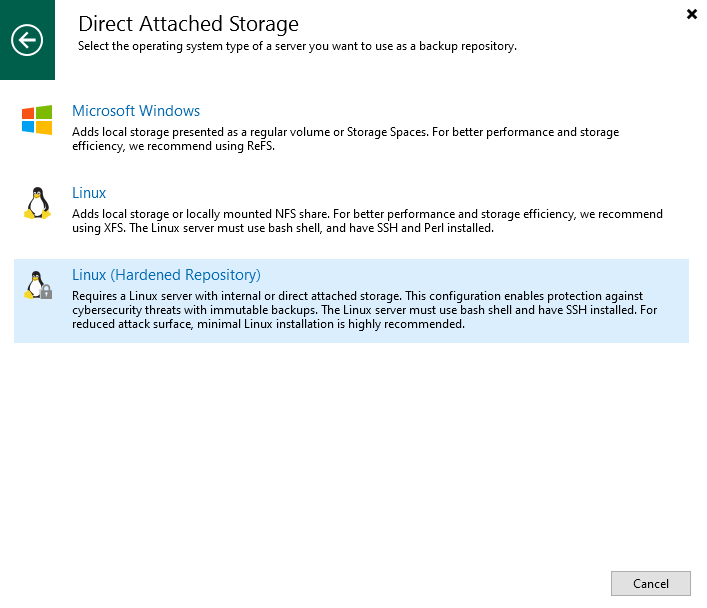
Next, select “Linux (Hardened Repository)”:

Direct Attached Storage | Select “Linux (Hardened Repository)”

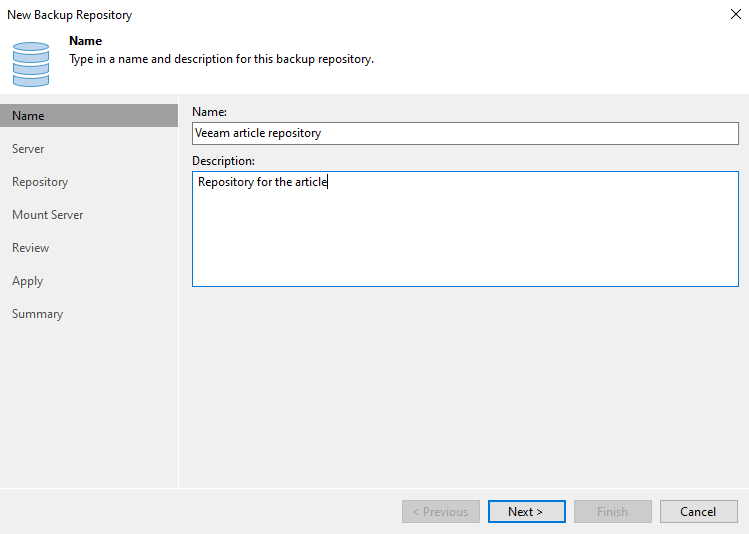
In the “New Backup Repository” wizard, specify the name and description for the new repository and click “Next”:

“New Backup Repository” wizard | Specify the name and description for the new repository

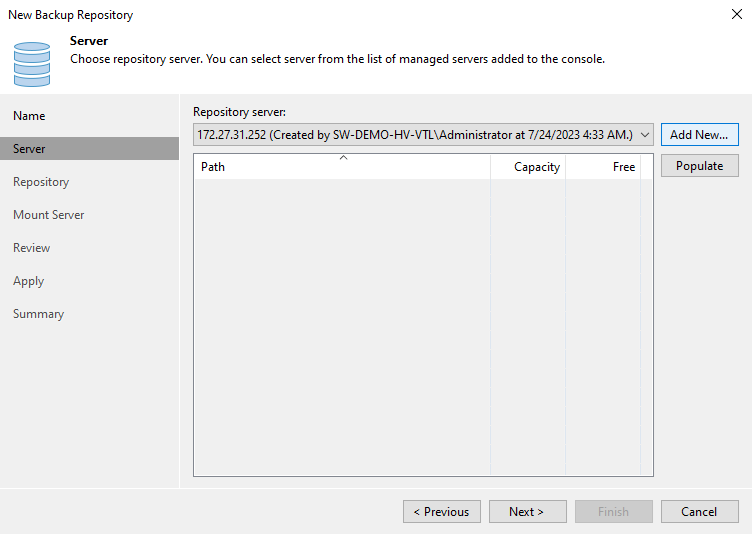
In the next step, click “Add New”:

New Backup Repository wizard | Add New

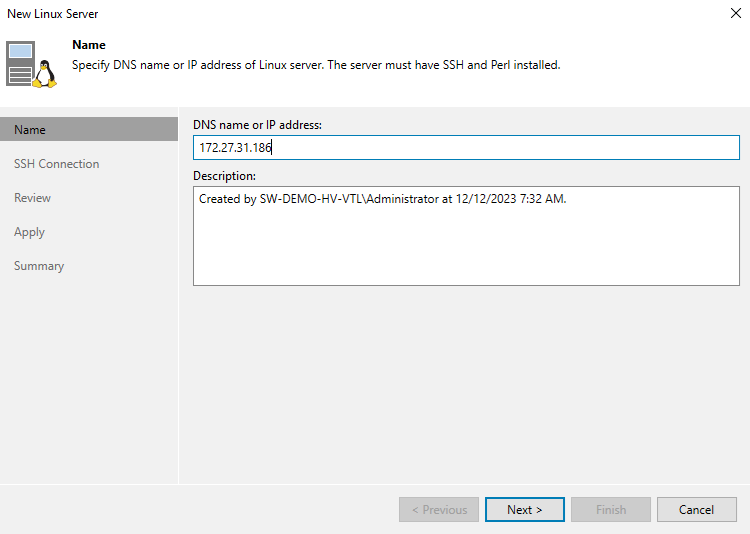
In the “New Linux Server” wizard, specify the IP address or the DNS name of your StarWind CVM and click “Next”:

New Linux Server wizard | Specify the IP address or the DNS

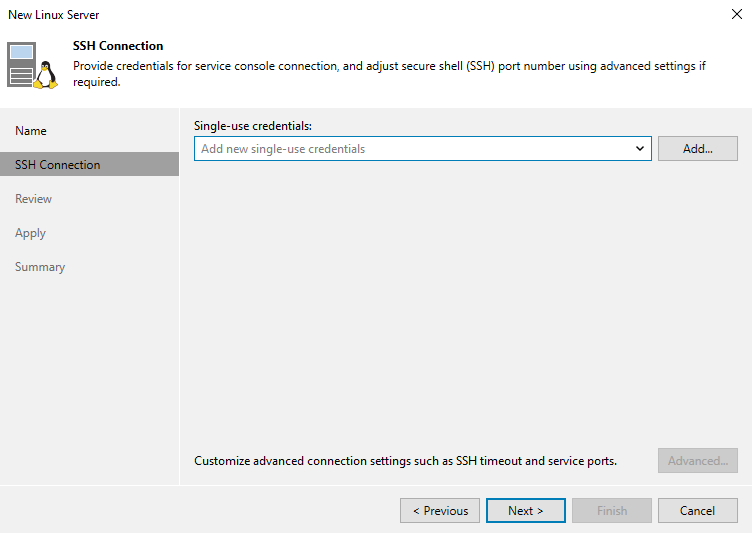
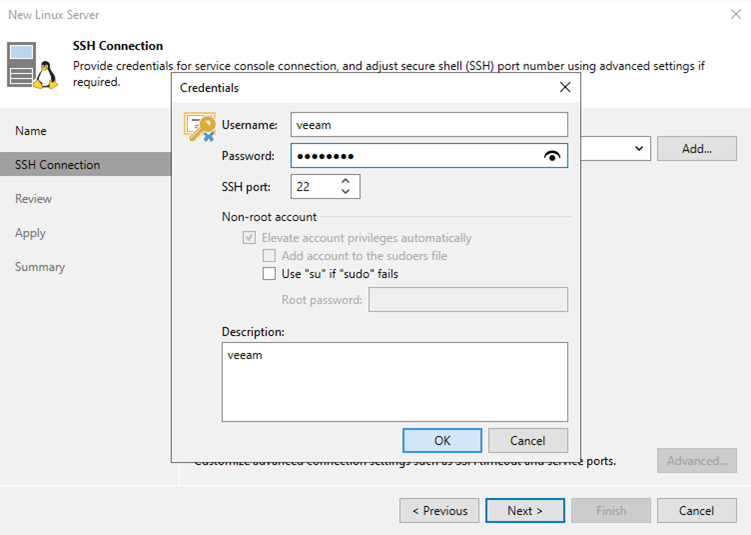
Click “Add” and specify the credentials of the VHR user account that you created in StarWind VSAN Web UI:

New Linux Server | Specify the credentials of the VHR user account

SSH Connection | Provide Credentials

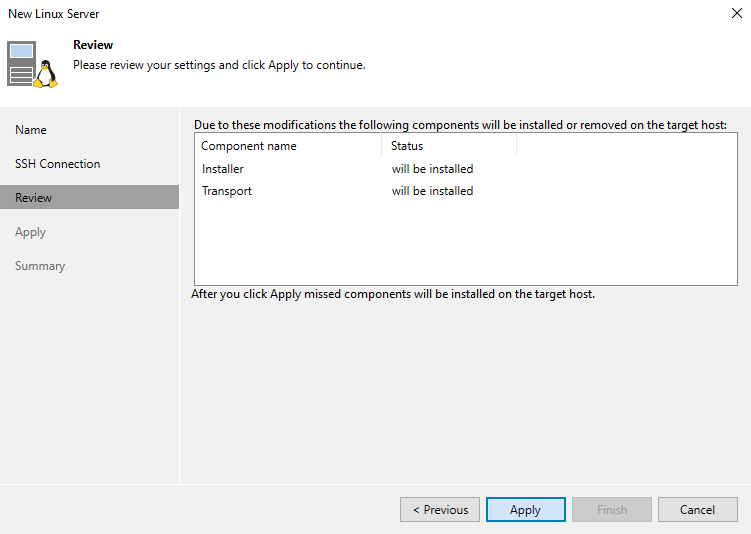
Review the installed components and click “Apply”:

New Linux Server | Review the installed components

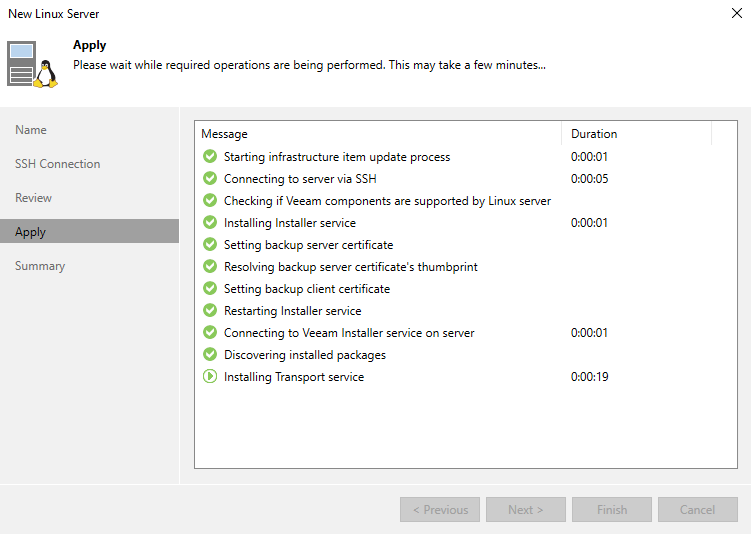
Wait until the installation is completed and then click the “Next” button:

New Linux Server | Wait until the installation is completed

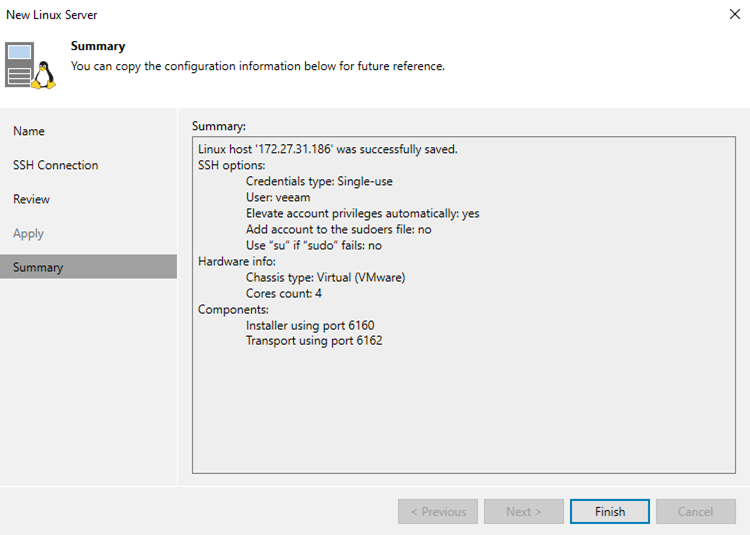
Review the summary and click “Finish”:

New Linux Server | Review the summary

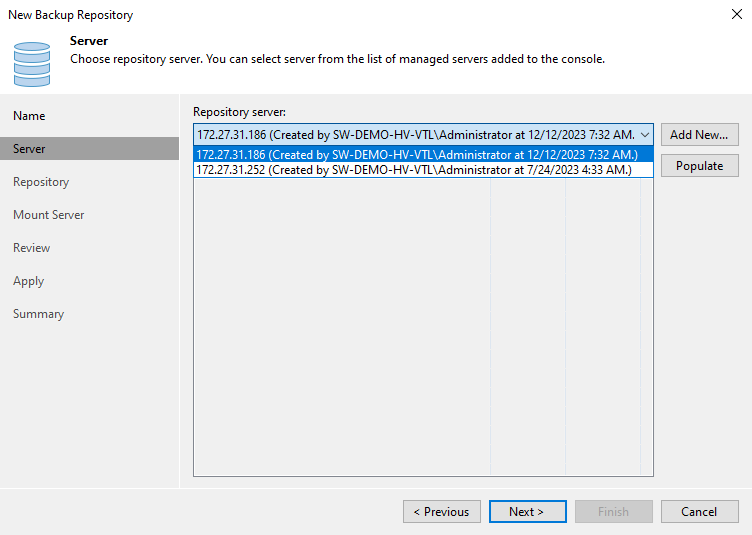
In the “New Backup Repository” wizard, select the newly added Repository server from the drop-down menu:

New Backup Repository wizard | Select the newly added Repository server

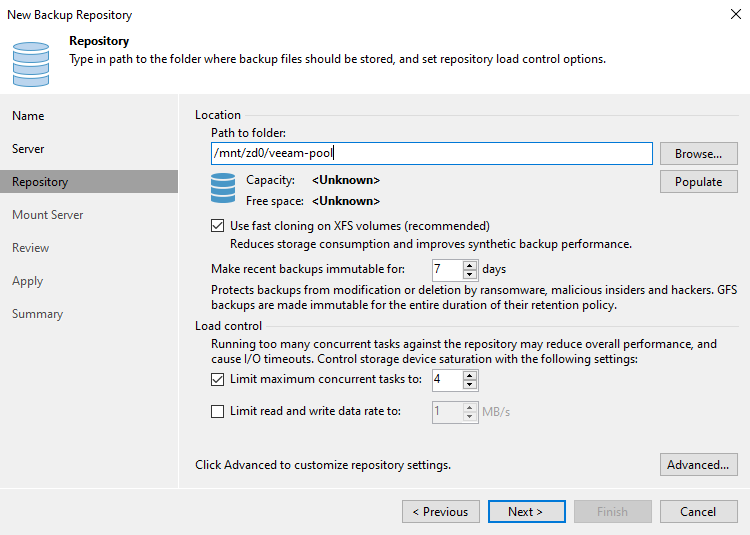
Now, select the path to the volume on the StarWind VSAN appliance. Also, check that the “Use fast cloning on XFS volumes” setting is enabled and specify the required retention period for immutability:

New Backup Repository | Select the path to the volume on the StarWind VSAN appliance

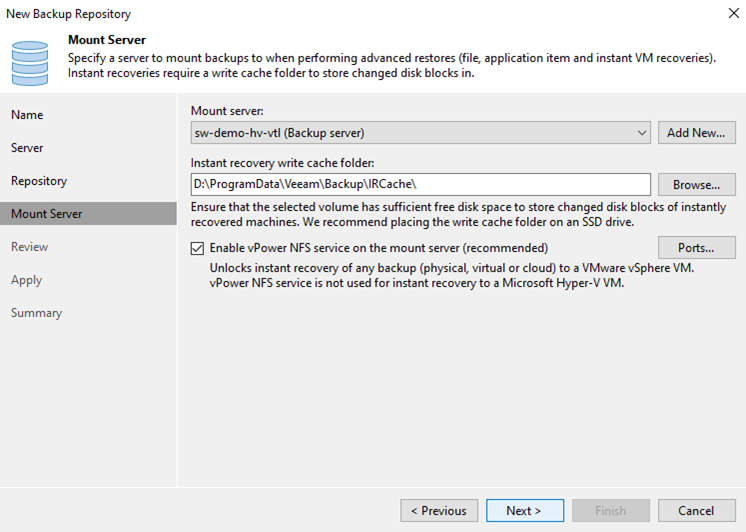
After that, check the Mount Server settings, where you will be doing fast restores of your backups:

New Backup Repository | Check the Mount Server settings

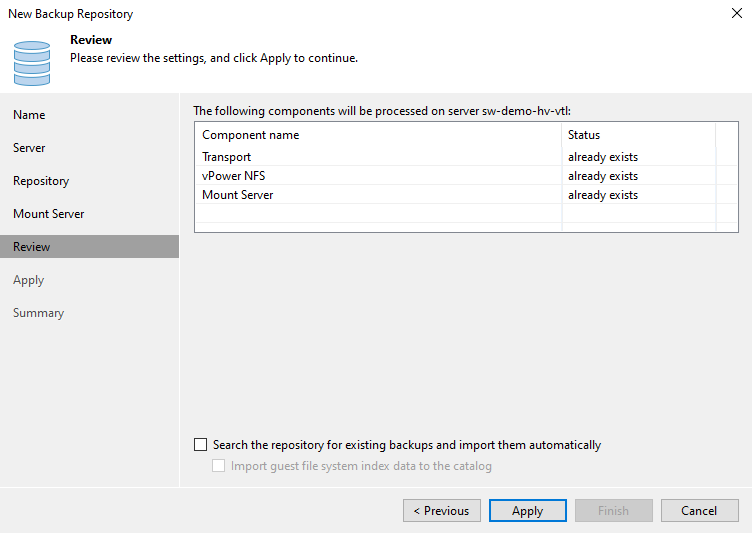
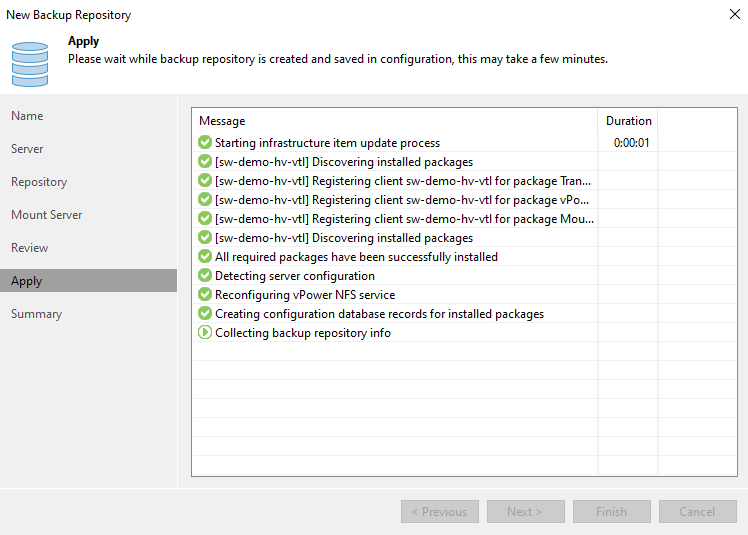
Check the components that will be installed and click “Apply”:

New Backup Repository | Check the components that will be installed

Wait until the process is completed and click “Next”:

New Backup Repository | Wait until the process is completed

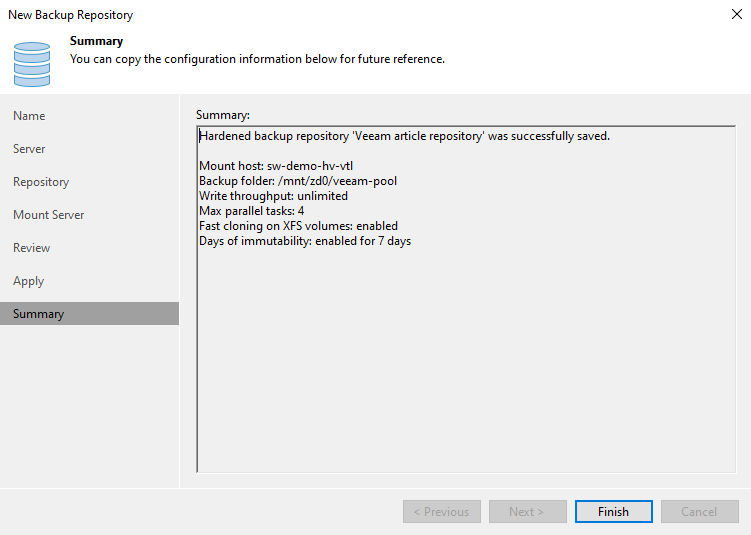
Review the summary and click “Finish”:

New Backup Repository | Review the summary

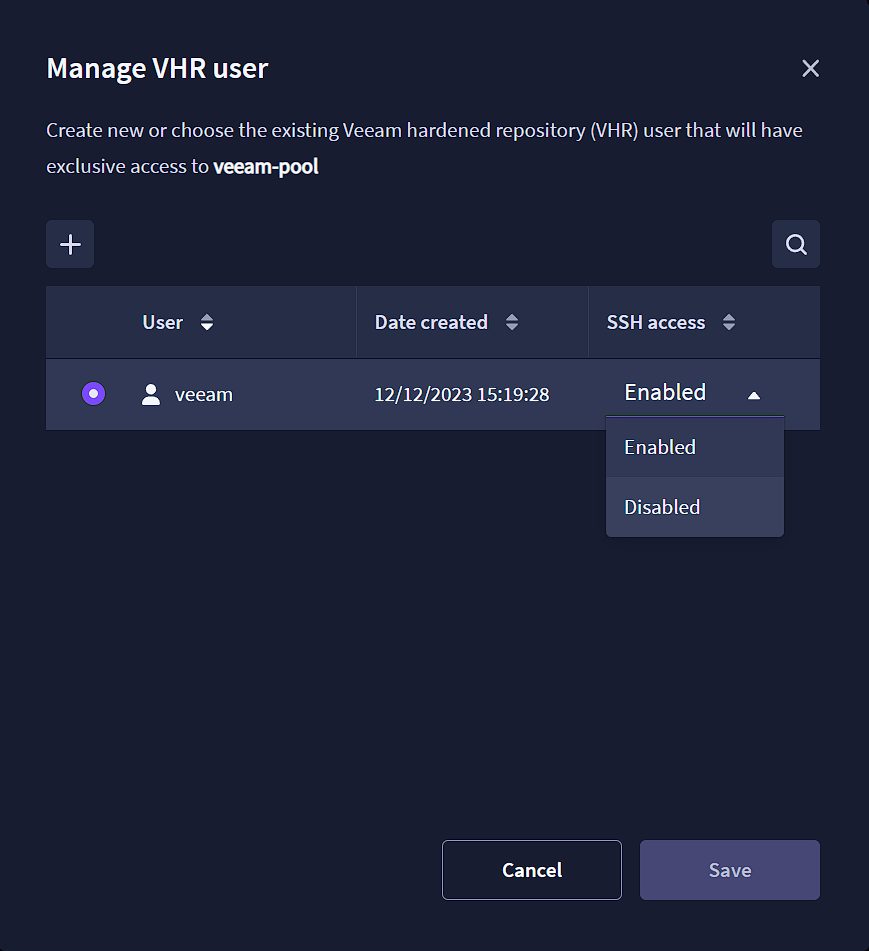
To secure the server from potential local threats such as credentials theft, in the StarWind VSAN Web UI, navigate to the “Volumes” page, launch the “Manage VHR user” wizard, and disable SSH for the VHR user account:

Manage VHR user wizard | Disable SSH for the VHR user account

Additionally, keep in mind that this method makes it easy to set up a hardened repository and secure your backups. It’s still important to regularly test and verify your backups to ensure they are working properly and can be restored in case of an emergency. Ensure your software and hardware up to date, and to have a disaster recovery plan in place in case the worst happens.

Conclusion

To sum up, using StarWind VSAN as hardened repository for Veeam B&R is a great way to protect your business data from any threats, while also making the process of setting it up easy and straightforward. With the help of our management tools, you can have a secure and reliable backup solution up and running in no time. So, if you’re looking to upgrade your backup strategy and keep your data safe, give StarWind VSAN a try.

About StarWind

StarWind is a pioneer of hyperconvergence and storage virtualization and the only all-flash hyperconvergence vendor on the market. We provide a unique blend of simplicity, performance, and affordability, yet with the ultimate in flexibility. Our focus is to help companies create sustainable and effective IT infrastructures with minimum effort.

We believe that quality should preside over quantity when it comes to building infrastructures. Our solutions provide businesses with the ability to use only those IT resources that are truly necessary and to make the most out of them in an efficient and performant manner.

About Version 2 Digital

Version 2 Digital is one of the most dynamic IT companies in Asia. The company distributes a wide range of IT products across various areas including cyber security, cloud, data protection, end points, infrastructures, system monitoring, storage, networking, business productivity and communication products.

Through an extensive network of channels, point of sales, resellers, and partnership companies, Version 2 offers quality products and services which are highly acclaimed in the market. Its customers cover a wide spectrum which include Global 1000 enterprises, regional listed companies, different vertical industries, public utilities, Government, a vast number of successful SMEs, and consumers in various Asian cities.

×

Hello!

Click one of our contacts below to chat on WhatsApp

×