
Skip to content

Notifications Telegram: Pandora FMS

Content:

For environments where you have the need to know immediately if any issues arise, such as production environments, security or critical resources of your company, this Pandora FMS integration with Telegram is absolutely perfect, as it is the answer to that required immediacy, as well as the possibility of offering exact information about the location and cause of the problem, thanks to the powerful Pandora FMS system of alerts and macros.

Likewise, being a messaging service based on telephone communications through the data network, it guarantees your technicians, managers and on-call operators that they will find out aboutany problem at the exact moment it appears, without the need to access a computer or manually check their email.

Thanks to the plugins of your library and the flexible alert system offered by Pandora FMS, we will show you how to configure your monitoring tool to send instant messages whenever a problem is detected.

First of all, you must start from the necessary environment, whose requirements are:

  • Pandora FMS environment running on Linux, in this case we will use Rocky Linux 8, the distribution recommended by the manufacturer.
  • Our library plugin: Telegram bot CLI.
  • Telegram account available to be used as a broadcaster for alert messages.

Bot creation

First of all, create the Telegram bot that will be in charge of sending messages. From the Telegram account you wish to use, you will have to interact with the user BotFather using the “/start”command:

Then use the comman “/newbot” to create your bot.

It will ask you for the name you wish your bot to have. Here specify the name you wish for your bot. It is important for the name to end with “bot”, for example Pandora_FMS_telegram_bot.

By sending you the name, if it is not in use, it will confirm that the bot was properly created, with a link to your chat and give you a Token that is important for you to save to set up the alert later.

Group Setup

Now enter the bot that you just created in an existing group you may have or a new one that you create, to receive your alerts.

The next step is to add another bot called GetIDs Bot to the same group in order to get the group identifier. By adding it, it will leave you a message with the ID of your group, and you should also take note of that for later.

With all of this you will already have your Telegram ready to receive alerts.

Integration with Pandora FMS (versions 773 and earlier)

First you should start by downloading our plugin Telegram bot CLI.

It will download a zip file called telegram-bot-cli.zip, which you should decompress.
Inside, you will find a file called “pandora-telegram-cli.py” which must be added to your Pandora FMS server in the path “/usr/share/pandora_server/util/plugin”.

Now, from the terminal of your server, install the Python3 dependencies (if you do not already have them) by means of the command “dnf install python3”:

Once installed, run the plugin to verify that it is running, through the command “python /usr/share/pandora_server/util/plugin/pandora-telegram-cli.py”:

We will now move on to Pandora FMS server console.
Go to the “Management > Alerts > Commands” section and click “Create”:

And set up your alert command as follows:

On command, type in the following:

python3
/usr/share/pandora_server/util/plugin/pandora-telegram-cli.py -t _field1_ -c _field2_ -m “_field3_”

The command that we will use is for executing the plugin that you downloaded, with the arguments -t, -c and -m. It is important for the argument -m to be enclosed in quotation marks “”.

  • In the field of argument -t, Bot Token, enter the token of your bot.
  • In the field of argument -c, Chat ID, enter the ID of the group that bot “GetIDs Bot” provided you with.
  • And in the -m field, Alert Message, enter the alert message that you want your bot to send to the group. You may use all the alert macros you need, some examples are:
    • _module_: Name of the module that triggered the alert.
    • _agentalias_: Alias of the agent that triggered the alert.
    • _modulestatus_: Status of the module when the alert was triggered.
    • _agentstatus_: Status of the agent when the alert was triggered.
    • _data_: Data of the module that triggered the alert.
    • _timestamp_: Time and date the alert was triggered.

For example, you could use this message (which we will enter in field3): “The module _module_ of agent _agentalias_ has changed to _modulestatus_ status”

.

Once all this is filled in, click “Create”.

Now access the “Management > Alerts > Actions” section of your Pandora FMS console and click “Create” to create your action.

Enter the name you want your action to have, select the group, the alert command that you created previously and choose a Threshold. All the fields will be filled in automatically and click “Create”:

Now access the “Management > Alerts > List of Alerts” section and configure the alert for the Agent and Module you want.

In this case select that when the “Host Alive” Module of the “Router” agent goes into critical state, your previously created “Telegram Message” action will be executed:

If your module goes into critical state, you will receive this message to your Telegram group:

When your alert recovers you will receive a message like this:

Integration with Pandora FMS (versions 774 and later)

In version v7.0NG.774, the Telegram plugin of your library has been added by default to Pandora FMS alert, with a standard basic configuration.

If you access the Management > Alerts > Commands section, you will have a command called “Pandora Telegram”:

When accessing it, you will see that the command that will execute your alert is already configured.
Fill the -t “TOKEN” parameter of the command with the token given to you by BotFather and save the command:

After this, access the Management > Alerts > Actions section and access Pandora Telegram action.
At the bottom, add the Chat ID of your group that gave you the bot “GetIDs Bot” In the Triggering and Recovery sections, you may modify the message to your liking using the alert macro as you saw previously, and click “Update”:

Once saved, enter the Alert List menu from Management > Alerts > List of Alerts and create a new alert.
Select the agent and module, the action you updated “Pandora Telegram”, the template you want and create the alert:

Once your alert is triggered, you will receive your message by Telegram:

Sending alerts with data graphs

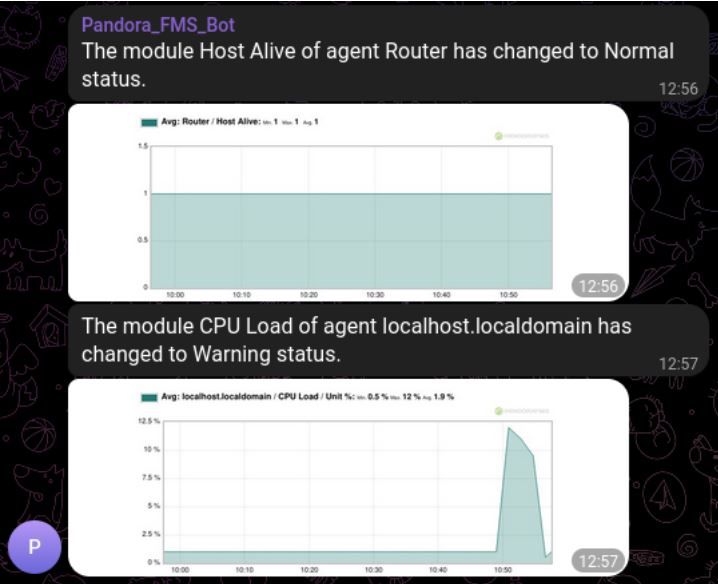
In our integration of Pandora FMS alerts and Telegram, you may add to the message a graph with the latest data of the module that triggered the alert, this applies both for version 773 and earlier and for 774 and later. You will be able to send graphs in your alerts by adding a call to the API of your Pandora FMS server to the script you used previously.

The first step that you must configure on your server is access to Pandora FMS API in the “Setup > Setup > General Setup” section, in the “API password” field you will have the API password and in the “IP list with API access” enter the IPs that need access or you may provide access to any IP (*).

Now edit the command that you had previously created to add the necessary data to send the graph. You need to add the following parameters:

  • –api_conf: Here indicate the configuration parameters of the API of your server, it is important to fill in the fields ” < >“:
    “user=,pass=,api_pass=,api_url=http:///pandora_console/include/api.php”.
    Example: “user=admin,pass=pandora,api_pass=1234,api_url=http://10.0.5.100/pandora_console/include/api.php”
  • –module_graph: Parameters of the module from which you will retrieve the graph, in this case there is two of them:
    • module_id: Where the ID of the module that triggered the alert is entered. In this case use the alert macro_id_module_ so that it is always filled in with the module ID of the alert.
    • interval: Total time interval shown in the graph, in seconds. We will use 3600 seconds by default, the equivalent of 60 minutes or 1 hour but you may configure the interval that best suits you.

The resulting full command will be as follows:

Command:

And field configuration:

And save the changes.

When the alert is triggered, you will receive the message with the data graph of your module:
El equipo de redacción de Pandora FMS está formado por un conjunto de escritores y profesionales de las TI con una cosa en común: su pasión por la monitorización de sistemas informáticos.

Pandora FMS’s editorial team is made up of a group of writers and IT professionals with one thing in common: their passion for computer system monitoring.


About Version 2 Digital

Version 2 Digital is one of the most dynamic IT companies in Asia. The company distributes a wide range of IT products across various areas including cyber security, cloud, data protection, end points, infrastructures, system monitoring, storage, networking, business productivity and communication products.

Through an extensive network of channels, point of sales, resellers, and partnership companies, Version 2 offers quality products and services which are highly acclaimed in the market. Its customers cover a wide spectrum which include Global 1000 enterprises, regional listed companies, different vertical industries, public utilities, Government, a vast number of successful SMEs, and consumers in various Asian cities.

About PandoraFMS
Pandora FMS is a flexible monitoring system, capable of monitoring devices, infrastructures, applications, services and business processes.
Of course, one of the things that Pandora FMS can control is the hard disks of your computers.

Unraveling the Dangers of Phishing: From Basics to Effective Prevention

Surely you may have at one time or another received an email warning of an outstanding invoice, a parcel shipment that you did not expect or a warning from the bank about suspicious activity in your account. These messages usually adopt an alarming tone and provide you with a link to a website that you must visit right away to verify your personal information or to complete payment information. Caution! This is a “phishing” attempt, one of the most popular scam methods on the Internet!

Content:

What is phishing?

Phishing is a form of cyberattack that uses technology and social engineering to breach user security.

The term comes from the word “fishing”, since cybercriminals employ bait tactics waiting for users to “bite” or fall into the trap. They usually aim to get hold of financial information, payment service passwords (such as PayPal), or login credentials.

Actually, phishing is nothing new. The first cases of this type of fraud date back to the mid-1990s, when a group of fraudsters posed as employees of the AOL company to steal confidential customer data. Already in the 2000s, attacks began to specialize, focusing mainly on the banking sector.

Over the years, scams have become more sophisticated and, despite advances in cybersecurity, phenomena such as the rise of teleworking or the fraudulent use of AI have contributed to the rise of new ways of phishing.

Phishing as a source of concern

Anyone can become a victim of phishing. Even though cybersecurity systems are getting more powerful by the day, scammers have also honed their skills and organized themselves into small teams, specializing in social engineering tactics.

Companies often become the preferred target of these cybercriminals who try to steal your sensitive data or trick intermediary charges into making unauthorized transfers. A fairly common example of phishing is vendor invoice fraud, in which fraudsters impersonate trusted business partners to request payment for an outstanding invoice.

Even more disturbing are cases like the one we saw at the beginning of 2020 in the magazine Forbes in which a Japanese company was the victim of an elaborate scam in which the generative AI was used to clone the voice of a manager and authorize a transfer of 35 million dollars.

Audio cloning, audiovisual deep fakes and, in general, the use of the latest technology for criminal purposes pose a great threat and, at the same time, a challenge for cybersecurity companies.

Risks associated to phishing attacks

Financial losses have an immediate impact, but there are other long-term consequences that phishing victims can experience:

  • Reputational damage: Data breaches can erode customer trust, causing permanent damage to the company’s reputation.
  • Service outage: A cyberattack can cripple the company’s computer systems, especially if it involves ransomware. It all starts by downloading a malicious file included in the phishing messages. Once in the system, it encrypts critical files and blocks access to business-critical information.
  • Fines and penalties: Violation of data protection regulations (such as GDPR) may result in sanctions by authorities.

It is important to be prepared to deal with these threats using robust cybersecurity solutions and internal employee awareness programs as the main weapons to prevent phishing attacks.

Relevant statistics and data

Email fraud already accounts for 27% of economic losses for cybersecurity breaches and is responsible for 90% of data breaches, according to the report Cybersecurity Threat Trends 2021 (CISCO). This is mainly because phishing campaigns have become massive and scammers use hundreds of emails to reach more people.

Key elements in a phishing attack

Luckily, phishing messages are usually quite clumsy and recipients quickly realize that they are facing a scam, but sometimes they are so customized that they cast doubt on whether they are legitimate or not.

To gain the trust of their victims, fraudsters impersonate institutions, banks or companies that offer their services over the Internet.

Most of these fraudulent emails consist of:

  1. An unknown sender, with generic email extensions (Gmail, Hotmail, etc.) or names that resemble those of official companies, but with strange words that we cannot identify.
  2. A generic greeting (“Dear customer”, “Dear friend”) since cybercriminals generally do not know the identity of the recipient.
  3. An urgent request for our personal information (ID, credit card number) under the pretext of solving an issue.
  4. An external link that leads to a fraudulent website with the same logo, design and colors of the brand they intend to impersonate. On this landing page you will be prompted to update your details to continue. Here is where information is stolen.
  5. There is also the possibility that the email contains an attachment infected with malicious software (malware, ransomware). If you download it, it will compromise the security of the system.

It is important to be cautious and learn to recognize these phishing signals to minimize risks.

Types of phishing

There are currently over 10,000 forms of phishing (as reported by Wikipedia). These are some of the best known embodiments.

Traditional phishing

It is the most common form of email fraud. It is based on the random issuance of emails impersonating the identity of a trusted company or institution. Messages include links to fraudulent websites or infected files.

Spear phishing

While traditional phishing is a random scam, spear phishing targets a specific person, usually an influential position within the company. To earn their trust, cybercriminals conduct extensive research on the Internet, collecting personal data from social networks such as LinkedIn, where they check information such as age, location or position within the company.

Whaling

In whaling, the target is important people within the company or executive positions (CEO, CFO, etc.). Scammers investigate their prey for weeks and send highly personalized emails, related to critical business issues.

Smishing

Fraudulent messages are sent via text messages (SMS) or WhatsApp. For example, we received a notice from our bank reporting an unauthorized purchase with our card with a link to change the PIN and login details. If YOU do, we will have fallen into the trap.

Vishing

It comes from the union of “voice” and “phishing”. In this case, the scam is done by phone call. A typical example is technical service fraud where scammers call to report a computer failure that doesn’t actually exist and convince us to install a Trojan that will steal your data.

Angler Phishing

It is a new tactic that consists of creating fake profiles on social networks with the name of prestigious institutions and companies. The goal is to steal sensitive data from other users.

How to detect Phishing attacks?

Recognizing a phishing message is not always easy, but there are some indications that may make us suspect that the request is unusual.

  • Alarmist tone: They often convey urgency and urge the user to act immediately. Cybercriminals use emotions such as fear or curiosity and use intimidation tactics to make us act irrationally.
  • Grammatical errors: Many phishing messages contain spelling and grammatical errors as they were written by non-native speakers. Anyway, nowadays many scammers use tools like Chat GPT to correct their texts, so we must be wary even of messages without spelling mistakes.
  • Suspicious links or unsolicited attachments: Does the sender ask you to click on a link? Does it include alleged unpaid bills or fines that you can’t identify? This is most likely a cyberattack.

How to prevent a Phishing attack?

  • Do not open messages from unknown senders.
  • Do not provide your personal information through a link in an email.
  • Don’t download suspicious attachments.
  • Hover over the link and check if the url starts with https. This indicates that the site has a safe certificate.

If despite these precautions you fell into the trap and provided your data, change the passwords of the affected accounts as soon as possible and report the scam to the local police. You may also contact the Internet User Security Office of INCIBE (National Institute of Security) to investigate the fraud.

Protecting your organization from phishing

IBM assures in its report Cost of a Data Breach Report 2021 that it can take an average of 213 days for a company to warn that it was the victim of a phishing attack. During this time, cybercriminals will access all kinds of confidential information: database passwords, trade secrets, access credentials to the corporate network… That is why it is important to be prepared and work proactively to stop the threat of phishing.

Some preventive measures:

Employee Awareness

Make cybersecurity part of your company’s organizational culture and create campaigns to warn your employees of the risks of Internet scams. A good measure is to implement a phishing simulation software to train them and teach them to differentiate an authentic email from a fraudulent one.

Implementing email security solutions

The first line of defense against a phishing attack is the anti-spam filter built into email. Make sure it’s up to date with the latest versions and security patches. You may also configure email authentication policies as Domain-based Message Authentication, Reporting, and Conformance (DMARC) to reduce the risk of phishing.

Endpoint monitoring and protection

Endpoints are the end devices (computers, tablets, smartphones) connected to the network. EDR solutions have been designed to monitor and detect the presence of malware on these endpoints.

Unlike antiviruses that work with previously identified patterns, EDR solutions are more advanced since they give automated and real-time responses to contain the attack. They use technologies such as AI and machine learning capable of detecting anomalous behaviors, such as the execution of malicious scripts.

Endpoint protection is a basic cybersecurity measure, but should be combined with other solutions such as network traffic monitoring or safe remote access solutions such as Pandora RC.

How does Pandora RC help improve remote access security?

More and more companies are adopting policies of teleworking or hybrid work. It is a reality that poses new challenges in terms of cybersecurity. Remote workers operate in less secure environments than those under the supervision of IT teams.

Tools like Pandora RC help monitor your systems by offering remote support and quick assistance if a phishing attack is suspected.

Other ways Pandora RC can help prevent cyberattacks:

  • It generates 100% local passwords avoiding vulnerabilities in centralized systems.
  • Remote connections must be pre-approved.
  • It uses dual authentication access policies. This reduces the risk of unauthorized access, as users have to validate their identity in two steps.
  • It is a flexible and scalable solution. In addition, it is available as a SaaS or On-Premise solution for companies that want to have more control over their infrastructures.

Other tips to prevent phishing attacks in the business environment

As phishing techniques become more sophisticated, the need for protection is increasing. Therefore, it is not a bad idea to keep in mind some basic tips:

  • Try to stay up to date on new scams, follow the news in the media, and read tech blogs like Pandora FMS blog.
  • Use strong passwords on your accounts that include a combination of numbers, letters, and special characters. Never choose personal data such as date of birth, cities or pet names for your passwords; phishers could guess this information by checking your social media.
  • Use a multi-factor authentication (MFA) system to add an extra layer of security to your connections. That way, if a hacker gets your login credentials, they would still need to know the code sent to your mobile to access your accounts.
  • Installing a firewall is critical to blocking unauthorized access to sensitive information. Make sure it’s properly configured and only allows safe transactions.
  • Keep your browser and operating system up to date as cybercriminals often take advantage of vulnerabilities in outdated systems.
  • Prevents access to sensitive information over public Wi-Fi networks. Many of these networks lack encryption protocols and transmitted data could be intercepted. Turn off the option to automatically connect to open Wi-Fi networks on your mobile.
  • Make automatic backups of company data to be able to recover information in the event of an attack. We recommend them to be immutable backups (they cannot be deleted or modified). This ensures that copies are protected and can be restored even if a ransomware attack takes place.

Conclusion

As we mentioned at the beginning, phishing has existed since the beginning of the Internet and will probably evolve and we will learn about new forms of this form of cyberattack. Although we must be vigilant in the face of these threats, slowing technological development is not the solution. The key is to adopt cybersecurity measures and educate users to minimize risks and create a safe working environment.

Estudié Filología, pero las circunstancias de la vida me llevaron a trabajar en el sector del Marketing como redactora de contenidos. Me apasiona el mundo del blogging y la oportunidad de aprender que se presenta con cada proyecto nuevo. Te invito a seguir mis publicaciones en el blog de Pandora FMS para descubrir las tendencias tecnológicas que están transformando el mundo de los negocios.

About Version 2 Digital

Version 2 Digital is one of the most dynamic IT companies in Asia. The company distributes a wide range of IT products across various areas including cyber security, cloud, data protection, end points, infrastructures, system monitoring, storage, networking, business productivity and communication products.

Through an extensive network of channels, point of sales, resellers, and partnership companies, Version 2 offers quality products and services which are highly acclaimed in the market. Its customers cover a wide spectrum which include Global 1000 enterprises, regional listed companies, different vertical industries, public utilities, Government, a vast number of successful SMEs, and consumers in various Asian cities.

About PandoraFMS
Pandora FMS is a flexible monitoring system, capable of monitoring devices, infrastructures, applications, services and business processes.
Of course, one of the things that Pandora FMS can control is the hard disks of your computers.

Keys to integrate IT support and manage your after-sales service better

We are all aware of the importance of attracting new customers for business growth purposes, but focusing solely on this goal is not actually the best decision. Delivering quality customer service is also key to success. For that reason, many companies that sell their products or services over the Internet have decided to implement an after-sales support service as a fundamental part of their business. 

How to make yourself stand out among your competitors with a good after-sales support service?

More than a century ago, the Japanese businessman and philosopher Konosuke Matsushita, known for being the founder of Panasonic and one of the promoters of the “Japanese economic miracle”, laid the foundations of a revolutionary business philosophy for his time. Matsushita was based on concepts such as social contribution, teamwork, customer focus and technological innovation as differentiating factors. He wrote several works throughout his life, projecting his particular vision on business and society. Regarding after-sales support, he was of the opinion that: “After-sales service is more important than assistance before the sale, because it is through this service that permanent customers are achieved.”

These regular customers can really become your best brand ambassadors, so they should be pampered, so that they feel satisfied and share their positive experiences or make new purchases and hires.

How to offer a customer-centric after-sales service?

One of the biggest difficulties that companies encounter when managing customer service is how to convey closeness and proximity in a service as automated as IT support and offered remotely?

In the past, when there was no Internet, customers had to call a call center to solve their doubts or report any problems. Today, IT support centers use tools like chatbots that save human teams a lot of time. The use of these virtual assistants grew dramatically during the pandemic, allowing companies to respond to very high activity peaks and continue to offer 24/7 services.

However, by returning to normal, users are demanding a more conversational and less transactional customer service. Most of them rate chatbots positively as a way to get quick answers to their questions, but they don’t want machine interactions to completely replace people. For example, McKinsey’s “Next in Personality 2021” report reveals that 71% of customers expect businesses to offer custom interactions and 76% get frustrated when this doesn’t happen.

Finding the perfect balance between automation and human support is vital to offer a fast, efficient after-sales support service based on customer needs. You cannot swim against the tide or try to put a brake on digitization. On the contrary, we must rely on the advantages of technology by integrating it into the company’s IT support to access information in a unified way and know which requests can be automated and which need personalized attention.

How to integrate the IT support center to provide customers with good after-sales service?

IT support center integration needs to be planned carefully to ensure orderly and efficient business workflow.

Some essential steps for a successful integration are as follows.

Implementing a service management system (ITSM)

To manage any type of incident or complaint, it is essential to have a structured framework in which the policies to be followed by the support department are defined.

Professionals in this area are responsible for coordinating IT services with business goals. In addition, they train the team and define which tasks can be automated.

Create an IT support infrastructure

Companies that receive a high volume of requests may be in critical situations if they don’t have the tools that allow them to create dynamic workflows.

In this sense email is a painful management tool since it does not allow you to do things as basic as prioritizing important requests, keeping track of them, or escalating them to a higher level when the frontline support team is not able to solve them.

If you try to offer an after-sales support service through this means, you will soon see that the email inbox becomes saturated until it becomes a catch-all. No employee will know where to start!

Do you already know about Pandora ITSM Ticketing Helpdesk? This tool is all you need to make things easier for the support team and build customer loyalty.

As the name suggests, Ticketing Helpdesk works through a ticketing system. Each time a customer makes a request through the platform, a new ticket is opened with their data, date and subject of the incident.

Tickets are automatically cataloged according to their status: new, pending, solved, etc. You may also prioritize those that require immediate action, define automation rules or transfer complex cases that could not be solved to higher support levels.

Helpdesk Ticketing is a flexible tool and ready to work in an omnichannel environment. It can be easily integrated with other IT infrastructure tools such as project managers or CRM, to avoid process redundancy and take advantage of all the information available to improve the operation of other departments and the after-sales service itself.

Use the information collected to optimize customer service

As already mentioned, Ticketing Helpdesk collects query data, analyzes it and generates custom reports with relevant information such as:

  • Number of tickets closed
  • Number of tickets that remain open
  • Average ticket resolution time
  • Most common incidents
  • Performance of each agent (customer feedback)
  • Tickets that were escalated to higher levels

Keeping track of these metrics is very useful to know the long-term performance of the service and detect possible anomalies that would go unnoticed when analyzing isolated data.

It also ensures compliance with contractual agreements related to the service (SLA) such as downtime and support response capacity (for example, resolution of incidents in 24 hours). Respecting these agreements is important for building customer trust. In addition, non-compliance involves financial compensation that companies must assume. With the Helpdesk tool you may manage this key information and create automatic alerts if the service remains inactive for a long time.

Finally, in addition to automatic reporting, Pandora ITSM Ticketing Helpdesk also collects information from satisfaction surveys that users may answer by email or via a web form. It is a reliable way to know if the service is working as expected and the agents in charge of the support area effectively solve customer problems.

Still unsure whether Pandora ITMS will meet your expectations?

Try it for free for 30 days. You do not need a credit card, only advanced knowledge in the IT area and some free time to become familiar with all its features.

Estudié Filología, pero las circunstancias de la vida me llevaron a trabajar en el sector del Marketing como redactora de contenidos. Me apasiona el mundo del blogging y la oportunidad de aprender que se presenta con cada proyecto nuevo. Te invito a seguir mis publicaciones en el blog de Pandora FMS para descubrir las tendencias tecnológicas que están transformando el mundo de los negocios.=

About Version 2 Digital

Version 2 Digital is one of the most dynamic IT companies in Asia. The company distributes a wide range of IT products across various areas including cyber security, cloud, data protection, end points, infrastructures, system monitoring, storage, networking, business productivity and communication products.

Through an extensive network of channels, point of sales, resellers, and partnership companies, Version 2 offers quality products and services which are highly acclaimed in the market. Its customers cover a wide spectrum which include Global 1000 enterprises, regional listed companies, different vertical industries, public utilities, Government, a vast number of successful SMEs, and consumers in various Asian cities.

About PandoraFMS
Pandora FMS is a flexible monitoring system, capable of monitoring devices, infrastructures, applications, services and business processes.
Of course, one of the things that Pandora FMS can control is the hard disks of your computers.

What is Cloud Computing? Everything you need to know about the cloud explained

Content: 

Cloud Computing is a service offered by several software providers paying a rent either by the hour, month or use of said service. They can be virtual machines, databases, web services, or other cloud technologies. These services are on remote servers provided by companies such as Google, Microsoft and Amazon among others that for rental or in some cases free of charge, provide such services. It is very convenient to have these services, since from a mobile phone or a not very sophisticated machine, you can have access to important services of all kinds just by having access to the internet.

Services provided in the cloud

The most common services provided in the cloud are as follows:

  • Storage in the cloud. Where the service allows multiple files, images, or other data to be stored in the cloud. It’s kind of like an internet-connected super hard drive.
  • Cloud Databases. You may access servers or databases such as SQL Server, PostgreSQL, MySQL, Oracle, etc. Note that you no longer need to access the entire server with the operating system (which is also possible). NoSQL databases, which are databases that do not use a relational database, can also be accessed. Instead of using tables, it uses documents or value keys to save the information.
  • Data Lake. The Data Lake service is, as the name suggests, a data lake. You may have structured, unstructured and semi-structured data. These services are used to manage what we know as Big Data. That is, lots of information. Today, data can no longer be handled in traditional databases exclusively without very large amounts of information. That is why other storage media such as Data Lakes are used.
  • Data analysis. Tools for analyzing data are also provided. There are tools for reporting, analytics using Machine Learning and other technologies.
  • Software in the cloud. There is the possibility of programming in different languages using cloud services. There are platforms to upload the code and websites.
  • Data Integration Services. Services such as AWS Glue, Google Cloud Data Fusion and Azure Data Factory among others, are services that allow you to integrate data. That is, copying data from one database to another or to a text file, moving data from a Data Lake to a database, etc.
  • Network Services. Networking services help connect on-premise applications with cloud applications. These services provide connectivity, security, and scalability. Some services offer gateways between the local network and the cloud. There is also the Virtual Network Gateway service. It connects the virtual network and the cloud. Another common service is the Load Balancer which distributes traffic between servers. There are also other Networking services such as application links, traffic handlers, etc.
  • Other Services. There are an infinite number of cloud services such as Machine Learning, AI, IoT…

How Cloud Computing Works

Saving is important. Instead of spending money on a good server or infrastructure, you may directly rent these cloud computing services. While the costs of renting cloud services from major vendors like Azure, AWS, and Google may seem high for small and medium-sized businesses, there are savings in staff.

A smaller team of IT professionals is required to maintain applications in the cloud. No time is wasted on hardware or many other aspects of security. While cloud service providers are not 100% responsible for security, much of the responsibility lies with them. They take care of the replications, of changing the hardware. Through a simple payment you may make your database server support more people connected simultaneously. That, in a local environment, would imply the purchase of new expensive servers and migrating information from one place to another.

Changing old hard drives, renewing servers, hardware problems, all of that is solved with the cloud, where you no longer have to worry about that aspect. Basically, it’s paying for the service and using it.

Services available

Some basic services are Microsoft 365 offering MS Word in the cloud, Excel, Word, PowerPoint, Outlook, OneNote, Publisher and Teams among other cloud applications. For example, documents in Excel are no longer saved on the hard drive but in the cloud. That is, on Microsoft Azure, servers to which you connect from your machine using the Internet.

Google offers Google Workspace which is similar to Microsoft 365. For example, it provides Google Sheets (a kind of online Excel), Google Docs (similar to MS Word), Gmail (similar to Outlook for emails), Google Slides (similar to MS PowerPoint).

Here are some of the many applications in the cloud. However, the cloud goes much further. It can offer Windows Servers, Linux. Databases of all kinds, whether relational or NoSQL, analytics services, IoT, Devops, websites, application programming platform, data analytics service, Machine Learning, APIs, cloud software and much more.

Examples of Cloud Computing

In everyday life we have been using cloud services for a long time. For example, Hotmail was the first service to use cloud technology. The concept of the cloud was not used then, but emails were stored on remote servers. Then came Yahoo’s mail services, Gmail.

Eventually Microsoft 365 arrived where it was already possible to use Word, Excel, PowerPoint, etc. using cloud technology. Then with AWS, Azure, Google Cloud and other providers, there are endless cloud services already mentioned above.

Source of the term Cloud Computing

Many people ask: what is the cloud? The term cloud computing is actually a metaphor. Since the 1960s, a cloud has been used to represent networks. Since 2000, the word has become popular and in a way indicates that the network is in heaven. That is, it is not within your physical reach but in another place that you may access through the internet.

History of Cloud Computing

As early as the 1960s, to represent networks, a cloud was used to represent them when they were connected to computers. However, it was not until the 1990s that the term began to be used to describe software as a service (SaaS). Through the service, machines connected to the internet without having to manage it from their computers.

However, the term became popular starting in 2000 with the rise of virtual machines and network computing. Cloud computing encompasses the multiple services offered on the network.

Importance of the Cloud

Large companies are taking their chances on the cloud. Microsoft for example upgraded its technology certifications to the cloud. The technologies located in the physical company have already been removed from the list of Microsoft certifications. Amazon on the other hand started in the cloud and was a pioneer. The trend is to spend less on an IT team and spend more on the rental of cloud services. Every year, the use of cloud services will grow more. According to Gartner, in 2025, 51% of IT services spending. They will be invested in the cloud.

Leading Cloud Providers

The following table shows the top cloud service providers and their market percentage:

Vendor

market percentage

Amazon Web Services (AWS)33,3 %
Microsoft Azure21,1 %
Google Cloud9,2 %
Alibaba8,4 %
IBM Cloud6,5 %
Salesforce5,9 %
Oracle Cloud Infrastructure (OCI)4,7 %
VMware3,1 %

As it can be seen in the table, AWS remains the leader and Microsoft maintains a second place. Google is in third place.

Key Elements of Cloud Computing

There are several types of services, which are IaaS, PaaS and SaaS. Below, we describe each one:

  • IaaS (Infrastructure as a Service) provides access to cloud services such as servers, storage, and networking. In this type of service, users are responsible for installing, configuring and managing the software and applications that are used.
  • PaaS (Platform as a Service) provides a complete platform for developing, running, and managing applications. In Paas, users are responsible for developing the application, however, the cloud provider is responsible for the underlying infrastructure and services.
  • SaaS (Software as a Service) provides access to complete applications over the Internet. The user does not have to install or manage the software, as all this is handled by the cloud provider.

Multi-Cloud Computing

Large companies usually choose to purchase different services from different cloud service providers. It is very common for a company to have services in Microsoft, Google and AWS. This is due to different factors such as price, IT service technical skills, some special offers from vendors, etc. Fortunately, major vendors are not very different from each other in their services.

Benefits of Cloud Computing

The main benefit is that users will not waste time on hardware maintenance, buying hardware, scaling and migrating servers. Business and IT teams will focus on business and applications. They’re not going to waste a lot of time on computer installations and configurations.

Advantages and disadvantages of Cloud Computing

As advantages, we already talked about a work reduction in software installation, security, installation time and hardware purchase. However, we hardly talked about the disadvantages.

In many cases, they are very expensive services. It is very common to hear jokes from people who say they went bankrupt for forgetting to turn off cloud servers. And there are services so expensive that they are paid by the hour, which, if you forget to turn them off, the cost increases considerably.

For example, suppose you have a cloud service that costs $100 an hour. $800 per day for 8 hours of use. However, imagine that the employee who uses it, forgot to turn off the machine in the cloud, that can make the service charge you $2,400 a day instead of $800. Another problem is that staff must be trained because if a hacker gets in the cloud, they can access all business information, which would make your company and its computers utterly vulnerable.

Widespread Adoption of Cloud Computing

There is a clear upward trend in the use of cloud services. In 2020, according to Gartner, 20% of the workload was handled by the cloud. In 2023, this figure doubled. Despite increased competition from cloud providers, the demand for cloud services and the benefits of companies offering these services are steadily increasing.

Challenges and Future of Cloud Computing

There are several challenges of cloud computing. IoT, or the internet of things, handles sensors. One may detect for example the status of the machines, maintain inventory, review production, track products. The use of cloud APIs, artificial intelligence services, is increasing. The cloud provides quite a few services and these are constantly increasing.

Conclusion

Cloud computing offers a host of services such as: data analysis, artificial intelligence services, web pages, application server, development platforms, DevOps and lots of others. The trend is to migrate much of the on-premise infrastructure to the cloud.

About Version 2 Digital

Version 2 Digital is one of the most dynamic IT companies in Asia. The company distributes a wide range of IT products across various areas including cyber security, cloud, data protection, end points, infrastructures, system monitoring, storage, networking, business productivity and communication products.

Through an extensive network of channels, point of sales, resellers, and partnership companies, Version 2 offers quality products and services which are highly acclaimed in the market. Its customers cover a wide spectrum which include Global 1000 enterprises, regional listed companies, different vertical industries, public utilities, Government, a vast number of successful SMEs, and consumers in various Asian cities.

About PandoraFMS
Pandora FMS is a flexible monitoring system, capable of monitoring devices, infrastructures, applications, services and business processes.
Of course, one of the things that Pandora FMS can control is the hard disks of your computers.

What is remote access? An open door to productivity and flexibility

What is remote access and how has it transformed work dynamics around the world? Let’s dive in, explore and discover together how this innovative practice has reshaped conventional work structures and opened up a whole range of possibilities!

What is remote access?

Remote access or remote connection, itself, is a virtual portal that links your work tasks to the physical location of your choice. Instead of being tethered to a boring desk in an office, this technology allows workers to access computer systems, files, and resources from anywhere with an Internet connection.
*Picture wearing your swimsuit and typing from the Maldives.
At the heart of this revolution is the ability to interact with platforms and data through virtual interfaces, which blurs the boundaries between the traditional grid office and a more flexible work environment (and with the possibility of an afternoon at the beach bar!).

What is remote access for?

The function of remote access transcends the limits of mere convenience. It has proven to be a crucial tool for companies and workers in different circumstances. During exceptional times, such as that global pandemic, that everyone seems to have forgotten, the way we worked as we knew it changed completely. In fact, this technology became a lifeline for business continuity. A notable example is in Spain, a large and free country, where the adoption of teleworking spiked surprisingly, with 80% of companies implementing remote access to maintain productivity in the midst of chaos.

Remote connection: Go beyond geographical borders

As it is obvious, the impact of remote access is not limited to a single region. Colombia, for example, has experienced a staggering 400% increase in the number of remote workers compared to previous years. This underlines and highlights how the adoption of this practice has transcended geographical borders and has become an essential step in the transformation of the working world.

Safe remote access: A tool for security and collaboration

In a scenario where cybersecurity is a constant priority, remote access rises as a neat yet elegant solution. For those who handle sensitive or valuable information, this method provides a safe alternative to local storage on personal devices. By authenticating on enterprise platforms, workers can access data without compromising their integrity or that of the company. Security, therefore, becomes one of the indisputable advantages of remote access. Peer collaboration is enhanced by remote access, as physical barriers are no longer obstacles to communication and teamwork. Video conferencing and task management tools can be activated with ease, enabling interaction and workflow no matter the distance. Remote access technology also plays a vital role in correcting errors and delivering important projects. Even if team members are not physically present, their contribution can flow consistently and effectively, ensuring project efficiency and responsiveness in the ever-changing world of work.

Labor productivity: Transforming business dynamics

In the fabric of the work evolution, remote access has become a common thread that unites productivity with flexibility at work. As we explore this revolutionary practice further, the many benefits it offers to businesses and their workers, as well as the fundamentals of how it works, are revealed. Remote access not only redefines the way we work, but it also drives unparalleled business efficiency. Among its most notable benefits, there are substantial time and money savings. While the initial investment in remote access software may seem like an expense, financial and operational rewards are significant. By getting rid of commuting time, workers can quickly immerse themselves in their tasks, while businesses save on electricity and supply costs. The virtual office stands as a sustainable and economic alternative, where it is only necessary to turn on a computer or tablet, enter the credentials and be ready to work.

Components and operation

Remote access is built on the convergence of three key elements:

  1. Software.
  2. Hardware.
  3. Network connectivity.

Currently, these items are routinely synchronized through a Virtual Private Network (VPN)which creates a safe link between users and systems through wired network interfaces, Wi-Fi connections, or even the Internet. The VPN plays a momentous role in establishing a connection between individual users and private networks. Once the user enters the software, it encrypts the data traffic before directing it through the Wi-Fi network. This process is known as a “VPN tunnel”, which ensures the privacy of the flow of information. The data is then decrypted and sent to the specific private network. For this process to be successful, both the computer from which the user connects and the one seeking access must be equipped with compatible communication software. Once the user connects to the remote host, access is granted to a virtual desktop that replicates the conventional work environment.

Successful implementation of remote access

The journey to a successful implementation of remote access in an enterprise is an exciting journey that requires meticulous planning and attention to detail. As you embark on this journey, here are four key tips that will guide you through a smooth and safe transition.

1. Training

Training is the foundation upon which a successful implementation of remote access is built. Providing your employees with a clear understanding of how it works and how to use it effectively is essential. An organized approach, planned by areas and departments, ensures that everyone is on the same page. By encouraging open communication, doubts can be solved and obstacles overcome more easily. Remember that an investment in training not only boosts productivity, but it can also increase the company’s profit margin by 24%.

2. The right tools

Equipping your employees with the necessary tools is a crucial step. Make sure everyone has a desktop or laptop with the remote access software installed. It’s critical to check your team’s preferences and provide viable alternatives. Each contributor must have a user configured with VPN connectivity to ensure safe access.

3. Remote access security

Security is the pillar that underpins any successful company. *Safety and the coffee machine. In the world of remote access, it is reinforced by two-factor authentication. This multi-factor authentication approach adds an additional layer of protection, reducing vulnerability to security breaches and information leaks. Options such as physical token, mobile phone authentication, or biometrics, such as fingerprinting, are effective ways to ensure that only authorized people have access to sensitive information.

4. Connectivity

The safe and efficient connectivity is the backbone, which is not a pillar, we have already used that analogy before, of a successful implementation of remote access. Installing a wireless access point backed by a robust firewall is a critical step. Leading enterprise firewalls not only protect against cyber threats, but also offer advanced capabilities such as network monitoring and support for mobile connections. These firewalls can be a vital defense to ensure information integrity and maintain operational continuity.

Exploring the Horizon: Remote access tools

As you get deeper into deploying remote access, there is a world of tools available to make this change effective and beneficial for your organization. Compiling a list of options and comparing their features can help you make informed decisions. Each tool has its own advantages, so it’s important to find the one that fits the size of your company, the number of collaborators, and the type of industry you’re in.

We advise you Pandora RC

As a culmination of our exploration in the world of remote access, we present a revolutionary solution that simplifies and enhances this essential practice:
Pandora RC, a computer management system that supports MS Windows®, GNU/Linux ® and Mac OS®, is the bridge that connects users with their computers anywhere and at any time, all through a web browser and without the need for direct connectivity. Rooted in careful planning and effective implementation, Pandora RCreveals its magic with a simple process. Before you can remotely access a device, you need to install an agent and register it on the central Pandora RC server. This process requires a valid user on the platform. Once the agent is configured with a user and activated, it will be provisioned and ready for remote connection.
The user portal will display the provisioned devices, each identified with a unique Key ID. This identifier, designed for accurate identification, ensures collaboration between users and enables efficient tracking in internal inventory systems.

Safety is critical at Pandora RC.
Each agent can have an individual password configured during installation or later. This password is interactively entered at each access, ensuring that sensitive information is protected and not stored on Pandora RC central servers. Pandora RC architecture ensures seamless connectivity. Agents connect to servers on the internet, and if necessary, they can be configured to use a proxy in case they cannot connect directly.

Conclusions

In a world where technology transcends boundaries and creates new horizons, remote access stands as an open door to productivity and flexibility. This concept has transformed global labor dynamics, blurring physical barriers and redefining how and where we work. Remote access has proven its vitality in exceptional situations, as it did in the pandemic and will do so in the apocalypse, by maintaining business continuity and enabling businesses to thrive in changing environments. From Spain to Colombia, mass adoption has marked a milestone in labor evolution, showing how collaboration and efficiency know no geographical boundaries. Security, a constant concern in the digital age, is addressed with advanced authentication and encryption solutions in remote access. In addition, this practice makes remote collaboration easier, driving seamless videoconferencing and workflows.
The successful implementation of remote access requires training, adequate tool supply, enhanced security, and robust connectivity. This process can be catalyzed by solutions such as Pandora RC, which has taken the remote access experience to the next level, democratizing the connection with machines and getting rid of location limitations. Ultimately, remote access not only changes the way we work, but redefines efficiency, security, and collaboration in today’s workplace landscape. A digital revolution that invites us to navigate towards a future where productivity has no borders and flexibility is the standard.

Want to learn more about Pandora RC?

El equipo de redacción de Pandora FMS está formado por un conjunto de escritores y profesionales de las TI con una cosa en común: su pasión por la monitorización de sistemas informáticos.

Pandora FMS’s editorial team is made up of a group of writers and IT professionals with one thing in common: their passion for computer system monitoring.


About Version 2 Digital

Version 2 Digital is one of the most dynamic IT companies in Asia. The company distributes a wide range of IT products across various areas including cyber security, cloud, data protection, end points, infrastructures, system monitoring, storage, networking, business productivity and communication products.

Through an extensive network of channels, point of sales, resellers, and partnership companies, Version 2 offers quality products and services which are highly acclaimed in the market. Its customers cover a wide spectrum which include Global 1000 enterprises, regional listed companies, different vertical industries, public utilities, Government, a vast number of successful SMEs, and consumers in various Asian cities.

About PandoraFMS
Pandora FMS is a flexible monitoring system, capable of monitoring devices, infrastructures, applications, services and business processes.
Of course, one of the things that Pandora FMS can control is the hard disks of your computers.