Skip to content

Web filtering software for schools: Keeping students safe online

338,144,752 children. Yes, you read that right, roughly 300 million children have been exposed to harmful content online. It’s more than just some numbers. It’s the collective innocence of our future generations at stake. According to UNICEF, the global population of children under 18 stands at a staggering 2,415,319,658, and of those aged 9-13—roughly 483,063,932 children—seven out of 10 have encountered inappropriate or dangerous content while browsing the internet.[1][2]
Web filtering software for schools
Content Filtering Software for Schools
The internet, while a way to infinite knowledge, has also become a minefield of risks for children, from explicit material to cyberbullying and scams. With such a massive number of young minds under threat, the pressing question is: are we doing enough to shield them? How can we unravel the problem and explore the solution?

Understanding web filtering in schools

After reading the numbers you might wonder that you were sending your kids to school every day to learn but they might be the ones distracted by harmful content, cyberbullies, or sites that offer nothing but junk. Sounds like a nightmare, right? Well, that’s exactly why web content filtering exists. It helps make sure that students stay on track, focused on their education, and away from all the dangerous stuff lurking online.
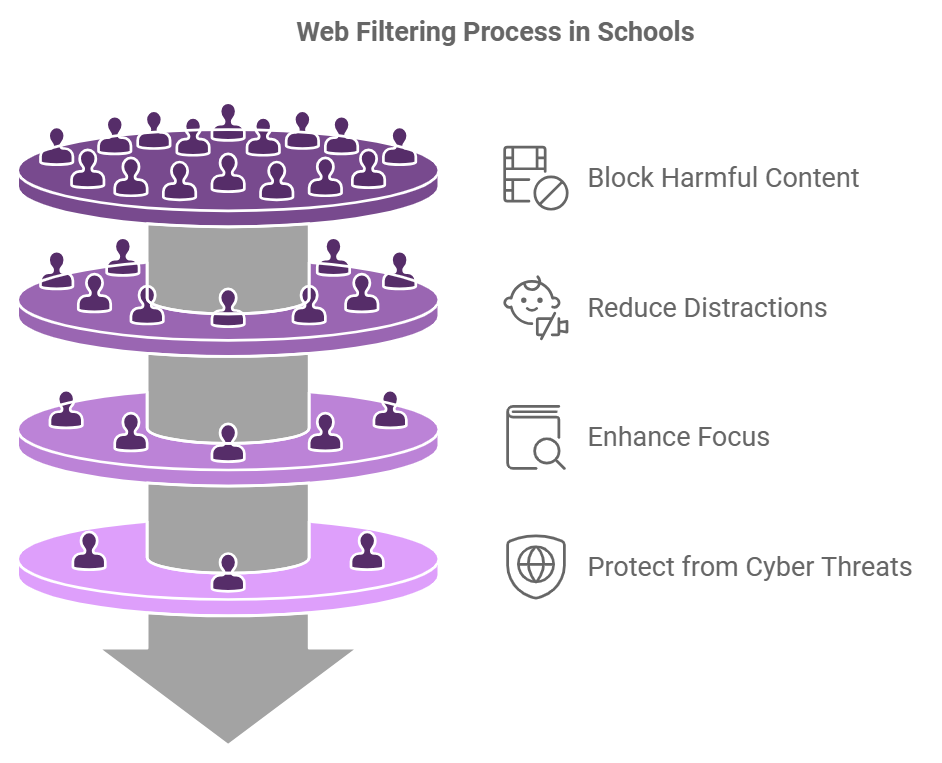
Internet filtering in schools isn’t as complicated as it might sound. In simple terms, it’s a system that blocks access to websites or content that could be harmful—whether that’s explicit material, violent content, or even distractions like social media. But here’s the thing: web filters don’t just stop at blocking bad content. They also help students stay focused on the right stuff—learning. With the right filters, schools can ensure that students aren’t sidetracked by online games, random videos, or other distractions during study time. It’s as if setting a study timer on your phone—but for the entire school. On top of that, web filters act as shields against the growing number of cyber threats. We’re talking about phishing scams, malware, and cyberbullying—risks that can wreak havoc not just on a student’s safety but on their mental health as well. These dangers are kept at bay with web filtering software for schools, creating a safer and more productive environment.

The Problem: The real dangers of an unfiltered internet

The internet, for all its potential, is full of dangers. And without proper web filtering, schools leave students vulnerable to a range of problems. Here are the top 5 threats that make web filtering a must-have:

1. Exposure to explicit content

We’re talking about graphic images, violence, and explicit material—things that no child should stumble upon while browsing the web. Yet, without web filters, students are just a click away from encountering inappropriate content.

2. Cyberbullying

It’s not just face-to-face bullying that we need to worry about anymore. Cyberbullying is a major concern, and it can have devastating effects on a child’s mental health. With web filters in place, students can be shielded from harmful interactions, ensuring they have a safer space to learn.

3. Scams and phishing attacks

The internet is a goldmine for scammers, and children are prime targets. From fake websites to phishing emails, it’s easy for students to fall for tricks that could steal their personal information. Web filters block these sites, preventing students from becoming victims.

4. Malware and viruses

The internet is full of shady websites and downloads that can infect devices with malware or viruses. These threats can compromise school networks and put personal data at risk. A strong web filter stops these malicious sites in their tracks, ensuring students and their devices stay safe.

5. Distractions that waste time

Think about the number of times you’ve clicked on random videos or games while you should be doing something else. Now imagine students doing the same during class. Without proper web filtering, distractions are everywhere, preventing students from focusing on their studies.

The Solution: web filtering software to the rescue

So, how do we stop these problems from derailing our kids’ education and safety? Solution: Web filtering software for schools. Here’s how it works:

Blocks harmful content

Web filters prevent access to inappropriate websites by scanning for specific keywords, categories, or URLs. Schools can customize these filters to block everything from explicit material to violent content, making sure students can’t stumble upon harmful websites.

Focuses students’ attention

With distractions like social media, games, and random videos out of the equation, web filtering helps students stay focused on the task at hand—learning. This is particularly important during school hours when students need to stay engaged in their lessons and educational resources.

Protects against cyber threats

A solid web filter does more than block inappropriate sites—it also protects students from cyber threats like phishing scams, malware, and identity theft. By stopping these dangerous sites before they can do harm, web filters keep students safe and secure while they navigate the web.

Protection for schools

One of the best parts of content filtering software for schools is that it can be tailored to meet specific needs. Filters can be set based on the grade level, the subject being studied, or even specific content areas that need to be restricted or encouraged.

Real-time monitoring and reporting

Most web filtering systems offer real-time monitoring and reports, which means educators and administrators can track what students are accessing online. This allows for quick action if anything inappropriate or dangerous is spotted, keeping everyone accountable.

A safer, smarter digital world for students with Veltar

At the end of the day, the internet is an incredible resource, but without the proper safeguards, it can also be a dangerous place. With the alarming statistics highlighting that approximately 338 million children have been exposed to harmful content online, it’s imperative for educational institutions to implement measures to protect their students. One effective solution is the deployment of web filtering software, such as Veltar. Veltar is a comprehensive endpoint security solution that helps protect data at rest and in motion. It offers features like web content filtering, VPN tunneling, I/O device access control, and application control, providing a unified approach to endpoint security. By integrating Veltar into school networks, administrators can prevent access to inappropriate websites by scanning for specific keywords, categories, or URLs. You can select categories of websites to block and enter specific domains to restrict. Keep students immersed in meaningful learning by cutting out distractions like social media and games.  

About Scalefusion
Scalefusion’s company DNA is built on the foundation of providing world-class customer service and making endpoint management simple and effortless for businesses globally. We prioritize the needs and feedback of our customers, making sure that they are at the forefront of all decision-making processes. We are dedicated to providing comprehensive customer support services, and place emphasis on customer-centric thinking throughout the organization.

About Version 2 Digital

Version 2 Digital is one of the most dynamic IT companies in Asia. The company distributes a wide range of IT products across various areas including cyber security, cloud, data protection, end points, infrastructures, system monitoring, storage, networking, business productivity and communication products.

Through an extensive network of channels, point of sales, resellers, and partnership companies, Version 2 offers quality products and services which are highly acclaimed in the market. Its customers cover a wide spectrum which include Global 1000 enterprises, regional listed companies, different vertical industries, public utilities, Government, a vast number of successful SMEs, and consumers in various Asian cities.

Integrating RPAM, ZTNA, and VDI in Modern IT Environments

Overview

Thanks for following along with our series on how integrating modern IT solutions can make your operations smoother and more secure. We’ve explored the fundamentals of RPAM, ZTNA, and VDI, and now we’ll dive into best practices and how Thinfinity® can help your business grow without adding IT complexity.


Understanding the Core Concepts

Remote Privileged Access Management (RPAM)

RPAM focuses on managing and securing privileged access to critical resources. It includes features like just-in-time access, approval workflows, session monitoring, and auditing. By ensuring privileged access is granted only when necessary, RPAM minimizes the risk of unauthorized access and potential security breaches.

Zero Trust Network Access (ZTNA)

ZTNA enforces strict identity verification and access controls, regardless of the user’s location or device. It operates on the principle of “never trust, always verify,” ensuring access is granted based on continuous verification of user identity, device health, and context. ZTNA provides a more secure and scalable solution for remote access compared to traditional VPNs.

Virtual Desktop Infrastructure (VDI)

VDI involves hosting desktop environments on a centralized server and providing users access to these virtual desktops from any device. VDI enhances security by keeping data within the corporate network and reducing the risk of data loss from endpoint devices. It also simplifies desktop management and ensures a consistent user experience across different devices.

Integrating RPAM, ZTNA, and VDI

Integrating RPAM, ZTNA, and VDI can create a secure and efficient environment for remote access and desktop management. Here are the key steps and best practices for implementing this integrated approach:

1. Assessing Organizational Needs

Before diving into the implementation, assess your organization’s specific needs and challenges. Identify critical assets, understand user roles, and determine the access level required for different user groups. A thorough assessment helps in designing a solution that meets your security and operational requirements.

2. Implementing Strong Authentication and Access Controls

Strong authentication methods, like multi-factor authentication (MFA), are crucial for securing access to critical resources. ZTNA enforces granular access controls based on user identity, device health, and contextual signals such as geographic location and time of access. By integrating RPAM, you can further enhance security by implementing just-in-time access and approval workflows for privileged accounts.

3. Deploying VDI for Enhanced Security and Efficiency

VDI provides a centralized and secure environment for managing desktop access. By hosting virtual desktops on centralized servers, organizations can ensure data remains within the corporate network, reducing the risk of data breaches. VDI also enables seamless access to applications and data from any device, enhancing user productivity.

4. Leveraging Cloud VDI for Scalability and Flexibility

Cloud VDI solutions offer scalability and flexibility, allowing organizations to adapt to changing business needs quickly. By leveraging cloud infrastructure, businesses can scale their virtual desktop environments up or down based on demand, without significant upfront investments in hardware. Cloud VDI also provides built-in redundancy and disaster recovery capabilities, ensuring continuous availability of desktop resources.

5. Continuous Monitoring and Auditing

Continuous monitoring and auditing are critical for maintaining security and integrity in the integrated environment. RPAM solutions provide session monitoring and recording capabilities, enabling organizations to track and audit privileged access activities. ZTNA solutions offer continuous verification and monitoring of user sessions, ensuring access is always based on up-to-date information. Regular audits help identify potential security gaps and ensure compliance with regulatory requirements.

Best Practices for Implementation

1. Standardize Access Policies

Establishing standard access policies for different user groups and roles simplifies the implementation and management of RPAM, ZTNA, and VDI. These policies should define the access level required for each role and the conditions under which access is granted. Standardizing access policies ensures consistency and reduces the complexity of managing access controls.

2. Educate and Train Users

User education and training are essential for successfully implementing RPAM, ZTNA, and VDI. Employees should be aware of security policies and procedures, understand the importance of privileged access management, and know how to use the virtual desktop environment effectively. Regular training sessions and awareness programs can help reinforce best practices and ensure compliance.

3. Ensure Seamless Integration

Seamless integration of RPAM, ZTNA, and VDI is crucial for achieving a cohesive security framework. Organizations should select solutions that are compatible and can be integrated with existing IT infrastructure. APIs and connectors can facilitate the integration of different components, ensuring they work together seamlessly to provide a unified security solution.

4. Prioritize User Experience

While security is paramount, it is also important to prioritize the user experience. The implementation of RPAM, ZTNA, and VDI should not create unnecessary barriers or hinder productivity. Solutions should be user-friendly and provide a seamless experience across different devices. Regular feedback from users can help identify areas for improvement and ensure that the solutions meet their needs.

5. Plan for Scalability and Future Growth

Organizations should plan for scalability and future growth when implementing RPAM, ZTNA, and VDI. This includes selecting solutions that can scale to accommodate an increasing number of users and devices, as well as future-proofing the infrastructure to support new technologies and business requirements. Regular reviews and updates to the security framework can help ensure that it remains effective and aligned with organizational goals.

How Thinfinity® Can Help

Thinfinity Workspace excels in integrating the capabilities of ZTNA, RPAM, and VDI to provide a robust and comprehensive solution for modern IT environments. Thinfinity offers several features that make it an ideal choice for businesses looking to enhance their security and efficiency:

ZTNA Capabilities

Thinfinity provides secure, controlled connectivity without the need for traditional VPNs. It integrates with identity providers like Okta and Duo, enforcing strict identity verification and access controls. With features such as IP blacklisting, GeoIP filtering, and brute force detection, Thinfinity ensures a high level of security and compliance with ZTNA principles.

RPAM Capabilities

Thinfinity’s RPAM features include resource reservation, just-in-time access, approval workflows, and comprehensive session monitoring and recording. These capabilities ensure that privileged access is granted only when necessary and under controlled conditions, reducing the risk of unauthorized access and potential security breaches.

VDI and Cloud VDI Capabilities

Thinfinity supports the deployment of virtual desktops and applications on various infrastructures, including major cloud providers such as AWS, Azure, and Google Cloud. It offers automatic provisioning, load balancing, and seamless integration with existing IT environments. Thinfinity’s VDI solutions enable businesses to provide a consistent and secure desktop experience across different devices, enhancing productivity and reducing the risk of data breaches.

Enhanced User Experience

Thinfinity prioritizes user experience by providing a seamless and intuitive interface for accessing virtual desktops and applications. With support for multiple virtualization protocols and local-like user experience, Thinfinity ensures that users can access their resources efficiently and without unnecessary barriers.

Conclusion

Integrating Remote Privileged Access Management (RPAM), Zero Trust Network Access (ZTNA), and Virtual Desktop Infrastructure (VDI) provides a comprehensive framework for securing and managing remote access to critical IT resources. By implementing strong authentication and access controls, leveraging cloud VDI for scalability, and continuously monitoring and auditing access activities, organizations can enhance their security posture and ensure a seamless user experience. Thinfinity Workspace offers a robust and comprehensive solution that excels in integrating these capabilities, providing businesses with the tools they need to stay secure and efficient in today’s digital landscape. Adopting best practices for implementation and prioritizing user education and training further contributes to the success of this integrated approach. As the digital landscape continues to evolve, organizations must remain vigilant and proactive in adapting their security strategies to protect their valuable assets and ensure business continuity.

About Cybele Software Inc.
We help organizations extend the life and value of their software. Whether they are looking to improve and empower remote work or turn their business-critical legacy apps into modern SaaS, our software enables customers to focus on what’s most important: expanding and evolving their business.

About Version 2 Digital

Version 2 Digital is one of the most dynamic IT companies in Asia. The company distributes a wide range of IT products across various areas including cyber security, cloud, data protection, end points, infrastructures, system monitoring, storage, networking, business productivity and communication products.

Through an extensive network of channels, point of sales, resellers, and partnership companies, Version 2 offers quality products and services which are highly acclaimed in the market. Its customers cover a wide spectrum which include Global 1000 enterprises, regional listed companies, different vertical industries, public utilities, Government, a vast number of successful SMEs, and consumers in various Asian cities.

How ITSM optimizes vulnerability management

Understanding Vulnerability Management 

Definition and importance of Vulnerability Management in modern IT environments 

Vulnerability management has become a top priority for organizations of all sizes and industries. The reason is simple: cyber threats are increasingly sophisticated, and any unmanaged vulnerability represents an open door for potential attacks. 


But what exactly is Vulnerability Management? 

It is a structured process that enables organizations to identify, assess, and resolve vulnerabilities in their IT systems before they can be exploited by malicious actors. 

Attention! Its role is not limited to security alone: efficient Vulnerability Management also contributes to business continuity and data protection, enhancing customer trust and ensuring compliance with security regulations such as GDPR. 


The main stages of the Vulnerability Management lifecycle
 

The vulnerability management lifecycle consists of several phases that must be carried out methodically to ensure vulnerabilities are properly managed: 

  • Scanning and Identification: Using specific tools, vulnerabilities in IT systems are detected.


  • Evaluation: Vulnerabilities are then analyzed to determine their severity and potential impact on the infrastructure
  • Prioritization: Vulnerabilities are classified based on their criticality, allowing IT teams to focus resources on the most severe threats as quickly as possible
  • Resolution: Corrective actions, such as applying patches or more comprehensive vulnerability mitigation, are implemented.
  • Verification and Continuous Monitoring: After correction, vulnerabilities are monitored to ensure they do not reoccur. Vulnerability Management, in fact, should not be limited to emergency operations but integrated into the normal functioning of business processes.

How ITSM processes improve Vulnerability Management 

IT Service Management (ITSM) processes are crucial in optimizing vulnerability management. 

Why, in concrete terms? 

Because they enable IT operations to be effectively integrated with security practices, automating many repetitive tasks and improving collaboration between security and IT teams. Moreover, they allow for precise tracking of the entire vulnerability lifecycle, from identification to resolution, ultimately improving the effectiveness and efficiency of management. 

How can these processes be enabled and made operational? 

Through versatile, powerful, and easy-to-use tools like EV Service Manager.

Connecting ITSM to security management 

Bridging the gap between ITSM and security is fundamental. 

Integrating these two areas allows for the standardization of processes, reduction of human error risks, and ensuring a faster and more effective response to threats. 

Thanks to tools like EV Reach, vulnerabilities can be managed remotely and automatically, ensuring that even the most distant or hard-to-reach systems are protected in real-time.

Leveraging ITSM processes for Vulnerability Management 

The role of ITSM in identifying, tracking, and managing vulnerabilities 

ITSM provides a well-organized IT service architecture, which, in turn, allows vulnerability management to be integrated into daily operational processes; as we mentioned earlier. 

But where does this role start? And how far does it go? 

It begins with the identification of vulnerabilities, naturally. Then it moves on to management through a ticketing system, which enables prioritization, progress tracking, and documentation of the actions taken to resolve each vulnerability. As a result, the actual resolution of the issue becomes the starting point for continuous process improvement through data analysis.

Aligning ITSM with security risk management 

Let’s get straight to the key point: aligning ITSM with risk management allows vulnerabilities to be addressed with a holistic view, not just an emergency one. 

This approach ensures that security threats are not treated as isolated problems but as part of a broader IT risk management framework with which companies must constantly coexist. 

The most important benefits of this more contemporary approach? Resource optimization and reduced response times, with IT teams staying one step ahead of potential attacks. 

The final outcome? Greater satisfaction for users and customers, along with the competitive advantage this brings. 


Integrating Vulnerability Management into key ITSM processes
 

The integration between ITSM and vulnerability management is something critical and increasingly indispensable; we have emphasized this repeatedly. Now, let’s get even more concrete and operational by isolating the key aspects of this integration: 

  • Incident Management: Vulnerabilities can turn into actual incidents if not managed in time. And when this happens, quick action is required. For example, the Automated Incident Management of EV Reach allows rapid responses to security-related incidents, monitoring resolution and ensuring critical escalations don’t occur. All of this is fully automated.


  • Change Management: Vulnerabilities often require patching or updates. Change Management processes enable these changes to be handled in a structured way, minimizing the impact on business operations and preventing potential interruptions.
  • Problem Management: Some vulnerabilities may recur over time, necessitating an in-depth analysis of their root causes. Problem management helps identify these causes and implement lasting solutions to prevent their reoccurrence
  • Configuration Management: Through the Configuration Management Database (CMDB), vulnerabilities can be mapped to specific IT assets, precisely monitoring the potential impact of each vulnerability on devices, servers, and applications. Products like EV Service Manager enable centralized asset management, improving visibility over systems and their vulnerabilities.

Enhancing vulnerability resolution with ITSM tools 

Finally, it’s time for the actual resolution. 

Solutions and products from EasyVista, such as EV Service Manager and EV Reach, provide tools to automate vulnerability resolution, ensuring that patches are applied quickly and consistently. 

This results in two mirrored benefits: 

  • Resolutions are much faster and more accurate compared to manual efforts. 
  • IT teams can focus on more strategic activities, reducing their workload.

Overcoming challenges in ITSM-based Vulnerability Management 


Addressing organizational and process silos
 

One of the main obstacles to integrating vulnerability management with ITSM is the organizational silos that still characterize the workflows of many companies. 

It’s necessary, therefore, to adopt solutions and tools that facilitate greater collaboration between teams, breaking down barriers that may hinder a coordinated response to threats. 

But even before that, a change in mindset within the company is needed.  


Managing the volume of security threats
 

With the constant increase in the number of threats, managing the volume of vulnerabilities can become complex. And here again, the importance of automation processes within ITSM solutions becomes evident, as they improve the scalability of the process.  


Continuous monitoring and process improvement
 

Continuous monitoring is essential to prevent and mitigate vulnerabilities and to act promptly. 

However, as we have already said, it is not enough to simply solve problems as they arise. 

What is even more crucial is to collect valuable data on all processes related to cybersecurity, turning vulnerability management into a prevention process that makes “cures” increasingly unnecessary. 


Automation and the future of Vulnerability Management


Automating vulnerability detection and resolution
 

We’ve said it and repeated it: Automation is the future of vulnerability management:  It’s about implementing tools that automatically detect vulnerabilities and apply patches with minimal human intervention, reducing the risk of error and speeding up response times. 


Leveraging AI and Machine Learning to improve threat response
 

Artificial intelligence (AI) and machine learning are playing an increasingly important role in all business digital processes, not least in proactive threat detection. 

In practice, these systems can analyze large amounts of data, identify patterns, and suggest corrective actions before vulnerabilities become problematic. 


Future trends in the integration between ITSM and Vulnerability Management
 

While the future can never be predicted with certainty, what we can be sure of is that we will see increasing integration between ITSM and vulnerability management, with the use of advanced technologies like artificial intelligence to anticipate threats and ensure continuous protection of IT infrastructures. 

All of this will be increasingly tailored to the unique needs of individual companies. 


FAQs


What is Vulnerability Management?

It is the process of identifying, evaluating, and resolving vulnerabilities in IT systems to prevent possible attacks. 


What is ITSM’s role in Vulnerability Management?

ITSM provides an organizational structure that allows vulnerabilities to be managed as part of IT operational processes, ensuring traceability, automation, and continuous improvement.


How do EasyVista solutions improve Vulnerability Management?

EV Service Manager and EV Reach help track, monitor, and automate the vulnerability management process, improving threat response, reducing resolution times, and easing the workload on IT teams.

About EasyVista  
EasyVista is a leading IT software provider delivering comprehensive IT solutions, including service management, remote support, IT monitoring, and self-healing technologies. We empower companies to embrace a customer-focused, proactive, and predictive approach to IT service, support, and operations. EasyVista is dedicated to understanding and exceeding customer expectations, ensuring seamless and superior IT experiences. Today, EasyVista supports over 3,000 companies worldwide in accelerating digital transformation, enhancing employee productivity, reducing operating costs, and boosting satisfaction for both employees and customers across various industries, including financial services, healthcare, education, and manufacturing.

About Version 2 Digital

Version 2 Digital is one of the most dynamic IT companies in Asia. The company distributes a wide range of IT products across various areas including cyber security, cloud, data protection, end points, infrastructures, system monitoring, storage, networking, business productivity and communication products.

Through an extensive network of channels, point of sales, resellers, and partnership companies, Version 2 offers quality products and services which are highly acclaimed in the market. Its customers cover a wide spectrum which include Global 1000 enterprises, regional listed companies, different vertical industries, public utilities, Government, a vast number of successful SMEs, and consumers in various Asian cities.

Is Broadcom’s Acquisition of VMware Disrupting Your MSP Business? Explore VDI and DaaS alternatives for your Customers

I) Introduction: Navigating the Changing Landscape of Virtual Desktop Infrastructure

The IT industry is witnessing pivotal transformations with significant impacts on Managed Service Providers (MSPs), particularly those navigating the recent VMware acquisition by Broadcom. This development has injected a degree of uncertainty concerning future product roadmaps, support structures, and licensing costs. In this evolving scenario, MSPs require robust, flexible solutions that can adapt to these changes without disrupting client operations. Thinfinity presents itself as an exemplary partner, offering state-of-the-art Virtual Desktop Infrastructure (VDI) and Desktop-as-a-Service (DaaS) solutions. This article delves deep into how Thinfinity can support MSPs in transitioning from VMware solutions, adopting new VDI and DaaS strategies, and ultimately, enhancing their service offerings to meet modern business demands.

Learn more about transitioning from VMware solutions $

Understanding the VMware Acquisition Impact

The acquisition of VMware by Broadcom has stirred anxieties among existing VMware customers and partners about potential escalations in costs and shifts in service dynamics. MSPs are particularly concerned about how these changes might affect their service delivery and client satisfaction. The situation necessitates a strategic pivot, prompting MSPs to explore reliable, cost-effective alternatives that align with long-term business objectives.

Thinfinity® as a Strategic Alternative

Thinfinity’s solutions are designed to address the needs of MSPs looking for stability and adaptability in their virtual desktop offerings. With comprehensive VDI and DaaS options, Thinfinity ensures that MSPs can provide their clients with seamless, secure, and efficient virtual desktop environments.

II) VDI vs. DaaS: Choosing the Right Solution

Virtual Desktop Infrastructure (VDI)

Thinfinity VDI solutions offer MSPs complete control over their desktop management and are ideal for those who require a high degree of customization and security. Key benefits include:

Customizable Security Measures - icon

Customizable Security Measures:
Tailor security settings to meet specific client requirements.

Controlled Resource Allocation - icon

Controlled Resource Allocation:
Manage resources efficiently to ensure optimal performance.

Cost Efficiency - icon

Cost Efficiency:
Although requiring an initial investment, VDI can be more economical over the long term for stable deployments.

Desktop-as-a-Service (DaaS)

Thinfinity Virtual Desktops solution is managed by Cybele Software, Inc, reducing the MSP’s burden of maintaining the infrastructure. This is particularly beneficial for MSPs that prefer to focus on scalability and flexibility without the complexities of direct infrastructure management. Advantages include:

Scalability - icon

Scalability:
Easily scale up or down based on client demand without significant capital expenditures.

Operational Expense Model - icon

Operational Expense Model:
Offers a pay-as-you-go model that is financially attractive for businesses looking to minimize upfront investments.

Reduced Operational Burden - icon

Reduced Operational Burden:
Outsourcing the management of virtual desktops to Thinfinity® allows MSPs to focus more on strategic initiatives.

Explore our guide on choosing between VDI and DaaS solutions $

III) Strategic Deployment and Migration

Migration Strategies for VMware Users

MSPs managing VMware infrastructures must consider strategic migrations to ensure continuity and cost-efficiency. Thinfinity offers tools and expertise to facilitate this transition, enabling MSPs to migrate their existing VMware setups to Thinfinity’s VDI or DaaS platforms seamlessly. This transition is supported by:

  • Detailed Compatibility Assessments: Ensure that all client applications and workflows are compatible with Thinfinity solutions.
  • Customized Migration Plans: Develop tailored migration strategies that minimize downtime and disruption.
  • Cost Management and Analysis: Provide comprehensive analyses to highlight the long-term savings and ROI of switching to Thinfinity solutions.

Cost-Effective Licensing Models

Thinfinity’s licensing models are designed to be straightforward and cost-effective, aligning with the usage patterns of MSPs and their clients. These models allow for flexibility and scalability, which is especially crucial in a market where traditional VMware partners are experiencing significant price hikes.

IV) Conclusion: Positioning MSPs for Future Success

As MSPs navigate the complexities of a changing virtual desktop market, partnering with Thinfinity provides a pathway to enhanced stability, flexibility, and growth. Thinfinity’s VDI and DaaS solutions not only offer a reliable alternative to VMware but also equip MSPs with the tools to adapt to market demands swiftly. By choosing Thinfinity, MSPs can assure their clients of continuous, secure, and cost-effective virtual desktop services. We invite all MSPs, whether currently partnered with VMware, seeking new alternatives, or exploring the initial deployment of virtual desktop solutions, to discuss how Thinfinity can tailor its offerings to meet your specific needs.

To learn more about how Thinfinity can support your business and to schedule a consultation with our experts, please visit our website or contact us directly. Thinfinity is committed to being your trusted partner in navigating the future of virtual desktop infrastructure.

About Cybele Software Inc.
We help organizations extend the life and value of their software. Whether they are looking to improve and empower remote work or turn their business-critical legacy apps into modern SaaS, our software enables customers to focus on what’s most important: expanding and evolving their business.

About Version 2 Digital

Version 2 Digital is one of the most dynamic IT companies in Asia. The company distributes a wide range of IT products across various areas including cyber security, cloud, data protection, end points, infrastructures, system monitoring, storage, networking, business productivity and communication products.

Through an extensive network of channels, point of sales, resellers, and partnership companies, Version 2 offers quality products and services which are highly acclaimed in the market. Its customers cover a wide spectrum which include Global 1000 enterprises, regional listed companies, different vertical industries, public utilities, Government, a vast number of successful SMEs, and consumers in various Asian cities.

Top Alternative to Citrix Netscaler in 2024

Introduction

In the previous article of our series, we discussed how to reduce latency across multi-cloud deployments. If you missed it, you can catch up here. Today, we’re going to discuss a crucial topic: finding the top alternative to Citrix Netscaler in 2024. As you all know, Citrix has recently undergone significant changes in management and strategy, focusing on simplifying its product offerings. This shift has brought numerous concerns, including increased support overhead and a lack of support for medium and small customers. Additionally, changes in the licensing model have introduced extra costs for contract renewals, adding to the overall financial burden on organizations.

In this context, it’s essential to explore robust alternatives that can offer reliable performance, security, and cost efficiency. One such alternative is Thinfinity Workspace. This article will delve into why Thinfinity Workspace stands out as the top alternative to Citrix Netscaler in 2024.

Let’s get into the meat of this real quick. Imagine a bustling corporate environment where the IT infrastructure must support hundreds of employees accessing critical applications simultaneously. The performance and reliability of these applications can make or break productivity. This is where Thinfinity® Workspace steps in, offering a robust and flexible solution that addresses the unique challenges faced by large organizations. We’ll delve into the features and benefits of Thinfinity Workspace and see why it stands out as the top alternative to Citrix Netscaler in 2024.


Understanding Application Delivery Controllers (ADCs)

ADCs, or Application Delivery Controllers, play a pivotal role in managing, optimizing, and securing the delivery of applications across networks. They ensure that applications are delivered swiftly, securely, and efficiently to end-users, thus maintaining business continuity and enhancing user experience.

Definition and Core Functions of ADCs

An ADC is a device or software appliance positioned between the client and server to manage application traffic. ADCs perform essential functions such as load balancing, traffic optimization, and application acceleration. By distributing client requests across multiple servers, ADCs prevent any single server from becoming a bottleneck, thereby enhancing the performance and availability of applications. Think of an ADC as a traffic cop at a busy intersection, skillfully directing vehicles to different lanes to prevent congestion and ensure a smooth flow of traffic. Similarly, ADCs manage data traffic, directing it efficiently to maintain optimal performance.

The Role of ADCs in Modern IT Infrastructure

In the era of cloud computing and distributed applications, ADCs have become indispensable. They not only balance loads but also provide crucial security features such as SSL offloading, Web Application Firewall (WAF) capabilities, and DDoS protection. This comprehensive approach ensures that applications are not only fast but also secure from various cyber threats. Picture an ADC as a skilled conductor leading an orchestra, ensuring each instrument plays harmoniously and at the right time while also safeguarding the entire performance from disruptions. Similarly, ADCs efficiently guide data traffic while safeguarding it against cyber threats, maintaining the integrity and performance of applications.

Common Challenges Addressed by ADCs

Enterprises often grapple with issues like server overload, latency, and security vulnerabilities. ADCs mitigate these problems by intelligently managing traffic, accelerating application performance, and implementing security protocols to protect against attacks.

For example, we assisted an oil and gas company with a vast network of remote drilling sites across the United States and South America. These sites relied on real-time data for monitoring and decision-making but faced significant latency and security issues that were impacting their operational efficiency. By deploying an ADC, we were able to distribute the traffic load more evenly, reducing latency and ensuring that data was transmitted securely and promptly. This improvement enabled the company to make timely decisions, enhancing both safety and productivity. Common applications in the oil and gas industry that benefit from ADCs include Supervisory Control and Data Acquisition (SCADA) systems, Programmable Logic Controllers (PLCs), and Distributed Control Systems (DCS), all of which require efficient data transmission for optimal performance.

How do ADCs enhance application performance and security?

Continuing with our story, this new customer in the Oil and Gas Industry had been struggling with delayed data transmissions and frequent security breaches in their SCADA systems, which are crucial for real-time monitoring and control of field equipment. Implementing the ADC addressed these issues by providing advanced load balancing and traffic management, which significantly reduced latency and ensured uninterrupted data flow. The ADC’s security features, including SSL offloading and DDoS protection, fortified the company’s network against cyber threats, safeguarding sensitive operational data. As a result, the company experienced a marked improvement in operational efficiency, enabling faster response times to field conditions and more accurate decision-making processes. This case underscores how ADCs can resolve critical pain points in application delivery, leading to enhanced performance and security in complex industrial environments.

Thinfinity® Workspace ADC 2024

Thinfinity Workspace offers a cutting-edge approach to application delivery, combining robust performance, security features, and ease of use, making it a superior alternative to traditional ADCs like Citrix Netscaler.

Key Features of Thinfinity® Workspace as an ADC

Performance: Thinfinity Workspace optimizes application delivery with advanced load balancing and traffic management techniques. Its ability to handle high traffic volumes without compromising performance ensures that applications remain accessible and responsive, even during peak usage times.

Security: Thinfinity Workspace provides comprehensive security features, including SSL offloading, Web Application Firewall (WAF) capabilities, and DDoS protection. These features safeguard applications from cyber threats, ensuring data integrity and compliance with security standards.

User Experience: The user-friendly interface and seamless integration with existing IT infrastructure simplify the management of application delivery. Thinfinity Workspace enhances the user experience by providing intuitive controls and efficient workflows.

Cloud-Agnostic Architecture: Thinfinity Workspace’s cloud-agnostic architecture supports deployment across various cloud environments, including public, private, and hybrid clouds. This flexibility allows organizations to scale their infrastructure as needed, without being locked into a single vendor. The solution seamlessly integrates with existing cloud services and on-premises systems, ensuring a smooth transition and optimal performance across different platforms. Think of Thinfinity Workspace’s cloud-agnostic architecture as a versatile vehicle that can traverse any terrain, providing reliable performance regardless of the environment.

Explore further cloud-agnostic capabilities of Thinfinity Workspace $

Once again, in the case of this oil and gas company, Thinfinity Workspace significantly improved the performance of their SCADA systems. Before implementing Thinfinity, data bottlenecks during peak operation hours led to delayed decision-making and reduced efficiency. With Thinfinity’s advanced load balancing, the company saw a 40% reduction in latency and a marked increase in system responsiveness. This allowed engineers to make quicker, more informed decisions, directly enhancing operational productivity.

The company also benefited from Thinfinity’s robust security features. Previously, their SCADA systems were vulnerable to cyber-attacks, which posed significant risks to their operations. With Thinfinity’s SSL offloading and WAF capabilities, the company’s network security was greatly enhanced. There was a notable decrease in security incidents, giving the IT team confidence that their data was protected. This improvement not only safeguarded critical operational data but also ensured compliance with industry regulations.

The transition to Thinfinity Workspace was seamless for the oil and gas company. The IT staff found the interface intuitive and easy to navigate, which minimized the learning curve and allowed them to quickly leverage Thinfinity’s full capabilities. The integration with their existing systems was smooth, with minimal downtime during the transition. As a result, the company experienced an overall improvement in IT staff efficiency and user satisfaction, as the platform’s intuitive controls and efficient workflows made their daily operations more manageable and less time-consuming.

Thinfinity Workspace addresses common challenges with its advanced features, improving both performance and security while offering a superior user experience. This makes it a compelling alternative to Citrix Netscaler for enterprises looking to enhance their application delivery infrastructure.

Transparent Licensing Model Based on Concurrent Users

Cost Efficiency: Thinfinity Workspace offers a transparent licensing model based on concurrent users, eliminating hidden fees and unexpected costs. This model provides organizations with clear pricing, making it easier to budget and plan for IT expenditures.

Scalability: The licensing model supports scalability, allowing organizations to add or remove users as needed without incurring additional costs. This flexibility ensures that businesses can adapt to changing demands without financial strain.

Of course, our new customer greatly benefited from Thinfinity Workspace’s transparent licensing model. Prior to implementing Thinfinity, the company struggled with high costs and maintenance burdens associated with Citrix. Our licensing model provided clear, predictable pricing not only for their current needs but also for future growth. This reduced their total cost of ownership (TCO) by up to 65%, thanks to lower licensing prices and the absence of hidden costs for features like fault tolerance or high availability. Additionally, the scalable licensing allowed the company to adjust user counts as needed without incurring extra costs, offering previously unattainable financial flexibility. This transparent and cost-effective approach empowered the company to better manage their IT budget and invest in other critical areas, ultimately enhancing their overall operational efficiency and financial health.

Thinfinity® Workspace vs. Citrix Netscaler

Before we conclude, let’s take a moment to compare Thinfinity Workspace with Citrix Netscaler across several key areas. This comprehensive table will help you make an informed decision by highlighting the strengths and differences between these two solutions.

This will ensure you have all the necessary information to understand why Thinfinity Workspace is an excellent alternative for your application delivery needs.

Conclusion

As we’ve explored today, finding a robust alternative to Citrix Netscaler is crucial, especially in light of recent changes at Citrix. These changes have led to increased support overhead, less support for medium and small customers, and additional costs due to new licensing models. Such developments have intensified the financial burden on organizations relying on Citrix for their application delivery needs.
Thinfinity Workspace shows up as a top contender to replace Citrix Netscaler, offering several compelling advantages. Its advanced features ensure optimal application performance, while the cloud-agnostic architecture provides flexibility across various environments. Furthermore, Thinfinity Workspace’s transparent licensing model alleviates financial uncertainties, making it a cost-effective solution for enterprises of all sizes.

For CIOs, CTOs, and CISOs, transitioning to Thinfinity Workspace is more than just a technical upgrade; it’s a strategic decision that can enhance operational efficiency and provide a competitive edge. The benefits of improved application performance, enhanced security, and significant cost savings make Thinfinity Workspace an excellent choice in the evolving digital landscape.

Now is the opportune time to explore Thinfinity Workspace’s capabilities fully and consider how it can meet your organization’s unique application delivery requirements, positioning you for success in 2024 and beyond.

About Cybele Software Inc.
We help organizations extend the life and value of their software. Whether they are looking to improve and empower remote work or turn their business-critical legacy apps into modern SaaS, our software enables customers to focus on what’s most important: expanding and evolving their business.

About Version 2 Digital

Version 2 Digital is one of the most dynamic IT companies in Asia. The company distributes a wide range of IT products across various areas including cyber security, cloud, data protection, end points, infrastructures, system monitoring, storage, networking, business productivity and communication products.

Through an extensive network of channels, point of sales, resellers, and partnership companies, Version 2 offers quality products and services which are highly acclaimed in the market. Its customers cover a wide spectrum which include Global 1000 enterprises, regional listed companies, different vertical industries, public utilities, Government, a vast number of successful SMEs, and consumers in various Asian cities.