Skip to content

Zero Trust Data Protection: a modern approach to securing sensitive data

Summary: Learn about Zero Trust Data Protection and its role in modern cybersecurity. See how it redefines data control, access, and risk in high-threat environments.

Today, traditional perimeter-based security models are no longer enough. With sensitive data flowing across hybrid environments, remote endpoints, and decentralized cloud systems, the challenge is no longer where data is—but who can access it and under what conditions. Zero Trust Data Protection offers a modern, policy-driven framework that rethinks how data security should function in a world where implicit trust is a liability.

This article explores what Zero Trust Data Protection really means, how it differs from broader Zero Trust security strategies, and why forward-thinking enterprises are adopting it as a foundational layer of their cybersecurity. If your organization handles sensitive data—and needs to ensure it’s always protected regardless of location, user, or device—this guide is for you.

What is Zero Trust Data Protection?

Zero Trust Data Protection (ZTDP) is an advanced security approach that applies Zero Trust principles specifically to how data is accessed, used, and protected. Unlike traditional models that assume trust based on network location or credentials, ZTDP follows the “never trust, always verify” philosophy—enforcing strict access controls and continuous validation across every layer of data interaction.

While it shares DNA with Zero Trust architecture, ZTDP goes a step further by shifting the focus from infrastructure to data access itself. This means that even if a user, device, or application gains entry into a trusted environment, data access is never assumed. Instead, policies built around least privilege access, real-time context, and behavioral signals govern who or what can interact with sensitive information—and under what conditions.

How does Zero Trust differ from traditional data security models?

Traditional data security models were built around the idea of a secure perimeter—think firewalls, VPNs, and on-premises access controls. In these models, once a user or device was authenticated and “inside the network,” they were typically granted broad access to internal systems and protected data. Trust was implicit, and security was largely dependent on defending the perimeter.

Zero Trust Data Protection completely upends this approach. Rooted in Zero Trust principles and enforced through Zero Trust architecture, ZTDP assumes that no user, device, or process should be trusted by default—even if inside the corporate network. Instead, every attempt to access data is treated as potentially hostile and evaluated in real time using contextual signals like identity, device health, geolocation, and behavior.

Another key distinction is how access is granted. While legacy systems often rely on static role-based access, ZTDP enforces least privilege access, ensuring that users can only access the data and resources they absolutely need, and only for the duration required. These strict access controls dramatically reduce the attack surface and limit lateral movement in the event of a breach.

In short, while traditional models focus on protecting the network, Zero Trust Data Protection is designed to protect the data itself—wherever it resides. This shift is critical in remote work, cloud adoption, and escalating insider threats. For organizations aiming to modernize their security posture and prevent unauthorized access or data loss, ZTDP isn’t just an upgrade—it’s a necessity.

What’s the difference between Zero Trust Data Protection and Zero Trust Data Security?

While often used interchangeably, Zero Trust Data Protection and Zero Trust Data Security serve distinct purposes—and understanding the difference is critical for businesses building advanced cybersecurity strategies.

In short, ZTDP differs from Zero Trust Data Security in that it centers more narrowly on data as the protected asset, rather than the broader ecosystem of users, networks, and endpoints. It strengthens an organization’s security posture, mitigates the risk of unauthorized access, and forms the backbone of effective data loss prevention strategies in modern, decentralized environments.

To put things into perspective, Zero Trust Data Security refers to the broader application of the Zero Trust security model. It includes securing networks, applications, endpoints, and identities, and is designed to eliminate implicit trust across the IT environment. Its goal is to reduce attack surfaces and prevent lateral movement through continuous verification and contextual authentication.

Zero Trust Data Protection, on the other hand, applies those principles directly to confidential data itself. Rather than focusing on infrastructure or identity per se, ZTDP enforces least privilege access to data at the object level—governing who or what can interact with specific data assets, under which conditions, and for how long. This data-centric approach is especially valuable in complex, distributed environments where access to data is fluid and dynamic.

The distinction matters. A company may implement Zero Trust security controls across its network and endpoints, but still leave data vulnerable if access policies aren’t enforced at the data layer. ZTDP closes that gap, enabling granular enforcement, contextual visibility, and stronger protection against unauthorized access—whether from external actors or insider threats.

An infographic showcasing that ZTDP matters, because it has reduced breach costs by 63% and enabled 45% faster threat detection.

This difference isn’t just theoretical. A 2021 study found that organizations implementing mature Zero Trust strategies—including data-level enforcement—experienced 63% lower breach costs and detected incidents 45% faster than those relying on traditional models or partial Zero Trust rollouts. In another example, a mid-sized healthcare provider reduced insider threat incidents by 40% after adopting data-centric Zero Trust controls, which limited data access to authorized personnel only, in real-time conditions.

For B2B organizations handling regulated or high-value data, Zero Trust Data Protection represents the next level of strategic investment—one that directly supports compliance, operational resilience, and long-term risk reduction.

Benefits of Zero Trust Data Protection

Securing data today isn’t just about keeping intruders out—it’s about controlling exactly who can access what, and under what conditions. As businesses grow more distributed and data becomes increasingly portable, traditional security approaches that focus on the perimeter or user identity alone are no longer enough. Zero Trust Data Protection takes a different approach: it puts the data at the center of the security strategy.

Below are some of the most valuable outcomes organizations can expect when implementing a ZTDP model:

Minimizes the attack surface

ZTDP reduces risk by enforcing least privilege access—only verified users and systems get access to the data they’re explicitly authorized to use. This limits the impact of compromised credentials or insider threats and prevents lateral movement within the environment.

Improves data visibility and control

One of the core benefits of Zero Trust—and of ZTDP specifically—is enhanced operational visibility. This makes it easier to detect unusual activity, apply dynamic policies, and respond to incidents faster.

Supports regulatory compliance

ZTDP helps meet regulatory requirements by applying precise, auditable controls to protected data. Organizations can enforce consistent policies and demonstrate that access is both justified and logged, simplifying audits and reducing compliance risk.

Key principles of Zero Trust applied to data protection

An image of a lock inside a shield and a list of the key principles of Zero Trust Data Protection: never trust, always verify; least privilege access; continuous verification; context-based data access; Protect data, not just perimeter

The principles of Zero Trust security form the foundation of an effective data protection strategy. When applied specifically to securing sensitive data, these principles help organizations reduce risk, enforce precise access controls, and respond dynamically to changing threats. Here are the core Zero Trust security principles as they relate to data protection:

  • Never trust, always verify. Trust is never assumed—even within the corporate network. Every request to access data must be authenticated, authorized, and continuously evaluated based on context such as user identity, device health, and location.
  • Least privilege access. Users, applications, and devices are granted only the minimum level of data access necessary to perform their function. This reduces the blast radius of potential breaches and enforces tight control over who can interact with which data.
  • Continuous verification. ZTDP relies on ongoing validation—not one-time authentication. Access is reassessed in real time using telemetry and behavior analysis, ensuring that session context and trust levels remain valid throughout.

How NordLayer helps implement Zero Trust Data Protection

Implementing Zero Trust Data Protection requires more than just high-level strategy—it demands technology that can enforce granular access controls, support dynamic work environments, and scale securely across your infrastructure. That’s where NordLayer’s platform stands out.

NordLayer enables organizations to apply Zero Trust security principles directly to data access, ensuring that every interaction with sensitive resources is authorized, authenticated, and context-aware. With identity-based Network Access Control (NAC), network segmentation, and Device Posture Security, NordLayer helps enforce least privilege access across your distributed workforce.

Its centralized Control Panel allows IT teams to manage user permissions, apply policy changes in real time, and monitor data activity across cloud and on-prem environments. By continuously verifying user and device trust levels, NordLayer ensures that access is both dynamic and compliant with modern security standards.

For organizations navigating complex compliance landscapes or hybrid infrastructure, NordLayer offers the tools to move from legacy perimeter-based models toward practical, enforceable Zero Trust solutions—ones that place data access at the core of the security strategy.

About NordLayer
NordLayer is an adaptive network access security solution for modern businesses – from the world’s most trusted cybersecurity brand, Nord Security.

The web has become a chaotic space where safety and trust have been compromised by cybercrime and data protection issues. Therefore, our team has a global mission to shape a more trusted and peaceful online future for people everywhere.

About Version 2 Digital

Version 2 Digital is one of the most dynamic IT companies in Asia. The company distributes a wide range of IT products across various areas including cyber security, cloud, data protection, end points, infrastructures, system monitoring, storage, networking, business productivity and communication products.

Through an extensive network of channels, point of sales, resellers, and partnership companies, Version 2 offers quality products and services which are highly acclaimed in the market. Its customers cover a wide spectrum which include Global 1000 enterprises, regional listed companies, different vertical industries, public utilities, Government, a vast number of successful SMEs, and consumers in various Asian cities.

More visibility to admins: Failed Logins data and revamped Dashboards

Summary: NordLayer’s new Failed Logins data and revamped Dashboards offer instant visibility, detailed logs, and clearer insights to enhance proactive threat detection.

Every access attempt to your network is significant—and quickly detecting unusual patterns can be critical for protecting your organization’s sensitive data. While occasional failed logins are normal, a sudden surge in login attempts can indicate brute-force attacks, signaling that someone may be trying to gain unauthorized access.

At NordLayer, we’re committed to protecting what matters most to your business while keeping security simple to manage. That’s why we continue to improve the Control Panel, which gives IT teams greater visibility and monitoring capabilities. These updates are part of our mission to provide layered, proactive protection without disrupting daily operations, helping you stay ahead of modern risks with confidence.

Instant visibility with the Failed Logins data

We’re introducing powerful new Failed Logins data within your Control Panel’s Dashboards section. It provides an overview of suspicious or unauthorized access attempts across your NordLayer Control Panel, apps, and Browser Extension—whether users log in via SSO or email/password, with or without 2FA.

Now, you’ll find a dedicated Failed Logins widget and graph that offers visibility into:

  • The number of attempts to log in within 24 hours
  • Trends that might indicate a targeted brute force attack
  • Anomalies that require your immediate attention
NordLayer Dashboards Security category displaying Failed Logins widget and graph, and the percentage of 2FA enablement

This instant insight helps you spot potential threats early, allowing you to stay in control and act before issues escalate. It’s a proactive approach to mitigating security risks.

Activity section upgrade—detailed Failed Logins log

To complement the Dashboards feature, we’ve also improved the Activity section. Now, a detailed Failed Logins log is available, providing 24-hour data and granular context for each unsuccessful access attempt.

NordLayer Control Panel showing Failed Logins log for monitoring suspicious login attempts

This comprehensive log equips IT admins with crucial information, including:

  • Name and email—who attempted to log in
  • Exact date and time—when the attempt occurred
  • Device IP address—the location of the attempt
  • Device or browser Information—what was used
  • Login method—SSO or email and password
  • Failure reason—which part of the login process failed
  • Number of failed attempts (per session)—to identify persistent efforts
  • Role (owner, member, etc.)—context about the user’s permissions
  • Status of the user—active, invited, etc

This level of visibility empowers your team to react faster to anomalies, investigate suspicious patterns thoroughly, and strengthens your overall threat response strategy with confidence.

By analyzing these patterns, admins can detect anomalies in user behavior, which may indicate brute force attacks, compromised accounts, or insider threats.

Dashboards overview

Beyond the new Failed Logins data, our redesigned Dashboards experience makes your security and usage insights clearer and more actionable.

Your NordLayer Dashboards continue to offer a wealth of valuable information, including:

  • User activity. Monitor who is connecting, when, and from where.
  • Throughput usage. Track data consumption across your network.
  • Server load. Keep an eye on performance and optimize resource allocation.
  • Connection trends. Understand network patterns and peak usage times.

These insights are vital for optimizing network performance, managing user access, and maintaining a robust security posture, all from a centralized control point.

Usage vs. Security categories

We’re restructuring the dashboard to improve clarity and streamline your experience. You’ll now find insights clearly grouped under two new, intuitive categories: Usage and Security.

NordLayer Dashboards displaying Usage category with network activity, such as Active sessions during the last seven days

Usage

This section provides an overview of network activity, throughput consumption, and user engagement, helping you manage resources efficiently. You’ll still find familiar visualizations, including:

  • Graphs for sessions, protocols, server bandwidth
  • Donut charts for device OS distribution, browser type distribution, and NordLayer client versions

Security

This new dedicated section consolidates all critical security-related data, including the new Failed Logins data, threat alerts, compliance-related metrics, and 2FA enablement percentages. This clear separation ensures that your most vital security information is easily accessible, allowing for rapid assessment and decision-making.

The new structure not only simplifies navigation but also makes it easier to focus on specific areas of your network’s performance and security health.

Why it matters

These updates are more than just new additions; they’re about giving IT admins and organization owners better visibility and monitoring capabilities for proactive security and streamlined operations.

  1. Monitor failed logins to instantly spot potential unauthorized access attempts or brute-force attacks, helping mitigate security risks before they escalate.
  2. Gain deeper insights into user behavior patterns to detect anomalies indicating compromised accounts or insider threats.
  3. Enforce stricter access controls and align with Zero Trust principles by continually verifying access based on failed login data. This allows you to quickly implement additional authentication measures or adjust permissions when suspicious activity is detected.
  4. When a spike in failed logins occurs, quickly investigate, block suspicious IPs, or temporarily suspend accounts, reducing response time and minimizing exposure.
  5. Contribute to audit trails with detailed logs of failed login attempts for compliance with regulations like GDPR and HIPAA, fostering accountability and demonstrating due diligence.
  6. Highlight areas where users might need additional training on password management or where access policies require refinement, such as implementing MFA for frequent failures.

By providing clear, actionable intelligence, NordLayer helps your organization detect threats early, stay in control, and act before issues escalate into significant incidents.

Final thoughts

The new Failed Logins data and the redesigned Dashboards experience represent a significant step forward in improving your cybersecurity with NordLayer. These tools will give you greater peace of mind and more effective control over your network’s security, empowering you to manage complex challenges with greater efficiency.

We encourage you to log into your Control Panel today, explore the new Dashboards categories, and use the data to strengthen your threat detection and response strategies.

Your proactive security journey just got a powerful upgrade.


About NordLayer
NordLayer is an adaptive network access security solution for modern businesses – from the world’s most trusted cybersecurity brand, Nord Security.

The web has become a chaotic space where safety and trust have been compromised by cybercrime and data protection issues. Therefore, our team has a global mission to shape a more trusted and peaceful online future for people everywhere.

About Version 2 Digital

Version 2 Digital is one of the most dynamic IT companies in Asia. The company distributes a wide range of IT products across various areas including cyber security, cloud, data protection, end points, infrastructures, system monitoring, storage, networking, business productivity and communication products.

Through an extensive network of channels, point of sales, resellers, and partnership companies, Version 2 offers quality products and services which are highly acclaimed in the market. Its customers cover a wide spectrum which include Global 1000 enterprises, regional listed companies, different vertical industries, public utilities, Government, a vast number of successful SMEs, and consumers in various Asian cities.

Looking for help? Here’s how you can contact NordPass Support

Where and how to contact NordPass

At NordPass, we offer several methods for clients to find answers and resolve issues — our dedicated Help Center, live chat, and subreddit.

Please keep in mind that NordPass does not offer customer support over the phone. Any parties claiming to provide phone support for NordPass or any other Nord Security product are fraudulent.

We’re aware that scammers sometimes attempt to impersonate our team and trick users into revealing their passwords, payment details, and other personal information. To ensure your safety while using NordPass and to successfully guide you through our product, here are the official ways you can get in touch with the NordPass team.

Help Center

The NordPass Help Center is an information hub for all Personal and Business clients. It contains all the information you need to get started with our password manager. From creating your account and selecting a plan to managing advanced security features — we’ve covered it all.

The Help Center is split into two directories — Personal and Business. They cover features specific to each plan. You can browse the topics based on categories like “Getting started,” “Account management,” and “Troubleshooting,” or you can use the search function to look up a specific question.

Under each Help Center article, you can submit a request or launch our live chat to get more assistance.

Live chat

For urgent issues, we offer live chat support. To contact us, select “Chat with us” on our Support page. An agent will respond to your inquiry and help you quickly resolve your issue. You can find the option to access live chat support under all articles in our Help Center.

Reddit

If you’re unsure which channel to use or want to share suggestions for our product, you’re always welcome to join our Reddit community. The NordPass subreddit is a place to discuss features and product experience with other users, join AMA sessions, report issues, and receive assistance with any questions you might have.

How to spot and report unofficial and fake support services

The four communication methods listed above are the main ways you can contact NordPass for product assistance. There are no other official channels, and we will alert users if and when we introduce other ways to get in touch with our team. We do not offer assistance via postal mail or phone. Please ensure that the communication channels you use are listed on the official NordPass website, and do not share your login details with anyone.

Although NordPass occasionally sends email correspondence, we will never ask you to provide sensitive personal information via email. NordPass or Nord Security will never ask for your Nord Account login credentials or your Master Password. Any party that requests direct access to your account or claims to be able to see your login credentials is committing fraud.

If you suspect someone is pretending to be NordPass Support or have noticed a scam, you can report these instances to our Support team or share them on the NordPass subreddit.

The official NordPass social media accounts are on Facebook, Reddit, X, Instagram, YouTube, LinkedIn, and Bluesky. Any other accounts are fraudulent and should be reported.


About NordPass
NordPass is developed by Nord Security, a company leading the global market of cybersecurity products.

The web has become a chaotic space where safety and trust have been compromised by cybercrime and data protection issues. Therefore, our team has a global mission to shape a more trusted and peaceful online future for people everywhere.

About Version 2 Digital

Version 2 Digital is one of the most dynamic IT companies in Asia. The company distributes a wide range of IT products across various areas including cyber security, cloud, data protection, end points, infrastructures, system monitoring, storage, networking, business productivity and communication products.

Through an extensive network of channels, point of sales, resellers, and partnership companies, Version 2 offers quality products and services which are highly acclaimed in the market. Its customers cover a wide spectrum which include Global 1000 enterprises, regional listed companies, different vertical industries, public utilities, Government, a vast number of successful SMEs, and consumers in various Asian cities.

Understanding the Business Continuity Plan (BCP) and Its Importance

What is a business continuity plan?

These days, cybercrime is rampant. It’s no longer a matter of “if” you’re going to suffer an attack but “when” it will happen. All companies want to be ready for any crisis – that’s where a business continuity plan comes into play.

Setting up a strategy helps understand the next steps during and following a potential cyber incident. So what is a business continuity plan, exactly? What does it encompass? And what makes it so important to organizations? Today, we’re exploring all these questions in-depth.

A business continuity plan (BCP) is a document that sets guidelines for maintaining or quickly resuming business operations during and after a disruption. Disruptions may include fires, floods, other natural disasters, cybersecurity incidents, or service outages. A BCP is a proactive strategy that aims to help organizations resume operations without significant downtime, safeguard resources, and maintain customer trust.

Despite their utility for business security, BCPs are not as common as expected. According to ZipDo, 57% of organizations that experience a business disruption don’t have a business continuity plan in place.

Business continuity vs disaster recovery plan: What’s the difference?

Sometimes, people use the terms disaster recovery plan (DRP) and business continuity plan (BCP) interchangeably. However, these are two separate types of plans. A business continuity plan helps organizations stay prepared to deal with a potential crisis and, hence, usually encompasses a disaster recovery plan. Although the two overlap and are often set into motion to optimize procedures during crisis events, their purposes differ.

The key difference between BCPs and DRPs is their goal. Business continuity plans aim to reduce downtime during the incident to a minimum. Disaster recovery plans focus on reducing any faults or abnormalities in the system caused by the event and returning things back to normal. They also tend to be more extensive, including additional steps like containing, examining, and restoring operations and covering employee safety measures.

In terms of functionality, a disaster recovery plan focuses on operational steps to restore data access to business as usual following an incident. On the other hand, a business recovery plan is set in place while the incident is still ongoing, ensuring that the operations proceed despite the circumstances.

Benefits of business continuity planning

The number of news headlines announcing data breaches has numbed us to the fact that cybercrime is very real and frequent and poses an existential risk to companies of all sizes and industries.

According to the 2023 Data Breach Investigations report, ransomware is present in 24% of all breaches and is among the top four most common types of cyberattacks. In fact, 24% of breaches involved ransomware, with damages costing businesses an average of $4.82 million.

Most cyberattacks are financially motivated, as the global cost of cybercrime exceeded $8 trillion in 2022 and is expected to exceed $13 trillion by 2028. The picture is quite clear — cybercrime is a lucrative venture for bad actors and potentially disastrous for those on the receiving end.

The importance of business continuity plans cannot be understated, as to thrive in these unpredictable times, organizations go beyond conventional security measures. Many companies develop a BCP parallel to secure infrastructure and consider it a critical part of the security ecosystem. The purpose of a business continuity plan is to significantly reduce the downtime in an emergency and, in turn, reduce the potential reputational damage and — of course — revenue losses.


Business continuity plan template

Business Continuity Plan Example

[Company Name]

[Date]

I. Introduction

  • Purpose of the Plan

  • Scope of the Plan

  • Budget

  • Timeline

The initial stage of developing a business continuity plan starts with a statement of the plan’s purpose. It explains the main objective of the plan, such as ensuring the organization’s ability to continue its operations during and after a disruptive event.

The Scope of the Plan outlines the areas or functions that the plan will cover, including business processes, personnel, equipment, and technology.

The Budget specifies the estimated financial resources required to implement and maintain the BCP. This includes costs related to technology, personnel, equipment, training, and other necessary expenses.

The Timeline provides a detailed schedule for developing, implementing, testing, and updating the BCP.

II. Risk Assessment

  • Identification of Risks

  • Prioritization of Risks

  • Mitigation Strategies

The Risk Assessment section is an essential part of the business continuity plan that identifies potential risks that can disrupt an organization’s critical functions.

The Identification of Risks involves identifying potential threats to the organization, such as cybersecurity breaches, supply chain disruptions, or power outages. This step is critical to understand the risks and their potential impact on the organization.

Once the risks have been identified, the Prioritization of Risks follows, which helps determine which risks require the most attention and resources.

The final step in the Risk Assessment section is developing Mitigation Strategies to minimize the impact of identified risks. Mitigation strategies may include preventative measures, such as system redundancies, data backups, and cybersecurity measures, as well as response and recovery measures, such as emergency protocols and employee training.

III. Emergency Response

  • Emergency Response Team

  • Communication Plan

  • Emergency Procedures

This section of the plan focuses on immediate actions that should be taken to ensure the safety and well-being of employees and minimize the event’s impact on the organization’s operations.

The Emergency Response Team manages the response to an emergency or disaster situation. This team should be composed of individuals trained in emergency response procedures who can act quickly and decisively during an emergency. The team should also include a designated leader coordinating the emergency response efforts.

The Communication Plan outlines how information will be disseminated during an emergency situation. It includes contact information for employees, stakeholders, and emergency response personnel, as well as protocols for communicating with these individuals.

The Emergency Procedures detail the steps during an emergency or disaster situation. They should be developed based on the potential risks identified in the Risk Assessment section. The procedures should be tested regularly to ensure their effectiveness.

IV. Business Impact Analysis

The Business Impact Analysis (BIA) section of a business continuity plan is a critical step in identifying the potential impact of a disruption to an organization’s critical operations.

The BIA is typically conducted by a team of individuals who understand the organization’s critical functions and can assess the potential impact of a disruption. The team may include representatives from various departments, including finance, operations, IT, and human resources.

V. Recovery and Restoration

  • Procedures for Recovery and Restoration of Critical Processes

  • Prioritization of Recovery Efforts

  • Establishment of Recovery Time Objectives


The Recovery and Restoration section of a Business Continuity Plan (BCP) outlines the procedures for recovering and restoring critical processes and functions following a disruption.

The Procedures for Recovery and Restoration of Critical Processes describe the steps required to restore critical processes and functions following a disruption. This may include steps such as relocating to alternate facilities, restoring data and systems, and re-establishing key business relationships.

The Prioritization of Recovery Efforts section identifies the order in which critical processes will be restored based on their importance to the organization’s operations and the overall mission.

Recovery time objectives (RTOs) define the maximum amount of time that critical processes and functions can be unavailable following a disruption. Establishing RTOs ensures that recovery efforts are focused on restoring critical functions within a specific timeframe.

VI. Plan Activation

  • Plan Activation Procedures

The Plan Activation section is critical in ensuring that an organization can quickly and effectively activate the plan and respond to a potential emergency.

The Plan Activation Procedures describe the steps required to activate the BCP in response to a disruption. The procedures should be clear and concise, with specific instructions for each step to ensure a prompt and effective response.

VII. Testing and Maintenance

  • Testing Procedures

  • Maintenance Procedures

  • Review and Update Procedures

This section of the plan is critical to ensure that an organization can effectively respond to disruptions and quickly resume its essential functions.

Testing Procedures may include scenarios such as natural disasters, cyber-attacks, and other potential risks. Clear objectives, testing scenarios, roles and responsibilities, and evaluation criteria to assess the plan’s effectiveness are also part of the procedural structure.

The Maintenance Procedures detail the steps necessary to keep the BCP up-to-date and relevant.

The Review and Update Procedures describe how the BCP will be reviewed and updated regularly to ensure its continued effectiveness. This may involve reviewing the plan regularly or after significant changes to the organization’s operations or threats.

What should a business continuity plan checklist include?

Organizations looking to develop a BCP have a lot to consider. Variables such as the organization’s size, its IT infrastructure, personnel, and resources all play a significant role in developing a continuity plan. Remember, each crisis is different, and each organization will have its own view on handling it according to all the variables in play. However, all business continuity plans include a few fundamental elements.

  • Clearly defined areas of responsibility

    A BCP should define specific roles and responsibilities for emergencies. You must detail who’s responsible for what tasks and clarify what course of action a person in a specific position should take. Clearly defined roles and responsibilities in an emergency event allow you to act quickly and decisively and minimize potential damage.

  • Crisis communication plan

    In an emergency, communication is vital. It is the determining factor in crisis handling. Establishing clear and effective communication pipelines is critical. Alternative communication channels should not be overlooked either. Make sure to outline them in your business continuity plan.

  • Recovery teams

    A recovery team is a collective of professionals who ensure that business operations are restored as soon as possible after the organization confronts a crisis.

  • Alternative site of operations

    Today, when we think of an incident in a business environment, we usually think of a cybersecurity-related event. However, as discussed earlier, a BCP covers many possible incidents. In a natural disaster, determine potential alternate sites where the company could continue to operate.

  • Backup power and data backups

    Whether a cyber event or a real-life physical incident, ensuring that you have access to a power source is crucial to continue operations. A BCP often contains lists of alternative power sources like generators, locations of such tools, and who should oversee them. The same applies to data – regularly scheduled backups can significantly reduce potential losses incurred by a crisis event.

  • Recovery guidelines

    If a crisis is significant, a comprehensive business continuity plan usually includes detailed guidelines on how the recovery process will be carried out.

Business continuity planning steps

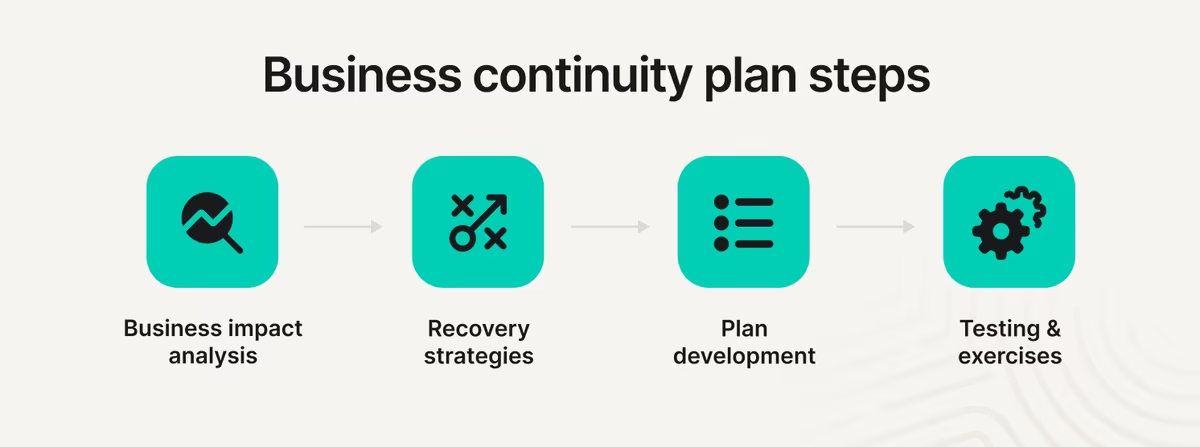
Business continuity plan steps

Here are the 3 main business continuity plan pillars that an organization looking to develop a BCP should consider:

Risk assessment and impact analysis

Any business continuity planning process should start with the identification of potential threats and vulnerabilities. All threats and vulnerabilities should be prioritized and systematized so that the organization can take steps to mitigate and manage them.

Once risks are identified, they should be followed by an assessment of the potential impact of these disruptions on critical business functions and resources. The analysis phase should also include assessing different levels of risk. This will help determine the most essential services or systems that have to be maintained during a crisis and how long they can stay offline before causing significant damage to the business.

Recovery strategies and plan development

Once you have a clear overview of the potential risks your company could face, start developing a plan. Create a draft and reassess it to see if it accounts for even the smallest of details, including alternative locations, communication plans, and how to restore critical functions.

Implementation, testing, and maintenance

A business continuity plan cannot be completed without regular implementation, testing, and maintenance:

  • Implement the BCP within the organization by providing staff with training sessions to familiarize them with the plan.

  • Run through a variety of scenarios in training sessions to assess the plan’s overall effectiveness. By doing so, everyone on the team will be closely familiar with the business continuity plan’s guidelines.

  • Tune your continuity plan to recent developments to ensure the plan remains relevant as the business and landscape change.

Business continuity planning standards

Business continuity plans don’t just appear out of thin air. They must strictly adhere to industry standards, including ISO and regional standards, to ensure that business is sufficiently prepared for a crisis scenario.

Following a standard is advantageous to businesses as the relevant information and the requirements are continuously being updated. This ensures that the implemented strategies don’t fall behind the security requirements. The ISO 223XX standard series, in particular, aims to provide a clear and internationally recognized framework for continuity planning.

ISO 22301

ISO 22301, or the Security and Resilience Standard, provides organizations with a framework to plan, operate, improve, and otherwise maintain response and recovery strategies. The business continuity plan acts as the documented management system (known as a business continuity management system, or BCMS) that aims to prevent disruptive incidents and, if they occur, ensure a full recovery. It goes hand in hand with ISO 22313.

ISO 22313

This business continuity plan standard provides guidance on implementing the ISO 22301 requirements. It details the precise steps on how the business continuity management system should be implemented in an organization.

ISO 27001

ISO 27001 provides a framework for managing information security. This standard ensures that an organization implements the right risk assessment and controls to upkeep the development, improvement, and protection of information management systems (ISMS). The NordPass ISMS is certified according to ISO 27001.

ISO/IEC 27031

These guidelines cover the principles of how ready an organization’s information and communication technology (ICT) infrastructure should be for business continuity. It covers all potential events and incidents that may impact the infrastructure, leading to the implementation of a BCP.

ISO 31000

ISO 31000, or the Risk Management Standard, exists to help all organizations handle potential risks. Its main purpose is to allow organizations to compare their internal risk management practices to the global standards. However, ISO 31000 can’t be used for certification purposes.

Level up your company’s security with NordPass Business

A comprehensive business continuity plan is vital for the entire organization’s security posture. However, in a perfect world, you wouldn’t have to use it. That’s is where NordPass Business can help.

Weak, reused, or compromised passwords are often cited among the top contributing factors in data breaches – unsurprising, considering that an average user has around 170 passwords. Password fatigue is real and significantly affects how people treat their credentials. NordPass Business counters these issues.

With NordPass Password Manager for IT Teams, your team will have a single secure place to store all work-related passwords, credit cards, and other sensitive information. Accessing all the data stored in NordPass is quick and easy, which allows your employees not to be distracted by the task of finding the correct passwords for the correct account.

NordPass Enterprise helps keep your corporate credentials secure at all times. Everything stored in the NordPass vault is secured with advanced xChaCha20 encryption, which would take hundreds of years to brute force.

If you’are interested in learning more about NordPass Business and how it can help fortify corporate security, do not hesitate to book a demo with our representative.

About NordPass
NordPass is developed by Nord Security, a company leading the global market of cybersecurity products.

The web has become a chaotic space where safety and trust have been compromised by cybercrime and data protection issues. Therefore, our team has a global mission to shape a more trusted and peaceful online future for people everywhere.

About Version 2 Digital

Version 2 Digital is one of the most dynamic IT companies in Asia. The company distributes a wide range of IT products across various areas including cyber security, cloud, data protection, end points, infrastructures, system monitoring, storage, networking, business productivity and communication products.

Through an extensive network of channels, point of sales, resellers, and partnership companies, Version 2 offers quality products and services which are highly acclaimed in the market. Its customers cover a wide spectrum which include Global 1000 enterprises, regional listed companies, different vertical industries, public utilities, Government, a vast number of successful SMEs, and consumers in various Asian cities.

How Traceloop protected its LLM dev workflow and met SOC2 compliance

Summary: Learn how Traceloop locked down AWS access, passed SOC 2 compliance, and saved hours with NordLayer’s dedicated IP.

Results at a glance. 1 year of using NordLayer. 100% of employees secured. IT hours saved weekly. SOC 2 compliance support. Secured access to AWS cloud environments

Established in 2022, Traceloop is a seed-stage startup based in Israel. It creates platforms that help companies worldwide build and improve their large language model (LLM) apps. The team consists of eight on-site employees and one remote worker based in Ukraine.

Focus features: Server with a dedicated IP. 2022 Year of establishment. Service scale: Global. Team presence: Tel-Aviv, Israel, Ukraine. Work policy On-site, Remote. Industry sector: Software that helps build and manage Al-powered apps

Before NordLayer, Traceloop didn’t have any security solution in place. And like many early-stage startups, its team focused exclusively on building products.

Knowing that their SOC 2 compliance audit was fast approaching, they needed a reliable and scalable solution that:

  • Helps secure access to their AWS-managed Kubernetes clusters
  • Supports SOC 2 compliance

The challenge: Securing access to DevOps environments

We spoke with Gal Kleinman, CTO and co-founder of Traceloop, about when security became a priority.

“We’ve always cared about security, but SOC 2 made us realize we needed tighter access controls to our cloud environments.”

The biggest issue was that their Kubernetes clusters were accessible from anywhere using AWS Command Line Interface (CLI), with no IP restrictions. Manually restricting access would’ve slowed down the team and introduced bottlenecks for developers.

They needed a solution that offers a server with a dedicated IP, works seamlessly with AWS, and could be set up in minutes, not days.

How NordLayer helped Traceloop

Traceloop needed a fast, reliable way to secure access to its cloud environments without adding unnecessary cost or complexity. As Gal Kleinman explains:

“With NordLayer, our team can now securely access our cloud resources, and I don’t have to spend much time managing it.”

Traceloop deployed NordLayer’s server with a dedicated IP, which was assigned to the company through a Virtual Private Gateway.

NordLayer Control Panel Network Gateways

Benefit 1: Fast NordLayer’s deployment

Traceloop was looking for a solution that was easy to use and set up. NordLayer’s deployment was simple:

  • Log in to NordLayer.
  • Invite the team members.
  • They click the link, download the app, and it installs automatically.
  • Within minutes, they’re securely connected.

“Everything took four or five minutes—start to finish.”

Benefit 2: Secure cloud access with a dedicated IP

To secure AWS access and meet SOC 2 compliance, Traceloop assigned a server with a dedicated IP to the Virtual Private Gateway. This ensured the whole team could connect through the same IP address, regardless of where they were.

Popup of NordLayer Control Panel Network Gateways

For a small team managing security themselves, this simplicity was a huge benefit. Setup was fast and straightforward. And they met all SOC 2 requirements without disrupting workflows or slowing down product development.

Results

After one year of using NordLayer, Traceloop achieved the following results:

  • Locked-down cloud access: Secure access to staging and production environments.
  • SOC 2 compliance support: Fast, compliant access controls for audit readiness.
  • Scales with the team: 8 out of 9 team members use NordLayer daily, and the setup is quick and effortless.
  • Many IT hours saved: NordLayer is easy to use and streamlines Traceloop’s workflows.

“NordLayer gave us a simple way to secure AWS access with a dedicated IP. The whole team connects through the gateway, and I can control access without touching our workflows.”


Why NordLayer works for Traceloop

NordLayer was the perfect fit for Traceloop because it delivered exactly what the team needed: simplicity, security, and zero disruption to developer workflows.

As a small startup without a dedicated IT team, Traceloop needed a solution that just worked, right out of the box:

  • Secure access with a dedicated IP. Locked down staging and production, eliminating open endpoints.
  • Set-up in minutes. NordLayer was fully deployed in under five minutes.
  • Works with existing tools. Integrated seamlessly with AWS Command Line Interface (CLI), so the team didn’t have to change how they work.

Pro cybersecurity tips

Gal Kleinman, CTO and co-founder of Traceloop, shared a few cybersecurity tips with us:

  • Keep it simple. Choose security tools that are easy to implement and use. Avoid overcomplicated setups that drain time and energy.
  • Protect without disrupting. Security measures should work quietly in the background, not block workflows or frustrate developers.
  • Balance security and speed. The best tools protect your systems and let your team move fast.
Quote: "Keep it simple. Choose security tools that are easy to implement and use. Avoid overcomplicated setups that drain time and energy."

Conclusion

Traceloop chose NordLayer to secure its AWS access and streamline SOC 2 compliance without disrupting the team’s daily work.

“NordLayer gave me exactly what I needed—a dedicated IP, fast setup, and no disruption to how our team works.”

With NordLayer, Traceloop gained secure cloud access and an easy way to scale security as the team grows.

Need to secure your cloud workflows without slowing your team down? Learn how NordLayer can help you with that.

Talk to our sales team to find the right plan for your team.


About NordLayer
NordLayer is an adaptive network access security solution for modern businesses – from the world’s most trusted cybersecurity brand, Nord Security.

The web has become a chaotic space where safety and trust have been compromised by cybercrime and data protection issues. Therefore, our team has a global mission to shape a more trusted and peaceful online future for people everywhere.

About Version 2 Digital

Version 2 Digital is one of the most dynamic IT companies in Asia. The company distributes a wide range of IT products across various areas including cyber security, cloud, data protection, end points, infrastructures, system monitoring, storage, networking, business productivity and communication products.

Through an extensive network of channels, point of sales, resellers, and partnership companies, Version 2 offers quality products and services which are highly acclaimed in the market. Its customers cover a wide spectrum which include Global 1000 enterprises, regional listed companies, different vertical industries, public utilities, Government, a vast number of successful SMEs, and consumers in various Asian cities.