338,144,752 children. Yes, you read that right, roughly 300 million children have been exposed to harmful content online. It’s more than just some numbers. It’s the collective innocence of our future generations at stake.
According to UNICEF, the global population of children under 18 stands at a staggering 2,415,319,658, and of those aged 9-13—roughly 483,063,932 children—seven out of 10 have encountered inappropriate or dangerous content while browsing the internet.[1][2]Content Filtering Software for Schools
The internet, while a way to infinite knowledge, has also become a minefield of risks for children, from explicit material to cyberbullying and scams. With such a massive number of young minds under threat, the pressing question is: are we doing enough to shield them?
How can we unravel the problem and explore the solution?
Understanding web filtering in schools
After reading the numbers you might wonder that you were sending your kids to school every day to learn but they might be the ones distracted by harmful content, cyberbullies, or sites that offer nothing but junk. Sounds like a nightmare, right?
Well, that’s exactly why web content filtering exists. It helps make sure that students stay on track, focused on their education, and away from all the dangerous stuff lurking online.
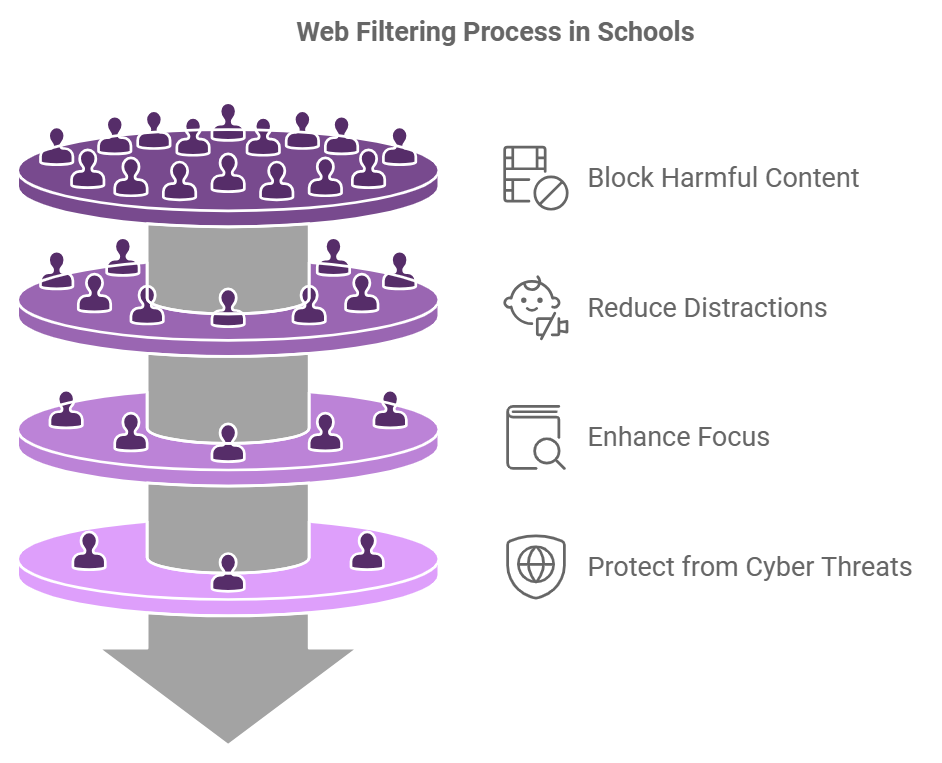
Internet filtering in schools isn’t as complicated as it might sound. In simple terms, it’s a system that blocks access to websites or content that could be harmful—whether that’s explicit material, violent content, or even distractions like social media.
But here’s the thing: web filters don’t just stop at blocking bad content. They also help students stay focused on the right stuff—learning. With the right filters, schools can ensure that students aren’t sidetracked by online games, random videos, or other distractions during study time.
It’s as if setting a study timer on your phone—but for the entire school.
On top of that, web filters act as shields against the growing number of cyber threats. We’re talking about phishing scams, malware, and cyberbullying—risks that can wreak havoc not just on a student’s safety but on their mental health as well. These dangers are kept at bay with web filtering software for schools, creating a safer and more productive environment.
The Problem: The real dangers of an unfiltered internet
The internet, for all its potential, is full of dangers. And without proper web filtering, schools leave students vulnerable to a range of problems.
Here are the top 5 threats that make web filtering a must-have:
1. Exposure to explicit content
We’re talking about graphic images, violence, and explicit material—things that no child should stumble upon while browsing the web. Yet, without web filters, students are just a click away from encountering inappropriate content.
2. Cyberbullying
It’s not just face-to-face bullying that we need to worry about anymore. Cyberbullying is a major concern, and it can have devastating effects on a child’s mental health. With web filters in place, students can be shielded from harmful interactions, ensuring they have a safer space to learn.
3. Scams and phishing attacks
The internet is a goldmine for scammers, and children are prime targets. From fake websites to phishing emails, it’s easy for students to fall for tricks that could steal their personal information. Web filters block these sites, preventing students from becoming victims.
4. Malware and viruses
The internet is full of shady websites and downloads that can infect devices with malware or viruses. These threats can compromise school networks and put personal data at risk. A strong web filter stops these malicious sites in their tracks, ensuring students and their devices stay safe.
5. Distractions that waste time
Think about the number of times you’ve clicked on random videos or games while you should be doing something else. Now imagine students doing the same during class. Without proper web filtering, distractions are everywhere, preventing students from focusing on their studies.
The Solution: web filtering software to the rescue
So, how do we stop these problems from derailing our kids’ education and safety? Solution: Web filtering software for schools.
Here’s how it works:
Blocks harmful content
Web filters prevent access to inappropriate websites by scanning for specific keywords, categories, or URLs. Schools can customize these filters to block everything from explicit material to violent content, making sure students can’t stumble upon harmful websites.
Focuses students’ attention
With distractions like social media, games, and random videos out of the equation, web filtering helps students stay focused on the task at hand—learning. This is particularly important during school hours when students need to stay engaged in their lessons and educational resources.
Protects against cyber threats
A solid web filter does more than block inappropriate sites—it also protects students from cyber threats like phishing scams, malware, and identity theft. By stopping these dangerous sites before they can do harm, web filters keep students safe and secure while they navigate the web.
Protection for schools
One of the best parts of content filtering software for schools is that it can be tailored to meet specific needs. Filters can be set based on the grade level, the subject being studied, or even specific content areas that need to be restricted or encouraged.
Real-time monitoring and reporting
Most web filtering systems offer real-time monitoring and reports, which means educators and administrators can track what students are accessing online. This allows for quick action if anything inappropriate or dangerous is spotted, keeping everyone accountable.
A safer, smarter digital world for students with Veltar
At the end of the day, the internet is an incredible resource, but without the proper safeguards, it can also be a dangerous place. With the alarming statistics highlighting that approximately 338 million children have been exposed to harmful content online, it’s imperative for educational institutions to implement measures to protect their students.
One effective solution is the deployment of web filtering software, such as Veltar.
Veltar is a comprehensive endpoint security solution that helps protect data at rest and in motion. It offers features like web content filtering, VPN tunneling, I/O device access control, and application control, providing a unified approach to endpoint security.
By integrating Veltar into school networks, administrators can prevent access to inappropriate websites by scanning for specific keywords, categories, or URLs. You can select categories of websites to block and enter specific domains to restrict.
Keep students immersed in meaningful learning by cutting out distractions like social media and games.
About Scalefusion Scalefusion’s company DNA is built on the foundation of providing world-class customer service and making endpoint management simple and effortless for businesses globally. We prioritize the needs and feedback of our customers, making sure that they are at the forefront of all decision-making processes. We are dedicated to providing comprehensive customer support services, and place emphasis on customer-centric thinking throughout the organization.
About Version 2 Digital
Version 2 Digital is one of the most dynamic IT companies in Asia. The company distributes a wide range of IT products across various areas including cyber security, cloud, data protection, end points, infrastructures, system monitoring, storage, networking, business productivity and communication products.
Through an extensive network of channels, point of sales, resellers, and partnership companies, Version 2 offers quality products and services which are highly acclaimed in the market. Its customers cover a wide spectrum which include Global 1000 enterprises, regional listed companies, different vertical industries, public utilities, Government, a vast number of successful SMEs, and consumers in various Asian cities.
The use of mobile devices has increased dramatically in recent years and will continue to do so with the rapid growth of EMM (enterprise mobility management). Managing these devices is crucial to safeguarding data and the devices that handle critical business information and functions. UEM is the best solution for managing and securing dedicated devices.
Dedicated devices are company-owned devices that can be employee-facing or customer-facing. They include self-check-in systems, point-of-sale (POS) systems, digital signage, retail store billing, checkout systems, and airport ticket printing desks, to name a few. The devices fulfill a single-use case by running in kiosk mode which can be single-app or multi-app. Dedicated devices perform essential business functions and hence need to run without any interruptions.
Some common examples of customer-facing dedicated devices are ATMs for cash transactions, digital signage in hotels for advertisements, baggage check-in at airports, POS terminals, handheld devices used as barcode scanners as well as for navigation, and dedicated tablets used for educational purposes.
Some employee-facing dedicated devices are for inventory management in logistics, handheld devices used by healthcare professionals, and vehicle-mounted devices used by drivers in transportation.
However, these devices can’t run independently and are required to be managed remotely. Usually, the devices are unattended and run in dedicated kiosk mode. Communicating with these devices in the field and ensuring timely updates on these devices can be best done using a dedicated device management solution like a Unified Endpoint Management (UEM) solution.
Corporate-owned dedicated devices don’t store content and information, and it’s crucial to push updated content regularly to these devices as they perform mission-critical functions. UEM enables you to update, troubleshoot, interact, and pass commands to devices remotely. UEM also simplifies configuring devices and provisioning them, enforcing policies, and ensuring device and data security.
How Does Dedicated Device Management Work?
A dedicated computer or dedicated hardware is often locked to a single application or a set of applications to serve a specific purpose, ensuring efficiency and security. This is achieved using either single-app kiosk mode or multi-app kiosk mode, based on the use case:
Multi-app kiosk mode: When a device needs to run multiple applications, it operates in a multi-app kiosk mode. With the help of a kiosk launcher, admins can easily switch between apps and manage various functions. This approach is perfect for devices used in environments that demand versatility while still maintaining the dedicated purpose of the hardware.
Single-app kiosk mode: In this setup, the device is locked to a single application, providing IT admins extensive control over the device’s functionality. They can configure peripheral settings to ensure seamless operation. Once locked, the application launches automatically and remains on the screen, even after the device restarts or shuts down. This makes it ideal for scenarios requiring a focused, dedicated hardware solution.
When it comes to types of hardware devices, dedicated hardware plays a pivotal role in streamlining specific operations across various industries. These devices are categorized based on their purpose and functionality:
Single-Use Hardware Devices These devices are designed to perform one specific task, often operating in single-app kiosk mode. Examples include:
Point-of-Sale (POS) Systems: Optimized for transaction processing.
Digital Signage Devices: Built to display content like advertisements or announcements.
Self-Service Kiosks: Used for ticketing, check-ins, or orders.
Multi-Function Hardware Devices These devices run multiple applications while maintaining a dedicated purpose, utilizing multi-app kiosk mode for flexibility. Examples include:
Retail Tablets: Supporting inventory management, customer assistance, and payment apps.
Educational Tablets: Configured with a suite of learning applications for students.
Medical Devices: Designed for patient records, monitoring, and diagnostics.
Industrial Hardware Devices Built for durability and reliability, these devices are essential in demanding environments, such as:
Barcode Scanners: Used for inventory tracking and warehouse management.
Fleet Management Devices: Installed in vehicles to monitor operations and logistics.
IoT Sensors: Designed for data collection and automation in industrial setups.
Benefits of Using Dedicated Devices
Using dedicated devices, particularly those managed with a UEM solution, brings numerous advantages for businesses.
Here are the key benefits:
Manage Content and Applications
The purpose of a dedicated device can evolve, requiring changes in the content or applications it runs. UEM software ensures smooth updates by allowing admins to silently install or uninstall apps without relying on end users. This reduces device downtime significantly. Through the UEM dashboard, admins can push apps from the Play Store or deploy enterprise apps directly from the Enterprise Store, making management efficient.
Ensure Endpoint Security
UEM solutions play a critical role in securing Android-dedicated devices and other platforms. They encrypt sensitive corporate data, preventing unauthorized access. With kiosk mode, admins gain full control over device settings, including peripherals, ensuring minimal end-user interference. Furthermore, network configurations such as Wi-Fi are managed to connect devices exclusively to corporate-approved networks. Automated OS updates ensure devices remain protected from malware and viruses.
Protect Lost or Stolen Devices
When devices are lost or stolen, UEM solutions provide critical security features like factory reset protection for Android devices. Admins can remotely lock the device, wipe sensitive data, and prevent misuse of corporate information. Location tracking and location history monitoring via the UEM dashboard ensure admins can quickly locate devices or enforce location-specific policies.
Remote Troubleshooting of Devices
Remote cast and control capabilities allow IT admins to address technical issues immediately. By casting the device screen to the UEM dashboard, admins can resolve glitches or sync files remotely, significantly reducing downtime. This feature is particularly valuable for dedicated devices operating in unattended locations, where physical access is challenging during disruptions.
G2 Review
Some Popular Examples of Dedicated Devices
Dedicated devices are designed to serve specific purposes, offering reliability and efficiency across various industries. Here are some dedicated devices examples that showcase their diverse applications:
Point-of-Sale (POS) Terminals: Used in retail and hospitality, these devices handle transactions and ensure smooth customer checkouts.
Digital Signage Systems: Display advertisements, announcements, or schedules in retail stores, airports, and public spaces.
Self-Service Kiosks: Found in ticketing counters, restaurants, and banks, these kiosks simplify customer interactions and reduce wait times.
Rugged Industrial Devices: Built for warehouse or field operations, these include barcode scanners and handheld terminals.
Healthcare Monitoring Devices: Used in hospitals for patient monitoring, diagnosis, and medical record access.
Key Considerations When Choosing Dedicated Devices
Selecting the right dedicated device is essential for meeting business needs while ensuring reliability and security. Here are some key factors to consider:
Purpose and Use Case: Clearly define the device’s role in your operations. Whether it’s for digital signage, POS, or rugged fieldwork, understanding the requirements will guide your choice.
Durability and Environment Suitability: If the device will be used in challenging environments, like warehouses or outdoor locations, ensure it has a rugged design and supports extreme conditions.
Management and Configuration Support: Choose devices that integrate seamlessly with a UEM solution to allow for remote management, app updates, and network configuration.
Security Features: Devices must offer strong security measures, such as encryption, kiosk mode, and remote locking or wiping capabilities, especially for corporate data protection.
Compatibility: Ensure the dedicated devices work with your existing software and infrastructure, including enterprise apps or specific operating systems like Android or iOS.
Pick Your UEM Alongside Your Dedicated Hardware
When investing in dedicated hardware, it’s crucial to pair it with a robust Unified Endpoint Management (UEM) solution. Here’s why this combination matters:
Streamlined Device Management A UEM solution allows IT admins to manage, monitor, and secure devices remotely. It ensures that the dedicated hardware always functions optimally by pushing updates, configuring settings, and deploying apps.
Enhanced Security Protect sensitive corporate data on your dedicated hardware through features like encryption, kiosk mode, and remote locking or wiping in case of theft or loss.
Flexible Adaptation to Business Needs UEM lets you reconfigure devices for new tasks or applications without replacing the hardware, extending its lifespan and value.
Minimized Downtime With remote troubleshooting and monitoring capabilities, admins can address technical issues immediately, ensuring uninterrupted device performance.
By choosing the right UEM solution alongside your dedicated hardware, you can maximize the functionality, security, and reliability of your devices, empowering your business operations.
The Final Words
Though dedicated devices help in executing different strategies for various businesses, the security of these devices is extremely important. Scalefusion UEM stands out as a versatile solution to efficiently manage a fleet of dedicated devices from a single console, offering robust data security and seamless management capabilities.
About Scalefusion Scalefusion’s company DNA is built on the foundation of providing world-class customer service and making endpoint management simple and effortless for businesses globally. We prioritize the needs and feedback of our customers, making sure that they are at the forefront of all decision-making processes. We are dedicated to providing comprehensive customer support services, and place emphasis on customer-centric thinking throughout the organization.
About Version 2 Digital
Version 2 Digital is one of the most dynamic IT companies in Asia. The company distributes a wide range of IT products across various areas including cyber security, cloud, data protection, end points, infrastructures, system monitoring, storage, networking, business productivity and communication products.
Through an extensive network of channels, point of sales, resellers, and partnership companies, Version 2 offers quality products and services which are highly acclaimed in the market. Its customers cover a wide spectrum which include Global 1000 enterprises, regional listed companies, different vertical industries, public utilities, Government, a vast number of successful SMEs, and consumers in various Asian cities.
The current global tech space, irrespective of the industry, has been fast and disruptive. In 2024, global technology spending is projected to grow by 5.3%, reaching $4.7 trillion. This growth is driven by robust investments, particularly a 5.4% increase in North America and 5.1% in Europe 5.7% in the Asia Pacific region[1].
As businesses increasingly rely on technology, managing and securing Windows devices has become more critical than ever. Mobile Device Management (MDM) solutions offer a way to manage and secure these devices while providing a seamless user experience.
Windows MDM solutions simplify this process by providing centralized tools for managing endpoints, deploying policies, and ensuring seamless device operations. Here’s a deep dive into some of the best Windows MDM solutions to consider.
This blog has a curated list of the five best Windows device management solutions you must consider in 2025.
Best Windows Mobile Device Management Software
1. Scalefusion MDM
Scalefusion is an intuitive and powerful MDM solution that offers device management for Windows 10 & 11 desktops and laptops across all available operating system versions. The Scalefusion Windows MDM platform provides complete management and control over corporate-owned, employee-owned, and shared Windows devices. Scalefusion is known for its all-encompassing suite of Windows 10 & 11 device management features that simplify and automate the everyday complex and mundane tasks of IT teams.
Why Scalefusion?
Scalefusion MDM offers modern device management Windows devices. The platform provides a user-friendly interface through a logically organized dashboard. This makes it easy for IT admins to remotely manage and secure Windows devices. Scalefusion offers some of the advanced features such as software metering to track and analyze the usage of software applications, location tracking and geofencing for location-based Windows device security.
Who It’s For?
Scalefusion MDM is suitable for businesses of all sizes looking to manage their Windows devices from a single platform. From enterprise IT teams to IT admins of educational institutes and NGOs, Scalefusion has the right set of offerings across industries.
Integration with other enterprise software (like ITSM, CRM, etc.)
Remote cast & control with VoIP
PowerShell scripts
Single- and multi-app kiosk mode for Windows (POS/mPOS management)
Unique Feature
One unique feature of Scalefusion Windows device management is its remote cast & control (with session recording and file transfer) feature that allows IT admins to remotely access Windows devices to troubleshoot any issue. This saves time and increases productivity for both IT teams and end users.
Pros
Easy and swift enrollment to ensure business ready devices
Conditional exchange settings for Windows (Office 365) device access
Microsoft Intune is a cloud-based mobile device management platform designed to help businesses manage mobile endpoints remotely. The platform provides comprehensive security features to protect devices and data, including conditional access policies, app protection, and device encryption.
Why Intune?
Microsoft Intune offers integration with other Microsoft products, making it an ideal choice for businesses that use Microsoft software. The platform offers comprehensive device management and security features and is suitable for businesses of all sizes.
Who It’s For?
Microsoft Intune is suitable for businesses of all sizes that want to manage devices remotely. The platform is especially useful for businesses that use other Microsoft products.
One unique feature of Microsoft Intune is its conditional access policies that allow businesses to set up security policies based on the user’s identity, device, and location. This ensures that only authorized users can access company data and enterprise apps.
Pros
Suitable for businesses of all sizes
Self-service features
Cons
The platform can be complex to set up and manage for non-technical users
Lot of add-on features with additional costs not suitable for SMBs
Incomplete App installations and updates
Complicated UI
Reasons to Buy
Technical expertise of support team
Data protection for un-enrolled devices as well
Pricing
Starts at $4 per user
Free trial available for 30 days
3. VMware Workspace ONE
VMware Workspace ONE is an MDM solution that provides a unified endpoint management platform for Windows devices. The platform offers a range of features for device management, security, and mobile application management.
Why Workspace ONE?
VMware Workspace ONE offers comprehensive device management and security features. The platform provides a range of tools for managing multiple devices, including remote management, app management, and security policies.
Who It’s For?
VMware Workspace ONE is suitable for large, globally distributed enterprises that want to manage their Windows devices remotely. The platform is especially useful for businesses that use other VMware products.
One unique feature of VMware Workspace ONE is its multi-factor authentication, which provides an extra layer of security to protect devices and data. This ensures that only authorized users can access company data and applications.
Pros
Comprehensive device management and security features
Intelligent insights and analytics
Cons
Steep product learning curve
Requires frequent maintenance
Prohibitive for smaller businesses or organizations
Reasons to Buy
Good option for frontline workers
Simplified access management
Pricing
Essential plans start at $3 per user
30-day free trial
4. Cisco Meraki Systems Manager
Cisco Meraki Systems Manager is a cloud-based mobile device management platform that provides comprehensive management and security features for Windows devices. The platform offers a range of features for device management, security, and application management.
Why Meraki?
Cisco Meraki Systems Manager has security features for comprehensive device management capabilities. The platform offers a range of tools for securing and managing mobile devices, including remote management, app management, and security policies.
Who It’s For?
Cisco Meraki Systems Manager suits enterprises that want to manage their Windows devices remotely. The platform is especially useful for businesses that use other Cisco products.
Key Features
App access with remote control capabilities
Integration with other Cisco products
Network visibility and control
Unique Feature
One unique feature of Cisco Meraki Systems Manager is its network visibility and control, which allows IT admins to monitor network activity and block suspicious traffic. This prevents data breaches and ensures compliance with industry regulations.
Pros
Zero-trust network support
Automated network security
Cons
Location tracking can be inconsistent
Limited support for advanced networking features.
Pushing device configuration can be time-consuming
Reasons to Buy
Scalability
Prompt customer support
Pricing
Available on request
Free trial available
5. IBM MaaS360
IBM MaaS360 is a cloud-based mobile device management platform that provides comprehensive management and security features for Windows devices. The platform offers a range of features for device management, security management, and application management.
Why MaaS360?
IBM MaaS360 offers a range of tools for managing and securing Windows devices, including remote management, app management, and security policies.
Who It’s For?
IBM MaaS360 is suitable for enterprises of all sizes that want to manage their Windows devices remotely. The platform is especially useful for businesses that use other IBM products.
Key Features
AI-driven UEM
Integration with other IBM products
Containerization for secure access to corporate data
Unique Feature
One unique feature of IBM MaaS360 is its containerization feature, which allows IT administrators to create secure containers on Windows devices that provide access to corporate data without compromising device security.
Pros
Watson integration
Native security features
Cons
The platform can be complex to set up and manage for non-technical users
Some features require additional licensing fees
Poor user access management capabilities
Reasons to Buy
Granular patch management
AI-based policy recommendations
Pricing
Starts at $4 per device/month
30-day free trial
Key Takeaways
Here’s a concise overview of the key features and strengths of leading MDM solutions—Scalefusion, Microsoft Intune, VMware Workspace ONE, Cisco Meraki Systems Manager, and IBM MaaS360—designed to help you make an informed choice for your organization.
A unified Windows management platform for managing legacy and modern devices laptops, desktops, tablets, POS terminals, and digital signage displays. Experience modern management features for advanced management of Windows-based devices and servers.
Microsoft Intune
Enterprise-level MDM solution with integration across the Microsoft product suite. Offers mobile devices and app management, conditional access, and endpoint protection.
VMware Workspace ONE
MDM solution for enterprises with a large number of devices. Offers device enrollment, app management, and security features.
Cisco Meraki Systems Manager
Cloud-based MDM solution with network security and endpoint management features. Offers remote access feature for device control and monitoring.
IBM MaaS360
Comprehensive MDM solution with app management, security policies, and containerization for secure access to corporate data. Offers integration with other IBM products.
Choosing the Right Windows MDM Solution for Your Business in 2025
Managing Windows devices effectively requires robust MDM solutions that balance security and ease of use. The five MDM solutions outlined—Scalefusion MDM, Microsoft Intune, VMware Workspace ONE, Cisco Meraki Systems Manager, and IBM MaaS360—are among the top choices for Windows device management in 2025.
These solutions provide comprehensive device management and security features tailored for Windows 10 and 11, making them suitable for businesses of all sizes. Each platform offers distinct features that set it apart from competitors. By evaluating the pros and cons of each, you can determine which Windows MDM solution best aligns with your business needs.
About Scalefusion Scalefusion’s company DNA is built on the foundation of providing world-class customer service and making endpoint management simple and effortless for businesses globally. We prioritize the needs and feedback of our customers, making sure that they are at the forefront of all decision-making processes. We are dedicated to providing comprehensive customer support services, and place emphasis on customer-centric thinking throughout the organization.
About Version 2 Digital
Version 2 Digital is one of the most dynamic IT companies in Asia. The company distributes a wide range of IT products across various areas including cyber security, cloud, data protection, end points, infrastructures, system monitoring, storage, networking, business productivity and communication products.
Through an extensive network of channels, point of sales, resellers, and partnership companies, Version 2 offers quality products and services which are highly acclaimed in the market. Its customers cover a wide spectrum which include Global 1000 enterprises, regional listed companies, different vertical industries, public utilities, Government, a vast number of successful SMEs, and consumers in various Asian cities.
Organizations have become heavily dependent on Windows-based laptops and desktops. According to Statcounter, Windows holds the largest market share at 73.41% as of October 2024[1]. This makes managing and securing Windows devices and the data they contain, a critical aspect of security.
To enhance these management and security efforts, Scalefusion UEM offers GeoFencing for Windows devices, a feature that automatically secures Windows devices and data based on their physical location. By defining specific geographic boundaries, businesses can proactively enforce security measures, ensuring that devices entering or leaving these zones are automatically protected.
To provide you with a better understanding, this blog explains how Scalefusion’s GeoFencing for Windows can enhance the security of your Windows-based devices and servers, keeping your data safe and secure.
Understanding GeoFencing for Windows 10 and above Devices
Geofencing is a virtual perimeter that allows organizations to create predefined virtual boundaries around real geographic areas. For Windows devices, geofencing enables IT administrators to restrict user’s actions on the device based on its location.
By defining these virtual boundaries through a Unified Endpoint Management solution, organizations ensure that devices comply with their security protocols when entering or leaving designated zones. This includes restricting access to sensitive data, enabling specific apps, and sending alerts to administrators.
Geofencing works by using location-based services such as GPS, Wi-Fi, or cellular networks. When a Windows device crosses the defined boundary, it triggers pre-configured actions automatically. For instance, if a device exits an organization’s premises, it may block access to its networks or resources.
This capability enhances security by preventing unauthorized access risks and improves operational efficiency by automating policy enforcement, making geofencing a critical feature for modern IT management.
The need for Windows GeoFencing in modern enterprises
In the early stages of geofencing, it was primarily used by retailers to send SMS notifications to potential customers, driving engagement and foot traffic. However, with the advancements in tech and a sudden rise in the use of mobiles and desktops in enterprise settings, geofencing capabilities also evolved.
Today, modern enterprises use geofencing to monitor and manage fleets of endpoints, including mobile devices, desktops, and laptops based on their location. While geofencing initially gained traction for tracking Android and iOS devices, its application expanded with the increasing reliance on Windows-based desktops and laptops.
Organizations today are heavily reliant on Windows devices for daily operations. The significance of geo-fencing in modern businesses lies in its ability to provide real-time device location. Geofencing addresses the growing need for location-based security, ensuring sensitive organizational data remains protected based on device location.
Irrespective of the type of workforce – on-premise, remote, or globally distributed, organizations face common challenges like managing a large inventory of Windows devices, securing sensitive data, and adhering to compliance standards. Geofencing addresses them by enabling IT admins and businesses to define rules and policies based on the device location for maintaining device and data security.
For CIOs and IT admins of modern-day enterprises, adopting Windows geofencing is not just about enhancing security – it’s about staying ahead of modern IT challenges. Geofencing aligns context-based device management with current business needs, allowing enterprises to operate smarter and more efficiently.
With vs. Without GeoFencing: A comparison
The table below highlights the key differences between operating with and without geofencing, demonstrating how it enhances security, compliance, and device management.
Aspect
Without Geofencing
With Geofencing
Data Security
Increased risk of unauthorized data access.
Restrict access to sensitive data or applications outside designated zones.
Device Usage Control
Lack of control over device usage in sensitive locations.
Monitor company devices or assets across multiple locations.
Compliance Management
Challenges in ensuring compliance with local policies.
Ensure adherence to data protection laws by enabling location-based policies.
Device Location
Unable to track the location of lost or stolen devices
Track the exact location of the lost, unattended, or stolen devices
Industry-Specific Use Cases of Windows GeoFencing
Windows devices are widely adopted across industries due to their versatility, scalability, and extensive software compatibility. Below are use cases of industries that benefit from Windows geofencing:
1. Corporate Sector
Corporate organizations rely on Windows devices for tasks such as document creation, collaboration, and accessing business applications. Geofencing helps enforce location-based policies to secure data access by ensuring knowledge workers can access devices and company resources only within designated office premises or authorized locations.
For instance, a consulting firm like Deloitte may use geofencing to restrict access to confidential project files and applications on Windows devices to office premises or approved locations, ensuring data security and compliance.
2. Healthcare
Healthcare organizations maintain private patient records on their devices. Geofencing ensures that sensitive patient data can only be accessed within designated hospital or clinic premises, reducing the risk of data breaches.
For example, a hospital using Windows laptops and tablets ensures compliance with HIPAA by geofencing access to devices with medical records on hospital premises.
3. Education
Modern educational institutions have IFPDs installed for teaching purposes. Moreover, students use Windows devices in computer labs. Geofencing ensures that when these devices are within campus boundaries students and teachers access only appropriate websites and applications maintaining a controlled environment.
For instance, a university deploys Windows laptops for exams and geofences them to specific classrooms, ensuring students cannot access external networks or resources during the test.
4. BFSI
Windows devices in banks and financial institutions are used for maintaining customer transactions and data. Geofencing restricts access to sensitive customer databases to office locations, ensuring compliance with financial regulations such as PCI DSS.
For example, a bank like JPMorgan Chase must use geofencing to ensure financial data on their Windows devices is accessible only within branch locations or secure office environments.
Key features of Windows GeoFencing with Scalefusion UEM
Scalefusion’s Windows Geofencing allows you to track the movement of Windows-based devices and servers across predefined geographical boundaries. This feature creates a virtual perimeter around a specific region, enabling seamless tracking of Scalefusion-managed devices as they enter or exit the designated area. Here are some features you get to leverage:
1. Customizable Geofences
Scalefusion enables you to remotely create and manage multiple geofences at once. You can create two types of geofences for your Windows devices:
a. Circular GeoFence
A circular geofence creates a defined area based on a central point and a specified radius. This type of geofence is ideal for straightforward work locations. For example, users can access applications or log in to their devices only within the boundaries of an office or a school building. Circular geofences are quick to configure and particularly effective for smaller or regularly shaped areas.
b. Polygonal GeoFence
A polygonal geofence offers more granular customization allowing users to draw irregular boundaries on the map. This feature is useful for complex or non-standard locations, such as large industrial zones or university campuses. By marking precise points on the map, IT administrators can establish more accurate boundaries, ensuring that devices are managed in line with the specific location needs.
2. GeoFence-based Switch Profile
Scalefusion’s Windows Workflows lets you schedule automatic switching to pre-configured device profiles based on the GeoFence event. For example, school laptops can automatically switch to a restricted profile when they enter a geofenced campus, limiting access to educational apps and websites. However, outside the campus, they may revert to a flexible device profile while still maintaining essential security controls.
3. GeoFence Compliance
GeoFence Compliance allows you to create compliance based on the ‘moved in’ and ‘moved out’ events. For example, a hospital can create a GeoFence around its premises, restricting the access of sensitive patient data to devices once they enter the fenced area. This helps healthcare organizations maintain compliance with regulations like HIPAA, ensuring that patient information is protected while blocking data access outside designated areas.
4. GeoFence Logs
Geofence logs record device activity whenever a device enters or exits the designated geofenced area. These logs include precise timestamps of each event for accurate tracking.
5. Real-Time Alerts
Scalefusion provides real-time notifications in case a device breaches a geofence. This allows you to take timely data security measures such as remote data wipe and device lock. Real-time alters enable you to make informed decisions to ensure data security by preventing device or data abuse.
Take a step towards advanced Windows Geofencing with Scalefusion UEM
Scalefusion UEM Windows Geofencing offers a simple and effective way to enhance security and manage devices based on location. By setting up customizable geofences and automated workflows, you can ensure that devices stay secure and compliant, on-site or remote. Scalefusion UEM is a smarter step towards modern Windows device management for your IT teams.
About Scalefusion Scalefusion’s company DNA is built on the foundation of providing world-class customer service and making endpoint management simple and effortless for businesses globally. We prioritize the needs and feedback of our customers, making sure that they are at the forefront of all decision-making processes. We are dedicated to providing comprehensive customer support services, and place emphasis on customer-centric thinking throughout the organization.
About Version 2 Digital
Version 2 Digital is one of the most dynamic IT companies in Asia. The company distributes a wide range of IT products across various areas including cyber security, cloud, data protection, end points, infrastructures, system monitoring, storage, networking, business productivity and communication products.
Through an extensive network of channels, point of sales, resellers, and partnership companies, Version 2 offers quality products and services which are highly acclaimed in the market. Its customers cover a wide spectrum which include Global 1000 enterprises, regional listed companies, different vertical industries, public utilities, Government, a vast number of successful SMEs, and consumers in various Asian cities.
Organizations face unprecedented challenges as cyber threats become increasingly sophisticated, enabling sensitive data protection more critical than ever. Conditional access is at the helm of this security effort, utilizing tailored permissions based on criteria such as user identity, device trust, location trust, and contextual factors.
But what if optimizing conditional access hinges not only on technology but also on understanding human behavior?
Empowering Teams: Human Factors in Conditional Access Management
Establishing a strong human-centric conditional access strategy
Access management and its purpose
Access management encompasses the processes and technologies that allow organizations to control who can access their systems and data. It includes identity management, authentication, authorization, and auditing. The primary goal is to ensure that only authorized users can access sensitive information, reducing the risk of data breaches and ensuring compliance with regulations.
Take solutions like OneIDP as an example to incorporate access management frameworks, organizations can achieve more seamless identity verification and robust security protocols, ensuring that only authorized users gain access to sensitive data.
Understanding Conditional Access
Conditional access is a security approach that dynamically adjusts access permissions based on conditions like user identity, device status, location, and behavior. Unlike traditional static controls that rely solely on user credentials, this method allows organizations to adapt their security posture to the current context, enhancing protection against unauthorized access while ensuring legitimate users can easily access necessary resources.
Key Components of Conditional Access
User Identity: Knowing the user is fundamental to any access management strategy, utilizing methods like Single Sign-On (SSO), multi-factor authentication (MFA), and biometric scans. Modern solutions such as OneIDP streamline user identity verification by providing a unified platform for managing access across various applications and systems, enhancing security while simplifying the user experience.
Device Trust: Assessing whether a device meets security standards—such as having up-to-date antivirus software and a secure operating system—is critical for establishing trust.
Location: Geographic context, including preferred locations or geofencing, helps determine risk. Accessing sensitive information from a known corporate location may warrant fewer controls than from an unfamiliar area.
Behavioral Context: User behavior analytics (UBA) is vital for shaping effective security practices. Understanding users’ interactions with systems can inform conditional access policies and help eliminate unknown malicious activity.
The Role of Zero Trust in Conditional Access
Integrating Zero Trust Access with conditional access can phenomenally enhance security by safeguarding sensitive data and enabling organizations to respond effectively to evolving cyber threats. Zero Trust Access is a critical framework that enhances conditional access strategies, providing a protected security posture for organizations.
Here’s how Zero Trust plays a vital role:
Never Trust, Always Verify: Challenges the notion of default trust, aligning seamlessly with conditional access policies that continuously verify users and devices before granting access to sensitive resources.
Granular Access Control: Think of Zero Trust like a high-security club where everyone is checked at the door, and conditional access ensures they only enter the areas they’re authorized to, minimizing risk.
Contextual Authentication: Emphasizes using real-time data to evaluate the context of each access attempt, ensuring additional authentication is triggered if a user accesses sensitive data from an unfamiliar device or location.
Continuous Monitoring and Response: It continuously monitors every movement, allowing conditional access to detect and respond to potential security threats in real-time.
Bridging Technology and Human Behavior
To create a strong conditional access framework, organizations must align technological capabilities with user behavior and needs. This includes designing user-friendly policies and leveraging data analytics to better understand and adapt to user actions. OneIDP simplifies the authentication process while aligning with user behaviors, making it easier for organizations to implement security policies that are both effective and user-friendly. Regular user feedback helps identify pain points and refine the user experience.
Designing User-Friendly Policies: Focus on simplifying authentication and providing clear guidelines that support productivity while maintaining security. User feedback is essential for identifying issues and improving the process.
Implementing Adaptive Security Measures: Adaptive security protocols adjust based on user behavior and risk levels. For instance, logging in from an unusual location can prompt additional authentication, maintaining security without burdening users.
The Benefits of a Human-Centric Access Management
Enhanced User Experience: Balancing security with usability minimizes friction, allowing legitimate users to access resources more easily.
Increased Compliance: A user-centric approach aids in meeting regulatory requirements, as informed and engaged users are more likely to adhere to access policies.
Reduced Risk of Insider Threats: Understanding user behavior and establishing clear access policies can help identify unusual patterns that may indicate insider threats.
Building an Ethical and Strong Security-Aware Culture
Creating a robust security-aware culture goes beyond strong policies and the latest technology. While technology provides essential protection, users remain the weakest link—phishing attacks, poor password hygiene, and careless handling of credentials can still compromise even the best systems. Therefore, prioritizing the human factor is critical for effective conditional access, integrating both technical skills and ethical decision-making into daily operations.
Employees need to understand the impact of their actions on security and feel empowered to make ethical decisions, while leaders set the tone by prioritizing transparency, explaining security measures, and establishing clear, rights-respecting access guidelines. This fosters a shared sense of responsibility, crucial to both the organization’s mission and customer trust.
Inclusivity is essential to an ethical security culture. Conditional access guidelines should provide alternative authentication methods, such as multifactor authentication (MFA), to accommodate diverse needs. Access policies must be flexible enough to address cultural and geographic differences, offering multiple secure authentication options (e.g., biometrics, PINs, or two-factor authentication) to respect regional preferences without compromising overall security. This ensures that security measures are not perceived as unfair or invasive.
Fairness in access control is critical to prevent discrimination based on location, device, or behavior. Policies must be free of bias to avoid unfairly targeting specific user groups. For instance, a potential issue can arise when an access control system uses behavior analytics to identify suspicious activity. If the system monitors login times and flags accounts with irregular login patterns, a user who occasionally logs in at unusual times—perhaps due to working late or traveling—could be incorrectly marked as a security risk.
To avoid such bias, policies should be designed to assess security risks based on a user’s actual behavior and risk profile, rather than making assumptions based on factors like location or device. Additionally, clear communication regarding the criteria for access decisions, along with an accessible appeals process, is essential for maintaining fairness. This ensures users feel heard and helps preserve trust in the system.
Creating a security-aware culture starts with comprehensive, ongoing training to ensure employees understand their critical role in access management and data protection. An informed workforce is more likely to follow best practices, reducing the risk of breaches and protecting both organizational assets and individual privacy.
To help organizations align security practices that are essential for the successful implementation of a conditional access strategy, here’s a 7-Point Checklist for Implementing Human-Centric Conditional Access.
7-Point Checklist for Implementing Human-Centric Conditional Access
By adopting this streamlined checklist, organizations can successfully implement a human-centric conditional access strategy that enhances security while empowering employees to actively protect sensitive information.
Engage Stakeholders: Involve key departments in policy development and gather feedback through workshops.
Implement Analytics: Use behavioral monitoring tools to establish user behavior baselines and detect anomalies.
Establish Reporting Protocols: Create clear channels for reporting suspicious activities and ensure employee awareness.
Review and Adapt Policies: Regularly assess and update access policies based on user feedback and evolving threats.
Promote Security Awareness: Conduct training sessions and awareness campaigns, recognizing employees who practice good security.
Document Access Policies: Write clear, accessible policies and integrate training into onboarding and ongoing education.
Monitor Compliance: Set metrics for policy adherence and conduct regular audits to identify areas for improvement.
Tracking regular updates will help ensure that this approach remains effective against the ever-evolving cyber threats.
Final Thoughts
As organizations prioritize the human factor in their conditional access strategies, they will be better equipped to navigate the evolving threat landscape, ultimately leading to a more secure and resilient digital future. Integrating the human element is essential for effective security in today’s complex environment. Organizations can enhance their access management frameworks by understanding user behavior, developing user-centric policies, and fostering a culture of security awareness.
OneIDP can empower your organization by streamlining identity management with comprehensive capabilities, including Single Sign-On (SSO), multi-factor authentication (MFA), and seamless integration with existing systems. This holistic approach not only strengthens security but also enables users to confidently access the resources they need while protecting sensitive information. Discover how OneIDP can transform your access management strategy today!
About Scalefusion Scalefusion’s company DNA is built on the foundation of providing world-class customer service and making endpoint management simple and effortless for businesses globally. We prioritize the needs and feedback of our customers, making sure that they are at the forefront of all decision-making processes. We are dedicated to providing comprehensive customer support services, and place emphasis on customer-centric thinking throughout the organization.
About Version 2 Digital
Version 2 Digital is one of the most dynamic IT companies in Asia. The company distributes a wide range of IT products across various areas including cyber security, cloud, data protection, end points, infrastructures, system monitoring, storage, networking, business productivity and communication products.
Through an extensive network of channels, point of sales, resellers, and partnership companies, Version 2 offers quality products and services which are highly acclaimed in the market. Its customers cover a wide spectrum which include Global 1000 enterprises, regional listed companies, different vertical industries, public utilities, Government, a vast number of successful SMEs, and consumers in various Asian cities.