Managing macOS applications presents a distinct challenge for IT administrators. Unlike iOS, where apps are centralized within the App Store, the majority of macOS apps are distributed through various external sources. This decentralized approach makes it difficult to monitor installations, manage updates, and ensure proper configurations.
At Scalefusion, we’ve taken on this challenge head-on, introducing a streamlined solution that redefines how enterprises manage macOS applications—simplifying processes, enhancing control, and minimizing administrative overhead.
This is why, we are excited to announce the App Catalog for macOS.
This feature is designed to streamline the way IT admins deploy, update, and manage third-party applications. With this release, we’re putting the control back in the hands of IT teams, ensuring a seamless experience for both admins and end-users.
What’s new?
The App Catalog for macOS introduces a suite of powerful features to enhance application management:
App Catalog: Give your users the freedom to install approved apps from a curated list known as the App Catalog, minimizing the need for IT support.
Centralized app installation and updates: Enable end-users to install and update 400+ third-party applications directly from the Scalefusion dashboard, saving time and reducing complexity.
Automated updates: Set up automatic updates for supported applications to ensure devices are always running the latest versions, eliminating the risks associated with outdated software.
Pre- and Post-installation scripts: Configure custom scripts to tailor application behavior before and after installation, catering to your organization’s specific needs.
Manage app permissions: Effortlessly auto-grant app permissions while ensuring security policy compliance with minimal user intervention.
How it works?
The macOS App Catalog leverages Installomator, a robust tool designed for seamless application installation and management. Here’s how it functions within Scalefusion:
Comprehensive catalog access: View and select 400+ applications directly on the Scalefusion dashboard.
Easy deployment: Once selected, apps can be deployed to device groups or profiles with just a few clicks.
Configurable options: Customize app installations with pre- and post-installation scripts to meet organizational requirements.
Real-time updates: Stay informed about app installation and update statuses to ensure uninterrupted functionality across devices.
Why App Catalog for macOS?
With App Catalog for macOS, we’re addressing one of the most significant pain points for IT teams, which is the efficient management of third-party applications on managed macOS devices.
This feature aims to simplify the application management lifecycle, right from deployment to updates, allowing IT teams to focus on strategic initiatives rather than operational hurdles.
Start simplifying macOS app management today
Scalefusion’s App Catalog for macOS is designed to make life easier for IT teams while enhancing the user experience for employees. We’re excited to introduce this feature as a step forward in enhancing macOS device management for IT teams. Your feedback is invaluable to us, so don’t hesitate to share your thoughts and suggestions at support@scalefusion.com.
About Scalefusion Scalefusion’s company DNA is built on the foundation of providing world-class customer service and making endpoint management simple and effortless for businesses globally. We prioritize the needs and feedback of our customers, making sure that they are at the forefront of all decision-making processes. We are dedicated to providing comprehensive customer support services, and place emphasis on customer-centric thinking throughout the organization.
About Version 2 Digital
Version 2 Digital is one of the most dynamic IT companies in Asia. The company distributes a wide range of IT products across various areas including cyber security, cloud, data protection, end points, infrastructures, system monitoring, storage, networking, business productivity and communication products.
Through an extensive network of channels, point of sales, resellers, and partnership companies, Version 2 offers quality products and services which are highly acclaimed in the market. Its customers cover a wide spectrum which include Global 1000 enterprises, regional listed companies, different vertical industries, public utilities, Government, a vast number of successful SMEs, and consumers in various Asian cities.
A device getting stolen or lost can lead to devastating consequences for businesses, whether they operate on-premises, remotely, or in a hybrid model. In fact, studies show that 41% of all data breaches are the result of lost or stolen devices, highlighting the urgent need for robust security measures.[1]
Remote wiping of Windows devices is an effective solution to mitigate this risk. By remotely erasing all data on a device, organizations can prevent unauthorized access to sensitive information, ensuring that even if a device is lost or stolen, the data remains secure.
Let’s explore how to remotely wipe data if your Windows laptop or desktop is lost or stolen, and discover the added benefits of using a UEM solution for this task. You’ll also learn how to remotely wipe a Windows device using Scalefusion UEM.
How to remote wipe a Windows computer?
1. By Enabling ‘Find My Device’ in Microsoft
Microsoft has its built-in ‘Find My Device’ feature that can help small businesses and individuals to remotely wipe Windows-based laptops and PCs.
Step 1. Enable Find My Device via Settings > Update & Security > Find My Device.
Step 2: Sign in to Your Microsoft Account.
Step 3: Select the lost or compromised device and choose the ‘Erase’ option.
2. Using Command Line Scripts
For IT professionals and advanced users, leveraging command-line scripting is a direct way to remotely wipe Windows devices. This method requires prior configuration of remote desktop access and appropriate administrative privileges on the target device.
For example, you can use PowerShell to execute a disk-wiping script. Here’s a sample command:
This command clears the specified disk, removing all data without requiring user confirmation. Ensure you double-check the disk number to avoid accidental data loss on unintended drives.
3. Using third-party UEM/MDM software
Unlike the initial two methods, remote wiping your Windows-based laptop using a Unified Endpoint Management solution has additional benefits. While former methods are suitable for personal Windows computers and laptops and small deployments, managing a large and distributed fleet of Windows devices is much more difficult. UEM solutions have become indispensable for streamlining device management, including secure remote wiping.
Why choose a UEM for Remote Wiping?
Centralized management: UEM platforms provide a single console to manage all enrolled devices, making it easier to initiate remote actions like wiping, even for large-scale deployments.
Real-time control: With a UEM in place, IT admins can monitor device activity in real-time and instantly execute a remote wipe if a device is lost, stolen, or compromised. This minimizes the window of vulnerability.
Compliance assurance: Many industries have stringent data protection regulations. UEM solutions help organizations stay compliant by ensuring sensitive data is erased securely and effectively.
Automation capabilities: Advanced endpoint management tools allow for automated workflows, such as triggering a remote wipe when a device is reported lost or after multiple failed login attempts.
Cross-platform support: Most UEM solutions support not only Windows but also other operating systems such as iOS, macOS, Android, Linux, and ChromeOS, enabling consistent security practices across diverse device inventories.
Remote wiping Windows devices with Scalefusion UEM
Scalefusion UEM offers an organized and easy-to-navigate dashboard, allowing IT admins to monitor devices, enforce security policies, and execute remote commands like wiping or factory resetting devices from a single console. By leveraging Scalefusion, organizations enhance their ability to safeguard devices and data, making remote wiping a proactive component of their overall security strategy.
How to wipe Windows devices using Scalefusion UEM?
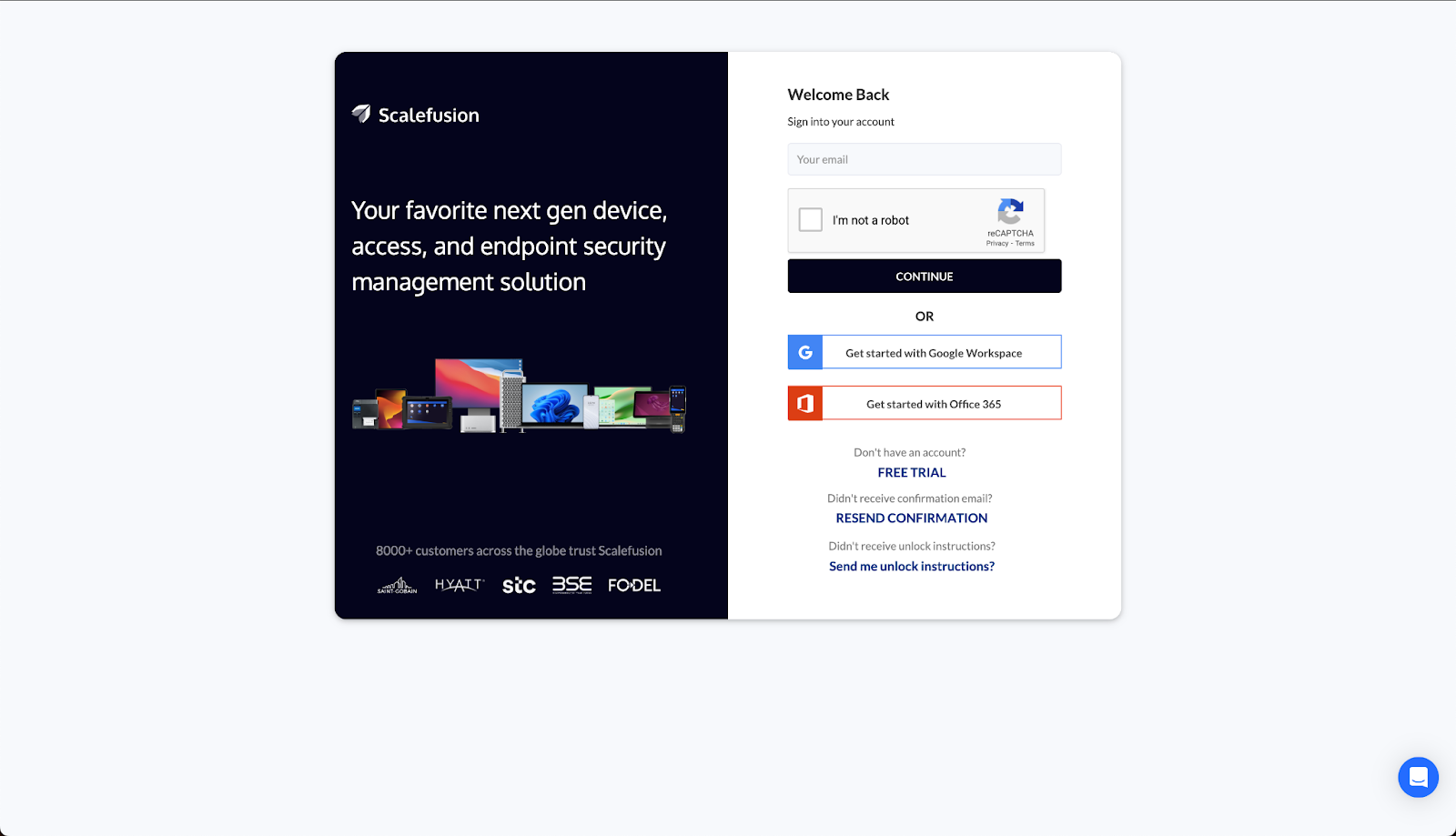
Follow the step below to wipe data on Windows laptops and desktops with Scalefusion UEM
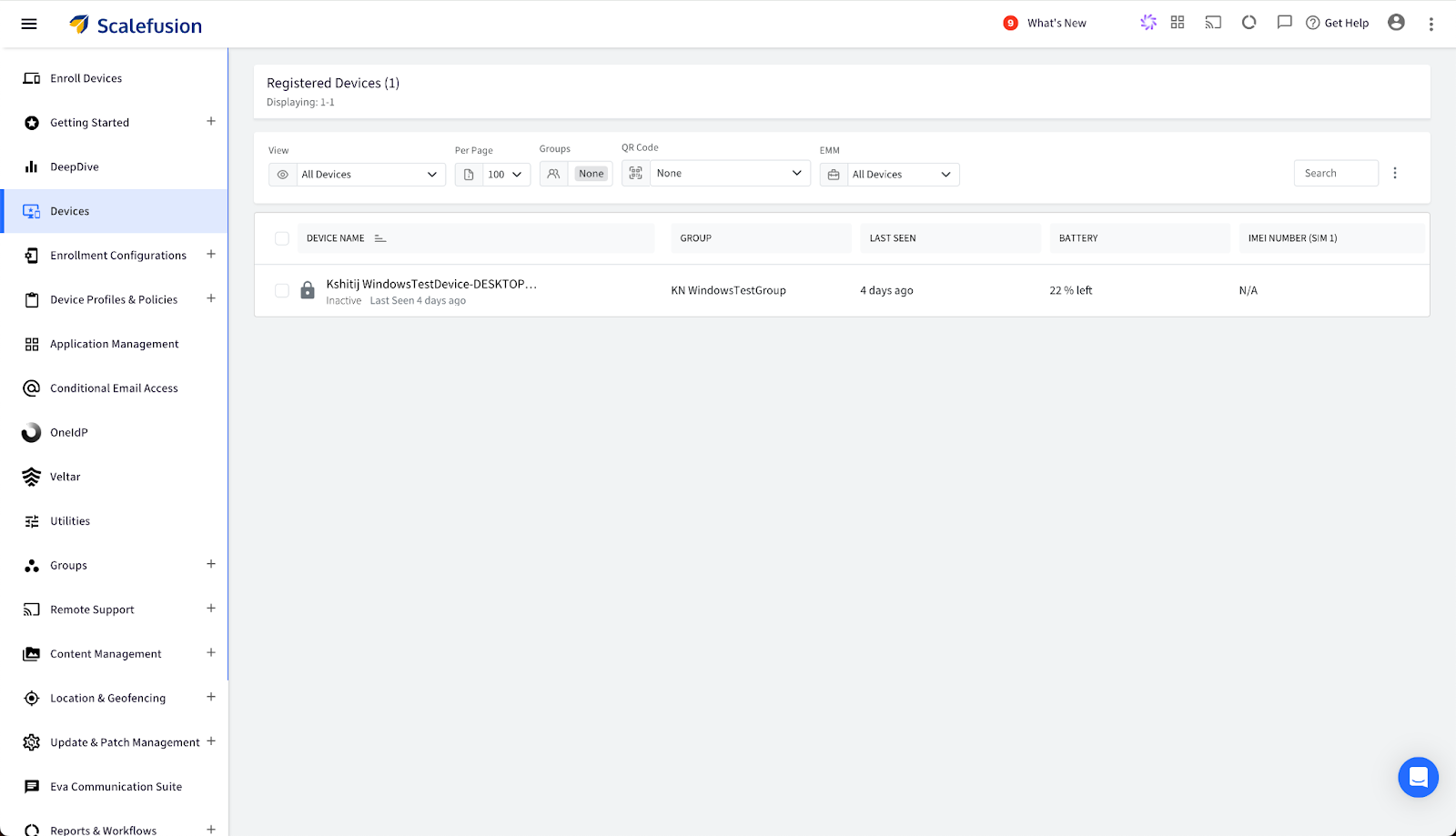
Step 2. Navigate to the ‘Devices’ tab in the panel on the right. This displays the entire list of managed devices. Now, click on the name of the Windows device you want to wipe and lock.
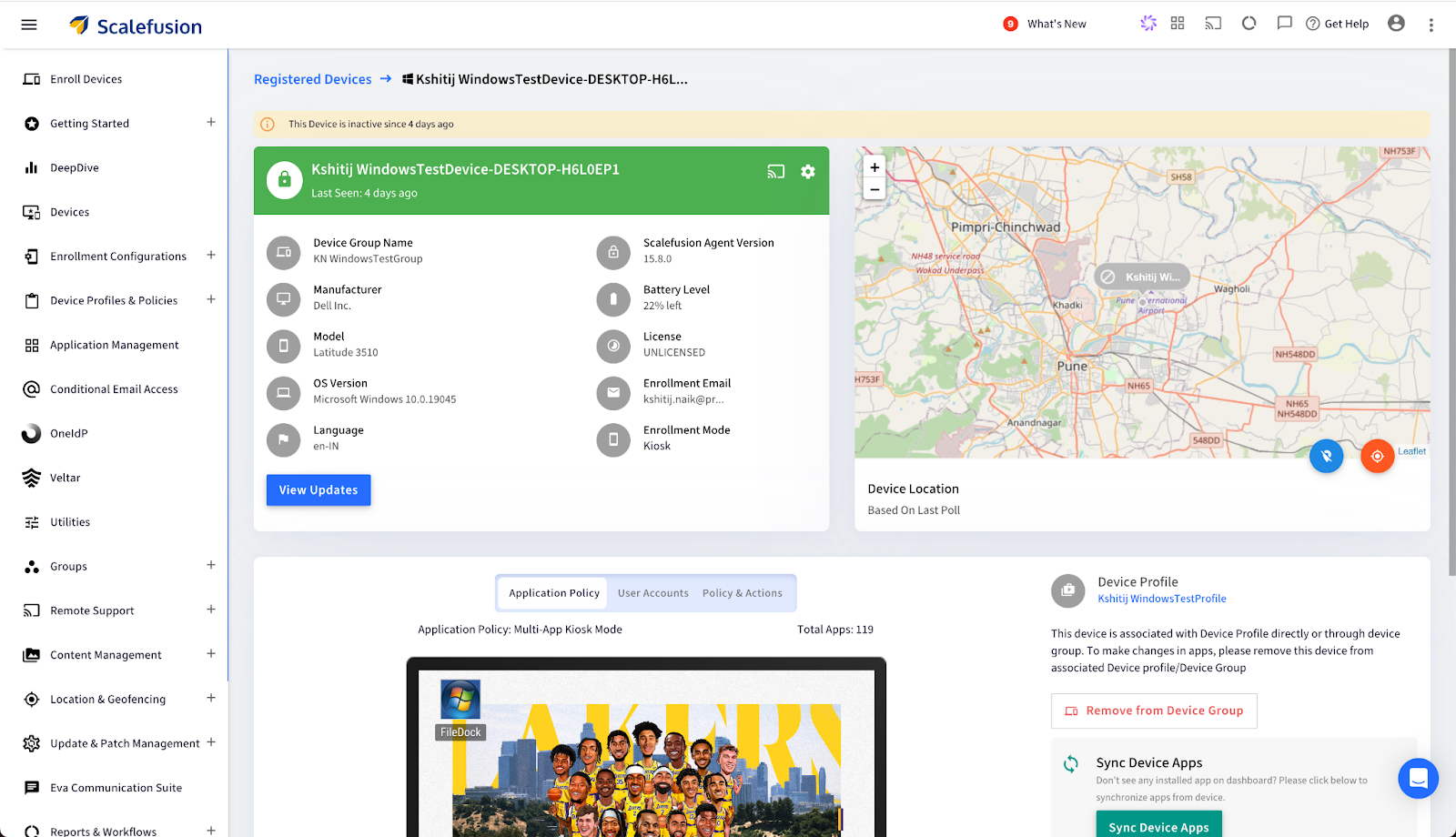
Step 3. A ‘Registered Devices’ screen will appear with all the necessary device details and device location. Click on the ‘Settings’ icon on the top right of the device details section.
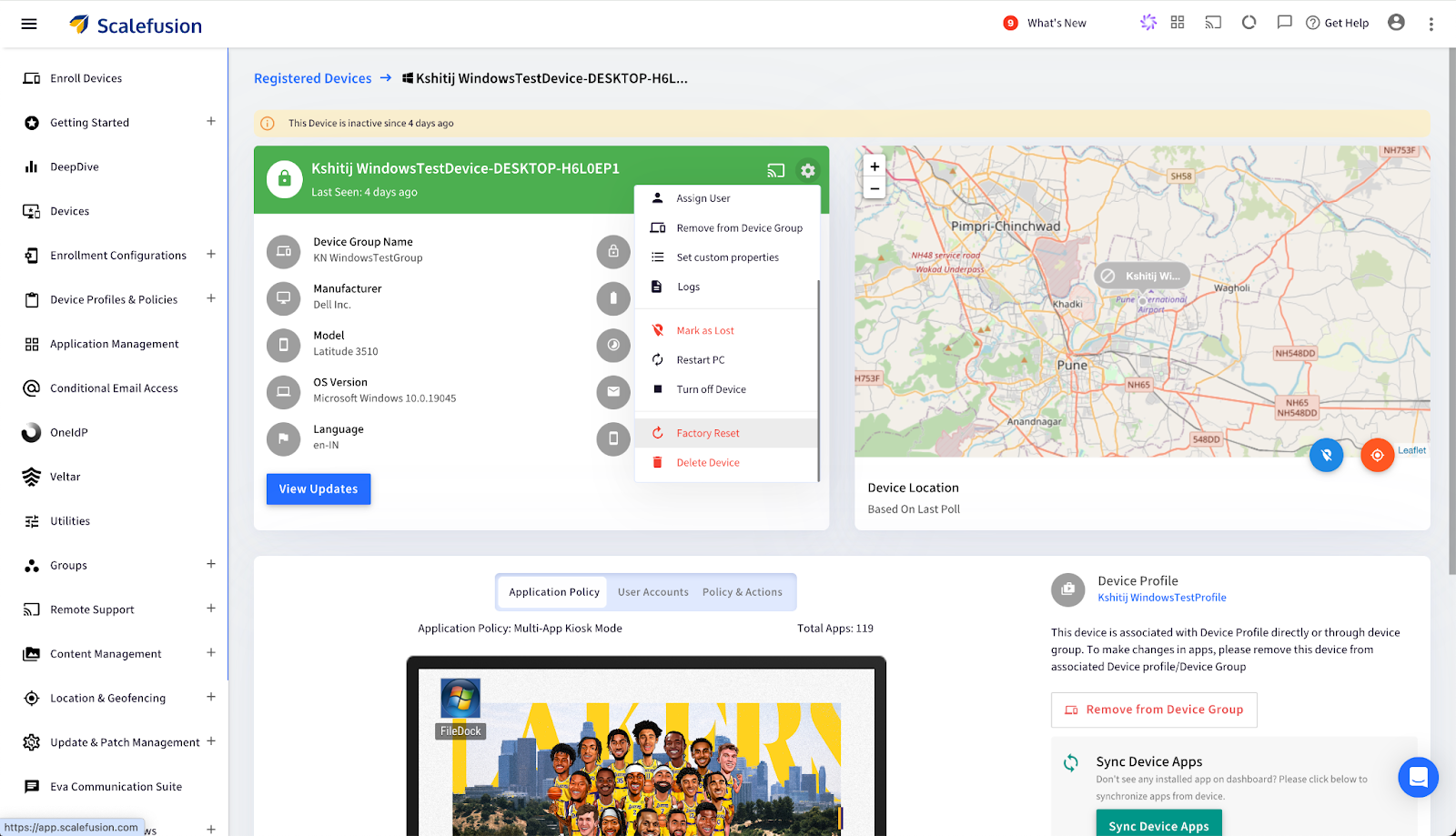
Step 4. A drop-down menu will appear. Scroll to the bottom of the menu and click the ‘Factory Reset’ option.
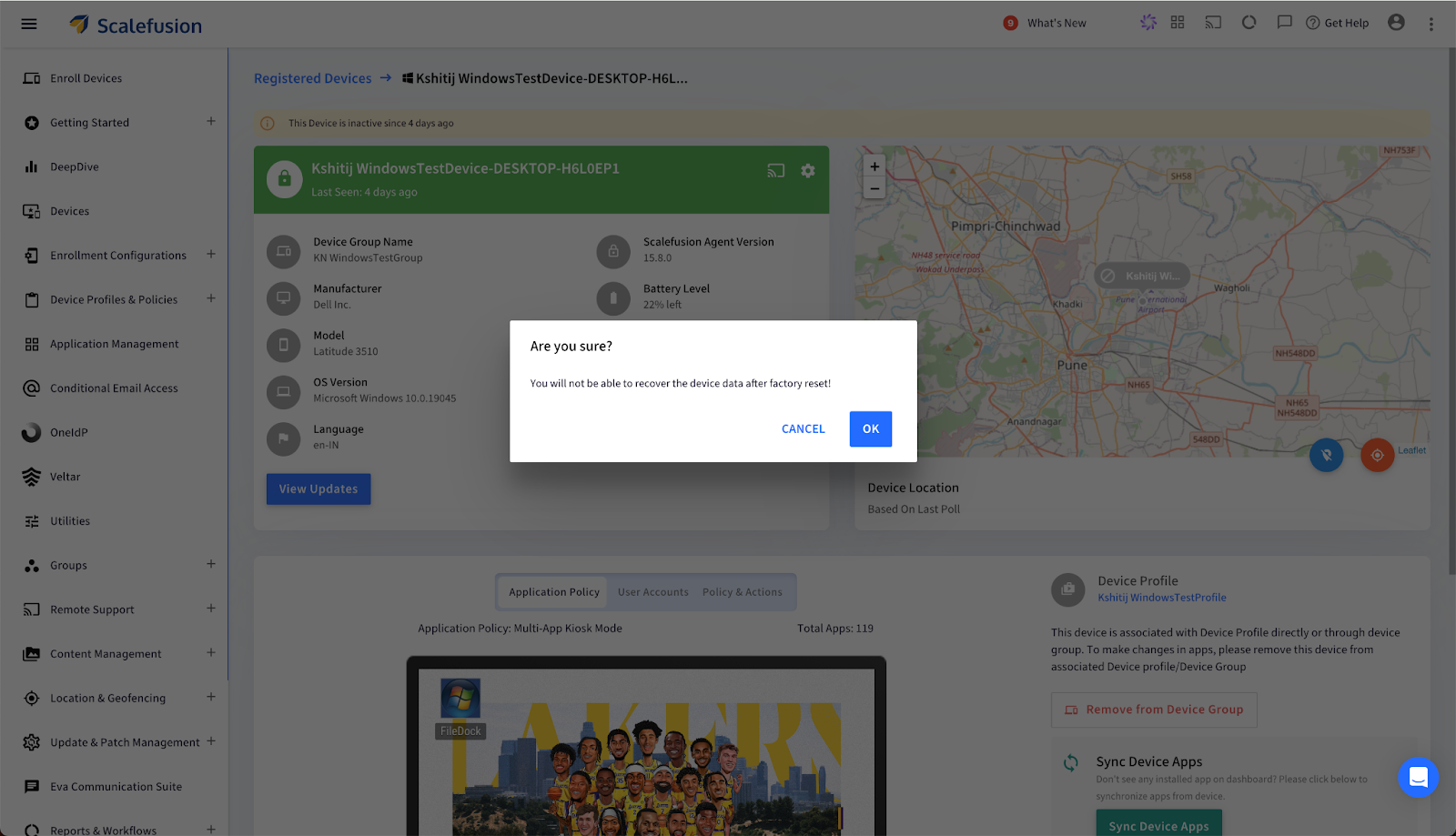
Step 5. Click on ‘Ok’ on the ‘Are you sure’ dialog box that pops up.
Step 6. Now, enter your Scalefusion dashboard login password in the ‘Confirm Action’ dialog box. Click on confirm to execute.
This wipes off the complete data of the selected device, keeping it secured and protected.
Gain complete security of Windows devices with Scalefusion UEM
Whether you’re safeguarding devices for a small business or a large enterprise, experience top-notch Windows Endpoint Management with Scalefusion UEM. Take proactive steps to maintain data security, compliance, and peace of mind. With Scalefusion get a centralized dashboard, real-time device monitoring, and automated workflows make it an ideal choice for organizations managing diverse and distributed device fleets.
About Scalefusion Scalefusion’s company DNA is built on the foundation of providing world-class customer service and making endpoint management simple and effortless for businesses globally. We prioritize the needs and feedback of our customers, making sure that they are at the forefront of all decision-making processes. We are dedicated to providing comprehensive customer support services, and place emphasis on customer-centric thinking throughout the organization.
About Version 2 Digital
Version 2 Digital is one of the most dynamic IT companies in Asia. The company distributes a wide range of IT products across various areas including cyber security, cloud, data protection, end points, infrastructures, system monitoring, storage, networking, business productivity and communication products.
Through an extensive network of channels, point of sales, resellers, and partnership companies, Version 2 offers quality products and services which are highly acclaimed in the market. Its customers cover a wide spectrum which include Global 1000 enterprises, regional listed companies, different vertical industries, public utilities, Government, a vast number of successful SMEs, and consumers in various Asian cities.
Many people feel tingled while buying a new Mac or using it for the first time. Its sleek design and seamless performance make it feel invincible. Macs can even be considered superhero devices, but even superheroes have their weaknesses, right? And your Mac? Well, it’s no exception.
Yes, Macs have a reputation for being secure—almost like the Fort Knox of computers. But before you pat yourself on the back for choosing “the safer option”, let me throw a curveball: They’re not bulletproof. In fact, that “Macs don’t get hacked” myth is as outdated as a floppy disk.
Mac Endpoint Security
Think about it—cybercriminals aren’t sitting around ignoring one of the most popular ecosystems in the world. They’re targeting it. And with the rise of sophisticated malware and security threats, Macs are no longer immune. This is where endpoint security steps in.
So, why does your beloved Mac need Mac endpoint security? Let’s break it down.
The Mac myth: Where it all started
For years, Apple marketed its devices as more secure than the rest. The narrative was simple: “Get a Mac, forget about viruses.” To be fair, this wasn’t entirely wrong back in the day. MacOS had built-in defenses like Gatekeeper, XProtect, and Sandboxing, making them less susceptible to threats than Windows.
But here’s the kicker—cybercriminals evolve. And with the increasing popularity of Macs, they’ve become a lucrative target. In fact, Macs might have a lower malware infection rate than Windows but according to a report, malware made up 11% of all threat detections on Macs in 2023.[1] While it’s still a smaller fraction compared to the threats faced by Windows environments, it’s not something to shrug off.
You can’t rely solely on built-in tools. It’s like using a lock on your door but leaving your windows wide open.
Threats targeting Macs
Macs, once considered impervious to most security threats, are now increasingly targeted by a distinct set of sophisticated attacks. Here are some of the most prevalent threats:
Ransomware: The belief that ransomware won’t affect Macs is a misconception. Incidents like the KeRanger attack demonstrate that Macs are firmly on the radar of cybercriminals.
Adware and spyware: The presence of unexpected pop-ups or unfamiliar applications often indicates adware infiltrating your system. These malicious programs are designed to collect your data discreetly and are becoming alarmingly common.
Phishing attacks: Macs are not immune to phishing campaigns. Cybercriminals deploy fraudulent emails and websites that are equally effective in compromising macOS users.
Zero-day exploits: Perhaps the most concerning, these attacks target vulnerabilities that are unknown even to Apple, exploiting them before they can be patched.
Why built-in Mac security isn’t enough
Apple’s native security features, while effective to a degree, fall short in addressing the advanced threats. Here’s a closer look:
Gatekeeper: This feature acts as a gatekeeper for apps, blocking known malicious software. However, it struggles with newer, unidentified malware, leaving gaps in protection.
XProtect: Apple’s built-in malware scanner is a solid tool, but its effectiveness depends on timely updates. Unfortunately, these updates can lag behind rapidly evolving threats.
Sandboxing: While this isolates apps in controlled environments, it doesn’t shield users from phishing attempts or browser-based attacks, which often bypass these restrictions entirely.
The reality is that these tools are foundational but not comprehensive. Against the backdrop of rising threats, relying solely on built-in features is akin to patching a leaking dam with duct tape—it might hold for now, but it’s not a long-term solution.
Why an Endpoint security solution is a must-have for macOS
macOS endpoint security solutions provide protection that goes far beyond the core features of macOS, serving as a comprehensive shield against modern threats. Here’s why they are indispensable:
Real-time protection: Unlike built-in tools that rely on periodic updates, endpoint security solutions monitor your Mac constantly, detecting and neutralizing threats as they arise.
Advanced threat detection: Using artificial intelligence and machine learning, these solutions identify suspicious patterns, catching malware even before it is formally recognized.
Data encryption: For sensitive or confidential files, endpoint security ensures data is encrypted, safeguarding it against unauthorized access or breaches.
Remote management: Ideal for businesses, endpoint security allows IT admins to oversee and secure multiple Macs from a centralized dashboard, ensuring consistent protection across all devices.
So, what is endpoint security for Mac? It’s the ultimate defense layer that ensures your device remains secure, efficient, and protected in an increasingly dangerous digital environment.
Features to look for in an Endpoint security solution
If you’ve decided it’s time to fortify your Mac’s defenses, these are the key features to prioritize:
Comprehensive malware protection: Opt for solutions that address both known and emerging threats, including zero-day vulnerabilities.
Firewall integration: A robust firewall adds an extra layer of protection, preventing unauthorized access and securing your network.
Phishing prevention: An essential feature to shield against deceptive emails and websites that could compromise your data.
Device control: Control over connected peripherals and external storage ensures tighter security and minimizes risks.
User-friendly interface: A straightforward, intuitive design ensures that even non-technical users can navigate and manage the solution effectively.
Busting the “too expensive” myth
It’s a common question: “Macs are already pricey; why add the cost of endpoint security?”
Here’s the reality: the potential cost of not having endpoint security is far greater. Imagine losing access to critical work files, experiencing downtime, or having your personal information exposed and sold on the dark web. Recovering from a breach can involve significant financial loss, reputational damage, and countless hours of stress.
Investing in a reliable Mac endpoint protection solution is about safeguarding not just your device but your peace of mind. When compared to the potential fallout of a successful attack, the cost is a small price to pay for comprehensive protection.
Veltar: The essential protection your Mac deserves
Your Mac is a masterpiece of technology, but it’s not invincible. Cybercriminals are getting smarter, threats are growing, and the stakes are higher than ever.
Endpoint security is not just a fancy add-on, it ensures your Mac stays safe while maintaining its performance and user experience.
Whether you’re a casual user, a creative professional, or running a business, the question isn’t whether your Mac needs endpoint security—it’s which solution you should choose.
Scalefusion’s Veltar combines protection with seamless usability, offering features such as application control and storage device access control. These features are designed to provide comprehensive security for your Mac without compromising its performance, ensuring that your device remains protected and optimized for every task.
Stay smart. Stay secure. And let your Mac keep doing what it does best—without interruptions.
About Scalefusion Scalefusion’s company DNA is built on the foundation of providing world-class customer service and making endpoint management simple and effortless for businesses globally. We prioritize the needs and feedback of our customers, making sure that they are at the forefront of all decision-making processes. We are dedicated to providing comprehensive customer support services, and place emphasis on customer-centric thinking throughout the organization.
About Version 2 Digital
Version 2 Digital is one of the most dynamic IT companies in Asia. The company distributes a wide range of IT products across various areas including cyber security, cloud, data protection, end points, infrastructures, system monitoring, storage, networking, business productivity and communication products.
Through an extensive network of channels, point of sales, resellers, and partnership companies, Version 2 offers quality products and services which are highly acclaimed in the market. Its customers cover a wide spectrum which include Global 1000 enterprises, regional listed companies, different vertical industries, public utilities, Government, a vast number of successful SMEs, and consumers in various Asian cities.
From humble beginnings in 1984 to becoming the backbone of modern productivity, macOS has shaped how we work, create, and innovate. With every update, Apple has redefined simplicity, security, and performance—ushering in a new era of innovation. But as macOS evolved, so did the challenges for IT teams and businesses managing its widespread adoption in the workplace.
Today, macOS is more than just an operating system. It’s a critical tool for businesses, loved by creative professionals and knowledge workers. MacOS’s increasing popularity increases the need for Mac device management solutions that help businesses with the security, performance, and management of these devices.
macOS MDM (Mobile Device Management) solution—empowers IT teams to effortlessly onboard, manage, and secure their macOS fleet, no matter the scale.
Explore this infographic to journey through the evolution of macOS, from its groundbreaking beginnings to its role in shaping the modern workplace. Discover the pros and cons and the role of macOS MDM in making device management smarter and more efficient.
Add this infographic to your blog or website
About Scalefusion Scalefusion’s company DNA is built on the foundation of providing world-class customer service and making endpoint management simple and effortless for businesses globally. We prioritize the needs and feedback of our customers, making sure that they are at the forefront of all decision-making processes. We are dedicated to providing comprehensive customer support services, and place emphasis on customer-centric thinking throughout the organization.
About Version 2 Digital
Version 2 Digital is one of the most dynamic IT companies in Asia. The company distributes a wide range of IT products across various areas including cyber security, cloud, data protection, end points, infrastructures, system monitoring, storage, networking, business productivity and communication products.
Through an extensive network of channels, point of sales, resellers, and partnership companies, Version 2 offers quality products and services which are highly acclaimed in the market. Its customers cover a wide spectrum which include Global 1000 enterprises, regional listed companies, different vertical industries, public utilities, Government, a vast number of successful SMEs, and consumers in various Asian cities.
How many Apple devices are in your workplace, school, or home right now?
Do you rely on an iPhone to manage your day, or perhaps a MacBook for work?
Ever wonder how many other people in the world are doing the same?
With 2.2 billion active Apple devices globally, the answer is: a lot.[1]
Apple Endpoint Management
From students browsing away on iPads to businesses running on Macs, Apple’s devices have seamlessly infiltrated our daily lives, becoming indispensable tools for productivity, creativity, and communication. But here’s the catch—as Apple’s influence grows, so does the complexity of managing these devices.
So, who’s in charge of keeping all these devices secure? How do you ensure compliance, prevent data breaches, and keep devices running smoothly—without a team of IT experts working overtime?
The answer lies in Apple Unified Endpoint Management (UEM). It’s the solution that simplifies the complexity of managing Apple devices, ensuring they remain secure, updated, and aligned with organizational policies. Whether it’s a CEO’s iPhone or a classroom full of iPads or you need to manage 10 devices or 10,000, UEM offers the structure needed to oversee a growing ecosystem.
So, how UEM for Apple can transform your device management? Let’s find out.
What is UEM, and why does Apple need it?
Managing a bunch of Apple devices without the right tools is a tricky balancing act. Basic controls aren’t enough. Unified Endpoint Management helps by offering a centralized platform that brings order to the complexity of managing Apple devices (along with other OSs), empowering IT teams to configure, secure, and monitor them all with ease.
Apple mobile device management makes sure every iPhone, iPad, and MacBook operates in sync with organizational needs. From ensuring software is up to date, to secure data, to control what users can and can’t do on their devices, UEM does it all. The better you manage your devices, the smoother your operations will run.
Apple and UEM: A perfect match for every industry
What makes Apple such a great choice across all these industries, and how does UEM play a role in managing them effectively?
Healthcare: Protecting patient data
According to a 2024 KLAS report, 64% of healthcare organizations use Apple devices, making them the most used commercial devices in healthcare.[2] Doctors and nurses rely on iPads and iPhones for accessing patient records, prescribing medications, and communicating within the hospital. UEM ensures that these devices remain HIPAA-compliant and secure, with features like device encryption and secure app management. UEM also allows healthcare organizations to monitor and restrict access to patient data, ensuring that only authorized personnel can view sensitive information.
Education: Managing classrooms of iPads
Schools and universities have embraced Apple devices for education, using iPads, Macs, and even Apple TVs to enhance learning. With Apple UEM, institutions can easily manage a large number of devices, controlling what apps and content are accessible to students. UEM allows schools to roll out software updates, enforce security policies, and ensure that devices are used for educational purposes —preventing distractions like unauthorized browsing or gaming during class.
BFSI: Securing sensitive data
Financial institutions need to ensure that their Apple devices are secure and compliant with industry standards. UEM allows financial firms to manage apps, control data access, and track devices, all while ensuring that they meet compliance requirements like GDPR. By controlling the entire Apple ecosystem, UEM protects sensitive financial data and reduces the risk of costly breaches. Leveraging Apple for BFSI, UEM ensures a secure and compliant environment tailored for the financial sector.
Retail: Seamless operations
In retail, Apple devices are used for everything from managing inventory to running point-of-sale (POS) systems. UEM simplifies the management of these devices, enabling retail businesses to deploy, update, and secure their devices without disrupting operations. With UEM, retailers can ensure that all devices are always up to date with the latest software, providing a seamless experience for both employees and customers.
Key concepts in Apple device management
Before we explore the specific benefits of UEM for Apple devices, it’s important to understand some of the foundational concepts that drive effective device management. These concepts set the stage for why UEM is essential for organizations looking to manage and secure Apple devices at scale.
1. Device supervision: A higher level of control
Device supervision is a critical mode for managing Apple devices in business, education, and institutional settings. When Apple devices are in supervision mode, IT teams gain access to a broader set of controls, features, and configurations, far beyond what is available on unsupervised devices.
For organizations, this level of control means better security, consistent device configurations, and the ability to customize devices according to their specific use cases—whether it’s an employee’s iPhone, a classroom of iPads, or interactive kiosks in retail or hospitality settings. Supervision is achieved through the Device Enrollment Program (DEP) as the primary method, or using tools like Apple Configurator 2 (AC2).
2. Apple Configurator 2: The deployment powerhouse
For large-scale deployments, Apple Configurator 2 is an indispensable tool. This macOS application enables organizations to configure, deploy, and manage multiple Apple devices simultaneously, ensuring that they are ready for use across various environments. Whether you need to supervise a batch of devices or enforce a particular configuration, Apple Configurator 2 is designed for efficiency.
In a UEM context, Apple Configurator 2 enables unsupervised devices to be enrolled into a management system by preparing them for deployment via DEP. It integrates with UEM solutions to configure settings, install profiles, and enforce business-specific requirements, making it ideal for organizations managing high device volumes or frequent turnover.
3. Apple ID vs. Managed Apple ID: Personal vs. organization-wide access
An Apple ID is typically associated with personal use, allowing users to access a variety of Apple services, including iCloud, app purchases, and data synchronization across devices. In an organizational setting, however, an Apple ID can quickly blur the line between personal and work-related use, potentially creating security risks and management complexities.
Managed Apple IDs provide businesses, schools, and government agencies with centralized control and enforced security settings on BYO devices. They maintain data privacy, streamline app distribution, and simplify device management, making them essential for organizations prioritizing secure Apple device usage.
4. APNs: Enabling secure communication between devices and apps
Apple Push Notification Service (APNs) acts as a bridge for delivering push notifications to devices. APNs ensures that any important updates, alerts, or information are securely delivered to iOS, iPadOS, macOS, and watchOS devices in real-time.
For organizations utilizing UEM for Apple, APNs is an essential feature. Not only does it facilitate secure communication between apps and users, but it also allows UEM solutions like Scalefusion to push updates, enforce policies, and notify users about device status, security alerts, or compliance requirements.
In a business context, APNs can be leveraged to ensure that the right messages reach the right devices, whether it’s a security alert, a device configuration change, or a software update.
5. Apple Declarative Device Management: Simplifying and Streamlining Control
Apple Declarative Device Management (DDM) takes device management to the next level by introducing a more proactive and streamlined approach. Apple DDM operates on a declarative model where devices are configured to know their desired state in advance.
This innovative method reduces back-and-forth communication with servers, making updates faster and more efficient. It also ensures devices can proactively adapt to new configurations, even in high-turnover environments.
For organizations using UEM, DDM offers a significant advantage by improving scalability and responsiveness. IT teams can push policies and settings more effectively, ensuring Apple devices remain compliant, secure, and aligned with business objectives.
How UEM simplifies Apple device management
Now that we’ve gone over the basics, let’s see how UEM makes managing Apple devices easier. Apple Business Manager (ABM) helps with setup and provisioning, but it’s UEM that steps in to handle the day-to-day management, secure the devices, and keep everything running smoothly.
With Apple UEM, this job gets a lot easier.
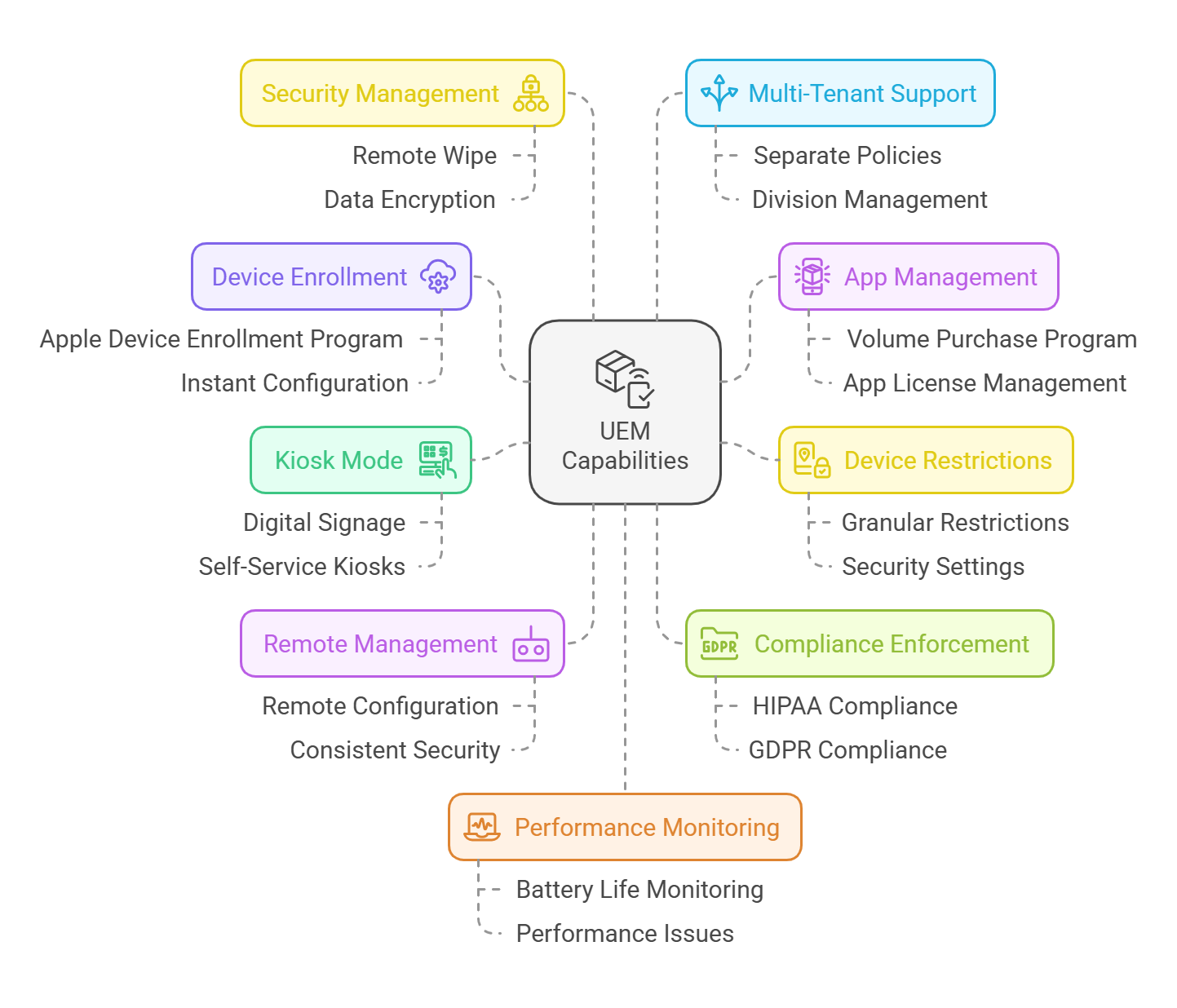
Apple device enrollment program (DEP): Automates the enrollment of devices, allowing IT teams to set up Apple devices straight out of the box. This streamlines large-scale deployments and ensures devices are instantly configured and ready for use without manual intervention.
Volume purchase program (VPP): Enables bulk purchasing and distribution of apps across multiple Apple devices. This feature allows organizations to easily manage app licenses and ensure that every device has the necessary software installed, updated, and maintained.
Granular device restrictions: UEM provides the ability to implement precise device restrictions, such as limiting access to specific apps, disabling certain features (e.g., camera or AirDrop), and enforcing security settings to align with organizational policies. This is crucial in environments like healthcare, retail, or education, where device usage needs to be controlled.
Kiosk mode: UEM allows devices to be locked down into a specific app or set of apps, turning them into dedicated kiosks. This is perfect for situations like digital signage in retail or self-service checkouts, where devices are meant to serve a single purpose and require strict usage control.
Remote configuration, support, and management: IT admins can remotely configure settings, manage devices, and apply updates across all Apple devices, eliminating the need for on-site support and making it easier to maintain consistency in configurations and security policies.
Compliance enforcement: UEM helps ensure compliance with industry standards such as HIPAA, GDPR, and PCI-DSS by enforcing security policies like encryption, password complexity, and data protection. This is essential in sectors like healthcare, finance, and education where regulatory compliance is a priority.
Security management: UEM offers advanced security controls, such as remote wipe capabilities, device tracking, and data encryption, ensuring that if a device is lost or stolen, sensitive data remains protected and inaccessible.
Multi-tenant support: For managed service providers or businesses with different divisions, UEM can provide a multi-tenant architecture, allowing for the management of different Apple device fleets under one system, but with separate policies and configurations for each tenant.
Battery and performance monitoring: UEM offers real-time monitoring of device health, including battery life and overall performance, helping IT teams proactively address issues before they impact productivity.
How UEM improves endpoint security for Apple devices
There’s no end to data breaches, malware attacks, and insider threats but we can definitely prevent them with the help of a UEM solution. Endpoint security is the first line of defense when it comes to securing Apple devices within an organization.
UEM solutions enhance security through several key features:
Device Compliance and Granular Restrictions: UEM solutions enforce security policies such as password rules, encryption, OS updates, and app restrictions. These help ensure compliance with industry regulations (HIPAA, GDPR) while protecting sensitive data from unauthorized access.
Zero Trust Access: UEM platforms enable a zero-trust security framework, where only authenticated users and compliant devices are allowed access to corporate resources, minimizing the risk of unauthorized entry.
Remote Lock and Data Wipe: In the event of a lost or stolen device, UEM solutions allow IT admins to lock or wipe the device remotely, securing sensitive corporate data and preventing unauthorized access.
Secure Network Connectivity with VPN Integration: UEM solutions configure and enforce VPN settings on Apple devices to ensure secure connections, especially for remote workers. This is further strengthened with endpoint security features like split tunneling and traffic filtering.
Proactive Security with Automatic Updates: UEM solutions ensure that devices are always up to date with the latest OS versions and security patches, protecting against vulnerabilities associated with outdated software.
I/O Device Access Control for macOS: UEM platforms allow organizations to manage and restrict the use of external devices like USBs and peripherals, preventing unauthorized data transfers and enhancing security on macOS.
Apple devices, while known for their robust security features, still face potential threats—whether it’s a lost iPhone with sensitive business data or a compromised app on an iPad. UEM solutions like Scalefusion, when paired with endpoint security solutions like Veltar, create an unbreakable defense against these risks.
Why Scalefusion is ideal for Apple device management
Scalefusion goes beyond basic UEM features like supervision, app control, and compliance enforcement. It offers robust tools to simplify and enhance the management of macOS and iOS devices, making it a comprehensive solution for businesses.
Support for all your Apple devices – Scalefusion is compatible with a wide range of Apple devices, from iPhones and iPads to Mac computers. Whether you’re managing mobile devices or desktop setups, you can handle them all from one unified platform, streamlining operations.
Dive deep with DeepDive – From the Scalefusion dashboard, you can get quick, graphical insights into your device inventory. View key metrics like platform-wise enrollment, active/inactive devices, and license usage. This data allows you to make informed decisions and track your device fleet more effectively.
Top-notch security – Keeping your business data secure is non-negotiable, and Scalefusion goes above and beyond to protect it. With features like remote device locking, data wipe, and passcode enforcement, you can ensure Apple devices are always secure and compliant with your company’s policies.
Effortless enrollment – Thanks to integration with Apple’s Device Enrollment Program (DEP), setting up Apple devices is a breeze. Zero-touch enrollment allows you to quickly onboard devices without physical interaction, making the process both fast and hassle-free.
Kiosk Mode and App Control – Scalefusion’s Kiosk Mode lets you restrict Apple devices to just one app or a set of apps, preventing unauthorized access and ensuring the device is dedicated to its intended function.
Granular policy control with Groups and Subgroups – Scalefusion gives you the ability to manage devices at a granular level. By organizing devices into groups and subgroups, you can apply specific policies to different teams or departments, offering greater control and tailoring device settings based on organizational needs.
No-code IT Workflows – Streamline IT tasks by automating and scheduling actions without coding. Create task flows, set execution times, and maintain compliance effortlessly.
Remote Troubleshooting with Remote Cast and Control – With the Remote Cast and Control feature, IT teams can mirror a device’s screen in real-time and take full control of the device to resolve problems. This eliminates the need for physical access, reduces downtime, and ensures your team can quickly address issues.
Seamless integration with Apple’s ecosystem – Scalefusion seamlessly integrates with Apple’s native services, such as iCloud, iTunes, and Apple School Manager. This tight integration ensures smooth syncing of apps, data, and settings across your Apple devices, providing a unified experience for your business.
OS Updates and Patch Management – Scalefusion simplifies OS updates and patch management, automating the process to keep your Apple devices secure and up to date. Scalefusion UEM leverages Apple’s declarative device management (DDM) protocol to further streamline the update process. With DDM, you can schedule updates for macOS devices based on your local time zone, ensuring updates are applied at optimal times. This ensures that devices always install the latest version when multiple updates are available, simplifying the update management process.
Ensure long-term success with Apple UEM
With Apple devices becoming more prevalent across businesses, schools and industries, managing them efficiently is essential. Scalefusion UEM ensures your device management solution evolves alongside your organization, seamlessly adapting to the latest Apple updates.
Scalefusion UEM provides a seamless experience for managing Apple devices, with continuous updates that ensure compatibility with the latest Apple advancements. Its scalability allows organizations to easily manage growing numbers of Apple devices, while its interoperability ensures smooth integration with not just new Apple technologies and updates but also any other OS or device type that your business or employees love and use.
Get in touch with our experts for more details and book a free demo call. Start your 14-day free trial today, with full access to all features, and discover how easy device management can be!
About Scalefusion Scalefusion’s company DNA is built on the foundation of providing world-class customer service and making endpoint management simple and effortless for businesses globally. We prioritize the needs and feedback of our customers, making sure that they are at the forefront of all decision-making processes. We are dedicated to providing comprehensive customer support services, and place emphasis on customer-centric thinking throughout the organization.
About Version 2 Digital
Version 2 Digital is one of the most dynamic IT companies in Asia. The company distributes a wide range of IT products across various areas including cyber security, cloud, data protection, end points, infrastructures, system monitoring, storage, networking, business productivity and communication products.
Through an extensive network of channels, point of sales, resellers, and partnership companies, Version 2 offers quality products and services which are highly acclaimed in the market. Its customers cover a wide spectrum which include Global 1000 enterprises, regional listed companies, different vertical industries, public utilities, Government, a vast number of successful SMEs, and consumers in various Asian cities.