

Skip to content

CISA BOD 23-01: Why vulnerability scanners miss the mark on asset inventory

On October 3, 2022, the Cybersecurity and Infrastructure Security Agency (CISA) issued Binding Operational Directive (BOD) 23-01: Improving Asset Visibility and Vulnerability Detection on Federal Networks. The directive requires that federal civilian executive branch (FCEB) departments and agencies perform automated discovery every 7 days and identify and report potential vulnerabilities every 14 days. Additionally, it requires the ability to initiate on-demand asset discovery to identify specific assets or subsets of vulnerabilities within 72 hours of receiving a request from CISA.

To meet these requirements, agencies will need to start with an accurate asset inventory. Most agencies will attempt to leverage existing solutions, like their vulnerability scanners, to build their asset inventories. It seems reasonable to do so, since most vulnerability scanners have built-in discovery capabilities and can build asset inventories. However, they will quickly learn that vulnerability scanners are not up for the task and cannot help them sufficiently and effectively meet the requirements laid out by CISA.

Let’s take a look at why agencies need a solution solely focused on asset inventory, in addition to their vulnerability scanner, if they want to tackle CISA BOD 23-01.

Asset inventory is a foundational building block

Every effective security and IT program starts with a solid asset inventory. CISA BOD 23-01 reinforces that imperative. Specifically, it states, “Asset discovery is a building block of operational visibility, and it is defined as an activity through which an organization identifies what network addressable IP-assets reside on their networks and identifies the associated IP addresses (hosts). Asset discovery is non-intrusive and usually does not require special logical access privileges.”

What does this mean? FCEB agencies looking to meet the requirements outlined by CISA BOD 23-01 must be able to discover managed and unmanaged devices connected to their networks. Internal and external internet-facing assets must be cataloged with full details and context. All within the timeframe outlined by CISA.

So now, the question is why vulnerability scanners can’t be used to meet the requirements laid out in the directive.

The challenges of asset inventory with vulnerability scanners

As the number of devices connecting to networks continues to grow exponentially, agencies need to stay on top of these devices; otherwise, they could provide potential footholds for attackers to exploit. However, common issues like shadow IT, rogue access, and oversight continue to make it difficult to keep up with unmanaged devices. BOD 23-01 highlights the importance of identifying unmanaged assets on the network. That’s why the need for a fully comprehensive asset inventory is the key to adequately addressing the directive.

So, why can’t vulnerability scanners deliver on asset inventory? Most vulnerability scanners combine discovery and assessment together, resulting in slower discovery times, delayed response to vulnerabilities, and limited asset details. As a result, most agencies are left wondering how they can do a better job building their asset inventories.

Combining discovery and assessment slows everything down

Vulnerability scanners typically combine asset discovery and assessment into one step. While on the surface, this appears to be efficient, it is actually quite the opposite. In regards to asset discovery, CISA BOD 23-01 specifically requires that FCEB agencies perform automated discovery every 7 days and identify and initiate on-demand discovery to identify specific assets or subsets of vulnerabilities within 72 hours of receiving a request from CISA.

Because vulnerability scanners leverage a lot of time-consuming checks, they’re not able to scan networks quickly enough. Add in the complexity of highly-segmented networks and maintenance windows, and it is nearly impossible to effectively utilize vulnerability scanners for discovery and meet the timing requirements outlined by CISA.

Under the new directive, assessing the potential impact of vulnerabilities becomes even more urgent. Agencies will need to perform on-demand discovery of assets that could be potentially impacted within 72 hours, if requested by CISA. When security news breaks, agencies need to respond as quickly as possible, but vulnerability scanners slow down the process. In a scenario like this, it would be more efficient to have a current asset inventory that agencies can search–without rescanning the network. This is particularly useful if agencies know there are specific assets they need to track down, they can query their existing asset inventory to identify them immediately.

For example, let’s say a new vulnerability is disclosed. Vendors will need some time to develop the vuln checks, and agencies will need to wait for the vuln checks to become available. Once they’ve been published, agencies can finally start rescanning their networks. Imagine waiting for the vuln check to be released, and then delaying the rescan due to scan windows. Without immediate insight into the potential impact of a vulnerability, agencies are playing the waiting game, instead of proactively being able to assess the risk.

How agencies can speed up discovery

So, what can agencies do? Let vulnerability scanners do what they do best: identify and report on vulnerabilities. Complement them with a dedicated solution that can automate and perform the discovery of assets within the timeframe set by the directive. In order to accomplish this, the asset inventory solution must be able to quickly and safely scan networks without a ton of overhead, be easy to deploy, and help security teams get ahead of new vulnerabilities.

Agencies need to have access to their full asset inventory, on-demand, so they can quickly zero in on any asset based on specific attributes. This information is invaluable for tracking down assets and investigating them, particularly when new zero-day vulnerabilities are uncovered. When the new zero-day is announced, agencies can find affected systems by searching across an existing asset inventory–without rescanning the network.

Meet CISA BOD 23-01 requirements with a dedicated asset inventory solution

It is increasingly evident that decoupling discovery and assessment is the most effective way to ensure that agencies have the data needed to accelerate vulnerability response and meet the requirements outlined in the directive. Because let’s face it: vulnerability scanners are really good at vulnerability enumeration–that’s what they’re designed to do. However, they really miss the mark when it comes to discovering assets and building comprehensive asset inventories. Because vulnerability scanners combine discovery and assessment, they aren’t able to scan entire networks quickly, and at times, they don’t fingerprint devices accurately.

As a result, many agencies are wondering how to meet the requirements outlined in CISA BOD 23-01 if they can’t depend on their vulnerability scanner for discovery. Agencies will need to start looking for a standalone asset inventory solution that is capable of performing unauthenticated, active discovery, while also enriching data from existing vulnerability management solutions.

How runZero can help agencies focus on asset discovery

runZero separates the discovery process from the vulnerability assessment stage, allowing agencies to perform discovery on-demand. Because runZero only performs discovery, it can deliver the data about assets and networks much faster than a vulnerability scanner. Customers have found that runZero performs scans about 10x faster than their vulnerability scanner, allowing them to:

  • Get a more immediate day one response to new vulnerabilities.
  • Gather as much information as possible about assets while waiting for vulnerability scan results.

That means, while waiting for vulnerability assessments to complete, agencies can already start digging into their asset inventory and identifying assets that may be impacted by a vulnerability. runZero regularly adds canned queries for assets impacted by newly disclosed vulnerabilities and highlights them via Rapid Response. Users can take advantage of these canned queries to instantly identify existing assets in the inventory that match specific identifiable attributes. For example, querying by hardware and device type can narrow down assets to a specific subset that may be affected by a vulnerability. All of the canned queries can be found in the Queries Library.

All in all, runZero is the only asset inventory solution that can truly help FCEB agencies stay on top of their ever-changing networks. By decoupling asset discovery from vulnerability assessment, agencies will gain visibility and efficiencies, while meeting the requirements set by CISA BOD 23-01.


About Version 2 Digital

Version 2 Digital is one of the most dynamic IT companies in Asia. The company distributes a wide range of IT products across various areas including cyber security, cloud, data protection, end points, infrastructures, system monitoring, storage, networking, business productivity and communication products.

Through an extensive network of channels, point of sales, resellers, and partnership companies, Version 2 offers quality products and services which are highly acclaimed in the market. Its customers cover a wide spectrum which include Global 1000 enterprises, regional listed companies, different vertical industries, public utilities, Government, a vast number of successful SMEs, and consumers in various Asian cities.

About runZero
runZero, a network discovery and asset inventory solution, was founded in 2018 by HD Moore, the creator of Metasploit. HD envisioned a modern active discovery solution that could find and identify everything on a network–without credentials. As a security researcher and penetration tester, he often employed benign ways to get information leaks and piece them together to build device profiles. Eventually, this work led him to leverage applied research and the discovery techniques developed for security and penetration testing to create runZero.

runZero 3.4: Vulnerability import from CrowdStrike Spotlight (plus something for everyone)

What’s new with runZero 3.4?

  • Vulnerability import from CrowdStrike Spotlight
  • Integration performance improvements and enhancements
    • Automatic expiration of ephemeral AWS assets
    • Processing performance improvements
    • Enrichment-only integration support
  • OAuth Client Secret authentication
  • Simplified site import and export format
  • Rapid Response queries for MegaRAC and Cisco
  • User interface improvements

Vulnerability inventory from CrowdStrike

runZero Enterprise customers can now import vulnerabilities from CrowdStrike Spotlight. runZero 3.4 automatically imports vulnerabilities when a credential is supplied that has access to the “Spotlight” OAuth scope. CrowdStrike Spotlight vulnerability data can be viewed from the asset detail page as well as in the vulnerability inventory. CrowdStrike vulnerability attributes include the relevant CVE identifier, severity, exploitability status, vulnerability detail, and any recommended actions to remediate the issue. Use the filter source:crowdstrike in the asset or vulnerability inventory to see CrowdStrike-sourced data. Use the following queries to track down common concerns: Ready to complement your runZero inventory with vulnerability data from CrowdStrike? To get started, set up a connection to CrowdStrike using a credential with access to Spotlight vulnerabilities. Vulnerabilities from CrowdStrike Spotlight

Integration performance improvements and enhancements

The 3.4 release delivers new features and performance improvements to runZero integrations.

Automatic expiration of ephemeral AWS assets

You can now have your AWS integration automatically remove AWS assets from your inventory that weren’t seen in the latest sync. Many AWS resources are ephemeral, only being in use for a short period of time, and these temporary assets can lead to a slow increase of offline assets over time. If you don’t want to keep those decommissioned AWS assets in your runZero inventory, this feature can be used to automatically delete them. An alternative to this feature is to place your cloud assets in a separate Organization and configure a low stale asset expiration.

Processing performance improvements

The performance of all integration tasks has been improved and processing now completes much faster, with better use of resources, especially for self-hosted customers. This improvement is the most significant for processing data from vulnerability management products.

Enrichment-only integration support

You can now choose to exclude unknown assets from your integration imports. If enabled, runZero won’t import assets from an integration unless they can be merged with an existing asset in your inventory. This places the integration into an enrichment-only mode. This option is helpful when overlaying data from directory providers (Azure AD and Windows AD) as well as MDM and EDR systems that often include off-network assets that may be outside of your runZero scope.

OAuth Client Secret authentication

In addition to being able to access the runZero APIs using bearer tokens, you can now configure the use of OAuth2 client credentials. Simply register an API client and use the client ID and secret to obtain a temporary session token, which can then be using with the existing APIs as a bearer token.

Simplified site import and export format

The process and format for importing sites has been simplified so that you can more quickly add multiple sites based on subnets. The format of the imported CSV has been updated so that each registered subnet can be provided as a separate row, with the results merged automatically during import. Need to add a ton of new subnets to your sites? Export the current CSV, append the new subnets to the end with the same site name, and re-import the list to update your site configuration.

Rapid Response queries for MegaRAC and Cisco

In addition to letting you create queries to fit your needs, runZero includes pre-built queries for recent threats. During the 3.4 release, new queries were added to quickly track down assets running MegaRAC BMC firmware and to locate Cisco 7800/8800 series IP phone assets.

User interface improvements

The 3.4 release includes several changes to the user interface to improve the performance of the runZero console. The tables on the analysis reports, site comparison reports, and SSO groups pages now perform and load faster. This will let users query and sort the results in tables more efficiently, getting to the answers they need faster.

Release notes

The runZero 3.4 release includes a rollup of all the 3.3.x updates, which includes all of the following features, improvements, and updates.

New features

  • The AWS integration now includes an option to automatically remove assets no longer reported by AWS.
  • OAuth 2.0 client credentials can now be used to authenticate with runZero APIs.
  • The edr.name asset attribute is now updated to show when a runZero scan no longer detects the EDR.
  • Tasks can now be stopped during data gathering and processing phases.
  • The site import and export CSV format has been simplified.
  • The performance of connector task processing has been improved.
  • Tables for the Site comparison report, analysis report results, and SSO group mappings have been redesigned for improved performance.
  • Added a new canned query for finding Cisco 7800/8800 series IP phone assets.
  • Improved fingerprinting coverage of Google Workspace assets.
  • Additional fingerprint updates.

Security improvements

  • A bug that could show cross-tenant “no access” role users in the Your team > Current organization view was resolved. This issue only applied to the cloud-hosted version of the runZero platform. The affected build was live for slightly more than two hours. Any customers affected by this issue will receive a detailed notice to the email addresses associated with their superuser accounts.

Product improvements

  • The consistency in asset terminology has been improved.
  • The site import CSV format has been improved.
  • The CLI Scanner --api-url parameter handling has been improved.
  • The DELETE API method for bulk asset deletion has been deprecated.
  • A public API endpoint to check the platform health has been added.
  • OS EOL dates are now reported for Windows 11.
  • A new canned query for MegaRAC BMC firmware has been added.
  • Self-hosted customers can configure concurrent task processing with the RUNZERO_CRUNCHER_INSTANCES option.
  • VMware ESXi instances now display OS end-of-life dates based on version.
  • The scanner now supports a configurable ToS/Traffic Class field in the advanced configuration.
  • Additional operating system and hardware icons are available in the inventory view.
  • Explorer and CLI Scanner binaries are now approximately 5MB smaller.
  • The All Organizations view now more accurately handles limited user permissions.

Performance improvements

  • The performance of the task overview page load time has been improved.
  • The import time for third-party data sources was improved.
  • The scheduler will now delay recurring tasks if the previously completed task has not yet started processing.
  • The backend now processes concurrent tasks for separate sites within the same organization when possible.
  • Searching and sorting is faster when using the asset first seen and last seen columns.

Fingerprinting changes

  • Improved fingerprinting coverage of Apple HomeKit and HomeKit-connected devices.
  • Improved fingerprinting coverage of Google Workspace assets.
  • Improved fingerprinting coverage of Microsoft Intune and Azure Active Directory assets.
  • Additional support added-or-improved for products by by Advidia, APC, Apple, Ascom, Avaya, Cisco, Citrix, D-Link, Dahua, ecobee, Eve, Fortinet, First Peer, Google, Green Electronics, ICP DAS, ifm electronic, iXsystems, LG, Microsoft, Motorola, Nintendo, OnePlus, OpenWRT, Poly, QNAP, Raspberry Pi, Red Hat, Riverbed, Roku, Sagemcom, Samsung, Shelly, Schneider Electric, SolidCP, Sony, SUSE, SwitchBot, TCL, Technicolor, Twinkly, UPS Manufacturing, Vizio, and VMware.

Integration improvements

  • The CrowdStrike integration now imports vulnerabilities when CrowdStrike Spotlight is enabled for the API key.
  • An option to disable the creation of new assets from third-party integrations has been added.
  • Third-party integrations merge assets more consistently.
  • Third-party integrations now merge more accurately when using IP addresses as the match key.
  • Microsoft Intune and Azure Active Directory assets are now fingerprinted more accurately.
  • New LDAP credentials now auto-populate the discovered port.
  • The Microsoft Defender integration now merges assets more comprehensively.
  • The AWS EC2 integration now provides an option to include Stopped instances.

Bug fixes

  • A bug that could prevent an Explorer from running scans with specific network configurations has been resolved.
  • A bug that could cause recurring tasks to backup has been resolved.
  • A bug in the Organization asset export API has been resolved.
  • A bug that caused the License information page to display an incorrect project asset count was resolved.
  • A bug that could delay concurrent task processing has been resolved.
  • An issue that could cause the command-line scanner to skip LDAP enumeration has been resolved with the --ldap-thumbprints flag.
  • A bug that could prevent tag searches from completing when thousands of tags are in use has been resolved.
  • A bug that could result in partial import of GCP CloudSQL assets was resolved.
  • A bug that could lead to duplicate vulnerabilities when an import was restarted has been resolved.

About Version 2 Digital

Version 2 Digital is one of the most dynamic IT companies in Asia. The company distributes a wide range of IT products across various areas including cyber security, cloud, data protection, end points, infrastructures, system monitoring, storage, networking, business productivity and communication products.

Through an extensive network of channels, point of sales, resellers, and partnership companies, Version 2 offers quality products and services which are highly acclaimed in the market. Its customers cover a wide spectrum which include Global 1000 enterprises, regional listed companies, different vertical industries, public utilities, Government, a vast number of successful SMEs, and consumers in various Asian cities.

About runZero
runZero, a network discovery and asset inventory solution, was founded in 2018 by HD Moore, the creator of Metasploit. HD envisioned a modern active discovery solution that could find and identify everything on a network–without credentials. As a security researcher and penetration tester, he often employed benign ways to get information leaks and piece them together to build device profiles. Eventually, this work led him to leverage applied research and the discovery techniques developed for security and penetration testing to create runZero.
Finding Cisco 7800 and 8800 series IP phone assets on your network

Cisco recently published vulnerability details which affect their 7800 and 8800 series of IP (VoIP) phones. These phones are sold across many different model numbers and can be found in businesses and organizations of varying sizes. Originally reported to Cisco by Qian Chen of the Codesafe Team of Legendsec at QI-ANXIN Group, this vulnerability does not require authentication for successful exploitation and can provide attackers remote code execution and/or denial-of-service (DoS) capabilities.

What is the impact?

Cisco assigned a CVSS “high” rating to this vulnerability (tracked as CVE-2022-20968) and has acknowledged that proof-of-concept exploitation code exists. Firmware for all 7800 and 8800 series IP phones (with the lone exception of Cisco Wireless IP Phone 8821) contains this vulnerability, which resides in the input validation logic of received Cisco Discovery Protocol packets. Attackers who have presence in the same VLAN or network segment as vulnerable devices can send specially-crafted Cisco Discovery Protocol packets to trigger a stack overflow, resulting in a denial-of-service condition or potential code execution.

Are updates available?

All firmware versions (14.2 and prior) for these 7800 and 8800 series IP phones contain this vulnerability (CVE-2022-20968), and Cisco is not planning on releasing patched firmware –which is currently expected to be version 14.2(1)– until next month (January 2023).

In the meantime, Cisco does offer the following mitigation for vulnerable IP phones:

Administrators may disable Cisco Discovery Protocol on affected IP Phone 7800 and 8800 Series devices. Devices will then use LLDP for discovery of configuration data such as voice VLAN, power negotiation, and so on. This is not a trivial change and will require diligence on behalf of the enterprise to evaluate any potential impact to devices as well as the best approach to deploy this change in their enterprise.

You can find the full details around this mitigation in the associated Cisco Security Advisory (see “Workarounds” section).

How do I find potentially vulnerable Cisco 7800 and 8800 series IP phone assets with runZero?

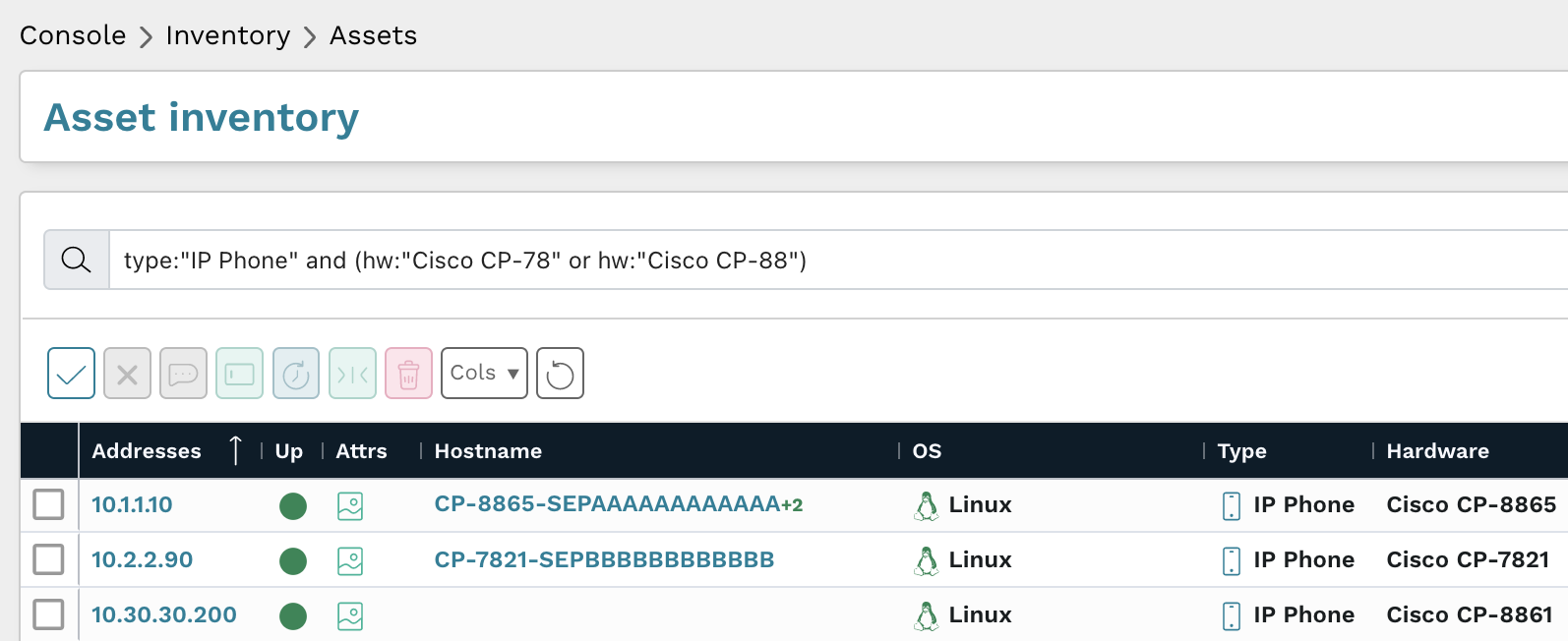
From the Asset Inventory, use the following pre-built query to locate Cisco 7800 and 8800 series IP phone assets which may need remediation:

type:"IP Phone" and (hw:"Cisco CP-78" or hw:"Cisco CP-88")

As always, any prebuilt queries are available from our Queries Library. Check out the library for other useful inventory queries.

About Version 2 Digital

Version 2 Digital is one of the most dynamic IT companies in Asia. The company distributes a wide range of IT products across various areas including cyber security, cloud, data protection, end points, infrastructures, system monitoring, storage, networking, business productivity and communication products.

Through an extensive network of channels, point of sales, resellers, and partnership companies, Version 2 offers quality products and services which are highly acclaimed in the market. Its customers cover a wide spectrum which include Global 1000 enterprises, regional listed companies, different vertical industries, public utilities, Government, a vast number of successful SMEs, and consumers in various Asian cities.

About runZero
runZero, a network discovery and asset inventory solution, was founded in 2018 by HD Moore, the creator of Metasploit. HD envisioned a modern active discovery solution that could find and identify everything on a network–without credentials. As a security researcher and penetration tester, he often employed benign ways to get information leaks and piece them together to build device profiles. Eventually, this work led him to leverage applied research and the discovery techniques developed for security and penetration testing to create runZero.

Finding MegaRAC BMC assets on your network

Earlier this week, researchers with Eclypsium shared findings on three vulnerabilities present in American Megatrends (AMI) MegaRAC firmware. MegaRAC can be found in many server manufacturers’ Baseboard Management Controllers (BMCs), including AMD, Ampere Computing, ASRock, Asus, ARM, Dell EMC, Gigabyte, HPE, Huawei, Inspur, Lenovo, Nvidia, Qualcomm, Quanta, and Tyan. Successful exploitation of these vulnerabilities can provide an attacker with remote code execution, an administrative shell, and user enumeration. Given American Megatrend’s broad reach across server manufacturers and models the number of systems with vulnerable MegaRAC BMC firmware could be quite large.

What is the impact?

These vulnerabilities are scored as CVSS “critical” and “high” severities, and the reported vulnerability details include:

  • CVE-2022-40259 (CVSS “critical” score of 9.9) – Remote code execution via Redfish API; requires initial access to an account with callback privileges or higher
  • CVE-2022-40242 (CVSS “high” score of 8.3) – Administrative shell via default credentials
  • CVE-2022-2827 (CVSS “high” score of 7.5) – User enumeration via API request manipulation

The Eclypsium report does mention that public exposure of vulnerable BMCs appears to be “relatively low compared to recent high-profile vulnerabilities in other infrastructure products.” That said, data centers where many similar servers exist -–including data centers providing cloud-based resources-– could yield many opportunities for an attacker who has attained access, and detection of BMC exploitation can be “complex” and is likely to be missed with traditional EDR/AV.

Are updates available?

While American Megatrends has not made a security advisory available at the time of this publication, owners and administrators of systems with MegaRAC BMC firmware should check with their server manufacturers for patched firmware updates.

Mitigations are offered in the Eclypsium report (see the “Mitigations” section), including (but not limited to) the following suggestions:

  • Ensure that all remote server management interfaces (e.g. Redfish, IPMI) and BMC subsystems in their environments are on their dedicated management networks and are not exposed externally, and ensure internal BMC interface access is restricted to administrative users with ACLs or firewalls.
  • Review vendor default configurations of device firmware to identify and disable built-in administrative accounts and/or use remote authentication where available.

How do I find potentially vulnerable MegaRAC BMC assets with runZero?

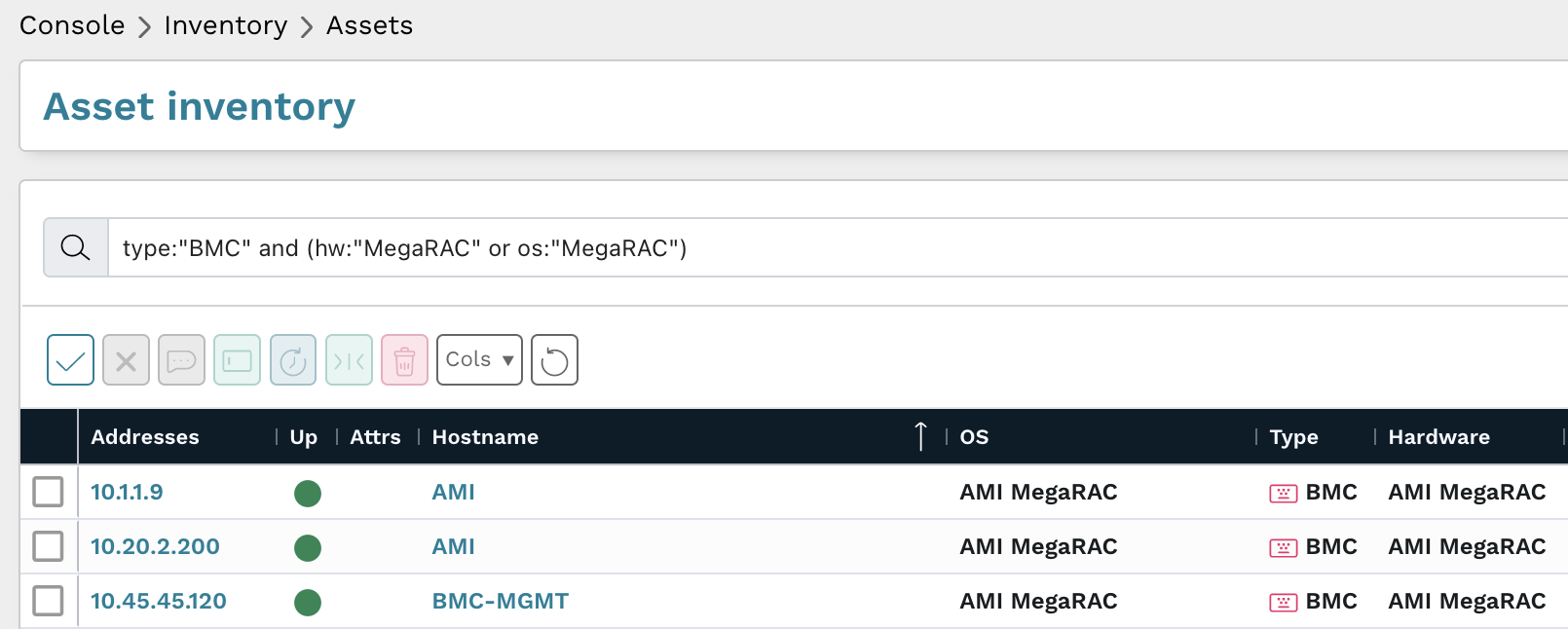
From the Asset Inventory, use the following pre-built query to locate BMC assets running MegaRAC firmware which may need remediation:

type:"BMC" and (hw:"MegaRAC" or os:"MegaRAC")
The prebuilt query is available in the Queries Library

You can also locate all BMC assets in your environment by searching your Asset inventory for type:"BMC", which can then be triaged further.

As always, any prebuilt queries are available from our Queries Library. Check out the library for other useful inventory queries.

About Version 2 Digital

Version 2 Digital is one of the most dynamic IT companies in Asia. The company distributes a wide range of IT products across various areas including cyber security, cloud, data protection, end points, infrastructures, system monitoring, storage, networking, business productivity and communication products.

Through an extensive network of channels, point of sales, resellers, and partnership companies, Version 2 offers quality products and services which are highly acclaimed in the market. Its customers cover a wide spectrum which include Global 1000 enterprises, regional listed companies, different vertical industries, public utilities, Government, a vast number of successful SMEs, and consumers in various Asian cities.

About runZero
runZero, a network discovery and asset inventory solution, was founded in 2018 by HD Moore, the creator of Metasploit. HD envisioned a modern active discovery solution that could find and identify everything on a network–without credentials. As a security researcher and penetration tester, he often employed benign ways to get information leaks and piece them together to build device profiles. Eventually, this work led him to leverage applied research and the discovery techniques developed for security and penetration testing to create runZero.
CISA BOD 23-01 requires asset visibility and vulnerability detection as foundational requirements

On October 3, 2022, the Cybersecurity and Infrastructure Security Agency (CISA) released the Binding Operational Directive (BOD) 23-01: Improving Asset Visibility and Vulnerability Detection on Federal Networks. This directive requires all Federal Civilian Executive Branch (FCEB) departments and agencies to comply with a set of cybersecurity requirements by April 3, 2023. Under the directive, asset visibility and vulnerability detection capabilities must be improved to meet the requirements outlined by CISA.

The BOD 23-01 strives to improve visibility and vulnerability detection on federal networks. However, the issues addressed by this directive are not exclusive to federal agencies. Asset inventory and vulnerability management are encouraged as best practices for all organizations, even though only FCEB agencies are legally required to comply by the April 3, 2023 deadline. In fact, CISA Director Jen Easterly told reporters, “Knowing what’s on your network is the first step for any organization to reduce risks.”

Asset visibility is foundational to cyber security

Cyber security is a universal challenge where asset inventory plays a major role. In other words, knowing your asset inventory is necessary for effective cyber security practices to be implemented. Easterly also said, “While this Directive applies to federal civilian agencies, we urge all organizations to adopt the guidance in the directive to gain a complete understanding of vulnerabilities that may exist on their network. We all have a role to play in building a more cyber resilient nation.” Regardless of whether or not an organization is a federal civilian agency, asset inventory should be the first step in reaching meaningful risk mitigation.

Modern cyber security practices require multi-part defensive measures. As technology has evolved, so have the threats to our security. More recently, the diversification of network environments in the civilian workplace has made network security and tracking more difficult. What had been a gradual transition to hybrid networks as the norm escalated rapidly during the pandemic, forcing security teams to suddenly manage on-premise, hybrid, and cloud networks more quickly than they were prepared to do. Network visibility now faces new challenges as networking environments have shifted.

There are too many assets to be tracked via manual methods, like spreadsheets. Not to mention unknown assets that may have been missed by traditional discovery methods. If you don’t know about an asset, how can you scan it for vulnerabilities?

Asset visibility is a critical building block for security measures, allowing you to have context around every asset connected to your network. You can leverage this data to assess endpoint detection and response (EDR) and vulnerability scan gaps in your network security. Thus ensuring you have strong, comprehensive network security coverage.

BOD 23-01 requires asset inventory and vulnerability enumeration

The number of assets has only continued to increase over time and CISA says “continuous and comprehensive asset visibility is a basic precondition for any organization to effectively manage cybersecurity risk.” In a 2021 US Senate report, federal agencies highlighted common asset and vulnerability challenges regarding their cyber security posture. That’s where CISA BOD 23-01 comes into play.

government cyber security diagram

BOD 23-01 focuses specifically on asset discovery and vulnerability enumeration which, as indicated in the diagram above, are critical pieces of any cyber security program. By April 3, 2023, federal civilian agencies need to have taken steps to comply with the following requirements:

  • Perform automated asset discovery every 7 days, covering a minimum of the organization’s IPv4 space.
  • Ingest on-demand vulnerability scan reports within 72 hours of a CISA request and be able to present findings to CISA within 7 days.
  • Perform vulnerability enumerations every 14 days with detection signatures that are no more than 24 hours old.

This criteria demands automated, on-demand, and rapid asset discovery capabilities. For many organizations, the volume of assets is too large for manual processing. BOD 23-01 aims to ensure federal agencies can keep up with their asset visibility and tracking. Automation must be able to report vulnerability data into a CDM dashboard to comply with BOD 23-01. CISA BOD 23-01 implementation guidelines specify what assets types fall within the scope of this directive, such as bring-your-own-device (BYOD) assets, communication devices, and more.

Asset discovery and vulnerability enumeration

The CISA BOD 23-01 requires that asset discovery capabilities must be able to capture high-fidelity data for managed and unmanaged devices. This data must be readily available, and presented in a digestible format to be considered compliant with the new directive. But asset discovery is only half the battle. There are several agencies that use vulnerability scanners to conduct discovery in addition to the traditional use of conducting vulnerability assessments. Vulnerability scanners are not an effective way to meet the new CISA requirements for asset inventory because they have limitations in terms of when they can run and how long the scans can take. FCEB agencies, and other organizations are encouraged, need a discovery solution that enables same-day response.

Asset discovery and vulnerability enumeration are the focal points of BOD 23-01. These two aspects of cyber security empower organizations to “better account” for assets and risks that have previously been unknown, and therefore unprotected, within their networks. While the CISA BOD 23-01 aspires to discover and protect the critical infrastructure and networks of the government, the same values can be applied to networks at large, no matter how the network is structured.

Asset discovery is a foundational security measure

The BOD 23-01 states, “Asset visibility is the building block for operational visibility.” Organizations must be able to identify IP addresses directly in the network as well as associated IP addresses. BYOD, cloud, and other assets are included in this identification requirement. IPv4 addresses need to be accounted for in their entirety at a minimum, though full visibility of other IP addressable assets are highly encouraged.

There are several ways to perform asset discovery, including active, passive, and external scanning. Each method will bring certain assets to light, but these methods also come with their own challenges.

  • Active: An active scan transmits network packets or queries local hosts and then analyzes responses. In other words, active scanning creates traffic for the network. If you are scanning a network with fragile devices, ensure that you pick a scanner that has been designed to safely scan these devices.
  • Passive: These scans observe traffic that traverses the network adapter the scanner is configured to listen in on. Passive scanning collects data about the assets actively talking on a limited section of the network, limiting visibility to a singular “choke point” and active assets. Passive collection is difficult to deploy across a sprawling organization. Encrypted protocols have made passive asset inventory increasingly harder.
  • External: External attack surface management (EASM) tools provide a perimeter view of IP addresses outside your network. Scanning external attack surfaces helps with gaining visibility to external hosts or exposed services, reconnaissance in penetration testing, and more. However, network owners can opt to hide their IP ranges, preventing those assets from showing up on your scan. Additionally, these are conducted without direct access to the network so visibility may be limited even further.

Effective asset discovery capabilities will deliver visibility into both internally and externally facing assets. As a result, you’ll have a more comprehensive asset inventory, allowing you to quickly identify and track when assets come online or go offline.

Critical vulnerabilities must be enumerated within 72 hours

Cyber security programs must be able to identify asset-specific vulnerabilities on-demand to comply with BOD 23-01 requirements. This applies to any information technology or operational technology asset that is accessible via IPv4 or IPv6 networks. BOD 23-01 mandates that agencies enumerate vulnerabilities across all discovered assets, such as operating systems, software and versions, potential misconfigurations, and missing updates. However, vulnerability enumeration has its own challenges and limitations with fingerprinting.

On top of struggling to meet data requirements, vulnerability management solutions lack the ability to meet the requirements outlined in CISA BOD 23-01, particularly, the 72 hour response timeline. Vulnerability scan times can vary greatly, depending on the business restrictions in place. Oftentimes, teams need to wait until the new vulnerability checks are available in order to scan for the newest security flaw. The solutions then need to scan the network again, which often requires waiting for the next maintenance window. This makes the required 72 hour response time extremely challenging to meet.

A modern approach to identifying potentially vulnerable systems much faster is to decouple the network scan from the vulnerability analysis. A modern asset discovery solution will be able to scan the hardware and software assets on the network with enough detail that it already contains enough information to identify potentially vulnerable systems. As a result, security teams can identify potentially impacted systems in minutes by querying the database. This approach is much faster than the traditional path of waiting for updated vulnerability checks, updating the scanners, scanning the network, and running reports on the new vulnerability.

Reducing the network security threat surface through asset inventory and vulnerability management solutions is critical to one’s overall security posture. One tool without the other is not enough to comply with the recent directive. Asset inventory and vulnerability management solutions work together to provide a clearer picture of an organization’s security posture.

How runZero helps comply with BOD 23-01

runZero is a comprehensive asset inventory solution that uses active, unauthenticated scanning capabilities as well as the ability to pull in third-party data, for example from vulnerability scanners, for a full picture of your network. runZero was founded by HD Moore, the creator of Metasploit, with cyber security fundamentals in mind. The runZero scan engine was designed from scratch to safely scan fragile devices.

runZero can help with administering asset discovery and inventory management in several ways including:

  • Discover the entire IPv4 space in less than 7 days: BOD 23-01 requires that the entire RFC 1918 space is scanned every 7 days for asset inventory. Most scanning technologies, especially vulnerability scanners, will struggle to cover an entire agency in this amount of time. runZero can cover the entire internally addressable RFC 1918 space overnight. runZero can also scan the agency’s external perimeter.
  • No credentials required: BOD 23-01 states that “asset discovery is non-intrusive and usually does not require special logical access privileges.” runZero features a proprietary unauthenticated active scanner that was designed with asset inventory in mind. Many other solutions require credentials to obtain enough information about systems
  • Respond rapidly to imminent threats: BOD 23-01 requires agencies to “develop and maintain the operational capability to initiate on-demand asset discovery and vulnerability enumeration to identify specific assets or subsets of vulnerabilities within 72 hours of receiving a request from CISA and provide the available results to CISA within 7 days of request.” After a new vulnerability story breaks, vulnerability scanners often take 1-2 weeks to create a vulnerability check for new vulnerabilities before agencies can even start testing. In most cases, you can use runZero’ existing scan data to find affected systems in a matter of seconds without having to rescan.
  • Get asset context on enumerated vulnerabilities: runZero integrates with Tenable, Rapid7 and Qualys to import vulnerability data into the asset inventory to provide contextual information on what assets a vulnerability was found on as well as the network context of the asset. In addition, runZero makes it easy to check that your vulnerability scanners are covering all of your subnets, highlighting any security control coverage gaps.
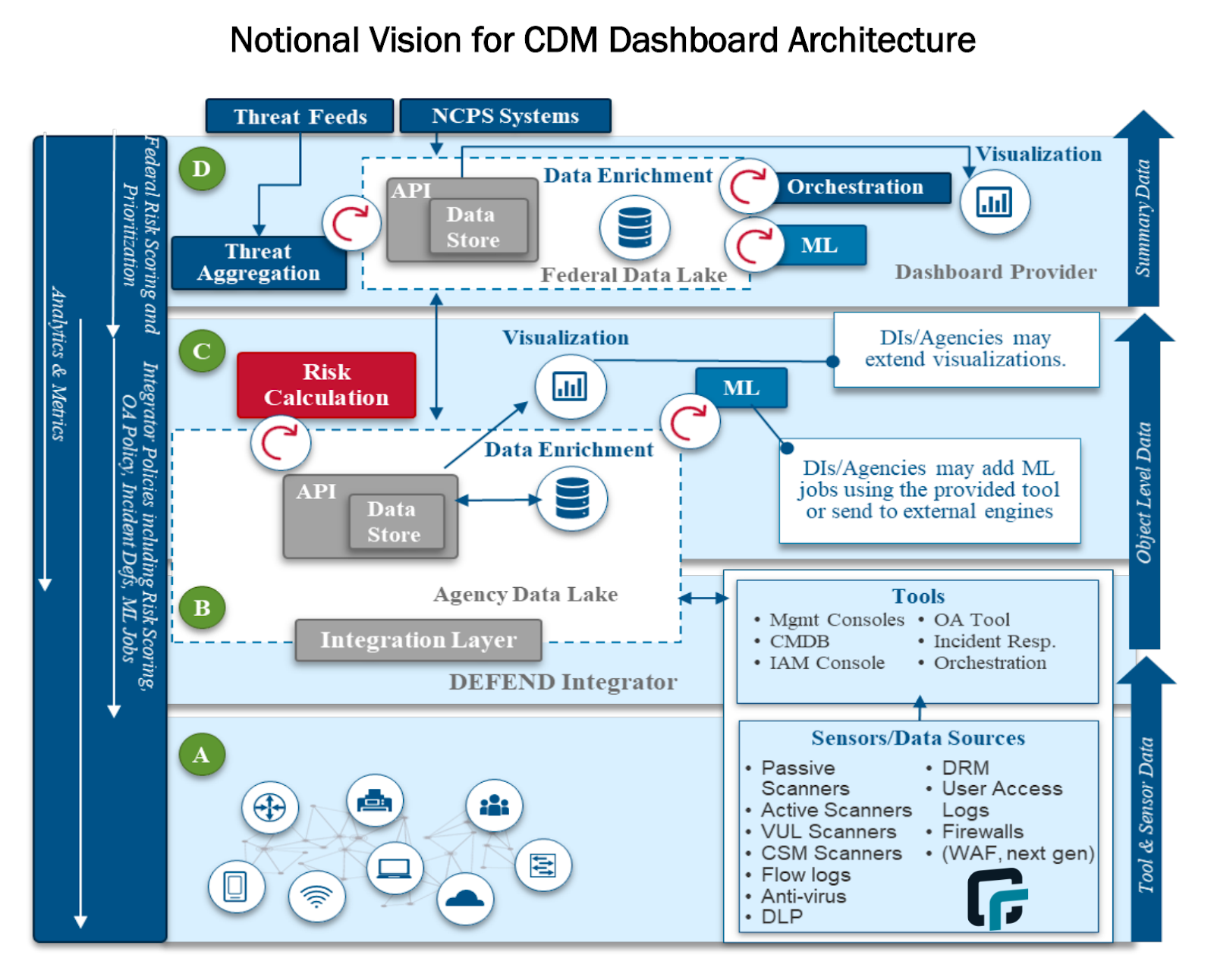
  • Import asset inventory data to the CMDB or Agency Data Lake: According to the CISA CDM architecture diagram, active scanners should push their data into the CMDB, which publishes data to the agency data lake that feeds the CDM. runZero integrates with CMDBs (e.g. ServiceNow). Some agencies that do not have an existing CMDB may even choose to aggregate data in runZero directly and feed the Agency Data Lake from there. runZero integrates with vulnerability scanners, endpoint detection and response (EDR) solutions, mobile device management (MDM) software, Microsoft Active Directory / Azure AD, attack surface management vendors, and cloud hosting providers to aggregate and consolidate all asset data in a single platform. It then offers a simple JSON export API to pull the asset inventory into a data lake.

Discover internal and external assets

runZero discovers internal and external assets, providing the high-fidelity context needed to fulfill BOD 23-01 requirements. Set up recurring unauthenticated scans to keep your asset inventory awareness up. Alerts for new asset connections or existing asset changes can be easily added to your scans. You can also conduct on-demand scans as needed and get the asset contextualization you need in minutes, complete with downloadable, digestible reports that you can present to your team (or CISA).

To meet the requirements outlined in BOD 23-01, your asset discovery solution needs to be able to quickly capture high-fidelity asset data on everything within your firewall as well as exposed services to properly assess your asset vulnerabilities. runZero can give you a strong picture of your external attack surface. Through active scanning and integrations, runZero augments data found by taking inputs from internal IPs that have been discovered and identifying public-facing hosts. Additionally, our unauthenticated scans can discover assets on a network without requiring a username/password. This approach is unobtrusive, because it doesn’t require credentials and agent deployment is time consuming and only covers managed assets.

Build a comprehensive asset inventory

A complete asset inventory includes unmanaged devices, internal and external assets, and having relevant data available on all of these assets. This level of visibility is essential both for strengthening your security posture and for meeting BOD 23-01 requirements. Unauthenticated scanning is the best way to quickly capture this information without having to worry about system fragility or resource-intensive setup like with agent-based solutions.

runZero creates a comprehensive picture of your asset inventory through on-demand unauthenticated scans and integrations, giving you more accurate fingerprinting of your assets, including those you don’t know about. You can find unmanaged devices and see when assets come on or offline in your network. Additionally, runZero gives you full control of your scans and queries, including the ability to create custom queries, generating alerts for specific assets in your scan results.

Enrich assets with vulnerability data

runZero leverages asset data from multiple sources, as well as its own unauthenticated scanner, to deliver full visibility into assets across any environment. Integrations with vulnerability scanners, like Tenable, Qualys, and Rapid7, will help you:

  • Add additional asset context to your vulnerability data
  • Find gaps in your vulnerability scan coverage
  • Respond to emerging vulnerabilities faster

Search web screenshots for oddities, identify outliers, and see assets that may need to be patched with on-demand custom queries. For example, let’s assume developers were aware of Log4Shell on the first day. They weren’t able to immediately go into their systems to find and fix the vulnerability because no one had checks available on day one. As a result, teams typically had to wait for their vuln scanner to have the checks available and then wait for a maintenance window to scan their targets resulting in delays in their ability to assess and remediate issues.

During one of our case studies, a customer that had been using ServiceNow ITOM (IT Operation Management) realized they struggled with getting all of the asset data they needed. This was especially true for their unmanaged assets, but they didn’t have the desired data for their managed assets either. The customer said, “The team looked at Qualys as an alternative data source for ServiceNow Discovery, but the system (scanned through appliances) was too slow.”

Log4Shell highlighted the importance of having the ability to quickly search an existing inventory to find assets that may be impacted by a new vulnerability without having to run a new vulnerability scan. runZero was able to provide prebuilt queries to help customers find potentially affected assets before vulnerability scanners had checks available for products and services using the Log4J.

runZero exceeds the asset visibility requirements of BOD 23-01

CISA BOD 23-01 was created to strengthen the overall cyber security posture of federal civilian agencies by requiring improvements around asset inventory and vulnerability management. With several tools and methods being used to conduct these practices, the new timeline requirements will force agencies to evaluate existing processes to comply with BOD 23-01 runZero will unify and enrich asset data from your existing security tools to deliver visibility across your internally and externally facing assets. You can take runZero for a test run with our free 21-day Enterprise trial or get a demo to learn how runZero can help your business. Contact us if you’d like to test our self-hosted version.

About Version 2 Digital

Version 2 Digital is one of the most dynamic IT companies in Asia. The company distributes a wide range of IT products across various areas including cyber security, cloud, data protection, end points, infrastructures, system monitoring, storage, networking, business productivity and communication products.

Through an extensive network of channels, point of sales, resellers, and partnership companies, Version 2 offers quality products and services which are highly acclaimed in the market. Its customers cover a wide spectrum which include Global 1000 enterprises, regional listed companies, different vertical industries, public utilities, Government, a vast number of successful SMEs, and consumers in various Asian cities.

About runZero
runZero, a network discovery and asset inventory solution, was founded in 2018 by HD Moore, the creator of Metasploit. HD envisioned a modern active discovery solution that could find and identify everything on a network–without credentials. As a security researcher and penetration tester, he often employed benign ways to get information leaks and piece them together to build device profiles. Eventually, this work led him to leverage applied research and the discovery techniques developed for security and penetration testing to create runZero.