Skip to content

24.3.0 Voyager released

Changes compared to 23.12.9

Enhancements

  • Added informational headers to job logs that are exported to CSV (now renamed to Text) or Excel. Previously these headers were only included when exporting to Clipboard
  • Added the ability to select which logs are exported from the Server Logs and Job Logs pages in the Comet Server web interface
  • Removed Object Lock options from Storage Role in the Comet Server web interface and the Comet Server Service Manager
  • Added a warning when starting the Comet Server starts if the Storage Role is detected to be using Object Lock
  • Enabled Server Self-Backup by default for new Comet Server installations. This will not affect existing Comet Servers when they are upgraded
  • Removed the File column on the Server Logs page on the Comet Server web interface
  • Added a Last Message column to the Server Logs page on the Comet Server web interface

Bug Fixes

  • Fixed an issue with the Storage Template dialog for tenant administrators displaying incorrect fields after upgrading the Comet Server version

About Version 2 Digital

Version 2 Digital is one of the most dynamic IT companies in Asia. The company distributes a wide range of IT products across various areas including cyber security, cloud, data protection, end points, infrastructures, system monitoring, storage, networking, business productivity and communication products.

Through an extensive network of channels, point of sales, resellers, and partnership companies, Version 2 offers quality products and services which are highly acclaimed in the market. Its customers cover a wide spectrum which include Global 1000 enterprises, regional listed companies, different vertical industries, public utilities, Government, a vast number of successful SMEs, and consumers in various Asian cities.

About Comet
We are a team of dedicated professionals committed to developing reliable and secure backup solutions for MSP’s, Businesses and IT professionals. With over 10 years of experience in the industry, we understand the importance of having a reliable backup solution in place to protect your valuable data. That’s why we’ve developed a comprehensive suite of backup solutions that are easy to use, scalable and highly secure.

Marching ahead with the Parallels platform

As the Senior Vice President of Product, I am thrilled about the latest release in Parallels platform – Parallels Browser Isolation (PBI).

In this post, I’d like to emphasize the importance of Parallels Browser Isolation and how it seamlessly integrates into our strategic Parallels platform, empowering our customers and partners to navigate the changing end-user computing and security landscape with confidence.

Cybersecurity at the forefront

Cybersecurity threats are multiplying at an alarming pace, fueled by the rise of remote work, BYOD, and the widespread adoption of SaaS applications. A recent survey paints a stark picture — a staggering 41% of organizations from different sectors experienced security breaches in the past year, highlighting the severity and prevalence of these threats.

With a growing need to protect their organization’s data from inadvertent compromises caused by cybersecurity incidents, administrators are looking for simple solutions to secure their data and applications.

Parallels has unified remote access as a single vendor capable of providing access to legacy applications – with Parallels RAS and Parallels Secure Workspace through VDI, as well as Parallels DaaS in the cloud. And now, with the addition of Parallels Browser Isolation securing remote access to SaaS applications. The need for secure access to apps and data has never been more pressing for organizations of all sizes.

By consolidating access under a single vendor, Parallels provides partners and customers with a one-stop shop for all their security access needs. There’s no need to juggle expensive secure access alternatives—Parallels Browser Isolation provides a way for partners and customers to use Parallels to access important tools that were previously only offered by CASB or DLP solutions.

A step towards a unified Parallels hub

With the launch of Parallels Browser Isolation, the Parallels team is not just enhancing security, but evolving the way customers and partners solve their application delivery and access challenges.

By implementing a hub and spoke model, we’ve centralized control through a robust control plane (the hub) that is architected to connect all Parallels products between endpoint, server, and cloud (the spokes). Parallels DaaS and Parallels Browser Isolation are the first two services in this hub and spoke model.

This milestone represents a significant step towards achieving our vision of a centralized hub for all Parallels products, streamlining operations for administrators, and ensuring a cohesive user experience.

Now, customers and partners can confidently rely on Parallels to securely access a wide range of applications, including legacy, cloud, desktop, and SaaS, all within our holistic platform of secure workspace solutions.

Our dedication to innovation and user-centric solutions

One of the first principles for Parallels has been to keep it simple for customers (administrators and end-users).

Moreover, Parallels offers a unified administrator experience that makes it easy for admins to deploy and manage desktops and applications. With our cloud services, we are building a centralized control plane that allows the management of various services via a common management interface.

The Parallels Browser Isolation release plays a vital role in realizing our central hub and spoke model. By addressing critical security perimeters, Parallels Browser Isolation becomes the cornerstone of building a seamless and comprehensive experience that encompasses remote access to all applications used by an organization.

We have a pipeline brimming with exciting innovations, all ensuring that Parallels remains at the forefront of technological advancement.

We assure our users that Parallels is and will be committed to innovation and user-centric solutions in the intersection of cybersecurity and end-user-computing (EUC) areas.

Access your Parallels Browser Isolation trial now.

About Version 2 Digital

Version 2 Digital is one of the most dynamic IT companies in Asia. The company distributes a wide range of IT products across various areas including cyber security, cloud, data protection, end points, infrastructures, system monitoring, storage, networking, business productivity and communication products.

Through an extensive network of channels, point of sales, resellers, and partnership companies, Version 2 offers quality products and services which are highly acclaimed in the market. Its customers cover a wide spectrum which include Global 1000 enterprises, regional listed companies, different vertical industries, public utilities, Government, a vast number of successful SMEs, and consumers in various Asian cities.

About Parallels 
Parallels® is a global leader in cross-platform solutions, enabling businesses and individuals to access and use the applications and files they need on any device or operating system. Parallels helps customers leverage the best technology available, whether it’s Windows, Linux, macOS, iOS, Android or the cloud.

How to prevent data breaches: best practices

Imagine you find out the most private details of your DNA, only to have them spilled out for anyone to see. That’s the scare 23andMe users faced when a big data breach hit, turning their quest for genetic discovery into a privacy nightmare.

This mishap shook trust in the company, leaving many to question the safety of their most personal data. For the CEO and investors, the data breach was a disaster, crashing stock values and challenging the company’s future.

This breach was a stark reminder of the fine line between innovation and privacy. In the U.S., data breach incidents have peaked, with a nearly 20% increase in the first nine months of 2023 compared to the same period last year. Additionally, 98% of companies have felt the impact through vendors who’ve experienced breaches in the past two years.

Let’s explore how to prevent data breaches and protect sensitive information in risky environments.

Key takeaways

  • The U.S. data breach rate surged by nearly 20% in early 2023, so the need for robust data security measures is growing.

  • The main reasons why data breaches occur include phishing, cloud misconfigurations, zero-day vulnerabilities, and third-party attacks.

  • Implementing a strong password policy, regular training and multi-factor authentication (MFA) are critical steps in data breach prevention and protecting customer data.

  • NordLayer helps achieve Zero Trust Network Access (ZTNA) and Secure Service Edge (SSE) frameworks that reduce data breach risks.

  • A comprehensive security strategy is essential for data breach prevention.

Why a data breach can happen

Data leaks are big problems for organizations. They lead to lost sensitive data, damaged trust, and high costs. Breaches happen differently, each finding a weak spot in a company’s digital or physical defenses. Knowing about data breach methods helps organizations strengthen their defenses and keep their data safe.
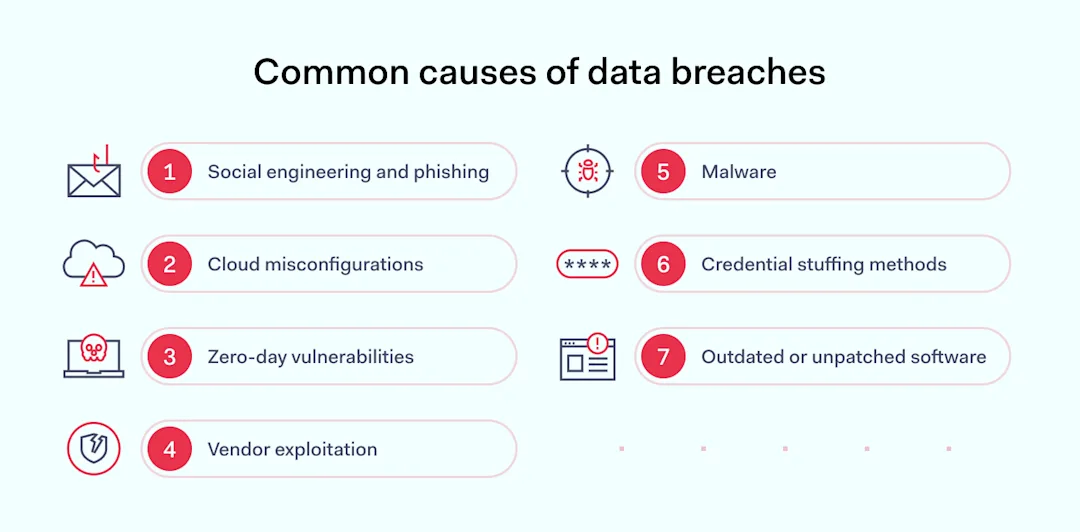
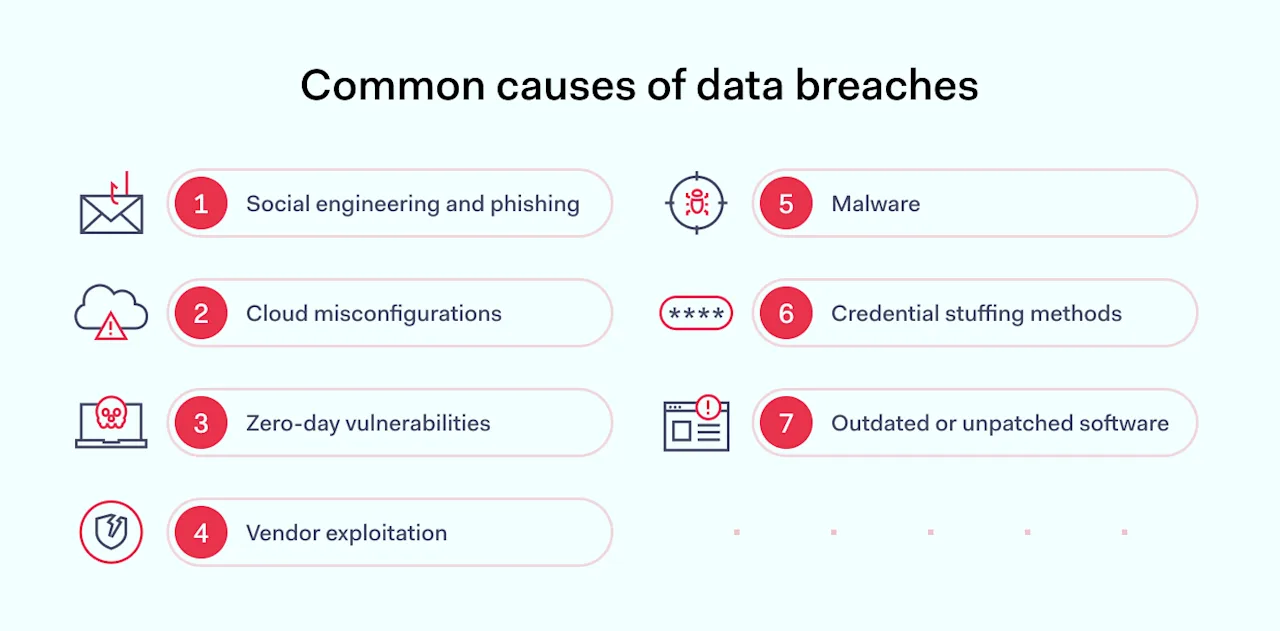
Common causes of data breaches

Social engineering and phishing

Social engineering has been around for a long time, yet it remains a highly effective method for causing data leaks. Despite widespread awareness about the risks of clicking on links in suspicious emails, a surprising number of data leaks—up to 90%—involve some form of social engineering.

Social engineering is the art of manipulating people into giving up confidential information or performing actions that grant access to secured systems and corporate data. It’s like someone dressing up as a postal worker and convincing you to hand over your house keys. This method works well because it tricks people, not machines.

Cloud misconfigurations

Imagine leaving your house with the front door unlocked. That’s similar to cloud misconfigurations. They happen when cloud settings aren’t appropriately secured, like leaving security features off or setting them up wrongly. This makes it easy for attackers to access data stored online. Because so many companies use cloud services, such mistakes are common and can lead to big problems.

Zero-day vulnerabilities

A zero-day vulnerability is a flaw in software or hardware that attackers find and use before the makers can fix it. It’s like a hidden weak floorboard in a new house that nobody knows about until someone steps on it and falls. Zero-day vulnerability attacks are rare but can cause much damage because there’s no defense against them at first.

Attacking the security flaws of vendors

This happens when attackers find a weak spot in the systems of companies that your organization works with. In 2022, the number of supply chain attacks jumped by 633%. They are still a big problem. For example, in June 2023, a group of threat actors from North Korea got into JumpCloud, which is a company that provides software services, by exploiting weaknesses not directly in JumpCloud but in another company they trusted. If the companies you share your data with aren’t careful, your data might be in danger, too. When we share data, we hope the other company will protect it well. Sadly, this doesn’t always happen.

Malware

Malware is a sneaky bug that gets into your computer to spy on you or steal things. Attackers send harmful software in emails or through websites. Once it’s on a computer, it can steal sensitive data. Keeping software up to date and being careful about what you download can help keep malware out.

Credential stuffing methods

Credential stuffing is when attackers use stolen passwords to try to get into many different accounts. It’s like someone finding a key and trying it in every door in the neighborhood to see which ones it can open. People often use the same password for many accounts, which makes this method very effective. To guard against this, having rules for strong passwords in your organization is a good step. It’s also smart to change passwords often, use a password manager, and make sure you don’t use the same password more than once.

Outdated or unpatched software

Using old or unpatched software is like having a lock that everyone knows how to pick because it’s old and the maker never improved it. Attackers look for software that hasn’t been updated because it’s easier to break into. Keeping software up to date is a simple but important way to protect data.

How to prevent data breaches

Keeping data safe is essential for protecting private information, earning people’s trust, and avoiding money problems. Using a mix of smart tech fixes and teaching your team about safety can help stop unauthorized access to your data. Let’s break down how to do this in simple steps anyone can follow.
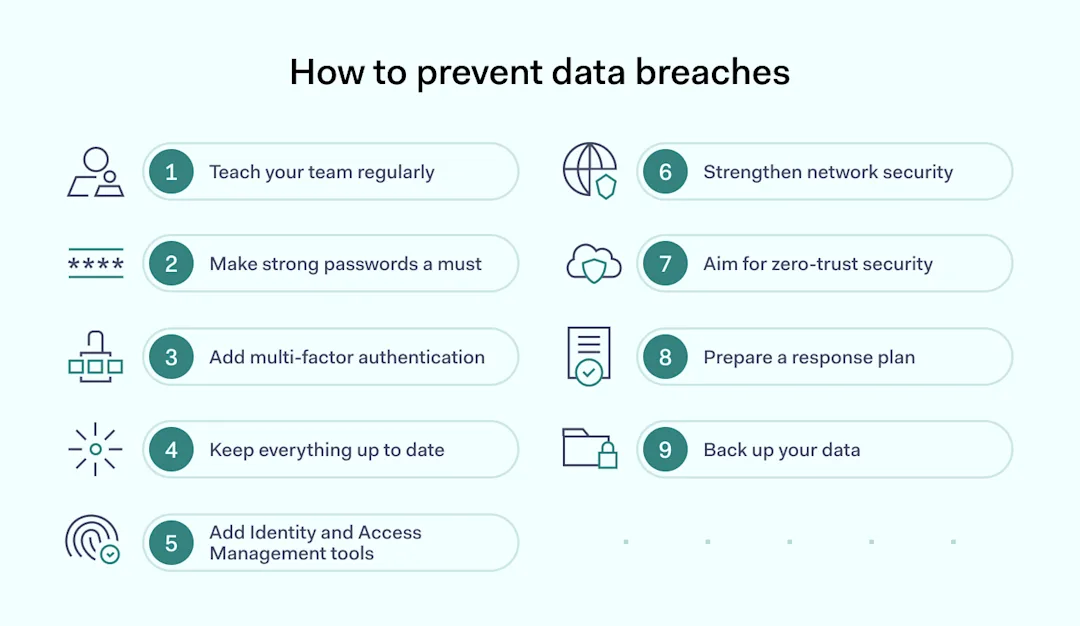
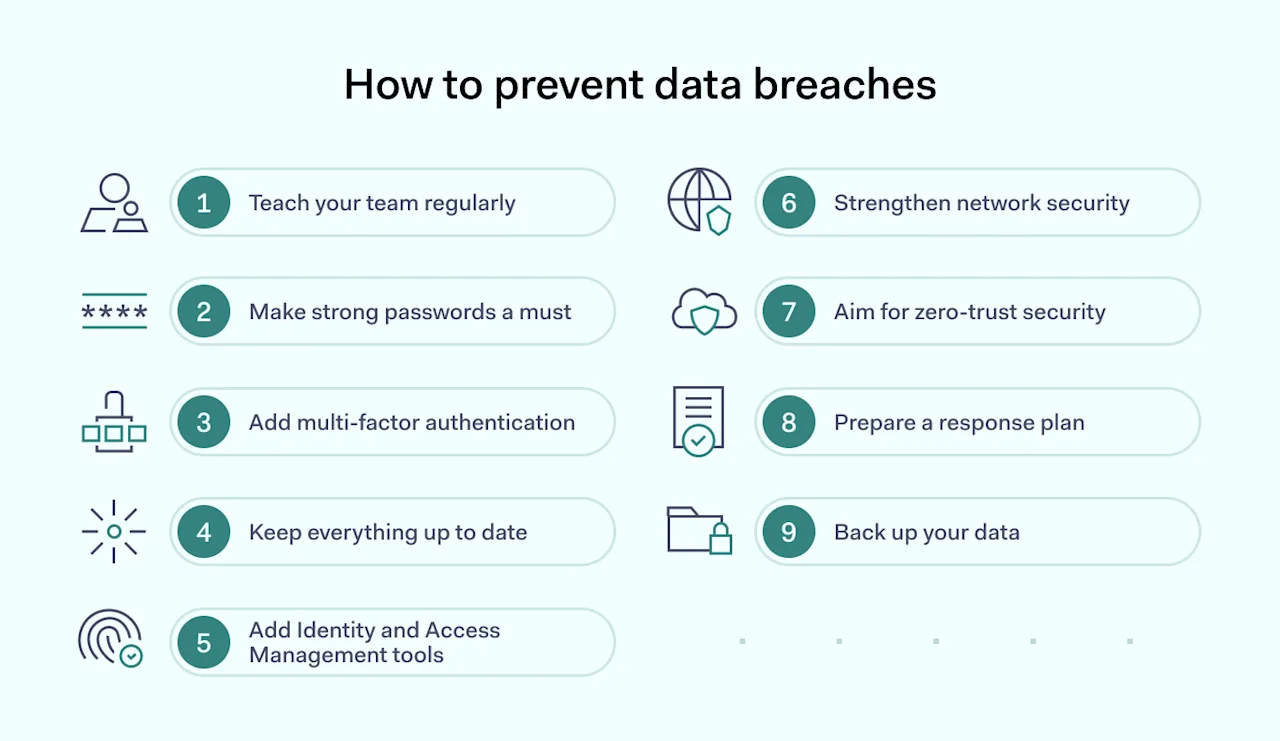
How to prevent data breaches

Teach your team regularly

Since 9 out of 10 data breach incidents begin with phishing, often due to simple mistakes, setting up regular training for your team is crucial. Most importantly, your team will learn to spot phishing emails—fake messages designed to steal sensitive data. Also, these sessions should cover how to create strong passwords, the importance of not sharing sensitive information, and what steps to take if they suspect a data breach threat. Making this training a routine ensures everyone stays sharp and ready to protect your organization’s data.

Make strong passwords a must

Using weak passwords is like using a flimsy lock on your door. To combat this, enforce a policy requiring solid and complex passwords. These passwords should be a mix of letters, numbers, and symbols, making them hard to guess.

Encourage or require password changes every few months to keep things even more secure. This simple step can significantly reduce data breach chances.

Add an extra lock—multi-factor authentication

MFA adds a crucial layer of security. It’s a way to ensure that even if a password gets stolen, there’s still another barrier keeping intruders out.

MFA can include something you know (like a password), something you have (like a smartphone app that generates a code), or something you are (like a fingerprint or facial recognition). This method significantly lowers the risk of someone else accessing your accounts.

Keep everything up to date

Software developers release updates not just for new features but to fix security gaps that threat actors could exploit. By staying on top of these updates, you’re essentially replacing old locks with new ones regularly.

This doesn’t just apply to your security software but to all software used in your business.

Don’t let everyone in every room

Think of your organization’s data like a house with many rooms. Not everyone needs a key to every room—just the ones they need to enter for their work.

This approach is called ‘least privilege,’ and it greatly lowers the risk of sensitive information getting out by mistake or on purpose.

Identity and Access Management (IAM) systems and tools like NordLayer’s Cloud Firewall are like giving out specific keys for specific doors. They help manage who can access certain pieces of information.

It’s also crucial to check the security measures of outside companies with access to your data. They might accidentally leave a window open for threat actors to climb through.

Build a strong fence—network security

Imagine surrounding your data with a high-tech fence. This fence, made up of firewalls and encryption, keeps your data safe from intruders.

Firewalls act as the gatekeepers, deciding what traffic can enter or leave your network. Encryption scrambles your data, so even if someone manages to grab it, they can’t understand it.

Together, they create a strong barrier that spots and stops threat actors before they can reach your confidential information.

Trust no one

Zero-trust security is like not letting anyone into your house without verifying their identity every single time, even if you recognize them.

In the digital world, this means not automatically trusting anyone inside or outside your organization. Everyone must prove they are who they say they are and that they really need access to the information they’re asking for.

This approach ensures that only the right people get access to the right data, reducing the chance of a data breach. It’s a way of keeping your digital doors locked tight, even if someone has managed to get past the fence.

Have a plan if a data breach happens

Even with the best precautions, things can still go sideways. That’s why having a response plan is crucial.

This plan outlines what to do, who to call, and how to communicate during a data breach. It helps you act quickly to limit damage and start the recovery process. Practicing this plan ensures everyone knows their role in an emergency, making it easier to stay calm and organized when every second counts.

Keep copies of important stuff

Backing up your data means quickly restoring what was lost and keeping your business moving without missing a beat.

It’s a safety net that ensures even in the worst-case scenario—like a ransomware attack or a natural disaster—you can recover your essential data. Regularly updating and storing these backups in a secure, offsite location or cloud service adds an extra layer of security.

Improve your data security with NordLayer

NordLayer offers solutions that support the Zero Trust Network Access (ZTNA) framework, a key strategy in modern data security. ZTNA works on the idea that nobody should be trusted automatically. It asks for verification from anyone trying to access the system. This method makes sure that only people who are supposed to see sensitive data can get to it, greatly lowering the chance of a data breach. NordLayer enhances this by checking who is trying to access what and the security of their devices. This stops unauthorized people from getting in and helps prevent data breaches.

NordLayer also helps companies use the Security Service Edge (SSE) framework, which efficiently protects corporate data and customer data. SSE combines several essential security tools into one service that’s based in the cloud. This includes things like firewalls as a service and ways to keep web browsing safe. Using SSE, companies can move faster and are better at stopping, spotting, and dealing with online dangers. SSE makes sure that only safe web use is allowed, keeping companies in line with their rules. It also uses a method where no trust is assumed; trust must be earned continuously. This means better protection against identity theft and more control over who gets to access what in the cloud.

If you have any questions or need more information, please contact our sales team. They’re ready to help you.

About Version 2 Digital

Version 2 Digital is one of the most dynamic IT companies in Asia. The company distributes a wide range of IT products across various areas including cyber security, cloud, data protection, end points, infrastructures, system monitoring, storage, networking, business productivity and communication products.

Through an extensive network of channels, point of sales, resellers, and partnership companies, Version 2 offers quality products and services which are highly acclaimed in the market. Its customers cover a wide spectrum which include Global 1000 enterprises, regional listed companies, different vertical industries, public utilities, Government, a vast number of successful SMEs, and consumers in various Asian cities.

About NordPass
NordPass is developed by Nord Security, a company leading the global market of cybersecurity products.

The web has become a chaotic space where safety and trust have been compromised by cybercrime and data protection issues. Therefore, our team has a global mission to shape a more trusted and peaceful online future for people everywhere.

How Accrete Inc. prepared for failover to protect the sensitive data of high-profile clients

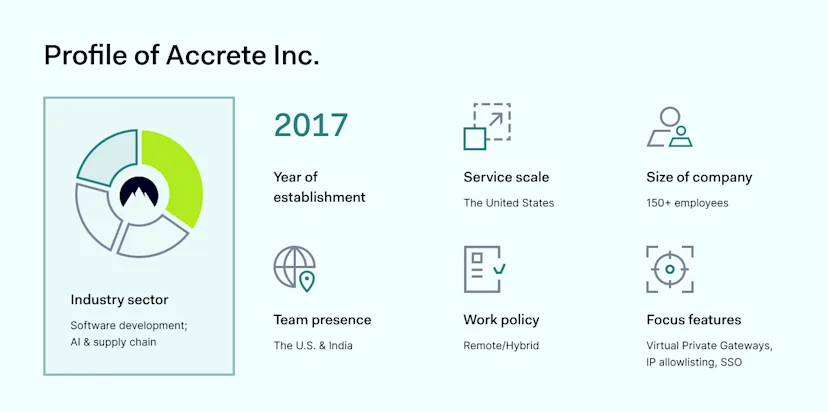
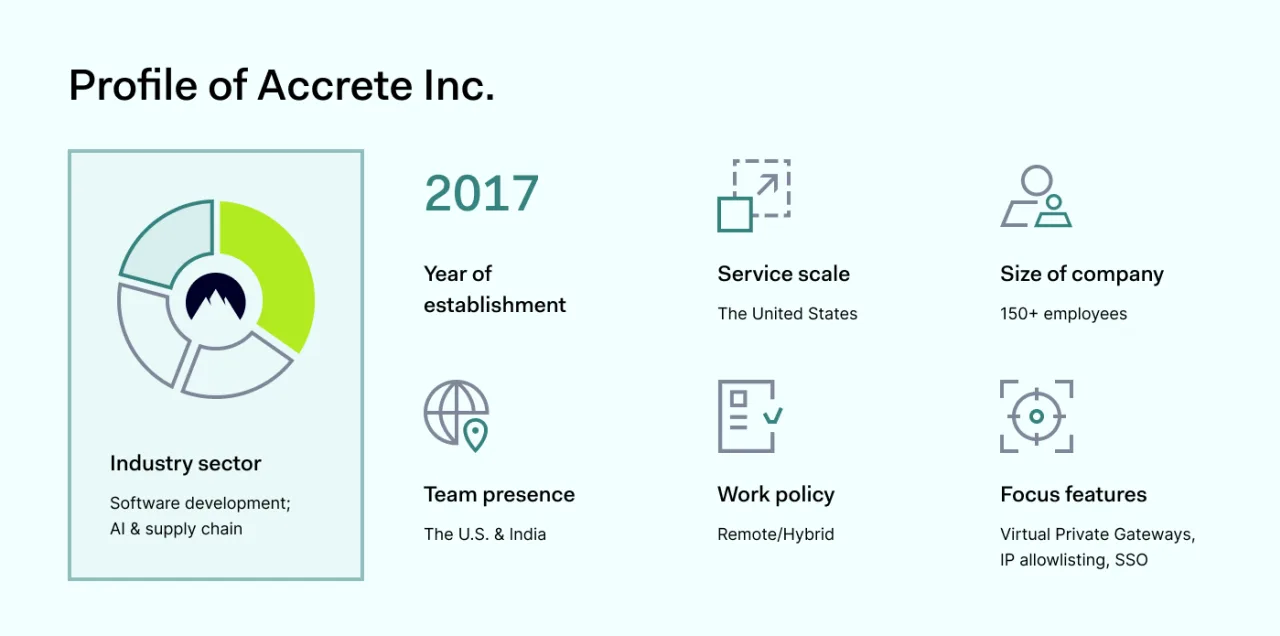
Accrete Inc. is an artificial intelligence company that specializes in a variety of sectors. Its wide range of products supports government, entertainment, financial services, and consumer packaged goods. The company has established a reputation for its innovative supply chain analysis and social media aggregation solutions. 

Profile of Accrete Inc.Peter Bierfeldt, the Chief Information Security Officer, oversees the security of the company’s intellectual property, customer data, and overall reputation. He shared how working with governmental and other high-risk clients requires a focus on layered security and how Accrete Inc. achieved it using NordLayer.
The challenge

Securing cloud environments for high-risk data clients

Accrete’s unique position in the market, dealing with sensitive government contracts and a global workforce, posed significant cybersecurity challenges.

The company works with a diverse range of clients, including the US Department of Defense. This requires them to follow stringent security standards like FedRAMP and NIST 800-171.

“We knew it’s a good practice to have a VPN solution in place to have everybody enter our client cloud network through an allowlisted IP, whether you’re talking AWS GovCloud or AWS commercial production.”

Click to tweet

The primary concern was securing a virtual, cloud-based network environment against potential threat actors, particularly in high-risk countries.

“We are a virtual company with no on-premise network. We don’t have anything like that. We are 100% in the cloud, and protecting that cloud is really, really important.”

Click to tweet

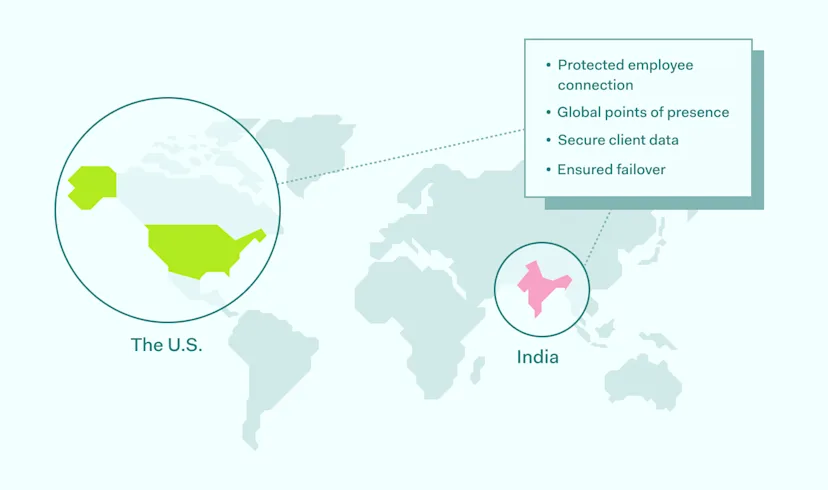
Additionally, Accrete faced challenges in managing a globally dispersed team with offices in the U.S. states and India, requiring secure and reliable access to the network from various locations worldwide.

The solution

Combining multiple security functionalities for the best result

Accrete Inc. chose NordLayer as their cybersecurity partner, transitioning from their previous VPN provider.

“Accrete Inc. needed one more piece of the puzzle for getting into our network, an additional layer of security that you can put in place to protect your production and entire network.”

Click to tweet

The company’s network security combines layers of different capabilities and functionalities. It includes virtual private gateways, IP allowlisting, SSO and MFA implementation, strong passwords, and antivirus protection. Thus, it must have been not only just a VPN but a solution that does more.

“Our old VPN didn’t do anything beyond being a VPN. We looked for a solution that secures the network when connected to untrusted Wi-Fi and is reliable regarding performance.”

Click to tweet

As Peter notes, different from free tools, the company is paying for the service to protect their information. Having government customers dealing with financial services and insurance, Accrete Inc. must ensure that nobody’s snooping on their traffic, and with a company like NordLayer, they don’t have to worry about it.

Why choose NordLayer

NordLayer was selected for its robust VPN solutions, global points of presence, and seamless integration with existing systems like Okta SSO providers.

“Our clients must know that we don’t relax our security. An outage and going down temporarily is an issue with high-sensitivity data, but with failover, we don’t need to worry about it.”

Click to tweet

One of the main objectives for Accrete Inc. was to establish a failover in case of an outage. Deploying at least two private servers ensured high service availability. This approach means security isn’t compromised, even if one of the virtual gateways flatlines for a few minutes.

A solid mesh of security and business continuity measures established with the NordLayer tool

The key reasons for this choice were:

  • NordLayer’s global network infrastructure provided low-latency, secure connections for their international team, which was particularly beneficial for the office in Mumbai.

  • The ability to establish failover systems ensured uninterrupted access and network resilience.

  • NordLayer’s reputation for reliability and security compliance aligned with Accrete’s needs for protecting sensitive government-related data.

  • The ease of onboarding and user-friendly nature of NordLayer’s services minimized IT overhead and facilitated smooth integration into Accrete’s operations.

The outcome

Complete team protection to enable full network security

Implementing NordLayer resulted in a strengthened cybersecurity posture for Accrete Inc. The new system enhanced network security without compromising on performance, even for remote and international team members.

Accrete Inc. added VPN gateways to cover both the United States and India, supporting all staff.  VPN usage mitigates the risk of leakage of even relatively benign information like email addresses and user names.

“Investing in 100% user coverage in the organization makes sense. When people get used to using the VPN, it limits network exposure  and mitigates the impact of compromise to our network even if an endpoint is compromised.”

Click to tweet

Accrete Inc. successfully met the compliance requirements for their government contracts and ensured the integrity of their intellectual property and customer data.  FedRAMP requires that only trusted devices access the network.  By combining allowlisting via the VPN to access the network via Okta, Accrete Inc. was able to address several FedRAMP controls.

“NordLayer plays very nicely with Okta. It integrated well with the onboarding process, making it easy and simple as we’ve got other systems with much more overhead and hand-holding.”

Click to tweet

The shift also demonstrated a commitment to utilizing leading-edge technology solutions to address complex security challenges.

Pro cybersecurity tips

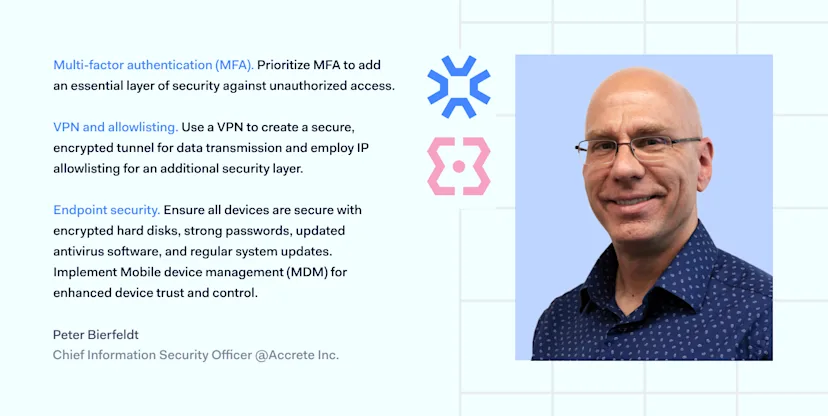
We talk with our clients not only to learn their experience using NordLayer but also to understand how cybersecurity experts perceive online security. Thus, we asked the Chief Information Security Officer at Accrete Inc. to share his personal favorite tips for building digital hygiene habits.

Accrete Inc. is a perfect example of how a layered approach to security can ease and improve your network protection journey. NordLayer is a solution that takes granular control of establishing different security measures, so they create a robust mesh against digital threats.

About Version 2 Digital

Version 2 Digital is one of the most dynamic IT companies in Asia. The company distributes a wide range of IT products across various areas including cyber security, cloud, data protection, end points, infrastructures, system monitoring, storage, networking, business productivity and communication products.

Through an extensive network of channels, point of sales, resellers, and partnership companies, Version 2 offers quality products and services which are highly acclaimed in the market. Its customers cover a wide spectrum which include Global 1000 enterprises, regional listed companies, different vertical industries, public utilities, Government, a vast number of successful SMEs, and consumers in various Asian cities.

About NordPass
NordPass is developed by Nord Security, a company leading the global market of cybersecurity products.

The web has become a chaotic space where safety and trust have been compromised by cybercrime and data protection issues. Therefore, our team has a global mission to shape a more trusted and peaceful online future for people everywhere.

China-aligned Evasive Panda leverages religious festival to target and spy on Tibetans, ESET Research discovers

  • ESET Research discovered a cyberespionage campaign that leverages the Monlam Festival — a religious gathering — to target Tibetans in several countries and territories. ESET attributes this campaign with high confidence to the China-aligned Evasive Panda Advanced Persistent Threat (APT) group.
  • The attackers compromised the website of the organizer of the annual festival, which takes place in India, and added malicious code to create a watering-hole attack targeting users connecting from specific networks.
  • ESET also discovered that a software developer’s supply chain was compromised and trojanized installers for both Windows and macOS were served to users. 
  • The attackers fielded a number of malicious downloaders and full-featured backdoors for the operation, including a publicly undocumented backdoor for Windows “Nightdoor.”
  • Targeted users were located in India, Taiwan, Hong Kong, Australia, and the United States (including at Georgia Tech).

BRATISLAVA, MONTREAL — March 7, 2024 — ESET researchers have discovered a cyberespionage campaign that, since at least September 2023, has been victimizing Tibetans via a targeted watering hole (also known as a strategic web compromise), and a supply-chain compromise to deliver trojanized installers of Tibetan language translation software. The attackers aimed to deploy malicious downloaders for both Windows and macOS to compromise website visitors with MgBot as well as a backdoor that has not been publicly documented yet; ESET has named it Nightdoor. The campaign by the China-aligned Evasive Panda APT group leveraged the Monlam Festival — a religious gathering — to target Tibetans in several countries and territories. Targeted networks were located in India, Taiwan, Hong Kong, Australia, and the United States.

ESET discovered the cyberespionage operation in January 2024. The compromised website abused as a watering hole (the attacker infests a website that the victim likely or regularly uses) belongs to Kagyu International Monlam Trust, an organization based in India that promotes Tibetan Buddhism internationally. The attack might have been intended to capitalize on international interest in the Kagyu Monlam Festival that is held annually in January in the city of Bodhgaya, India. The network of the Georgia Institute of Technology (also known as Georgia Tech) in the United States is among the identified entities in the targeted IP address ranges. In the past, the university was mentioned in connection with the Chinese Communist Party’s influence on education institutes in the U.S.

Around September 2023, the attackers compromised the website of a software development company based in India that produces Tibetan language translation software. The attackers placed several trojanized applications there that deploy a malicious downloader for Windows or macOS.

In addition to this, the attackers also abused the same website and a Tibetan news website called Tibetpost to host the payloads obtained by the malicious downloads, including two full-featured backdoors for Windows and an unknown number of payloads for macOS.

“The attackers fielded several downloaders, droppers, and backdoors, including MgBot — which is used exclusively by Evasive Panda — and Nightdoor, the latest major addition to the group’s toolkit and that has been used to target several networks in East Asia,” says ESET researcher Anh Ho, who discovered the attack. “The Nightdoor backdoor, used in the supply-chain attack, is a recent addition to Evasive Panda’s toolset. The earliest version of Nightdoor that we’ve been able to find is from 2020, when Evasive Panda deployed it onto the machine of a high-profile target in Vietnam. We have requested that the Google account associated with its authorization token be taken down,” adds Ho.

With high confidence, ESET attributes this campaign to the Evasive Panda APT group, based on the malware that was used: MgBot and Nightdoor. Over the past two years, we have seen both backdoors deployed together in an unrelated attack against a religious organization in Taiwan, in which they also shared the same Command & Control server.

Evasive Panda (also known as BRONZE HIGHLAND or Daggerfly) is a Chinese-speaking and China-aligned APT group, active since at least 2012. ESET Research has observed the group conducting cyberespionage against individuals in mainland China, Hong Kong, Macao, and Nigeria. Government entities were targeted in Southeast and East Asia, specifically China, Macao, Myanmar, The Philippines, Taiwan, and Vietnam. Other organizations in China and Hong Kong were also targeted. According to public reports, the group has also targeted unknown entities in Hong Kong, India, and Malaysia.

The group uses its own custom malware framework with a modular architecture that allows its backdoor, known as MgBot, to receive modules to spy on its victims and enhance its capabilities. Since 2020 ESET has also observed that Evasive Panda has capabilities to deliver its backdoors via adversary-in-the-middle attacks hijacking updates of legitimate software.

For more technical information about the latest malicious campaign of the Evasive Panda group, check out the blogpost “Evasive Panda leverages Monlam Festival to target Tibetans” on WeLiveSecurity.com. Make sure to follow ESET Research on Twitter (today known as X) for the latest news from ESET Research.

About Version 2 Digital

Version 2 Digital is one of the most dynamic IT companies in Asia. The company distributes a wide range of IT products across various areas including cyber security, cloud, data protection, end points, infrastructures, system monitoring, storage, networking, business productivity and communication products.

Through an extensive network of channels, point of sales, resellers, and partnership companies, Version 2 offers quality products and services which are highly acclaimed in the market. Its customers cover a wide spectrum which include Global 1000 enterprises, regional listed companies, different vertical industries, public utilities, Government, a vast number of successful SMEs, and consumers in various Asian cities.

About ESET
For 30 years, ESET® has been developing industry-leading IT security software and services for businesses and consumers worldwide. With solutions ranging from endpoint security to encryption and two-factor authentication, ESET’s high-performing, easy-to-use products give individuals and businesses the peace of mind to enjoy the full potential of their technology. ESET unobtrusively protects and monitors 24/7, updating defenses in real time to keep users safe and businesses running without interruption. Evolving threats require an evolving IT security company. Backed by R&D facilities worldwide, ESET became the first IT security company to earn 100 Virus Bulletin VB100 awards, identifying every single “in-the-wild” malware without interruption since 2003.