

Skip to content

NoSQL Databases: The ultimate Guide

Today, many companies generate and store huge amounts of data. To give you an idea, decades ago, the size of the Internet was measured in Terabytes (TB) and now it is measured in Zettabytes (ZB). 

Relational databases were designed to meet the storage and information management needs of the time. Today we have a new scenario where social networks, IoT devices and Edge Computing generate millions of unstructured and highly variable data. Many modern applications require high performance to provide quick responses to user queries.

In relational DBMSs, an increase in data volume must be accompanied by improvements in hardware capacity. This technological challenge forced companies to look for more flexible and scalable solutions.

NoSQL databases have a distributed architecture that allows them to scale horizontally and handle continuous and fast data flows. This makes them a viable option in high-demand environments such as streaming platforms where data processing takes place in real time.

Given the interest in NoSQL databases in the current context, we believe it is essential to develop a user guide that helps developers understand and effectively use this technology. In this article we aim to clarify some basics about NoSQL, giving practical examples and providing recommendations on implementation and optimization to make the most of its advantages.

NoSQL data modeling

One of the biggest differences between relational and non-relational bases lies in the approach we took to data modeling.

NoSQL databases do not follow a rigid and predefined scheme. This allows developers to freely choose the data model based on the features of the project.

The fundamental goal is to improve query performance, getting rid of the need to structure information in complex tables. Thus, NoSQL supports a wide variety of denormalized data such as JSON documents, key values, columns, and graph relationships.

Each NoSQL database type is optimized for easy access, query, and modification of a specific class of data. The main ones are:

  • Key-value: Redis, Riak or DyamoDB. These are the simplest NoSQL databases. They store the information as if it were a dictionary based on key-value pairs, where each value is associated with a unique key. They were designed to scale quickly ensuring system performance and data availability.
  • Documentary: MongoDB, Couchbase. Data is stored in documents such as JSON, BSON or XML. Some consider them an upper echelon of key-value systems since they allow encapsulating key-value pairs in more complex structures for advanced queries.
  • Column-oriented: BigTable, Cassandra, HBase. Instead of storing data in rows like relational databases do, they do it in columns. These in turn are organized into logically ordered column families in the database. The system is optimized to work with large datasets and distributed workloads.
  • Graph-oriented: Neo4J, InfiniteGraph. They save data as entities and relationships between entities. The entities are called “nodes” and the relationships that bind the nodes are the “edges”. They are perfect for managing data with complex relationships, such as social networks or applications with geospatial location.

NoSQL data storage and partitioning

Instead of making use of a monolithic and expensive architecture where all data is stored on a single server, NoSQL distributes the information on different servers known as “nodes” that join in a network called “cluster“.
This feature allows NoSQL DBMSs to scale horizontally and manage large volumes of data using partitioning techniques.

What is NoSQL database partitioning?

It is a process of breaking up a large database into smaller, easier-to-manage chunks.

It is necessary to clarify that data partitioning is not exclusive to NoSQL. SQL databases also support partitioning, but NoSQL systems have a native function called “auto-sharding” that automatically splits data, balancing the load between servers.

When to partition a NoSQL database?

There are several situations in which it is necessary to partition a NoSQL database:

  • When the server is at the limit of its storage capacity or RAM.
  • When you need to reduce latency. In this case you get to balance the workload on different cluster nodes to improve performance.
  • When you wish to ensure data availability by initiating a replication procedure.

Although partitioning is used in large databases, you should not wait for the data volume to become excessive because in that case it could cause system overload.
Many programmers use AWS or Azure to simplify the process. These platforms offer a wide variety of cloud services that allow developers to skip the tasks related to database administration and focus on writing the code of their applications.

Partitioning techniques

There are different techniques for partitioning a distributed architecture database.

  • Clustering
    It consists of grouping several servers so that they work together as if they were one. In a clustering environment, all nodes in the cluster share the workload to increase system throughput and fault tolerance.
  • Separation of Reads and Writes
    It consists of directing read and write operations to different nodes in the cluster. For example, read operations can be directed to replica servers acting as children to ease the load on the parent node.
  • Sharding
    Data is divided horizontally into smaller chunks called “shards” and distributed across different nodes in the cluster.
    It is the most widely used partitioning technique in databases with distributed architecture due to its scalability and ability to self-balance the system load, avoiding bottlenecks.
  • Consistent Hashing
    It is an algorithm that is used to efficiently allocate data to nodes in a distributed environment.
    The idea of consistent hashes was introduced by David Karger in a research paper published in 1997 and entitled “Consistent Hashing and Random Trees: Distributed Caching Protocols for Relieving Hot Spots on the World Wide Web“.
    In this academic work, the “Consistent Hashing” algorithm was proposed for the first time as a solution to balance the workload of servers with distributed databases.
    It is a technique that is used in both partitioning and data replication, since it allows to solve problems common to both processes such as the redistribution of keys and resources when adding or removing nodes in a cluster.

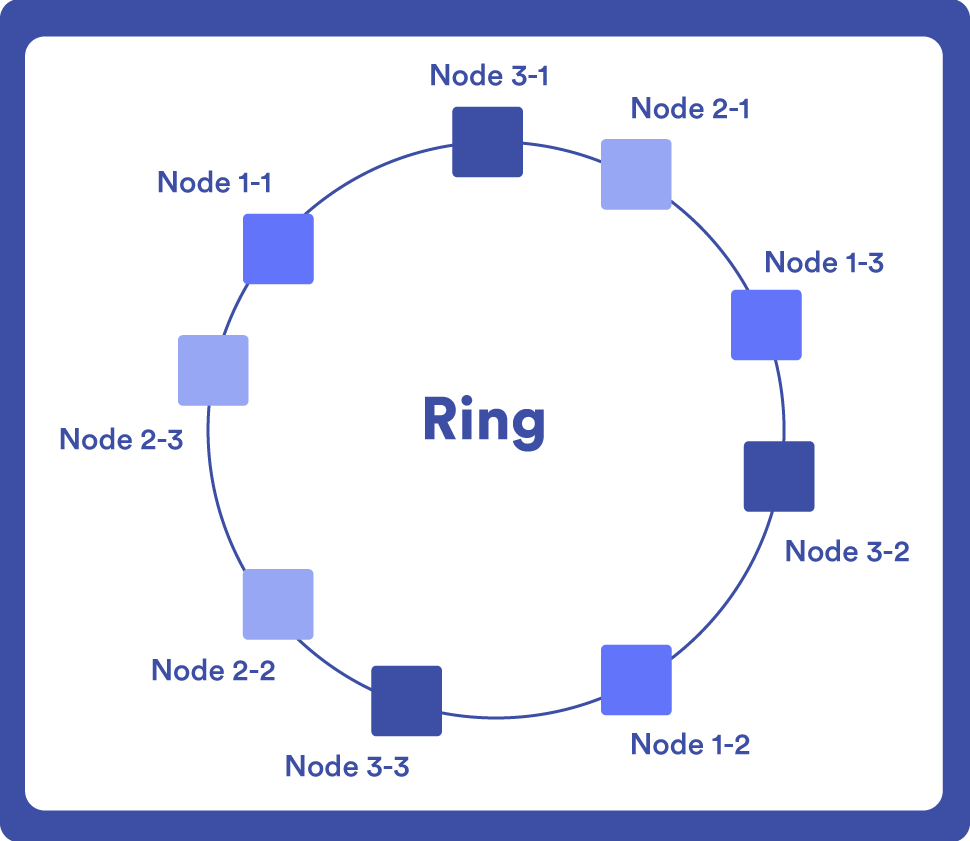
    Nodes are represented in a circular ring and each data is assigned to a node using a hash function. When a new node is added to the system, the data is redistributed between the existing nodes and the new node.
    The hash works as a unique identifier so that when you make a query, you just have to locate that point on the ring.
    An example of a NoSQL database that uses “Consistent Hashing” is DynamoDB, since one of its strengths is incremental scaling, and to achieve this it needs a procedure capable of fractionating data dynamically.
Replication in NoSQL databases

It consists of creating copies of the data on multiple machines. This process seeks to improve database performance by distributing queries among different nodes. At the same time, it ensures that the information will continue to be available, even if the hardware fails.
The two main ways to perform data replication (in addition to the Consistent Hashing that we already mentioned in the previous section) are:

Master-slave server

Writing is made to the primary node and from there data is replicated to secondary nodes.

Peer to peer

All nodes in the cluster have the same hierarchical level and can accept writing. When data is written to one node it spreads to all the others. This ensures availability, but can also lead to inconsistencies if conflict resolution mechanisms are not implemented (for example, if two nodes try to write to the same location at the same time).

CAP theorem and consistency of NoSQL databases.

The CAP theorem was introduced by Professor Eric Brewer of the University of Berkeley in the year 2000. He explains that a distributed database can meet two of these three qualities at the same time:

  • Consistency: All requests after the writing operation get the same value, regardless of where the queries are made.
  • Availability: The database always responds to requests, even if a failure takes place.
  • Partition Tolerance: The system continues to operate even if communication between some nodes is interrupted.

Under this scheme we could choose a DBMS that is consistent and partition tolerant (MongoDB, HBase), available and partition tolerant (DynamoDB, Cassandra), or consistent and available (MySQL), but all three features cannot be preserved at once.
Each development has its requirements and the CAP theorem helps us find the DBMS that best suits your needs. Sometimes it is imperative for data to be consistent at all times (for example, in a stock control system). In these cases, we usually work with a relational database. In NoSQL databases, consistency is not one hundred percent guaranteed, since changes must propagate between all nodes in the cluster.

BASIS and eventual consistency model in NoSQL

BASE is a concept opposed to the ACID properties (atomicity, consistency, isolation, durability) of relational databases. In this approach, we prioritize data availability over immediate consistency, which is especially important in applications that process data in real time.

The BASE acronym means:

  • Basically Available: The database always sends a response, even if it contains errors if readings occur from nodes that did not yet receive the last writing.
  • Soft state: The database may be in an inconsistent state when reading takes place, so you may get different results on different readings.
  • Eventually Consistent: Database consistency is reached once the information has been propagated to all nodes. Up to that point we talk about an eventual consistency.

Even though the BASE approach arose in response to ACID, they are not exclusionary options. In fact, some NoSQL databases like MongoDB offer configurable consistency.

Tree indexing in NoSQL databases. What are the best-known structures?

So far we have seen how data is distributed and replicated in a NoSQL database, but we need to explain how it is structured efficiently to make its search and retrieval easier.
Trees are the most commonly used data structures. They organize nodes hierarchically starting from a root node, which is the first tree node; parent nodes, which are all those nodes that have at least one child; and child nodes, which complete the tree.
The number of levels of a tree determines its height. It is important to consider the final size of the tree and the number of nodes it contains, as this can influence query performance and data recovery time.
There are different tree indexes that you may use in NoSQL databases.

B Trees

They are balanced trees and perfect for distributed systems for their ability to maintain index consistency, although they can also be used in relational databases.
The main feature of B trees is that they can have several child nodes for each parent node, but they always keep their height balanced. This means that they have an identical or very similar number of levels in each tree branch, a particularity that makes it possible to handle insertions and deletions efficiently.
They are widely used in filing systems, where large data sets need to be accessed quickly.

T Trees

They are also balanced trees that can have a maximum of two or three child nodes.
Unlike B-trees, which are designed to make searches on large volumes of data easier, T-trees work best in applications where quick access to sorted data is needed.

AVL Trees

They are binary trees, which means that each parent node can have a maximum of two child nodes.
Another outstanding feature of AVL trees is that they are balanced in height. The self-balancing system serves to ensure that the tree does not grow in an uncontrolled manner, something that could harm the database performance.
They are a good choice for developing applications that require quick queries and logarithmic time insertion and deletion operations.

KD Trees

They are binary, balanced trees that organize data into multiple dimensions. A specific dimension is created at each tree level.
They are used in applications that work with geospatial data or scientific data.

Merkle Trees

They represent a special case of data structures in distributed systems. They are known for their utility in Blockchain to efficiently and securely encrypt data.
A Merkle tree is a type of binary tree that offers a first-rate solution to the data verification problem. Its creator was an American computer scientist and cryptographer named Ralph Merkle in 1979.
Merkle trees have a mathematical structure made up by hashes of several blocks of data that summarize all transactions in a block.

Data is grouped into larger datasets and related to the main nodes until all the data within the system is gathered. As a result, the Merkle Root is obtained.

How is the Merkle Root calculated?

1. The data is divided into blocks of a fixed size.

2. Each data block is subjected to a cryptographic hash function.

3. Hashes are grouped into pairs and a function is again applied to these pairs to generate their corresponding parent hashes until only one hash remains, which is the Merkle root.

The Merkle root is at the top of the tree and is the value that securely represents data integrity. This is because it is strongly related to all datasets and the hash that identifies each of them. Any changes to the original data will alter the Merkle Root. That way, you can make sure that the data has not been modified at any point.
This is why Merkle trees are frequently employed to verify the integrity of data blocks in Blockchain transactions.
NoSQL databases like Cassandra draw on these structures to validate data without sacrificing speed and performance.

Comparison between NoSQL database management systems

From what we have seen so far, NoSQL DBMSs are extraordinarily complex and varied. Each of them can adopt a different data model and present unique storage, consultation and scalability features. This range of options allows developers to select the most appropriate database for their project needs.
Below, we will give as an example two of the most widely used NoSQL DBMSs for the development of scalable and high-performance applications: MongoDB and Apache Cassandra.

MongoDB

It is a documentary DBMS developed by 10gen in 2007. It is open source and has been created in programming languages such as C++, C and JavaScript.

MongoDB is one of the most popular systems for distributed databases. Social networks such as LinkedIn, telecommunications companies such as Telefónica or news media such as the Washington Post use MongoDB.
Here are some of its main features.

  • Database storage with MongoDB: MongoDB stores data in BSON files (binary JSON). Each database consists of a collection of documents. Once MongoDB is installed and Shell is running, you may create the DB just by indicating the name you wish to use. If the database does not already exist, MongoDB will automatically create it when adding the first collection. Similarly, a collection is created automatically when you store a file in it. You just have to add the first document and execute the “insert” statement and MongoDB will create an ID field assigning it an ObjectID value that is unique for each machine at the time the operation is executed.
  • DB Partitioning with MongoDB: MongoDB makes it easy to distribute data across multiple servers using the automatic sharding feature. Data fragmentation takes place at the collection level, distributing documents among the different cluster nodes. To carry out this distribution, a “partition key” defined as a field is used in all collection documents. Data is fragmented into “chunks”, which have a default size of 64 MB and are stored in different shards within the cluster, ensuring that there is a balance. MongoBD monitors continuously chunk distribution among the shard nodes and, if necessary, performs automatic rebalancing to ensure that the workload supported by these nodes is balanced.
  • DB Replication with MongoDB: MongoDB uses a replication system based on the master-slave architecture. The master server can perform writing and reading operations, but slave nodes only perform reads (replica set). Updates are communicated to slave nodes via an operation log called oplog.
  • Database Queries with MongoDB: MongoDB has a powerful API that allows you to access and analyze data in real time, as well as perform ad-hoc queries, that is, direct queries on a database that are not predefined. This gives users the ability to perform custom searches, filter documents, and sort results by specific fields. To carry out these queries, MongoDB uses the “find” method on the desired collection or “findAndModify” to query and update the values of one or more fields simultaneously.
  • DB Consistency with MongoDB: From version 4.0 (the most recent one is 6.0), MongoDB supports ACID transactions at document level. The “snapshot isolation” function provides a consistent view of the data and allows atomic operations to be performed on multiple documents within a single transaction. This feature is especially relevant for NoSQL databases, as it poses solutions to different consistency-related issues, such as concurrent writes or queries that return outdated file versions. In this respect, MongoDB comes very close to the stability of RDMSs.
  • Database indexing with MongoDB: MongoDB uses B trees to index the data stored in its collections. This is a variant of the B trees with index nodes that contain keys and pointers to other nodes. These indexes store the value of a specific field, allowing data recovery and deletion operations to be more efficient.
  • DB Security with MongoDB: MongoDB has a high level of security to ensure the confidentiality of stored data. It has several authentication mechanisms, role-based access configuration, data encryption at rest and the possibility of restricting access to certain IP addresses. In addition, it allows you to audit the activity of the system and keep a record of the operations carried out in the database.

Apache Cassandra

It is a column-oriented DBMS that was developed by Facebook to optimize searches within its platform. One of the creators of Cassandra is computer scientist Avinash Lakshman, who previously worked for Amazon, as part of the group of engineers who developed DynamoDB. For that reason, it does not come as a surprise that it shares some features with this other system.
In 2008 it was launched as an open source project, and in 2010 it became a top-level project of the Apache Foundation. Since then, Cassandra continued to grow to become one of the most popular NoSQL DBMSs.
Although Meta uses other technologies today, Cassandra is still part of its data infrastructure. Other companies that use it are Netflix, Apple or Ebay. In terms of scalability, it is considered one of the best NoSQL databases.

Let’s take a look at some of its key properties:

  • Database storage with Apache Cassandra: Cassandra uses a “Column Family” data model, which is similar to relational databases, but more flexible. It does not refer to a hierarchical structure of columns that contain other columns, but rather to a collection of key-value pairs, where the key identifies a row and the value is a set of columns. It is designed to store large amounts of data and perform more efficient writing and reading operations.
  • DB Partitioning with Apache Cassandra: For data distribution, Cassandra uses a partitioner that distributes data to different cluster nodes. This partitioner uses the algorithm “consistent hashing” to assign a unique partition key to each data row. Data possessing the same partition key will stay together on the same nodes. It also supports virtual nodes (vnodes), which means that the same physical node may have multiple data ranges.
  • DB Replication with Apache Cassandra: Cassandra proposes a replication model based on Peer to peer in which all cluster nodes accept reads and writes. By not relying on a master node to process requests, the chance of a bottleneck occurring is minimal. Nodes communicate with each other and share data using a gossiping protocol.
  • DB Queries with Apache Cassandra: Like MongoDB, Cassandra also supports ad-hoc queries, but these tend to be more efficient if they are based on the primary key. In addition, it has its own query language called CQL (Cassandra Query Language) with a syntax similar to that of SQL, but instead of using joins, it takes its chances on data denormalization.
  • DB Indexation with Apache Cassandra: Cassandra uses secondary indexes to allow efficient queries on columns that are not part of the primary key. These indices may affect individual columns or multiple columns (SSTable Attached Secondary Index). They are created to allow complex range, prefix or text search queries in a large number of columns.
  • DB Coherence with Apache Cassandra: By using Peer to Peer architecture, Cassandra plays with eventual consistency. Data is propagated asynchronously across multiple nodes. This means that, for a short period of time, there may be discrepancies between the different replicas. However, Cassandra also provides mechanisms for setting the consistency level. When a conflict takes place (for example, if the replicas have different versions), use the timestamp and validate the most recent version. In addition, perform automatic repairs to maintain data consistency and integrity if hardware failures or other events that may cause discrepancies between replicas take place.
  • DB Security with Apache Cassandra: To use Cassandra in a safe environment, it is necessary to perform configurations, since many options are not enabled by default. For example, activate the authentication system and set permissions for each user role. In addition, it is critical to encrypt data in transit and at rest. For communication between the nodes and the client, data in transit can be encrypted using SSL/TLS.

Challenges in managing NoSQL databases. How does Pandora FMS help?

NoSQL DBMSs offer developers the ability to manage large volumes of data and scale horizontally by adding multiple nodes to a cluster.
To manage these distributed infrastructures, it is necessary to master different data partitioning and replication techniques (for example, we have seen that MongoDB uses a master-slave architecture, while Cassandra prioritizes availability with the Peer to peermodel).
Unlike RDMS, which share many similarities, in NoSQL databases there is no common paradigm and each system has its own APIs, languages and a different implementation, so getting used to working with each of them can be a real challenge.
Considering that monitoring is a fundamental component for managing any database, we must be pragmatic and rely on those resources that make our lives easier.
Both MongoDB and Apache Cassandra have commands that return system status information and allow problems to be diagnosed before they become critical failures. Another possibility is to use Pandora FMS software to simplify the whole process.

How to do so?

If this is a database in MongoDB, download Pandora FMS plugin for MongoDB. This plugin uses the mongostat command to collect basic information about system performance. Once the relevant metrics are obtained, they are sent to Pandora FMS data server for their analysis.
On the other hand, if the database works with Apache Cassandra, download the corresponding plugin for this system. This plugin obtains the information by internally running the tool nodetool, which is already included in the standard Cassandra installation, and offers a wide range of commands to monitor server status. Once the results are analyzed, the plugin structures the data in XML format and sends it to Pandora FMS server for further analysis and display.
For these plugins to work properly, copy the files to the plugin directory of Pandora FMS agent, edit the configuration file and, finally, restart the system (the linked articles explain the procedure very well).
Once the plugins are active, you will be able to monitor the activity of the cluster nodes in a graph view and receive alerts should any failures take place. These and other automation options help us save considerable time and resources in maintaining NoSQL databases.

Create a free account and discover all Pandora FMS utilities to boost your digital project!

And if you have doubts about the difference between NoSQL and SQL you can consult our post “NoSQL vs SQL: main differences and when to choose each of them“.
About Version 2 Digital

Version 2 Digital is one of the most dynamic IT companies in Asia. The company distributes a wide range of IT products across various areas including cyber security, cloud, data protection, end points, infrastructures, system monitoring, storage, networking, business productivity and communication products.

Through an extensive network of channels, point of sales, resellers, and partnership companies, Version 2 offers quality products and services which are highly acclaimed in the market. Its customers cover a wide spectrum which include Global 1000 enterprises, regional listed companies, different vertical industries, public utilities, Government, a vast number of successful SMEs, and consumers in various Asian cities.

About PandoraFMS
Pandora FMS is a flexible monitoring system, capable of monitoring devices, infrastructures, applications, services and business processes.
Of course, one of the things that Pandora FMS can control is the hard disks of your computers.

STARMUS, POWERED BY ESET, UNVEILS ITS PROGRAM FOR “STARMUS VII, THE FUTURE OF OUR HOME PLANET“

•    STARMUS will bring an inspiring debate on the future of our planet to Bratislava turning the Slovak capital into the world’s science capital for a whole week this May.
•    The world’s most ambitious science and music festival includes lectures, a music program, star gazing, and the STARMUS camp for the general public.
•    The festival will feature the Stephen Hawking Awards Ceremony, with the winners expected to be announced days before the start of the event.
•    STARMUS will bring eight Nobel laureates, astronauts, top researchers, and the greatest thought leaders in climate change, environment, artificial intelligence, and cybersecurity to the city.
•    Tickets are available through www.ticketportal.sk and have gone on sale with an early bird discount available until April 15.

BRATISLAVA – March 21, 2024 – STARMUS, powered by ESET, today announces an unparalleled program for its seventh edition which is set to be the most inspiring debate on the future of our home planet. As announced in May 2023, the prestigious STARMUS festival – the brainchild of astrophysicist Garik Israelian, PhD, and Queen guitarist Sir Brian May, PhD in astrophysics – will hold its next edition in Bratislava this May.  

STARMUS will kick off with a performance by a legendary musician to be announced soon with the full line-up, followed by a four-day program of STARMUS Exclusive Talks with more than 50 world-class speakers and world-renowned artists in Bratislava´s Ice Hockey Stadium, The Ondrej Nepela Arena.

ESET, a global leader in cybersecurity, has consistently advocated for the progress of science and its transformative impact on society. The company firmly believes in the potential of science to drive significant progress for humanity and is committed to safeguarding this progress by providing AI-native security solutions.

I believe that our role here at ESET is more than just technology development and innovation. We stand for protecting the progress society is making. And we believe this progress is brought by science. Science brings solutions to many of humanity’s challenges. The work that we do to protect our communities from cyber threats, is just a small piece of what the wider scientific community is doing to protect people from disease, help technological progress, and educate everyone around the world.”  said Richard Marko, ESET CEO,who is also giving a talk named Tech for Earth: Rethinking Cybersecurity in the Age of Global Challenges during the second day of the conference. He will be joined by Starmus speakers, including astronaut Charlie Duke and technology visionary Tony Fadell.

STARMUS, in its first edition focusing on Planet Earth, will feature Nobel laureates, such as Michel Mayor, Emmanuelle Charpentier, and Kip Thorne; astronauts who made history as part of the space race – namely Charlie Duke or Chris Hadfield– and world icons, including Jane Goodall and the music legend Sir Brian May, co-founder of the festival.

The festival will also showcase exclusive performances from the popular Californian punk-rock band The Offspring, Tony Hadley, the former lead singer of the British pop icon from the 80s Spandau Ballet, and more one-off live performances to be announced soon with the full line-up.

One of the festival’s highlights will be the ceremony for the Stephen Hawking Medal for Science Communication which awards excellence across four categories: Music & Arts, Science Writing, Films & Entertainment, and Lifetime Achievement.

This year, STARMUS, powered by ESET, is sponsored by VÚB Banka, OMEGA, and KIA Slovakia. The festival will be held under the auspices of the President of the Slovak Republic and the Mayor of Bratislava and under the patronage of the European Commission Representation in Slovakia.

Ticket Information:
Tickets, available at www.ticketportal.sk and www.starmus.com include access to all festival events. Early bird discounts are available until April 15. Student Tickets for 98 euros and General Attendees tickets for 198 euros. Subsequently, tickets will be priced at 150 euros for Students and 250 euros for General Attendees.

The tickets include STARMUS Exclusive Lectures (May 13-17), Star Party (May 14), Stephen Hawking Medial Award Ceremony & Sonic Universe Concert (May 15).

To learn more about STARMUS click here

About Version 2 Digital

Version 2 Digital is one of the most dynamic IT companies in Asia. The company distributes a wide range of IT products across various areas including cyber security, cloud, data protection, end points, infrastructures, system monitoring, storage, networking, business productivity and communication products.

Through an extensive network of channels, point of sales, resellers, and partnership companies, Version 2 offers quality products and services which are highly acclaimed in the market. Its customers cover a wide spectrum which include Global 1000 enterprises, regional listed companies, different vertical industries, public utilities, Government, a vast number of successful SMEs, and consumers in various Asian cities.

About ESET
For 30 years, ESET® has been developing industry-leading IT security software and services for businesses and consumers worldwide. With solutions ranging from endpoint security to encryption and two-factor authentication, ESET’s high-performing, easy-to-use products give individuals and businesses the peace of mind to enjoy the full potential of their technology. ESET unobtrusively protects and monitors 24/7, updating defenses in real time to keep users safe and businesses running without interruption. Evolving threats require an evolving IT security company. Backed by R&D facilities worldwide, ESET became the first IT security company to earn 100 Virus Bulletin VB100 awards, identifying every single “in-the-wild” malware without interruption since 2003.

Preparing your business for the unpredictable: The role of DaaS in disaster recovery

In the fast-paced world of modern business, the surge in natural disasters, intensified by climate change, poses unprecedented business challenges. 
Businesses must be ready for anything, from hurricanes to floods to wildfires and cyber-attacks. While securing the safety of your company’s employees and physical locations is most important, once that’s in place then the focus shifts to maintaining connectivity and operations.

That’s where disaster recovery (DR) is a crucial process, ensuring the restoration of business operations after a disaster. While traditional DR methods often prioritize servers and networks, the significance of desktops must also be understood in today’s digital landscape. Your employees’ desktops are their hub for data storage and application access. Losing them in a disaster can be a severe setback for your business.

This is where Desktop-as-a-Service (DaaS) emerges as a game-changer. Parallels DaaS, a cloud-based service providing users with virtual desktops stored in the cloud, offers several advantages for effective disaster recovery.

Understanding the climate-induced surge

Extreme weather events

Multiple scientific studies, notably by the Intergovernmental Panel on Climate Change (IPCC), reveal a significant increase in hurricanes and extreme weather events. Elevated sea surface temperatures fuel these storms, heightening the vulnerability of physical infrastructure and leading to extended downtime.

Altered precipitation patterns and flood risks

Climate-induced changes in precipitation patterns elevate the risk of flooding, and warmer temperatures increase rainfall, posing a direct threat to businesses. Accordingly, robust disaster recovery measures, especially for desktop systems, have become imperative to mitigate downtime and data loss in the event of a flood and associated water damage.

Wildfires and ecological dynamics

Prolonged droughts and rising temperatures intensify wildfires, impacting businesses in vulnerable regions. Beyond the immediate smoke and fire damage, the possibility of compromised IT infrastructure necessitates effective disaster recovery for desktop systems.

The intersection of natural and artificial disasters

Escalation of cybersecurity threats

The evolving cyber threat landscape, marked by ransomware attacks, malware, phishing attempts, and more, demands swift recovery measures. Desktop-as-a-Service (DaaS) emerges as a solution to ensure business continuity and prompt recovery from cyber-induced disasters.

Vulnerabilities in power infrastructure

Whether stemming from natural disasters or cyber-attacks, power outages present an artificial disaster. When integrated into disaster recovery plans, DaaS ensures cloud-hosted desktop accessibility or cloud-based disaster recovery during power disruptions.

Embracing resilience with DaaS

The escalating frequency of natural and artificial disasters emphasizes the need for resilient disaster recovery strategies. Scientific research and published reports underscore the urgency of adopting solutions like DaaS to navigate the unpredictable nature of current climate conditions.

Discover DaaS for disaster resilience

Efficient data backup and restoration

Storing your desktops in the cloud makes it significantly easier to back up and restore your data. This streamlined process ensures that your critical information is safeguarded against unforeseen disasters.

Remote accessibility

In the event of office damage, DaaS allows your staff to access their desktops from anywhere with an internet connection. This remote accessibility ensures business continuity, allowing your team to continue operations even when the physical workspace is compromised.

Data privacy compliance

DaaS aids in compliance with data privacy regulations, such as GDPR and HIPAA. By storing data securely in the cloud, businesses can navigate regulatory requirements more effectively, mitigating the risks of non-compliance.

Considerations when implementing DaaS for disaster recovery

Choose a reliable DaaS provider

Selecting a trustworthy DaaS provider is crucial. Seek out a provider such as Parallels with a proven track record in disaster recovery and a robust infrastructure to support your business needs.

Network readiness

Ensure that your network can handle the traffic associated with streaming virtual desktops. A robust and scalable network is essential for the seamless functioning of DaaS during disaster recovery scenarios.

Employee training

Train your employees on how to use DaaS effectively. Familiarizing your team with the platform ensures a smooth transition during disaster recovery and helps maintain productivity.

Additional tips for disaster recovery

Develop a comprehensive DR plan

Create a thorough disaster recovery plan that encompasses all aspects of your business. Ensure it includes protocols for desktop recovery using DaaS.

Regular DR plan testing

Test your disaster recovery plan regularly to verify its effectiveness. Regular testing helps identify potential gaps and ensures your plan is reliable.

Secure data backup

Keep your data backed up in a secure location. Implement robust backup strategies to protect your critical information from potential disaster loss.

Employee training

Train your employees in disaster response protocols. Ensuring your team is well-prepared for emergencies contributes to a swift and coordinated response.

How to protect your business from the unpredictable with DaaS for disaster recovery

A data-centric approach to disaster recovery is crucial for safeguarding your business from the unexpected. Preparedness is more critical than ever in today’s ever-changing world. By incorporating these tips and embracing solutions like DaaS, your business can weather challenges and storms, emerging on the other side stronger than ever.

To learn more about how DaaS is the ideal solution for a desktop disaster recovery plan, download the full whitepaper here.

About Version 2 Digital

Version 2 Digital is one of the most dynamic IT companies in Asia. The company distributes a wide range of IT products across various areas including cyber security, cloud, data protection, end points, infrastructures, system monitoring, storage, networking, business productivity and communication products.

Through an extensive network of channels, point of sales, resellers, and partnership companies, Version 2 offers quality products and services which are highly acclaimed in the market. Its customers cover a wide spectrum which include Global 1000 enterprises, regional listed companies, different vertical industries, public utilities, Government, a vast number of successful SMEs, and consumers in various Asian cities.

About Parallels 
Parallels® is a global leader in cross-platform solutions, enabling businesses and individuals to access and use the applications and files they need on any device or operating system. Parallels helps customers leverage the best technology available, whether it’s Windows, Linux, macOS, iOS, Android or the cloud.

How to find Siemens Devices with runZero

Latest Siemens vulnerabilities 

Siemens has released security advisories for a variety of products and devices, including the SENTRON, SCALANCE, and RUGGEDCOM product lines.

Several of the vulnerabilities have CVSS scores in the 7.0 to 8.9 range (high) and several more in the 9.0 to 10.0 range (critical).

For a full list of vulnerabilities, please consult Siemens ProductCERT.

What is the impact?

Several of these vulnerabilities allow for unauthenticated remote code execution, allowing for compromise of the vulnerable systems. Other vulnerabilities may lead to privilege escalation, information disclosure, or denial of service. Users are urged to upgrade as quickly as possible.

Are updates or workarounds available?

Siemens has released updates via a variety of channels. See Siemens ProductCERT for details.

How do I find potentially vulnerable systems with runZero?

From the Asset Inventory, use the following query to locate Siemens assets that may be vulnerable:

hardware:Siemens OR hardware:RuggedCom

About Version 2 Digital

Version 2 Digital is one of the most dynamic IT companies in Asia. The company distributes a wide range of IT products across various areas including cyber security, cloud, data protection, end points, infrastructures, system monitoring, storage, networking, business productivity and communication products.

Through an extensive network of channels, point of sales, resellers, and partnership companies, Version 2 offers quality products and services which are highly acclaimed in the market. Its customers cover a wide spectrum which include Global 1000 enterprises, regional listed companies, different vertical industries, public utilities, Government, a vast number of successful SMEs, and consumers in various Asian cities.

About runZero
runZero, a network discovery and asset inventory solution, was founded in 2018 by HD Moore, the creator of Metasploit. HD envisioned a modern active discovery solution that could find and identify everything on a network–without credentials. As a security researcher and penetration tester, he often employed benign ways to get information leaks and piece them together to build device profiles. Eventually, this work led him to leverage applied research and the discovery techniques developed for security and penetration testing to create runZero.

How to block employees from accessing websites

Have you heard about the federal employee who browsed 9,000 adult sites in under 7 months? Between 2016 and 2017, this person used their work computer to access thousands of sites with explicit content. Many of these sites were linked to Russian pages that had malware.

On average, this meant visiting about 79 adult sites on each business day. This employee also stored a lot of explicit content on an unauthorized USB drive and their personal Android phone, both of which were connected to the work computer against the rules. The phone ended up getting infected with malware, according to the investigation.

This example highlights why blocking sites with adult-themed media is sensible. However, is it a good idea to block all types of inappropriate websites, such as social media? Would your employees see you as a tyrant, or could you adopt a Google-like approach that effectively improves security?

Let’s investigate whether blocking access to specific websites can benefit your company and how it might be perceived.

Key takeaways

  • It’s important for businesses to learn how to stop employees from using non-work-related or harmful websites. This helps keep the workplace focused and safe, boosts productivity, and protects the company’s online assets.

  • DNS filtering is a great way to keep employees away from sites they shouldn’t visit. It works by blocking certain internet requests, which helps reduce both distractions and security risks.

  • Teaching employees why web filtering matters is key. It helps everyone understand why it keeps the company secure.

  • In July 2023, Google limited internet access for some employees to just Google sites and a few others. This move shows how important it is to control internet use to stay safe from online threats, a practice even adopted by big companies.

  • NordLayer helps companies efficiently block websites that might distract or pose risks. Its DNS filtering service makes it easier to manage what sites can be accessed, supporting productivity and security. This approach ensures employees only visit appropriate websites.

Why restrict internet access in a workplace?

Many businesses find it crucial to restrict internet access at work to boost productivity and secure their networks. Let’s explore the reasons and benefits of such restrictions.

  • A key reason for limiting internet access is to enhance employee productivity. By blocking websites, especially social media and entertainment sites, companies can reduce distractions.

  • Another vital reason is to protect the company’s network security. Accessing insecure websites can increase the risk of cyber threats such as malware, phishing attacks, and data breaches.

  • It’s also important to manage bandwidth usage. Without restrictions, internet access might consume bandwidth for non-essential activities.

  • Compliance with legal and regulatory standards is crucial. Accessing or downloading copyrighted material without permission, or engaging in other illegal online activities, could pose legal risks to the company. DNS filtering and web filtering block websites that could lead to legal issues.

  • Lastly, maintaining a professional work environment involves blocking websites with inappropriate content, such as adult material or sites promoting hate or violence. This ensures a safe workplace where employees are not exposed to offensive content.

What websites should your business block access to?

Blocking websites effectively requires a clear strategy. Here’s a comprehensive list of the types of websites your business should consider blocking access to.

Websites your business should block
  1. Phishing sites. These websites are crafted to deceive people into giving away personal or sensitive company information. They often mimic legitimate websites to steal data. Blocking access to known phishing sites is crucial for protecting your employees and your business.

  2. Unofficial software download sites. While these sites may seem like a handy resource for free software, they frequently harbor security risks. These can include malware or software that infringes on copyright laws. Block these sites to protect your network and comply with intellectual property regulations.

  3. File sharing and torrent sites. These platforms are notorious for spreading malware and facilitating data breaches. By blocking these sites, you significantly reduce the risk of infecting your company’s systems with malicious software.

  4. Social media platforms. Well, it’s no secret that social media can be a major distraction in the workplace. Block social media platforms to increase productivity.

  5. Video streaming services. High bandwidth usage from streaming services can slow down your network and affect the performance of work-critical applications. Blocking these services ensures that your internet bandwidth is reserved for business operations.

  6. Online gaming sites. Similar to social media, online games can divert employees’ attention from their work. DNS filtering can prevent access to gaming websites, helping employees stay on track.

  7. Adult content websites. Restrict access to websites with adult content to maintain a respectful and comfortable work environment for everyone, beyond the obvious professional and security reasons.

  8. Online shopping sites. While convenient for personal use, these sites can distract employees during work hours. Block access to e-commerce platforms to keep the focus on work.

  9. Gambling websites. Block access to gambling sites to maintain professionalism and prevent potential legal issues.

  10. Content that promotes hate or violence. Websites that promote hate, violence, or illegal activities should be inaccessible to maintain a safe and respectful workplace.

How to block websites on a network: 5 simple ways

Nowadays, having free access to the internet at work can result in decreased productivity and higher risks to security. This is why it’s important for businesses to find ways to limit access to certain websites.

By combining technical methods and clear rules, companies can ensure their employees stay on task, and their networks are safe. Here are five easy-to-understand ways to do this.

Internet access restriction methods

DNS filtering

DNS filtering is a powerful approach to prevent access to specific websites. It blocks DNS queries, which is how the internet translates website names into IP addresses.

When a company sets up DNS filtering, it stops these queries for unwanted websites. This means if an employee tries to visit a non-work-related site, the DNS filter will block it.

Think of DNS filtering like a librarian who decides which books are okay to check out. This method inspects the internet’s ‘book catalog’ (DNS queries) and only lets through the requests for websites that the company thinks are okay. If an employee tries to visit a banned site, the ‘librarian’ simply says, ‘This book is not available.’

This method is effective not only for blocking certain sites but also for preventing access to malicious or phishing sites.

Web filtering software

Web filtering software allows businesses to define which websites are not allowed and enforce these rules across the network. Categories like social media, entertainment, or adult content can be restricted.

The software examines the content of web pages and blocks them if they match the prohibited criteria. This ensures employees access only work-related sites.

Router settings

Routers, especially those for business use, often have features to block specific websites. Administrators can enter URLs or keywords related to unwanted websites through the router’s settings.

This method is especially handy for small businesses without the means for more advanced filtering. It’s a bit like making a no-entry list, but it might need updates now and then to keep up.

Firewall configurations

Configuring firewalls to block websites is like having a guardian at the gate that only lets in traffic that follows the rules set by the business. By blocking specific IP addresses or domains, the guardian ensures that only safe and approved content can be entered.

This method, when used with others, strengthens the security. It can be either a hardware or a cloud firewall, so businesses are flexible in protecting the network.

Browser extensions

Install browser extensions that block access to specified websites on individual devices. While this method applies at the device level rather than the network, it’s a straightforward way to prevent access to non-work-related content on company computers.

Besides technical measures, educating employees about the significance of web filtering and the rationale for blocking certain sites is crucial. This education might include training, policies, or regular reminders about proper internet use at work.

Should companies restrict internet access?

Deciding if companies should limit internet access at work is all about finding the right balance. Many companies block websites that are unrelated to work to keep the workplace productive and focused. However, cyber-attacks are a more solid reason.

In July 2023, Google decided to restrict some employees from accessing the internet, except for Google’s own sites and a few essential services. This was part of an experiment to see how well blocking access could protect against cyber threats.

As the use of AI tools grows and brings more risks to data privacy, and as companies like Google aim for high-security government contracts, the reasons to restrict internet access become even stronger.

Limiting internet access can be a crucial step for companies that handle sensitive information or want to safeguard national security. It helps prevent unauthorized access to websites, ensuring the company’s and users’ data stays safe.

How NordLayer can help

NordLayer’s DNS filtering simplifies how to block employees from accessing websites that could harm your company’s network. This system scrutinizes each attempt to visit a website, comparing it to a list of sites that are not allowed. When it finds a website that’s recognized as a threat or is already on the blocklist, NordLayer steps in to block access to that website, ensuring your network remains secure.

DNS filtering by category

By choosing NordLayer, businesses can control and block access to a website across more than 50 varied categories, all while securing sensitive company data with robust AES 256-bit encryption. This approach offers a comprehensive solution for maintaining productivity and enhancing network security. If you have any questions before getting started, feel free to contact our sales team. They’re here to assist you.

About Version 2 Digital

Version 2 Digital is one of the most dynamic IT companies in Asia. The company distributes a wide range of IT products across various areas including cyber security, cloud, data protection, end points, infrastructures, system monitoring, storage, networking, business productivity and communication products.

Through an extensive network of channels, point of sales, resellers, and partnership companies, Version 2 offers quality products and services which are highly acclaimed in the market. Its customers cover a wide spectrum which include Global 1000 enterprises, regional listed companies, different vertical industries, public utilities, Government, a vast number of successful SMEs, and consumers in various Asian cities.

About NordLayer
NordLayer is an adaptive network access security solution for modern businesses – from the world’s most trusted cybersecurity brand, Nord Security.

The web has become a chaotic space where safety and trust have been compromised by cybercrime and data protection issues. Therefore, our team has a global mission to shape a more trusted and peaceful online future for people everywhere.