Skip to content

How Does PAM Assist in Hiring Cyber Insurance?

Organizations are increasingly exposed to cyber threats, which justifies hiring insurance to cover losses related to hacker attacks, incidents, and human failures.

Nevertheless, ensuring this additional protection can be a major challenge, as insurers require companies to take useful measures for cybersecurity, making it infeasible to hire insurance or increasing the costs of this process.

An excellent solution for these cases is senhasegura PAM, which can provide more security to your IT structure and, consequently, facilitate negotiation with insurers. Check below how this is possible.

Make it Possible to Hire Cyber Insurance with senhasegura PAM

According to the Verizon Data Breach Investigation Report 2021, 61% of cyberattacks involve privileged credentials. In addition, the abuse of privilege has caused 70% of the attacks. 

Therefore, when hiring cyber insurance, it is important to show your credentials are protected by senhasegura PAM, which has the following features:

1. Audit of Accesses Performed 

The audit of functions performed by human users or machines assures that the actions have been, are, and will be performed properly, according to the organization’s security policy, facilitating the acceptance of insurers.

For this, in addition to ensuring the traceability of the actions taken, the audit allows the organization to manage the use of a privileged credential after access. 

2. senhasegura Domum 

Indiscriminate access by third parties and remote users to IT infrastructure can also be considered by insurers when stipulating the values of (and even when hiring) cyber insurance, as it increases the attack surface exploited by malicious agents.

However, with senhasegura Domum, one can strengthen security aspects exploited by invaders, promoting secure remote access to privileged credentials.

3. Remote Session Recording 

If you wish to hire cyber insurance, we also recommend monitoring privileged session activities, which helps prevent the misuse of privileges, as well as identifying malicious activities and facilitating the incident investigation process, providing the assurance that accounts are not compromised.

4. Multi-Level Approval Workflows 

This senhasegura PAM capability allows one to increase control over privileged account credentials, requiring approvals to grant these accesses.

In practice, approval workflows are configured at various levels, which ensure access review and approval, while an audit trail records who requested this access, who authorized it, and why they are needed for the business.

5. Data Theft Prevention 

Exposure to data theft is another factor that prevents insurers from accepting a company as an insured party. 

However, senhasegura PAM assesses which data needs greater protection, limits access to sensitive information, reinforces internal and external controls for data privacy, and uses strong passwords to protect IT devices, eliminating this objection. 

Contact Us

In this article, you saw how senhasegura PAM can contribute when hiring cyber insurance. If you are interested in this solution, please contact us by clicking here. 

About Version 2 Digital

Version 2 Digital is one of the most dynamic IT companies in Asia. The company distributes a wide range of IT products across various areas including cyber security, cloud, data protection, end points, infrastructures, system monitoring, storage, networking, business productivity and communication products.

Through an extensive network of channels, point of sales, resellers, and partnership companies, Version 2 offers quality products and services which are highly acclaimed in the market. Its customers cover a wide spectrum which include Global 1000 enterprises, regional listed companies, different vertical industries, public utilities, Government, a vast number of successful SMEs, and consumers in various Asian cities.

About Segura®
Segura® strive to ensure the sovereignty of companies over actions and privileged information. To this end, we work against data theft through traceability of administrator actions on networks, servers, databases and a multitude of devices. In addition, we pursue compliance with auditing requirements and the most demanding standards, including PCI DSS, Sarbanes-Oxley, ISO 27001 and HIPAA.

Gone Phishing – Basics

Intro

We all know what phishing is and how prevalent it is. This is the attack that accounted for more than 80% in 2021! More details can be found here and here.

With such scary numbers, it is an attack vector that warrants our attention. As we know, the security at our company is only as strong as our weakest link, and unfortunately, this is how threat actors leverage phishing attacks against us.

You can have all controls in the world, but you can still get phished; it is virtually impossible to implement an anti-phishing solution that will cover all the bases. Yes, you can have safe links, and a myriad of other controls, but that user interaction that’s at the core of this attack is how you get exploited and it’s just too difficult to account for. There are many tools out there that will do filtering for you (and whatever else), however these emails still can (and probably will) get through. You need to know what to do when that (inevitably) happens.

This all goes to say how important our education and cyber awareness in the organization are since we can be sure that we will eventually get targeted by one of these attacks.

My goal in this series is to look at and explain how a phishing attack works and how to analyse a phishing email. I will only explain some of the most important things briefly in this article. In the upcoming article, I will dive into the technical aspects of the attack.


Some Historical Context

Phishing and Spam are extremely common social engineering attacks, and not that new at all. First spam message dates all the way back to 1978 – you can read more about that here.

In the 4+ decades this attack has existed, threat actors have found creative ways to perfect it, and we’re all witnessing the results of that effort. As mentioned above, phishing is how 80% of breaches had started in 2021. We can’t know with certainty, but don’t expect this attack to fall out of favor. It is just too convenient for the attacker to at least try and phish the unsuspecting employee.

After obtaining those credentials, they’re off to the races.

Types of Phishing Attacks

Below are listed some of the phishing attack variants:

  • Phishing – Emails sent to the target, appearing to be from a legitimate source with the goal to obtain sensitive information
  • Vishing – Attack that’s based on calling the target on their mobile phone. Same logic and goal as for the regular phishing email
  • Smishing – Same as vishing, with the difference being the attacker is now sending specifically crafted SMS messages to their targets
  • Spear phishing – As phishing, but targeted at a specific individual or organization
  • Whaling – As spear phishing but targeted at C-level executives. Also known as CEO Fraud
  • Spam – Sending of unsolicited emails in bulk to a large group of people

The MO here is almost the same for every variant, even though they might leverage different methods.


Typical Phishing Email

A typical phishing email will have some (or all) of these characteristics:

  • Urgency – Almost invariably, the email will be urgent in one way or the other; be it your ‘reward’ that you just got (you claiming it would be on a timer/urgent), or be it something you need to pay to avoid penalty. It will call you to action, hoping you would react immediately
  • Bad grammar/spelling – This one is quite common and is oftentimes a really good indicator. Most of the phishing attacks will have small grammar/spelling errors within the email. Read through everything carefully. Of course, if an email is written perfectly, it can still be a phishing email
  • Mismatched domains – Email is claiming to be from one company (domain) but it is actually sent from gmail.com or another domain. Misspelling is also sometimes use to hide the illegitimate domain by tricking you into thinking the domain’s good. Example: rnicrosoft.com, google.cm, g0ogle.com, etc. also known as Typosquatting – more on that here
  • Suscpicious links/attachements – Unsolicited attachements are sent to you in an email, probably also prompting you to act on them.
  • The sender email address will act and try to appear as a trusted entity – email spoofing
  • The body of the email uses generic addressing such as Dear Sir/Madam, etc.
  • Hyperlinks – oftentimes shortened with URL shortening services so it can hide its true purpose; don’t click on these! Hover over them to see the destination
  • The body of the email is crafted in such a way that it matches a trusted entity (Google, Microsoft, for example)

This is very important to note. There are some good examples out there that illustrate the above nicely, while giving you a practical on the topic. Most companies will use similar stuff when training their employees (most likely with an internal mock phishing test). To see how you fare, you can try the quiz here.

Of course, even if we’re mindful of the above, human error can occur, so you should always pay extra attention when an unknown email pops in your inbox.

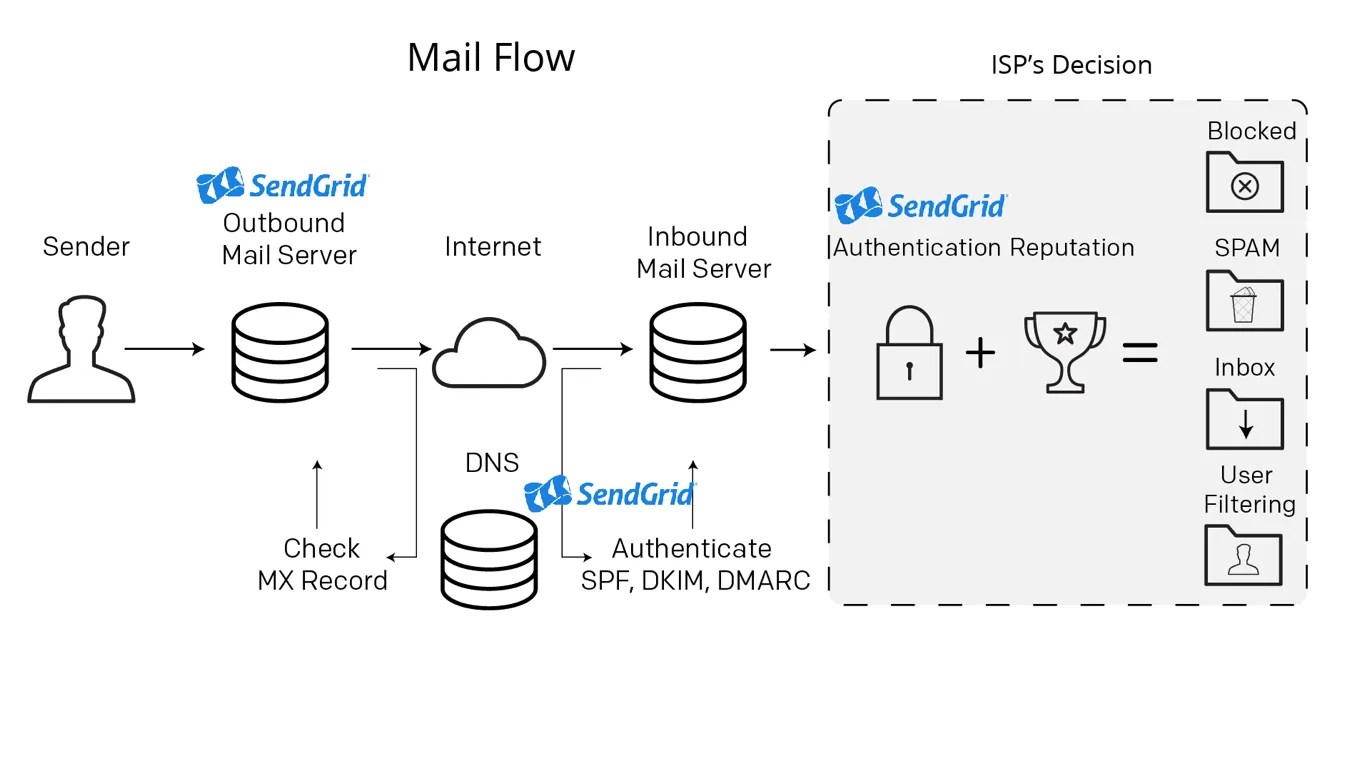
How does an Email Travel

Upon hitting SEND in your favorite email client app, there’s a lot of stuff that happens behind the curtains for your email to arrive at its destination. Three protocols are involved in this: POP3, IMAP, and SMTP.

POP3 – Post Office Protocol – receiving emails, downloading from the server

SMTP – Simple Mail Transfer Protocol – handles the sending of the emails

IMTP – Internet Message Access Protocol – stores messages on the server and syncs them across multiple devices

Slightly longer explanation can be found in this article:

IMAP:

Emails are stored on the server (meaning they can also be downloaded on multiple devices)

Sent emails are stored on the server

Messages can be synced and accessed from multiple devices

POP3:

Emails are downloaded (and stored) on a single device

Sent emails are stored on a single device, from which the email was sent

To keep messages on the server you need to enable “Keep email on server” option, because all the emails would be deleted from the server, once downloaded to the single device

Emails can only be accessed from a single device (where they were downloaded to)

SMTP:

By using SMTP, you’re sending, relaying, or forwarding messages from an email client (thinks MS Outlook) to a receiving email server

Explained here.

Lastly, to summarize, an email travelling would look something like this:

  • You hit send within your email client after composing the message, sending it to someone@example.com
  • The SMTP queries the DNS for records about example.com
  • The DNS server fetches information about example.com and sends it to the SMTP server
  • The SMTP server sends the email to someone’s mailbox at example.com
  • The email goes through many SMTP servers before being relayed to the destination SMTP server
  • Upon reaching the destination SMTP server your email is forwarded and waits in the local POP3/IMAP server waiting on someone
  • Someone logs in to their email clients
  • Their email client queries the local POP3/IMAP server for new emails
  • Your email is copied (IMAP) or downloaded (POP3) to someone’s email client

This is nicely explained here, where you can also find the diagram shown below.

Here you can read more about these three protocols.

Default (un)encrypted ports for these protocols are:

POP3 – (110)995

IMAP – (143)993

SMTP – (25)587/465

Conclusion

Okay, so I talked a bit about phishing, how scary (real) it is, how an email travels, and I mentioned the variants of phishing attacks.

Before concluding, I’d like to emphasize again how important it is to understand/have some plan prepared against phishing as it is the best way attackers gain access, which in turn leads to some real ugly stuff. Prime example is ransomware, which is the most common way in which a ‘simple’ phishing attack evolves. (You can read more about it here, here, and here)

Finally, to let you go on a very dark note, please remember that phishing kits can be bought online quite easily, and that launching a phishing campaign can be done by someone less technical while the true danger remains; what comes after the attack i.e., what was it used for.  They might be less effective, true, but it is scary to think that it can be done in that way with so little effort – in comparison to the impact the attack can have.

Stay tuned for the next piece where I’ll be talking about header and body analysis, and more!

Cover by Mohamed Hassan

#phishing #smtp #pop3 #imap #vicarius_blog

About Version 2 Digital

Version 2 Digital is one of the most dynamic IT companies in Asia. The company distributes a wide range of IT products across various areas including cyber security, cloud, data protection, end points, infrastructures, system monitoring, storage, networking, business productivity and communication products.

Through an extensive network of channels, point of sales, resellers, and partnership companies, Version 2 offers quality products and services which are highly acclaimed in the market. Its customers cover a wide spectrum which include Global 1000 enterprises, regional listed companies, different vertical industries, public utilities, Government, a vast number of successful SMEs, and consumers in various Asian cities.

About VRX
VRX is a consolidated vulnerability management platform that protects assets in real time. Its rich, integrated features efficiently pinpoint and remediate the largest risks to your cyber infrastructure. Resolve the most pressing threats with efficient automation features and precise contextual analysis.

Why BYOK does not solve the problems you were led to believe it solves

Working in the security industry we are regularly in conversations about how BYOK (Bring Your Own Key) can help solve security concerns around data confidentiality, compliance, protection from espionage, and much more.

However, it is most often the case that BYOK does not and cannot solve the problems that people are led or misled to believe it does.

This post is an attempt to address some of these misunderstandings.

First, we need to establish the vocabulary; BYOK is short for Bring Your Own Key, which means the customer provides a data encryption key to the service provider, and the service provider then holds and uses this key for some security function in relation to providing service to the customer.

Already here now that we talk about it, it should be clear that there are a great many problems this scheme does not solve, as the service provider holds a copy of the key.

Another key acronym in security is MFA, or Multi-Factor Authentication. MFA requires that the customer does not just log in using a username and password, but that at least one more factor is provided, which could be a time-based code the user can read from a device only the user possesses. In a sense, this is unrelated to BYOK, but as we shall see, MFA is often the actual working solution to problems believed to be addressed by BYOK.

With that out of the way, let’s look at a few common myths of what BYOK brings to the table then go through why this is not actually the case:

Myth #1: BYOK protects my data in case my account gets compromised.

That would be lovely, but this is not the case at all. First of all, the data encryption key is online all the time. This is a necessary condition for the service to be available and online because what good would your cloud service be if data wasn’t accessible? So, your key is online and now your account gets compromised. An attacker successfully poses as you, so naturally, all data is available to the attacker just as it would be to you, BYOK or not.

Myth #2: In case of compromise, revoking my key renders data unreadable.

This is wishful thinking, unfortunately, and for reasons, you may not expect. As is the case on commonly available BYOK platforms (AWS to name one) the key you bring is not even used for the actual data encryption! Since the service provider cannot trust that a customer can competently generate a strong key, the service provider will use their own key for the actual data encryption.

This key though may then be encrypted with another key, and then finally this package can be encrypted with the actual customer-supplied key. What this means is that the customer has some degree of control over one of the keys used in the encryption of a ‘key package’ which may be used in concert with the encrypted data during a bulk transfer between regions for example. But this is a very niche use. In day-to-day operations, on the most well-established BYOK-enabled platforms in the world today, the customer-supplied key plays NO role in data encryption of the customer data.

The customer can lose the key, revoke the key, modify the key, get the key stolen, have the key tampered with, or all of the above, leaving the day-to-day operations of the service absolutely and completely unaffected because the customer-supplied key plays no role in day-to-day operations. This is not a ‘dirty secret’ in any way; this is well documented in publicly available descriptions of these systems.

The only realistic protection against account compromise is MFA. You can only do so much to make it more difficult for an attacker to compromise your account. That’s why you need to realize that when your account is compromised, someone can actually pose as you, and do what you can do. Cryptography cannot help you at this point.

Myth #3: If the service provider is compromised, I can revoke the key.

By now we know your key isn’t used for actual data encryption. But for argument’s sake, let’s play along and pretend it actually is (but it really isn’t). This means the service provider is encrypting data using the customer-supplied key to which they hold a copy, otherwise, they couldn’t use it.

Now, what happens if the service provider is compromised? Let’s say that either an attacker gains full control of the service provider platform or the government under which the provider operates seizes their systems. Well, the key is being used by the service provider for data encryption and decryption, so obviously the key is available there in one form or another. In other words; what the customer does with their copy of the key has no bearing on the copy that is available and in the hands of the service provider or whomever now controls their platform.

Realistic protections here are along the lines of choosing the region in which the service is provided carefully and ensuring the service provider implements a mature information security management system.

As was said famously by renowned cryptographer Bruce Schneier, ‘If you believe cryptography solves your problem, then either you do not understand your problem or you do not understand cryptography.”

There is a lot of truth in this statement. It does not mean that cryptography does not play an important role in solving security challenges, but it does underline that simple encryption in isolation does not solve the challenges we are facing.

BYOK is no silver bullet. In fact, it is very often not even helpful. Further, if the employment of BYOK delays initiatives to seriously implement MFA or other effective security mechanisms, then BYOK may be outright harmful to the overall security posture of your organization.

I hope this short write-up helps bring clarity to an area of information security that is too often not discussed in detail or even widely understood.

About Version 2 Digital

Version 2 Digital is one of the most dynamic IT companies in Asia. The company distributes a wide range of IT products across various areas including cyber security, cloud, data protection, end points, infrastructures, system monitoring, storage, networking, business productivity and communication products.

Through an extensive network of channels, point of sales, resellers, and partnership companies, Version 2 offers quality products and services which are highly acclaimed in the market. Its customers cover a wide spectrum which include Global 1000 enterprises, regional listed companies, different vertical industries, public utilities, Government, a vast number of successful SMEs, and consumers in various Asian cities.

About Keepit
At Keepit, we believe in a digital future where all software is delivered as a service. Keepit’s mission is to protect data in the cloud Keepit is a software company specializing in Cloud-to-Cloud data backup and recovery. Deriving from +20 year experience in building best-in-class data protection and hosting services, Keepit is pioneering the way to secure and protect cloud data at scale.

Can User Behavior Analytics Help IT Security Mitigate Risk to Corporate Networks?

Your employees can use their laptops or mobile devices from anywhere within your corporate building to access your WiFi network. Convenience is often coupled with risk however, and many WiFi networks these days simply do not have the appropriate security measures needed, making them susceptible to cyber threats that put your company’s data and customer information at risk.

However, you can protect your network and sensitive data by using some of these best practices for WiFi network security. We’ll focus on the four most effective methods for WiFi security:

4 Best Practices for Enterprise WiFi Security

When it comes to WiFi security and preventing unauthorized access and data loss, businesses must take the time to thoroughly plan out a comprehensive strategy. Although the degree of protection needed, and the available budget determine the final security measures, the essential guidelines listed below can be helpful for getting started.

I. Maintain User Segregation Between Internal and Guest Users

When guests come to your place of business, they will most likely want access to your WiFi network. While giving this to your customers seems a perk, you must maintain a barrier between their access and that of your employees. If they do not need access to any company’s resources, it is beneficial to your company’s safety to ensure that they are kept separate.

II. Carefully Select Your SSID Name

Your SSID shouldn’t advertise your company. Organizations often expose their networks to attackers, and in densely inhabited areas the risks of a hack are much higher. Even with an unassuming SSID, hackers may locate your WiFi network. Yet, having a safename increases the difficulty of hacking a network. Note that banal SSIDs assist WiFi security but aren’t a must-have.

III. Utilize Intrusion Prevention Systems for WiFi Networks

Include a wireless intrusion prevention system (IPS) inside your Wi-Fi security to protect your system. These devices monitor and detect targeted WLAN cyberattacks that utilize packet floods,ARP (Address Resolution Protocol),spoofing, and malicious broadcasts.

Snort refers to a network intrusion prevention system that can swiftly detect and handle potential threats. as a preemptive approach to securing your network. As with intrusion detection, these systems also help monitor network traffic. Depending on your network administrator’s security controls, they can rapidly respond against a prospective exploit.

IV. Mobile Device Management (MDM)

Mobile device management (MDM) allows you isolate and manage access for numerous mobile devices which protects your corporate network and data in numerous ways, including:

  • Monitoring regulatory compliance activities.
  • Remotely deactivate or disconnect illegal users and their devices.
  • Centralize device update auditing.
  • Protect mobile devices with your company’s security protocols.

About Version 2 Digital

Version 2 Digital is one of the most dynamic IT companies in Asia. The company distributes a wide range of IT products across various areas including cyber security, cloud, data protection, end points, infrastructures, system monitoring, storage, networking, business productivity and communication products.

Through an extensive network of channels, point of sales, resellers, and partnership companies, Version 2 offers quality products and services which are highly acclaimed in the market. Its customers cover a wide spectrum which include Global 1000 enterprises, regional listed companies, different vertical industries, public utilities, Government, a vast number of successful SMEs, and consumers in various Asian cities.

About Portnox
Portnox provides simple-to-deploy, operate and maintain network access control, security and visibility solutions. Portnox software can be deployed on-premises, as a cloud-delivered service, or in hybrid mode. It is agentless and vendor-agnostic, allowing organizations to maximize their existing network and cybersecurity investments. Hundreds of enterprises around the world rely on Portnox for network visibility, cybersecurity policy enforcement and regulatory compliance. The company has been recognized for its innovations by Info Security Products Guide, Cyber Security Excellence Awards, IoT Innovator Awards, Computing Security Awards, Best of Interop ITX and Cyber Defense Magazine. Portnox has offices in the U.S., Europe and Asia. For information visit http://www.portnox.com, and follow us on Twitter and LinkedIn.。

Verizon Data Breach Investigation Report 2021: What You Need to Know About This Report

Human interaction with IT structures represents one of the main cyber threats faced by organizations of the most diverse sizes and industries. 

This is just one of the important pieces of information extracted from the Verizon Data Breach Investigation Report 2021, issued by telecommunications service provider Verizon.

The document reveals aspects of extreme relevance for organizations that wish to anticipate problems such as cyberattacks and data leaks, avoiding a series of inconveniences and losses.

In this article, we explain what exactly this report is and how you can use this data in your company’s favor. Check out our list of topics below:

  • Verizon Data Breach Investigation Report 2021: What Is This Report?
  • Data Extracted from the Verizon Data Breach Investigation Report 2021
  • Is Verizon Data Breach Investigation Report Reliable?
  • What Should Be Done in Practical Terms with the Information in the Report?
  1. About senhasegura
  2. Conclusion

Follow our text to the end!

Verizon Data Breach Investigation Report 2021: What Is This Report?

The Verizon Data Breach Report consists of an annual report, published by telecommunications service provider Verizon, on security incidents and data breaches that occurred in the previous year.

In this report, information is shared about the different types of attacks and vulnerabilities, also indicating the main changes that have occurred in the world when it comes to cybersecurity. 

For the 2021 edition, prepared with the collaboration of 83 companies, 29,207 real security incidents were analyzed, which – according to Verizon – would have compromised the integrity, confidentiality, or availability of information assets. 

Of this total, 5,258 violations were confirmed, which resulted in the unauthorized propagation of data. 

In the next topic, we cover some important information extracted from the Verizon Data Breach Investigation Report 2021. Continue reading and check it out. 

Data Extracted from the Verizon Data Breach Investigation Report 2021

The following are the main data collected by the Verizon Data Breach Report for its 2021 edition:

  • 61% of Cyberattacks Surveyed Involved Privileged Credentials

Privileged credentials are among the main vectors of attacks by malicious agents and, according to the Verizon Data Breach Report, they motivated 61% of cyberattacks performed in 2021.

Therefore, organizations must adopt protective measures, raising awareness and training their employees so they can avoid risks, and adopting solutions such as PAM, which makes it possible to reduce insider and external threats.

  • Privilege Abuse Was the Cause of 70% of Attacks Involving Misuse of Credentials

Many organizations fail to apply the principle of least privilege, which grants each human user or machine only the required access to perform their activities. 

As a result, they face internal risks, such as the privileges granted to active or dismissed employees.

The abuse of these privileges, granted in excess or not revoked, has caused 70% of attacks related to the misuse of credentials, according to the Verizon Data Breach Report.

  • Phishing Is the Main Tactic Used by Malicious Attackers

Phishing is a cyberattack in which the hacker uses the identity of a legitimate institution, gaining the trust of its victims to steal sensitive data, such as banking information.

Very common, this type of crime is the main approach applied by malicious attackers, according to Verizon Data Breach Report. For this reason, organizations must train their employees to avoid this threat.

For that, it is possible to perform exercises that simulate phishing campaigns, preparing users to detect it. 


  • 30% of Attacks Involved Social Engineering

The Verizon Data Breach Report reveals another factor that poses a major risk to the cybersecurity of organizations is related to the behavior of unsuspecting or poorly trained users, who may become victims of social engineering attacks.

This technique is widely used by malicious attackers to persuade their victims to send sensitive data or perform actions that facilitate their actions.

Information collected by the Verizon Data Breach Report points out that 1,761 social engineering attacks carried out in 2021 resulted in the disclosure of data, which often generated the loss of credentials, usually used in hacker and malware attacks.

Another relevant information is that most of these attacks were detected externally, showing that IT and security teams, system administrators, and employees of organizations would not be aware of these crimes. 


  • Attacks Involving Cloud Are Increasing

The use of cloud-based solutions grew exponentially with the Covid-19 pandemic, which imposed social distancing, making room for remote work.

In addition, companies were able to know all the advantages related to these services, which include more speed and scalability.

However, despite its numerous benefits, the adoption of cloud computing challenges those who are concerned with ensuring digital security.

This is because many human users and machines use privileged credentials to access cloud resources, increasing the attack surface and risks.

In the Verizon Data Breach Report, it is possible to verify that, among the attacked assets, those from the external cloud were more common than the local ones. This information reinforces that hackers can take advantage of the lack of visibility inherent in cloud environments.

  • The Human Aspect Was Involved in 85% of the Attacks

Often, unintended incidents, such as the incorrect configuration of database assets, directly compromise an organization’s cybersecurity, as evidenced by the Verizon Data Breach Report.

In this latest version of the report, Verizon has detected and assessed 919 incidents, 896 with confirmed data propagation. Among the compromised information, 79% were personal data, 17% were from physicians, 13% related to banks, and 13% to credentials.

Moreover, it was noticed that 50% of violations generated by human errors are caused by administrators and 30% by developers, with incorrect configurations representing 50% of these errors and incorrect deliveries representing 30%. 

Also, according to Verizon, data storage was observed being placed on the internet without controls and searched by security researchers.

Is Verizon Data Breach Investigation Report Reliable?

The Verizon Data Breach Report is a widely known and respected annual report, being one of the best in the world when it comes to violations and incidents globally. 

It consists of a totally impartial initiative, since it does not promote any product or service. In addition, data are collected from institutions around the world, which makes it truly global. 

This data is used to understand and share what are the vulnerabilities that generate violations and incidents, considering the technical and human risks. 

Verizon works with transparency both with regard to its sources and the data analysis process. 

What Should Be Done in Practical Terms with the Information in the Report?

Now that you have checked the key information raised by the Verizon Data Breach Report, you may be wondering what to do with this data in practice. 

First, it is essential to analyze human risk factors and prioritize the key threats faced in this regard by your company, managing these risks more effectively. 

It is also extremely important to use the Verizon Data Breach Report as a support instrument, showing the organization’s leaders the relevance of human risk and why it is recommended to invest in awareness and training of employees who interact with the IT environment.

Check out the main points to be considered below:

  • Awareness first: In this latest report, Verizon ranked the top risk factors for eleven different industries, recommending the Center for Internet Security’s top three controls to manage the risks of each of them. The only common control for all areas was Security Awareness and Training.
  • People are a major risk factor: 85% of the violations raised by the report are related to human interaction. Therefore, it is not enough for companies to adopt a technology-only strategy to eliminate risks and ensure cybersecurity. After all, the intention is not to protect the assets themselves, but the organization as a whole, which includes its employees. 
  • Human errors generate many disruptions: many companies focus their security strategies on explicit threats such as the actions of malicious attackers. However, 20% of violations are caused by a human error committed by people trying to work the right way. 

Among these errors, the incorrect configuration of cloud accounts stands out, which results in the sharing of the organization’s data with the wrong people. Therefore, it is highly recommended to have a solution that solves this type of failure and a professional responsible for it. 

  • The two main types of attacks are associated with phishing and passwords: so, if you do not know where to start training your employees to get better human risk management, start with these elements, which should be an essential part of an awareness plan.

About senhasegura

We, from senhasegura, are part of the group of information security companies MT4 Tecnologia, founded in 2001, and we aim to provide digital sovereignty to our customers through the control of privileged actions and data.

With this, we prevent data leaks and theft, as we manage privileged permissions before, during, and after access through machine automation. We work to:

  • Optimize the performance of companies, avoiding interruption of operations; 
  • Perform automatic audits on the use of permissions;
  • Audit privileged changes to detect abuse of privilege automatically;
  • Provide advanced solutions with the PAM Security Platform;
  • Reduce cyber threats; and
  • Bring the organizations that hire us into compliance with audit requirements and standards such as PCI DSS, Sarbanes-Oxley, ISO 27001, and HIPAA.

Conclusion

In this article, you saw that:

  • The Verizon Data Breach Report is an annual report on security incidents and data breaches that occurred in the previous year;
  • According to this report, the threats generated by human actions and errors stand out among the main risks faced by companies, in addition to the increase in attacks involving cloud solutions and attacks associated with privileged credentials;
  • The Verizon Data Breach Report is extremely reliable and recognized, also characterized by its transparency and impartiality;
  • It points out the need to invest in awareness and training of all professionals in a company and can be shared with leaders to seek support in this regard.

We hope this article has clarified your key questions about Verizon Data Breach Report and can be shared with more people.


ALSO READ IN SENHASEGURA’S BLOG

Configuration Management Database (CMDB): Learn More About It

Cybersecurity Risk Assessment According to ISA/IEC 62443-3-2

What is NIST and Why Is It Critical to Cybersecurity?

About Version 2 Digital

Version 2 Digital is one of the most dynamic IT companies in Asia. The company distributes a wide range of IT products across various areas including cyber security, cloud, data protection, end points, infrastructures, system monitoring, storage, networking, business productivity and communication products.

Through an extensive network of channels, point of sales, resellers, and partnership companies, Version 2 offers quality products and services which are highly acclaimed in the market. Its customers cover a wide spectrum which include Global 1000 enterprises, regional listed companies, different vertical industries, public utilities, Government, a vast number of successful SMEs, and consumers in various Asian cities.

About Segura®
Segura® strive to ensure the sovereignty of companies over actions and privileged information. To this end, we work against data theft through traceability of administrator actions on networks, servers, databases and a multitude of devices. In addition, we pursue compliance with auditing requirements and the most demanding standards, including PCI DSS, Sarbanes-Oxley, ISO 27001 and HIPAA.