Skip to content

Small business cybersecurity: the importance of proactive safety measures

Small businesses are on the front line of cybersecurity. At any moment, cyberattacks could extract confidential data, damage network infrastructure, or even cause total business failure.

The risks are real. According to Verizon, 60% of small businesses that suffer cyber attacks go out of business within 6 months. Healthcare company Wood Ranch Medical is a great example. The small operator was bankrupted by a 2019 ransomware attack that prevented access to sensitive patient records.

Despite cases like Wood Ranch Medical, most small businesses fail to allocate enough time and resources to counter cyber-threats.

Don’t fall into that trap. Instead, follow this guide to implement robust cybersecurity measures. With our help, you can counter the most dangerous cyber threats faced by SMBs. Let’s find out more.

Understanding the threat landscape for SMBs

The first thing to understand is that small businesses face a diverse range of cyber threats. Any one of them could ruin your reputation and lead to regulatory fines.

Attackers can lurk for months and monitor traffic. They can steal sensitive client data or lock it away until victims pay a ransom. Or they could cause technical damage, ruining network infrastructure.

SMBs can’t afford these consequences. But how do you handle critical cybersecurity threats?

Prevention starts from awareness of the most common threats and how they fit into cybersecurity for small businesses.

Types of cyber attacks

Here’s a list of the most common types of online threats.
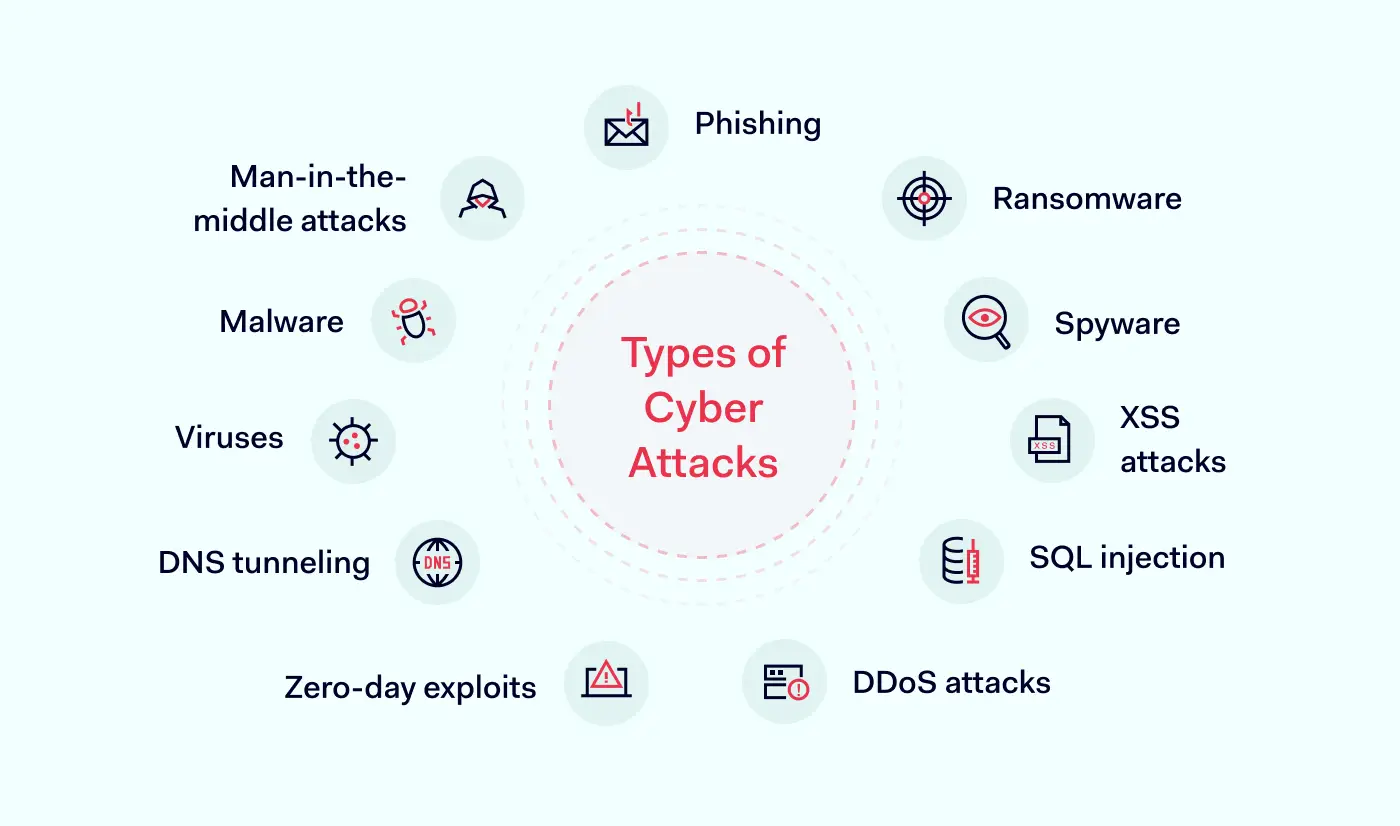
All of them threaten small businesses.

1. Phishing

Phishers use social engineering techniques to fool small business employees. With a few pieces of information, attackers can easily convince time-poor workers to make dangerous decisions. This might involve emails pretending to come from colleagues or trusted third parties. The links in these emails lead to malicious sites or initiate malware downloads.

2. Ransomware

Ransomware locks down high-value data and demands a ransom from targets. If attackers control these targets, they can demand a high price to restore access. And small businesses are not always able to pay.

3. Spyware

Spyware tracks data flowing through network assets and sends this information to controllers outside the targeted organization. Some spyware is legitimate. For instance, advertisers sometimes use it to deliver targeted ads. But the majority of spyware is malicious and linked to data extraction.

4. Viruses

Viruses spread between devices and their effects range from relatively light disruption to complete system failure. Some viruses remain dormant for long periods. Others set to work immediately. In all cases, small businesses need updated and effective antivirus software to defend their perimeter.

5. Malware

Malware extends beyond ransomware and spyware. For example, businesses might encounter trojans or worms that stay below the radar until activated. Bots are also common. These agents latch onto devices and create “swarms” to launch wide-scale attacks.

6. Man-in-the-middle attacks

Man-in-the-middle attacks target insecure wifi connections. Attackers can intervene between remote access workers and the corporate network. If the connection is unencrypted, hackers can harvest information from corporate network traffic and steal confidential data.

7. SQL injection

SQL injection uses SQL code to request access to valuable databases. This generally occurs via web forms connected to SQL databases. For small businesses, this could include employee gateways or payment forms. Securing web assets is absolutely essential.

8. DDoS attacks

Distributed denial-of-service attacks involve botnets featuring hundreds or thousands of agents. Botnets direct massive amounts of traffic at their target with the aim of overwhelming networks. Larger organizations may have the resources to absorb DDoS floods. But with attacks averaging 5.17 Gbps, small business websites can easily fold under the pressure.

9. Zero-day exploits

Zero-day exploits target recently documented software vulnerabilities. In these situations, vendors probably haven’t developed patches, exposing users to opportunist attackers. Small businesses rely on anti-virus, communications, and data management tools in everyday work. But any of these tools can become vulnerable overnight.

10. DNS tunneling

DNS tunneling injects malicious code into networks via DNS queries. This allows hackers to seize control of local DNS servers. When that happens, a small business can lose control of its website and network assets. DNS tunneling exploits insecure firewalls, but SMBs often retain legacy firewall products. That’s a bad idea when successful attacks can ruin reputations in seconds.

11. XSS attacks

XSS (or Cross Site Scripting) injects malicious code via web applications and browser-side scripts. XSS attacks allow attackers to change website designs, adding undesirable content. They can launch malicious software, infecting business networks and customer devices. It allows hackers to spoof legitimate identities by hijacking cookies. All of that is bad news for SMBs.

Cybersecurity best practices for small businesses

Small businesses need cybersecurity strategies that deal with critical threats. But how can you implement an effective strategy with a small business budget?

SMBs lack the resources of corporations. But cybersecurity for small businesses must still protect sensitive data and network resources. Here are some best practices to follow that balance cost and efficiency.

1. Implement a strong password policy

Employees should only use strong passwords to log into your company network. Weak passwords are easy to guess or brute force. This makes mounting attacks much simpler.

Require employees to use 10-15 character passwords. Demand a mixture of upper and lower case letters, numbers, and symbols. Enterprise-wide password management tools can help. They make storing and changing passwords easier, eliminating much of the risk of human error.

Combining password hygiene with anti-virus software and firewall protection is also good practice. That way, you can filter potential threats and authenticate users effectively.

2. Schedule regular backups

Cyber-attacks can lead to the deletion of data or system failures that compromise important workflows. This makes it vital to back up high-priority data regularly. Use secure cloud services or external locations away from your core network.

3. Train employees in cybersecurity basics

Digital cybersecurity controls rely upon human knowledge and behavior. The way employees act when encountering cyber threats is a crucial part of a small business security setup. That’s why it’s vital to focus on what is known as the human firewall.

Strengthen the human firewall by training employees to spot phishing emails and malicious links. They must know the company password and access management policies. Remote workers should also understand how to connect securely, as well as the risks of using an insecure public wi-fi network.

4. Use threat prevention measures to reduce cyber attack risks

Minimize cyber security risks by adding antivirus software and malware scanning tools to your network traffic. Use VPNs to encrypt data and anonymize user IP addresses. Create allowlists to screen user identities, admitting only authorized addresses.

Take action to secure your local network as well. You may need to upgrade your wifi network from WEP to WPA2. Check that your router SSID is anonymized and consider upgrading your firewall to add features like Deep Packet Inspection.

5. Implement protection for sensitive information

Encrypt high-value data like personnel records and customer financial information. If you rely on SaaS or PaaS tools, use any cloud data protection tools provided by your Cloud Service Provider.

Use privileges management to limit freedom within network boundaries. Confidential data should only be available to users who need it in their working tasks. That way, when a data breach occurs, attackers will struggle to access and extract data.

Minimize the number of users with administrative privileges. Avoid giving single users the power to make fundamental network changes.

Consider using Data Loss Prevention tools as well. These tools track the location and state of important data. They block data transfers to unauthorized devices and log potentially dangerous access requests. If you handle high-risk, high-value data, DLP could be a sound investment.

6. Create an Incident Response Plan

Small businesses must prepare for cybersecurity incidents. Aim to restore normal working conditions as soon as possible while protecting data and neutralizing active threats.

Carry out a risk assessment for the threats detailed above. Include an assessment of where critical data resides. Assign an individual with the responsibility to protect important data. And connect every resource with risk-reduction strategies.

Create a recovery plan for all critical assets. This should include security scans to identify any malware or virus infections. Document access requests during the security alerts and determine whether data loss has occurred.

SMBs need to be ready to act as soon as possible when cybersecurity issues arise. Be proactive and make sure everyone is aware of incident response procedures.

7. Focus on secure remote access

Many small businesses allow employees to work from home. Sales representatives may also travel widely but require access to central resources. In both cases, remote access creates cybersecurity risks.

Require strong passwords and MFA for remote connections. Consider requiring employees to use an approved VPN service when working from home. Staff may store confidential information on smartphones, creating additional risk. Enforce strict data protection policies for mobile devices.

Make sure your cyber security tools cover both on-premises and cloud resources. Remote workers can bypass central network routers if they connect to SaaS apps. This can create security gaps and compromise visibility.

8. Manage third parties securely

Small businesses rely on third-party vendors, but partners can act as vectors for cyber attackers. For example, CRM providers may not encrypt data securely, putting client data at risk. Virus checkers or low-quality VPNs may transmit spyware.

Check all third parties and ensure they have rock-solid security policies. Trust nobody, and always ask for security assurances if you aren’t sure.

9. Enable 2FA or MFA

Small companies need to secure the network edge with robust authentication procedures. 2-factor authentication or multi-factor authentication are the best options here. These tools request multiple identification factors whenever users connect to network assets. This makes it far harder to obtain access illegitimately.

If MFA is too burdensome for employees, consider using it only for administrator accounts. Or try user-friendly 2FA procedures such as fingerprint scanning. Balance user experience and security. But always go beyond simple password protection.

Ensure your company’s sensitive information is protected

Data protection is the most important cybersecurity goal for small businesses. Data losses lead to huge reputational damage and regulatory penalties. It’s critically important to secure data and show evidence that confidential information is protected. Basic data protection measures include:

  • Encrypting important databases

  • Filtering access with privileges management

  • Strengthening malware and firewall protection.

  • Using Data Loss Prevention tools

  • Educating employees about data security policies.

Beyond those actions, it’s also a good idea to check your data security posture. The Cybersecurity & Infrastructure Security Agency (CISA) provides a free “cyber hygiene” check. This is a good starting point. It should help you find vulnerabilities and identify areas of improvement.

Penetration testing also mimics the activities of hackers, providing a good measure of your data security setup. Robust testing will dramatically reduce the risk of data breaches in the future.

Cybersecurity checklist for small businesses

Small businesses should have a comprehensive cybersecurity plan that guides their efforts.
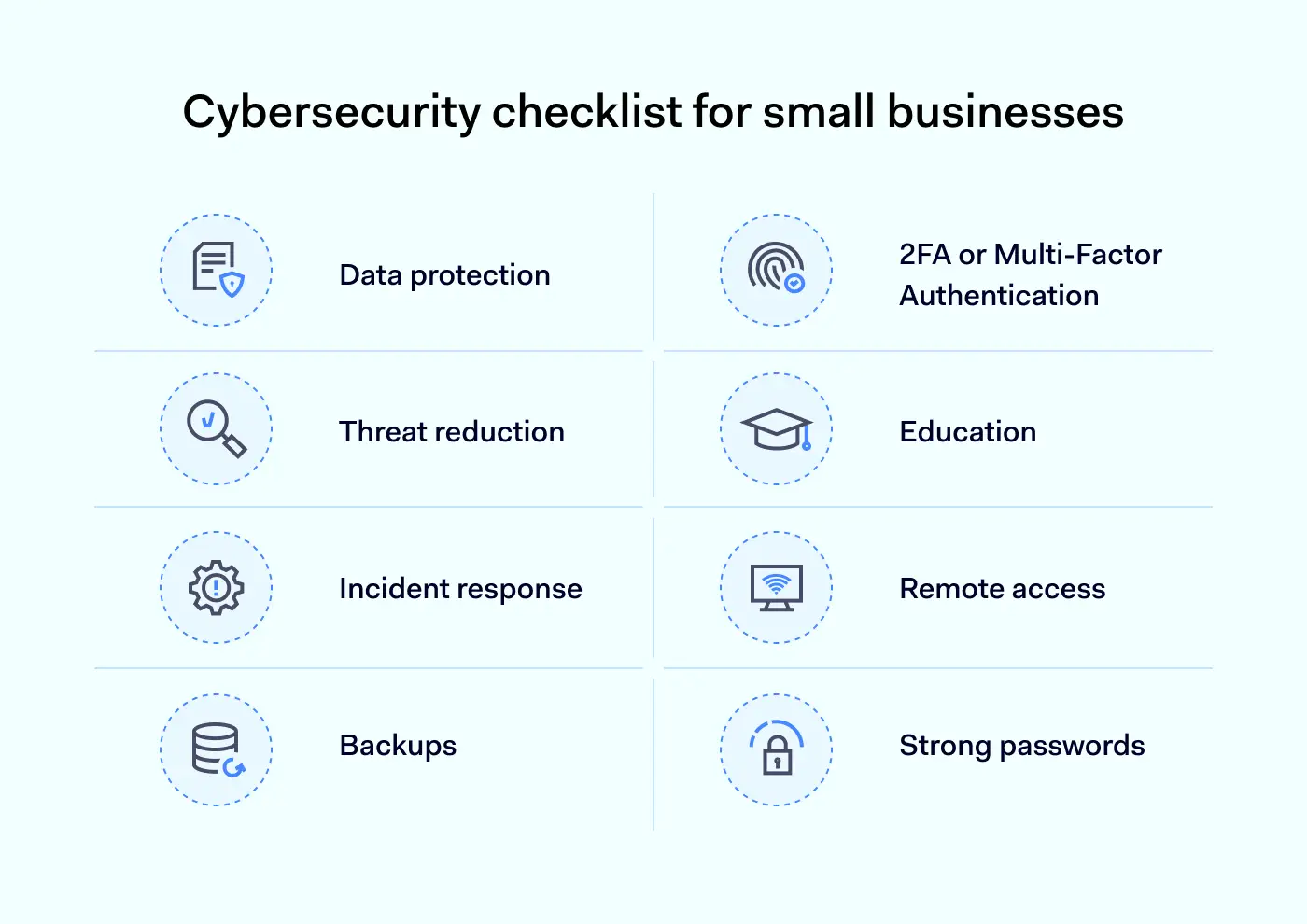
Follow this checklist to make sure you include the right security measures:
  1. Data protection – Apply encryption, DLP, and privileges management. Prioritize high-value data.

  2. Threat reduction – Put in place virus and malware scanning, and firewall protection.

  3. Incident response – Ensure rapid restoration of critical assets with full security checks.

  4. Backups – Regularly back up important data. Use secure cloud or external storage solutions.

  5. 2FA or Multi-Factor Authentication – Apply robust authentication to ensure legitimate access.

  6. Education – Provide full security training for all employees with a focus on phishing risks.

  7. Remote access – Ensure safe, user-friendly remote access. Enforce strong mobile device security.

  8. Strong passwords – Use strong, regularly changed passwords. Install password management tools to automate procedures.

How can NordLayer help?

Nordlayer is the ideal partner to help small businesses secure their data. We offer a variety of solutions to strengthen network defenses and manage employee identities.

Device Posture Checks make working from home safer. Nordlayer’s systems assess every device connection. If devices fail to meet security rules, posture checks deny access. Users will instantly know about access requests from unknown or compromised devices.

IP allowlisting lets you exclude unauthorized addresses at the network edge. IAM solutions use multifactor authentication and Single Sign On to admit verified identities. Virtual Private Gateways anonymize and encrypt data, adding more remote access protection. And our Cloud VPN services lock down hard-to-secure cloud assets that small businesses rely on.

Nordlayer makes achieving compliance goals easier and provides a safer customer experience. To find out more, get in touch with our sales team today.

About Version 2 Digital

Version 2 Digital is one of the most dynamic IT companies in Asia. The company distributes a wide range of IT products across various areas including cyber security, cloud, data protection, end points, infrastructures, system monitoring, storage, networking, business productivity and communication products.

Through an extensive network of channels, point of sales, resellers, and partnership companies, Version 2 offers quality products and services which are highly acclaimed in the market. Its customers cover a wide spectrum which include Global 1000 enterprises, regional listed companies, different vertical industries, public utilities, Government, a vast number of successful SMEs, and consumers in various Asian cities.

About NordLayer
NordLayer is an adaptive network access security solution for modern businesses – from the world’s most trusted cybersecurity brand, Nord Security.

The web has become a chaotic space where safety and trust have been compromised by cybercrime and data protection issues. Therefore, our team has a global mission to shape a more trusted and peaceful online future for people everywhere.

How CMHA protected sensitive client data in dynamic team environments

Canadian Mental Health Association (CMHA), Alberta South Region (CMHA, ASR), is a mental health non-profit, charitable organization in Canada. CMHA, ASR serves the Southwestern Alberta Region. As part of a nationwide mental health organization, it delivers a wide range of services that contribute to all people’s well-being. Dedicated teams support people in need through housing, crisis services, case management, peer support, Wellness Recovery, information and referral, service navigation, education, and advocacy. From a rapid response operation to providing information to an emergency helpline, CMHA, ASR is here to help people walk through the most challenging moments of their lives.

The CMHA Alberta South Region operates in an area of approximately 200,000 people. It is located next door to two large indigenous communities with over 16,000 people living on and off the reserve. The organization’s nature and a team of 50 specialists working on several projects mean a dynamic and fast-paced workplace. Managing employee attrition and onboarding, working between program sites or at the regional hospital emergency department, and protecting sensitive client data require watertight and responsive security measures to support the daily CMHA operations. Wesley Chenery, the IT Specialist at the CMHA Alberta South Region, reveals the technological backstage of handling these challenges. 

The challenge

One-man army to initiate and contain sensitive data controls

CMHA’s case is unique to the nature of the service model and its place in the health care system in Alberta. Although the organization does not fall under all the regulatory conditions within the public health care system, it is contractually mandated to follow compliance standards like HIPAA and other general data protection regulatory requirements. Yet, most of the security measures are applied by a proactive approach to avoid any potential negative outcomes of client data loss.

Our work culture requires a specific set of skills to be on board with what we do and offer to people. Unlike many more complex government organizations with layers of staff to support departmental needs, I am alone responsible for IT, statistics, and centrally administrating the CMHA’s client-data registry.

Click to tweet

CMHA uses a client management system called ‘Efforts and Outcomes (ETO),’ where all client data is stored. The organization must follow government standards to keep data solely in Canada — it cannot bounce between servers in different countries.

“The information has to be stored in the local data centers, and transfers must find a route that stays within Canada — other restrictions and policies regarding data are designed and implemented at our own discretion.”

Click to tweet

Contractual requirements and government regulations clearly outline data collection security standards. The organization is committed to maintaining high standards of compliance.

Another challenge CMHA faces is ongoing staff change. In a relatively short time, five employees tend to leave the organization, and another five join. A high rate of employee attrition and onboarding creates underlying security issues. Thus, access controls must be carefully managed to disconnect former employees and add new joiners in order to mitigate security risks.

So how does a company with limited resources can streamline its security policies and get ahead of security risks in one of the most cyber-targeted sectors?

The solution

A helping hand for defending data from cyberattacks

A service provider that provides an extensive range of services from hospital presentation aftercare to housing vulnerable individuals, from completing taxes to the monitoring of prescribed medication or guidance on reintegration into society – must represent and maintain trust. Strict internal policies and different tools help to achieve this goal.

Every computer and phone had to run security software that was controlled centrally by the network administrator. Every endpoint had its cookies and internet data wiped out every half-hour or when a browser was closed. Moreover, the browser was running an internet protection tool, and for a VPN, CMHA used an in-house server which was getting old and expensive to maintain. It is also worth mentioning that the internet in Canada is not that fast.

“There were many issues with in-house maintenance as hardware downgrades over time. You have to renew your licenses non-stop and buy accounts for new users — it’s just ridiculously expensive.”

Click to tweet

Besides, there was no option for backup with the on-site server — you lose power, and everyone loses connection. Upgrading the legacy infrastructure for better efficiency and getting more features demonstrated a need for a new solution that is well-developed and affordable.

The solution had to support the IT manager’s daily operations, not burden them. It also had to be simple and intuitive for fast user onboarding, turning money and time to value.

“We used a really old and non-automated system to connect people from the VPN. I’d have to log into the server manually, unplug employees, change over their IP addresses, and afterward get them all set up again. It was extremely time-consuming.”

Click to tweet

Employees are not allowed to connect to public networks. However, they must be mobile as the staff’s workplace might transform into hospitals or encampments. Thus, the tool must be running on their devices.

To eliminate as many risks as possible, CMHA performs cybersecurity awareness training for its employees. There’s a strict work-only device usage policy not to mix business and personal activities on provided laptops and cellphones. Company policies allow user activity monitoring to ensure top-level compliance and client data security.

Why choose NordLayer

NordLayer provides Control Panel with visibility on user activity and controls, with features like Always On VPN, KillSwitch, or ThreatBlock managed centrally. Automation and simple controls allow for saving IT manager’s time and monitoring network safety on a unified scale.

“The biggest feature that I’m really liking is the KillSwitch — it has saved us a couple of times.”

Click to tweet

Once somebody got into CMHA’s network and started changing their setting static IP address. The threat actor was overriding the computer and trying to re-direct our outgoing traffic. But when they hit Implement, all organization computers lost internet, stopping them from getting onto the company’s computers.

“The malware virus was designed to sit underneath our programs and slowly transfer data. I’m guessing it would have probably taken about a month to realize there was an attack before anything started acting funny.”

Click to tweet

Because of the feature, computers went down instead of connecting to the router, where the attacker left a malicious program to transfer all organization information to them. Instead, it hinted to the IT manager that someone was on the network — therefore, data was secured, and the router went into the garbage.

Malicious activity and software can stay undetected on the network for months until the damage is done irreversibly. Threat actors collect or lock away sensitive data for ransomware – one of the most destructive types of cyberattacks – exposing client personal information and making businesses face risks and losses.

The outcome

Effectively-used time to take care of organization security

Sensitive client data in the mental health sector, dynamic teamwork arrangements, and only one person to make it work technically and securely poses a major challenge to anyone.

Therefore, even support-oriented organizations need assistance to make their work easy and effective. A solution like NordLayer is focused on eliminating the complexity and inconvenience outdated hardware brings to security administrators.

“With NordLayer, I receive so few calls about network issues. Unless you are connecting to the right network, you won’t be able to use our systems — an immediate reminder to employees that they need to change the network instead of contacting me to troubleshoot via phone.”

Click to tweet

The right tools give more time, flexibility, and visibility to complicated and sometimes even destructive events in the organizational cybersecurity ecosystem. Besides security features, NordLayer enables to extract user activity data, useful for reporting and auditing, ensuring the security approach is compliant.

Pro cybersecurity tips

Despite the background and certificates in cybersecurity, real-life experiences bring the best insights into what methods and processes work best. Therefore, every story matters, it’s just important to hear it and apply it to your own case.

Wesley Chenery, IT Specialist of CMHA, Alberta South Region, shares the points of importance every security manager should consider and share with their organizations:

Using the right tools, you have better chances to be ahead of unfortunate events that threaten your organization’s network security. A proactive and safety-first mindset in evaluating risks and possible attack scenarios can become a vital element in business continuity. Make sure to upgrade to effective and efficient solutions — contact us to discover your options to improve the way the security of your company.

About Version 2 Digital

Version 2 Digital is one of the most dynamic IT companies in Asia. The company distributes a wide range of IT products across various areas including cyber security, cloud, data protection, end points, infrastructures, system monitoring, storage, networking, business productivity and communication products.

Through an extensive network of channels, point of sales, resellers, and partnership companies, Version 2 offers quality products and services which are highly acclaimed in the market. Its customers cover a wide spectrum which include Global 1000 enterprises, regional listed companies, different vertical industries, public utilities, Government, a vast number of successful SMEs, and consumers in various Asian cities.

About NordLayer
NordLayer is an adaptive network access security solution for modern businesses – from the world’s most trusted cybersecurity brand, Nord Security.

The web has become a chaotic space where safety and trust have been compromised by cybercrime and data protection issues. Therefore, our team has a global mission to shape a more trusted and peaceful online future for people everywhere.

How User and Entity Behavior Analytics Helps Cybersecurity

User and Entity Behavior Analytics

Cyberattacks are increasingly sophisticated, making traditional digital security tools insufficient to protect organizations from malicious actors.

In 2015, Gartner defined a category of solutions called User and Entity Behavior Analytics (UEBA).
Its big advantage is monitoring suspicious behaviors of human users and devices in corporate networks through algorithms and machine learning, determining if there are threats and issuing alerts to security teams.

In this article, we explain more about this subject, which is extremely important for the security of your company. To facilitate your reading, we divided our text into the following topics:

  • What Is User and Entity Behavior Analytics?
  • How Does UEBA Work?
  • What Are Its Three Pillars?
  • What Are the Benefits of UEBA?
  • Disadvantages of User and Entity Behavior Analytics
  • Best Practices for User and Entity Behavior Analytics
  • What Is the Difference Between SIEM and UEBA?
  • UEBA X NTA
  • What Is UBA and What Is It For?
  • What Is the Difference Between UBA and UEBA?
  • senhasegura UEBA Solution
  • About senhasegura
  • Conclusion

Enjoy the read!

What Is User and Entity Behavior Analytics?

User and Entity Behavior Analytics (UEBA) is a digital security feature that uses algorithms and machine learning to identify abnormal behaviors in users, routers, servers, and endpoints of a network.

In practice, this technology allows alerting IT administrators about anomalies and automatically disconnecting users with unusual behavior from the network, as it monitors human and machine behavior.

With this, it helps detect people and equipment that could compromise an organization’s system, strengthening its digital security and sovereignty.

How Does UEBA Work?

To ensure the effectiveness of User and Entity Behavior Analytics, it is necessary to implement this feature in the organization’s infrastructure, which can be targeted by malicious attackers.

Moreover, many corporations ask their employees to install this solution on their home routers to avoid risks. This is because the professional may have to access the corporate network using their own router, generating security vulnerabilities.

It is very simple to understand how UEBA works. Let’s imagine an unauthorized user steals an employee’s credentials and accesses the network. This does not make them capable of imitating this employee’s usual behavior.

Therefore, UEBA issues alerts, which reveal suspicious behavior to IT administrators. A UEBA solution has three essential elements. They are analytics, integration, and presentation.

Analytics collects and organizes data about the behavior of human users and entities to determine what should be considered normal. Through this system, profiles are created of how each user behaves when accessing the network. Thus, one can develop models that allow the identification of suspicious behavior.

With the growth and evolution of corporations, it becomes necessary to integrate UEBA into other security systems. Through proper integration, UEBA solutions compare information collected from different sources, which optimizes the system.

Finally, the presentation involves how User and Entity Behavior Analytics responds to abnormal behaviors. It depends on what is defined by the company.

Some UEBA systems are configured to simply create an alert, suggesting an investigation for IT administrators. Others are configured to perform additional actions, such as disconnecting an employee with abnormal behavior.

What Are Its Three Pillars?

According to Gartner, a UEBA solution has three pillars:

  • Use cases;
  • Data sources; and
  • Analytical methods.

Use cases refer to the behavior of human or machine users reported by User and Entity Behavior Analytics, which monitors, identifies, and alerts about anomalies. Unlike systems that perform specialized analysis, UEBA technology needs to be relevant to different use cases.

When we talk about data sources, we refer to repositories of information that feed into UEBA, since User and Entity Behavior Analytics does not collect data directly from IT environments.

Analytical methods are what enable UEBA to identify abnormal behavior. They include threat signatures, statistical models, rules, and machine learning.

What Are the Benefits of UEBA?

Traditional security solutions have proven ineffective at protecting corporations from sophisticated cyberattacks, which has boosted the rise of User and Entity Behavior Analytics, as it allows one to identify even the smallest of unusual behaviors.
Its main benefits include:

Broad Approach to Cyberattacks

In addition to monitoring the behavior of human users, UEBA monitors devices such as endpoints, servers, and routers, which are often targeted by malicious attackers.

Thus, User and Entity Behavior Analytics detects a wide variety of cyberattacks, including insider threats, compromised accounts, brute force attacks, and DDoS.

Operational Efficiency

With the use of artificial intelligence and machine learning, UEBA solutions can replace the workforce of IT employees, which represents a benefit for corporations and security teams.

Nevertheless, User and Entity Behavior Analytics does not generate a drastic reduction in IT staff, especially in larger organizations, due to the complexity of security requirements, which require skilled people to configure systems and guide employees.

These professionals may also be responsible for investigating abnormal behaviors if the company decides to investigate them before taking measures.

In addition, IT analysts can develop other projects, working strategically for business growth.

Cost Reduction

With the reduction of the IT team, an organization consequently reduces costs. Also, by detecting abnormal behavior and preventing cyberattacks, companies prevent losses by stopping activities.
They also avoid having their customers’ and employees’ data exposed, which could result in fines due to data protection laws.

Risk Reduction

With professionals connected to corporate networks, including in a home environment, vulnerabilities caused by cyber threats increase gradually, making protection solutions in silos insufficient.

For IT teams, it is impossible to manually monitor all devices in use. Hence the perks of UEBA solutions.
It is worth mentioning that UEBA resources are not limited to ensuring information security. They also enable compliance with security standards for regulated industries, avoiding problems that could lead to lawsuits and fines for companies, as previously mentioned.

Disadvantages of User and Entity Behavior Analytics

The UEBA solutions also have some negative aspects. The first one is its high price, which can make this technology inaccessible to small and medium-sized businesses.

Another disadvantage of User and Entity Behavior Analytics is the slow deployment. Although many vendors claim this system can be deployed in a short time, Gartner customers say that in simple use cases, it can take three to six months, and in complex situations, it can take up to 18 months.

In addition, the view UEBA offers over network behaviors is restricted as its logs are enabled on a small part of a corporation’s network.

It is also important to keep in mind UEBA needs third-party logs to work. Failures in the generation of these logs impact its function.

Best Practices for User and Entity Behavior Analytics

User and Entity Behavior Analytics is designed to identify abnormal behaviors of humans and machines.
However, this solution should not be used in isolation but associated with other monitoring systems, in order to improve the digital security of an organization. Other best practices for companies using UEBA resources are:

  • Avoiding false alerts and overloading of generated data, taking advantage of big data resources, and using machine learning and statistical analysis;
  • Creating security policies taking into account insider and external threats;
    Ensuring that only information security professionals receive alerts from UEBA; and
  • Not underestimating the risks posed by unprivileged user accounts, as hackers can increase privileges to gain access to sensitive systems.

What Is the Difference Between SIEM and UEBA?

Like UEBA, Security Information and Event Management (SIEM) features tools that make it possible to improve information security through normal patterns and suspicious behaviors.

The notable difference is that User and Entity Behavior Analytics uses data from human and machine user behavior to define what is normal.

Because SIEM is rule-based, malicious actors can circumvent these guidelines to attack a corporation. Also, SIEM detects threats that happen in real-time, but it is inefficient to prevent sophisticated attacks performed over months or years.

UEBA, on the other hand, is not based on rules, but on risk-scoring techniques and algorithms, which make it possible to detect abnormal behavior over a much longer period.

UEBA X NTA

Like UEBA, Network Traffic Analysis (NTA) solutions are based on machine learning, advanced analytics, and security rules, and monitor user behavior on corporate networks. Moreover, it detects suspicious actions and threats.

However, this technology has other advantages. One is to allow companies to visualize everything that happens on their network, including in the context of a cyberattack. NTA also makes it possible to create network profiles and devices, with easy deployment.

We emphasize these two solutions should be used in a complementary way, since NTA alone does not track local events, nor detect advanced security problems.

What Is UBA and What Is It For?

User Behavior Analytics (UBA) is a technology that allows one to identify unusual or abnormal behaviors, detect intrusions, and minimize their consequences.

Through UBA solutions, one can discover an invasion promoted by cybercriminals or find out if an employee is misusing the data to which they have access.

The focus of User Behavior Analytics is on user analytics, their accounts, and identity, not machine behavior.

What Is the Difference Between UBA and UEBA?

The difference between UBA and UEBA is that, in the first case, we refer to a solution that monitors human users to detect any anomalies in their behavior.

The extra “e” in UEBA extends monitoring to machine entities such as routers, servers, endpoints, and devices in general.

The acronym was updated in 2017 by Gartner to show that in addition to tracking human users, it is essential to identify threats related to devices and applications.

senhasegura UEBA Solution

senhasegura has a UEBA solution embedded in its PAM security platform, which allows one to monitor the behavior of human and machine users automatically.

This technology features a self-learning mechanism to identify and respond to changes in users’ behavior patterns and access profiles.

Some of the main characteristics are:

  • Analysis of user session based on behavioral history;
  • Identification of accesses and check of suspects by a series of criteria;
  • Identification of unusual behavior with abnormality alerts for SIEM/SYSLOG;
  • Detailed dashboards with a visual representation of incidents and threats, which allow a security team to act quickly;
  • Algorithms are continuously adjusted to user behavior.


Its benefits include:

  • Restriction of privilege abuse;
  • Fast detection of attacks and compromised accounts;
  • Control over the user’s administrative actions;
  • Automatic response to suspected credential theft.

About senhasegura

We, from senhasegura, are part of the group of information security companies MT4 Tecnologia, founded in 2001, and we aim to provide digital sovereignty to our customers through the control of privileged actions and data.

With this, we prevent data leaks and theft, as we manage privileged permissions before, during, and after access through machine automation. We work to:

Optimizing the performance of companies, avoiding interruption of operations;
Performing automatic audits on the use of permissions;
Auditing privileged changes to detect abuse of privilege automatically;
Providing advanced solutions with the PAM Security Platform;
Reducing cyber threats; and
Bringing the organizations that hire us into compliance with audit requirements and standards such as PCI DSS, Sarbanes-Oxley, ISO 27001, and HIPAA.

Conclusion

In this article, you saw that:

  • User and Entity Behavior Analytics uses algorithms and machine learning to identify abnormal behaviors in users, whether they are humans or machine entities;
  • This solution allows alerting IT administrators about anomalies and automatically disconnecting users with unusual network behavior;
  • To ensure the effectiveness of User and Entity Behavior Analytics, it is necessary to install this feature on the organization’s and employees’ devices;
  • A UEBA solution has three essential elements. They are analytics, integration, and presentation;
  • According to Gartner, a UEBA solution also has three pillars: the use cases, the data sources, and the analytical methods;
  • The benefits of UEBA include: a broad approach to cyberattacks, reduction of human labor, cost reduction, and risk reduction;
  • Among its negative aspects, the high price and slow deployment stand out;
  • The creation of security policies that take into account insider and external threats is among the best practices in the use of UEBA solutions;
  • It is also recommended to consider the risks presented by users without privileges;
    SIEM differs from UEBA because it is rule-based and detects only threats that occur in real-time.
    NTA allows organizations to view all the activities that occur on their network, including in the context of a cyberattack, and enables the creation of network profiles and devices, with easy deployment;
  • The difference between UBA and UEBA is that the first provides for the monitoring of human users and, in the second case, it is extended to machines.

About Version 2 Digital

Version 2 Digital is one of the most dynamic IT companies in Asia. The company distributes a wide range of IT products across various areas including cyber security, cloud, data protection, end points, infrastructures, system monitoring, storage, networking, business productivity and communication products.

Through an extensive network of channels, point of sales, resellers, and partnership companies, Version 2 offers quality products and services which are highly acclaimed in the market. Its customers cover a wide spectrum which include Global 1000 enterprises, regional listed companies, different vertical industries, public utilities, Government, a vast number of successful SMEs, and consumers in various Asian cities.

About Segura®
Segura® strive to ensure the sovereignty of companies over actions and privileged information. To this end, we work against data theft through traceability of administrator actions on networks, servers, databases and a multitude of devices. In addition, we pursue compliance with auditing requirements and the most demanding standards, including PCI DSS, Sarbanes-Oxley, ISO 27001 and HIPAA.

Important update for our clients

Important update for our clients


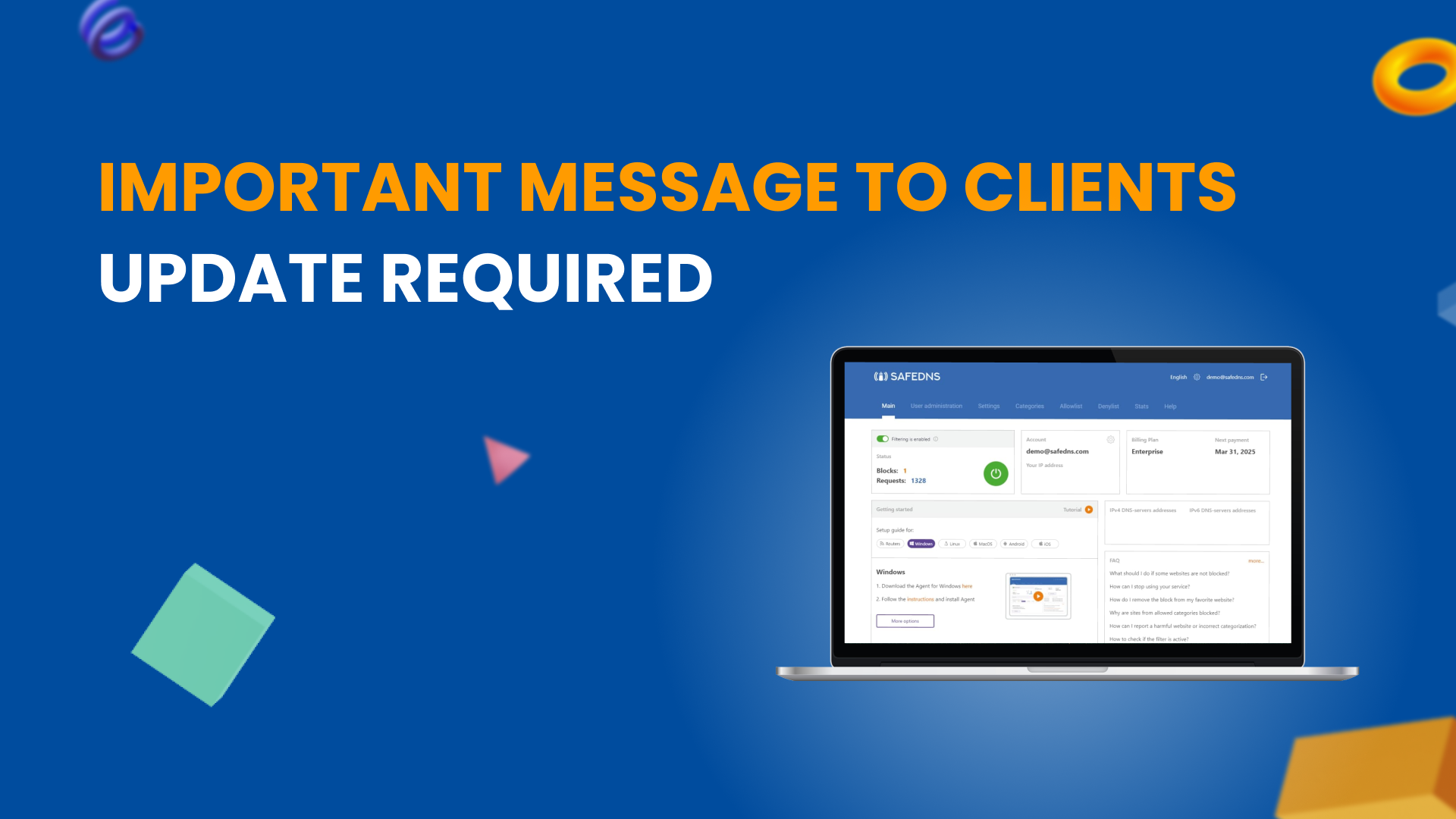
On February 19, 2023, we will be updating our blockpage certificate.
This certificate is not a necessary part of the filter and is used to display blockpage for HTTPS webpages. HTTP webpages are not affected.

Don’t worry, the filtering will continue to work without the new certificate.

You need to install a new version if:
1. You have manually installed the certificate before.
2. You are using SafeDNS Agent and want blockpage to be displayed on HTTPS webpages.

Here is a step-by-step guide on how to download and install the certificate.

Direct link to the certificate file.

About Version 2 Digital

Version 2 Digital is one of the most dynamic IT companies in Asia. The company distributes a wide range of IT products across various areas including cyber security, cloud, data protection, end points, infrastructures, system monitoring, storage, networking, business productivity and communication products.

Through an extensive network of channels, point of sales, resellers, and partnership companies, Version 2 offers quality products and services which are highly acclaimed in the market. Its customers cover a wide spectrum which include Global 1000 enterprises, regional listed companies, different vertical industries, public utilities, Government, a vast number of successful SMEs, and consumers in various Asian cities.

About SafeDNS
SafeDNS breathes to make the internet safer for people all over the world with solutions ranging from AI & ML-powered web filtering, cybersecurity to threat intelligence. Moreover, we strive to create the next generation of safer and more affordable web filtering products. Endlessly working to improve our users’ online protection, SafeDNS has also launched an innovative system powered by continuous machine learning and user behavior analytics to detect botnets and malicious websites.

New cybersecurity requirements from the Transportation Security Administration (TSA) in the United States

cybersecurity requirements

On the last March 7th, the Transportation Security Administration (TSA) issued a new emergency amendment requiring regulated airlines and airports to increase their capacity to face cyber attacks. The measure was taken less than a week after the United States government announced its national cyber security strategy, following similar requirements directed at freight and passenger rail carriers.

According to the issued statement, TSA’s priority is to protect the United States transportation system, working collaboratively with stakeholders and offering safe, secure, and efficient travel. This was necessary due to hackers who have attacked the aviation industry using different invasion methods.

In July 2022, American Airlines was a victim of a phishing attack, granting unauthorized access to its IT environment. In addition, various airports in the United States were targeted by DDoS attacks in October of the same year.

For this reason, regulated entities affected by the TSA must promote the following actions:

  • Develop network segmentation policies and controls, ensuring that operational technology systems continue to function securely in case of a compromise of IT;
  • Create access control measures, protecting critical systems from unauthorized access;
  • Implement continuous monitoring and detection policies and procedures to identify and respond to cyber security threats and anomalies; and
  • Reduce the risks of exploitation of uncorrected systems by applying security patches and updates on operating systems, applications, drivers, and firmware through a risk-based methodology.

Previously imposed requirements for aircraft operators and airports include establishing a cyber security point of contact, developing and adopting a cyber security incident response plan, conducting a cyber security vulnerability assessment, and reporting significant cyber security incidents to the Cybersecurity and Infrastructure Security Agency (CISA).

Conclusion

In conclusion, the new amendment issued by the TSA is their latest effort to ensure that transportation operators improve their ability to address cyber threats. In this article, we covered its goals and importance.

According to Cybersecurity Ventures, the world ended 2020 with 300 billion passwords to protect. And the trend shows this number will increase dramatically. Email accounts (personal and professional), banking services, corporate systems, devices, and applications are some examples that require authentication through passwords. And with the increase in the number of data leaks, it is easy to find compromised credentials on forums on the dark web being sold for pennies.

And yes, we know that it is not easy to manage so many passwords. Even the most tech-savvy can struggle to manage and protect credentials in so many different environments. In times of personal data protection legislation, such as LGPD and GDPR, ensuring the protection of such data has become more than a security requirement – it is a business must.

Despite all the risks associated with their use, many users and companies use passwords that are easy to guess, such as numbers or sequential letters (123456 or abcdef). SolarWinds itself, the victim of a serious attack on its supply chain, was using the password solarwinds123 in its infrastructure. Certainly, your email password or mine is stronger than the one used by this American technology company.

So, on this World Password Day, here are some tips that should be considered by users to keep their data protected:

  1. Use long and complex passwords. This prevents hackers from using techniques to guess them. However, just using complex passwords may not be enough to protect them from hackers.
  2. Many devices are configured with default passwords. Change them immediately.
  3. Avoid reusing your passwords on different accounts. Also, constantly check if you have already been the victim of a data leak through senhasegura Hunter. If so, change your passwords immediately.
  4. Configure your passwords to be changed frequently. The ideal is at least every 3 months.
  5. Do not write down, store in an easily accessible place, or share your passwords with others, thus avoiding unauthorized access.
  6. Consider password management solutions, or even privileged access management (PAM), to manage the use of systems and devices.
  7. Use Multiple-Factor Authentication (MFA) mechanisms to add a layer of security to your accounts.
  8. Set up means of retrieving access, such as including phone numbers or emails.

Passwords are one of the oldest security mechanisms in the computing world and are also one of the main attackvectors by hackers. And in the “new normal” era, with increasing threats resulting from the covid-19 pandemic, it is vital that users be alert and properly protect their digital identities. In this way, we can avoid cyberattacks that can cause considerable damage not only to people, but also to companies. And on this World Password Day, remember: security starts with you!

About Version 2 Digital

Version 2 Digital is one of the most dynamic IT companies in Asia. The company distributes a wide range of IT products across various areas including cyber security, cloud, data protection, end points, infrastructures, system monitoring, storage, networking, business productivity and communication products.

Through an extensive network of channels, point of sales, resellers, and partnership companies, Version 2 offers quality products and services which are highly acclaimed in the market. Its customers cover a wide spectrum which include Global 1000 enterprises, regional listed companies, different vertical industries, public utilities, Government, a vast number of successful SMEs, and consumers in various Asian cities.

About Segura®
Segura® strive to ensure the sovereignty of companies over actions and privileged information. To this end, we work against data theft through traceability of administrator actions on networks, servers, databases and a multitude of devices. In addition, we pursue compliance with auditing requirements and the most demanding standards, including PCI DSS, Sarbanes-Oxley, ISO 27001 and HIPAA.

×

Hello!

Click one of our contacts below to chat on WhatsApp

×