Skip to content

ESET Research: Iran-aligned OilRig group deployed new malware to its Israeli victims, collecting credentials

  • ESET Research analyzed two OilRig campaigns that occurred throughout 2021 (Outer Space) and 2022 (Juicy Mix) by this Iran-aligned APT group. 
  • The operators exclusively targeted Israeli organizations and compromised legitimate Israeli websites for use in OilRig’s Command & Control (C&C) communications.
  • They used a new, previously undocumented backdoor in each campaign: Solar in Outer Space, then its successor Mango in Juicy Mix.
  • A variety of post-compromise tools were deployed in both campaigns. They were used to collect sensitive information from major browsers and the Windows Credential Manager.


BRATISLAVA, MONTREAL — September 21, 2023
— ESET researchers have analyzed two campaigns by the Iran-aligned OilRig APT group: Outer Space from 2021, and Juicy Mix from 2022. Both of these cyberespionage campaigns targeted Israeli organizations exclusively, which is in line with the group’s focus on the Middle East, and both used the same playbook: OilRig first compromised a legitimate website to use as a C&C server and then delivered previously undocumented backdoors to its victims while also deploying a variety of post-compromise tools mostly used for data exfiltration from the target systems. Specifically, they were used to collects credentials from Windows Credential Manager and from major browsers, credentials, cookies and browsing history.

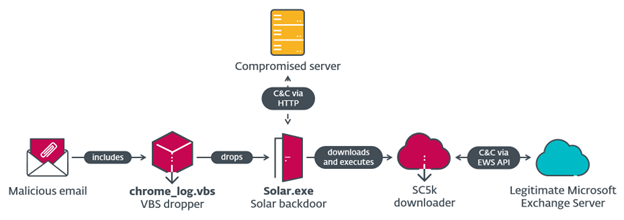
In their Outer Space campaign, OilRig used a simple, previously undocumented C#/.NET backdoor ESET Research has named Solar, along with a new downloader, SampleCheck5000 (or SC5k), that uses the Microsoft Office Exchange Web Services API for C&C communication. For the Juicy Mix campaign, the threat actors improved on Solar to create the Mango backdoor, which possesses additional capabilities and obfuscation methods. Both backdoors were deployed by VBS droppers, presumably spread via spearphishing emails. In addition to detecting the malicious toolset, ESET has also notified the Israeli CERT about the compromised websites.
ESET named the Solar backdoor based on the use of an astronomy-based naming scheme in its function names and tasks; we named Mango, another new backdoor, based on its internal assembly name and its filename.

Solar backdoor possesses basic functionalities and can be used, among other things, to download and execute files, and automatically exfiltrate staged files. An Israeli human resources company’s web server, which OilRig compromised at some point prior to deploying Solar, was used as the C&C server.

For its Juicy Mix campaign, OilRig switched from the Solar backdoor to Mango. It has a similar workflow to Solar and overlapping capabilities, with some notable technical changes. ESET identified an unused detection evasion technique within Mango. “This technique’s goal is to block endpoint security solutions from loading their user-mode code hooks via a DLL in this process. While the parameter was not used in the sample we analyzed, it could be activated in future versions,” says ESET researcher Zuzana Hromcová, who co-analyzed the two campaigns of OilRig.

OilRig, also known as APT34, Lyceum, or Siamesekitten, is a cyberespionage group that has been active since at least 2014 and is commonly believed to be based in Iran. The group targets Middle Eastern governments and a variety of verticals, including chemical, energy, financial and telecommunications.

For more technical information about OilRig and its Outer Space and Juicy Mix campaigns, check out the blogpost “OilRig’s Outer Space and Juicy Mix: Same ol’ rig, new drill pipes” on WeLiveSecurity. Make sure to follow ESET Research on Twitter (today known as X) for the latest news from ESET Research.

About Version 2 Digital

Version 2 Digital is one of the most dynamic IT companies in Asia. The company distributes a wide range of IT products across various areas including cyber security, cloud, data protection, end points, infrastructures, system monitoring, storage, networking, business productivity and communication products.

Through an extensive network of channels, point of sales, resellers, and partnership companies, Version 2 offers quality products and services which are highly acclaimed in the market. Its customers cover a wide spectrum which include Global 1000 enterprises, regional listed companies, different vertical industries, public utilities, Government, a vast number of successful SMEs, and consumers in various Asian cities.

About ESET
For 30 years, ESET® has been developing industry-leading IT security software and services for businesses and consumers worldwide. With solutions ranging from endpoint security to encryption and two-factor authentication, ESET’s high-performing, easy-to-use products give individuals and businesses the peace of mind to enjoy the full potential of their technology. ESET unobtrusively protects and monitors 24/7, updating defenses in real time to keep users safe and businesses running without interruption. Evolving threats require an evolving IT security company. Backed by R&D facilities worldwide, ESET became the first IT security company to earn 100 Virus Bulletin VB100 awards, identifying every single “in-the-wild” malware without interruption since 2003.

Continuous Improvement and Pure Excellence: Advantages of RCA in Troubleshooting

As a good technology superhero you will know that in the world of troubleshooting, there is an approach that goes beyond simply fixing superficial symptoms. We call this approach “Maximum Heroics” or Root Cause Analysis (ACR), a charming method that seeks to unravel the mysteries behind an incident. 

Through the RCA, the causal factors of an incident are examined, and why, how and when it happened are broken down in order to prevent it from repeating itself and ensure smooth continuity.

Anticipate issues, optimize your systems and processes with RCA

Imagine this post-apocalyptic scenario: a system breaks down or undergoes an unexpected change, surprising all of those who depend on it.

This is where RCA comes into play, as an indispensable tool to fully understand the incident and what triggered it.

Unlike simple troubleshooting, which focuses on taking corrective action once the incident took place, RCA goes further, seeking to uncover the root cause of the problem.

Sometimes RCA is also used to investigate and understand the performance of a particular system, as well as its superiority performance compared to other similar systems.

However, in most cases, root cause analysis focuses on problems, especially when they affect critical systems.

Through a RCA, all the contributing factors to the problem are identified and connected in a meaningful way, allowing a proper approach and, most importantly, preventing the same adversity from happening all over again.

Only by getting “to the root cause” of the problem, rather than focusing on surface symptoms, you may find out how, when and why the problem arose in the first place.

There is a wide range of problems that warrant a root cause analysis and they might come from a variety of sources, from human errors to physical system failures to deficiencies in an organization’s processes or operations.

To sum up, any type of anomaly that affects the optimal functioning of a system may require the implementation of an RCA.

Whether it’s faulty machinery in a manufacturing plant, an emergency landing on an airplane or a service interruption in a web application, investigators embark on a journey to uncover the hidden layers of each incident, in search for the ultimate solution.

Pursuing Continuous Improvement: The advantages of Root Cause Analysis

When it comes to maintaining the integrity and smooth operation of an organization, root cause analysis becomes an invaluable ally.

With the primary goal of reducing risk at all levels, this revealing process provides vital information that can be used to improve system reliability.

But, what exactly are the objectives and advantages of performing a root cause analysis??

First, root cause analysis, as we already know, seeks to identify precisely what has actually been happening, going beyond the superficial symptoms to unravel the sequence of events and root causes.

Understanding what is needed to solve the incident or taking advantage of the lessons learned from it, taking into account its causal factors, are some other key objectives of RCA.

In addition, repetition of similar problems is avoided, leading to an improvement in the management quality.

Once these goals are achieved, an RCA can provide a number of significant benefits to an organization.

First, systems, processes and operations are optimized by providing valuable information about the underlying problems and obstacles.

In addition, repetition of similar problems is avoided, leading to an improvement in the quality of management.

By addressing problems more effectively and comprehensively, you may deliver higher quality services to your customers, thereby generating customer satisfaction and loyalty.

Root cause analysis also promotes improved internal communication and collaboration, while strengthening the understanding of the underlying systems.

In addition, by quickly getting to the root of the problem instead of just treating the symptoms, the time and effort spent on long-term resolution of recurring problems is significantly reduced.
Moreover, this efficient approach also reduces costs by directly addressing the root cause of the problem, rather than continually dealing with unresolved symptoms.

More importantly, root cause analysis is not limited to a single sector, but can benefit a wide range of industries.

From improving medical treatment and reducing workplace injuries, to optimizing application performance and ensuring infrastructure availability, this methodology has the potential to drive excellence in a variety of systems and processes.

The Foundations of Root Cause Analysis: Principles for Success

Root cause analysis is a versatile enough methodology to adapt to various industries and individual circumstances.

However, at the core of this flexibility, there are four fundamental principles that are essential to ensure the success of RCA:

  • Understand the why, how and when of the incident: These questions work together to provide a complete picture of the underlying causes.
    For example, it is difficult to understand why an event occurred without understanding how or when it happened.
    Investigators must explore the full magnitude of the incident and all the key factors that contributed to it taking place at that precise time.
  • Focus on underlying causes, not symptoms: Addressing only symptoms when a problem arises rarely prevents recurrence and can result in wasted time and resources.
    Instead, RCA focuses on the relationships between events and the root causes of the incident.
    This approach helps reduce the time and resources spent solving problems and ensures a sustainable long-term solution.
  • Think prevention when using RCA to solve problems: To be effective, root cause analysis must get to the root causes of the problem, but that is not enough.
    It must also enable the implementation of solutions that prevent the problem from happening all over again.
    If RCA does not help solve the problem and prevent its recurrence, much of the effort will have been wasted.
  • Get it right the first time: A root cause analysis is only successful to the extent that it is performed properly.
    A poorly executed RCA can waste time and resources and even make the situation worse, forcing investigators to start over.
    An effective root cause analysis must be carried out carefully and systematically.
    It requires the right methods and tools, as well as leadership that understands what the effort entails and fully supports it.

By following these fundamental principles, root cause analysis becomes a powerful tool for unraveling the root causes of problems and achieving lasting solutions.

By fully understanding incidents, focusing on underlying causes and taking a preventative approach, organizations can avoid repeat problems and continuously improve their performance.

Ultimately, root cause analysis becomes the foundation upon which a culture of continuous improvement and excellence is built.

A Range of Tools: Methods for Root Cause Analysis

When it comes to unraveling the root causes of a problem, root cause analysis offers a variety of effective methods.

One of the most popular approaches is the 5 whys, where successive “why” questions are asked to get to the underlying causes.

This method seeks to keep probing until the reasons that explain the primary source of the problem are uncovered.

While number five is only a guide, fewer or more “why” questions may be required to get to the root causes of the problem initially defined.

Another method widely used in RCA is the “Ishikawa Diagram”, also known as “Cause and Effect Diagram” or “Fishbone Diagram”.

In this approach, the problem is defined at the head of the fishbone, while the causes and effects unfold at the branches.

The possible causes are grouped into categories that are connected to the backbone, providing an overview of the possible causes that could have led to the incident.

In addition, investigators have several methodologies for performing a root cause analysis:

  • Failure Mode and Effects Analysis (FMEA): Identifies the various ways in which a system can fail and analyzes the possible effects of each failure.
  • Fault Tree Analysis (FTA): Provides a visual map of causal relationships using Boolean logic to determine the possible causes of a failure or assess the reliability of a system.
  • Pareto Diagram: It combines a bar diagram and a line diagram to show the frequency of the most common causes of problems, from most likely to least likely.
  • Change analysis: Consider how the conditions surrounding the incident have changed over time, which may play a direct role in its occurrence.
  • Scatter plot: It plots data on a two-dimensional graph with an X-axis and a Y-axis to uncover relationships between data and possible causes of an incident.
  • In addition to these methods, there are other approaches used in root cause analysis. Those professionals who engage in root cause analysis and seek continuous reliability improvement should be familiar with several methods and use the most appropriate one for each specific situation.

The success of root cause analysis also depends on effective communication within the group and personnel involved in the system.

Post-RCA debriefings, commonly referred to as “post-mortems,” help ensure that key stakeholders understand the causal and related factors, their effects, and the resolution methods used.

The exchange of information at these meetings can also lead to brainstorming about other areas that may require further investigation and who should be in charge of each.

Joining Forces: Tools for Root Cause Analysis

Root cause analysis is a process that combines human ability for deduction with data collection and the use of reporting tools.

Information technology (IT) teams often leverage platforms they already use for application performance monitoring, infrastructure monitoring or systems management, including cloud management tools, to obtain the necessary data to support root cause analysis.

Many of these products also include features built into their platforms to make root cause analysis.

In addition, some vendors offer specialized tools that collect and correlate metrics from other platforms, which helps remediate problems or disruptive events.

Tools that incorporate AIOps (Artificial Intelligence for IT Operations) capabilities are able to learn from past events and suggest corrective actions for the future.

In addition to monitoring and analysis tools, IT organizations often look to external sources for help in root cause analysis easier.

Collaboration and utilization of external resources are valuable aspects of root cause analysis.

By leveraging existing tools and seeking additional expertise from online communities and platforms, IT teams can gain a more complete and enriching perspective.

These synergies allow problems to be addressed more effectively and lasting solutions to be achieved.

Conclusions:

Root cause analysis emerges as a powerful methodology for understanding the underlying causes of problems and incidents faced by organizations.

Throughout this article, we have explored in detail what root cause analysis is, its objectives and advantages, as well as the fundamental principles behind it.

Root cause analysis invites us to go beyond the superficial symptoms and discover the real causes behind an incident.

Using multiple methods and tools, such as the 5 Whys, Ishikawa diagrams, FMEA, FEA and many others, RCA practitioners embark on a psychotropic journey of discovery to identify root causes and prevent problems from recurring.

Achieving the goals of root cause analysis, such as fully understanding events, applying preventive solutions and improving the quality of systems and processes, comes with a host of benefits that you can brag about over coffee later.

From optimizing systems and operations to improving service quality, reducing costs and promoting internal collaboration, root cause analysis becomes an enabler of continuous improvement and organizational excellence.

In this process, the right choice of tools and methods is crucial.

Organizations can leverage existing monitoring, analysis and systems management tools, as well as seek additional insights from external sources.

Collaboration and information sharing play a vital role in the success of root cause analysis, as they enable broader and richer perspectives.

Root cause analysis is a powerful ally of The Force and organizations in their search for effective and lasting solutions.

About Version 2 Digital

Version 2 Digital is one of the most dynamic IT companies in Asia. The company distributes a wide range of IT products across various areas including cyber security, cloud, data protection, end points, infrastructures, system monitoring, storage, networking, business productivity and communication products.

Through an extensive network of channels, point of sales, resellers, and partnership companies, Version 2 offers quality products and services which are highly acclaimed in the market. Its customers cover a wide spectrum which include Global 1000 enterprises, regional listed companies, different vertical industries, public utilities, Government, a vast number of successful SMEs, and consumers in various Asian cities.

About PandoraFMS
Pandora FMS is a flexible monitoring system, capable of monitoring devices, infrastructures, applications, services and business processes.
Of course, one of the things that Pandora FMS can control is the hard disks of your computers.

UAE-linked Stealth Falcon spies with sophisticated new backdoor on its neighbors, ESET Research discovers

  • ESET Research discovered a sophisticated backdoor, Deadglyph, that has unusual architecture.
  • ESET attributes the malware to the Stealth Falcon group, which, according to MITRE, is linked to the United Arab Emirates (UAE).
  • The victim is a governmental entity in the Middle East that was compromised for espionage purposes. A related sample found on VirusTotal was also uploaded to the file-scanning platform from this region, specifically from Qatar.
  • Traditional backdoor commands are implemented via additional modules received from its Command and Control (C&C) server.
  • ESET has obtained three out of many modules: process creator, file reader, and info collector.

BRATISLAVA — September 22, 2023 —  ESET researchers have discovered and analyzed a sophisticated backdoor, used by the Stealth Falcon group, that has been named Deadglyph by ESET. According to the US not-for-profit security organization MITRE, the group is linked to the United Arab Emirates. Deadglyph has an unusual architecture, and its backdoor capabilities are provided by its C&C in the form of additional modules. Deadglyph has a range of counter-detection mechanisms and it is capable of uninstalling itself to minimize the likelihood of its detection in certain cases. ESET made the discovery in the midst of routine monitoring of suspicious activities on the systems of high-profile customers, some based in the Middle East region. The victim of the analyzed infiltration is a governmental entity in the Middle East that was compromised for espionage purposes. A related sample found on VirusTotal was uploaded from Qatar.

ESET derived the name from artifacts found in the backdoor, coupled with the presence of a homoglyph attack. A homoglyph is a deceptive string of characters appearing like a reliable string. In the case of this backdoor, it was mimicking Microsoft Corporation in one instance.

This previously undocumented backdoor exhibits a notable degree of sophistication and expertise. The traditional backdoor commands are not implemented in the backdoor binary; instead, they are dynamically received by it from its C&C server in the form of additional modules. This backdoor also features a number of capabilities to avoid being detected, including continuous monitoring of system processes and the implementation of randomized network patterns.

ESET Research has managed to obtain three of these modules, uncovering a fraction of Deadglyph’s full capabilities: process creator, file reader, and info collector. The info collector module collects extensive information about the computer, including details about the operating system, installed software and drivers, processes, services, users, and security software. Additionally, the file reader module is able to read specified files; in one case, the module was used to retrieve the victim’s Outlook data file.

Additionally, ESET Research has found a related shellcode downloader that could potentially be used to install Deadglyph.

Based on the targeting and additional evidence, with high confidence ESET attributes Deadglyph to the Stealth Falcon APT group. Also known as Project Raven or FruityArmor, according to MITRE this threat group is linked to the United Arab Emirates. Active since 2012, Stealth Falcon is known to target political activists, journalists, and dissidents in the Middle East. It was first discovered and described by Citizen Lab, which published an analysis of a campaign of spyware attacks in 2016.

For more technical information about Stealth Falcon and Deadglyph, check out the blogpost “Stealth Falcon preying over Middle Eastern skies with Deadglyph” on WeLiveSecurity. Make sure to follow ESET Research on Twitter (now known as X) for the latest news from ESET Research.

Victimology of Deadglyph; the related sample was uploaded to VirusTotal from Qatar (in darker color)

About Version 2 Digital

Version 2 Digital is one of the most dynamic IT companies in Asia. The company distributes a wide range of IT products across various areas including cyber security, cloud, data protection, end points, infrastructures, system monitoring, storage, networking, business productivity and communication products.

Through an extensive network of channels, point of sales, resellers, and partnership companies, Version 2 offers quality products and services which are highly acclaimed in the market. Its customers cover a wide spectrum which include Global 1000 enterprises, regional listed companies, different vertical industries, public utilities, Government, a vast number of successful SMEs, and consumers in various Asian cities.

About ESET
For 30 years, ESET® has been developing industry-leading IT security software and services for businesses and consumers worldwide. With solutions ranging from endpoint security to encryption and two-factor authentication, ESET’s high-performing, easy-to-use products give individuals and businesses the peace of mind to enjoy the full potential of their technology. ESET unobtrusively protects and monitors 24/7, updating defenses in real time to keep users safe and businesses running without interruption. Evolving threats require an evolving IT security company. Backed by R&D facilities worldwide, ESET became the first IT security company to earn 100 Virus Bulletin VB100 awards, identifying every single “in-the-wild” malware without interruption since 2003.

ESET peer-recognized as a Customers’ Choice in the 2023 Gartner® Peer Insights™ Voice of the Customer report

BRATISLAVA — September 21, 2023ESET, a leading provider of Endpoint Protection Platforms (EPP), today announces  that it has been named a Customer Choice in the 2023 Gartner Peer Insights Voice of the Customer for Endpoint Protection Platforms report for our EPP solution ESET PROTECT.1 This recognition means that ESET  meets or exceeds both the market average in terms of Overall Experience and User Interest and Adoption. According to the report, 97 percent of Gartner Peer Insights reviews received for ESET indicated a 5-star or a 4-star rating*. 

In several hundred product reviews, customers expressed their appreciation for the ESET PROTECT solution for its product capabilities, sales experience, deployment experience and support experience. The report synthesizes the reviews of the vendors and focuses on direct peers’ experiences with implementing and operating a solution and, from our perspective, makes the report an invaluable resource for IT decision-makers seeking the best EPP for their organization. ESET has also received a 91% Willingness to Recommend* from our customers and the peer-distinction as an Overall Customers’ Choice and as a Customers’ Choice for the EMEA region.

The ESET PROTECT offering has been built around real-world customer needs and is under continual development to respond to businesses’ changing security requirements. Today’s customers benefit from:

  •     advanced threat protection and detection technologies;
  •     scalable and supported managed detection and response services;
  •     automated vulnerability assessment;
  •     and patch management capability

“We believe this recognition serves as an evaluation that we are on the right path, reaffirming our unwavering commitment to continuously empower and protect our customers in their digital endeavors. We are immensely grateful for the continuous customer feedback, which also influences the decision-making related to the development of our solutions. We will continue innovating and striving for excellence to ensure our customers‘ cybersecurity needs are met with the utmost precision and care,“ said Pavol Balaj, Vice President of the Enterprise Segment at ESET.

“We‘re really happy to be recognized with the Customers’ Choice distinction, especially because it‘s coming from regular users of our business tools. It‘s like a direct report card on our products from the people who use them every day. In our opinion, this recognition shows that our approach to business makes our customers satisfied from the moment they start considering our services, through the contracting and deployment phase, and on to daily use,” Balaj continued.

For more information about ESET’s awards and recognition, click here.

About Version 2 Digital

Version 2 Digital is one of the most dynamic IT companies in Asia. The company distributes a wide range of IT products across various areas including cyber security, cloud, data protection, end points, infrastructures, system monitoring, storage, networking, business productivity and communication products.

Through an extensive network of channels, point of sales, resellers, and partnership companies, Version 2 offers quality products and services which are highly acclaimed in the market. Its customers cover a wide spectrum which include Global 1000 enterprises, regional listed companies, different vertical industries, public utilities, Government, a vast number of successful SMEs, and consumers in various Asian cities.

About ESET
For 30 years, ESET® has been developing industry-leading IT security software and services for businesses and consumers worldwide. With solutions ranging from endpoint security to encryption and two-factor authentication, ESET’s high-performing, easy-to-use products give individuals and businesses the peace of mind to enjoy the full potential of their technology. ESET unobtrusively protects and monitors 24/7, updating defenses in real time to keep users safe and businesses running without interruption. Evolving threats require an evolving IT security company. Backed by R&D facilities worldwide, ESET became the first IT security company to earn 100 Virus Bulletin VB100 awards, identifying every single “in-the-wild” malware without interruption since 2003.

Support remote workers: a comprehensive guide to seamless IT assistance

Remote work isn’t just a cool perk offered by a few forward-thinking companies anymore—it’s the new normal. With everyone craving flexibility and companies looking to save money and get the best talent, working from home has shifted from exception to expectation

IT support, always a big deal in the office, has become even more important now that many of us are logging in from our living rooms or kitchen tables. So, what should you know to keep tech hiccups from ruining your day? Stick around because we’re diving deep into the best IT practices to support remote workers.

5 biggest challenges remote workers face

Before we jump into the best IT support practices for a remote workforce, it’s vital to know what remote workers are up against. These aren’t just your typical office problems but different challenges.

Things like distance between team members, different time zones, and varying degrees of tech skills can turn simple tasks into complex puzzles while working remotely. Get ready because we’re about to unpack these unique challenges and give you the lowdown on dealing with them.

Ensuring devices are up-to-date

In a regular office, the IT team ensures everyone’s computer is updated. But when you’re working remotely, that’s usually on your remote workforce. Out-of-date software can slow remote workers down and make their systems less secure. Threat actors love finding old software because it’s easier to break into.

For companies, this is a big challenge. They need a solid plan to manage this so that remote employees update their devices without causing work delays or risking the person’s or company’s online security. The plan must be easy for everyone to follow, even if they are managers and not tech experts.

Resolving IT issues in a timely manner

When everyone is in the office, IT issues get sorted out fast. At home, it’s a different story. Remote employees might have to try fixing problems while chatting with an IT expert. This can take more time and doesn’t necessarily lead to a solution.

It gets even trickier when remote employees work in different time zones or have odd hours. Even if remote employee support is available all day, the ideal time to fix or manage a problem might be missed. Companies need a plan to make sure IT issues are addressed and resolved fast, no matter where their employees are.

Securing remote work environments

While your employees work remotely, their network becomes a part of your company’s network. This can be risky because many employees get remote access, and their devices may not be as secure. Bad passwords or insecure devices can offer hackers an easy way in.

Companies have difficulty ensuring their remote workforce follows good security practices outside the office across all their devices. The strategies for an office building might not work for someone’s living room. Businesses need to think creatively and always be on the lookout for risks that could affect everyone in the company.

Maintaining effective communication

Poor communication makes it harder to support remote workers, affecting productivity and morale. Clear communication in virtual meetings is essential for all remote work support teams. But technical problems can make this challenging. A glitchy video call can stop a meeting and lead to misunderstandings.

Poor communication is more than an annoyance—it hampers remote work. Unclear guidelines on file access or IT support can derail projects. Companies must improve communication methods to keep remote teams effective

Time management and work-life boundaries

When employees work from home, the line between work and personal life often blurs. This flexibility is a double-edged sword: while convenient, it can make it tough for employees to “switch off” and enjoy their time.

Companies should be proactive about this issue. One way to address it is by offering guidelines or formal training on managing time and setting healthy work-life boundaries. By doing this, a company can help employees get the most out of remote work, boosting productivity and overall job satisfaction.Remote employee onboarding checklist web

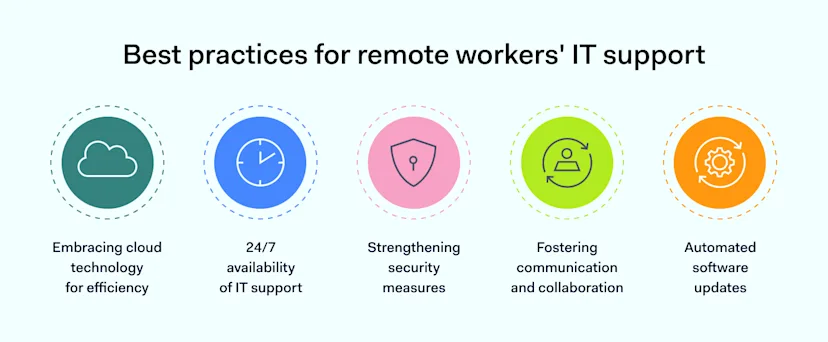
Best practices for remote workers’ IT support

When your team is remote, you need a game plan for tech support. Software should be up-to-date, and if tech issues pop up, you’ll need a way to tackle them quickly.

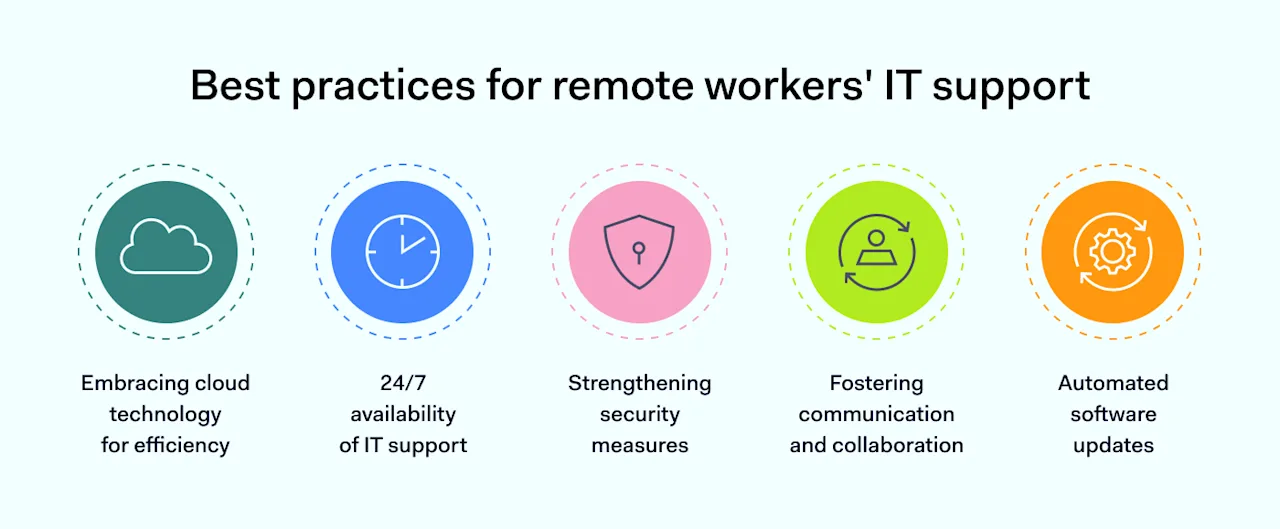
Best practices for remote workers- IT support 1400x579

In this section, we’ll share the key steps to ensure remote workers’ IT support is up to the challenge of supporting the whole remote workforce.

Embracing cloud technology for efficiency

When working remotely, accessing company resources via cloud technology like Google Drive or Dropbox is often essential. However, convenience isn’t the only factor; security is equally crucial. A Virtual Private Network (VPN) might be necessary for more sensitive internal resources for secure access.

Companies should consider using virtual private networks like NordLayer to ensure the organization’s data and cloud assets are more protected from threat actors. This can be done with the help of IP whitelisting (allowlisting).

This method gives remote workers access to the network by ignoring the firewall. And if the IP is not whitelisted, the user’s data doesn’t go through. IP allowlisting is excellent for Network Access Control (NAC), Software-as-a-Service (SaaS) user management, Internet of Things (IoT) security, and more.

24/7 availability of IT remote workers’ support

Technical problems can pop up anytime, and waiting until the next business day is often not an option. An IT team available 24/7 is essential for dealing with these unpredictable issues.

Implementing 24/7 IT support does not necessitate the overexertion of your current personnel. Through judicious scheduling and the strategic employment of remote support teams situated in diverse time zones, assistance can be made continuously available at a mere click of a button or a phone call.

Strengthening security measures

All devices that connect to your company’s network must be secure. You can’t afford weak links to secure access and protect important data. A good start is to set up identity access management solutions (IAM), two-factor authentication (2FA), or multi-factor authentication (MFA), where your remote workforce must provide more verification factors or methods of authentication before logging in.

Another effective measure is single sign-on (SSO), which lets users access many services with one login credential. This makes things easier for employees and lowers the chances of password-related security breaches.

Additionally, incorporating a Remote Access VPN solution like NordLayer can secure data transmission and safeguard sensitive information, offering an extra layer of security that’s crucial in a remote work setting.

Fostering communication and collaboration

Effective communication is the backbone of any remote work setup. Communication tools like Slack and Microsoft Teams are popular for remote workers because they do the job. But you’ll want to add an extra layer of security to these platforms.

Moreover, make sure you hold regular team meetings to keep everyone on the same page about the communication methods and how to use them.

Automated software updates

Ensuring that all software is updated with the latest security fixes is paramount for maintaining a secure remote work environment. While automating software updates is one straightforward approach, advanced features like NordLayer’s Device Posture Security offer an added layer of security. This feature checks if devices comply with multiple predefined rule sets and identifies unknown devices in the network.

Moreover, it ensures that the operating system and NordLayer application are up-to-date, thereby bolstering the security of your remote workforce. Importantly, IT teams are notified about non-compliant devices on the network, allowing for immediate corrective action.

Incorporating both automated software updates and device posture security measures will further fortify your network against potential vulnerabilities.

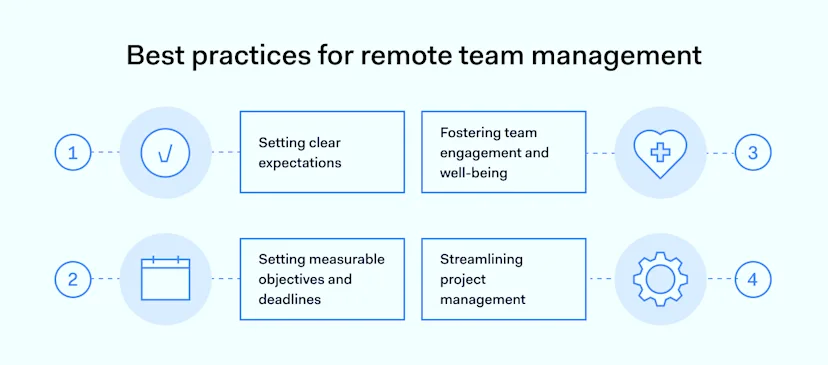
Best practices for remote team management

Managing a remote team has its own set of hurdles. From dealing with different time zones to ensuring everyone’s on the same page, the usual management playbook might not cut it.

Keep reading, and we’ll share essential tips to help you manage your remote team like a pro, ensuring you can handle the unique challenges that come with it.

Setting clear expectations

For a team working remotely, it’s crucial to know what’s expected. This isn’t just about which apps to use for talking or video meetings. There are other rules, too. For example, everyone might have to use a VPN all the time for better security. The remote workforce should contact IT support immediately if something looks off or doesn’t work right.

Also, there are usually other restrictions around what sites remote workers should not be able to access during work hours. Those include gambling sites, adult sites, or gaming during work. Features like DNS Filtering from NordLayer can help block these sites to ensure everyone is focused on work.

By laying down these rules clearly, DNS Filtering helps avoid misunderstandings and keeps the team on track.

Setting measurable objectives and deadlines

Goals help a team focus. Setting measurable objectives and giving honest feedback is even more critical in a remote setting. Deadlines help avoid slacking during the day, and measurable deadlines are about daily control to see if the worker’s productivity isn’t declining.

These objectives should be clear and achievable. They should also be reviewed periodically to make adjustments if necessary. This keeps the team engaged and ensures everyone contributes to the project’s success.

Fostering team engagement and well-being

Remote work can sometimes feel isolating. To counter this, managers should actively engage with team members to check their well-being. This can be done through regular one-on-one meetings or team activities designed to build rapport with remote staff.

In addition to work, focus on your team’s emotional and mental well-being. Provide resources, training, or activities that can help reduce stress and increase overall job satisfaction.

Streamlining project management

Managing projects remotely can be challenging. Use project management software that enables everyone to keep track of tasks and deadlines. This ensures that all team members can update their progress and stay accountable.

Consistency is key. Stick to one project management tool for all projects and ensure everyone knows how to use it. Regular updates and check-ins can also help track the project’s status and make necessary adjustments promptly.

Ease remote working issues with NordLayer

We’ve gone over a lot in this guide, from the daily challenges of remote work to how to make IT remote support problems less of a headache. Here is where a solution like NordLayer can help. It doesn’t just help keep your data safe, it makes your workday smoother by improving control access to company resources.

If you’re serious about making your remote work environment as secure and efficient as possible, NordLayer is a tool you should try. Having great remote work support is great, but protecting your network is the key—get in touch with NordLayer.

About Version 2 Digital

Version 2 Digital is one of the most dynamic IT companies in Asia. The company distributes a wide range of IT products across various areas including cyber security, cloud, data protection, end points, infrastructures, system monitoring, storage, networking, business productivity and communication products.

Through an extensive network of channels, point of sales, resellers, and partnership companies, Version 2 offers quality products and services which are highly acclaimed in the market. Its customers cover a wide spectrum which include Global 1000 enterprises, regional listed companies, different vertical industries, public utilities, Government, a vast number of successful SMEs, and consumers in various Asian cities.

About NordLayer
NordLayer is an adaptive network access security solution for modern businesses – from the world’s most trusted cybersecurity brand, Nord Security.

The web has become a chaotic space where safety and trust have been compromised by cybercrime and data protection issues. Therefore, our team has a global mission to shape a more trusted and peaceful online future for people everywhere.

×

Hello!

Click one of our contacts below to chat on WhatsApp

×