

Skip to content

Comparison N-Able vs Kaseya vs Pandora FMS: Fight !!!

Official comparison: N-Able vs Kaseya vs Pandora FMS

Lemons, oranges, grapefruits, limes… We know that they are not the same, but if necessary, you can make juice with all of them. And yes, we can and we will. We are in summer and it makes you want to make a good cocktail, doesn’t it? Today, in PFMS blog, we are going to analyze the commonalities of N-Able (Solarwinds MSP), Kaseya and Pandora FMS. Also their -remarkable- differences of course.

Both Kaseya and N-Able stand out for being RMM solutions and integral IT management systems in SaaS mode for MSP. In short, they are a very good solution for managing remote workstations and being able to manage and monitor them remotely. This includes tasks such as patch installation, remote software installation, network equipment configuration, remote desktop access, backups, and of course, receiving alerts when something goes wrong on managed machines.

Kaseya’s client is usually an MSP that provides services to different users, so it needs a tool that with a single license can serve different clients, managing them in an isolated, but centralized and homogeneous manner. This saves costs and is more efficient, since both Kaseya and N-Able are specific tools for Windows desktops that need to be managed remotely.

Pandora FMS client is usually an end company, or an MSP specialized in managing more complex infrastructures, which requires a tool with a more technical profile, which allows its technicians to apply their existing knowledge, scripts, etc. integrating them to compose an effective monitoring that allows them to go where other tools cannot. They are more oriented towards base infrastructure (communications, servers and applications) than to desktop computers.

In this comparison, we will also talk about prices, and both Kaseya and N-Able are above 20K USD in projects of 250 teams, yes, they are expensive tools and they also have a complex and peculiar pricing model, so much so that you will not be able to find these prices clearly on their respective websites.

A very important difference is that both Kaseya and N-Able are usually used in a cloud model (SaaS) (although they also have on-premise licensing), while Pandora FMS is a much more conservative model and is totally on-premise. This is especially relevant regarding the impact on security, since as the last hack to the Kaseya infrastructure showed us, attacking the manufacturer may imply that they can reach the end customer. As we teased long ago, Solarwinds is also not spared from this plague of security problems, and has suffered, since the first attack in 2020, several more attacks.

Given that Pandora FMS is a 100% autonomous installation (it can be installed in an environment without Internet access), and that Pandora FMS agents are not accessible from the outside nor can they be updated remotely, it is, by design, somewhat safer than Kaseya and Solarwinds. However, no one is spared, and Pandora FMS during 2020 and 2021 has published several security patches, as it can be seen in the CVE registry of Mitre.org.

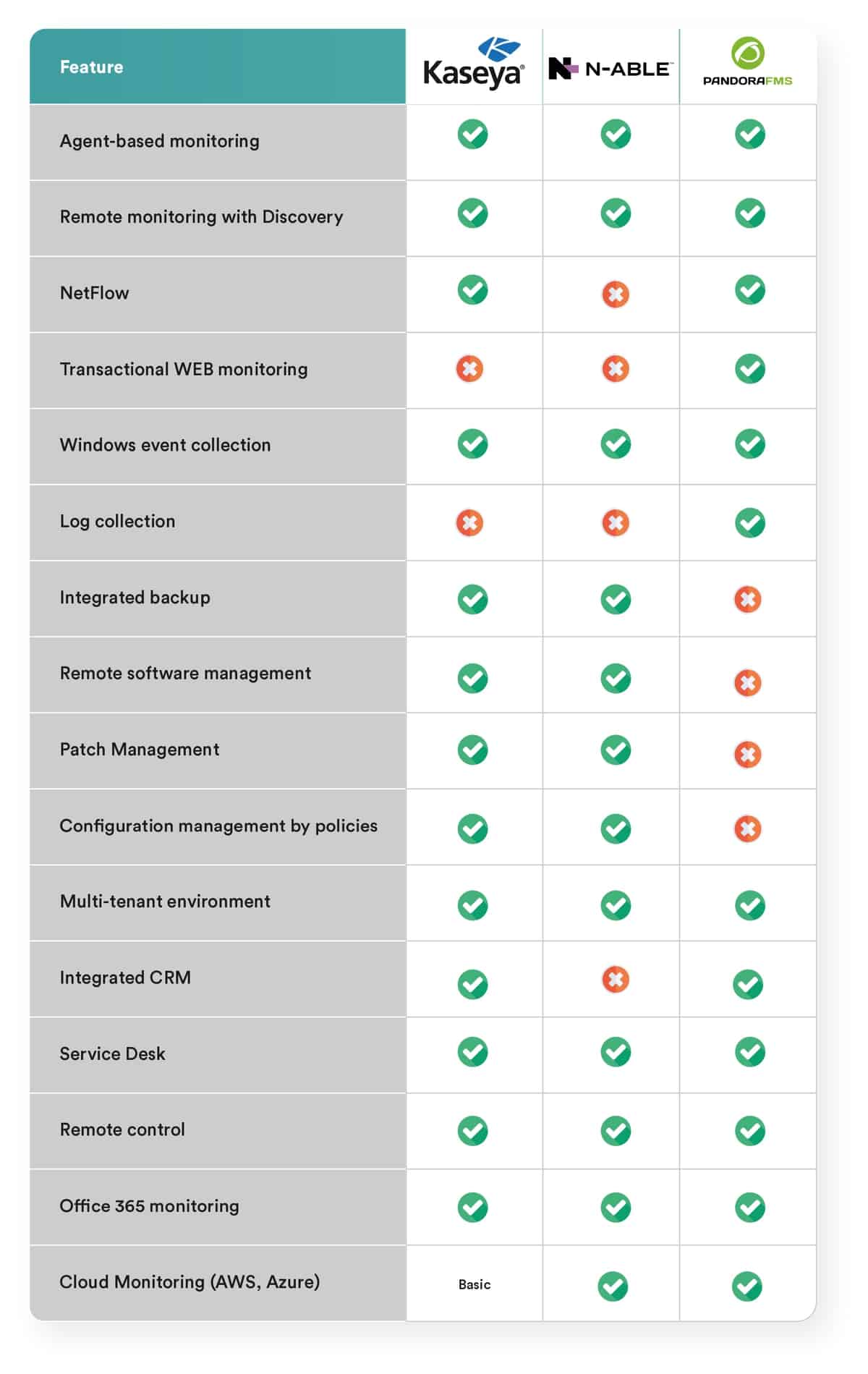
As a summary, we have created a table that describes features. Below there are some additional explanations.

N-Able vs Kaseya vs Pandora FMS
Prices

Others don’t talk about prices, we do. And we do it because it is something that everyone wants and needs to see. We know that it is very difficult to compare them because no product is licensed the same and they do not even share the same concepts. What we do is propose a more or less understandable and standard project to be able to compare the costs in three years. Let’s say, for example, that you want to monitor about 250 computers distributed among virtualized servers (30), workstations (200), physical network equipment and physical servers. Making a total of 250 teams. Well, the cost of a THREE-year project, without professional services and with standard support, would be the following:

  • Kaseya: 30,000 USD
  •  N-Able: 50,000 USD
  •  Pandora FMS: 15,000 USD

Conclusions

Both N-Able and Kaseya are products that excel in desktop management capabilities: patch management, software installation, and configuration change management. They provide added value such as monitoring, backup, security policy management and remote control. To all of this, they offer a layer of additional services such as ticketing and a portal for MSPs to offer their clients an integrated management and billing platform (the latter only in the case of N-Able).

They are very oriented to job monitoring. Monitoring, although it covers many aspects, is not the main focus of the product, especially if we consider some advanced features such as:

  • Distributed transaction monitoring (web applications).
  •  Monitoring Linux environments.
  •  Service-oriented monitoring (defining of service trees).
  •  High capacity (more than 10,000 devices).
  •  Advanced monitoring of enterprise technologies (Oracle, SAP, VMware …).
  •  Detailed monitoring of cloud environments (AWS, Azure).

In general, both N-Able and Kaseya have monitors for all kinds of applications, but only from a very superficial and remote point of view. That is, they are limited and not easily extensible.

If we add the high costs to this, Kaseya and N-Able do not seem like a good option for server monitoring projects or core infrastructure. For that, Solarwinds has a more traditional on-premise solution, although with costs of a similar order of magnitude, while Kaseya can only offer its product in an on-premise model.
About Version 2 Digital

Version 2 Digital is one of the most dynamic IT companies in Asia. The company distributes a wide range of IT products across various areas including cyber security, cloud, data protection, end points, infrastructures, system monitoring, storage, networking, business productivity and communication products.

Through an extensive network of channels, point of sales, resellers, and partnership companies, Version 2 offers quality products and services which are highly acclaimed in the market. Its customers cover a wide spectrum which include Global 1000 enterprises, regional listed companies, different vertical industries, public utilities, Government, a vast number of successful SMEs, and consumers in various Asian cities.

About PandoraFMS
Pandora FMS is a flexible monitoring system, capable of monitoring devices, infrastructures, applications, services and business processes.
Of course, one of the things that Pandora FMS can control is the hard disks of your computers.

Hard reflection on the cyberattack on Kaseya

What happened to Kaseya? How can we avoid it?

Imagine being offered an electronic lock for your front door. One that allows you to open the door through a mobile application in the cloud, would you accept it?

They promised that they would never lose the key, that with the app your would be able to open the door remotely and even through a webcam in the peephole, the device will be able to recognize your face and welcome you.

Well, that would be making things even easier, thieves no longer would have to go door by door, breaking locks. A good thief would be enough to break the security of the company that manages the application in the cloud and resell the master key to the highest bidder on the deepweb, this includes criminal groups around the world. Days later, if not the same evening, specialized thieves will enter the houses of the selected clients, because, of course, in addition to the master key, they will have a list of clients with attributes, names and addresses. The cloud company will have to choose between crying, denying everything and declaring bankruptcy. The president of the company (CEO) will probably be the first to sell his shares in a hurry.

Weeks after the thieves almost run out of addresses on their lists, thanks to the webcam and access logs, because through those they will know that there is no one at home, the owners will arrive at their homes and when they arrive, they will not know what happened, among other things because there will not even be, a forced door.

Please don’t laugh, does it look like the script from an upcoming Netflix production? You should know that what I tell you has already happened before, including the CEO selling shares in a hurry.

It may seem like a step back, but making the decision to go back to old-fashioned IT management can be the difference between life and death for a business. Cost reduction, service outsourcing and the culture of “everything in the cloud” leads us inexorably to this phenomenon.

It happened. It’s happening. It is ransomware. It is about encrypting all the information and then blackmailing for its recovery, its decryption.

They enter your house, they take everything and if you want to see it again, you will have to pay a ransom. The information is still there, encrypted, inaccessible. Nothing works and what is worse, if you try something or you don’t pay on time, they will erase everything forever.

This time those affected are not governments or large companies. They are greengrocers, nursery schools, restaurants, dentists… hundreds of small and medium-sized businesses have had to close due to their computer systems being blocked. Again, a ransomware attack that encrypts and locks all the hard drives on your computers. Tomorrow it could be your business… or your own personal mobile. It is connected to the cloud, right?

All the victims had one thing in common: the remote access and patch management software they used at their companies. This software, Kaseya, is sold to managed service providers – outsourced IT departments – which they use then to manage their customers’ networks, usually small businesses. That software, of course, works in the cloud.

The cost of the ransom is not the most important thing, although the figures are not small (we speak of 70 million dollars for Kaseya, an average of 300 thousand USD to each individual affected).

Could it happen tomorrow again?

Absolutely, YES.

The problem is no longer the software itself. It’s not that Kaseya is a bad software or it is poorly made. Probably its level of engineering has nothing to envy to the giants of the industry like Microsoft. Everything can be improved, but that is not the issue.

As it happened with Solarwinds, a security problem led to hackers taking their malicious software inside the client, using the attacked software’s own update system to spread. Like a virus that replicates inside its victim and spreads to relatives, once inside a house, sheltered from heating and blankets. Once the attack perpetrated this way, the company in turn had problems sending the patches to its customers, that is, the patient could not get the medicine that would cure him. For some customers who never responded electronically, they had to call them to tell them the software update procedure.

The problem with Kaseya is that we are not talking about software for large companies, which requires qualified personnel for its operation, but rather a software used to provide services to small companies without technical personnel, or very few, and that cannot manage such an attack.

While Solarwinds is used by government organizations, banks, and companies on the top 500 Standards & Poors (an American financial services rating agency) list, Kaseya is used by small and medium-sized businesses around the world, and the security problem is much more massive and its impact can be even more devastating.

If the attack is directed at a company, and it is successful, it allows taking control of that company. If one service provider is attacked and the attack succeeds, all their customers’ systems can be accessed. That is why the attack on Kaseya is so serious, because Kaseya has tens of thousands of customers around the world due to its SaaS (Software as a Service) model.

Although Kaseya is a US company, affected companies have already been reported throughout Europe, the Middle East, Asia, and South America.

The attack was so successful that companies like Elliptic, which analyze cryptocurrency networks to analyze unusual traffic, are scared by the number of victims who are proceeding to pay ransoms. No doubt, if the attack was a success and made lots of profit, there will be many more.

Can it be helped?

Well, imagine that you’re invited to a barbecue in a garden. Everything is beautiful, it looks like a villa in Italian Tuscany. The temperature is perfect and the aroma of the food is delicious. The wine, the company, everything is fantastic.

There is only one problem, mosquitoes are going to devour you. When you go back home, you will not be able to sleep, you will end up full of bites and will wonder how it is possible.

Something similar happens with Kaseya and Solarwinds. They are fantastic, but, do you see yourself all your life assuming the inconvenience of eating in the countryside? It is not about putting on pants or applying insect repellent. There are wasps, ants, all kinds of bugs in the countryside, attracted by people and the smell of food.

A party in your home kitchen may be less glamorous, but if you just want to eat well and not watch out for mosquito bites, you know the smart thing to do. It will be more inconvenient, even more expensive, but it controls the environment.

The same goes for applications based on the cloud or based on the SaaS model. They have many advantages, but security is not one of them, because you delegate it to organizations that you do not know.

If you rely on IT for your business continuity, you may need to step back and go back to more conservative models. After all, trends go by and the world keeps on running.

References:

https://www.wsj.com/articles/kaseya-hack-ripples-across-europe-as-ransomware-boom-escalates-11625823001

https://techcrunch.com/2021/07/05/kaseya-hack-flood-ransomware/

https://pandorafms.com/blog/es/monitorizacion-y-seguridad/

https://csirt.divd.nl/2021/07/04/Kaseya-Case-Update-2/

About Version 2 Digital

Version 2 Digital is one of the most dynamic IT companies in Asia. The company distributes a wide range of IT products across various areas including cyber security, cloud, data protection, end points, infrastructures, system monitoring, storage, networking, business productivity and communication products.

Through an extensive network of channels, point of sales, resellers, and partnership companies, Version 2 offers quality products and services which are highly acclaimed in the market. Its customers cover a wide spectrum which include Global 1000 enterprises, regional listed companies, different vertical industries, public utilities, Government, a vast number of successful SMEs, and consumers in various Asian cities.

About PandoraFMS
Pandora FMS is a flexible monitoring system, capable of monitoring devices, infrastructures, applications, services and business processes.
Of course, one of the things that Pandora FMS can control is the hard disks of your computers.

SaaS Plus, a new way of monitoring your Infrastructure with Pandora FMS

SaaS Plus, new ways to exploit monitoring

With Pandora FMS SaaS monitoring you can start operating almost instantly, using our Enterprise technology, thanks to any of our certified partners who offer this service. This allows you to focus exclusively on the operational aspects, control costs and growth from the very first minute, without having to invest in training, licenses, management, updates, initial implementation, etc.

Let’s cut to the chase. The standard SaaS would be closer to the guy who´s made his bed so he can lie in it, simply by hitting the buy or try button in the provider of his choice within Pandora FMS certified ones. Perfect to start a project or to operate a medium or small sized environment.

However, our new SaaS Plus model goes much further. It is suitable for that other type of professionals, who need to scale from an environment with hundreds of agents to several thousands. Due to limitations beyond their control, it cannot operate on its own, in a more traditional (on-premise) model. In addition, these professionals are looking for help in the early stages, with consulting and integration. Just what we do best: helping. You will also have custom support with the sale, which is done individually, guided by a sales engineer, with a specialized technical profile and the support of pre-sales and support engineers.

Okay, but then what makes SaaS plus different from Pandora FMS?

  • 100% system control (hardware, OS and Pandora FMS).
  • Hour packs for custom adjustments.
  • Monitoring operation./li>
  • Agent installation services and remote deployments.
  • Installation and dedicated staff.
  • 24/7 NOC (Network Operation Center) operation anywhere in the world with customized service level conditions.

SaaS Plus services can be run in any country in the world, relying on local partners to integrate the best of partner proximity and experience and vendor expertise and support.

About Version 2 Digital

Version 2 Digital is one of the most dynamic IT companies in Asia. The company distributes a wide range of IT products across various areas including cyber security, cloud, data protection, end points, infrastructures, system monitoring, storage, networking, business productivity and communication products.

Through an extensive network of channels, point of sales, resellers, and partnership companies, Version 2 offers quality products and services which are highly acclaimed in the market. Its customers cover a wide spectrum which include Global 1000 enterprises, regional listed companies, different vertical industries, public utilities, Government, a vast number of successful SMEs, and consumers in various Asian cities.

About PandoraFMS
Pandora FMS is a flexible monitoring system, capable of monitoring devices, infrastructures, applications, services and business processes.
Of course, one of the things that Pandora FMS can control is the hard disks of your computers.

Get on the DeLorean: Digital transformation over time!

We travel back in time in search of the first digital transformation

“-Jimmy! Define Digital Transformation!
-I haven’t studied it…
-There are no excuses, it is a very intuitive and well-known concept, even for an elementary school student.
-Mmm…
-Come on, Jimmy! Or I’ll give you an F that will give you blisters!
”

It was right then that Jimmy rose like a spring, and with his mind blank and his gaze clouded, he snapped a sonorous and mechanical sound to the horizon:

“Digital transformation is that change or advance relative to any application of new digital technologies in all aspects and aspects of human society.”.


“-BRAVO, JIMMY! BRAVO!”, applauded the whole class.

That day they carried Jimmy out of the building on their shoulders and immediately instituted summer vacations for the entire school, in the middle of October. From here we can only say: Thanks, Jimmy. We will use your neat and undeniable definition to trace today, on Pandora FMS blog, a journey through time in search of the first notions about digital transformation and its consequent repercussions. So join us, if you like, on our tuned, hybrid, and full of diesel DeLorean, to make an absolute reference to Back to the Future.

Digital Transformation in 2011, 2013 and 2015

We have already burned wheels in two parallel lines of fire with our DeLorean and we have reached 2015. Do you remember? Jorge Lorenzo won his third MotoGP World Championship and Juan Goytisolo received the Cervantes Award. That same year the research center MIT Center for Digital Business and the private firm Deloitte declared: “mature digital businesses are focused on the integration of digital technologies, such as social, mobile, analytics and cloud, at the service of the transformation of how business is done. In contrast, less mature businesses are focused on solving discrete business problems with individual digital technologies.” Is it clear enough? If you are not applying digital transformation, your chances of being left behind are high then.

In 2013, the Year of Faith according to the Catholic Church and the year of Luigi according to Nintendo. Not that long ago, not even a line on our DeLorean’s tank marker, we found a very uneven analog-digital conversion, according to Booz & Company, the global strategy consulting team. We are talking about sectors and countries lagging behind in converting from analog to digital. I am sure that if you look back, you will remember the uncertainty and slowness of analog technology. Politicians and strategists at the helm around the world had to step up the development ladder in this paradigm shift. The economy depended on it!

In 2011, with the death of Steve Jobs and the beatification of Pope John Paul II, we find that only a third of the companies around the world have a particular program of truly efficient digital transformation. Sad, yes, but as we travel backwards we will feel this crudeness more strongly.

Digital Transformation in 2000

We refuel our DeLorean in 2000, big milestones of the year? I got Pokemon Gold with Typhlosion at level 91. At that time, digital transformation was a fact very much in mind and in which they were already working, but the arrival of the three Ws (World Wide Web) changed, profusely, the speed and scope that digitization would show. There was increased pressure from societies to pass this process.

Digitization had become a concept/argument that was used at all times. And of course, it had to do with the increased use of the Internet and IT at all scales. This climate, already so common in companies, made us all aware of the issue and even the EU, for example, created the Digital Single Market. From this place arose many of the ideas with which the political agendas of the different countries of the Union were nurtured. The transformation of their different societies began gradually.

Digital Transformation much further back in time

I know you didn’t expect our DeLorean to be past eighty. After all, many believe that from there, apart from the unquestionable Back to the Future franchise, comes all the magic of digitization. However, it is time to accelerate. The Flux Condenser will fume but it will be worth it. If we get stuck in the past, with no possibility of returning, we will learn its customs and form a new family while we make ends meet by investing in aspirin or the gramophone.

In 1703, the King of Portugal, Pedro II, declared himself opposed to the cause of Philip of Anjou and Tsar Peter the Great founded the city of Saint Petersburg. However, the digital transformation has to give thanks at that time to Gottfried Wilhelm von Leibniz, who, attentive, gave birth to the concept of digitization in one of his most transcendental publications: “Explication de l’Arithmétique Binaire”. Years later, 1854, 1938, approx, geniuses as renowned as George Boole and Claude Elwood Shannon complemented and developed it.

In 1939, World War II begins and Gaby, Fofó and Miliki decide to form a comic trio of clowns. But we also have George Stibitz, known in the trade for his work on the development of digital logic circuits and, nothing more and nothing less, than for laying the foundations of the first digital computer. In addition to popularizing the term “digital”, very important for this article.

In 1961, Yuri Gagarin becomes the first human being to travel to outer space and Roy Orbison releases his debut album, “Roy Orbison at the Rock House”. But who interests us is Leonard Kleinrock, the American, engineer and science teacher who conceives the Internet in his work “Information flow in large communication networks”. To this day (the day the article is published), this man is still alive. Better go pay tribute to the door of his house. He resides between New York and Los Angeles and likes camellias.

In 1969, the arrival of Apollo 11 to the Moon and the Beatles’ last public performance. The ARPANET network was also created, commissioned by the US Department of Defense, and which is basically the seed of what we now know as the Internet.

Now that we have returned, unscathed, from our journey in search of the past milestones and nuances of the “Digital Transformation” concept, and now that the DeLorean is parked, until the next adventure (in which we will undoubtedly go see a Tyrannosaurus Rex or a Queen concert), we can resolve that the digital transformation has led to important changes within business models, social and economic structures, political and legal decisions, culture and other organizational patterns that guide us in the present. The concept went from a small and private sector to reach the hands of a huge public, always eager to master new technologies. The question is: In this new kingdom, as we have seen, new and old at the same time, what is your place?

About Version 2 Digital

Version 2 Digital is one of the most dynamic IT companies in Asia. The company distributes a wide range of IT products across various areas including cyber security, cloud, data protection, end points, infrastructures, system monitoring, storage, networking, business productivity and communication products.

Through an extensive network of channels, point of sales, resellers, and partnership companies, Version 2 offers quality products and services which are highly acclaimed in the market. Its customers cover a wide spectrum which include Global 1000 enterprises, regional listed companies, different vertical industries, public utilities, Government, a vast number of successful SMEs, and consumers in various Asian cities.

About PandoraFMS
Pandora FMS is a flexible monitoring system, capable of monitoring devices, infrastructures, applications, services and business processes.
Of course, one of the things that Pandora FMS can control is the hard disks of your computers.

Do you know what VMWare is and how to include it in monitoring?

Find out what VMWare is and how to include it in monitoring

Background

Before we dive into how to monitor virtualized environments with VMWare, let’s clarify a couple of concepts for those who are less into the subject, starting withWhat is VMWare?.

VMWare is a software product development company, mostly related to virtualization, and more recently to containerization, although this is beyond the scope of this article. Today, we are going to focus on monitoring virtualized environments with VMWare.

To do this, the first step would be to know what virtualization is. A quick summary, and a bit imprecise I must say, but that will give you a general idea. We can claim that virtualization is like dividing the components (CPU, Memory, Disk, etc.) of a physical computer or server (which we will refer to from now on as Bare-Metal) into virtual or emulated components. This will allow us to share the same component between different instances which we will call “virtual machines.” That way, using a single set of hardware, you may have different virtual machines running different versions of operating systems, applications, libraries, etc. simultaneously and separate from each other.

The interesting thing about this is that, for the virtual machine (which we will refer to as VM from now on), the resources that have been assigned to it are only from it and are real elements. This opens a world of possibilities, it allows you to have many services and virtual machines running on a single hardware device with the energy, space and cost savings that this implies. In addition, since it is all at software level, it will allow you to manage the machine as one more file inside the computer, being able to copy it, modify it or even package and distribute it.

The advantages of virtualization are more than proven and today almost any service and infrastructure runs mostly on virtual servers. A very clear example is when you go to your favorite cloud provider and click a button to activate an instance of a database or a server, actually what you’re doing is activating a virtual machine that it already had pre-configured and that can work for you in a matter of seconds, thanks to this technology.

Due to these types of advantages, and because of the massive distribution of virtual machines in most ecosystems, it is so important to have a monitoring tool capable of adapting to this type of environment efficiently.

Now that we know what virtualization is, we will see a new concept. We already said that from a physical machine we can emulate and subdivide its components to create instances of smaller virtual machines, and it is true, although there is a small nuance, we require software devoted to this, we call this software hypervisor.

There are different types, manufacturers and features we are not going to delve into today. If you are interested in this topic and want us to do a more detailed article on virtualization leave it in the comments

vSphere

Today we will focus on one of VMWare’s most widespread and well-known products: the vSphere suite which, according to Wikipedia, “is VMware’s core business suite, the cornerstone on which almost all the business products they offer rely on. It consists of the ESXi virtualization software that is installed directly on the servers and the centralized management console vCenter.2020 ”

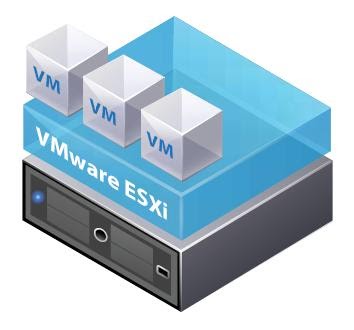
As we have seen, vSphere is the name of the set of tools that VMWare offers for device virtualization, there is a range of different vSphere environments, from a single ESXi server that works as a hypervisor as well as management.

ESXi

Stand alone ESX [esxi.jpg]

To much more complex environments where several ESXi work in parallel being managed by a centralized administration software called vCenter.

vsphere

vSphere Vcenter [vsphere.png]

Virtual environment monitoring

To monitor virtual environments, whether it is from VMWare or not, there are two main ways.

The first is to treat each virtual machine as an independent machine, attacking its operating system with standard protocols or using some monitoring agent.
This approach does not require for the tool have a special or devoted management, since it will deal with each VM as any other machine. Along this approach, we can say that we will interrogate the operating system, therefore, in heterogeneous environments, we must define metric captures for each system.

The second way is more general and allows deploying monitoring very quickly and efficiently. In this case we will integrate the hypervisor, since it has information on all the machines it contains and we can interrogate it directly. For each manufacturer the protocol, the responses and the format with which we will interrogate the hypervisor may vary, but in most cases they have an interface to communicate with it. Along this approach, it is the monitoring tool that must be adapted and have a connector to communicate with the supervisor in a centralized way.

Of course, Pandora FMS has both types of monitoring, being able to combine them if necessary if deep and detailed monitoring is required.

In today’s case, we will see the monitoring integrated in Pandora FMS Enterprise Discovery tool. That will allow us, in a very simple way, to connect well, either with a standalone ESX or with a vcenter, through the vmware SDK.

vSphere Monitoring with PandoraFMS

Starting from the fact that we have a Pandora FMS Enterprise instance, the steps are very simple: by default Pandora FMS has the necessary libraries to connect to a VMWare environment, you only need a user account with reading permissions and connectivity with the ESX or vCenter as the case may be.

Once you fill in the simple form with the data from our VMWare environment:

discoveryapp

[discoveryapp]

form2

[form2]

You will see a window to configure some monitoring data, such as the scan interval for new machines, the execution threads that you will devote to this task, if you want to activate network monitoring and (only for vcenter), if you want to capture the environment events.

You will also have a field for extra configurations that will allow you to add advanced configurations related to the task (you can see the possible configurations:
https://pandorafms.com/manual/en/documentation/03_monitoring/05_virtual_environment_monitoring?s[]=vmware#vmware 1 plugin ocnfiguration ).

form3

[form3]

Once finished, you will be able to see that a task has been added to Pandora FMS task list, where you will be able to see its last execution, enable it, disable it or force task execution manually.

form4

[form4]

The default task will give you information about all the ESXs (in the case of vcenter), virtual machines and datastores available in the vmware environment that you configured, returning the following metrics:

Default monitoring for Datacenter:

  • Ping
  • Check 443 port

Default monitoring for Datastore:

  • Capacity
  • Free Space
  • Disk Overallocation
  • Free Space Bytes

Default monitoring for ESXi:

  • CPU Usage
  • Memory Usage
  • Received data
  • Transmitted data
  • Disk Read Latency
  • Disk Write Latency
  • Host Alive
  • Disk Rate
  • Net Usage

Default monitoring for virtual machines:

  • CPU Usage
  • Memory Usage
  • Tools Running Status
  • Host Alive
  • Disk Free
  • Disk Read Latency
  • Disk Write Latency
  • Received data
  • Transmitted data
  • Net Usage

In addition to the metrics described, you will also have a specific view for monitoring vSphere environments that has compilation information on the general state of the environment and each monitored ESX and even a map of the monitored infrastructure.

vmwareview1

[vmwareview1]

view2

[view2]

view3

[view3]

As you can see, it is very easy to start monitoring a vSphere environment with Pandora FMS, just follow a few steps and you will have your VMWare monitoring integrated quickly and easily.

If you are interested in knowing in more detail how synthetic transactions are configured and executed with Pandora FMS, do not hesitate to visit our YouTube channel, where you may find different contents such as tutorials, workshops and a lot of other resources devoted to this and many other topics related to monitoring.

About Version 2 Digital

Version 2 Digital is one of the most dynamic IT companies in Asia. The company distributes a wide range of IT products across various areas including cyber security, cloud, data protection, end points, infrastructures, system monitoring, storage, networking, business productivity and communication products.

Through an extensive network of channels, point of sales, resellers, and partnership companies, Version 2 offers quality products and services which are highly acclaimed in the market. Its customers cover a wide spectrum which include Global 1000 enterprises, regional listed companies, different vertical industries, public utilities, Government, a vast number of successful SMEs, and consumers in various Asian cities.

About PandoraFMS
Pandora FMS is a flexible monitoring system, capable of monitoring devices, infrastructures, applications, services and business processes.
Of course, one of the things that Pandora FMS can control is the hard disks of your computers.