What does ransomware recovery look like?

Ransomware recovery isn’t a one-size-fits all type of thing, and as such, it’s important to be thinking about data protection best practices and how to minimize the impact of an eventual ransomware attack — because it’s a matter of when it happens to you, not if.

Because of the complexity of SaaS deployments and all the differing policies, it’s easy to overlook some details and have data protection gaps — gaps that will become painfully obvious when you’re trying to recover from ransomware or another data loss scenario.

So, that’s why I want to equip you with some of my recommended steps that you can use to hopefully make good business decisions about how you can prepare for the time when ransomware comes to you.

Here’s a checklist of six points for disaster recovery and business continuity that I would encourage you to keep in mind and think about to boost your cyber resiliency:

1. You’ve done a risk assessment to find the most critical infrastructure and data assets to protect.

2. You’ve created a prioritized, granular DR (disaster recovery) plan supported by your software.

3. You’ve backed up all your mission-critical data.

4. You regularly test and verify your recovery processes.

5. You’re recovering from backups that are immutable and tamper proof.

6. Your backups remain available on a separate, air-gapped infrastructure.

Let’s dive deeper into the details of the six steps I’ve recommended

Point 1: Do a formal risk assessment 

The first thing I’d recommend you check is that you’ve done a formal risk assessment to identify what the most critical infrastructure and data assets are for you to protect. This is obviously going to vary according to your business. Where are you located? What line of business are you in? What are the biggest risks that your business faces? And so on.

It’s very likely you’ve already done some of that work for sort of generic cybersecurity reasons, but you need to carry it to the next step and say, “All right, if I have assessed the risk of different security threats and the impact that they may have, what’s the second order risk assessment if one of those risks turns into a vulnerability that is successfully exploited? What does it mean for my business continuity capabilities?” 


Point 2: Create a prioritized, granular DR plan 

Second, you should be able to check off the box that says you’ve created a prioritized, granular disaster recovery plan that’s supported by your software. I see far too many customers who come to us and say, “Hey, good news, we’re buying your solutions so our SaaS data will be protected.” I say, “OK, that’s great. Tell me about your disaster recovery plan.” And their answer is, “Well, we’re just getting started. We don’t really have a plan yet.”

If I’m honest, I’d rather you build a plan and then call Keepit rather than call Keepit and then build your plan because your plan has to incorporate things that don’t involve SaaS data recovery. Just to cite one example from a real customer that we’re working with: Suppose that your operations are in a part of the world that is subject to hurricanes.

That means for every hurricane that you see, you’re going to see several other events — high winds, flooding, storm surge, and so on. How do you tell people not to come to work because the building is flooded? You may not be able to rely on Teams or on Zoom or on another cloud-based communication system to do that. That’s a part of your disaster recovery plan. 


Point 3: Create a backup of all your mission-critical data 

I like to emphasize to people that recovering your data is the first necessary part of restoring your business operations. It’s not completely sufficient all by itself just to say, “Oh, I have a backup” because if I walked up to you and said, “Oh, you had a disaster, great, here’s a USB stick that has all of your data on it” that probably wouldn’t be enough to get your business up and running again. It would help, but it wouldn’t be enough all by itself. 


Point 4: Test regularly and verify your backups 

Having a backup of your mission critical data and knowing that that backup is valid because you have regularly tested and verified the recovery is critical. This helps you know, in the gravest extreme, where your data is, that it’s intact, that it hasn’t been tampered with, and that you have people available to you who can coordinate and execute or restore leading to a recovery. Super important.

Those are the things most people think of when they think of what does good recovery look like. Do I have a backup and does my backup work? That’s not to minimize the importance of these questions, but they’re only part of the overall evaluation that you should be doing. 


Point 5: Ensure your backups are immutable and tamper proof 

Next, when you do a recovery, ensure the source backups that you’re using to do that recovery are immutable and tamper proof — and you can prove it. Why do I say that? Well, if you have a backup and you don’t know for certain that it is immutable, then you’ve got a potential exploitable data protection gap. (Read more about immutable data protection.)

As we see persistent nation-state scale attacks becoming more common, one increasingly common tactic is for the attacker to attack your repository of backups, too. (Attacks such as Midnight Blizzard.)  When you think about how traditional backup systems are constructed, if an attacker can get into your on-premises environment, they can probably escalate privileges and pivot to kill your on-prem backups. Now you may say, “Oh hey, no problem, I’ve got backups in the cloud.”

Well, guess what?

If your cloud environment is linked to your on-prem environment, as it almost always will be with Azure and very probably is with AWS (Amazon Web Services), then an attacker who can compromise an account and then escalate privileges in the cloud can take that privilege to account, pivot to the cloud, and start blowing things up. This is the whole focus of the Mango Sandstorm attacks that Microsoft wrote about last year. So, the only way to protect yourself against that is to have your backups isolated. Which leads me to my final point. 


Point 6: Keep backups on a logically separate, air-gapped infrastructure 

You can call them air gapped, and you can call them isolated. The term isn’t as important as the notion that you want your backups to be stored somewhere that doesn’t have direct directory or security connectivity to your production systems. This way, if your production system is compromised, you’re able to get into your backup environment, verify the presence of your backups, verify the integrity of your backups before you start doing a restore. Read about why air-gapped backup is your best defense against ransomware. 


Final words 

From conducting a comprehensive risk assessment to fortifying your backups within an air-gapped, immutable backup, each step is a crucial layer in the armor of cyber defense. The importance of proactive measures can’t be overstated, so I hope the pointers outlined above are helpful for you and your DR plan.

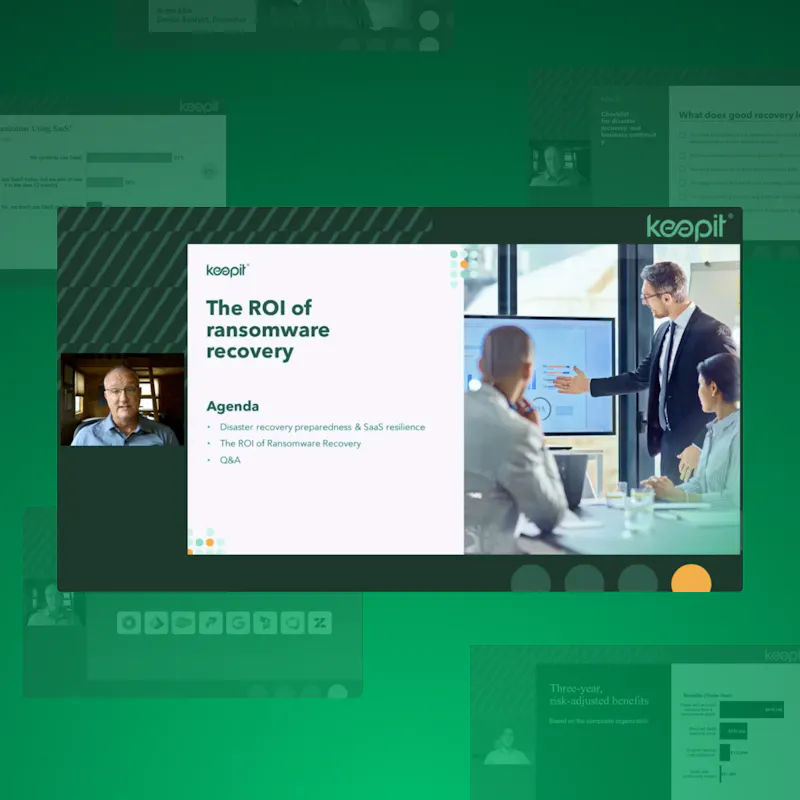
If you’d like to learn more about ransomware recovery, be sure to catch our on-demand webinar, The ROI of ransomware recovery

About Version 2 Digital

Version 2 Digital is one of the most dynamic IT companies in Asia. The company distributes a wide range of IT products across various areas including cyber security, cloud, data protection, end points, infrastructures, system monitoring, storage, networking, business productivity and communication products.

Through an extensive network of channels, point of sales, resellers, and partnership companies, Version 2 offers quality products and services which are highly acclaimed in the market. Its customers cover a wide spectrum which include Global 1000 enterprises, regional listed companies, different vertical industries, public utilities, Government, a vast number of successful SMEs, and consumers in various Asian cities.

About Keepit
At Keepit, we believe in a digital future where all software is delivered as a service. Keepit’s mission is to protect data in the cloud Keepit is a software company specializing in Cloud-to-Cloud data backup and recovery. Deriving from +20 year experience in building best-in-class data protection and hosting services, Keepit is pioneering the way to secure and protect cloud data at scale.

Keepit receives third consecutive Customer Top Rated Award from TrustRadius

Keepit has been recognized as a leader among SaaS Backup, Data Loss Prevention, Disaster Recovery, and Enterprise Backup categories. 

Copenhagen, Denmark – May 10 Keepit, a global leader in SaaS data backup and recovery, today announced that it has been recognized as TrustRadius Top Rated in four categories: SaaS Backup, Data Loss Prevention, Disaster Recovery and Enterprise Backup. This recognition comes directly from customers, underscoring Keepit’s commitment to providing an effortless and secure backup and recovery platform.

“Keepit earning a TrustRadius Top Rated award is a testament to the overwhelmingly positive feedback captured in their customer reviews. This recognition highlights Keepit’s commitment to delivering exceptional cloud data protection solutions. We congratulate Keepit on this well-deserved honor and commend them for their dedication to exceeding customer expectations, empowering businesses, and providing outstanding data protection services”, says Allyson Havener, SVP of Marketing & Community, TrustRadius.

Since 2016, the TrustRadius Top Rated Awards have become the B2B’s industry standard for unbiased recognition of excellent technology products. Based entirely on customer feedback, they have never been influenced by analyst opinion or status as a TrustRadius customer. Here is a detailed criteria breakdown of the methodology and scoring that TrustRadius uses to determine Top Rated winners.

“For Keepit, this is one of the most valuable categories of awards we can receive,” says Michele Hayes, CMO at Keepit. “An award based on customer praise reinforces that Keepit is delivering on its promise to support our customers globally with leading backup services characterized by security, efficiency and simplicity.”


About Version 2 Digital

Version 2 Digital is one of the most dynamic IT companies in Asia. The company distributes a wide range of IT products across various areas including cyber security, cloud, data protection, end points, infrastructures, system monitoring, storage, networking, business productivity and communication products.

Through an extensive network of channels, point of sales, resellers, and partnership companies, Version 2 offers quality products and services which are highly acclaimed in the market. Its customers cover a wide spectrum which include Global 1000 enterprises, regional listed companies, different vertical industries, public utilities, Government, a vast number of successful SMEs, and consumers in various Asian cities.

About Keepit
At Keepit, we believe in a digital future where all software is delivered as a service. Keepit’s mission is to protect data in the cloud Keepit is a software company specializing in Cloud-to-Cloud data backup and recovery. Deriving from +20 year experience in building best-in-class data protection and hosting services, Keepit is pioneering the way to secure and protect cloud data at scale.

Why Microsoft’s entry into the backup space is good news

Microsoft’s recent jump into the backup space with Microsoft 365 Backup signals a significant shift. Paul Robichaux, a seasoned Microsoft MVP and Senior Director of Product Management, shares what Microsoft’s entry to the market means for customers and the broader SaaS data protection community in a contributed article for Storage Magazine.

Read the full article or continue reading for the abbreviated version. 


A bit of a surprise — yet welcomed — entry 

For years, Microsoft has been synonymous with data integrity measures (think back to trusty-old Windows Backup), yet their prior reluctance to offer dedicated backup solutions for Microsoft 365 left a data protection gap. 

“They have been pretty steadfast in ignoring Microsoft 365 as a backup opportunity, broadcasting the message that the native data protection features in the service provide adequate coverage.” However, with the unveiling of Microsoft 365 Backup, a public preview poised for general availability, the narrative is set to change. 


You are responsible for your Microsoft SaaS data 

Robichaux underscores a critical message: While Microsoft ensures redundancy, the onus remains on users to safeguard their data. Put simply, Microsoft 365 Backup emphasizes that you need backup. This fundamental shift in perception is crucial, especially considering the prevalent misconception that cloud-hosted data is impervious to loss.

The introduction of Microsoft 365 Backup not only validates the necessity of third-party data protection but also ignites conversations around shared responsibility models. Questions like “What components of Microsoft 365 warrant backup?” and “What defines a robust backup strategy?” are being asked.

While Microsoft’s solution is a step in the right direction, it’s essential to recognize its limitations, notably in coverage and granularity. Moreover, the collaboration between Microsoft and third-party ISVs in leveraging Microsoft 365 Backup Storage opens avenues for innovation and growth. 


Ultimately, Microsoft’s venture into the backup arena revitalizes discussions on data protection, fostering a more nuanced understanding of shared responsibilities. With Microsoft’s influence, Robichaux envisions a future where comprehensive SaaS data protection becomes the norm, ensuring resilience in an ever-evolving digital landscape. 

Read the full article

About Version 2 Digital

Version 2 Digital is one of the most dynamic IT companies in Asia. The company distributes a wide range of IT products across various areas including cyber security, cloud, data protection, end points, infrastructures, system monitoring, storage, networking, business productivity and communication products.

Through an extensive network of channels, point of sales, resellers, and partnership companies, Version 2 offers quality products and services which are highly acclaimed in the market. Its customers cover a wide spectrum which include Global 1000 enterprises, regional listed companies, different vertical industries, public utilities, Government, a vast number of successful SMEs, and consumers in various Asian cities.

About Keepit
At Keepit, we believe in a digital future where all software is delivered as a service. Keepit’s mission is to protect data in the cloud Keepit is a software company specializing in Cloud-to-Cloud data backup and recovery. Deriving from +20 year experience in building best-in-class data protection and hosting services, Keepit is pioneering the way to secure and protect cloud data at scale.

Why you need immutable data protection in your ransomware strategy

And why a lean, purpose-built tech stack is the way to do it

Immutability is a key feature that plays a pivotal role in safeguarding data integrity, boosting data resilience, and protecting data against threats, including ransomware, but certain considerations need to be addressed when evaluating backup solutions. Let’s look into the concept of data immutability, its significance, and what it means for Keepit’s SaaS data protection platform.

Data immutability definition: Why it’s important

Immutable storage operates on a simple principle: Data can only be added. Once data is written, it can’t be changed, effectively locking it and preventing any unauthorized tampering or deletion. In the context of data protection, this means that once data is stored immutably, it remains unchanged and is safeguarded against unauthorized modifications or deletions, ensuring data integrity at all times.

How an immutable backup solution will enhance your overall security posture

The importance of data immutability in data protection is multifaceted. Here’s a quick rundown of some of the main drivers for deploying a solution leveraging data immutable technology:

  • Data integrity: First, immutability ensures that data remains in its original, unaltered state, preserving its integrity. This is critical for basically all industries.
  • Ransomware defense: In the battle against ransomware, data immutability offers a robust defense. Here’s why: Even if ransomware infiltrates a system, it cannot manipulate or delete immutable data. Because of this, it’s providing a secure fallback option for data recovery.
  • Compliance and legal requirements: Since regulatory bodies require organizations to maintain unaltered records for a specified period of time, having a backup solution that guarantees this is vital. In this way, immutability helps organizations meet these compliance requirements.
  • Historical data preservation: Immutability enables organizations to keep historical data records that are unchangeable. This is valuable for auditing, investigations, and analysis of past data.


So, which features should you look for when evaluating backup options that all offer immutability? First, I’d say simplicity, because it’s not always simple.

“Simplicity as a shield”

Who doesn’t like a good acronym hijacking: Software as a service (SaaS) meets “simplicity as a shield.” Our solution distinguishes itself in data backup and recovery by having the most efficient tech stack. It’s cloud native and purpose built for SaaS data storage with the clear security goal of keeping data tamper proof and always immutable.

But what does simplicity mean for defining immutability and how it impacts a data protection strategy? Or alternatively, what does complexity mean for immutability? Let’s look at both, starting with the latter.

Vulnerabilities for backup providers with complex adaptations

Many backup providers have legacy systems that were initially designed for on-premises environments. In order to adapt to storing cloud data, these providers had to implement bolt-on solutions via additional layers to their old, on-prem tech stack, resulting in a much more complex architecture.

There are two main considerations that I want to discuss, from a security standpoint, with cloud adaptions to on-premises solutions: First, the complexity is significantly increased with the added layers required to retrofit an on-premises deployment for the cloud, thereby increasing the attack surface and potential attacker entry points; Second, these bolted-on layers often have immutability as a configuration, not baked into the architecture.

While these top layers often offer options for manual configuration to achieve immutability, this configurability and added complexity create potential entry points for attackers. Effectively, this results in more entry points — more “doors” that bad actors will come knocking on to see if someone forgot to lock up. (Read about why backups are key ransomware targets.)

To make matters worse, the complexity added by having those extra layers makes comprehensive testing challenging. More potential entry points with less comprehensive testing means a larger attack surface to protect and test to ensure that they’re secured. That’s not great for data integrity, ransomware defense, or historical data preservation.

In solutions deploying these bolt-on cloud adaptations to “modernize” legacy systems, attackers can exploit these optional higher levels (I say optional since these levels only exist because they’re modifying an on-prem solution for the cloud). These retrofitted legacy systems can be (and should be) thought of as having more potential access points for threats.

Retrofitted complexity: The Achilles’ Heel of many backup solutions? 

“Defenders need to be perfect all of the time, while the attacker only needs to succeed once.” 

-Popular security axiom 


So, where does all this lead to? As a result of these legacy on-premises systems being retrofitted for cloud data, cybercriminals are finding easier entry points into the targeted environment, gaining access (Think: social engineering like phishing) into the ecosystem at these more vulnerable higher levels (where the stakes perhaps don’t seem so severe) before drilling down through the layers to lower-level access with their highjacked rights. 


Here they can then gain entry to the lowest, most-important (and secure) levels to corrupt, encrypt, or otherwise destroy backup data — attackers typically assume access at a higher level, but the main concern here is that if the assumption that the higher the level you go, the easier entry is, then those solutions with the highest complexity would also be the most vulnerable. 


To say it another way: The deeper the layer of attempted entry, the fewer chances for access and exploitation. Therefore, less complex solutions — “less complex” meaning something good because you’re more deliberate on the design — have fewer options to exploit and can be tested much more holistically. That’s a win win. 


There are three notions I want to keep top of mind:

  • Typically, higher levels can be immutable, but sometimes these must be configured manually. 
  • Attackers use these “immutable optional” higher levels as easier entry points and then drill down to the immutable, lower-level access points with assumed access rights they acquired. 
  • Having fewer layers means a smaller attack surface for exploitation. Simple is a good thing because it means you’re more deliberate on the design (and can test more holistically). 


What an efficient tech stack means for cyberattack defense 

Unlike legacy systems with bloated, bolted-on complexities, Keepit’s purpose-built and streamlined architecture minimizes potential access points for threats. The leanness of our software means having fewer layers of complexity and therefore having fewer points of entry for threat actors. Not only that, but since it’s simpler, we can test holistically (and testing is key). 


Put simply, Keepit has fewer layers since our tech stack is purpose built for cloud data storage. In this way, it avoids a lot of the complexity other backup providers “need” to have but only because they’re running legacy systems from the on-premises days with bolt-on cloud modifications. 


The level of leanness, efficiency, and simplicity we’ve achieved directly adds to the strength of immutability in our solution. 


We’re able to achieve this because we designed our solution for the cloud, in the cloud, and to do “one thing” extremely well, and that’s to protect and store cloud SaaS data securely on an independent cloud, air gapped, so customers can always have access to clean backup copies of their data. 


Simplicity is key: Fewer layers are much more secure 

SpaceX, the company that revolutionized commercial spaceflight, has a philosophy that states “the best part is no part,” which resonates here. By embracing simplicity and efficiency in design, Keepit aligns with a principle that’s also reaching for the sky (well, the cloud at least) — it’s a design choice that enhances security, boosts efficiency and agility, and integrates seamlessly with a multitude of SaaS applications due to its API-only design. 


Software can be infinitely complex, with no way to test everything (among other issues, like development and maintenance). From a security standpoint, if your solution is too complex, there’s just no way you could test sufficiently. And so, simplicity is key. That’s my philosophy and the philosophy behind Keepit. 


Immutable by default 

Deep at the core of the Keepit platform, there’s simply no way to overwrite data in storage: It’s just not possible. Like the backup tapes of the past, our disk-based storage systems do not offer a mechanism for modifying backup data. Hypothetically, even if an attacker — or a malicious insider — were to gain access, they just couldn’t do anything there. That’s immutability. 


So, our approach disrupts the pattern ransomware attackers are exploiting in other backup solutions. By providing a more secure foundation through not only avoiding these superfluous layers, but by being designed specifically for cloud backup data storage, we leverage immutability through simplicity. 


In addition to immutability, we leverage a number of other data protection best-practice security methods. 


Adding to immutability: Data protection best practices 

Some of our other security methods deployed for data resilience and data immutability are the immediate encryption of backup data, incremental backup, and data deduplication.

The Keepit solution is running on a vendor-independent, tamper-proof and air-gapped cloud infrastructure. Our cloud offers true backup, where data is stored separately from the primary production data set, regardless of if the data is in Microsoft Azure storage, AWS, Gcloud, or otherwise. 

“True backup” is air gapped in line with the 321 backup rule, meaning your ability to recover clean backup copies is always there, regardless of the status of your SaaS vendor.

To sum up what makes Keepit’s approach to data immutability uniquely strong against ransomware and other cyberthreats:

  • Cloud native: Our tech stack is purpose-built for cloud data storage, so we avoid unnecessary layers of complexity and the associated vulnerabilities with legacy systems. 
  • Efficient tech stack: Our efficient tech stack minimizes potential access points and reduces the overall attack surface. 
  • Holistic testing: The simplicity of our solution (remember, simple is good) allows for more holistic testing, ensuring a robust and secure environment. 
  • Immutability: Administrative access cannot overrule or unconfigure the immutability as it is baked into the solution from the ground up, so even if a customer account is fully compromised, the immutable data storage will retain the historical backup data in pristine condition.

Where to go next

This post is part three of a five-part series on ransomware resilience. Read part one “Why backups are key ransomware targets” and part two “Why air gapping is your best defense.” Check back soon to catch the fourth installment of the series, where we’ll discuss the importance of SaaS data protection for identity systems like Microsoft Entra ID. 


Want to keep learning? Watch our on-demand webinar co-hosted with Enterprise Strategy Group (ESG) entitled “Surviving ransomware: 2023 data protection insights and strategies.” Learn how to be data resilient in the face of cyberattacks. 

About Version 2 Digital

Version 2 Digital is one of the most dynamic IT companies in Asia. The company distributes a wide range of IT products across various areas including cyber security, cloud, data protection, end points, infrastructures, system monitoring, storage, networking, business productivity and communication products.

Through an extensive network of channels, point of sales, resellers, and partnership companies, Version 2 offers quality products and services which are highly acclaimed in the market. Its customers cover a wide spectrum which include Global 1000 enterprises, regional listed companies, different vertical industries, public utilities, Government, a vast number of successful SMEs, and consumers in various Asian cities.

About Keepit
At Keepit, we believe in a digital future where all software is delivered as a service. Keepit’s mission is to protect data in the cloud Keepit is a software company specializing in Cloud-to-Cloud data backup and recovery. Deriving from +20 year experience in building best-in-class data protection and hosting services, Keepit is pioneering the way to secure and protect cloud data at scale.

Empowering resellers: SaaS data protection with Keepit

As businesses increasingly rely on cloud-based applications and services to drive productivity and innovation, the need to safeguard sensitive data against cyber threats and unexpected data loss is clear — not least of all due to increased compliance requirements globally such as NIS2, SEC, and GDPR.

Partnering with Keepit means always being at the forefront of cloud SaaS data protection.

Anders Kaag 

CMO of ITM8, Denmark 

In joining Keepit’s newly enhanced Partner Network with a partner-only focus, value-added resellers (VARs) can empower their clients with industry-leading cloud data protection, ensuring the safety and integrity of their critical business data.

In this blog, we’ll explore why Keepit is not only the ideal partner but also the best solution on the market for resellers looking for the opportunity to elevate their services, increase profitability, and stand out from the competition with Keepit’s leading cloud data protection solution.

“We are pleased to continue our partnership with Keepit and to join their new KPN partner program. The team we collaborate with is extremely responsive and always on hand to assist with any of our queries. The new program recognizes our efforts in terms of skills and commercial success and will accelerate our development and growth in the coming years in the field of SaaS data protection.”

Nicola Gargett 

Partner Program Manager 

Phoenix Software Ltd., UK  

Top 3 reasons to join the VAR track of the Keepit Partner Network  

Here’s why the Keepit Partner Network is a great opportunity for resellers wanting to support their clients: 

1. Increased gross profit and recurring revenue:

Keepit offers resellers the chance to quickly boost their gross profit and establish a long-term recurring revenue stream, all without the burden of operational expenses. By partnering with Keepit, resellers can retain their gross profit, fuel their growth, and protect their margins with a partner-only go-to-market strategy.

2. Partner-friendly tools and support:

Keepit is easy to work with and easy to price. Managing customers’ accounts is made simple with Keepit’s ready-to-use Partner Management Console or seamless integration options with favorite systems using APIs. This allows resellers to stay aligned with the buyer’s journey.

3. Be a hero for your customers:

With Keepit, resellers can be heroes for their customers by offering a fast and easy-to-implement solution. Whether it’s providing fast provisioning or one-click restore capabilities, Keepit enables resellers to deliver exceptional value to their clients. Differentiate from the competition by offering the most comprehensive SaaS data backup coverage on the market. 

We don’t compete with Keepit, we succeed together. An equal partnership was the goal from the very beginning.

Henning Malmin  

CTO of Upheads, Norway 

The Keepit difference for customers and partners

Keepit doesn’t just offer benefits for resellers; we also provide unparalleled advantages for customers and partners alike. Many of Keepit’s partners have a hybrid business model, acting as both Managed Service Providers (MSPs) and value-added resellers (VARs). Keepit’s solutions are flexible enough to support both models, allowing resellers to seamlessly integrate SaaS data protection into their managed services practices. 

What makes Keepit the best SaaS data protection for partners and customers 

From our dedicated, purpose-built independent cloud to our native data immutability and compliance-ready architecture, Keepit ensures that both partners and their customers receive top-notch service and protection with the broadest SaaS applications protection available, including Microsoft 365, Entra ID (Azure AD), Salesforce, and more.

Here’s why Keepit is the leading solution for resellers wanting to best support their clients on their data protection journey: 

  • Independent cloud: 

Keepit owns and operates a dedicated, purpose-built independent cloud infrastructure, ensuring maximum security, reliability, and compliance for partners and their customers’ data. 

  • Built in the cloud, for the cloud: 

The Keepit solution is designed and optimized specifically for the cloud environment, storing data logically and physically separate from the SaaS vendor. It provides seamless integration and performance for SaaS data protection without any of the issues or inefficiencies found in solutions with legacy bolt-on systems. 

  • Multiple data centers with fully load-balanced redundancy: 

We ensure data availability and data resiliency 24/7 with dual data centers per data region of choice, featuring fully load-balanced redundancy and air-gapped data storage. This maximizes data protection and data availability, supporting business continuity goals.

  • Native, built-in data immutability: 

Keepit’s platform incorporates native data immutability, safeguarding data from unauthorized alterations or deletions and providing assurance of data integrity through blockchain-like encryption. Data remains tamper proof, always.

  • Transparent, predictable, all-inclusive pricing: 

Keepit operates on a transparent pricing model with no hidden fees. This makes it easy for partners and their customers to budget and plan effectively. 

  • Simple tool onboarding process: 

Keepit’s intuitive setup process and automated features allow for easy implementation and management, with no training needed. This frees up time and resources for partners to focus on other aspects of their business.

  • Granular restore functionality: 

We simplify data recovery with granular, one-click restore functionality. This enables partners and customers to swiftly recover critical data in place in the event of data loss or disruptions, prioritizing business-critical data to minimize impact.

  • Recognized industry leadership: 

Keepit is consistently recognized as a leader in SaaS data protection by industry analysts. This demonstrates our commitment to delivering top-tier solutions and services.

  • GDPR compliance and data privacy: 

With no sub-processors, Keepit prioritizes compliance, ensuring that partners and their customers’ data is handled with the highest level of sensitivity and adherence to regulations. This includes support for GDPR right to be forgotten (RTBF). 

Differentiate, diversify, and grow with Keepit 

Don’t settle for selling the same solutions as everyone else in the market. With Keepit, resellers can differentiate themselves, diversify their offerings, and accelerate their growth in the field of SaaS data protection. 

Keepit offers resellers the perfect combination of partner-friendly tools, unparalleled support, and innovative solutions to succeed in today’s competitive landscape. Ready to elevate your reselling business with Keepit’s leading cloud data protection solution? Join the Keepit Partner Network today and unlock exclusive benefits, unparalleled support, and innovative solutions to drive growth and success.

About Version 2 Digital

Version 2 Digital is one of the most dynamic IT companies in Asia. The company distributes a wide range of IT products across various areas including cyber security, cloud, data protection, end points, infrastructures, system monitoring, storage, networking, business productivity and communication products.

Through an extensive network of channels, point of sales, resellers, and partnership companies, Version 2 offers quality products and services which are highly acclaimed in the market. Its customers cover a wide spectrum which include Global 1000 enterprises, regional listed companies, different vertical industries, public utilities, Government, a vast number of successful SMEs, and consumers in various Asian cities.

About Keepit
At Keepit, we believe in a digital future where all software is delivered as a service. Keepit’s mission is to protect data in the cloud Keepit is a software company specializing in Cloud-to-Cloud data backup and recovery. Deriving from +20 year experience in building best-in-class data protection and hosting services, Keepit is pioneering the way to secure and protect cloud data at scale.